Bereishit, Lekh-Lekha, & Vayeira: Talking Back

When characters in the Torah hear God speak, some simply obey. Others some talk back to God, either to ask questions or to make excuses. In this week’s Torah portion, Vayeira (Genesis 18:1-22:21), Avraham raises talking back to God to a new level.

Bereishit: shifting the blame

The first human being to whom God speaks is the first human being: the adam (אָדָם = human being) in the first Torah portion of Genesis/Bereishit (Genesis 1:1-6:8). The God character warns the adam that eating from the Tree of the Knowledge of Good and Evil would result in death.

Nothing happens. I suspect that the human does not understand, never having seen anything die, but nevertheless follows God’s advice and avoids the Tree of Knowledge.  Then God separates the human into male and female, and provides a talking snake. Finally the two humans eat the fruit.

The next time they hear God in the garden, they hide. Then God asks:

“Where are you?” (Genesis 3:9)

The male human answers:

“I heard your sound in the garden, and I was afraid because I am naked, and I hid.” (Genesis 3:10)

Before the two humans ate the fruit, they did not notice they were naked; so were all the other animals in Eden. But once they know that some things are good and some are bad, they become self-conscious. (See my post Bereishit: In Hiding.) God asks:

The Rebuke of Adam and Eve, by Domenichino, 1626, detail

“Who told you that you are naked? From the tree about which I ordered you not to eat, did you eat?” And the human said: “The woman whom you gave to be with me, she gave to me from the tree, and I ate.” (Genesis 3:11-12)

The man admits that he ate from the tree, but only after blaming the woman. When God questions the woman, she blames the snake. Then the God character “curses” the snake, the woman, and the man with the ordinary hardships of life outside the mythical garden of Eden, and expels them from the garden so that they will not eat from the Tree of Life and become immortal.

Throughout the conversation, the God character is the authority figure, and the two humans are like children making excuses to avoid being blamed and punished.

Bereishit: lying and begging

The next human God speaks to is the oldest child of the first two humans, Kayin (קַיִן, “Cain” in English). He makes a spontaneous offering to God, and his younger brother Hevel (הֶבֶל, “Abel” in English) follows suit. Kayin gets upset because God only pays attention to Hevel’s offering. Then God warns Kayin to rule over his impulse to do evil, but the warning goes over Kayin’s head.

Cain Leads Abel to Death, by James Tissot, circa 1890

And it happened when they were in the field, and Kayin rose up against his brother Hevel, and he killed him. Then God said to Kayin: “Where is Hevel, your brother?” And Kayin said: “I don’t know. Am I my brother’s shomeir?” (Genesis 4:8-9)

Shomeir (שֺׁמֵר) = watcher, guard, protector, keeper.

Kayin certainly knows where he left Hevel’s body, so his answer “I don’t know” is a lie. He might not have understood what death is before he killed his brother, but he knows now, and he suspects that he did something wrong. So he lies in an effort to escape being blamed.

Next Kayin asks what might be an honest question. Was he supposed to watch over his brother, the way he tends his vegetables and Hevel used to tend his sheep?

On the other hand, his question might be a protest that he is not responsible for protecting his brother, so he should not be blamed for what happened when he “rose up against” Hevel.

The God character does not bother to answer. Instead God curses him with a life of wandering instead of farming. Kayin cries out in alarm:

“My punishment is too great to bear! … Anyone who encounters me will kill me!” (Genesis 4:13-14)

Kayin might be thinking that his future relatives will be angry with him, and kill him the way he killed Hevel.

Then God said to him: “Therefore, anyone who kills Kayin, sevenfold it will be avenged!” And God set a sign for Kayin, so that anyone who encountered him would not strike him down. (Genesis 4:15)

Once again, the God character is the authority figure. Kayin lies to avoid being blamed, but he also (indirectly) begs God for protection, which God provides.

Lekh-Lekha: doubting

The next human to whom God speaks is Noach (נֺחַ, “Noah” in English). God gives Noach orders, and Noach follows them without a word. (See my post Noach: Silent Obedience.) There are no questions.

Avram (אַבְרָם, “Abram” in English) begins his relationship with God on the Noach model. But after God has promised him twice that he will have vast numbers of descendants,1 and twice that his descendants will own the land of Canaan,2 Avram cannot resist speaking up. He points out that at age 75 he is still childless. Then he asks God for more than verbal promises.

“My lord God, how will I know that I will possess it [the land]?” (Genesis 15:8)

The God character responds by staging an elaborate covenant ceremony. (See my post Lekh-Lekha: Conversation.) At its conclusion, God repeats once more that Avram’s descendants will own the land of Canaan.

When Avram is 86, he has a son by his wife Sarai’s servant Hagar, and names the boy Yishmael (יִשְׁמָעֵאל, “Ishmael” in English). Although a divine messenger speaks to Hagar when she is pregnant,3 God does not speak to Avram again until he is 99 years old. Then God manifests to him and announces:

“I am Eil Shadai! Walk about in my presence, and be unblemished!” (Genesis 17:1)

Eil Shadai (אֵל שַׁדַּי) = God who is enough, God of pouring-forth, God of overpowering.

This is the first use in the bible of the name Eil Shaddai. This name for God occurs most often in the context of fertility. Here, the name might encourage Avram to believe God has the power to make even a 99-year-old man and his 89-year-old wife fertile. God continues:

“I set my covenant between me and you, and I will multiply you very much.” (Genesis 17:2)

Avram responds by silently prostrating himself. He already has a covenant with God, and the only multiplication that has happened during all the years since is the birth of Yishmael.

But God outlines a new covenant, this time one in which both parties have responsibilities. First there is the question of names: just as God is now Eil Shadai, Avram will henceforth be Avraham (אַבְרָהָם; “Abraham” in English),

“… because I will make you the av of a throng of nations!”

av (אַב) = father. (Raham is not a word in Biblical Hebrew.)

The God character expands on the usual theme, promising that Avraham’s descendants will include many kings, and they will rule the whole land of Canaan. In return, Avraham must circumcise himself and every male in his household, including slaves, and so must all his descendants.

Next God changes the name of Avraham’s 89-year-old wife from Sarai to Sarah (שָׂרָה = princess, noblewoman), and promises to bless her so that she will bear Avraham a son.

But Avraham flung himself on his face and laughed. And he said in his heart: “Will a hundred-year-old man procreate? And if Sarah, a ninety-year-old woman, gives birth—!” (Genesis 17:17)

In other words, Avraham does not believe God, who has been making the same promise for years. But he does want blessings for the thirteen-year-old son he already has from Hagar.

And Avraham said to God: “If only Yishmael might live in your presence!” (Genesis 17:18)

Then God promises that Yishmael will also be a great nation, but the covenant will go through Avraham’s son from Sarah, who will be born the following year and will be called Yitzchak (יִצְחָק = he laughs; Isaac in English). The God character noticed when Avraham laughed.

The Torah portion closes with Avraham circumcising himself and all the males in his household, including Yishmael. Whether Avraham believes Sarah will give birth or not, he wants to fulfill his own part of the covenant. Why would he risk upsetting God?

In the portion Lekh-Lekha, the God character is more powerful than the man, and Avram/Avraham is careful not to incur God’s displeasure–but he has his own opinions.

Vayeira: teaching

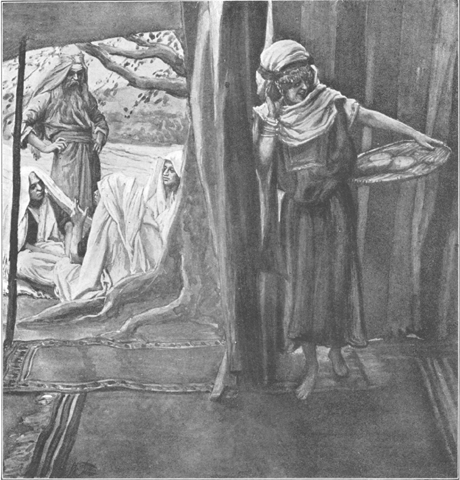
This week’s Torah portion, Vayeira, opens when Avraham sees three men approaching his tent. At least they look like men, and Avraham lavishes hospitality upon them as if they were weary travelers. But the “men” turn out to be divine messengers. Through one of them, God speaks to both Avraham and Sarah, announcing that Sarah will give birth the next year. (See my post Vayeira: On Speaking Terms.)

Abraham and the Three Angels, by Bartolome Esteban Muriollo, ca. 1670

Then Avraham walks with the three “men” to a lookout point, where God says:

“The outcry of Sodom and Gomorrah is great, because their abundant guilt is very heavy. Indeed I will go down, and I will see: Are they doing like the outcry coming to me? [If so,] Annihilation! And if not, I will know.” (Genesis 18:20-21)

Two of the divine messengers continue down to Sodom to see if its people really are as evil as God has heard,4 while God stays with Avraham at the lookout.

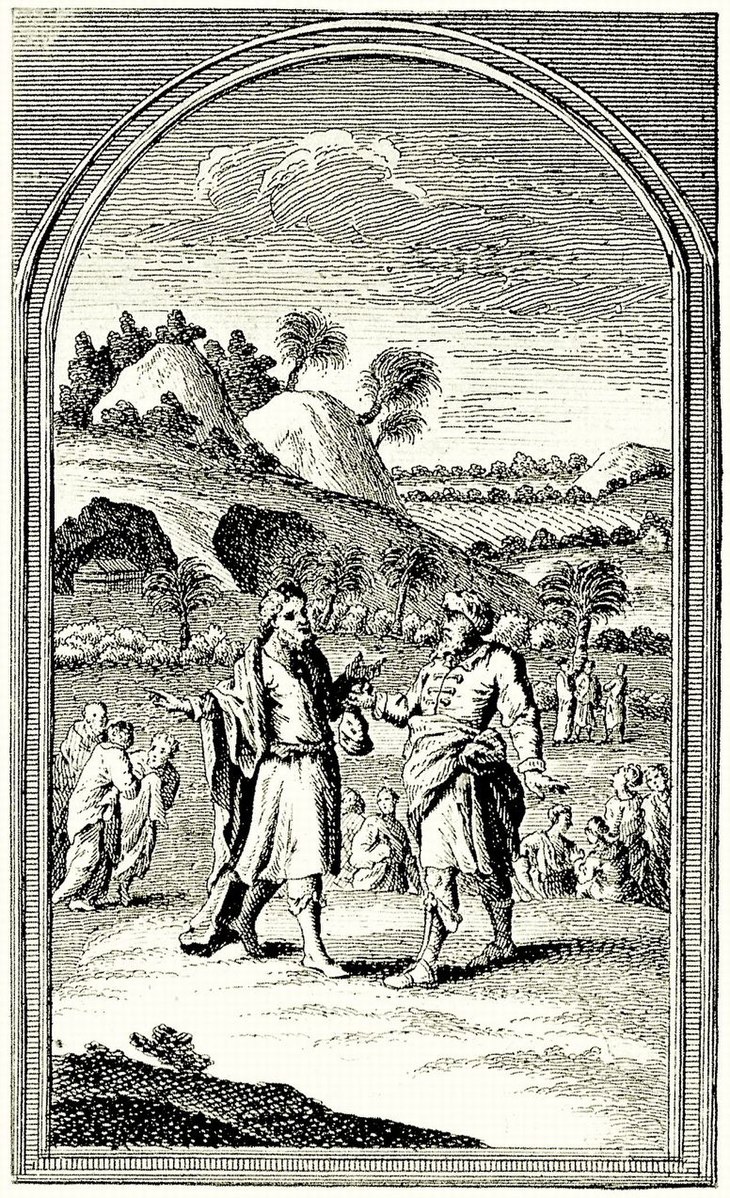
Avraham came forward and said: “Would you sweep away the tzadik with the wicked? What if there are fifty tzadikim inside the city? Would you sweep away and not pardon the place for the sake of the fifty tzadikim who are in it? Far be it from you to do this thing, to bring death to the tzadik with the wicked! Then the tzadik would be like the wicked. Far be it from you! The judge of all the earth should do justice!” (Genesis 18:23-25)

tzadik (צַדִּיק) = righteous, innocent. tzadikim (צַדִּיקִם) = people who are righteous or innocent.

This is a new thing in the world: a human being arguing with God and telling God the right thing to do.

Is Avraham the teacher now, and the God character his pupil? How does God react?

See my post next week: Vayeira: Persuasion.


  1. Genesis 12:2, 13:16.
  2. Genesis 12:7, 13:15-17.
  3. Genesis 16:7-12. See my post Lekh-Lekha: First Encounter.
  4. The God character in the Torah is not omniscient.
Lekh-Lekha: Conversation

(corrected version)

In last week’s Torah portion, Noach, God gives Noach (Noah in English) orders, and Noach obeys. The communication is strictly one-way; Noach never says anything to God. (See my post Noach: Silent Obedience.)

In this week’s Torah portion, Lekh-Lekha (Genesis/Bereishit 12:1-17:27), God speaks to Abraham, and Abraham responds—at first with action, like Noach, but eventually with questions.

An order or an offer?

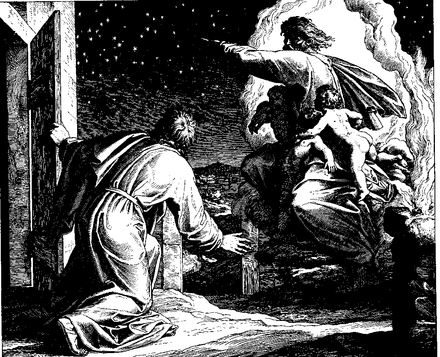
The Lord Directing Abraham, by Julius Schnorr von Carolsfeld, 1860

The Torah portion opens when God first addresses Avram. (“Avram” is Abraham’s original name before God changes it.)

Then God said to Avram: “Go for yourself, from your land, from your kindred, and from your father’s house, to the land that I will show you. And I will make you into a great nation, and I will bless you, and I will magnify your name.” (Genesis 12:1-2)

The beginning of God’s first speech to Avram sounds more like an offer than an order. If Avram leaves and goes to the land God indicates, then God will make Avram’s descendants into a great nation, bless Avram with success, and make his name famous.

Although God could simply command Avram to move to Canaan, God seems to want Avram to choose going to Canaan over staying in Charan. 19th-century Rabbi S.R. Hirsch explained that God’s first promise would compensate Avram for giving up his nationality in the Aramean kingdom where he and his family lived; the second promise would compensate him for his prosperity there; and the third promise would compensate him for starting over again without his family’s reputation.1

Next God says:

Veheyeih brakhah!” (Genesis 12:2)

veheyeih (וֶהְיֵה) = Then become! (The prefix ve- (וֶ) is a conjunction that means either “and” or “then”. Heyeih (הְיֵה) is the imperative of the verb hayah (הָיָה), which means either “be” or “become”.)

brakhah (בְּרָכָה) = blessing, a blessing. (In the Hebrew Bible, humans are considered blessed when they have prosperity, good health, fertility, victory over enemies, or power over subordinates.)  

What does God’s imperative “Then become a blessing!” mean?

One tradition from the 13th century to the present is that the word veheyeih was assigned the wrong vowels, and actually means “then you will be”. According to this line of commentary, God is predicting that Avram will become part of peoples’ prayers for blessing. For example, Ramban wrote: “You will be the blessing by whom people will be blessed, saying, ‘God make you like Abraham.’”2 And eight centuries later Steinsaltz wrote: “… people will use you as a paradigm for blessings. When they bless one another, they will say: May you merit to be like Abram.”3

I prefer the alternate tradition, that God is telling Avram to act in such a way as to be a blessing to others. In Bereishit Rabbah (circa 400 C.E.), Avram becomes a blessing by praying for childless women, who then become pregnant, and for the sick, who then heal.4

Then God finishes:

“And I will bless those blessing you, and those demeaning you I will curse. And all the clans of the earth, nivrekhu vekha.” (Genesis 12:3)

nivrekhu vekha (נִבְרְכוּ בְךָ) = they will want to be blessed like you. (Nivrekhu (נִבְרְכוּ) is the third person plural of the rare nifil form of verb barakh (בָּרוּךְ), “be blessed”, and means “they seek to be blessed”. Vekha(בְךָ) in other contexts could mean “in you”, “by you”, or “through you”, but immediately after nivrekhu it means “like you”.)5

The second part of God’s initial speech to Avram, from “Become a blessing” through “they will want to be blessed like you” sounds like another if-then statement. If Avram becomes a blessing, then God will bless or curse everyone Avram encounters according to how they treat him, and everyone in the world will want the kind of blessing Avram has.

And Avram went, as God had spoken to him … (Genesis 12:4)

Avram’s first blessing from God

Avram brings along his wife Sarai (whom God later renames Sarah), his nephew Lot, all their servants, and all their livestock. When they reach a sacred tree near Shekhem in Canaan, God appears to Avram and says:

“To your descendants I give this land!” And he built an altar there to God, who had appeared to him. (Genesis 12:7)

Avram does not mention to God that he is still childless at age 75. He and his household keep traveling south, and when there is a famine in Canaan, they go all the way to Egypt.

There Avram scams the pharaoh by claiming Sarai is his sister, not his wife. (See my post Lekh-Lekha, Vayeira, & Toledot: The Wife-Sister Trick, Part 2.) The pharaoh takes Sarai as a concubine, and pays Avram a generous bride-price. The God character plays along and afflicts the pharaoh with an unmentionable disease. Then the pharaoh has Avram escorted out of Egypt—along with Sarai, all the other humans and animals who came with him, and the bride-price. Thanks to God’s assistance, Avram is blessed with even more prosperity.

Avram talks back

Enriched by more slaves, livestock, silver, and gold, Avram returns to the hills east of Beit-Eil. There he and his nephew Lot separate, with Avram staying in the highlands, while Lot takes his men and livestock down to the plain of Sodom.

And God said to Avram, after Lot had separated from him: “Raise your eyes, please, and look from the place where you are … For all the land that you yourself see, I will give it to you and to your descendants forever. And I will make your descendants like the dust of the earth, so that if a man were able to count the dust of the earth, your descendants could also be counted.” (Genesis 13:14-17)

Again Avram responds by building an altar to God, rather than by saying anything. Avram’s name is magnified (i.e. his reputation rises) in the central part of Canaan because he defeats four invading kings and returns the captives and the loot to their own communities. Then the priest-king Melchizedek says to Avram:

“Blessed be Avram by God Most High, founder of heaven and earth! And blessed be God Most High, who delivered your adversaries into your hand!” (Genesis 14:19-20)

So if this mysterious priest-king is correct, and if his god is Avram’s God, then God rewarded Avram for moving to Canaan with the blessing of success in battle.

But what about the blessing of fertility, which is necessary for God’s promise of a great nation of descendants?

The next time God makes him a promise involving descendants, Avram speaks up.

After these events, the word of God happened to Avram in a vision, saying: “Don’t be afraid, Avram! I myself am a shield to you; your reward multiplies exceedingly!” Then Avram said: “My lord God, what will you give to me? And I am going childless, and the heir of my household is a Damascan, Eliezer.” And Avram said: “Hey, you have not given a descendant to me, and hey! The heir of my household will inherit from me.” (Genesis 15:1-3)

The repetition of “Avram said” in the middle of a speech is a biblical convention indicating that the speaker pauses, but the one being addressed does not respond, so the speaker says more. In this case, the God character may be surprised that Avram asked a question; it is the first time someone questions God in the book of Genesis.6

After Avram rephrases his issue, God does respond:

“This one will not inherit from you. Instead, one going out from your innards, he will inherit from you.” And [God] brought him outside and said: “Look, please, toward the heavens and count the stars, if you are able to count them.” And [God] said to him: “Thus will be your descendants.” (Genesis 15:4-5)

Does Avram believe God’s promise that he will father a son, who will have countless descendants? The text says:

And he trusted in God, and [God] reckoned it as righteousness on his part. (Genesis 15:6)

Yet after God repeats the promise to give Avram the land of Canaan (through his descendants), Avram says:

“My lord God, how will I know that I will possess it [the land]?” (Genesis 15:8)

Now he sounds as if he has some doubts about God’s promises, and wants something more reassuring than words. So God arranges an elaborate ceremony commonly called the “Covenant of the Pieces”. Following God’s instructions, Avram cuts in half a heifer, a she-goat, and a ram, and lines up the pieces facing each other. He adds two birds, so each row has three half-animals and a bird. One ritual in the Ancient Near East was for two leaders “cutting” a treaty to cut an animal in half and then walk between the two parts.7

Abraham falls into a deep sleep or trance at sunset, and hears God reveal that his descendants will suffer a 400-year exile in Egypt, but then return to Canaan. Then he sees an oven smoking, and a flaming torch passing between the pieces of the animals. The story concludes:

On that day, God cut a covenant with Avram, saying: “To your descendants I give this land, from the river of Egypt to the great river, the river Euphrates.” (Genesis 15:18)

Is God’s first covenant with Avram lop-sided, with only God vowing to do something? Or will God give Avram’s descendants all that land only if Avram “becomes a blessing”?


This year I am moved by Hirsch’s commentary saying that Jews, as Avram’s descendants, are also required to “become a blessing”:

“Honesty, humanity, and love are duties incumbent upon the individual, but are regarded as folly in relations between nations and are viewed as unimportant by statesmen and politicians. … In the midst of a world where mankind’s … ambition is to increase its power and extend its domain no matter what the cost, the nation of Avraham is—in private and public life—to heed only one call: Veheyeih brakhah! Its life is to be devoted to the Divine aims of bringing harmony to mankind and to the world and restoring man to his former glory.”8

May all human beings finally learn to be a blessing to others.


  1. Rabbi Samson Raphael Hirsch, The Hirsch Chumash, Sefer Bereshis, English translation by Daniel Haberman, Feldheim Publishers, Jerusalem, 2002, p. 290.
  2. Ramban (the acronym for 13th-century Rabbi Moshe ben Nachman, or Nachmanides), translated in www.sefaria.org.
  3. Rabbi Adin Even-Israel Steinsaltz, The Steinsaltz Tanakh, Koren Publishers, 2019.
  4. Bereishit Rabbah 39:11, ca. 400 CE, translated in www.sefaria.org.
  5. William L. Holladay, A Concise Hebrew and Aramaic Lexicon of the Old Testament, William B. Eerdmans Publishing Co., Grand Rapids, MI, 1971, p. 49. (On the other hand, the 1906 edition of The Brown-Driver-Briggs Hebrew and English Lexicon states that the nifil form of barakh means the same as the hitpael form: “bless oneself” or “congratulate oneself”.
  6. Not counting Cain’s remark “Am I my brother’s keeper?”, which is an excuse rather than a true question.
  7. E.g. Jeremiah 34:18. Also see my post Lekh-Lekha: Unconditional Covenant.
  8. Hirsch, p. 292-293.

Haftarat Shelakh-Lekha—Joshua: Loyalty, Kindness, or Exchange?

English makes a clear distinction between “loyalty” and “kindness”. Loyalty means a long-term, committed allegiance; a loyal person consistently supports a person or a social group no matter what happens. Kindness means acting with generosity, thoughtfulness, or consideration; you can do a kindness for a stranger you will never see again.

But in Biblical Hebrew, the word chessed (חֶסֶד) covers both loyalty and kindness. The translation depends on the context—but it also colors the interpretation.

For example, Abraham uses the word chessed when he is explaining to the king of Gerar why both he and Sarah said they were brother and sister, when in fact they are husband and wife. He claims that if strangers knew they were married, they would kill him to get her; but if a man who wants her (such as the king) believes Abraham is only Sarah’s brother, the man would pay him to take her as a concubine, and Abraham would live.1

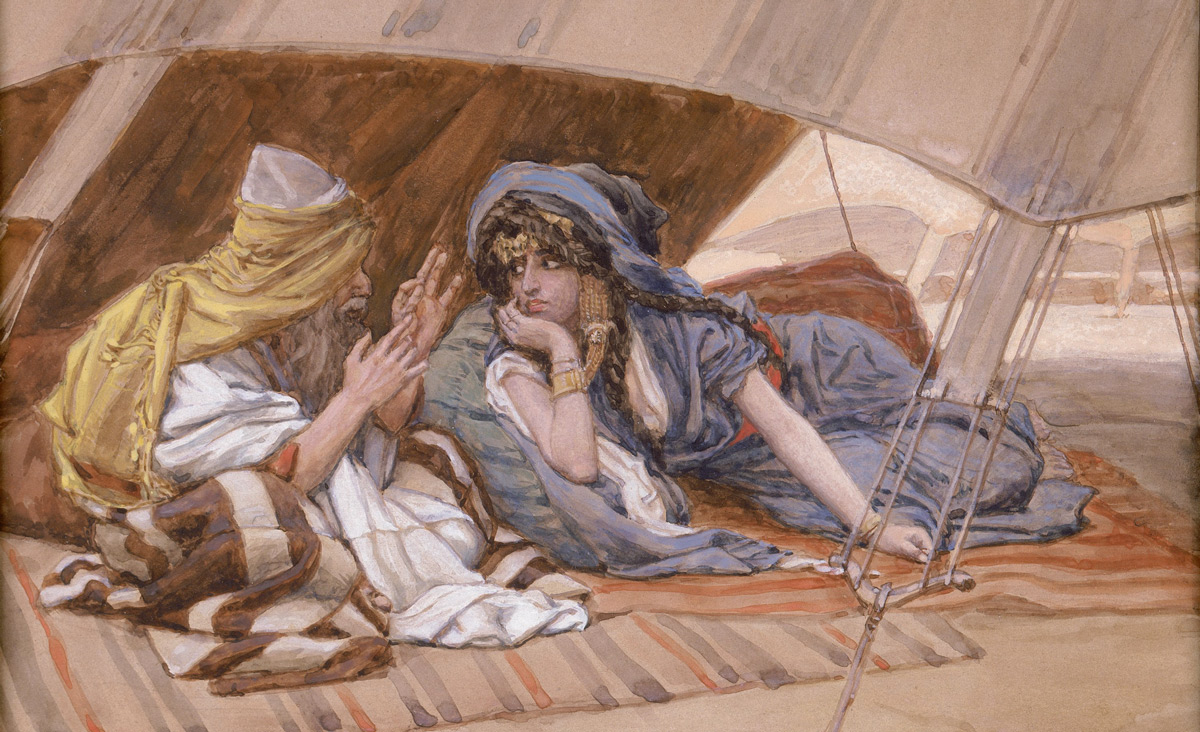
Abraham’s Counsel to Sarah, by James Tissot, ca. 1900, detail

“When God made me wander from my father’s house, I said to her: ‘This is your chessed that you will do for me: At every place where we arrive, say of me: He is my brother.’” (Genesis 20:13)

If chessed is translated as “kindness” here, the implication is that Sarah lies about her marital status out of the goodness of her heart, as a favor to her husband. If chessed is translated as “loyalty”, the implication is that Sarah has an obligation to her husband: as a loyal wife, she must either obey him, or (if she believes Abraham’s claim about strangers) save his life by telling the lie.


The word chessed appears four times in this week’s haftarah reading, Joshua 2:1-24. (A haftarah is the passage from the Prophets that accompanies the weekly Torah portion. In this week’s Torah portion, Moses sends spies into Canaan almost 40 years before Joshua does it in the haftarah. See my post Shelakh-Lekha: Sticking Point.)

Disloyalty to king and country

In this week’s haftarah, the Israelites are camped on the east bank of the Jordan River, across from the city-state of Jericho. Moses has died, and the people are poised to begin the conquest of Canaan under their new leader, Joshua. Before he leads his troops around Jericho and the walls come tumbling down, Joshua sends two spies across the river. They slip through the city gates as evening approaches, and go to a prostitute’s house.

Someone in town sees the two strangers, assumes they must be spies from the horde of Israelites camped right across the river, and tells the king of Jericho. The king immediately sends a message to the prostitute, Rachav, saying:

Rahab Receiveth and Concealeth the Spies, by H.R. Pickersgill, 1897

“Bring out the men who came to you, who came into your house, because they have come to search out the whole land!” (Joshua 2:3)

Naturally the king of Jericho wants to interrogate the two spies, and then make sure they never report back to the Israelite camp.

Thinking fast, Rachav tells the king’s messengers:

“True, the men came to me, but I do not know where they were from. And it was, the gate was closing at dark, and the men went out. I do not know where the men went. Quick, chase after them, for you might overtake them!” (Joshua 2:4-5)

As a loyal subject and citizen, Rachav should have handed over the two Israelites—not only because her king ordered it, but also because they are enemies of her own city-state. But she has secretly decided to defect to the other side, so she lies to the king’s men. They believe her, and run off to look for the two spies at the fords along the Jordan River.

Allegiance to a deity

Rachav hides the two Israelites on her roof, under the stalks of flax she had spread out to dry.2

And before they lay down, she herself came up to them on the roof. And she said to the men: “I know that Y-H-V-H has given you the land, and that dread of you has fallen over us, and that all the land’s inhabitants are quivering before you. Because we heard that God dried up the waters of the Reed Sea before you when you went out of Egypt, and what you did to the two Amorite kings who were across the Jordan … 3 And we heard, and our hearts melted [in fear], and no spirit of life rose again in a man before you, because Y-H-V-H is your god. He is God in the heavens above and on the earth below!” (Joshua 2:8-11)

Once she has declared her faith in the God of Israel (a necessary step for defecting and joining the Israelites), and provided some valuable information about the morale of the people of Jericho, Rachav asks the two spies to repay her for saving them from the king of Jericho’s men.

Loyalty to family

“And now, please swear to me by Y-H-V-H, since I have done chessed for you, then you will also do chessed for my father’s household, and you will give me a sign of emet; and you will preserve the lives of my father and my mother and my brothers and my sisters, and all those who belong to them, and you will rescue our souls from death!” (Joshua 2:12-13)

emet (אֱמֶת) = reliability, faithfulness; truth.

Rachav asks the spies to save her whole family as well as herself. Yet in the Hebrew Bible, a prostitute supports herself by taking customers because she is not supported by her father, brother, or husband. Rachav’s father and brothers are still alive. Either they refused to let her live with them, or she is an unusually independent woman who chose to set up her own house and business, even though it would shame the whole family.

Despite this earlier rift, Rachav is now loyally doing chessed for her family by requesting that the spies save their lives as well.

Exchange of favors

But although Rachav is loyal to her family, she has not yet had an opportunity to join the Israelites and pledge her loyalty to them. So when she points out that she has done chessed for the two spies, she means she has done them a kindness or a favor.

When she asks the spies to swear that they will do chessed for her and her family, she is not asking for an act of kindness or an act of loyalty. She is asking for reciprocity, an exchange of favors.

Later in the story of the conquest of Canaan, the word chessed is employed that way when some Israelite scouts see a man leaving the town of Beit-El. They stop him and propose an exchange of favors:

“Please show us the way to enter the town, and we will do chessed for you.” And he showed them the way to enter the town, and they struck the town with the edge of the sword, but they sent free the man and his whole clan. (Judges 1:24-25)

Rachav’s proposal is more formal, calling for an oath and a reliable sign from the two men.

And the men said to her: “Our souls to die instead of yours—as long as you do not tell about this business of ours! And it will be, at Y-H-V-H’s giving the land to us, that we will do with you chessed and emet.” (Joshua 2:14)

The combination chessed and emet can be translated as “reliable loyalty” or “true kindness”, depending on the circumstances. Here, the men are not pledging to be kind, but to be loyal—loyal to the reciprocal arrangement that Rachav requested.

Thorough kindness

After dark, Rachav completes her initial act of kindness by helping the two spies leave the town unnoticed.

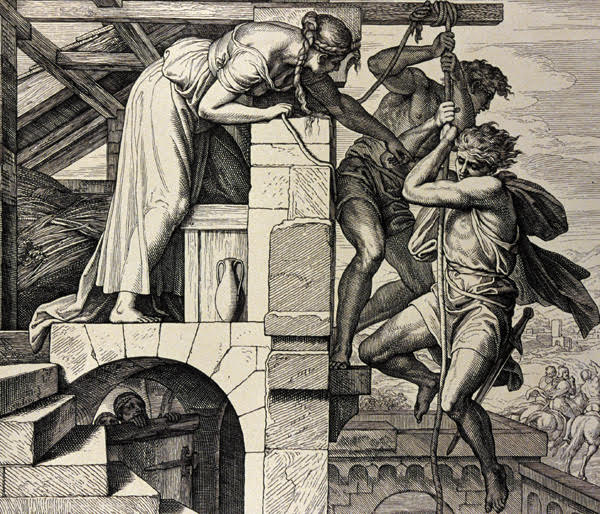
Escape from Rahab’s House, by Julius Schnorr von Carolsfeld, 1860

Then she let them down by a rope through the window—since her house was in a recess of the wall, and in the [city] wall she lived. (Joshua 2:15)

Fortified cities in the Ancient Near East were encircled by double (casemate) walls, with rooms between the two walls. At strategic points, these rooms were occupied by soldiers, but other stretches of wall were available to those who could not afford larger quarters.

And she said to them: “Go to the hills, lest the pursuers encounter you, and stay hidden there for three days, until the pursuers return. After that you may go on your way.” (Joshua 4:16)

Rachav tells the spies to hide in the hills to the west of the Jordan valley, the opposite direction from the river where the “pursuers”—the king’s men—will be guarding the fords.

Before they leave, the two spies designate the sign of emet that Rachav asked for.

“Hey, we will be coming into the land. Then you tie this cord of red string in the window through which you let us down; and you gather your father and mother and brothers and your father’s whole household to yourself in the house. And it will be: anyone who goes outside the doors of your house, his blood will be on his own head and we will be innocent. But anyone who is with you in the house, his blood will be on our head, if a hand is against him. But if you tell about this business of ours, then we will exempt from this oath of yours you had us swear.”  (Joshua 4:18-20)

The spies make sure the terms of the arrangement are spelled out so they can avoid any mistakes or misunderstandings.

And she said: “As you have spoken, so be it!” And she sent them off, and they went. And she tied the red cord through the window. (Joshua 2:21)

The two spies follow Rachav’s directions, and after hiding in the hills for three days, they arrive safely back at the Israelite camp. When the Israelite troops come to Jericho, Joshua orders them to kill all the people in the city, except Rachav and everyone with her in her house.4 While the city wall is collapsing and the rest of the troops are running through killing people, the two spies fulfill their oath by bringing Rachav and her family out to safety.

And Rachav the prostitute, and her father’s household, and everyone who was hers, Joshua let live. And she settled in the midst of Israel, to this day, because she had hidden the messengers whom Joshua had sent to spy out Jericho. (Joshua 6:25)


Some people remain loyal to a person or a country no matter what. Others are loyal only as long as the person or government meets their ethical standards. And some people act loyal only when it is in their self-interest.

Rachav acts in her own self-interest when she becomes disloyal to her king, her city-state, and the god of Jericho. But her request that the Israelites save her family is an act of loyalty to her relatives. She hides the two Israelite spies as an act of kindness. When she realizes that this is her opportunity to defect to the Israelite side, she frames her kindness as a favor, and asks the men to return the favor. After they do, Rachav becomes a loyal citizen of Israel. For her, chessed encompasses impulsive kindness, the practical exchange of favors, and loyalty—both to the family she was born into, and to the people she chose.


  1. See my post Lekh-Lekha, Vayeira, & Toledot: The Wife-Sister Trick, Part 1.
  2. Joshua 2:6.
  3. The two Amorite kings are Sichon and Og; Israelite soldiers conquer their kingdoms, Chesbon and Bashan, in Numbers 21:21-35, once their families have camped above the Jordan River across from Jericho.
  4. Joshua 6:17.

Lekh Lekha & Isaiah: Faith and Promises

Moving to another country is risky. You don’t know all the rules, all the dangers. And even if you believe God wants you to go, how do you know you will prosper? If life is not so terrible where you are, isn’t it safer to stay put?

Abraham and his household face the question of emigration in this week’s Torah portion, Lekh-Lekha (Genesis 12:1-17:27). So do the Israelite exiles in the accompanying haftarah reading, Isaiah 40:27-41:16. In both cases, God asks people who live in Mesopotamia to emigrate to Canaan. And God promises to reward them for doing so. But in both cases, there are reasons for doubt.

Lekh Lekha

Last week’s Torah portion, Noach, tells us that Abraham (originally named Avram) has already relocated once. He is the first of three sons Terach begets in Ur, a city in southern Mesopotamia.

And this is the genealogy of Terach: Terach begot Avram, Nachor, and Haran, and Haran begot Lot. And Haran died before his father Terach, in the land of his kin, in Ur of the Mesopotamians. (Genesis/Bereishit 11:27-28)

After naming the wives of Avram and Nachor and mentioning that Avram’s wife Sarai had no children, the story continues:

Then Terach took his son Avram; and his grandson Lot, son of Haran; and his daughter-in-law Sarai, the wife of his son Avram; and they left with him from Ur of the Mesopotamians to go to the land of Canaan. And they came as far as Charan, and they settled there. The days of Terach were 205 years, and Terach died in Charan. (Genesis 11:31-32)

The book of Genesis never says why Terach was heading for Canaan, or why he stops halfway and settles in northern Mesopotamia.

Then God said to Avram: “Go for yourself, from your land and from your kindred and from your father’s house, to the land that I will show you! And I will make you a great nation, and I will bless you, and I will make your name great. Then be a blessing! And I will bless those who bless you, and curse those who demean you. And all the clans of the earth will seek to be blessed through you.” (Genesis 12:1-3)

There are no divine threats that anything bad will happen if Avram does not emigrate to Canaan. Is he tempted by the reward God promises? In the Torah, a blessing from God means longevity, material prosperity, and fertility. A great name means fame. When God makes someone a great nation, it means that person’s descendants will someday own a country.

Avram went as God had spoken to him, and Lot went with him. And Avram was seventy-five years old when he left Charan. (Genesis 12:4)

Since Avram is already 75 and still healthy enough to walk all the way from Charan to Canaan, a journey of about 600 miles or 1,000 kilometers, he could assume he is already set for a long life. He does not need to emigrate to be blessed with longevity.

What about the blessing of prosperity?

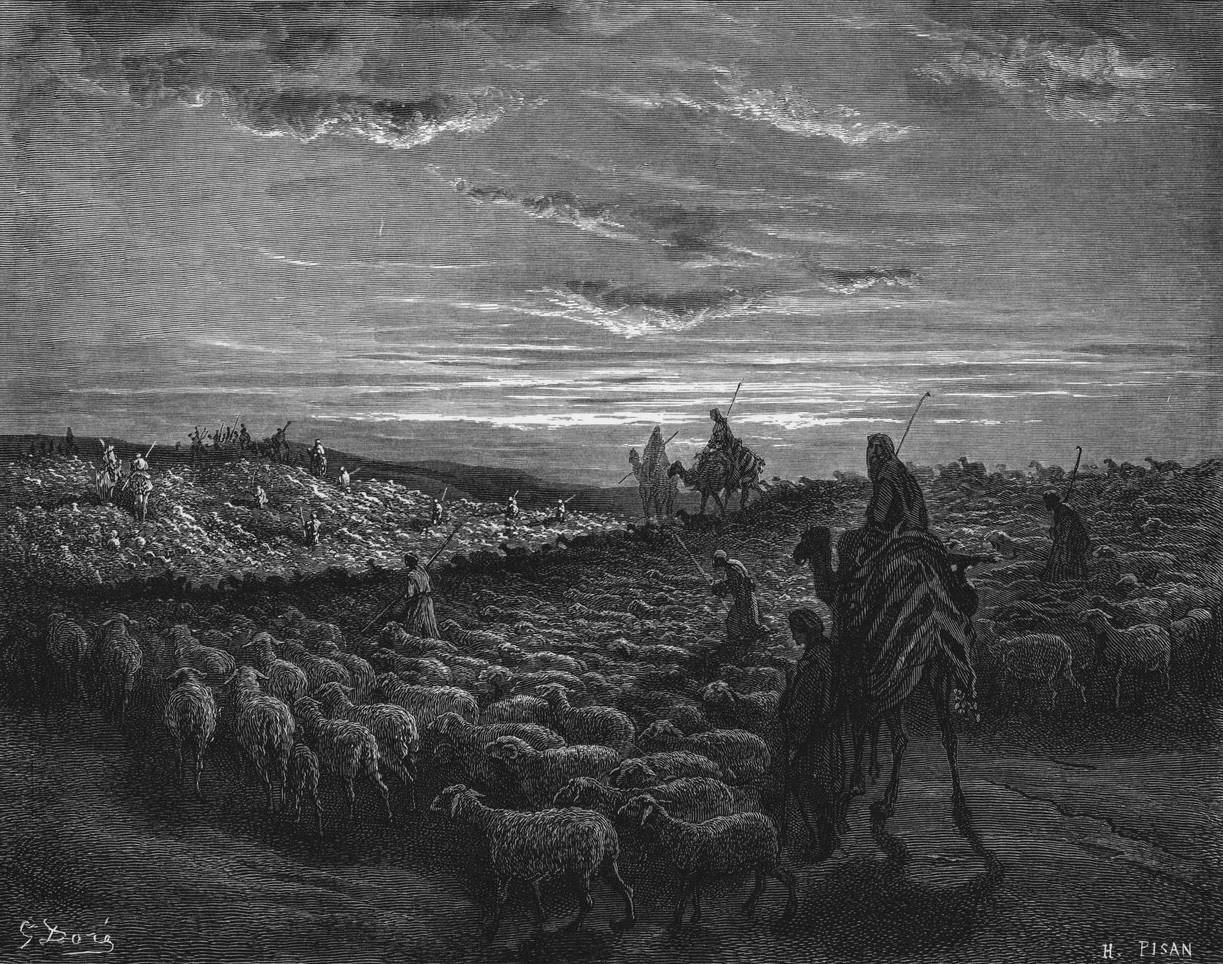
Abraham Journeying into the Land of Canaan,
by Gustave Doré, 1866

Avram took his wife Sarai and his brother’s son Lot, and all the property that they had acquired, and the people that they had acquired in Charan, and they left to go to the land of Canaan. And they entered the land of Canaan. (Genesis 12:4-5)

Avram, Sarai, and Lot have already acquired a lot of moveable property by the time they emigrate to Canaan, including animals, goods, and slaves.1 They do not need to emigrate to be blessed with material prosperity.

What about the blessing of fertility? We already know Sarai is childless, and we learn later that she is only ten years younger than Avram, so she is 65. Avram has not had any children in Charan, and unless he has a son in old age, he will have no descendants to become “a great nation”.

Perhaps the promise of fertility is the reason Avram obeys God and heads for Canaan. And the rest of his household, including his wife, his nephew, and his employees and slaves, have no say in the matter. They might have (unrecorded) opinions, but in their culture, the male head of household decides for everyone.

Unlike Terach, Avram and his people finish the trip to Canaan. They arrive at a sacred site near the Canaanite town of Shekhem.2

Then God appeared to Avram and said: “To your see [descendants] I give this land.” So he [Avram] built an altar there for God, whom he had seen. (Exodus 12:7)

I imagine that seeing some manifestation of God as well as hearing God speak about descendants again would confirm to Avram that he had made the right choice in following God’s instruction to move to Canaan. Yet when Canaan experiences a famine,

Avram went down to Egypt, lagur there, since the famine was severe in the land. (Exodus 12:10)

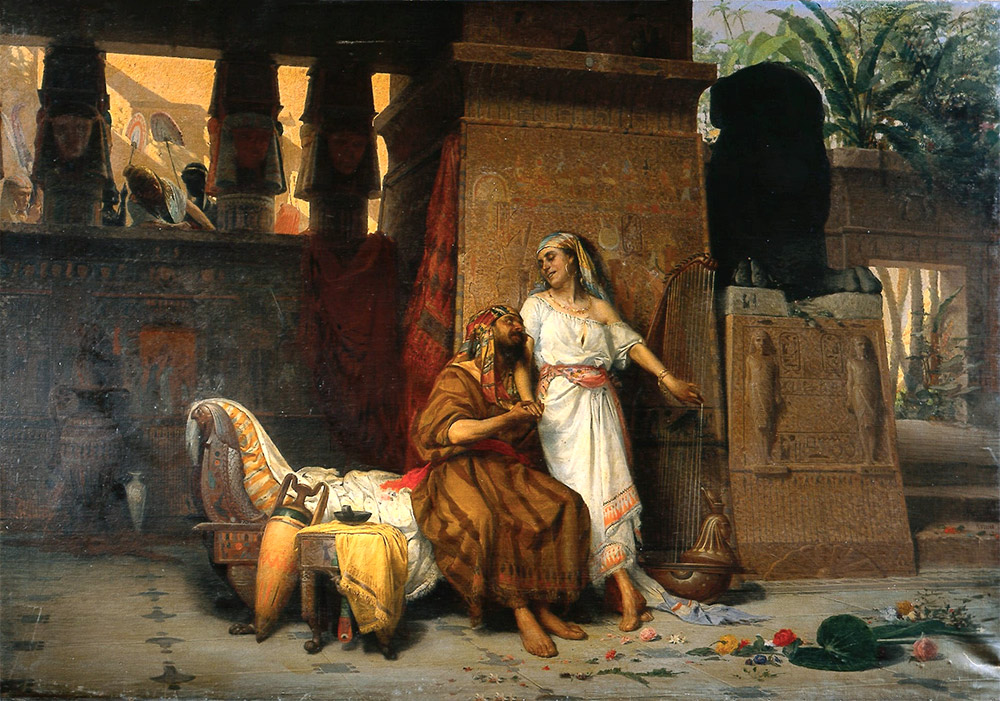
Abraham and Sarah in Pharaoh’s Palace,
by Giovanni Muzzioli, 1875

lagur (לָגוּר) = to live as a resident alien, to sojourn, to become a migrant.

And God does not object. In fact, God helps Avram pull off a scam that results in pharaoh giving Avram additional animals, silver and gold, and slaves—and ordering men to escort Avram and his household back to the border. (See my post Lekh Lekha, Vayeira, & Toledot: The Wife-Sister Trick, Part 1 and Part 2.)

Avram has further adventures in Canaan, and then the unsolved problem of his lack of descendants comes up again.

After these things, the word of God happened to Avram in a vision, saying: “Don’t be afraid, Avram. I myself am a shield for you; your reward will be very big!” But Avram said: “My lord God, what will you give me? I am going accursed, and the heir of my household is the Damascan, Eliezer!” And Avram said: “To me you have not given seed [a descendant], so hey! The head servant of my household is my heir!”  (Genesis 15:1-3)

When the same person says two things in a row, with nothing in between except “And he said”, it indicates a pause while the one being addressed fails to respond. In this case, God does not respond to Avram’s first statement, so Avram adds an explanation.

Then hey! The word of God happened to him, saying: “This one will not be your heir; but rather, the one who goes out from your inward parts will be your heir.” (Genesis 15:4) Another vague promise. So Avram’s wife Sarai tackles the problem herself by arranging for her husband to impregnate her female Egyptian slave. Avram no longer has to have faith that somehow God will provide.

Second Isaiah

Avram at least has the advantage of hearing God tell him directly to emigrate to Canaan from Mesopotamia. When the Babylonian Empire falls, the Israelites living in exile there have only the words of a human prophet who tells them that God wants them to move back and rebuild the razed city of Jerusalem. The prophet is not named, but since the prophecies compose the second half of the book of Isaiah, the speaker is known as “Second Isaiah”. In this week’s haftarah, God declares (through Second Isaiah):

Don’t be afraid, for I am with you.
Don’t look around anxiously, for I am your God.
I will strengthen you.
Also I will help you.
Also I will hold you up by the right hand of my righteousness. (Isaiah 41:10)

The Israelites living in Mesopotamia are anxious about returning to Jerusalem for understandable reasons. Between 597 and 587 B.C.E., while the Babylonian army was conquering the Kingdom of Judah, many Israelites were forcibly deported to Babylon.

Seal of Cyrus I (from Anshan)

Half a century later, when Second Isaiah began prophesying, the new Persian Empire had swallowed up the Babylonian empire. The first Persian king, Cyrus, gave all deportees and children of deportees permission to return to their former homes and rebuild their former temples. But after their traumatic experience, the Israelites are reluctant to believe it would really be safe to move back to Jerusalem. Besides, they saw the city burning down.

Assuring the exiles that their Babylonian conquerors are now powerless, God says:

Hey, everyone who was infuriated with you
will be shamed and humiliated;
They will be like nothingness,
And the men who contended with you will perish. (Isaiah 41:11)

But before the exiles can believe God will eliminate their enemies, they must believe that God is on their side now. And that is hard for people who remember when God failed to rescue them from death and deportation at the hands of the Babylonians. Then God promises to make the Israelites, not just the Persians, a weapon for defeating the Babylonian armies that seem as strong as mountains.

Hey, I will transform you into a new sharp thresher,
An owner of teeth,
You will thresh the mountains
And crush the hills, make them like chaff.
You will scatter them,
And the wind will carry them off,
And a whirlwind will disperse them.
And you, you will rejoice in God
And you will praise the Holy One of Israel. (Isaiah 41:15-16)

The Israelites in Babylonia hear (or read) the prophet’s speeches quoting God. But do they believe the quotes are real? Do they believe God will help them now? Do they set off for Jerusalem?

The Burning of Jerusalem by Nebuchadnezzar’s Army,
by the circle of Juan de la Corte, 1630-1660

The book of Isaiah does not give an answer. The conclusion of book of Jeremiah reports that a total of 4,600 people were deported by Babylonian King Nebuchadnezzar.3 (The poorest citizens of Judah were kept in the land to serve as “vine-dressers and field hands”.)4

The book of Ezra describes the return of 42,360 exiles to Jerusalem, along with their 7,337 slaves and 200 singers,5 but the archeological record indicates that the numbers are inflated.

It is also hard to determine how many of the exiles stayed in Babylonia under Persian rule. The city of Babylon had a large Jewish population when Philo of Alexandria wrote in the first century C.E., and had become the center of Jewish law and culture by the time the Talmud was written in the 3rd-5th centuries C.E.6 There is no historical record of a large in-migration of Jews to Babylon, so a lot of deported Israelites and their children must have stayed behind when Ezra and his group set off for Jerusalem.


Believing that God will help you is not so hard when your life has already been good, like Abraham’s. Believing that God will help you is harder when you, or your parents, can remember a time when God failed to rescue you from enemies—enemies who burned your city, killed many of your family and friends, and marched you off to a strange land. Jeremiah explains that God punished the Kingdom of Judah for the bad policies of its kings and for the widespread worship of other gods. Second Isaiah insists that now all that is forgiven.

What would it take for you to believe that God wants you to emigrate? What would it take for you to actually do it?

What if you were a Jew thinking about “making aliyah”—moving to Israel?


  1. An alternative reading from Talmudic times says that Avram, Sarai, and Lot had not acquired slaves in Charan, but rather made converts. This reading, however, does not fit the society of the time, and is not supported by any other reference in the Hebrew Bible.
  2. The site is named Eilon Moreh. An eilon (אֵל֣וֹן) is a large and significant tree, the kind that was involved in Asherah worship. Moreh (מוֹרֶה) means “teaching, instruction”.
  3. Jeremiah 52:30.
  4. Jeremiah 52:16.
  5. Ezra 2:65-66.
  6. Talmudic volumes were written both in Jerusalem (the Talmud Yerushalmi) and in Babylon (the Talmud Bavli), the two centers of Jewish scholarship. The Talmud Bavli is more complete and authoritative.

Chayei Sarah & 1 Kings: Old Age for Scoundrels, Part 1

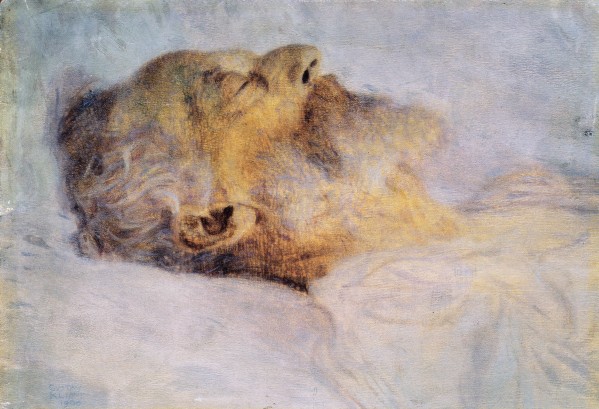
And Abraham expired and died at a good old age, old and saveia, and he was gathered to his people. (Genesis 25:8)

Old Man on his Deathbed, by Gustav Klimt

saveia (שָׂבֵעַ) = (adjective) satisfied, full, sated. (From the root verb sava, שָׂבַע = be sated, have enough, be filled up—usually with food.)

The full and satisfying end of Abraham’s life in this week’s Torah portion, Chayei Sarah (“The Life of Sarah”, Genesis 23:1-25:18) contrasts with the thin and bitter end of King David’s life in the accompanying haftarah reading (1 Kings 1:1-1:31). The haftarah sets the tone for King David’s final years when it opens:

And the king, David, was old, coming on in years, and they covered him with bedclothes, but he never felt warm. (1 Kings 1:1)

In their prime, both men have motley careers: brave and magnanimous in one scene, heartless and unscrupulous in the next. But in old age (about age 140-175 for Abraham, 60-70 for David) their paths diverge.

Abraham’s prime

Abraham commits several major unethical deeds after he moves his family to Canaan when he is 75. Although his behavior toward his nephew Lot is faultless, his behavior toward his wife Sarah and his first two sons, Ishmael and Isaac, is sometimes cruel, selfish, and immoral.

Abram’s Counsel to Sarai, by James Tissot, ca. 1900, detail

Twice when he travels to a new kingdom, Abraham asks Sarah to pretend to be his sister. He claims that she was unusually beautiful1 and that the king has peculiar morals, considering adultery taboo, but murder perfectly all right. The king will take Sarah regardless, but only if everyone lies and says Abraham is her brother will the king let him live. In fact, both kings pay Abraham a bride-price for his “sister”. Both kings are horrified when they discovered the truth. Both times, Abraham gets to take back his wife and leave richer than when he arrived.2

Sarah also uses Abraham, by giving him her slave Hagar as a concubine for the purpose of producing an heir. (She is 75 and childless at the time.) After Sarah give birth to her own son at age 90, she sees that Hagar’s son Ishmael is not treating her son Isaac with respect. So she orders Abraham to cast out Hagar and Ishmael, in order to make Isaac the only heir. Abraham is rich, and could easily give his own son and his former concubine a couple of donkeys laden with water, food, and silver to ensure their safe relocation. Instead, Abraham sends them off into the desert with only bread and a skin of water. When they get lost and use up the water, Ishmael nearly dies.3 God arranges a rescue, but Abraham never sees his oldest son again.

Isaac has grown up, but has not yet married or had children, when Abraham hears God tell him:

“Please take your son, your only one, whom you love, Isaac. And get yourself going to the land I will show you, and offer him up there as a burnt offering on one of the hills, which I will say to you.” (Genesis 22:2)

Sacrifice of Isaac, by Caravaggio, 1603

Abraham knows he could argue with God. When he was 99, he argued with God about destroying Sodom, and God listened and agreed it would be unjust to annihilate the city if it contained even ten innocent people.4 Yet now, in his 130’s, Abraham does not argue with God. he does not even ask God a question. He gets up early and leaves with Isaac, two servants, and a donkey carrying firewood, without telling Sarah where they are going. When Isaac lies bound on the altar and Abraham lifts the knife, God has to call his name twice to get him to stop. After Abraham sacrifices a ram instead, he walks back down the hill alone.5 The breach between father and son is irreparable. Abraham never sees Isaac again.

Abraham’s old age

Is Abraham consumed by guilt and loss during the final stage of his life, from his late 130’s to his death at 175? No. But he has changed. This week’s Torah portion, Chayei Sarah, portrays a man at peace with himself who meets all his responsibilities and also enjoys life.

The Torah portion begins with Sarah’s death in Hebron. Yet the last we knew, Abraham was living in Beersheba.6 Perhaps the two locations reflect a glitch in a redactor’s effort to combine two stories. Or perhaps Sarah left her husband after he returned without Isaac and tried to explain what happened. In an already difficult marriage, that would be the last straw. Yet the estrangement does not stop Abraham from traveling to Hebron and doing his duty as Sarah’s husband.

Abraham Buys the Field of Ephron the Hittite, by William Hogarth, ca. 1725

And Abraham came to beat the breast for Sarah and to observe mourning rites. Then Abraham got up from the presence of his dead, and he spoke to the Hittites, saying: “I am a resident alien among you. Give me a burial site among you, and I will bury my dead away from my presence.” (Genesis 23:2)

After some negotiations, Abraham buys a plot of land with a suitable burial cave, and buries Sarah there. In this way he also prepares for his own burial, and future burials in his family.

Isaac is not mentioned during the first scene in Chayei Sarah. But in the next scene, Abraham makes arrangements for Isaac’s marriage.

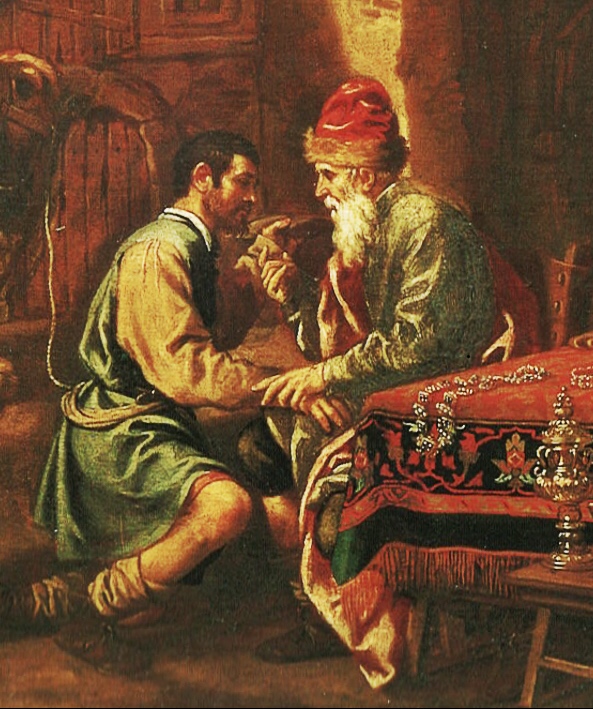
And Abraham said to his elder servant of his household, the one who governed all that was his: “Please place your hand under my yareikh, and I will make you swear by God, god of the heavens and god of the earth, that you do not take a wife for my son from the daughters of the Canaanites amidst whom I am dwelling.  For you must go to the land I came from and to my relatives, and you must take a wife for my son, for Isaac.”  (Genesis 24:2-4)

Abraham’s Solemn Charge, by Pedro Orrente, 17th century, detail

yareikh (יָרֵךְ) = upper thigh, buttocks, genitals.

This is a serious oath. Isaac is in his late thirties at this point, and his father has obviously been keeping track of him from a distance. Now Abraham wants to make sure, before he dies, that Isaac marries and starts producing the descendants God promised. But he does not try to confront his estranged and traumatized son in person. He instructs his steward, and trusts him to deliver the right bride to his son.

Arranged marriage was the norm in the Ancient Near East, so Isaac is not shocked when his father’s steward arrives with a young woman for him. In fact, he falls in love with her.7

Once Isaac is married, Abraham takes a concubine again, and has six sons with Keturah.

And Abraham gave all that was his to Isaac. But to the sons of the concubines that were Abraham’s, Abraham gave gifts, and he sent them away from his son Isaac while he was still alive, eastward, to the land of the east. And these are the days of the years of Abraham, that he lived: 175 years. And Abraham expired and died in good seivah (Genesis 25:6-8)

Abraham is virile and enjoys life his old age. He is also in charge of his own life, and takes care to meet all his responsibilities well before he dies. He divides his wealth among his sons and makes sure Isaac will not be harassed by his stepbrothers. After his death, Ishmael and Isaac bury their father in the cave he bought for Sarah’s burial. Whatever mistakes he made before the age of 140, Abraham leads an enviable life for his last 35 years. He is fortunate to be in good health, with both virility and a sound mind. He knows what he is doing, and he does it more thoughtfully than he used to. Abraham was always good at generating plans. But during the last part of his life, his plans are more reasonable, and take the other people in his life into consideration.


No human being is perfect. We may not commit such extravagant misdeeds as Abraham, but we have all hurt other humans. Occasionally we get the blessing of a frank conversation with someone we hurt, and an opportunity to apologize and make amends. But often the chance for a frank conversation never comes. Then the best we can do is to acknowledge our misdeeds to ourselves, and plan how we will behave more ethically in the future. Sometimes we can notice our own improvement, and find peace in our old age.

Perhaps this is what Abraham does in the book of Genesis. He never apologizes to Sarah, or Ishmael, or Isaac. But after age 140, he is careful to meet his responsibilities to everyone, even the people estranged from him. Abraham still pursues his own interests and arranges a pleasant life for himself, but he does it without any deceit and without endangering anyone’s safety. He dies old and satisfied.

Next week, in Part 2, we will look at the unfortunate counterexample of King David’s old age.


  1. Sarah is 65 when Abraham pulls this scam on the king of Egypt in Genesis 12:10-20. She is 89 when he repeats it with the king of Gerar in Genesis 20:1-18, but during that year God is presumably making Sarah’s body younger so she can bear a son to Abraham.
  2. See my posts The Wife-Sister Trick: Part 1 and Part 2.
  3. Genesis 21:8-19. See my post Vayeira: Failure of Empathy.
  4. Genesis 18:16-32.
  5. Genesis 22:1-19. See my post Vayeira: Stopped by an Angel.
  6. In Genesis 22:19 Abraham comes back to Beersheba without Isaac.
  7. Genesis 25:67.

Lekh Lekha: Abraham’s Heir

When you die, what do you leave behind in the world of the living?

Someone inherits your wealth: land, money, or—for nomads in the Ancient Near East—the  livestock and slaves you own. Someone may take your place at work or in your community. And some people will remember you and tell stories about you, for good or bad.

What do you want to leave behind, and who do you want to your heirs to be?


The question of inheritance is a major concern in this week’s Torah portion, Lekh Lekha (Genesis 12:1-17:27), and for the next six portions. For three generations, from Abraham to his grandson Jacob, the men and women in his family tree try to manipulate events in order to control who will inherit.

Abraham appears (under his original name, Avram) at the end of a long genealogy in last week’s portion, Noach. Nine generations after Noah, Terach was living in the city-state of Ur in southern Mesopotamia when he begot three sons: Avram, Nachor, and Haran. All three sons grew up and got married in Ur. Haran died there. Terach set out for Canaan with Avram and his wife Sarai, and Haran’s son Lot. Before they reached Canaan, they stopped and settled in the Aramaean town of Charan in northern Mesopotamia.1 Later we learn that Nachor and his wife also settled in Aram.2

Possible heir #1: Lot

When Avram is 75, God tells him:

“Get yourself going away from your land and your clan and your father’s house, to the land that I will show you! And I will make you a great people, and I will bless you. I will make your name great, and it will become a blessing. And I will bless those who bless you, and I will curse those who belittle you.” (Genesis 12:1-2)

In the Torah, someone becomes “a people” by having numerous descendants who become an ongoing society or even country. A great name means fame or a great reputation. Already God has promised Avram two roles that his heirs might inherit: the leadership of a whole people, and a name that can trigger divine blessing or curse.

And Avram went, as his god, Y-H-V-H, had spoken. And Lot went with him. And Avram was 75 years old when he went out from Charan. And Avram took his wife Sarai, and his brother’s son Lot, and all their acquisitions that they had acquired, and the persons that they had made [their own] in Charan; and they left to go to the land of Canaan. (Genesis 12:4-5)

Without an explicit direction from God, Avram heads toward Canaan, his father’s intended destination. Besides his wife and his nephew, Avram takes all his possessions with him—mostly livestock and slaves. He stops at the site of Shekhem in Canaan, where God appears to him and says: “I will give this land to your offspring.” (Genesis 12:7)

This confirms that Canaan was the right place to go. Avram does not question God’s promise to give Canaan to his offspring, even though he has no children and Sarai is already 65. The household migrates south through Canaan, from Bethel to the Negev. When a famine comes, they go to Egypt, where Avram uses Sarai to pull a scam on the pharaoh. (See my posts Lekh-Lekha, Vayeira, & Toledot: The Wife-Sister Trick, Part 1 and Part 2.)

It went well on account of her, and he acquired flocks and cattle and male donkeys and male slaves and female slaves and female donkeys and camels. (Genesis 12:16)

When Avram, Sarai, and Lot return to Canaan with and all their possessions,

Avram was very heavy in livestock and in silver and in gold. (Genesis 13:2)

At this point, Avram has great wealth to pass on to his heir. The right heir might also inherit his connection with divine blessing, and his ability to hear God. Avram’s presumed heir at the beginning of Lekh Lekha is his nephew Lot. But when they return to Bethel, Avram and Lot decide to go their separate ways.

Lot, who went with Avram, also had flocks and cattle and tents. And the land could not support them [if they were] staying together … And there was quarreling between the herdsmen of Avram’s cattle and the herdsmen of Lot’s cattle. (Genesis 13:5-7)

Avram gives his nephew first choice of pastureland, and Lot claims “the whole plain of the Jordan”—the river valley and the land near the Dead Sea—because it has lots of water.

And they separated, each man from his kinsman. Avram stayed in the land of Canaan, and Lot settled in the cities of the plain, and he pitched his tent near Sodom. (Genesis 13:11-12)

The Torah never specifies the borders of Canaan, only the borders of the future kingdom of Israel.3 It does locate some towns as being in Canaan, but Sodom is not one of them. The passage above indicates that Lot rejects Canaan in favor of Sodom. This may be the point when Avram realizes Lot will not be his heir.4

As soon as Lot has left, Avram hears God repeat the promise that Avram’s offspring will someday own the land of Canaan.

And God said to Avram, after Lot had separated from him: “Raise your eyes, please, and look around from the place where you are, to the north and to the south and to the east and to the west. For all the land that you see, I give it to you and to your offspring forever. And I will make your offspring like the dust of the earth, so that if anyone is able to count the dust of the earth, he can count your offspring.”  (Genesis 13:14-16)

Possible heir #2: Eliezer

The next time God appears to Avram in a vision, God says:

“Don’t be afraid, Avram. I am a shield to you. Your wages will be very great.” (Genesis 15:1)

Avram does not ask what God is paying him for. But he does ask who will inherit God’s reward:

“What could you give me, when I am going childless, and the one maintaining my household is Eliezer of Damascus?” (Genesis 15:2)

When God does not answer, Avram explains:

“Since you have not given me offspring, then hey! The one over my household yoreish from me.” (Genesis 15:3)

yoreish (יוֹרֵשׁ) = will inherit

Perhaps Avram nudging God to provide him with his own son, so he can have the descendants God promised. There is nothing wrong with his steward Eliezer, especially if he is the same unnamed senior servant who, years later, goes out of his way to procure the right wife for Avram’s son Yitzchak (Isaac in English).5 But like most men in the Hebrew Bible, Avram wants an heir who is his own flesh and blood.

Then, hey! The word of God came to him, saying: “This one lo yiyrashekha, because one who goes out from your own loins, he yiyrashekha.” (Genesis 15:3-4)

lo yiyrashekha (לֹא יִירָשְׁךָ) = will not inherit land or property from you, will not get your possessions. (Lo, לֹא = not + yiyrashekha,יִירָשְׁךָ = will inherit land or property from you, will get your possessions.)

Then God again promises Avram an uncountable number of descendants.

Possible heir #3: Yishmael (Ishmael)

When Avram is 85 and his wife Sarai is 75, long past menopause, Sarai decides to give her husband an heir without waiting for a miracle.

And Sarai, Avram’s wife, had not borne children to him. And she had an Egyptian slave-woman, and her name was Hagar. And Sarai said to Avram: “Hey, please, God has kept me from bearing children. Please come into my slave-woman. Perhaps I will have a son through her.” And Avram paid attention on Sarai’s voice. (Genesis 16:1-2)

This was not an unusual strategy in the Ancient Near East. Childless women assign surrogates to their husbands and then adopt the resulting progeny both in the Mesopotamian laws of Hammurabi and in another story in Genesis, when Rachel and Leah ask their husband Jacob to produce more children for them by using their slave-women as surrogate mothers.5

And Hagar bore a son to Avram, and Avram called the name of his son that Hagar had borne Yishmael. And Avram was 86 years old when Hagar bore Ishmael to Avram. (Genesis 16:15-16)

The arrangement does not go well for Sarai or Hagar, but Avram acknowledges and grows fond of his son Yishmael (Ishmael in English).6

Possible heir #4: Yitzchak (Isaac)

When Avram is 99, and Sarai is 89, and Ishmael is 13, God appears to Avram again and says:

“Walk constantly in my presence, and be blameless. Then I will establish my covenant between me and you, and I will make you very, very numerous.”

At first the deal appears to be that Avram will behave perfectly, and in return God will give him those long-promised descendants. But then God continues:

“Behold my covenant with you: You will be a father for a hamon of nations. And you will no longer be called the name Avram, but your name will be Avraham; because I will give you a hamon of nations. And I will make you very, very fruitful, and give you nations, and kings will go out from you. And I will establish my covenant between me and you and your descendants after you for generations as a covenant forever: to be a god for you and your descendants after you. And I give you and your descendants after you the land of your sojourning, all the land of Canaan, as a possession forever, and I will be their god.” (Genesis 17:4-8)

hamon (הָמוֹן) = crowd, noisy procession, uproar. (From the root verb  hamah,הָמה  = roar, make an uproar. Avram’s new name, Avraham, incorporates the root hamah.)

Now God’s side of the covenant is to give Avraham crowds of descendants who will possess the land of Canaan; and to act as their god, presumably by paying special attention to their welfare.

Then God tells Avraham what he must do for his side of the covenant:

“This is my covenant that you must keep, between me and you and your descendants after you: Be circumcised, every male among you. And they must be circumcised, the flesh of your foreskins, and it will be a sign of the covenant between me and you.” (Genesis 17:10-11)  

In future generations, God adds, the circumcision should happen when a male infant is eight days old; and every man should also circumcise his male slaves.

And God said to Avraham: “Sarai, your wife—her name will not be called Sarai, because Sarah will be her name. And I will bless her, and even give you a son from her. I will bless her and she will become nations; kings of nations will come from her!” And Avraham threw himself on his face and he laughed, and he thought in his heart: Can a son be born to a hundred-year-old? Or can Sarah bring forth a child at ninety? And Avraham said to God: “May Ishmael live before your presence!” (Genesis 17:15-18)

Avraham seems content with Ishmael as his son and heir. Why does he need another? God reassures him that Ishmael will have twelve children and found a nation of his own. But the heir to Abraham’s property and relationship with God will not be Hagar’s son, but Sarah’s son, whom he must name Yitzchak.

“And my covenant I will establish with Yitzchak, whom Sarah will bear to you at this time next year.” (Genesis 17:21)

So Avraham’s own wife will miraculously give birth to Yitzchak, who will inherit God’s covenant with Avraham: God’s attention, the obligation of circumcision, and the equivalent of a deed to the land of Canaan. And that is not all Yitzchak inherits. God also blesses him7 and makes him a blessing to others.8 When Avraham himself dies at age 175, in the Torah portion Chayei Sarah, he leaves his wealth and livestock business to Yitzchak.

And Avraham gave everything that was his to Yitzchak. But to the sons of Avraham’s concubines, Avraham gave gifts, and he sent them away from his son Yitzchak while he was still alive, eastward to the land of the east. (Genesis 25:6)

Thus Yitzchak, the fourth person under consideration as Avraham’s heir, inherits his father’s wealth, livestock business, position as a blessing to others, deed to the land of Canaan, covenant with God, and ability to speak with God. Avraham left a lot to inherit, and he was happy with his heir.

And Avraham died at a good ripe age, old and satisfied. (Genesis 25:8)


When you die, what will you leave behind in the world of the living?

Someone will inherit your wealth. Someone may take your place at work or in your community. Some people will remember you and tell stories about you, for good or bad. And some may inherit your personality, or your attitude toward God.

Will you be satisfied with what you leave behind? Will you be satisfied with your heirs?


  1. Genesis 11:27-31.
  2. Genesis 22:20-22 and 24:10.
  3. Numbers 34:1-12.
  4. In chapter 14 of Genesis, invaders from the north raid Sodom and its neighbors, capture Lot and other residents of Sodom, and carry them off along with the loot. Abraham and his 318 men rescue all the captives, either because Sodom is one of Abraham’s allies at the time, or because he feels affection and/or responsibility for his nephew. But Lot returns to his home in Sodom, not to Avram’s camp in Canaan.
  5. Genesis 24.
  6. See my post Lekh Lekha: Belittlement.
  7. Genesis 30:1-13.
  8. Genesis 25:11.
  9. Genesis 26:2-4.

Lekh Lekha: First Encounter

Two people hear God’s voice for the first time in this week’s Torah portion, Lekh Lekha (“Get yourself going”, God’s opening words). And the reactions of Abraham and Hagar to their first encounter with the divine are very different.

Abraham

God first speaks to Abraham1 at the start of this week’s Torah portion, Lekh Lekha. There is no preliminary visual effect, just a voice.

And God said to Abraham: “Go for yourself from your land and from your clan and from your father’s house to the land that I will show you. And I will make you into a great people, and I will bless you, and I will make your name great, so it will become a blessing.” (Genesis 12:1-2)

The rewards for obedience are significant: descendants for the childless 75-year-old old man, a divine blessing (which usually means health and prosperity), and fame that will lead people to say “May you be blessed like Abraham”. So Abraham leaves Charan.

And Abraham took Sarah, his wife, and Lot, his brother’s son, and all their personal property that they had acquired, and the persons that they had made [their own] in Charan. And they left to go to the land of Canaan. (Genesis 12:5)

Abraham obeys God without hesitation. But he makes his own decisions about who and what to take with him. He also decides his own route, heading southwest toward Canaan, rather than southeast toward his birthplace, Ur, or north into the mountains of the Hittites.

Fortunately, God confirms that Canaan is the right place after Abraham reaches the town of Shekhem.2

Abraham and God have many conversations in the book of Genesis, including one in next week’s Torah portion, Vayeira, in which Avram questions God’s plan to wipe out the entire population of Sodom and Gomorrah. He even tells God:

“Far be it from you to do a thing like this, to kill the tzadik with the wicked, [treating] tzadik and wicked the same! Far be it from you! The judge of all the earth would not do justice!” (Genesis 18:25)

Yet later in the portion Vayeira, Abraham fails to question God’s command to sacrifice his own innocent son Isaac.3 God issues that command as a “test”, and Abraham chooses blind obedience over standing up for justice. If God is testing Abraham’s sense of ethics, God learns that his protégé’s knowledge of good and evil comes into play only intermittently.

Sometimes, as at the beginning of this week’s Torah portion, Abraham uses his own judgment. Sometimes he does not.

Hagar

The other person who hears God speak for the first time in this week’s portion is Hagar, Sarah’s Egyptian slave.

Sarah, childless and post-menopausal, assigns her slave to Abraham in the hope that Hagar will produce a son for them by proxy. Once the slave is pregnant, her status in the household is ambiguous. Hagar treats Sarah with less respect, and Sarah reacts by oppressing and humiliating her. Hagar runs away.

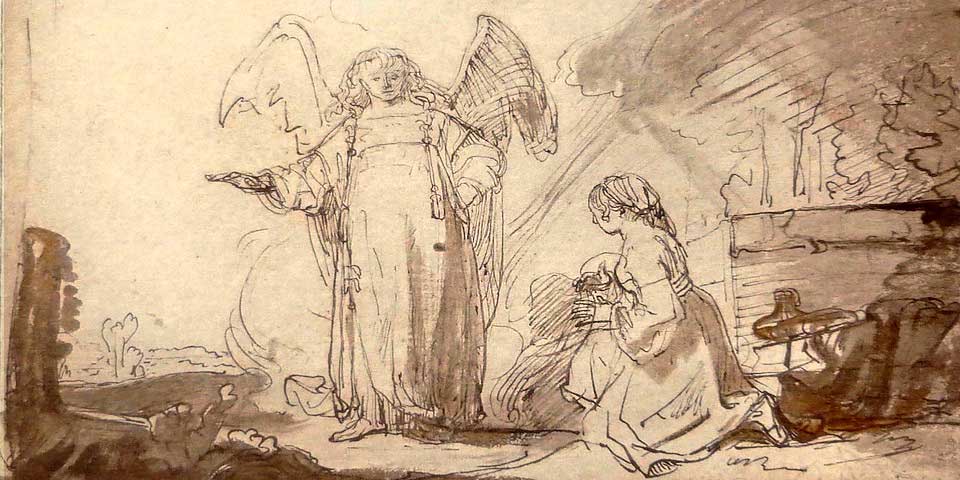
And a messenger4 of God found her by a spring of water in the wilderness … and said: “Hagar, slave of Sarah, where did you come from and where are you going?” And she said: “I am running away from the presence of Sarah, my mistress.” (Genesis 16:7-8)

Hagar answers honestly about where she came from. But she does not say where she is going. Perhaps the messenger’s question makes her realize that she has no plan, and poor future prospects.

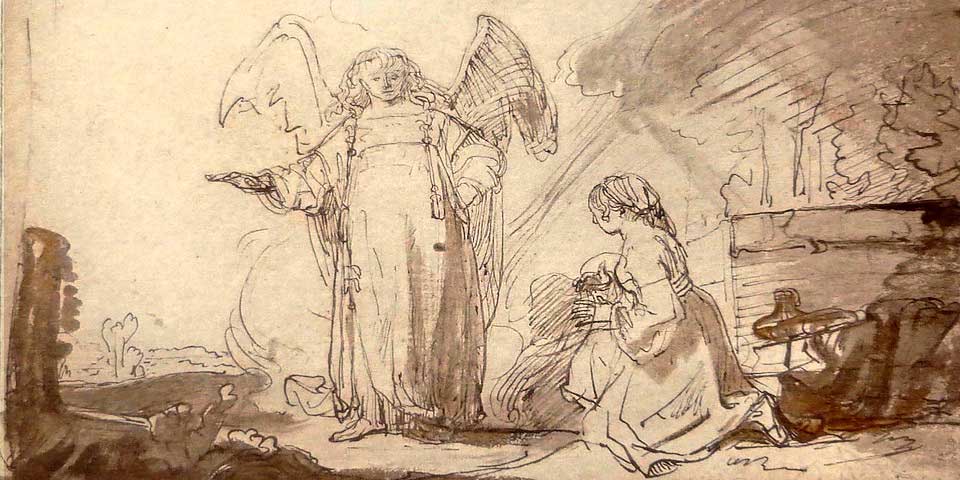
Hagar and the Angel, by Rembrandt van Rijn

Abraham can plan his journey from Charan to Canaan because he is the owner of a livestock business; he is accustomed to taking command and thinking out what to do. Hagar is only a slave, with no experience in making her own decisions.

And the messenger of God said to her: “Go back to your mistress and submit to oppression under her hand.” (Genesis 16:9)

We know that Hagar does not respond, because the next sentence begins with the messenger speaking to her again—a convention the Torah uses to indicate silence on the part of the one spoken to. Hagar does not want to return and submit to Sarah, but she is probably afraid to protest against the order.

And the messenger of God said to her: “I will definitely multiply your descendants, and they will be too many to count!” (Genesis 16:10)

Still Hagar does not respond.

And the messenger of God said to her: “Here you are, pregnant, and you will give birth to a son. And you shall call his name Yishmaeil, because God listened to your oppression. And he will be a wild-ass human, his hand against everyone, and everyone’s hand against him. But he will dwell in the presence of all his kinsmen.” (Genesis 16:11-12)

Yishmaeil (יִשְׁמָעֵאל) = God listens. Eil (אֵל) = God + yishma (יִשְׁמָע) = he listens. (Many English translations spell the name “Ishmael”.)

This information is enough for Hagar. She herself may never escape slavery again, but God will ensure that her son is independent and has his own extended family of like-minded rebels. So she returns to Sarah.

But before Hagar leaves the spring, she speaks.

And she called out the name of God, the one who spoke to her. “You are Eil Roi!” Because, she said: “Have I not seen, even here, after [God] saw me?” (Genesis 16:13)

Eil Roi (אֵל רֺאִי) = God Who Sees Me. Eil (אֵל) = God + roi (רֺאִי) = is seeing me.

Hagar realizes that the messenger is just a device for God to speak through. God has listened to her and seen her! She has heard God, and seen one of God’s manifestations!

Like Abraham, Hagar makes a considered decision to obey God. Unlike Abraham, she is amazed and awed by her first encounter with God.

Awed, but not cowed. Hagar waits silently until God promises a reward she considers worth sacrificing herself for. And she is the only person in the Torah who assigns a name to God.


What happens the first time God speaks directly to a human being? It depends on the psychology of the individual. Abraham is a clever person accustomed to leadership. Hagar is a pawn who yearns for independence, and treasures her encounter with the divine.

Both of them are certain that they do indeed hear God’s voice, not the voice of a demon or some subconscious part of themselves. Throughout the Torah, everyone to whom God speaks knows that the speaker is God.

I have had a few liminal experiences in my life, but I have never heard God speaking to me, and I am glad. Now, in the twenty-first century, someone who claims to hear words directly from God might be evaluated for schizophrenia—or made the guru of a cult. Regardless of where the voice in your head comes from, the most important thing is what you do as a result of hearing it. Abraham takes practical action to emigrate with his whole household, expecting certain improvements in his life. Hagar accepts her fate as a slave, and also names and remembers her amazing encounter with the divine.


  1. At this point in the book of Genesis, Abraham is named Avram (אַבְרָם). Later in the Torah portion Lekh Lekha (Genesis 17:3-5), God changes his name to Avraham (אַבִרָהָם), which is written “Abraham” in traditional English translations.
  2. Genesis 12:7.
  3. Genesis 22:1-19.
  4. See my post Bereishit: How Many Gods? on messengers or “angels” of God.

Book of Genesis: Inbreeding

Why is there so much inbreeding in the book of Genesis/Bereishit? After the first two Torah portions, most of the major characters are descended from Abraham’s father, Terach, through multiple lines. The branches of their family tree keep growing together again.

Noach

The Torah does not say how many wives Terach has, but it does name four of his children at the end of the Torah portion Noach. He has three sons: Avram (whom God renames Abraham), Nachor, and Haran.1 He also has a daughter named Sarai (whom God renames Sarah).2 While they are all living in the southern Mesopotamian city of Ur, Avram and Nachor marry their own relatives.

Avram and Nachor took wives for themselves. The name of Avram’s wife was Sarai, and the name of Nachor’s wife was Milkah, the daughter of Haran … (Genesis 11:29)

In other words, Avram marries his half-sister, Terach’s daughter, and Nachor marries his niece, Terach’s granddaughter.

Terach leaves Ur and heads toward Canaan with some of his family members. Halfway there they stop and settle in the town of Charan, where Terach dies.3

Thanks to archeology, we know that Charan was an actual city where the main road north from Ur met the main road that went southwest to Canaan. Both Charan and Ur were dedicated to the moon-god Nannar. The residents of those two cities worshiped many other gods as well, in temples stocked with idols. They also kept terafim, figurines of lesser gods, to protect their households.

Terach would probably acknowledge Nannar, but his primary god might be a different deity. In last week’s Torah portion, Chayei Sarah, both Betueil (son of Nachor and Milkah) and Betueil’s son Lavan use the same four-letter name of God that Avram uses (commonly represented in Roman letters as Y-H-W-H).4 Later in Genesis, Lavan says “Y-H-W-H” has blessed him, and he makes a vow in the name of “the god of Nachor”.5 But he is not a monotheist; he also owns terafim.6

Lekh-Lekha and Vayeira

Does Terach hear the voice of God, Y-H-W-H? The Torah is silent.7 But it is conceivable that he starts traveling toward Canaan because he hears the same voice in Ur that his son Avram hears  in Charan:

“Go for yourself, away from your land and from your relatives and from your father’s house, to the land that I will show you.” (Genesis 12:1)

For Avram, that land turns out to be Canaan.

Avram hears God’s voice many more times in the portions Lekh-Lekha and Vayeira. On five occasions God promises him that his descendants will inherit the land of Canaan.8 God informs him that first those descendants will be enslaved in another land for 400 years.9 God demands circumcision for every male in his household and all of his future descendants, alters the names of Avram and Sarai, and promises that Sarai (now Sarah) will have a son at age 90.10 Avram (now Abraham) talks God into agreeing not to wipe out Sodom and Gomorrah if there are even ten innocent people living there.11 When Sarah demands that Abraham cast out his first son, Ishmael, along with Ishmael’s mother, God tells him to do what Sarah says.12

Sarah Hears and Laughs, by James J.J. Tissot

Terach’s daughter Sarah also hears God’s voice. When three men who turn out to be angels visit in the Torah portion Vayeira, she overhears one of them say that she will have a child the following year. Sarah, who is 89, laughs silently. Then she hears God asking Abraham: “Why did Sarah laugh?”

And Sarah lied, saying: “I did not laugh,” because she was afraid. But [God] said: “No, for you did laugh.” (Genesis 18:15)

Abraham and Sarah do have a son. Isaac is probably 26 when his father hears God order him to sacrifice that son on an altar.  God calls him off at the last minute, and Abraham goes home alone.13 Then he gets news from Charan: Nachor and Milkah (Abraham’s brother and niece) had a son named Betueil, and Betueil now has a daughter named Rebecca.14

Chayei Sarah

Abraham arranges a marriage for Isaac fourteen years later, in the Torah portion Chayei Sarah. He insists that Isaac must marry one of his relatives back in the Aramaean town of Charan. He adds the condition that the bride must be willing to move to Canaan, because he wants Isaac to stay in Canaan.

Why does he reject the idea of simply getting Isaac a Canaanite wife?

In last week’s post I proposed that Abraham worries Isaac might stray in his religion, after the trauma of being bound as a sacrifice to his father’s god. (See Chayei Sarah: Arranged Marriage.) Since his extended family in Charan worships Y-H-W-H (among others)15, a wife from that branch of the family would not tempt Isaac away from serving the God of Abraham.

But there is another possible reason for marrying Isaac to one of his relatives. Perhaps Abraham believes his covenant with God can be best continued through the generations if as many of his descendants as possible can hear God’s voice. For that, more inbreeding might help.

Rebecca may be exactly the young woman Abraham has in mind as a bride for Isaac. After all, she is descended from Terach through both Nachor and Milkah. She agrees to go to Canaan, and marries Isaac.

Toledot

In Toledot, this week’s Torah portion, Rebecca is alarmed by her pregnancy; it feels as though a wrestling match is taking place in her womb.

And she went to inquire of God. And God said to her: “Two nations are in your womb, and two peoples will branch off from your belly. One people will be mightier than the other, and the older will serve the younger.” (Genesis 25:22-23)

The text does not say where Rebecca goes to inquire of God; some commentary suggests that she consults an oracle.  But the text does say that God speaks directly to her, and it uses the name Y-H-V-H. The voice of God is correct; Rebecca has twins, Esau and Jacob, who eventually found two peoples in the Torah: the Edomites and the Israelites.

Rebecca’s husband Isaac, who is descended from Terach through both Abraham and Sarah, also hears God’s voice.

And God appeared to him that night and said: “I am the god of Abraham, your father. Don’t be afraid, because I am with you, and I will bless you and increase your descendants for the sake of my servant Abraham.” (Genesis 26:24)

Jacob proves more intelligent and more patient than his twin brother Esau.17 The Torah does not say whether his parents realize that Jacob is the better candidate to carry on the covenant with God. Isaac fumbles his delivery of the blessing of Abraham, Esau is enraged at the result, and Rebecca tells Jacob to flee to her brother Lavan’s house in Charan. Then she tells Isaac that she is disgusted with the Hittite women Esau married, and she could not bear it if Jacob also married one of the local women.

Isaac calls in Jacob. Rebecca has not told him where to send Jacob for a bride, but Isaac decides to continue Abraham’s family breeding program.

And he said to him: “Do not take a wife from the daughters of Canaan! Rise, go to Padan Aram, to the house of Betueil, your mother’s father, and take yourself a wife from there, from the daughters of Lavan, your mother’s brother.” (Genesis 28:1-2)

Thus he orders Jacob to marry one of his first cousins, who also carries more than the usual share of Terach’s blood (or genes).

Vayeitzei

Jacob’s ladder, German 14th century

As soon as Jacob leaves home he, too, hears the voice of God. In next week’s Torah portion, Vayeitzei, he dreams of God’s angelic messengers ascending and descending between heaven and earth, and then sees God standing over him. God confirms that the blessing of descendants who will inherit Canaan has gone from Abraham to Isaac to Jacob.

And [God] said: “I am God [Y-H-V-H], the God of your father Abraham and the God of Isaac. The land which you are lying on I will give to you and to your descendants.” (Genesis 28:13).

Jacob marries both of Lavan’s daughters, and their eight sons (plus Jacob’s four sons with Lavan’s daughters’ servants) become the ancestors of the twelve tribes of Israel.

Being able to hear God is not a unique trait of Terach’s descendants. Before the Flood, God converses with Adam and Eve, Cain, and Noah. After the flood, God speaks twice to Hagar the Egyptian and once to Avimelekh of Gerar.18 But most of God’s words in the Genesis are addressed to Abraham, Sarah, Isaac, Rebecca, and Jacob, all inbred descendants of Terach.19

There is no record in the Torah of God speaking to any of Jacob’s children. Perhaps a few of them would be able to hear God’s voice, but God chooses to be “with” them without words. It may be enough for God that all the inbreeding among Terach’s descendants results in the genesis of the Israelite people. The next time God speaks in the Torah is in the book of Exodus when God needs a prophet to bring the Israelites from Egypt to Canaan, and chooses Moses.20


In the Torah, God is one of the characters, and converses with some of the human characters. Is this only a literary device to make the stories juicier? Or does it also reflect some deeper truth?

When individuals today claim to have heard God’s voice, how can we tell whether they have heard an external power of the universe, or a hidden part of their own minds?

Is there a difference?


  1. Genesis 11:26-27.
  2. Genesis 20:12 (unless Abraham is lying).
  3. Genesis 11:31.
  4. Genesis 24:50-51.
  5. Genesis 30:27 and 31:51-53.
  6. Genesis 31:19.
  7. In a 5th century C.E. story attributed to Rabbi Chiya, Terach made idols for a living, and Abraham mocks them (Bereishit Rabbah, 38:13). This fable enhanced Abraham’s reputation with a Jewish audience, but the Hebrew Bible itself never mentions idols in connection with Terach.
  8. Genesis 12:7, 13:14-17, 15:1-7, 15:17-21, 17:1-8.
  9. Genesis 15:13-16.
  10. Genesis 17:9-22.
  11. Genesis 18:20-33.
  12. Genesis 21:9-13.
  13. Genesis 22:1-2, 22:11-19.
  14. Genesis 22:20-23.
  15. Joshua 24:2.
  16. Genesis 25:27-28.
  17. See Genesis 25:29-34, in which Esau can only think about eating, but Jacob cooks stew ahead of time and is prepared to bargain for Esau’s birthright.
  18. Hagar hears God in Genesis 16:7-13 and 21:17-18. Avimelekh hears God in a dream in Genesis 20:3-7.
  19. Lavan, Rebecca’s brother, also hears God in a dream (Genesis 31:24).
  20. Exodus 3:1-4:23.


Lekh Lekha: Belittlement

Here is another essay from the first version of my book on moral psychology in Genesis, which I am now rewriting.  The Torah portion this week is the beginning of the Abraham story, Lekh-Lekha (“Get Going” or “Go for Yourself”).

 Belittled

And Sarah, the wife of Abraham, had not borne children to him, and she had an Egyptian domestic slave, and her name was Hagar. And Sarah said to Abraham: “Here, please! God has barred me from bearing [a child]. Come, please, into my domestic slave; perhaps I will be built up through her.” (Genesis 16:1-2)

Hagar (הָגָר) = ha- (הַ) = the + geir (גֵּר) = male resident alien; or ha- (הַ) = the + hitgar (הִתְגָּר) = opposed, struggled with. (Hagar is a foreigner who becomes Sarah’s opponent.)

Sarah is 75 years old and God has never “opened her womb”, enabling a first pregnancy. Maybe she concludes that God must intend Abraham to have descendants through a different woman, so he might as well do it now. Or maybe she hopes to adopt Hagar’s son as her own, so he will support her if she outlives her husband. Maybe she believes that once Abraham has impregnated one woman, God will make it easier for him to do it again, and she will finally give birth.1

Sarah Leading Hagar to Abraham, by Matthias Stom, 17th century

And Abraham paid attention to the voice of Sarah. And Sarah, the wife of Abraham, took Hagar the Egyptian, her domestic slave, at the end of ten years [that] Abraham had been dwelling in the land of Canaan; and she gave her to Abraham, her husband, as a woman for him. (Genesis 16:2-3)

Sarah does not ask Hagar if she is willing to have intercourse with an 85-year-old man. The whole premise of slavery is that one person gives orders and the other must obey. Later books in the Torah establish some rights for Israelites who become slaves because of debt,2 but foreign slaves have fewer protections.  There is no limit to how long a foreign slave must serve, and the foreign slave is considered property that can be sold or inherited, like a herd of cattle.3

Today a world-wide consensus of opinion considers slavery grossly unethical, though it still occurs. By our own standards it is unethical for Sarah to own Hagar, but not by the standards of the Torah.

And he came into Hagar and she became pregnant. And she saw that she was pregnant, vateikal, her mistress was, in her eyes. (Genesis 16:4)

vateikal (וַתֵּקַל) = and she was diminished, of no account. (A form of the verb kalal, קלל. Various stems of this verb mean to be small and unimportant, to demean oneself, to declare a curse, to reduce, to shake something or someone.)

Hagar upsets the premise of slavery when she stops treating Sarah with deference. The Torah does not say exactly what Hagar does. Perhaps she continues to visit Abraham’s bed after she is pregnant. Perhaps she does not follow Sarah’s orders as thoroughly as she used to, or perhaps she complains. All these actions would be unwise, but they may not be unethical.

Sarah becomes enraged when her pregnant slave belittles her by acting above her station.

Then Sarah said to Abraham: “The cruelty I suffer from is on account of you! I myself placed my domestic slave in your bosom. Now she sees that she is pregnant, va-eikal in her eyes. May God judge between me and you!” Then Abraham said to Sarah: “Hey! Your domestic slave is in your hand. Do to her whatever is good in your eyes.” (Genesis 16:5-6)

va-eikal (וָאֵקַל) = and I am diminished, of no account. (Another conjugation of the verb kalal.)

From Sarah’s point of view, Abraham is guilty of encouraging Hagar to treat his real wife as if she has no status. Maybe he was unusually considerate of the slave in his bed. Maybe he continued to take Hagar to bed even after she was pregnant.4 Regardless of whether Abraham did anything to contribute to Hagar’s new attitude, he refuses to take any responsibility for her future welfare.

Yet by agreeing to impregnate Hagar, Abraham implicitly accepted some responsibility for her. She is the future mother of his child, and therefore he is morally obligated to protect her.


When Sarah tells Abraham “May God judge between me and you!” she means that the situation is not fair. I can imagine her thinking: It’s not fair that I lose both my slave and my husband’s attention, when I’m the one who made the arrangement in the first place. I never asked to be barren. I was only promoting God’s plan. Why should I suffer?

I can imagine Hagar thinking: It’s not fair that my mistress elevates me to the position of a concubine, and then snatches it away from me again. I never asked for this role, but now that I have it, why should I suffer?

And I can imagine Abraham thinking: It’s not fair that I’m forced to choose between these two women, between my lifelong companion and the mother of my child. I never asked for this mess. Why should I suffer?

The situation is unfair to all three characters, but no one deliberately creates an unfair situation—until Abraham tells Sarah “Do to her whatever is good in your eyes” and Sarah does it.

Sarah vataneha, and [Hagar] ran away from her. (Genesis 16:6)

vataneha (וַתְּעַנֶּהָ) = then (she) oppressed her, humiliated her, overpowered her, violated her. (A piel form of the verb anah, עָנַה = was wretched.)

The Torah outlaws humiliating or overpowering an Israelite slave,5 but not a foreign slave. Nevertheless, the use of the verb anah implies that Sarah’s behavior is unethical.  The Torah uses a piel stem of anah to describe the unfair working conditions of the Hebrew slaves in Egypt, where they are the foreigners.6

Hagar runs away impulsively; she has no particular destination in mind, though she does head south, in the general direction of Egypt.  When she stops at a spring on the road and a messenger (a.k.a. an angel) from God asks her two questions, Hagar can only answer the first one.

Hagar and the Angel, by Rembrandt. 17th century

And he said: “Hagar, domestic slave of Sarah, where have you come from, and where are you going?” And she said: “Me? I am running away from my mistress, Sarah.” And the messenger of God said to her: “Return to your mistress, vehitani under her hand.” (Genesis 16:8-9)

vehitani (וְהִתְעַנִּי) = and submit to being humiliated or tormented. (An imperative hitpael form of the verb anah.)

But Hagar does not obey, at least not immediately. Since she is silent, the divine messenger adds that Hagar will have too many descendants to count. Hagar still does not respond. The messenger adds that her son will be like a wild ass, impossible to discipline or domesticate, fighting everyone. After hearing that, Hagar obeys and returns to Sarah. She is willing to project her desires on her son and let him be the rebel.

She may also be having second thoughts about running away. If continuing south meant that she would escape slavery and her son would not be born a slave, then that would be a better moral choice that obeying God. But Hagar may now realize that if she stays on the road, sooner or later someone else will capture and enslave her, or worse. In that case it would be better to return to Sarah and Abraham, who at least want to keep Hagar’s unborn child alive and well.

For whatever reason, Hagar makes the most ethical choice open to her in a bad situation.


Sarah accuses Hagar of belittling her, but actually both Sarah and Abraham belittle Hagar.  The treatment of foreign slaves varies even within their household.  Abraham trusts and respects one of his foreign slaves, Eliezer of Damascus, enough to promote him to the post of steward.  If Abraham remains childless, Eliezer will be his heir.7

On the other hand, Sarah does not respect Hagar.  She assigns Hagar to Abraham long enough for her to get pregnant, but then instead of promoting her to the status of a concubine she takes full control over her slave again.  Even then, Sarah is insecure about her own value relative to the value of the woman carrying Abraham’s child.  When Hagar does something that triggers  Sarah’s insecurity, she abuses the woman who became pregnant at her own command. Sarah does not master her own emotional reaction in order to treat Hagar more ethically.

Abraham ducks his responsibility to protect Hagar.  He looks the other way when his wife is cruel to her, and he fails to promote Hagar to concubine over Sarah’s head, even though in his society the mother of a man’s heir is normally a wife or concubine.8 Abraham is motivated primarily by a desire to avoid confrontation with Sarah.  He does not master his own emotional complex in order to treat Hagar more ethically.

Even when biblical characters do not consider whether slavery itself is immoral, they still face moral choices about individual actions. Today, even when heads of governments do not consider whether war itself is immoral, they still face moral choices about how they conduct war. Even when we do not transcend the evils that are commonplace in our societies, may we still strive to transcend our selfish interests and emotions in order to protect other human beings as much as we can.


  1. Pamela Tamarkin Reis, Reading the Lines: A fresh Look at the Hebrew Bible, Hendrickson Publishers, Peabody, Mass., 2002, pp. 60-63.
  2. Exodus 21:2-11, Leviticus 25:39-43, Deuteronomy 15:12-17.
  3. Leviticus 25:44-46.
  4. Reis, p. 66-67.
  5. Leviticus 25:46 rules that one may not dominate an Israelite slave with violence.
  6. Genesis 15:13, Exodus 1:11-12, Deuteronomy 26:6-7.
  7. Genesis 15:2.
  8. Pilagesh (פִּילֶגֶשׁ) = concubine, lesser wife. Hagar is always called a shifchah (שִׁפְחָה) or an amah (אָמָה); both terms mean a female domestic slave. The term pilagesh first appears in Genesis 22:24, in a list of the children of Abraham’s brother Nachor: eight by wife, Milkah, and four by his concubine, Re-umah.  Abraham’s grandson Jacob has two wives, Rachel and Leah, who ask their domestic servants, Bilhah and Zilpah, to bear children to him. The Torah calls Bilhah and Zilpah Jacob’s domestic servants (Genesis 32:23), and later refers to Bilhah as Jacob’s pilagesh. All other references in the Hebrew Bible to a mother of a free man’s children call her either a wife or a concubine, not a slave.


Naso, Lekh Lekha, & Vayeira: No Jealousy

Marriage as always been a strange institution.

The default marriage in the west today is an exclusive covenant between two people who care for one another and restrict their sexual activity to one another. This arrangement is feasible and rewarding for many couples, but not for everyone. So some people try polyamory or “open marriage”, some cheat on their covenant by secretly having sex with others, and some opt for divorce.

The default marriage in the Torah is a different kind of contract. A man with sufficient wealth can take multiple wives, concubines, and female slaves. Another option is to pay prostitutes.  A woman who is not a prostitute is expected to restrict her sexual activity to the man who owns her.  A girl or unmarried women is supposed to remain a virgin and live with her father until he either sells her as a slave,1 or accepts a bride-price for her.

Elkanah and His Wives, from musicformass.blog

In this unequal kind of marriage, one wife might feel jealous of her husband’s other wife because she has some advantage: more children, or more affection from their husband. 2  But a wife does not complain that her husband is unfaithful to her when he takes another woman.

A husband, however, considers it a serious breach of contract if one of his wives has sex with another man.  In the Torah, if a married woman is witnessed committing adultery, both she and her lover get the death penalty.3  A man expects exclusive possession of any woman he purchases, as a wife or as a slave.  If he merely suspects his wife has been unfaithful, but there are no witnesses to prove it, he can divorce her; a man can divorce a wife for any reason.4

What if she has been in an apparently compromising position, but there are no witnesses, and he does not want to divorce her?  The question arises both in this week’s Torah portion, Naso (“Lift it”) in the book of Numbers, and in the book I am writing on moral psychology in the book of Genesis.

Naso in the book of Numbers/Bemidbar

A spirit of kinah passes over him and he is kinei of his wife and she defiled herself, or a spirit of kinah passes over him and he is kinei of his wife and she did not defile herself.  Then the man shall bring his wife to the priest, and he shall bring an offering over her, one-tenth of an eifah of barley flour.  He shall not pour oil over it and he shall not place frankincense on it, because it is a grain-offering of kena-ot, a grain-offering of an acknowledging reminder of a bad deed.   (Numbers/Bemidbar 5:14-15)

kinah (קִנְאָה) = jealousy, envy; passion, fury, zeal.5  (Plural: kena-ot, קְנָאֺת.  In all cases kinah is a powerful feeling that may overwhelm reason.)

kinei (קִנֵּא) = he is jealous, envious, zealous.

Ceremony of the Suspected Adulteress, by Matthijs Pool, 1686-1727

The priest pronounces a curse on the woman, asking God to inflict a particular physical calamity on her if she did lie down with a man other than her husband.  (Biblical scholars do not agree on the exact nature of the calamity, which involves her belly and her crotch; it may be a miscarriage.)  The woman must say “Amen, amen!”  The priest writes down the curse, then rubs the lettering off into water mixed with dirt from the floor of the sanctuary and makes the woman drink it then and there.

After this impressive ordeal, the verdict is up to God.

When he has made her drink the water, it happens: if she defiled herself and she was unfaithful with unfaithfulness to her man, then the water will enter her, inflicting a curse for bitterness, and her belly will swell and her crotch will fall, and the woman will become am object of cursing among her people.  But if the woman has not defiled herself and she is pure, she is cleared and she will bear seed.  (Numbers 5:27-28)

Her husband no longer has any reason for jealousy, and becomes able to trust his wife again.  The rest of the community also accepts that she is innocent.

Vayeira in the book of Genesis/Bereishit

In the book of Genesis, Abraham puts his wife, Sarah, in a compromising position twice by telling a king that she is his sister, accepting the king’s bride-price, and cheerfully sending her off to the king’s harem.  Is he incapable of jealousy?

On the first occasion, in the Torah portion Lekh-Lekha, Abraham, Sarah, and the rest of his household travel to Egypt to escape a famine.  Abraham asks his wife to lie when they reach the border of Egypt.

“Hey, please, I know that you are a woman of beautiful appearance.  And if the Egyptians see you and say, ‘This is his wife’, then they will kill me and let you live.  Say, please, you are my sister, so that it will be good for me because of you, and I will remain alive on account of you.”   (Genesis 12:11-13)

Abraham’s extraordinary request assumes that Egyptians abhor adultery, but have no qualms about killing a man in order to marry his wife.  The pharaoh himself makes Sarah his concubine and pays Abraham a lavish bride-price.  Then God afflicts the pharaoh and his household with a disease.  The pharaoh scolds Abraham and has him and Sarah escorted out of Egypt, but they get to keep the bride-price.

Avimelekh Returns Sarah to Abraham, by Elias van Nijmegen (1667-1755)

So Abraham tries it again with King Avimelekh of Gerar in the Torah portion Vayeira.  This time God speaks to the king in a dream after he has paid the bride-price and welcomed Sarah into his house.  God threatens to kill Avimelekh, who protests his innocence due to ignorance.

And God said to him in the dream: “Also I knew that you did this with a blameless heart, and I, even I, restrained you from erring against me.  Therefore I did not let you touch her.  And now, restore the man’s wife.  Since he is a prophet, he will pray for your benefit and life.”  (Genesis 20:6-7)

The early commentary assumes that the king of Gerar also executes husbands in order to marry their wives, so Abraham’s deception is once again justified.   Furthermore, since God calls Abraham a prophet, both the Talmud and Bereishit Rabbah conclude that Abraham knows ahead of time that God will protect Sarah.6   Therefore he is not guilty of pimping his wife.

I disagree.  After traveling toward Egypt for weeks, does Abraham suddenly remember the bizarre ethics of Egyptians?   It is more likely that he gets a brilliant idea for acquiring a lot more wealth in livestock and slaves—if his scam comes off.  That would also explain why he does not return the bride-price after the pharaoh discovers his scam.

He destroys his wife’s honor by putting her in a position where she, too, is exposed as a liar, and where she stays in Pharaoh’s harem long enough for her chastity to be in question.  He is careless about her reputation and does not even consider her self-esteem.

Years later, Abraham uses the same scam to swindle Avimelekh of Gerar—apparently for no reason except that he can get away with it and make a profit.  No sense of honor stops him, nor does any consideration for either his wife or the afflicted king.

Abraham is an amusing trickster, and nobody is killed on his account.   He happily prays for healing for Avimelekh—once he has received the king’s gifts.   But he fails to meet his moral obligations either to his wife or to the kings of the countries where he is a guest.

Abraham does, in effect, pimp his wife.  Why does he feel no jealousy?  If marrying the two kings were Sarah’s idea, then he might be granting her the freedom he enjoys as a man.  But Abraham, not Sarah, is the one who initiates the scam both times.

If he knows ahead of time that God will prevent both kings from touching Sarah, then he is spared from jealousy over his property, i.e. his wife.

Or perhaps Abraham does not really care what happens to Sarah.  The Torah says Isaac loves his wife, Rebecca,7 and Jacob loves one of his wives, Rachel,8 but it does not say Abraham loves any of the three women he has children with.9

There is more than one way to avoid jealousy in a marriage.

  1. In Exodus 21:7-11, sexual duties are part of the job description of a daughter sold as a slave.
  2. For example, in Genesis 29:31-30:24, Leah envies Rachel because their mutual husband, Jacob, loves Rachel more. Rachel envies Leah because Leah regularly bears Jacob children. In 1 Samuel 1:1-8, Hannah is jealous of her husband Elkanah’s other wife, Peninah, because Peninah has children.2
  3. Leviticus 20:10, Deuteronomy 22:22. The Talmud later added so many extra requirements for conviction of adultery that the death penalty was no longer practiced. A man is free to have sexual intercourse with an unbetrothed virgin as long as he then pays her father a bride-price and marries her (Deuteronomy 22:28).
  4. Deuteronomy 24:1.
  5. Kinah for God is usually translated as “zeal”, and kinah of one human over another human is usually translated as “jealousy”. God’s kinah regarding humans is often translated as “fury”, though Isaiah and Zecharaiah refer to God’s kinah meaning God’s zeal to ensure a good future for the Israelites (Isaiah 9:6, 11:11, 37:32; Zechariah 1:14, 8:2).
  6. Talmud Makkot 9b, Bereishit Rabbah.
  7. When God tells him to obey Sarah and send away Hagar and her son Ishmael, he is only troubled about Ishmael (Genesis 21:9-12).
  8. Genesis 24:67.
  9. Genesis 29:18.
  10. Sarah (Genesis 21:2), Hagar (Genesis 16:15), and Keturah (Genesis 25:1-2).