Bereishit, Lekh-Lekha, & Vayeira: Talking Back

When characters in the Torah hear God speak, some simply obey. Others some talk back to God, either to ask questions or to make excuses. In this week’s Torah portion, Vayeira (Genesis 18:1-22:21), Avraham raises talking back to God to a new level.

Bereishit: shifting the blame

The first human being to whom God speaks is the first human being: the adam (אָדָם = human being) in the first Torah portion of Genesis/Bereishit (Genesis 1:1-6:8). The God character warns the adam that eating from the Tree of the Knowledge of Good and Evil would result in death.

Nothing happens. I suspect that the human does not understand, never having seen anything die, but nevertheless follows God’s advice and avoids the Tree of Knowledge.  Then God separates the human into male and female, and provides a talking snake. Finally the two humans eat the fruit.

The next time they hear God in the garden, they hide. Then God asks:

“Where are you?” (Genesis 3:9)

The male human answers:

“I heard your sound in the garden, and I was afraid because I am naked, and I hid.” (Genesis 3:10)

Before the two humans ate the fruit, they did not notice they were naked; so were all the other animals in Eden. But once they know that some things are good and some are bad, they become self-conscious. (See my post Bereishit: In Hiding.) God asks:
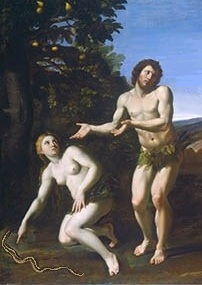
The Rebuke of Adam and Eve, by Domenichino, 1626, detail

“Who told you that you are naked? From the tree about which I ordered you not to eat, did you eat?” And the human said: “The woman whom you gave to be with me, she gave to me from the tree, and I ate.” (Genesis 3:11-12)

The man admits that he ate from the tree, but only after blaming the woman. When God questions the woman, she blames the snake. Then the God character “curses” the snake, the woman, and the man with the ordinary hardships of life outside the mythical garden of Eden, and expels them from the garden so that they will not eat from the Tree of Life and become immortal.

Throughout the conversation, the God character is the authority figure, and the two humans are like children making excuses to avoid being blamed and punished.

Bereishit: lying and begging

The next human God speaks to is the oldest child of the first two humans, Kayin (קַיִן, “Cain” in English). He makes a spontaneous offering to God, and his younger brother Hevel (הֶבֶל, “Abel” in English) follows suit. Kayin gets upset because God only pays attention to Hevel’s offering. Then God warns Kayin to rule over his impulse to do evil, but the warning goes over Kayin’s head.

Cain Leads Abel to Death, by James Tissot, circa 1890

And it happened when they were in the field, and Kayin rose up against his brother Hevel, and he killed him. Then God said to Kayin: “Where is Hevel, your brother?” And Kayin said: “I don’t know. Am I my brother’s shomeir?” (Genesis 4:8-9)

Shomeir (שֺׁמֵר) = watcher, guard, protector, keeper.

Kayin certainly knows where he left Hevel’s body, so his answer “I don’t know” is a lie. He might not have understood what death is before he killed his brother, but he knows now, and he suspects that he did something wrong. So he lies in an effort to escape being blamed.

Next Kayin asks what might be an honest question. Was he supposed to watch over his brother, the way he tends his vegetables and Hevel used to tend his sheep?

On the other hand, his question might be a protest that he is not responsible for protecting his brother, so he should not be blamed for what happened when he “rose up against” Hevel.

The God character does not bother to answer. Instead God curses him with a life of wandering instead of farming. Kayin cries out in alarm:

“My punishment is too great to bear! … Anyone who encounters me will kill me!” (Genesis 4:13-14)

Kayin might be thinking that his future relatives will be angry with him, and kill him the way he killed Hevel.

Then God said to him: “Therefore, anyone who kills Kayin, sevenfold it will be avenged!” And God set a sign for Kayin, so that anyone who encountered him would not strike him down. (Genesis 4:15)

Once again, the God character is the authority figure. Kayin lies to avoid being blamed, but he also (indirectly) begs God for protection, which God provides.

Lekh-Lekha: doubting

The next human to whom God speaks is Noach (נֺחַ, “Noah” in English). God gives Noach orders, and Noach follows them without a word. (See my post Noach: Silent Obedience.) There are no questions.

Avram (אַבְרָם, “Abram” in English) begins his relationship with God on the Noach model. But after God has promised him twice that he will have vast numbers of descendants,1 and twice that his descendants will own the land of Canaan,2 Avram cannot resist speaking up. He points out that at age 75 he is still childless. Then he asks God for more than verbal promises.

“My lord God, how will I know that I will possess it [the land]?” (Genesis 15:8)

The God character responds by staging an elaborate covenant ceremony. (See my post Lekh-Lekha: Conversation.) At its conclusion, God repeats once more that Avram’s descendants will own the land of Canaan.

When Avram is 86, he has a son by his wife Sarai’s servant Hagar, and names the boy Yishmael (יִשְׁמָעֵאל, “Ishmael” in English). Although a divine messenger speaks to Hagar when she is pregnant,3 God does not speak to Avram again until he is 99 years old. Then God manifests to him and announces:

“I am Eil Shadai! Walk about in my presence, and be unblemished!” (Genesis 17:1)

Eil Shadai (אֵל שַׁדַּי) = God who is enough, God of pouring-forth, God of overpowering.

This is the first use in the bible of the name Eil Shaddai. This name for God occurs most often in the context of fertility. Here, the name might encourage Avram to believe God has the power to make even a 99-year-old man and his 89-year-old wife fertile. God continues:

“I set my covenant between me and you, and I will multiply you very much.” (Genesis 17:2)

Avram responds by silently prostrating himself. He already has a covenant with God, and the only multiplication that has happened during all the years since is the birth of Yishmael.

But God outlines a new covenant, this time one in which both parties have responsibilities. First there is the question of names: just as God is now Eil Shadai, Avram will henceforth be Avraham (אַבְרָהָם; “Abraham” in English),

“… because I will make you the av of a throng of nations!”

av (אַב) = father. (Raham is not a word in Biblical Hebrew.)

The God character expands on the usual theme, promising that Avraham’s descendants will include many kings, and they will rule the whole land of Canaan. In return, Avraham must circumcise himself and every male in his household, including slaves, and so must all his descendants.

Next God changes the name of Avraham’s 89-year-old wife from Sarai to Sarah (שָׂרָה = princess, noblewoman), and promises to bless her so that she will bear Avraham a son.

But Avraham flung himself on his face and laughed. And he said in his heart: “Will a hundred-year-old man procreate? And if Sarah, a ninety-year-old woman, gives birth—!” (Genesis 17:17)

In other words, Avraham does not believe God, who has been making the same promise for years. But he does want blessings for the thirteen-year-old son he already has from Hagar.

And Avraham said to God: “If only Yishmael might live in your presence!” (Genesis 17:18)

Then God promises that Yishmael will also be a great nation, but the covenant will go through Avraham’s son from Sarah, who will be born the following year and will be called Yitzchak (יִצְחָק = he laughs; Isaac in English). The God character noticed when Avraham laughed.

The Torah portion closes with Avraham circumcising himself and all the males in his household, including Yishmael. Whether Avraham believes Sarah will give birth or not, he wants to fulfill his own part of the covenant. Why would he risk upsetting God?

In the portion Lekh-Lekha, the God character is more powerful than the man, and Avram/Avraham is careful not to incur God’s displeasure–but he has his own opinions.

Vayeira: teaching

This week’s Torah portion, Vayeira, opens when Avraham sees three men approaching his tent. At least they look like men, and Avraham lavishes hospitality upon them as if they were weary travelers. But the “men” turn out to be divine messengers. Through one of them, God speaks to both Avraham and Sarah, announcing that Sarah will give birth the next year. (See my post Vayeira: On Speaking Terms.)

Abraham and the Three Angels, by Bartolome Esteban Muriollo, ca. 1670

Then Avraham walks with the three “men” to a lookout point, where God says:

“The outcry of Sodom and Gomorrah is great, because their abundant guilt is very heavy. Indeed I will go down, and I will see: Are they doing like the outcry coming to me? [If so,] Annihilation! And if not, I will know.” (Genesis 18:20-21)

Two of the divine messengers continue down to Sodom to see if its people really are as evil as God has heard,4 while God stays with Avraham at the lookout.

Avraham came forward and said: “Would you sweep away the tzadik with the wicked? What if there are fifty tzadikim inside the city? Would you sweep away and not pardon the place for the sake of the fifty tzadikim who are in it? Far be it from you to do this thing, to bring death to the tzadik with the wicked! Then the tzadik would be like the wicked. Far be it from you! The judge of all the earth should do justice!” (Genesis 18:23-25)

tzadik (צַדִּיק) = righteous, innocent. tzadikim (צַדִּיקִם) = people who are righteous or innocent.

This is a new thing in the world: a human being arguing with God and telling God the right thing to do.

Is Avraham the teacher now, and the God character his pupil? How does God react?

See my post next week: Vayeira: Persuasion.


  1. Genesis 12:2, 13:16.
  2. Genesis 12:7, 13:15-17.
  3. Genesis 16:7-12. See my post Lekh-Lekha: First Encounter.
  4. The God character in the Torah is not omniscient.
Noach: Silent Obedience

This week’s Torah portion, Noach (Genesis 6:9-11:31), begins:

These are the histories of Noach: Noach was a tzadik man; he was tamim in his generations; Noach hithalekh God. (Genesis/Bereishit 6:9)

Noach (נֺחַ) = rest, resting-place; “Noah” in English.

tzadik (צַדִּיק) = in the right, just, God-fearing, innocent.

tamim (תָּמִים) = whole, intact, unblemished, perfect, unobjectionable.

hithalekh (הִתְהַלֶּךְ) = walked around with, went around with, followed around.

Is Noach being praised as a morally and religiously superior person?

Tzadik could mean righteous, or merely innocent. Tamim could mean perfect, or merely unobjectionable relative to others. The verb hithalekh could mean that Noach followed direct instructions from God, but did not take initiative to follow the spirit of God’s directives like Abraham and Hezekiah, who “walked around in God’s presence”.1

As the story of the flood unfolds, Noach does everything God tells him to. But does this make him virtuous? Or is he merely resting, like his name, because it is easier not to think for himself?

Not too awful

Just before the Torah portion begins, the text sets the scene:

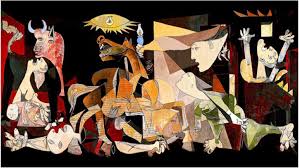
Guernica, by Pablo Picasso, 1937

Then God saw that great was the evil-doing of the human on the earth, and every shape of its conscious planning was only evil all the time. And God had a change of heart about making the human on the earth, and [God] felt mental anguish. And God said: “I will wipe out humankind, which I created, from the face of the earth, from human to beast to crawling thing to flying thing of the sky, because I have had a change of heart about making them.” But Noach found favor in the eyes of God. (Genesis 6:5-8)

(See my post Noach: Spoiled on why God wipes out all the other land animals, as well as human beings, except those on Noach’s ark.)

In the context of massive evil-doing by nearly all human beings, it need not take much for the God character to view Noach favorably. At least Noach is innocent and unobjectionable, and takes orders.

According to Avivah Gottlieb Zornberg, “So, here, God chooses Noah, not because he has achieved significant wisdom or virtue, but because He seeks to convey to some one the knowledge of Himself.”2

I find it hard to believe that out of the entire human population, Noach is the only family head who is innocent, unobjectionable, and obedient (and has some carpentry skills). Surely there must be a few other meek and non-violent men. So why does God choose Noach?

According to Daniel Feldman, God chooses Noach because he is calm. “… the prized attribute he possessed is hinted at in his name, Noach, which suggested calmness. In other words, he was in control of his temperament, and did not give himself to anger … On the other hand, a failure to anger can sometimes reflect a failure to respond to, or even to notice, injustice and immoral behavior in one’s orbit. Accordingly, the source of Noach’s chein [favor] may equally have been the source of his criticized passivity.”3

Noach’s silence

Noah is minding his own business when God suddenly speaks to him.

And God said to Noah: “The end of all flesh is coming before Me, because the earth is filled with violence because of them. So here I am, ruining them along with the land. Make for yourself an ark of gofer wood …” (Genesis 6:12-6:14)

Noah listens silently to the instructions of the voice in his head, and follows them to the letter.

And Noah did everything God commanded him; that is what he did. (Genesis 6:22)

Another person might ask why God plans to drown all the animals on earth except for those in the ark: eight humans (Noah, his wife, their three sons, and the sons’ wives) and one pair of each of other species.4 Even if almost all adult humans are violent and do evil, some of them might repent if they were warned. Some children might learn better behavior. And what about all the non-human animals God has doomed?

But Noah only does what he is told.

Then God said to Noah: “Come into the ark, you and your whole household, for I have seen you are a tzadik before me in this generation.” (Genesis 7:1)

The “you” in this sentence is singular, not plural; it does not seem to matter whether Noah’s wife, sons, and daughters-in-law are innocent.

After giving some additional instructions about animals, God says:

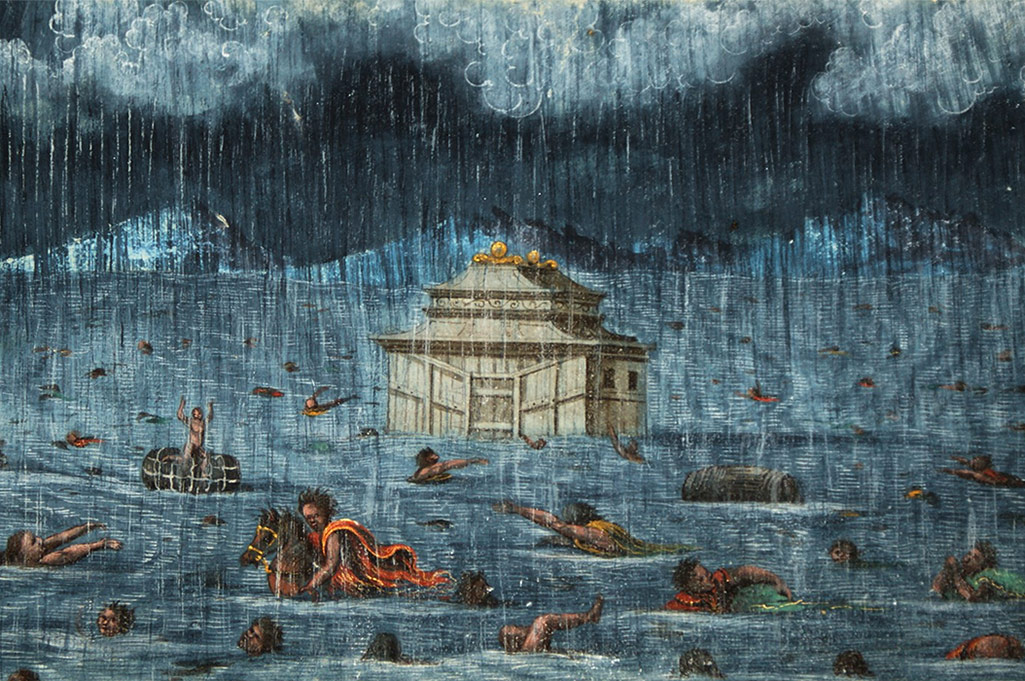
Noah’s Ark and the Flood, Augsburg Book of Miracles, ca. 1552

“For in another seven days, I will be sending rain upon the earth forty days and forty nights, and I will wipe out everything that exists, that I made, from the surface of the land.” (Genesis 7:4)

Apparently this explicit warning still does not inspire Noach to speak—either to question God, or to tell any humans outside his immediate family what is about to happen.5 The text only repeats:

And Noach did everything that God had commanded him. (Genesis 7:5)

Failure to question or pray

According to one 18th-century commentary, Or HaChayim, “Noach became convinced from what God told him that any prayer of his would be futile, that the fate of these people had been sealed beyond reprieve. All of this is contained in the words: ‘the end of all flesh has come before Me, here I am about to destroy them.’”6

Another 18th-century commentary, Kedushat Levi, attributed Noach’s decision to remain silent to his own self-evaluation: “Now even though Noah was a great and blameless tsaddik, he was very small in his own eyes and did not have faith that he was a powerful tsaddik with the ability to annul the decree of the flood. In fact, he thought of himself as being equal to the rest of his generation. …Therefore, he did not pray to save the people of his generation.”7

But this is a poor excuse, wrote Arthur Green. “The question is whether we choose to stand up and act for the good, even while knowing that we may not succeed and that our actions will be imperfect.”8

Modern commentator Norman Cohen, on the other hand, wrote that Noach is passive because he is self-centered.  “Noah saw the world through the narrow prism of his own life and his own needs. He was concerned only with himself—a trait evident in most young children. He seemed to show a lack of compassion for all the rest of humanity, which was about to be destroyed. All that mattered to him was that the ark would guarantee his survival and that of his household.”9

Failure to warn

The same explanations for why Noach fails to speak up to God also apply to the question of why Noach fails to warn other human beings.

Irreversible fate. Just as God seems adamant about wiping out all humans and land animals except for those on the ark, Noach’s neighbors might seem unyielding in their determination to do wholesale violence. He might believe that warning them about their fate would be useless, since they would never reform. (He might also think that even if a few people did repent, God would not let him smuggle them on the ark, or let them build their own boats.)

Low self-esteem. Just as Noach does not believe God would listen to him, Noach would not believe that other people would listen to him. A low self-opinion makes everyone else look more powerful. Feldman wrote: “In order to react proactively to injustice, one must first have faith in their own ability to make a difference. A lack of such faith can result in the perception that all reaction is futile, and not worth the effort.”10

Egocentrism. If the problem is that Noach is so self-centered that he lacks compassion, he has no motivation to go to the trouble of warning people about the coming flood. Avivah Gottlieb Zornberg wrote: “It is not surprising that he is not effective in swaying his contemporaries. … Noah’s silence, I suggest, is essentially a metastasis of the sickness of his time. He is incurious, he does not know and does not care what happens to others. He suffers from the incapacity to speak meaningfully to God or to his fellow human beings.”11 Zornberg added that Noach’s time in the ark teaches him about compassion, since he and his family must spend all their time feeding the various animals. “… there is feeding, the acute awareness of timing and taste in nurturing the other. I suggest that feeding animals becomes a year-long workshop in … kindness.”12


Noach’s name means “rest”. When he is born, his father, Lemekh, gives him that name as an expression of hope, saying:

“May this one give us a change of heart from our labor and from the toil of our hands, from the ground that God cursed.” (Genesis 5:29)

Eight long generations after God cursed the ground so that Adam would have to work hard to farm it,13 Lemekh is fed up with the endless labor and wants some rest.

We all want rest from hard labor, time off to do the things that please us. Over the millennia, humans have found ways to reduce the hardship—through inventing technologies, yes, but mostly through cooperating and helping each other. When we engage in too much violence, the system falls apart and people starve. The cure for a world of violence, as the God character realizes at the end of the story of the flood,14 is not to make an ark to rescue a select few and start a new world. The cure is the mutual aid that can only happen if we are not like Noach—only if we care about our fellow creatures, and do not rest silently in the belief that our efforts would be futile.


  1. Noach and Enoch (Genesis 5:24) “walked around with God” (et ha-Elohim hithalekh, אֶת הָאֱלֺהִים הִתְהַלֶּךְ). The Hebrew Bible also refers three times to walking around in God’s presence (lehithaleikh lifnei Elohim, לְהִתְהַלֵּךְ לִפְנֵי אֱלֺהִים), by Abraham in Genesis 24:40, Hezekiah in 2 Kings 20:3 and Isaiah 38:3, and the psalmist in Psalm 56:14. The injunction to “walk humbly with your God” in Micah 6:8 uses the infinitive kal form of the verb halakh (lekhet, לֶכֶת = “to walk”), rather than the infinitive hitpael form of the verb (hithaleikh, הִתְְהַלֵּךְ = to walk around).
  2. Avivah Gottlieb Zornberg, The Beginning of Desire: Reflections on Genesis, Doubleday, New York, 1995, p. 41.
  3. Daniel Z. Feldman, “Noach: Of Rage, Rainbows, and Redemption”, Mitokh Ha-Ohel: Essages on the Weekly Parashah from the Rabbis and Professors of Yeshiva University, Yeshiva University, New York, 2010.
  4. Genesis 6:19-20.
  5. See my 2013 post Noach: Righteous Choices.
  6. Chayim ben Moshe ibn Attar (c.1718 – c.1742), Or HaChayim, on 6:13, translated in www.sefaria.org.
  7. Levi Yitzchak of Berdyczow (1740-1809), Kedushat Levi, translated by Arthur Green in Speaking Torah: Vol. 1, Jewish Lights Publishing, Woodstock, VT, 2013, p. 90.
  8. Arthur Green, Speaking Torah Vol. 1, commentary on Kedushat Levi, p. 90.
  9. Norman J. Cohen, Voices from Genesis, Jewish Lights Publishing, Woodstock, VT, 2001, p. 52.
  10. Feldman, ibid.
  11. Zornberg,p. 58.
  12. Ibid, p. 61.
  13. Genesis 3:17.
  14. Genesis 8:21.

Bereishit: Darkness First

Simchat Torah (“Joy of the Torah”) is the day when, besides dancing with the Torah scroll, Jews read the end of Deuteronomy/Devarim, then roll the Torah scroll all the way back to the beginning and start reading Genesis/Bereishit. The annual cycle of Torah portions begins again!1

Then for Shabbat this Saturday morning we read from the first Torah portion in Genesis. In this blog post, let’s look at the darkness at the beginning of the book.

Darkness before light

The book of Genesis begins with a grand poetic work describing six days of creation and a seventh day of rest. It opens by stating the subject of the composition:

At the beginning God created the heavens and ha-aretz. (Genesis/Bereishit 1:1)

ha-aretz (הָאָרֶץ) = the earth, the land, the ground; the world.

In Genesis 1:1 it means “the earth”, since the heavens and the earth together make the created world. In the next verse, we learn that God does not create the world ex nihilo, out of nothing. What already existed before God begins to speak was dark, shapeless, and watery.

And ha-aretz had been2 undifferentiated unreality, and darkness over the face of tehom; and the breath of God hovered over the surface of the water. (Genesis 1:2)

In this verse, the best translation for ha-aretz is “world”, since it refers to what existed before there was a solid mass of earth (or, in today’s terms, a planet). “Undifferentiated unreality” is one translation for tohu vavohu (תֺטוּ וָבֺהטוּ). The “breath” of God is one translation for God’s ruach (רוּחַ). (See my post Bereishit: Before the Beginning for alternate translations of tohu vavohu and ruach.)

The Hebrew word for darkness is choshekh (חֺשֶׁךְ), which captures both the literal usage and many of the same metaphorical usages as in English. But the darkness is over the surface of something else: tehom.

tehom (תְהוֹם) = a source of deep water, i.e. an underground spring; the subterranean water beneath the earth.

In the second verse of Genesis, tehom probably means infinitely deep water, since the breathof God hovers “over the surface of the water”.

Hieronymus Bosch, exterior shutters of The Garden of Earthly Delights, 15th century. In ancient Israelite cosmology, the black background would represent the waters above and below.

(As in much literature from the Ancient Near East, the Hebrew Bible pictures the universe as having four layers. The bottom is tehom, the water below, which extends downward infinitely, but is capped at the top by a layer of solid earth (with some rivers, lakes, and so forth). Above the earth is air and sky, the lower part of the heavens. The upper part of the heavens consists of more water: the water above, which extends upward infinitely.)

Both darkness and God’s “breath” are described as being over, or above, the tehom. So even though everything is undifferentiated unreality before God begins to create, there is in fact one distinction before creation: above and below. Either God is one of the things in the undifferentiated unreality above the tehom, or God is another category altogether, and only God’s hovering breath is there above the tehom.

Having established the situation before God begins to create, the text continues:

And God said: “Light, be!” And light was. And God saw the light, that it was good. And God separated the light from the darkness. And God called the light day, and the darkness night. And it was evening and it was morning, one day. (Genesis 1:3-5)

The separation of light from darkness creates the first day, consisting of a period of light (newly created) and a period of darkness (already there before God spoke).

So what does “darkness”, choshekh, mean in the first five verses of Genesis?

Is darkness visible?

Does “darkness” mean the absence of light, or is it something that is present, the way light is present? The clause “… and darkness was over the face of tehom …” implies that there was something above the surface of the water. If darkness meant the mere absence of light, the Torah could have said “… and nothing was over the face of tehom …”.

Furthermore, the curious sentence “And God separated the light from the darkness” implies that when light popped into being, it was mixed together with darkness at first. Then God began creating the orderly world by separating these two opposites, in time if not in space. The next verse says: “God called the light day, and the darkness night”.3

When God creates the plague of darkness in the book of Exodus, darkness seems like a visible and tangible substance.

And God said to Moses: “Stretch out your hand up to the heavens, and darkness will be over the land of Egypt, and [the Egyptians] will feel darkness!” And Moses stretched his hand up to the heavens, and gloomy darkness was in all the land of Egypt three days. A man could not see his brother, a man could not get up from his spot, for three days. But for all the Israelites, light was in their dwelling-places. (Exodus/Shemot 10:21-23)

The poetic image is of a darkness so dense that it presses against the skin. But then it becomes clear that the Egyptians are totally blind for three days, while the Israelites can still see light.

One tradition in Jewish commentary is that darkness did exist before God spoke light into being, but the darkness was invisible. (This begs the question of whether something can be invisible if there is nobody to see it.) The writer known as Pseudo-Philo, who lived circa 70-150 C.E., imagined King David singing: “Darkness and silence were before the world was made, and silence spoke and the darkness became visible.”4

This implies that God was the primordial silence, and darkness was the primordial light. First God changed, by speaking. Then God’s first words, “Light, be!” changed darkness into light, making it visible.

In the 12th or 13th century, Radak wrote that the darkness before God spoke was actually a type of fire, but it was invisible because it could not produce light. He added that this invisible fire is still present at night. “If this primordial fire would give off light, we would be able to see at nighttime. The night would appear to us as if it were aflame.”5

Is darkness bad?

And God saw the light, that it was good … (Genesis 1:4)

Does that mean merely that God identifies light as good? Or does it mean that darkness is bad by contrast?

The implication that light is good and darkness is bad appears as early as Second Isaiah, written in the 6th century B.C.E.:

Forming light and creating darkness, making peace and creating evil—I, God, am doing all these. (Isaiah 45:7)

But many commentators have objected to the idea that God creates, or created, evil. They take the view that there is only one God and God is good, so therefore evil must come from a different source. But what is the source? One common answer to the “Problem of Evil” is that God gave human beings free will, and therefore we sometimes choose to commit evil acts. But this does not explain another category of evil: the natural causes of diseases and disasters that make innocent people suffer.

One solution to the problem is that our world is “the best of all possible worlds”, the explanation of Gottfried Leibniz in his 1710 book known as the Theodicy. But the first chapter of Genesis indicates a different solution. Israel Knohl wrote:

“In my view, the Priestly description of Creation is an effort to solve this fundamental dilemma. The primeval elements tohu [undifferentiation], choshekh [darkness], and tehom [water below] all belong to the evil sphere. The three elements comprising the preexistent cosmic substance are the roots (put another way, the substance) of the evil in the world. At the conclusion of the Priestly account of Creation, it is written: ‘And God saw all that He had made, and found it very good’ (Gen. 1:31). All that God had made was very good. Evil was not made by God. It predated the Creation in Genesis 1!”6

But S.R. Hirsch pointed out that if we assume that God did not create darkness, we end up limiting God’s abilities:

“If matter had antedated Creation, then the Creator of the universe would have been able to fashion from the material given Him not a world that was absolutely good, but only the best world possible within the limitations of the material. In that case, all evil—natural and moral—would be due to the inherent faultiness of the material, and not even God would be able to save the world from evil, natural or moral.”8

Since Hirsch could not accept the idea that God is not omnipotent, he insisted that God created everything that ever was, including the darkness that existed before God created light. Then he maintained that God is omnibenevolent, and this is not merely the best of all possible worlds, but the only ultimately good world.

“This world—with all its seeming flaws—corresponds with the wise plan of the creator; He could have created a different world, has such a world corresponded with His Will. … Both, the world and man, will reach the highest ideal of the good, for which both were created. They will achieve this level of good because God, Who has placed this goal before them, has created them both for this goal, in accordance with His free and unlimited Will.”9

Assigning a goal to not just human beings, but the whole natural world, strains credulity. Is it worth denying the plain meaning of Genesis 1:2—that chaotic undifferentiation, darkness, and the mysterious deeps existed before God started creating the world—in order to defend the post-biblical belief that God is omnipotent, omniscient, and omnibenevolent?


The beginning of Genesis does not say that God created darkness. Nor does it say that darkness is evil. Darkness is just there, like God’s hovering breath. Evil does not come into the picture until after God has created humankind.

After all, we humans decide what we classify as evil.


  1. Some congregations read an entire Torah portion each week, while others read a third of the Torah portion on that week. (One year it is the first third, the next year it is the middle third, and the third year it is the last third.) By either system, Jewish congregations finish Deuteronomy and start Genesis again on Simchat Torah.
  2. In Genesis 1:2, the noun ha-aretz comes before the verb, haitah (הָיְתתָה), which is in the perfect form. This syntax is used in Biblical Hebrew to indicate the past perfect, so the correct translation is “And the earth had been …” (Richard Elliott Friedman, Commentary on the Torah, HarperCollins Publishers, New York, 2001, p. 6) 
  3. God does not create the sun until the fourth day. However, on the fourth day God says that the purpose of the sun, moon, and stars is: “to separate the day from the night”(Genesis 1:14).
  4. Pseudo-Philo, Book of Biblical Antiquities, translated by Howard Jacobson, Outside the Bible, Jewish Publication Society, 2013, p. 601.
  5. Radak (Rabbi David Kimchi, 1160-1235), translated in www.sefaria.org.
  6. Israel Knohl, The Divine Symphony: The Bible’s Many Voices, The Jewish Publication Society, Philadelphia, 2003, p. 12.
  7. See my post Psalm 73: When Good Things Happen.
  8. Samson Raphael Hirsch, The Hirsch Chumash: Sefer Bereshis, English translation by Daniel Haberman, Feldheim Publishers, Jerusalem, 2002, p. 1.
  9. Ibid, p. 2.

Bereishit & Noach: What Ruined the World?

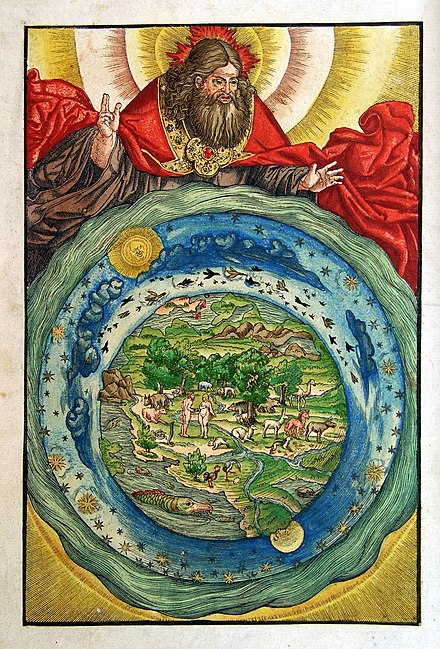
Creation, by Lucas Cranach, 1434

On the sixth “day” of creation God creates land animals, including humans.

And God saw everything [God] had made, and hey! It was very good. And it was evening and it was morning, the sixth day. (Genesis 1:31)

But by the end of this first Torah portion in Genesis, Bereishit, something has gone wrong.

Then God saw that the evil of humankind was abundant on the earth, and all the shapes of the plans of its mind were only evil all the time. And God had second thoughts about making the human being on the earth, and [God’s] heart was distressed. And God thought: “I will wipe out the human that I created from upon the face of the earth—from humankind to beasts to creeping animals to flying animals in the sky—because I have had second thoughts about making them.” But Noach found favor in the eyes of God. (Genesis 6:5-8)

Noach (נֺחַ) = rest, resting-place; the personal name “Noah” in English.

Humans are generating so much evil that God wants to roll back creation to somewhere on the fifth “day” and start over again.

What kind of evil? The beginning of this week’s Torah portion, Noach (Genesis 6:9-11:32), narrows it down a bit.

The earth had become ruined in front of God; the earth was filled with chamas. And God looked at the earth, and hey! It was ruined, because all basar had ruined its ways on the earth. And God said to Noach: “The end of all basar is coming before me! For the earth is filled with chamas because of them. So here I am, ruinging them along with the earth! Make for yourself an ark of gofer wood …” (Genesis 6:11-14)

chamas (חָמָס) = violence.

basar (בָּשָׂר) = soft tissue of a human or other animal, including skin, muscle, meat; animals in general. (See my post Bereishit & Noach: All Flesh.)

After giving instructions for building the ark, God tells Noach:“As for me, here I am bringing the flood waters over the earth, to ruin all basar with a breath of life in it under the skies.” (Genesis 6:17)

All flesh

In the Noach story, the phrase “all flesh” (kol basar) means all non-human land animals four times in order to emphasize that Noach and his family are saving a pair of every type of animal.  “All flesh” means all land animals, including humans, eight times in the Noach story.1 For example:

And all basar expired: the crawlers on the earth, birds and beasts, and all swarming creatures that swarm on the earth, and all the human beings. Everything that breathed the air of life in its nostrils, out of all that were on dry land, died.  (Genesis 7:21-22)

The portion Noach states at the beginning that all basar had “ruined its ways on the earth” (Genesis 6:12), and then God tells Noach: “the earth is filled with chamas because of them” (Genesis 6:13). It is reasonable to conclude that God floods the earth because all land animals, including humans, are ruining God’s creation through violence.

What kind of violence?

What kind of chamas has ruined the earth? Classic commentators suggested four answers2:

Robbery. For example, “There is a discussion between the sages as to the difference in meaning between the word: חמס (violence) and the word גזל (robbery) when used in the Holy Scriptures. According to Rabbi Chaninah, the difference is merely in the amount misappropriated by violent means.” (Chizkuni, in response to earlier commentary including Rashi).

I reject robbery as a candidate because although I can imagine one animal biting another in order to steal its stash of food, this kind of behavior is never mentioned in the Torah.

Idolatry. For example, “Ḥamas refers to idolatry, as it is stated [in Ezekiel 8:17—Is it so little for the house of Judah, doing the abominations that they do here, that] they filled the earth with ḥamas?” (Bereishit Rabbah 31:6).

I reject idolatry as a candidate for two reasons: 1)  Ezekiel might have meant that the Judahites were violent in addition to committing abominations, and 2) Non-human animals exhibit no god-worshiping behavior, violent or otherwise.

Sexual misconduct. For example, “The dog would consort with the wolf, and the chicken would consort with the peacock.” (Bereishit Rabbah 28:8). “All flesh engaged in unnatural and perverted sexual acts.” (Ibn Ezra). “They raped women against their will.” (Chizkuni).

I reject this theory because no sexual violence or other sexual misconduct is mentioned in the Torah until after the flood.

Shedding innocent blood. For example, “Ḥamas refers to bloodshed, as it is stated: “[in Joel 4:19—Egypt shall be a desolation and Edom a desolate waste] due to the ḥamas against the children of Judah, that they shed innocent blood.” (Bereishit Rabbah 31:6).

Shedding innocent blood certainly counts as chamas, and too much of it might well make the God character conclude that the world is ruined. The quote from the book of Joel in Bereishit Rabbah refers to humans shedding the blood of other humans, but it is also possible that the word chamas applies to other kinds of bloodshed.

When God has second thoughts about the world, what innocent blood is being shed, and by whom? The Torah portions Bereishit and Noach support two different answers. In one, humans and some of the other animals are shedding the blood of innocent animals in order to eat them. In the other, evil humans are murdering innocent humans.

Carnivores versus herbivores

On the sixth “day” of creation, God tells the first humans:

“Hey! I give you all seed-bearing plants that are on the face of the whole earth, and all the trees with seed-bearing fruits; they shall be your food. And to all animals on the land, and all birds in the skies, and all crawlers on the ground that have the animating soul of life in them: all green plants for food.” (Genesis 1:29-30)

Thus God’s original plan is for all animals, including humans, to follow a vegan diet. No animals are created to be carnivores.

The next episode in the book of Genesis is an older creation story, in which the first living thing God creates is the human being. Then God plants the garden of Eden and transfers the androgynous human there. God gives it permission to eat fruit:

“From every tree of the garden you may certainly eat. But from the Tree of the Knowledge of Good and Evil, you should not eat from it …” (Genesis 2:16-17)

Then God makes animals and brings them to the human to name. The approved diet for these animals is not mentioned. Later, when God is about to banish the first two humans from Eden, along with the snake, God says that in the real world the snake will eat dust.

“On your belly you will go, and dust you will eat, all the days of your life.” (Genesis 3:14).

Eating dust might be an idiom, as in English, leaving the snake’s actual source of nutrition unspecified. But God does say what the man will eat after he is expelled from the garden of Eden:

“And your food will be the plants of the field. By the sweat of your face you will eat bread.” (Genesis 3:18-19)

Perhaps, over time, all flesh—humans and other predatory animals—ruin the world that God created by becoming carnivores. After all, eating meat, basar, requires the death of an animal—a violent act of bloodshed, since any animal struggles against its killer.

If this is the widespread chamas that is ruining the world, the flood makes sense as God’s solution. If all flesh were wiped out, God could repopulate the earth with creatures designed so they would stay vegetarian.

Yet after the flood is over, God decides to put up with the evil inclinations of humans. God specifically accepts the practice of eating meat, telling Noach and his sons:

“Fear and dread of you will be upon every beast of the earth, and upon every bird of the skies, in everything that crawls on the ground, and in every fish in the sea; into your hand I give them. Every crawler that is alive will be yours for eating; as with green plants, I give them all to you.” (Genesis 9:2-3)

The only caveats God makes are that humans must not drink an animal’s blood; and that neither a human nor a beast can shed human blood and get away with it.

Whoever sheds the blood of humankind, by humankind his blood must be shed.” (Genesis 9: 6)

Killing and eating animals is now an acceptable form of violence; but human murder is not.

Human versus human

After the expulsion from Eden and before God decides to flood the earth, there is another story about chamas—one in which the evil behavior is murder, not eating meat.

Adam and Eve’s first son, Cain, farms the soil, and their second son, Abel, tends a flock. This division of labor bothered some classic commentators, who tried to reconcile being a shepherd with following God’s instructions to eat only plants.

“The one who became the shepherd was interested in eating the dairy products obtainable from the sheep and goats. He was also in need of the wool of the sheep to make clothing. They restricted themselves to these vocations, seeing that God had not permitted the eating of meat but only grass, fruit of the trees, and bread …” (Radak)3

The Torah does not report that any of the first four humans eats a sheep or goat. But Abel does become the first human to kill an animal.

And Cain brought from the fruit of the ground an offering to God. And Abel, also he, brought from the firstborn of his flock and from their fattest. And God paid regard to Abel and to his offering. But to Cain and to his offering, [God] paid no regard. And Cain was very angry and his face fell. (Genesis 4:3-5)

In the Torah, every animal offering is butchered, and at least part of it is burned up into smoke, which God enjoys smelling. (See my post Pinchas: Aromatherapy.) Since God indicates approval of Abel’s offering in some way, we can conclude that God is not distressed when Abel kills an animal in his flock. Perhaps animal-killing is acceptable as an act of worship, even though eating its flesh is still unacceptable.4

Cain is so upset about God’s preference for Abel that he becomes the first human to commit murder. We can assume that the murder involves violent bloodshed, since God tells Cain:

“And now you will be more cursed than the ground, which opened its mouth to take in the blood of your brother from your hand!” (Genesis 4:11)

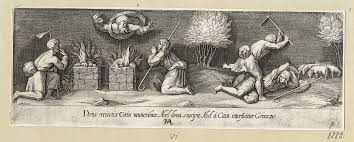
Cain and Abel, 1624 print by Francesco Villamena, after Raphael

The next biblical reference to killing a fellow creature, human or beast, is when six generation later a man named Lemekh brags:

“I have killed a man for crushing me, and a boy for bruising me!” (Genesis 4:23)

Then (after a quick, unconnected story about lesser gods mating with human women to produce heroes) God sees that humankind has become evil, and all basar has filled the world with chamas.

One more indication that God does not object to humans killing beasts is that after the flood, Noah builds an altar, kills some extra animals, and burns them as offering to God. As in the story of Cain and Abel, God appreciates the animal offering.

And God smelled the soothing smell, and God said in [God’s] heart: Never again [will I] curse the ground on account of humankind, because the impulse of the human heart is evil from its youth. And never again [will I] strike down all life, as I have done.” (Genesis 8:20-21).

According to classic commentary, God decides that it is only natural for children to act on their bad impulses, but adults can learn to control these impulses and be good. Throughout the Torah, sacrificing animals to worship God is considered good behavior. God must think so, too, even before the flood. (See my post Noach: The Soother.)

“He ascribes merit to men because by their very creation they have an evil nature in their youthful days but not in their mature years.” (Ramban)5

After that, God explicitly gives Noah and his sons permission to eat meat—although presumably they will have to wait until the animals they saved on the ark have reproduced.

Why does God wipe out not only humankind, but all animals?

If the chamas that distresses God is carnivorous behavior, then why does God drown all the land animals, including herbivores? Is it too much work to create a plague that kills only the carnivorous species?

Similarly, if the kind of chamas that distresses God is human murder, then why does God make a flood that wipes out not only humankind, but also every land animal that is not on Noah’s ark?

The Talmud imagines God answering:

“Did I create domesticated animals and non-domesticated animals for any reason other than for man? Now that man sins and is sentenced to destruction, why do I need domesticated animals and non-domesticated animals?” (Talmud Bavli, Sanhedrin 108a)5

In other words, God drowns the other animals because they have no value apart from their usefulness to humans. After all, in the first creation story God tells the newly created humans:

“Be fruitful and multiply, and fill the earth and subjugate it, and rule over the fish of the sea and over the birds of the skies and over everything alive crawling on the land.” (Genesis 1:28)

In Genesis, non-human animals are clearly inferior to humans, and do not deserve the same respect. Therefore if a flood is the easiest way to wipe out the whole human population, the fact that it wipes out other animals as well is irrelevant to God—as long as enough are preserved on the ark to repopulate the world, and to be burned as offerings to God.


What is the chamas that makes God have second thoughts about creating the world? The book of Genesis provides evidence for both the theory that the world is ruined by carnivorous behavior, and the theory that the world is ruined by human murder. But God and humankind are made in the same “image”, and the death by violence of a fellow human usually causes the most despair in humans themselves.

Today, chamas (חָמָס) is the Hebrew spelling of the Arabic acronym Charakat al-Muqawama al-Islamiya (“Islamic Resistance Movement”)—spelled “Hamas” in English. This group, founded in 1987, has been the de facto government of the Gaza strip since 2007. As I write this post, Hamas is engaged in a terrorist invasion of Israel marked by personal violence.

Since “the impulse of the human heart is evil from its youth”, what will it take for all of humanity to learn to reject violence?


  1. Kol basar refers to all non-human animals in Genesis 6:19, 7:15, 7:16, and 8:17. Kol basar refers to all animals including humans in 6:12, 6:13, 6:17, 7:21, 9:11, 9:15 (twice), and 9:17. The phrase does not refer to all human flesh until Deuteronomy 5:23.
  2. Translations of Chizkuni (13th century) and Bereishit Rabbah (4th-5th century C.E.), are from www.sefaria.org.
  3. Radak (Rabbi David Kimchi),13th century; translation from www.sefaria.org. Also see Siftei Chakhamim, 17th century, on Genesis 4:2.
  4. Of course, it is also possible that the author of the story of Cain and Abel was unaware of the vegetarian diet commanded in the two creation stories. Scholars date the story of the six days of creation to the 6th century B.C.E., and the subsequent stories in the Torah portion Bereishit to an earlier date.
  5. Talmud Bavli, Sanhedrin 108a:20, William Davidson translation, www.sefaria.org.

Bereishit: Before the Beginning

This week we roll the Torah scroll back to the beginning, and read:

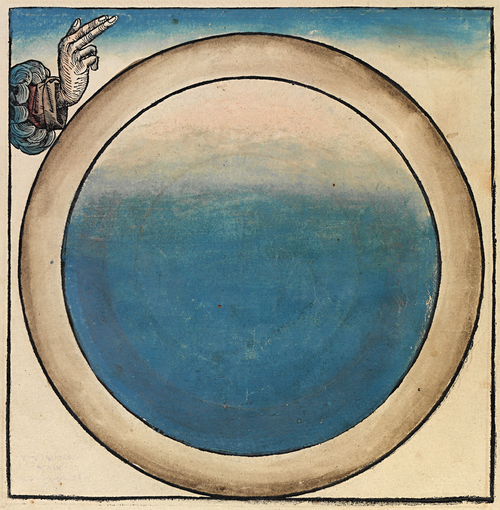
First Day of Creation, Nuremberg Chronicle, 1493

Bereishit, God created the heavens and the earth and the earth had been tohu vavohu, and darkness over the face of tehom, and a ruach of Elohim was hovering over the face of the waters — then God said: “Light, be!” and light was. (Genesis/Bereishit 1:1-3)

Beginning

bereishit (בְּרֵאשִׁית) = in a beginning, at first, when first. (The prepositional prefix be- (בְּ) =in, at, among, through, by, when. Reishit (רֵאשִׁית) = (noun) a beginning, a first step, a starting point; (adjective) first-rate, choicest, best.)

Two possible accurate translations of Genesis 1:1 are “In a beginning, God created” or “When God first created”.

Although the old King James translation of the first word as “In the beginning” is no longer popular, it is also a reasonable possibility. Normally a prefix meaning “in the” would be ba (בַּ), not be- (בְּ). But reishit is an unusual word, in that it does not take a definite article even in contexts where the English translation would be “the beginning” or “the first step”. In 50 of the 51 times that reishit appears in the Hebrew Bible, there is no prefix indicating a definite article (“the”).1 And the word bereishit appears four times in the book of Jeremiah in the phrase “at the beginning of the reign of”.2

Therefore, the translation “In the beginning, God created” is also accurate—and it has a different implication. “In the beginning” indicates that there was only one beginning. “In a beginning” indicates that this creation story describes only one beginning, and there might have been—or will be—others.3

What does God create in this verse of the bible?

… the  shamayim and the eretz … (Genesis 1:1)

shamayim (שָׁמַיִם) = heavens, skies.

eretz (אֶרֶץ) = land, earth.

Shamayim, always plural, refers to the visible dome above the horizon containing the sun, moon, stars, and clouds. Birds fly in the shamayim. The heavens are not called the abode of God until Deuteronomy 26:15.4

Eretz can refer to a specific land (such as “Eretz Israel”), or to all the land in the world. Eretz can also mean “Earth”—our world—but not dirt, which is adamah. In Genesis 1:1-2 God has not yet created land, so eretz can only mean Earth or the world.5

Yet what God creates on the first “day” is not the heavens and the earth, but light:

Then God said: “Light, be!” and light was. And God saw the light, that it was good, and God separated the light from the darkness. And God called the light day, and called the darkness night. And it was evening and it was morning, one day. (Genesis 1:3-5)

What does God create first: the heavens and the earth, or light? 20th-century translator Everett Fox explained that “the shamayim and the eretzis “probably a merism—an inclusive idiom meaning ‘everything’ or ‘everywhere’—such as Hamlet’s ‘There are more things in heaven and earth …’”

So Genesis 1:1 actually means one of the following:

  1. In the beginning, God created the world—
  2. In a beginning, God created the world—
  3. When God first created the world—

Translation 1 implies that God created only one world, and this is it. There was a single moment when creation began; the moment when God created light.

Translations 2 and 3 leave the possibility open that our world is one of many that God has or will create. Other worlds may exist in a different time and/or space.

“There was a God before He created the world, who was perhaps involved in other things prior to choosing to turn His Divine attention to our homeland. … Genesis 1:1 is the biblical account of the commencement of our narrative journey, but not necessarily God’s.” (Dennis Shulman,)6

Translation 3 also opens the possibility that God’s creation of the world did not stop on the seventh “day”, but is ongoing.

“The Lord created the world in a state of beginning. The universe is always in an uncompleted state, in the form of its beginning. It is not like a vessel at which the master works to finish it; it requires continuous labor and renewal by creative forces. Should these cease for only a second, the universe would return to primeval chaos.” (Simcha Bunim Bonhardt)7

Tohu

You might have noticed that so far I have not referred to Genesis 1:2. This parenthetical but important verse is inserted between “When God first created the world” and “God said: Light, be! And light was.”

— and the eretz [Earth] had been tohu vavohu, and darkness over the face of tehom, and a ruach of Elohim was hovering over the face of the waters — (Genesis 1:2)

tohu (תֺהוּ)= emptiness, unreality; worthlessness, worthless people or things; chaos, shapelessness, undifferentiation.

vavohu (וָבֺהוּ) = “and the vohu”. The word vohu appears only three times in the bible,8 always as part of tohu vavohu. Therefore vavohu is probably an intensifier for tohu, and is often translated with an alliterative synonym, as in “void and vacant”, “chaos and confusion”, “a worthless waste”, “a hodge-podge”, or “a mish-mash”. Tohu vavohu could also mean “an insubstantial unreality”.

The word tohu appears in the Hebrew 20 times. Eleven of these occurrences use the word either as a synonym for “nothing”, or as a descriptor of an empty, depopulated desert.9 In six other places, tohu is a synonym for either “worthlessness” or “worthless people or things”.10 This leaves two occurrences of the word tohu that are harder to translate. One is the tohu vavohu in Genesis 1:2; the other is in second Isaiah.

The creator of the heavens, he is God,
          who formed the earth and made it.
          He established it.
He did not create tohu;
          For dwelling he shaped it. (Isaiah 45:18)

In other words, God created the world as an orderly place to live in; God did not create undifferentiated chaos.

One opinion in the commentary is that tohu is indeterminate matter that has the potential to become something definite.

“The first raw material was something entirely new. It is described as tohu to indicate that at that point it was merely something which had potential, the potential not yet having been converted to something actual.” (Sforno)11

It seems that when God began to create the world in the book of Genesis, tohu already existed. That means God did not create the world ex nihilo, out of nothing, as many Jewish and Christian commentators have claimed from the first century C.E. onward. God had tohu, at least, as a raw material—though God may have previously created tohu vavohu, darkness, and tehom.

On the other hand, some commentators claim that these words describe what the universe was like before God created anything.

“At the beginning of creation, God encounters primordial material (Genesis 1:2) … The universe in its pristine state betrayed a disorganization and utter lack of order which God found intolerable and on which He felt compelled to impose order. … His dissatisfaction with the chaotic state of existence leads to the reordering, classifying, and distinguishing described in the primordial week of creation.”12

“This description raises two questions potentially troubling to monotheism. First, if God did not create the primeval entity, who did? And second, doesn’t the claim that there are elements of the universe that predated Creation diminish God’s omnipotence and sovereignty? … I believe that scripture would like us to understand that these materials were always there, coexistent with God.”13

Darkness and water

Tohu vavohu is not the only thing that already exists when God begins to create.

— and the earth was tohu vavohu, and darkness was over the face of tehom,and a ruach of God was hovering over the face of the waters— (Genesis 1:2)

tehom (תְהוֹם) = a place of deep water, i.e. a sea bed or an underground spring. The word is often translated as “deeps” or “abyss”.14

ruach (רוּחַ) = wind; spirit; mood or disposition. (Ruach is also one of several words that mean “breath”.)

In Genesis 1:2, either a divine wind is preparing to expose the land that lies underneath the water (as the east wind exposes the land under the Reed Sea in Exodus); or God’s spirit (or metaphorical breath) is hovering over the water while God decides what to do.

Are darkness and deep waters part of tohu vavohu? Or are they separate materials that were also present before God began to create the world? Classic commentators considered the original tohu as both dark and watery.

“Darkness and silence were before the world was made, and silence spoke and the darkness became visible.” (Pseudo-Philo)15

“This tohu vavohu is alternately referred to by the Torah as “water” … at this point God wanted to imbue this tohu vavohu with some quality, [some] useful meaning, hence God’s spirit moved above it in order to inspire such a change. When something assumes definitive, solid dimensions, it has become qualitatively superior to water, which slips through one’s fingers, cannot be held in one’s hand. This mass which has thickened out of a primordial murky liquid something is—the earth.” (Radak)16

Speech and separation

Yet the text in Genesis does not say that God turned tohu, darkness, or water into the items God creates over the course of six “days”.

When God first created the heavens and the earth—and the Earth was tohu vavohu, and darkness was over the face of deep water, and a ruach of God was hovering over the face of the waters—then God said: “Light, be!” and light was. And God saw the light, that it was good, and God separated the light from the darkness. And God called the light “day” and called the darkness “night”, and it was evening and it was morning: one day. (Genesis 1:1-5)

Tohu, darkness, and deep waters existed before God created light. But God creates light by speaking. And simply commanding light to exist makes it so—ex nihilo.

So on the first “day” of creation, the world includes both the darkness that pre-existed the beginning of creation, and the light that God creates ex nihilo. God separates light from the existing darkness—a separation in time, distinguishing day from night.

On the second day God speaks again, and creates a dome or vault that separates the waters into two areas, one below the dome and one above it. This is the first separation in space.

Second Day of Creation, Nuremberg Chronicle, 1493

And God called the dome shamayim [heavens, skies]; and it was evening and it was morning, a second day.  (Genesis 1: 8)

When God speaks on the third day, the waters below the skies collect into one place and dry land appears.

And God called the dry land eretz [earth], and called the gathering of the waters: seas. And God saw that it was good. (Genesis 1:10)

Thus God’s first creations in Genesis are light, sky, and land—as well as time and space.

Apparently God is dissatisfied with what already exists (tohu, darkness, and tehom), so God creates light using speech alone, then makes separations and sets boundaries in both time and space to change the pre-existing raw materials into the sky, the land, and the seas.


Today someone writing about the creation of the world might start with the mysterious Big Bang about 13 billion years ago, when a single point of something suddenly existed. Billions of years later, a floating cloud of interstellar gas (mostly hydrogen) and dust (microscopic particles made of other elements) collapsed into a solar nebula – a spinning, swirling disk of raw material. Gravity made this nebulous tohu vavohu—excuse me, gas and dust—coalesce in the center to form our sun—and light was. Clumps of gas and dust farther out in the solar nebula compressed into planets. One of them was our Earth. Both creation stories are amazing.


  1. The exception is the word lareishit (לָרֵאשִׁית) = “for the first [fruits]” (Nehemiah 12:44).
  2. Jeremiah 26:1, 27:1, 28:1, and 49:34.
  3. See my post Bereishit: A First-Rate Beginning.
  4. The etymology of shamayim is uncertain. It may be related to an Akkadian word shamu, meaning “lofty”. If there was once an equivalent Hebrew root word shamah, the plural would be shamayim, i.e. “lofty places”. On the other hand, shamayim may be the Hebrew noun mayim (מַיִם), which means “waters”, with a prefix sh- (שְׁ) meaning “that is”. God makes the shamayim in Genesis 1:6-8 by separating the waters above from the waters below.
  5. According to modern scholars, Genesis 1:1-2:4 was written in the 6th century B.C.E. The first recorded proposal that our world is a sphere was made in the 5th century B.C.E. by Pythagorean astronomers. So the author(s) of Genesis chapter 1 would not imagine Earth as a sphere. They might use eretz to refer to our world, but not to a planet Earth.
  6. Dennis Shulman, The Genius of Genesis, iUniverse Inc., 2003, p. 25.
  7. Simcha Bunim Bonhardt, 1765-1827, translated in www.sefaria.org.
  8. Genesis 1:2, Isaiah 24:10, 34:11; Jeremiah 4:23.
  9. Deuteronomy 32:10; Isaiah 29:21, 40:17, 40:23, 41:29; Jeremiah 4:23; Psalm 107:40, Job 6:18, 12:24, 26:7.
  10. 1 Sam 12:21 (twice); Isaiah 44:9, 45:19, 49:4, 59:4.
  11. Ovadiah Sforno, 16th century, translation in www.sefaria.org.
  12. James A. Diamond, “Creating Order from Tohu and Bohu”, www.thetorah.com.
  13. Israel Knohl, The Divine Symphony: The Bible’s Many Voices, The Jewish Publication Society, Philadelphia, 2003, p. 12.
  14. The word tehom occurs 35 times in the Hebrew Bible. The only time tehom contains fire instead of water is in Amos 7:4.
  15. Pseudo-Philo, circa 70-150 C.E., translation in www.sefaria.org.
  16. Radak (an acronym for Rabbi David Kimchi, 1160–1235), translation in www.sefaria.org.

Yitro & Bereishit: Don’t Even Touch It

Finally, after walking through the wilderness of the Sinai Peninsula for two and a half months, the Israelites and their fellow-travelers arrive at Mount Sinai, where Moses first encountered God.1

They camp at the foot of the mountain, and Moses climbs up and down four times in this week’s Torah portion, Yitro (Exodus 18:1-20:23). On each trip, he gets instructions from God at the top, and reports them to the people below.

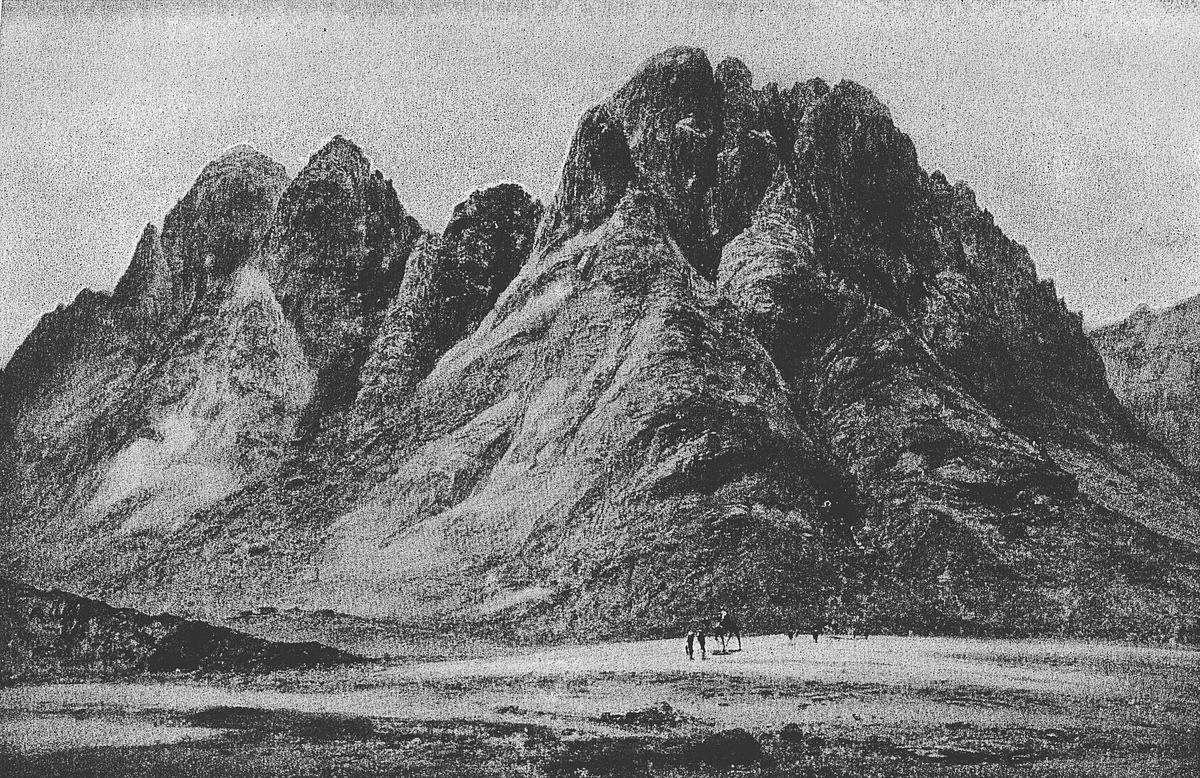
Mount Sinai, by Elijah Walton, 19th century

The second time Moses climbs up, God tells him:

“Here I am, coming to you in a thick canopy of cloud, so that the people will hear my words along with you, and also [so that] they will trust you forever!” (Exodus/Shemot 19:9)

No one will be able to see God, but all the people will hear God’s words—an extraordinary phenomena.

And God said to Moses: “Go to the people and consecrate them today and tomorrow. And they must wash their clothes. And they must be ready for the third day, because on the third day, God will come down on Mount Sinai before the eyes of the people. And you must set boundaries for the people all around [the mountain], saying: Guard yourselves against going up on the mountain, or negoa its outskirts.  Anyone hanogeia the mountain must definitely die.” (Exodus19:10-12)

negoa (נְגוֹעַ) = touching. (A form of the verb naga. נָגַע = touched, reached.)

hanogeia ( הַנֺּגֵעַ) = who is touching. (Another form of naga.)

One might think that if God touched the top of Mount Sinai, any human who touched the bottom of it would automatically die, as if the whole mountain were electrified. But then God clarifies that anyone (except Moses) who dares to touch the mountain while God’s presence rests on it must be executed. And the people must perform the execution without touching the offender.

“A hand lo tiga him! Because he must definitely be stoned or shot; if a beast or if a man, he must not live. When [there is] a protracted sound of a ran’s horn, they may go up on the mountain.”  (Exodus19:13)

lo tiga (לֺא תִגַּע) = it may not touch. (Another form of naga.)

All the people have to be clean and consecrated before they can safely hear God’s voice coming from the cloud that lands on Mount Sinai. But even in this condition, they cannot see God. And touching the mountain while God is on top is taboo. Like some other taboos in the bible, this one is communicable by touch.2

Don’t go up Mount Sinai, God commands. Don’t even touch it! Don’t even touch someone who touches it!

Touching the Tree of Knowledge

The order not to touch the mountain reminds me of the conversation between the snake and Eve in the garden of Eden. Both God in Exodus, and Eve in Genesis, say that death is the penalty for touching something holy.

The snake speaks first in the first Torah portion of Genesis, Bereishit (Genesis 1:1-6:8).

He said to the woman: “Did God really say you should not eat from any tree of the garden?” And the woman said to the snake: “We may eat fruit from the trees of the garden. But as for fruit from the tree that is in the middle of the garden, God said: ‘You must not eat from it, and lo tigeu, lest you die.’” (Genesis/Bereishit 3:1-3)

lo tigeu (לֺא תִגְּעוּ) = you must not touch it. (Another form of naga.)

Eve, by Lucan Cranach the Elder, 1528

In Genesis, God orders the primordial human not to eat from the Tree of the Knowledge of Good and Evil in the middle of the garden.3 But God says nothing about touching or not touching the tree. Although God delivered the original order to the one primordial human being, before it was divided into male and female, there is no reason why the female human would not remember it. Maybe she simply added “and you must not touch it” on the spur of the moment.

Why? The classic commentary suggested that she was “making a fence around the Torah”: protecting herself from accidentally violating God’s actual prohibition by avoiding doing something that could lead to the violation.4 (One of the more famous examples of a fence around the Torah is the rule in many orthodox Jewish communities that bans turning on a stove or an electric light on Shabbat. If you feel free to make heat and light, you might forget the biblical prohibition against lighting a fire on Shabbat.5)

At first glance, a rule to avoid touching the Tree of Knowledge seems like a reasonable fence. If Eve does not get close enough to that tree to touch it, she will not be able to eat its fruit. Yet after further conversation with the snake, she transgresses both her own fence and God’s order.

Bereishit Rabbah, a fifth-century collection of commentary, adds some action and dialogue to the biblical story: “Rabbi Chiyya taught: That means that you must not make the fence more than the principal thing … When the serpent saw her exaggerating in this manner, he grabbed her and pushed her against the tree. ‘So, have you died?’ he asked her. ‘Just as you were not stricken when you touched it, so will you not die when you eat from it.’”6 According to Bereishit Rabbah, if the fence seems too important (in this case because Eve claims touching the tree carries a death penalty), then once you break the fence, it feels insignificant to break the original command as well.

Touching Mount Sinai

In Exodus, on the other hand, God tells Moses that the people may not climb Mount Sinai on the day that God will descend, and God also says the people may not touch the mountain until the signal of the sound of a ram’s horn. Both prohibitions, against climbing and against touching, come from God. God makes the fence.

What is the reason for it? 16th-century rabbi Ovadiah Sforno wrote that some people might have been so eager to catch a glimpse of God, they would trample the boundary markers and run up the mountain. The death penalty was a deterrent.

19th-century rabbi Samson R. Hirsch wrote that one reason for the two prohibitions was to make the people realize they were nowhere near Moses’ spiritual level. This seems plausible to me, since God tells Moses that after the people hear God speak from the cloud on the mountaintop, they will trust Moses forever (Exodus 19:9, above). Recognizing Moses’ high spiritual level—or closeness to God—would help to foster this trust.

Another reason, Hirsch wrote, was: “The distinction between the people about to receive the Torah, and the Source from which they are to receive it, is underscored also in terms of physical separation.”7

The realm of ordinary people at the foot of the mountain is mundane. The realm of Mount Sinai is the realm of God and God’s teachings.8 Only God’s prophet, Moses, goes back and forth between the two realms.9

There is also a practical reason for prohibiting both climbing and touching Mount Sinai on the day of revelation: the mountain becomes a dangerous place.

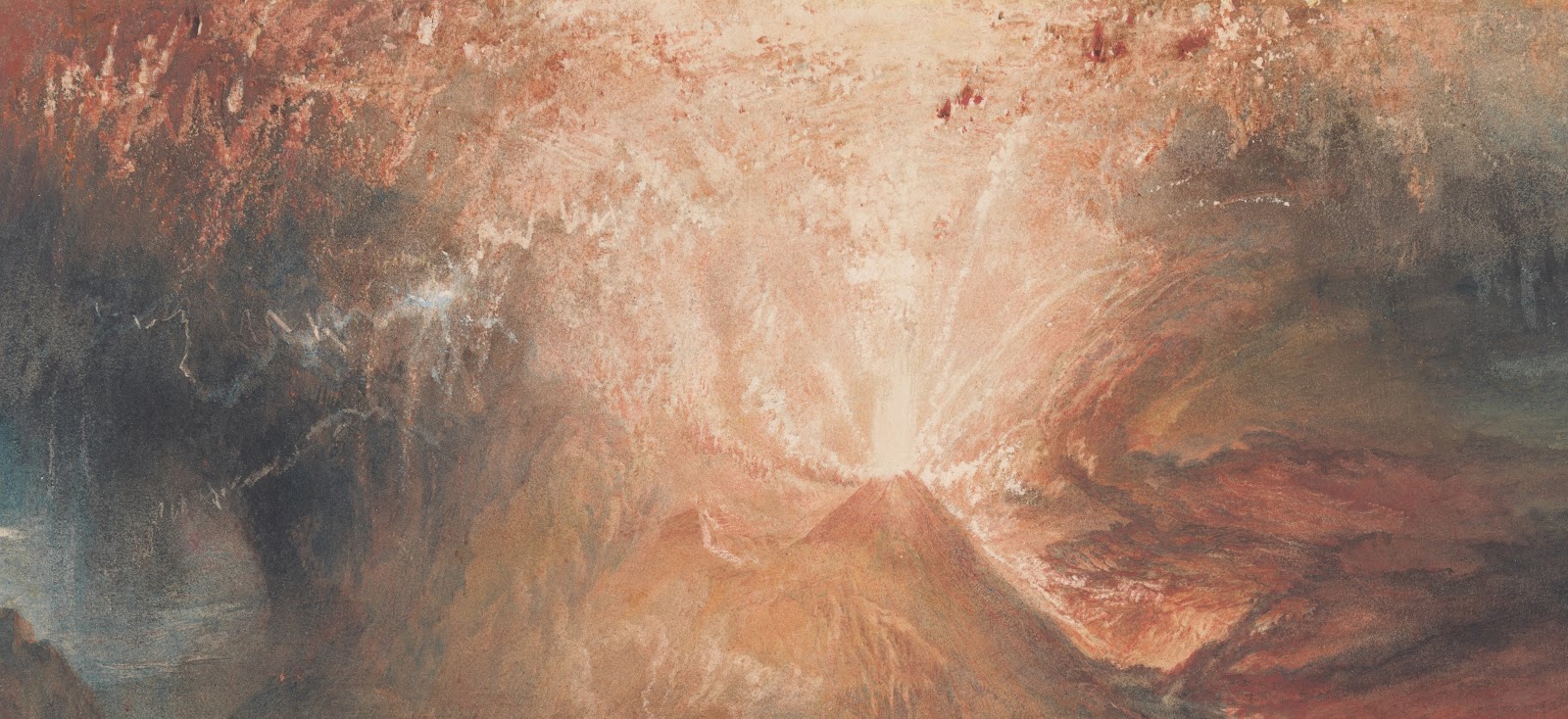
And it was the third day, in the morning, and there was thunder and impressive lightning on the mountain, and a very loud sound of a ram’s horn … And Mount Sinai was all in smoke from the presence of God that came down on it in fire, and its smoke rose like smoke from a furnace, and the whole mountain shuddered violently. (Exodus 19:16-18)

Vesuvius in Eruption, by J.M.W. Turner, 1817-1820, detail

Thus the prohibition against getting close enough to touch the bottom of Mt. Sinai is a reasonable fence around the prohibition against climbing the mountain—which, in turn, is a fence around the prohibition against attempting to look and see God.

Nobody breaks the fence. Moses leads the people to the foot of the mountain, but they cannot bear to get any closer. They are already seeing too much, experiencing synesthesia.

Then all the people were seeing the thunderclaps and the flames and the sound of the ram’s horn and the mountain smoking. When the people saw, they were shaken and they stood at a distance. And they said to Moses: “You speak to us, and we will listen. But may God not speak to us, or else we will die!”  (Exodus 20:15-16).

The people back  away from the supernatural volcano. No fences, with or without death sentences, are needed to keep them at a distance.


I have heard people say they wish they could experience a miracle like seeing God’s voice at Mount Sinai.  Personally, I think a miracle like that would terrify me as much as it terrified the Israelites and their fellow-travelers.  I am grateful that, by the grace of God, my own numinous experiences have been only gentle intimations.

Sometimes there is no question that we will follow a rule, because we want to follow it with all our heard and soul.  But sometimes we recognize that a rule is a good idea, yet we have no emotional investment in it. That is when we need a fence around the rule to keep us on track.


  1. At the burning bush in Exodus 3:1-4:17. The “mountain of God” is called Mount Choreiv in some passages and Mount Sinai in others, since the book of Exodus was redacted from more than one original source.
  2. For example, when someone who have been in contact with a corpse is ritually purified by being sprinkled with water containing the ashes of a pure red heifer, the person who does the sprinkling has to wash his clothes and wait until nightfall to return to a state of ritual purity. While the sprinkler waits, “Anything that he touches is impure, and the person who touches him will be impure until nightfall.” (Leviticus 19:19:22)
  3. Genesis 2:17.
  4. The phrase “Make a fence around the Torah” originated in Pirkei Avot 1:1, a compendium of rabbinic advice composed around 200 C.E.
  5. Exodus 35:3.
  6. Bereishit Rabbah 19:3, translated by www.sefaria.org.
  7. Samson Raphael Hirsch, The Hirsch Chumash: Sefer Shemos, translated by Daniel Haberman, Feldheim Publishers, Jerusalem, copyright 2005, p. 322.
  8. Torah (תּוֹרָה) = instruction, teachings; divine law; the first five books of the bible; all instructions in the Hebrew Bible.
  9. In Exodus 19:24, God tells Moses to go down and bring his brother Aaron up to the top of Mount Sinai, but this request is not followed up in the text; the Ten Commandments are delivered instead. On another day, Aaron climbs partway up Mount Sinai, along with two of his sons and 70 elders (Exodus 24:9-14), but only Moses and his attendant Joshua complete the trip to the top.

Bereishit: How Many Gods?

Question: How many gods does it take to create humankind?

The whole universe is created in six days at the beginning of the first book and first Torah portion of the bible, both called Bereishit (“In a beginning”). God announces what will exist, and then it does. Here is the first act of creation:

The First Day of Creation, Nuremburg Chronicle, 1493

Vayomer Elohim: “Let light be! And light was.” (Genesis/Bereishit 1:3)

vayomer elohim (ובַיֺּאמֶר אֱלוֹהִים) = And God said. (vayomer (וַיֺּאמֶר) = and he said + elohim (אֱלוֹהִים) = God; multiple gods.

Grammatically, elohim is the plural of eloha, אֱלוֹהַּ = a god.1 But the plural elohim is also used to refer to the God, the one with the four-letter personal name abbreviated Y-H-V-H.2

We know that only one God speaks light into being, because vayomer is singular—“he said”, not “they said”.  (In the Torah the God is referred to by the default gender: male.) Hebrew has no capital letters, but I capitalize elohim in this essay when it is clear that the word means “God” rather than “gods”.

The words Vayomer Elohim precede each new creation in the first story of Genesis.3 On the sixth day, God makes land animals of various kinds, and finally human beings. But the grammar of the sentence in which God initiates the creation of humans is peculiar.

Vayomer Elohim: “Let us make humankind in our image, like our likeness. And they shall rule over the fish of the sea and over the flyers of the skies and over the big animals and over all the earth and over all the crawlers that crawl on the earth.” (Genesis 1:26)

The speaker is God in the singular. But what God says is “Let us make humankind in our image, like our likeness.”4

Us? Neither the kings nor the God speak with the royal “we” in the Hebrew Bible. In fact, God uses the first person plural only four times in that entire canon:

  • In Genesis 1:26 on the sixth day of creation (above).
  • In Isaiah 6:8 in a vision calling the first Isaiah to become a prophet.
  • In Genesis 3:22 regarding the Garden of Eden.
  • In Genesis 11:7 regarding the Tower of Babel.

Can we figure out whom God is addressing in Genesis 1:26 by examining the other three times God says “we”?

Angels?

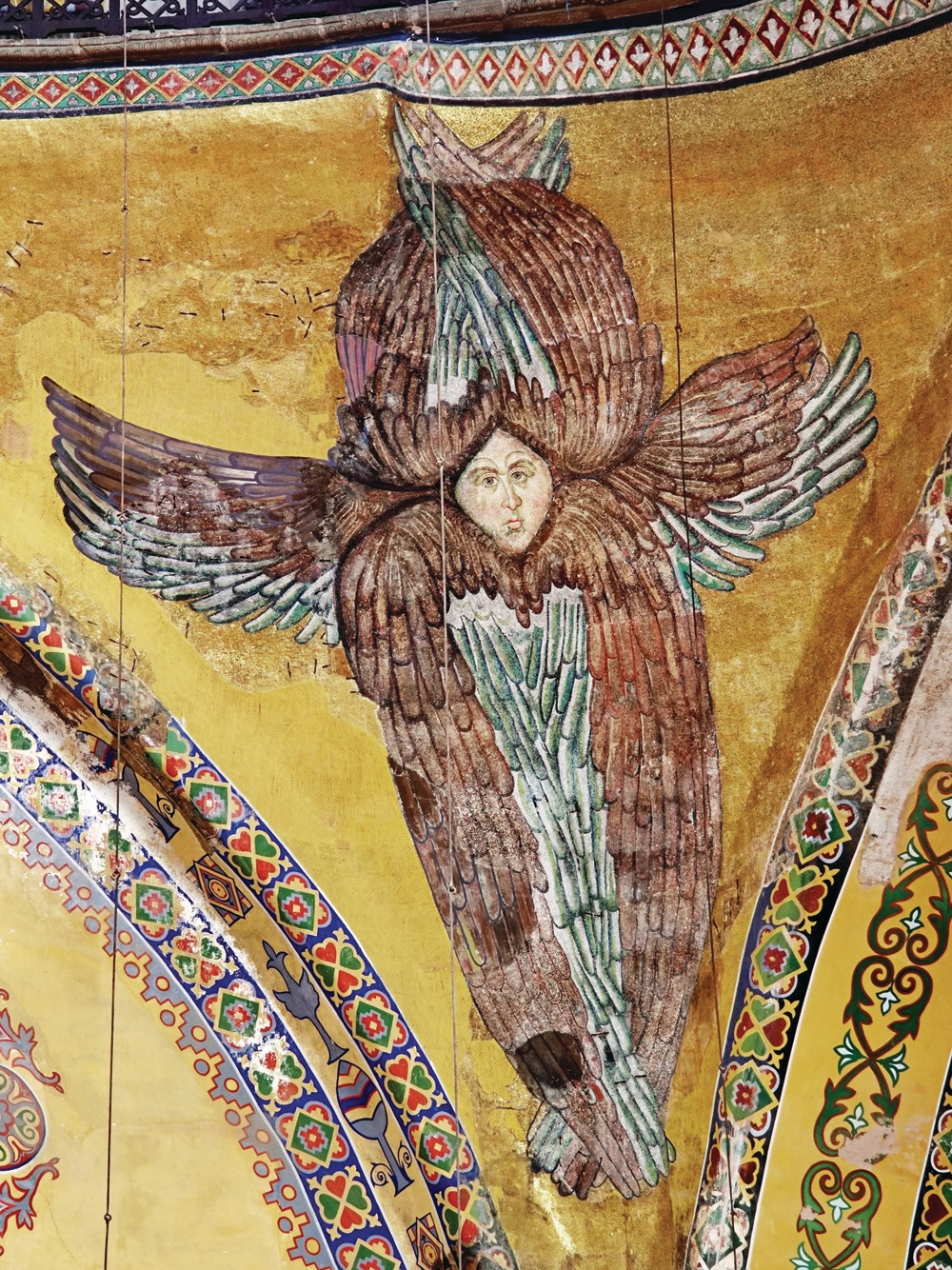
Serafim were standing in attendance from above; each had six wings … And I heard the voice of my lord saying: “Whom shall I send? And who will go for us?” And I said: “Here I am. Send me.” (Isaiah 6:2, 6:8)

In “Whom shall I send?” God speaks in the first person singular. But in “And who will go for us?” God is probably including the serafim, six-winged fiery creatures who surround God in Isaiah’s vision. God addresses them because in this case God is looking for a human prophet, rather than an angel, to pass on God’s words to the people.

Seraf in Hagia Sophia, Istanbul, mosaic ca. 1300

No serafim appear in the book of Genesis. However, medieval commentators proposed that God is addressing a different kind of angel in Genesis 1:26: a malakh. (Malakh, מַלְאַךְ = messenger, emissary. Plural malakhim, מַלְאָכִים.)5

A malakh sent by a human being is simply a man who delivers a message to another human. A malakh sent by God also delivers a message, but the human recipient perceives a voice, a fire, or something that at first looks like a man (without wings) but then vanishes dramatically.6 Every “angel” mentioned in Genesis through 2 Kings is called a malakh.

By the fifth century C.E., Talmudic rabbis considered malakhim not just mouthpieces, but half-human creatures with independent thoughts and feelings. Bereishit Rabbah 8 claims that God created the “ministering angels” (malakhei hashareit, מַלְאֲכֵי הַשָּׁרֵת) before creating the universe. According to this text, angels and humans are similar in how they stand, speak, understand, and see; but only humans are also animals that eat, drink, bear children, excrete, and die.

11th-century rabbi Shlomoh Yitzchaki, known as Rashi, built on this idea when he explained Genesis 1:26. He wrote that the malakhim were created in God’s image before God created the universe. When God wanted to create another kind of being in God’s image, God included the malakhim in the decision as a tactful way to prevent them from feeling envious. Perhaps these angles might be jealous of humankind’s animal functions. Alternatively, angels might envy humans because right after God creates them, God tells them to rule over the earth and all its animals.7

This fanciful characterization of malakhim is entirely absent from the Hebrew Bible, where a malakh is not an independent person with feelings, but only a mouthpiece God that uses and discards, like a marionette. Sometimes in the Torah a malakh speaks to a human, and then with no transition the next sentence is from God in the first person singular.8

A malakh in the Torah has no will of its own and cannot create something. When God says “Let us make humankind in our image, like our likeness,” God is addressing fellow creators—creators who can collectively make a new kind of animal. Thus in the context of the book of Genesis, God is not addressing any angels.

Moral immortals?

Does that mean God is addressing other gods in Genesis 1:26?

The second time in the book of Genesis that God uses the first person plural occurs after the two humans in the Garden of Eden eat from the Tree of the Knowledge of Good and Evil. God says:

“Humankind is becoming like one of us, knowing good and evil!  And now, lest it stretch out its hand and take also from the Tree of Life and eat and live forever—!” And Y-H-V-H Elohim sent it away from the Garden of Eden … (Genesis 3:22-23)

Here, “us” includes fellow beings who are aware of good and evil. These beings must also be immortal, or they would not be alarmed by the idea of humans living forever. The only other information about them in this week’s Torah portion comes from the snake in the Garden of Eden, who tells Eve:

“Because Elohim knows that on the day you eat from it, your eyes will be opened and you will be like elohim, knowing good and evil.” (Genesis 3:5)

The second elohim in this sentence could refer to either the one God, or to gods in general. Most English translations use a plural such as “divine beings” for the second Elohim. It makes sense, and not just because God says “one of us later in the story. After all, what is a moral immortal? Not an angel; before the later prophets, biblical angels appear to be amoral and transient manifestations.

But the bible does contain other passages assuming the existence of multiple gods. Lesser gods appear in Genesis 6:2-4 at the of this week’s Torah portion (where the “sons of the elohim”impregnate the “daughters of humankind”). There are also references to a court of gods who acknowledge the God of Israel as their king in Exodus 15:11, Job 1:6-2:7, and Psalms 29, 82, and 97.

Alienators?

The remaining sentence in the Hebrew Bible in which God speaks in the first person plural appears in the Tower of Babel story in next week’s Torah portion, Noach:

Vayomer Y-H-V-H: “Hey, one people and one language for all of them, and this is how they have begun to act! So now nothing that they plan to do will be impossible! Come, let us go down there and let us make their language fail, so that a man cannot understand the language of his neighbor.” (Genesis 11:6-7)

Here God’s “us” includes fellow beings who can separate collaborators and turn them into strangers, aliens who cannot even understand each other. These beings cannot be malakhim, who only repeat God’s words. Nor can they be human beings, since all the humans on earth are building the Tower of Babel together. Therefore the obfuscators can only be subsidiary gods, gods that have power to move people to different locations and change their ways of thinking. (I will discuss this further in next week’s blog post, Noach: Alienation.)


Why do lesser gods make several fleeting appearances in the book of Genesis, which otherwise posits a single god powerful enough to create the heavens and the earth? Genesis 1:26, 3:22, and 11:7 might be remnants of other ancient stories—polytheistic tales about  a chief creator god with lesser gods to assist him. This could also explain the perfunctory story in Genesis 6:2-4 about how the “sons of elohim” took human wives who bore them children who became legendary heroes. The scribes who wrote down the book of Genesis may have been inspired, but they were only human. There are many rough spots in the Torah where different oral traditions were combined without being edited for consistency.9

Question: How many gods does it take to create a universe, invent humankind, set up the Garden of Eden, and turn human language into babble?

Answer: Only one, but that God makes the other gods that are hanging around feel included and empowered.

Apparently God is considerate of other gods, at least in the book of Genesis.


  1. The first place in the Torah where the word elohim definitely refers to plural gods is Genesis 3:5 in the Garden of Eden story.
  2. See my post Lekh-Lekha: New Names for God. God is referred to as elohim throughout Genesis chapter 1. The first use of God’s personal name, Y-H-V-H, occurs in Genesis 2:4.
  3. Genesis 1:3, 1:6, 1:9, 1:11, 1:14, 1:20, 1:24, 1:26.
  4. “Let us make” is na-aseh, נַֽעֲשֶׂ֥ה. The prefix נ indicates a first person plural verb. “In our image” is betzalmeinu, בְּצַלמֵנוּ, and “like our likeness” is kidmuteinu, כִּדְמוּתֵנוּ. In both nouns, the suffix einu (ֵנוּ  ) indicates the first person plural possessive, i.e. “our”.   
  5. The Septuagint (3rd century B.C.E.), the first Greek translation of the Hebrew Bible, routinely translates the word malakh as “angelos”, whether the malakh in question is human or supernatural. Many English translations call a malakh from a human a messenger, but a malakh from God an “angel”.
  6. See my post Vayeira: Stopped by an Angel.
  7. Genesis 1:28.
  8. E.g. Genesis 22:11-2 and 22:15-18.
  9. Most modern scholars agree that the first creation story in Genesis, the one about the six days of creation and seventh day of rest, was written by a Levite who was deported to Babylon in the 6th century B.C.E. and was influenced by Babylonian theology. The Garden of Eden and Tower of Babel stories are attributed to a different author, whose century is still a matter of debate; but scholars agree that this author or redactor drew from more than one oral tradition.

Bereishit: Bad Stewardship

What happened to my book about moral psychology in Genesis?  I finished it—then realized that examining why most of the characters in Genesis do the wrong thing is not enough.  I needed an ongoing argument about why humans find it so hard to take the high road out of Eden.

Now I am doing more research and rewriting my book.  Meanwhile, here is an essay from my first version.  The Torah portion this week is Bereishit (“In a beginning”), and tells about the beginning of everything, including good and evil.

§

Humans Dominate the Earth

And God made beasts of the land according to their type, and cattle by their type, and all creeping things of the earth by their type; and God saw that it was tov. (Genesis 1:25)

tov (טוֹב) = good; functional, attractive, beneficial, or virtuous.

Fourth Day of Creation, Nuremberg Chronicle, 1493

In the first creation story, God sees that seven creations are tov: light (day 1); the separation of dry land from waters (day 3); plants (day 3); sun, moon, and stars (day 4); swimming and flying animals (day 5); land animals excluding humans (day 6); and the whole world (day 6).1  In all seven of these divine observations, tov means functional, attractive, or beneficial for some divine plan, but not virtuous.  Stars and fish are not moral agents.

All the land animals, including humankind, are made on the same day, but God only considers the other animals tov.  When God makes humans, God blesses them, but does not see that they are tov.

And God created humankind in [God’s] image; in the image of God [God]created it; male and female [God] created them. And God blessed them, and God said to them: “Be fruitful and multiply, and fill the earth vekhivshuha; urdu over the fish of the sea and over the flyers of the skies and over every beast that crawls on the earth.” (Genesis 1:27-28)

vekhivshuha (וְכִבְשֻׁהָ) = and subjugate her, make her subservient, rape her, bring her under control. (An imperative form of the verb kavash, כָּבַשׁ.)

urdu (וּרְדוּ) = and subdue, dominate, rule over. (An imperative form of the verb radah, רָדָה.)

Humankind is the only creation that gets a blessing and a directive from God.

Why does God tell humans to subjugate and rule over a perfectly good world? What if they ruin the earth and its animals?

A Garden of Eden by Jan Brueghel the Younger, 1630

If God had created an imperfect world and given humankind the job of improving it, humans might have organized an uncivilized wilderness into parklands and gardens. The Garden of Eden might have served as a model, as well as being the source of humankind’s awareness of the categories of good and evil. But God does not create an imperfect world; God sees that the entire creation is already “very good”.

*

What if God expected humans to be good stewards of the earth? Since humans have the free will to choose between good and evil actions, and since we have the intelligence to learn and extrapolate from experience, we could have multiplied only until we filled the earth without overtaxing its resources. And we could have husbanded the earth rather than raped it.

Instead, our widespread adherence to a red meat diet led to overgrazing, which caused desertification (that’s why the Sahara is so big) and deforestation (e.g. to create more pastureland in 20th century South America). Our demand for lumber at unsustainable rates has led to millennia of clear-cutting, which changes biomes and causes more deforestation. (The bible praises the cedars of Lebanon, which used to be a vast forest and now consist of isolated urban trees and endangered wooded enclaves high in the mountains.) During the last century humans have also poisoned the air, soil, and water, and released greenhouse gases that are causing permanent climate change. Worldwide, humans have had neither the right intuitions nor the wisdom to be good stewards of the earth.

What if God, who gives humankind free will in the Garden of Eden, does not know whether humans will be good stewards or not?  What if God’s instruction to subjugate and dominate the earth and its animals is a temporary authorization, conditional upon good behavior?

Some classic commentators have proposed that at first humans were afraid of other animals and needed to be encouraged to control them by using their superior intelligence.2 The project of bringing wilderness under cultivation must also have seemed daunting.

But by the time humankind achieved the power to alter the earth’s ecology, the divine instruction to the first humans was no longer useful.

Bereishit Rabbah, a 5th-century C.E. collection of commentary, presents one rabbi’s opinion that people with merit will dominate the animals, but people without merit will descend to the state of being dominated by animals—perhaps by the beastly side of their own natures.3

This interpretation is based on an ambiguous word in God’s initial remark about letting humankind rule over the earth and all the animals:

And God said: “Let us make humankind in our image, like our likeness, veyirdu the fish of the sea and over the flyers of the skies and over the big animals and over all the earth and over all the crawlers that crawl on the earth.” (Genesis/Bereishit 1:26)

veyirdu (וְיִרְדּוּ) = and they shall subdue, dominate, rule over. (An imperfect form of the verb radah, רָדָה)

The word veyirdu is another form of the verb radah only when it is spelled with the Masoretic vowel pointings added to the Torah in the 6th to 10th century C.E.. But there were no vowel pointings in the Torah scrolls the Masoretes annotated.4  Therefore commentators are free to interpret a biblical passage as if one of the words originally had different vowels. Bereishit Rabbah is perhaps the earliest, but not the only, commentary that spells the word v-y-r-d-u as veyeirdu.5

veyeirdu (וְיֵרְדוּ) = and they shall go down, descend; and they might descend. (An imperfect form of the verb yarad, יָרַד).6

According to this interpretation, God still tells humankind to subjugate and dominate the earth and its animals, but only after predicting that humans might descend to the level of unthinking animals themselves.

*

In the 21st century it looks as if our beastly natures have won. Too many of us have acted in ways that control the earth without thinking about the consequences. Yet human intelligence could also be used for restoring the earth, or at least minimizing its degradation. What we and all the other animals and plants on earth need now is for every human leader, in governments and industries, to choose ethical actions over selfish short-term benefits.

Humans already rule over the earth, for good or bad. Our rule has already caused global climate change, with some areas flooding and others burning up.  Our only hope now is to stop choosing what seems good, tov, because it is functional, attractive, or beneficial to only a few individuals, and start choosing what is virtuous because it reduces the harm to all humans and all living creatures on earth.

  1. Genesis 1:4, 1:10, 1:12, 1:18, 1:21, 1:25, and 1:31.
  2. e.g. Nachalas Yaakov in Siftei Chakhamim, a 17th-century collection of commentary; Haamek Davar, a 19th-century commentary by Naftali Zvi Yehuda Berlin.
  3. Bereishit Rabbah 8:12.
  4. At services today Jews still read out loud from parchment Torah scrolls on which scribes have copied the letters without vowel pointings or other diacritical marks indicating pronunciation (nikkudim).
  5. e.g. Rashi (11th-century Rabbi Shlomoh Yitzchaki), and Jacob ben Asher (13th-century rabbi) in Kitzur Baal Haturim, Nachalas Yaakov (ibid.).
  6. Biblical Hebrew has no past, present, or future tense. Veyeirdu is in the imperfect aspect, which means that its action has not been completed. Often the context indicates that an imperfect verb in Biblical Hebrew should be translated as a future tense verb in English, but in this case the imperfect verb yeirdu could be translated equally well as “they will descend”, “they shall descend”, “they could descend”, or “they might descend”.

Balak: Motivations

Why do King Balak and the prophet Bilam behave badly in this week’s Torah portion, Balak?

In the book I am writing on moral psychology in Genesis, I examine the text for emotional impulses and character flaws that result in immoral behavior.  Three of the character flaws I found in Genesis also explain the poor ethical choices of Balak and Bilam.

Balak

Balak, the king of Moab, is alarmed after the Israelites have conquered the Amorite city-state of Cheshbon on the northern border of his kingdom.  He sends dignitaries to Bilam, who lives by the Euphrates River, with the following message:

“And now please go curse these people for me!  Because they are more numerous than we are.  Maybe I will be able to nakeh them and drive them out from the land.  For I know that whoever you bless is blessed, and whoever you curse is cursed.”  (Numbers/Bemidbar 22:6)

nakeh (נַכֶּה) = strike down, break, beat down.  (A form of the root verb nakah, נָכָּה = strike, hit, beat, destroy.)

Balak’s emotional reaction to finding a horde of strangers camped across his border is fear, naturally enough.  But when he tries to address his fear he makes two mistakes.  One is that he assumes the Israelites will attack Moab next.  The truth is that the Israelites are on their way to Canaan, and conquered Cheshbon because the king of Cheshbon refused to let them pass through his land.  They are not interested in attacking Moab, which lies to the south, before they continue their journey northward.  But it never occurs to Balak to see if he can find out why the Israelites attacked Cheshbon.

His other mistake is that he tries to hire Bilam to curse the Israelites, instead of to bless the Moabites.  King Balak could just as well ask Bilam to make Moab look invulnerable to the Israelites, or to make the Israelites seek peace.

But Balak only thinks in terms of war, in terms of kill or be killed.  He tries to arrange the mass destruction of the people camping across the Arnon River from Moab even though they have made no hostile move against him because he lacks imagination.

He is not the only one in the Torah with this character flaw.  In the book of Genesis, Noah fails to talk God into saving innocent animals and children from the flood because he cannot imagine talking back when God speaks to him.1  Jacob masquerades as his brother Esau and lies to Isaac, their father, because it does not occur to him that Isaac might intend to give two blessings, one to Esau and a different one to Jacob.2  Shimon and Levi lie to the men of Shekhem and then massacre them because nobody in their family thinks of a polite way to refuse an invitation by the ruler of Shekhem.3

An inability to imagine better alternatives leads many human beings to follow their worst impulses: callous resignation for Noah, greed for Jacob, and violence for Shimon and Levi.  The same lack of imagination makes Balak respond to his fear of strangers by trying to make it easier to kill them.

On the other hand, people who often exercise imagination can become unable to think outside the box when they are gripped by an overwhelming emotional reaction.   A psychological complex can overwhelm one’s more rational self; perhaps Balak, Shimon, and Levi had complexes that made them react to trouble by lashing out violently.  We cannot tell from the text of the Torah.

Bilam and the Moabites

When King Balak’s delegation arrives at Bilam’s house, God visits Bilam in a dream and tells him not to go to Moab, because the Israelites are blessed.  In the morning Bilam tells the Moabites that God will not let him go with them.

Then Balak sends back a more impressive group of dignitaries, and the promise of a rich reward.  Bilam already knows that God will not let him curse the Israelites, but this time he prevaricates:

“If Balak gave me what fills his house, [all the] silver and gold, I would not be able to cross the word of God, my God, to do [anything] small or large.  But now please stay here overnight again, and I will find out again what God will speak to me.”  (Numbers 22:18-19)

That night God tells the prophet he may go to Moab, but when he arrives he must do whatever God tells him to do.  Bilam accompanies the Moabites without telling them God’s caveat, giving them the false impression that he will curse the Israelites and earn his pay.

Why does Bilam string along the Moabites?  The clue in the text is that he has named a high price for his services: all the silver and gold in Balak’s house.  His motivation for going to Moab, and his character flaw, is greed.

Greed was also Abraham’s motivation in Genesis when he passed off his wife Sarah as his sister, hoping to cheat the king of Gerar out of a high bride-price.4  If the Torah told us about what Bilam and Abraham learned from their parents or from earlier experiences, we could guess why they are greedy enough to brush aside ethical considerations.  But the Torah only presents the two men as they are.

Bilam and the donkey

Next God tests Bilam by placing a divine messenger in his path, an angel that only Bilam’s donkey can see.  Twice the donkey swerves twice to avoid the angel.  The third time, when the way is too narrow, she lies down underneath Bilam and refuses to move.  All three times Bilam angrily beats his donkey.

Then God opened the mouth of the donkey, and she said to Bilam: “What have I done to you that hikitani these three times?”  And Bilam said to the donkey: “Because you made a fool of me!  If only there were a sword in my hand so that now I could kill you!” (Numbers 22:28-29)

hikitani (הִכִּיתַנִי) = you struck me, you hit me, you beat me.  (Another form of the root verb nakah.)

Why does Bilam beat his donkey?  It would have been more ethical for him to investigate her unusual behavior (not to mention her sudden gift of speech).  But Bilam is overwhelmed by his angry impulse because of another character flaw: pride.  King Balak’s men were probably watching the first two times the donkey swerved.  He believed his donkey’s behavior made him look like a fool who could not control his own mount.

In the book of Genesis, Cain also becomes infuriated when his pride is hurt.  He is the first person to make an offering to God.  After he has laid out the fruits of the soil he has labored over, his brother Abel offers an animal from his flock.  God accepts Abel’s offering but ignores Cain’s.  Cain is humiliated, and God cautions him:

“Why did you become hot-with-anger,

and why did your face fall?

“Isn’t it true that if you do good,

[there is] uplifting?

“And if you do not do good,

wickedness is crouching like a beast at the door,

and its craving is for you.

“But you, you can rule over it.” (Genesis 4:6-7)

Cain loses his temper and kills Abel.  He is unable to rule over his pride and stop himself from succumbing to wickedness.

When Bilam is infuriated by pride, God does not caution him directly, but instead lets the donkey speak.

Then God opened the mouth of the donkey, and she said to Bilam: “Aren’t I your donkey, that you have ridden on from long ago until this day?  Am I really accustomed to doing this to you?”  And he said: “No.”  (Numbers 22:30)

Bilam and His Ass, by Rembrandt, 1626

At least Bilam is honest at this point, recognizing that his donkey does not deserve to be beaten.  Once he has answered “No”, God lets him see the divine messenger, who scolds him for beating the donkey and adds: “Hey, I went out as a accuser.” (Numbers 22:32)

Bilam concludes that God sent the angel to oppose his journey to Moab in the hope of being able to curse the Israelites.

And Bilam said to God’s messenger: “I did wrong because I did not know that you were stationed to meet me on the way.  And now, if it is wrong in your eyes I will turn back.”  (Genesis 22:34)

Turning around at this point would make Bilam look even more foolish to the Moabite dignitaries, but now Bilam is willing to swallow his pride.  The divine messenger tells him to go to Moab anyway, but say nothing except what God tells him.  He does, and finds himself blessing (giving good prophecies about) the Israelites three times.  King Balak pays Bilam nothing, and the reformed prophet heads home.5

In this week’s Torah portion, Bilam makes two ethical errors: he deceives someone because of greed, like Abraham, and he strikes an innocent party because of pride, like Cain.  But his bad deeds are not as bad as theirs.  Bilam only deceives the king of Moab, whereas Abraham both deceives the king of Gerar and puts Sarah in a dangerous and compromising position.  Bilam only beats his donkey, whereas Cain murders his brother.  And Bilam admits he was wrong and repents.


We all have negative emotional impulses sometimes.  Whether these impulses lead to unethical behavior often depends on our individual character flaws, which may be the result of psychological complexes.  But early in the book of Genesis, God promises Cain that even though it is difficult, we can learn what our complexes are and rise above them.

May we exercise more imagination than Balak, so we can think of better alternatives than lashing out at others.  And if we become overwhelmed by greed or pride, may we recognize it, temper it, and admit when we did wrong, like Bilam.


  1. Abraham persuades God to refrain from burning up Sodom if there are even ten innocent people in the city. Moses persuades God to give the Israelites a second chance after they worship the Golden Calf. But Noach is silent. After God has spoken to him, all the Torah says is: And Noach did everything that God commanded him; thus he did. (Genesis 6:22)
  2. Genesis 27:1-28:4.
  3. Genesis 34:8-29.
  4. Genesis 20:1-18.
  5. In a later Torah portion, Mattot, Moses orders a war of vengeance against the Midianites of Moab, who had invited the Israelites to make offerings to their own god. The Israelites kill every Midianite male including the five kings of Midian, “and Bilam son of Beor they killed by the sword” (Numbers 31:8).  The Torah does not say why Bilam was there, but Moses says that the Midianite females seduced the Israelite men “according to the word of Bilam” (Numbers 31:16).

Repost: Bereishit

Michelangelo, Sistine Chapel

And God formed the human out of the dust of the earth, and blew into its nostrils the breath of life, and the human became an animated animal.  (Genesis/Bereishit 2:7)

Sorry, Michelangelo.  In the book of Genesis, God breathes life into the first human’s nose.  God does not animate Adam with a fingertip, the way Michelangelo painted it on the Sistine Chapel ceiling.

I’d like to say I saw this painting on our first full day in Italy.  But we are in Florence, not Rome, and we had to go grocery shopping.  So today all we saw the house where Michelangelo lived as an adolescent, along with two of his earliest relief sculptures.

Michelangelo, Battle of the Centaurs (photo by Melissa Carpenter)

His “Battle of the Centaurs”, completed in 1492 when he was 17, proved that he had already mastered the realistic depiction of the human form (in a period when artists were just beginning to revive the approach of ancient Greek sculptors).  But his own spark of genius had not yet emerged.

Next week we plan to see some of Michelangelo’s greatest sculptures, from “David” to “Captives”.  How amazing that he could create such things out of giant blocks of marble!  How amazing that we are here, and can see them!

What a crazy universe we humans inherited.  We have inspiration, we have beauty, we have life.  We also have despair, and evil deeds, and death.  Can we embrace the good things without hiding from the bad?

Click on this link to read my 2015 post about how humans and God hide from each other: Bereishit: In Hiding.