Ki Tavo: The Curse of Frustration

What are the worst curses you can imagine?

A slew of curses that will result if the people do not obey God appear in this week’s Torah portion, Ki Tavo (Deuteronomy 26:1-29:8). This section begins:

But it will be, if you do not heed the voice of God, your God, by observing and doing all [God’s] commands and decrees which I command you today, then all these curses will come upon you and overtake you. (Deuteronomy 28:15)

The first curses in this section of the Torah portion use general language, such as:

Cursed will you be in your comings, and cursed will you be in your goings. (Deuteronomy 28:19)

But then the Torah moves to curses about specific areas of life, including the curse of failure in whatever you try to accomplish.

God will send against you the malediction, the vexation, and the reproach, against every undertaking of your hand that you do, until you are annihilated and you perish quickly because of your evil deeds when you abandoned me.  (Deuteronomy 28:20)

This sentence ends in the first person, with God reacting personally to being disobeyed, feeling abandoned.

But it opens in the third person, stating that God will reproach the disobedient Israelites by thwarting every effort they make to thrive. 19th-century rabbi Hirsch explained: “Consequent to the sin, inner serenity disappears and is replaced by inner disquiet, and by a constant feeling of reproach, self-reproach, the consciousness that one deserves God’s censure. … Inner disquiet and a constant mood of self-reproach will prevent the success of your labors.”1

This is an apt psychological explanation for why some people cannot bring their undertakings to completion. But what about the threat of being annihilated and perishing quickly? Many people live with guilt and self-reproach for decades, depressed but not annihilated.

Next the Torah describes how the disobedient Israelites will be cursed by diseases, drought, and defeat in battle—all potentially deadly. Then we return to the failure of people’s enterprises.

The Scream, by Edvard Munch, 1893

And God will strike you with shiga-on and with blindness and with confusion of mind. And you will grope around at midday the way the blind grope around in their [own] darkness, and your ways will not prosper; and indeed you will be exploited and robbed all the time, and there will be no rescuer. (Deuteronomy 28:28-29)

shiga-on (שִׁהָּעוֹן) = madness, insanity. (From the root verb shaga, שָׁגַע = acted insane.)

Since blindness is listed between insanity and confusion, it probably means the inability to foresee or understand anything, rather than a literal lack of vision.

Hirsch explained: “You will not have a clear perception of things and of the circumstances; hence, nothing that you do will achieve the desired end. Others, first and foremost the neighboring nations, will take advantage of your perplexity so as to rob you of your rights.”2

Three milestones
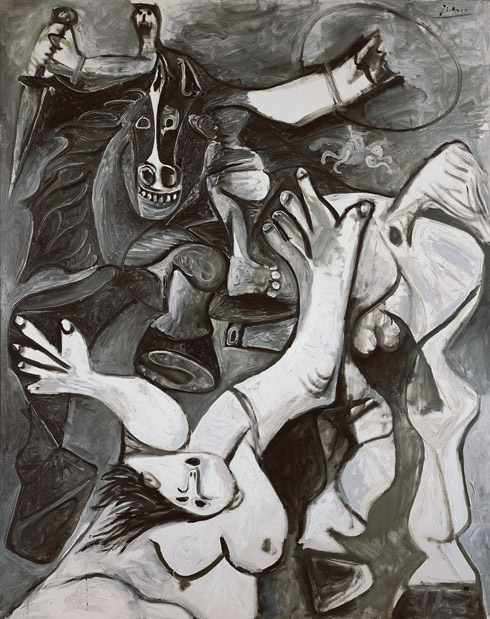
Rape of the Sabines, by Pablo Picasso,1962

The portion Ki Tavo then lists three deeds that require a major investment of a man’s time and money in order to reap a deeply satisfying reward. For all three, the disobedient Israelites will never get the reward.  

A woman you will betroth, and another man will use her for sex. A house you will build, and you will not live in it. A vineyard you will plant, and you will not use it. (Deuteronomy 28:30)

Arranging a marriage in the Torah included negotiations with the woman’s family and the payment of a bride-price; the reward was not only a sex partner, but a companion, a worker, and a  mother of one’s children. Building a house was also a big enterprise with a long-term reward. And grape vines, like fruit trees, had to be cultivated for three years without a harvest; only in the fourth year could they be picked for food, wine, and profitable trade.

The Torah portion Shoftim, earlier in Deuteronomy, treats the same three things as milestones in a man’s life. Officials who are recruiting troops are supposed to say:

“Who is the man that has built a new house and has not dedicated it? Let him go and return to his house, lest he die in the battle, and another man dedicate it. And who is the man that has planted a vineyard and has not used it? Let him go and return to his house, lest he die in the battle, and another man harvest it. And who is the man that has betrothed a woman and has not taken her [in marriage]? Let him go and return to his house, lest he die in the battle, and another man take her.” (Deuteronomy 20:5-7)3

No man wants to die before marrying, moving into his own house, and harvesting from his own grapevines (or fruit trees). If the Israelites are behaving well, following God’s directions, men can be excused from military service in order to enjoy reaching these milestones. Other men can go off to invade towns outside Israel’s borders, and God will give them success in battle.4

But if Israelites are behaving badly, flouting God’s directions, then they will be invaded by outsiders who seize their fiancées, their houses, and their vineyards.

Last week’s Torah portion, Ki Teitzei, expands on one of these military exemptions:

When a man takes a new wife, he must not go out with the troops, and he must not cross over to them for any matter. He will be exempt for his household one year and give joy to his wife whom he has taken. (Deuteronomy 24:5)

We can imagine the recruits crossing the town square to stand on one side, while the men who are staying home remain on the other side. This verse also informs us that the exemption from military service lasts for a year, and that a man must “give joy” to his new wife.

A wife in ancient Israel was not just a baby-making, bread-kneading, thread-spinning machine. She was supposed to be able to enjoy sex with her husband, and to be content with her new life in his household.

The Talmud adds that the exemptions for a new house and a newly mature vineyard also last for a full year.

“Since the wife needs twelve months, also all of them need twelve months.” (Talmud Yerushalmi, Sotah 8:8:2)5

“Those who are exempt for these reasons do not even provide water and food to the soldiers, and they do not repair the roads.” (Talmud Bavli, Sotah 43a)5

Thwarted by enemies

But when the Israelites disobey God, no one will get a year off for settling into a new marriage, a new house, or a new addition to their livelihood. Instead, God will let outsiders invade Israel and win. This week’s Torah portion continues:

Your ox will be slaughtered in front of your eyes, and you will not eat from it. Your donkey will be stolen in front of you, and it will not return to you. Your flock will be given to your enemies, and there will be no rescuer for you. Your sons and your daughters will be given to another people, and your eyes will be seeing and longing over them every day, but there will be no strength in your hand. The fruit of your land, and everything you toiled for, will be consumed by a people you do not know, and you will only be exploited and crushed all the time.  (Deuteronomy 28:31-33)

The laws laid down by God through Moses mandate returning stray animals to their owners,6 provide redemption for children sold as slaves, and even make the sale of land temporary.7 But invaders from other countries would disregard the local laws, and act only for their own benefit. Ironically, God will let the invaders succeed because the Israelites have been disregarding laws and acting only for their own benefit!

The curses that result from invasion by enemies are communal punishments, occurring when the people as a whole disobey God’s laws. Ethical and law-abiding individuals or families do not get special treatment when enemies invade.

Insanity

And you will be meshuga from the sight that you see with your eyes. (Deuteronomy 28:34)

The Sleep of Reason Produces Monsters, by Francisco de Goya, circa 1797

meshuga (מְשֻׁגָּ֑ע) = insane, crazy, raving. (Also from the root verb shaga, שָׁגַע, otherwise used only in the hitpael form: hishtaga-a, הִשְׁתַּגַּעַ = behaved like an insane person, or mishtaga-a, מִשְׁתַּגַּעַ = was behaving like an insane person.)

Ha-Emek Davar, a collection of 12th and 13th-century commentary, explained: “You will be amazed that you have become like this. That a few bandits have done so much damage, and your strength cannot save you, even though really it should have been strong enough against them. From this you will become insane and go out of your minds.”8

If the conquerors were merely a group of bandits, the Israelites might be driven mad by an inability to understand why they had not been able to defeat them. Only a few Israelites would attribute their unlikely failure to defend their land to a divine curse. If the conquerors were a large army, more Israelites might realize that God was no longer on their side, and remember that they needed God’s help. Either way, the Israelites could only explain their defeat if they acknowledged that they had done wrong and disobeyed their God.


It is human nature to cling to the belief that you are right and righteous, and to resist admitting that your actions have been unethical.

In a world-view with a God who administers rewards and punishments for collective behavior, the only responses to the total frustration of our plans and dreams are to admit our own bad behavior, to blame only the people around us, or to plunge into the mental blindness of believing that everything you are suffering is all for the best.

Without a God-centered world-view, there is a fourth option: to believe that tragedies sometimes happen when no one is at fault. This belief is easy to maintain when inexplicable tragedies are happening to people you don’t know. But it could lead to a mental breakdown when tragedies happen to you.

No wonder we feel cursed when undertakings we have nurtured for years are suddenly annihilated. Admitting collective guilt, blaming others, believing it’s all for the best, shrugging it off as bad luck, and going a little crazy are all possible responses. If, God forbid, it happened to you, what would your response be?


  1. Samson Raphael Hirsch, The Hirsch Chumash: Sefer Devarim, translated from German by Daniel Haberman, Feldheim Publishers, Jerusalem, 2009, p. 667.
  2. Ibid., p. 670.
  3. See my post Shoftim: More Important than War, Part 1.
  4. Deuteronomy 20:1.
  5. Translations of both Talmud Yerushalmi and Talmud Bavli are from www.sefaria.org.
  6. Deuteronomy 22:1-3.
  7. Deuteronomy 25:25-46.
  8. Ha-Emek Davar, commentary by the 12th to 13th-century Tosafists, translated in www.sefaria.org.
Shoftim: Trees Versus Humans

The rules for insiders have been different from the rules for outsiders since human history began. The difference is obvious in this week’s Torah portion, Shoftim (Deuteronomy 16:18-21:9).

Rules about insiders

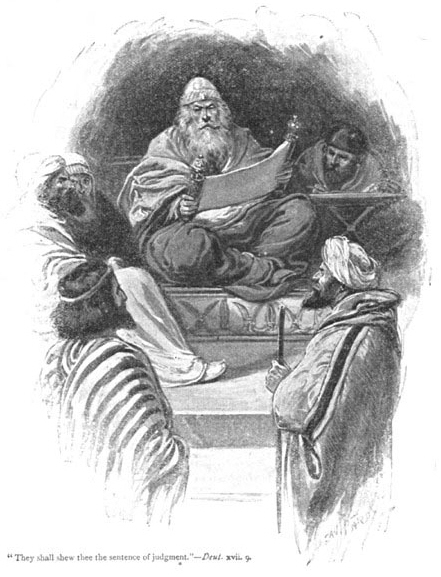
A judge in Deuteronomy, by Paul Hardy, ca. 1900

The portion Shoftim includes several rules for justice among fellow Israelites: judges must be unbiased, two witnesses are required for any sentence, accidental manslaughter must not be punished with death, and a disputed case should be referred to a higher court.1

The Torah portion also includes rules for assembling troops to initiate a battle, providing a humane alternative to the draft. Every man who has just built a new house, planted a new vineyard, or become engaged to a woman—or who is fearful—is excused from joining the troops.2

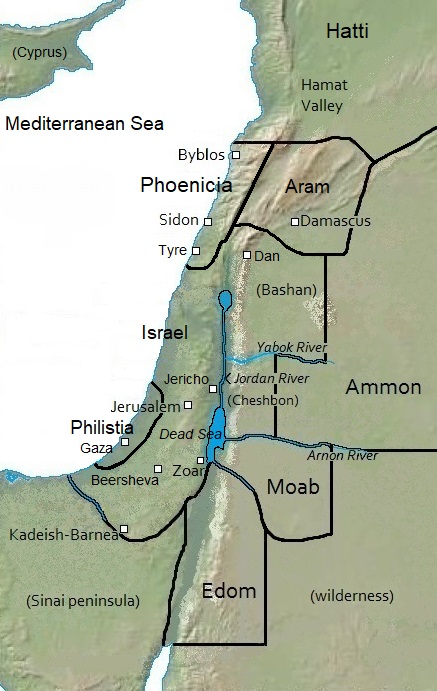
But the rules for attacking a town are not so humane—at least not to the outsiders being attacked. This week’s Torah portion considers two categories of towns of outsiders. The first category covers “far-away” towns: any town outside the national border that God decreed for Israel. The second category includes any remaining towns of native Canaanites within the land that God promised to the Israelites.

Rules about far-away towns that surrender

The Torah assumes that, like everyone else in the Ancient Near East, Israelites will raid towns outside their own borders to bring home booty, and sometimes kings of Israel will assemble larger armies and try to conquer a neighboring kingdom in order to skim off its resources. The portion Shoftim moderates this “normal” behavior somewhat by distinguishing between towns that surrender immediately, and towns that fight back.

If you approach a town to wage battle against it, then you must call out to it [terms] for peace. And it will be, if it answers you with peace, and opens [its gates] to you, then all the people that are found in it will become yours for mas, and they will serve you. (Deuteronomy 20:10-11)

mas (מַס) = compulsory labor (corvée labor) imposed on a subjugated people.

The Israelites were subjected to mas in Egypt.3 Now Moses passes on the rule that if the Israelites threaten a town and it surrenders, the Israelites (insiders) will subject the town’s whole population (outsiders) to the same kind of oppression. But although the citizens of a town that immediately surrenders are treated like slaves, they are not killed or driven off their land.

Rules about far-away towns that fight back

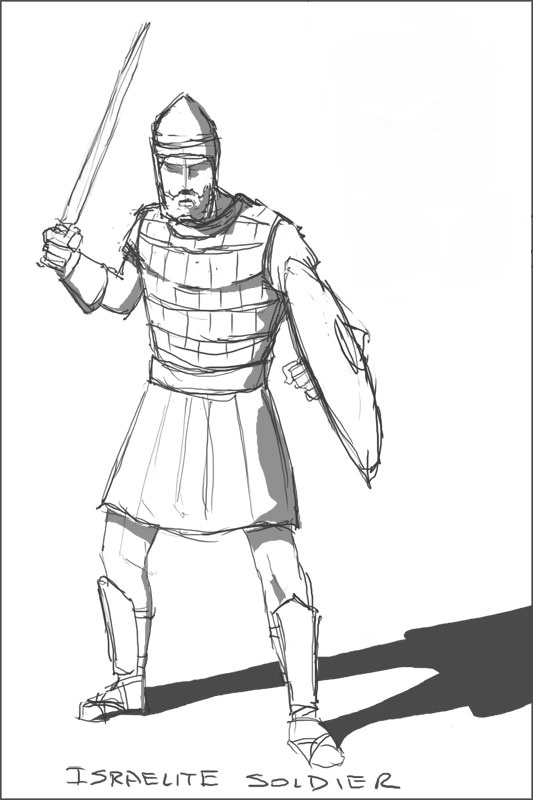
Israelite solider, artist unknown

But if it does not make peace with you, and it does battle with you, then you may besiege it. And [when] God, your God, gives it into your hand, then you must strike down all its males with the edge of a sword. Only the women and the little children and the animals and everything that is in the town—all its spoils—you may plunder for yourself. And you may consume the spoils of your enemies, which God, your God, gives you. (Deuteronomy 20:12-13)

The town’s men are called enemies here, even though the Israelites start the hostilities. The women and children are part of the spoils, since in that culture they were the property of the men. Female captives, who were useful for sex as well as labor, and their children, who could be trained to be good slaves when they got older, were taken away from their homes and brought to Israel as permanent slaves.4

Rules about natives of Canaan

Next we learn that the rules about far-away towns do not apply to towns in the land of Canaan.

Thus you will do to all the towns that are very far away from you, that are not the towns of these nations [in Canaan]. Only in the towns of these peoples that God, your God, is giving to you as a possession, you must not leave alive anything that breathes, because hachareim!—You must hecharim them … as God, your God, commanded you. (Deuteronomy 20:14-16)

hachareim (הַחֲרֵם), hecherim (הֶחֱרִים) = prohibit for human use and dedicate to destruction for God.

Why are the Israelites obligated to exterminate the entire native population of Canaan? The reason for genocide is religious:

So that they do not teach you to do according to all their to-avot that they do for their gods, and then you wrong God, your God. (Deuteronomy 20:18)

to-avot (תּוֹעֲבֺת) = abominations, acts that are acceptable in one culture but taboo in another.

When the Israelites arrived at the Jordan River in the book of Numbers, many of them engaged in sex with the native women and worshiped their god, Ba-al Peor.5 Judging by the rest of the Hebrew Bible, Israelites could hardly resist the temptation to worship other gods.

Rules about fruit trees

The next verse applies to any walled town that Israelites are besieging, whether in Canaan or far away.

by Winslow Homer, 19th century

When you besiege a town for many days, to battle against it to capture it, you must not destroy its trees by swinging an axe against them. For you will eat from them, so you must not cut them down. For is a tree of the field a human being, to come in front of you in the siege? (Deuteronomy 20:19)

Why must the Israelites refrain from chopping down fruit trees?

One answer is for you will eat from them. Even if the fruit is not in season while the Israelites are conducting the siege, if they succeed in taking the town, they will appreciate the local source of fruit. Trampled fields can be sown for a crop the next year, but fruit trees take a long time to grow.

A 13th-century commentary, probably considering the case of a far-away town, added: “Since the object of the siege is not to kill all its inhabitants, but to make them subservient to you, depriving them of their fruit bearing trees would be neither in your interest and certainly not in their interest.” (Chizkuni)6

Why would besiegers want to cut down a town’s orchards anyway? One answer is in the next verse:

Only trees which you know are not trees for eating, those you may destroy and cut down, and build siege-works against the town that is doing battle with you, until it falls. (Deuteronomy 20:19)

A 14th-century commentator explained: “You are free to cut down such a tree without restriction whether in order to build platforms to shoot arrows from, or for whatever reasons, such as to build a fire at night to keep warm.” (Tur HaArokh)7

The Talmud generalizes the prohibition against cutting down fruit trees in a siege to ban any wasteful destruction, including tearing fabric when you are not in mourning (Kiddushin 32a), or scattering your money in anger (Shabbat 105b).8

For is a tree of the field a human being, to come in front of you in the siege?

No. In this week’s Torah portion, trees are treated pragmatically, in terms of their value to the humans who are insiders, the Israelite besiegers. Fruit-bearing trees must be unharmed in order to provide food for both the conquerors and the survivors of the town who will be subjugated. Other trees are more useful for building siege-works or burning as fuel. 

Humans in far-away towns are treated with the same pragmatism as trees. If the town under attack fights back (and the Israelites win), then all its men and older boys must be killed to prevent future attempts at revenge, but the rest of the residents are useful as slaves. Humans in far-away town that surrenders are useful as a compulsory work force.

But humans who are natives of Canaan are treated with less respect than trees; they must all be chopped down and not used. The policy is wasteful, but it prevents the Israelites from being  tempted to adopt any Canaanite religions.

Furthermore, although individual Israelites accused of crimes are protected by laws that require fair judges and witnesses, there is no justice for individuals who are outsiders because they live in Canaanite towns or “far-away” towns.


The text of chapters 12-26 in Deuteronomy was written in the 7th century B.C.E., then reframed as the central section of Moses’ series of speeches to the Israelites at the Jordan River. I am writing this blog post in the year 2024 C.E., more than 26 centuries later.

Are we more humane to outsiders now? Western intellectuals condemn genocide by conquering settlers who view the natives of a land view as outsiders, “not like us”. Subcultures in many countries disapprove of initiating a war for any reason.

Yet in this year of 2024, the Russian government continues to attack Ukraine, ignoring the rights of Ukrainians to democratic self-rule and to life itself. The governments of other nations, such as Myanmar, attack minority groups of citizens who happen to be outsiders because of ethnicity and religion, forcing them to leave their homes and land. Modern Israel uses other methods to force members of an Arab minority to leave their homes and land—including, ironically and poignantly, destroying their olive trees.

This week’s Torah portion says: “Justice, justice you must pursue!”9 But when will people pursue justice for insiders and outsiders alike?


  1. Deuteronomy 16:18-20, 17:6 and 19:15-19, 19:1-7, and 17:8-12. See my post: Shoftim: To Do Justice.
  2. Deuteronomy 20:5-9. See my post: Shoftim: More Important Than War, Part 2.
  3. Exodus 1:11.
  4. Leviticus 25:39-54 decrees that when poverty forces native Israelites to sell themselves as slaves, their owners must treat them like hired workers, release them if a relative pays a fair amount to redeem them, and free them in the yoveil (jubilee) year without payment. But foreign slaves and their children can be kept in slavery indefinitely, and passed on to the owners’ heirs.
  5. Numbers 25:1-9. See my post: Balak: Wide Open.
  6. Chizkuni, compiled by Chizkiah ben Manoach, translated in www.sefaria.org.
  7. Tur HaArokh, by Jacob ben Asher, translated in www.sefaria.org.
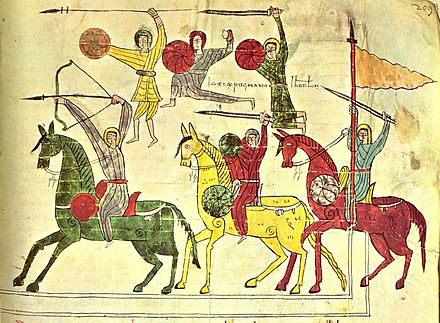
  8. For more on the Jewish prohibition against waste that originated in the Talmud, see my post: Shoftim: Saving Trees.
  9. Deuteronomy 16:20.

Shoftim: Is Magic Abominable? Part 2

(If you would like to read one of my posts on this week’s Torah portion, click on “Categories” in the sidebar, then select “Deuteronomy” and “Ki Teitzei”.)

In last week’s Torah portion, Shoftim, Moses warns the Israelites:

When you enter the land that God, your god, is giving to you, you must not learn to act according to the to-avot of those nations. (Deuteronomy/Devarim 18:9)

to-avot (תּוֹעֲבֺת) = plural of to-eivah (תּוֹעֵבָה) = taboo; an abomination, a foreign perversion, a custom in one culture that is prohibited in another culture.

Then Moses lists nine abominable occult practices:

There shall not be found among you one who makes his son or his daughter go across through the fire; a koseim kesomim, a meonein, or a menacheish; a mekhasheif or a choveir chaver,or one who inquires of ov or yidoni, or one who seeks the dead. Because anyone who does these things is to-avot; and on account of these to-avot, God, your god, is dispossessing them [the Canaanite nations] before you. (Deuteronomy 18:10-12)

What are all these procedures?

I examined the first four practices in last week’s post, Shoftim: Is Magic Abominable? Part 1, and concluded that the first, making offspring cross the fire, is to-eivah because it involves worshiping a foreign god; and the next three, which all types of divining, are to-avot because they are not sanctioned ways to get information from God. Divining itself is acceptable, as long as the diviner consults the God of Israel (usually through casting lots).

This week we will look at the remaining five kinds of forbidden magic: two types of sorcery, and three ways to get information from people who have died.

A sorcerer: Mekhasheif

A mekhasheif (מְכַשֵּׁף) is someone who does sorcery or witchcraft: khisheif (כִּשֵּׁף) = practice sorcery. The Hebrew Bible does not specify what actions a mekhasheif performs, but in related Semitic languages the root of the word refers to cutting off, or to praying by cutting one’s skin.1 No one called a mekhasheif  is included in any biblical story. Instead, the word usually appears in lists with other types of occult practitioners, as in the Torah portion Shoftim.2 

One notable exception is the bald statement in the book of Exodus:

You must not let a mekhasheifah live. (Exodus 22:17)

(Mekhasheifah, מְכַשֵׁפָה, is the feminine form of the word, corresponding to the English “sorceress”.)

This injunction appears between a law giving the financial penalty for seducing a virgin, and a law giving the death penalty to anyone who lies with a beast. Perhaps a female’s sorcery also had a sexual element, but there is no corroboration elsewhere in the Hebrew Bible.

The bible mentions four people by name who employ a mekhasheif. One is the idol-worshiper King Menashe of Judah.3The other three are thoroughly reviled foreigners: a pharaoh, Queen Jezebel, and Nebuchadnezzar.4 Perhaps a mekhasheif or mekhasheifah is taboo, to-eivah, because the profession is associated with foreign religions.

A sorcerer: : Choveir chaver

Both choveir and chaver come from the root verb chaver (חָבַר) = join. Normally, a choveir (חֺבֵר) is “one who joins”, and a chaver (חָבֶר) or chever (חֶבֶר) is a group of comrades, a company, a band, or a gang.

But lexicons give alternate meanings for words from that root when the context indicates magic, suggesting that the magic involves conjuring, or tying knots, or chanting spells, or charming animals who act as familiars. Only one biblical passage provides more definite information:

The Snake Charmer, by Charles Wilda, 1883

The wicked are alienated from the womb;

            The liars go astray from birth.

They have venom like the venom of a snake,

            Like a deaf cobra who closes its ears

So it will not hear the voice of a whisperer,

            An expert choveir chavarim. (Psalm 58:4-5)

In this simile, a choveir is a snake charmer who fails—because the snake is so fixated on biting its victim that it turns a deaf ear to the spells the charmer is whispering. Wicked people, particularly liars, also turn a deaf ear to any instruction.

Why would snake charmers be taboo in Deuteronomy? Maybe they were associated with the snake in the Garden of Eden, who encourages the first woman to eat from the Tree of the Knowledge of Good and Evil. Or maybe the problem was that other religions in the Ancient near East had snake-gods and religious symbols of snakes. Or maybe the bible discourages consulting any animal, because only humans are made in the image of God.

A necromancer: One who inquires of an ov or yidoni, or seeks the dead

The terms ov (אוֹב) and yidoni (יִדְּעֺנִי) usually appear together as synonyms.6 Both mean either a spirit of a dead person, or a necromancer who summons that spirit. The word yidoni comes from the verb yada (יָדַע) = know; and a dead spirit is assumed to know things that the living do not. The three references to ghosts in Leviticus are revealing.

Do not turn to the ovot or to the yidonim; do not seek them out, to become impure; I am God, your God. (Leviticus 19:31)

ovot (אוֹבוֹת) = plural of ov. Yidonim (יִדְּעֺנִים) = plural of yidoni.

Thus summoning a ghost makes people ritually impure, unable to serve God until they have been purified.

And the soul who turns to the ovot or to the yidonim to have illicit intercourse with them: I [God] will set my face against that soul and I will cut it off from among its people. (Leviticus 20:6)

The Hebrew Bible often calls worshiping other gods a act of prostitution, being unfaithful to the God of Israel. In this verse, consulting a ghost is also an act of infidelity.

And a man or a woman who has an ov or a yidoni must definitely be put to death by stoning; their bloodguilt is upon them. (Leviticus 20:27)

This sounds like a medium who calls up the same ghost repeatedly.

But in the one biblical story about someone who summons an ov, the identity of the ghost depends not on the medium, but on her employer.

And [the prophet] Samuel had died, and all Israel mourned for him, and he was buried in Ramah in his own town. And Saul had banished the ovot and the yidonim from the land. (1 Samuel 28:3)

When King Saul is facing a major battle with the Philistines, he sees the size of the Philistine camp and becomes afraid. At first he sticks to God’s rules, and asks for information only from God-approved sources.

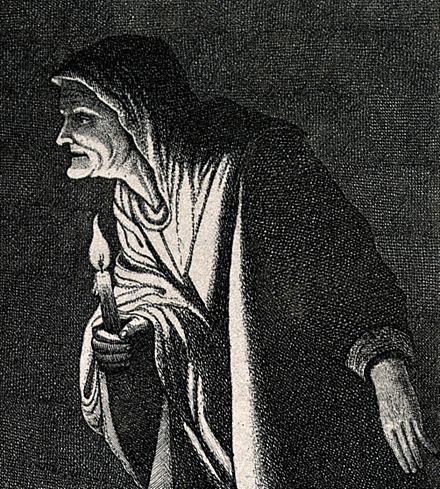
Witch of Endor, by Adam Elsheimer, 17th c.

And Saul put a question to God, but God did not answer him, either by dreams or by the [high priest’s] oracular device or by prophets. Then Saul said to his attendants: “Seek out for me a woman who is a master of ov, and I will go to her and I will inquire through her.” And his attendants said to him: “Hey!  A woman who is a master of ov is in Eyn Dor.” Then Saul disguised himself and put on different clothes, and he went, together with two men, and they came to the woman by night. And he said: “Please divine for me through an ov, and bring up for me the one whom I will say to you.” (1 Samuel 28:6-8)

The woman reminds him that King Saul made divination through an ov illegal. The disguised king reassures her. She asks him who to bring up from the dead, and he asks for Samuel.

Then the woman saw Samuel, and she shrieked in a loud voice and … said: “Why did you deceive me? You are Saul!” And the king said to her: “Do not be afraid. But what do you see?” And the woman said to Saul: “I see a god coming up from the ground.” Then he said to her: “What does he look like?” And she said: “An old man is rising up, and he is wrapped in a robe.” Then Saul knew that it was Samuel, and he bowed down to the ground and made obeisance. Then Samuel said to Saul: “Why have you bothered me, bringing me up?” (1 Samuel 28:12-15)

Saul explains. Then Samuel’s ghost says that God is giving the kingship to David, and Saul’s army will lose the battle. He blames Saul’s past disobedience in the war with Amalek for this outcome, and adds:

“And tomorrow you and your sons will be with me!” (1 Samuel 29:19)

In other words, they will be dead in Sheol underground, like Samuel.

Everything Samuel predicts comes true. But we do not know whether that is because he was God’s favorite prophet when he was alive, or because ghosts have secret knowledge.

The list of taboo occult practices in the book of Deuteronomy ends: “or one who seeks the dead”, but that description would cover necromancers who summon ovot or yidonim.  Maybe the list ends that way to indicate that divination by speaking to the spirits of dead people is the ultimate insult to God.

Moses concludes:

Because anyone who does these things is to-avot; and on account of these to-avot, God, your god, is dispossessing them [the Canaanites] before you. You must be wholehearted with God, your god. Because these nations that you are taking possession of, they paid attention to meoneinim and to kesomim; but God, your god, did not set this out for you. God, your god, will establish for you a prophet from your midst, from your brothers, like myself. To him you should listen! (Deuteronomy 18:12-15)

To be “wholehearted with God”, the Israelites must avoid worshiping any other gods or engaging in Canaanite magic practices. They must not try to get foreknowledge through any divining practice that does not consult God, or through the familiars of animal charmers, or through consulting the spirits of the dead. If God will not tell you, through a prophet or a dream or a God-dependent oracular practice, then you should not seek to know. Because adopting a foreign occult practice is tantamount to adopting a foreign religious practice. And any substitute for God is taboo, to-eivah.


Humans are by nature anxious about the future. We want to know what will happen so we can make choices that turn out well for us. (Meanwhile, other people are making choices that change the future, but few people think of that.)

What we learn by observation and reason, and what we are told by experts or authority figures, is not enough to satisfy many of us. We want inside information.

Some people today still try to get inside information through magic. The craze for Ouija boards has faded, but there are still mediums for the dead, palm readers, and tarot card readers. Some still look for omens in tea leaves and crystal balls.

Is there any harm in these practices? Perhaps not, if we use them once in a while for entertainment. But if we believe we can use occult practices to manipulate our own futures, we distract ourselves from what we should really be doing with our lives. When we spend time and energy on indirect means to selfish ends, we have less time for the truly good things in life: enjoying creation, being kind to other humans, and improving our world.


  1. The Brown-Driver-Briggs Hebrew and English Lexicon.
  2. Other examples include Exodus 7:11, Isaiah 47:9-13, Jeremiah 27:9, and Daniel 2:2.
  3. 2 Chronicles 33:6.
  4. Pharaoh in Exodus 7:11, Queen Jezebel in 2 Kings 9:22, and King Nebuchadnezzar in Daniel 2:2.
  5. The snake “Python” in made oracular pronouncements in ancient Greek mythology. In Egyptian religion, the uraeus, a winged cobra, protects the pharaoh; but the giant snake Apophis attacks the sun-god every night as he sails underground to rise again in the east. And archaeologists have found artifacts suggesting religious roles for snakes and snake-gods throughout Mesopotamia and the region known as Canaan.
  6. The only exception is one reference in Job 32:19 to an ov as a wineskin.

Shoftim: Is Magic Abominable?— Part 1

Humans have always wanted to improve their odds for a good future. In biblical times, people stored extra grain in case next year’s crop was bad; today we can put part of our paycheck into savings. In biblical times, people followed religious rules so God would not smite them with disease; today we can get vaccinations.

And some people have always tried to beat the odds with occult practices, practices that others believe are either ridiculous acts or religious violations.  

This week’s Torah portion, Shoftim (Deuteronomy 16:18-21:9), includes an instruction that denounces nine occult practices, five of which were performed in order to divine the future. That passage begins:

When you enter the land that God, your god, is giving to you, you must not learn to act according to the to-avot of those nations. (Deuteronomy/Devarim 18:9)

to-avot (תּוֹעֲבֺת) = plural of to-eivah (תּוֹעֵבָה) = taboo; an abomination, a foreign perversion, a custom in one culture that is prohibited in another culture.

Biblical Hebrew uses the word to-eivah almost like the English word “taboo” (which comes from the Tongan word tabu = set apart, forbidden). Actions (or topics of conversation) that are to-eivah in the bible and taboo in English usage are prohibited because they violate social, moral, or religious norms. These violations incite strong negative emotional reactions. In the bible either God, or people belonging to a certain religious or ethnic group might react with visceral repugnance. (See my post Shoftim: Abominable.)

Moses uses the word to-eivah sixteen times in the book of Deuteronomy, as he forbids a variety of activities that violate Israelite cultural, moral, or religious norms. Half of these verses explicitly refer to worshiping Canaanite gods, including two verses in the Torah portion Shoftim.1 This week’s Torah portion also calls sacrificing a defective animal to the God of Israel to-eivah.2

Then there are two verses in the portion Shoftim that forbid the Israelites to copy the to-avot of the Canaanites in the land they are about to conquer.3 These two verses bracket a list of nine types of practitioners of abhorrent magic:

There shall not be found among you one who makes his son or his daughter go across through the fire; a koseim kesomim, a meonein, or a menacheish; a mekhasheif or a choveir chaver; or one who inquires of ov or yidoni, or one who seeks the dead. (Deuteronomy 18:10-11)

Since many of the Hebrew words are almost untranslatable, we will consider one category at a time. Part 1 this week will examine making your offspring cross the fire, then three different types of divination. Part 2 next week will examine the sorcery of a mekhasheif and a choveir, then three types of necromancy.

One who makes his son or daughter cross the fire

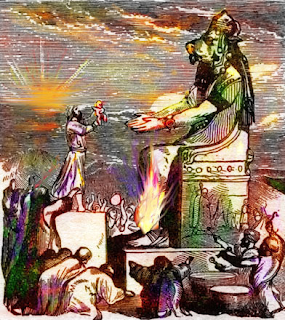
Offering to Molech, Bible Pictures by Charles Foster, 1897

The first to-eivah practice is making your son or daughter “go across through the fire”. According to the books of Leviticus, 1 Kings, Jeremiah, and 2 Chronicles, some Israelites gave their offspring to an Ammonite god called Milkom or Molekh in a ritual that included crossing through fire. This took place in the Valley of Ben-Hinom, just outside the southern wall of the city of Jerusalem.4

It is not clear whether this ritual was a dramatic initiation ceremony, an ordeal by fire that could be survived, or a form of human sacrifice. Whatever happened, making your offspring pass through the fire would be to-eivah on religious grounds, since God prohibits the worship of idols and/or other gods throughout the bible, comparing it to prostitution and finding it abominable.

A diviner: Koseim

Next Moses lists three types of people who are to-eivah because they engage in divination. The first is a:

koseim kesomim (קֺסֵם קְסָמִים) = diviner of divinations. (The root verb is kasam, קָסַם = practice divination.)

What type of divinations are kesomim? Although words from the root kasam appear 33 times in the Hebrew Bible, there is only one verse that offers any clues about how it is done. In this verse, God describes the king of Babylon wondering whether to send his army to conquer the city of Rabah in Ammon, or the city of Jerusalem in Judah. God tells the prophet Ezekiel:

For the king of Babylon stood at a fork in the road, at the starting point of the two roads, liksam kesem; he shook arrows, he inquired of figurines, he looked into a liver [the organ in an animal]. (Ezekiel 21:26)

liksam (לִקְסָם) = to divine.

kesem (קֶסֶם) = a divination (singular of kesomim).

When Moses refers to kesomim in this week’s Torah portion, the divination technique might be any of these three.

A diviner: Meonein

Meonein (מְעוֹנֵן) = diviner. The verb is onein (עוֹנֵן) = cause something to appear, conjure up a spirit, practice magic. This verb is closely related to the noun anan (עָנָן) = cloud. Did a meonein divine the future by reading clouds? Or by conjuring spirits?

The only hint in the bible is that first Isaiah denounces the Israelites for practicing magic including onenim like the Philistines”. (Isaiah 2:6)

onenim (עֺנְנִים) = making things appear. (A plural participle form of onein.)

But we do not know what sort of things the Philistines made appear, or how they did it.

A diviner: Menacheish

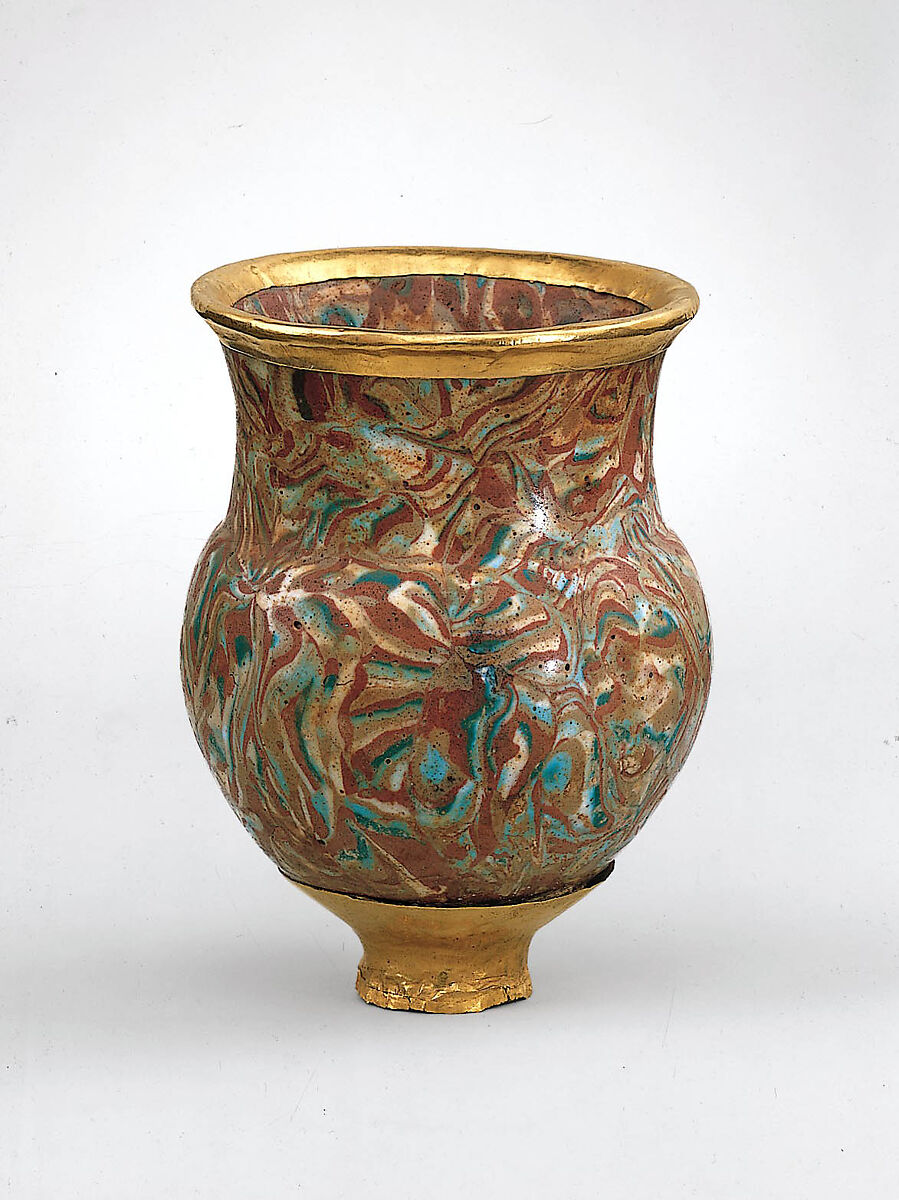
Egyptian Drinking Cup, 15th century B.C.E.

Menacheish (מְנַחֵשׁ) = diviner. The verb is nachash (נַחַשׁ) = practice divination. This verb is closely related to the noun nachash (נָחַשׁ) = snake. In ancient Greece, female diviners went into trances with the help of snake venom. We do not know if there was a similar practice in Canaan.

When Joseph is a viceroy of Egypt in the book of Genesis, he pretends to his brothers that he uses a silver goblet for divination, using the phrase nacheish yenacheish (נַחֵשׁ יְנַחֵשׁ) = “he definitely does divination”.5 This could mean that a menacheish did divination by reading the dregs in a cup—if it does not mean divination by drinking something hallucinogenic.

Not all divination is to-eivah

Although these three forms of divination are to-avot, the Hebrew Bible does not object to divination per se. Casting lots and answering yes-or-no questions using two objects in a priest’s vestments both win the bible’s wholehearted approval—when they are done under the right circumstances. For example, on Yom Kippur, the high priest is required to place lots on the heads two identical goats in the temple courtyard.

And Aaron must place goralot on the two hairy goats, one goral marked for God, and one goral for Azazeil. (Leviticus 16:8)

goralot (גֺּרָלוֹת) = plural of goral (גּוֹרָל) = a lot, something drawn from a container or tossed onto a marked surface in order to determine a decision; an allotted portion.

According to the Talmud, the two goralot used on Yom Kippur were made out of boxwood at first, then of gold.6 One was engraved with the name of God, and one with the name Azazeil. The high priest drew them out of an urn and placed one on each goat’s head. The goat that got the goral with God’s name on it was slaughtered, and its blood sprinkled in the Holy of Holies. The goat that got the goral with Azazeil on it was sent off into the wilderness after the high priest had transferred the sins of the Israelites to the “scapegoat”.7

After the Israelites conquer much of Canaan in the book of Joshua, Joshua casts lots to allocate territories to the seven tribes that have not yet claimed land, and parcels of land to the clans within each tribe.8 The word for “lot” is goral here, as well. The goralot are cast to match the tribes or clans to written descriptions of the lands.

Whether goralot were gold tokens or pebbles, what mattered was that no human being could determine the outcome of drawing or throwing lots. An outcome that many modern people would call random was, in the Hebrew Bible, a clear sign of God’s choice.

Another biblically approved method of divination was consulting the urim and tumim in the inside pocket of the high priest’s breast-piece, a key item in his elaborate vestments. These two mysterious objects are introduced in the book of Exodus, when God describes the vestments to Moses.

And you must place in the breast-piece of the rulings the urim and the tumim, and they will be over Aaron’s heart when he comes before God. (Exodus 28:29-30)

urim (אוּרִים) = an item in the pocket of the breast-piece. All we know is that is was small enough to fit, and that the word urim may—or may not—be related to the verb or (אוֹר) = become bright, illuminate.

tumim (תֻּמִּים) = an item in the pocket of the breast-piece. All we know is that is was small enough to fit, and that the word tumim may—or may not—be related to the adjective tamim (תָּמִם) = whole, complete, intact, unblemished, honest, perfect.

There are no clues in the Hebrew Bible about what the urim or the tumim look like, or how the high priest used them.

The book of Numbers says that when Joshua leads the Israelites to conquer Canaan, the high priest Elazar should consult the urim and tumim in front of God, and tell Joshua when to go out to battle and when to return.9 God will communicate through these objects.

In the first book of Samuel, King Saul tries, and fails, to get an answer from the urim about his upcoming battle against the Philistines.

And Saul saw the camp of the Philistines, and he was afraid and his heart trembled very much. Then Saul inquired of God, but God did not answer, either through dreams, or through the urim, or through prophets. (1 Samuel 28:5-6)

These inquiries are perfectly acceptable ways to ask God about the future. Saul’s unacceptable behavior is when he sneaks off to the “witch of Endor”, a woman who inquires of the dead, and asks her to raise the ghost of the deceased prophet Samuel. We will look into that story next week, in Shoftim: Is Magic Abominable?—Part 2, when we consider the last five kinds of magic in Moses’ list of occult practices that are to-avot.


  1. In the portion Shoftim: Deuteronomy 17:4 and 20:18. In other portions of the book: Deuteronomy 7:25, 7:26, 12:31 (including offering children in fire to other gods), 13:15, 27:15, and 32:16.
  2. Deuteronomy 17:1.
  3. Deuteronomy 18:9 (above) and Deuteronomy 18:12.
  4. Leviticus 18:21, 20:2; 1 Kings 23:10; Jeremiah 7:30-31, 32:34-35; 2 Chronicles 28:1-3, 33:5-6. See my post Acharey Mot & Kedoshim: Fire of the Molekh.
  5. Genesis 44:5 and 44:15.
  6. Talmud Yerushalmi, Yoma 3:7.
  7. Leviticus 16:5-10; . See my post Acharey Mot: Azazeil.
  8. Joshua 18:6-20:51.
  9. Numbers 27:21.

Haftarat Shoftim—Isaiah: Drunk on Rage

How do you console people who have been vanquished?

Babylonians besiege Jerusalem, 10th-cent. French ms.

This week Jews read the Torah portion Shoftim in Deuteronomy, accompanied by the fourth “haftarah of consolation”1 from second Isaiah (chapters 40-66 of the book of Isaiah, a collection of prophecies given after the Babylonians captured Jerusalem in 586 B.C.E.).

This week’s haftarah of consolation opens with God saying:

I, I am the one who comforts you.

            Who are you that you fear a mortal, who must die,

                        A human, who is like grass?

And you forget God, your maker,

            Who stretches out the heavens and establishes the earth!

And you are constantly terrified all day

            By the rage2 of the oppressor, as he prepares ruin.

But [after that] where is the rage of the oppressor? (Isaiah 51:12-13)

Nebuchadnezzar II with ziggurat, Babylonian stele, 6th cent. BCE

The oppressor of the Judahites was the Babylonian king Nebuchadnezzar II, who conquered Judah and exiled its leading citizens to Babylon. Yet the king and his generals did not necessarily feel anger toward the people of Judah; their strategic decisions for expanding the Babylonian Empire were probably cold-blooded. However, when an army is seizing one’s country through battles and sieges, it feels like a violent attack of rage.

By pointing out that all humans die, God encourages the Judahites to believe that even the Babylonian Empire and its apparent rage will pass away.

After a few verses reminding the exiles from Judah that God has sheltered them in the past and has the power to do it again, God says:

Wake up, wake up! Rise up, Jerusalem,

            Who drank from God’s hand the cup of rage;

The chalice cup of the tareilah

            You drank to the dregs. (Isaiah 51:17)

tareilah (תַרְעֵלָה) staggering, reeling, shaking uncontrollably.

Here the haftarah refers to the rage of God. Often the Hebrew Bible depicts God as smiting people in fury. After all, a lot of people are killed by war, disease, and famine; and according to the bible, God controls all those things. No wonder the bible paints God as a violent and abusive father with no anger management skills. When God has a fit of rage, the people must drink whatever God gives them. Naturally they feel terrified.

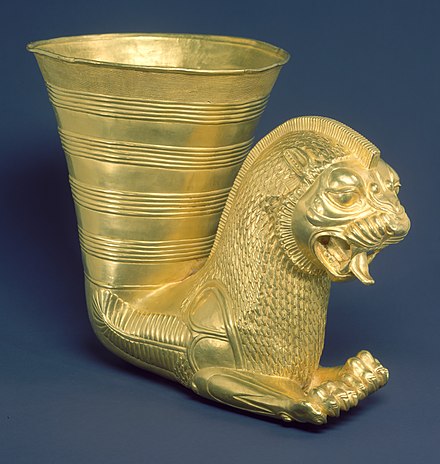
A drinking cup of the Achaemenids, who took Babylon in 539 BCE

In this week’s haftarah, the “cup of rage” might also refer to the answering rage of the Judahites, as they react to the apparent rage God by feeling their own anger at a God that has no compassion for them.

The Judahites drink the cup of rage, down to the dregs. And their own fear and rage incapacitate them. Both their bodies and their minds are tareilah, reeling and quivering, out of control.

Tareilah is a rare word in the Hebrew Bible; outside of this week’s haftarah from second Isaiah, it appears only in Psalm 60, in which the poet reminds God:

You made your people experience hardship,

          You made them drink the wine of tareilah! (Psalm 60:5)

A word related to tareilah appears in the book of Zechariah, when God says:

“Hey! I made Jerusalem a bowl of ra-al for the peoples all around, and [the ra-al] will also be for Judah, because of the siege on Jerusalem. … Her burden will certainly damage all the nations of the earth, and they will gather against her. On that day,” said God, “I will strike every horse with confusion and its rider with madness …” (Zechariah 12:2-4)

ra-al (רַעַל) = staggering, quivering; poison. (From the same root as tareilah. It occurs only two more times in the bible.3)

The book of Zechariah was written after the Babylonians were defeated by the Achaemenid Persians, but before any of the exiled Judahites returned to Jerusalem to take advantage of the Persian policy of limited self-government for provinces.4 Zechariah claims that everyone in the lands surrounding Judah has been going mad since the Babylonian conquest of Jerusalem. He warns that any further war against Judah will turn into chaos.

Before Zechariah, Jeremiah delivered a similar prophecy while the Babylonians were besieging Jerusalem:

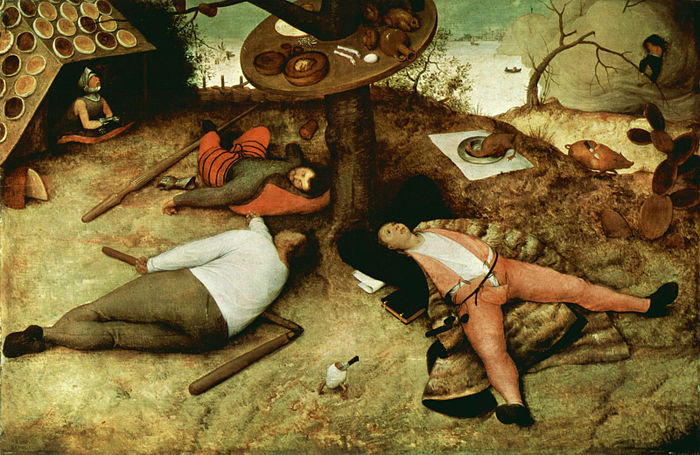
The Land of Cockaigne, by Pieter Bruegel the Elder, 1567

Thus said God, the God of Israel, to me: “Take the cup of the wine of rage from my hand, and make all the nations to which I am sending you drink it! … And you shall say to them: “Thus said God of Hosts, God of Israel: Drink and get drunk and vomit and fall down! And you will not rise up, because of the edge of the sword that I am sending among you.” (Jeremiah 25:15, 17)

In Psalm 60, Zechariah, and Jeremiah, people are completely helpless once they drink the cup of rage. Overwhelmed by their fear of God’s rage, and perhaps by their own answering rage, they stagger and shake, reel, vomit, and fall down.

Yet in Isaiah 51:17, God urges the people who have drunk the cup of rage:

Wake up, wake up! Rise up, Jerusalem,

            Who drank from God’s hand the cup of rage!”

How can they “wake up” from their tareilah?

The bible often refers to Jerusalem as a woman. But if she is a mother, she has no children who can help her get up.

There are none carefully leading [Jerusalem],

            Out of all the children she bore.

And there are none holding her hand

            Out of all the children she brought up. (Isaiah 51:18)

Soon we learn why Jerusalem has no “children” to help her up and lead her. At the end of the siege, everyone in the city who is not rounded up and marched off to Babylon lies faint with starvation, wounded by Babylonian weapons, or dead.

Your children have fainted;

            They lie at the head of every street like an antelope in a net,

Glutted with the rage of God,

            The rebuke of your God. (Isaiah 51:20)

In other words, all the people of Jerusalem are dead or incapacitated in some way, and therefore they cannot help one another to wake and rise up. In this verse the rage of God is the “rebuke” God delivers through the Babylonians in order to pay back the Judahites for worshiping other gods and failing to follow God’s ethical rules.

Does the punishment (death, incapacitation, and tareilah) fit the crime (cheating on God and cheating the poor)? Second Isaiah never questions it.

Therefore listen, please, to this, wretched one

            Who is drunk but not with wine:

Thus says your lord, God,

            Your God who conducts a lawsuit for [God’s] people:

“Hey! I have taken from your hand

            The cup of the tareilah,

            The chalice cup of my rage.

You will not drink from it again!” (Isaiah 51:21-22)

That is the ultimate consolation: that the period of incapacitation is over, and it will not return.

*

How do you comfort people who are being vanquished—by external enemies, or by enemies in their minds?

This week’s haftarah considers the case of people vanquished by enemies from outside. The unrelenting battles and sieges shatter them—both physically, through wounds and hunger, and mentally, through fear and answering rage over their plight. Thus the Judahites are also vanquished by enemies from within, emotionally overwhelmed until they are driven to madness, like the horse riders in Jeremiah.

When I reread the fourth haftarah of consolation this year, I thought of my mother, who has been suffering from tareilah for years now. A lifelong teetotaler, in old age she reels around because her balance is so poor. She often falls, and I keep expecting her to be vanquished by physical incapacitation. Yet after each hospitalization except the last she healed enough to stagger to her feet and use her walker. For all I know, she will rise up again at age 93.

My mother also staggers mentally, due to early-stage dementia. Sometimes her absence of short-term memory and subsequent confusion make her panic. She knows something is terribly wrong but she does not know what it is. Then in is my job as her daughter to hold her hand and “carefully lead her” by telling her the sad facts of her situation yet again. She calms down, so I must be comforting her, temporarily.

I hate to see my mother lie helplessly in bed “like an antelope in a net”. But I cannot take the cup of rage, or fear, away from her.

A people may live for hundreds of generations. But an individual human being is indeed “a mortal who must die”, like grass. Someday every one of us will be vanquished by incapacitation, then death.

If I said, like second Isaiah:

Therefore listen, please, to this, wretched one

            Who is drunk but not with wine—

I could not promise an end to tareilah. I could only add:

“I came back to hold your hand. Look at the flowers I brought you. Look out the window at the sky and the green trees. Wait.”

  1. We are in the middle of the seven-week period during which Jews read a “haftarah of consolation” from second Isaiah each week.
  2. Throughout this essay I translate the nouns chamah (חֲמַה) and chamat (חֲמַת) as “rage”. Other translations include “wrath” and “fury”.
  3. The two other occurrences of the root ra-al are hare-alu (הָרְעָלוּ), “they were shaken”, in Nahum 2:4; and hare-alot (הָרְעָלוֹת), which appears in a list of ornaments women wore in Psalm 60:5.
  4. King Cyrus, who founded the Persian Empire, quickly captured Babylon and its empire in 539 B.C.E.


Yitro, Mishpatim, & Va-etchanan: Relative or Relevant? Part 1

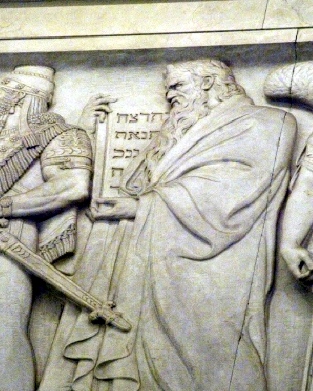
Moses on south frieze of Supreme Court building, by Adolph Weinman

The “Ten Commandments”1 are fundamental precepts, good for all time, right? Well, maybe.

The first four of the ten commandments (which appear in this week’s Torah portion, Yitro, in the book of Exodus, and again in Va-etchanan in the book of Deuteronomy) are religious injunctions. They prohibit having other gods,2 making or worshiping idols, swearing falsely in the name of God,3 and working on the holy seventh day of the week, Shabbat. These four commandments are hardly universal precepts, since they do not apply to people with other religions (including atheism).

The next six commandments, however, are about ethics, i.e. the right way to treat other people:

  1. Honor your father and your mother …
  2. You must not kill.
  3. You must not commit adultery.
  4. You must not steal.
  5. You must not testify falsely.
  6. You must not covet …

Not all of these commandments are easy to interpret outside the context of the social customs of the Ancient Near East.  Does that mean they are morally relative, guides only to correct behavior within the ancient Israelite culture? Or are they nevertheless moral absolutes, still relevant today?

This week’s post examines commandments five and six. Next week, Part 2 will assess commandments seven and eight. The week after that, Part 3 will explore the last two commandments.

*

The Fifth Commandment

Kabeid your father and your mother, so that your days will be long on the earth that God, your God, is giving to you. (Exodus/Shemot 20:12)

kabeid (כַּבֵּד) = honor, treat as important. (From the same root as the adjective kabeid, כַּבֵּד = heavy, weighty, impressive, oppressive, dull, hard.)

According to traditional commentary, if you honor your parents, your children will honor you.4 That means your adult children will make sure you are well fed and housed when you can no longer manage on your own, and therefore you will indeed live longer. (No wonder having children is a top priority in the Torah!)5

Maimonides wrote that in addition to making sure our parents have food, clothing, and shelter, we must be indulgent with them if they have dementia. When adult children can no long bear the strain of tending such a parent, they may hire others to take care of them.6

Honoring one’s parents goes beyond providing for their physical needs in the Torah. Next week’s Torah portion, Mishpatim, assigns the death penalty to the crime of hitting parents, or even speaking ill of them.

And one who strikes his father or his mother shall certainly be put to death. (Exodus 21:15)

And mekaleil his father or his mother shall certainly be put to death. (Exodus 21:17)

mekaleil (מְקַלֵּל) = one who belittles, one who curses.

There is no penalty in the Hebrew bible for a parent hitting or belittling a child. Hitting children in order to discipline them is considered a good deed in the book of Proverbs.7 Elsewhere parents are required to teach their children certain laws and traditions from the Torah,8 but the bible is silent about child abuse or neglect.9

This silence reflects the culture of the Ancient Near East, in which underage children were the property of their fathers and had no rights of their own. In other cultures, child abuse and neglect are considered criminal, and the ethical standard is for parents to treat their children with kindness and respect them as individuals, while still teaching them acceptable behavior in their society.

The fifth commandment implies that we should treat our parents with respect whether they deserve it or not.10 This may be a worthy aspiration, but when parents have seriously abused or neglected children while they were growing up, honoring and taking care of these bad parents could make the lives of their adult children unbearable.

I believe the fifth commandment should not be a universal ethical rule as it stands. I would amend it this way:

Parents must respect their children, and children must respect their parents.

The Sixth Commandment

The Servants of Absalom Killing Amnon, Heinrich Aldegrever, 1540

Lo tirtzach. (Exodus 20:13)

lo tirtzach (לֺא תִרְצָח) = you must not kill without a legal sanction. (From the verb ratzach, רָצַח.)

This commandment is sometimes translated into English as “You shall not kill” and sometimes as “You shall not murder”. Does the Torah distinguish between accidental manslaughter and deliberate murder?

The death penalty is prescribed only for pre-meditated murder in next week’s Torah portion, Mishpatim.

One who strikes down a man so that he dies, he [the one who struck] shall certainly be put to death. [However, if it was] one who did not stalk him, but God let [the one who died] fall by his hand, I will appoint a place for you where he can flee. But if someone plots against his fellow to kill him with cunning, from [even] my altar you shall take him to die. (Exodus 21:12-14)

More specifics are given in the Torah portion Masey in the book of Numbers, which also uses a form of the same verb as in the sixth commandment: ratzach.11 Here God orders the Israelites to set aside six cities of refuge once they have conquered Canaan.

… cities of refuge they shall be for you, and a rotzeiach who struck down a life inadvertently will flee there.” (Numbers 35:11)

rotzeiach (רֺצֵַח) = someone who commits either  premeditated murder or involuntary manslaughter. (The participle form of the verb ratzach).

Then God tells Moses:

But if one struck with an iron implement and [the victim] died, he is a rotzeiach and the rotzeiach must certainly be put to death. … Or [if] in enmity he struck him with his hand and [the victim] died, he shall certainly be put to death. (Numbers 35:16, 35:21)

Someone who kills accidentally can live in exile; someone who kills deliberately (either out of hatred or by using an implement well-known to cause death) gets the death penalty. The executioner, in that case, is the “redeemer of bloodshed”, a designated avenger from the family of the deceased victim. The commandment against killing does not apply to the avenger.

Nor does it apply to soldiers who kill enemies in battle. The Torah never criticizes the Israelites for starting a war, regardless of the reason. Moses only rules (in the Torah portion Shoftim in Deuteronomy) that when the Israelites attack a town outside Canaan merely in order to expand their territory or get some booty, they must first offer the option of “peaceful” surrender.

And if [the town] answers you with peace and opens itself to you, then all the people found inside it will be yours for forced labor, and they must serve you. But if it does not make peace with you, and does battle, and you besiege it, and God places it in your hand, then you shall put all its males to the edge of the sword. However, the women and the little ones and the livestock and everything that is in the town, all its plunder you shall plunder for yourself … However, in the towns of these peoples [Canaanites] which God, your God, is giving you as a hereditary possession, you shall not let a soul live. (Deuteronomy/Devarim 20:11-16)

These two approaches to conquest were considered ethical in the Ancient Near East. But today, an increasing number of people believe that even when a killing is legal, it may not be ethical.

Many people would agree with the commandment lo tirtzach, you must not kill without a legal sanction. But standards have changed for when it should be legal to kill someone. The death penalty is now banned in a majority of countries in the world, and is controversial in the United States.

War, on the other hand, is still an option for every nation. But some acts during war are now considered war crimes, and there is more interest in minimizing the deaths of non-combatants. Most people condone killing in self-defense, whether it is killing an individual who is about to kill you, or fighting a nation that has attacked yours. But is initiating a war justified if the purpose is to defend the citizens of an allied nation, or to defend a principle such as democracy?

A basic moral rule must be brief and express an ethical ideal, even if there are gray and cloudy areas in its application. The sixth commandment, which merely says “You must not ratzach” (You must not kill without a legal sanction) meets this requirement as it stands.

But I believe that too many types of killing have been legal, in both ancient Israelite and modern Western societies. An ethical ideal, in my opinion, would be more restricted. So I would like to propose this amended sixth commandment:

You must not kill except to prevent someone from being killed.

*

Next week I will address what the seventh and eighth commandments mean when they prohibit adultery and theft—then and now.

  1. Exodus 20:1 introduces what we call “the Ten Commandments” in English with “And God spoke all these devarim”. Devarim, דְּבָרִים = words, statements, things. In Deuteronomy, Moses calls the ten “commandments” the devar of God; devar is the singular of devarim.
  2. See my 2011 post Yitro: Not in My Face.
  3. See my 2014 post Yitro: The Power of the Name.
  4. E.g. the Book of Sirach, 3:1-16 (second century B.C.E.)
  5. In first-world countries today, the whole society pays various taxes to take care of its aged population through various taxes. Yet when old people can no longer manage certain tasks themselves, their adult children are still expected to meet some obligations.
  6. Maimonides (12th-century Moses ben Maimon or “Rambam”), Mishneh Torah, book 14, treatise 3, chapter 6:10, as quoted in Edward Hoffman, The Wisdom of Maimonides, Trumpeter, Boston, 2008, p. 114-115.
  7. Proverbs 13:24, 19:18, 22:15, 29:15.
  8. E.g. Exodus 13:8; Deuteronomy 6:6-7 and 11:19.
  9. One father, Jepthah/Yiptach, vows that if God gives him success in battle he will offer to God whatever comes out of his house first when he returns. He is dismayed when his daughter runs out to greet him. But this father is portrayed as foolish, not abusive. He immediately grants her request for a two-month postponement so she can “cry over her virginity”. The cautionary tale ends without clarifying whether Yiptach’s daughter was slaughtered at the altar or given to the local sanctuary. (Judges 11:30-35)
  10. See my 2015 post Yitro: The Heaviness of Honoring Parents. The Book of Sirach adds: Help your father in his old age, and do not grieve him as long as he lives; Even if he is lacking in understanding, show forbearance …”
  11. For more on the words ratzach and rotzeiach, see Marty Lockshin, “Does the Torah Differentiate between Murder and Killing?”, thetorah.com.

Eikev & Judges: Love or Kill the Stranger?

Are foreigners neighbors or enemies?  Should you befriend them or kill them? This week’s Torah portion, Eikev (“on the heels of”), appears to promote both points of view.

Love the stranger

And you must love the geir, for you were geirim in the land of Egypt.  (Deuteronomy/Devarim 10:19)

geir (גֵּר), plural geirim (גֵּרִים) = immigrant, resident alien.  (Not any “stranger”; only a foreigner who has settled down in another country.)

The command to be good to the immigrant appears many times in the Torah.1  In this week’s iteration, Moses warns his people not to act like the Egyptians, who mistreated the multiplying family of Jacob (a.k.a. Israel) when they were resident aliens in Pharaoh’s kingdom.2  He anticipates that after the Israelites have conquered Canaan and settled down, there will be individual immigrants who should be treated with the same fairness and compassion as anyone else in the land.

Kill the stranger

But this ethical rule does not apply to the Canaanites already living in the land the Israelites are about to conquer.  In last week’s Torah portion, Va-etchanan, Moses says:

You must dedicate them to destruction.  You must not cut a treaty with them, and you must not show them mercy.  You must not give them your daughters, nor give their daughters to your sons … because they would turn your children away from [God], and they would serve other gods … Instead … you must tear down their altars and smash their standing stones and cut down their goddess posts and burn their images in fire.  (Deuteronomy 7:2-5)

In the portion Eikev, Moses repeats the call for genocide of the Canaanites.

And you must eat up all the peoples that God, your God, is giving to you.  You must not look at them with compassion.  And you must not serve their gods, because it would be a trap for you.  (Deuteronomy 7:16)

Why?

Why does the God-character tell the Israelites to be kind to new immigrants, but to exterminate the existing population of Canaan?

If the Israelites had succeeded in conquering all of Canaan and killing its whole population, the injunction in Eikev could be viewed as a post-genocide justification: “We had to wipe them out because God told us to”.  But the book of Judges, which opens with an account of territories that the Israelite tribes partially conquered, reports that the original Canaanites continued to live in their midst.3

Therefore the exhortation to exterminate all the Canaanites serves a different purpose: to emphasize that nothing is more important for the Israelites than sticking to their own religion.  This agenda appears in the passages above from both Va-etchanan and Eikev.

The God-character portrayed in the books of Exodus, Numbers, Deuteronomy, Joshua, and 1 Samuel explicitly approves of genocide when the perpetrators are Israelites, and the victims worship a different god and occupy land that God has designated for the Israelites.4 No exceptions are made for infants or atheists.

In the book of Numbers, the land designated for Israelites includes not only Canaan, but also the region on the east bank of the Jordan River.  God helps the Israelites conquer the kingdoms of Cheshbon and Bashan, where two and a half of the twelve tribes will live.

War Against the Midianites, detail, by Balthasar Bernards, ca. 1720-1728

While they are camping at Peor, preparing to cross the Jordan, the Israelites accept invitations from the Midianites there to worship the god of Peor (Baal-Peor).  The God-character is enraged with jealousy, and (after wiping out 24,000 Israelites with a plague), orders the surviving men of Israel to kill all the Midianites around Peor: men, women, and male children.5

In next week’s Torah portion, Shoftim, Moses says that when the Israelites go to war to conquer a town outside the lands God has given them, they must first invite the town to surrender peacefully.  If the town accepts this offer, all its residents can continue to live there, as long as they provide labor for Israelites projects.However,

In the towns of those peoples that God, your God, is giving to you as a permanent possession, you must not let a soul live.  … so that they will not teach you to do all the taboo things that they do for their gods … (Deuteronomy 20:16, 20:18)

Thus the real issue is whether foreigners will help or hamper the Israelites in serving their God.

The Torah promotes friendly assimilation of new immigrants because they can be required to observe some basic Israelite religious practices.  The Torah rules that geirim must refrain from eating leavened bread during the week of Passover,7 refrain from working on the sabbath or Yom Kippur,8 refrain from eating an animal’s blood,9 obey the Israelite sexual prohibitions,10 refrain from giving children to the god Molekh,11 refrain using God’s name in an insult or curse,12 follow the laws of purity after exposure to a human corpse,13 and listen to a reading of the Torah every seven years.14

Immigrants who obey all these rules are not likely to worship other gods openly, or entice Israelites to join them in worship.

Israelite immigrants

But what will the Israelites do when they are the immigrants, a large population settling Canaan by force?  Since they do not wipe out the indigenous peoples, will they start worshiping the local gods the way they did in Peor?

The answer in the book of Judges is a resounding yes.

The Israelites did what was bad in the eyes of God, and they served the be-alim.  And they abandoned God, the God of their forefathers, the one who brought them out of the land of Egypt.  And they went after other gods from among the gods of the peoples who were all around them, and they bowed down to them, and [thus] they offended God.  (Judges 2:11-12)

be-alim (בְּעָלִים) = plural of baal (בַּעַל) = owner; a male Canaanite god.

Canaanite religions seemed to be so enticing that they were hard to resist.15

A different solution

From an ethical point of view, sharing the land of Canaan with its indigenous inhabitants is far better than committing genocide.  Why don’t Moses and the God-character in the Torah find a more ethical way to keep the Israelites from worshiping other gods?

Persuading the Israelites that no other gods exist is not the answer.  Moses tried this earlier in the book of Deuteronomy, saying:

You yourselves have seen for the knowledge that God is the God; there is no other than he alone.  (Deuteronomy 4:35)

But the people are not psychologically ready for monotheism.  Threats do not work either.  The portion Eikev includes two of many statements in the Torah that God will kill the Israelites if they worship other gods:

And it will be if you actually forget God, your God, and you go after other gods and serve them and bow down to them, I call witness against you this day that you will truly perish.  (Deuteronomy 8:19)

Guard yourselves lest your heart deceives you and you desert and serve other gods and bow down to them.  Then God’s anger will heat up against you and shut the heavens, and there will be no rain and the earth will not give its produce, and you will quickly perish from upon the good land that God is giving to you.  (Deuteronomy 11:16-17)

Perhaps at this stage, the Israelites need dazzling visual displays to reinforce their commitment to their religion.  The Canaanites have glittering gold and silver idols.  The Israelites have a single invisible god who only occasionally manifests as a miraculous fire.

The book of Judges points out that the sight of miracles made all the difference.

And the people served God all the days of Joshua and all the days of the elders who came after Joshua, who had seen all the great deeds of God that [God] did for Israel.  (Judges 2:7)

Elijah and King Ahab see divine fire, Zurich Bible, 1531

If the Israelites cannot yet stick to their own God without miracles, an occasional miracle might help to keep the religion going until the people become able to adopt a more sophisticated idea of God.  An example is when Elijah when Elijah sets up two altars, one for God and one for Baal, and asks the people of the northern kingdom of Israel to make their choice.  God sends down fire to consume the offerings, and the Israelites respond by attacking the priests of Baal.16

A miracle in every generation might have kept the Israelites away from Canaanite religion.  At least it would be a better solution than genocide.

Even today many people cannot relate to an invisible, abstract god.  Some people still use icons and other shiny objects to support their religious resolve.  Others still need miracles, and gladly interpret apparent coincidences as the hand of God.  If these religious practices strengthen their commitment to ethical behavior, then they are well worth it.

But a god that sanctions murder is not worth worshiping.  Killing the infidel is a practice that has continued somewhere in the world to this day.  May it cease in our own time.


  1. See my blog post Mishpatim: The Immigrant, including the footnotes.
  2. Moses also makes this point in Exodus 23:9.
  3. Judges 1:21-33.
  4. Divine commands for genocide of seven Canaanite peoples include Exodus 23:28-33, Deuteronomy 7:1-5, 7:16, 7:24, 20:16-18; and Joshua 8:2, 10:40. The God-character commands genocide of the Amalekites in 1 Samuel 15:2-3.
  5. See my posts on “How to Stop a Plague”, Part 1, Part 2, and Part 3.
  6. Deuteronomy 20:10-11.
  7. Exodus 12:19.
  8. Exodus 20:10, 23:12; Leviticus 16:29; Deuteronomy 5:14.
  9. Leviticus 17:10-13.
  10. Leviticus 18:26.
  11. Leviticus 20:3.
  12. Leviticus 24:16.
  13. Numbers 19:10.
  14. Deuteronomy 31:12.
  15. Even in the 6th century B.C.E. people were worshiping “the Queen of Heaven” (Jeremiah 7:18)
  16. 1 Kings 18:20-40.


Shoftim: More Important Than War, Part 2

Israelite Soldier (artist unknown)

Once the Israelites have taken over most of Canaan and established their own country, Moses says in last week’s Torah portion, Shoftim (“Judges”), a king will have more important duties than wars of conquest, and some men will have more important duties than being soldiers.  Battles are inevitable in the Torah, and advantageous to the winners; winning king expands his kingdom, and his soldiers get shares of the booty.  But the portion Shoftim opens a door to an attitude that values peace.

In last week’s post, Shoftim: More Important Than War, Part 1, I covered the four rules a good king must follow, all of which would make a war of conquest more difficult—unless God intervened.

Later the portion Shoftim says:

If you go out to battle against your enemies and you see horse and chariot, more troops than you have, you must not be afraid of them, because God, your God who brought you up from the land of Egypt, is with you.  (Deuteronomy/Devarim 20:1)

Individual men must still be prepared to die, but they should know that God is on the side of their country and their comrades.

If the war is defensive, protecting the kingdom from attack, then all able-bodied men who are age 20 and older must serve in the military.1  But if the war is offensive, designed to expand Israel’s border or its prestige, then four kinds of circumstances excuse men altogether from going to battle.2

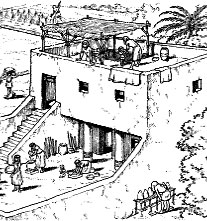
Israelite house, artist unknown

1) Then the officials will speak to the troops, saying: “Who is the man that has built a new house and not chanako?  He must leave and return to his house, lest he die in the battle and another man yachnekhenu.”  (Deuteronomy 20:5)

chanakho (חֲנָכוֹ) = dedicated it, inaugurated it.  yachnekhenu (יַחְנְכֶנּוּ) = he will dedicate it, inaugurate it.  (From the same root as chanukah, חֲנֻכָּה = dedication; the name of the winter solstice holiday.)

According to Talmud Bavli (Sotah 43b) this exemption applies to any man who has not dedicated a new house, whether he built it, bought it, inherited it, or received it as a gift.  What does it mean to dedicate a new house?  According to Targum Yonatan, it means putting a mezuzah on the doorpost.3  But this takes only a few minutes, not long enough to stop a man from going to battle.  Rashi wrote that dedicating a house means living in it.4

If the new owner died in battle, he would never know that another man was living there.  But the Torah does not want to deprive the owner of the satisfaction of moving into the new house.  In the Torah, a man who lives in his own house is the head of a household, no longer a dependent on an older family member.  He should not be denied the joy of his new status.

2) “And who is the man that has planted a vineyard and not chilelo?  He must leave and return to his house, lest he die in the war and another man yechalilenu.” (Deuteronomy 20:6)

Grape vine, artist unknown

chilelo (חִלְּלוֹ) = made profane use of it; made personal use of it.  yechalilenu (יְחַלְּלֶנּוּ) = he will make profane/personal use of it.

The Talmud defines a vineyard as at least five grape vines, and extends the exemption to include those who had planted at least five fruit trees.5  No fruit may be harvested from a grape vine or a fruit tree for the first three years after it is planted.  In the fourth year, all of its fruit must be donated to God—either brought to the priests at the temple, or exchanged for silver which is brought to the temple.  Only in the fifth year can the owner eat the fruit himself, or sell it for profit.6

The book of Leviticus/Vayikra, in which these rules are laid out, is primarily concerned with the holy rather than the profane.  But here in Deuteronomy, Moses emphasizes the importance of feeding yourself and your own household.  After waiting four years for his vines or trees to mature, farmer should not be denied the joy of making a living from them.

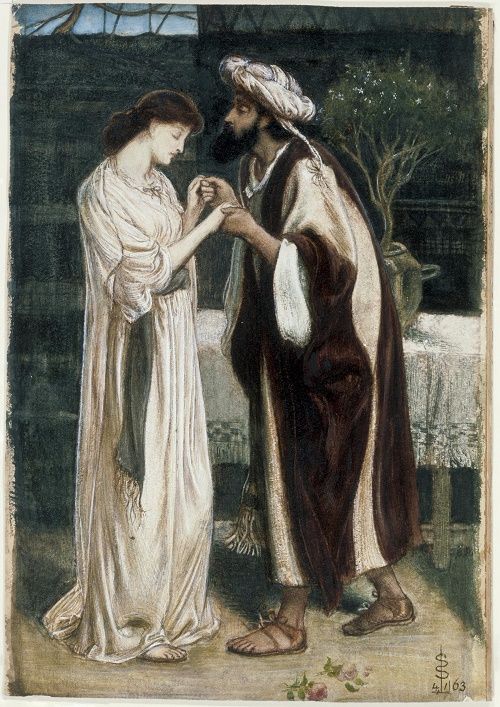
Isaac and Rebekah, by Simeon Solomon, 1863

3) “And who is the man that has paid the bride-price for a wife and not lekachah?  He must leave and return to his house, lest he die in the war and another man yikachenah.” (Deuteronomy 20:7)

lekachah (לְקָחָהּ) = taken her, had sexual intercourse with her, married her.  yikachenah (יִקָּחֶנָּה) = he will take her, have sex with her, marry her.

Is the fiancé exempt from battle so that he is not deprived of intercourse with his bride, or so that he can beget children with her?  This week’s Torah portion, Ki Teitzei, says:

When a man takes a new wife, he must not go out with the army for any purpose; he shall be exempt for his household for one year, and make his wife glad. (Deuteronomy 24:5)

This implies that a new wife must not be deprived of the joy of intercourse with her husband.

The Talmud, Sotah 43b, says that the bridegroom is sent home whether he paid the bride-price for a virgin or a widow, or he is doing his duty for his deceased brother’s widow.  Under Israelite and Canaanite law, a childless woman whose husband died was is entitled to get a son through her husband’s brother.  “And even if there are five brothers, and one of them dies in the war, they all return for the widow.”7  Perhaps giving the widow a son is so important that if one brother fails, another must be available.  This Talmud passage implies that the purpose of the exemption is to get a new wife pregnant.

Whether the goal is to make the wife glad, or to have a child, a husband should not be denied the joy of living with his new wife.

Rembrandt history painting detail, 1626

4) “And the officials will continue to speak to the people, and they will say: “Who is the man who is yarei and rakh of heart?  He must leave and return to his house, and not melt the heart of his brother [soldier] like his heart.”  (Deuteronomy 20:8)

yarei (יָרֵא) = afraid, fearful.

verakh (רַךְ) = sensitive, tender, weak, delicate.

The Talmud (Sotah 44a) offers two reasons why a man might be fearful: Rabbi Akiva said the man would be terrified by the sight of a drawn sword; Rabbi Yosei HaGelili said the man would be afraid because of his sins (implying a view of the afterlife that was invented after the Hebrew Bible was written).8  Both of these reasons address fear, but not sensitivity.  Perhaps the rabbis of the Talmud interpreted the sentence as describing the man as “fearful and weak-hearted”, making weak-hearted a synonym for fearful.

Talmud tractate Sotah 44b says the reason for this fourth exemption is that fear spreads, making formerly brave and hard-hearted soldiers feel qualms about going to battle.

But the officials could also be asking “Who is the man who is afraid and tender-hearted?”  Since the adjective rakh applies to a mental attitude as well as physical condition, this man would feel tenderness toward all human beings, and be afraid of killing them rather than of being killed.

A tender-hearted man’s reluctance to kill could also spread to other soldiers if he were allowed to march with the troops.

According to the Talmud (Sotah 44a), all four exemptions are announced at once to spare a fearful man from embarrassment; for all the other men know, he is leaving the ranks and going home because of a house or vineyard or wife.

But what if the exemption for a fearful or tender-hearted man is parallel to the other three exemptions?  Then perhaps he must also leave and return home for his own good.  Maybe a peaceful, gentle man must not be denied the joy of living in peace.


What is more important than going to war?

Home.

Livelihood.

Family.

Peace.


  1. Numbers 1:2-3.
  2. The Talmud distinguishes between optional wars of conquest, and obligatory wars to defend the kingdom of Israel or Judah from invasion. (Sotah 43b-44b)
  3. Targum Yonasan (a.k.a.Targum Pseudo-Jonathan, between 4th and 13th centuries C.E.) as cited by Rabbi Elie Munk, The Call of the Torah: Devarim, trans. by E.S. Mazer, Mesorah Publications, Brooklyn, NY, 1995, p. 205.
  4. Rashi is the acronym for 11th-century C.E. Rabbi Shlomoh Yitzchaki.
  5. Talmud Bavli, Sotah 43b.
  6. Leviticus 19:23-25.
  7. Talmud Bavli, Sotah 44a, William Davidson translation, www.sefaria.com.
  8. See Talmud Bavli, Eiruvin 19a.  Jews did not adopt the idea that souls survive death until the second century B.C.E.  The idea of souls burning in an underground fire came from Greek and Persian sources, which Jews developed into the myth of Gehinnom (later called Gehenna) and Christians developed into the myths of Hell and Purgatory.  The Talmud was written during the third through fifth centuries C.E.


Shoftim: More Important Than War, Part 1

Israelite soldier (artist unknown)

Wars of conquest and even genocide are glorified in the books of Numbers and Joshua.  (For a blatant biblical example, see my post Mattot: Killing the Innocent.)

Yet sometimes in Deuteronomy a kinder voice comes through.  In this week’s Torah portion, Shoftim (“Judges”), Moses looks ahead to when the Israelites have already taken over most of Canaan and established their own country.  Then a king will have more important duties than wars of conquest; Moses lists four.  Then a man will sometimes have more important duties than serving as a soldier in battle; Moses lists four of these, also.1

King, Hazor, 15-13th cent. BCE, Israel Museum

This week’s post will cover the four things a good king must do.  Next week’s post will cover the four things that are more important than serving as a soldier.

A good king

When you have entered the land that God, your God, is giving to you, and you have taken possession of it and settled in it, and you say: “I will put a king over myself, like all the nations around me,” you may certainly put a king over yourself—one that God, your God, will choose.  (Deuteronomy/Devarim 17:14-15)

Once on his throne (all the kings of the Israelites were male), the king would have to obey four rules, all of which would make the conquest of foreign countries more difficult:

  • He must not accumulate horses.
  • He must not accumulate wives, especially foreign women who worship other gods.
  • He must not accumulate too much silver and gold.
  • He must read the Torah every day.

This description applies to Josiah/Yoshiyahu, a young king of Judah in the 7th century B.C.E.  At age sixteen, “he began to seek out the God of David, his forefather …” (2 Chronicles 34:3).  At 26, he orders repairs for the temple in Jerusalem, and the high priest Hilkiah/Chilkiyahu reports:

“I have found a book of the torah in the house of God.”  (2 Kings 22:8)

torah (תוֹרָה) = teaching, instruction; the first five books of the Hebrew Bible.  (From the root verb yorah, יֺרָה = teach, instruct.)

Josiah hearing the book of the law, 1873

Galvanized by this scroll, King Josiah demands exclusive worship of the God of Israel throughout the Kingdom of Judah and parts of the former Kingdom of Israel to the north.  He demands that his people worship only at the temple in Jerusalem, he reinstitutes Passover, and he destroys the shrines, priests, and idols of other gods.2

Modern scholars propose that Hilkiah’s scroll was a substantial part of the book of Deuteronomy, either the early core (chapters 5-26) or the code of laws in chapters 12-20.  They point to various items in the story of Josiah’s reign that appear as laws in Deuteronomy, but are not mentioned in the first four books of the bible.3

Some passages in Deuteronomy imply praise of King Josiah and criticism of earlier kings.  In this week’s Torah portion, Moses’ four rules for kings seem to be veiled criticism of King Solomon/Shlomoh, whose reign over a united Israel would have taken place during the 10th century B.C.E.

1) He must not accumulate horses for himself, and he must not send people back to Egypt in order to accumulate horses, for God said to you: “You must not find an excuse to turn back on that road again.”  (Deuteronomy 17:16)

Israelites used donkeys for riding, not horses.  Throughout the Ancient Near East horses were used to pull war chariots.  Charioteers usually defeated foot soldiers—unless God intervened, as when 600 Egyptian chariots tried to cross the Reed Sea.4  God does not say “You must not find an excuse to turn back on that road again” until this week’s Torah portion, but several times in the books of Exodus and Numbers the Israelites in the wilderness come up with an excuse to head back to Egypt, and God acts to prevent them.5

By the time of Josiah, the kings of Judah were not only keeping horses and chariots, but dedicating them to the sun god Shemesh.

And he [Josiah] abolished the horses that the kings of Judah had dedicated to the Shemesh, from the entrance of the house of God to … the outskirts, and he burned the chariots of the Shemesh in a fire.  (2 Kings 23:11)

Chariots, ivory plaque from Megiddo

Despite this loyal action, God does not intervene when the army of Egypt under Pharaoh Nekho fights the army of Judah under King Josiah.  The second book of Chronicles explains that the pharaoh sends messengers to Josiah asking for safe passage through Judah on his way to fight the Assyrians to the north.  But Josiah “did not listen to the words of Nekho from the mouth of God, and he came out to fight on the plains of Megiddo.” (2 Chronicles 35:22).  The Egyptians win, and an arrow kills King Josiah, who is riding in a horse-drawn chariot.

Three centuries earlier, King Solomon buys horses from Egypt.6  He keeps 12,000 horses and 1,400 chariots—a substantial military force.7  Although the bible does not describe his battles, it does say that Solomon exacts tribute from countries on Israel’s borders, and enforces punishing corvée labor on the Israelites in the north (as the pharaoh did to the enslaved Israelites in Egypt).8

2) And he must not accumulate wives for himself, so that his leivav will not veer away.  (Deuteronomy 17:17)

leivav = heart (literally), mind, inner self, seat of emotions and thoughts.

Only two of King Josiah’s wives are mentioned in the bible: Chamutal of Livnah (a town in western Judah) and Zevudah of Rumah (a village west of the Sea of Galilee in what was the Kingdom of Israel until the Assyrian conquest of 701 B.C.E.).9  Both of these women are of Israelite descent, not foreigners.

Israel and its neighbors in Solomon’s time

King Solomon, however, has 700 royal wives and 300 concubines.  His first wife is the daughter of the Pharaoh of Egypt.10  He loves and becomes attached to Pharaoh’s daughter and to women from the royal families of Moab, Ammon, Edom, Phoenicia, and Hatti.11  Although at the beginning of his kingship he builds the first temple to the God of Israel in Jerusalem, in his old age he becomes more devoted to his foreign wives than to God.

And it happened in his old age, Solomon’s wives turned his leivav away after other gods, and the leivav of Solomon was not with God, his God, like the leivav of his father, David, had been.  (1 Kings 11:4)

King Solomon even builds shrines for the foreign gods Khemosh and Molekh.12  Thus the second rule for a king in this week’s Torah portion can be read as another veiled criticism of Solomon.

3) And he must not accumulate too much silver and gold for himself.  (Deuteronomy 17:17)

If an Israelite king kept more money than he needed to pay for the basic functions of kingship, he was disobeying the biblical injunctions to support the poor, widows and orphans, resident aliens, and Levites (religious functionaries who lived on donations).13

King Josiah takes this responsibility seriously.  When he reinstitutes the observance of Passover,

Josiah contributed lambs and goat kids for the people numbering 30,000, and 3,000 cattle, everything for the Passover sacrifices for everyone who was present.  These were from the property of the king.  (2 Chronicles 35:7)

But the description of King Solomon’s palace indicates that he uses excess gold for his own luxury.  He decorates the palace with 200 shields and 300 bucklers of hammered gold.  All his drinking cups and other utensils are also gold.14

4) And it shall be when he sits upon his throne of kingship, then he must write for himself a copy of this torah on a scroll, from [the scroll] in front of the priests of the Levites.  And it must be with him, and he must read in it all the days of his life, so that he may learn to be in awe of God, his God, to observe all the words of this torah and these decrees, to do them.   (Deuteronomy 17:18)

The fourth rule establishes that Israelite kings are not above the law.  The king’s most important job is to follow God’s rules.  To do this, he must keep on rereading them so he does not forget any, and so they immediately come into his mind when he faces a relevant situation.

Once again, King Josiah serves as an example of a good king.

Solomon Reading from the Torah of Moses, French manuscript, 13th cent. CE  (In the bible that king is Josiah, not Solomon!)

The king went up to the house of God, along with all the men of Judah and all the inhabitants of Jerusalem, and the priests and the prophets and all the people from small to big.  And he read out loud all the words of the scroll of the covenant that had been found in the house of God.  And the king stood on a platform and he cut the covenant in front of God: to follow God and to observe [God’s] commandments and testimonies and decrees with all [their] leiv and with all [their] soul, to carry out the words of this covenant, the one written on this scroll.  And all the people stood with the covenant.  (2 Kings 23:2-3)

leiv (לֵב) = a short version of the word leivav = heart, mind, inner emotions and thought.

Not so King Solomon.

And God felt angry with Solomon because he had turned away his leivav from being with God, the God of Israel …  And God said to Solomon: ‘… You have not observed my covenant and my decrees that I commanded.’  (1 Kings 11:9, 11:11)


These four rules for kings can still show us how to do good instead of make war.  If a king must not accumulate war horses, then today every head of state should make treaties rather than weapons, and every individual should learn how to give up violence.

If a king must avoid marrying women who will tempt him to turn away from God, then today every head of state should avoid listening to those who advise taking office for the sake of power rather than service, and every individual should avoid listening to people who tempt them away from their own standards.

If a king must not accumulate too much silver and gold, then today every head of state should avoid using their position for personal gain, and every individual should learn to care more about people and actions than about wealth.

Finally, if a king must copy, read, and reread the Torah, then today every head of state should read their country’s constitution and key laws, consult with experts in every field requiring action, and question the morality of each option before acting.  And every individual should engage in study before speaking out or voting.

Then we would have more than a good king; we would have a good world.

Next week: four more startling rules in the portion Shoftim, this time about who must be excused from military service, in Shoftim: More Important Than War, Part 2.


  1. Unlike today’s nation of Israel, the ancient kingdoms of Israel and Judah did not use women as soldiers in battle. (However, in Judges 4:1-22 the prophetess Devorah acts as the general of the Israelite tribes behind the scenes, and Jael kills the enemy general when he is in her tent.)
  2. 2 Kings 22-11 through 23:25.
  3. Including the temple (a.k.a. the house of God) in Jerusalem as the only legitimate place for offerings to God, the celebration of Passover at the temple rather than at home, and the language of passages in which the people pledge themselves to a covenant with God. (W. Gunther Plaut, “Introducing Deuteronomy”, The Torah: A Modern Commentary, ed. by W. Gunther Plaut, Union of American Hebrew Congregations, New York, 1981, pp. 1290-1294.)
  4. Exodus 14:1-30.
  5. Exodus 14:10-14, 15:26, 16:2-4, 17:3-6; Numbers 11:4-6, 14:2-4.
  6. 2 Kings 23:28-30.
  7. Solomon’s father, King David, hamstrings 1,600 of the horses he captures in a battle with the king of Tzovah, keeping only 100 for his own use (2 Samuel 8:4). King Solomon buys horses in 1 Kings 10:28.
  8. 1 Kings 10:26.
  9. 1 Kings 10:25 and 11:28.
  10. 2 Kings 23:30-36.
  11. 1 Kings 3:1.
  12. 1 Kings 11:1-3.
  13. 1 Kings 11:7-8.
  14. The book of Deuteronomy requires all landowners to support these groups in 14:27-29, 15:4-11, 24:19-21, and 26:12.
  15. 1 Kings 10:16 and 0:21.

Repost: Shoftim

Four things are called toeivah (abominable, repugnant) in this week’s Torah portion, Shoftim: offering defective animals as a sacrifices for God, worshiping other gods, keeping carved images of gods, and practicing magic.

My 2015 blog post on these abominations pointed out that while it is fine to avoid doing things we find repugnant, it is immoral to kill human beings who do repugnant things.

I still believe that.  But when I reviewed my 2015 post, I decided to rewrite the last part of it.  Since the 2016 American election I have become more concerned about government-sponsored heartlessness than about individual heartless deeds.  So here is my rewritten post: Shoftim: Abominable.