Becoming a Maggid

I am preparing for my certification on January 29 as a maggid (or maggidah, the feminine form in Hebrew).  So I decided to look up what a maggid does in the Torah.  The word first shows up when Pharaoh tells Joseph his two dreams:  one about seven scrawny cows eating up seven fat cows, and one about seven withered ears of grain eating up seven fat ears of grain.

And I spoke to the soothsayers, but none of them was a maggid for me.  (Genesis/Bereishit 41.24)

maggid = telling; an announcer, reporter, explainer, interpreter (from the root verb naggid = to tell)

Joseph’s interpretation of the dreams rings true for Pharoah, so he is a good maggid.

The word maggid does not appear again until the book of Judges, when Samson poses a riddle to 30 guests at his wedding party.  If they guess the answer to the riddle by the end of the seven-day party, he will give them 30 suits of clothing, but if they fail, they will give Samson 30 suits of clothing.  The guests learn the answer by cheating, and Samson, in a rage, kills 30 men in another town and strips off their clothing to give the wedding guests.

… and he took their clothes and he gave the sets of clothing to the tellers (maggidai) of the riddle.  (Judges/Shoftim 14:19)

In this reference, as in the story of Joseph, a maggid is someone who interprets a mystery.  But we get another meaning of the word maggid  in the second book of Samuel, which refers several times to messengers describing events to King David.  A young Amelekite maggid brings David the crown of King Saul, and gives his eye-witness account of how Saul was fatally wounded in battle, and asked someone to finish him off.  The maggid claims he himself did the deed—a mistake, since David responded by having the maggid killed.  Later David explains that the maggid thought he was bringing good news, but David did not see it that way.  This is a good reminder to me that the same story will be received differently by every listener.

Someone bringing news is called a maggid twice during the struggle between David and his son Absalom for the kingship.  One maggid reports to David that the hearts of the Israelite men are turning toward Absalom; David takes this bit of interpretation seriously and flees Jerusalem.  Another maggid reports to David’s general Joab, describing how he encountered Absalom riding a mule, and when Absalom ‘s long hair was caught in some tangled tree branches, his mule kept on going, leaving Absalom hanging by the hair.  Joab takes this comic story seriously, finds Absalom hanging by the hair, and stabs him to death.

The book of Jeremiah also uses the word maggid to mean a messenger who tells the news orally.  But the word  acquires more  gravity in the book of Isaiah, where God calls Itself a maggid.

I told of the first things, and they came to be; now I am a maggid of new things, before they sprout up, I announce.  (Isaiah/Yeshayahu 42:9)

I am God, speaking rightly; a maggid of  uprightness.  (Isaiah 45:19)

I am a maggid from the beginning to the end, and from the origin of things that had not happened.  (Isaiah 46:10)

So in the Hebrew bible, a maggid interprets dreams and riddles; tells eyewitness stories of real events; and (when God is a maggid) foretells the future—or speaks the future into reality.

In the Talmud, a maggid told stories (aggadah, an Aramaic word from the same Hebrew root word as maggid) to communicate subtle truths, while a darshan explained religious laws and technical points in the Torah.  The book that Jews still read at Passover is the haggadah (also from the same root as maggid) and everyone at the table who helps to to tell the story of the Exodus is a maggid.

By the Middle Ages, a maggid was an itinerant preacher who quoted from the Torah and offered his own interpretations, and also told other Jewish stories, in order to inspire uneducated Jews to become more devout.  A darshan gave the equivalent of a sermon at Jewish services, speaking about the weekly Torah portion and finding an inspiring message for the congregation.

The work of the maggid reached its greatest glory in Eastern Europe during the 17th through 19th centuries, when the chassidic movement fostered leaders who combined the jobs of maggid, darshan, and rabbi.

The old Eastern European model of the maggid faded away during the 20th century.  But now a new interest in the maggidic calling is rising, and I know of at least two formal programs to train maggids.  I am one of seven women who are completing the first two-year training program offered by Rabbi David Zaslow and professional storyteller Devorah Zaslow.

In some ways I have already been serving as a maggid.  This blog, now in its third year, is a series of
drashot (or “drashes”,  in colloquial American Jewish parlance):  commentary on Torah portions that explores meanings we can consider today.  I have also been a darshan (one of many!) for my congregation, P’nai Or of Portland, for many years.  And my Torah monologues are a creative form of drashot.  The only part of a maggid’s job that I used to lack was Jewish storytelling.  During the last two years, while I have been studying with David and Devorah Zaslow, my drashot have become deeper, and I have learned how tell traditional Jewish stories.  (I always rewrite the stories to make them more interesting or meaningful to me and my audience—but that, too, is part of the Jewish storytelling tradition!)

This January 27-29, in Portland, Oregon,  the seven of us graduating from the maggid program will lead both Friday evening and Saturday morning Shabbat services, using both traditional liturgy and  some creative approaches to prayers, and giving seven drashot on different pieces of the Torah portion for that week, Bo (Come!).  That Saturday evening we’ll tell Jewish stories in a storytelling concert, and on Sunday we’ll have our graduation ceremony.

Because I need to spend all my spare time the next two weeks preparing for the big graduation weekend, I will not be posting any blogs on the first two Torah portions of the book of Exodus/Shemot.  If you would like to read my previous blogs on the Torah portions Shemot and Va-Eira, go to http://www.mtorah.com and click on the tab “Blogs by Torah Portion”.

And for my next blog?  Part of my preparation will be writing a four-minute drash on one of the inner meanings of the  locust plague in Bo.  Look for it in blog form at the end of the month!

Meanwhile, I have become more aware that human beings not only need to tell stories, but we need to hear and read stories to help us interpret our own inner stories, to help us interpret our dreams and our mysterious yearnings and the personal histories we are continually rewriting for ourselves.  Ultimately, maybe good stories have the same purpose as good religion and good psychology:  the discovery of meaning in our lives.

Vayeishev & Mikeitz: Symbols of Authority

Visible tokens of your public role help to remind everybody of your authority.  Who would obey a  police officer in street clothes, without even a badge?

Visible symbols of authority can also seduce you, and others, into forgetting the difference between one’s public identity and one’s personal, inner self.  The Torah addresses this problem in the first two Torah portions that tell the story of Joseph and his brothers:  Vayeishev (“And he settled”) and Mikeitz (“In the end”).

The Story of Judah and Tamar

In this week’s portion, Vayeishev, one of Joseph’s older brothers, Judah, convinces the others to sell Joseph into slavery in Egypt instead of killing him outright.  (See my post Vayeishev: What Drove Them Crazy on why Joseph’s brothers hated him.)

Then Judah moves away from his family and starts a new life.  He becomes a prosperous shepherd with his own household, including three sons.  Judah marries his oldest son, Eir, to a Canaanite woman named Tamar.  Eir dies soon after, and Tamar is not pregnant.  So according to the custom of yibum, or “levirate marriage”, Eir’s brother (or closest male relative) must impregnate his widow.  If her baby is a boy, he will inherit her late husband’s property, and she will be have economic security and status through her son.

Judah sends his second son, Onan, to Tamar.  But Onan refuses to do his duty; why should he mess up his own inheritance?  Then he dies, too.1

Judah superstitiously delays giving Tamar his youngest son, Shelah.  He uses his authority as the head of his household to return Tamar to her father’s house.  Here she must live as  a widow who cannot remarry as long as the yibum is pending.

Tamar and Judah, by James Tissot

Tamar waits for years.  Shelah grows up, and Judah’s wife dies.  Judah finishes mourning for his wife, and heads off to the annual sheep-shearing.  Tamar slips away from her father’s house, dresses as a veiled prostitute, and sits by the road where Judah will see her.  Not recognizing her, and feeling festive, he propositions her.

When Judah promises her a kid goat in payment for sex, Tamar demands a pledge to keep until the goat is delivered.

And he said:  “What is the pledge that I must give to you?”  And she said: “Your chotam and your cord and the matteh that is in your hand”.  And he gave them to her, and he entered her, and she conceived.  (Genesis/Bereishit 38:18)

chotam (חֹתָם) = a seal.  (A common kind of seal in the Middle East was a carved cylinder worn on a cord around the neck.  To authorize a document written on a damp clay tablet, a man rolled his seal over the clay as a signature.)

matteh (מַטֶּה) = a staff, a walking stick, the symbol of a tribe or clan or its chieftain.

453px-Babylonian_-_Cylinder_Seal_with_Three_Standing_Figures_and_Inscriptions_-_Walters_42692_-_Side_D
Cylinder seal (chotam)

Tamar is asking Judah for the symbols of his public authority—his signature (which is how a seal was used) and his corner office!  And he loans them to her, as if he were using a credit card to buy sex now and pay later.  It does not occur to him that this veiled woman might use his seal and staff to run a scam or to blackmail him.  He is so accustomed to ruling his extended household, and to judging and sentencing anyone under his control, it does not occur to him that anything could jeopardize his position.

Later, Judah’s best friend and confidant searches for the “prostitute” to give her the kid goat and retrieve the seal and staff.  But she has disappeared.  Then Judah gets nervous about losing status in the community, and he asks his friend not to tell anyone that he left his seal and staff with a prostitute.

Eventually Judah learns that Tamar is pregnant.  He knows that his son Shelah is not the father, so he calls her a harlot and sentences her to burning.  As Tamar is taken away, she sends Judah his pledge with this message:

I am pregnant by the man to whom these belong.   Please recognize who owns these, the chotam and the cord and the matteh.  (Genesis 38:25)

At that point, Judah says:  She is more right than I am” (Genesis 38:26), thus becoming the first person in the Torah to admit he is wrong.

Judah is acknowledging both that he is the father, and that he was wrong to thwart Tamar’s right to get pregnant by a relative of her late husband.

This story also demonstrates that Judah’s personal desires—to protect his last living son, and to enjoy sex after his own wife is dead—are in conflict with his duty as a clan leader.  But he is so accustomed to his position of power, he does not at first realize there is any difference between his private desires and his public role.  By taking away the symbols of his public authority, and then returning them at the crucial moment, Tamar shocks Judah into seeing the difference.

When he takes back his chotam and matteh, Judah also commits himself to doing the right thing as the man in charge—even if his private wishes are different.  This is a major step forward in ethical development.

The Story of Joseph and Pharaoh

Meanwhile,  in next week’s Torah portion, Mikeitz, Judah’s little brother Joseph is transformed in one day from an imprisoned slave to the viceroy of Egypt.

The pharaoh has two troubling dreams that his own wise man cannot interpret.  His butler mentions a dream interpreter he met when he was in prison awaiting trial, a slave from Canaan.  Pharaoh commands that Joseph be brought to him.  He is impressed with Joseph’s divinely inspired interpretation of Pharaoh’s dreams as warnings about a coming seven-year famine, as well as with his proposal for solving the problem—so impressed that he puts Joseph in charge.

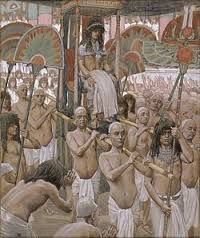
The Glory of Joseph, by James Tissot

And Pharoah said to Joseph:  “See, I have placed you over all the land of Egypt!”  And Pharaoh removed his taba-at from upon his hand and he put it on Joseph’s hand, and he clothed him in linen garments, and he put the gold collar on his neck.  And he had him ride in the merkavah of his second-in-command, and they called out before him “Avreikh!”; thus he appointed him over all the land of Egypt.  (Genesis 41:41-43)

taba-at (טַבַּעַַת) = a signet ring.  (A king’s ring in Egypt was a signet ring with the king’s seal carved into it.  Like the cylindrical chotam that a Canaanite man such as Judah wore on a cord, the signet ring was pressed on a damp clay document as a signature of authorization.)

merkavah (מֶרְכָּבָה= chariot.

Avreikh (אַבְרֵךְ) = (Translation disputed.  It might be an unknown Egyptian word, or “I command kneeling!” in Hebrew.)

The pharaoh is smart enough to realize that Egyptians will not treat a foreigner and ex-slave like a viceroy unless he has plenty of visible symbols of his new public identity.  Pharoah also gives Joseph an Egyptian name and a high-ranking Egyptian wife.  Joseph’s word is then taken as law, and he successfully prepares Egypt for the coming famine.

But Joseph loses some of his own personal identity when he gains these symbols of his new public identity.  When his first son is born, Joseph says:  “God has made me forget all my hardship and all the household of my father.” (Genesis 41:51)  He retains his religion, but otherwise he speaks and dresses and rules as an Egyptian.  He never writes home.  He is happy to live his role—until his ten older brothers come to him to buy food during the first year of famine.

Joseph recognizes them, but they do not recognize him.  He speaks Egyptian, dresses as an Egyptian, has an Egyptian name, and wears the gold collar and taba-at of the pharaoh.  His public role completely hides his private identity.

Inside, Joseph bears a personal grudge against the brothers who sold him into slavery, and he cannot forgive them until he knows whether they have changed.  I can imagine him wondering whether he should take them aside, drop his mask, and confront them directly; or stick to being the Egyptian viceroy, and simply sell them food along with all the other purchasers from Canaan.  Then he thinks of a way to test them.

Joseph invents a charge against his brothers, accusing them of being spies, and throws them in prison for three days.  He retains one brother, and sends the rest home with an order to bring back their youngest brother, or else.  (Jacob’s youngest son, Benjamin, was a child at home when Joseph’s older brothers sold him into slavery.)  When starvation forces them to return with Benjamin, Joseph inflicts more tests on his older brothers, all while maintaining the persona of an Egyptian ruler.  Although he hides his personal identity, his private past affects his behavior as a public official.

The game does not end until Judah confronts the unjust viceroy in the Torah portion Vayiggash and volunteers to enslave himself to spare his father and youngest brother.2

Judah is able to step up and speak to the Egyptian viceroy because, thanks to Tamar, he has already recognized and addressed the conflict between his personal feelings and his public role.  He has repented of both selling his brother and denying his daughter-in-law.  He has dedicated himself to justice and compassion.

Hearing him, Joseph weeps and reveals his personal identity—after sending away his Egyptian servants to make sure they will not lose respect for his authority.  He never apologizes for testing his brothers by lying to them; nor does he explain to them why he did it.  He does send for his whole extended family, introduces a few of them to the Pharaoh, and arranges for them to live in Egypt, where there is food.  But he makes these arrangements as the gracious viceroy of Egypt, without every admitting he was wrong about anything.

Perhaps he cannot integrate an old private identity that he hates (persecuted son of Jacob) with his new public position of authority (viceroy of Egypt).  But those who adopt their public roles as their only guide to behavior cannot have a change of heart.

  1. Genesis 38:8-10.
  2. Genesis 44:1-34.

Vayeitzei: Guilty Conscience

At the end of last week’s Torah portion, Toledot (Histories), Jacob runs away to his uncle Lavan’s house in Charan.  The official reason for his trip east is to get a wife.  But his more urgent reason is to avoid being murdered by his twin brother Esau.

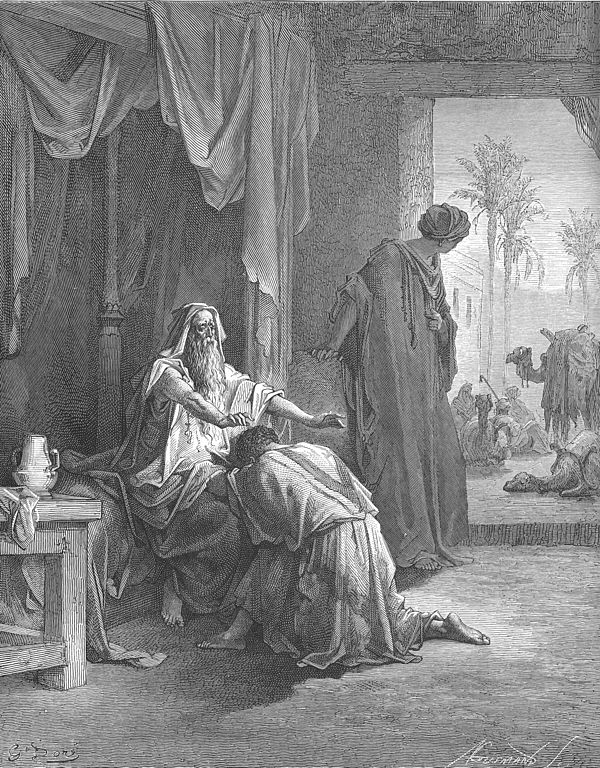
Isaac Blesses Jacob, by Gustave Dore, 1866

Jacob has just tricked their blind father in order to “steal” the blessing that Isaac intended for Esau.  The twins’ mother, Rebecca (who instigated the scheme to divert the blessing), finds out that Esau is so enraged he is vowing to kill his brother.  So she privately tells Jacob:

Flee for yourself to my brother Lavan, to Charan!  And stay with him a few days, until your brother’s rage turns away… from you, and he forgets what you did to him; then I will send and take you away from there. (Genesis 27:43-45)

Rebecca does not mean a few days literally; it would take at least a week just to travel to Charan and back.  But she does indicate that Jacob’s stay in Charan will be brief.  This is reasonable, since we know Esau is a man whose emotions, though  overwhelming, are short-lived. (See my post Toledot: Seeing Red.)

Officially, Jacob is not running away at all, but following Isaac’s instruction to go to Charan and take a wife from among the daughters of Rebecca’s brother, Lavan.  But Jacob does not wait for his wealthy father to give him a bride-price, riding animals, and servants for the journey.  Instead, he dashes away with only his walking stick.

I think Jacob is determined to leave his past behind, and never again try to take anything from his father: neither an inheritance, nor a blessing, nor even a bag of silver.

In this week’s Torah portion, Vayeitzei (“And he went”), Jacob arrives in Charan, and Lavan takes him in.

And he stayed with him a month of days.  Then Lavan said to Jacob:  Is it so, that you are my kinsman, and you serve me without compensation?  Tell me what is your maskoret!  (Genesis/Bereishit 29:14-15)

maskoret (מַשְׂכֺּרֶת) = wage, pay for hired labor.

And Jacob loved Rachel, so he said:  “I will serve you for seven years for Rachel, your younger daughter.”  (Genesis 29:18)

Seven years?  Jacob has already been tending Lavan’s flocks for a month.  Why does he offer to serve for seven years?

Many commentators have written that seven years of labor is the bride-price Jacob pays for Rachel. Yet Jacob’s family is wealthy.  When his father sends him off to get a bride, he would normally send him with riding animals, servants, and gifts for the bride’s family—just as Abraham did when he sent his steward to Charan to get a wife for Isaac.1  And even though Isaac learned how Jacob had tricked him, he still gave Jacob a generous parting blessing, showing no desire to deprive him of anything.  So Jacob should be well equipped to pay a large bride-price to Lavan on the spot.

Yet he is not.  The text does not say any servants are traveling with him; when he stops for the night he is alone and sleeps on the ground with a stone for his pillow.2  And he travels on foot:

Then Jacob lifted his feet and he walked toward the land of the easterners.  (Genesis 29:1)

Lavan puts him to work as soon as he arrives, treating him as a poor relative rather than as a guest, so we can infer that Jacob did not carry any valuable gifts in his pack.  And in next week’s Torah portion, Vayishlakh (And he sent), when Jacob heads back west, he says:

“With my walking-stick I crossed this Jordan, and now I have become two camps.”  (Genesis 32:11)

Why does Jacob leave without the servants, riding animals, and gifts that his father must have provided for his journey?

I believe Jacob is punishing himself, perhaps subconsciously, for tricking his father and cheating his brother.  Instead of coming to Lavan as a guest and a wealthy prospective bridegroom, he arrives as a poor relative who volunteers to serve Lavan as his master.

The 20th-century commentator Shmuel Klitsner3 has pointed out that although a hired laborer is paid a daily wage and is free to leave his employer at any time, a Hebrew slave serves his master without fair wages for up to seven years.

If you buy a Hebrew slave, he will serve six years, and in the seventh he will go out as free, without compensation. (Exodus/Shemot 21:1)

Jacob gives himself the maximum number of years of slavery as a punishment for stealing Esau’s blessing.  Since his father has not sentenced him to any punishment, he has to punish himself.  It is the only way he can cope with his guilty conscience.

Later in the Torah, Moses sets up a system of animal sacrifices as guilt-offerings; the animal’s owner not only suffers the loss of the valuable property, but also lays hands on the animal before the priest slaughters it, symbolically transferring his guilt to the animal about to be killed for God.  In the book of Genesis, Noah, Abraham, Isaac, and later Jacob himself, do offer animal sacrifices to God.  But they are never guilt-offerings, and never for the purpose of expiating sin or wrongdoing.

If Jacob cannot atone for his bad deed through a guilt-offering, and his clan leader and father will not punish him, what else can he do to resolve his guilty conscience?  Today, we might ask him to apologize to both Isaac and Esau, and find a way to make restitution.  That is precisely what Jews are expected to do every year before Yom Kippur, the Day of Atonement.

But although the people in the book of Genesis sometimes confess their wrongdoing to God, they never think of apologizing to one another.  Jacob’s grandfather Abraham never apologizes  either to Sarah, or to the two kings he hoodwinks, for passing off his wife as his sexually available sister.  Neither Sarah nor Hagar apologizes after they abuse one another.  Rebecca does not apologize to anyone for masterminding the trick on Isaac, which also hurts Esau and makes Jacob flee for his life.  And Jacob does not apologize to Esau, either for talking him into trading his birthright for stew, or for cheating him out of his blessing.  In his family, in his whole experience, people do not apologize to each other.

I am tempted to conclude that we are better off today, when rabbis, teachers, and parents train us to confess and apologize whenever we do something wrong.  Yet I know it’s not that easy.  Sure, I can apologize for an inconsiderate remark to someone who understands and forgives me, and then I feel relieved.  But I also know from personal experience that few things are harder than apologizing to someone whom you believe will neither understand nor forgive you.  It takes not only courage, but also an ability to accept that your effort may fail, and the only reward you will get for doing the right thing is the knowledge that you did the right thing.

This knowledge may not seem like much of a blessing at the time.  But it does save you from having to run away from the person you wronged, and punish yourself by becoming a slave for seven years.  


  1. Genesis 24:21, 24:53.
  2. Genesis 28:10-11.
  3. Shmuel Klitsner, Wrestling Jacob: Deception, Identity, and Freudian Slips in Genesis, Urim Publications, Jerusalem, 2006.

Bereishit & Toledot: Seeing Red

The book of Genesis/Bereishit explores a series of conflicts between brothers, and one between sisters.  Two of these conflicts feature an especially hot-blooded, emotional brother, and both of these use various permutations of the word for the color “red”: adom, אָדֺם.

Blood red

After Cain kills Abel in the first Torah portion of Genesis, Bereishit, God tells Cain:

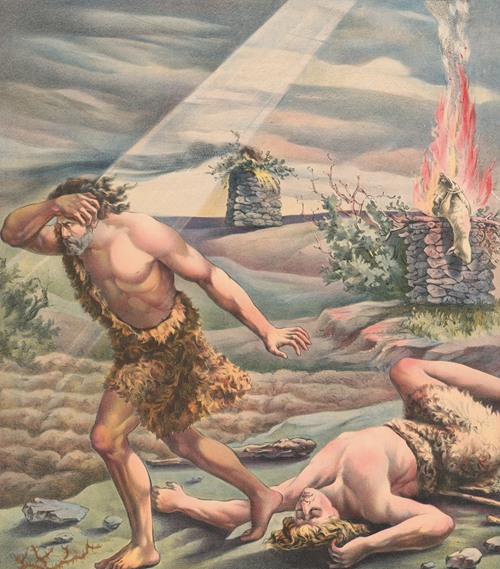
The Killing of Abel, Providence Lithograph Co., 1905

“What have you done? The voice of the damim of your brother is crying out to me from the adamah!”  (Genesis/Bereishit 4:10)
damim (דֱָמִים) = shed blood. (plural of damדָּם = blood.)
adamah (אֲדָמָה) = ground, dirt, earth.

Both Hebrew words come from the same root as adam (“human”, also the name of the father of Cain and Abel, whom God makes out of dirt in Chapter 2).  To be human is, among other things, to be red.  Dam, “blood”, is obviously red.  And traditional commentary explains that uncultivated earth (at least in the world described by the Torah) is red clay.

Red man, red stew

This week’s Torah portion, Toledot (“Histories”), tells the story of the twins Esau and Jacob, from their conception until they are in their forties and  Jacob flees because Esau is threatening to kill him.

Then her days of pregnancy were completed, and hey! –twins were in her womb.  And the first one went out, admoni all over like a fur robe of hair, and they called his name Eisav.  And after that his brother went out, and … they called his name Jacob.. (Genesis 25:24-26)

admoni (אַדְמוֹנִי) = reddish.

Eisav (עֵשָׂו) = Do it, get it done. (From the verb asahעָשָׂה = do.) “Esau” in English.

The text is not clear about whether he has ruddy skin and is covered with hair, or whether his fur-like hair is reddish.  Either way, he is born red, like blood, and hairy, like a beast.

Since Esau is born a moment before Jacob, he counts as the firstborn son.  In the world of the Torah, when the patriarch of an extended family dies, his firstborn son inherits a double portion of his father’s possessions, and also becomes the family’s priest.  Yet in this story, when Esau grows up and becomes a hunter, he does not care about the role of the firstborn.  Jacob, who stays in the tents, cares very much.

Jacob stewed a stew, and Esau came in from the field, and he was famished.  And Esau said to Jacob: “Please let me gulp down some of the adom— this adom— because I am famished.”  Therefore his name was called Edom.  (Genesis 25:29-30)

Edom (אֳדוֹם) = a people who later lived in the hill country east of the Jordan river valley, supposedly descended from Esau.  (From the same root as adom = red.)

Esau Selling His Birthright to Jacob, by Rembrandt, 17th c.

Jacob takes advantage of his incoherent brother’s request by charging an exorbitant price for the stew.

And Jacob said:  “Hand over, as of today, your right as firstborn to me”.  And Esau said:  “Hey, I am going toward death, so what is this to me, a firstborn right?”  Then Jacob said:  “Swear to me, as of today!”  And he swore to him, and he handed over his firstborn right to Jacob.  And as for Jacob, he gave to Esau bread and a stew of lentils.  And he ate and he drank and he got up and he went.  Thus he belittled the right of the firstborn.  (Genesis 25:31-34)

On a literal level, this story amuses me, because I often make stew from red lentils, and it always comes out a golden color.  Other kinds of cooked lentils are dark brown or green-brown—but never red.  Did someone who never cooked write down this story, and get the detail about lentils wrong?  I prefer to assume that Jacob is so clever, he adds an ingredient to his stew that will make even lentils look red enough to attract Esau’s attention.

Esau sees food and the color red.  He does not notice the lentils.  He cannot even find the word for stew.  The 19th-century commentator Samson Raphael Hirsch wrote that the color red delights Esau because it reminds him of the blood on an animal when his arrow hits it.1

The 20th-century psychologist Helen Luke wrote that red is the color of instinct, impulse, and emotion.  She added that Esau, who is controlled by the color red, is in danger of losing all civilizing tendencies and becoming evil.  Jacob, his opposite, is in danger of repressing or denying all instinct and emotion, and becoming evil.2

Neither Cain, the man of blood-red violence, nor Jacob, the bloodless schemer, is a good candidate for the spiritual role of the firstborn, the one who speaks with and makes offerings to God.

I think Jacob sees the world as black and white, divided between losers and winners.  Since he sees the firstborn as the winner in the family, he applies his intelligence to acquiring that role.  He suppresses any emotional impulses in order to carry out first his own scheme for taking his brother’s birthright, then his mother’s scheme for stealing his brother’s blessing.  Jacob may not savor his food as much as Esau, but he knows how to plan ahead.

Esau sees only red.  Carried away by one emotion after another during the Torah portion of Toledot, he carries out his impulses and lives for the moment.  In the passage translated above, he gives away his birthright to appease one day’s feelings of hunger and despair.  Later in the Torah portion, he weeps like a child when he finds out Jacob has stolen the blessing their father intended for Esau.  Then he becomes so angry he threatens to kill Jacob as soon as their father dies.

Jacob flees from him, and (in the Torah portion Vayeitzei) he meets his match in his cold, calculating uncle Lavan—whose name means “white” in Hebrew.  Yet some color finally comes into Jacob’s black-and-white life, as he falls in love with Lavan’s daughter Rachel.  Gradually he succeeds in becoming the leader of his own clan, through a combination of sensitivity to others’ emotions and rational long-term planning.

Meanwhile, Esau leaves home and learns how to be a leader.  When he hears that his twin and nemesis is coming his way (in the Torah portion Vayishlach), he plans ahead by bringing 400 men to meet Jacob on the road.  But he retains his emotional instincts, and when he sees Jacob bow to him, he runs over and embraces his brother.  The two older and wiser men pull off a peaceful reunion.


We all have some of Jacob’s black-and-white rationalism and some of Esau’s red emotionalism.  We can only be whole human beings when those two sides embrace.

Furthermore, in order turn our whole personality toward peace rather than toward evil, we must learn from the evolution of both brothers.  Jacob learns to use his black-and-white intellect to lay plans for the good of everyone, instead of for just his own advantage.  And Esau learns to move beyond seeing red as the blood shed in killing, and see red as the blood of life, shared with other humans.

If we can widen our vision enough, through both our intellects and our emotions, we will recognize that all human beings share the same blood; we are descendants of Adam, אָדָם = the human, humankind. (From the same root as adom = red.) Then we will all truly deserve the right of the firstborn to speak with and offer gifts to God.


  1. Rabbi Samson Raphael Hirsch, The Hirsch Chumash: Sefer Bereshis, Feldheim Publishers, Jerusalem, 2002, pp. 561-562.
  2. Helen Luke, Kaleidoscope, Parabola Books, New York, 1992, p. 225.

Lekh-Lekha & Vayeira: Going with the Voice

The phrase lekh-lekha appears only twice in the Torah.  Both times God is telling Abraham to do something radical.

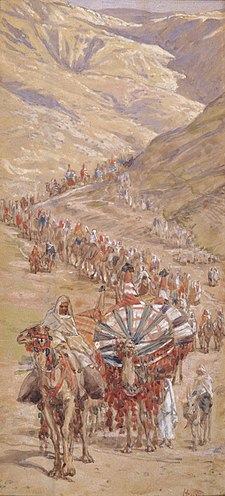
The Caravan of Abraham, by James Tissot

The first time God says lekh-lekha is in his first request of Abraham, at the beginning of this week’s Torah portion (called “Lekh-lekha”):

God said to Abraham: “Lekh-lekha , away from your land, and away from your birthplace, and away from the house of your father, to the land that I will show you.”  (Genesis/Bereishit 12:1) 

lekh (לֶךְ) = Go! 

lekha (לְךָ) =  for yourself, to yourself.

lekh-lekha (לְךְ־לְךָ) = Go for yourself!  Go to yourself!  Go, yourself!  Get going!  

God’s final request to Abraham, in the Torah portion Vayeira (“And he appeared”), contains the same phrase.

And [God] said:  “Please take your son, your only one, whom you love, Isaac; and lekh-lekha to the land of the Moriyah, and bring him up there for a burnt offering upon one of the mountains, which I will tell to you.” (Genesis 22:2)

God’s first request seems difficult but relatively benign.  Yes, Abraham leaves his father and his familiar life.  But he takes along his wife Sarah, his nephew Lot, a number of servants or followers, and his wealth in livestock.  Although he is venturing into a strange land to find himself,  he has the benefit of both resources and companions of his choosing.  He also has the reassurance of knowing his brother Nachor has remained in Charan to take care of their elderly father, Terach.

Sacrifice of Isaac, French, 13th century

God’s final request, on the other hand, seems impossibly horrific.  Abraham must cut the throat of his son and heir, and burn him up as an offering to God.  In dire circumstances, chieftains in the Middle East did sacrifice their own sons to prevent national disaster.But at this point in the story of Abraham, his small clan is living peacefully at Beer-sheva, with no threat in sight.

So Abraham knows that although he will prove something to God and himself by sacrificing Isaac, his own people and his neighbors will probably think he is a lunatic.  He also knows that his wife Sarah is so attached to Isaac that she will either die of shock or become his bitterest enemy.  Nevertheless he leaves early in the morning with his son and three servants, without speaking to Sarah and without telling the servants what kind of offering he is planning.

God’s final request leaves Abraham without aid or comfort from anyone.   At this point Abraham only has two family members at home: his wife Sarah, and their son Isaac.  (He has already sent away his concubine Hagar and their son Ishmael.  His nephew Lot separated from him long ago.)  By sacrificing Isaac, Abraham will lose the rest of his family: his wife and his remaining son.

Yet God’s two requests, one benign and one disastrous, are related.  Not only do both requests use the unusual term lekh-lekha, but both of them also use a series of phrases that increase Abraham’s emotional stake in obeying.  In the first request, God asks Abraham to leave not just his country, but also the culture he grew up with, and even his own birth family.  In the final request, God asks Abraham to sacrifice not just his son, but his only child (now that Ishamel is exiled), the son he loves.

Both sentences with the phrase lekh-lekha also leave Abraham’s destination a mystery.  The first time, God does not even tell Abraham that he should head for Canaan; he must blindly go to “the land that I will show you”.  The second time, God tells Abraham to go to the land of Moriyah (a place name that may be related to the word marah,  “something shown”) and promises to point out the right mountain to Abraham when he arrives.  Both times, Abraham must start out on his mission trusting God to reveal where it will end.

Furthermore, both of God’s orders come at times when Abraham has a settled life and there is no emergency.  When Abraham first hears God say lekh-lekha, he is simply living in Charan with his extended family.  (Later commentary invented stories about his dramatic youth there as an idol-smasher, but the Torah itself says nothing.)  And when Abraham hears God say lekh-lekha again, he and his people have been living at Beer-sheva for “many years”.

Both times, when nothing in particular is happening, Abraham hears God speak to him out of the blue.  Maybe lekh lekha does mean “Get going!”, since both times Abraham responds by rousing himself and taking an action that changes his whole life.

Rashi wrote that lekh-lekha meant “Go for yourself”, i.e. for your own benefit.2  He pointed out that God promised Abraham many descendants, a famous name, and blessing in return for leaving Charan and going to God’s undisclosed destination.

But surely Abraham would not benefit from sacrificing Isaac, his son and heir.

The sacrifice is not completed; an angel of God stops Abraham at the last minute, when he is holding his knife over Isaac’s throat.  But Abraham’s willingness to sacrifice his own son causes lifelong psychological trauma for Isaac.  Although Abraham arranges a marriage for his younger son, there is no indication in the Torah that he and Isaac ever see one another again.

Furthermore, after the attempted sacrifice, the next story in the book of Genesis is about the death of Abraham’s wife Sarah.3  Although Abraham eventually remarries, the death of Sarah probably weighs on him.

*

Lekh-lekha!

How do you know whether the apparently divine voice in your head is summoning you to an adventure, or to a nightmare?  How do you know whether it is ethical to follow that call?

Maybe you experience a divine call as an urgent need to change your life, even though you do not know where the need comes from, or where you will end up if you act on it.  Suppose you ignore this inner voice, this inner god.  Will you feel ashamed for the rest of your life that you did not rise to the challenge?

Suppose you do heed the call.  Will you become a revered leader and the founder of a new way of life, like Abraham?  Or will you become a crazy person ready to sacrifice his own child—like Abraham?

Listen carefully.

  1. For example, in 2 Kings 3:27, when the king of Moab is losing to the invading armies of Israel, Judah, and Edom, he sacrifices his son and heir as a burnt offering, and the invaders retreat.
  2. Rashi is the acronym of 11th-century rabbi Shlomoh Yitzchaki.
  3. The story of Abraham’s near-sacrifice of Isaac is Genesis 22:1-19.  Then there is a brief genealogical interlude, Genesis 22:20-24.  The story of Sarah’s funeral begins with Genesis 23:1.

Bereishit & Noach: All Flesh

Light and dark, good and evil, heaven and earth, spirit and matter—the narratives as well as the religious laws in the Torah often speak in terms of opposites.  In this universe of contrasting pairs, humans are a unique combination of the heavenly and the earthly.  This concept of humankind begins in the second chapter of Genesis:

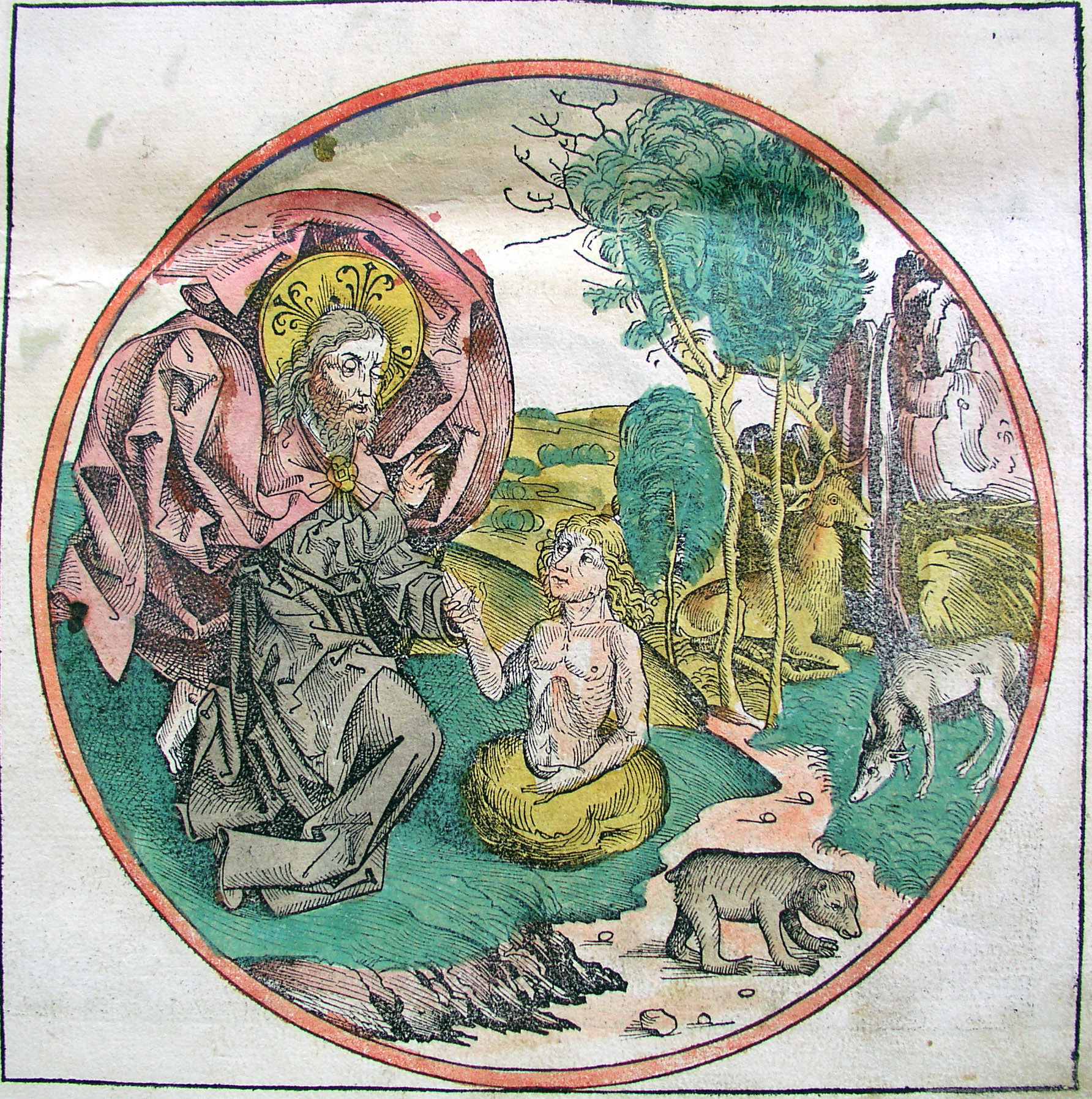
Creation of Adam, Nuremberg Chronicle, 1493

And God formed the human out of dirt from the ground, and blew into its nostrils the soul of life, and the human became a living being. (Genesis/Bereishit 2:7)

Humans are a combination of dirt and God’s breath—a vivid way of saying we are a combination of body and soul (in the English idiom), or basar (flesh) and ruach (spirit) in the biblical Hebrew idiom.

basar (בָּשָׂר) = flesh; muscle; all the soft tissue of a human or other animal, the part that can decay, be eaten, or be burned up; all mortal creatures

ruach (רוּחַ) = wind; spirit; temperament; divine movement or impulse

The word ruach appears right at the beginning of the Torah, at the beginning of the first creation story:

… and darkness was over the face of the deep, and the ruach of God was hovering over the face of the waters.  (Genesis 1:2)

The word basar first appears when God divides the primordial human into two sides, and refashions them into two independent creatures:

Then God cast the human into a supernal sleep, and took one of its side, and closed the basar.  And God built the side that It took from the human into a woman, and It brought her to the human.  And the human said:  This time, it is bone from my bone, and basar from my basar; this one will be called woman, because this one was taken from man. (Genesis 2:21-23)

Eleven generations and about a thousand years later, God observes that the human combination of flesh and spirit has led to a lot of bad thoughts and actions.

And God saw that the evil of the human on the earth was abundant, and all the shapings of its inventions were only evil, every day.  (Genesis 6:5)

How were they evil?  The next Torah portion, Noach (a resting place, serenity; as a proper name, “Noah”) gives us only a hint.

God looked at the earth, and hey! it had become spoiled, because all basar had spoiled its ways upon the earth.  So God said to Noach:  “An end of all basar is coming, because they have filled the earth with outrage; so here I am, about to spoil the earth.”  (Genesis 6:12-6:13)

When God warns Noah about the flood, God predicts the end of  all basar.  But when God proceeds to flood the earth, the Torah describes the end of the ruach  of humans and the other land animals.

Everything that had the soul of the ruach of life from God’s nostrils, out of all that was on dry land, died.  …and God wiped them away from the earth, and kept safe only Noach and those with him in the ark.  (Genesis 7:22-23)

Apparently the evil does not lie exclusively in either the basar (flesh, which is the “dirt” or inanimate matter that God brought to life) or the ruach (which means either wind or spirit: God’s movement inside us).  The evil may be in a spoiled relationship between flesh and spirit.

Medieval Jewish commentators said the problem was sexual immorality (one of their favorite topics).  The 19th-century rabbi Samson Raphael Hirsch explained that a righteous person refrains from sexual immorality by subordinating the physical, sensual drives of the flesh to the divine will of God’s spirit.  If, on the other hand, the spirit is subordinate to the flesh, then a person’s thoughts and actions will tend toward immorality, and be “spoiled”.

Jews have little or no monastic tradition, and even medieval rabbis carefully distinguished between morally desirable sex and immoral sex.  Today some of us might draw the line in a different place, but we still draw a line, and expect a decent human being to have enough self-control to refrain from immoral sexual acts.

And sex is not the only area in life where humans experience a conflict between the flesh and the spirit.  For example, sometimes we crave food or drugs that we know will have bad results for ourselves and other humans who depend upon us; if our flesh is not subordinate to our spirit, we act on our cravings.  Sometimes we have trouble giving up a material comfort our “flesh” is attached to, for the sake of a higher good.

It’s easy to condemn other people for not trying hard enough, when their spirit loses the struggle with an undesirable desire of the flesh.  But when I look deeper, I see people who find dieting manageable condemning those who try to diet without success; people who already have sexual self-control condemning those who succumb to temptation; people who can afford to buy hybrid electric cars condemning those who drive old gas-guzzlers.

In the Torah, God condemns and wipes out the whole human race except for Noah and his immediate family, and throws in millions of animals for good measure.  After the flood subsides, Noah sacrifices the excess animals that God included in the ark at the last minute, in Chapter 7.  By building an altar and completely burning up their flesh, Noah demonstrates that he values God more than animals, spirit more than flesh.

And God smelled the soothing fragrance, and God said to [God’s] heart:  I will not again denigrate the ground on account of the human , for the tendencies of the human heart are bad from its youth; so I will not again strike down everything that lives, as I have done.  (Genesis, 8:21)

Thus God decides to continue the experiment, continue with these strange combinations of physical flesh and divine spirit that we call adam, humankind.  God pulls back from condemnation because of the mere scent of a better relationship between flesh and spirit.

If God can do it in the Torah, maybe we can do it here on earth.  We humans all have bad tendencies, because we are all hybrid creatures of flesh and spirit.  My most troublesome bad tendency may be different from yours.  But I pray that I will notice what is good in you, and in myself ; that I will refrain from the impulse to condemn; and that I will become a humane human.

Vezot Habrakhah: Face to Face

And no other prophet arose in Israel like Moses, whom God knew face to face; for all the signs and the miracles that God sent him to do in the land of Egypt, to Pharaoh and to all who served him, and to all his land; and for all the strong power and all the great awe that Moses carried out before the eyes of all Israel. (Deuteronomy/Devarim 34:10-12)

That’s the ending of this week’s Torah portion, Vezot Habrachah (And this is the blessing); of the book of Deuteronomy/Devarim; and of the Torah proper (the first five books of the Jewish canon).

In one sense, this passage is a eulogy for Moses, who died at age 120 “by the mouth of God” after liberating the people from Egypt and shepherding them for forty years until they were ready to cross the Jordan River into “the promised land” of Canaan.

But the passage also tells us something about God.

panim = face; indicator of mood; identity

panim el panim = face to face, directly, without an intermediary

The first place that the Torah uses the expression “face to face”, is at the end of the mysterious account of Jacob wrestling all night with an unnamed “man” who blesses him with a new name (Israel) at dawn.

Jacob called the place there Penieil (Face of a god), ‘Because I saw Elohim face to face, and my life was saved.’  (Genesis/Bereishit 32:31)

eil = God, a god

elohim = God, gods

The next place we see the phrase “face to face” is after the golden calf incident, when Moses pitches his tent some distance from the camp.  Whenever Moses returns to the tent, now called the Tent of Meeting, everyone can see the pillar of cloud descend and stand at the tent opening.  Then, the Torah says,

God spoke to Moses face to face, as a man speaks to his neighbor.  (Exodus/Shemot 33:11)

This verse uses the personal, four-letter name of God, so there is no ambiguity about whether the speaker is a god or the God.  Moses is able to hear God’s speech “face to face”, as clearly as one man can hear his neighbor speak.   Moses is able to hear God directly at the burning bush, and according to the Torah, this straightforward communication occurs repeatedly for the rest of Moses’ life.  The ability to hear God is not unique to Moses; the Torah reports that many of the characters in Genesis, as well as all true prophets, also hear God speak.  But Moses  hears God’s voice much more often than anyone else, and only Moses can count on initiating a conversation with God.

Yet despite their close relationship, when Moses asks to see God’s kavod (glory, heaviness), God tells Moses:

You will not be able to see my face, because no human can see  Me and live.  (Exodus/Shemot 33:20)

Then what about Jacob, who said he saw God’s face and lived?  I think Jacob neither saw nor wrestled with God’s real identity, but only with a few aspects of God, which he called elohim.  He was grateful to live through the experience of beholding even one divine aspect, or angel, or god.

“Seeing” God’s face is different from having a face-to-face conversation with God.  Like English, Biblical Hebrew often uses the verb for “see” to mean “understand”.  If one’s “face” is one’s identity, then nobody can know God that intimately and live.

Two humans in an intimate relationship often watch one another’s faces for clues about what the other person is thinking and feeling inside.  Yet anyone who has had a loving partner for decades knows that we can still get it wrong.  The expressions on a well-known face indicate a fleeting mood, but the observer can only guess at the thoughts behind the face.  Experience over time makes the guesses somewhat more accurate.  Yet the innermost person is still inaccessible, unknowable.

In fact, we cannot even fully know ourselves, or even predict what choices we will make in every circumstance.  Watching our own faces in a mirror is not much help.  The face itself is an intermediary between the soul and the observer; a person’s inner identity is still hidden.

Does the conclusion of the book of Deuteronomy tell us that Moses finally saw God’s true “face” at the moment of his death?  Not really.  The Hebrew says that God knows Moses face to face, not that Moses knows God that way.

Since God knows Moses’ true “face”, his inner self, God knows that Moses has the potential to carry out all the signs and the miracles, and to demonstrate all the strong power that creates all the great awe, and moves the religion forward.

Whatever our notions about God are, if we are wise we know we can never see God’s “face”, as long as we live.  But maybe it’s more important that God can see us.

Ki Teitzei: Work Like an Animal

You shall not plow with an ox and a donkey together.  (Deuteronomy/Devarim 22:10)

You shall not muzzle an ox while it is threshing.  (Deuteronomy/Devarim 25:4)

These two lines from this week’s Torah portion, Ki Teitzei (“When you go forth”), are often cited as examples of  biblical injunctions to minimize the suffering of animals.  If two animals of unequal strength are yoked together, the weaker animal is likely to stumble or strain itself to exhaustion.  If an ox is muzzled while it is trampling grain to thresh it, the ox is tormented by the sight of food it cannot eat.

The Talmud (in Bava Metzia 90b) explains that both prohibitions also apply more generally.  Two different kinds of animals must not be made to work together at any task, whether they are yoked or not, even if they are merely driven by a shout.  Similarly, an ox must not be restrained even by a shout from eating as much grain as it wants while it works.

Ki Teitzei is also the Torah portion that insists an employer may not delay paying an employee’s wages.

You shall not oppress a poor or destitute hired laborer, from among your brothers or from among your stranger who is in your land, within your gates.  Each day you shall give him his hire and the sun shall not set on him, because he is poor and it is supporting his life …  (Deuteronomy/Devarim 24:14-15)

Thus the general principle of acting with consideration toward the animals who work for you also applies to the human beings who work for you.  We should be considerate toward human laborers by paying them promptly.

I believe we should also treat them at least as well as our laboring animals.

That means we should not ask two people with different strengths to do the same job, any more than we should ask an ox and a donkey to do the same job.  And we should not make people slave away without any breaks to refresh their spirits, any more than we should make an ox trample grain without taking any grain for its own refreshment.

And, following the Talmud, we should not shout at anyone who works for us: employees, students, or family members.  Nor should we insult them.


In an even larger sense, the laboring animal and the human master are two parts of a person’s psyche.  Sometimes I browbeat myself into finishing a project even when my body is sore or my brain is tired.  This is cruelty to my animal aspect.

After studying this week’s Torah portion, I have three new rules for myself.  I shall not expect to do the same job as someone else, or even the same job that I did on another day.  I shall not put my nose to the grindstone, but instead snatch what spiritual nourishment I can from every job.  And I shall reward myself at regular intervals for my own hard work.

These are not easy rules for a conscientious perfectionist to follow.  But I need my inner ox.  I must not muzzle it!

Eikev: With Heart and Throat

What does God want from us?  Moses asks and answers that question, as old as human history, in this week’s Torah portion, Eikev (“following on the heels of”).  And the answer still means something, even for those of us who define God as a state of being rather than as the omnipotent ruler of the universe.

And now, Israel, what does God, your god, request from you?  Nothing but to be in awe of God, your god; to walk in all God’s paths; and to love God; and to serve God, your god, with all your levav and all your nefesh; to observe the commands and decrees of God that I am commanding you today for your own good.  (Deuteronomy/Devarim 10:12-13)

levav = heart; seat of thoughts and feelings and understanding; inner self, consciousness

nefesh = throat; appetite; the soul that animates the body; life force

Long-time readers of this blog are already acquainted with the Hebrew words levav and nefesh.  Both words refer to parts of human anatomy that are metaphors for aspects of being human.  But why does God require service with all our “heart” AND all our “throat”—both in last week’s Torah portion (check out Deuteronomy 6:5), and again this week?

In modern terms, we might translate the phrase as “with all your mind and all your body”.  So the two verses translated above mean we must direct all our conscious feelings toward both awe and love of God, and make all our conscious decisions so they follow God’s paths.  Furthermore, our conscious feelings and decisions must become so habitual that our bodies instinctively react that way.  And it takes both our minds and our bodies to keep on observing (paying attention to, guarding) the rules Moses laid out for going God’s way.

If you define God as the omnipotent ruler of the universe, obviously doing all this is “for your own good”.  We get more rewards and fewer punishments when we go along with human authorities, so it seems reasonable that the same would be true for going along with a divine authority.  When we provide what the boss wants from us, we get more of what we want from the boss.

Do you define God as the omnipotent ruler of the universe?  That definition is certainly implied in the book of Deuteronomy.  And the Talmud, commenting on the passage above, claims that God rules everything except our own feelings.  “Everything is in the hands of Heaven, except the awe/fear of Heaven.”  (Talmud, Berakhot 33b)

Jewish liturgy applies this definition of God in its repeated use of the phrase “melech ha-olam”, literally “king of the world/universe/eternity”, in formal blessings and prayers.  And many people today, in several different religions, view God as the omnipotent ruler of the universe.

I do not.  Maybe it’s because I grew up in a family of athiests, but the only rulers I know of are human decision-makers.  I don’t even view “nature” as the ruler of the universe, since “nature” doesn’t make decisions; it just is.

Yet the two verses I translate above still speak to me, even though in my own “heart” I use the slippery word “God” to name a mystery that my rational mind can describe as a state of being, and my intuitive mind identifies as the source and goal of my yearning.

I encourage and cultivate my yearning for “God” in ways that Jews have cultivated their awe and love of “God” ever since the fall of the second temple, almost 2,000 years ago:  through Torah study, through prayer, and through noticing the wonders of this world (from the bug crawling on a leaf to my husband smiling at me).  All three practices lead to feeling awe, love, and gratitude for … what?  Why not call it “God”, in English or Hebrew?

Okay, so I’m working on two of God’s requests in this week’s Torah portion:  feeling awe and feeling love.  What about walking in all God’s paths, and serving God with all my levav and all my nefesh, and following all the rules passed on by Moses?

I can’t prove it, but I believe all this studying, praying, and noticing I’m doing does lead to making better decisions (in my levav) and creating better habits (in my nefesh), so I walk more often on the right paths, and better serve the spirit of God within me.  I don’t follow exactly the same set of rules Moses gives in the Torah (though I do pay attention to them, and think about them, when I study Torah).  But I work on following, as best I can, an informal set of rules for behavior that my own branch of Judaism agrees upon.  And I like myself more, so perhaps all these practices are indeed for my own good.

What God wants from me is, apparently, the same as what I want from my orientation toward God.

Am I just being self-centered?  I don’t know, but I take comfort in the double name of God that first appears in the book of Deuteronomy.  In the verses above I translate the double name as “God, your god”, but the Hebrew actually uses two different words for “God”.  The first one is the four-letter name of God, spelled with the Hebrew equivalents of Y-H-V-H and related to the verb “to be”.  Jews refer to it as Hashem, “The Name”, and treat it as sacred.

The second word appears sometimes in Deuteronomy as Eloheynu, “our god”, sometimes as Eloheykhem, “your god” (the god of all of you being addressed), and sometimes, including the verses above, as  Eloheykha, “your god” (the god of you, one person in particular).  The implication is that the God of all be-ing is also a god that we, you, and I have a relationship with.

What does God want from you?  Relationship, connection, direction.  You can deduce it from the verses quoted above.  What do you want from God?  Relationship, connection, direction?

Masey: Refuge from Compensation

This week’s Torah portion, Masey (“Journeys”), calls for the new land of Israel to be divided up into territories by tribe, with a special arrangement for Levites, who will not own land.  Forty-eight cities  must be set aside for the Levites, and six of these will be designated “cities of  refuge”.

Speak to the children of Israel, and you shall say to them:  When you cross the Jordan to the land of Canaan, you shall select cities for yourselves.  They will become cities of refuge for you, and a killer who strikes down a living soul inadvertently shall flee there.  The cities shall be for you a refuge from a go-eil, so the killer will not die until he has stood before the community for the legal ruling.  (Numbers/Bemidbar 35:10-12)

go-eil (גֺּאֵל) = a compensator; a redeemer or avenger; a person who is responsible for redressing the situation when a man’s life or land is taken

In the Torah, a go-eil is usually a male relative of a male victim.  When an Israelite man becomes a slave, a go-eil redeems him, freeing him by paying his owner.  When a man dies without heirs, his nearest male relative serves as a go-eil by making the widow pregnant, so her child will inherit the deceased man’s property and his “name” will continue.  When a man is killed, a “go-eil of the blood”  (go-eil hadam)  is responsible for correcting the situation by killing the killer.

Legally, execution by the “go-eil of the blood” is is not revenge, but rather a way to uphold the dignity and importance of the victim.  If no male relative is available to serve as the go-eil of the blood, the judges appoint one.

(What if the victim of enslavement or murder is a woman?  The Torah does give a few examples of redemption and retribution for female victims, but there is no go-eil in these cases.  The Torah reflects the culture of the time and place where it was written down, so it has different laws for men than for women.)

The Torah provides for six cities of refuge where a killer can flee to be safe from an over-eager go-eil until the community where the killing occurred passes sentence on the case.  If the verdict is murder, the go-eil may execute the death penalty, even if he has to enter a city of refuge to do it.  But what if the verdict is accidental manslaughter?

If in an instant, without enmity, he knocked someone down, or threw down upon him any implement, without premeditated malice … then the community shall rescue the killer from the hand of the go-eil of the blood, and the community shall return him to his city of refuge where he had fled.  And he shall stay in it until the death of the high priest … and after the death of the high priest the killer may return to his land-holding. (Numbers 35:22, 25, 28) 

Thus a man who accidentally causes another’s death receives a different sentence. He must leave his own land, and live in a city of refuge, where the go-eil is not allowed to harm him.  The killer must not leave his city of refuge until the high priest of Israel dies.

Traditional commentary offers three reasons for this restriction.  One is that it preserves the killer’s life by protecting him from being attacked by a vengeful go-eil.  The Talmud takes the idea of protection further by teaching that the refugee is given a place to live in the city of refuge, and he does not have to pay taxes to the Levites.

A  second reason for the restriction is that since taking a life is such an awful deed, even an inadvertent killer should be punished.  So he is exiled from his home, his land, his friends and neighbors.  This makes a “city of refuge” more like a city of imprisonment (though it is a very nice prison, where he can have a normal life within the city limits).

A third reason is that the Levites who run the city, and are presumably spiritually elevated by their career of serving God,  will help the killer to repent and atone for his guilt over any possible negligence.

I would add that it would be hard to process your guilt and horror over causing someone’s death if you stayed in your old job and kept associating with the same people (who would now see you differently).  Moving to a new place would give you breathing room.  Although the residents of the city of refuge would all know why you were there, you would still get a chance to built a new identity, instead of pretending you were the same old person.

Then why does the exile in a city of refuge end when the high priest of all Israel dies?

Whatever reasons they give, traditional commentators agree that the high priest was a beloved figure whom everyone looked up to.  So his death was a national tragedy, touching everyone’s heart and moving everyone to see life differently.

Rambam (12-century commentator Moses ben Maimon, or Maimonides) wrote that when the high priest dies, a go-eil of the blood loses his taste for vengeance, so it becomes safe for his relative’s killer to leave the city of refuge.

Other commentary views the death of the high priest as the final cleansing of the inadvertent killer’s soul, so he becomes sufficiently pure of heart to go back to his former life with the right attitude.

I’ve seen similar psychological transformations in my own congregation, P’nai Or of Portland, when our beloved founding rabbi, Aryeh Hirschfield of blessed memory, passed away unexpectedly.  So many of us felt overwhelmed by grief, we could have fallen apart as a community.  Instead, the shock and grief opened our hearts, so that many of us rose above petty personal issues and took on new challenges to keep the congregation going.  We had even more lay leadership for services, more learning, more support for each other.  And we are still going strong.

Although it is a psychological truth that the death of a beloved leader can transform people, we must not postpone our own transformations until our personal high priests die.  We need to begin changing our lives at once, just as an unintentional killer was required to flee to a city of refuge at once.  And we need to open our hearts so that any tragedy or insight might offer transformation.

Few of us are haunted by the knowledge that we accidentally killed a human being.  But many of us are haunted by other things we did in the past.  Our society rarely provides us with clearly defined refuges from our internal “go-eil of the blood”:  our recurrent guilt, self-accusation, or emotional memories.  We need to find our own cities of refuge, even if they are part-time or internal.

May each of us find a place of refuge from the past deeds that haunt us.  May each of us be able to use that refuge to look more honestly at our past and accept it with compassion toward ourselves.  And then may each of us be blessed with a big shift in perspective, opening up a new phase in our lives.