Vayikra: Sour, Sweet, and Salt

Humans tend to bring gifts to their gods. They have done it all over the world, from the beginning of history. In the Torah, the first human to offer a gift to God is Cain, the oldest son of Adam and Eve … and God rejects his offering. Religions help people to avoid the fear of being rejected by their gods by spelling out what gifts are and are not acceptable.

The first part of the book of Leviticus/Vayikra (And It Called) is devoted to instructions about offerings for the altar. What kinds of animal and grain offerings will be acceptable to God? The first Torah portion begins by considering animals for burned offerings.

If one brings an olah from the herd, he shall bring an unblemished male; he shall bring it to the opening of the Tent of  Meeting, liretzono before God. And he shall lean his hand upon the head of the olah, and it will be nirtzah for him, to atone for him. (Leviticus/Vayikra 1:3-4)

olah = an offering that is completely burned, so its smoke will rise to the heavens

liretzono = to be accepted for him

nirtzah = favorably received, acceptable, counted as good (from the same root as liretzonoרצה)

After an initial review of animal offerings, the Torah gives particulars about the minchah offering: a gift of homage to God, made from grain. (See my blog post “Vayikra: Gifts to the Giver”.) Embedded in the minchah instructions is a ban on any leavening or sweetener in a burned offering:

Every homage that you bring to God you shall make without chameitz; for you shall not bring any sourdough or any devash into an offering by fire to God. (Leviticus 2:11)

chameitz = leavened bread, fermented food

devash = syrup, bee honey, fruit nectar

Leavened loaves of bread can only be brought to the sanctuary for the priests and their families to eat; they must not be burned on the altar. Fruit syrup or jam can only be brought at the annual festival of first fruits, Shavuot, and the fruit preserves were also eaten by the priests.

Why are leavened bread and syrup are banned from burned offerings?  Philo of Alexandria, who lived 2,000 years ago, began a long line of Jewish commentatary comparing bread rising to a human puffing up with self-importance—the opposite of the humility needed to pay homage to God. Another view stresses the instruction in the book of Exodus/Shemot to eat unleavened matzah on Passover/Pesach in order to remember that the Israelites did not have time to let their dough leaven before escaping Egypt. Since matzah is “the bread of our affliction”, the Israelites presumably did not have time to watch bread rise during their years of slavery, either. According to 19th-century rabbi Samson Raphel Hirsch, leavened bread therefore represents political independence, which the Israelites achieved not by their own efforts, but only by following God’s Torah. Fruit syrup represents ownership of land where dates and other fruit trees grow naturally—another gift from God. Hirsch argued that an acceptable offering to God could only be something that the Israelites had acquired by their own efforts. (Presumably the Israelites put a lot of their own labor into making flour and tending their animals.)

I am not persuaded by either Philo or Hirsch. I suspect that the key lies in the way the ancient Israelites viewed leavening. For modern Americans, leavened bread is sweet and yeasty, and sourdough bread is an interesting variation. But the ancient Israelites had only sourdough leavening, and their word for leavened bread, chameitz, comes from the same root as the word for vinegar, chometz. In Biblical Hebrew, when something leavens or ferments itself, yitchameitz, it turns sour and sharp, whether it is flour becoming sourdough bread or grape juice becoming vinegar.

An offering that is going to straight up to God in smoke should not be sour. If we give ourselves to God in a sour mood, our offering will not be accepted.

Nor should an offering sent straight to God be sweetened, as if the donor wanted to make it more palatable to God. If we try to sweet-talk our way into God’s favor, or to adopt a sweetness that we do not feel inside, our offering will not be accepted.

After banning leaven and syrup in burned offerings, the Torah says that all offerings to God must be salted:

Every offering of your homage you shall salt with salt; you may not omit the melach of the brit of your God from your homage. You shall put melach on every offering of yours. (Leviticus/Vayikra 2:13)

melach = salt

brit = covenant, pact, alliance

Why is salt required for acceptance? Salt was not a rare commodity in Canaan; the Israelites used to quarry rock salt near the Dead Sea, which the Hebrew Bible calls the Sea of Salt. The salt quarries between that sea and the city of Sodom may be the “Valley of Salt”, the site of at least two battles in the Hebrew Bible. When God annahilates Sodom and Gomorrah in the book of Genesis/Bereishit, Lot’s wife looks back at Sodom and becomes a pillar of salt (one of many strange salt formations left by the evaporation of the Dead Sea). In Deuteronomy/Devarim Moses warns that when the Israelites worship idols in the future, God will destroy their land, and visitors will compare its barrenness to burning with sulfur and salt.

Yet the proper care of a newborn infant included bathing it in water and rubbing it with salt, according to the book of Ezekiel/Yechezkeil; and the prophet Elisha “heals” a contaminated spring with a dish of salt in 2 Kings/Melakhim. Salt is both a preservative and a condiment for food. Thus the Hebrew Bible associates salt with both death and life.

This week’s Torah portion refers to salt as a form of covenant. A covenant of salt also shows up in the book of Numbers/Bemidbar. After disposing of Korach’s threat to the rights of priests, God tells the high priest Aaron:

All holy upraised offerings that the children of Israel raise up to God, I give to you and to your sons and to your daughters with you, as a decree forever; it will be a brit melach forever; it is before God for you and your offspring with you. (Numbers/Bemidbar 18:19)

And in the second book of Chronicles, Aviyah, king of Judah, says:

Listen to me, Yaravam and all Israel! Don’t you know that God, the god of Israel, gave kingship to David over Israel forever, to him and to his sons, a brit melach? (2 Chronicles/2 Divrei Hayamim 13:4-5)

Salt apparently makes a covenant especially unbreakable and long-lasting. Many commentators attribute this to the fact that salt was the main preservative used by the Israelites. But salt was also their universal seasoning, set on the table for every meal. Eating a man’s salt was an idiom for being either his friend or his dependent. So a covenant of salt might imply not only durability, but also dependence or even friendship.

Now that we reach out to God by praying instead of by burning animals and matzah, we can apply the ideas in Leviticus about leaven, syrup, and salt in a more subtle way. All too often, when we stand before other people, we have to paste on a sweet smile. But when we stand before God, we need to abandon any false sweetness, as well as the pride and the sourness implied by leavening. And we need to be serious about life and death, offering our whole selves, and acknowledging that we all eat our salt at God’s table.

Stories from Eve’s Tree

A story as old as the Talmud says that when Abraham and Sarah went to Egypt, and Abraham suddenly noticed his wife was beautiful, he hid her in a casket and tried to smuggle her across the border.

What happened next? Five women who were certified last year as maggidot (“tellers” of Jewish stories and Torah) have put our own spin on the ancient tale. We’ll present it this Saturday, March 16, in a show called “Stories from Eve’s Tree”. In between scenes about the dubious border crossing, we’ll tell other tales about how the lives of women are hidden and revealed—-traditional stories, personal stories, and stories about characters in the Torah as we imagine them. For this show, I wrote a story about about Lot and his wife when they imitate Abraham and Sarah, with hilarious results.

If you can be in Portland, Oregon, this Saturday night, come to “Stories from Eve’s Tree” at 7:30 p.m. Here’s the poster: SFET flyer

And here’s the link to our website: www.storiesfromevestree.com

If you can’t be in Portland on March 16, stay tuned! We are forming a troupe and taking this show on the road.

Ki Tissa: Interrupted Wedding

The covenant between the people of Israel and the God of the Torah has often been compared to a wedding, perhaps ever since the prophecy of the 6th century BCE:  As the bridegroom rejoices over the bride, so shall your God rejoice over you. (Isaiah 62:5) According to the Torah, God and the Israelites make their covenant (a contract like a marriage) at Mount Sinai.  The Talmud tractate Kiddushin states that the three elements of a wedding are money (the dowry), a written contract (the ketubah), and intercourse. So far in the book of Exodus/Shemot, God has given the Israelites a dowry: their freedom from Egypt, plus the gold and silver that the Egyptians handed over to the Israelites in response to God’s miraculous plagues. In this week’s Torah portion, Ki Tissa (“When you lift”), when Moses comes down from a 40-day meeting with God on Mount Sinai, he brings the other two elements of the wedding: a  marriage contract engraved on two stone tablets (presumably the Ten Commandments), and instructions for building a sanctuary so God will “dwell among them”.

Alas, while Moses was away, the bride was unfaithful. The Israelites, terrified that Moses would never return, got Aaron to make a golden calf to lead them. Moses returns to find the people cavorting in front of  an idol. Clearly, the Israelites do not yet have enough faith and fortitude for this marriage. So Moses quickly smashes the two stone tablets of the contract, and postpones the building of the sanctuary for cohabitation.

Before the wedding can resume, the bride must have a change of heart. So God and Moses arrange for the Israelites to see their separation from God’s presence.

And Moses, he shall take the tent and pitch it for himself outside the camp, far away from the camp, and he shall call it the Tent of  Meeting. Then it will be that anyone seeking God must go to the Tent of Meeting, which will be outside the camp. (Exodus/Shemot 33:7)

In the next two books of the Torah, we learn that anyone who contracts the skin disease tzara-at is ritually impure, and must live outside the camp until he or she is cured. Here in the portion Ki Tissa, the whole camp is ritually impure after the golden calf worship, unfit for worshiping God. Therefore the place where God can be encountered must be far away from the camp—until the whole camp is cured. Only then does the Tent of Meeting move from outside the camp to inside the new sanctuary in the heart of the camp.

During the period when God does not dwell in the camp, any individual who wants to communicate with God must go to the Tent of Meeting, which will be outside the camp. The Torah does not say whether Moses acts as an intermediary, or God answers the seekers who walk out to the Tent of Meeting directly. But the Torah does describe the experience of the people who wait in the camp while Moses goes to meet God.

Then it was, that when Moses was going out to the Tent, all the people stood up, and each one stationed himself at the petach of his tent, and they gazed after Moses until he came to the Tent. And it was, that when Moses came to the Tent, the pillar of the cloud descended, and it stood at the  petach of the Tent, and It spoke with Moses. And all the people saw the pillar of the cloud standing at the petach of the Tent, and all the people stood, and each one prostrated himself at the petach of his [own] tent. (Exodus 33:8-10)

petach  = opening, entrance, doorway

How do the people feel when they gaze after Moses, and see him speaking with the pillar of cloud ? How do they feel, knowing that they have jilted God?

The Talmud offers two different theories. In one, the people resent Moses so much, they accuse him of profiting at their expense. In the other, they admire Moses for his confidence that God will speak to him. Either way, they are painfully aware that Moses’ relationship with God is unbroken, while they are suffering through a separation. I think that their jealousy of Moses contains more longing than resentment, since they stand up respectfully when he leaves for the Tent of Meeting, and they prostrate themselves, bowing to God, when they see the pillar of cloud. These are the Israelites who survived the killings Moses and God carried out after the Golden Calf worship, presumably the ones who did not incite idol worship, but did look the other way. Now, after the death of their neighbors and the separation of God’s presence from the camp, the survivors  are humble.

The repetition of the Hebrew word petach indicates to me that this period between the destruction of the golden calf and the building of the sanctuary is is a time of openings and doorways. When Moses speaks with God at the entrance of the tent outside the camp, each Israelite stands alone in the entrance of his (and perhaps her) own tent. Each one longs for God from a distance. I can imagine an Israelite bowing down toward the distant God that he or she betrayed. A person’s tent is his dwelling-place, like his body, or his mind. Bowing to God leaves the doorway open; it makes an opening for change.

I have been feeling distant from God lately. I try to pray, since my prayers of gratitude used to make an opening for joy to enter my own “tent”. But these days, the prayers feel formulaic. I am not aware of doing anything to jilt God, but nevertheless I feel a separation. I wish I could see a Moses going out to the Tent of Meeting. Maybe the sight would inspire me. Or maybe then I’d know where to seek God.

The book of Exodus ends when the people have made everything to build a mishkan, a dwelling-place, for God, and Moses puts all the pieces together. Then God comes into the camp and dwells in their midst. In other words, the wedding resumes, and the covenant is cut or signed between the Israelites and God. Will something similar happen to each of us today, when we yearn for God? Will our longing make an opening? If we work hard to make God’s dwelling-place, will God become manifest to us?

And can we do it individually? Or do we need a whole community, a whole camp, to bring God into our midst?


Terumah: Bread of Faces

Why does God need a dinner table?

In this week’s Torah portion, Terumah (Donations), God orders a Moses to make a table, and tells him how to set it. The table is just one piece of furniture God requests during Moses’s first 40-day stay at the top of Mount Sinai. God also wants the children of Israel to make a lamp, an incense burner, and an ark, and a tent to put them in.

They shall make a mikdash for me, and I will dwell among them. Like everything that I show you, the pattern of the mishkan and the pattern of all its furnishings, that is how you shall make it.  (Exodus/Shemot 25:8-9)

mikdash (מִקְדָּשׁ) = sanctuary, holy-place

mishkan (מִשְׁכָּן) = sanctuary, dwelling-place

God calls for the sanctuary to be divided into three zones of holiness. All Israelite men can enter the outer courtyard, which will be  unroofed but enclosed by curtains. This is where animal sacrifices will be burned at the altar. Inside this courtyard Moses will erect a tent divided into two rooms. The main room, called the Holy, is reserved for the priests. The innermost room, screened off by a curtain, is the Holy of Holies, a small enclosure for the ark (see my post Terumah: Cherubs Are Not for Valentine’s Day). Only Moses, and the high priest once a year, can enter the Holy of Holies.

But priests will be walking into the room of intermediate holiness every day. God requests three pieces of furniture for this room: a gold incense altar, a  gold lampstand or menorah, and a small gold-plated table.

You shall make a table of acacia wood, its length a pair of cubits, its width a cubit, and its height a cubit and a half. And you shall overlay it with pure gold, and you shall make a molding of gold for it, all around. (Exodus/Shemot 25:23-28)

The flames of the lamps and the smoke of the incense are intangible, so they make natural reminders of intangibles such as enlightenment, the soul, God.  But the table does not produce anything intangible. After giving more specifications for the design of the table, God orders Moses to lay out a place setting and some bread—as if God were going to sit down and eat.

And you shall make its bowls and its scoops and its jars and its chalices for pouring out [libations]; of pure gold you shall make them. And you shall place upon the table bread of panim, lefanai continually. (Exodus 25:30)

panim (פָּנִים) = faces, face, expression of feelings, surface, front, presence

lefanai (לְפָנַי) = facing me, in front of me, before my presence

Although some translations still call this bread “shewbread”, following the King James Bible, a more accurate translation would be “Bread of Faces”. We learn in the next book of the Torah, Vayikra/Leviticus, that twelve loaves of bread (actually flat rounds of bread, like pita or naan) are stacked on this table at all times. The priests replace them once a week on Shabbat with newly baked loaves.

The Israelites knew that other religious cults in the region set food in front of an idol so that the essence of the god inhabiting the idol could eat the essence of the food in front of it. But the Torah clearly states that when the old loaves are removed once a week in the God of Israel’s sanctuary, the priests eat them (Leviticus 24:9). So why does God need a dinner table?

I believe the point of the table appears in the sentence I would translate as “And you shall place upon the table Bread of Faces, facing Me continually”. In the Torah, bread represents all food, which is a gift from God. Yet since humans need to actively intervene to change grain into bread, I  think bread can also symbolize the creative effort humanity puts into the material world. Twelve loaves of bread represent everyone in the twelve tribes of Israel. Symbolically, the Israelites are faces of bread, facing God continually.

No wonder God orders a table set with bread.  It is not enough to approach God through the mysterious dazzlement of flames and smoke, the overwhelming feeling of mystical experience. We must also approach God through our everyday, solid, material lives, setting ourselves out on the table and facing God continually.

This is a difficult goal to achieve. How can we face a god we cannot see?

In ancient times the mishkan, and later the temples, provided holy rooms to serve as God’s “dwelling place”, and the place for human priests to enact rituals to orient the people toward God. Today, we build sanctuaries where everyone can come and pray and enact rituals in order to orient themselves toward the divine.

The ritual space, with its furniture, helps. Nevertheless, I am sometimes so distracted during a service in a sanctuary that I forget to try to face God.  It is even harder to keep trying to face God during the week, as I deal with all the material things in my life. It is a tall order, but a good one, when the Torah says:

You shall place upon the table bread of faces, facing Me continually.

Mishpatim, Ki Tisa, & 2 Samuel: Soul Recovery

The curious verb nafash shows up only three times in the whole Hebrew Bible. The first occurrence comes in this week’s Torah portion, Mishpatim (Laws):

Six days you shall make your makings, and on the seventh day you shall shavat, in order that your ox and your donkey will rest in tranquility, veyinafeish, the son of your slave-woman and the resident foreigner. (Exodus 23:12)

shavat (שָׁבַת) = desist, cease, stop an activity. (From the same root as shabbat = day of stopping, not-doing.)

veyinafeish (וְיִּנָּפֵשׁ) = and he can refresh his soul, recovered himself, and reanimate himself. (From the same root as nefesh = soul, the soul that animates the body, inclination, appetite.)

Hebrew has several words for “soul”; nefesh means the soul at the level that animates the body.  It also means an individual person, or an inclination or appetite. The corresponding verb nafash implies resting to recover one’s personal energy and self-direction.

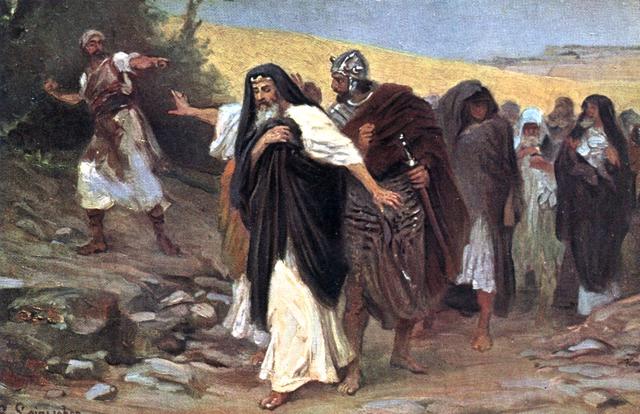
Shimi throws stones at David (artist unknown)

This definition certainly applies to the only use of the verb nafash in the Hebrew Bible excluding the book of Exodus. In the second book of Samuel/Shmuel, King David and his men have endured a long march while Shimi, a member of Saul’s clan, walked beside them hurling insults, dirt clods, and stones. Finally they leave Shimi behind, and camp at the Jordan.

The king, and all the people who were with him, arrived exhausted; and he veyinafeish there. (2 Samuel 16:14)

King David and his men are used to marching; they are not exhausted physically, but their souls are exhausted by enduring the abuse. They rest to recover their animation and their inner selves.

The drudgery and daily misfortunes of life can wear down anyone’s soul at the nefesh level. So Mishpatim orders us to share our shabbat with  humans less fortunate than we are—including those who work for us, or who are alienated in our society—get one day a week to refresh their energy and recover their individual selves.

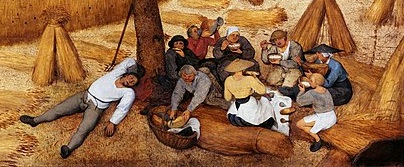
detail from The Harvesters, by Pieter Bruegel the Elder, 1565

The two elements in this shabbat process are desisting from productive work, and refreshing the spirit. The Hebrew Bible specifically prohibits lighting a fire (Exodus 35:3), gathering food or wood (Exodus 16:23-30, Numbers 16:32-36), carrying burdens outside (Jeremiah 17:21), treading in a winepress (Nehemiah 13:15), and selling or buying food (Nehemiah 13:15-18). Apparently the Israelites needed extra reminders not to do any work related to getting food to the table.

Other activities prohibited on shabbat can be inferred, but are not actually stated in the bible. Later, the Talmud multiplied rules about what a Jew cannot do on shabbat. The 312-page Talmud tractate Shabbat discusses every finicky prohibition the rabbis of the first few centuries C.E. could imagine. Although many orthodox Jews today observe  shabbat according to strict and complex rules that evolved from the Talmud, I know that if I tried to imitate them, I would spend the whole day worrying. My anxiety and resentment would make  shabbat a day to dread, and I would look forward to the six weekdays when I could relax and refresh my soul!

Fortunately, the Torah itself offers a more attractive and interesting view of Shabbat for unorthodox people like me. Desisting from creative work is connected with recovering the soul in a passage from the upcoming portion of Exodus called Ki Tisa. (It is also part of the Shabbat liturgy.)

The children of Israel shall observe the shabbat, to make the shabbat for their generations a covenant for all time. Between Me and the children of Israel it will be a sign forever, because for six days God made the heavens and the earth, and on the seventh day (God) shavat vayinafash. (Exodus 31:16-17)

vayinafash וַיִּנָּפַשׁ)= and he refreshed his soul, recovered himself, reanimated himself. (Also from the same root as nefesh.)

I am awed by this portrayal of a god that changes through time, breathing life into the universe and then stopping to catch its breath and recover the divine soul. That is how I experience life, the universe, and everything—not as a static abstraction, but as the changing rhythmic flow of heartbeats, breaths, lifespans, seasons.

The Torah says that in order to be holy to God, we humans must add another rhythm to our lives: a seven-day cycle of work and rest, creative production and cessation. For six days we may pour out our energy and creativity into productive work, but on the seventh day we desist from creative work to re-center and re-animate our inner selves. 

But wait a minute! I used to need a day off from my bookkeeping job to recover my self. But a lot of the creative work I do now—including writing this blog—re-energizes me. When I finish writing an essay or a story, I feel joy, and a sense of purpose, and the re-centering that comes from returning to my own soul. Why should I deprive myself of creative work once a week?

One answer is that I cannot keep creating endlessly without pause. Even God, in the story of creation that opens the book of Genesis/Bereishit, divides the job into six separate days, completes each day of creation before starting the next, and then takes a break at the end. I need to finish a piece of work and then stop to pay attention to where I am and where God is. I can believe that I need not only those moments of stopping every day, but also a whole day of stoppage every week. a whole day to reconnect with myself and the holy.

Alas, I still have not developed a steady practice for spending the day of shabbat in tranquility, restoring my soul. Merely refraining from certain activities doesn’t do it for me. Joining my congregation in prayer is uplifting,  and following or leading Shabbat services does remind me of what to focus on. Yet all too often, the long drive and the personal interactions disturb my ability to focus on anything.

Nevertheless, I have not given up on establishing a shabbat practice. Any suggestions, readers?

Beshalach: High-Handed

As a child I was a natural victim, the target of any bully who needed to humiliate someone.  So I can imagine how the Israelites might feel in the book of Exodus/Shemot when they finally leave Egypt on the morning after God’s tenth and final plague:

Our god beat the pharaoh!  We asked our Egyptian neighbors for silver and gold, and they just handed it over to us!  Yesterday we were slaves, and today we are free!  We can do what we please, and we never need to be afraid of Egypt again!

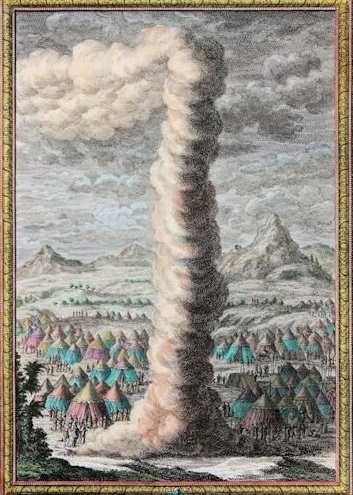
Pillar of Cloud, by Johann Jakob Scheuchzer, 1731

The Israelites leave the city of Ramses unchallenged at the beginning of this week’s Torah portion, Beshalach (“When sending out”).  They march for three days in military formation, following God’s spectacular pillar of cloud by day and fire by night.  For three days, they feel on top of the world.

God leads them to the Reed Sea, rather than by the main road to Canaan, which passes through the land of the Philistines.1  When the Israelites reach the shore of the Reed Sea, God stages one last showdown with the pharaoh.

God strengthened the heart of the pharaoh, the king of Egypt, and he chased after the children of Israel, while the children of Israel were going out beyad ramah. (Exodus 14:8)

beyad ramah (בְּיָד רָמָה) = with a high hand.  Yad (יָד) = hand; power to do something.  Ramah (רָמָה) = high, exalted.

What does it mean to march “with a high hand”?  When I first read this passage, I pictured the Israelites raising their hands as if they were trying to get the teacher’s attention.  But this image is the opposite of the spirit of beyad ramah.

In both Biblical Hebrew and English, the word yad or “hand” is used in many idioms.  After all, we accomplish things primarily with our hands.  Twice in the Torah portion Beshallach Moses raises his hands in order to channel divine energy.  At the Reed Sea, God tells Moses:

And you shall be hareim your staff and stretching out your yad over the sea and splitting it, and the Children of Israel shall come into the middle of the sea on dry land.  (Exodus 14:16)

hareim (הָרֵם) = raising, lifting up.  (From the same root as the adjective ramah.)

Battle with the Amalekites, by Julius Schnorr von Carolsfeld, 1860

Later in this week’s Torah portion the people of Amaleik attack the Israelites, and Moses influences the course of the battle by stationing himself on a hill and raising his hands.

And it happened that Moses yarim his yad, then Israel was mightier, but when he rested his yad, then Amaleik was mightier.  (Exodus 17:11)

yarim (יָרִים) = he would raise.  (From the same root as ramah.)

The Israelites win the battle because Aaron and Hur help Moses hold up his hands when he gets tired.  This confirms that holding up his hands is how Moses channels God’s power; he does not have power of his own.

But the idiom yad ramah refers to acting as if you have power to accomplish things by yourself.  It appears only four  times in the Torah, and two of these appearances refer to the way the Israelites leave Egypt (in Exodus 14:8 above, and in Numbers/Bamidbar 33:3).  The other two appearances help to clarify the idiom’s meaning.

But a person who does it beyad ramah, whether citizen or foreign resident, is reviling God; so that person will be cut off from among the people. (Numbers 15:30) 

In this passage, the Torah has just ruled that if someone inadvertently fails to obey one of God’s laws, he can atone by offering a goat as a sacrifice.  But if he does it on purpose, acting “with a high hand”, the consequence is more severe: he is banished or dies.  When someone transgresses deliberately, beyad ramah, he is acting as if he has more authority than the religious law.

The fourth occurrence of yad ramah in the Torah comes in Moses’ parting poem to the Israelites.  In his long final warning, Moses quotes God’s response to their ingratitude and idolatry:

I said: I would have cut them to pieces,

I would have made the memory of them disappear from men,

If I had not feared for the provocation of enemies—

lest their foes would misinterpret,

lest they would say: “Our yad was ramah, and it was not God Who accomplished all this!”

(Deuteronomy/Devarim 32:26-27)

Here, the “high hand” is the arrogance of Israel’s enemies, who will falsely assume that they have the power to destroy Israel on their own, without God’s collaboration.

Similarly, in English “high-handed” persons assume they have all the power, and arrogantly do something without considering the concerns of others.

So why do the newly freed slaves in the portion Beshalach leave Egypt beyad ramah?  Dazzled by their new higher status, they may well imitate the arrogance of their former masters.  If they had a chance, they might even try to bully or enslave someone less fortunate.  But God does not give them a chance.

In this week’s Torah portion, after “the children of Israel were going out beyad ramah“, the pharaoh sends a troop of charioteers after them.

And Pharaoh came closer, and the children of Israel raised their eyes, and hey!  Egyptians!  Pulling out after them!  And they were very frightened, and the Children of Israel cried out to God.  And they said to Moses: “Are there no graves in Egypt, that you take us to die in the wilderness?  What is this you have done to us, to take us out from Egypt?” (Exodus 14:10-11)

At once the Israelites are struck with fear of their old owners, the bullies who tortured and subjugated them.  They cry out to God, but there is no immediate response.  Their belief in God’s protection is too new and fragile to withstand their reflexive fear.  They cringe and despair.  They are caught between the sea and the chariots.  At that moment, they think they will always be victims.

Yet when they complain to Moses, they make a sarcastic joke: “Are there no graves in Egypt, that you take us to die in the wilderness?”  Thus Jewish humor is born.

*

Would you rather be an arrogant bully, like the pharaoh in the book of Exodus, treating people with high-handed disregard, too habitually hard-hearted to learn compassion?

Or would you rather be like an Israelite in Egypt, never certain of your status and power—but resilient enough to keep your sense of humor?  If so, then be careful about when you act with “a high hand”.

  1. Exodus 13:17-18.

Bo: The Dog in the Night

To me, dogs are pets. Most dogs have appealing personalities, and the love between dog and human is real. I rarely cry, but I cried when our dog died.

Canaan dog

In the Torah, dogs are bad news. The ancient Israelites did not domesticate dogs until late in the First Temple period, even though their neighbors had long been training dogs for hunting, herding, and guarding. So most of the 24 references to dogs in the Hebrew Bible view them as disgusting feral scavengers. Calling a man a dog (or worse, a dead dog) means that he is the lowest of the low.

The first appearance of the Hebrew word for dog, kelev, is in this week’s Torah portion, Bo (“Come”).

Moses said: Thus said God: In the middle of the night, I Myself will go out in the midst of Egypt. And every firstborn in the land of Egypt will die, from the firstborn of Pharaoh sitting on his throne, to the firstborn of the slave-woman who is behind the millstones, and every firstborn beast. Then there will be loud wailing in all the land of Egypt, the like of which has never happened, and the like of which will not happen again. But as for all the children of Israel, not a dog yecheratz its tongue against man or beast; in order that you shall know that God makes a distinction between Egypt and Israel. (Exodus/Shemot 11:4-7)

yecheratz = will cut, will sharpen, will use a sharp instrument, will decide

On the night of the tenth plague, the death of the firstborn, not a dog will use its tongue as a sharp instrument against the Israelites. In other words, while God is killing Egyptians, not even a dog will snarl or bark to threaten the Israelites.

The verses translated above include two contrasts between the highest and the lowest. First, God says all the firstborn of Egypt will die, from the firstborn of Pharaoh sitting on his throne, to the firstborn of the slave-woman who is behind the millstones. The phrase “slave-woman behind the millstones” is a translation of a phrase that an Egyptian document uses to indicate someone of the lowest possible social class. In other words, God will make no exceptions; everyone belonging to Egypt will suffer, regardless of social position, and regardless of guilt or innocence.

Next, the Torah says that everyone belonging to Israel will be safe from all threats: from the highest power possible–God Itself–to the lowest danger–dogs. In the middle of the night, while God is killing the Egyptian firstborn, and the Israelites are eating their Passover lamb, roaming dogs  will not bite any Israelite humans or beasts. They will not even bark.

This reminds me of the dog that did not bark in the night in “Silver Blaze”, a Sherlock Holmes story by Arthur Conan Doyle. Inspector Gregory asks Holmes, “Is there any other point to which you would wish to draw my attention?”

“To the curious incident of the dog in the night-time.”

“The dog did nothing in the night-time.”

“That was the curious incident.”

Sherlock Holmes has deduced that the guard-dog was silent in the middle of the night because the intruder was not a stranger, but the dog’s owner.

The passage in Exodus/Shemot contrasts the loud wailing of the Egyptians with the silence of the dogs. Dogs get agitated when their owners start screaming and wailing, and they respond by whimpering and barking. The dogs who will not growl or bark during the night of the death of the firstborn clearly do not have Egyptian owners. The Israelites who wrote down the Torah thought of dogs as ownerless wanderers, so the silent dogs do not belong to the children of Israel, either. Whose dogs are they?

And it was at midnight when God struck every firstborn in the land of Egypt, from the firstborn of Pharaoh sitting on this throne, to the firstborn of the captive in the dungeon, and every firstborn beast. (Exodus 12:29)

God goes from house to house in Egypt that night, skipping over only the houses of the Israelites. But the dogs roaming in the streets are silent, like the dog in “Silver Blaze”–because they recognize their owner.

I want to be like a dog. I don’t want to be the lowest of the low. But I do want to recognize my owner.

I have often wondered why the scout in the book of Numbers/Bamidbar who argues that the Israelites should go ahead and enter Canaan, and trust God to give them the land, is named Caleb, Kaleiv in Hebrew. His name comes from the same root as kelev, “dog”. Yet Caleb’s actions are all virtuous, not base and low, the way most dogs in the Torah behave. Perhaps Caleb is named after the dogs in Egypt—because he, too, recognized God.

Shemot: Holy Ground

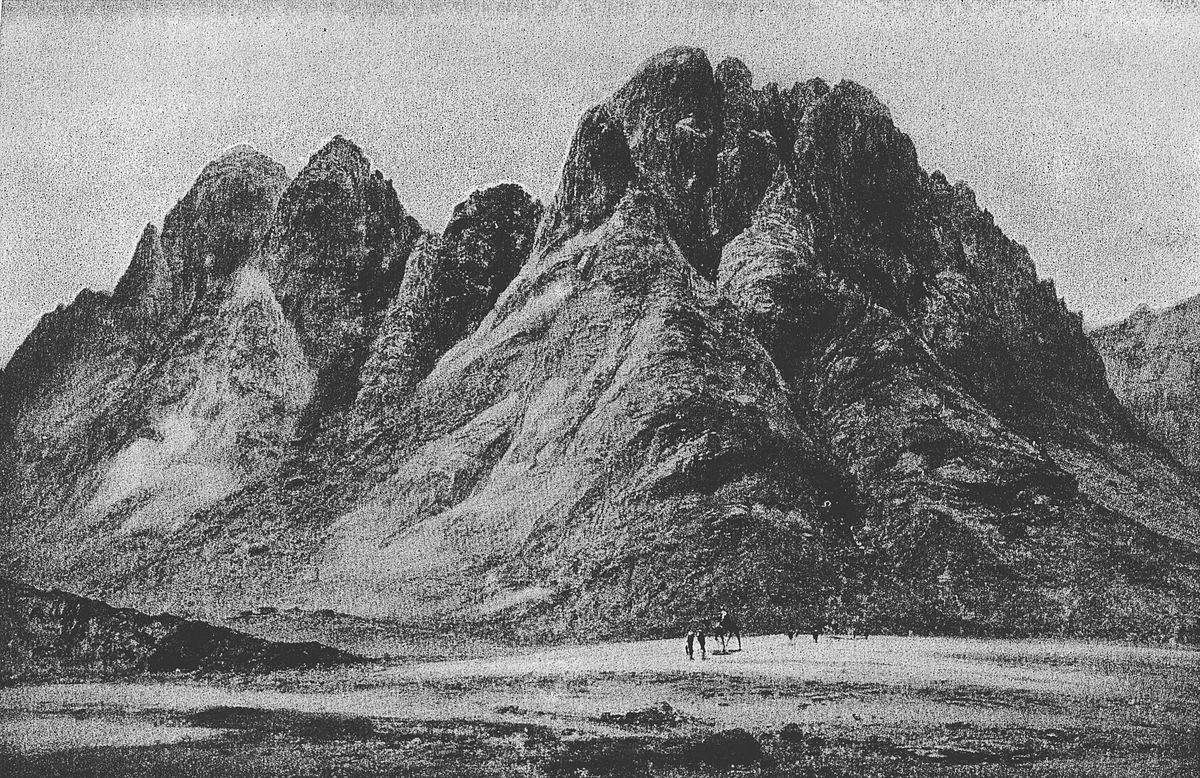
Mount Sinai/Chorev, by Elijah Walton, 19th cent.

This week we open a new book in the cycle of Torah readings, the book of Exodus/Shemot (“Names”). The Israelites, who were welcome guests in Egypt at the end of  Genesis/Bereishit, are now slaves under a genocidal pharoah. This week’s Torah portion, also called Shemot, tells the story of Moses from his birth to Hebrew slaves until his return to Egypt as God’s prophet.

His life story does not mention God until after Moses is settled in the land of Midian with a wife and child. He knows that he was born a Hebrew, and that his people have their own god, but he does not know the god’s name. Moses learns about Egyptian gods while he is growing up as the adopted son of the pharaoh’s daughter. He also learns about the gods of Midian, since he lives with the Midianite priest Yitro and  marries one of his daughters.

In Midian, Moses leads a introspective life as a shepherd, deliberately taking his flock to remote places where he will be alone.

Moses was shepherding the flock of Yitro, his father-in-law, priest of Midian, and he guided the flock achar the midbar, and he came to the mountain of God, to chorev. (Exodus/Shemot 3:1)

achar (אַחַר) = behind, after, in the back, in the future

midbar (מִדְבָּר) = the wilderness.  (A homonym is midbeir, מְדַבֵּר = speaking, speaker.)

chorev (חֺרֵב) =  dry desolation; “Horeb” (in English), the  name of a mountain and a region also identified as Sinai.

A simple translation is that Moses “guided the flock beyond the wilderness, and he came to the mountain of God, to (Mount) Chorev”.

Alternatively, maybe Moses “guided the flock to the future of the speaker, and he came to the mountain of God, to dry desolation”. The second translation is non-standard, but it does describe Moses’ psychological journey. He takes what he was given by his father-in-law the priest (literally sheep, but perhaps also theology), and goes beyond his accustomed life into his own future. He is about to become a prophet, a speaker for God. He is also about to feel dry and desolate, because he does not want the mission God thrusts upon him.

Meanwhile, God has noticed the groaning of the enslaved Israelites, and is about to recruit Moses as the instrument for liberating and leading the Israelites. But God does not suddenly speak to Moses, or appear in a dream, as God did with Abraham, Sarah, Hagar, Isaac, and Jacob in the book of Genesis. Instead, God arranges a small miracle off to one side of Moses’ route.

Moses at the Burning Bush, by Rembrandt van Rijn

Then a messenger of God appeared to him in a flame of fire from the middle of  the seneh; and he saw it; and hey! the seneh was burning in the fire, but the seneh was not consumed. (Exodus 3:2)

seneh (סְנֶה) = a particular type of bush

In the entire Hebrew bible, the word seneh appears only in this scene (five times), and once in Deuteronomy/Devarim. It is probably related to the Arabic word sina = thornbush, and the Latin senna = a family of woody flowering perennials with straggling branches, about knee-high. The seneh may or may not come from the same Hebrew root as Sinai (סִינַי), the other name for the mountain where Moses repeatedly meets God. But as Martin Buber pointed out, repeating the word seneh three times in one sentence certainly evokes the name “Sinai”.

Later in the book of Exodus, God manifests at Mount Sinai in volcanic fire and thunder. But here, God’s fire appears in a small plant, and burns quietly without consuming it. Why does God choose this manifestation?

The symbolic meaning of the burning bush according to Shemot Rabbah is that Moses is afraid Egypt will destroy Israel, just as a fire would normally destroy a bush. Since this burning bush is not consumed, it represents a promise that the Israelites will never be destroyed by their oppressors.1

I agree with 20th-century scholar Nehama Leibowitz that the fire in the bush is an implausible symbol for the Egyptians; since God’s messenger (angel) speaks from the middle of this fire, the fire would more plausibly represent divine revelation.2 According to 19th-century rabbi Samson Raphael Hirsch, the burning bush means that anyone who opens their heart to God will not be destroyed by the divine power.3

Moses said: “Oh, I must turn aside so I will see this great sight! Why does the bush not burn up?”  (Exodus 3:3)

The “messenger” of God is simply the sight of something outside natural law—and therefore numinous. Moses is a person who will notice something unusual and turn aside. Maybe  he is curious about the nature of the universe; or maybe he is searching for God. After all, why did he take the flock beyond the grassy wilderness to this dry and desolate mountain, where there is nothing good for sheep to eat? His father-in-law the priest must have told him where to find the “mountain of the gods”. Now Moses is alert for any sign of the divine.

God does not speak to Moses until after he has turned aside to look at the bush. Apparently alert curiosity and a willingness to approach the numinous are essential traits that God requires in his prophet.

And God saw that he had turned aside to see, so God called to him from the middle of the bush, and said: “Moses! Moses!” And he said: “Here I am.” (Exodus 3:4)

That Moses hears God speak from a mere thorn-bush demonstrates that God is everywhere, even in the lowliest places: a scrubby shrub as well as a tall cedar of Lebanon, a small and barren mountain as well as a lofty peak.4

I have heard many of my friends say they feel God’s presence the most when they are out hiking and surrounded by tall trees or snow-capped peaks. I confess that I, too, feel touched by something numinous when I see the forest or the ocean here in Oregon. Yet I know that if we want to seek the divine, we need to look at straggly little plants as well as cedars, and pray in pre-fab rooms as well as cathedrals.

And God said: Don’t come closer to here! Take off your sandals from upon your feet, because the place that you are standing upon is holy ground. (Exodus 3:5)

Moses cannot come closer to God right away. No matter how much he wants to understand the divine, he must learn about God during the course of a long relationship.


In my experience, that is also true for God-seekers today. A mystical experience can be a message, but it does not change your life, or even your soul. The next day, your old behaviors come right back (even if your feeling of transformation keeps you from noticing them). One experience cannot change you into someone who walks with God—someone who thoughtfully does the right things and remains aware of a larger view of reality. You have to change yourself over the course of many years, noticing when it is time to turn aside, noticing when you have made another mistake, and remembering over and over again that a divine fire hides in the weedy bushes of life.

At least that’s what I believe. So I take comfort from knowing that even Moses cannot walk right into the divine fire and become one with God. His encounter at the burning bush is only the beginning. But at least God tells him he is standing on holy ground. If only we could realize that we are all standing on holy ground!


  1. Shemot Rabbah 2:1.  (Written by rabbis of the first few centuries C.E.)
  2. Nehama Leibowitz, New Studies in Shemot, translated by Aryeh Newman, The Joint Authority for Jewish Zionist Education, Jerusalem, 1996, p. 55.
  3. Samson Raphael Hirsch, The Hirsch Chumash: Sefer Shemos, translated by Daniel Haberman, Feldheim Publishers, Jerusalem, 2005, p. 31.
  4. Mekhilta of R. Shimon b, Yochai, attributed to R. Eliezer b. Arakh, quoted in Leibowitz, p. 56.

Vayeishev: Prey

On Thursday when my stepfather was released from the hospital, my mother was handed information about hospice care. As soon as she told me this over the phone, I pictured my stepfather’s name being erased from the book of life.

Every year, from Rosh Hashanah to Yom Kippur, Jews pray that God will inscribe their names in the book of life. The ancient Jewish tradition says that anyone whose name is omitted from the list will die sometime during the year. Jews greet each other during those holy days by saying: Leshanah tovah tikateivu! (May you be inscribed for a good year!)

In another part of the Rosh Hashanah and Yom Kippur liturgy, we acknowledge that we do not know when or how a person will die. The liturgy asks “Who by fire and who by water? Who by sword and who by wild beast?” The list of possible ways to die continues, and then broadens into the recognition that we do not even know what will happen to those who live. “Who will rest and who will wander? Who will be undisturbed and who yitareif?

yitareif = will be like prey torn to pieces by wild animals

Who will die by cancer this year? Who will feel torn to pieces, like my mother?

If you are a subscriber to this blog and you notice that I miss a week or two, you will know I am helping my mother during the next stage of my stepfather’s exit from this world. On other weeks, I hope I will be able to carry on with my own life, including researching, writing, and posting this blog. But I do not know.

As for this week, the Torah portion is Vayeishev (And he settled), the first part of the story of Joseph. This year, I am struck by how quickly Jacob assumes that his favorite son, Joseph, is dead. In fact, his ten older brothers throw him into a pit far from home. They consider murdering him, but they sell him into slavery instead. Now that they have disposed of the brother they hate, what will they tell their father when they return home without him?

They took Joseph’s tunic and they slaughtered a he-goat kid, and they dipped the tunic in the blood. Then they sent the fancy tunic and had it brought it to their father. And they said: We found this. Recognize, please; is it the tunic of your son, or not? And he recognized it, and he said: The tunic of my son! An evil wild beast devoured him! Joseph is definitely toraf! (Genesis/Bereishit 37:31-33)

toraf = prey torn to pieces by a wild animal (a different form of the word yitareif above)

And Jacob ripped his cloak and he put sak around his hips and he put himself into mourning over his son for many, many days. All his sons (and grandsons) and his daughters (and granddaughters) rose up to console him, but he refused to console himself. And he said: For I will do down to my son in mourning, sheolah. And his father wailed for him. (Genesis 37:34-35)

sak = sack-cloth; crude material made of goat hair

sheolah = to Sheol, to the underworld, to the grave; to ask it, to wish for it

Why does Jacob refuse to be consoled for Joseph’s death, and continue wailing and wearing sackcloth for such a long time? We do not expect him to forget the (supposed) death of his favorite son, but the Torah implies that his mourning is excessive. I think Jacob feels responsible for Joseph’s death, and his guilt prevents him from turning back toward life.

Jacob is clearly responsible for the initial jealousy of Joseph’s ten older brothers.

…[Jacob] made him a fancy tunic. And his brothers saw that their father loved him more than any of his brothers, so they hated him, and they were not able to speak to him in peace. (Genesis 37:3-4)

The brothers’ resentment increases when the 17-year-old Joseph tells them his two prophetic dreams, in which his brothers are symbolically bowing down to him. Jacob hears about the dreams, and he knows that his older sons cannot speak to Joseph in peace. Nevertheless, he sends Joseph far away from home to check up on how his brothers are pasturing the flocks, and report back.

Jacob must realize, on some level, that he is sending his favorite son into danger. Subconsciously he must be afraid that he has sent Joseph to his death. When he sees the bloody tunic, he asks no questions, but jumps to the conclusion that Joseph has been killed. When he says, “Joseph is definitely prey torn to pieces by a wild animal!” he might mean it literally. But he might also mean that Joseph is the prey of his brothers, who are like wild, murderous beasts. Jacob has not forgotten how his ten older sons once tricked the entire male population of the city of Shechem and then exterminated them.

Even Jacob’s use of the word Sheol is ambiguous. I do not know why Sheol, the word for the place where dead bodies go, has the same root as the verb “to ask” or “to wish for”. But here, both meanings of the word apply. Jacob is so overwhelmed by guilt, he wishes to die like his son Joseph. If Joseph is dead, Jacob can never make amends, never set things right.

Jacob’s inconsolable mourning demonstrates what happens when you carry a burden of guilt. It is easier, in the short run, to act without thinking about whether your action will hurt someone. It is easier, in the short run, to avoid making amends when you are guilty over a past mistake. But I know that in the long run, guilt catches up with you. And you never know when it will suddenly be too late to set things right.

I believe that if we think ahead, dedicate ourselves to doing no harm, and address our mistakes as soon as we realize them, then we will not suffer like Jacob. We will be able to accept the reality of death, and also rejoice in the reality of living.

But I know this belief of mine will be tested again. We are all tested. Every year, some people are left out of the book of life.

Toledot & Vayeitzei & Vayishlach: Goat Versus Snake

Esau and Jacob are twin brothers, but because of their personality differences they can never build a real partnership—any more than a goat can partner with a snake.

Birth of Esau and Jacob, by Francois Maitre, ca. 1480

The Torah identifies the twins with these two animals when they are born in this week’s Torah portion, Toledot (“Lineages”):

The first emerged red [and] completely like a robe of sei-ar, so they called his name Eisav.  And after that his brother emerged, and his hand was holding fast to the heel of Eisav, so he called his name Ya-akov …  (Genesis/Bereishit 25:25-26)

sei-ar (שֵׂעָר) = goat hair, bristling hair.  (From the same root as sa-ir, שָׂעִיר = he-goat.)

Eisav (עֵשָׂו) = (Esau in English)  Doer, Made.  (From the root verb asahעָשָׂה = do, make.)

Ya-akov (יַעֲקֹב) = (Jacob in English)  Heel-grabber, Sneak.  (From the same root as akeiv, עָקֵב = heel, which derives from the verb akav,  עָקַב= came from behind.)

The Torah explains why Jacob and Rebekah, the parents of the twins, named the second one Ya-akov: he emerged hanging onto his brother’s heel.  But why did they name the first one Eisav?  Rashi (11th-century rabbi Shlomoh Yiztchaki) wrote that because he was covered with hair, he looked like an adult, completely “made”.

Toledot

At birth, Esau is hairy like a goat.  Goats are also known for being “horny” beasts, which fits Esau’s personality when he grows up.  He brings home not one, but two Hittite wives against his parents’ objections.1

Jacob’s grip on his twin’s heel is a reminder of the snake in the garden of Eden, whom God cursed to crawl on his belly and bite humans on the heel.2  The Torah describes the heel-biting snake as arum (עָרוּם) = naked; clever, cunning.3  Jacob is hairless, and therefore naked compared to Esau; and when he grows up he is the clever one.  We first see this when Esau comes home famished and Jacob talks him into trading his birthright for a bowl of stew.4

In the next scene about Esau and Jacob, their blind father, Isaac, wants to give his firstborn son a blessing.  But first he tells Esau to go hunt game and make it into the delicacy he loves.   Rebecca, the twins’ mother, overhears.  She is certain that Jacob should get the blessing instead.  So she orders Jacob:

“Please go to the flock and take for me two good goat kids, and I will make them a delicacy for your father like [those] he loves.”  (Genesis 27:9)

Rebecca’s favorite son can bring back goats from the flock faster than Esau can hunt, and she knows how to make them taste like the game Esau often cooks for his father.  On another level, Rebecca may be implying that Jacob should overpower his hairy he-goat of a brother.

And why does she need two goats for one old man’s meal?  Is she subconsciously sacrificing both of her sons to make sure the right one gets Isaac’s blessing?

Isaac Blessing Jacob, by Gerbrand van den Eeckhout, 1642, detail

Jacob protests:

Hey, my brother Esau is a sa-ir man, and I am a smooth man!  (Genesis 27:11)

sa-ir (שָׂעִר) = hairy.  (Also from the same root as sa-ir, שָׂעִיר = he-goat.)

Physically, Jacob is still as smooth as a snake.  So Rebecca fixes it.  After dressing Jacob in Esau’s clothes, she covers his hands and neck “with skins of goat kids” (Genesis 27:16).  When he brings in the dish of meat, his blind father is not sure which son he is.  He speaks like Jacob, so Isaac asks him to come closer, and touches his son’s hands.

And he did not recognize him because his hands were like the hands of his brother, se-irot.  And he blessed him.  (Genesis 27:23)

se-irot (שְׂעִרֹת) = hairy.  (The plural of sa-ir above.)

Isaac gives Jacob the blessing he intended for Esau.  Enraged by the “theft” of his blessing, Esau rashly swears he will murder his brother, and Jacob quickly slips away and heads for his uncle Lavan’s house in Aram.

Vayeitzei

In the next Torah portion, Vayeitzei (“And he went”), Jacob marries his uncle Lavan’s daughters, Leah and Rachel, and serves Lavan for fourteen years in lieu of bride-prices for them.  When his time is up, his employer/uncle/father-in-law does not want to let him go.

And Lavan said to him: “If, please, I have found favor in your eyes!  Nichashti, and God has blessed me on account of you.”  And he [Lavan] said: “Designate your wage to me, and I will give it.”  (Genesis 30:27-28)

nichashti (נִחַשְׁתִּי) = I received an omen.  (From the same root as nachash, נָחָשׁ = snake.  Snakes were associated with omens and magic in the ancient Near East.)

Lavan comes close to saying, “I sought a snake, and God has blessed me on account of you.”

The serpentine Jacob makes a clever bargain with Lavan and works for another six years in exchange for far more livestock than his employer expected.  Then twenty years after Jacob fled to avoid being murdered by his brother, he finally heads back toward Canaan with his family, servants, and flocks.

Vayishlach

The next Torah portion begins:

And Jacob sent messengers ahead of himself to his brother Esau, to the land of Sei-ir, the country of Edom.  (Genesis 32:4)

sei-ir (שֵׂעִר) = hairy goat.

Esau has become the chieftain of “The Land of the Hairy Goat”, also called Edom.  Jacob’s messengers return with the news that Esau is already marching to meet him—with 400 men.

Reconciliation of Jacob and Esau, by Peter Paul Rubens, 1624

This time, instead of bargaining with his twin brother, Jacob sends him extravagant gifts of livestock.  (See my post Vayishlach: Two Camps.)  In the morning, after Jacob has wrestled with a “man” who turns out to be a messenger of God, the estranged brothers meet.  They embrace one another and weep out loud.  Esau offers to return Jacob’s gifts, and Jacob insists that he keep everything.

“Because I have seen your face, which is like seeing the face of God, and you have accepted me.”  (Genesis 33:10)

Then Esau offers to travel with Jacob as far as Sei-ir.  But Jacob politely says his group has to go more slowly, so Esau and his men should go ahead, and he will catch up later.  As soon Esau and his warriors are out of sight, Jacob heads in another direction.  The two brothers do not see one another again until their father’s funeral.5


Esau and Jacob do better than Cain and Abel; they manage a peaceful reunion, and nobody dies.  Yet a goat and a snake cannot become close friends and go home together.  They have separate destinies.

May each of us be blessed, like Jacob, to see God’s face in people who are fundamentally different from us.  And may we learn to greet them in peace, and part from them in peace.


  1. Genesis 26:34, 27:46.
  2. Genesis 3:15.
  3. Genesis 3:1.
  4. Genesis 29:25-34.
  5. Genesis 35:29.