Ruth: What’s in a name?

Barley sheaf

This Saturday evening the Jewish holy day of Shavuot (“Weeks”) begins. Shavuot comes at the end of seven weeks of counting of the omer, a measure of harvested barley, every day.  Originally, Shavuot was a summer pilgrimage festival, when farmers brought the “first fruits” of their harvests to the temple. After the fall of the second temple in the year 70, Shavuot became the annual celebration of the giving of the Torah at Mount Sinai.

So why do we read the Book of Ruth, the story of a Moabite convert, on Shavuot?

It was in the days of the judging of the judges, and there was a famine in the land, and a man went from Bethlehem of Judah to be an expatriate in the fields of Moab–he, and his wife, and his two sons. The name of the man was Elimelekh, and the name of his wife was Naomi(Ruth 1:1-2)

Naomi (נָעֳמִי) = My sweetness. She must have lived up to her name, at least in Moab, or her daughters-in-law would not have cried at the idea of parting from her.

Elimelekh died in Moab, and their two sons married Moabite women.  After about ten years with no offspring, the two sons died.   Then only the three widows remained: Naomi and her daughters-in-law Orpah and Ruth. Naomi heard that the famine in Bethlehem was over, and she headed back to her old home.  Her daughters-in-law followed her, but Naomi insisted they should return to their own mothers’ homes instead, where they would be more likely to remarry.

They raised their voice and they wept again.  And Orpah kissed her mother-in-law [goodbye], but Ruth clung to her. (Ruth 1:14)

Orpah (עָרפָּה) = from oref = nape, back of the neck; dripping.  The Talmud claimed that Orpah dripped tears, while Ruth Rabbah (rabbinic commentary compiled around the 6th century) noted that “she turned her back on her mother-in-law”.

Then Ruth said her famous words:  

Do not urge me to leave you, to turn back from following you; because where you go I will go, and where you stay I will stay; your people will be my people, and your god will be my god.  Where you die, I will die, and there I will be buried … for [only] death will separate me from you. (Ruth 1:16-17)

When they came to Bethlehem, Naomi told the women of the city:  Do not call me Naomi; call me Mara, for the bitterness of God to me is extreme. I was full when I went, and God has brought me back empty. (Ruth 1:20-21)

If only Mara were spelled the same way as mar = bitterness, Naomi’s remark would be straightforward.  However, the Hebrew text spells Mara with the letter alef at the end, and that changes the word to “apparition” or “mirror”. Perhaps Naomi had become so empty, so despairing, that she was only a shadow or reflection of her former sweet self. Perhaps she was like a ghost, the walking dead. She did not even introduce Ruth, the young stranger beside her.

Ruth (pronounced “Root” in Hebrew) probably comes from the same root as riutah = she drenched, she provided abundant drink. The Talmud said Ruth’s name foretold that her great-grandson David would drench God with songs and hymns.

Ruth Rabbah traced her name to a similar word with the letter alef in the middle, ra-atah = she saw, she perceived. According to Ruth Rabbah, Ruth was perceptive, considering carefully the words of Naomi.

More recent scholars speculate that Ruth comes from a similar word with the letter ayin in the middle, reut = female neighbor or friend; striving, aspiration.  Ruth was a faithful friend to Naomi even when Naomi gave up hope; and she never stopped striving to improve their lot, always working hard and thinking fast.

Naomi and Ruth arrived in Bethlehem destitute.  Ruth supported them by gleaning barley and wheat, and she chose to glean in the fields of Boaz, one of Elimelech’s relatives. When the harvest ended, Ruth, following Naomi’s instructions, came to Boaz in the night and suggested that he marry her.  As a childless widow, Ruth was entitled under Israelite law to get a son through her dead husband’s closest male relative.  This “levirate marriage” would “redeem” her dead husband’s inheritance.

Boaz was not the closest relative, but he was the most willing, and by the end of the book, he had married Ruth and given her a son. In an all-around happy ending, Naomi’s life was redeemed through her grandson. This boy, Oveid, became the grandfather of King David.

So why do we study Ruth on the holiday of Shavuot?

Like Shavuot, the book is about first fruits: Ruth gleans barley, the grain that is counted before Shavuot, and wheat, the grain the Israelites brought to the Temple on Shavuot in the form of loaves of bread.

The book of Ruth also addresses the other theme of  Shavuot, the giving of Torah at Mount Sinai. Ruth is Judaism’s supreme example of a convert, and not just because of her famous words of commitment to Naomi and her religion. Traditional Judaism sees Ruth as the convert who merited being the great-grandmother of King David. What does conversion have to do with Sinai?  The Vilna Gaon, an 18th-century rabbinic authority, declared that everyone at Mount Sinai was a convert, because there was no Jewish religion until God gave the Torah to the people there–to the Israelites and to those who came with them out of Egypt.

I believe the names of the women in the Book of Ruth also comment on conversion and attachment to a religion. Naomi represents the native Jew, in both her sweetness–the blessing of giving so many blessings –and her bitterness, the mirror of her past suffering. Orpah, who turns her back on her mother-in-law’s religion and stays in Moab, reminds me of someone who converts to Judaism when she marries a Jew, but does not take the religion seriously. Ruth is the passionate convert, always striving. Even if other Jews ignore her, she keeps pouring her soul into the cup of kindness and offering it again and again.  She is also perceptive, seeing when to act, when to speak, and when to hold her peace. May we all be granted Ruth’s passion, her willingness to give, and her insight.

***

Last week we finished the book of Leviticus/Vayikra. This week we begin the book of Numbers/Bemidbar, as the Israelites get their marching orders.  (At least, the tribes are counted and appointed their camping positions on the journey ahead, and the Levites are given their duties for disassembling and transporting the mishkan, God’s dwelling place.  It takes a lot of organization to move all those people and all those holy items  from one camp to the next.)

I will be on a personal retreat during the month of June, organizing my own life, so I won’t be posting any new “Torah sparks” for the next month. If you are looking for a spark of inspiration on any Torah portion in the first half of the book of Numbers, you can go to my website, http://www.mtorah.com, and click on the tab “Blogs by Torah Portion”.  You’ll find my postings for the last two years on Numbers/Bemidbar. I’ll be back with new sparks in July!
Emor: The God of Life

The Jewish tradition of focusing on this life, in this world, began with the Torah itself. Its first two books, Genesis/Bereishit and Exodus/Shemot, treat death as merely the end of life. People grieve when their loved ones die, but the text shows little interest in what happens to the dead.  The next book, Leviticus/Vayikra warns the children of Israel not to succumb to idolatry of the dead. In this week’s Torah portion, Emor (Say), the priests are given additional rules which make it clear that the God of Israel is opposed to worshiping death or those who have died.

While priests in other ancient Middle Eastern religions conducted elaborate funeral rites, the priests of Israel had to minimize their contact with the dead.  While ordinary people in other religions followed extreme mourning practices, including gashing themselves and yanking out their hair, the Torah forbids Israelites from making cuts in their skin or bald spots on their heads. These permanent marks would mean that the living survivor has less honor (according to 16th-century rabbi Obadiah Sforno) or less value (according to 19th-century rabbi Samson Raphael Hirsch) than the dead.

Furthermore, the Torah says anyone who touches a dead human body, or enters a room containing a corpse, becomes tamei, a state of ritual impurity that prevents one from entering God’s sanctuary until one has completed seven days of purification. Worship of the God of Israel must remain completely separate from the experience of death.

Since proximity to a human corpse makes a person tamei, the priests of the Israelites can only do their jobs if they avoid the dead.  (Ironically, the priests’ service inside the sanctuary required slaughtering and butchering animals; but the Torah views the body of a kosher animal differently from the body of a human being.)

The Torah makes two exceptions to this ban against proximity to dead human bodies.  If a priest finds an unidentified corpse on the road, he has the same obligation as anyone to take the body away for proper burial.  Additionally, this weeks’s portion says that all priests except for the high priest are allowed to become tamei  when their closest blood relatives die: mother, father, brother, unwed sister, son, and daughter.  (Rabbis through the centuries have assumed that the priest’s wife also counts as a sufficiently close relative, and have devised explanations for her omission from the list.)

Like other Israelites, regular priests are forbidden to mourn by shaving their beards, making bald patches on their heads, or cutting incisions in their skin.  But they are allowed to dishevel their hair and rip their clothing as they grieve. The high priest, however, must follow stricter rules.

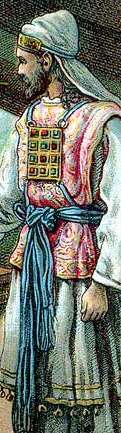
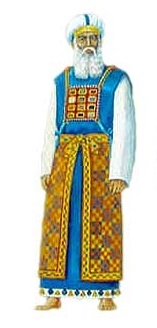
The high priest over his brothers, who has had the oil of the anointing poured over his head and his hand filled, so as to wear the garments– he shall not dishevel his head, and he shall not rip his garments. And he shall not enter (a room) with any dead body; not even for his father or for his mother shall he become tamei. And he shall not leave the holy place, and he shall not profane the holy place of his God; because the crown of the anointing oil of his God is upon him. (Leviticus/Vayikra 21:10-12)

kohein gadol = great priest, high priest (a lifetime office after anointment, with unique duties)

mikdash = holy place, holiness; that which is set apart as exclusively for God

neizer = crown, headband, head of hair; mark of distinction, ordination, setting apart

On a practical level, if one regular priest becomes tamei because of the death in the family, another priest can substitute for him in his sacred work.  But there is only one high priest, who has no substitute.  (In this respect, the high priest is like the president of the United States, who is always on call, and can use the vice president as a substitute only if he is seriously incapacitated.)

On another level, the Torah requires all of the priests to serve as public symbols of holiness, and the high priest is the ultimate symbol. He even wears a unique gold medallion on his forehead engraved with the words “Holy to God”.  (See my post on “Tetzavveh: Holy Flower”.) All priests, but especially the high priest, represent God’s characteristics to the public.  That is why, when they are on duty, they dress in beautiful costumes colored with expensive dyes, dazzling people with their majesty. And that is why, unlike priests in other religions, they avoid corpses. Traditional Jewish commentary agrees that if the priests of the God of Israel engaged in rituals for the dead,  God would be viewed as another god of death.  Above all, the God of Israel is a god of life.

In fact, one of the names of God in the Hebrew Bible is “God of Life”, a phrase that first appears in the book of Deuteronomy, and occurs in many of the books of the prophets:

For who, of all flesh, heard the voice of Elohim Chayyim speaking from the midst of the fire, as we did, and lived? (Deuteronomy/Devarim 5:23)

Elohim Chayyim = God of Life, Living God (Both translations are valid.)

Because the high priest is distinguished from all other priests by his method of ordination–which includes anointment on the head–and by the additional items he wears with his official garments, he must avoid any appearance of mourning on his head or his garments. As a human being, he will grieve in his heart.  But as a symbol of God, he must always stand for life, life in the body in this world.  This life is God’s great gift to us, the one that lets us praise and bless God in return.

The dead do not praise God, nor any who go down to silence. But we ourselves will bless God, from now until eternity.  (Psalm 155:1718)

Of course, life and death must co-exist in this world; you can’t have one without the other.  But we can choose which aspect of reality to focus on and appreciate.  When I meet people whose personal religion revolves around an afterlife, I wonder if they are fully appreciating this life, in this world.  I find that the more attention I pay to everything that is alive, right now, the more I appreciate life, the more I rejoice in creation, the more I am able to praise God.  A god of death would give me a grim outlook.

There is a time for mourning, and I am glad I will never be a high priest!  But I am grateful I could choose to become a Jew, and bless the God of Life.

Shemini: Aaron’s Four Sons

Four sons.  We have completed the week of Passover/Pesach, with its ritual commemorating the exodus from Egypt.  For at least 1,500 years this ritual has included a description of the “four sons”—four kinds of children the parent must teach about the exodus.

Now I am preparing to go to Ashland, Oregon, for a weekend learning from Rabbi Zalman Schacter-Shalomi, and I will be telling a new Torah monologue inspired by the Torah portion of the week, Shemini (“Eighth”).  In this portion, Aaron and his four sons emerge from seven days of seclusion after Moses anointed them as priests, and  engage in the final ritual inauguration of  the mishkan, the dwelling-place for God.  Only two of Aaron’s four sons survive the day.

The four sons in the Passover reading are based on four places in the Torah where a father tells his son the reason for performing the Passover ritual.  Three of these answers are preceded by a question by a hypothetical son (Deuteronomy 6:20, Exodus 12:26, and Exodus 13:14).  The fourth place, Exodus 13:8, merely implies it is the answer to a child’s question.  The rabbis of the first several centuries C.E. took these lines out of context in order to describe four kinds of children:

the “wise son” who wants to know all the rules;

the “wicked son” who thinks Passsover has nothing to do with him;

the “simple son” who merely asks “What is this?”;

and the son who does not even know how to ask.

In the Torah, all four answers are variations on “Because God freed us from slavery in Egypt”.  The answers in the Torah are clearly addressed to the descendants of the Israelites in general, while the elaborations in the Passover ritual refer to four general types of children.  I have never seen a haggadah (a book telling the Passover ritual from start to finish) that connects the “four sons” with Aaron’s four sons.  But next year, I hope to write one.

Two years ago I analyzed what happened to Aaron’s two older sons, Nadav and Avihu, in my blog “Shemini: Strange Fire”.  As I wrote my new Torah monologue the past week, I became interested in the psychology of the two younger sons, the survivors who were not consumed by the fire from God:  Elazar and Itamar.

In birth order, the sons of the high priest Aaron and his wife, Elisheva, are:

Nadav = Willing Donor

Avihu = He Is My Father

Elazar = God Helps

Itamar = Island of Date Palms

Although the Torah gives reasons for the names of many of the people in its stories, it is silent about these four.  Here is what I imagine:

Elisheva had a dream when each of her four sons was born in Egypt. She saw her firstborn walking toward God’s throne, bringing God a glorious gift.  So she named him Nadav, “Willing Donor”.  And Nadav lived up to his name.  Whenever he learned another way to worship the Holy One, he threw his whole soul into it.  When the men asked his father, Aaron, to make an idol for them to worship, Nadav said, “No, don’t do it!  Our god only appears in fire, or in a pillar of cloud.  You can’t drag that holiness down into mere metal!” Later, when holy fire poured forth from God and consumed the animals on the new altar before the mishkan (the new, authorized dwelling-place for God), Nadav picked up his fire-pan in an ecstasy of desire to give his soul to the true god, the god of fire.  And his soul was consumed.

When her second son was born, Elisheva dreamed he was toddling after Aaron, mimicking his father’s walk.  So she named him Avihu, “He is My Father”.  And Avihu lived up to his name.  From his first step, he was always imitating Daddy.  When the men asked Aaron for an idol, Avihu said, “Yes, do it!  Our god is so great, He can appear anywhere, even in an idol.”  And when Aaron made the Golden Calf, Avihu built the fire to melt the gold.  Later, Avihu watched his father pick up an incense-pan and follow Moses into the inner sanctuary of the new mishkan.  Both men came out and blessed the people, and then a river of holy fire poured over the altar.  Avihu took his own pan and walked toward the Holy of Holies.  And the fire from God consumed his soul.

When her third son was born, Elisheva saw a shepherd’s staff moving all by itself, pointing out hazards along the road.  And she saw her baby following the staff carefully, and walking in safety.  So she named him Elazar, “God Helps”.  And Elazar lived up to his name.  He took his job as a Levite, and then as a priest, very seriously, and he never acted without checking to get the details right.  When the men asked Aaron for an idol, Elazar said, “No, don’t do anything without Moses’ approval.  And if we have to spend the rest of our lives waiting for Moses to come back down the mountain, so be it.”  Later, when holy fire poured over the new altar, Elazar reached for his fire-pan, wanting to give something, anything, to the all-powerful God.  But he drew his hand back, because Moses had not commanded it.  And he lived to become the high priest after Aaron died.

When her fourth son was born, Elisheva was exhausted.  She didn’t dream about anybody.  She just had a vision of an island covered with palm trees, date palms.  So she named the baby Itamar, “Island of Dates”.  And little Itamar turned out to be a sweet and loving boy. When the men asked Aaron for an idol, Itamar said nothing, because he did not understand enough about God—and because he was so much younger, he was not used to being listened to.  Later, when holy fire poured over the new altar, Itamar could not even remember where he had left his fire-pan, and he felt no impulse to bring incense to God.  He just wanted to survive the awesome spectacle, and learn his new priestly duties, and make his own life in whatever free time was left to him.

The Torah monologue I’ll tell in Ashland is from the viewpoint of Itamar.  But maybe next year I will write another Torah monologue, from the viewpoint of Elisheva.

And next year, God willing, I will write a haggadah for Passover in which the four sons of Aaron and Elisheva are the four sons of  Passover.  But I won’t list them by birth order.  Elazar will be the “wise son”, the one who wants to learn all the rules, so he will make no mistakes in his service to God.

Nadav. as I imagine him, is like the “wicked son”, the one who thinks the religion of his fathers has nothing to do with him.  He not really wicked, since he willingly gives himself to God.  But he does not listen to his father Aaron or his uncle Moses; he brings his own “strange fire” to God.

Avihu, in my book, is the “simple son”, awed by all the ceremony.  All gods are exciting to him, and he is just as willing to worship the Golden Calf as his father was to make it.  When Aaron repents and commits to the god of Moses, so does Avihu.  But without real understanding, he flings himself into the impulse of the moment.

Itamar, Aaron’s youngest son, is like the son who does not know how to ask.  He does not understand the new family business of priesthood, but he is willing to learn it.  He does not understand the impulse to give everything to God, but he understands the desire to give to other human beings.

I have to admit I am more like Nadav than Elazar, making up my own mind regardless of what my my predecessors taught.  So I had better be careful when I play with fire. At least I am not impulsive, the way I see Avihu.  Most of all, I can identify with Itamar, the novice who does not even know what to ask, and who tries to serve both God and his own life and loved ones.

Which son do you resemble?

Tzav: Who Gets the Skin?

When I read all the gory details of the animal sacrifices in the book of Leviticus/Vayikra, I have to work hard to imagine how all that slaughtering, butchering, and throwing blood around could bring anyone closer to God. I believe that when we kill our fellow mammals we should mourn, not celebrate; and I view the slaughter as something we need to atone for, not as a means of atonement.  Thank God we switched to worship through prayer about 2,000 years ago!

It would be easy for me to dismiss the earlier technology as an artifact of an ancient culture.  I could simply address the issues of the present day, and campaign for treating all mammals more humanely, killing them only out of practical necessity, and reforming our diets. But I have dedicated myself to Torah study, and that means I must search for deeper meaning in the text, even the descriptions of animal offerings.

When I reread this week’s Torah portion, Tzav (Command), I noticed that the three basic motivations for offering an animal at the altar correspond to three instructions for what to do with the animal’s skin.

Although the book of Leviticus/Vayikra classifies offerings with five different names, covering at least a dozen different situations, they boil down to three reasons for bringing an animal to the altar:  to express individual gratitude or devotion to God; to atone for individual guilt; and to atone for the whole community and/or its religious leaders.

When a man brought an animal offering to express gratitude or devotion (in the Torah only men bring animals to the altar), after the butchery, burning, and feasting, he got to keep the animal’s skin, which had value because it could be tanned to make leather.

We learn in the Torah portion Tzav that when an individual brought an animal offering to be relieved of guilt over a lapse, a wicked thought, a sin of omission, or an unintentional wrong against God, the priest who performed the atonement got to keep the hide.

As for the priest who brings near a man’s rising-offering, the or of the rising-offering that the man brought to the priest will become his.  (Leviticus/Vayikra 7:8)

or (עוֹר) = skin (either human or animal)

When a priest brought an animal offering to make atonement for himself or for the entire community, the skin was burned on the ash-heap outside the camp where the ashes from the altar were taken.  Moses does this in this week’s Torah portion during the ordination of Aaron and his four sons as the first priests of the Israelites, so they can begin their new offices with a clean slate.

And the bull and its or and its flesh and its intestinal contents he burned in the ash-heap outside the camp, as God had commanded Moses.  (Leviticus 8:17)

The three ways of disposing of the slaughtered animal’s skin make sense on a practical level.  Someone who wanted to draw closer to God out of a devotional impulse, or gratitude for good fortune, should be allowed to keep any part of the animal not used in the ritual.  Why should he suffer any extra economic loss?

However, someone who was guilty of missing the mark in his relationship with God needed to experience a loss, to give up something in exchange for being freed of his guilt.  The priest got the skin because his service enabled the guilty man’s atonement.  (Priests were not paid salaries, or given land to farm, so they received compensation in the form of meat, skins, and bread from various offerings.)

If a priest erred in his holy service, or if the whole community missed the mark (because the priests did not guide them properly), then it makes practical sense that the priest should get no economic benefit from the sacrificial animal’s skin.  Burning the hide adds dramatic impact to this most serious kind of ritual offering.

I can also see symbolic meaning in the three ways of handling the skins.  In the book of Genesis/Bereishit, God clothes Adam and Eve in skins before sending them out into the world. Skin is like a garment.  It separates and protects an individual from the rest of the world.  And skin, like a garment, also signals the individual’s public identity and role in the world.

Perhaps the skin of an animal offering represents the skin of the man who brings it.  The Torah mandates that the man who brings an animal  to the altar must lean his hands on its head before it is slaughtered.  This gesture apparently connects the human with the animal, so the offering counts as his.

When someone brought an offering of gratitude or devotion, he was already in a good standing with God; the offering expressed his feelings and brought him even closer to the divine.  His public identity did not need to change.  Therefore he could keep the animal skin.

When someone brought an offering out of guilt, he had stumbled in his service to God.  In order to atone and return to good standing, he needed to recognize, in his heart, that his position in the community and his connection with God must not be taken for granted.  I think he gave the animal skin to the officiating priest as an act of humility.

Why was the skin burned when a priest brought an offering to atone for his own guilt, or for the guilt of the whole community?  The Torah requires burning the skin outside the camp when a priest is ordained, when a priest discovers that he or the whole community has committed a lapse in service to God, and once a year on Yom Kippur, the day of atonement for everyone.

The priests of the Israelites, like all religious leaders today, and everyone else who guides people on the level of their souls, have to be meticulous in their service.  If they violate someone’s trust; if they treat other humans without respect; if they preach one thing and do another; if they become so enamored of their role, so dazzled by their own garments, that they fail to examine their inner selves; then their guilt is so great they must burn their animal skins.  That means they must leave their sanctuary and leave the community where they did wrong, going “outside the camp”, and give up their public roles, their animal skins.

What if the animal offering atones for the whole community, like the goat offered to God on Yom Kippur?  Modern Jews do not cast lots on goats on Yom Kippur, but we do spend the day praying.  Our prayers for atonement are in the plural: we have become guilty, we have betrayed, we have robbed, we have slandered, and so on.  No one is isolated; we are all responsible for one another.  We share the good and the bad.  We are our brothers’ keepers.  And our membership in the human community is intrinsic to our connection with the divine.

Therefore, when we want to come closer to God, we must all abandon the garments of our public roles.  Burn those animal skins, and let the smoke rise up to the heavens!

Vaykheil-Pekudei: Witnessing the Divine

The book of Exodus/Shemot ends this week with a double portion, Vayakheil (And he assembled) and Pekudei (Inventories).  The Israelites eagerly donate materials for the mishkan (the portable dwelling-place for God), and for ritual garments for the new priests.  They make all the parts of the mishkan, and Moses assembles them.  At the end of the book, God’s glory enters the Dwelling.

High Priest, Bible
card by Providence
Lithograph Co., 1907

The portion Vayakheil begins:  And Moses assembled the whole community (everyone who would witness) among the children of Israel.  (Exodus/Shemot 35:1)

The portion Pekudei begins:  These are the inventories for the Dwelling, the Dwelling of the Testimony of God.  (Exodus 38:21)

kol adat = all the witnesses of, the whole community of

eidut = report of a witness, testimony (from the same root as adat)

ha-eidut = The testimony (This form is used for the testimony of God.)

In Vayakheil, the community of witnesses is also the community that donates and makes the mishkan.  Women as well as men are specifically included in this group.  In Pekudei, when Moses assembles all the parts of the mishkan, he puts God’s testimony, ha-eidut, into the ark, then inserts the carrying-poles into the rings at its corners, and puts the golden cover on as a lid.  The Torah does not specify what the testimony inside the ark actually is.  Classic commentary is divided on whether it consists of a parchment scroll on which Moses wrote down the first part of the Torah, or the stone tablets inscribed by the finger of God with the commandments (both the intact pair of tablets and the shards of the broken pair), or both the scroll and the tablets.

Either way, The Testimony is something the Israelites already have.  And Moses has already told the people that God is with them.  But seeing is believing.  The Israelites need to witness Moses putting God’s “testimony” into the ark, and then they need to witness God’s visible presence.  On their journey from Egypt to Mount Sinai, they followed a manifestation of God as a pillar of cloud by day and fire by night.  But the pillar disappeared when they arrived at the mountain, and clouds of smoke and fire appeared only at the mountain’s peak.  This was not enough for the Israelites; when Moses was gone too long, they made a golden calf.  And soon they will have to leave Mount Sinai and journey on to the Promised Land.  How can they know God is really with them, and God’s testimony is really secure?

Their memories of God’s miracles in Egypt and manifestations after that are not sufficient.  The Israelites are like witnesses with poor recall.  In order to remain fully aware of God’s presence and God’s investment in them, they have to build a visible, tangible place for God to dwell, and then they have to witness something that indicates God’s presence in that dwelling-place.  Only then can they fend off their fear of abandonment.

This plan works.  The book of Exodus ends:

…and Moses completed the work.  The cloud covered the Tent of Meeting, and the glory of God filled the Dwelling … For the cloud of God was upon the Dwelling by day, and  fire was in it by night, before the eyes of all the house of Israel on all their journeys.  (Exodus 40:33-38)


Today, our world has many sanctuaries designed to make people feel the presence of God, including many synagogues, cathedrals, and mosques.  (We also have a plethora of buildings intended for religious worship whose architecture is no more inspiring than a high school gymnasium—but that’s another story.)  Many religions also have fixed prayers or mantras, with words to be recited or sung at specific times, words designed to help people feel the presence of God.

Nevertheless, God’s presence is not concrete enough for most humans today to attest to it as witnesses (and those who do have no corroboration).  And the written “testimony” we have, however accurately copied, was written down by fallible human beings, which means that, at best, something was lost in translation. We have no ark, we have no mishkan.  We know that if we discovered the ark, buried away somewhere, and attempted to duplicate the mishkan described in the Torah, God would not manifest in it the same way.  We live in another time, millennia away from the ancient peoples who built the Dwelling for God on their journey across the wilderness.

Yet so many people, including myself, yearn for something ineffable, something so hard to name that we call it “God”.  Some find an anthropomorphic idea of God helpful.  Some find the idea of a being who is omniscient, omnipotent, and omni-benevolent helpful.  I am one of those who use the words “God” and “soul” when we want shorthand ways to talk about the mysterious feeling that there is some huge extra meaning in the universe and in ourselves.

No matter what phenomena I observe, I can always generate counter-explanations that prevent me from being a witness for “God”, whatever that word means.  Nevertheless, I have discovered that I can help my sense of a divine presence to grow.  I can build an imaginary mishkan inside my mind, and witness some  spirit of the divine, in the form of mystery and exaltation, obscurity and light …  cloud and fire.

May we all discover some of the divinity that dwells inside us.

Ki Tissa: Observing Shabbat

It’s Friday, I’ve had an exhausting week, and besides finally writing this blog and catching up on my work, I’m determined to clean the bathroom before sunset.

Any Jewish readers observe or try to observe Shabbat, Shabbes, the Sabbath, are smiling now.  It sounds wonderful to make one day a week a holy day of rest.  And the importance of keeping Shabbat comes up over and over again in the Torah, in the Talmud, and in the writings and talks of sages and rabbis for thousands of years, to this day.  Yet observing Shabbat can be so hard … and not just because it takes some preparation every Friday.  Even Jews committed to strict observance have to figure out how to carry out the letter of the law recorded in the Torah, which was written at a time when our lives today were unimaginable.  Jews who want to carry out the spirit of the law of Shabbat observance, in addition or instead of the letter of the law, also have a lot of figuring out to do.

This week’s Torah portion, Ki Tissa (When you lift up), begins with God’s final instructions to Moses before God hands over the first pair of stone tablets popularly known as the Ten Commandments. After God finishes telling Moses how to make the mishkan, the portable sanctuary that will make God’s presence manifest,  and all the sacred objects in it, God says:

And you, you speak to the children of Israel, saying:  Nevertheless, guard my shabbatot, because that is a sign between Me and you throughout your generations, in order to know that I, God, am making you holy.  (Exodus/Shemot 31:13)

shabbatot (שַׁבָּתֹת) = sabbaths, stopping-days

In other words, Shabbat is even more important than creating the sanctuary.  Every seventh day, the Israelites must stop doing the holy work God commanded, and do something different.  And after the sanctuary is built, the descendants of the Israelites, every generation, including Jews in the 21st century, must stop and do something different on Shabbat.  The Torah continues:

And you shall guard the shabbat because it is holy for you; whoever desecrates it will certainly die, for anyone who does melakhah on it, that soul shall be cut off from among its people.  (Exodus 31:14)

melakhah (מְלָאכָה) = tasks, job, crafts; creative work, productive work; project, enterprise.

What counts as melakhah?  The Hebrew bible gives six concrete examples of activities forbidden on Shabbat:  cooking manna (Exodus 16:23), lighting a fire (Exodus 35:3), gathering wood (Numbers 15:32),  carrying burdens into Jerusalem or out of your house (Jeremiah 17:21-22), treading grapes for  wine (Nehemiah 13:15), or buying and selling (Nehemiah 10:32).

From these examples, as well as from the multiple meanings of the word melakhah, and from lists of tasks necessary to build the sanctuary,  Jewish commentary from the Talmud to today extrapolates so many different arguments about what you shouldn’t do on Shabbat that my head spins.

But desisting from certain kinds of work is not all it takes to observe Shabbat.  This week’s Torah portion says that Shabbat is a sign that God is making us holy.  When we stop and rest on the seventh day, what do we do to realize that holiness?

I found two good clues in the Torah.  One comes from the book of Isaiah:

… turn back from stepping on ShabbatDoing whatever you want on My holy day/And instead call the Shabbat a delight/ The holy (day) of God an honor … (Isaiah 58:13)

Instead of stepping all over Shabbat by doing whatever you want, including melakhah, we should make Shabbat a delight and an honor to observe.

Another clue comes at the end of the warning about Shabbat in this week’s Torah portion:

Between Me and the children of Israel it is a sign forever, that for six days God made the heavens and the earth, but on the seventh day It stopped and was refreshed (shavat vayinafash).  (Exodus 31:17)

shavat (שָׁבַת) = he/it stopped, ceased, desisted. (From the same root as Shabbat)

vayinafash (וַיִּנָּפַשׁ) = and refreshed his/its soul, and recovered himself/itself, and re-animated himself/itself.

Here, God is refreshed by a day of rest.  Earlier in the book of Exodus (Mishpatim, 23:12), Israelites are required to desist from work on Shabbat so that all of their dependents (by example, the son of a maidservant) and the strangers living among them could be refreshed.

So how can I observe Shabbat in a way that will result in my being refreshed, re-animated, re-ensouled?  I confess that I am still trying to figure this out.  (For example, singing prayers with my congregation re-animates my soul, but driving an hour to where we meet—and back—wears me out.)

I do know that my spirit is brighter when I don’t have to look at a dirty bathroom.  So please excuse me now; Shabbat begins at sunset this evening, and Friday afternoon is all too short.

Tetzaveh: Divining

What should I do?

Usually human beings carry on with their habitual behavior, but sometimes we have to make a deliberate decision.  And we do not know whether a particular choice will lead to good or evil, or to happiness or disaster.  If only we knew ahead of time!

The longing for foreknowledge has been with us for millennia.  Most cultures have had their own methods of divination, of gaining knowledge that is normally outside the human realm.

High priest’s vestments, artist unknown

In the Hebrew Bible, leaders and kings ask the high priest to consult the urim and tumim tucked into his breast-pouch. These mysterious items are introduced in this week’s Torah portion, Tetzaveh (“You shall command”), but we do not learn their purpose until the book of Numbers/Bemidbar, when God tells Moses what Joshua must do after Moses has died. Since Joshua, unlike Moses, cannot hear God directly, he must ask the high priest for divination when he needs to decide whether to go out to battle:

He shall stand before Eleazar the priest, and ask him for the ruling of the urim before God. (Numbers 27:21)

urim (אוּרִים) = firelight? illumination?

But the book of Joshua never refers to the urim. The only time the Torah says someone actually consults them is in the first book of Samuel:

And Saul inquired of God, but God did not answer him, either with dreams or with urim or with prophets.  (1 Samuel 28:6)

Several other times in that book both Saul and David “inquire of God” in the presence of a priest, and when David receive yes/no answers, we can assume the answers are indicated by the urim.  But no description is given.

This week’s Torah portion describes everything else the high priest wears, from his headband to his underpants. Over his sky-blue robe, the priest must wear an eifod, a kind of tabard with shoulder-straps and sewn-in ties at the waist.  A chosen, a square pouch, will hang from the shoulder-straps of the eifod, secured on the high priest’s breast.  This breast-pouch will be folded at the bottom, and twelve gems will be set into the front.  Each gem will be engraved with the name of one of the tribes of Israel.

And into the breast-pouch of the law you will place the urim and the tumim; and they will be over the heart of Aaron when he comes before God, and Aaron will carry the law of  the children of Israel over his heart before God constantly.  (Exodus/Shemot 28:30)

tumim (תֻּמִּים) = ? (a noun probably based on the adjective tamim, תָּמִים = whole, flawless, blameless.)

Obviously a high priest could not carry firelight and wholeness in a pouch on his chest; the names of the actual items are symbolic.  But what do they mean?  In Ezekiel, ur is a destroying fire. Throughout the book of Isaiah, urim means “fires” or “firelight”, not an object worn by a high priest.  Everywhere else in the Hebrew Bible, the word urim refers to the item worn by the high priest.

Traditional commentary says the word urim means light, illumination, clarity, because it has the same root letters as the word or = light. Some modern language scholars speculate that urim is derived from nei-arim (נֵאָרִים) = cursed, inflicted with a curse. In that case, urim and tumim would mean “cursed” and “blameless”. In other words, one object indicates a bad outcome and the other indicates a good one.

Rashi (11th-century rabbi Shlomo Yitzchaki) suggested that the two words urim and tumim were written on a single piece of parchment, and the high priest would look down through the open top of his breast-pouch to see which word was facing up.

In the Talmud tractate Yoma 73b, the rabbis seem to use the phrase “urim and tumim” interchangeably with the phrase “breast-pouch of the law”.   Some speculated that the names of the twelve tribes were inscribed on the urim and tumim, and the letters lit up or moved around to create an oracular message.  Others said that the urim and tumim caused the stones on the front of the breast-pouch to light up, and the message could be deciphered from the pattern of flashing lights.  The important thing was that both the person with the question and the high priest had to direct their minds toward God.


Some passages in the Torah appear to forbid using any kind of divination, along with any other kind of magic.  For example:

No one must be found among you who sacrifices his son or his daughter in the fire, or who reads omens, a cloud-conjurer or a diviner, or a sorcerer; or a charm-binder, or a medium who consults ghosts or a medium who possesses a familiar spirit, or who questions the dead.  For anyone who does these is an abomination of God, and on account of these abominations, God, your god, is dispossessing them before you.  You shall be whole with God, your god.   (Deuteronomy/Devarim 18:10-13)

Here Moses is banning all the divination practices of the people surrounding the Israelites.  In other places, the Torah approves of a few practices for getting a bit of divine knowledge.

The two most common ways that God shares foreknowledge with humans is through dreams, and through communication with prophets.  In the absence of dreams or prophetic utterances, a person can take the initiative by casting lots, or by consulting the high priest’s urim and tumim.


When this week’s Torah portion introduces the urim and tumim, it says “they will be over the heart of Aaron when he comes before God”—like the gems representing twelve tribes of Israel.  Maybe the primary purpose of the urim and tumim is not to enable divination, but to keep light and wholeness in the high priest’s awareness whenever he approaches God.

Even today, people who want to make the right decision resort to dubious divination methods.  Instead of reading omens in entrails or conjuring clouds, they flip a coin, or buy something from a New Age shop, or consult a medium who channels the spirit of a dead person.  It is hard to accept that we cannot have foreknowledge, only good guesses.

Yet we can answer the question “What should I do?” without knowing the outcome of our choice.  And when our intuitions are not clear, we can use approaches similar to the kind of “divination” the Torah approves of.  Dreams still help by connecting us with hidden parts of ourselves that are connected with the divine.  And we can improve our conscious thought by keeping certain ideas in our awareness, carrying them upon our hearts like high priests.   We can consciously stay in touch with urim, the light shed by the fire of our passions; tumim, the continual effort to complete ourselves and become whole; and on the outside, the gemstones of our own tribes, our own families, friends, and communities.

Terumah: Heavy Metals

The Torah portion Terumah (“raised donations”) begins with God telling Moses to ask everyone whose heart is so moved to donate materials to make a sanctuary:  three kinds of metals, three colors of expensive dye, linen, wool, two kinds of hides, wood, oil, incense spices, and gems.  Then God says:

They shall make for me a sanctuary, and I will dwell among them.  (Exodus/Shemot 25:8)

God has already promised to be the god of the Israelites and their fellow-travelers.  But, as we see in the golden calf incident two Torah portions later, the Israelites cannot believe God is still with them without some visual aid.  God refuses to inhabit a golden statue of a calf.  Instead, the people will be reassured by the sight of the sanctuary.

The list of materials for this sanctuary begins:

And this is the raised donation that you will take from them:  zahav, and kesef, and nechoshet …  (Exodus 25:3)

zahav (זָהָב) = gold.

kesef (כֶּסֶף) = silver; the common currency in the Middle East.

nechoshet (נְחֺשֶׁת) = copper, brass, bronze.  (From the root verb nicheish, נִחֵשׁ = practiced divination.)

Gold and Silver

We know why the Israelites had gold and silver to donate.  After the final plague in Egypt, they followed God’s order to “ask” their Egyptian neighbors for silver items, gold items, and clothing.  The Egyptians complied.

Besides using silver and gold for ornamental vessels and jewelry, Egyptians and other peoples in the Middle East made idols (statues for gods to inhabit) out of precious metals.  That is why, after the revelation at Mount Sinai, God says:

With me, do not make gods of silver or gods of gold; you shall not make them for yourselves.  (Exodus/Shemot 20:20)

Accustomed to thinking of gold as the metal of highest status, the Israelites would feel reassured that their donated gold would go into all the holy objects in the inner chamber of the sanctuary:  the lamp-stand, the table, the incense altar, and the ark itself.  Silver was less precious, so it is not surprising that God tells Moses to use silver for the sockets in the framework around the inner chamber.  This framework supports the curtains and tent-roof, and is made of wood planks plated with gold.

The use of gold and silver reinforces the high status and the holiness of the sanctuary’s inner chamber of the sanctuary.  I believe the requirement that these two metals be donated also has a psychological value.  After all, the people know that the gold and silver objects do not really belong to them; the Egyptians handed over the objects when they were desperate to end the plagues.  And the gold is also a reminder of the golden calf.  Donating their gold and silver for God’s sanctuary would relieve the people’s guilt on both counts.

Once the inner chamber of the sanctuary is assembled, the people see only its outer walls—the gorgeous curtains fastened to the gold-plated planks that are fitted into silver sockets.  Only priests are allowed into the area with the incense altar, table, and lamp-stand, and only Moses and the high priest, Aaron, can enter the innermost Holy of Holies, where the ark is concealed.  But everyone knows that God manifests and speaks in the empty space above the gold-plated ark.

Bronze

Another area of the sanctuary is open to every Israelite: the outer courtyard, which contains the altar for animal sacrifices.  This altar, and all its tools, are made out of copper or bronze.

Where does the copper come from?  The Israelites only took silver, gold, and clothing from the Egyptians.  The word for copper, nechoshet, appears only once before this in the Torah: the list of Cain’s descendants includes Tuval-Kayin, who made cutting tools out of nechoshet and iron.1

The book of Exodus is set in a historical period when the Bronze Age is ending, and iron is just beginning to come into use.  Bronze, an alloy of copper and zinc, was the most common metal for tools and blades.  It was also the most common metal for making mirrors, since bronze reflects well when it is polished.  And mirror-like surfaces were used for divination, the type of magic practiced by people who want to see the future.

The snake in the garden of Eden is a nachash, נָחָשׁ, another word from the root nicheish.  The role of the snake is to arouse a desire in Eve for a different kind of knowledge, the knowledge that God has.  Only after her conversation with the snake does she taste the fruit of the Tree of Knowledge of Good and Evil.2

When Moses first demonstrates God’s power to Pharaoh, his staff turns into a nachash.  He is trying to give Pharaoh knowledge about God, though Pharaoh is too defensive to pay attention. Pharaoh’s magicians turn their own staffs into crocodiles, but Moses’ snake eats them.3   (Later, in the book of Numbers/Bemidbar, Moses halts a plague of poisonous snakes, nechashim, with a bronze snake on a pole, a nechash nechoshet.4)

In the book of Genesis, both Lavan and Joseph claim to practice divination when they are trying to impress their troublesome relatives.5  But in  Deuteronomy/Devarim, God warns the Israelites not to practice divination, or any other kind of magic.  One must not try to force information out of God.6

Traditional Jewish commentary explains that the altar in the courtyard of God’s sanctuary is made of copper or bronze because it is a third-rate metal, less valuable than gold or silver but good enough for the area that is merely holy, not the Holy of Holies.  Another explanation might be that the tools for the altar had to be bronze so they would hold an edge, and it seemed appropriate to make the altar itself out of the same metal.

Or maybe the Israelites needed to surrender not only the silver and gold they took from the Egyptians, but also their own snakiness, their own desire for divination and divine knowledge.

Maybe even today, we need to give up the idea that we can predict and control the future.  Can we accept that we are not gods, and we cannot make our own gods?  Can we resist the promise of magic?  Can we donate what knowledge we have, all our copper and all our serpentine wisdom, to building a sanctuary for the whole world?  If we can, then maybe God will dwell among us.

  1. Genesis 4:22.
  2. Genesis 3:1-6.
  3. Exodus 7:8-13.
  4. Numbers 21:9.
  5. Lavan in Genesis 30:27, Joseph in Genesis 44:15.
  6. Deuteronomy 18:10.

Mishpatim: Passionate Arson

Last week’s Torah portion, Yitro, begins with the reunion of Moses and his father-in-law, then moves into the mind-bending revelation of God at Mount Sinai.  This week’s Torah portion, Mishpatim (Laws) gives a long list of laws, then ends with a vision of God’s feet on a sapphire pavement.  (See my blog “Mishpatim:  After the Vision, Eat Something”.)

I’m always tempted to rush straight from the vision of God as fire and thunder to the vision of God’s feet.  But imagine someone who had two mystical experiences in a row, with no time in between to come down to earth.  Their mental balance would be hard to recover.  It would  actually be a blessing to spend an interval on practical matters, in between mystical experiences.  Maybe reading case law in between  the stories of visions at Mount Sinai serves an analogous purpose for Torah scholars.

So this year I paid attention to the case law, and found one law that might addresses unbalancing mental states.

If a fire goes forth, and it finds thorn-bushes, a heap of grain or the standing grain, or the field, and they are consumed, the burner who starts the burning shall certainly make complete restitution.  (Exodus/Shemot 22:5)

On a peshat (simple) level, this law refers to legal responsibility for negligence in a certain farming practice.  On the next level of traditional Torah interpretation, remez (alluded extension), the Talmud tractate Baba Kama (60a) treats this law as a paradigm for all cases in which someone deploys a fire, an animal, a tool, or anything that is not fixed in place, and then it causes damage because the person did not keep it under control.

Going up another rung, at the level of drash (investigation), I see that the law embodies two ethical principles:  that we should make every effort to avoid doing any harm through negligence; and that if it happens anyway, we must make restitution.

At the fourth level of Torah interpretation, sod (secrecy, intimacy), the verse speaks to our own psychological and spiritual condition.  In the Torah, as in colloquial English, fire and burning are often used to describe human passions such as anger, or lust, or even an overwhelming longing for God.  Any consuming passion is likely to get out of control.  Unless people in the throes of passion pay attention and take special care, their negligence can result in significant damage, both to themselves and to others.

Let’s look at the verse again, to see what the fire of passion might consume.

If a fire goes forth, and it finds thorn-bushes, a stack of grain or the standing grain, or the field, and they are consumed, the burner who starts the burning shall certainly make complete restitution.

kotzim = thorn-bushes, thorns.  (A verb with the same root is kutz = awaken; feel sick and tired of.)

gadish = a stack or heap of grain.

hakamah = the standing.  (Standing grain is implied in a simple reading of the verse.)

hasadeh = the field (cultivated or open); the plot of land owned by an individual; the domain of a city.

bo-eirah = burning, kindling or maintaining a fire; sweeping away; being stupid as a cow.

In a reading at the sod level, if a fiery passion is not guarded, it first consumes thorn-bushes.  Applied to your own soul, the burning anger or desire is at first beneficial, eating up those annoying, thorny habits of thought that you are sick and tired of.  Your passion is so strong, it sweeps aside the inner voice that keeps saying “You’re not good enough”, or the one that always says, “It’ll never work”, or—well, we each have our own mental habits.  When a passion sweeps them away, it feel as if you are waking up to a new and better self.

But your consuming passion also burns up the people around you who are thorns in our sides, the people whom you are sick and tired of.  Speaking from rage, or passionate conviction, or overwhelming desire, you impatiently mow right over the  people you find difficult.  In the long run, this is not beneficial to either you or them.

Next, your inner conflagration burns up the grain you have cut and stacked for future nourishment.  In the heat of the moment, preserving the other aspects of your life seems unimportant.  All that matters is the pursuit of the object of your anger or desire.  Yet if you are not careful, you can damage a relationship or a job or even your own body.

After that, the fire can destroy your own standing—both your reputation, and your uprightness or moral compass.  It is tempting, in the heat of passion, to cross lines you would never cross in your cooler moments.  And with uncontrolled, passionate speech, you may also destroy the reputation of others, or incite them to react in a way that they will feel guilty about later.

Finally, if your passion continues unchecked, you will cross the line in another way, failing to respect the boundary between yourself and another human being.  The whole word looks as if it is lit with fire, so it all appears to be part of the same passion that is consuming you.   Of course the person you are talking to feels the same way you do!  Of course they want the same things!  Of course they will do exactly what you want!  Of course they will be happy if you make it easier for them to do what you want by interfering with their lives!

Most of us know about the hazards of unchecked anger or lust.  Most of us do not want to be negligent when these passions seize us.  We work on paying attention and controlling ourselves.

But the Torah focuses most often on the passionate desire for God, which rises like a flame.  And the Torah’s most common metaphor for God is fire.  Sometimes God manifests as a fire that does not consume, like the one Moses saw in the burning bush (which, by the way, was not a thorn-bush).  But often God manifests in the Torah as a fire that does consume, and sometimes kills.

When we are filled with a passion that seems as if it comes from God, because we are burning for justice, or for a religious experience, that is when we are most in danger of being negligent and causing unforeseen damage to ourselves and others.

The law in this week’s Torah portion rules that the person who starts a fire and fails to control it must make complete restitution for all damages.  But some damage cannot be repaired.

May each of us be blessed with the ability to pay attention when we feel any passion, even the most righteous passion, begin to consume us; to remain aware of everything we would normally consider; and to control our speech and our actions so we do no harm.  May we burn brightly without consuming, and without being stupid as a cow.

Bo & Beshalach: Clouds and East Wind

This is the d’var Torah I delivered as part of my graduation as a maggidah:

Blood. Frogs. Lice. Beasts. Livestock disease. Boils. Hail. Locusts. Darkness. Death of the Firstborn.

Today’s Torah portion picks up with the plague of locusts, goes into darkness, and brings death to the firstborn. Then, finally, Pharaoh releases the children of Israel.

Why locusts? One morning when I was in college in California, I stepped outside and—crunch! The ground was blanketed with crickets. They covered the lawns, the sidewalks, the flowerbeds. Their bodies were so close together, you couldn’t see the ground. Every time somebody opened a door, crickets jumped inside the building.

Those crickets on campus didn’t eat a lot of vegetation before they died. They were a wonder, but not a plague. They were amateurs compared to the locusts in Egypt.

And Moses stretched out his staff over the land of Egypt, and God guided a an east wind into the land, all that day and all the night … (Exodus/Shemot, Bo, 10:13)
And the locust-swarm went up over the whole land of Egypt … (Bo, 10:14)
It covered the sight of all the land, and the land went dark. It devoured all the vegetation … and all the fruit … that remained after the hail. And there was no green left, in the trees or in the field, in all the land of Egypt. (Bo, 10:15)

Now that’s a plague.

You can watch a locust-swarm flying on YouTube. When the sun shines on it, millions of locust-wings glitter like a sea of sparks. And when the locusts swirl in front of the sun, they make a dark cloud, like a gigantic billow of smoke.

This reminds me of how God manifests as a pillar of cloud by day, and fire by night, in next week’s Torah portion. While the pillar of cloud and fire is leading the Israelites out of Egypt, Pharaoh changes his mind and sends his army after them. They meet at the Red Sea. Then the pillar of cloud and fire circles back, to stand between the Israelites and the Egyptians. And, the Torah says,

Moses stretched out his hand over the sea, and God made the sea move with a strong east wind, all the night … and split the waters. (Exodus/Shemot, Beshalach, 14:21)

Both times, God humbles the Egyptians and frees the Israelites with a moving, swirling cloud that sometimes glitters and sometimes darkens.

Both times, God also brings in a ruach-kadim. Ruach means wind—or spirit. Kedem means east—or the place of origin. So the “east wind” is also the “spirit of the beginning”.

The first east wind brings in a vast cloud of locusts that finishes off Egypt’s plant life, and dooms Pharaoh to rule over a dead land. This east wind is Pharaoh’s enemy because he cannot accept the “spirit of beginning”. He is unable to change his ways and make a fresh start.

The second east wind parts the sea so the Israelites can escape from the Egyptian army and live. The east wind is their ally because, once they get over their initial despair, they embrace the “spirit of beginning”. They leave Egypt, ready to make a fresh start.

I think the holy “spirit of beginning” touches our lives, too—whether we see the swirling cloud or not. When we are really stuck, unable to choose anything new, we risk being devoured by a cloud of locusts. But—we have the ability to cast aside that mood, and follow the pillar of cloud and fire instead.

May each one of us receive the strength to embrace the spirit of beginning, and make a fresh start.