Bechukotai: Gender, Age, and Personal Value

by Melissa Carpenter, maggidah

Men are worth more than women.  It says so in the Torah—or does it?

A list of the equivalent value in silver of each of eight classes of people appears in Bechukkotai (“by My decrees”), the last portion in the book of Leviticus/Vayikra:
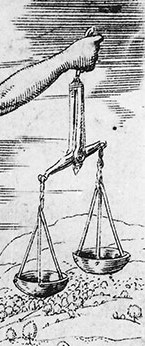
Weighing scales by Cornelius Matsys

When someone designates a vow by erekekha of persons for God— (Leviticus/Vayikra 27:2)

erekekha (עֶרְכְּךֳ) = the equivalent value, assessment.

—then the erekekha of the male of age 20 years up to age 60 years, erekekha will be 50 shekels of silver according to the shekel-weight of the Holy Place. And if she is a female, erekekha will be 30 shekels. (Leviticus 27:3-4)

And if from age 5 years up to age 20 years, erekekha will be for the male 20 shekels, and for the female 10 shekels. (Leviticus 27:5)

And if from the age of a month up to age 5 years, erekekha will be for the male 5 shekels of silver, and erekekha for the female 3 shekels of silver. (Leviticus 27:6)

And if from age 60 years and above, if male, erekekha will be 15 shekels, and for the female, 10 shekels. (Leviticus 27:7)

In this list of equivalent values, males are assigned a higher erekekha than females, and adults between the ages of 20 and 60 are assigned a higher erekekha than children or seniors.  Individual differences between people within each of the eight classes of persons are disregarded.

Pledging donations to God

Leviticus includes a number of mandatory gifts to the sanctuary or the priests who serve there.  All Israelite households are required to give:

* tithes of produce or other acquired wealth.

* the firstborn of their livestock and a portion of their first fruits.

* the prescribed animal and grain offerings for relieving guilt and thanking God for good fortune.

* the prescribed offerings for being readmitted into the community after a period of ritual impurity.

The tithes and the first farm products are like annual taxes or membership dues.  For the ancient Israelites, there was no separation of temple and state; every citizen was also a member of the religious community and had to help support the religious rituals at the temple.  Individuals had to make additional payments to support the rituals for specified situations in their own lives.

I daresay most Israelites were glad to be part of a system that connected them with their God through concrete actions.  And sometimes one of them had a religious impulse, and felt moved to pledge an extra donation.

Ancient Israelites could not do this by simply writing a check.  In fact, even coins were not invented until the sixth century B.C.E. (A shekel was a measure of weight in silver, rather than a coin.) So the Torah portion Bechukkotai considers four other things that could be donated:  a field, a house, part or all of an edible animal, and the erekekha of a person.

The Talmud tractate Arakhin, written during the first few centuries C.E. by rabbis analyzing this passage in the Torah, states that either a man or a woman could make this vow.  A person often dedicated his or her own erekekha to the temple in Jerusalem.  But someone could also vow to donate the erekekha of any person belonging to him or her at the time—i.e. someone the vower owned and could legally sell.  In that era, people could sell their slaves or their own underage sons and daughters.

When someone made the vow, a priest would collect a token pledge.  Then sometime later, the vower would come to the temple and fulfill his or her vow by paying the erekekha in silver.

Pledging the value of a person

Wouldn’t it be simpler to vow to give a certain weight of silver to the sanctuary?  Why bring a person into the equation?

One theory is that the system of erekekha was developed to replace the custom of giving human beings to God, either by sacrificing them at the altar or by dedicating them to service at a temple.

Human sacrifice was widespread in the ancient Near East, and is mentioned several times in the Bible.  In the book of Judges, an Israelite general named Yiftach (Jephthah in English) vows that if God lets him vanquish the enemy and return safely, he will give God whatever comes out the door of his house by making it a burnt offering.  His daughter comes out the door.  She is sacrificed.
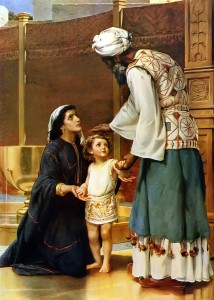
“Samuel Dedicated by Hannah” by Frank W.W. Topham

In the first book of Samuel, Hannah vows that if God lets her have a son, she will give him to God for “all the days of his life”.  Once her son, Samuel, is weaned, she brings him to the temple in Shiloh to serve as an assistant to the high priest.

The book of Leviticus, on the other hand, describes the practices of the priests during the time of the first temple in Jerusalem, centuries after the period described in Judges and Samuel.  Human sacrifice has been banned, and the priests and Levites who serve at the temple in Jerusalem inherit their positions.

But perhaps some people still made vows that if God would do something extraordinary for them, then they would do something extraordinary for God. And perhaps some people simply wanted to be consecrated to the temple, even though they could not be priests or Levites.

One way to achieve this was to replace the donation of a human being with the donation of the human being’s erekekha in silver.

The time lag between the vow and the delivery of the erekekha is not explained in either the Bible or the Talmud.  Perhaps some people felt moved to make an unusual vow before they had saved up enough silver to fulfill it.

Or perhaps the time lag was important because between the time of the vow and the time the silver was delivered, the person whose erekekha was vowed was considered consecrated—marked out as having a holy purpose.

Imagine what it would be like to fulfill a vow that made you consecrated to God for a period of time.  Unlike a monk or nun (or a nazirite in ancient Israel—see my blog post Naso: Distanced by Hair), you would continue with your usual life.  But the meaning of your life would be different.

Imagine what it would be like to fulfill a vow that made your servant or your young child consecrated to God for a period of time.

Value by age and gender

The erekekha of a person is not his or her market value. The eight classifications according to age and gender do bear some relation to a person’s ability to perform work; generally speaking, adults between the ages of 20 and 60 can do more work than the very old or the very young, and men can do more literal heavy lifting than women.  But the market value of an individual sold as a slave varied according to the person’s physical and mental condition.  (Talmud Bavli, Arakhin 2a)  The eight assessments for a person’s erekekha disregard any individual strengths or weaknesses.

The assignment of values according to age and gender probably reflects the prejudices of society in the ancient Near East, which was dominated by men who were heads of households. Yet Judith Antonelli, in her book In the Image of God: A Feminist Commentary on the Torah, argues that the lower erekekha for women indicates that the ancient Israelites respected women more than their neighbors did.  “…the lower prices for women reflect the Torah’s prohibition of sexual slavery. Where female slaves are officially used for sex as well as for labor—that is, kept in harems as concubines—they are in greater demand than male slaves and thus command a higher price.”

In other words, even slave women had value as persons, not merely as sex objects.

So the amount of each erekekha reflected the realities of an agricultural society in which brawn mattered, free men dominated, and children were possessions.  But vowing to pay the erekekha of a woman, child, or old person, meant respecting that person’s value.  By consecrating him or her to God for the period of your vow, you were assigning a high value to your slave or your child.

And when you consecrated yourself to God by vowing to pay your own erekekha, you were assigning a high value to your own life.

Today our systems of religious worship are very different.  But I wonder if we could devise a new way to consecrate our own life, or the life of someone in our family, for a period of time until we achieve a goal. It would change the way we treated ourselves or the other person.  And everyone, of any age and gender, might be worth more.
 

Haftarat Emor: Tzadok the Priest

by Melissa Carpenter, maggidah

Say to the kohanim, the sons of Aaron, say to them: For the death of someone among his people he shall not become ritually impure; only for the blood-relations closest to him… (Leviticus/Vayikra 21:1-2)

kohanim (כֹּהֲנִים) = priests.  (Singular:  kohein, כֹּהֵן)

Thus this week’s Torah portion, Emor (“Say”), opens with instructions from God to the priests on avoiding ritual impurity as much as possible in their personal lives, including who they mourn for and who they marry.  The haftarah (the weekly reading from the prophets) comes from the book of Ezekiel, and also warns that a priest must not marry a divorced women, enter a house where there is a corpse, or engage in mourning practices for anyone except his immediate blood relatives.

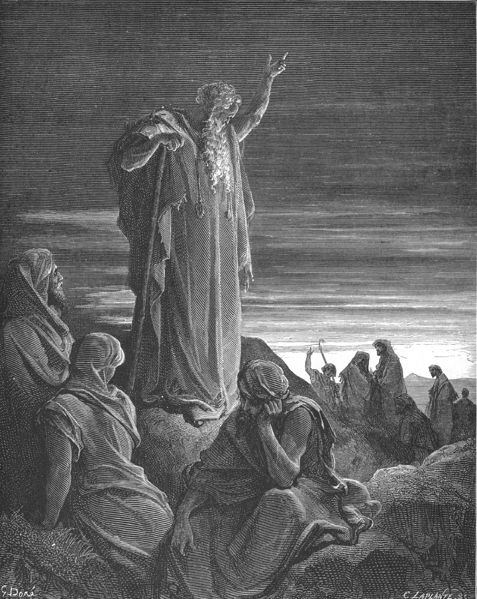
The Prophet Ezekiel by Gustave Dore
The Prophet Ezekiel
by Gustave Dore

The details of the two warnings differ, but the general themes are the same, and support the idea that a priest must devote himself completely, body and soul, to the ritual service for God. (All priests were male.) According to both the book of Leviticus/Vayikra and the book of Ezekiel (Yechezkeil), that includes avoiding certain negative conditions as much as possible—physical conditions such as contact with a corpse, and psychological conditions such as the states of mind that arise in mourning, or in dealing with a wife who was divorced by her previous husband.

In the entire Hebrew Bible, priesthood is hereditary.  And even today, men whose last name is “Cohen” share a genetic marker.  The right genealogy was enough to qualify a man for service as a priest in both the portable sanctuary of Leviticus and the temple of Ezekiel.  But both books insist that the priests must also observe certain rules of behavior in order to be “holy” and serve God properly.

The book of Ezekiel was written either by, or about, a man named Ezekiel who was exiled to Babylon, along with other Judahite officials, priests, and craftsmen, after the Babylonians captured Jerusalem and destroyed the first temple in 586 B.C.E.  Ezekiel lived in a community of exiles on the Kedar Canal outside the city of Babylon, where he had a series of visions and became a prophet.  The haftarah begins in the middle of one of Ezekiel’s visions, shortly after a divine guide has given Ezekiel the measurements for rebuilding the temple in Jerusalem.

And the priests of the Levites [who are] the children of Tzadok, who kept custody of My sanctuary while the children of Israel were straying away from Me, only they shall come close to Me to minister to Me, and they shall stand before Me to offer Me fat and blood—declares my lord, God.  Only they shall come into My sanctuary, and only they shall come close to My table to minister to Me, and they shall keep My custody. (Ezekiel 44:15-16)

Tzadok (צָדוֹק) = Righteous one.  From the same root as tzedek (צֶדֶק) = what is morally right or just.

In the book of Leviticus, all the descendants of Aaron (a man from the tribe of Levi who was the brother of Moses and the first high priest) qualify as priests who can perform the rituals involving incense and animal and grain offerings. Men in the tribe of Levi who are not descended from Aaron are classified as Levites, who assist the priests by transporting the (carefully wrapped) holy objects, and by guarding the portable sanctuary while it is erected. (Singing Levites are not mentioned until the first book of Chronicles.)

Ezekiel says that only the descendants of Tzadok will be priests when the temple in Jerusalem is rebuilt. Tzadok is a tenth or eleventh-generation descendant of Aaron through Aaron’s son Eleazar. He first appears in the second book of Samuel, where King David appoints him as one of two priests in Jerusalem, along with Evyatar.  In the first book of Kings, after many adventures, King Solomon fires Evyatar and makes Tzadok the only high priest.

And the king placed Benayahu son of Yehoyada over the army instead of him [Yoav], and Tzadok ha-kohein the king placed instead of Evyatar. (I Kings 2:35)

ha-kohein (הַכֹּהֵן) = the priest; the high priest.

Aaron has numerous descendants; two of his four sons die childless in Leviticus, but the survivors, Eleazar and Itamar, father large dynasties. Why should the priesthood be limited to Tzadok’s branch of the family tree?

A later chapter in the book of Ezekiel explains:

…the holy contribution [of land] for the kohanim: on the north 25,000 [cubits] and on the west 10,000 and on the east 10,000 and on the south 25,000, and the holy place of God will be in its center.  The holy place will be for the kohanim [descended] from Tzadok, who kept My custody, who did not stray continually [like] the Children of Israel or like the Levites. (Ezekiel 48:10-11)

Ezekiel implies that during the last years of the first temple in Jerusalem, there were two factions of priests. The Tzadokites stuck to the rules for serving God, but the other priests, as well as the Levites and the non-clergy, kept straying.  A vision in chapter 8 of Ezekiel shows some priests as well as some Israelites worshipping other gods right on the temple grounds.

Scholars speculate that Ezekiel himself was a descendant of Tzadok, because his visions and prophecies focus on rebuilding the temple in Jerusalem and reinstating the traditional priestly rituals. Nothing else is important to him; the presence of God must once again have a home in Jerusalem.

In order to make God’s contact point on earth secure, the Tzadokites must be the only legitimate priests—not because of their lineage, but because they remained true to God and continued the ritual service of the God of Israel.  And part of that service, in both the haftarah in Ezekiel and the Torah portion Emor, is maintaining a state of mind compatible with ritual purity.

Despite Ezekiel’s prophecy, non-Tzadokite priests were allowed to serve in the second temple once it was built in 538 B.C.E.  But Tzadokites were the high priests of the second temple from the founding priest Ezra until 153 B.C.E., when the Romans appointed Jonathan Maccabaeus as both king and high priest of Judah.

During the past two millennia, since the fall of the second temple in 70 C.E., almost all Jews have abandoned the idea of reinstating temple worship.  Unlike Ezekiel, we do not believe that God needs one particular spot to bring the divine presence to earth.

Priestly blessing: birkat kohanim
Priestly blessing:
birkat kohanim

We have also abandoned the idea of hereditary priesthood, except for a few minor customs. (Cohens get to do special blessings at services, and are supposed to stay out of cemeteries.)  Instead of ritually pure technical experts who make temple offerings, we now want spiritual leaders such as rabbis to help us improve our inner selves and our prayers.  Many Jews retain some practices having to do with ritual purity, such as keeping kosher.  But holiness is now about divine inspiration and ethical behavior.

We can still aspire to be “a kingdom of priests” and priestesses, as Moses predicts in Exodus/Shemot 19:6. We can even aspire to be Tzadok the priest. But today, that means being tzaddikim, people who are righteous and ethical, like Tzadok—“Righteous One”.

Kedoshim: Holier than Thou

by Melissa Carpenter, maggidah

God spoke to Moses, saying: Speak to the whole assembly of the Children of Israel, and say to them: Kedoshim tiheyu, for kadosh [am] I, God, your god. (Leviticus/ Vayikra 19:1-2)

kadosh (קָדוֹשׁ) = holy; set apart for religious ritual. (plural kedoshim).

tiheyu (תִּהְיוּ) = you shall become, you shall be.

This divine directive, which opens the Torah portion Kedoshim, bundles together three statements:

1) You can, and should, become holy.

2)  God, the God of Israel, is holy. (Or God will be holy.  English requires a form of the verb “to be” between “holy” and “I” in this sentence, but Hebrew omits it, so we can only guess whether God is holy, or used to be holy, or will be holy.)

3)  God’s holiness is related to human holiness.

First, what does it mean for a human being to be holy? 

A place is called “holy” in the Hebrew Bible if it is physically close to a manifestation of God. (When Moses stands in front of the Burning Bush, he is standing on holy ground.  The Holy of Holies in the sanctuary or temple is where the voice of God manifests.)

Medieval depiction of high priest

Objects (such as incense pans) and days (such as Shabbat) are holy if they are set apart for religious use. The holy status of the high priest of the Israelites is probably due to both his proximity to God’s presence in the Holy of Holies, and the dedication of his life to service in the sanctuary.

The Torah mentions two other ways human beings can become holy. One way is by always obeying God’s laws and decrees.

This day God, your god, commands you to perform these decrees and the laws, and you must observe and perform them with all your heart and with all your soul.  …  And God promised to you today you will be Its treasured people … a holy people to God, your god, as [God] has spoken.  (Deuteronomy 26:16-19)

Another way that a person can become holy is by always acting ethically. In Kedoshim, after telling the Israelites to become holy, God provides a list of general rules of behavior which scholars call the Holiness Code.  The opening of the Torah portion is followed by a list of general rules, most of which are about treating other people ethically, from You shall respect your mother and your father (Leviticus:19:3) to You shall love your fellow as yourself (Leviticus 19:18).

So human beings become holy if they are set apart for religious ritual, if they observe and perform all of God’s laws and decrees, or if they consistently behave according to the ethics laid out in this Torah portion.

What does it mean for the God of Israel to be holy?

The god portrayed in the Bible is not holy in any of the three ways humans become holy.  God is not set apart for religious ritual; “He” also interferes in a variety of human affairs, telling people what to do, sending plagues, and frightening armies.  God does not obey “His” own laws and decrees, since they are written so they only apply to humans.  And the God character in the Torah violates at least two of the ethical imperatives in the Holiness Code.

You shall not do injustice in judgement … (Leviticus 19:15)

The God character often makes a judgement in anger and then wipes out the innocent with the guilty.  For example, “He” floods the earth and kills every human being except for Noah’s immediate family—deliberately drowning thousands of innocent children. Another example is when God is responsible for killing all of Job’s children and afflicting him with horrible diseases—just in order to find out what Job will do.

You shall not hate your brother in your heart; you shall certainly reprove your fellow person and …you shall not take vengeance.  (Leviticus 19:17-18)

In other words, when someone’s behavior angers you, you must give that person an opportunity to repent, rather than lashing back in revenge.  But in the Torah, God is often keen on vengeance.  For example, in the poem at the end of Deuteronomy/Devarim, God vows:

When I whet the lightning of My sword

And my hand seizes it with judgement

I will give back vengeance to My adversary

And My hated enemy I will repay.  (Deuteronomy/Devarim 32:41)

In later parts of the Hebrew Bible, God becomes more ethical.  A shining example is the book of Jonah, in which God rescues Jonah from drowning even though he has refused to obey God’s order to go to Nineveh, makes sure Jonah reproves the inhabitants of Nineveh so they have an opportunity to repent, withholds vengeance against them when they do repent, and reproves the refractory Jonah with a lesson in compassion.

The directive at the opening of Kedoshim is usually translated:

You shall be holy, for I, God, your god, am holy.

But maybe we should translate it this way:

You shall become holy, for I, God, your god, will become holy.

Medieval depiction of a seraph

Another way to explain the difference between human holiness and divine holiness is to note that God in the Bible seems to be holy by definition; anything pertaining to God is, or ought to be, holy.

One of the names of God is Ha-kaddosh, “the holy one”.  In the Prophets, God’s holiness appears to refer to a numinous experience of the divine beyond our ordinary perceptions.

In the year of the death of the king Uzziyahu, I beheld my Lord sitting on a high and elevated throne, and [God’s] skirts were filling the palace.  Serafim are standing up above him, six wings, six wings to each: with a pair it covers its face and with a pair it covers its feet and with a pair it flies. And it would call, one to another, and say:  “Kadosh! Kadosh! Kadosh! God of hosts!  Its glory fills the earth!” (Isaiah 6:1-3)

How is God’s holiness related to human holiness?

Nevertheless, there must be some relationship between God’s holiness and human holiness, or the opening directive in Kedoshim would not instruct us to become holy because God is holy.

In the first chapter of the book of Genesis, God creates humankind “in God’s image”. Even the primeval adam, human, seems to lack most of God’s traits, but he-she can speak and name things, has the potential to make new objects, and has the potential to acquire knowledge of good and bad—like God. Before they can actually make things or distinguish between good and bad, humans have to spend time learning and thinking.

I think that humankind also has the potential to become holy like God.  The first stage is to learn how to serve the divine and how to behave ethically.  Next we must dedicate ourselves to a divine purpose and to always striving to do the right thing.  After that comes practice.  I have met a few people who had practiced for a long time, and to me they seemed to embody holiness.  I could sense it just by being in their presence—the way someone who beheld God might be moved to sing out Kadosh! Kadosh! Kadosh!  Holy! Holy! Holy!

Tazria and Lekh-Lekha: On the Eighth Day

by Melissa Carpenter, maggidah

Circumcision in Egypt circa 2400 B.C.E.
Circumcision in Egypt
circa 2400 B.C.E.

The ancient Israelites did not invent circumcision.  It was practiced in Egypt even before 2400 B.C.E..  Biblical references indicate that although some tribes living in the ancient Near East did not practice circumcision, the Midianites, Moabites, Ammonites, and Edomites did.

However, all of these peoples circumcised boys either at puberty or in preparation for marriage.  The Israelites were unique in circumcising their males at the age of only eight days.

The first time the Torah mentions circumcision, God commands Abraham to circumcise himself and all the males in his household, from infants to old men.  (Abraham himself is 100 at the time.)  Then God declares:

U-nemaltem the flesh of your foreskin, and it will be the sign of the brit between Me and you.  At the age of eight days every male among you yimmol, throughout your generations… (Genesis/Bereishit 17:11-12)

Circumcision of Isaac, Regensburg Pentateuch circa 1300 C.E.
Circumcision of Isaac,
Regensburg Pentateuch circa 1300 C.E.

u-nemaltem (וּנְמַלְתֶּם) = And you shall be circumcised.

brit (בְּרִית) = covenant, treaty, pact.

yimmol (יִמּוֹל) = he/it shall be circumcised.

Why does the Torah change the age of circumcision to eight days, and make it part of a covenant with God?

In Biblical Hebrew, the idiom for formalizing a covenant is “cutting” it, not sealing or signing it.  One method of concluding a covenant in the ancient Near East was to cut one or more animals in half and walk between the pieces.  (See my blog post Lekh-Lekha: Cutting a Covenant.)  If you wanted a more impressive and lifelong covenant, what could you cut?

The directions for Abraham to cut a covenant with God by circumcising all the males in his household conclude:

A foreskinned male, one who has not yimmol the flesh of his foreskin: that soul shall be cut off from its people; my brit he has broken.  (Genesis 17:14)

Ironically, this leaves male Israelites with a choice between two kinds of cuts:  cut off the foreskin, or be cut off from your people.

In fact, only a convert gets to make a personal choice.  Fathers in the Torah have their eight-day-old sons circumcised, and household heads have their newly-acquired male slaves circumcised, without their consent.

Circumcision on the eighth day is mentioned again in this week’s Torah portion, Tazria (“She makes seed”).  At first glance, it appears to be a gratuitous aside in a passage about how long after childbirth a woman is ritually impure and must stay away from public worship:

God spoke to Moses, saying:  Speak to the Children of Israel, saying: When a woman makes seed and gives birth to a male, then she is ritually impure for seven days: as in the days of menstrual flow of her menstruation she is ritually impure. (Leviticus/Vayikra 12:1-2)

On the eighth day, the flesh of his foreskin yimmol. (Leviticus 12:3)

And for 33 days she shall stay in her bloodshed of ritual purification; she shall not touch anything holy, and she shall not come into the holy place, until the days of her ritual purification are completed.  (Leviticus 12:4)

In 1517 C.E., Rabbi Yitzchak Karo wrote: “If the Torah deems it necessary to repeat the law of the circumcision … this is not the right place!  Surely the Covenant of the Circumcision is holy and pure—why then associate it with uncleanness, as if placing a kohen into a graveyard?”

Why does the Torah bring up circumcision in this context?

The obvious connection is that two things happen on the eighth day after a boy is born:  the son is circumcised, and the mother transitions from one state of ritual impurity to another.  For the first seven days after the birth of as son (while her blood flow is like that of menstruation) the mother’s bedding and anything she sits on is considered “impure”; anyone who touches these things must immerse himself and his garments in water, and refrain entering the sanctuary or temple the rest of the day.  The mother herself must abstain from sexual intercourse as well as from going to the sanctuary.Pigeons 2

On the eighth day after a boy is born, the places where the mother lies and sits are no longer ritually impure, and she may have intercourse again. But she still may not come to the sanctuary or touch objects used in the sanctuary until 40 days after her son is born.  Then she immerses herself in water and brings two sacrificial birds to the priest at the entrance of the sanctuary.  These acts return her to her former state of ritual purity and reintegrate her into public worship.

According to 16th-century rabbi Ovadiah Sforno, even the blood that nourishes an infant in the womb counts as menstrual blood, and it takes seven days after the umbilical cord is cut for a son to become ritually pure from his mother’s blood.  He cannot be circumcised until he is ritually pure.

But I doubt that this is the reason the Torah calls for circumcision on the eighth day.  After all, the Torah does not require immersion or animal sacrifices on behalf of the infant.  Instead, a son’s circumcision is a religious promotion, turning him into an Israelite dedicated to God through the brit milah, the “covenant of circumcision”, as it came to be known in the Talmud.

milah (מִילָה) = circumcision (a noun in post-Biblical Hebrew, derived from the Biblical Hebrew noun mulah, מוּלָה).

Other commentary points out the connection between the circumcision of an Israelite boy and the sacrifice or a calf, lamb, or kid.  In two places, Exodus/Shemot 22:29 and Leviticus/Vayikra 22:27, the Torah says herd and flock animals must stay with their mothers for the first seven days after they are born.  On the eighth day, they can be brought to the altar as an offering to God.

According to the Zohar (written in the 13th century by the Kabbalist rabbi Moses de Leon) the drop of blood from a circumcision brings atonement to the father—just as an animal sacrifice brings atonement to the man who offers the animal.

The custom of circumcision faded among most Near Eastern peoples as the uncircumcised Greeks became dominant.  Many Semitic tribes began imitating the Greeks even before they were conquered by the Seleucid Empire in the fourth century B.C.E.  Circumcision continued only among some Egyptians and Arabs, and Jews.  The ruling classes—first Greeks, then Romans, and then Catholics—identified Jews in the Near East and Europe by their circumcisions.

The practice of circumcision did not spread to non-Jewish Westerners until the early 20th century.  Today the pendulum of public opinion is swinging against circumcision again.  Yet even Jewish atheists commonly circumcise their sons on the eighth day.  Even if they do not believe in a covenant with God, they still believe in a covenant between their own family and the rest of the Jewish people.

I was not a Jew when my son was born, and even if I had been, I doubt I would have immersed myself in a mikveh 40 days later.  To me, the categories of ritually pure and impure are merely historical.

But when I converted to Judaism, I had my two-year-old son circumcised. Was I dedicating him to the God of Israel?  Not really; I expected he would make his own decisions about religion when he came of age.  I did want him to fit in with other Jewish boys.  And I did want him to at least grow up as Jew, as a member of the people whose religion I had dedicated myself to.  Thus, in a roundabout way, my son’s circumcision was part of my own covenant with the God of Israel.

One way or another, the tradition continues.


Shemini: Is Strong Wine Divine?

fire

by Melissa Carpenter, maggidah

In this week’s portion, Shemini (Eighth), Aaron and his four sons complete the eighth day of their ordination as priests by presenting an animal offering at the new altar.  God sends forth a miraculous fire that consumes everything on the altar, and all the people shout with joy and bow down to the ground.

Then Aaron’s two older sons, Nadav and Avihu, bring unauthorized incense into the Tent of Meeting, and God sends forth a miraculous fire that consumes them.  (See my post Shemini: Fire Meets Fire.)

Moses gives instructions regarding removing the bodies and mourning.  Then God tells Aaron:

Wine or sheikhar do not drink, you or your sons with you, when you come into the Tent of Meeting, and you will not die—a decree forever for your generations—and to distinguish between the holy and the ordinary, and between the ritually-impure and the ritually -pure; and to teach the Children of Israel all the decrees that God, your god, has spoken through Moses.  (Leviticus/Vayikra 10:9-11)

sheikhar (שֵׁכָר) = strong drink.  (From the root verb shakhar, שׁכר = was drunk, became intoxicated.)

Sheikhar is not liquor or fortified wine, since distilling was not inventing until the fourth century B.C.E.  The alcoholic drinks available to the ancient Israelites were wine from grapes, wine from other fruits, and beer from grain.  Judging by other Biblical passages containing the word sheikhar, the word might mean any of these fermented drinks, if they happened to be especially strong.

The Torah distinguishes between new wine, chemer (חֶמֶר), and old wine, called shemer (שֶׁמֶר) or sheikhar.  New wine has only progressed through the first stage of fermentation; old wine has fermented for at least 40 days (according to the Talmud, Sanhedrin 70a) and has more alcoholic content.  (The Torah also refers to both new and old wine as yayin (יַיִן), which simply means “wine”.)

Does God give Aaron the injunction above shortly after Nadav and Avihu’s fatal error because they were drunk when they brought the unauthorized incense?  The commentary is divided.  Either way, God states the reason why priests must not drink on duty: alcohol decreases reasoning and discernment, and therefore would interfere with several of the priests’ duties: judging whether something is holy, judging whether something or someone is ritually pure, and teaching the laws correctly.

Coin with libation flagon for second temple (photo by CNG)

However, the Torah does not banish wine altogether from the sanctuary or temple.  Priests are required to give offerings of wine to God, poured out as libations on the altar.  The book of Numbers/Bemidbar even specifies strong wine for God:

And you shall say to them: This is the fire-offering you shall bring close to Hashem: male yearling lambs, unblemished, a pair for the day, as a perpetual rising-offering.  The one male lamb you shall do in the morning, and the second male lamb you shall do in the evening.  … And he shall pour out a fourth of a hin for the one male lamb, on the holy place, to provide a libation, a drink-offering of sheikhar for Hashem.  (Numbers/Bemidbar 28:3-4, 7)

During the time of the second temple in Jerusalem, the wine libation was poured near the southwest corner of the altar.  The wine flowed down through holes into drainpipes.  (See my post Emor: Libations.)  The wine of a libation had to be be entirely poured out; Jews did not follow the Greek practice of pouring a libation and then drinking the rest of the wine.

On the other hand, it was acceptable for non-priestly worshipers to drink their own wine in front of the sanctuary.

You must definitely tithe all the yield of your planting, what comes out of the field, year by year.  And you shall eat in front of God, your god … so that you will learn to be in awe of God, your god, all the time.  And if the road is too long for you … Then you shall give silver, and you shall bundle up the silver in your hand, and you shall go to the place that God, your god, will choose.  And you may give the silver for what your nefesh craves: cattle, or sheep, or wine, or sheikhar, or anything that your nefesh asks you for.  And you shall eat it there in front of God, your god, and you shall rejoice, you and your household.  (Deuteronomy/Devarim 14:22-26)

nefesh (נֶפֶשׁ) = appetite; the soul that animates the body.

Here the Torah seems to approve of imbibing (as well as feasting) as an aid to feeling both joy and awe when serving God.  Yet in the first book of Samuel/Shmuel, the high priest Eli criticizes Hannah for coming to the temple when she is, apparently, drunk.

And Channah, she was speaking in her heart; only her lips moved, but her voice was not heard.  And Eli considered her leshikorah.  And Eli said to her:  How long will you go on making yourself drunk?  Remove your wine from over yourself!

But Channah replied, and she said:  No, my lord, I am a woman of heavy spirit, and I have not drunk wine nor sheikhar, but I have poured out my nefesh before God.  (1 Samuel 13-15)

leshikorah (לְשִׁכּוֹרָה) = to be drunk.

By pouring out her soul before God, Channah is, in effect, making her own libation offering.  And she is dedicating something stronger than old wine.

Perhaps the priests must avoid drinking at the sanctuary not only to keep their minds sharp, but also to serve God with appropriate levels of joy and awe, avoiding emotional excess.  Their libation offerings could be interpreted as pouring out their own emotionality, emptying themselves in order to become holy vessels for their work.


When I lead prayer services, the people in front of me seem to find more comfort, or insight, or elevation, when I manage to step away from the emotions that I walked in with, but retain my rational alertness.  At those times, I find myself empty and available for inspiration, yet also able to notice when I need to change the volume or tempo of a song, to skip something I had planned, to say something different, to invite comment or to move back into song.

If only I could do that every time!

Next time, I will imagine pouring out all my sheikhar, my old, strong wine, in a libation to God before the service begins.  Then maybe I can be both clear and clear-headed in the sanctuary that it is my duty to help create.

Pesach:  Being Unleavened, Part 2

by Melissa Carpenter, maggidah

In the Hebrew Bible, Passover appears to be a conflation of three holidays:

* chag ha-aviv (“festival of the new ears of grain”), a one-day celebration of spring on the 15th of the month that was called Aviv until the Babylonian exile in the sixth century B.C.E, then renamed Nissan. (See Leviticus 2:14.)

lamb 2

* chag ha-matzot (“festival of the unleavened bread”), a seven-day period of refraining from eating, or owning, any leavened food.  This period fell at the beginning of the barley harvest in the spring. (See Exodus 23:15, 34:18.)

* pesach (“skipping over”), a one-day observance in Aviv, in which a lamb or goat kid was sacrificed, and the meat was roasted and eaten in one night.

Some modern scholars speculate that the Torah combines an ancient festival of matzot (when farmers cleared out their old grain products in preparation for the new grain) with an ancient festival of pesach (when shepherds celebrated the spring lambing by sacrificing a lamb and performing a skipping dance)—and then incorporates both spring holidays in the story of the exodus from Egypt.

Thus the special Torah reading for the first day of Passover, Exodus 12:21-51 (in the Torah portion Bo), begins with Moses’ instructions to the Israelites for the night of the tenth and final plague in Egypt: the death of the firstborn.  Each family must slaughter a lamb as a pesach offering, paint the blood on the lintel and doorposts of its home, and stay indoors all night, eating the roasted meat, while God “skips over” the marked houses and kills only the firstborn children of the Egyptians. The Torah adds that the Israelites shall continue to re-enact this ritual every spring.

Then, after describing the final plague and Pharaoh’s command that the Israelites leave at once, the Torah says:

The people picked up their dough before it could become chameitz, their kneading-troughs wrapped up in their cloaks upon their shoulders. …And the Children of Israel journeyed from Ramses to Sukkot… And they baked the dough that they had taken from Mitzrayim in rounds of matzot, because it was not chameitz, because they were banished from Mitzrayim and they could not delay, and they had not even prepared provisions for themselves. (Exodus 12:34, 37, 39)

chameitz (חָמֵץ) = leavened bread, leavened food.

Mitzrayim (מִצְרַיִם) = Egypt.  The dual form —ayim (ַיִם) probably refers to the combined kingdoms of Upper and Lower Egypt. The first three letters, מצר, might be related to the word meitzar (מֵצַר) = narrow strait, constriction, confinement, bondage.

Egyptian kneading trough

I have always found the above explanation of the festival of matzot unconvincing.  If the Israelites normally made leavened bread in Egypt, then they would always have a jar of sourdough starter bubbling in the house.  Why not bring that jar along with a kneading-trough and flour?  The story in the book of Exodus smacks of a post-hoc, invented rationale.

Nevertheless, one of the special Torah readings for intermediate days of the week of Passover, Exodus 13:1-16 (also in the Torah portion Bo), makes the festival of matzot an essential part of the observance of Passover:

Moses said to the people: Remember this day on which you went out from Egypt, from the house of slavery.  For with a strong hand God brought you out from this, and you shall not eat chameitz.  Today you are leaving, in the month of Aviv… and it will happen when God brings you into the land…then you shall serve this service in this month.  Seven days you shall eat matzot, and on the seventh day [will be] a festival for God. Matzot shall be eaten these seven days, and chameitz must not be seen with you, and se-or must not be seen with you in all your borders. And you shall tell your child on that day, saying:  Because of this, God acted for me when I went out from Egypt. (Exodus 13:3-8)

se-or (שְׂאֹר) = sourdough starter; any leavening agent.

Throughout history, religions have connected their new holidays to pre-existing holidays.  Sometimes the only real connection between the new and old holiday seems to be the time of year.  Spring is certainly a good time of year to celebrate both the promise of new grain and the concept of liberation.

But the connection between the festival of matzot and the story of liberation from Egypt may be deeper than that.

In last week’s post, Tzav & Pesach: Being Unleavened, Part 1, I wrote about the symbolic meanings of matzot and chameitz proposed by Philo of Alexandria in the first century C.E. and by Rabbi Raphael Samson Hirsch in the 19th century.

Philo considered how leaven makes bread rise and puff up, like an arrogant person.  He wrote that eating matzot is a reminder of our humility before God.

Hirsch wrote that chameitz is the bread of independence, and matzot the bread of dependence.  Among other arguments, he cited a verse from the special Torah reading for the eighth day of Passover, Deuteronomy 15:19-16:17 (in the Torah portion Re-eih):

Seven days you shall eat matzot, the bread of oni, because in hurried flight you went out from the land of Egypt—so that you shall remember the day of your exodus from the land of Egypt all the days of your life. (Deuteronomy/Devarim 16:3)

oni (עֹנִי) = misery, wretchedness; a state of dependence due to poverty.

By eating matzot in remembrance of our deliverance from slavery, Hirsch argued, we acknowledge that we did not escape from poverty and oppression by our own actions, but only because of God’s actions: the ten plagues or miracles, and the warnings God communicated through Moses.  We rose to the independence represented by chameitz only because God lifted us out of Egypt.

That is as far as Hirsch went.  But I wonder:  Does leaven itself represent one aspect the divine?  What if God is the fermentation in our souls, and in the world, which leads to liberation and expansion?

During Passover we might acknowledge that without the divine spark, we would be as flat as matzah.  We could not escape from Egypt, Mitzrayim, or the constrictions in our own souls. We would be slaves to our genetic predispositions and to all the psychological complexes we have acquired during our lives.

But if the divine spark in our souls bubbles up like the se-or that bubbles up and makes bread rise, and we are inspired with an insight, then we can make different decisions. With a holy insight, we can push open some of the narrow places in our psyches, and expand into a new life of more freedom and independence.

But we cannot change from matzot into chameitz through sheer willpower. It takes a touch of leavening, and that is a gift from God.

matzah001

The festival called Chag ha-Matzot, Pesach, or in English, Passover, lasts for seven days in Israel.  By Jewish tradition, Passover lasts for eight days outside of Israel (to make sure that those who live far away will be observing Passover during all of Israel’s seven days). This year in the diaspora, Passover begins on a Friday evening and ends on a Saturday evening the following week.  That means we will study the special Torah portions for Passover—including the ones in this blog post—for two weeks.

So it will be two weeks before I return to the annual cycle of Torah portions, and post my new thoughts on Shemini, the next Torah portion in the book of Leviticus.

May all my Jewish readers have a happy Passover! And may some divine insight bubble up in everyone during this change of seasons.

Tzav & Pesach:  Being Unleavened, Part 1

by Melissa Carpenter, maggidah

If you mix flour and water, spread it flat, and slap it in the oven at once, what comes out is a matzah (plural: matzot):  “unleavened bread” that is really a large, bland cracker.

one kind of leavened bread

If you mix flour and water and let the mixture sit indoors for six to nine days, adding more flour and water each day, you get frothy sourdough starter, thanks to the activity of wild yeast—invisible microorganisms that cover everything, even flour. Add more flour to the starter, spend a day kneading it, shaping it, and letting it rise twice, and put the balls of dough in the oven.  What comes out is chameitz: loaves of leavened bread.  To get from flour and water to loaves of sourdough bread takes at least seven days.

The difference between matzot and chameitz is critical in this week’s Torah portion, Tzav (“Command”), and even more critical in the Torah readings for the following two weeks, during the holiday of Passover/Pesach.

The Torah first mentions matzot in the book of Genesis/Bereishit, when Abraham’s nephew Lot meets two strangers in the town square of Sodom and invites them home.

He urged them very much, so they turned aside to him and came into his house.  And he prepared food and drink, and he baked matzot, and they ate. (Genesis/Berieshit19:3)

matzah
matzah

matzot (מַצּוֹת) =  (plural) unleavened “bread”.

Lot’s wife is not involved in this act of hospitality.  Lot himself, who may not even know whether she has dough rising somewhere, simply mixes flour and water and spreads it on the hot inner surface of the oven, so that at least his guests will have crackers to eat with their meal.

The first mention of chameitz in the Torah is in the book of Exodus/Shemot, when God tells Moses what the Israelites should eat during the night of the final plague in Egypt, in preparation for the exodus the next morning. They must eat their meat roasted (the fastest way to cook it) and their bread as matzot (the fastest way to bake it).  And every year after that, they must remember the event with matzot:

Seven days you shall eat matzot; but on the first day you shall eliminate se-or from your houses, because anyone who eats chameitz, that soul shall be cut off from Israel—from the first day to the seventh day.  (Exodus/Shemot 12:15)

se-or (שְׂאֹר) = leavening agent, sourdough starter.

chameitz (חָמֵץ) = leavened bread, leavened food.

The Torah forbids the people of Israel to eat or own leavened bread during Passover. It also says that leavened bread must never be burned on the altar for God. But this week’s Torah portion, Tzav, gives directions for two kinds of offerings that include matzot burned on the altar: the grain offering and the thanksgiving offering.

And this is the teaching of the minchah: Sons of Aaron, bring it close before God, to the front of the altar. Then (one) shall elevate his handful: some of the fine flour of the minchah and some of its oil and all of its frankincense. Then he shall make it go up in smoke on the altar for a soothing aroma, a memorial portion for God. (Leviticus/Vayikra 6:8)

minchah (מִנְחָה) = grain offering; tribute or gift to express respect and allegiance.

The loose flour sprinkled with oil and frankincense can be burned on the altar because it is dry, and therefore unleavened.

A similar rule applies to the thanksgiving offering, which is made by someone who has emerged safely from a dangerous or oppressive situation. This type of offering includes both meat and grain products, and is divided into three portions: one to burn up on the altar for God, one for the officiating priest to eat, and one for the donor and his guests to eat.

And this is the teaching of the slaughtered-animal of the wholeness-offering that is brought close to God: If as a todah he brings it close, then he shall bring close along with the slaughtered-animal of todah [the following]: round bread of matzot mixed with oil, and thin matzot sprinkled with oil, and fine flour loaves soaked through with oil, along with loaves of chameitz bread.  He shall bring close his offering: along with the slaughtered-animal, his whole todah. (Leviticus 7:11-13)

todah (תּוֹדָה) = thanks; thanksgiving offering (one category of shelamim = wholeness-offering).

In other words, the donor brings animals for slaughter, three kinds of matzot, and loaves of leavened bread.  Portions of the animals and the matzot are burned on the altar.  The officiating priest gets one of each kind of item (including a loaf of chameitz). The rest of the food, including the chameitz, is eaten by the donor and his guests.

Once again, matzot are considered more “holy” than chameitz.

matzah001

In the first century C.E., Philo of Alexandria wrote that leaven is forbidden on the altar because it makes dough rise, and nobody should be inflated and puffed up by arrogance or insolence in front of God.

In the 19th century C.E., Rabbi Samson Raphael Hirsch suggested that chameitz stands for independence, and matzot for dependence. In a thanksgiving offering, Hirsch wrote, the chameitz represents the donor’s well-being and independence in the world.  The matzot acknowledges that he regained his worldly independence only through God, upon whom he is always dependent.

As a modern Jew, I am happy to offer prayers and blessings as my tribute (minchah) and my thanks (todah) to the divine. But when I am addressing God, I do not want to waste my time begging a parent-figure to give me what my inflated ego wants.  Instead, I want to acknowledge that I am not in charge—with an expression of humility, like tribute to a king, like matzot in a minchah offering.

I also want to give thanks for the amazing and wonderful universe I live in, knowing that I and the rest of the universe exist only because of forces I cannot imagine or control.  I want to acknowledge that I am not in charge—with an expression of dependence and appreciation, like giving thanks, like the matzot in a todah offering.

And while I’m at it, I want to express my gratitude for life by sharing my food with others, like the donor of a todah.  One of the things I want to share is some chameitz, some lovely leavened bread that stands for my joy over the small sphere of independence and power I have been given.

matzah001

(Next week, check my blog for Tzav & Pesach: Unleavened, Part 2, which will discuss how ideas about leavened versus unleavened bread apply to the holiday of Passover.)

Vayikra: Happening or Calling

by Melissa Carpenter, maggidah

Vayikra to Moses, and God spoke to him from the Tent of Meeting. (Leviticus/Vayikra 1:1)

vayikra (וַיִּקְרא) = and he/It called, proclaimed, summoned; and he/It met.

The book of Leviticus and its first Torah portion are called Vayikra, the opening word.  In Hebrew, the word looks different here than in any other place in the Bible, because of the size of the last letter:

Vaiykra with nikkud

Early copies of the Torah had no diminutive letters.  But when the Masoretes wrote their definitive 9th-10th century versions of the Torah, they spelled 28 words with small letters, including Vayikra with a small alef, and the word has appeared that way ever since.

Torah scrolls omit the vowels that the Masoretes added to the text, but keep the Masoretic diminutive letters. So in a Torah scroll, the first word of Leviticus looks like this:

Vayikra alef

Most of the Masoretic additions to the text of the Hebrew Bible make it easier for someone to read (or chant) the Bible out loud. The nikkudim (marks above, below, and inside letters to indicate vowels and doubled consonants) clarify pronunciation. The trope (cantillation marks above and below letters) indicate which syllables to accent, and which melodic phrases to use for chanting. With both kinds of markings, the first word of Leviticus looks like this:

Vayikra with trope

There are also places where the Masoretic text gives two versions of a word, one (ketiv) in its original spelling (an actual word, but probably a scribal error), and one (kere) in a spelling that makes sense in context.

But the 28 words with diminutive letters would be spoken or chanted the same way regardless of the size of their letters.  Why did the Masoretes use small letters?

Some versions of 10th century Masoretic texts include marginal notes, and at least six of these notes on small letters say (in a rough translation of the Aramaic) “small [name of letter] to state the accepted version”. The footnotes for at least four more just say “small” (ze-ira), probably an abbreviation of the note that the letter is small to indicate the accepted version.

In other words, in the versions of the text that the Masoretes found unacceptable, the words were spelled with the controversial letters omitted.  For example, the first word of Leviticus was spelled ויקר.

In the accepted version of the text, the words were spelled with the controversial letters included.  Vayikra was spelled ויקרא. The Masoretes spelled these words according to the “accepted” version—but they made the controversial letters undersized to document that they were missing in some Torah scrolls.

Out of the 28 words with diminutive letters, seven are proper names, and ten are not even Hebrew words without the small letter. So only eleven of the words might mean something different if the diminutive letter were omitted.  And one of these is vayikra, the first word of this week’s Torah portion.

Without the alef (א) at the end, vayikra (וַיִּקְרא = and he/it called, summoned, met, encountered) would be vayiker (וַיִּקֶר = and he/it happened to, befell). The opening sentence would read: And It happened to Moses, and God spoke to him from the Tent of Meeting.

God “happens to” (וַיִּקֶר) the Mesopotamian prophet Bilam in Numbers/Bemidbar 23:3. God tells Bilam what to do, and then when it is time for him to utter a curse or blessing, God puts the words into Bilam’s mouth. It is a one-way relationship.

But the prophet Moses has a two-way relationship with God.  They have long conversations, and sometimes argue with one another.  So God wants to get Moses’ attention, God “meets” him or “calls” to him.

In an earlier post, Vayikra: A Voice is Calling, I mentioned that God “called” Moses three times, the first two times from Mount Sinai, and the third time (with the diminutive alef) from the Tent of Meeting. I cited commentary in Rashi and the Zohar that the miniature alef  indicates a restriction or muting of the call, and suggested that God switched to an “indoor voice” when the people switched to connecting with God through the vehicle of the sanctuary tent.

This year, I’d like to add that whether you encounter God in a sanctuary, or anywhere else in your life, there are two kinds of encounters. Sometimes a mystical experience just happens to you. If you are like Bilam, your mind is wired in such a way that it happens relatively often.

Moses at the Burning Bush by Rembrandt van Rijn
Moses at the Burning Bush
by Rembrandt van Rijn

The other kind of encounter begins when you merely notice the possibility of the numinous—as Moses noticed the bush that burned but was not consumed. You stop and pay attention, and try to figure out what is going on. If you are quiet enough, you may discover that the divine is calling you—as God called to Moses in the first portion of Exodus:

God saw that he had turned aside to look, vayikra to him from amidst the bush, and It said: Moses! Moses! (Exodus/Shemot 3:4)

18th-century rabbi Menahem Nahum Twersky of Chernobyl wrote in Me’or ‘Eynayim , “God the cosmic aleph is present in miniature form within each Israelite, calling us to return. These are our pangs of conscience, but we do not perceive them as God’s own call to us.” (Translated by Rabbi Arthur Green in Speaking Torah, Vol. 1, p. 250.)

Thus a conversation with the divine voice could be a much quieter affair than when God “happens” to someone.

At the beginning of this week’s Torah portion, at the beginning of the book of Leviticus, God calls Moses with a small alef.  Then Moses realizes that completing the Tent of Meeting according to God’s specifications is not the end of his work. Even though God’s radiance has filled the sanctuary, Moses hears the divine inner voice urging him to go back into the Tent of Meeting for further instructions.

May all of us learn how to be still, pay attention, and listen for the call inside ourselves.

Vayakheil: Holy Time

by Melissa Carpenter, maggidah

Holy time is more important than holy space. Jewish commentary through the millennia has drawn this conclusion from several key passages in the Torah, including the opening of this week’s Torah portion, Vayakheil (“And he assembled”):

matchAnd Moses assembled the whole community of the Children of Israel, and he said to them: Six days you shall do melakhah, and the seventh day there shall be holiness for you: a shabbat shabbaton for God. Anyone who does melakhah on it shall be put to death. You shall not kindle a fire in any of your settlements on the day of the shabbat. (Exodus/Shemot 35:1-3)

melakhah (מְלָאכָה) = tasks, labors; crafts; creative work, productive work; a project, an enterprise.

Shabbat (שַׁבָּת) = day of rest, day of stopping. (From the root verb shavat, שָׁבַת = stop, cease, desist.)

shabbat shabbaton (שַׁבַּת שַׁבָּתוֹן) = day of absolute stopping.

Immediately after this, Moses hands down God’s directions for making the portable sanctuary—the most holy type of melakhah humans can do. According to most of commentary, Moses first makes it clear that the work of making the sanctuary must be confined to six days a week, then tells the people what to make.  The holy day of Shabbat trumps the holy sanctuary.

As confirming evidence, the commentary points to the first mention of any form of the root shavat in the Torah—after God spends six “days” creating the heavens and the earth and everything in them.

God finished on the seventh day Its melakhah that It had done, vayishbot on the seventh day from all Its work that It had done. God blessed the seventh day and made it holy… (Genesis/Bereishit 2:2-3)

vayishbot (וַיִּשְׁבֹּת) = and he/it stopped, ceased, desisted.

God made the seventh day holy long before making the sanctuary (or any other place) holy.

In between the beginning of Genesis and the ending of Exodus, the Torah gives us more information about Shabbat and melakhah in the fourth of the Ten Commandments.

Remember the day of the Shabbat to make it holy. Six days you shall serve and you shall do all your melakhah. And the seventh day is Shabbat for God, your god; you shall not do any melakhah—you or your son or your daughter, your male slave or your female slave or your livestock or your resident alien who is within your gates.  Because [for] six days God made the heavens and the earth, the sea and everything that is in them, vayanach on the seventh day; therefore God blessed the seventh day and made it holy. (Exodus 20:8-11)

vayanach  (וַיָּנָח) = and he/it rested.

Here the Torah introduces the idea of stopping as resting. People, animals, and even God must periodically stop and rest. We know that our physical bodies need rest to rebuild energy. Do our souls also need rest to re-energize? During Moses’ first 40 days on Mount Sinai, God says:

The Children of Israel shall guard the Shabbat, to make the Shabbat for their generations, a covenant forever. Between Me and the Children of Israel it is a sign forever, because for six days God made the heavens and the earth, and on the seventh day shavat, vayinafash. (Exodus 31:16-17)

shavat (שָׁבַת) = he/it stopped, ceased, desisted.

vayinafash (וַיִּנָּפַשׁ) = and refreshed his/its soul, and recovered himself/itself, and re-animated himself/itself. (From the same root as nefesh = soul, the soul that animates the body, inclination, appetite.)

Since the divine life of the universe pauses periodically for refreshment and redirection, so must our own souls. (See my earlier post, Shabbat in Yitro, Mishpatim and Ki Tissa: Soul Recovery.)

One divine inspiration can trigger human beings to engage in a lifetime of holy work; but if we do not stop regularly to rest and listen with our souls, our work will never be animated by new inspirations.

When Shabbat comes up again in this week’s Torah portion, the Torah adds a new detail:

You shall not kindle a fire in any of your settlements on the day of the shabbat. (Exodus 35:3)

Kindling a fire is the archetype of a human activity that is creative and useful, and enables further creative and useful work. Many ancient cultures considered kindling fire the beginning of civilization.

fireI would add that God manifests in the Torah as a sound, a cloud, or a fire. So fire can stand for our own holy work, as well as for God’s presence. And fire represents change and activity; flames are always moving, never stopping, until the fire has burned down to an ember.

I learned a hard lesson from preparing this blog post: as I suspected, I have been cheating myself.

It is a pleasure to refrain from doing drudgery on Shabbat. And during the years I worked at a job that was not my calling, I was always glad to take Saturday off.

But now I love my melakhah, my creative work of learning, pondering, and teaching Torah through my adult education classes, my Torah monologues, the services I lead, and this weekly blog. I love the work so much that it is hard to make myself take a vacation. I know I should rest on Shabbat, but after all, studying Torah is an approved Shabbat activity.  So what if I put sticky tags next to passages I want to copy onto my computer the next day? So what if I take notes on Shabbat afternoon, even though the Talmud (in Shabbat 73a) includes writing in its list of melakhah forbidden on Shabbat?  I decided long ago that I never wanted to be so strict in my observance that Shabbat became a punishment.  Why not write down any ideas about the Torah that come to me?  After all, studying Torah is holy work.

So was making the items for the sanctuary.

Rereading the portion Vayakheil this year, I can understand the value of stopping even holy work, once a week. My work makes me feel happy, but also driven. Every day that I have the blessing of time to work on Torah, I quickly kindle my inner fire. So far I have not run out of insights and observations—perhaps because I have 60 years of life to reflect upon. But I do run out of energy. I am starting to worry that my fuel supply is dwindling, and if I go on this way, I will burn out.

I need to rest more. I need to re-animate my soul. I need a regular day of shabbat shabbaton, absolute stopping. The Torah is right.

So I am going to start obeying the fourth commandment. I will still lead a Shabbat service now and then, having prepared the week before. But I will rest every Shabbat, and refrain from working on my next holy project. It will not be easy for me.


Ki Tisa: Heard But Not Seen

by Melissa Carpenter, maggidah  (first posted 2015, revised 2020)

For 40 days at the top of Mount Sinai, Moses listens to God’s instructions on making a sanctuary and preparing priests for the new religion.  After all that time, the Israelites at the foot of Mount Sinai give up and decide Moses is never coming back in this week’s Torah portion, Ki Tisa (“When you bring up”).

And the people saw that Moses took too long to come down from the mountain, and the people gathered against Aaron, and they said to him: “Get up!  Make for us elohim that will go in front of us, because this man Moses who brought us up from the land of Egypt, we don’t know what happened to him!”  (Exodus/Shemot 32:1)

elohim (אֱלוֹהִים) = gods (the plural of eloha, אֱלוֹהַּ.); a god; God.

Moses is gone, and God’s pillar of cloud and fire, which led them from Egypt to Mount Sinai, has disappeared.  Who or what can lead them through the wilderness now?  When the Israelites ask Aaron to make them elohim, they are asking for an idol, an image of a god that carries some divine power or magic.

Gold calf, Temple of Baalat in Byblos
Gold calf from Temple of Baalat, Byblos

Aaron said to them: “Pull off the gold rings that are in the ears of your wives, your sons, and your daughters, and bring them to me.” And all the people pulled off the gold rings in their ears, and they brought them to Aaron.  He took [the gold] from their hand, and he shaped it in the mold, and he made it a calf of cast metal …  (Exodus 32:2-4)

Maybe Aaron forgot that in the Ten Commandments God had ordered: “You shall not make yourself a sculpted image or any likeness of what is in the heavens above or on the earth below or in the water beneath the earth.  You shall not bow down to them nor serve them …  (Exodus 20:4-5)

The people at the foot of Mount Sinai immediately identify the gold calf Aaron makes with the god who made miracles in Egypt and led them out of slavery with a pillar of cloud and fire.

… and they said: “This is your elohim, Israel, who brought you up from the land of Egypt!”  And Aaron saw, and he built an altar in front of it; and Aaron called out, and said: “A festival for God tomorrow!”  (Exodus 32:4-5)

Aaron uses God’s four-letter proper name, so at least he is not encouraging the people to worship any other god.  But he continues to behave as if God does not mind being worshiped through an idol.  The next day people bring offerings to burn in front of the golden calf and eat the remainder of the meat in a celebratory feast—the standard way to serve a god at that time.

By the end of this week’s Torah portion, the golden calf has been destroyed and its worshipers killed (though Aaron is excused).  But later in the Bible, King Jereboam calls for two gold calves.

The united kingdom of David and Solomon falls apart in the first book of Kings/Melachim when Solomon’s son Reheboam overworks and overtaxes the people.  Jereboam leads the revolt and secession of the north, and becomes the first ruler of the northern kingdom of Israel.  Jerusalem remains the capital of the southern part of the land, the kingdom of Judah.

King Jereboam consolidates his reign by means of two golden calves.

And the king took counsel and he made two gold calves, and he said to them: “Going up to Jerusalem is too much for you.  Here are your gods, Israel, that brought you up from the land of Egypt.”  And he placed one in Beit El and the other he gave to Dan.  (1 Kings 12:28-29)

The temples at Beit El (a central location) and Dan (far to the north) become the new centers of worship for the northern kingdom.  Although the ten northern tribes worship the God of Israel, the Bible denounces King Jereboam’s action.

And this thing was wrong.  But the people went into the presence of even the one in Dan.  (1 Kings 12:30)

Moses and Joshua Bowing before the Ark, by James Tissot, c. 1900

Yet this does not mean all sculptures are bad.  The temple in Jerusalem has its own sculpted images: the two gold-plated keruvim, hybrid winged creatures erected on either side of the ark by King Solomon, in imitation of the two keruvim that God tells Moses to hammer out of the gold lid of the ark in Exodus 25:18-20.1

Why would God find the keruvim acceptable, but not the golden calves?


A location, not a throne

Baal Hadad on bull throne, stele from Arslan Tash

Modern commentator Robert Alter wrote that the Golden Calf was not intended to be inhabited by a deity, but rather to serve as the throne for a god—just  as Canaanite deities were often shown sitting or standing on a bull or calf.2

The ark with its keruvim is not a throne.  Later in the Bible, God acquires the title “Who Sits Above the Keruvim”.3  But the book of Exodus makes it clear that God manifests as a voice coming from the empty space between the keruvim.When God is enthroned above keruvim in the book of Ezekiel, the glory of God is hovering above the four-faced creatures next to the wheels with eyes in the prophet’s vision—quite different from the two keruvim framing the lid of the ark.

Imaginary, not actual

A sculpture of a calf falls into the category of “a sculpted image or any likeness of what is in the heavens above or on the earth below” which God forbids in the Ten Commandments.  But the keruvim do not represent any known animal on earth. Are they acceptable because they are mythical?  Or did the people in the Ancient Near East consider this hybrid guardian figures representations of angels in the heavens?

Commanded, not volunteered

In his book Kuzari, 12th-century commentator Judah Halevi argued that images were psychologically necessary for people in that era.  Until they reached Mount Sinai, the Israelites followed a visible pillar of cloud and fire.  After the pillar disappeared, they waited for Moses to come down from Mount Sinai with some other visible item.  Only after they concluded Moses would never return did they make an unauthorized image.5

The difference between the keruvim and the Golden Calf, according to Halevi and subsequent commentary by Ibn Ezra and Abarbanel, is that God ordered the keruvim.  God does not want people to use any items for worship that God has not authorized.

Heard, not seen

I think the underlying reason why golden calves are idols but keruvim are acceptable is while a number of people hear God’s voice in the Torah, nobody sees God’s form.  God’s glory (kavod, כָּבוֹד) appears as cloud or fire, not a physical creature.6  Even the pillar of cloud and fire that leads the people through the wilderness is called God’s messenger.  In this week’s Torah portion, Ki Tissa, God tells Moses:

You will not be able to see My face, because humankind may not see Me and live. (Exodus 33:20)

Only God’s creations can be seen, not God.  But God’s voice is heard by all the people in the revelation at Mount Sinai.  And throughout the Bible, God speaks to individual human beings.

The people in the Torah portion Ki Tissa err in expecting God to manifest as a visible shape, sitting astride the golden calf or standing on its back.  They want the reassurance of something they can see.  But God only manifests as a voice; God wants people to listen for divine direction.

In the Torah, God does not manifest on the solid and visible Golden Calf; God speaks from an invisible empty space between and above the keruvim.

Maybe God still speaks to us from out of nowhere—if we make empty spaces in our lives, and listen.


  1. See my post Terumah:  Cherubs Are Not for Valentine’s Day.
  2. Robert Alter, The Five Books of Moses, W. W. Norton & Company, 2008, p. 494.
  3. Isaiah 37:16.
  4. Exodus 25:22.
  5. Elie Munk, The Call of the Torah: Shemos, Mesorah Publications Ltd., 1994, p. 443-444.
  6. The only exception is when 74 selected people see God’s “feet” on a sapphire pavement after they have hiked halfway up Mount Sinai.  (Exodus 24:9-11)