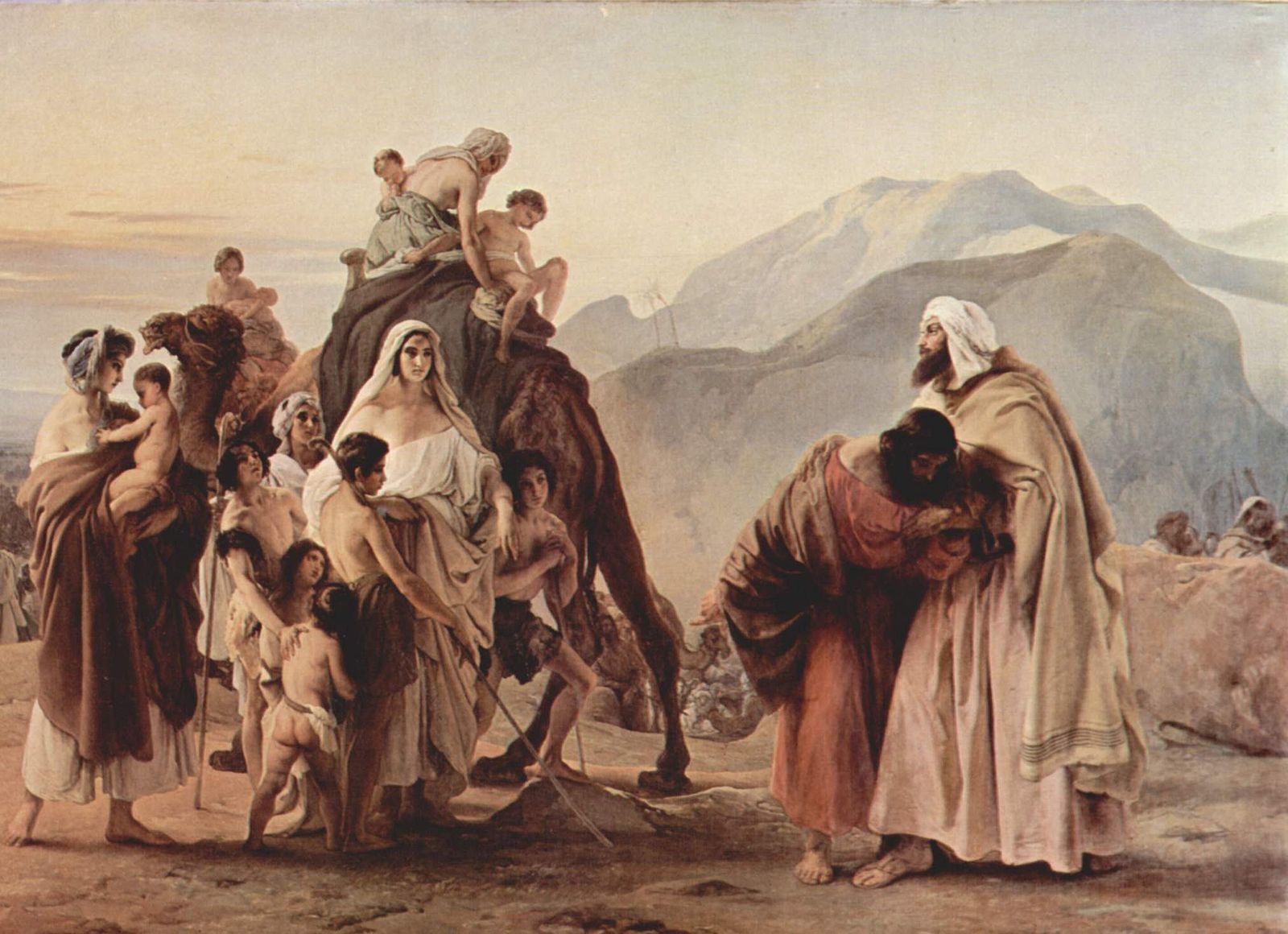
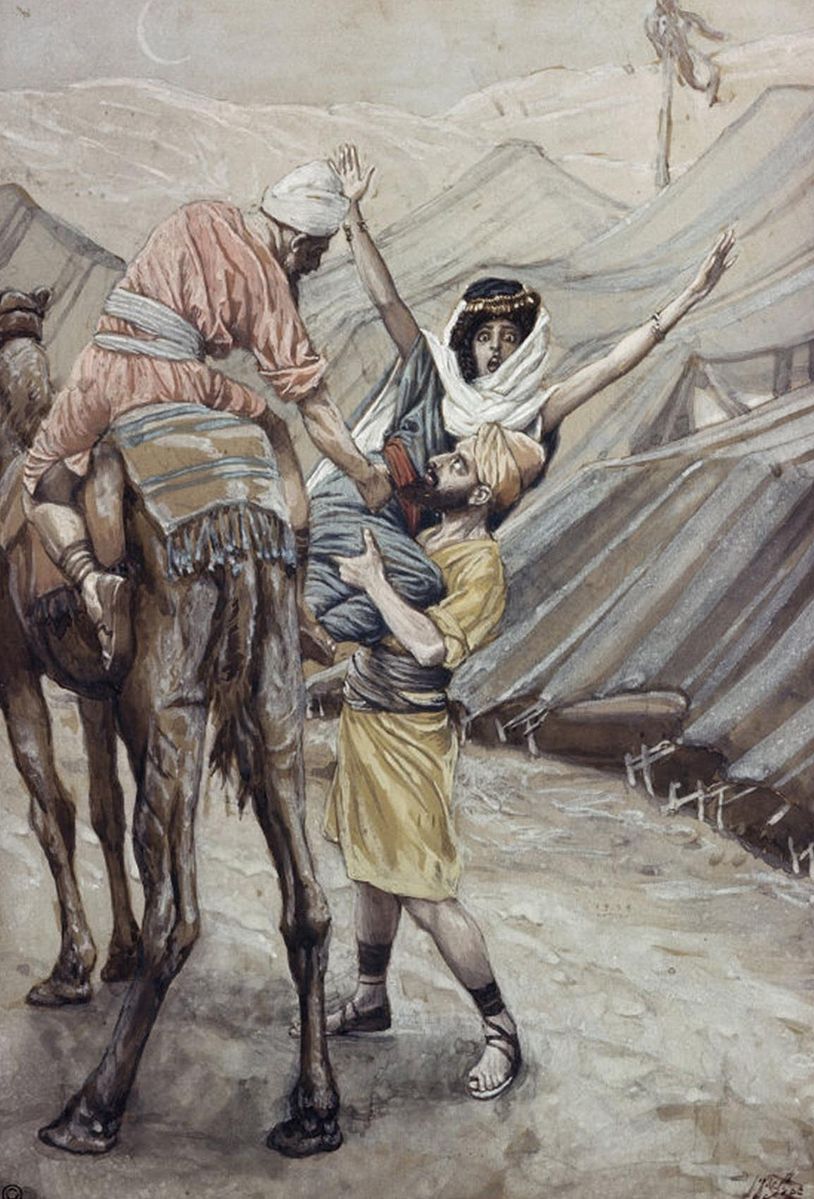
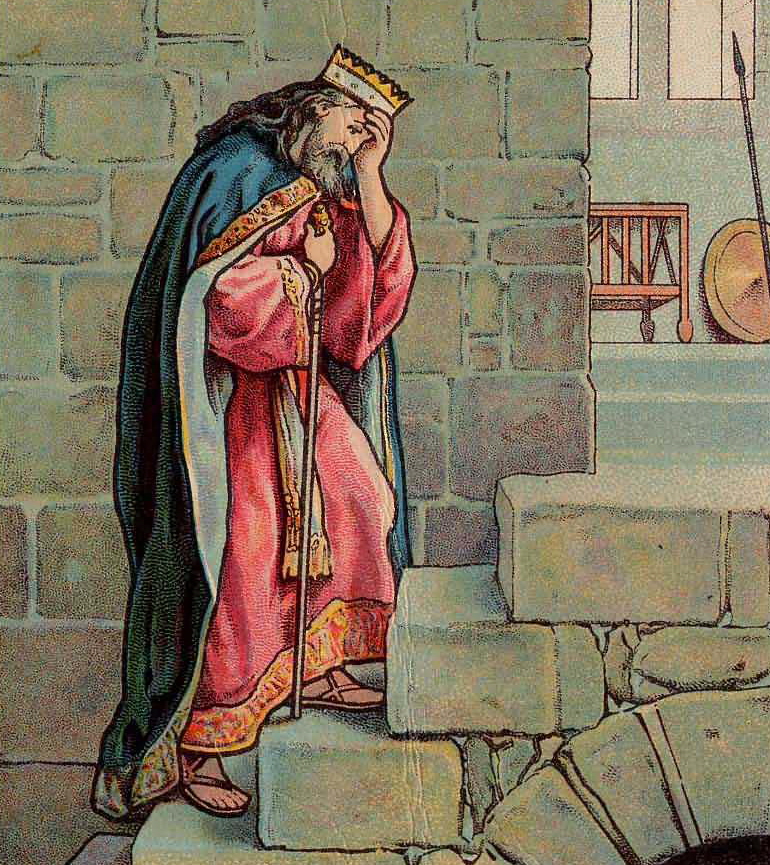
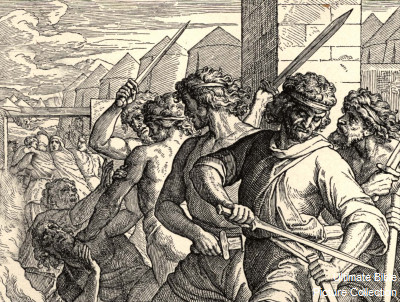
Vayigash & Vayechi: Forgiving?

Salachtikha; I forgive you.

Joseph never says that.  But then, no form of the verb salach, סָלַח (forgave) appears in the book of Genesis/Bereishit.  When the word shows up elsewhere in the Bible, it is always God, not a human being, who forgives.
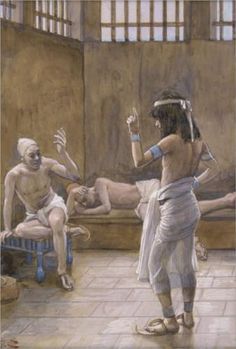
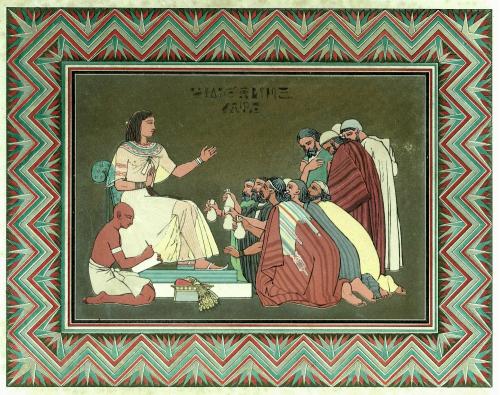
Joseph in Prison,
by James Tissot, ca. 1900

However, Joseph does know about pardoning, which men in command can do.  In the Torah portion Vayeishev he interprets the dreams of two of his fellow inmates in an Egyptian prison.  He tells one, the pharaoh’s chief cupbearer:

“In another three days the pharaoh yissa your head and he will restore you to your position and you will put the pharaoh’s cup on his palm…”  (Genesis/Bereishit 40:13)

yissa (יִשָׂא) = he will lift. To lift up someone’s head is an idiom meaning “to pardon”.  (A form of the root verb nasa, נָשָׂא = lifted, raised high, carried.)

Joseph then interprets the chief baker’s dream:

“In another three days the pharaoh yissa your head off you, and he will impale you on a pole and the birds will eat your flesh off you.”  And it was the third day, the birthday of the pharaoh, and he made a banquet for all of his servants.  Vayissa the head of the chief cupbearer and the head of the chief baker from among his servants.  And he restored the chief cupbearer to bearing cups, and he put the pharaoh’s cup on his palm.  But the chief baker he impaled…  (Genesis 40:19-22)

vayissa (וַיִּשָּׁא) = and he lifted.  (From the root verb nasa.)

The pharaoh lifts up the cupbearer’s head, pardoning him; but he lifts off the baker’s head, executing him.

Two years later, Joseph is brought up from prison to interpret two dreams of the pharaoh, and by the end of their conversation the pharaoh has made Joseph the viceroy of Egypt.1

Joseph wants to forget his family back in Canaan, especially his ten older brothers, who hated him so much they were not able to speak to him in peace2, and his father, who was responsible both for creating the discord among his sons and for sending Joseph out alone to find and report back on his brothers.  (See my post Mikeitz: Forgetting a Father.)  The brothers seized him, threw him in a pit, then sold him as a slave to a caravan bound for Egypt.

When he sees his brothers again, Joseph is 37 years old and the viceroy of Egypt.  He now has the power to execute his brothers or to pardon them.

He decides to test them first.  He overhears them express remorse over how they treated their younger brother Joseph.  Then Joseph puts the brothers through a series of tests, and concludes that they have indeed changed.  (See my post Mikeitz & Vayiggash: Testing.)  The tests are mysterious to Joseph’s brothers because they do not recognize him; they assume their younger brother died as a slave, and the viceroy is an Egyptian.

The conditions are ripe for forgiveness; Joseph’s older brothers have expressed remorse, and he can now trust them not to harm him or his younger brother Benjamin.  But does Joseph ever forgive—or at least pardon—his brothers?  Does he forgive his father for putting him in danger?

Vayiggash: Does Joseph forgive his brothers?

Joseph reveals his identity to his brothers after they refuse to leave Egypt without Benjamin, the youngest of Jacob’s sons and the only one with the same mother as Joseph.

And Joseph said to his brothers: “I am Joseph.  Is my father really still alive!”  But his brothers were not able to answer him, because they were aghast before his face.  (Genesis 45:3)

His brothers are too stunned, and perhaps terrified, to answer.  The man who has absolute power over them is the man whom they once sold into slavery.

Meanwhile, Joseph realizes that events had to unfold this way, or his whole extended family would have starved to death during the famine.  His brothers’ crime was necessary to get Joseph to Egypt, where God inspired him to interpret the pharaoh’s dreams and he became the viceroy in charge of the only food supply in the region.

“And now, don’t worry, and don’t be angry with yourselves that you sold me here, because God sent me ahead of you to preserve life.  For this pair of years the famine has been in the land, and for another five years there will be no plowing nor harvest.  So God sent me ahead of you to set up food for you in the land and to keep you alive as a large group of survivors.” (Genesis 45:5-7)

By telling his older brothers not to worry or be angry with themselves over their crime, Joseph is telling them that the concept of guilt does not apply in their case.  They are not responsible for their bad deed; God made them do it.

So now, you did not send me here, but God!  And He has set me up as a father-figure to the pharaoh, and as the master of all his household, and as the ruler of all the land of Egypt.  (Genesis/Berishit 45:8)

Now, Joseph thinks, he can be a hero and save everyone—his brothers, his father, and the whole extended family.
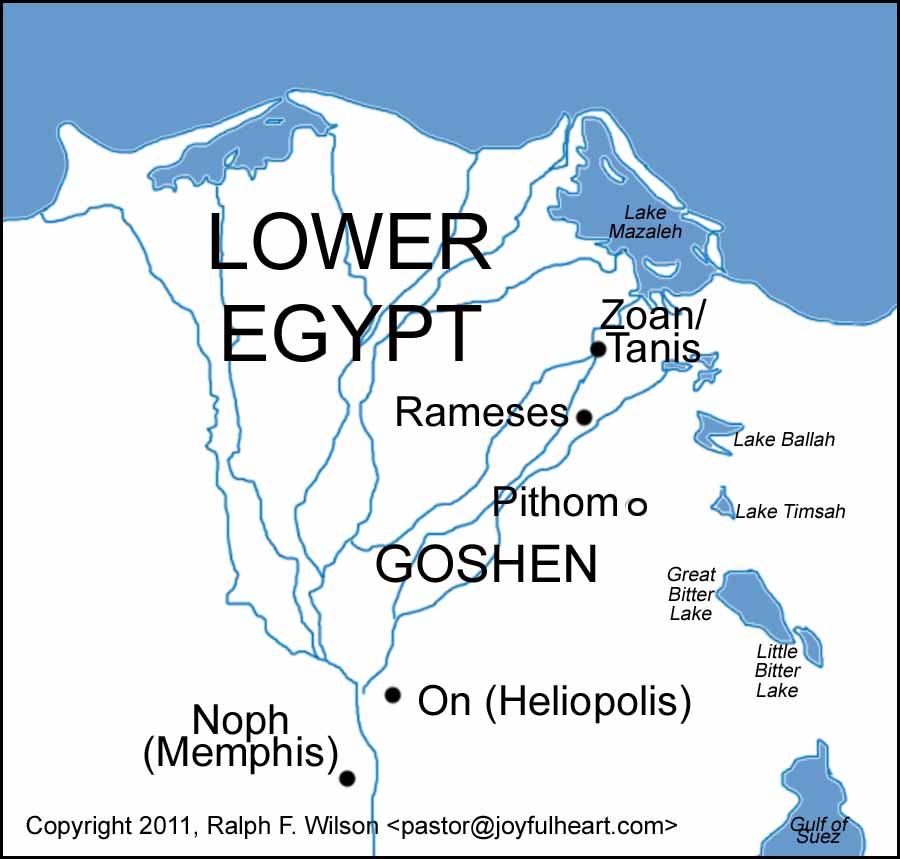
“Hurry and go up to my father and say to him: Thus said your son Joseph:  God placed me as master of all Egypt.  Come down to me, don’t stand still.  And you shall dwell in the land of Goshen, and you shall be near me, you and your children and the children of your children, and your flocks and your herds and everything that is yours.  And I will provide for you there …” (Genesis 45:9-11)

Although Joseph starts off attributing everything to God, he ends up promising that he, Joseph, will be a father-figure to his own family, as well as to the pharaoh.  He is in charge.3  And he wants his actual father, Jacob, to be impressed by his long-lost son’s power.

“And you must tell my father about all my honor in Egypt, and all that you have seen.  And you must hurry and bring my father down here.”  (Genesis 45:13)
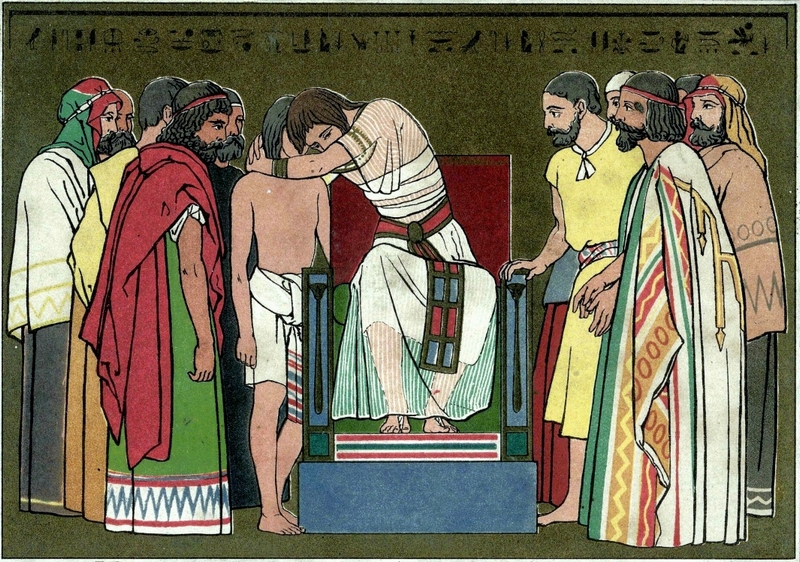
Joseph Embraces Benjamin,
by Owen Jones, 1869

Having reduced his brothers to mere dependents, Joseph embraces Benjamin and weeps.  Benjamin hugs him back, also weeping.

Then he kissed all his brothers and he wept upon them, and after that his brothers spoke to him.  (Genesis 45:15)

Maybe now his older brothers can “speak to him in peace” because they no longer hate him.  Or maybe their hatred has been replaced by fear.  Benjamin, who was six years old and at home when the older brothers sold Joseph, can embrace his long-lost brother.  But the ten older men merely speak; they neither cry, nor kiss Joseph, nor embrace him.

By denying that his brothers made a choice to sell him into slavery, Joseph shows that he does not respect them as adult human beings who are responsible for their own actions.  Personally, I would rather admit a crime and apologize for it, than be silenced because my victim insists I had no freedom of choice.

As far as Joseph is concerned, he has absolved his older brothers of guilt and reconciled with him.  But his brothers do not see it that way.  Joseph’s speech allays their fear of retribution for a while, but it does not resolve their guilt.

Vayiggash: Does Joseph forgive his father?

Joseph sends his brothers back to Canaan with gifts, and his whole extended family moves to Egypt to live under Joseph’s protection.
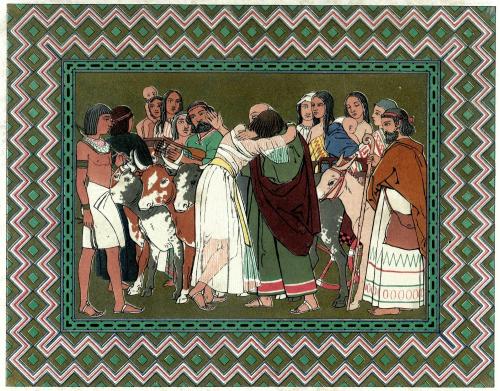
Joseph and Jacob Reunited,
by Owen Jones 1869

Joseph hitched up his chariot and went up to Goshen to meet Israel [a.k.a. Jacob], his father.  And he [Joseph] appeared to him, and he fell upon his neck, and he wept upon his neck a while.  Then Israel said to Joseph: “I can die now, after seeing your face, [knowing] that you are still alive.”  (Genesis 46:29-30)

Like many parents, Jacob does not know that he failed his son, so he does not apologize.  Joseph could bring up what his father did 22 years before, and hope for an apology.  (See my post Miketiz: Forgetting a Father.)  Instead he treats Jacob the same way he treated the innocent Benjamin.  There is no apology and no forgiveness; both father and son act as if their relationship is just fine.

This may be pragmatism on Joseph’s part.  After all, Joseph has all the authority now, and he knows Jacob is not an insightful person.  Why stir up old trouble?

Or Joseph may be thinking that if his father had not played favorites, then sent him alone into danger, he would never have been sold to the caravan headed for Egypt.  Therefore God must have arranged Jacob’s behavior, too.

Vayechi: Does Joseph forgive his brothers after Jacob’s death?

Jacob dies in this week’s Torah portion, Vayechi (“and he lived”).  Then his ten older sons become afraid that Joseph only restrained himself from executing them so as not to upset Jacob.  In desperation, they invent a deathbed command.

And the brothers of Joseph saw that their father was dead, and they said: “What if Joseph bears a grudge against us and he indeed pays us back for all the evil that we rendered to him?”  And they sent an order to Joseph saying: “Your father gave an order before he died, saying: Thus you shall say to Joseph: Please sa, please, the offense of your brothers and their guilt because of the evil they rendered to you. And now sa, please, the offense of the servants of the god of your father.”  And Joseph wept over the words to him.  (Genesis 50:15-17)

sa (שָׂא) = lift!  (A form of the verb nasa.)

This communication proves that Joseph’s brothers did not feel pardoned or forgiven when he first told them that God arranged everything, including their crime.

And they do not feel safe with Joseph.  Why should they?  According to Joseph’s philosophy, anyone might become a puppet in God’s hands, deprived of free will.  In such a universe, no one can be trusted.

On the other hand, if Joseph is wrong and humans do have a measure of free will, they still cannot trust Joseph.
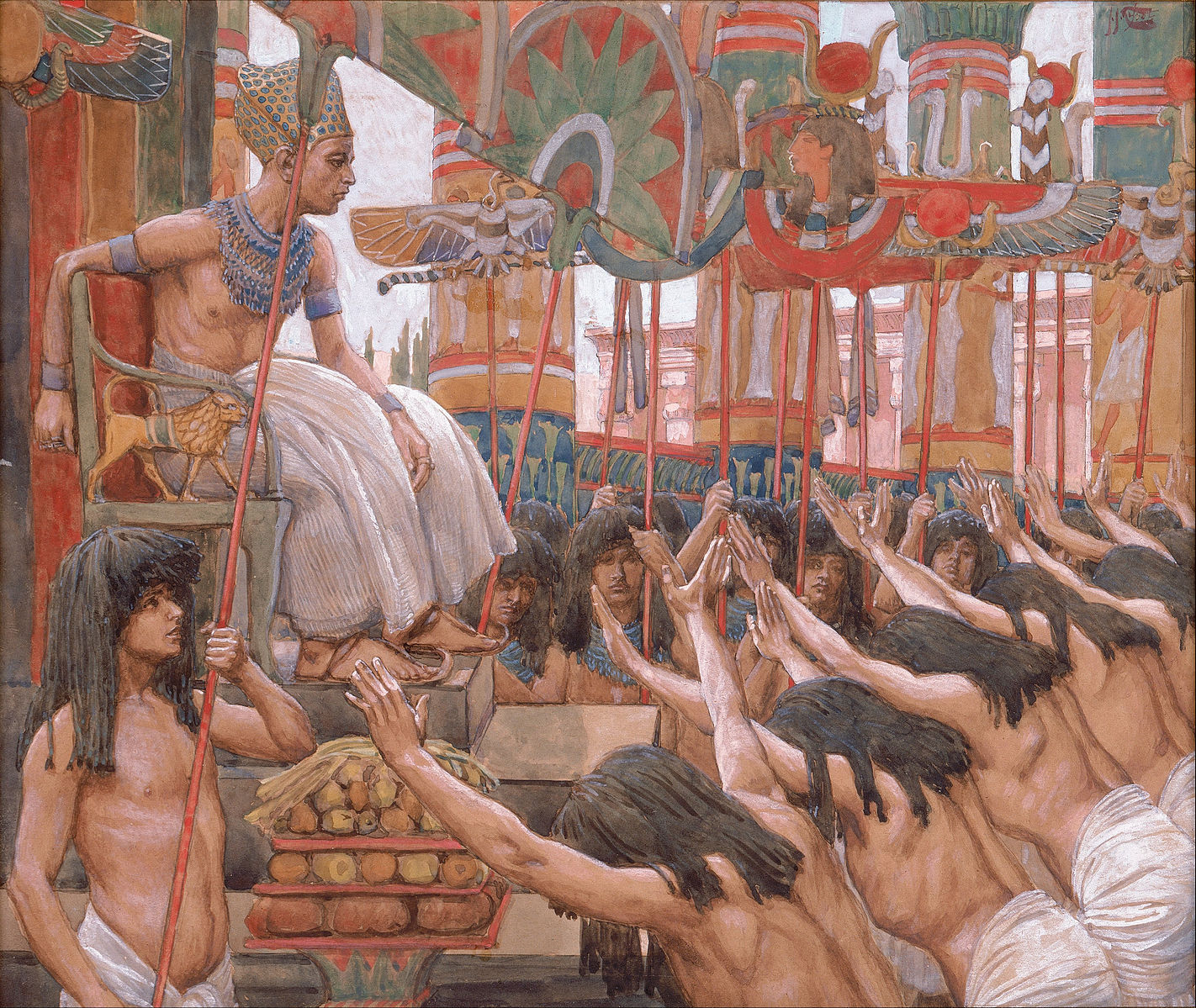
by James Tissot, ca. 1900

Then his brothers even went and threw themselves down before him, and they said: “Here we are, your slaves.”  And Joseph said to them: “Don’t be afraid!  Am I instead of God?4 And you, you planned evil for me, but God planned it for good, in order to bring about this time of keeping many people alive.”  (Genesis 50:18-20)

Joseph implies that only God can decide whether to punish the brothers.  He also continues to make God responsible for his brothers’ crime.  And although their false deathbed order explicitly begs Joseph to pardon—sa!—his brothers, he does not do so.  Instead he says:

“And now, don’t be afraid; I, myself, will provide for you and your little ones.”  And he comforted them and he spoke upon their hearts.  (Genesis 50:21)

In the Torah, to speak upon someone’s heart is an idiom for changing that person’s feelings.  (See my post Vayishlach: Change of Heart, Part 1.)  Joseph both comforts his brothers and persuades them that he will continue to be responsible for their well-being.  Even without a pardon, they finally trust Joseph.

Forgiveness or pardon is not the only road to reconciliation.


It’s a tall order, but I try to do better than Joseph.  When people offer me apologies, explicitly or implicitly, I remember Joseph, and I am careful to accept them.  Instead of saying merely, “It’s okay,” I say: “It’s okay, I forgive you.”  I do not want anyone to suffer lingering guilt or uncertainty on my account.

On the other hand, if people wrong me or those I love, and they never admit it nor apologize, I struggle to forgive them.  Sometimes I can reach a working relationship with them, but I never feel safe.  Any reconciliation is incomplete.

May we all be blessed with a greater ability to be responsible for our own actions, to apologize, to forgive, and to change.


  1. Genesis 41:1-41.
  2. Genesis 37:4.
  3. Although Joseph is indeed second only to the pharaoh in power, he is not the absolute ruler he claims to be when he is bragging to his brothers. Later he has to ask the pharaoh for authorization for his family to settle in Goshen (Genesis 46:31-34) and for permission to leave Egypt to bury his father (Genesis 50:4-6).
  4. Jacob protested “Am I instead of God?” when Rachel, his second wife, has not become pregnant and she demands that Jacob give her children (Genesis 30:2, Vayeitzei).

Mikeitz: Forgetting a Father

To name your infant, in the book of Genesis/Bereishit, is usually to tell a piece of your own life story.  Eve begins this convention when she names her firstborn son Kayin (Cain in English) and declares:

Kaniti a man with [the help of] God!  (Genesis/Bereishit 4:1)

Kaniti (קָנִיתִי) = I have acquired, produced, created.  (A form of the verb kanah, קָנָה.  The name Kayin, קַיִן, is probably derived not from kanah but from the same root as kiynah, קִינָה = dirge.  Eve’s explanation of the name is a folk etymology.)

Jacob’s wives Leah and Rachel name all twelve of their natural and adopted sons to express their sentiments about their own lives in the Torah portion Vayeitzei.  Rachel’s son Joseph does the same when he has a son of his own.

And Joseph called the name of the firstborn Menasheh “because God nashani all my hardship and all the household of my father”.  (Genesis 41:51)

Menasheh (מְנַשֶּׁה) = Manasseh in English; m-, ־מְ = from + nashah, נָשָׁה = forget, overlook, neglect.

nashani (נַשַּׁנִי) = he made me forget, overlook, neglect.  (A form of the verb nashah.)1

Joseph implies that his current good fortune is such a blessing from God that he can now overlook two periods of suffering in his past: his hardship (presumably his slavery and imprisonment in Egypt) and his father’s household.

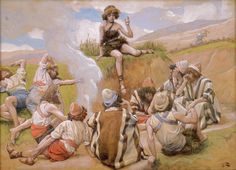
Joseph Reveals his Dream to his Brothers, by James Tissot

How did Joseph suffer in Jacob’s household?  Last week’s Torah portion, Vayeishev, informs us that after his beloved Rachel dies, Jacob continues to play favorites, loving Rachel’s son Joseph more than his ten older sons.  Joseph’s half-brothers hate him for three reasons: because they are jealous of their father’s love, because Joseph brings Jacob bad reports about them, and because Joseph tells them two of his dreams in which his brothers appear to be bowing to him.2

After the brothers head north to pasture the flocks at Shechem, Jacob sends Joseph to find them and then report back.  Joseph’s brothers spot him coming, seize him, strip him, and throw him into an empty cistern.  After debating whether to kill him, they sell him as a slave to a caravan headed for Egypt.3

Joseph is 30 years old in this week’s Torah portion, Mikeitz (“In the end”), when he is summoned to interpret the pharaoh’s two dreams.  The pharaoh, impressed by the slave’s gift of prophecy and by his intelligent advice, makes him the viceroy of Egypt, and gives him a high-born Egyptian wife.4  Joseph names his first son Menasheh.

It is easy to see why Joseph wants to bury his memories of the brothers who sold him as a slave.  But when he names his first son, he says “God nashani all my hardship and all the household of my father”—not just his older brothers.  When Joseph was sold at age seventeen, Jacob’s household also included the mothers of the ten older brothers, Leah, Zilpah, and Bilhah; Joseph’s little brother Benjamin; various employees and slaves; and the patriarch Jacob himself.  Most of these people were merely the background of Joseph’s misery after his own mother died.  But I believe one of them was an additional source of hardship: Jacob.

A telling clue is that Joseph never sends a message back to Canaan to let his father know that he is alive and well.  Maybe he is unable to send a message to another country when he is a slave, even though he quickly rises to the post of steward.  But during the first nine years after Joseph becomes the viceroy of Egypt, he still does not send Jacob any word.  Nor does he ask any of the pharaoh’s agents in Canaan to check up on the old man.

Apologists who saw Joseph as an exemplar of righteousness have theorized that Joseph avoided any communication with Canaan because:

  1.  He did not want to shame his family by revealing that his brothers had sold him.5
  2.  Or: If Jacob found out what his ten older sons had done, the family would fall apart.  Then their aged father would be even worse off.6
  3.  Or: Joseph knew his dreams at age seventeen were prophetic, and he did not want to interfere with God’s plan by taking any action regarding his father or his brothers until the dreams were fulfilled—until all of them had come and bowed down to him.7

Modern commentator Avivah Gottlieb Zornberg8 speculated that Joseph is so traumatized when his brothers seize him and throw him into the pit, that thirteen years later he suffers from post-traumatic stress disorder.  He functions successfully in Egypt only by going into denial about his past.  When he sees his brothers again, he cries because he remembers his trauma.

Jacob Blesses Joseph and Gives him the Coat, by Owen Jones

I wonder if the answer is simply that Joseph hates his father.  A child enjoys being spoiled at first, but later becomes uneasy about being treated differently from everyone else.  Jacob’s love might have felt both smothering and unreal.  The princely tunic that Jacob gave him may have fed Joseph’s grandiosity, but it also may have struck him as a ridiculous garment for a shepherd.  When he wore it in last week’s Torah portion, Vayeishev, travelling alone to Shechem and on to Dotan, the tunic made it easy for his brothers to identify him from a distance and plan their ambush.

Joseph must have asked himself why his father, who should have known better, sent him off on a two- or three-day journey from Hebron to Shechem and beyond without providing an escort or any other protection against bandits and enraged brothers.  Did his father secretly want him to die?  Did Jacob really love him, or did he just love Joseph’s face, because it looked like the face of his beloved dead wife Rachel?  When Joseph was seventeen and his formerly girlish face began sprouting whiskers, did his father stop loving him?

I can imagine Joseph riding toward Egypt in fetters, facing a life of slavery, and thinking bleakly that nobody loves him.  Obviously his ten half-brothers hate him, and now it appears that his father does not care what happens to him.  His full brother Benjamin is only six years old, and his mother is dead.  He might as well give up on his whole family, “all the household of his father”.  He will have to build a new life from scratch, supported by nothing but his own wits—and the one hope remaining to him, that God might someday make those dreams of rulership come true.

Thus when his first son is born, Joseph gives him a name that memorializes both his change of fortune in Egypt, and also his lingering bitterness that he was betrayed not just by his older brothers, but even by his father.  In Egypt he has a new life with honor and authority, and a family of his own.  He will be the father from now on.

Joseph is Governor,
by Owen Jones

When Joseph’s prediction comes true and the first year of  famine arrives after seven years of plenty, only Egypt has large stores of grain—thanks to Joseph’s iron rule.  Then suddenly his past reappears.  He recognizes his ten older brothers as they bow to the ground and ask him for permission to buy Egyptian grain.

Joseph’s first action looks like revenge.  He keeps his own identity secret and accuses his brothers of being spies—perhaps because he remembers that his father sent him to spy on his brothers and report back.  Then he imprisons all ten brothers for three days, just as they had thrown him in the empty cistern while they discussed whether to kill him or sell him.9

But Joseph’s next move is different.  He devises a test to find out whether his brothers have changed over the last thirteen years.

*

Our childhood and adolescent wounds never disappear.  Small slights may fade into insignificance from an adult perspective, but we carry our early psychological wounds for the rest of our lives—and use various strategies to function nevertheless in our roles as adults.  One common strategy is to “forget” our wounds or traumas—avoid thinking about them, and carry on as if they never happened.  Another is to “overlook” them, to pretend that they do not affect us in our adult lives.

Yet these early wounds continue to influence our reactions.  And eventually something happens that forces us to face them—as Joseph suddenly found himself face to face with his brothers.

(What Joseph does about his brothers and his father is the subject of next week’s post on the Torah portion Vayiggash.)

May we all remember our early wounds well enough so that we can recognize them when the time to deal with them arises.  And may we refrain from naming or addressing our children from the viewpoint of our wounds!

  1. The traditional translation of Menasheh and nashani in this sentence assumes that the words come from the root verb nashah, נָשָׁה = forget, overlook, neglect. However, Biblical Hebrew scholars Samson Raphael Hirsch and Robert Alter have pointed out that sometimes the root verb nasha, נָשָׁא is conjugated as if it ended in a ה rather than an אNasha, נָשָׁא = lend, borrow, indebt, become a creditor or debtor (depending on the verb form).  If the words Menasheh and nashani in Genesis 41:51 are actually from the root nasha in that alternate conjugation the sentence could be translated: And Joseph called the name of the firstborn Menasheh/From debt “because I am in debt to God for all my hardship and all the household of my father”.
  2. Genesis 37:1-11(Torah portion Vayeishev).
  3. Genesis 37:12-28 (Torah portion Vayeishev).
  4. Genesis 41:1-46 (Torah portion Mikeitz).
  5. e.g. Philo of Alexandria, De Josepho 41, as cited in Rabbi Elie Munk, The Call of the Torah: Bereishis, trans. by E.S. Mazer, Mesorah Publications, New York, @1994, p. 567.
  6. e.g. Rabbi Samson Raphael Hirsch, The Hirsch Chumash: Sefer Bereshis, trans. by Daniel Haberman, Feldheim Publishers, Jerusalem, @2002, p. 778.
  7. e.g. Ramban (13th-century Rabbi Moses ben Nachman or Nachmanides) as cited in Elie Munk, p. 566; Rabbi Adin Steinsaltz, Biblical Images, trans. by Yehuda Hanegbi and Yehudit Keshet, Jason Aronson Inc., Northvale, NJ, 1994, p. 78.
  8. Avivah Gottlieb Zornberg, The Murmuring Deep, Schocken Books, New York, 2009, p. 303.
  9. Genesis 42:6-17 (Torah portion Mikeitz).

Vayishlach: Change of Heart, Part 2

(My last post considered how the feelings of Shekhem and Dinah change in the Torah portion Vayishlach.  This post considers the decision of Dinah’s brothers in the same story.)

And Jacob came safely from Paddan Aram to the town of Shekhem, which is in the land of Canaan, and he camped in front of the town. (Genesis/Bereishit 33:18)

shekhem (שְׁכֶם)= shoulders; an ancient town; a certain chieftain in that town.

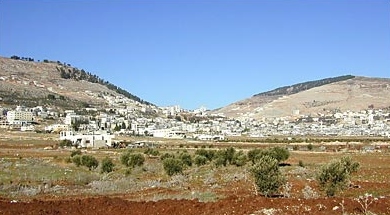
Mt. Gerizim (left) and Mt. Eyval (right)

The city of Shekhem, now part of the modern city of Nablus, sat in a narrow valley between two hills (“shoulders” of land):  Mount Gezerim and Mount Eyval.  Later in the Torah, when the Israelites are about to cross the Jordan, Moses instructs them to perform a ritual on those two hills.  While the Levites recite a list of good deeds that God rewards with blessings, and a list of bad deeds that God punishes with curses, half of the tribes will stand on Mount Gezerim to confirm the blessings, and half on Mount Eyval to confirm the curses.  (Deuteronomy 27:11-14; see my post Ki Tavo: Cursing Yourself.)

Thus Shekhem represents a decision point.  North or south?  Good or evil?  Blessing or curse?

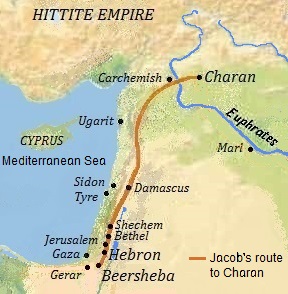
Jacob makes the wrong decision when he arrives.  He has been returning on the same route he took from Beersheba to Charan 20 years before.  Now is supposed to continue south to Beit-El (Bethel), where he promised God that he would build an altar.  Then he should travel farther south to Beersheba, where his aged parents are still waiting for him.  Instead he stops at the crossroads of Shekhem, unwilling to move or choose.  He buys the plot of ground where he is camped.

And Dinah, the daughter of Leah whom she had borne to Jacob, went out to see the women of the land. And Shekhem, son of Chamor the Chivvite, a chieftain of the land, saw her, and he took her, and he lay with her, and he violated her. (Genesis/Bereishit 34:1-2)

Shekhem the young chieftain enters the story as a bad guy who rapes a virgin.  Then he falls in love with his victim, Dinah.  (See my post Vayishlach: Change of Heart, Part 1.)  He speaks “upon the heart of the young woman”, reassuring her, changing her feelings about him, persuading her that he will become a good husband.  He plans to offer her father exorbitant bride-price so he can marry her and restore her honor.  And he asks his own father, Chamor, to come with him to arrange the marriage contract.

Unfortunately, Chamor has another idea.  His clan has land; Jacob has lots of livestock.  What if they all intermarry, and become one people?  Surely the union would benefit both sides.  Chamor makes this a stipulation in the marriage negotiation of Shekhem and Dinah.

Jacob does not respond, but his sons pretend to agree to both Dinah’s marriage and the union of the two peoples, provided that all the men of the town circumcise themselves.  Chamor goes back and tells his men that this is a way everyone can marry into wealth, acquiring Jacob’s livestock.  And the men of Shekhem go for it.

Ruins of stairs and city gate of Shekhem

It was the third day, when they were in pain.  And two of the sons of Jacob, Simon and Levi, [full] brothers of Dinah, each took his sword, and they came upon the town without resistance, and they killed all the males. (Genesis 34:25)

They take Dinah, and then some “sons of Jacob”—maybe the same two, maybe others—plunder all the houses and enslave all the women and girls.

They have made Jacob’s decision for him.  They could have chosen the good side (represented by Mt. Gezerim) and dealt honestly with the citizens of Shekhem.  What if Chamor’s offer turned out to be part of God’s plan to give the land of Canaan to the descendants of Jacob, and God would bless them if they accepted and converted the Shekhemites to their own religion?

On the other hand, even if Jacob’s sons refuse to intermarry or proselytize, they could still accept a generous bride-price for their sister and try to negotiate a peaceful covenant with the town.  This approach would also result in a blessing of prosperity and peace with their new neighbors.

Instead, Jacob’s sons choose the bad side (represented by Mt. Eyval) and commit vengeance.  After they have massacred the men of Shekhem and enslaved the women, their father finally speaks up.

Then Jacob said to Simon and Levi: “You cut me off from the inhabitants of the land, from the Canaanites and Perizzites!  And I am few in number, so they will unite against me and strike at me, and I will be exterminated, I and my household!” (Genesis 34:30)

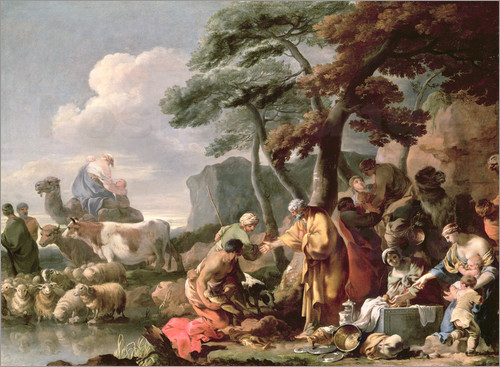
Jacob Burying the Strange Gods,
by Sebastien Bourdon

At that point God tells Jacob to move to Beit-El.  Jacob collects everyone’s idols and earrings and buries them at Shekhem, perhaps hoping to win God’s favor that way.  Then he abandons the empty town and the land he bought, and flees south.

And they set out, and a horror of God came upon the towns that surrounded them, and they did not pursue the sons of Jacob. (Genesis 35:5)

So God blesses Jacob’s sons even though they choose evil at the decision point of Shekhem.  God also fails to reward Shekhem for turning away from evil and trying to do good.


Like the book of Job, the story of Dinah in last week’s Torah portion illustrates that we cannot expect to get our just rewards out in the world.  Instead, we are rewarded or punished inside.  When we feel anger and hatred but nevertheless choose to do good, our self-control strengthens, and it is easier to choose good in the future.

When we let our bad feelings carry us away, we may momentarily enjoy doing violence, but then it becomes easier to choose evil the next time.  After committing genocide in the Torah portion Vayishlach, Jacob’s older sons sell their brother Joseph as a slave in next week’s portion, Vayeishev—and they feel guilty the rest of their lives.

May each of us, when we reach a decision point, set our immediate feelings aside, consider the moral implications of each option, and do the right thing.

Vayishlach: Change of Heart, Part 1

Jacob’s Family Meets Esau,
by Francesco Hayez, 1844

Jacob, after working for his uncle Lavan for twenty years, returns to Canaan in this week’s Torah portion, Vayishlach (“And he sent”). When he left Canaan he was alone; when he returns he brings back two wives, two concubines, eleven sons, servants, a wealth of livestock, and one daughter—or perhaps only one daughter whom the Torah considers worth mentioning.

Eager to settle down, Jacob buys the land where his household is camping in front of the town of Shekhem.

And Dinah, the daughter of Leah whom she had borne to Jacob, went out to see the women of the land. And Shekhem, son of Chamor the Chivvite, a chieftain of the land, saw her, and he took her, and he lay with her, and he violated her. (Genesis/Bereishit 34:1-2)

dinah (דִינָה) = judge her, pass sentence on her; her judgment, her verdict.

shekhem (שְׁכֶם)= shoulders; an ancient town on the west bank of the Jordan1.

The Seduction of Dinah,
by James Tissot

Dinah’s name hints that she is doing something unacceptable.  In the culture of the ancient Near East, a young unmarried woman did not leave her family’s compound unaccompanied.  Her motive is merely to make friends with the women who have become her neighbors.  But walking alone, in that time and place, was considered asking for trouble.

And trouble comes.  Dinah is raped—by the young chieftain whose name is the same as the town.  It is as if the whole town of Shekhem rapes the whole household of Jacob.  Honor, shame, and responsibility were not restricted to individuals in the ancient Near East; what happened to one family member affected the standing of the entire family.

But Shekhem does not throw his victim out in the morning.

And his soul became attached to Dinah, daughter of Jacob, and he loved the young woman, and he spoke al leiv the young woman.  Then Shekhem spoke to Chamor, his father, saying: “Take for me this girl as a wife” (Genesis 34:3-4)

al leiv (עַל־לֵב) = upon the heart of. (In biblical Hebrew, the heart is the mind, the seat of conscious thoughts and feelings.)

Clearly Shekhem falls in love with Dinah.  He not only wants to keep her and take care of her; he wants to repair her reputation (as much as he can) by marrying her through an official contract between his family and hers.

How does Dinah feel now about the man who raped her?  The Torah does not say.  The only clue we have is that Shekhem speaks al leiv her, upon her heart.

Touching the heart

Biblical Hebrew uses several idioms that include the word leiv or its alternative spelling levav. When something arises in someone’s heart, an idea or a memory is occurring to that person.2  To place something upon one’s heart is to think it over.3  What does it mean to speak upon someone’s heart?

At the end of the book of Genesis, Joseph’s brothers are afraid that Joseph will finally take revenge for when they sold him as a slave.  Joseph reassures them: “And now don’t you fear, I will provide for you and your little ones.”  And he comforted them, and he spoke al leiv them. (Genesis 50:21)

Joseph’s intent is to reassure his brothers so they no longer feel afraid.

In the book of Judges, a man’s concubine runs away to her father’s house.  After four months, Her husband got up and went after her, to speak al leiv her to get her back. (Judges 19:3)

The concubine does head back with the man, so he must have changed her feelings about him.4

David’s Grief over Absalom, Bible card

King David’s troops win a battle and kill his son Absalom, who had seized David’s throne.  When David ignores his soldiers and weeps for his dead son, the troops become demoralized.  David’s general, Yoav, warns him that if he does not act at once, they will all desert overnight.  Yoav concludes: “And now get up! Go out! And speak al leiv your followers!” (2 Samuel 19:8)

Here, King David must persuade his soldiers that he appreciates their victory after all, and he is still their king.5  He must change their feelings from despondency to optimism.

Ruth gives the idiom a different shade of meaning when she is a gleaner in Boaz’s field.  He asks her to stick to his field, where he has ordered his men not to molest her; tells her to help herself from the water jugs; compliments her on taking care of her mother-in-law; and gives her a blessing.  Ruth replies: “I find favor in your eyes, my lord, since you comfort me and since you speak al leiv your maidservant—although I, I am not even one of your maidservants.” (Ruth 2:13)

Ruth does not need to be persuaded to return to Boaz’s field.6  She is telling him that he has reassured her and made her feel better.

The other two occurrences in the Hebrew Bible of the idiom “to speak al leiv” are in prophecies that God (in the role of a husband) will take back the Israelites (in the role of a wife) even though they have strayed with other gods.  God will tenderly reassure Israel that “her” suffering is over.7  Then the Israelites will no longer feel despair.

So if speaking al leiv someone means reassuring someone or changing someone’s feelings, we can conclude that in this week’s Torah portion, Shekhem changes Dinah’s feelings about him, and she wants to marry him.

Not touching the heart

Shekhem offers to pay Jacob any bride-price he asks for.  But his father, Chamor, stipulates that the people of Shekhem and Jacob’s household will all intermarry and become one people.  He promises Jacob’s people that they can share the town’s land, and he promises the town’s people that they can share Jacob’s livestock.  It does not occur to Chamor that Dinah’s family is still upset about her rape and hates Shekhem—both the man and the town.

Chamor does not speak al leiv Jacob or his sons, and their feelings do not change.

Then the sons of Jacob answered Shekhem and his father Chamor, and they spoke deceitfully, since he had defiled their sister Dinah.  And they said to them: “We cannot do this thing, giving our sister to a man who has a foreskin, because that is a disgrace for us.” (Genesis 34:13-14)

Dinah’s Brothers Attack Shekhem
(artist unknown)

Jacob says nothing.  But his sons pretend to agree to intermarriage if all the men of the town will circumcise themselves.  After the men of Shekhem have done so, and are disabled by pain, two of Dinah’s brothers, Simon and Levi, swoop in, kill every male, take their sister out of the chieftain’s house, and leave.  Then the “sons of Jacob” (which sons are not specified) plunder the town of Shekhem and take its women and girls as slaves.

When Dinah’s brothers are finished, the reformed Shekhem is dead, and Dinah is a tainted woman with low market value instead of the happy wife of a chieftain.


The story of Dinah illustrates both that human feelings can change—and that when people refuse to change their feelings, they may hurt the people they care about as well as those they consider enemies.

May everyone who is trapped in old feelings of anger, resentment, or despair be freed.  And if nobody steps forward to speak al leiv, may we hear an inner voice comforting our hearts with a different point of view.


  1. Shekhem was 30 miles (49 km) north of Jerusalem, between two round hills, Mt. Gezerim and Mt. Eyval. It is now part of the modern city of Nablus.
  2. Arising in someone’s heart: e.g. Jeremiah 44:21, Ezekiel 38:10.
  3. Placing upon one’s heart: e.g. Deuteronomy 6:6, Jeremiah 12:11, Isaiah 57:11, Malachi 2:2.
  4. The King James Bible (KJV) translation is “to speak friendly unto her”; the Jewish Publication Society (JPS) translation is “to woo her”.
  5. The JPS translation is “placate your followers”.
  6. The KJV translation is “thou hast spoken friendly”; the JPS translation is “to speak gently to”.
  7. Hosea 2:16, Isaiah 40:1.

Vayeitzei: The Place

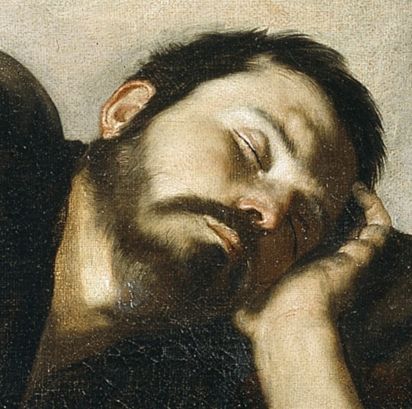
Jacob’s Dream,
by Jusepe de Ribera, 1639, detail

Jacob departed from Beersheba and he went toward Charan.  He encountered the makom, and he spent the night there because the sun had set.  He took one of the stones of the makom and he put it at his head, and he lay down at that makom. (Genesis/Bereishit 28:10-11)

makom (מָקוֹם) = place, location, space.

The repetition of the word makom at the beginning of this week’s Torah portion, Vayeitzei (“And he left”) establishes that the place Jacob stumbles upon at sunset will be significant for him. But when he arrives, all he notices is hard, stony ground., detail

Jacob has lived his entire life in Beersheba, but now he is running away from his twin brother, Esau. In last week’s Torah portion, Toledot, Jacob cheated Esau first out of his birthright, then out of the family blessing. Esau threatened to kill him, and the twins’ mother, Rebecca, arranged Jacob’s hasty departure on the pretext that he must find a wife in her old hometown in northern Mesopotamia.

So in this week’s portion Jacob sets off on a journey of about 620 miles (1,000 km) to his uncle’s house in Charan. He hikes north from Beersheba, carrying with a flask of olive oil and some other provisions, but no donkey nor servant nor livestock nor silver.1 For the son of a wealthy man, he is ill-equipped for either a long journey or a marriage negotiation.

At sunset on the second or third day he arrives at the makom, identified later as the site of the former town of Luz and the future town of Beit-El (Bethel).2 Nobody lives in the vicinity to offer a traveler a place to sleep.  So Jacob lies on the ground with a stone for a pillow.

During the day, Jacob’s conscious mind is busy as he acts and schemes.  But on this night, his unconscious mind opens in a dream.

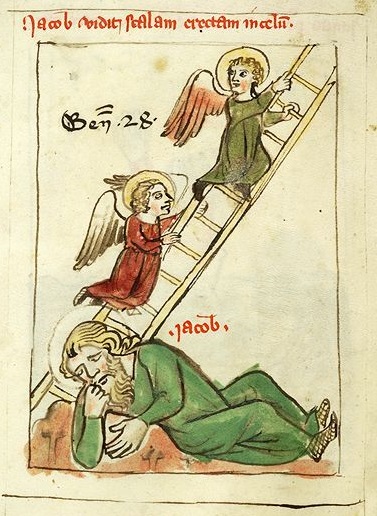
German 14th century

And he dreamed, and hey! A stairway was set to the ground and its top reached to the heavens, and hey! Messengers of God were ascending and descending on it. (Genesis 28:12)

The stairway and its traffic of messenger angels may represent a new idea for Jacob. He knows that his father was almost sacrificed on an altar by his grandfather Abraham; after all, at the end of this week’s Torah portion, Jacob calls God “the terror of Isaac”.3 He knows that a messenger of God called to Abraham and ordered him to desist.

But we never see Jacob praying or conversing with God before this week’s Torah portion. Jacob has depended on his own guile to get what he wants.  Now his dream reveals that communication between heaven and earth happens all the time. It could happen with him.

And hey! God stood over him and said: “I am God, the god of Abraham your forefather and the god of Isaac. The ground that you yourself are lying on, I will give it to you and to your descendants.” (Genesis 28:13)

God continues speaking to Jacob in the dream, giving him the blessing of Abraham, and promising to guard Jacob wherever he goes and return him to the place where he is lying now.

And Jacob woke up from his sleep, and he said: “Actually, there is God in this makom, and I, I did not know!”  And he was awed, and he said: “How awesome is this makom!  This is none other than the home of God, and this is the gate of the heavens!”  (Genesis/Bereishit 28:16-17)

What is Jacob’s amazing realization?

One tradition claims that Jacob dreams in the same place where his father, Isaac, was almost sacrificed—at the top of Mount Moriyah, which that tradition identifies with Jerusalem.4 It actually is the gate between heaven and earth, the makom where humans pray and God speaks. Jacob does not even recognize anything holy about it when he lies down. Yet he is transformed by the dream he has in that particular makom, where God broke through to his father and grandfather.5

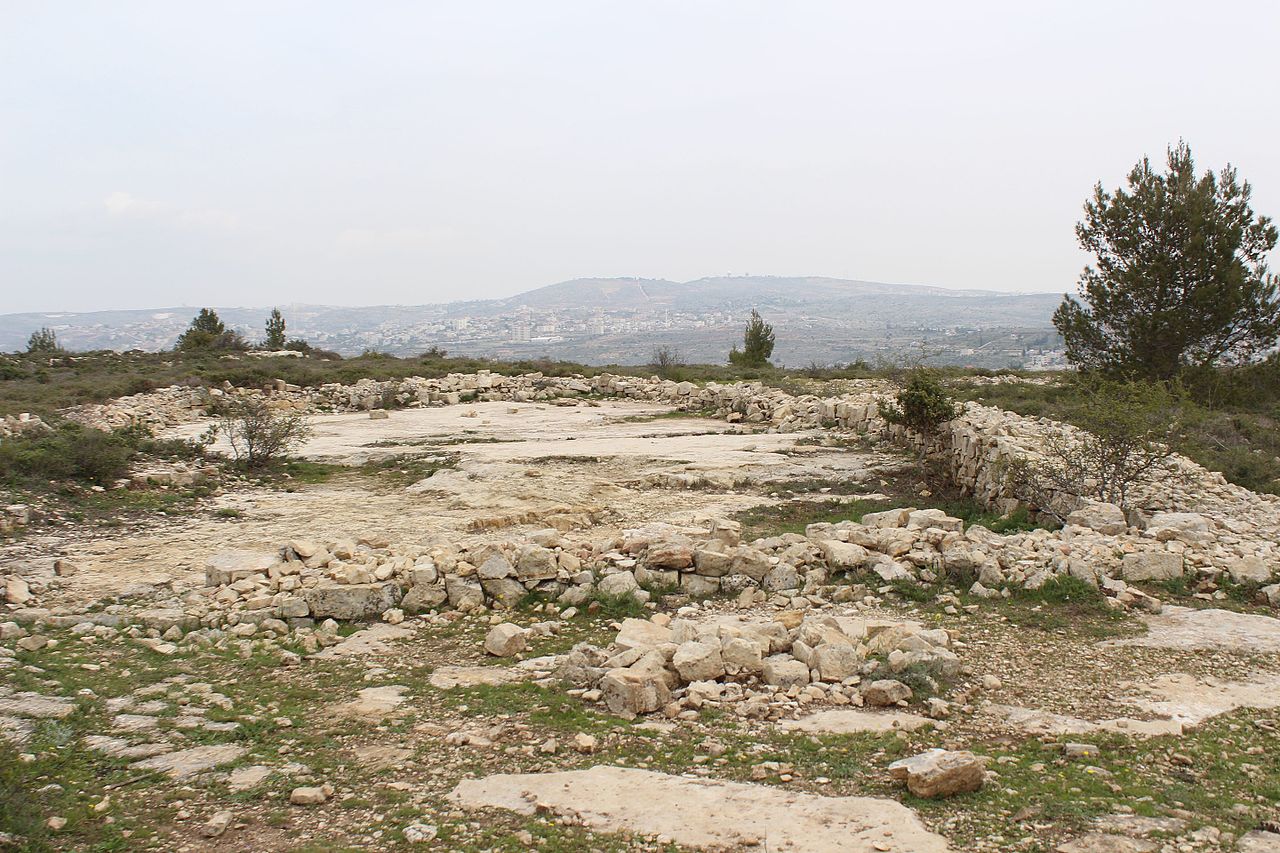
Ruins of Jeroboam’s temple at Beit-El

However, this week’s Torah portion clearly states that the makom of Jacob’s dream is the site of Beit-El (Bethel in English), about 12 miles north of Jerusalem. In the Torah, Beit-El becomes a holy place because Jacob erects and anoints a standing-stone there to commemorate his dream, and upon his return he builds an altar.6 (These actions provide a rationale for why Jereboam, the first king of the northern kingdom of Israel, built a temple at Beit-El.7)

Rashi reconciles the two stories about the location of Jacob’s dream by suggesting that God simply collapses the distance between Beit-El and Jerusalem for that one night. Therefore the foot of the ladder is at Beit-El, while the top of the ladder is at the gate of the heavens above the future temple in Jerusalem.2

I prefer the theory that God is in every place, even an unremarkable patch of stony ground; the question is whether we are aware of God. Jacob lies down unaware. When he wakes up from his dream, he is aware of and awed by the presence of God.

He could only become aware of God by losing awareness of himself, according to Tiferet Shlomo: “This “I, I did not know,” means I did not know myself at all. I was not aware of myself at all, but only of the unity of the Holy One, Blessed Be He.”8

Jacob’s father, Isaac, had a direct waking encounter with God while he was bound on the altar, then twice heard God promise him the blessing of Abraham.9 But Jacob spent his waking hours scheming for his own advantage. God could only reach him in a dream.

Jacob’s real achievement is taking his dream seriously. And he takes two more psychological steps. He realizes with amazement that God is still there, in the same place where he is. And he realizes that his own ego, his own “I” (anokhi in Hebrew), has been ignorant, unaware of God and perhaps of his own larger self.10

Until this point, Jacob has been driven by the identity he has held ever since he heard the story of how he emerged from the womb second, grasping Esau’s heel. Jacob has acted from the conviction that he was cheated at birth. He could only get a full inheritance and a full blessing by cheating his brother out of them.

When he lies down at the makom, Jacob owns nothing. He may never receive an inheritance. His father gave him the blessing of Abraham before he left, but was it real?  Since Jacob duped Isaac into giving him the first blessing, how can he believe his father’s second blessing is intentional and authentic?

Now, in his dream, God blesses him and promises to stay with him. Now Jacob has a chance to become someone larger, separate from Esau.


Several times when I was a young atheist I happened to step outside with nothing particular in mind and suddenly, for some unknown reason, I was struck by how everything around me was alive.  Everything was one thing, and I was part of it.

If I had known some Torah then, I might have thought: “Actually, there is God in this place, and I, I did not know!”

May we all find ourselves in that makom, and may we discover our deeper selves.


  1. No animals or servants are mentioned in this week’s Torah portion. And when Jacob head home twenty years later, he says: “With only my staff I crossed this Jordan, and now I have become two camps” (Genesis 32:11).
  2. Genesis 28:19. Beit-El (“Bethel” in English) is about 60 miles (100 km) north of Beersheba, so Jacob could not have reached in on his first day of travel. It is about 12 miles (20 km) north of Jerusalem.
  3. In Genesis 32:42 Jacob refers to God as “the God of Abraham and Pachad Yitzchak (פַּחַד יִצְחָק) = “the terror of Isaac”. In Genesis and 32:53 Jacob swears by Pachad Yitzchak.
  4. See note 3 on Pirkei d’Rabbi Eliezer. This tradition continues in the Midrash Rabbah, and is repeated by Rashi (11th-century Rabbi Shlomoh Yitzchaki).
  5. g. Avivah Gottlieb Zornberg, The Beginning of Desire, Doubleday, New York, 1995, p. 187-188.
  6. Genesis 28:19, Genesis 35:6-7.
  7. 1 Kings 12:28-33.
  8. Tiferet Shlomo, by 19th-century Polish Rabbi Shlomo Hakohen Rainowicz, translated by Rabbi David Kasher, ParshaNut Weekly Post: Parshat Vayeitzei.
  9. Genesis 26:2-5, Genesis 26:24.
  10. Avivah Gottlieb Zornberg, The Murmuring Deep, Schocken Books, New York, 2009, p. 278: “The Zohar reads his waking speech—va-anokhi lo yadati—‘I–I did not know,’ as referring to his own selfhood: ‘I have not known my anokhi—my self.’”

Chayei Sarah: A Satisfactory Old Age

What is a good old age?  What is a good time to die?

Sarah dies at age 127 at the beginning of this week’s Torah portion, Chayyei Sarah (“Life of Sarah”).

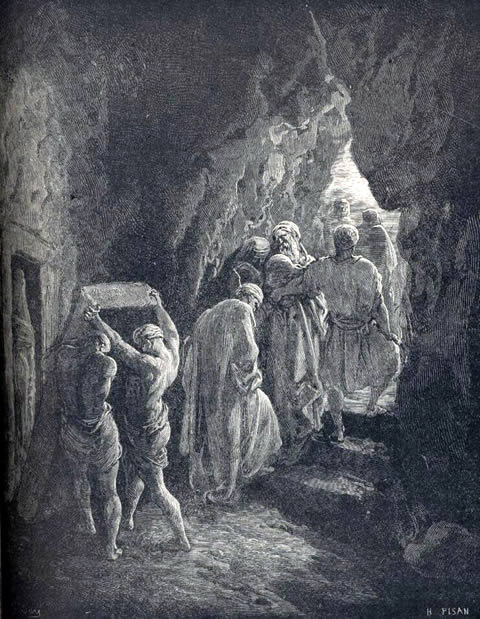
Sarah’s Burial,
by Gustave Dore

And Sarah died in Kiryat Arba, which is Hebron, in the land of Canaan. And Abraham came to lament for Sarah and to wail for her. (Genesis/Bereishit 23:2)

At the end of last week’s portion, Vayeira, Abraham and Sarah lived in Beersheba.  Now Sarah dies in Hebron, 26 miles (42 km) northeast of Beersheba, near the grove where they camped during their first sojourn in Canaan.  Abraham travels there to perform ritual mourning and purchase a burial site.  The couple appear to have separated, and Abraham’s ritual mourning is emphasized, as if he needs to make a show of grief.

At the end of this week’s Torah portion, Abraham dies at age 175.

And Abraham breathed his last and he died at a good old age, old and savei-a, and he was gathered to his people. (Genesis 25:8)

savei-a (שָׂבֵעַ) = satisfied, sated, with plenty, contented.

Sarah’s death, despite her advanced age, is treated as tragic.  Abraham’s is good.  What makes their final years different?

Sarah’s old age

Sarah and Abimelech,
by Marc Chagall

Sarah was already old when she finally had a baby—at age 90, according to last week’s Torah portion. (See my post Vayeira: Laughter, Part 1.)  Right after God announced the miraculous pregnancy, Abraham took his 89-year-old wife to Gerar.  She was still so attractive that Abraham passed her off as his sister, and the king of Gerar “took” her.1  (In Biblical Hebrew, when a man “takes” a woman, it means he has sexual intercourse with her in order to make her his wife or concubine.)  In the Babylonian Talmud (Bava Metziah 87a), Rav Chisda explained that after the annunciation, Sarah’s worn and wrinkled skin was rejuvenated, and her beauty returned.

Before the king of Gerar touched Sarah, God told him in a dream that she was married, and unless her husband Abraham interceded, the king would die.  King Avimelekh returned Sarah to Abraham, showered him with gifts, and invited him to live anywhere in the territory.  Abraham and his household settled in Beersheba, and Sarah gave birth to Isaac.

But at Isaac’s weaning feast three years later, Sarah was full of anxieties.  (See my post Vayeira & Toldot: Laughter, Part 2.)  She worried that people would mock her, and she was afraid that Isaac’s older half-brother, Ishmael, would inherit the firstborn’s double portion of Abraham’s wealth, even though Ishmael was the son of a slave.  So Sarah tried to secure her own son’s future by telling her husband to exile Ishmael and his mother.2  God backed up her request and Abraham obeyed.

Nevertheless, when Isaac was a young man God told Abraham to sacrifice him as a burnt offering.3

According to one strand of classic commentary, Sarah dies of shock when she learns that Abraham almost slaughtered her beloved Isaac.4  This explanation implies that she had moved back to Hebron earlier, leaving Isaac with his father, and that news of the Akedah reached her there.  But why would she separate from her husband and stop watching over her son when nothing else was happening?  It would make more psychological sense if Abraham sent her back to Hebron because he resented her for making him exile Ishmael and Hagar—or if Sarah left her husband only after he tried to slaughter Isaac.

Whenever Sarah moved away, she also lost contact with her son.  Isaac walked away alone from the altar where Abraham almost sacrificed him, and later in this week’s potion we learn that he settled farther south, in the Negev.

At the beginning of Chayyei Sarah, Sarah dies at 127, and Isaac is 37.  He is not present at his mother’s funeral.

What is a good old age, a good death?  When I asked some of my friends, we concluded that the best ending would be:

  • Having fulfilled your mission in life, whatever that turned out to be.
  • Doing something meaningful with your last years.
  • Having a loving connection with someone during your last years.
  • Leaving no unfinished business (such as making amends, arranging inheritance).
  • Dying in a calm state of mind.

Sarah raised a son in her old age, fulfilling the mission God gave her.  But the Torah does not say that she did anything after she moved back to Hebron.  She was alienated from her husband, and out of contact with her son.  She died among mere acquaintances, in a state of either shock or bitterness.

Abraham’s old age

Abraham suffered during what turned out to be his early old age in the Torah portion Vayeira.  At 103, he had to drive out his concubine Hagar and his beloved son Ishmael.  And the thing was very bad in his eyes. (Genesis 21:11)

Akedah in an Icelandic
14th cent manuscript

When his remaining son, Isaac, was a young man, he carried out God’s orders to sacrifice him.  Although God stayed his hand at the last minute, he never saw Isaac again, and his wife never forgave him.  In this week’s Torah portion Sarah dies when Abraham is 137, and he still feels guilty about her.5

Yet after that Abraham lives another 38 years in Beersheba.  His first order of business is to send his steward to Aram to arrange a suitable marriage for Isaac.  (He sees no need to consult his son about this; the important point is that Isaac’s descendants are supposed to inherit the land and God’s blessing.  Isaac has to marry a woman from his father’s clan and religious background, so that he can produce those descendants.)

After the steward is dispatched, Abraham takes a new concubine for himself.

And Abraham continued, and he took a woman, and her name was Keturah.  (Genesis/Bereshit 25:1)

Keturah (קְטוּרָה) = incense, smoke from incense.

The name Keturah is suggestive.  Biblical Hebrew, like English, associates heat and fire with passionate emotion.  Fragrant smoke is something to savor and enjoy; the smoke from a burnt offering or an incense pan is the part of an offering that gives God the most pleasure.  Abraham and Keturah have six sons—another indication that at long last, Abraham has a passionate relationship with a woman.

He has already fulfilled his mission in life by moving to Canaan, accumulating wealth to pass on to his heirs, making a covenant with God through circumcision, and producing the correct son to fulfill God’s prophecy that his numerous descendants will own Canaan and be a blessing to other peoples.  He has even furthered God’s plan by getting Isaac married to his cousin Rebecca.

Abraham also does something meaningful in his last years: raising six more children.  We can assume he has a loving connection with them; he certainly has one with Keturah.  And he leaves no unfinished business.  When his sons through Keturah have grown up, Abraham resolves his inheritance ahead of time.

Abraham gave everything that he had to Isaac.  And to the sons of the concubines he had, Abraham gave gifts, and while he was still alive he sent them away from his son Isaac, eastward to the land of Kedem. (Genesis 5-6)

Abraham dies not only in a calm state of mind, but savei-a: satisfied, contented.

Our own old age

When we are in the thick of life, we do not know whether we will die like Sarah or like Abraham.  But we can improve our chances of dying “at a good old age, old and satisfied” (Genesis 25:8).

During our most active years, may we keep asking ourselves what our true mission in life is, and how we can realign ourselves to carry it out.

May we still do things that are meaningful to us and give us satisfaction when that God-given work is completed (perhaps when we retire from a career, perhaps when a cause or a beloved individual no longer needs our efforts, perhaps when our bodies or circumstances change).

May we keep learning how to love, keep working on the relationships that are worth continuing, and keep making new friends as long as we live. May we take care of our own business as we go along, so that whenever we leave this world we leave nothing important undone. And may we cultivate awareness and gratitude, making a calm and contented state of mind a habit that we never lose, even at the end.

Then no matter when death comes, at that moment we can be satisfied with our lives.

  1. Genesis 20:1-3.
  2. Genesis 21:9-13.
  3. Genesis 22:1-12.
  4. Rashi (11th-century C.E. Rabbi Shlomoh Yitzchaki) cites the opinion of Rabbi Yose in Genesis Rabbah 58:5.)
  5. Moshe Anisfled, “Rashi’s Midrashic Comments Are Supported by a Broad Range of Biblical Texts”, Jewish Bible Quarterly, p. 144.

Vayeira & Toledot: Laughter, Part 2

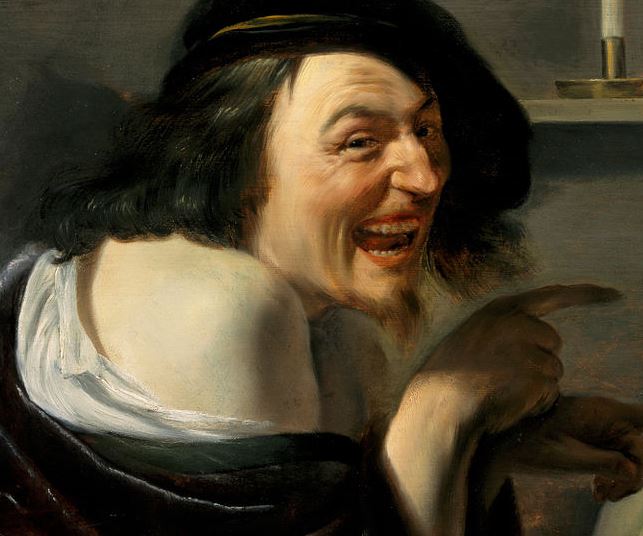
Democritus, by Johannes Moreelse, 1630, detail

Laughter is not always happy.  In English we distinguish between the friendly act of laughing with someone and the cruel act of laughing at someone.  A “fool” might be either a professional jester, or an innocent ignoramus who makes people laugh because of the contrast between his serious doings and what his words or actions mean to “normal” people.  All of these meanings of “laugh” and “fool” are captured by Biblical Hebrew verbs based on the root tzachak, צָחֲק = laughed.

Abraham and Sarah laugh

The first person to laugh in the Torah is Abraham, when God tells him that he and his wife Sarah will finally have a baby the following year.  His laughter is incredulous.

And Abraham fell on his face vayitzchak, and he said in his heart:  Will he be born to a 100-year-old man, and will 90-year-old Sarah give birth? (Genesis 17:17)

vayitzchak (וַיִּצְחָק) = and he laughed.

The first six times a word derived from the root verb tzachak appears in the Torah, it is in the kal stem of the verb and refers simply to laughing.  (See last week’s post, Vayeira: Laughter, Part 1.)  Even the name of Abraham and Sarah’s son comes from the kal stem of tzachak.

Sarah Hears and Laughs,
by James Tissot

“Truly Sarah, your wife, will be pregnant with your son, and you shall call his name Yitzchak, and I will establish my covenant with him …” (Genesis 17:19)

Yitzchak (יִצְחָק) = Isaac in English; “He laughs” in Hebrew.

When God reveals the same information to Sarah in last week’s Torah portion, Vayeira, she too laughs incredulously.

Lot the joker

Later in the portion Vayeira, Abraham’s nephew Lot tries to convince his sons-in-law that God is about to destroy the town of Sodom.

Lot went out and he spoke to his sons-in-law who had married his daughters, and he said: “Get up and go out from this place, because God is destroying the town!” But he was like a metzacheik in the eyes of his sons-in-law. (Genesis 19:14)

metzacheik (מְצַחֵק) = joking, amusing oneself, fooling around, making someone laugh; a jester, a fool.

Although metzacheik is derived from the same root verb as vayitzchak and yitzchak, it comes from the piel stem.  While the kal stem of the root means laughing, the piel stem means making or causing laughter—and can also indicate someone who makes people laugh.

Lot’s sons-in-law see Lot as a fool who seriously believes something will happen that “normal” people know is impossible.  How could the god of Lot and Abraham wipe out the whole town of Sodom?  The men cannot believe in the miracle that kills them the next morning.

Abraham, standing on the heights above, sees Sodom and Gomorrah being obliterated, and moves his household south, settling near Gerar.

Embarrassing laughter

Then Sarah became pregnant, and she bore for Abraham a son for his old age, at the appointed time that God had spoken of …  And Abraham was 100 years old when his son Yitzchak was born to him.  And Sarah said: God has made tzechok for me; everyone who hears, yitzachak about me. (Genesis 21:2, 6)

tzechok (צְחֹק) = laughter (noun, from the root tzachak).

yitzachak (יִצֲחַק) = he will joke, he will amuse himself or others (from the root tzachak in the piel stem).

Old Woman, with Child, by Jakub Schikaneder, 1855–1924, detail

For Sarah, having a baby is a good miracle.  After all, in the Torah portion Lekh-Lekha she wants a son and heir so much that she gives Abraham her slave Hagar and plans to adopt their baby, Ishmael.  That plan does not go well, but now Sarah has her own son.

However, instead of laughing with joy, Sarah is self-conscious about the laughter she expects from other people.  How ridiculous it looks for a 90-year-old woman to nurse an infant! Sarah expects to be the butt of jokes.

Yishmael the joker

When Yitzchak is weaned, Abraham holds a feast in celebration.  There Sarah observes Ishmael, now an adolescent, doing something that alarms her.

Sarah saw the son of Hagar the Egyptian, whom she had born to Abraham, metzacheik.  And she said to Abraham: Drive out this slave-woman with her son, because the son of this slave-woman must not inherit along with my son, with Yitzchak! (Genesis 21:9-10)

Sarah observes Ishmael metzacheik: “joking, playing, amusing himself”.  But what, exactly, is the boy doing?

Rashi1 suggested three possibilities taken from the Midrash Rabbah on Genesis2: Sarah might have seen Ishmael in the act of sexual immorality, idolatry, or killing people in a contest.  His bad moral character would give Sarah an excuse to exile him, so that her own Yitzchak would become Abraham’s only heir.

Ramban and later Sforno3 wrote that Ishmael is joking that Yitzchak is actually the son of Avimelekh, the king of Gerar, who only pretended he had not touched Sarah when he held her captive in chapter 20. This is a potentially profitable joke for Ishmael to make; if Yitzchak really were the son of Sarah and Avimelekh, then Ishmael would be the only son of Abraham, and therefore his only heir.

Robert Alter has pointed out that since Yitzchak and metzacheik come from the same root, “we may also be invited to construe it as ‘Isaacing it’—that is, Sarah sees Ishmael presuming to play the role of Isaac, child of laughter, presuming to be the legitimate heir.”5

If Ishmael were merely laughing with Yitzchak, his behavior might be innocent.  But since the text says she sees Ishmael metzacheik, making someone laugh, he probably is joking around at Yitzchak’s expense.

Yitzchak plays

What about Yitzchak himself?  Is he named “He laughs” merely because Abraham laughs at the news of his conception?

The Torah never says that Yitzchak himself laughs.  But in next week’s Torah portion, Toledot, Yitzchak creates laugher (in the piel stem).

Yitzchak and his beloved wife Rebecca move to Gerar to escape a drought, and Yitzchak, like his father Abraham, worries that the king of Gerar or one of his men will seize Rebecca for his own harem.  If the men of Gerar know she is married to Yitzchak, he thinks, they will kill him so they can take her as a widow without fear of reprisal.  Thus Yitzchak, like Abraham, calls his wife his sister. (See my post Lekh-Lekha, Vayeira, & Toledot: The Wife/Sister Trick.)

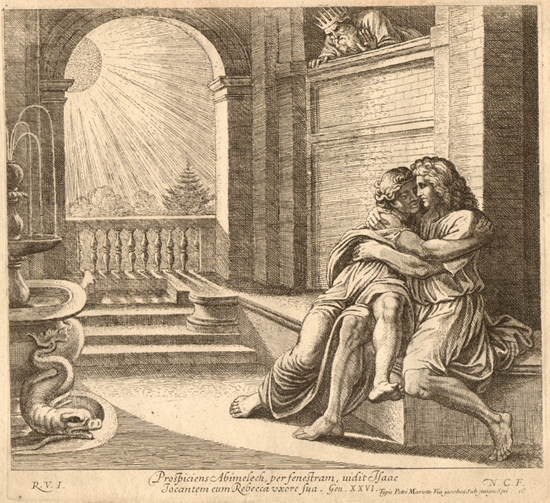
Abimelech, Isaac, and Rebecca,
by Daniele Squaglia, 1649

But unlike his father, Yitzchak cannot keep his hands off his wife.

And the days became long for him there.  And Avimelekh, the king of the Philistines, looked down through the window, and he saw—hey!—Yitzchak metzacheik with Rebecca, his wife!  (Genesis 26:8)

Here metzacheik means fondling: playing or fooling around sexually.  There is no implication of mockery or meanness in Yitzchak’s behavior.  He is merely in love with his own wife, and touches her when he thinks they are unobserved.

Like the king of Gerar who took in Sarah, this king of Gerar is horrified to discover that an apparently single woman is actually someone’s wife.  The king issues an order:  Anyone who touches this man or his wife shall certainly die.  (Genesis 26:11)  And Yitzchak prospers in Gerar.


Yitzchak, “He laughs”, is surrounded by people who laugh and joke.  Both his parents laugh at the incredible mismatch between their extreme old age and having a baby.  Both accept God’s miracle and adjust their lives to it, Abraham by winning God’s reassurance that his older son Ishmael will survive, and Sarah by finding a reason to exile Ishmael and give her own son the inheritance.

Yitzchak’s uncle Lot informs his sons-in-law of a different divine miracle, the impending destruction of Sodom.  His earnest belief in something they think is impossible makes them laugh, and they see him as a fool, a metzacheik.  So they stay put in Sodom, and are annihilated.

May we become more like Abraham and Sarah than like Lot’s sons-in-law: flexible and able to accept the unexpected in our lives.

When Ishmael is metzacheik at Yitzchak’s weaning feast, he is probably making other people laugh at Yitzchak’s expense.  But when Yitzchak is metzacheik with his wife in Gerar, he is probably making her laugh with his playful fondling as he expresses his love for her.

May we become more like Yitzchak than like Ishmael; may we guard ourselves against cruelty, even toward our opponents, when we joke around, and restrict ourselves to generating only loving laughter.


  1. Rashi is the acronym for the 11th-century C.E. French rabbi Shlomoh Yitzchaki, who wrote commentary on the entire Hebrew Bible and all of the Babylonian Talmud.
  2. Genesis/Bereishit Midrash Rabbah is a compilation of commentary by rabbis of the first through third century C.E. The three alternatives on page 53:11 are based on the use of similar words in three other passages.  In Genesis 39:17, the verb letzachek (לְצַחֶק, in the piel) is used to accuse someone of attempting sexual seduction.  In Exodus 32:6, letzacheik (לְצַחֵק, in the piel) is what the Israelites do after sacrificing to the Golden Calf.  In 2 Samuel 2:14, the lietwort viysachaku (וִישַׂחַקוּ) is used to mean a tournament or contest in which pairs of soldiers fight to the death.
  3. Ramban is the acronym for the 13th-century C.E. rabbi Moshe ben Nachman Girondi, a.k.a. Nachmanides. 16h-century C.E. rabbi Ovadiah Sforno gave the same opinion.
  4. Rachel Adelman, “The Expulsion of Ishmael: Who Is Being Tried?”, thetorah.com.
  5. Robert Alter, The Five Books of Moses, W.W. Norton & Co., New York, 2004, p. 103.


Vayeira: Laughter, Part 1

The first laughter in the Torah happens when God tells Abraham, age 99, that after he has circumcised himself and all the males in his household, he and Sarah, his 89-year-old wife, will have a son.

“I will bless her, and I will even give you a son from her, and I will bless her and she will become nations; kings of peoples will come from her.” (Genesis/Bereishit 17:16)

And Abraham fell on his face vayitzchak, and he said in his heart:  Will he be born to a 100-year-old man, and will 90-year-old Sarah give birth? (Genesis 17:17)

vayitzchak (וַיִּצְחָק) = and he laughed.  (From the root tzachak, צָחֲק = laughed.)

Humans laugh when we encounter a mismatch: when two things appear together that we would never expect to see in the same context.  We laugh in fun when we are surprised by a joke, or in mockery when we point out mismatched traits in a person we resent.  We also laugh

* in incredulity when a mismatch is almost unbelievable,

* in bitterness when we wish both mismatched things were true but cannot believe it, and

* in joy when receive unexpected good fortune.

In the Torah, humor is offered without a laugh track; it is up to the reader to recognize jokes and funny situations.  But characters in the Bible do laugh in incredulity, in bitterness, and in joy.

When God tells Abraham that he and his 89-your-old wife will have a baby, he silently laughs out of incredulity.  He also “falls on his face” into the prostrate posture for communicating with God,1 because he is concerned about how God is planning to fulfill the divine prophecy that Abraham will have more descendants than there are stars in the sky.2  Until this point, Abraham assumed all these descendants would come from his 13-year-old son Ishmael, whose mother is Sarah’s slave.  What if God ignored Ishmael while making these almost unbelievable plans for Sarah to get pregnant?

Abraham said to God: “If only Ishmael will live in Your presence!” (Genesis 17:18)

And God said: “Truly Sarah, your wife, will be pregnant with your son, and you shall call his name Yitzchak, and I will establish my covenant with him as an everlasting covenant for his descendants after him.  And as for Ishmael, I have heard you. Hey! I will bless him and I will make him fruitful… (Genesis 17:19-20)

Yitzchak (יִצְחָק) = Isaac, in English.  In Hebrew, yitzchak = he laughs, he will laugh (from the root tzachak, צָחֲק).

When God repeats his promise of a miraculous birth, Abraham overcomes his incredulity and goes ahead with the circumcisions.

Abraham Sees Three Visitors
(artist unknown)

In this week’s Torah portion, Vayeira (“And he appeared”), three mysterious strangers arrive at Abraham’s camp while he is recovering from his circumcisionThe aged Abraham gets up and runs to welcome the visitors, who look like men, but turn out to be divine messengers or angels.  Abraham prepares them a meal.  The visitors eat as if they were men, and then make sure Sarah is close enough to overhear them.

And they said to him: “Where is Sarah, your wife?”

And he said: “Here!  In the tent.”

Then [one of them] said: “I will definitely return to you at the time of life, and hey!  A son for Sarah, your wife.”  (Genesis 18:9-10)

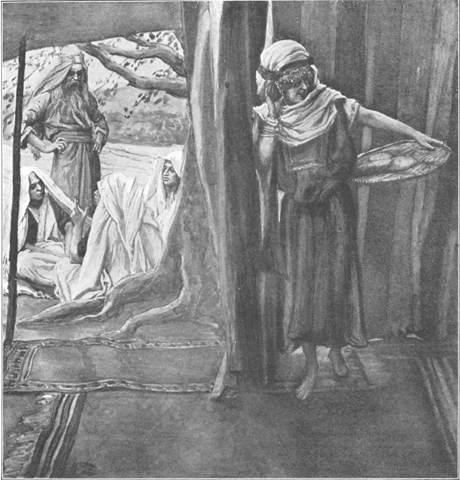
And Sarah was listening at the opening of the tent, which was behind him.  Abraham and Sarah were old, coming on in years; the periods of women had stopped happening to Sarah.  Vatitzchak, Sarah, inside herself, saying: After I am worn out, will I have sexual pleasure? And my husband is old! (Genesis 18:10-12)

Sarah Hears and Laughs,
by James Tissot

vatitzchak (וַתִּצְחַק) = and she laughed (also from the root tzachak, צָחֲק).

What kind of laughter does Sarah laugh—incredulous, bitter, or joyful?  Biblical commentary is divided.  So I offer these three alternatives, in colloquial modern English, for what she might be thinking as she laughs:

  1. Incredulity:

    What an idiot this stranger is!  He hasn’t seen me, so he doesn’t know what a dried-up old woman I am.  But Abraham’s standing right in front of him, all wrinkled and liver-spotted.  Who would make an outrageous prediction like that, with a time limit, even? Only an idiot—or a prophet.3  That’s it, Abraham’s three guests are a band of traveling prophets!  Well, this is the most absurd prophecy I’ve ever heard.  You’ve got to laugh at such a ridiculous situation.

  2. Bitterness:

    This stranger may know my name, but he obviously doesn’t know my age.  I bet he was trying to give old Abraham a compliment; even a 99-year-old man likes to hear that he’s virile.  But the man overdid it.  And I bet he doesn’t know I’ve been barren my whole life, and I had to give my slave to my husband just to get a son to adopt.  That was a disaster!  Now, even if I were still young enough to have some juice, I know Abraham is past it.  I thought I was used to sleeping in a cold bed. But suddenly all I can think about is how long I’ve been alone.  No sex for years, never nursed a baby, and Ishmael never treats me as his mother.  Curse that stranger!  He doesn’t realize how much his remark hurts me.  Men are careless like that.  Even my own husband asks me to make fancy cakes for his guests, and then forgets to serve them!  Men never think of women’s feelings.  You’ve got to laugh at these jokers, so you don’t cry.

  3. Joy:

    Who is this stranger?  How does he know my name?  Does he realize how old we are?  Actually, Abraham may have forgotten to serve my cakes to those men, but he’s been running around like a man in his prime.  And not every 99-year-old man could even survive being circumcised.  Or be so cheerful about it.  Hey, Abraham even winked at me, when he told me about what he was going to do to himself, and about how God opened up our names by adding the letter hey.  Everything’s opening up now, he said.  I wonder if he was hinting that my womb was going to open, too?  Maybe when God changed our names and ordered the circumcisions, He went on and told Abraham were going to have a child?  Oh, that would be a rich joke, after I’ve been barren my whole long life!  But if God wants to play a joke on us, and give us both a second youth so I can have my own baby— well then, bring on the miracle!

Then God said to Abraham: “Why is it that Sarah tzachakah, saying: Is it really true, I will give birth, when I have become old? Is a thing too extraordinary for God? At the appointed time I will return to you, at the time of life, and Sarah will have a son.”  (Genesis 18: 14)

tzachakah (צָחֲקָה) = she laughed (also from the root tzachak, צָחֲק).

Now Sarah is alarmed. How could the visitor hear her silent thoughts? Only God could do that sort of thing.  Has she just insulted God?

And Sarah denied it, saying: “Lo tzachakti!”—for she was afraid. But he said: “Not so, for tzachakte”. (Genesis 18:15)

lo tzachakti (לֺא צָחַקְתִּיה) = I did not laugh (also from the root tzachak, צָחֲק).

tzachakte (צָחָקְתְּ) = you (feminine) laughed (also from the root tzachak, צָחֲק).

Then the three “men” get up and walk with Abraham to look down at Sodom in the valley below.

*

Both Abraham and Sarah laugh at the idea of having a baby in extreme old age.  But they keep listening to God, get over their incredulity, and accept the transformation of their lives.  Abraham is reassured to hear that both his sons will become fathers and patriarchs.  Sarah accepts her sudden good fortune,  prepared to enjoy sexual pleasure again and even nurse her own child.  We next see her in the Torah at the weaning feast of her son Yitzchak.

When you laugh incredulously, do you leave an opening for an unexpected miracle?  Are you willing to accept a new reality? Are you able to move from bitterness to joy?

(An earlier version of this essay was published in October 2010.  Next week I will post part 2, on making laughter in joy and in mockery.)

  1. See my post Korach: Face Down.
  2. In Genesis 15:5 God promised Abraham he will have more descendants than there are stars in the sky. By the time Abraham is 99, God has promised him five times that his descendants will possess the land of Canaan.  Abraham has assumed these descendants will come from Ishmael, his son through the slave Hagar.
  3. 16th-century Rabbi Obadiah Sforno wrote that Sarah assumes the speaker is a prophet giving a blessing. (Sforno: Commentary on the Torah, trans. by Raphael Pelcovitz, ArtScroll Mesorah Publications, 1993)


Lekh-Lekha: New Names for God

What is God’s name?

In this week’s Torah portion alone, Abraham encounters God six times, more than anyone else in the book of Genesis/Bereishit.  God both speaks to him and appears to him.  And Abraham learns—or adopts—three new names for God:  Eil Elyon, Adonai, and Eil Shaddai.

The Vision of the Lord Directing Abraham to Count the Stars, by Julius Schnorr von Carolsfeld, 1860

Before Abraham appears in the Torah, God is called either Y-H-V-H or Elohim.  These names for God are also used in this week’s Torah portion, Lekh-Lekha (“Get yourself going”).

And Y-H-V-H said to Abraham: “Get yourself going, away from your land and from your birthplace and from your father’s house, to the land that I will show you.”  (Genesis 12:1)

Y-H-V-H (י־ה־ו־ה) = the four-letter name of God (the “tetragrammaton”).

This is God’s most holy and personal name in Judaism.  Y-H-V-H may be based on the root verb for being, becoming, and happening, hayah (היה); or it may derive from an ancient pre-Hebrew god name.  It is often translated into English as “LORD” in all capitals, although the Hebrew word for “lord” is adon (see Adonai below) and has nothing to do with the tetragrammaton.

The Torah calls God Elohim from the beginning, in Genesis/Bereishit 1:1, and the name resurfaces often, including later in this week’s Torah portion:

And Abraham fell on his face, and Elohim spoke to him.  (Genesis 17:3)

elohim (אֱלוֹהִים) = God; gods.

The first new name for God is introduced when Abraham he runs into a delicate political situation.  After Abraham and his allies have won a war, the local kings meet in the valley of the king-priest MalkiTzedek.1

Melchizedek and Abraham,
Cologne Bible, 1478

And Malki-Tzedek, the king of Shaleim, brought out bread and wine.  He was a priest to Eil Elyon.  And he blessed him; he said: “Blessed is Abraham to Eil Elyon, the owner of heaven and earth”.  (Genesis 14:18)

Eil Elyon (אֵל עֶלְיוֹן) = highest god, supreme god.  Eil (אֵל) = god +  elyon (עֶליוֹן) = highest, uppermost.

Then the crasser king of Sodom interrupts with a plan for dividing the spoils of war.  In order not to insult the god of Malki-Tzedek, Abraham replies using the same god-language as the king-priest, merely putting his four-letter name for God in front of Malki-Tzedek’s formula.

And Avram said to the king of Sodom: “I vow by Y-H-V-H, Eil Elyon, the owner of heaven and earth, from a thread to a sandal strap, if I take anything that is yours …  (Genesis 14:22-23)

Thus Abraham politely indicates that his own personal god is the same as Melki-Tzedek’s highest god, the owner of heaven and earth.

This is the only chapter in the Torah in which God is called Eil Elyon.  But the word Elyon, “highest”, is used again 21 times in the Hebrew bible.  Most of these uses occur in poems, where the parallel structure of verses requires a lot of synonyms for “God”.

The second new god-name introduced in this week’s Torah portion is an honorific.  Abraham is the first person to call God Adonai, “my lord”.  He follows this honorific with the four-letter name of God both times that he initiates a conversation with his god.

And Abraham said: “Adonai, Y-H-V-H, what will you give me, since I go childless, and the heir of my household is Eliezer of Damascus?”  (Genesis/Bereishit 15:2)

And he said: “Adonai, Y-H-V-H, how will I know that I will take possession of it?”  (Genesis/Bereishit 15:8)

Adonai (אֲדֺנָי) = my lords (usually translated as “my lord” when it refers to God).  From the singular adon (אֲדוֹן) = lord, master.

The third new god-name in this week’s Torah portion is the most difficult to translate.  Eil Shaddai is commonly translated into English as “God Almighty”, based on the Latin Vulgate, but Shaddai means something else in Hebrew.

It was when Abraham was 99 years old that Y-H-V-H appeared to Abraham and said to him: “I am Eil Shaddai.  Walk constantly in my presence, and become perfect.”  (Genesis 17:1)

Eil Shaddai (אֵל שַׁדַּי) = eil = god + shaddai  Shaddai might mean:

— who is enough (prefix she-/שֶׁ = who + dai/דַּי = enough)

— of breasts (shadayim/שָׁדַי = breasts)

— devastation (shudad/ שֻׁדַּד = devastated)

— of the mountain (if the word shaddai is borrowed from Akkadian)

God is called Eil Shaddai 48 times in the Hebrew Bible.  Most references to Eil Shaddai or just Shaddai occur in poems,2 which need lots of synonyms for God.  The two uses of Shaddai in the book of Ezekiel are onomatopoeic; Ezekiel describes the sound of wings in his vision as being “like the sound of Shaddai”.

However, Eil Shaddai does occur nine times in biblical prose passages, including every reference in Genesis.  And all nine occurrences have something to do with fertility.  In this week’s Torah portion, when God first reveals the name Eil Shaddai to Abraham, God goes on to say 1) that Abraham will be very fruitful, with nations of descendants; 2) that he and all the males in his household must be circumcised, and 3) that he will have a son with his 89-year-old wife Sarah.3

*

The five names for God that Abraham uses in the Torah portion Lekh-Lekha are still used in Hebrew liturgy today.4  Do Abraham’s three new names for God have any relevance to us?  The name Eil Elyon, “Highest God”, is about God’s relationship to other gods.  But by the time of Deuteronomy, the Torah is monotheistic, and uses only Elyon, “Highest”, as an adjective for the one God.  Today, calling God Elyon might remind us that God (at least the God within us) is more important than other things we give top priority in our lives.

The name Adonai, “My lords”, can remind us that we are not as autonomous as we might think.  We are not the masters of the universe.  We are not even masters of our own souls; we do what we can, but we are all dependent on the grace of God.  Calling God Adonai might remind us to be humble.

The name Eil Shaddai, “God of Breasts” or “God of Enough”, is about God as the source of fertility and nurture.  We are creative creatures; we not only bear offspring, like other animals, but we generate inventions, art, ideas, religions.  Calling God Eil Shaddai might remind us to be grateful for all those inspirations that come “out of the blue”, and grateful for our abilities to nurture both ideas and fellow human beings.

(An earlier version of this essay was published in October 2010.)

  1. MalkiTzedek (מַלְכִּי־צֶדֶק) = melekh (מֶלֶךְ)=king + tzedek (צֶדֶק)=righteousness, justice. MalkiTzedek is identified as the king of Shaleim (שָׁלֵם) = wholeness; from the same root as shalom (שָׁלוֹם) = peace.  Judging by the location, he is probably Jebusite ruler of the town that came to be known as Jerusalem.
  2. The word Shaddai occurs in poems in Isaiah 13:6, Joel 1:15, twice in Bilaam’s prophecies in Numbers/Bemidbar, twice in Psalms, and 31 times in the book of Job.
  3. In the next occurrence, Isaac asks Eil Shaddai to bless Jacob by making him “fruitful and numerous” and “an assembly of peoples”.  When God renames Jacob “Israel”, God adds, “I am Eil Shaddai; be fruitful and numerous; a nation and an assembly of nations…”  Jacob himself uses the name Shaddai three times, once to recall the above blessing, once to plead for the safe return of two of his sons from Egypt, and once to shower blessings on the tribe of Joseph, including “blessings of breasts and womb”.  In Exodus, God tells Moses “I appeared to Avraham, to Yitzchak, and to Yaakov with Eil Shaddai”, but then uses a different name with Moses—whose personal fertility is not an issue.  In the book of Ruth, Naomi refers to Shaddai twice, complaining that this god harmed her and made her bitter by bereaving her of her husband and two sons, and leaving her with no grandchildren.  Eil Shaddai, the god of breasts, can withhold fertility as well as grant it.
  4. This week’s Torah portion also includes what might be considered a fourth new name of God.  Hagar, who is Abraham’s concubine and Sarah’s servant, runs away, then hears angels of God giving her advice and prophecy.  She says, “You are a seeing god!”  But this particular formation, eil ro-iy, is never used again in the Torah, and I have never found it in the standard liturgy. It seems to be an expression Hagar’s personal relationship to God.

Noach: Noah’s Wife

a Torah monologue by Maggidah Melissa Carpenter

It all started with sheep.  When I was a girl, people kept sheep to shear for wool and to milk for making cheese.  My mother used to say, “On the sixth day, God gave the humans and animals plants for food.  Nothing but plants!”1

I used to argue, “Then why did God make mothers that give milk?”  And I ate cheese on my lentils.  I still do.

Lamech and His Two Wives
by William Blake, 1795

Those were the good days.  Then some man named Lemech went crazy, and there was a fight, and two men died.  Lemech was the second murderer in the world.  He boasted about what he’d done, so I could understand why God didn’t give him a mark of protection, like Cain.  What I could not understand was why God didn’t speak.

After that fight, it seemed like young men had shorter tempers and bigger appetites.  One year they came back from the sheep-shearing missing two sheep.  There was blood on the fleeces.  Blood in their beards.  Soon they were bringing back whole sheepskins, and legs to cook.  The first time I saw a man bite into a roasted leg, I had nightmares for a week.

Nobody stopped them.  My mother tried, but she was a small woman, and they knocked her down.  After that she walked with a limp.  My father kept going out with the other shepherds.  And when they brought back lambs, some of the women ate the tender meat.  In a few years almost everybody was eating lamb.  Even the lions.

The young men came home sometimes with cuts and gouges from the shearing knives.  They were fighting.

Chamas,2” my mother whispered.  Violence.  Cruelty.

*

            Lots of men came after me once my figure filled out.  I carried my own knife to keep them away, since we had no laws.

Some years later I made friends with Lemech’s youngest son, Noach.  His mother had died by then, and his father had gone for good.  Noach traded barley and grapes in the marketplace, along with the little wooden boxes he made.  He stayed away from the other end of the market.  Said he didn’t like the taste of meat, and sheep gave him a rash.

One day he invited me up the hill to see the house he’d built.  It was a big empty wooden house with four bedrooms.  Noach said we could put a bed in the room I liked best.

“What about the other rooms?”

He looked down.  “Maybe we’ll have children.”

“Yes,” I said.

*

            We had three sons, and I raised them to be vegetarians.  Once Cham, our youngest, came home with a nasty knife wound, but at least none of my sons ever brought home meat.  All three married good women.  Our house was full.

One day when Noach came home from the fields he was shivering.  He said: “God spoke to me.”

“What!”

“I was just hoeing, out in the field, and God spoke to me. Inside my body.”

“Are you sure it was God?”

“Yes.  God said I have to build a box.  A giant box.  Waterproof.  Divided up into compartments.  And then I have to collect animals.  Two of every kind of animal in the world. And put them in the box.  And four pairs of humans: you and me, and our sons and their wives.”

“Why?”

“Because God is disappointed in the human race.  Because of all our violence, our chamas.  God wants to start all over again.  So he’s going to send a flood that will wipe out the whole earth.  Except for the survivors in the floating box.  The ark.”

“But Noach, what about children?  And the more peaceful animals?  Isn’t God more—selective?”

“I guess not.  And I can’t argue with God.  I’ve got to start building a box.”

He did.  It dwarfed our house.  Sometimes folks wandered by and jeered at him, but my husband only told them one thing, over and over again.  “God said to build an ark, because the earth is filled with chamas, so he’s going to send a flood to wipe out all flesh.  That’s what God said.”3

Nobody listened to Noach.

He finished the ark, and packed several compartments with seeds and farming tools, and grain to feed everybody.  Even the lions.  He sent off our sons and their wives to collect pairs of animals from around the world.  Then he asked me to get the sheep.  He told me that now God wanted seven rams and seven ewes, so he could make slaughter-sacrifices for God after the flood.4

“What?  I thought God didn’t like chamas!  Why would God want us to save animals only to kill them?”

“I dunno.  I can’t argue with God.”

“Then go get the sheep yourself, Noach.”

“I can’t.  Sheep give me a rash.”

“I thought—I thought that was just an excuse.  I thought you were a good man, different from all the others.”

Noach looked miserable.  He backed up and stood in the shadow of the ark.  “God wants seven cattle, too, and seven goats, and some extra birds.  I’ll take care of those.”

And I knew I had to get the sheep.  My only other choice was to drown.

God gave us seven days to load all the animals.  When the rain started our son Cham balked and argued, but in the end he followed his wife inside the ark, and we sealed the door.  I remember when the ark shifted and began to float.  We all cheered.  Then we heard people hammering on the outside of the door, and I felt bad.

We spent all our waking time feeding the animals.  The rain stopped after 40 days, but the flood went on for months.  Then the ark grated against something.  We climbed the ladder and peered out the window in the roof.  The sky was blue.  So was the water, rippling in the wind.  Tiny islands of bare rock stuck out of the water.  I realized they were mountaintops.

by Gustave Dore, 1866

When the water finally dried up, we saw lots of mud where we could plant seeds.  We wait for Noach to lead us out of the ark, but he just kept shoveling grain into the animals’ stalls.  Until one morning he finally called us together and said:  “God said to go out, and let out the animals, to be fruitful and multiply.”

We started to cheer, but Noach looked so glum that the cheer failed.  I wondered if my husband had delayed leaving the ark because he was not looking forward to the animal sacrifice.

Noach held back the sheep and cattle and goats and birds that he said God wanted sacrificed.  I stood with my hands on my hips and watched him build a platform out of stones.  I think it was an altar, though I’d never seen one before.

He got our sons to hold the animals while he slit their throats.  Then he burned them.  A new, clean world, and my husband goes and sends up a column of greasy black smoke.  Behind it a rainbow appeared.  Noach’s face and hands broke out in a rash.

We ploughed a big field of mud farther down the mountain, and we discovered that some debris from the flood had settled into the mud.  Pottery, blankets, dead animals.  Human bodies.  When I ploughed up a dead child, I lay down on the dirt and cried the rest of the day.

I don’t get it.  If all our chamas made God regret creating the world, why did God do so much chamas to destroy it?

I liked God’s first creation better.

  1. And God said: “Hey, I give to you all seed-bearing green plants that are on the face of all the earth, and all the trees that have seed-bearing fruit; they shall be food for you. And to all animals of the land and to all birds of the heavens and to all crawlers on the earth that have the soul of life:  all greens, green plants, for food.”  And it was so.  And God saw all that “he” had made, and hey!  Very good.  And it was evening and it was morning, the sixth day.  (Genesis 1:29-31)
  2. chamas (חָמָס) = violence, lawlessness, cruelty. The first occurrence of this word is in the Torah portion Noach: The earth was corrupt in front of the Elohim, and it was chamas. (Genesis 6:11)
  3. Genesis 6:13, 6:17.
  4. Genesis 7:2.