Chayei Sarah & 1 Kings: Old Age for Scoundrels, Part 1

And Abraham expired and died at a good old age, old and saveia, and he was gathered to his people. (Genesis 25:8)

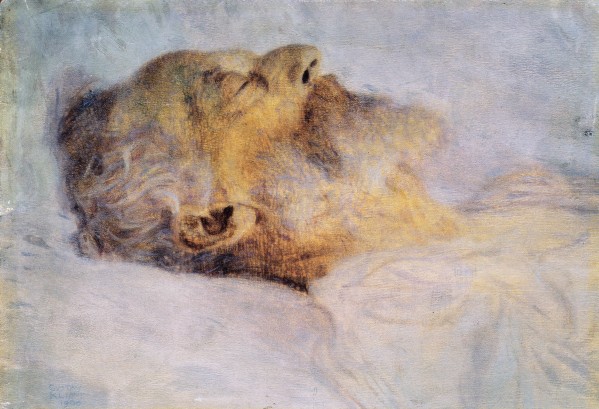
Old Man on his Deathbed, by Gustav Klimt

saveia (שָׂבֵעַ) = (adjective) satisfied, full, sated. (From the root verb sava, שָׂבַע = be sated, have enough, be filled up—usually with food.)

The full and satisfying end of Abraham’s life in this week’s Torah portion, Chayei Sarah (“The Life of Sarah”, Genesis 23:1-25:18) contrasts with the thin and bitter end of King David’s life in the accompanying haftarah reading (1 Kings 1:1-1:31). The haftarah sets the tone for King David’s final years when it opens:

And the king, David, was old, coming on in years, and they covered him with bedclothes, but he never felt warm. (1 Kings 1:1)

In their prime, both men have motley careers: brave and magnanimous in one scene, heartless and unscrupulous in the next. But in old age (about age 140-175 for Abraham, 60-70 for David) their paths diverge.

Abraham’s prime

Abraham commits several major unethical deeds after he moves his family to Canaan when he is 75. Although his behavior toward his nephew Lot is faultless, his behavior toward his wife Sarah and his first two sons, Ishmael and Isaac, is sometimes cruel, selfish, and immoral.

Abram’s Counsel to Sarai, by James Tissot, ca. 1900, detail

Twice when he travels to a new kingdom, Abraham asks Sarah to pretend to be his sister. He claims that she was unusually beautiful1 and that the king has peculiar morals, considering adultery taboo, but murder perfectly all right. The king will take Sarah regardless, but only if everyone lies and says Abraham is her brother will the king let him live. In fact, both kings pay Abraham a bride-price for his “sister”. Both kings are horrified when they discovered the truth. Both times, Abraham gets to take back his wife and leave richer than when he arrived.2

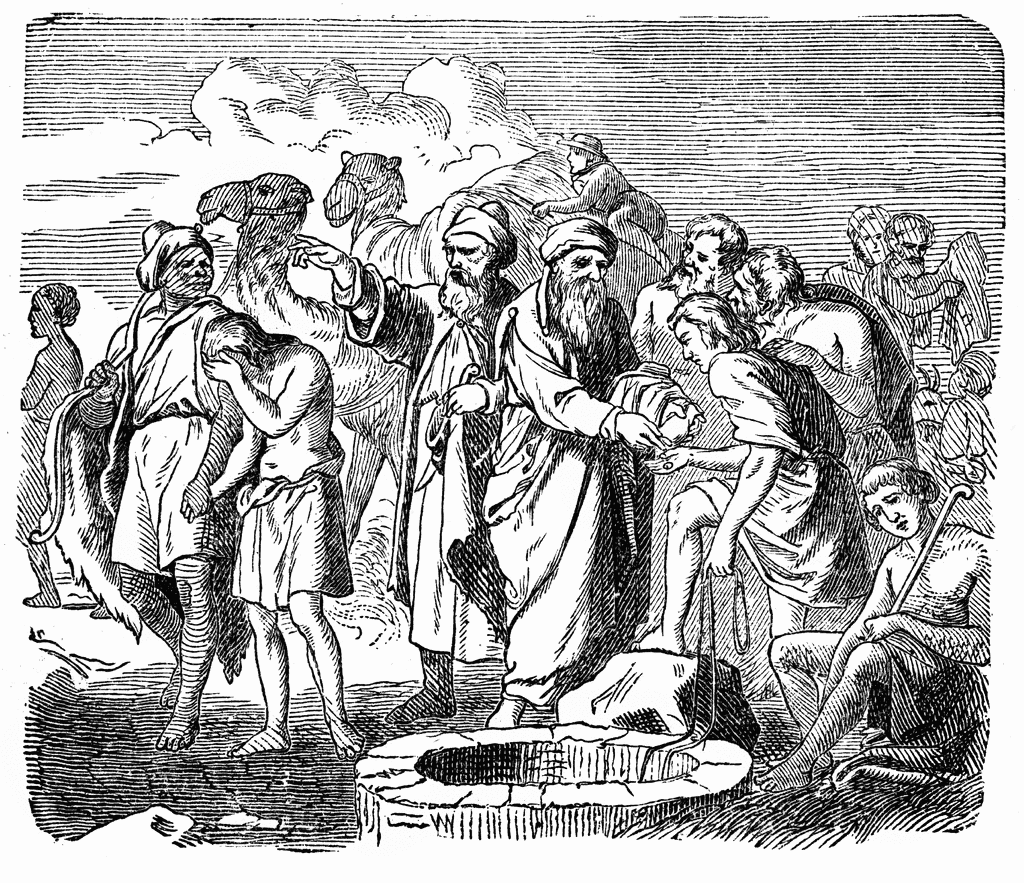
Sarah also uses Abraham, by giving him her slave Hagar as a concubine for the purpose of producing an heir. (She is 75 and childless at the time.) After Sarah give birth to her own son at age 90, she sees that Hagar’s son Ishmael is not treating her son Isaac with respect. So she orders Abraham to cast out Hagar and Ishmael, in order to make Isaac the only heir. Abraham is rich, and could easily give his own son and his former concubine a couple of donkeys laden with water, food, and silver to ensure their safe relocation. Instead, Abraham sends them off into the desert with only bread and a skin of water. When they get lost and use up the water, Ishmael nearly dies.3 God arranges a rescue, but Abraham never sees his oldest son again.

Isaac has grown up, but has not yet married or had children, when Abraham hears God tell him:

“Please take your son, your only one, whom you love, Isaac. And get yourself going to the land I will show you, and offer him up there as a burnt offering on one of the hills, which I will say to you.” (Genesis 22:2)

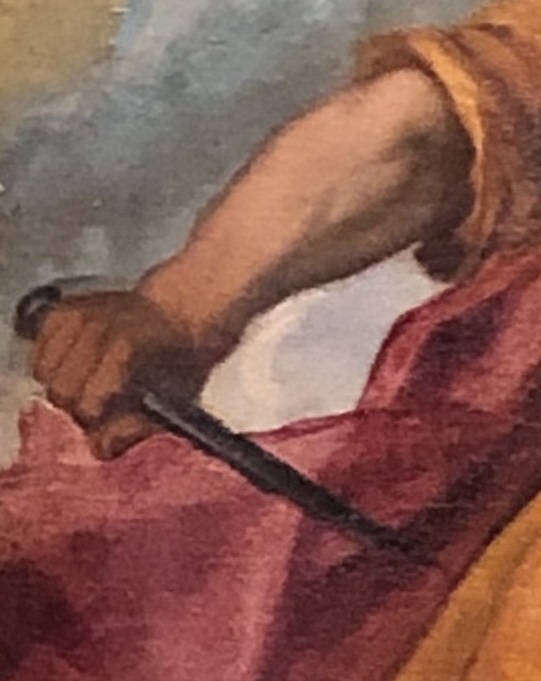
Sacrifice of Isaac, by Caravaggio, 1603

Abraham knows he could argue with God. When he was 99, he argued with God about destroying Sodom, and God listened and agreed it would be unjust to annihilate the city if it contained even ten innocent people.4 Yet now, in his 130’s, Abraham does not argue with God. he does not even ask God a question. He gets up early and leaves with Isaac, two servants, and a donkey carrying firewood, without telling Sarah where they are going. When Isaac lies bound on the altar and Abraham lifts the knife, God has to call his name twice to get him to stop. After Abraham sacrifices a ram instead, he walks back down the hill alone.5 The breach between father and son is irreparable. Abraham never sees Isaac again.

Abraham’s old age

Is Abraham consumed by guilt and loss during the final stage of his life, from his late 130’s to his death at 175? No. But he has changed. This week’s Torah portion, Chayei Sarah, portrays a man at peace with himself who meets all his responsibilities and also enjoys life.

The Torah portion begins with Sarah’s death in Hebron. Yet the last we knew, Abraham was living in Beersheba.6 Perhaps the two locations reflect a glitch in a redactor’s effort to combine two stories. Or perhaps Sarah left her husband after he returned without Isaac and tried to explain what happened. In an already difficult marriage, that would be the last straw. Yet the estrangement does not stop Abraham from traveling to Hebron and doing his duty as Sarah’s husband.

Abraham Buys the Field of Ephron the Hittite, by William Hogarth, ca. 1725

And Abraham came to beat the breast for Sarah and to observe mourning rites. Then Abraham got up from the presence of his dead, and he spoke to the Hittites, saying: “I am a resident alien among you. Give me a burial site among you, and I will bury my dead away from my presence.” (Genesis 23:2)

After some negotiations, Abraham buys a plot of land with a suitable burial cave, and buries Sarah there. In this way he also prepares for his own burial, and future burials in his family.

Isaac is not mentioned during the first scene in Chayei Sarah. But in the next scene, Abraham makes arrangements for Isaac’s marriage.

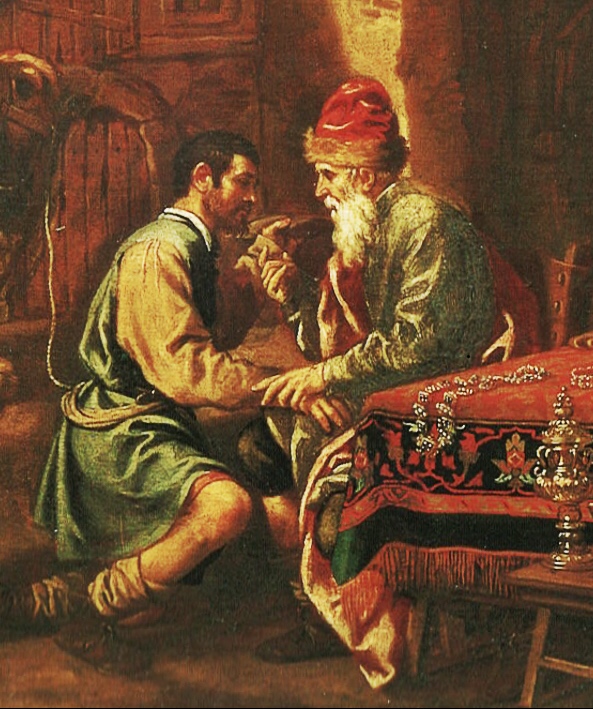
And Abraham said to his elder servant of his household, the one who governed all that was his: “Please place your hand under my yareikh, and I will make you swear by God, god of the heavens and god of the earth, that you do not take a wife for my son from the daughters of the Canaanites amidst whom I am dwelling.  For you must go to the land I came from and to my relatives, and you must take a wife for my son, for Isaac.”  (Genesis 24:2-4)

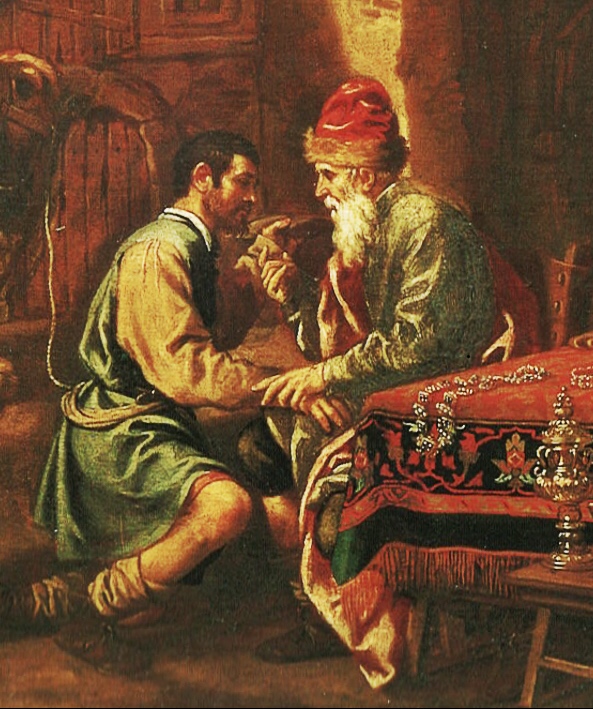
Abraham’s Solemn Charge, by Pedro Orrente, 17th century, detail

yareikh (יָרֵךְ) = upper thigh, buttocks, genitals.

This is a serious oath. Isaac is in his late thirties at this point, and his father has obviously been keeping track of him from a distance. Now Abraham wants to make sure, before he dies, that Isaac marries and starts producing the descendants God promised. But he does not try to confront his estranged and traumatized son in person. He instructs his steward, and trusts him to deliver the right bride to his son.

Arranged marriage was the norm in the Ancient Near East, so Isaac is not shocked when his father’s steward arrives with a young woman for him. In fact, he falls in love with her.7

Once Isaac is married, Abraham takes a concubine again, and has six sons with Keturah.

And Abraham gave all that was his to Isaac. But to the sons of the concubines that were Abraham’s, Abraham gave gifts, and he sent them away from his son Isaac while he was still alive, eastward, to the land of the east. And these are the days of the years of Abraham, that he lived: 175 years. And Abraham expired and died in good seivah (Genesis 25:6-8)

Abraham is virile and enjoys life his old age. He is also in charge of his own life, and takes care to meet all his responsibilities well before he dies. He divides his wealth among his sons and makes sure Isaac will not be harassed by his stepbrothers. After his death, Ishmael and Isaac bury their father in the cave he bought for Sarah’s burial. Whatever mistakes he made before the age of 140, Abraham leads an enviable life for his last 35 years. He is fortunate to be in good health, with both virility and a sound mind. He knows what he is doing, and he does it more thoughtfully than he used to. Abraham was always good at generating plans. But during the last part of his life, his plans are more reasonable, and take the other people in his life into consideration.


No human being is perfect. We may not commit such extravagant misdeeds as Abraham, but we have all hurt other humans. Occasionally we get the blessing of a frank conversation with someone we hurt, and an opportunity to apologize and make amends. But often the chance for a frank conversation never comes. Then the best we can do is to acknowledge our misdeeds to ourselves, and plan how we will behave more ethically in the future. Sometimes we can notice our own improvement, and find peace in our old age.

Perhaps this is what Abraham does in the book of Genesis. He never apologizes to Sarah, or Ishmael, or Isaac. But after age 140, he is careful to meet his responsibilities to everyone, even the people estranged from him. Abraham still pursues his own interests and arranges a pleasant life for himself, but he does it without any deceit and without endangering anyone’s safety. He dies old and satisfied.

Next week, in Part 2, we will look at the unfortunate counterexample of King David’s old age.


  1. Sarah is 65 when Abraham pulls this scam on the king of Egypt in Genesis 12:10-20. She is 89 when he repeats it with the king of Gerar in Genesis 20:1-18, but during that year God is presumably making Sarah’s body younger so she can bear a son to Abraham.
  2. See my posts The Wife-Sister Trick: Part 1 and Part 2.
  3. Genesis 21:8-19. See my post Vayeira: Failure of Empathy.
  4. Genesis 18:16-32.
  5. Genesis 22:1-19. See my post Vayeira: Stopped by an Angel.
  6. In Genesis 22:19 Abraham comes back to Beersheba without Isaac.
  7. Genesis 25:67.

Vayeira: On Speaking Terms

Direct speech, or visions, or dreams, or divine messengers—the Hebrew Bible portrays God as communicating with human beings through all these methods. In this week’s Torah portion, Vayeira (“And he appeared”, Genesis 18:1-22:24), God speaks to Abraham both directly and through divine messengers, called malakhim; to Sarah directly; to King Avimelekh in a dream; and to Lot and Hagar through malakhim.

malakh (מַלְאָךְ) = messenger, emissary. (Plural: malakhim, מַלְאָכִים. While human characters in the Torah send fellow humans as malakhim, the God character sends divine malakhim. “A malakh of God” is often translated into English as “an angel”.)

One way or another, God speaks to more people in Vayeira than in any other Torah portion or haftarah reading. And Vayeira is the only place in the Hebrew Bible where God sends three malakhim at once. What does the God-character achieve?

Three “men”

Abraham is 99 when this week’s Torah portion begins. God spoke directly with him five times in last week’s portion, Lekh Lekha, both with and without accompanying visions.1 The portion Vayeira begins:

Three Visitors, by James Tissot, ca. 1900

And God appeared to him by the great trees of Mamrei, while he was sitting at the entrance of the tent as the day grew hot. And he raised his eyes, and he saw—hey! Three men were standing near him. And he saw, and he ran from the entrance of the tent to greet them, and he bowed down to the ground. (Genesis/Bereishit 18:1-3)

When God appears in Mamrei, what Abraham sees is three men.2 At first Abraham assumes the three men are ordinary human beings, travelers passing through. He rushes to offer them hospitality: water for washing their feet, shade to rest in, and food to eat. He waits on them under the trees. Then one of the strangers speaks like a prophet, saying:

“I will definitely return to you when this season revives, and hey! A son for Sarah, your wife!” (18:10)

Sarah, who is 89 years old, overhears from inside the tent, and immediately thinks of the sexual act necessary to produce a son.

And Sarah laughed inside herself, saying: After I am all used up, will there be pleasure for me? And my lord is old. (Genesis 18:12)

Then God said to Abraham: “Why is it that Sarah laughed, saying: ‘Can I truly even give birth, when I am old?’ Is it too extraordinary a thing, from God?” (Genesis 18:13-14)

Abraham expresses no surprise that now God is talking to him, though the three “men” are still present. Perhaps he knows that God sometimes speaks through malakhim who look human, at least at first.

And Sarah lied, saying: “I did not laugh,” because she was afraid. But [God] said: “No, because you did laugh.” (Genesis 18:15)

Sarah’s fear shows that she, too, knows that God is speaking.

Does God make three malakhim manifest in the grove of Mamrei only in order to test Abraham’s hospitality and/or to announce Sarah’s future child? I doubt it. A single malakh could have achieved both these objectives.3

Then the men got up from there, and they looked down at Sodom. And Abraham was walking with them to send them off.  And God said: Will I hide from Abraham what I am doing? … For I pay attention to him, so that he can instruct his sons and his descendants after him, so they will observe God’s path to do righteousness and justice … (Genesis 18:16-19)

After this thought, God addresses Abraham, saying:

“The outcry of Sodom and Gomorrah is great, because their abundant guilt is very heavy. Indeed I will go down, and I will see: Are they doing like the outcry coming to me? [If so,] Annihilation! And if not, I will know.” The men turned their faces away from there and they went to Sodom, while Abraham was still standing before God. (Genesis 18:20-22)

In other words, God sends two of the malakhim down to check out Sodom. The God in the Torah is not omniscient; in the story about the Tower of Babble, God  comes down from the heavens to look at the city and tower before taking action.4 The God of Torah is not omnipresent either, but always has a specific location in our world or in the heavens.

After God’s opening statement about the outcry about Sodom and Gomorrah (presumably coming from victims),

Abraham approached and said: “Would you sweep away the tzadik with the wicked? What if there are fifty tzadikim inside the city? Would you sweep away and not pardon the place for the sake of the fifty tzadikim who are in it? Far be it from you to do this thing, to bring death to the tzadik with the wicked! Then the tzadik would be like the wicked. Far be it from you! The judge of all the earth should do justice!” (Genesis 18:23-25)

tzadik (צַדִּיק) = righteous, innocent. tzadikim (צַדִּיקִם) = people who are righteous or innocent.

And God agrees to pardon the whole city if fifty of its residents are innocent. Abraham continues until God agrees to spare Sodom even if it has only ten innocent people.

As we will see, this encounter between God and Abraham could have changed Abraham’s life about 30 years later—if only he had remembered that he could argue with God. As it is, Abraham does succeed in establishing that God is supposed to be a god of justice.

Two malakhim

And the two malakhim came to Sodom in the evening, and Lot was sitting in the gate of Sodom. And Lot saw them, and he rose to greet them, and he bowed down with his nose to the ground. (Genesis 19:1)

Abraham’s nephew Lot emigrated with him from Aram to Canaan 24 years before. They parted when the pastureland around Bethel was no longer sufficient to feed the increasing flocks and herds of both men. Abraham stayed in the hill country, and Lot went down to the fertile valley and settled in the city of Sodom.5

Now, when he sees two strangers enter the city, Lot is as hospitable as his uncle Abraham. He, too, bows to the ground. He begs the men to come home with him for the night, and he prepares a feast for them. That night, all the men of Sodom surround Lot’s house.

And they called to Lot and they said to him: “Where are the men who came to you tonight? Bring them out to us, and we will ‘know’ them!” (Genesis 19:5)

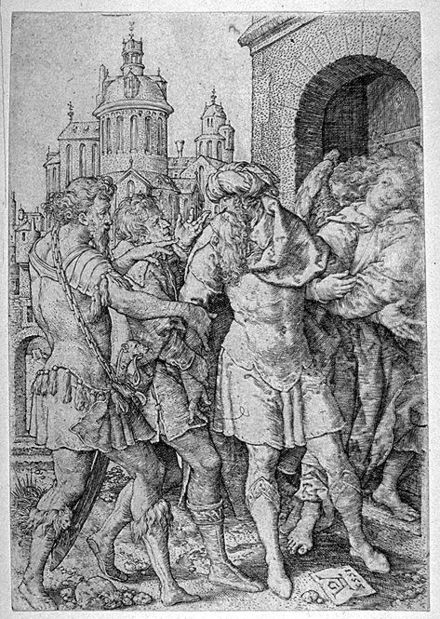
Lot Prevents the Sodomites from Raping the Angels, by Heinrich Aldegrever, 1555

The men of Sodom believe that the two strangers in Lot’s house are ordinary men who can be degraded through rape. They do not care about other people; they only want to prove how powerful they are. Lot steps out, closing the door behind himself, and begs the men of Sodom not to do an evil deed. He volunteers to send out his own two virgin daughters for them to rape instead. (This offer indicates that he is not a tzadik, but his hospitality to strangers indicates that he is not wicked like the native Sodomites.)

The men of Sodom reject Lot’s offer.

And they moved forward to break the door. But the “men” [inside] stretched out their hands and brought Lot inside the house with them, and they shut the door. And the men who were at the entrance of the house, from small to big, they struck with a blinding light; and they were powerless to find the door.

The two malakhim urge Lot to collect his married daughters and their families, so they can all flee together before Sodom is annihilated. Although Lot believes the malakhim, he cannot persuade his sons-in-law to take the warning seriously. When he returns to his own house at dawn, the two malakhim urge Lot to leave at once with his wife and his two unmarried daughters. Lot hesitates, and the malakhim grasp the hands of all four humans and drag them out of the city.

Then God rained down on Sodom, and on Gomorrah, sulfur and fire from God,  from the heavens. (Genesis 19:24) 

We can deduce that God sends two malakhim to Sodom in order to confirm that all the men there (except Lot) really are evil, and to rescue Lot and his wife and virgin daughters. The rescue requires a magical power (blinding the Sodomites) and four hands with a firm grip.

The encounter with the two malakhim from God does save four human lives, but it does not redeem them. Lot’s wife ignores the warning of the malakhim not to look back, and turns into a pillar of salt. Lot gets drunk and has incestuous intercourse with his two remaining daughters, providing an excuse for the author to insult the kingdoms of their descendants, Moab and Ammon. (See my post Vayeira & Noach: Drunk and Disorderly.)

A dream

Abraham travels on to Gerar, where the Torah gives us a second version of the wife-sister story.6

And Abraham said about Sarah, his wife: “She is my sister.” And Avimelekh, the king of Gerar, sent for and took Sarah. Then God came to Avimelekh in the dream at night, and said to him: “Hey, you will die on account of the woman that you took, for she is the wife of a husband.” (Genesis 20:2-3)

In his dream, the king defends himself, protesting that Abraham and Sarah lied to him, and anyway he has not yet touched Sarah, so he is innocent. Avimelekh’s argument is successful.

And God said to him in the dream: “I also know that you did this with an innocent heart, and I  also held you back from doing wrong to her. That is why I did not let you touch her.” Genesis 20:6)

After claiming credit for the disease that caused King Avimelekh’s delay, God orders him to restore Sarah to her husband. He does so, throwing in some portable wealth to be on the safe side, and God heals him.

In this case, God participates in Abraham’s scam, but then sends Avimelekh a dream that gives him a chance to defend himself. When he does, God remits his punishment. As in the first wife-sister story, Abraham goes unpunished.

About Ishmael

After Abraham and Sarah return from Gerar, Sarah does indeed have a son at age 90. Several years later, at her son Isaac’s weaning feast, she is disturbed by the behavior of Abraham’s first son, Ishmael. Sarah orders her husband to cast out Ishmael and his mother, the slave-woman Hagar, in order to prevent Ishmael from sharing Isaac’s inheritance. (See my post Vayeira: Failure of Empathy.) Abraham is not happy about this order from his wife.

But God said to Abraham: “Don’t let it be bad in your eyes about the boy and about the slave-woman. Everything that Sarah says to you, listen to her voice! … And also I will set the son of the slave-woman as [the founder of] a nation, because he is your seed.” (Genesis 21:12)

Perhaps this promise makes Abraham feel absolved of responsibility for the adolescent boy. He sends off Ishmael and Hagar with only some bread and one skin of water, and nothing to give them a start on a new life. The mother and son run out of water in the desert.

Hagar in the Desert, by Gheorghe Tattarescu, 1870, detail

And God listened to the sound of the boy [crying], and a malakh of God called to Hagar from the heavens and said to her: “What is it, Hagar? Don’t be afraid. Because God has listened to the sound of the boy where he is. Get up, lift up the boy, and hold your hand firmly in his. Because I will make him a great nation.” Then God opened her eyes, and she saw a well of water. (Genesis 21:17-19)

The words of the malakh might make Hagar feel more optimistic, but the important change is that Hagar now sees the water.

Abraham obeys again

Abraham hears from God for the last time in his life near the end of the portion Vayeira.

And it was after these things, and God tested Abraham. And [God] said to him: “Abraham!” And he answered: “Here I am.” And [God] said: “Take, please, your son, your only one,7 whom you love, Isaac. And go for yourself to the land of the Moriyah, and offer him there as a burned offering on one of the hills that I say to you.” And Abraham got up early in the morning and he saddled his donkey and he took two [slave] boys with him, and his son Isaac. And he split wood for the burnt offering and he got up and went to the place that God had said to him. (Genesis 22:1-3)

Abraham simply obeys. He does not argue with God. Apparently he does not remember the time when he debated with God about justice and the city of Sodom; he does not even mention that Isaac is innocent.

The Sacrifice of Isaac, by Tintoretto, 1550-55, detail

On the summit of the hill in Moriyah,

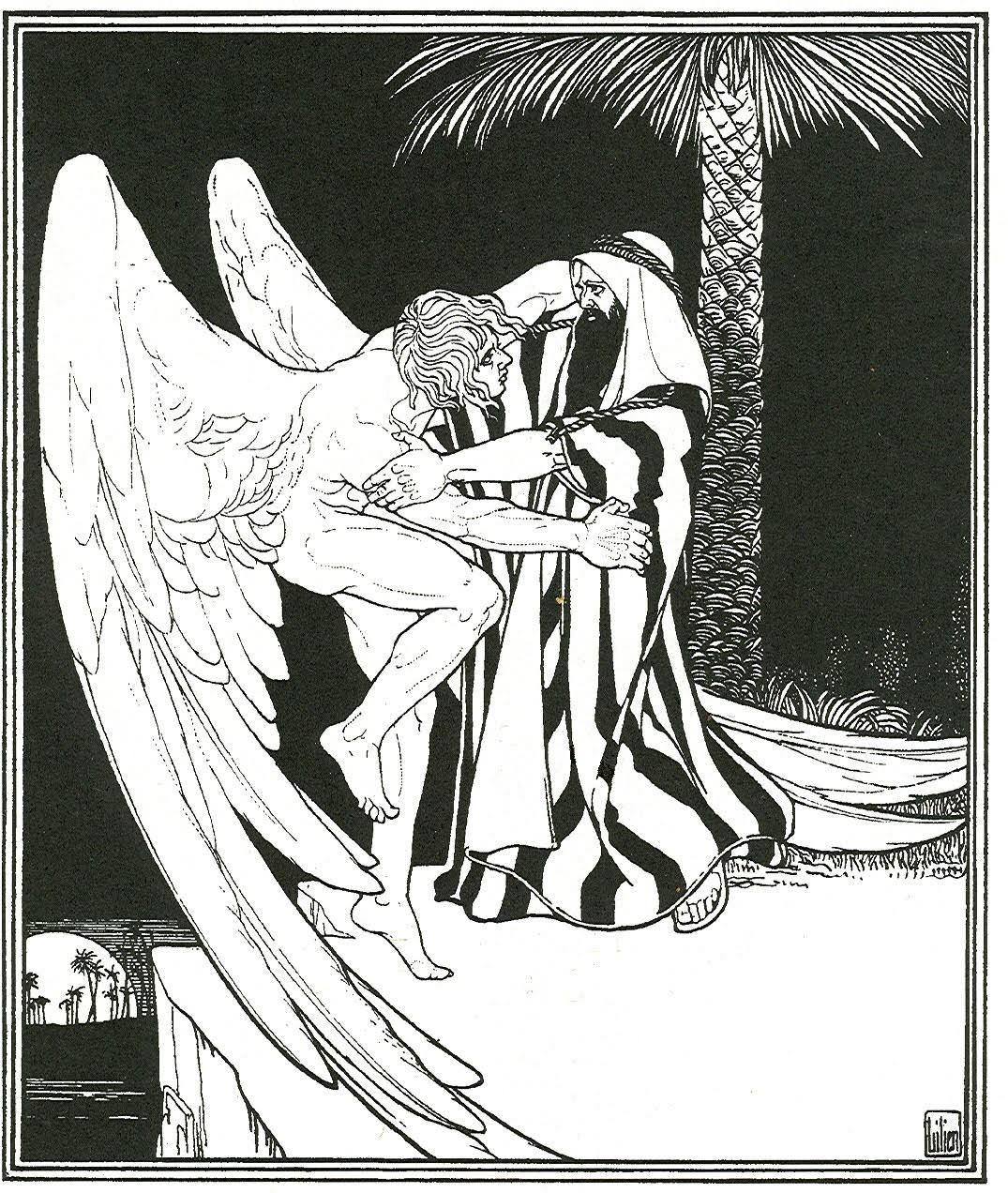
Abraham stretched out his hand and he took the knife to slaughter his son. Then a malakh of God called to him from the heavens, and said: “Abraham! Abraham!” And he said: “Here I am.” (Genesis 22:10-11)

In the Torah, when the speaker repeats the name of the person addressed, it means there was no answer the first time. Abraham is not even listening for God’s voice.

Once he has Abraham’s attention, the malakh from God says:

“You must not stretch out your hand against the boy, and you must not do anything to him. Because now I know that you fear God, and you have not withheld your son, your only one, from me.” (Genesis 22:12)

Abraham looks up, sees a ram caught in the bushes, and sacrifices it instead of Isaac.8 But as a result of his unquestioning obedience, he is estranged from his only remaining son for the rest of his life. And although Abraham appears in several more scenes in the book of Genesis, God does not speak to him again.


What does God achieve in the portion Vayeira through all these conversations, speaking with Sarah, Lot, Avimelekh, and Hagar as well as Abraham?

Abraham argues in favor of sparing Sodom if it contains ten innocent people, but then he fails to argue for the life of his own innocent son. Sarah is unaffected by the annunciation of Isaac, though she defends him after he is born. God spares Lot’s life, but Lot does not appreciate it, and falls into immoral behavior. Avimelekh protests to God in his dream, and God heals him—of the affliction God caused in the first place. And God does not tell Abraham anything that motivates him to behave decently to Hagar and Ishmael.

We can see God’s involvement in the lives of all five people: Abraham Sarah, Lot, Avimelekh, and Hagar. But if God had remained silent and distant in the portion Vayeira, the five humans might have been better off. And although the generations after Abraham have benefited from his argument that God is supposed to do justice, this benefit has been undermined by the story of his unquestioning obedience to an unjust command.

But without God’s conversations, the stories would have been less entertaining.


  1. God manifests to Abraham as a voice only in Genesis 12:1-3, and 13:14-17; and as voice with an accompanying visuals in Genesis 12:7, 15:1-21, and 17:1-22.
  2. God might be invisible, or manifest in a fire, or use a malakh; but nobody can see what God actually looks like. As God tells Moses in the book of Exodus, “No man can see me and live” (Exodus 33:20). Moses, Aaron, two of Aaron’s sons, and 70 elders do see God’s feet on a sapphire pavement in Exodus 24:10, but this does not count.
  3. Cf. the single malakh who announces the coming birth of Samson in Judges 13:2-24.
  4. Genesis 11:5 in the portion Noach.
  5. Abraham and Lot separate in Genesis 13:1-13.
  6. The first wife-sister story is in Lekh-Lekha, in Genesis 12:11-20. See my posts Lekh Lekha, Vayeira, and Toledot: The Wife-Sister Trick, Part 1, Part 2, and Part 3.
  7. We know Abraham has two living sons, so why does God call Isaac “the only one” (yechidekha, יְחִידֶךָ)? I believe here the word means “the only one remaining to you”, since Ishmael has been banished.
  8. See my post Vayeira: Stopped by an Angel.

Lekh Lekha: Abraham’s Heir

When you die, what do you leave behind in the world of the living?

Someone inherits your wealth: land, money, or—for nomads in the Ancient Near East—the  livestock and slaves you own. Someone may take your place at work or in your community. And some people will remember you and tell stories about you, for good or bad.

What do you want to leave behind, and who do you want to your heirs to be?


The question of inheritance is a major concern in this week’s Torah portion, Lekh Lekha (Genesis 12:1-17:27), and for the next six portions. For three generations, from Abraham to his grandson Jacob, the men and women in his family tree try to manipulate events in order to control who will inherit.

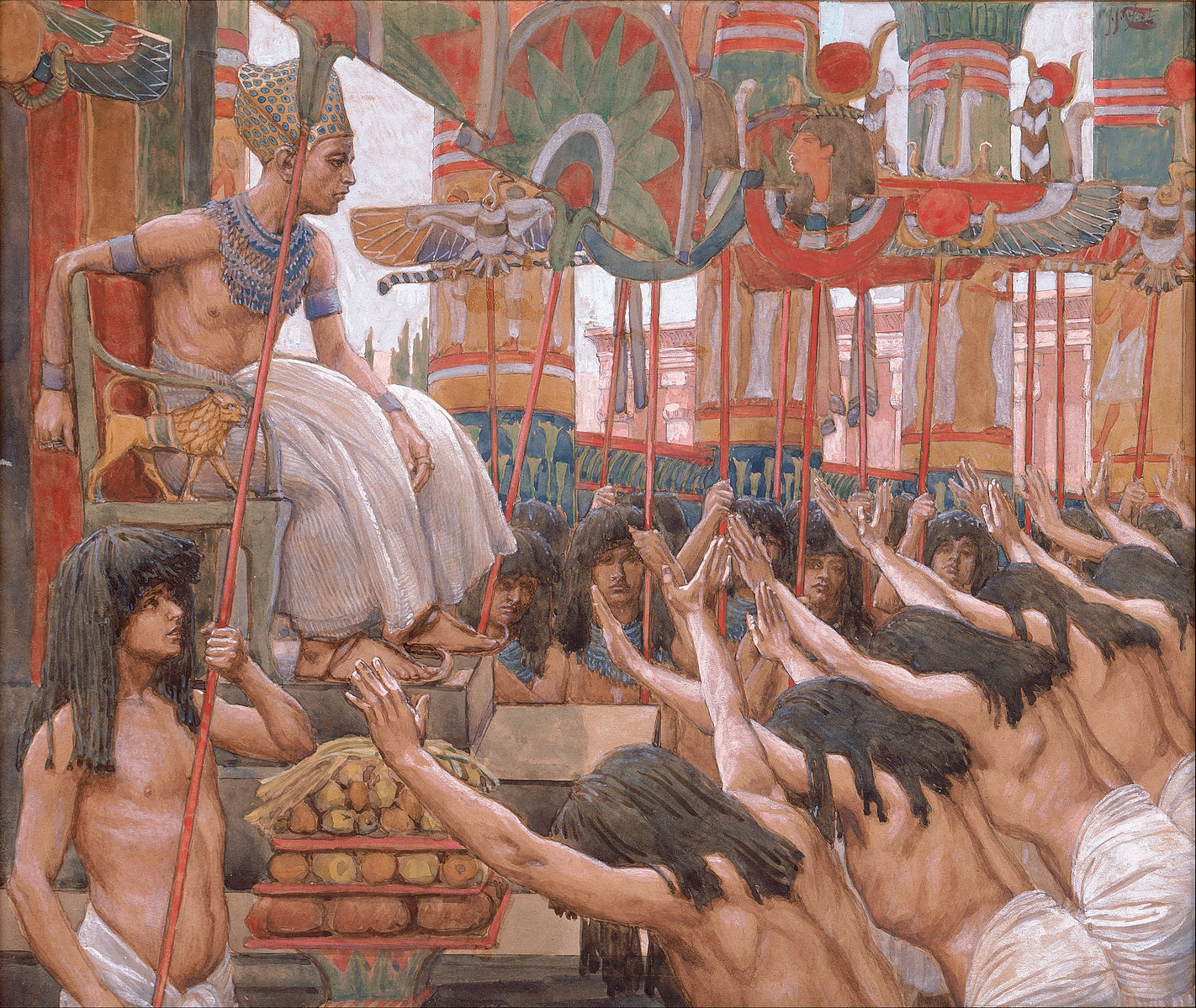
Abraham appears (under his original name, Avram) at the end of a long genealogy in last week’s portion, Noach. Nine generations after Noah, Terach was living in the city-state of Ur in southern Mesopotamia when he begot three sons: Avram, Nachor, and Haran. All three sons grew up and got married in Ur. Haran died there. Terach set out for Canaan with Avram and his wife Sarai, and Haran’s son Lot. Before they reached Canaan, they stopped and settled in the Aramaean town of Charan in northern Mesopotamia.1 Later we learn that Nachor and his wife also settled in Aram.2

Possible heir #1: Lot

When Avram is 75, God tells him:

“Get yourself going away from your land and your clan and your father’s house, to the land that I will show you! And I will make you a great people, and I will bless you. I will make your name great, and it will become a blessing. And I will bless those who bless you, and I will curse those who belittle you.” (Genesis 12:1-2)

In the Torah, someone becomes “a people” by having numerous descendants who become an ongoing society or even country. A great name means fame or a great reputation. Already God has promised Avram two roles that his heirs might inherit: the leadership of a whole people, and a name that can trigger divine blessing or curse.

And Avram went, as his god, Y-H-V-H, had spoken. And Lot went with him. And Avram was 75 years old when he went out from Charan. And Avram took his wife Sarai, and his brother’s son Lot, and all their acquisitions that they had acquired, and the persons that they had made [their own] in Charan; and they left to go to the land of Canaan. (Genesis 12:4-5)

Without an explicit direction from God, Avram heads toward Canaan, his father’s intended destination. Besides his wife and his nephew, Avram takes all his possessions with him—mostly livestock and slaves. He stops at the site of Shekhem in Canaan, where God appears to him and says: “I will give this land to your offspring.” (Genesis 12:7)

This confirms that Canaan was the right place to go. Avram does not question God’s promise to give Canaan to his offspring, even though he has no children and Sarai is already 65. The household migrates south through Canaan, from Bethel to the Negev. When a famine comes, they go to Egypt, where Avram uses Sarai to pull a scam on the pharaoh. (See my posts Lekh-Lekha, Vayeira, & Toledot: The Wife-Sister Trick, Part 1 and Part 2.)

It went well on account of her, and he acquired flocks and cattle and male donkeys and male slaves and female slaves and female donkeys and camels. (Genesis 12:16)

When Avram, Sarai, and Lot return to Canaan with and all their possessions,

Avram was very heavy in livestock and in silver and in gold. (Genesis 13:2)

At this point, Avram has great wealth to pass on to his heir. The right heir might also inherit his connection with divine blessing, and his ability to hear God. Avram’s presumed heir at the beginning of Lekh Lekha is his nephew Lot. But when they return to Bethel, Avram and Lot decide to go their separate ways.

Lot, who went with Avram, also had flocks and cattle and tents. And the land could not support them [if they were] staying together … And there was quarreling between the herdsmen of Avram’s cattle and the herdsmen of Lot’s cattle. (Genesis 13:5-7)

Avram gives his nephew first choice of pastureland, and Lot claims “the whole plain of the Jordan”—the river valley and the land near the Dead Sea—because it has lots of water.

And they separated, each man from his kinsman. Avram stayed in the land of Canaan, and Lot settled in the cities of the plain, and he pitched his tent near Sodom. (Genesis 13:11-12)

The Torah never specifies the borders of Canaan, only the borders of the future kingdom of Israel.3 It does locate some towns as being in Canaan, but Sodom is not one of them. The passage above indicates that Lot rejects Canaan in favor of Sodom. This may be the point when Avram realizes Lot will not be his heir.4

As soon as Lot has left, Avram hears God repeat the promise that Avram’s offspring will someday own the land of Canaan.

And God said to Avram, after Lot had separated from him: “Raise your eyes, please, and look around from the place where you are, to the north and to the south and to the east and to the west. For all the land that you see, I give it to you and to your offspring forever. And I will make your offspring like the dust of the earth, so that if anyone is able to count the dust of the earth, he can count your offspring.”  (Genesis 13:14-16)

Possible heir #2: Eliezer

The next time God appears to Avram in a vision, God says:

“Don’t be afraid, Avram. I am a shield to you. Your wages will be very great.” (Genesis 15:1)

Avram does not ask what God is paying him for. But he does ask who will inherit God’s reward:

“What could you give me, when I am going childless, and the one maintaining my household is Eliezer of Damascus?” (Genesis 15:2)

When God does not answer, Avram explains:

“Since you have not given me offspring, then hey! The one over my household yoreish from me.” (Genesis 15:3)

yoreish (יוֹרֵשׁ) = will inherit

Perhaps Avram nudging God to provide him with his own son, so he can have the descendants God promised. There is nothing wrong with his steward Eliezer, especially if he is the same unnamed senior servant who, years later, goes out of his way to procure the right wife for Avram’s son Yitzchak (Isaac in English).5 But like most men in the Hebrew Bible, Avram wants an heir who is his own flesh and blood.

Then, hey! The word of God came to him, saying: “This one lo yiyrashekha, because one who goes out from your own loins, he yiyrashekha.” (Genesis 15:3-4)

lo yiyrashekha (לֹא יִירָשְׁךָ) = will not inherit land or property from you, will not get your possessions. (Lo, לֹא = not + yiyrashekha,יִירָשְׁךָ = will inherit land or property from you, will get your possessions.)

Then God again promises Avram an uncountable number of descendants.

Possible heir #3: Yishmael (Ishmael)

When Avram is 85 and his wife Sarai is 75, long past menopause, Sarai decides to give her husband an heir without waiting for a miracle.

And Sarai, Avram’s wife, had not borne children to him. And she had an Egyptian slave-woman, and her name was Hagar. And Sarai said to Avram: “Hey, please, God has kept me from bearing children. Please come into my slave-woman. Perhaps I will have a son through her.” And Avram paid attention on Sarai’s voice. (Genesis 16:1-2)

This was not an unusual strategy in the Ancient Near East. Childless women assign surrogates to their husbands and then adopt the resulting progeny both in the Mesopotamian laws of Hammurabi and in another story in Genesis, when Rachel and Leah ask their husband Jacob to produce more children for them by using their slave-women as surrogate mothers.5

And Hagar bore a son to Avram, and Avram called the name of his son that Hagar had borne Yishmael. And Avram was 86 years old when Hagar bore Ishmael to Avram. (Genesis 16:15-16)

The arrangement does not go well for Sarai or Hagar, but Avram acknowledges and grows fond of his son Yishmael (Ishmael in English).6

Possible heir #4: Yitzchak (Isaac)

When Avram is 99, and Sarai is 89, and Ishmael is 13, God appears to Avram again and says:

“Walk constantly in my presence, and be blameless. Then I will establish my covenant between me and you, and I will make you very, very numerous.”

At first the deal appears to be that Avram will behave perfectly, and in return God will give him those long-promised descendants. But then God continues:

“Behold my covenant with you: You will be a father for a hamon of nations. And you will no longer be called the name Avram, but your name will be Avraham; because I will give you a hamon of nations. And I will make you very, very fruitful, and give you nations, and kings will go out from you. And I will establish my covenant between me and you and your descendants after you for generations as a covenant forever: to be a god for you and your descendants after you. And I give you and your descendants after you the land of your sojourning, all the land of Canaan, as a possession forever, and I will be their god.” (Genesis 17:4-8)

hamon (הָמוֹן) = crowd, noisy procession, uproar. (From the root verb  hamah,הָמה  = roar, make an uproar. Avram’s new name, Avraham, incorporates the root hamah.)

Now God’s side of the covenant is to give Avraham crowds of descendants who will possess the land of Canaan; and to act as their god, presumably by paying special attention to their welfare.

Then God tells Avraham what he must do for his side of the covenant:

“This is my covenant that you must keep, between me and you and your descendants after you: Be circumcised, every male among you. And they must be circumcised, the flesh of your foreskins, and it will be a sign of the covenant between me and you.” (Genesis 17:10-11)  

In future generations, God adds, the circumcision should happen when a male infant is eight days old; and every man should also circumcise his male slaves.

And God said to Avraham: “Sarai, your wife—her name will not be called Sarai, because Sarah will be her name. And I will bless her, and even give you a son from her. I will bless her and she will become nations; kings of nations will come from her!” And Avraham threw himself on his face and he laughed, and he thought in his heart: Can a son be born to a hundred-year-old? Or can Sarah bring forth a child at ninety? And Avraham said to God: “May Ishmael live before your presence!” (Genesis 17:15-18)

Avraham seems content with Ishmael as his son and heir. Why does he need another? God reassures him that Ishmael will have twelve children and found a nation of his own. But the heir to Abraham’s property and relationship with God will not be Hagar’s son, but Sarah’s son, whom he must name Yitzchak.

“And my covenant I will establish with Yitzchak, whom Sarah will bear to you at this time next year.” (Genesis 17:21)

So Avraham’s own wife will miraculously give birth to Yitzchak, who will inherit God’s covenant with Avraham: God’s attention, the obligation of circumcision, and the equivalent of a deed to the land of Canaan. And that is not all Yitzchak inherits. God also blesses him7 and makes him a blessing to others.8 When Avraham himself dies at age 175, in the Torah portion Chayei Sarah, he leaves his wealth and livestock business to Yitzchak.

And Avraham gave everything that was his to Yitzchak. But to the sons of Avraham’s concubines, Avraham gave gifts, and he sent them away from his son Yitzchak while he was still alive, eastward to the land of the east. (Genesis 25:6)

Thus Yitzchak, the fourth person under consideration as Avraham’s heir, inherits his father’s wealth, livestock business, position as a blessing to others, deed to the land of Canaan, covenant with God, and ability to speak with God. Avraham left a lot to inherit, and he was happy with his heir.

And Avraham died at a good ripe age, old and satisfied. (Genesis 25:8)


When you die, what will you leave behind in the world of the living?

Someone will inherit your wealth. Someone may take your place at work or in your community. Some people will remember you and tell stories about you, for good or bad. And some may inherit your personality, or your attitude toward God.

Will you be satisfied with what you leave behind? Will you be satisfied with your heirs?


  1. Genesis 11:27-31.
  2. Genesis 22:20-22 and 24:10.
  3. Numbers 34:1-12.
  4. In chapter 14 of Genesis, invaders from the north raid Sodom and its neighbors, capture Lot and other residents of Sodom, and carry them off along with the loot. Abraham and his 318 men rescue all the captives, either because Sodom is one of Abraham’s allies at the time, or because he feels affection and/or responsibility for his nephew. But Lot returns to his home in Sodom, not to Avram’s camp in Canaan.
  5. Genesis 24.
  6. See my post Lekh Lekha: Belittlement.
  7. Genesis 30:1-13.
  8. Genesis 25:11.
  9. Genesis 26:2-4.

Bereishit & Noach: What Ruined the World?

Creation, by Lucas Cranach, 1434

On the sixth “day” of creation God creates land animals, including humans.

And God saw everything [God] had made, and hey! It was very good. And it was evening and it was morning, the sixth day. (Genesis 1:31)

But by the end of this first Torah portion in Genesis, Bereishit, something has gone wrong.

Then God saw that the evil of humankind was abundant on the earth, and all the shapes of the plans of its mind were only evil all the time. And God had second thoughts about making the human being on the earth, and [God’s] heart was distressed. And God thought: “I will wipe out the human that I created from upon the face of the earth—from humankind to beasts to creeping animals to flying animals in the sky—because I have had second thoughts about making them.” But Noach found favor in the eyes of God. (Genesis 6:5-8)

Noach (נֺחַ) = rest, resting-place; the personal name “Noah” in English.

Humans are generating so much evil that God wants to roll back creation to somewhere on the fifth “day” and start over again.

What kind of evil? The beginning of this week’s Torah portion, Noach (Genesis 6:9-11:32), narrows it down a bit.

The earth had become ruined in front of God; the earth was filled with chamas. And God looked at the earth, and hey! It was ruined, because all basar had ruined its ways on the earth. And God said to Noach: “The end of all basar is coming before me! For the earth is filled with chamas because of them. So here I am, ruinging them along with the earth! Make for yourself an ark of gofer wood …” (Genesis 6:11-14)

chamas (חָמָס) = violence.

basar (בָּשָׂר) = soft tissue of a human or other animal, including skin, muscle, meat; animals in general. (See my post Bereishit & Noach: All Flesh.)

After giving instructions for building the ark, God tells Noach:“As for me, here I am bringing the flood waters over the earth, to ruin all basar with a breath of life in it under the skies.” (Genesis 6:17)

All flesh

In the Noach story, the phrase “all flesh” (kol basar) means all non-human land animals four times in order to emphasize that Noach and his family are saving a pair of every type of animal.  “All flesh” means all land animals, including humans, eight times in the Noach story.1 For example:

And all basar expired: the crawlers on the earth, birds and beasts, and all swarming creatures that swarm on the earth, and all the human beings. Everything that breathed the air of life in its nostrils, out of all that were on dry land, died.  (Genesis 7:21-22)

The portion Noach states at the beginning that all basar had “ruined its ways on the earth” (Genesis 6:12), and then God tells Noach: “the earth is filled with chamas because of them” (Genesis 6:13). It is reasonable to conclude that God floods the earth because all land animals, including humans, are ruining God’s creation through violence.

What kind of violence?

What kind of chamas has ruined the earth? Classic commentators suggested four answers2:

Robbery. For example, “There is a discussion between the sages as to the difference in meaning between the word: חמס (violence) and the word גזל (robbery) when used in the Holy Scriptures. According to Rabbi Chaninah, the difference is merely in the amount misappropriated by violent means.” (Chizkuni, in response to earlier commentary including Rashi).

I reject robbery as a candidate because although I can imagine one animal biting another in order to steal its stash of food, this kind of behavior is never mentioned in the Torah.

Idolatry. For example, “Ḥamas refers to idolatry, as it is stated [in Ezekiel 8:17—Is it so little for the house of Judah, doing the abominations that they do here, that] they filled the earth with ḥamas?” (Bereishit Rabbah 31:6).

I reject idolatry as a candidate for two reasons: 1)  Ezekiel might have meant that the Judahites were violent in addition to committing abominations, and 2) Non-human animals exhibit no god-worshiping behavior, violent or otherwise.

Sexual misconduct. For example, “The dog would consort with the wolf, and the chicken would consort with the peacock.” (Bereishit Rabbah 28:8). “All flesh engaged in unnatural and perverted sexual acts.” (Ibn Ezra). “They raped women against their will.” (Chizkuni).

I reject this theory because no sexual violence or other sexual misconduct is mentioned in the Torah until after the flood.

Shedding innocent blood. For example, “Ḥamas refers to bloodshed, as it is stated: “[in Joel 4:19—Egypt shall be a desolation and Edom a desolate waste] due to the ḥamas against the children of Judah, that they shed innocent blood.” (Bereishit Rabbah 31:6).

Shedding innocent blood certainly counts as chamas, and too much of it might well make the God character conclude that the world is ruined. The quote from the book of Joel in Bereishit Rabbah refers to humans shedding the blood of other humans, but it is also possible that the word chamas applies to other kinds of bloodshed.

When God has second thoughts about the world, what innocent blood is being shed, and by whom? The Torah portions Bereishit and Noach support two different answers. In one, humans and some of the other animals are shedding the blood of innocent animals in order to eat them. In the other, evil humans are murdering innocent humans.

Carnivores versus herbivores

On the sixth “day” of creation, God tells the first humans:

“Hey! I give you all seed-bearing plants that are on the face of the whole earth, and all the trees with seed-bearing fruits; they shall be your food. And to all animals on the land, and all birds in the skies, and all crawlers on the ground that have the animating soul of life in them: all green plants for food.” (Genesis 1:29-30)

Thus God’s original plan is for all animals, including humans, to follow a vegan diet. No animals are created to be carnivores.

The next episode in the book of Genesis is an older creation story, in which the first living thing God creates is the human being. Then God plants the garden of Eden and transfers the androgynous human there. God gives it permission to eat fruit:

“From every tree of the garden you may certainly eat. But from the Tree of the Knowledge of Good and Evil, you should not eat from it …” (Genesis 2:16-17)

Then God makes animals and brings them to the human to name. The approved diet for these animals is not mentioned. Later, when God is about to banish the first two humans from Eden, along with the snake, God says that in the real world the snake will eat dust.

“On your belly you will go, and dust you will eat, all the days of your life.” (Genesis 3:14).

Eating dust might be an idiom, as in English, leaving the snake’s actual source of nutrition unspecified. But God does say what the man will eat after he is expelled from the garden of Eden:

“And your food will be the plants of the field. By the sweat of your face you will eat bread.” (Genesis 3:18-19)

Perhaps, over time, all flesh—humans and other predatory animals—ruin the world that God created by becoming carnivores. After all, eating meat, basar, requires the death of an animal—a violent act of bloodshed, since any animal struggles against its killer.

If this is the widespread chamas that is ruining the world, the flood makes sense as God’s solution. If all flesh were wiped out, God could repopulate the earth with creatures designed so they would stay vegetarian.

Yet after the flood is over, God decides to put up with the evil inclinations of humans. God specifically accepts the practice of eating meat, telling Noach and his sons:

“Fear and dread of you will be upon every beast of the earth, and upon every bird of the skies, in everything that crawls on the ground, and in every fish in the sea; into your hand I give them. Every crawler that is alive will be yours for eating; as with green plants, I give them all to you.” (Genesis 9:2-3)

The only caveats God makes are that humans must not drink an animal’s blood; and that neither a human nor a beast can shed human blood and get away with it.

Whoever sheds the blood of humankind, by humankind his blood must be shed.” (Genesis 9: 6)

Killing and eating animals is now an acceptable form of violence; but human murder is not.

Human versus human

After the expulsion from Eden and before God decides to flood the earth, there is another story about chamas—one in which the evil behavior is murder, not eating meat.

Adam and Eve’s first son, Cain, farms the soil, and their second son, Abel, tends a flock. This division of labor bothered some classic commentators, who tried to reconcile being a shepherd with following God’s instructions to eat only plants.

“The one who became the shepherd was interested in eating the dairy products obtainable from the sheep and goats. He was also in need of the wool of the sheep to make clothing. They restricted themselves to these vocations, seeing that God had not permitted the eating of meat but only grass, fruit of the trees, and bread …” (Radak)3

The Torah does not report that any of the first four humans eats a sheep or goat. But Abel does become the first human to kill an animal.

And Cain brought from the fruit of the ground an offering to God. And Abel, also he, brought from the firstborn of his flock and from their fattest. And God paid regard to Abel and to his offering. But to Cain and to his offering, [God] paid no regard. And Cain was very angry and his face fell. (Genesis 4:3-5)

In the Torah, every animal offering is butchered, and at least part of it is burned up into smoke, which God enjoys smelling. (See my post Pinchas: Aromatherapy.) Since God indicates approval of Abel’s offering in some way, we can conclude that God is not distressed when Abel kills an animal in his flock. Perhaps animal-killing is acceptable as an act of worship, even though eating its flesh is still unacceptable.4

Cain is so upset about God’s preference for Abel that he becomes the first human to commit murder. We can assume that the murder involves violent bloodshed, since God tells Cain:

“And now you will be more cursed than the ground, which opened its mouth to take in the blood of your brother from your hand!” (Genesis 4:11)

Cain and Abel, 1624 print by Francesco Villamena, after Raphael

The next biblical reference to killing a fellow creature, human or beast, is when six generation later a man named Lemekh brags:

“I have killed a man for crushing me, and a boy for bruising me!” (Genesis 4:23)

Then (after a quick, unconnected story about lesser gods mating with human women to produce heroes) God sees that humankind has become evil, and all basar has filled the world with chamas.

One more indication that God does not object to humans killing beasts is that after the flood, Noah builds an altar, kills some extra animals, and burns them as offering to God. As in the story of Cain and Abel, God appreciates the animal offering.

And God smelled the soothing smell, and God said in [God’s] heart: Never again [will I] curse the ground on account of humankind, because the impulse of the human heart is evil from its youth. And never again [will I] strike down all life, as I have done.” (Genesis 8:20-21).

According to classic commentary, God decides that it is only natural for children to act on their bad impulses, but adults can learn to control these impulses and be good. Throughout the Torah, sacrificing animals to worship God is considered good behavior. God must think so, too, even before the flood. (See my post Noach: The Soother.)

“He ascribes merit to men because by their very creation they have an evil nature in their youthful days but not in their mature years.” (Ramban)5

After that, God explicitly gives Noah and his sons permission to eat meat—although presumably they will have to wait until the animals they saved on the ark have reproduced.

Why does God wipe out not only humankind, but all animals?

If the chamas that distresses God is carnivorous behavior, then why does God drown all the land animals, including herbivores? Is it too much work to create a plague that kills only the carnivorous species?

Similarly, if the kind of chamas that distresses God is human murder, then why does God make a flood that wipes out not only humankind, but also every land animal that is not on Noah’s ark?

The Talmud imagines God answering:

“Did I create domesticated animals and non-domesticated animals for any reason other than for man? Now that man sins and is sentenced to destruction, why do I need domesticated animals and non-domesticated animals?” (Talmud Bavli, Sanhedrin 108a)5

In other words, God drowns the other animals because they have no value apart from their usefulness to humans. After all, in the first creation story God tells the newly created humans:

“Be fruitful and multiply, and fill the earth and subjugate it, and rule over the fish of the sea and over the birds of the skies and over everything alive crawling on the land.” (Genesis 1:28)

In Genesis, non-human animals are clearly inferior to humans, and do not deserve the same respect. Therefore if a flood is the easiest way to wipe out the whole human population, the fact that it wipes out other animals as well is irrelevant to God—as long as enough are preserved on the ark to repopulate the world, and to be burned as offerings to God.


What is the chamas that makes God have second thoughts about creating the world? The book of Genesis provides evidence for both the theory that the world is ruined by carnivorous behavior, and the theory that the world is ruined by human murder. But God and humankind are made in the same “image”, and the death by violence of a fellow human usually causes the most despair in humans themselves.

Today, chamas (חָמָס) is the Hebrew spelling of the Arabic acronym Charakat al-Muqawama al-Islamiya (“Islamic Resistance Movement”)—spelled “Hamas” in English. This group, founded in 1987, has been the de facto government of the Gaza strip since 2007. As I write this post, Hamas is engaged in a terrorist invasion of Israel marked by personal violence.

Since “the impulse of the human heart is evil from its youth”, what will it take for all of humanity to learn to reject violence?


  1. Kol basar refers to all non-human animals in Genesis 6:19, 7:15, 7:16, and 8:17. Kol basar refers to all animals including humans in 6:12, 6:13, 6:17, 7:21, 9:11, 9:15 (twice), and 9:17. The phrase does not refer to all human flesh until Deuteronomy 5:23.
  2. Translations of Chizkuni (13th century) and Bereishit Rabbah (4th-5th century C.E.), are from www.sefaria.org.
  3. Radak (Rabbi David Kimchi),13th century; translation from www.sefaria.org. Also see Siftei Chakhamim, 17th century, on Genesis 4:2.
  4. Of course, it is also possible that the author of the story of Cain and Abel was unaware of the vegetarian diet commanded in the two creation stories. Scholars date the story of the six days of creation to the 6th century B.C.E., and the subsequent stories in the Torah portion Bereishit to an earlier date.
  5. Talmud Bavli, Sanhedrin 108a:20, William Davidson translation, www.sefaria.org.

Bereishit: Before the Beginning

This week we roll the Torah scroll back to the beginning, and read:

First Day of Creation, Nuremberg Chronicle, 1493

Bereishit, God created the heavens and the earth and the earth had been tohu vavohu, and darkness over the face of tehom, and a ruach of Elohim was hovering over the face of the waters — then God said: “Light, be!” and light was. (Genesis/Bereishit 1:1-3)

Beginning

bereishit (בְּרֵאשִׁית) = in a beginning, at first, when first. (The prepositional prefix be- (בְּ) =in, at, among, through, by, when. Reishit (רֵאשִׁית) = (noun) a beginning, a first step, a starting point; (adjective) first-rate, choicest, best.)

Two possible accurate translations of Genesis 1:1 are “In a beginning, God created” or “When God first created”.

Although the old King James translation of the first word as “In the beginning” is no longer popular, it is also a reasonable possibility. Normally a prefix meaning “in the” would be ba (בַּ), not be- (בְּ). But reishit is an unusual word, in that it does not take a definite article even in contexts where the English translation would be “the beginning” or “the first step”. In 50 of the 51 times that reishit appears in the Hebrew Bible, there is no prefix indicating a definite article (“the”).1 And the word bereishit appears four times in the book of Jeremiah in the phrase “at the beginning of the reign of”.2

Therefore, the translation “In the beginning, God created” is also accurate—and it has a different implication. “In the beginning” indicates that there was only one beginning. “In a beginning” indicates that this creation story describes only one beginning, and there might have been—or will be—others.3

What does God create in this verse of the bible?

… the  shamayim and the eretz … (Genesis 1:1)

shamayim (שָׁמַיִם) = heavens, skies.

eretz (אֶרֶץ) = land, earth.

Shamayim, always plural, refers to the visible dome above the horizon containing the sun, moon, stars, and clouds. Birds fly in the shamayim. The heavens are not called the abode of God until Deuteronomy 26:15.4

Eretz can refer to a specific land (such as “Eretz Israel”), or to all the land in the world. Eretz can also mean “Earth”—our world—but not dirt, which is adamah. In Genesis 1:1-2 God has not yet created land, so eretz can only mean Earth or the world.5

Yet what God creates on the first “day” is not the heavens and the earth, but light:

Then God said: “Light, be!” and light was. And God saw the light, that it was good, and God separated the light from the darkness. And God called the light day, and called the darkness night. And it was evening and it was morning, one day. (Genesis 1:3-5)

What does God create first: the heavens and the earth, or light? 20th-century translator Everett Fox explained that “the shamayim and the eretzis “probably a merism—an inclusive idiom meaning ‘everything’ or ‘everywhere’—such as Hamlet’s ‘There are more things in heaven and earth …’”

So Genesis 1:1 actually means one of the following:

  1. In the beginning, God created the world—
  2. In a beginning, God created the world—
  3. When God first created the world—

Translation 1 implies that God created only one world, and this is it. There was a single moment when creation began; the moment when God created light.

Translations 2 and 3 leave the possibility open that our world is one of many that God has or will create. Other worlds may exist in a different time and/or space.

“There was a God before He created the world, who was perhaps involved in other things prior to choosing to turn His Divine attention to our homeland. … Genesis 1:1 is the biblical account of the commencement of our narrative journey, but not necessarily God’s.” (Dennis Shulman,)6

Translation 3 also opens the possibility that God’s creation of the world did not stop on the seventh “day”, but is ongoing.

“The Lord created the world in a state of beginning. The universe is always in an uncompleted state, in the form of its beginning. It is not like a vessel at which the master works to finish it; it requires continuous labor and renewal by creative forces. Should these cease for only a second, the universe would return to primeval chaos.” (Simcha Bunim Bonhardt)7

Tohu

You might have noticed that so far I have not referred to Genesis 1:2. This parenthetical but important verse is inserted between “When God first created the world” and “God said: Light, be! And light was.”

— and the eretz [Earth] had been tohu vavohu, and darkness over the face of tehom, and a ruach of Elohim was hovering over the face of the waters — (Genesis 1:2)

tohu (תֺהוּ)= emptiness, unreality; worthlessness, worthless people or things; chaos, shapelessness, undifferentiation.

vavohu (וָבֺהוּ) = “and the vohu”. The word vohu appears only three times in the bible,8 always as part of tohu vavohu. Therefore vavohu is probably an intensifier for tohu, and is often translated with an alliterative synonym, as in “void and vacant”, “chaos and confusion”, “a worthless waste”, “a hodge-podge”, or “a mish-mash”. Tohu vavohu could also mean “an insubstantial unreality”.

The word tohu appears in the Hebrew 20 times. Eleven of these occurrences use the word either as a synonym for “nothing”, or as a descriptor of an empty, depopulated desert.9 In six other places, tohu is a synonym for either “worthlessness” or “worthless people or things”.10 This leaves two occurrences of the word tohu that are harder to translate. One is the tohu vavohu in Genesis 1:2; the other is in second Isaiah.

The creator of the heavens, he is God,
          who formed the earth and made it.
          He established it.
He did not create tohu;
          For dwelling he shaped it. (Isaiah 45:18)

In other words, God created the world as an orderly place to live in; God did not create undifferentiated chaos.

One opinion in the commentary is that tohu is indeterminate matter that has the potential to become something definite.

“The first raw material was something entirely new. It is described as tohu to indicate that at that point it was merely something which had potential, the potential not yet having been converted to something actual.” (Sforno)11

It seems that when God began to create the world in the book of Genesis, tohu already existed. That means God did not create the world ex nihilo, out of nothing, as many Jewish and Christian commentators have claimed from the first century C.E. onward. God had tohu, at least, as a raw material—though God may have previously created tohu vavohu, darkness, and tehom.

On the other hand, some commentators claim that these words describe what the universe was like before God created anything.

“At the beginning of creation, God encounters primordial material (Genesis 1:2) … The universe in its pristine state betrayed a disorganization and utter lack of order which God found intolerable and on which He felt compelled to impose order. … His dissatisfaction with the chaotic state of existence leads to the reordering, classifying, and distinguishing described in the primordial week of creation.”12

“This description raises two questions potentially troubling to monotheism. First, if God did not create the primeval entity, who did? And second, doesn’t the claim that there are elements of the universe that predated Creation diminish God’s omnipotence and sovereignty? … I believe that scripture would like us to understand that these materials were always there, coexistent with God.”13

Darkness and water

Tohu vavohu is not the only thing that already exists when God begins to create.

— and the earth was tohu vavohu, and darkness was over the face of tehom,and a ruach of God was hovering over the face of the waters— (Genesis 1:2)

tehom (תְהוֹם) = a place of deep water, i.e. a sea bed or an underground spring. The word is often translated as “deeps” or “abyss”.14

ruach (רוּחַ) = wind; spirit; mood or disposition. (Ruach is also one of several words that mean “breath”.)

In Genesis 1:2, either a divine wind is preparing to expose the land that lies underneath the water (as the east wind exposes the land under the Reed Sea in Exodus); or God’s spirit (or metaphorical breath) is hovering over the water while God decides what to do.

Are darkness and deep waters part of tohu vavohu? Or are they separate materials that were also present before God began to create the world? Classic commentators considered the original tohu as both dark and watery.

“Darkness and silence were before the world was made, and silence spoke and the darkness became visible.” (Pseudo-Philo)15

“This tohu vavohu is alternately referred to by the Torah as “water” … at this point God wanted to imbue this tohu vavohu with some quality, [some] useful meaning, hence God’s spirit moved above it in order to inspire such a change. When something assumes definitive, solid dimensions, it has become qualitatively superior to water, which slips through one’s fingers, cannot be held in one’s hand. This mass which has thickened out of a primordial murky liquid something is—the earth.” (Radak)16

Speech and separation

Yet the text in Genesis does not say that God turned tohu, darkness, or water into the items God creates over the course of six “days”.

When God first created the heavens and the earth—and the Earth was tohu vavohu, and darkness was over the face of deep water, and a ruach of God was hovering over the face of the waters—then God said: “Light, be!” and light was. And God saw the light, that it was good, and God separated the light from the darkness. And God called the light “day” and called the darkness “night”, and it was evening and it was morning: one day. (Genesis 1:1-5)

Tohu, darkness, and deep waters existed before God created light. But God creates light by speaking. And simply commanding light to exist makes it so—ex nihilo.

So on the first “day” of creation, the world includes both the darkness that pre-existed the beginning of creation, and the light that God creates ex nihilo. God separates light from the existing darkness—a separation in time, distinguishing day from night.

On the second day God speaks again, and creates a dome or vault that separates the waters into two areas, one below the dome and one above it. This is the first separation in space.

Second Day of Creation, Nuremberg Chronicle, 1493

And God called the dome shamayim [heavens, skies]; and it was evening and it was morning, a second day.  (Genesis 1: 8)

When God speaks on the third day, the waters below the skies collect into one place and dry land appears.

And God called the dry land eretz [earth], and called the gathering of the waters: seas. And God saw that it was good. (Genesis 1:10)

Thus God’s first creations in Genesis are light, sky, and land—as well as time and space.

Apparently God is dissatisfied with what already exists (tohu, darkness, and tehom), so God creates light using speech alone, then makes separations and sets boundaries in both time and space to change the pre-existing raw materials into the sky, the land, and the seas.


Today someone writing about the creation of the world might start with the mysterious Big Bang about 13 billion years ago, when a single point of something suddenly existed. Billions of years later, a floating cloud of interstellar gas (mostly hydrogen) and dust (microscopic particles made of other elements) collapsed into a solar nebula – a spinning, swirling disk of raw material. Gravity made this nebulous tohu vavohu—excuse me, gas and dust—coalesce in the center to form our sun—and light was. Clumps of gas and dust farther out in the solar nebula compressed into planets. One of them was our Earth. Both creation stories are amazing.


  1. The exception is the word lareishit (לָרֵאשִׁית) = “for the first [fruits]” (Nehemiah 12:44).
  2. Jeremiah 26:1, 27:1, 28:1, and 49:34.
  3. See my post Bereishit: A First-Rate Beginning.
  4. The etymology of shamayim is uncertain. It may be related to an Akkadian word shamu, meaning “lofty”. If there was once an equivalent Hebrew root word shamah, the plural would be shamayim, i.e. “lofty places”. On the other hand, shamayim may be the Hebrew noun mayim (מַיִם), which means “waters”, with a prefix sh- (שְׁ) meaning “that is”. God makes the shamayim in Genesis 1:6-8 by separating the waters above from the waters below.
  5. According to modern scholars, Genesis 1:1-2:4 was written in the 6th century B.C.E. The first recorded proposal that our world is a sphere was made in the 5th century B.C.E. by Pythagorean astronomers. So the author(s) of Genesis chapter 1 would not imagine Earth as a sphere. They might use eretz to refer to our world, but not to a planet Earth.
  6. Dennis Shulman, The Genius of Genesis, iUniverse Inc., 2003, p. 25.
  7. Simcha Bunim Bonhardt, 1765-1827, translated in www.sefaria.org.
  8. Genesis 1:2, Isaiah 24:10, 34:11; Jeremiah 4:23.
  9. Deuteronomy 32:10; Isaiah 29:21, 40:17, 40:23, 41:29; Jeremiah 4:23; Psalm 107:40, Job 6:18, 12:24, 26:7.
  10. 1 Sam 12:21 (twice); Isaiah 44:9, 45:19, 49:4, 59:4.
  11. Ovadiah Sforno, 16th century, translation in www.sefaria.org.
  12. James A. Diamond, “Creating Order from Tohu and Bohu”, www.thetorah.com.
  13. Israel Knohl, The Divine Symphony: The Bible’s Many Voices, The Jewish Publication Society, Philadelphia, 2003, p. 12.
  14. The word tehom occurs 35 times in the Hebrew Bible. The only time tehom contains fire instead of water is in Amos 7:4.
  15. Pseudo-Philo, circa 70-150 C.E., translation in www.sefaria.org.
  16. Radak (an acronym for Rabbi David Kimchi, 1160–1235), translation in www.sefaria.org.

Shemini Atzeret: Returning to Normal

Take a week or two off work and out of your home. Spend it doing things you never do the rest of the year. When you come back from your vacation, it may be hard to resume your usual life. How do you return to normal?

This is the question Jews have faced for millennia in the month of Tishrei, the lunar month that falls in September or October in the Gregorian calendar.

  • 1 & 2 Tishrei: Rosh Hashanah, a new year observance with two days of services.
  • 10 Tishrei: Yom Kippur, a full day of fasting and praying for our misdeeds of the past year to be forgiven, and for God to enroll us for a good life in the new year..
  • 15-21 Tishrei: Sukkot.
  • 21 Tishrei: Hoshana Rabbah, the last day of Sukkot. (Friday, October 6 in 2023.)
  • 22 Shemini Atzeret.
  • 23 Simchat Torah.

And then, suddenly, life as usual resumes.

Sukkot Elaborations

Examining the Lulav, by Leopold Pilichowski, 1890’s

The Torah describes Sukkot both as a week for making animal, grain, and wine offerings at the altar in Jerusalem,1 and as a week for living in a sukkah (a temporary hut with a porous roof of branches or straw) and doing something unspecified with an etrog (a yellow citrus fruit) and branches from palm, myrtle, and willow trees (later bound together and called a lulav).2 (See last week’s post, Sukkot: Rootless.)

The Talmud reports that during the time of the second temple in Jerusalem, many people brought their lulav and etrog to an additional festivity at the temple: the pouring of a water libation every evening.

One who did not see the Celebration of the Place of the Drawing of the Water never saw celebration in his days. (Talmud Bavli, Sukkah 51a)3

An elaborate procession brought a large golden jug of water from the Siloam Pool at the southern end of Jerusalem to the top of the temple mount and up the ramp to the altar, while Levites played flutes and priests blew the shofar. There were so many oil lamps on poles in the temple courtyards that the whole city was lit up.

And the Levites would play on lyres, harps, cymbals, and trumpets, and countless other musical instruments. The musicians would stand on the fifteen stairs that descend from the Israelite [Men’s] Courtyard to the Women’s Courtyard. (Talmud Bavli, Sukkah 51a)

The high priest poured the water into a basin as a libation for God. Men danced and juggled flaming torches.

One time a Sadducee priest intentionally poured the water on his feet, as the Sadducees did not accept the oral tradition requiring water libation, and in their rage all the people pelted him with their etrogim.4 (Talmud Bavli, Sukkah 48b)

The water-pouring celebration, as well as the offerings at the altar, ceased when the Romans razed the second temple in 70 C.E. But to this day, many Jews continue to spend the week of Sukkot eating and even sleeping in a festively decorated sukkah, and ritually shaking a lulav and etrog in six directions, an ancient ritual to encourage the rainy season to begin.

Hoshana Rabbah

In the Torah there is nothing special about the seventh day of Sukkot except a change in the number of animals to offer at the temple altar.5 But the Talmud relates an additional change in observance. The Talmudic rabbis recall that at the start of Sukkot, cut willow branches were placed upright on the platform of the altar, so they leaned over the edge at the top. On each of the first six days of Sukkot, priests blew  signal on the shofar, and people walked in a circle around the altar, chanting two lines from Psalm 118:

I beg you, God, hoshiyah, na!

I beg you, God, make us prosper, na! (Psalm 118:25)

hoshiyah (הוֹשִׁיעָה) = Rescue! Save! (An imperative hifil form of the verb yasha, ישׁע = help, save, liberate.)

na (נָא) = please!

On the seventh day of Sukkot, people circled the altar not once, but seven times.6 This practice became incorporated into an additional morning prayer on Sukkot that begins with and repeats the words hosha na (הוֹשַׁע נָא), an Aramaic version of hoshiyah na. While chanting this prayer, congregants holding a lulav make a circuit around the sanctuary (at least in congregations that hold daily morning services during Sukkot).

The last day of Sukkot is called Hoshana Rabbah, when people circle seven times, and then strike the floor with willow branches until the leaves fall off—perhaps evoking either the change of season, or the final discarding of the old year’s misdeeds.

Shemini Atzeret

The last day of Sukkot is Hoshana Rabbah. Yet both Leviticus7 and Numbers mandate an eighth holy day. The Torah gives no explanation for this day, but merely lists the required offerings at the temple.

On the day of Shemini Atzeret, you must not you must not work at your occupations. And you must present a fire-offering, a soothing smell for God: one bull, one ram, seven yearling lambs, unblemished; your grain-offerings and your libations for the bull, the ram, and the lambs, by the legal count; and one hairy goat [for a] guilt-offering, aside from the perpetual rising-offering and its grain offering and libation. (Numbers 29:35-38) 

shemini (שְׁמִינִי) = eighth.

atzeret (עֲצֶֶרֶת) = holding back; festive gathering while refraining from work. (From the verb atzar, עָצַר = hold back, detain, retain, be at a standstill.)

The Talmud paints Shemini Atzeret as a quieter day than any day of Sukkot, since there was no water-pouring, and people were not even required to sit in a sukkah or hold a lulav and etrog.8 All they did was remain in Jerusalem for one more round of offerings at the temple.

Then what could Jews do to observe Shemini Atzeret after the second temple was razed in 70 C.E?

19th-century rabbi Samson Raphael Hirsch considered Shemini Atzeret a day of reflection. “Its purpose is to keep us before God … in order to strengthen our grasp of perceptions we have already gained, so that they remain with us for a long time. … on this day we gather up and hold fast to all the spiritual treasures that we have collected during the festival. Thus they will truly enrich us; thus we can integrate them into everyday life, which recommences at the end of the seventh day.” 9  

But for the last millennium, Shemini Atzeret has also been a day to pray for rain. Israel is a land with parched summers and few year-round rivers, so life depends on winter rains. The famines in the Hebrew Bible are the result of winter droughts. Winter is when fields are green, when barley and wheat grow so they can be harvested in the spring.

Nobody wants the winter rains to begin until we have moved out of the sukkah and back into our watertight homes. Nevertheless, we shake the lulav during Sukkot to evoke the sound of rain. On Shemini Atzeret, our liturgy includes two direct prayers for rain.

1) The second Amidah (standing) prayer begins:

You are powerful forever, God; bringing life to the dead, you are abundant in hoshiya—

hoshiya (הוֹשִׁיעַ) = helping, saving, rescuing. (An infinitive hifil form of the verb yasha.)

From Shemini Atzeret in the autumn to Pesach/Passover in the spring, we add the phrase:

bringing back the wind and bringing down the rain.

2) On Shemini Atzeret only, this praise of a God who brings rainstorms is preceded in some congregations by a prayer addressing “Af-bri”, and followed by a poem begging God to send us water. The prayer spoken on this day only begins:

Af-Bri is the name of the angel of rain, who thickens and shapes clouds to empty them and to make rain, water to crown the valley with green. May rain not be withheld from us because of our unpaid debts. May the merit of the faithful patriarchs protect those who pray for rain.

Sukkot is a celebration of the final harvest of the year, with gestures that anticipate rain for a new growing season. Shemini Atzeret is a plea for normal winter rain.

Simchat Torah

But that is not the end of our vacation from our usual lives. In the diaspora, a one-day holiday often lasts for two days.10 The second day of Shemini Atzeret has become Simchat Torah (“Rejoicing in the Torah”), an observance not of the agricultural cycle, but of the cycle of Torah readings. Rabbis from the 6th to the 11th century C.E. established the Torah portions for every week of the year, completing the book of Deuteronomy this week. For the last thousand years or so, Jews read the final passage about Moses’ death on the evening of Simchat Torah, then start reading about the creation of the world in the book of Genesis.11

Simchat Torah flag, 1900

Before we begin reading, we circle the sanctuary seven times, as on Hoshana Rabbah, but without the lulav; the leader holds a Torah scroll. At the start of each circuit, the congregation begins chanting the same verse people chanted on Hoshana Rabbah when they circled the altar of the second temple. When the circuit is complete, everyone sings and dances with the Torah scrolls. The holiday is as joyful as the water-pouring during Sukkot at the temple.

Then unrolling the Torah and reading about the end of Moses’ life in Deuteronomy is only a prelude to the birth of the whole world in Genesis.


How do you return to normal after a vacation? Especially if your vacation is a holy celebration?

I suggest that after the life-and-death solemnity of Yom Kippur, people need the seven (or eight) days of intense festivity called Sukkot. But after Hoshana Rabbah, the Israelites were not emotionally ready to simply go home and go back to work the next day. So they took an extra day, Shemini Atzeret, to hold back from normal life and let the holiness of their proximity to God sink in. Many centuries later, Jews found that this eighth day was not enough; they needed a final celebration to mark the end of an old life and the beginning of a new one. And Simchat Torah fit the bill.

Simchat Torah begins at sunset on October 7, 2023—the 23rd day of the holiday-packed month of Tishrei. Whether we are dancing with the Torah or sitting in our own homes thinking about going back to work, may we step lightly into a new year and a new season, and savor the small joys that ordinary life brings when we are in touch with our inner selves, the natural world, and the people around us.


  1. Numbers 29:12-34.
  2. Leviticus 23:39-43.
  3. A shofar is a natural trumpet made from the horn of a ram or goat. It is blown in the Hebrew Bible to announce certain holy days, or the start of a battle. Talmudic descriptions of the water pouring during Sukkot can be found in Talmud Bavli, Sukkah 48a, 50a, 51a, and 53a. Quotes from tractate Sukkah follow the William Davidson translation in www.sefaria.org.
  4. Etrogim is the plural of etrog.
  5. In the Torah reading for Hoshana Rabbah, the seventh day of Sukkot: Numbers 29:29-34.
  6. Talmud Bavli, Sukkah 45a.
  7. Leviticus 23:37.
  8. Talmud Bavli, Sukkah 47a.
  9. The Hirsch Chumash, Sefer Vayikra Part 2, translated by Daniel Haberman, Feldheim Publishers, Jerusalem, 2000, pp. 820-821.
  10. “The diaspora” refers to all Jews living outside Israel. When a holiday that lasts one day in Israel is observed for two days in the diaspora, Jews can start the holiday at sunset in their own location even when it is morning in Jerusalem.
  11. The entire first Torah portion is not read until the following week.

Sukkot: Rootless

The hut

Any makeshift shelter is called a sukkah in the Hebrew Bible. When Jacob settles for a while somewhere between the Yabok River and the city of Shekhem, he throws together makeshift shelters for his animals:

… he built a house for himself and he made sukkot for his livestock; therefore the name of the place is called Sukkot. (Genesis 33:17)

sukkah (סֻכָּה) = hut, shack, “booth”; temporary shelter. (Plural: sukkot, סֻכּוֹת.)

Jonah, after he has finally delivered God’s prophecy to Nineveh, makes a hasty sukkah for himself on a vantage point east of the city so he can sit and see whether God destroys it or not.1 A flimsy shelter for harvesters in the field, or for a watchman guarding a ripening crop, was also called a sukkah.2

In biblical poetry, God makes sukkot out of thunderclouds, which are also temporary and flimsy. Dark and dense at first, they evaporate when the storm is over.3

from Sukkot Customs, English woodcut, 1662

The holiday

Sukkot is also the name of a seven-day harvest holiday that Jews still celebrate today; this year it begins at sunset on September 29. The Torah readings for the first day of Sukkot are Leviticus 22:26-23:44 and Numbers 29:12-16. The festival is also mandated in Deuteronomy 16:13-17. But the three passages in the Torah do not agree on where Sukkot should be celebrated.4

In Numbers and Deuteronomy, Sukkot is one of the three annual pilgrimage festivals in which all men (often accompanied by their families) must come to Jerusalem and make offerings at the temple.5

The reading from Leviticus initially requires people to refrain from working at their jobs on the first day, and to bring offerings to God on all seven days.6 Next comes a two-verse conclusion to the list of holy days in the year, followed by an extra passage about Sukkot which was probably inserted later by a redactor.

In this insertion, God mandates a harvest celebration ritual suitable to conduct at home.

from Sukkot Customs, English woodcut, 1662

And on the first day you must take for yourselves fruit of the citrus tree, open hands [palm-branches] of date-palms, and branches of the myrtle tree, and willows of the creek. And you must rejoice before God, your God, seven days. (Leviticus/Vayikra 23:40)7

The flexible branches from the three kinds of trees (date palm, myrtle, and willow) are bound together into a lulav, which is shaken to encourage the rainy season to begin. Shaking a lulav makes a sound like rain.

Then the God in Leviticus issues a further order:

In sukkot you must dwell seven days; all the natives in Israel must dwell in sukkot, so that your generations will know that I made the children of Israel dwell in sukkot when I brought them out from the land of Egypt. (Leviticus 23:42-43)

Leviticus does not tell Israelites to dwell in sukkot in Jerusalem, where they are supposed to make the animal offerings. The book of Nehemiah, set in the mid-fifth century B.C.E., gives people two options for dwelling in sukkot: they can do it on their own property, or in the courtyards of the temple in Jerusalem. Nehemiah reports that the Jerusalemites went out to hills to collect branches of olive, pine, myrtle, and palm trees, as well as other leafy trees.8

And the people went out and brought them, and they made themselves sukkot, each man on his roof, and in their courtyards, and in the courtyards of the House of God … (Nehemiah 8:16)

Holiday huts

The tractate Sukkah in the Babylonian Talmud recommends that every household build a sukkah as a temporary residence for the seven days of Sukkot. (However, it is permissible to use someone else’s sukkah, as long as you have your own lulav.9) Most sukkot were built on the flat roofs of houses, but they could also be built on the ground, or even on a wagon or ship if someone was traveling.10

With a few exceptions, all men must eat meals and sleep in a sukkah; women and children are welcome, but not required, to join them. But if rains ruins the food, or prevents people from sleeping, everyone can go back into their permanent house to finish the meal or the night’s rest.11 After all, sukkot is supposed to be a happy holiday.

The sukkah must be constructed expressly for the festival, not for any other use.12 It must have two complete walls and a third wall that is at least a handbreadth wide; the fourth side of the structure can be open.13 The walls can be made out of almost anything, as long as the sukkah is a temporary structure; you can even use an elephant as part of a wall, as long as the elephant is securely tied!14 But the Talmud recommends beautifying the sukkah with colorful sheets and other ornaments, and using your best dishes and bedding when you eat and sleep in it.15

The roof is especially important. It must provide more shade than sunlight16, yet it must include some gaps through which you can see the sky. The roof cannot include animal skins or anything else that could become ritually impure.17 The framework of the roof can be made of boards, or even metal skewers.18

But something that grew from the ground should be laid over the roof frame.19 According to the Talmud,20 the best kinds of roofing are straw from which grain was winnowed on the threshing floor, and vines from which the grapes have been stripped for the winepress—because the Torah says:

The festival of the Sukkot you must make for yourself seven days when you gather from your threshing floor and from your winepress. (Deuteronomy 16:13)

What if someone trained vines to grow over a potential sukkah frame? The Talmud answers:

If one trellised the grapevine, the gourd, or the ivy, climbing plants, over a sukkah while they are still attached to the ground, and he then added roofing atop them, the sukkah is unfit, as roofing attached to the ground is unfit. If the amount of fit roofing was greater than the plants attached to the ground, or if he cut the climbing plants so that they were no longer attached to the ground, it is fit.” (Talmud Bavli, Sukkah 9b)21

The roof of a sukkah includes plant material that grew from the ground, but is no longer attached to the ground. Similarly, during Sukkot we are supposed to uproot ourselves from our grounded lives, and live in temporary shelters, flimsy and impermanent.

Rootless

The Sages taught: All seven days of Sukkot, a person renders his sukkah his permanent residence and his house his temporary residence. (Sukkah 28b)22

For seven days only, we pretend our lives are rootless and temporary. Then we move back into our “permanent” homes—if we are fortunate enough to have them.


Refugees from natural disasters, or from disastrous governments, often live in temporary housing in camps, waiting for months or years for their own homes.  When I leave my comfortable apartment and walk down the street, I see homeless people living in pup tents with makeshift awnings, which they set up in parking strips or under bridges—until they are ordered to move on.

A sukkah roof that looks green on the first day of Sukkot is often withered and brown by the seventh day. Can rootless human beings sustain life any better than rootless plants?

And can those of us blessed with rooted lives remember that nothing lasts forever, and our lives are temporary, too?


  1. Jonah 4:5.
  2. Isaiah 1:8, Job 27:18.
  3. 2 Samuel 22:11, Psalm 18:12, Job 36:29.
  4. Scholars do not agree on when these three books were written, but a common theory is that Numbers and much of Deuteronomy date to around 600 BCE, while Leviticus was written later, from roughly 550 to 350 BCE.
  5. The other two pilgrimage festivals are Pesach (Passover) and Shavuot.
  6. Leviticus 23:35.
  7. Instead of “the citrus tree”, the Hebrew says a tree of hadar (הָדָר) = splendor, beauty. The Talmud determined that meant a tree bearing a citrus fruit called an etrog (Talmud Bavli, Sukkah 31a, 36a). Instead of “the myrtle tree”, the Hebrew says a tree of avot (עָבֺת) = thick foliage. The Talmud determined that this meant the myrtle tree (Talmud Bavli, Sukkah 12a, 32b).
  8. Nehemiah 8:13-15.
  9. Talmud Bavli, Sukkah 27b.
  10. Talmud Bavli, Sukkah 22b.
  11. Talmud Bavli, Sukkah 29a.
  12. Talmud Bavli, Sukkah 9b.
  13. Talmud Bavli, Sukkah 4b, 7b.
  14. Talmud Bavli, Sukkah 23a.
  15. Talmud Bavli, Sukkah 28b.
  16. Talmud Bavli, Sukkah 4a, 22b.
  17. Talmud Bavli, Sukkah 11a.
  18. Boards less than four handbreadths wide are acceptable in the roof, as long as the gaps between them are as wide as the boards—and partially filled in with vegetation (Talmud Bavli, Sukkah 15a). Sukkah 15a also permits metal skewers.
  19. Talmud Bavli, Sukkah 11a.
  20. Talmud Bavli, Sukkah 12a.
  21. William Davidson translation in www.sefaria.org.
  22. Ibid.

Vayeilekh: Long-Term Prophecy

(I am flying cross-country to see my sister for the first time since 2019, so I will not be able to write new blog posts for the next three weeks. You can read some of my favorite earlier posts for this time of year at the following links: Ha-Azinu: Raining Wisdom; Rosh Hashanah & Yom Kippur: Our Father, Our King; Haftarot for Rosh Hashanah & Shabbat Shuvah—1 Samuel & Hosea: From Smoke to Words; Yom Kippur & Isaiah: Ending Slavery; and Jonah: Turning Around. You can also look under “Categories” on my home page to find all my previous posts.)


Most prophecies in the Hebrew Bible are short-term; they predict events during the lifetime of the prophet’s audience. They are also conditional; the prophet announces what will happen if the people, or their rulers, do not change their course of action. If they do change, like the Assyrians of Nineveh in the book of Jonah, God changes the decree.

But a prophecy containing the idiom be-acharit hayamim is about events in the distant future, not a warning to anyone alive at the time of the prophecy. Moses makes one of these long-term prophecies near the end of this week’s double Torah portion, Nitzavim and Vayeilekh (Deuteronomy 29:9-31:22), after God has told him what will happen many generations later, after the Israelites have conquered Canaan.

And God said to Moses: “Hey, you will be lying with your fathers, and this people will rise up and go whoring after the foreign gods of the land where they are coming into their midst. And they will abandon me and violate my covenant that I cut with them. And on that day my nose will heat up against them, and I will abandon them! And I will hide my face from them. And they will be [ripe] for devouring, and many bad things and troubles will find them. And on that day they will say: Isn’t it because our God is not in our midst that these evils found us?” (Deuteronomy 31:16-17)

Not only God, but also the writer of these verses knows that the Israelites will backslide again and be punished. According to some 21st-century biblical scholarship, much of the book of Deuteronomy was written in the 7th century, but it was rewritten and expanded in the 6th century during the Babylonian exile.1 The rewriter made two major changes: the book was recast as a series of speeches by Moses; and “predictions” were added that Judah and its capital would be destroyed someday because the Israelites would disobey God’s primary command: do not worship any other gods.

The Babylonian army razed Jerusalem in 586 BCE, and the rewriter of Deuteronomy lived through it. According to biblical reasoning, Judah could only be conquered if God stopped protecting it; and God would only stop protecting Judah if its people persistently disobeyed God. Therefore the conquest and destruction of Judah was the people’s own fault.

Moses duly transmits God’s message to the people, saying:

For I know that after my death, you will indeed act ruinously, and you will swerve away from the path that I commanded to you, and bad things will happen to you, be-acharit hayamim. For you will do what is bad in the eyes of God, offending [God] through your handiwork. (Deuteronomy 31:29)

be-acharit (בְּאַחֲרִית) = in an end, when afterward, as an aftermath, in the future. Be (בְּ) = in, at, when, through. Acharit (אַחֲרִית) = an end, outcome, future. (From achar (אַחַר)= behind, after, afterward, following.)

hayamim (הַיָּמִים) = (literally) the days; (as an idiom) a long period of time.

be-acharit hayamim (בְּאַחֲרִית הַיָּמִים) = (literally) “at the end of days”; (as an idiom) a long time afterward, in the distant future, as a long-term outcome.

A long time from now

The phrase be-acharit hayamim appears 15 times in the Hebrew Bible, and even though it could be translated as “at the end of days”, none of these verses refer to the end of the world as we know it. They usually predict the future of the people of Israel, and describe events that had actually happened by the time the second temple was built in Jerusalem in the 5th century BCE. (Prophecies about two neighboring kingdoms foretell events in the same time period.2)

The first appearance of be-acharit hayamim is in Jacob’s deathbed prophecies, supposedly about his twelve sons, but actually about what happens to the twelve tribes of Israel after the land of Canaan is settled.3

The second appearance is in Bilam’s introduction to the fourth prophecy he delivers to King Balak of Moab about the Israelites camped on the king’s border:

Bilam Prophesies, by James Tissot, ca. 1900

And now, here I am going [back] to my people. I will advise you what this people will do to your people be-acharit hayamim. (Numbers 24:16)

Bilam says Israel will conquer Moab and Edom; 2 Samuel 8:11-12 reports King David’s conquest of those two kingdoms. Bilam says Amalek will perish forever; 1 Samuel 7-33 reports that King Saul killed all the Amalekites (although a few of them show up later in the bible).4 Bilam says the Kenites (allies of the Israelites who are nomads in their territory) will be captured by Asshur (the Neo-Assyrian Empire); the Assyrians did take over the northern kingdom of Israel in the 8th century BCE, a conquest reported in 2 Kings 17:5-6, and they attacked Judah, the southern kingdom, so they may well have captured the Kenites. Bilam’s final prediction is that enemies on ships will destroy Asshur forever; the Medes and the Babylonians did conquer the Assyrians in 614-612 BCE, but the Tigris River was too shallow for ships to reach the capital.

Some modern scholars attribute this prophetic poem to a refugee from the Assyrian conquest of the northern kingdom of Israel.5 The only event in the prophecy that had not happened by the time the refugee recorded it was the conquest of the Assyrian Empire.

The phrase be-acharit hayamim occurs twice in the book of Deuteronomy. In this week’s portion Vayeilekh, Moses tells the Israelites:

… bad things will happen to you, be-acharit hayamim. For you will do what is bad in the eyes of God, offending [God] through your handiwork. (Deuteronomy 31:29)

Sure enough, although the Israelites toe the line in the book of Joshua, they repeatedly worship foreign gods in the book of Judges and the first and second books of Kings, as well as in most of the books of the prophets. Meanwhile, the Assyrians wipe out the northern kingdom of Israel in the 8th century BCE, and the Babylonians destroy Jerusalem in the 6th century BCE. Thus when Deuteronomy was revised and Moses’ prophecy was recorded, it had already come true.

Earlier in Deuteronomy, Moses predicts that after the Israelites have been living in Canaan for generations, they will make and worship idols, and God will get angry and drive them out of their land into other nations. In fact, the Assyrians deported many leading citizens of Israel, and the Babylonians deported many leading citizens of Judah. Moses continues:

But if you seek there, then you will find God, your God, if you inquire with all your heart and with all your soul. When you are in distress and all these things have found you, be-acharit hayamim, then you will return to God, your god, and you will listen to [God’s] voice. (Deuteronomy 4:29-30)

It may be no accident that here Moses sounds like second Isaiah, who wrote after the Persians conquered Babylon. Second Isaiah repeatedly urges the exiles in Babylon to seek God and return to their religion and to Jerusalem.

The phrase be-acharit hayamim also appears in first Isaiah, Hosea, Micah, and Jeremiah, in predictions that are so vague, they merely express optimism that someday the Israelites will return to their God. Ezekiel uses be-acharit hayamim in two expressions of pessimism over the long-term future of the Israelites, when he invents a foreign king called Gog who will overrun the land. Although none of these predictions from the Prophets refer to specific events in the future, they do all refer to a distant future in historical time, in this world.6

Not the end of the world

The phrase be-acharit hayamim appears twice in the book of Daniel, but neither time does it refer to the End of Days.  First Daniel uses the Aramaic version be-acharit hayamim when he interprets King Nebuchadnezzar’s dream about a statue made of different materials, from a gold head down to feet of iron and clay.7  It is not an apocalyptic image, but merely foretells a succession of kingdoms ruling Mesopotamia. The second time the phrase appears in Daniel, an angel proceeds to tell him the future of the Persian Empire.8 In both cases, a better translation of be-acharit hayamim would be “in the distant future”.

The verse that does mean “the End of Days” comes at the end of the book of Daniel, when an angel tells him:

“But you go to the keitz. And you will rest [in the grave]; then you will stand up for your destiny at keitz hayamim.” (Daniel 12:13)

keitz (קֵץ) = end (of someone’s existence), limit, boundary, extremity.

keitz hayamim (קֵץ הַיָּמִים) = the end of days; the limit of time.

Acharit means an outcome sometime in the future, after which history will continue. But keitz is an absolute end. The verse at the end of Daniel is is the only occurrence in the Hebrew bible of the phrase keitz hayamim—and the book of Daniel is the only book that seriously proposes the resurrection of the dead at the end of the world as we know it. Although the Daniel story begins during the 6th-century CE Babylonian Exile, the book was written in the 2nd century CE, well after all the other books of the Hebrew Bible. The starting point for Jewish and Christian eschatology9 is the final chapter of Daniel, which includes not only the phrase “the end of days”, but also the concept of resurrection of the dead—the righteous to “everlasting life” and others to “everlasting shame”.


Some people hope for a life after death; others believe this world is the only one we get, and humans only live once. Some people believe the ethical level of humanity will continue to improve, rapidly enough so we will save ourselves and our polluted earth; others believe we will not get our act together in time.

Will we win the human race, or self-destruct? Will humankind learn how to manage without war? How bad will the damage be from our degradation of the planet, and when will it stabilize? And what about my own nation, my own religion, my own people? Will we ever get it right?

We might want to know the short-term future for selfish reasons: so that we can make choices that will improve our own lot, or our family’s. But we want to know long-term future because we care about the fate of human beings who come after us, even those we will never meet.

I pray that enough people find enlightenment, dedicate their lives to doing no harm, and repair what they are able to repair. I am not interested in an End of Days, but I pray for a better future for this world, be-acharit hayamim.


  1. See Eckart Otto, www.thetorah.com/article/deuteronomy-rewritten-to-reflect-on-the-exile-and-future-redemption.
  2. Jeremiah 48:47 and 49:39.
  3. See my post Vayechi & 1 Kings: Deathbed Prophecies.
  4. Amalekites appear in 1 Samuel 30:1-2 and 2 Samuel 1:5-10.
  5. The “E” or Elohist source.
  6. Isaiah 2:2; Jeremiah 23:20, 30:24, 48:47, 49:39; Hosea 3:5; Micah 4:1; Ezekiel 38:8, 38:16.
  7. Daniel 2:28.
  8. Daniel 10:14.
  9. The orthodox Christian tradition is that the “The End of Days” or “The End Times” will be a world-wide apocalypse, as described in the Book of Revelation, followed by the Second Coming of Jesus and the Last Judgment, when life on earth will become obsolete. Jewish eschatology is moderate by comparison. The orthodox Jewish tradition, established as a subject for argument in the Talmud before 500 CE, is that in some distant future there will be a happy olam haba (world-to-come) here on earth. There will be a new king (moshiach, מַשִׁיַח = “anointed one”) who is a descendant of King David; the Jews in the diaspora will return to the land that was once David’s kingdom; and righteous people who have died over the centuries will be resurrected bodily.

Ki Tavo & 2 Isaiah: Enlightenment

Enlightenment is a theme in both this week’s Torah portion, Ki Tavo (Deuteronomy 26:1-29:8) and this week’s haftarah reading (Isaiah 60:1-22). At any other time of year, this synchrony would be no accident. When the rabbis of the second century C.E. paired haftarah readings from the prophets with the weekly readings from the Torah proper (Genesis through Deuteronomy), they picked haftarot that had related themes—at least most of the year.

But during seven weeks in late summer, between Tisha B’Av1 and Rosh Hashanah2, the Torah readings continue working through the book of Deuteronomy, while the haftarot all explore the same theme in second Isaiah—an unknown prophet recorded in chapters 40-66 of the book of Isaiah. Second Isaiah addresses the Israelites who were deported to Babylon when King Nebuchadnezzar captured and razed Jerusalem.3

March of the Prisoners from Jerusalem, by James Tissot, 1896

The prophet promises the exiles that if they return, God will forgive them for their past disobediences, and their ruined city will become glorious. This week we read the Sixth Haftarah of Consolation, which describes how God will make Jerusalem shine like a beacon to other nations.

Ki Tavo: Enlightenment

At Mount Sinai, when Moses led the Israelites through a formal covenant ritual with God (including splashing blood on the altar and the people),

Moses came and recounted to the people all God’s words and the laws, and all the people answered with one voice, and they said: “All the things that God has spoken, we will do!” (Exodus 24:3)

In this week’s Torah portion, Moses gives instructions for conducting another covenant ritual once the Israelites have entered Canaan.4 But first he declares:

Today you have affirmed God to be your god, and to walk on [God’s] paths, and to keep [God’s] decrees and commands and laws, and to pay attention to [God’s] voice. (Deuteronomy 26:17)

The Israelites do not shout out their agreement in the book of Deuteronomy, the way they did in the book of Exodus, but neither do they grumble. Moses continues as if everyone agrees.

And God has affirmed to you today that you are [God’s] treasured people, as [God] spoke to you, and keeping all [God’s] commands. And [God will] set you high above all the nations that [God] made, in praise and in reputation and in splendor. And you will become a holy people to God, as [God] spoke. 5 (Deuteronomy 26:18-19)

Moses is describing a covenant, originating at Sinai and affirmed on the east bank of Jordan River where the people can see Canaan. The Israelites as a people promise to single out God as their only god, and to obey God. God promises to single out the Israelites as God’s unique treasure, and to elevate them relative to other nations.

Including the phrase and keeping all [God’s] commands” makes the statement of God’s side of the covenant awkward reading. Probably it means that God promises to give the Israelites special treatment only if they keep their promise to obey all of God’s commands. But the commentary includes alternate interpretations. One is that God gives all the rules to the people Israel, and only some of them to the other, lesser nations.6 Another is that God will act to help the Israelites achieve the difficult task of keeping all God’s laws and decrees.7

Next Moses recites the blessings God will give those who obey God’s rules, and the curses God will inflict on those who disobey. Then he says:

You have seen all that God did before your eyes in the land of Egypt, to Pharaoh and to all his attendants and to all his land—the great trials that your eyes saw, the great signs and marvels. Yet God has not given you a leiv for da-at, or eyes for seeing, or ears for listening, until this day. (Deuteronomy 29:1-3)

leiv (לֵב) or leivav (לֵבָב) = the heart; the seat of both thinking and feeling, therefore the conscious mind.

da-at (דַעַת) = knowledge; intimate acquaintance, insight, understanding. (From the root verb yada, יָדַע = notice, find out, recognize, become acquainted, know, understand.)

In Egypt, the Israelite slaves witnessed the trials of Pharaoh and his advisors when God afflicted Egypt with ten miraculous plagues. Forty years later, the next generation of Israelites includes many who were children in Egypt and can vouch for God’s miracles.

But during the Israelites’ long journey through the wilderness, they often complained about God and said they were better off as slaves in Egypt. In the last of the forty years, many of the men went to Moabite feasts and worshiped Ba-al Pe-or, disobeying their own God’s repeated command that they must not worship other gods.8

They heard, but did not have “ears for listening” to God’s words as transmitted by Moses. They saw more divine miracles on their journey, but did not have “eyes for seeing” that God was still taking care of them, leading the way with the pillar of cloud and fire, and providing water to drink and manna to eat. They did not use their leiv to think about the evidence of their senses, and so they did not reach any understanding about God’s long-term plan. They did not find any enlightenment.

The Torah switches briefly to God’s point of view9:

And I brought you up, all of you, for forty years in the wilderness. Your cloak did not wear out from upon you, and your sandal did not wear out from on your foot. You did not eat bread or drink wine or liquor—in order that teide-u that I am God, your God. (Deuteronomy 29:4-5)

teide-u (תֵּדְעוּ) = you would know, you would understand. (Also from the root verb yada.)

But God’s demonstration did not result in any enlightenment. As Moses has just said, “Yet God has not given you a leiv for da-at, or eyes for seeing, or ears for listening, until this day.”

What has changed now that the Israelites are about to cross the Jordan into Canaan? The answer in this week’s Torah portion is not that Moses’ long oration has enlightened them. Moses hints at a different answer when he concludes:

And you came up to this place. And Sichon, king of Cheshbon, and Og, king of the Bashan, went out to meet us in battle, but we struck them down. And we took their land and gave it as hereditary property to the Reubenites and to the Gadites and to half of the tribe of Menashe. So you must keep the words of this covenant and you must do them, in order that taskilu everything that you do. (Deuteronomy 29:6-8)

taskilu (תַּשְׂכִּילוּ) = you (plural) will succeed; understand; act with religious insight. (A form of the verb sakhal, שָׂכַל; its meaning overlaps but does not coincide with yada.)

In this context, taskilu means “you will succeed”. Yet the success depends on the understanding and religious insight that would motivate the Israelites to keep the covenant and obey God.

When the Israelites defeat the armies of kings Sichon and Og and take their lands, they learn in the most direct way that God’s pledge to give them the much larger land of Canaan is not an empty promise. They could actually do it!—with God’s help. There is nothing like an exciting experience to change your thinking. Now, at last, they see the light.

And for a while, at least through the whole book of Joshua, they enthusiastically obey God’s rules.

Second Isaiah: Illumination

In the chapter of Isaiah before the sixth haftarah of consolation, the prophet repeats his or her message that the people of Judah were defeated and exiled because they disobeyed God; but now God will forgive and redeem all of them who repent and head back to Jerusalem.10

From Jerusalem, by John Singer Sargent, 1905-6

This week’s haftarah then opens with imagery of light:

Arise! Brighten! For your light is coming,

And the glory of God shines on you.

Because hey! The darkness will cover the land,

And thick fog, the peoples.

But upon you God will shine

            And  [God’s] glory will be seen upon you. (Isaiah 60:1-2)

We can see sources of light, such as stars, and every material thing that light shines on. But without light, we are blind. No wonder cultures around the world associate light with knowledge. No wonder the English language calls understanding “enlightenment”.

Many cultures also associate light with good behavior, and darkness with bad behavior. The book of Proverbs says:

The route of the righteous is like radiant light,

            Going on and brightening until the day is established.

The path of the wicked is like darkness;

            They do not know what they stumble on. (Proverbs 4:18-19)

The wicked—which in the bible means not only those who wrong their fellow humans, but all those who disobey God—stumble and fall in the darkness. But the righteous, who can see everything in front of them, know how to avoid tripping.

Furthermore, when the righteous settle in Jerusalem, God will shine light on the city, and the people of other nations will notice it. Second Isaiah continues:

And nations will walk by your light,

And kings, by the radiance of your shining. (Isaiah 60:3)

Ibn Ezra commented: “He who is in darkness usually sees those that are dwelling in light.”11 Naturally they are drawn to the clarity and well-being that light provides.

According to second Isaiah, peace and prosperity will govern Jerusalem, and riches will flow into the city from places as far away as Sheba and Tarshish.

Because God will be your light forever,

            And your days of mourning will be done.

And your people, all of them righteous,

            Will possess the land forever. (Isaiah 60:20-21)

According to Ibn Ezra, “The mourner sits, as it were, in darkness.” Death is associated with darkness, and a good life with light.


This week’s Torah portion, Ki Tavo, points out that despite all of God’s efforts at enlightening the Israelites in the wilderness, they do not fully throw in their lot with God until they win a couple of battles and camp across the Jordan River from Canaan. Only then do they understand God’s plan; only then do their minds open to illumination. Only then do they settle into obeying God. On the other hand, this week’s haftarah, Isaiah chapter 60, declares that the reward of obeying God’s commands is illumination.

Today we no longer receive signs from the God-character in the bible. We must make do with telling coincidences and unforeseen results that are enlightening in retrospect. Individuals stumble along in the darkness, making mistake after mistake. Nations are governed by politicians who cannot agree on, or even see, a path to peace and prosperity. And world-wide climate change is accelerating because we humans have fouled our own nest and failed to cooperate enough to clean it.

What would a Moses or a second Isaiah say to us? What would make us stop and reconsider? How do get enough illumination to see the right path and redeem ourselves?


  1. Tisha B-Av is the annual day of mourning for the destruction of the temple in Jerusalem. See my post: Lamentations: Seeking Comfort.
  2. Rosh Hashanah is the first day of the Jewish year. See my post: Rosh Hashanah: Remembering.
  3. The Babylonian campaign to eliminate rebellion in their vassal state of Judah included deporting all of its leading citizens to Babylon in two waves, after each of Nebuchadnezzar’s successful sieges of Jerusalem in 597 and 587 B.C.E.
  4. On two hills in front of the Canaanite town of Shekhem. See my posts: Ki Tavo: Making It Clear, and Ki Tavo: Cursing Yourself.
  5. Moses is alluding to God’s statement at Mount Sinai: And now, if you really pay attention to my voice and keep my covenant, then you will be my treasure among all the peoples. For all the earth is mine, but you will be my kingdom of priests and a holy nation. (Exodus 19:5-6)
  6. See Ovadiah Sforno (16th century) on Deuteronomy 26:18.
  7. See Or HaChayim (18th century) on Deuteronomy 26:18
  8. Numbers 25:1-9.
  9. Probably because of an error in editing when a 6th-century BCE redactor revised an older text to frame it as part of Moses’ oration.
  10. Isaiah 59:9-21.
  11. 12th century rabbi Abraham ben Meir ibn Ezra, translation in www.sefaria.org.

Shoftim: Is Magic Abominable? Part 2

(If you would like to read one of my posts on this week’s Torah portion, click on “Categories” in the sidebar, then select “Deuteronomy” and “Ki Teitzei”.)

In last week’s Torah portion, Shoftim, Moses warns the Israelites:

When you enter the land that God, your god, is giving to you, you must not learn to act according to the to-avot of those nations. (Deuteronomy/Devarim 18:9)

to-avot (תּוֹעֲבֺת) = plural of to-eivah (תּוֹעֵבָה) = taboo; an abomination, a foreign perversion, a custom in one culture that is prohibited in another culture.

Then Moses lists nine abominable occult practices:

There shall not be found among you one who makes his son or his daughter go across through the fire; a koseim kesomim, a meonein, or a menacheish; a mekhasheif or a choveir chaver,or one who inquires of ov or yidoni, or one who seeks the dead. Because anyone who does these things is to-avot; and on account of these to-avot, God, your god, is dispossessing them [the Canaanite nations] before you. (Deuteronomy 18:10-12)

What are all these procedures?

I examined the first four practices in last week’s post, Shoftim: Is Magic Abominable? Part 1, and concluded that the first, making offspring cross the fire, is to-eivah because it involves worshiping a foreign god; and the next three, which all types of divining, are to-avot because they are not sanctioned ways to get information from God. Divining itself is acceptable, as long as the diviner consults the God of Israel (usually through casting lots).

This week we will look at the remaining five kinds of forbidden magic: two types of sorcery, and three ways to get information from people who have died.

A sorcerer: Mekhasheif

A mekhasheif (מְכַשֵּׁף) is someone who does sorcery or witchcraft: khisheif (כִּשֵּׁף) = practice sorcery. The Hebrew Bible does not specify what actions a mekhasheif performs, but in related Semitic languages the root of the word refers to cutting off, or to praying by cutting one’s skin.1 No one called a mekhasheif  is included in any biblical story. Instead, the word usually appears in lists with other types of occult practitioners, as in the Torah portion Shoftim.2 

One notable exception is the bald statement in the book of Exodus:

You must not let a mekhasheifah live. (Exodus 22:17)

(Mekhasheifah, מְכַשֵׁפָה, is the feminine form of the word, corresponding to the English “sorceress”.)

This injunction appears between a law giving the financial penalty for seducing a virgin, and a law giving the death penalty to anyone who lies with a beast. Perhaps a female’s sorcery also had a sexual element, but there is no corroboration elsewhere in the Hebrew Bible.

The bible mentions four people by name who employ a mekhasheif. One is the idol-worshiper King Menashe of Judah.3The other three are thoroughly reviled foreigners: a pharaoh, Queen Jezebel, and Nebuchadnezzar.4 Perhaps a mekhasheif or mekhasheifah is taboo, to-eivah, because the profession is associated with foreign religions.

A sorcerer: : Choveir chaver

Both choveir and chaver come from the root verb chaver (חָבַר) = join. Normally, a choveir (חֺבֵר) is “one who joins”, and a chaver (חָבֶר) or chever (חֶבֶר) is a group of comrades, a company, a band, or a gang.

But lexicons give alternate meanings for words from that root when the context indicates magic, suggesting that the magic involves conjuring, or tying knots, or chanting spells, or charming animals who act as familiars. Only one biblical passage provides more definite information:

The Snake Charmer, by Charles Wilda, 1883

The wicked are alienated from the womb;

            The liars go astray from birth.

They have venom like the venom of a snake,

            Like a deaf cobra who closes its ears

So it will not hear the voice of a whisperer,

            An expert choveir chavarim. (Psalm 58:4-5)

In this simile, a choveir is a snake charmer who fails—because the snake is so fixated on biting its victim that it turns a deaf ear to the spells the charmer is whispering. Wicked people, particularly liars, also turn a deaf ear to any instruction.

Why would snake charmers be taboo in Deuteronomy? Maybe they were associated with the snake in the Garden of Eden, who encourages the first woman to eat from the Tree of the Knowledge of Good and Evil. Or maybe the problem was that other religions in the Ancient near East had snake-gods and religious symbols of snakes. Or maybe the bible discourages consulting any animal, because only humans are made in the image of God.

A necromancer: One who inquires of an ov or yidoni, or seeks the dead

The terms ov (אוֹב) and yidoni (יִדְּעֺנִי) usually appear together as synonyms.6 Both mean either a spirit of a dead person, or a necromancer who summons that spirit. The word yidoni comes from the verb yada (יָדַע) = know; and a dead spirit is assumed to know things that the living do not. The three references to ghosts in Leviticus are revealing.

Do not turn to the ovot or to the yidonim; do not seek them out, to become impure; I am God, your God. (Leviticus 19:31)

ovot (אוֹבוֹת) = plural of ov. Yidonim (יִדְּעֺנִים) = plural of yidoni.

Thus summoning a ghost makes people ritually impure, unable to serve God until they have been purified.

And the soul who turns to the ovot or to the yidonim to have illicit intercourse with them: I [God] will set my face against that soul and I will cut it off from among its people. (Leviticus 20:6)

The Hebrew Bible often calls worshiping other gods a act of prostitution, being unfaithful to the God of Israel. In this verse, consulting a ghost is also an act of infidelity.

And a man or a woman who has an ov or a yidoni must definitely be put to death by stoning; their bloodguilt is upon them. (Leviticus 20:27)

This sounds like a medium who calls up the same ghost repeatedly.

But in the one biblical story about someone who summons an ov, the identity of the ghost depends not on the medium, but on her employer.

And [the prophet] Samuel had died, and all Israel mourned for him, and he was buried in Ramah in his own town. And Saul had banished the ovot and the yidonim from the land. (1 Samuel 28:3)

When King Saul is facing a major battle with the Philistines, he sees the size of the Philistine camp and becomes afraid. At first he sticks to God’s rules, and asks for information only from God-approved sources.

Witch of Endor, by Adam Elsheimer, 17th c.

And Saul put a question to God, but God did not answer him, either by dreams or by the [high priest’s] oracular device or by prophets. Then Saul said to his attendants: “Seek out for me a woman who is a master of ov, and I will go to her and I will inquire through her.” And his attendants said to him: “Hey!  A woman who is a master of ov is in Eyn Dor.” Then Saul disguised himself and put on different clothes, and he went, together with two men, and they came to the woman by night. And he said: “Please divine for me through an ov, and bring up for me the one whom I will say to you.” (1 Samuel 28:6-8)

The woman reminds him that King Saul made divination through an ov illegal. The disguised king reassures her. She asks him who to bring up from the dead, and he asks for Samuel.

Then the woman saw Samuel, and she shrieked in a loud voice and … said: “Why did you deceive me? You are Saul!” And the king said to her: “Do not be afraid. But what do you see?” And the woman said to Saul: “I see a god coming up from the ground.” Then he said to her: “What does he look like?” And she said: “An old man is rising up, and he is wrapped in a robe.” Then Saul knew that it was Samuel, and he bowed down to the ground and made obeisance. Then Samuel said to Saul: “Why have you bothered me, bringing me up?” (1 Samuel 28:12-15)

Saul explains. Then Samuel’s ghost says that God is giving the kingship to David, and Saul’s army will lose the battle. He blames Saul’s past disobedience in the war with Amalek for this outcome, and adds:

“And tomorrow you and your sons will be with me!” (1 Samuel 29:19)

In other words, they will be dead in Sheol underground, like Samuel.

Everything Samuel predicts comes true. But we do not know whether that is because he was God’s favorite prophet when he was alive, or because ghosts have secret knowledge.

The list of taboo occult practices in the book of Deuteronomy ends: “or one who seeks the dead”, but that description would cover necromancers who summon ovot or yidonim.  Maybe the list ends that way to indicate that divination by speaking to the spirits of dead people is the ultimate insult to God.

Moses concludes:

Because anyone who does these things is to-avot; and on account of these to-avot, God, your god, is dispossessing them [the Canaanites] before you. You must be wholehearted with God, your god. Because these nations that you are taking possession of, they paid attention to meoneinim and to kesomim; but God, your god, did not set this out for you. God, your god, will establish for you a prophet from your midst, from your brothers, like myself. To him you should listen! (Deuteronomy 18:12-15)

To be “wholehearted with God”, the Israelites must avoid worshiping any other gods or engaging in Canaanite magic practices. They must not try to get foreknowledge through any divining practice that does not consult God, or through the familiars of animal charmers, or through consulting the spirits of the dead. If God will not tell you, through a prophet or a dream or a God-dependent oracular practice, then you should not seek to know. Because adopting a foreign occult practice is tantamount to adopting a foreign religious practice. And any substitute for God is taboo, to-eivah.


Humans are by nature anxious about the future. We want to know what will happen so we can make choices that turn out well for us. (Meanwhile, other people are making choices that change the future, but few people think of that.)

What we learn by observation and reason, and what we are told by experts or authority figures, is not enough to satisfy many of us. We want inside information.

Some people today still try to get inside information through magic. The craze for Ouija boards has faded, but there are still mediums for the dead, palm readers, and tarot card readers. Some still look for omens in tea leaves and crystal balls.

Is there any harm in these practices? Perhaps not, if we use them once in a while for entertainment. But if we believe we can use occult practices to manipulate our own futures, we distract ourselves from what we should really be doing with our lives. When we spend time and energy on indirect means to selfish ends, we have less time for the truly good things in life: enjoying creation, being kind to other humans, and improving our world.


  1. The Brown-Driver-Briggs Hebrew and English Lexicon.
  2. Other examples include Exodus 7:11, Isaiah 47:9-13, Jeremiah 27:9, and Daniel 2:2.
  3. 2 Chronicles 33:6.
  4. Pharaoh in Exodus 7:11, Queen Jezebel in 2 Kings 9:22, and King Nebuchadnezzar in Daniel 2:2.
  5. The snake “Python” in made oracular pronouncements in ancient Greek mythology. In Egyptian religion, the uraeus, a winged cobra, protects the pharaoh; but the giant snake Apophis attacks the sun-god every night as he sails underground to rise again in the east. And archaeologists have found artifacts suggesting religious roles for snakes and snake-gods throughout Mesopotamia and the region known as Canaan.
  6. The only exception is one reference in Job 32:19 to an ov as a wineskin.