Beshalach: Who Is Like You?

Pharaoh thinks his army of charioteers has trapped the Israelites on the shore of the Reed Sea. The Israelites think they are going to die. Then God splits the water long enough for them cross over on dry ground, and for the Egyptians to follow them onto the sea bed. At that point in this week’s Torah portion, Beshalach (Exodus 13:17-17:16), the water rushes back, and all the Egyptians drown.
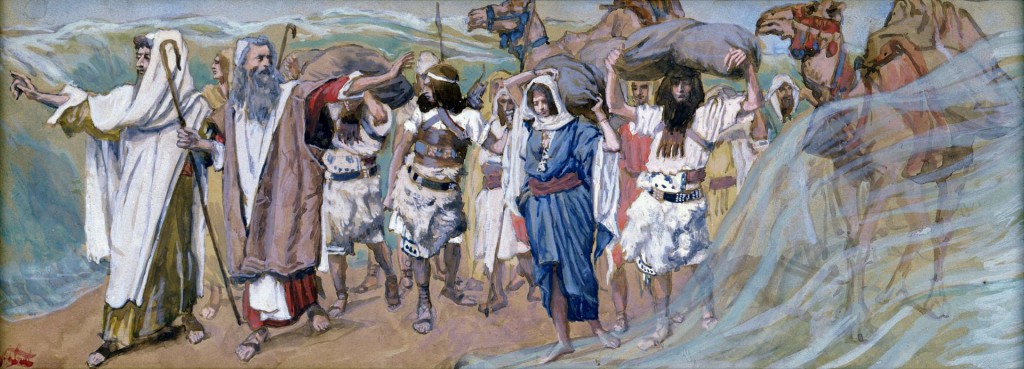
The Waters Are Divided, by James Tissot, circa 1900

The Israelites saw the Egyptians dead on the shore of the sea. And the Israelites saw the great power that God had used against the Egyptians, and the people feared God … and they trusted in God and in God’s servant, Moses. That was when Moses and the Israelites sang this song to God. (Exodus 14:30-15:1)

The 18-verse “Song of the Sea” that follows may be the oldest text in the bible; Hebrew scholars date it to roughly 1100 B.C.E. (The rest of the book of Exodus, judging by the language, was written well after 900 B.C.E.) The song differs from the prose account leading up to it, but it does include descriptions of God drowning an army of Egyptian chariots.

This is the first time anyone sings in the bible, as well as the first time a human character addresses God with words of praise (instead of pleading or questions).

In the first part of the “Song of the Sea”, verses 4-10 describe God drowning the Egyptian charioteers (with no mention of Moses). In the second part, verses 14-16 describe the fear of the surrounding kingdoms when they hear about it (a theme that is premature at this point in the Exodus story). In between these two themes, there is a verse that Jews still sing at every morning and evening service:

Mi khamokhah ba-eilim, Adonai!
Mi kamokhah, nedar bakodesh,
Nora tehilot, oseh feleh!

  Who is like you among the eilim, Y-H-V-H!
  Who is like you, majestic in holiness,
  Too nora for praises, doing wonders! (Exodus 15:11)

eilim (אֵלִם) = Plural of eil (אֵל) = a god; the name of the father god in Canaanite mythology; a title of the God of Israel.

nora (נוֹרָא) = feared, fearsome, awesome. (A form of the verb yareh, יָרֵא = fear, be afraid.)

The verse beginning “Mi khamokhah” (often transliterated as mi chamocha) certainly counts as praising God. But what kind of praise is this, comparing God to other gods? Or saying that God is too fearsome to praise? In the book of Exodus, the Israelites who travel from Egypt to Canaan believe that there were many gods, all inhuman and frightening, and the best they could hope for was that their own God was the most powerful, and would help them—if not for their own sake, for the sake of God’s reputation. The straightforward translations of eilim as “gods” and nora as “feared” or “fearsome” match their point of view.

Nobody is like you

The Song of the Sea is not the only biblical text that contain references to other gods—usually serving under the God of Israel, who is the supreme creator and judge. The idea appears in the books of Genesis, Exodus, Psalms, and Job. (See my posts Yitro & Psalms 29, 82, & 97: Greater Than Other Gods and Bereishit: How Many Gods?)

However, two biblical books, Deuteronomy and Isaiah, present clear statements of monotheism.1  For example, God says:

And there are no gods [elohim] except for Me.  (Isaiah 44:6)

Because I am Eil, and there is no other.  (Isaiah 45:22)

Jewish theology was almost exclusively monotheistic by the first century C.E., when Philo of Alexandria, a Jewish Platonist, analyzed the Hebrew Bible and rabbinic laws in terms of Greek philosophical categories. Philo dealt with archaic ideas in the bible, such as an anthropomorphic god and references to other gods, by explaining that they were allegorical.

But Talmudic and medieval commentators were more attached to taking the bible literally. They strained to find alternate interpretations for the scattered references to other gods, including the comparison between God and the eilim in the Song of the Sea.

One ploy was to treat the word eilim (אֵלִם) as if it were a misspelling of the Hebrew word ilam (אִלָּם) = mute, unable to speak. This was a legitimate move, since the Hebrew in the bible was written without the diacritical marks commonly called vowel pointing until the Masoretic text was fixed in the 7th-10th centuries C.E. Theoretically, the Masoretes could have misinterpreted a word spelled simply אלם in the Torah scroll.

So the Talmud, extant around 500 C.E., reports:

“The school of Rabbi Yishmael taught that the verse: “Who is like You, O Lord, among the gods” (Exodus 15:11), should be read as: ‘Who is like You among the mute’, for You conduct Yourself like a mute and remain silent in the face of Your blasphemers.” (Talmud Bavli, Gittin 56b)2

Rashi, 16th century woodcut

Rashi (11th-century Rabbi Shlomoh Yitzchaki) went farther afield when he suggested reading eilim (אֵלִם) as its homophone eilim (אֵילִים), which is the plural of ayil (אַיִל) = ram; metaphorically, a powerful man or a mighty tree.

 “באלם means ‘amongst the mighty’, just as (Ezekiel 17:13) ‘and the mighty of (אילי) the land he took away’.” (Rashi)2

Other rabbis chose to consider the eilim angels, i.e. celestial beings who have no existence apart from God. Ramban (13th-century Rabbi Moshe ben Nachman) wrote that “among the eilim” means “among those who serve before Thee in heaven”.2

An 18th-century commentator explained the events at the Sea of Reeds as a battle between the God of Israel and the guardian angel of Egypt:

“Israel describes that they had seen the guardian angel of Egypt die; hence they could say that absolutely no celestial force compares to the Lord our God.” (Or HaChayim)3

But in the 19th century, Rabbi Samson Raphel Hirsch identified the eilim as powerful natural forces:

“True, there are אֵלִם, active and effective forces in nature; but though men may worship them as gods, they are subject and bound by powerful bonds to the order You have ordained for them. You alone are free; You are not bound by the was of nature, the work of Your own hands.”4

The “Mi Khamokha” verse in modern prayerbooks is often translated so as not to raise questions about monotheism. Rashi’s proposal, “Who is like you among the mighty?” is a common translation. The traditional Artscroll Siddur goes with: “Who is like You among the heavenly powers?”

I like the approach in Rabbi David Zaslow’s prayerbook, Ivdu Et Hashem B’Simcha, which retains the literal definition of eilim as “gods” but adds a explanatory phrase: “Who is like you among the gods that are worshipped?”5

Too fearsome to praise

After the difficult question “Who is like you among the eilim?”, the rest of the verse extols God by saying:

Who is like you, majestic in holiness,

Too fearsome for praises, doing wonders! (Exodus 15:11)

A strictly literal translation of the phrase Nora tehillot” would be “fearsome praises”, but the oldest Biblical Hebrew omits many of the connecting words we rely on in English. The consensus of translators is that the sense of the phrase is “too nora for praises”. But does the word nora (a past participle used as an adjective) carry its primary meaning of “feared” or “fearsome”? Or its secondary meaning of “treated with awe” or “awesome”?

Many medieval rabbis analyzed the phrase Nora tehillot” in terms of being afraid of God.According to Rashi in the 11th century:

“Thou art an object of dread, so that people do not recount thy praises, fearing lest these may be enumerated less then they really are, just as it is written (Psalms 65:2) ‘To Thee, silence is praise’.”2

12th-century Rabbi Abraham ben Meir ibn Ezra added:

“However, they are obligated to praise Him because He alone does wonders.”2

In the 13th century, Ramban had another explanation for the use of the word nora:

“In my opinion, nora t’hilot means: “fearful with praises, for He does fearful things and He is praised for them, as when He wreaks vengeance on those who transgress His will, and thereby helps those who serve Him. Thus He is [both] feared and highly praised.” (Ramban)2

But in the 16th century, Rabbi Obadiah Sforno (who lived in Italy during the Renaissance) commented on the verse in terms of awe rather than fear.

“Anyone aware of the marvelous attributes of His cannot fail but recite these praises in awe, not because he is afraid of being punished but because the very nature of God inspires awe and reverence.”2

Yet in the 19th century, S.R. Hirsch wrote sternly:

“Songs of praise to God that do not lead to the fear of God, or that are even intended as substitutes for the fear of God, are nothing but a profanation of God’s Name.”6

Most modern prayerbooks translate nora (נוֹרָא) as “awesome”, rather than “feared” or “fearsome”, probably so as not to make God sound harsh and unloving.


I believe that literal translations of the Hebrew Bible reflect the viewpoint of the original authors, and are appropriate for everyone except readers who do not grasp concepts such as allegory or cultural history, and insist on taking every word in an English translation of the bible as a simple directive from God.

But in a Jewish prayerbook, literal translations of quotes from the bible are more problematic. Some readers are comfortable with the evolution of the religion, and can mentally adapt the ancient words—even while singing them—so that the prayer becomes worthy vehicle for their heartfelt feelings. For other readers, this approach seems unnatural, difficult, or contrary. Why should one sing or recite a prayer one does not believe in literally?

For these people, it might be better to adjust the translations of Hebrew words in prayers so as to avoid raising objections about whether there is only one God, or whether God is kind rather than frightening. Then they, too, might be able to use prayer to express gratitude for the wonders of creation.


  1. Deuteronomy 4:35, 10:14, and 32:39; Isaiah 37:16, 37:20, 41:4, 43:10-11, 44:6, 44:8, 45:5-6, 45:21-22, and 48:12. (Isaiah from chapter 40 on is called second Isaiah or Deutero-Isaiah, and was written in the 6th century C.E.)
  2. Translations from www.sefaria.org.
  3. Or HaChayim, by Rabbi Chayim ben Moshe ibn Attar, translation in www.sefaria.org.
  4. Samson Raphael Hirsch, The Hirsch Chumash: Sefer Shemot, translated by Daniel Haberman, Feldheim Publishers, Jerusalem, 2003, p. 247.
  5. Ivdu Et Hashem B’Simcha, compiled and edited by Rabbi David Zaslow, The Wisdom Exchange, 2010, pp. 81 and 82.
  6. Hirsch, ibid., p. 248.
Bo: Plague of Darkness

The days are short and dark now, for those of us who live north of 45o in the northern hemisphere. But even at night we do not experience true darkness. A single lamp, a single flame, generates a lot of light.

Pitch darkness, the complete absence of light, means blindness at first, then death. Without light, no plants can live, and no living thing can survive. No wonder the first thing God creates in the book of Genesis is light.

And no wonder darkness is such a frightening plague in this week’s Torah portion, Bo (Exodus 10:1-13:16).

The darkness plague

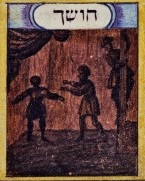
Plague of Darkness, Haggadah by Judah Pinhas, 1747

Pharaoh does not let the Israelites leave Egypt until God has afflicted the land with ten miraculous disasters or plagues. The ninth plague is darkness.

Darkness is the only plague that does not bring death or disease to any living thing. Yet three days of utter darkness alarm Pharaoh and all the Egyptians more than anything but the tenth and final plague: death of the firstborn children.

And God said to Moses: “Stretch out your hand toward the heavens, and choshekh will be over the land of Egypt, a choshekh one can touch.” And Moses stretched out his hand toward the heavens, and there was a dark choshekh in all the land of Egypt for three days. No one could see his brother, and no one could get up from his spot for three days. But for all the Israelites, light was in their settlements. (Exodus 10:21-23)

choshekh (חֺשֶׁךְ) = darkness. (Like the word “darkness” in English, the word choshekh is used not only for the absence of physical light, but also for the absence of enlightenment or goodness.)

What is a darkness one can touch?

Medieval commentators wrote that the darkness was thick—a thing with its own palpable substance. Ibn Ezra wrote: “The Egyptians will feel the darkness with their hands.”1 Ramban described the darkness as “a very thick cloud that came down from heaven … which would extinguish every light, just as in all deep caverns.”2

And Rabbeinu Bachya explained: “The darkness was not a kind of solar eclipse. On the contrary, the sun operated completely normally during all these days. In fact, the whole universe operated normally; the palpable darkness was as if each individual Egyptian had been imprisoned all by himself in a black box. … Once this stage had been reached, God intensified this darkness to the extent that it was felt physically, preventing people from being able to move without ‘bumping’ into darkness at every move they tried to make.”3

Faced with this kind of darkness, the Egyptians stopped moving. No one got up for three days. People in the same room might speak to each other, but they could not help each other. So each one suffered alone; “no one could see his brother” (Exodus 10:23). If the plague had continued for a few additional days, all the Egyptians would have died of thirst by darkness.

19th-century rabbi Hirsch pointed out: “This plague was the most sweeping, in that it shackled the whole person, cutting him off from all fellowship and from all possessions, so that he could move neither his hands nor his feet to obtain the necessities of life.”4

As usual, Pharaoh asks Moses to beg his God to end the plague.

Then Pharaoh summoned Moses … (Exodus 10:24)

How does he summon anyone, when neither he nor any of his servants can get up from his spot”? Perhaps the person who wrote down that verse did not think through the implications of the miraculous darkness. Or perhaps Moses has not left the palace courtyard since raising his hand to summon the darkness, and he can hear Pharaoh calling to him. Being an Israelite, Moses could still see and move, so he walks over to where Pharaoh sits. And he finds out whether Pharaoh is at last willing to let the Israelites go.

Darkness as metaphor

The Hebrew word choshekh, like the English word “darkness”, is used as a metaphor for gloominess, death, ignorance, or evil.

Since darkness means the absence of visible light, it also means ignorance, the absence of enlightenment.

Inform us of what we can say to [God]!
    We cannot lay a case before him from a position of choshekh. (Job 37:19)

And in both Biblical Hebrew and English, light is associated with goodness, while darkness is associated with evil.

They forsake the paths of the upright
    To go in the ways of choshekh. (Proverbs 2:13)

Pharaoh’s darkness

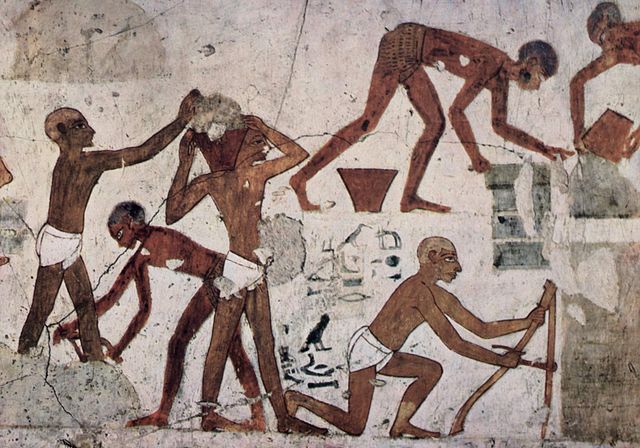
When Pharaoh’s father was on the throne (in Exodus 1:8-2:22), he conscripted all the Israelite men to do corvée labor on royal building projects.5 Corvée labor was common in the Ancient Near East, as common as governments conscripting their citizens into military service in modern times. But in the book of Exodus, the Israelites’ term of service never ends, under either the first pharaoh or his successor. Then God gets involved.

Making Bricks, tomb of Vizier Rekmire, 1459 BCE

And the Israelites groaned under the servitude and they cried out. And their plea for rescue from the servitude went up to God. And God listened to their moaning … (Exodus 2:23-24)

The solution God devises is to send Moses to act as a prophet, and the plagues to force the new pharaoh to recognize the power of God and let the Israelites leave Egypt.

With each plague, Moses asks Pharaoh to let the Israelites go for at three-day walk into the wilderness to worship their God. Each time, Pharaoh refuses to give them even a few days off. They might as well be slaves.

If being in the dark is being unenlightened, blind to reality, Pharaoh always lives in darkness. He believes he can mistreat the Israelites without any personal consequences. He believes that their God, who keeps afflicting Egypt with disastrous miracles, cannot really destroy him or his kingdom.

Earlier in this week’s Torah portion, after Moses warns the court about the eighth plague, locust swarms, Pharaoh’s courtiers urge their king to give up.

And Pharaoh’s courtiers said to him: “How long will this be a trap for us? Let the men go so they can serve Y-H-V-H, their god! Don’t you realize yet that Egypt is lost?” (Exodus 10:7) 

But Pharaoh still tries to bargain. He asks Moses which Israelites would go to worship Y-H-V-H, and Moses replies:

“With our young and with our old we will go, with our sons and with our daughters we will go, with our flocks and with our herds we will go, because it is our festival for God.” (Exodus 10:9)

Pharoah insists that he will let only the men go, so he and Moses are at an impasse again, and God sends the plague of darkness.

If darkness is a metaphor for evil, Pharaoh fits the bill. Not only does he refuse to give the Israelites even a few days off from work, he also increases their workload so it is impossible for them to meet their quotas.8 This gives his overseers a reason to whip them at any time.

Moses warns Pharaoh about each plague, but Pharaoh refuses, again and again, to let the Israelites go. This harms the native Egyptians, who suffer from thirst, vermin, agricultural collapse, and multiple diseases.

During the plague of darkness, Pharaoh summons Moses and says:

“Go, serve Y-H-V-H! Only your flocks and your herds must be left behind. Even your little ones may go with you!” (Exodus 10:24)

Pharaoh is still bargaining, but he has made a concession. Although he knows the Israelites will not come back, he is now willing to give up his free labor force—as long as they leave their livestock behind. Of course, he knows that the animals are the Israelites’ wealth and means of livelihood. And he probably doubts that they will get very far through the desert without at least the milk from their cattle, sheep, and goats.

But Pharaoh may also be considering the welfare of the native Egyptians for the first time. All of their livestock died during the fifth plague, cattle disease.5 The eighth plague, locust swarms, consumed the last green leaves in Egypt,6 so the Israelite livestock have nothing to eat (except for any hay the Egyptians might have stockpiled inside barns). But at least the Egyptians could eat the Israelites’ animals. The meat would keep them alive for a while, until Pharaoh came up with another plan.

Moses, however, refuses to make any concession to Pharaoh. He replies:

“You, even you, must place slaughter offerings and rising offerings in our hands, and we will make them for Y-H-V-H, our God. And also our property must go with us; not a hoof can remain behind …” (Exodus 10:25-26)

Then God steps in—or perhaps what steps in is Pharaoh’s pride and the power of habit.

Then Y-H-V-H strengthened Pharaoh’s mind, and he did not consent to let them go. (Exodus 10:27)

Three days of blindness and immobility are not enough to make Pharaoh completely change his mind. With the help of a little mind-hardening from God, Pharaoh holds out until his own firstborn son dies in the tenth plague, the one that God has planned all along as the finale.7

Does Pharaoh deserve the death of his firstborn son? Yes, the classic commentary answered, because Pharaoh is evil. (His son, and the other Egyptian firstborn and their parents, may be innocent. But the tales in the Torah focus on individual characters, using the reset of the people as background.)

Metaphorically speaking, Pharaoh always sits in darkness. No wonder he qualifies his permission to let the Israelites go, even after the life-threatening plague of darkness. No wonder God can easily harden his attitude so he refuses to let the Israelites take their livestock with them.

Darkness itself blinds and paralyzes him, but Pharaoh does not change his attitude. After all, he has lived in darkness his whole life.


One of the participants in a class I am teaching on Exodus pointed out that if you state a position once and get negative feedback, it is not too hard to change your mind. But if you stick with your unpopular opinion, it gets harder to change every time it is questioned. You find yourself fiercely defending your position to others—and refusing to reexamine it yourself.

Pharaoh’s mind keeps hardening because he is human. God’s assistance in hardening it is the human nature we are endowed with.

May we all pay attention to what we are doing, and seek enlightenment lest we slip into utter darkness.


  1. Abraham Ibn Ezra, 12th century, translation in www.sefaria.org.
  2. Ramban (Rabbi Moshe Nachman), 13th century, translation in www.sefaria.org.
  3. Rabbeinu Bachya ben Asher ibn Chalavah, 1255-1340, translation in www.sefaria.org.
  4. Rabbi Shimshon Rafael Hirsch, 19th century, The Hirsch Chumash: Sefer Shemot, translated by Daniel Haberman, Feldheim Publishers, Jerusalem, p. 144.
  5. The pharaoh in Exodus 1:8-2:22 also attempted to reduce the population of Israelites in Egypt by commanding the murder of male Israelite infants.
  6. Exodus 10:15.
  7. See God’s speech to Moses in Exodus 4:21-22.
  8. Exodus 1:8-22.

Va-eira: Snake Staff, Part 2

The first time God changed Moses’ staff into a snake was on Mount Sinai, when God was giving him the signs he would use to convince the Israelites in Egypt that he was a genuine prophet. (See last week’s post, Shemot: Snake Staff, Part 1.)

The second time God transformed the staff was at the meeting Aaron set up between his brother Moses and elders of the Israelites in Egypt.

And Aaron spoke all the words that God had spoken to Moses, and he performed the signs in the sight of the people. And the people trusted him, and they heard that God had taken up the cause of the Israelites and had seen their misery and noticed them. And they bowed to the ground. (Exodus 4:30-31)

So far, so good. The next step was to persuade Pharaoh that God had sent them.

And afterward Moses and Aaron came and said to Pharaoh: “Thus says Y-H-V-H, the God of Israel: Let my people go so they will celebrate a festival for me in the wilderness.” But Pharaoh said: “Who is Y-H-V-H, that I should listen to his voice and let the Israelites go? I do not know Y-H-V-H, and furthermore, I will not let the Israelites go.” (Exodus 5:1-2)  

This might have been a good time for the brothers to use the magic staff to demonstrate that they are real emissaries of a real god. But God had not ordered it. Moses and Aaron merely talked a little longer, and then Pharoah decided to increase the workload of the Israelites instead.

The Israelites lost faith in Moses and in the promised rescue from Egypt. The Torah portion Shemot ends shortly after the Israelite foremen complain to Moses and Aaron:

“May God examine you and judge, since you made us smell loathsome in the eyes of Pharaoh and in the eyes of his courtiers, putting a sword in their hand to kill us!” (Exodus 5:21)

Marvel in the palace

This week’s Torah portion, Va-eria (Exodus 6:2-9:35), opens with some repetitions of the story line and a genealogy.1 Then God finally tells Moses and Aaron to demonstrate the transformation of the staff to Pharaoh.

And God said to Moses and to Aaron: “When Pharaoh speaks to you, saying: ‘Give me your marvel!’ then you will say to Aaron: ‘Take your staff and cast it down in front of Pharaoh!’ It will become a tanin.” Then Moses and Aaron came to Pharaoh, and they did just as God had commanded; Aaron cast down his staff in front of Pharaoh and his courtiers, and it became a tanin. (Exodus 7:8-10)

tanin (תַנִּין) = sea monster, crocodile, snake.2

When God transformed Moses’ staff on Mount Sinai (in a tale some scholars attribute to an E source), it became a nachash (נָחָשׁ) = snake, serpent. Now (in the tale from a P source) it becomes a tanin. Different source stories used somewhat different terminology.

And Pharaoh also summoned his wise men and his sorcerers, and they, also they, the chartumim of Egypt, did this with their spells. (Exodus 7:11)

chartumim (חַרְטֻמִּים) = literate Egyptian priests with occult knowledge.

The word chartumim is often translated as “magicians”, but these Egyptian dignitaries were not magicians in the modern sense: people who create illusions and trick their audiences. The ancient Egyptians believed that the gods created and maintained the universe with “heka”, a cosmic power that priests could also tap into and use to manipulate reality.)

Aaron’s Road Changed into a Serpent, by Julius Schnorr von Carolsfeld, Charles Foster Bible Pictures, 1860

Each one cast down his staff, and it became a tanin. But Aaron’s staff gulped down their staffs. (Exodus 7:12)

The Egyptian priests use “heka” to produce the same marvel that God makes: a staff turning into a tanin. But the magic of the God of Israel proves superior to the magic of the Egyptian priests, since God’s staff swallows their staffs.

This is a significant coup, considering the nature of the crocodile and snake gods in Egyptian theology.

The crocodile in Egyptian theology

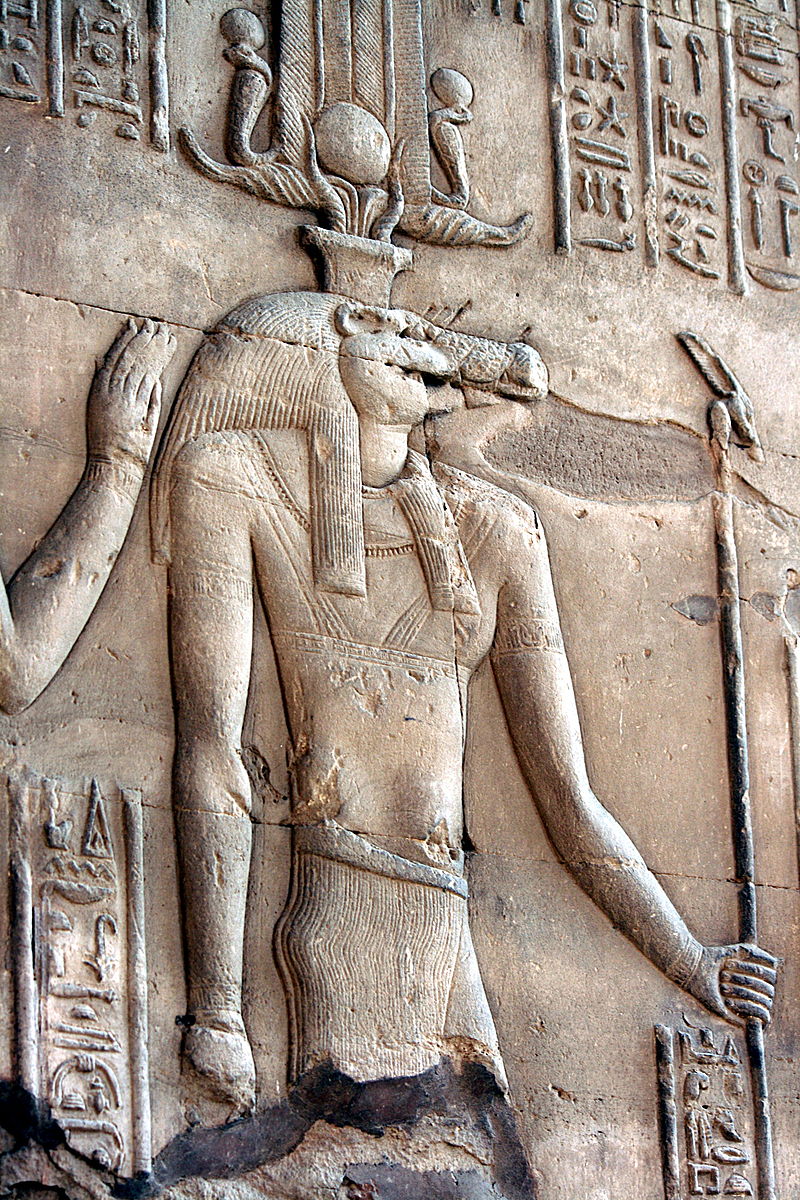
Egyptian god Sobek, Kom Ombo temple

The transformation of a staff into a crocodile would remind Egyptians of their crocodile god, Sobek, credited with both creating the Nile and giving strength to the pharaoh. If the God of Israel has power over Sobek, Pharaoh and the whole country are in danger.

The concept of a staff becoming a crocodile would not seem strange to the Egyptians. In an Egyptian tale written as early as 1600 B.C.E., the Egyptian priest Webaoner made a wax crocodile “seven fingers long”, and when his assistant threw it into a lake it became a real crocodile and swallowed up the priest’s enemy. When the king arrived, Webaoner caught the real crocodile, and it shrank and turned back into wax.3

The snake in Egyptian theology

Egyptian Priests Holding Serpent Staffs, Tomb of Sennufer, 15th c. BCE, photo by Scott B. Noegel, detail

The idea of a staff changing into a snake may have come from Egyptian rituals in which priests carried rods with heads shaped like snakes, as depicted in a 15th-century B.C.E. tomb painting.

The sudden appearance of a snake in Pharaoh’s audience chamber would remind the Egyptians of the snake god Apep. Apep was the god of chaos, evil, and darkness, the enemy of the sun god, Ra. Ra was the god of order and light, and crossed the sky from east to west every day. Every night the sun went down in the west and Ra traveled through the underworld to where the sun was due to rise again in the east. During this nightly underground crossing, Ra fought Apep, who lived in the underworld of the dead. For centuries Egyptian priests helped Ra in the battle by making wax models of Apep and spitting on them, mutilating them, or burning them while reciting spells to kill the evil god.4 

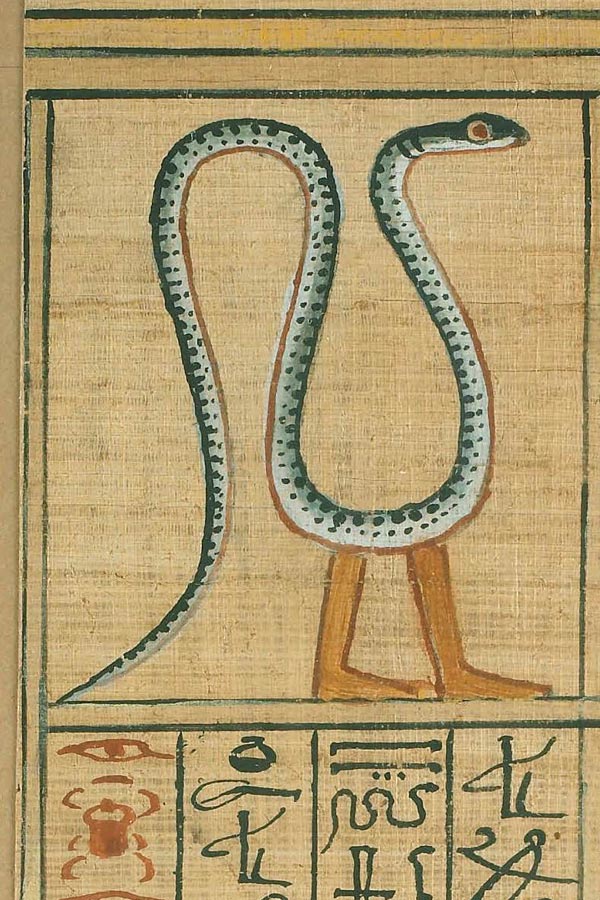
Nehebu-kau, Spell 87 of the Book of the Dead of Ani

Another Egyptian snake god was Nehebu-kau, a variant of Apep who had become a benign underworld god by the 13th century B.C.E., when the Exodus story was set. Nehebu-kau ws one of the 42 gods who judged the souls of the deceased. (Another was the crocodile god Sobek.) When souls of the dead passed the test for good behavior during life, Nehebu-kau gave them the life-force ka so they would have an afterlife. (Apep, on the other hand, was called “Eater of Souls”.)

When Aaron’s snake swallows the Egyptian priests’ snakes, it signals that the whole Egyptian cosmic order is in danger. Can Ra defeat a god even more powerful than Apep? Will there be any afterlife if Nehebu-kau is overthrown?

Pharaoh versus his priests

But Pharaoh’s mind hardened, and he did not listen to them, just as God had spoken. (Exodus 7: 13)

The next step is the first of the miraculous plagues that will destroy Egypt, just what God predicted to Moses in the Torah portion Shemot .

We can assume the Egyptian chartumim in the book of Exodus are shocked and alarmed when Aaron’s snake-staff gulps down all of theirs. It is an obvious omen that the God of Moses and Aaron will triumph over their pharaoh, and over all Egypt. But they do not want to believe this omen, so they return to do more magic for Pharaoh. They gamely use “heka” to reproduce God’s plagues of blood and frogs, at least in miniature.5 But they cannot replicate God’s third plague, lice.6 And at that point they acknowledge that the power behind the plagues is a serious danger to their world.

And the chartumim said to Pharoah: “It is a finger of a god!” But Pharaoh’s mind hardened, and did not listen to them. (Exodus 8:15)


Modern Torah readers are familiar with the idea that God is omnipotent. For us, the magic tricks that God arranges with a shepherd’s staff might seem like a sideshow before the main action of the ten plagues begins.

Yet it is necessary for Moses to prove to both the Israelites and the Egyptians that he really is speaking for a powerful god, and that his God is more powerful than any Egyptian god or Egyptian magic. Otherwise the Israelites will never follow him out of Egypt. And otherwise the pharaoh will attribute the plagues to other deities.

Some people are better than others at noticing signs and drawing long-term conclusions. Moses notices the subtle miracle of the bush that burns without being consumed, and walks right over to find out more.

The chartumim a a bit slower. They do not warn Pharaoh that Egypt is doomed right after the snake-staff demonstration; they are probably hoping to uncover an explanation consistent with their world-view. But when they cannot replicate God’s miraculous plague of lice, they give up. After that, the chartumim do not seem to be present at any other confrontational meetings between Moses and Pharaoh.7

But Pharaoh continues to assume that no matter what happens Egypt will go on, he will stay on the throne, and he must keep the Israelites as his slaves. Whenever Pharaoh’s faith is shaken, he recovers—until the final blow, the death of his own first-born son.

The longer you hold a belief, the harder it is to give up. What does it take before you admit you were wrong?

A single unexpected event, like the sight of a bush that burns but is not consumed?

Several demonstrations that the power structure you depend upon has been subverted?

The destruction of your world because of your failure to change?


  1. According to modern source criticism, a redactor of the book of Exodus patched in some material from a different account. The portion Shemot recorded mostly J and E traditions of the tale. Exodus 6:2-7:13 comes mostly from P sources, with some explanatory additions.
  2. The word tanin appears 14 timesin the Hebrew Bible. Half the time it means a sea-monster—or perhaps a crocodile (Genesis 1:21, Isaiah 27:1 and 51:9, Jeremiah 51:34,  Psalms 74:13 and 148:7, Job 7:12, and Nehemiah 2:13). Twice a tanin is a snake (Deuteronomy 32:33 and Psalm 91:13), and twice it is a misspelling of “jackals” (tanim, in Lamentations 4:3 and Nehemiah 2:13). The remaining three occurrences of the word tanin are in the P story about the meeting with Pharaoh. (The word tanim, תַּנִּים, also occurs 14 times in the Hebrew Bible. In 10 of those occurrences it means “jackals”. But it is used as an alternate spelling of tanin in Isaiah 13:22 (snakes), Ezekiel 29:3 and 32:2 (crocodiles or sea monsters), and Psalm 44:20 (sea monsters).
  3. Prof. Scott B. Noegel, “The Egyptian ‘Magicians”, www.thetorah.com.
  4. One of the rituals in The Book of Overthrowing Apep, circa 305 B.C.E.
  5. Exodus 7:22 and 8:3.
  6. Exodus 8:14.
  7. No chartumim are mentioned in the passages about the next two plagues. The story of the sixth plague, boils, says: The chartumim were not able to stand in front of Moses because of the boils. (Exodus 9:11) After that they are absent from the rest of the book of Exodus.

Shemot: Snake Staff, Part 1

Moses hears God speak out of the burning bush on Mount Sinai, and learns that he must act as God’s prophet and lead the Israelites out of Egypt. He tries four times to get out of the job in this week’s Torah portion, Shemot (Exodus 1:1-6:1), and one of his efforts leads to God making his staff magical.

First Moses hints that he is not qualified, saying:

“Who am I, that I should go to Pharaoh and that I should bring the Israelites out from Egypt?” (Exodus 3:11)

Instead of saying why Moses meets the job qualifications, God replies:

“I will be with you, and this will be your sign I myself sent you.” (Exodus 3:12)

In other words, Moses will be frequently reminded that God sent him on this mission, because God will be present for him. As the story continues, God’s presence with Moses is indeed obvious, since God continues to speak to him.

Next Moses asks what name he should call God when he speaks to the Israelites, and God answers at length, giving him more information about his mission as well as about who God is. Then Moses makes his second protest:

“And if they do not believe me, and do not listen to my voice, but say: Y-H-V-H did not appear to you?” (Exodus 4:1)

This time God responds by showing Moses three “signs” he can perform in front of the Israelites to demonstrate that Y-H-V-H1 is with him. The first sign turns out to be the most important.

God said to him: “What is this in your hand?” And he said: “A mateh.” (Exodus 4:2)

mateh (מַטֶּה) = a shepherd’s staff; a staff serving as an official symbol of authority over a tribe or country; a tribe. (Plural: mattot, מַטּוֹת.)

Moses is holding a shepherd’s staff because he has just led his father-in-law’s flock through the wilderness all the way to Mount Sinai. But this is his last undertaking as a shepherd. After he returns to Egypt, Moses will use his staff to signal divine miracles. He will also become the leader of the thousands of Israelites who follow him out Egypt.

From Charles Foster Bible, illustration by Julius Schnorr von Carolsfeld, 1860

Now God demonstrates that Moses is no longer holding a mere shepherd’s staff.

Then (God) said: “Throw it to the ground.” So he threw it to the ground, and it became a nachash, and Moses fled from it. Then God said to Moses: “Reach out your hand and grasp it by its tail.” And he reached out his hand and took hold of it, and it became a mateh in his palm. (Exodus 4:3)

nachash (נָחָשׁ)= snake, serpent. (Words from the same root include the verb nichash, נִחַשׁ = practice divination, the noun nachash, נַחַשׁ = bewitchment, magic curse, and nechoshet, נְחֺשֶׁת = copper, copper alloy.)

Then God gives Moses two more signs for the Israelites. For the second sign, is he puts his hand into the fold at the bosom of his robe, and when he pulls it out his hand looks white and scaly. When he repeats the action, his hand returns to normal.2 For the third sign, God says,  Moses will pour some water from the Nile on dry ground, and it will turn into blood.3

Once Moses has demonstrated the signs to the Israelites, God says, they will believe that God appeared to him.

Moses does perform all three signs in front of the elders of Israel when he arrives back in Egypt, and they believe he is God’s prophet.4 But the only one of these signs he uses in front of Pharaoh is the staff trick. (See next week’s post, Va-eira: Snake Staff, Part 2.)

But the three signs are not enough for Moses, who does not want to be a prophet in the first place. So he makes two more attempts to talk God out of giving him the job. He says he is a slow and clumsy speaker, but God promises to tell him what to say. Finally, Moses simply begs God to send someone else.5 God gets angry, then promises to appoint his brother Aaron to help him. And Moses resigns himself to returning to Egypt.


Moses’ staff could turn into anything surprising, and the transformation would prove that he is a channel for the miraculous power of God. So why does God choose a snake for this sign?

Snake as deceiver

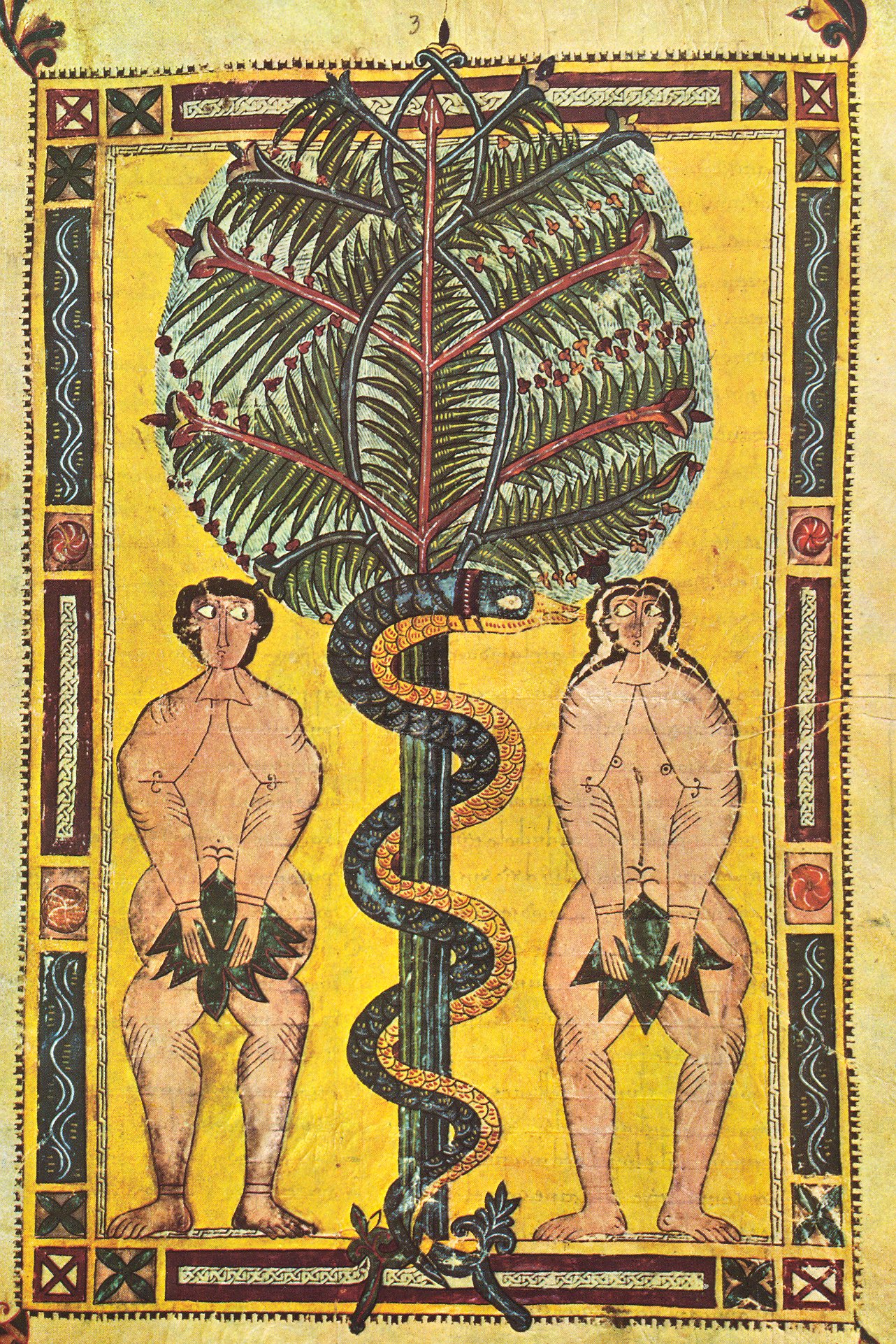
Adam, Eve, and Snake, Escorial Beatus, ca. 950

One explanation is that a snake is the opposite of a staff. A snake is a flexible animal that moves with whiplash speed. It can shed its dead skin and emerge alive. And in the story of the Garden of Eden, the snake is clever and deals in deception and half-truths.6

Some early commentators claimed that the first time God changed Moses’ staff into a snake, it was a personal message to Moses that he had slandered the Israelites when he said they would not believe him—just as the snake in the Garden of Eden had slandered God by implying that God had lied about the effects of eating fruit from the Tree of Knowledge of Good and Evil.7

A staff, on the other hand, is a long stick of dead wood, hard and inflexible. It is reliable, strong enough to lean against without breaking—and therefore a good symbol for a chieftain or a king. 19th-century Rabbi S.R. Hirsch wrote:

“… מטה [mateh] denotes (a) an extension of the hand, upon which man can lean for support as he stands on the ground; (b) an extension of man’s sphere of power; it is a symbol of his authority. This sign in Moshe’s hand will show the people that, if God so desires, the thing on which a person leans for support and with which he wields his authority can turn into the very opposite: a serpent. … Conversely, if He so desires, God can take a hostile force that is feared and shunned by man and place it into his hand as an accommodating support and tractable tool.”8

Snake as phallic symbol

Both a staff and a snake are obvious phallic symbols. I suspect that when this story was told orally, the verbal image of a snake stiffening into a staff in Moses’ hand drew snickers from the audience.

The staff and the snake represent two aspects of power. The staff stands for legitimate authority. The snake stands for creative subversion—the power of the trickster. Perhaps one way God uses the staff and snake is to demonstrate, first to Moses and then to the Israelites, that ultimate power over everything belongs to God.

Furthermore, God only makes the snake harmless enough for Moses to pick up with his bare hand when a demonstration of Moses’ status as God’s prophet is required. This demonstration happens first to Moses himself on Mount Sinai, then to the Israelites, then to Pharaoh and his court.

When Moses sets off for Egypt with his wife Tziporah and their two small sons,

Moses took the mateh of God in his hand. (Exodus 4:20)

Moses’ staff is now called the staff of God because God has imbued it with the power to miraculously turn into a snake (and to signal or initiate other miracles in the future).

An incident on Moses’ journey to Egypt shows that the snake can also be dangerous as a phallic symbol.

On the road, at a lodging-place, God confronted him and sought to kill him. Then Tziporah took a flint, and she cut the foreskin of her son, and she touched it to his raglayim, and she said: “Because a bridegroom of blood you are to me!” (Exodus 4:24-25)

raglayim (רַגְלַיִם) = a pair of feet, a pair of legs—or a euphemism for genitals.

The Torah does not say how God “sought to kill him”. But since the next sentence refers to a foreskin and genitals, the Talmud and Exodus Rabbah imagined the angel of death swallowing Moses from his head down to his genitals, where Moses’ circumcision stops the process.9 Rashi wrote:

 “The angel became a kind of serpent and swallowed him [Moses] from his head to his thigh, spewed him forth, and then again swallowed him from his legs to that place. Tziporah thus understood that this had happened on account of the delay in the circumcision of her son.”10  (For a fuller discussion of the “Bridegroom of Blood” episode, see my post Shemot: Uncircumcised, Part 1.)

The staff that turns into a snake and back is God’s phallic symbol, not Moses’. Moses is merely another of God’s tools. In next week’s Torah portion, Vayeira, God makes Moses use the staff to impress the simple-minded people in Egypt, from Israelite slave to Egyptian monarch. It would be easy for me, as a feminist, to mock these displays of male power. Yet perhaps they are necessary to get some people’s attention.

And once they are paying attention, they might consider the difference between a man with a staff of office on whom you can depend, and a man in authority who is more like a poisonous snake. Which kind of authority is Pharaoh?

What about our leaders and authority figures today?


  1. For an explanation of God’s personal name, indicated by Y-H-V-H, see my post Lekh-Lekha: New Names for God.
  2. Exodus 4:6-7.
  3. Exodus 4:9.
  4. Exodus 4:28-31.
  5. Exodus 4:13.
  6. Genesis 3:1-6.
  7. C.f. Ramban on Exodus 4:3. (Ramban is the acronym of 13th-century Rabbi Moshe ben Nachman, also called Nachmanides.) For the snake’s implication that God was lying when God said eating from the Tree of Knowledge would result in death, see Genesis 3:2-5.
  8. Samson Raphael Hirsch, The Hirsch Chumash, Sefer Shemos, translated by Daniel Haberman, Feldheim Publishers, Jerusalem, 2005, p. 50. (Hirsch was a 19th-century German rabbi and commentator.)
  9. Talmud tractate Nedarim 32a, Exodus Rabbah 5:8, both written circa 300-600 C.E.
  10. Translation from www.sefaria.org. Rashi is the acronym for 11th-century Rabbi Shlomo Yitzchaki.

Vayechi, Chayei Sarah, & Vayishlach: A Touching Oath

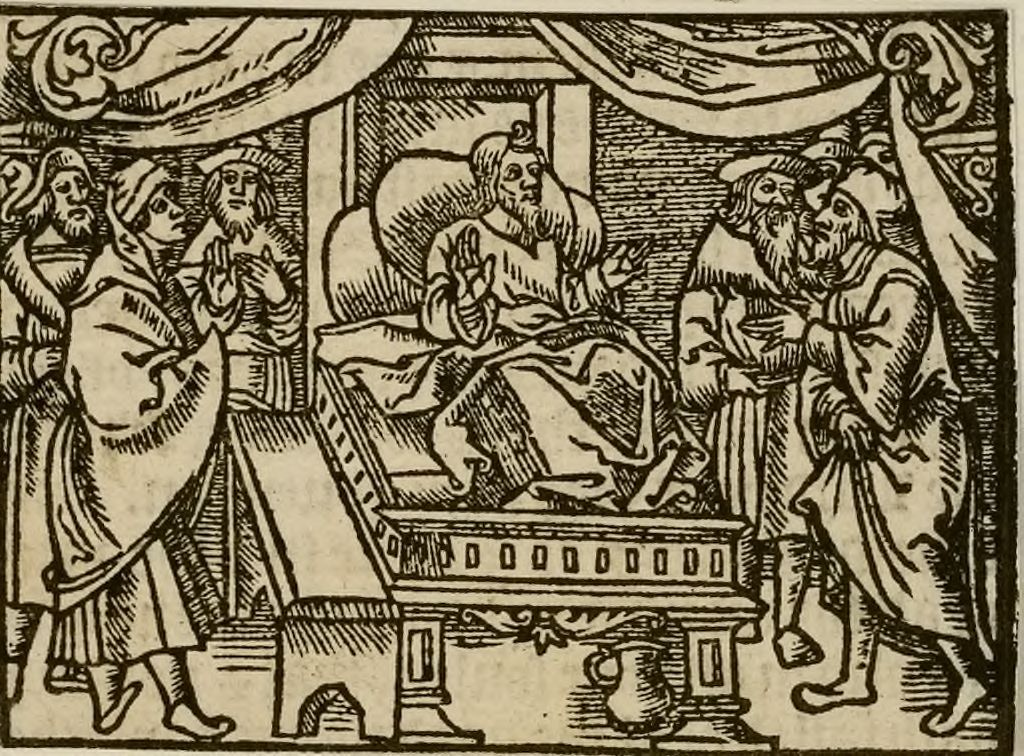
Jacob on his Deathbed, 1539 woodcut

This week’s Torah portion, Vayechi (Genesis 47:28-50:26), begins:

And Jacob lived in the land of Egypt seventeen years; and the years of Jacob, the years of his life, were 147 years. The time for Israel to die approached, and he called for his son, for Joseph …  (Genesis/Bereishit 47:28-29)

Jacob acquired a second name, Israel, in an earlier portion of the book of Genesis, Vayishlach, when he wrestled with a mysterious “man” all night before his reunion with Esau, the brother whom Jacob had cheated twenty years before.

Becoming Israel

In Vayishlach, Esau was approaching with 400 men, and Jacob was terrified that his brother would attack his camp for revenge. He prayed, he sent generous gifts ahead on the road, and he moved his whole household and all his possessions across the Yabok River. Then Jacob spent the night on the other side.

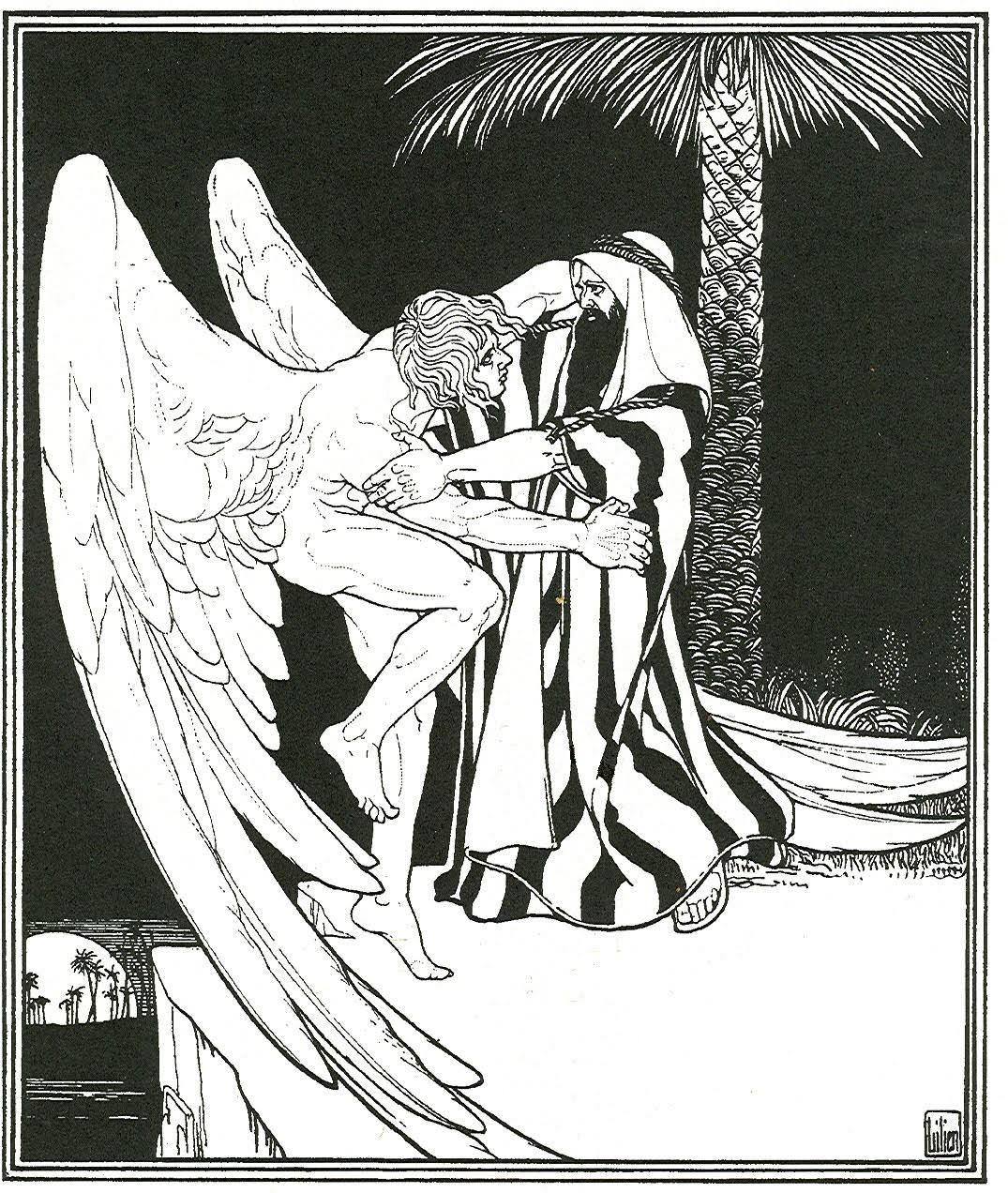
And Jacob was left alone. And a man wrestled with him until dawn rose. And he saw that he had not prevailed against [Jacob], so he touched the socket of his yareikh, and the socket of Jacob’s yareikh was dislocated when he wrestled with him. (Genesis 32:25-26)

yareikh (יָרֵךְ) = loin, i.e. hip, buttocks, upper thigh, or genitals (depending on the context).

One cannot actually touch the socket inside a human hip—unless, perhaps, one is a supernatural creature. Even with the pain of a dislocated hip, Jacob hangs onto his opponent. The mysterious wrestler is the first to speak.

Jacob Wrestles, by Ephraim Moses LIlien, 1923

Then he said: “Let me go, because dawn is rising.”

But [Jacob] said: “I will not let you go unless you bless me!”

And he said to [Jacob]: “What is your name?”

And he said: “Jacob.”

Then he said: “It will no longer be said that Jacob is your name, but Yisrael. Because sarita with God and with men, and you have prevailed.”

And Jacob inquired and said: “Please tell your name.”

And he said: “What is this, that you ask for my name!” (Genesis 32:27-29)

Yisrael (יִשְׂרָאֵל) = “Israel” in English. Possibly he strives with God, he contends with God. (Yisar,יִשַׂר  = he strives with, he contends with + Eil, אֵל  = God, a god.) On the other hand, the subject usually follows the verb in Biblical Hebrew, so Yisrael could mean “God contends”.)

sarita (שָׂרִיתָ) = you have striven with, you have contended. (From the same root as yisar.)

Gradually the “man” who wrestles with Jacob is revealed as a divine messenger. “Jacob was left alone”—away from any other human beings. “A man wrestled with him”—messengers from God often look like men at first, and can do physical things in our world.1 “You have striven with God and with men”—striving with God’s messenger is the equivalent of striving with God. And protesting that “you ask for my name!”—God’s messengers do not reveal their names in the Torah.2

The two wrestlers in this passage also serve as a metaphor for a narrow human frame of reference wrestling with a broad divine frame of reference—both within Jacob’s psyche. The divine perspective touches an intimate spot, and Jacob emerges from the experience with a new name, and a limp to remind him of what happened.

And the sun rose for him as he passed Penueil, and he, he was limping on his yareikh. (Genesis 32:32)

After this story, the Torah continues to use the name Jacob, but sometimes switches to Jacob’s new name, Israel. Why does it switch from “Jacob” to “Israel” at the beginning of this week’s portion, Vayechi?

Requesting an oath

The time for Israel to die approached, and he called for his son, for Joseph, and he said to him: “If, please, I have found favor in your eyes, please place your hand under my thigh. And do with me loyal-kindness and faithfulness: do not, please, bury me in Egypt! [When] I lie down with my fathers, then carry me out of Egypt and bury me in their burial site!” (Genesis 47:29-30)

This is Jacob/Israel’s first deathbed speech. As the self-centered Jacob, he might want to be buried in Bethlehem beside Rachel, the wife who died in childbirth, the wife he loved and mourned for the rest of his life. Or he might even want his sons to bury him in Egypt, where his entire surviving family has emigrated. His beloved son Joseph is a viceroy, so he could buy a deluxe burial site there.

But Jacob does not mention either possibility. As Israel, he knows it will be best for his future descendants if he is buried in the cave of Machpelah, which his grandfather Abraham purchased for a family burial site. This is where Abraham and Sarah, Isaac and Rebecca, and (we learn later in this Torah portion) Jacob’s first wife, Leah, are buried. Reinforcing the importance of that site, the only land in Canaan that his family inherits through the generations, will help Israel’s descendants in Egypt remember that someday they must return to Canaan to fulfill God’s prophecies.

Israel begins his speech to Joseph with extreme formality and politeness, addressing him in his role as the viceroy. The consensus among commentators is that the pharaoh does not want his invaluable viceroy to leave Egypt for even a short visit to Canaan, his homeland.  What if Joseph did not return?  So Israel decides to give Pharaoh an extra reason to let Joseph go to Machpelah. If Joseph has sworn the most solemn oath possible, how could Pharoah make his viceroy dishonor himself by violating it?

Precedent for the oath

So Israel requests the kind of oath that Abraham made his steward swear regarding a bride for his son Isaac. Jacob/Israel knows he will be powerless over his own burial; Abraham, at age 137, was afraid he would not live long enough to make sure his son married one of his relatives from Aram instead of a Canaanite. In both cases, the aged father relies on the most serious oath possible. Abraham told his steward:

“Please place your hand under my yareikh, and I will make you swear by God, god of the heavens and god of the earth, that you do not take a wife for my son from the daughters of the Canaanites amidst whom I am dwelling. Because you must go to my [former] land and to my relatives, and [there] you must take a wife for my son, for Isaac. (Genesis 24:2-4)

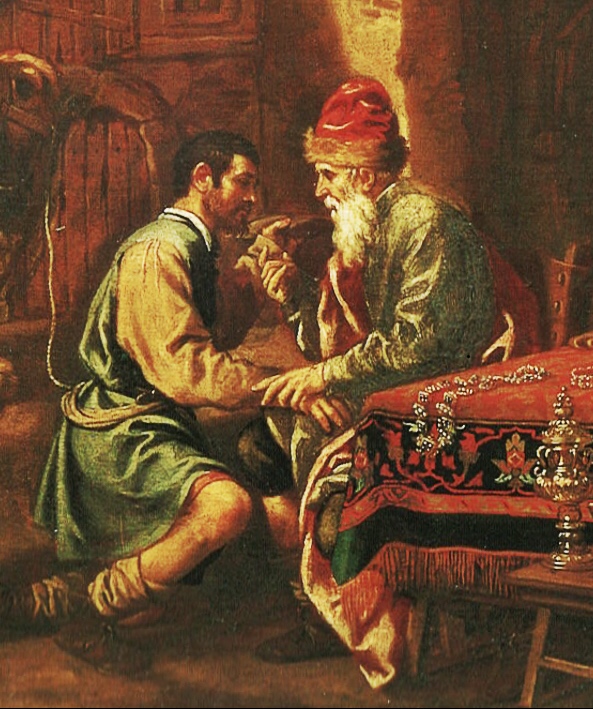
Abraham’s Solemn Charge, by Pedro Orrente, 17th century, detail

Abraham’s steward asked a clarifying question to make sure he understood his mission. Then he complied at once with his master’s request:

And the servant placed his hand under the yareikh of Abraham, his master, and he swore to him on this matter. (Genesis 24:9)

Since the word yareikh could mean any of several locations on the lower body, we can only guess where Abraham’s steward placed his hand. But commentators have noted that the Latin root “testis” appears in words whose English versions are testify, testimony, and testicles, and claim that this may reflect a Roman practice of taking an oath on the genitals. And for at least two millennia, oaths administered by a court have required the person swearing the oath to hold a sacred item in the hand. Before the holy objects were made for the sanctuary, before the Torah was written down, a circumcised penis was the only sacred object available.3

The actual oath

In the portion Vayechi, Joseph listens to his father’s request, then tells him:

“I will do as you have spoken.” (Genesis 47:30)

Instead of immediately placing his hand under his father’s yareikh, Joseph makes a simple verbal promise. Is placing his hand under his father’s whatever-it-is beneath the dignity of a viceroy of Egypt?

Or does Joseph remember Jacob’s famous limp, and feel reluctant to touch the spot that the unnamed being touched?

Jacob does not accept Joseph’s unsupported promise as a bona fide oath.

He said: “Swear to me!” And he swore to him. Vayishtachu, Israel, at the head of the bed. (Genesis 47:31)

vayishtachu (וַיִּשְׁתַּחוּ) = and he prostrated himself, and he bowed as deeply as possible. (This verb is used for bowing to a king or to God.)

It sounds as though Joseph brings himself to place his hand under the spot and swear. His father, Israel, accepts Joseph’s response as a duly sworn oath, one that even the Pharaoh could not quibble about. And he bows as deeply as possible for an invalid in bed.

When Jacob limped toward Esau the morning after the wrestling match, he prostrated himself seven times—honoring his brother’s power over his life. Now Jacob prostrates himself as best he can, at age 147, to his Joseph—honoring his son the viceroy’s power.

Pharaoh’s permission

After that Israel rearranges his inheritance by adopting Joseph’s two sons as his own4 and makes two deathbed prophecies, one short5 and one lengthy.6 Then he repeats the instructions for his burial in the cave of Machpelah, and dies.7

Joseph has his father embalmed like an Egyptian nobleman, and then informs Pharaoh:

“My father made me swear, saying: ‘Here, I am dying. In my burial side that I dug for myself in the land of Canaan there you must bury me.’ And now please let me go up, and I will bury my father, and I will return.” And Pharaoh said: “Go up and bury your father as he made you swear.” (Genesis 50:5-6)

So Israel’s plan works.

A speculation

Yet Pharaoh gives Joseph permission to go even though Joseph does not mention the hand position he used for his oath to his father. Why is the placement of Joseph’s hand so important to his father?

I wonder if Israel wants Joseph to touch the same place the divine being touched. He might recognize himself in his favorite son. The first two times Joseph’s brothers came to Egypt, Joseph disguised himself and lied to them in order to get the information he wanted. When Jacob was a young man, he disguised himself and lied to his father in order to steal his brother’s blessing.

How can Israel get Joseph to recognize the manipulative side of his personality, and wrestle with it? Maybe if Joseph touches the spot that the divine being touched, it will shock him into the awareness that he is not as grand and impartial as he thinks. Joseph is the supreme judge of Egypt’s agricultural system, but he is not divine.

Would Jacob/Israel think in those terms? He is not a psychologist, but he is a clever thinker. And humans have always used symbolic acts to make connections between the known and the unknown. There is always more going on inside us than we know. Some people tend to act intuitively, and need to practice thinking and planning. Others are like Jacob, Joseph, and myself: thinking and planning are default behavior for us. We need to step back, take a breath, and take the long view. We need a touch of the divine.


  1. For example, divine messengers wash their feet and eat in front of Abraham in Genesis 18:1-8.
  2. See my posts Toledot & Vayishlach: Wrestlers, and Haftarat Naso—Judges: Spot the Angel.
  3. Talmud Bavli, Shevuot 38b; Rashi (11th-century Rabbi Shlomoh Yitzchaki); Rabbi Elie Munk, The Call of the Torah: Bereishis, Mesorah Publications, 1994, p. 626. See my post Chayei Sarah: A Peculiar Oath.
  4. Genesis 48:3-11, 48:22.
  5. The prophecy about Efrayim and Menasheh is in Genesis 48:12-20.
  6. The prophecy about the twelve tribes of Israel is in Genesis 49:1-28.
  7. Genesis 49:29-33.

Vayigash: Compassion

Vayigash to him, Judah did, and he said: “By your leave, my lord, please let your servant speak words to the ears of my lord, and do not get angry with your servant, for you are the equal of Pharaoh.” (Genesis 44:18)

vayigash (וַיִּגַּשׁ) = and he approached, and he came closer.

Judah steps closer to the viceroy of Egypt in order to make a plea and an offer at the beginning of this week’s Torah portion, Vayigash (Genesis 44:18-47:27).

Judah’s view

Even at close range, Judah does not recognize the Egyptian viceroy as his missing brother Joseph.1 It has been twenty years since he sold Joseph as a slave to a caravan headed for Egypt.

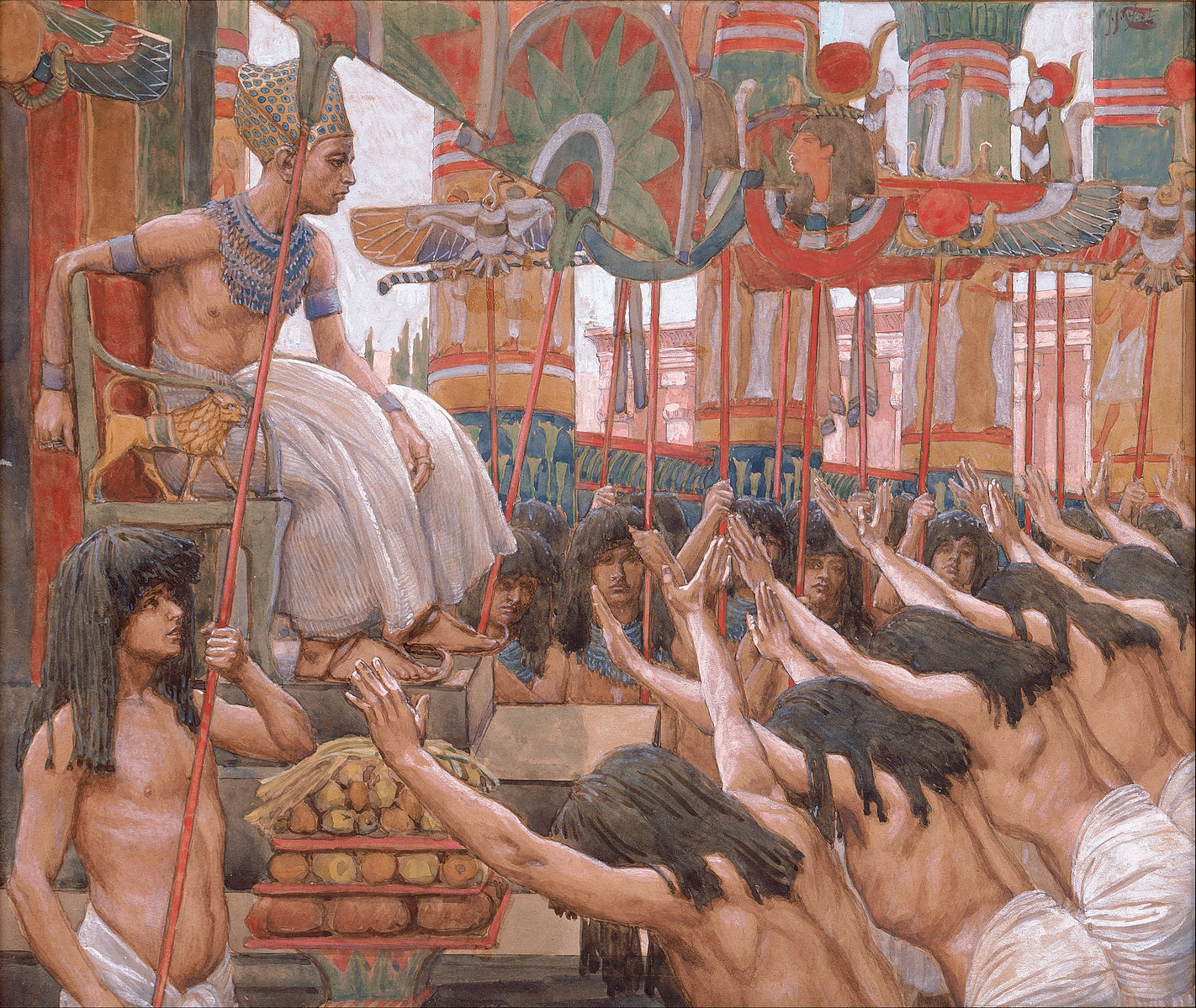
Joseph Dwelleth in Egypt, by James Tissot, circa 1900

Judah sees an Egyptian nobleman wearing fine linen and gold, seated in a chair on a dais above him, speaking through an interpreter. This is a man with absolute power in Egypt. This is the man who sold Judah and his brothers grain the year before on the condition that they come back with their youngest brother—probably not imagining how hard it would be to meet that condition.

Now the viceroy seems to be playing a sadistic game with the brothers from Canaan. The day before, he welcomed them into his own palace and treated them to a feast. Today, he had them arrested for a crime they did not commit. At least he had one of them arrested: the youngest, Benjamin. Judah had vowed to their father, Jacob, that he would not return to Canaan without Benjamin.

But Judah is desperate. He has to persuade the viceroy to free Benjamin, and to do that he must get closer, and touch the man’s emotions.

Joseph’s view

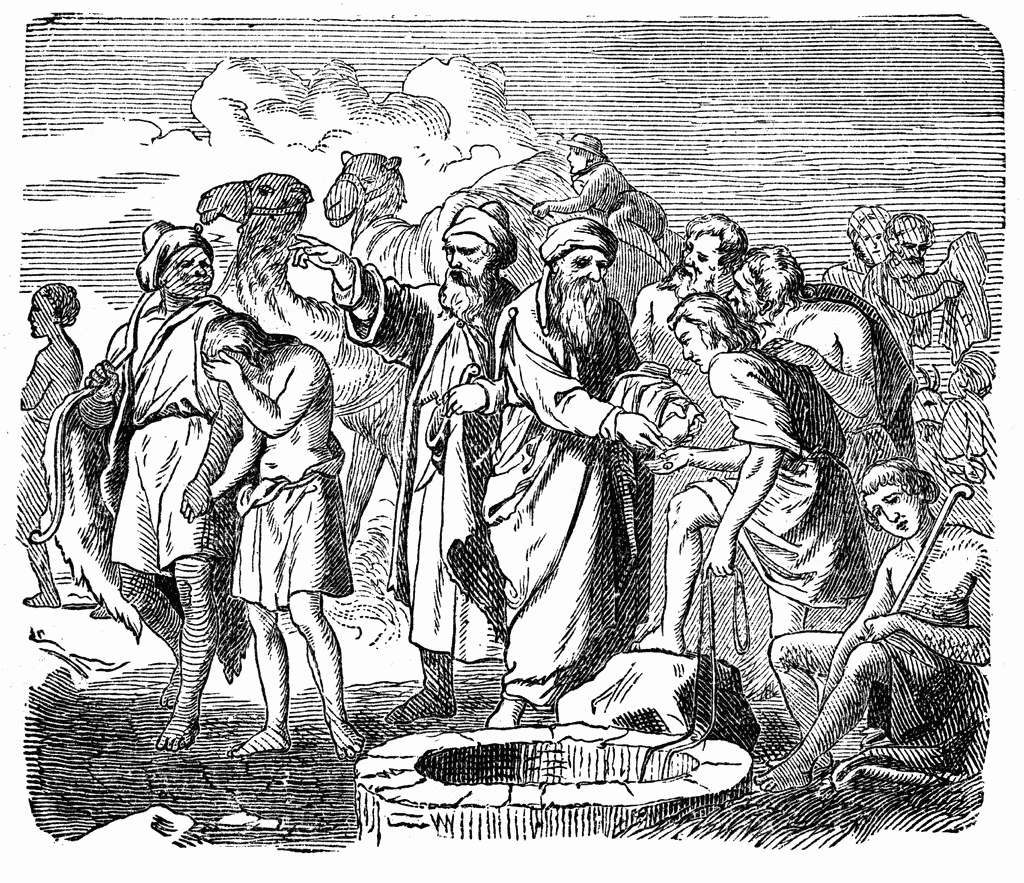
Joseph Sold for Twenty Pieces of Silver, Bible Stories for Little Children, Benziger Bros., 1894

Joseph sees his brother Judah stepping closer. He does not trust any of his ten older brothers. Twenty years before, they stripped off his clothes and threw him into a pit, then discussed killing him until Judah saw the caravan and persuaded the others to sell him instead.

Back then, his brothers overpowered him physically in order to eliminate him from their lives. But now Joseph has all the power. In fact, when his ten older brothers came to Egypt to buy grain the year before, he imprisoned them all for three days while he figured out what to do.2

With a word, he could have had his brothers killed, or sold as slaves. But he overheard them telling each other that God was (finally) punishing them for their merciless behavior toward Joseph. So he embarked on a series of secret tests to see if his brothers had reformed. (See my posts Mikeitz: A Fair Test, Part 1 and Mikeitz & Vayigash: A Fair Test, Part 2.)

Joseph’s last test

Joseph knew the famine would continue in Canaan, and his brothers would have to return—with Benjamin—to buy more grain. The night before they head up to Canaan again, Joseph prepares his final test by ordering his assistant:

“Fill the sacks of the men with food, as much as they are able to hold, swelling. And put each man’s silver in the mouth of his sack. And my goblet, the silver goblet, put it in the mouth of the sack of the youngest one, along with the silver for his grain purchase.” (Genesis 44:1-22)

At dawn, as soon as his brothers leave, Joseph tells his assistant:

The Cup Found, by James Tissot, circa 1900

“Get up, chase after the men! Overtake them, and say to them: Why did you repay [the viceroy] with wickedness instead of good? Isn’t this what my lord drinks from, and he divines divinations in? What a wickedness you did!” (Genesis 44:4-5)

Then they tore their clothes. And each one reloaded his donkey, and they returned to the city. (Genesis 44:11-13)

The man catches up with them just outside the city and delivers the accusation. He searches their sacks of grain, from the oldest brother’s to the youngest, and pulls the goblet out of Benjamin’s.

Tearing one’s clothes is an act of mourning. Benjamin will never return to Canaan now. And without him, their father will die of grief.

When they are brought before the viceroy, he says:

“The man in whose possession the goblet was found, he will be my slave. And you, [the rest of] you, go back in peace to your father.” (Genesis 44:17)

Judah’s plea

At this point Judah steps closer to the viceroy, and the Torah portion Vayigash begins. After obsequiously begging the powerful man to listen, Judah gives his own version of what happened the year before.

“My lord questioned his servants, saying: ‘Do you have a father or another brother?’ And we said to my lord: ‘We have an old father, and a child of his old age, the youngest. And his [full] brother is dead, so he alone is left from his mother, and his father loves him.’” (Genesis 44:19-20)

This is not quite what happened. Actually, the viceroy accused the ten Canaanite men of being spies. Flabbergasted, they protested that they were all brothers, ten of their father’s twelve sons, and added:

“And hey! The youngest is now with our father, and the other is no more.” (Genesis 42:13)

The viceroy agreed to sell them grain, but ordered them to prove they were not spies by bringing back their youngest brother.

Now Judah decides not to bring up the viceroy’s accusation. He continues his story:

“And you said to your servants: ‘Bring him down to me, so I can set my eyes on him!’ But we said to my lord: ‘The young man is not able to leave his father; if he did leave, his father would die.’ But you said to your servants: ‘If your youngest brother does not come down with you, you will not see my face again.’” (Genesis 44:21-23)

Judah reports that this year, when their father told them to go back to Egypt and buy more grain, they reminded him that they could not go without their youngest brother.

Then your servant, my father, said to us: “You know that my wife bore two sons to me.” (Genesis 44:27)

Rachel is only one of Jacob’s four wives, but he thinks of Rachel and her two sons as if they were his only family. He loved rather Rachel far more than his other wives. After she died, Jacob treated her son Joseph with blatant favoritism—which contributed to the ten older brothers’ desire to get rid of him.3 After they did, and deceived their father so he believed his beloved son was dead, he transferred his attachment Rachel’s second son, Benjamin.

In last week’s portion, Mikeitz, Jacob finally agreed to let Benjamin go to Egypt, but warned his older sons that if anything happened to him, they would be sending his gray head down to Sheol in torment. (Sheol is a vague underworld where souls sleep forever after death.)

Judah phrases his father’s protest this way in his report to the viceroy:

“But the one is gone from me, and I said: Alas, he was certainly torn by a wild animal! And I have not seen him since. And you would take this one from in front of me, too? If a mortal accident happens, then you would send down my gray head to Sheol in misery.” (Genesis 44:28-29)

Then Judah comes to the point.

“And now, if I come back to your servant, my father, and the young man is not with us—and his [own] soul is bound up with his soul—then it will happen when he sees that the young man is not [with us]: he will die. And your servants will send down the gray head of your servant, our father, in torment to Sheol.”  (Genesis 44:30-31)

After this attempt to rouse the viceroy’s compassion for the old father, Judah asserts his own responsibility.

“For your servant pledged himself for the young man to my father, saying: ‘If I do not bring him back to you, then I am guilty before my father all the days [to come].’ So now, please let your servant stay instead of the young man as a slave to my lord, and let the young man go up with his brothers! Because how can I go up to my father if the young man is not with me? Lest I see the evil that will find my father!” (Genesis 44:32-34)

Judah’s speech works—in a different way than he hoped. Joseph is impressed and moved by Judah’s choice to become a slave in Egypt himself, rather than see Jacob’s other favorite son in that position.

Without knowing it, Judah has passed the ultimate test, and proved to Joseph that he has reformed.

And Joseph was not able to control himself in front of all his attendants, and he called out: “Have everyone leave me!” So no one stood with him when Joseph made himself known to his brothers. And he gave his voice to weeping. And the Egyptians [nearby] heard, and then Pharaoh’s household heard. And Joseph said to his brothers: “I am Joseph. Is my father still alive?” (Genesis 45:1-2)

Compassion

Judah demonstrates compassion both for Jacob, the father who never loved him, and Benjamin, who swims in paternal affection.

When Joseph recognizes Judah’s compassion, he feels compassion himself. Although only Judah has passed the final test, Joseph is moved to welcome all of his brothers as his own family. And the first thing asks them about is the welfare of his father, with whom he has not communicated for twenty years, not since Jacob sent him off alone to confront the brothers who hated him.4

Both Judah and Joseph feel compassion for people whom they had resented for years. And both men act on it, changing their lives forever.


Feeling compassion does not necessarily mean acting on it. I am not the only person I know who can feel compassion for someone—such as a starving child in a distant land, whose photograph appears when I open my mail—and yet do nothing about it.

I am also not the only person who can doggedly go on doing the right thing, treating people as if I felt compassion for them even when my heart is not moved.

The story of Joseph reminds me that we humans tend to keep on doing whatever we’ve been doing. Like Joseph, we keep on ignoring a resented parent, or manipulating others, or setting a slew of conditions. We do not like to change.

But if compassion suddenly touches your heart, there is a moment when your egotism loses its grip. You might even weep, like Joseph. Then you could harden your heart and return to your old habits.  But you could also change into a more generous person.

I am grateful that humans are capable of feeling compassion. Although the feeling does not last, it may trigger a change that does. And the whole world needs more generosity.


  1. And Joseph recognized his brothers, but they did not recognized him. (Genesis 42:8). Judah’s behavior when he makes his plea in Vayigash does not indicate that this has changed.
  2. Genesis 42:17.
  3. Other contributing factors were Joseph’s reports of dreams in which his brothers were bowing down to him, and the fact the Joseph, encouraged by their father, brought back bad reports on his brothers (Genesis 37:2-14).
  4. See my post Mikeitz: Forgetting a Father.

Mikeitz: An Unlikely Ascent

From prison to palace, from slave to ruler, in one day.

At Pharaoh’s command, Joseph leaves the dungeon and becomes the vice-regent of all Egypt in this week’s Torah portion, Mikeitz (Genesis 41:1-44:17). Joseph has intelligence and God’s favor; Pharaoh has power. Yet Joseph’s elevation would not have occurred without the honesty of Pharaoh’s chief butler, the Egyptian “magicians”, and Joseph himself.

Joseph Sold into Slavery, by Own Jones, 1865

Joseph is a Hebrew youth who grew up as the favorite son of a rich man, Jacob. His descent was precipitous in last week’s portion, Vayeishev. His older brothers stripped off his fancy clothing, told a caravan bound for Egypt that he was a slave, and sold him. The Egyptian who bought him recognized Joseph’s intelligence and ability, and made him the head slave of his household. But his Egyptian master’s wife falsely accused him of attempted rape, and Joseph was thrown into the dungeon.

Thanks to the dishonesty and cruelty of his own brothers and his master’s wife, Joseph became the lowest of the low. At least he is not sentenced to death. Joseph lives in the dungeon, and once again his attitude and abilities lead to a small increase in status: the chief jailer makes Joseph his assistant, and lets him run everything inside the dungeon. But he is not allowed to leave.

The chief butler forgets

The portion Vayeishev ends with Joseph interpreting the dreams of two of his fellow prisoners. Joseph predicts that the former chief baker will be executed, but the former chief butler will be pardoned and restored to his post.

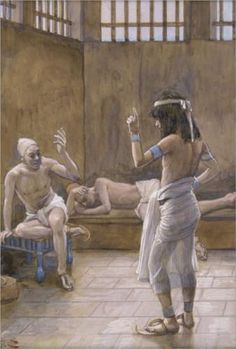
Joseph in Prison, by James Tissot, c. 1900

This man is the only person Joseph knows who will soon be in Pharaoh’s presence. He tells the chief butler he is innocent, and begs him to mention his case to Pharaoh.

The chief butler does not actually promise Joseph he will tell Pharaoh, but he does not demur. Yet the portion Vayeishev ends with the sentence:

But the chief butler did not zakhar Joseph, and he forgot him. (Genesis 40:23)

zakhar (זַכַר) = remember.

This week’s portion, Mikeitz, begins:

It was at the end of two years, and Pharaoh had a dream … (Genesis 41:1)

For two years nothing happened. The chief butler did not mention Joseph to Pharaoh. Joseph continued to live in the dungeon.

Why does the chief butler “forget” to bring up Joseph’s case?

An 18th-century commentary explained that the Torah says he “did not remember Joseph and he forgot him” to refer to two stages of forgetting:

“At the beginning he simply did not recall Joseph’s name, something that Joseph had asked him to remember. … This verse also informs us that the chief butler subsequently forgot Joseph completely, he erased the incident from his heart. … a deliberate act of forgetting.” (Or HaChayim)1

When I put myself in the chief butler’s place, I imagine that when he is first pardoned and restored to his position, he would want to keep his head down and not ask Pharaoh for any favors. I’ll bring it up later, he would think, after I’m sure Pharaoh trusts me again.

A few months later, when everything is going well, the man remembers Joseph. But now he does not want to remind Pharaoh about whatever he did that caused Pharoah to throw him into the dungeon in the first place. I imagine the chief butler rationalizing that he did not actually make a promise to Joseph. And it is not as if the young Hebrew man is under a death sentence. So gradually the butler forgets all about Joseph’s request—until Pharaoh asks for a dream interpretation.

A 12th-century commentator, Rashbam, wrote that God “performed a miracle for the sake of Joseph” by sending Pharoah two dreams that his own interpreters could not understand. That way, the chief butler “was forced to remember him.” 2

The chartumim do not cheat

Pharaoh has two dreams in a single night. In the first dream, seven healthy cows are eaten by seven gaunt cows. In the second, seven healthy ears of grain are swallowed up by seven thin, scorched ears.

Then it was morning, and his spirit was disturbed. And he sent out and summoned all the chartumim of Egypt, and all of its wise. But there was no dream-interpreter among them for Pharaoh. (Genesis 41:8)

Chartumim (חַרְטֻמִּים) = literate priests with occult knowledge. (Probably from the Hebrew word charut, חָרוּת = engraved, written. These high-level priests wrote down and read incantations out loud.)

Khamwese, Egyptian Priest and Heka manipulator, 13th century BCE

The word chartumim is often translated in English as “magicians”. But they were not magicians in the modern sense: people who create illusions and trick their audience. The ancient Egyptians believed that the gods created and maintained the universe with “heka”, a cosmic power that some individuals could also tap into and use to manipulate reality. Priests who were chartumim accomplished this through incantations and ritual actions.3

The Torah assumes that are that significant dreams are predictions about the future. In last week’s portion, when seventeen-year-old Joseph related his two dreams, his brothers and his father assumed they were predictions that someday they would bow down to Joseph (although they did not want to believe it).4

The other assumption in the portion Mikeitz is that chartumim were usually able to interpret significant dreams. Perhaps they failed with Pharaoh’s two dreams because their occult knowledge was about Egyptian gods. This time, although Pharaoh does not know it, his dreams came from the God of Abraham, the God of Joseph. So the rituals of the chartumim do not yield any results.

And they are honest enough to say so.

Thechief butler remembers

Then the chief butler spoke to Pharaoh, saying: “My offenses I am mazkir today. Pharaoh became angry with his servant, and he placed me in custody of the house of the chief of the guards, me and the chief baker.” (Genesis 41:9-10)

mazkir (מַזְכִּיר) = mentioning, recounting. (A form of the verb zakhar = remember.)

When the chief butler mentions his “offenses”, he probably is not including his failure to mention Joseph to Pharaoh. His “offenses” are whatever he did two years ago that offended Pharaoh. He chooses not to remind Pharaoh of exactly what he had done, but he does take the risk of Pharaoh remembering it—in order to help his boss now, and perhaps even in order to help the young Hebrew in the dungeon.

The chief butler continues:

“And one night we [both] dreamed a dream, I and he, each dream according to its own meaning. And there was with us a young Hebrew man, a slave of the chief of the guards, and we told him, and he interpreted our dreams for us … And it happened as he had interpreted for us: I was restored to my position, and he was hanged.”
 (Genesis 41:11-13)

This true account is all it takes to move the story along; the chief butler does not even need to add Joseph’s claim that he is innocent. Pharaoh is so eager to have his two disturbing dreams interpreted that he sends for Joseph immediately.

Joseph does not take credit

Then Pharaoh sent and summoned Joseph, and he was rushed out of the dungeon, and he shaved and he changed his clothes and he came to Pharaoh. And Pharaoh said to Joseph: “A dream I dreamed, and there is no interpreter for it. But I have heard it said about you: you [need only] hear a dream to interpret it.” (Genesis 41:14-15)

Pharaoh’s chief butler did indeed describe Joseph interpreting his dream and the chief baker’s dream right after he heard them, without engaging in any of the occult rituals the chartumim would use.

Joseph knows his dream interpretations in the dungeon were inspired by God; he would never have made such accurate guesses on his own. He had even told the chief butler and chief baker:

“Isn’t interpretation of them for God?” (Genesis 40:8)

Now that he stands in front of Pharaoh, Joseph once more refuses to pretend he has magic power of his own.  

And Joseph answered Pharaoh, saying: “Not I! Elohim will answer for the welfare of Pharaoh.” (Genesis 41:16)

Elohim (אֱלֺהִים) = plural of eloha, אֱלוֹהַּ = god. Elohim  = gods, god, God.

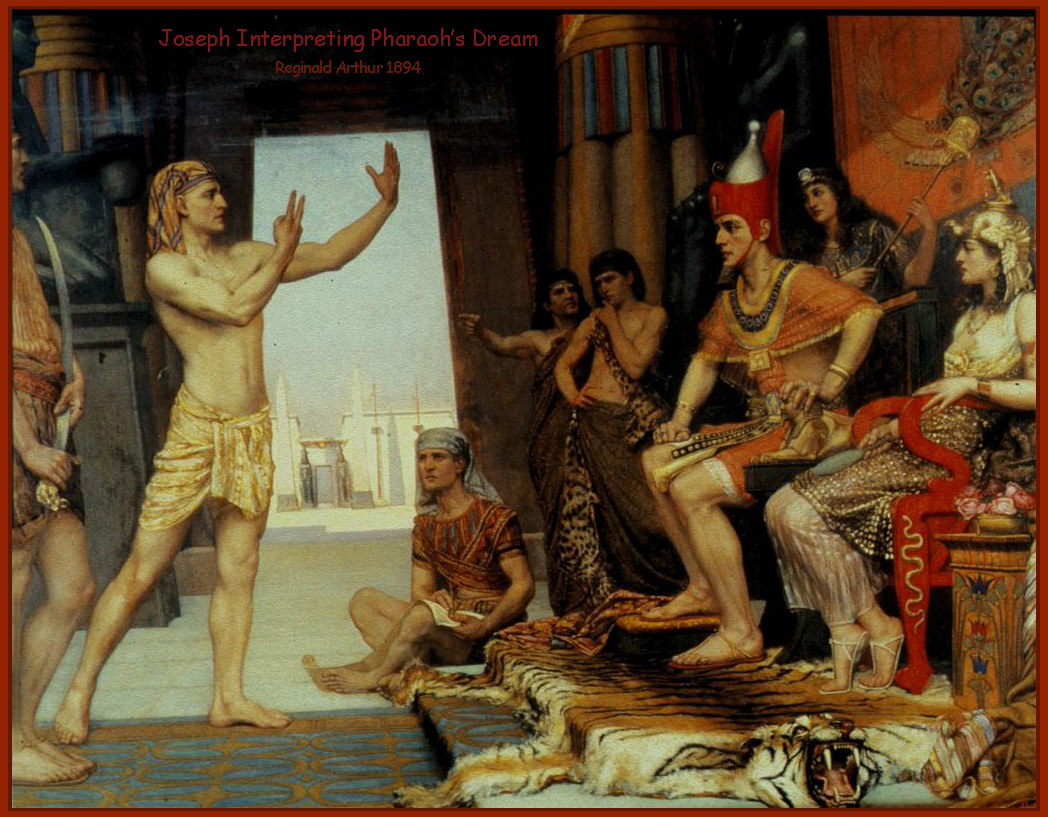
Joseph Interprets Pharaoh’s Dreams, by Reginal Arthur, 1894

Instead of using God’s personal name, Y-H-V-H, Joseph uses an ambiguous word that could as easily refer to the gods of Egypt as to Joseph’s God, the God of his great-grandfather Abraham. He is both honest about his own abilities, and intelligent about using a neutral word for God that will not trigger any negative reaction from Pharaoh.

With no further ado, Pharaoh tells Joseph his two dreams, concluding:

“And the scanty ears of grain swallowed up the seven good ears of grain. And I told the chartumim, but none [of them] was an explainer for me.” (Genesis 41:24)

Joseph might have decided to make the number seven mean seven years if he wanted to invent an explanation for the dreams of seven scrawny cows consuming seven fat cows and seven scanty ears of grain swallowing up seven good ears. But how could anyone invent explanations for the other elements in Pharaoh’s dreams that would turn out to be true predictions? There is too much at stake for anyone to prophesize without the help of a guidebook or a god.

The chartumim had no guidebook for the dreams sent by Joseph’s God. But Joseph has God, who instantly puts the meaning of the dreams into his mind. He explains the dreams to Pharaoh, ending with this summary:

“What the Elohim is doing, he made Pharaoh see. Behold, seven years of great plenty are coming throughout the land of Egypt. And seven years of famine will arise after them, and all the plenty in the land of Egypt will be forgotten, and the famine will completely use up the land. … And the dream came to Pharaoh two times because the matter was determined by the Elohim, and the Elohim is hastening to do it.” (Genesis 41:28-32)

Next Joseph gives Pharaoh some good advice. The text does not indicate whether God is transmitting these words to Joseph as well, or whether Joseph now had an idea of his own.

“And now, let Pharaoh select a man of discernment and wisdom, and set him over the land of Egypt. … And let them collect all the food of the seven good years … in cities under guard. And let the food be a reserve for the land for the seven years of the famine that will be in the land of Egypt. Then the land will not be cut down by the famine.” (Genesis 41:33-36)

And the thing was good in the eyes of Pharaoh and all his courtiers. And Pharaoh said to his courtiers: “Could we find another man like this, who has the spirit of Elohim in him?” (Genesis 41:37-38)

Pharaoh makes Joseph his viceroy on the spot—because the spirit of Elohim is in him.


Pharaoh needs a dream interpreter. He does not know that he also needs a viceroy in charge of agriculture and food rationing. Joseph wants to be released from both prison and slavery. He does not know what he wants to do once he is free.

Pharoah and Joseph need each other. But they would never meet, if it were not for the honesty of the Egyptian chartumim, and a belated good deed by Pharaoh’s chief butler. And their meeting would not have led to Joseph’s elevation if Joseph had not been honest about the true source of his dream interpretations. Pharaoh gives him the job title and the signet ring because he respects Elohim—whether that means Joseph’s God or many gods—and sees that Joseph has Elohim’s favor.

Does everything come together by chance? Are Joseph and Pharaoh just lucky?

Or does God arrange everything as part of a master plan? (Later in the Joseph story, Joseph tells the brothers who sold him into slavery “you did not send me here, but God!” and “you planned evil for me, but God planned it for good, in order to bring about this time of keeping many people alive.”)5

Or is it a combination of luck and the honest, ethical behavior of everyone involved at the time?

The same questions apply to our life stories today. When the right people do the right things and everything “clicks” for a good outcome, what do you attribute it to? Luck? A master plan of God’s? Or a combination of luck and a few individuals acting honestly for the good of everyone?


  1. Or HaChayim is a collection of 18th-century Moroccan Jewish commentary. Translation from www.sefaria.org.
  2. Rashbam is the acronym of 12th-century Rabbi Shmuel ben Meir. Translation from www.sefaria.org.
  3. Scott B. Noegel, “The Egyptian Magicians”, www.thetorah.com/article/the-egyptian-magicians; Flora Brooke Anthony, “Heka: Understanding Egyptian Magic on Its Own Terms”, https://www.thetorah.com/article/heka-understanding-egyptian-magic-on-its-own-terms.
  4. Genesis 37:5-11.
  5. Genesis 45:8 and 50:18-20. See my post: Vayigash & Vayechi: Forgiving?

Vayeishev: Question at Shekhem

His brothers went to pasture their father’s flocks at Shekhem. And Israel said to Joseph: “Aren’t your brothers pasturing at Shekhem? Go, and I will send you to them.” And [Joseph] said to him: “Here I am.” And he said to him: “Go, please, see the welfare of your brothers and the welfare of the flock, and bring back word to me.” (Genesis 37:12-14)

This passage in the Torah portion Vayeishev (Genesis 37:1-40:23) sounds pleasant—as if there were nothing ominous about Shekhem, or dangerous about sending Joseph to report on his brothers. But someone who reads the book of Genesis up to this point knows that something dire is about to happen.

At Shekhem: Rape and murder

The Seduction of Dinah, by James Tissot, ca. 1900

When Joseph and his half-sister Dinah were about twelve or thirteen years old, their father Jacob (a.k.a. Israel) brought his whole family to Shekhem1 and pitched camp next to the town. Jacob even purchased the land they were camping on, as if he intended to stay. Then one day Dinah walked into town alone “to see the daughters of the land”.2 Instead of making some female friends, she is abducted and raped by the son of the town’s ruler.

Jacob delayed taking action until his older sons came home from pasturing the flocks. By that time the ruler’s son, also named Shekhem, had fallen in love with Dinah and talked her into changing her mind about him.3 Shekhem and his father came to Jacob’s camp to arrange a marriage. The son offered to pay Jacob any bride-price he asked for. The father upped the ante, proposing that his people and Jacob’s people would intermarry and become one people.4

Jacob said nothing. His sons pretended to agree to intermarriage if all the men of the town  circumcised themselves first.  After the men of Shekhem had done so, and were disabled by pain, two of Jacob’s sons, Simon and Levi, came into town and killed every male. They took their sister and left.  Then “the sons of Jacob” (which sons are not specified) plundered the town, seizing its women and girls as slaves, and its goods and livestock as booty.5

Then Jacob said to Simon and Levi: “You have stirred up trouble, making me stink among the inhabitants of the land, among the Canaanites and Perizites! And I am few in number, and they will gather together against me, and they will strike me and I will be destroyed, I and my household!” (Genesis 34:30)

To escape vengeance from neighboring towns, Jacob makes his whole household pack up and move south to Hebron.

Joseph was probably too young to participate in the massacre or the looting of Shekhem. His mother, Rachel, was protective of her only son; and when Jacob introduced his family to Esau and his soldiers, he placed Rachel and Joseph in back, the safest position.6

But Joseph saw his half-brothers Simon and Levi arm themselves with swords, go into Shekhem, and return covered with other men’s blood. Later that day Joseph saw his older brothers herding their new female slaves. And when the whole household packed up and took down the tents, Joseph knew that they were moving again to escape a possible counter-attack.

Now, only four or five years later, Joseph’s ten older brothers have taken the family flocks to
Shekhem, of all places. And his father wants him to go there and check up on them.

At Hebron: Joseph’s negative reports

Joseph is seventeen when Jacob sends him from their home in Hebron back to Shekhem. By this time Joseph’s ten older brothers hate him—partly because their father demonstrated blatant favoritism by giving only Joseph a garment fit for royalty; partly because Joseph told them two of his dreams, in which his brothers were bowing down to him; and partly because he maligns them when he reports to their father.7

Joseph, at age seventeen, was tending the flock with his brothers, and he was an assistant to the sons of Bilhah and Zilpah, his father’s women.8 And Joseph brought bad slander about them to their father.9 (Genesis 37:2)

Jacob may believe everything his favorite son says, and trust him to bring an honest report back from Shekhem. He may also be concerned that his ten older sons decided to take the flocks to Shekhem. (I assume that Jacob’s older sons are still making independent decisions without consulting their father, as they did several years before at Shekhem.)  What if someone from a neighboring town recognized them from the time before the massacre?

On the other hand, what if someone in the vicinity of Shekhem recognizes Joseph? This possibility does not seem to occur to Jacob.

Perhaps he does not think logically where his favorite son is concerned, especially now that Joseph’s mother, Rachel, has died. It also does not occur to Jacob that his older sons might hate Joseph so much that they are a greater danger to him than any neighbors of the former Shekhemites.

At Shekhem: The question

Joseph answers his father, “Here I am!” With the blitheness of a spoiled adolescent, he heads off alone for Shekhem.

And [Jacob] sent [Joseph] away from the valley of Hebron. And he came to Shekhem.  And a man found him, and hey! He was wandering in the fields. And the man asked him: “What tevakeish?” (Genesis 37:14-15)

tevakeish (תְּבַקֵּשׁ) = do you seek, will you seek, are you looking for. (A conjugation of the piel verb bikeish, בִּקֵּשׁ  = seek, look for, try to get.)

Joseph probably wandered off the road and through the fields looking for his brothers and the flocks. The Torah never identifies the “man” who questions Joseph. It might be an ordinary man, or it might be a “man” like the “man” who wrestled with Jacob in Genesis 32:25 and turned out to be a divine being. Most classic commentators said it was an angel, i.e. a divine messenger who looked like a man,10 though Ibn Ezra wrote that the man was simply someone passing by.11 

At Shekhem: Joseph’s answer

And he said: “My brothers I am mevakeish.  Tell me, please, where they are pasturing.” (Genesis 37:16)

mevakeish (מְבַקֵּשׁ) = seeking. (Another piel form of bikeish.)

Why does Joseph assume that a man who happens to be crossing a field near the former town of Shekhem would know who his brothers are, or where they went?

Perhaps Joseph’s polite request implies “if you happen to know”.12 Perhaps Joseph intuitively senses that the “man” is actually a divine messenger from God.13 Or perhaps he simply figures he might as well ask, just in case the man has seen them.

Growing up with his family’s religion and stories, Joseph would know that God’s divine messengers sometimes look like men—until they disappear. So the question “What do you seek?” might be an inquiry from God.  In that case, Joseph could take the opportunity to give a different answer, and receive a different response.

1) He could say: “I am seeking to find out what my brothers are doing wrong this time, so I can report back our father.”

He knows his father loves him more than any of his brothers, but he is old enough to wonder if it will last. Perhaps Joseph thinks that slandering his brothers helps to keep him in first place.

2) He could say: “I am seeking to find out what really happened when my family lived here in Shekhem.”

If Joseph had asked his mother and other adults in the household about Shekhem, their reactions combined with his own vivid but incomplete memories would give him a morbid fascination with the subject.

3) He could say: “I am seeking an interpretation of those two dreams I had in which my brothers were bowing down to me.”

His father and his brothers thought that Joseph was fantasizing that he would become a king and rule over them all.14 But what if the dreams were true prophecies from God? Was there something else he should know?

4) But he would not say: “I am seeking to know why my father sent me all the way to an abandoned city to check up on my brothers who hate me enough to kill me.”

If he had been more aware of his family’s psychology, Joseph would have been afraid of finding his brothers. Readers today might suspect Jacob of the psychological blindness of narcissism. (See my post: Mikeitz: Forgetting a Father.) We might also wonder about the Joseph’s older brothers, who were brought up in a family where two of their mothers were openly jealous of one another,15 where their father and grandfather were cheating one another,16 and where they literally got away with murder at Shekhem. Would these young men feel any ethical qualms about harming the little brother they hated?

Joseph has an excuse for giving up and going home, since he could not find his brothers near Shekhem. But he is determined to complete the mission his father sent him on. So instead of giving a more response, he merely tells the stranger that he is looking for his brothers.

Does Joseph feel some inner calling in the presence of God’s angel? Or does he simply believe, with the naivety of a spoiled seventeen-year-old, that he will return safely to his father in Hebron?

And the man said: “They pulled out from here, for I heard them saying: Let’s go to Dotan.”  So Joseph went after his brothers and he found them at Dotan.  (Genesis 37:17)

When the brothers at Dotan see Joseph approaching, some of them want to kill him right away and throw him into a nearby dry cistern. Reuben, the oldest, says they should throw him into the pit alive. So the brothers seize Joseph, strip off his royal clothing, and throw him in. Then a caravan headed for Egypt passes by, and the brothers sell him to the traders as a slave.17

They think they will never see him again. But the rest of the book of Genesis is a story about the complicated reconciliation between Joseph and his brothers, and how all the children of Israel ended up living in Egypt.


History haunts the story of Joseph and his brothers. They leave Shekhem with their father to make a fresh start; but then they return, and Shekhem becomes the place where Joseph makes the fateful decision to follow his brothers instead of going home. Jacob gives Joseph a royal tunic and Joseph blabs about his dreams and his brothers’ faults; and these relatively small errors in judgment lead to attempted murder, slavery, redemption, and four hundred years of exile in Egypt.

Everything is connected in the Joseph story. Everything he does matters.

I suspect this is true in our own lives as well. Before we act, before we speak, we might ask ourselves: What are we looking for?


  1. Shekhem was about 30 miles (50 km) north of Jerusalem, between two round hills, Mt. Gezerim and Mt. Eyval. (The common noun shekhem, שְׁכֶם, means “shoulders”.) The site is now part of the city of Nablus.
  2. Genesis 34:1.
  3. Genesis 34:2-4. See my post Vayishlach: Change of Heart, Part 1.
  4. Genesis 34:4-12
  5. Genesis 34:13-29.
  6. Genesis 33:1-2.
  7. Genesis 37:3-4. See my post Vayeishev: Favoritism.
  8. Jacob’s two wives, Rachel and Leah, gave him their slaves Bilhah and Zilpah as concubines in Genesis 30:3-9.
  9. The Hebrew word is dibatam (דִּבָּתָם), which could mean slander or negative gossip about them, reports of their own slander, or their bad reputation. See my post Vayeishev: What Drove Them Crazy.
  10. C.f. Aggadat Bereshit 73:3, Bereshit Rabbah 84:14, Midrash Tanchuma Buber, Rashi, Kli Yakar, Siftei Chakhamim.
  11. 12th-century rabbi Abraham Ibn Ezra.
  12. C.f. Ibn Ezra, Radak.
  13. C.f. Haamek Davar by 19th-century Naftali Zvi Yehuda Berlin.
  14. Genesis 37:5-11.
  15. Leah and Rachel in Genesis 29:31-30:24. Leah’s son Reuben, at least, knows about their competition for Jacob’s love when he gives his mother mandrake roots in Genesis 30:14.
  16. Lavan cheats his son-in-law Jacob in Genesis 29:18-27. Lavan and Jacob both try to cheat one another regarding Jacob’s wages in Genesis 30:31-30:2.
  17. Genesis 37:18-28.

Vayeitzei: Awe versus Terror

Jacob introduces a new name for God in this week’s Torah portion, Vayeitzei (Genesis 28:10-32:3):

“If it were not that the elohim of my father—the Elohim of Abraham and the Pachad of Isaac—is with me, you would have sent me off empty-handed!” (Genesis 31:42)

elohim (אֱלֹהִים) = gods, god, God.

pachad (פַּחַד) = trembling; terror, dread. (From the verb pachad, פָּחַד = tremble uncontrollably, shudder, be terrified; dread.)

Everyone in the book of Genesis uses the common noun elohim to refer to gods in general. Descendants of Terach, both Abraham’s line in Canaan and Nachor’s line in Aram, also use the proper name Y-H-V-H for the god who becomes known later as the God of Israel.1 Y-H-V-H has other names and titles, but only Jacob calls God the Pachad of his father.

Jacob’s awe

Jacob’s Dream, by William Blake, 1800

In last week’s Torah portion, Toledot, Jacob cheats his older brother Esau twice, and Esau vows to kill him. He flees to his uncle Lavan’s house in Aram, a northern Mesopotamian territory far from Canaan. On the way, Jacob has his first direct experience of God: a dream featuring a stairway between the earth and the heavens, and God standing over him.

Then Jacob woke up from his sleep, and he said: “Surely there is Y-H-V-H in this place, and I, I did not know!” Vayiyra, and he said: “How awesome is this place!” (Genesis 28:16)

vayiyra (וַיִּירָא) = and he was afraid, and he was awed. (A form of the verb yarei, יָרֵא = fear, be afraid, be awed, revere.

Jacob feels awed and frightened by his numinous experience. Maybe he has goosebumps. But he is not overcome by the uncontrollable trembling associated with pachad, terror. When he gets up, he erects a stone, pours oil on it, and vows that if God protects him until he returns to his father’s house, he will worship God and give God a tenth of his possessions.

Isaac’s terror

Jacob’s practical bargaining is a far cry from his father Isaac’s relationship to God. As a young adult, Isaac voluntarily let his father tie him up on an altar as a burnt offering to God. Abraham almost cut his throat before God intervened.2 According to some classic Jewish commentators, Isaac experienced pachad then, and carried the trauma for the rest of his life.3 When Isaac is old and blind, Jacob impersonates his brother Esau in order to steal Isaac’s blessing in the name of God. When Esau arrives and confirms what Jacob did, Isaac is seized by another kind of fearful trembling, charad.4

Perhaps Jacob thinks of Isaac’s overwhelming relationship to God in terms of trembling.

Jacob’s wages

Jacob arrives safely at his uncle’s house in this week’s Torah portion, and promptly falls in love with Lavan’s younger daughter, Rachel. Having arrived without any gifts to use as a bride-price,5 Jacob works as a shepherd for Lavan for seven years. But on the wedding day, Lavan substitutes his older daughter, Leah. Jacob still wants Rachel, and Lavan tells Jacob he has to work another seven years for her.6

After Jacob completes fourteen years of service for his two wives, he continues to work for his uncle and father-in-law, this time in exchange for the black sheep and the spotted and brindled goats in Lavan’s flocks. Lavan promptly sends them all to a distant pasture before they can be counted.7 But over the next six years Jacob uses breeding techniques to build up his own flocks of black sheep and brindled goats.

… so the feeble ones were Lavan’s and the [sturdy] striped ones were Jacob’s. And the man spread out very much, and he owned large flocks, female slaves and male slaves, and camels and donkeys. (Genesis 30:42-43)

After Jacob has accumulated this wealth, he notices that Lavan and Lavan’s sons act as if they have a grudge against him.

Then Y-H-V-H said to Jacob: “Return to the land of your fathers and your clan, and I will be with you.” (Genesis 31:3)

Jacob talks it over with his wives, who agree it is time to leave their father in order to ensure their own children’s inheritance. While Lavan and his sons are away at a sheep-shearing, Jacob leaves town with his whole household (his two wives, two concubines, twelve children, and many slaves) and all his flocks and other possessions. He does not know that his wife Rachel secretly brings along the small idols from her father’s house.8 They cross the Euphrates River and continue west, heading for Canaan.

Final confrontation

Lavan and his sons are not amused. They pursue Jacob’s party for seven days, and catch up with them in the hill country.

And Lavan said to Jacob: “What have you done when you deceived me and you carried off my daughters like captives of the sword? … There is power in my hand to do harm to you all! But last night the elohim of your father spoke to me, saying: Guard yourself, lest you speak with Jacob for good or bad. And now, you are surely going because you surely longed for your father’s house. [But] why did you steal my elohim?” (Genesis 31:29-30)

Elohim is an elastic word in the Hebrew Bible. When Lavan remembers his dream, he refers to the elohim of Jacob’s father (and also of Lavan’s father), whose name is Y-H-V-H. But also when he remembers that his household idols are missing, he accuses Jacob of stealing his elohim. Lavan does not limit himself to a single god.

Jacob chooses not to respond to Lavan’s allegation that he carried off Leah and Rachel like captives. Instead he makes his own accusation.

And Jacob answered, and said to Lavan: “Because yareiti, because I thought: Lest you take your daughters from me by force!” (Genesis 31:31)

yareiti (יָרֵאתִי) = I was afraid. (Another form of the verb yarei.)

Jacob’s use of the verb yarei does not imply that he was pusillanimous, only that he recognized a danger. He was afraid, not terrified.

Then Jacob challenges Lavan to look through the camp and see if he can find his household idols. Lavan searches the tents belonging to Jacob, his two wives, and his two concubines without finding them. (Rachel has hidden them in a camel cushion and is sitting on them. She tells her father she cannot get up because it is her menstrual period.)8

After that, Jacob feels entitled to castigate Lavan. He points out that he did hard, honest work for for twenty years, while Lavan tricked him more than once regarding his wages. He claims that he had to leave while Lavan was away, because:

“If it were not that the elohim of my father—the Elohim of Abraham and the Pachad of Isaac—was with me, you would have sent me off empty-handed! But Elohim saw my plight and the labor of my hands, and gave judgement last night.” (Genesis 31:42)

The judgement, according to Jacob, is God’s warning to Lavan the previous night that he must not say (or do) anything bad to his nephew and son-in-law. If God had not intervened in Lavan’s dream, Lavan would have taken everything Jacob had earned.

The two men agree that the Elohim in Lavan’s dream is the god they both acknowledge, Y-H-V-H. But Jacob includes another name for God: the Pachad of Isaac.

Jacob is not the kind of person who says the first thing that pops into his mind. I suggest that Jacob thought of “the pachad of Isaac”, then decided to say the words out loud in order to warn Lavan that his father’s God is a god of terror. The aspect of Y-H-V-H that causes terror and dread is on Jacob’s side.

Lavan cannot resist one last protest:

“The daughters are my daughters, and the children are my children, and the flocks are my flocks, and everything that you see, it is mine!” (Genesis 31:43)

But then he gives up and proposes that he and Jacob make a formal peace treaty. Jacob raises a memorial stone and builds a cairn (a heap of stones) to mark the boundary between them. Lavan says:

The Heap of Witness, Holman Bible, 1890

“A witness is this cairn, and a witness is the standing-stone, that I will not cross over past this cairn to you, and that you will not cross over past this cairn or this standing-stone to me, [to do anything] bad. The elohim of Abraham and the elohim of Nachor, may he judge between us—the elohim of their father.” (Genesis 31:52-53)

When Lavan swears by the elohim of Abraham (Jacob’s grandfather) and Nachor (his own grandfather) and their mutual great-grandfather, Terach, he knows he is swearing by Y-H-V-H, the god that Jacob also recognizes. Lavan phrases his oath to emphasize his kinship with Jacob. It is a reassurance: We have the same god.

And Jacob swore by the pachad of his father, Isaac. (Genesis 31:53)

Perhaps, as Robert Alter wrote, “he himself does not presume to go back as far as Abraham, but in the God of his father Isaac he senses something numinous, awesome, frightening.”9

Or perhaps Jacob is fed up with his uncle and father-in-law, and wants a clean break—as long as he gets to keep all of his own family and property. He does not care about his kinship with Lavan. Swearing by the pachad of Isaac emphasizes the dreadful power of the god who helped him and judged in his favor. It is a warning: My god is more dangerous!

Divine terror

The next time the word pachad appears is in the book of Exodus, in an ancient poem about how Egyptians were defeated at sea by the power of Y-H-V-H. The poem declares that all the nations in the region are aghast and tremble with fear of the God of Israel.

Horror and pachad fall upon them! (Exodus 15:16)

Pachad next appears in the book of Deuteronomy, when God promises the Israelites:

“This day I begin putting pachad of you and yirah of you over the faces of all the peoples under the heavens, so that they will pay attention to a rumor of you, and they will shake and they will weaken before you.” (Deuteronomy 2:25)

Later in Deuteronomy, Moses warns the Israelites that if they fail to obey God’s rules, God will inflict horrors upon them.

“And your life will hang in the balance, and you will be pachad night and day, and you will not [be able to] rely upon living. In the morning you will say ‘Who will make it evening?’ and in the evening you will say ‘Who will make it morning?’ because of the pachad of your heart that you will be pachad, and the vision of your eyes that you will see.” (Deuteronomy 28:66-67)

So God is the pachad of Isaac, who obeyed and nearly died; the pachad that Jacob uses to threaten Lavan; the pachad of the enemies and rivals of the Israelites; and the pachad of anyone who dares to disobey God.


I have felt a touch of yirah of the divine, though not quite at the goosebump level. I have never experienced pachad, the shuddering terror. I hope I never do. When I pray, I try to cultivate awe, but not dread.

Yet I know what is going to happen to Jacob in next week’s Torah portion. He will wrestle with a mysterious being, and walk away limping on his hip. He ran away from Esau and he ran away from Lavan, but he cannot run away from God.

I pray that everyone who is overwhelmed by terror is able to walk away—perhaps traumatized, like Isaac, or limping, like Jacob—but able to go on living.


  1. In Genesius 24:50-51, Nachor’s son Betuel and grandson Lavan spontaneously use the name Y-H-V-H.
  2. Genesis 22:1-14.
  3. Cf. Ibn Ezra, Ramban, Rabbeinu Bachya.
  4. Genesis 27:33. Charad (חָרַד) = tremble with fear.
  5. Even though Isaac is rich, Jacob runs off without any silver, animals, or trade goods to use as a bride-price. See my post Vayeitzei: Guilty Conscience.
  6. Genesis 29:9-20.
  7. Genesis 30:33-36.
  8. See my posts Vayeitzei: Idol Thief and Vayeitzei: Stealing Away.
  9. Robert Alter, The Five Books of Moses, W.W. Norton & Co., NY, 2004, p. 175.

Chayei Sarah & 1 Kings: Old Age for Scoundrels, Part 2

Both Abraham and King David have motley careers in the bible: brave and magnanimous in one scene, heartless and unscrupulous in the next. But in old age (about age 140-175 for Abraham, 60-70 for David) the two characters take different paths.

And Abraham expired and died at a good old age, old and satisfied, and he was gathered to his people. (Genesis 25:8)

Abraham, who is healthy and virile in extreme old age, takes a new concubine and raises a new family in last week’s Torah portion, Chayei Sarah (Genesis 23:1-25:18). But this time, instead of endangering his women and his sons, he acts responsibly. Abraham makes explicit arrangements for his eight sons so that each will carry on an independent life without internecine struggles. (See last week’s post: Chayei Sarah & 1 Kings: Old Age for Scoundrels, Part 1)

King David, however, is feeble and bitter during his last years. The haftarah reading for Chayei Sarah (1 Kings 1:1-1:31) sets the tone with its opening:

King David’s Deathbed, 1435

And the king, David, was old, coming on in years. And they covered him with bedclothes, but he never felt warm. (1 Kings 1:1)

This is the man who personally killed 200 Philistines in a single battle,1 who took at least eight wives and ten concubines,2 and who danced and leaped in front of the ark all the way into Jerusalem.3

David’s prime

As a young man, David is such a charismatic and popular military commander that King Saul is afraid David will steal his kingdom. Saul makes four attempts to kill him.4 David flees and becomes the leader of an outlaw band. At one point he seems to be running a protection racket.5

Later David defects to the Philistines, Israel’s longtime enemies, with his 600 men. The Philistine king of Gat welcomes the mercenaries and gives David the town of Ziklag. For over a year David and his men raid villages, kill the residents, and bring back booty (presumably sharing it with the king of Gat). This kind of raiding was common in the Ancient Near East, and the Hebrew Bible does not censure David; the text merely indicates that David lied to the king of Gat in order to avoid raiding Israelite villages.6

After King Saul and his son and heir Jonathan die in a battle with Philistines, David and his men relocate to Hebron, where David is proclaimed king of Judah, his own tribe. Meanwhile, Saul’s general Abner makes one of Saul’s sons7 the king of the northern Israelite territory.8 Right after David and Abner have made a truce, Joab, David’s army commander and nephew, assassinates Abner.9 Two other supporters of David assassinate Saul’s son in the north, and David becomes the king of all Israel—when he is only 30.

He captures the part of Jerusalem and turns it into his capitol, the City of David. One spring King David stays home while Joab leads a fight against the kingdom of Ammon. Walking on his rooftop in the evening, David sees a beautiful woman bathing on her rooftop. He finds out that she is Bathsheba (Batsheva), the wife of one of his own soldiers, Uriyah.

King David Sees Bathsheba, by Jean-Leon Gerome, 1889

Adultery is a sin in the Torah, a crime punishable by death.10 Nevertheless, David has Bathsheba brought to him. When she tells David she has become pregnant, he calls Uriyah home from the front so it will look as if she is pregnant by her husband. Uriyah, however, refuses to spend even one night in his own house at a time of war.

So David compounds his crime.

And it was in the morning when David wrote a letter to Joab, and he sent it by the hand of Uriyah. And the letter he wrote said: “Put Uriyah in the front of the hardest battle, then draw back from him, so he will be struck down and die.” (2 Samuel 11:15)

Joab obeys. The innocent Uriyah dies. As soon as Bathsheba finishes the mourning rituals for her husband, David marries her.

And the thing that David had done was evil in the eyes of God. (2 Samuel 11:27)

The prophet Natan transmits the words of God’s curse to the king:

“And now the sword will never swerve away from your house again, because you have despised me and have taken the wife of Uriyah the Hittite to be your wife. Thus says God: Here I am, raising up against you evil  from within your own house…” (2 Samuel 12:10-11)

The death of Bathsheba’s infant conceived in adultery is only the beginning. Amnon, who is David’s firstborn son by his wife Achinoam, rapes Tamar, David’s daughter by his wife Ma-akhah. David is responsible for justice, in both his household and his kingdom, but he does nothing about the rape. So Tamar’s full brother, Absalom (Avshalom), kills Amnon and goes into exile.

King David grieves over Amnon’s death for three years, then lets Absalom return to Jerusalem. Absalom usurps David’s throne after a long misinformation campaign, and King David leaves Jerusalem with his supporters. They camp at Machanayim on the other side of the Jordan River. On the way, a fellow named Shimi throws stones, dirt, and insults at David, but David is feeling either defeated or philosophical, and he tells his men to leave Shimi alone, since this, too, is God’s doing.11

David’s Grief over Absalom, Bible card, Providence Lithograph Co., 19th century

When Absalom’s army clashes with David’s army, David orders Joab and his other two commanders to go easy on Absalom. David’s troops win the battle, and Absalom is left dangling from a tree branch by his own long hair. Joab disregards David’s order and kills Absalom. David is heartbroken. His grief demoralizes his troops, until Joab persuades David to come down from his bedroom and act like a king.12 Shortly after that, David replaces Joab with Amasa, who was Absalom’s general.13

When David and his followers cross the Jordan back into Jerusalem, Shimi prostrates himself and apologizes for insulting the king and throwing rocks at him. Joab’s brother Avishai says:

“Shouldn’t Shimi be put to death instead, since he cursed God’s anointed?” (2 Samuel 19:22)

But David scolds Avishai and says no man of Israel should be killed on a day of national reconciliation.

And the king said to Shimi: “You will not be put to death.” And the king swore to him. (2 Samuel 19:24)

With David back on the throne, life continues as usual for ancient Israel, full of battles against neighboring countries. During one of them, Joab kills General Amasa, hides his bloody corpse with a cloak, and takes charge of the king’s troops. He defeats the enemy and returns to Jerusalem as the king’s general once more. King David takes no action.

 Unlike Abraham, David is punished during his lifetime for his worst sin (committing adultery and then having the woman’s husband killed). But his woes only make him more passive, not more ethical.

David’s old age

The first book of Kings begins:

And the king, David, was old, coming on in years. And they covered him with bedclothes, but he never felt warm. Then his courtiers said to him: “Let them seek for my lord the king a virgin young woman, and she will wait on the king, and she will be an administrator for him, and she will lie in your bosom and my lord the king will be warm.”  (1 Kings 1:1)

David and Abishag, Bible Illustration Cycle, 1432-35

They bring King David a beautiful young woman named Avishag.

And she became an attendant to the king and waited on him, but the king lo yeda-ah. (1 Kings 1:4)

lo yeda-ah (לֺא יְדָעָהּ) =he was not intimately acquainted with her. (lo, לֺא = not + yeda-ah, יְדָעָהּ = he was intimately acquainted with her. From the verb yada, יָדָע = he found out by experience,was acquainted with, had sexual relations with, understood, knew.)

Poor David! Even though Avishag is young and beautiful and lies down right next to him, he is too feeble to take advantage of the situation. And he used to be a man who loved spreading his seed around.

Unlike Abraham, David has not named his heir or distributed his property. His three oldest sons were Amnon (murdered by Absalom), Khiliav (Avigail’s son, who has disappeared from the story), and Absalom (killed in battle). Next in birth order is Adoniyah.

And Adoniyah, son of Chagit, was exalting himself, thinking: I myself will be king! … And his father had not found fault with him, or said “Why did you do that?” And also he was very good-looking … (1 Kings 1:5-6)

Adoniyah, the son whom David spoiled, gets support from General Joab and one of the top priests. He holds a coronation feast at on the southeast side of the City of David, and he invites everyone except his half-brother Solomon (a later son of David and Bathsheba) and Solomon’s supporters (the prophet Natan, the priest Tzadok, and King David’s personal guard, headed by Beneyahu).

Then Natan said to Solomon’s mother, Bathsheba: “Haven’t you heard that Adoniyah son of Chagit rules, and our lord David lo yada? And now, please take my advice, and save your life and the life of your son Solomon!” (1 Kings 1:11-12)

lo yada (לֺא יָדָע) = he does not know, does not understand.

King David, once an active and decisive leader, seems to have slipped into a state of passive ignorance. Perhaps he has become senile.

Following Natan’s script, Bathsheba comes to David’s bedchamber and bows.

And she said to him: “My lord, you yourself swore by God, your God, to your servant about Solomon, your son, ‘He will rule after me and he will sit on my throne.’ Yet now, hey! Adoniyah is king, and now, my lord the king, lo yadata! And he has slaughtered oxen and fatlings and many sheep, and he has invited all the king’s sons and Avyatar the priest and Joab commander of the army, but he has not sent for your servant Solomon. And you, my lord the king, the eyes of all Israel are upon you, to tell them who will sit on the throne of my lord the king after him. And it will happen when my lord the king lies down with his fathers, that I and my son Solomon will be considered guilty!” (1 Kings 1:18-21)

lo yadata (לֺא יָדָעתָּ) = you do not know; you do not understand. (Also from the verb yada.)

Natan comes in and corroborates. Then King David pulls himself together and issues orders for Solomon’s anointment as king.

The Solomon faction immediately holds a ceremony just east of Jerusalem, with shofar-blowing and music so loud that Adoniyah’s people hear it on the other side of the city. Solomon sits on the king’s throne before Adoniyah can get there.

Thus David, who had forgotten to take care of his most important business, makes Solomon his heir at the last minute. Adoniyah submits to his younger brother, and Solomon spares his life.

David’s last words to Solomon come right after last week’s haftarah reading, in the second chapter of 1 Kings. David opens with a formulaic directive to be strong and walk in God’s ways, but then he orders Solomon to take care of some unfinished business. Apparently David was too weak—politically, physically, or psychologically—to mete out rewards and punishments before he took to his bed. After his introduction, David tells Solomon:

“And also yadata yourself what Joab son of Tzeruyah did to me, what he did to the two commanders of the army of Israel, to Abner son of Neir and to Amasa son of Yeter. He killed them, and he put the bloodshed of war into a time of peace … So you must act in your wisdom, and his gray head will not go down in peace to Sheol. (1 Kings 2:5)

David reminds Solomon of what Joab did to Abner and Amasa, but does not say what Joab did to David. The obvious answer is that Joab killed David’s son Absalom, but David chooses not to go into that on his deathbed. He just wants Solomon to execute Joab, something David himself could not manage to do.

“But to the sons of Barzilai the Gileadite you must do loyal-kindness, and let them eat at your table, since [Barzilai] came close to me with blessings when I fled from the face of Absalom, your brother.” (1 Kings 2:7)

Here David is merely asking Solomon to continue the reward he set up for one of Barzilai’s sons after Barzilai had provided provisions for David and all his men during their exile from Jerusalem after Absalom usurped the kingship. But then David remembers someone who did not treat him well when he left Jerusalem.

“And hey! With you is Shimi son of Geira … and he, he insulted me with scathing insults on the day I went to Machanayim. Then he went down to meet me at the Jordan, and I swore to him by God, saying ‘I will not put you to death by the sword”. But now, do not hold him guiltless, because you are a wise man, veyadata what you should do to him. And you must bring his gray head down in blood to Sheol!” (1 Kings 2:8-9)

veyadata (וְיָדַעְתָּ) = and you will know. (Also from the verb yada.)

After David has laid these orders on Solomon, reminding him that he knows what to do, David dies—cold, ineffective, unforgiving, and bitter.


Abraham has a good and satisfied old age; David has the opposite. Abraham starts taking care of his family, instead of using them for his own selfish desires. David becomes so passive it takes both Natan and Bathsheba to get him to give orders to prevent a civil war, and on his deathbed he orders his son and heir to take revenge for him.

Why are the two characters so different?

Now, when I remember my mother’s suffering, senile incomprehension, and verbal sniping during her long journey toward death, I think that what matters most in the last part of life is autonomy and agency. During Abraham’s last years he is sound of mind; he gives thoughtful orders, and he continues to be obeyed. David retreats from thinking during the last half of his life. Instead of seeking more knowledge and understanding, he continues to make impulsive decisions that disregard both other people’s point of view and the good of his own kingdom. First Joab, and then Natan, manipulate him for the good of the kingdom. At the end, David takes no responsibility for anything, and asks his son Solomon to avenge him after he dies.

May each of us take responsibility while we still have autonomy and agency, and may we act in order to improve the situation for those who survive us. Even if we have a past record of misdeeds, may we be more like Abraham in old age, and less like King David.


  1. David killed 200 Philistines and harvested their foreskins (1 Samuel 18:25-27).
  2. The foreskins were the bride-price for marrying King Saul’s daughter Mikhal. David was leading an outlaw band when he married Avigail (1 Samuel 25:39-42) and Achinoam (1 Samuel 25:43). As king of Judah, he married Ma-akhah, Chagit, Avital, and Eglah (2 Samuel 3: 3-6); and as king of all Israel he took “more concubines and wives” (2 Samuel 5:13). He married Batsheva in 2 Samuel 11:27. We learn he had ten concubines in 2 Samuel 15:16.
  3. David danced in front of the ark, whirling and leaping, in 2 Samuel 6:13-16.
  4. King Saul tries to thrust a spear through David himself in 1 Samuel 18:8-2 and 19:10. He sends David into a difficult battle in the hope that Philistines will kill him in 1 Samuel 18:25-26. And Saul sends assassins to David’s house in 1 Samuel 19:11.
  5. 1 Samuel 25:2-44.
  6. 1 Samuel 27:10-13.
  7. The Hebrew Bible calls this son of Saul Ish-Boshet, meaning “Man of Shame”; we never learn his actual name.
  8. 2 Samuel 2:1-10.
  9. 2 Samuel 2:12-3:39.
  10. Leviticus 20:20.
  11. 2 Samuel 16:5-14.
  12. 2 Samuel 18:1-19:15.
  13. 2 Samuel 19:12-15. Amasa is another nephew of David’s, and a cousin of Absalom’s.