
Yom Kippur means “Day of Atonement”; the root verb kapar, כָּפַר = atone, reconcile; cover over. It falls on the tenth of the month of Tishrei in the Hebrew calendar; this year Yom Kippur begins on Sunday evening, and continues until nightfall on Monday. On this solemn holy day, Jews confess their collective misdeeds over the past year, and try to return to being “at one” with God.
Why do we need atonement, and how do we do it?
The answer in the Torah and the Talmud is different from the answer in the Yom Kippur liturgy that has evolved over the past two millennia.
Atonement in Torah and Talmud
In the Torah, the Israelites need to achieve atonement with God because they have transgressed some of God’s laws or commandments, advertently or inadvertently. These commandments include ethical rules, rules for religious observance, and cultural norms. The Torah assumes that even the priests, who are charged with teaching everyone else God’s rules, cannot manage to follow all 613 laws1 all year without errors!2
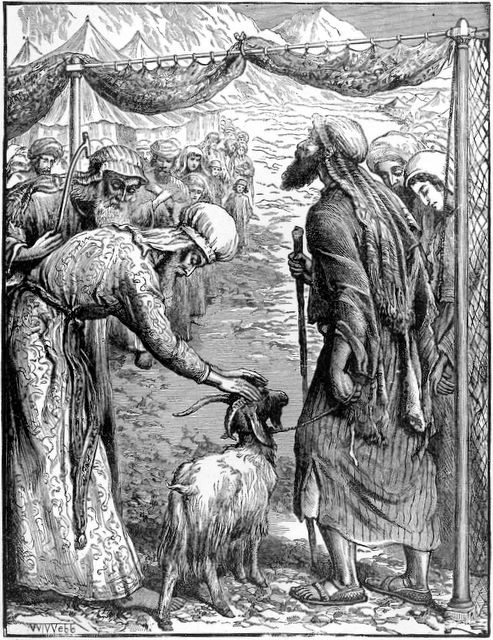
The book of Leviticus outlines the Yom Kippur ritual that presumably was followed at the first temple in Jerusalem (10th century to 587 CE). In brief, the high priest slaughters a bull and a goat, and sprinkles their blood on the outside altar and inside the innermost sanctum, the Holy of Holies.3 Then he lays his hands on the head of a second goat, and confesses that all the people have committed errors in observing God’s rules. This act transfers the Israelites’ misdeeds to the goat. Finally, a designated man sends the goat away “to Azazel” in an inaccessible part of the wilderness. (See my post Acharey Mot: Azazel.) The Israelites must fast and refrain from all labor on Yom Kippur while their misdeeds are being atoned for.4 At the end of the day, all the Israelites and their sanctuary have been purified; the invisible residue of disobeying God has been cleaned off and ritual purity is restored, so all the Israelites are at one with God again.
The Talmud tractate Yoma describes Yom Kippur rituals added during the time of the second temple in Jerusalem (516 to 70 CE). The only major change is that the designated man pushed the goat for Azazel (the goat carrying the Israelites’ misdeeds) off a nearby cliff to die, instead of setting it free in an inaccessible place.5
Atonement without a temple
The procedure for achieving atonement changed after sacrificial temple services were replaced with prayer services. Before Yom Kippur begins, Jews confess, apologize, and make amends (as much as possible) for the wrongs we have personally done to other people. Then during Yom Kippur we work on atonement with God, through prayer services in the evening and from morning to sundown the next day.
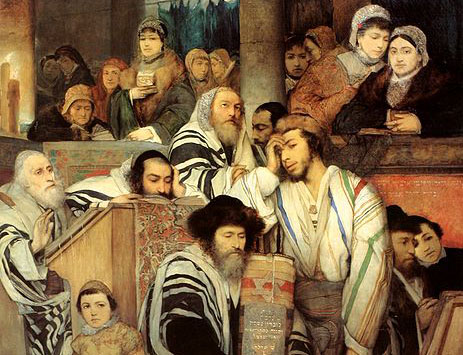
A temple is not required; Yom Kippur is observed all over the world wherever Jews gather to pray. Although rabbis and cantors usually lead the prayers, neither of these functionaries is required; any knowledgeable Jews can lead, and all congregants and encouraged to join in. No animals are harmed, and no blood is involved. The ritual objects are the Torah scroll and one long-burning candle. Special prayers inserted into the regular liturgy include confessions that all of us have committed unethical acts. We pray for God to forgive us, take us back, and let us live for another year. Observant Jews also fast and refrain from all labor on Yom Kippur. At the end of the day, we hope we have achieved teshuvah(תְּשׁוּבָה) = return: turning around, returning to God, or returning to our God-given souls.
What misdeeds do we atone for?
In Leviticus, the high priest transfers three kinds of sins or misdeeds to the goat that is headed for the wilderness.
And Aaron [the high priest] will lean both his hands on the head of the living hairy goat, and he will confess on it all the avonot of the Israelites and all their pesha-im for all their chatat. And he will place them on the head of the hairy goat, and send it away by the hand of a designated man into the wilderness. Then the hairy goat will carry all their avonot on itself to a separated land; he will send out the hairy goat into the wilderness. (Leviticus 16:21-22)
avonot (עֲוֹנֺת) = intentional deeds that are crooked or wrong, in a social or religious sense; guilt for committing such deeds. (From the root verb avah, עָוָה = do wrong, pervert, twist.)
pesha-im (פְּשָׁעִים) = rebellions against a ruler—a suzerain country, a king, or God; guilt for rebellions against God.
chatat (חַטָּאת) = violation of social norms, civil law, or God’s laws, whether inadvertent or deliberate; guilt for such violations. (From the root verb chata, חָטָא = miss the mark, offend, fall short of a standard; be guilty.)
These three categories cover a lot of offenses against other people and against God. The Hebrew Bible never says exactly what the high priest confessed on the head of the goat. The Talmud says he used these words:
“Aviti, pashati, and chatati.”6
aviti (עָוִיתִי) = I have done wrong, I have perverted, I have been crooked. (From the Rabbinic Hebrew root verb avi, עָוִי, which came from the Biblical Hebrew root avah.)
pashati (פָּשַׁעְתִּי) = I have rebelled, I have been an apostate, I have deliberately violated God’s law. (A Rabbinic Hebrew verb from the same root as pesha-im.)
chatati (חָטָאתִי) = I have been mistaken, I have done wrong. (A Rabbinic Hebrew verb from the same root as chatat.)
So according to the Talmud, the high priest used to lay hands on the goat’s head and speak the same three words used in the description in Leviticus. The only new information is that the high priest used to say “I”; he took personal responsibility for all the Israelites.
The Yom Kippur liturgy of the past fourteen centuries includes somewhat more specific confessions, which all congregants make on behalf of all Jews (or in some liberal congregations, on behalf of all human beings). We chant the Vidui (“confession”) up to ten times during the prayer services. The two main prayers of the Vidui are the Ashamnu and the Al Cheit. Both use the first person plural, indicating that we have done these things, and we are collectively responsible.
Ashamnu (אָשַׁמְנוּ) = we have become guilty.
The Ashamnu is an acrostic; there is one word or two-word phrase for each of the first 21 letters of the Hebrew alphabet, and three for the 22nd and final letter. As we chant them, many Jews lightly beat their breasts. Here is a translation:
We have become guilty, we have betrayed, we have robbed, we have spoken slander. We have been crooked [from the same root as avonot], and we have caused wickedness, we have been arrogant, we have been violent, we have smeared others with falsehoods. We have counseled evil, we have deceived, we have scoffed, we have revolted, we have been disrespectful, we have been stubborn, we have been perverse, we have rebelled [from the same root as pesha-im], we have persecuted, we have been stiff-necked. We have been wicked, we have ruined, we have loathed, we have strayed; you have let us go astray.
We are responsible for doing these things; but God let us do them.
All of these bad deeds can be read as ethical transgressions: actions that harm other people. Only a few of them can also be read as failure to worship God properly.
Al Cheit (עַל חֵטְא) = about wrongdoing, about missing the mark, about falling short. (From the same root as chatat.)
The Al Cheit is also an acrostic, but each letter gets a whole couplet, making it a much longer confession. Every line begins “About the wrongdoing that we have done wrong before you” and continues by describing either a motivation or a misdeed. For example, the first couplet says: “About the wrongdoing that we have done wrong before you under duress or willingly; and about the wrongdoing that we have done wrong before you through hardness of heart.”
The final couplet says: “About the wrongdoing that we have done wrong before you concerning extending a hand; and about the wrongdoing that we have done wrong before you through confusion of mind.”
The chant is interrupted twice by a sentence sung to a different melody:
For all these, God of forgiveness, forgive us, pardon us, atone for us!
We sing this plea again at the end of the Al Cheit.
The method of finding atonement with God has completely changed since the fall of the second temple in Jerusalem in 70 CE. Instead of depending on a priest and two goats to trigger atonement for us, Jews depend on our own prayers—and our inner orientation and good deeds.
Another Yom Kippur prayer, the Unetaneh Tokef, 7 considers God’s decisions for the coming year, especially “who will live and who will die”, and then declares:
But turning, and praying, and doing the right thing can overturn the badness of the decree.
We hope to become at one with God by teshuvah (turning around our inner orientation), tefillah (praying), and tzedakah (acting ethically, especially regarding social justice). And just as our confessions say “we” have done wrong, we seek atonement for everyone.
For the last two millennia, we have no longer asked God to forgive us for errors in temple worship. But we still beg God to forgive us, as a group, for crooked deeds (avonot), for revolts against legitimate authority (pesha-im), and for falling short in our interactions with other people (chatat).
When we sincerely ask for forgiveness for everyone, our hearts open, and we become kinder, more forgiving, more ethical, more at one.
- Maimonides (Rabbi Moshe ben Maimon, a.k.a. Rambam) combed through the Torah in the 12th century CE and found 613 commandments from God. His list remains the standard in the Jewish world, although 342 of them cannot be performed without a temple in Jerusalem.
- Leviticus 16:11 says that the high priest must slaughter a bull first in order to atone for himself and his own family.
- Leviticus 16:15-19.
- Leviticus 16:2-34, 23:23-32; Numbers 29:1-11.
- The temple rituals are described in detail in Talmud Bavli, tractate Yoma.
- Talmud Bavli, Yoma 36b.
- Unetaneh Tokef is sung at the end of the Amidah in the Musaf service, which usually occurs in the early afternoon of Yom Kippur.

 Questioning Torah