
Each Israelite town in the Hebrew Bible is self-governing up to a point. Its elders make decisions as a town council, and the judges (shoftim, שֺׁפְטִים) among the elders decide lawsuits. But sometimes the elders need a leader who coordinates the men of several towns.
Three different forms of government exercise authority over the town elders during the course of the first book of Samuel. At first, the high priest is also the chief judge of the land. Then the prophet Shmu-eil (“Samuel” in English) becomes the judge. And in this week’s haftarah reading from the Prophets, 1 Samuel 11:14-12:22, the job of governing goes to the first king of the Israelites, Sha-ul (“Saul” in English).
From priest to prophet
The last high priest and judge in the tent-temple at Shiloh is Eili (“Eli” in English), who dies at age 98 when he hears that the Philistines have won another big battle with the Israelites, and captured the ark, which Eili’s sons had brought all the way to the battlefield.
And he himself, shafat Israel 40 years. (1 Samuel 4:18)
shafat (שָׁפַט) = he had judged, he had governed.
Shiloh ceases to be the seat of government for the Israelites, and Eili’s protégé, the prophet Shmu-eil (“Samuel”), returns to his birthplace, Ramah. The conflict between the Philistines and the Israelites drags on for another twenty years. Then the Israelites start longing for the support of their own god. The prophet tells them to turn away from foreign gods and worship only Y-H-V-H. Only then, he says, God will rescue them from the Philistines. Next he summons “all Israel” to Mitzpah, where he leads the people in a purification and dedication ceremony.1
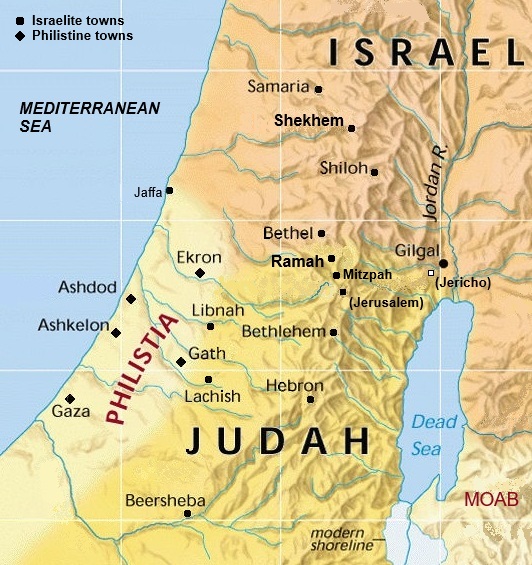
And the Philistines heard that the Israelites were gathered together at Mitzpah, and the Philistine rulers went up toward Israel. And the Israelites heard, and they became afraid in the face of the Philistines. Then the Israelites said to Shmu-eil: “Don’t you be silent, on account of us, from crying out to Y-H-V-H, our God, so [God] will save us from the hand of the Philistines!” (1 Samuel 7:7-8)
At this point, a judge who was a war leader would organize the men for battle. But Shmu-eil is a prophet. He offers up a lamb, cries out to God, and is answered.
… And God thundered in a loud voice that day against the Philistines, and he panicked them. And they were struck down before Israel. (1 Samuel 7:9)
The Israelites pursue their enemies, and reclaim the Israelite towns that the Philistines had captured earlier. For many years there is peace between the Israelites and the Philistines.
Vayishpot, Shmu-eil, the Israelites all the days of his life. And he went year after year and made the rounds of Bethel and Gilgal and Mitzpah, and shafat Israel in all these places. And he returned to Ramah, since his house was there, and shafat Israel there, and he built an altar there for God. (1 Samuel 7:15-7:17)
vayishpot (וַיִּשְׁפֺּט) = and he judged, and he governed. (From the verb shafat.)
Demand for a king
In his old age, Shmu-eil makes his two sons shoftim in Beersheba, about 50 miles south of his own home in Ramah. Perhaps he hopes they will grow into the job there, so they can replace him when he dies or retires.ִ
But his sons did not walk in his ways; they turned aside after profit, and they took bribes and turned aside from justice. Then all the elders of Israel assembled and came to Shmu-eil at Ramah. And they said to him: “Hey! You have grown old, and your sons have not walked in your ways. Now set up a king for us, leshafteinu like all the nations!” (1 Samuel 8:3-5)
leshafteinu (לְשָׁפְטֵנוּ) = to govern us, to judge us. (A form of the verb shafat.)
Although the elders of Israel are making a demand, Alter pointed out: “The entire people becomes subservient to Samuel, and they feel that only through the initiative of the prophet (however grudging) can they get the king they want.”2
The elders could have asked Shmu-eil to appoint a new chief judge. Instead, they ask for a king. In the Hebrew Bible, a king not only governs and judges the whole country, but is also the man in charge of foreign policy, both war and peace.
Shmu-eil warns them that a king will take away their children and their land to enlarge his government and pursue war. (See my post Haftarat Korach—1 Samuel: No Kings?) But they do not care that a king would control their lives far more than a circuit court judge. They have an underlying agenda.
But the people refused to listen to Shmu-eil’s voice; and they said: “No! Rather, let there be a king over us! Then we will be, even we, like all the nations! Let our king govern us, and go out before us and fight battles for us!” (Numbers 8:19-20)
The elders want a permanent war leader. And God tells Shmu-eil to go ahead and give the people a king.
The prophet chooses a tall, handsome, clueless young man named Sha-ul (“Saul” in English), and God confirms the choice when lots are drawn at a meeting in Mitzpah. Then Sha-ul goes back home to work on his father’s farm.
Soon after that Nachash, the king of Ammon, threatens the Israelite town of Yaveish, and refuses to accept their surrender unless every man of Yaveish has his right eye gouged out by the end of seven days. The elders of Yaveish send a message to Sha-ul, who rallies the men from all the towns in the area and leads a successful battle against the Ammonite army.3
This week’s haftarah begins right after Sha-ul’s victory.
Then Shemu-eil said to the people: “Come, let us go to Gilgal, and we will inaugurate the kingship there!” And all the people went to Gilgal, and made Shmu-eil king there, in front of God at Gilgal. And they slaughtered thanksgiving offerings there in front of God, and Sha-ul and all the men of Israel rejoiced very much. (1 Samuel 11:14-15)
Ad hoc war leaders
But Shmu-eil is not ready to retire. He makes a speech, asking if he has defrauded, oppressed, or stolen from anyone during his years as the region’s judge and governor. They all shout that he has not. Then, even though Sha-ul has been officially coronated, Shmu-eil argues that the Israelites do not really need a permanent war leader.
He reminds them that whenever the Israelites worshiped other gods, their own God punished them by sending attackers from neighboring countries. When the Israelites admitted their guilt and begged God to rescue them, Shmu-eil says:
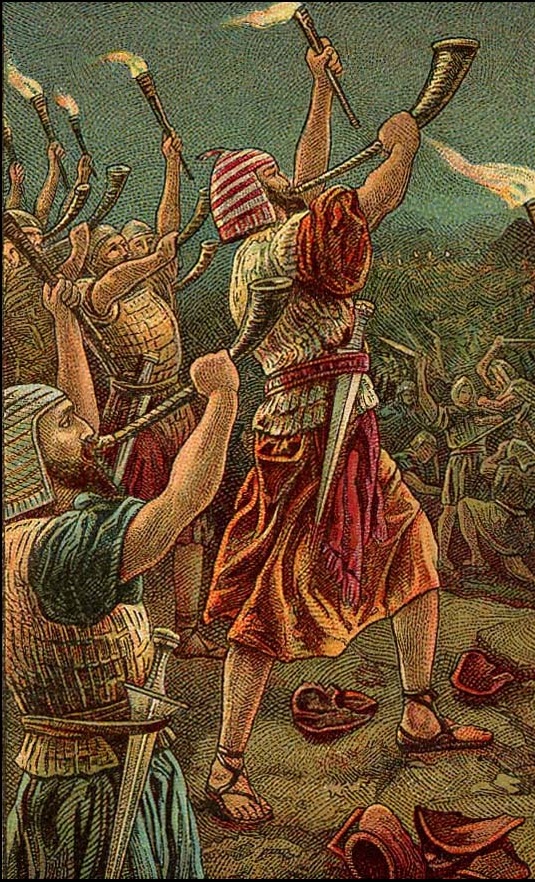
“Then God sent Yerubaal and Bedan, and Yiftach, and Shmueil, and rescued you from the hand of your enemies all around, and you dwelt in security.” (1 Samuel 12:11)
In other words, whenever the Israelites need a war leader, God sends them one until the threat is over.
Who are the four war leaders Shmu-eil cites?
Yerubaal (יְרֻבַּעַל) is the name the Israelites give Gideon after he destroys his father’s altar for Ba-al and builds a new altar for the God of Israel.4 When soldiers from Midian, Amalek, and Kedem march into the valley of Jezreel, Gideon/Yerubaal rallies the four Israelite tribes in the region and leads their combined forces in an attack that sends the enemies running. After he has led several other successful military actions, the Israelites ask him to rule over them and start a dynasty, but he refuses to become a king, saying “God will rule over you.” (Judges 8:23)
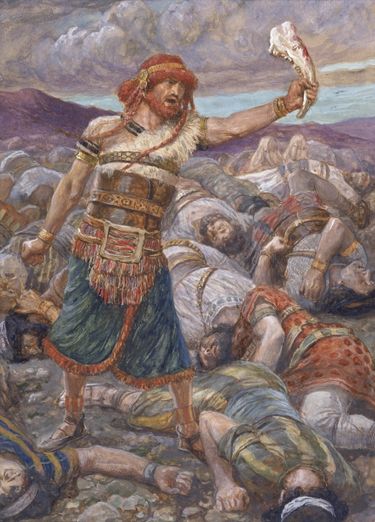
Bedan (בְּדָן), according to the Talmud,5 is Shimshon (“Samson” in English), who belongs to the tribe of Dan. The book of Judges describes his single-handed defeat of groups of Philistines, and says: “Vayishpot Israel in the days of the Philistines for twenty years.” (Judges 15:20)
Shimshon is not exactly a war leader, since he fights alone, and it is hard to imagine such an impulsive strongman as a judge. But he is an ad-hoc leader who does not start a dynasty.
Yiftach (יִפְתָּח) heads a band of outlaws when the Ammonites start a war on Gilead, the Israelite territory east of the Jordan River. The elders of Gilead choose him as their war leader because of his fighting skills.6 Yiftach acts as both a diplomat and a general, defeats the Ammonites, then defends Gilead from Efrayim, the Israelite territory west of the river. He governs Gilead for six years, until he dies.
And Shmu-eil? He is the very man who is making the speech to the Israelites! The prophet is not a war leader, but his prayer to God at Mitzpah did result in God terrifying the Philistines with thunder, which resulted in a major victory for the Israelites.
A permanent war leader
After Shmu-eil points out that God rescued the Israelites through four men who were not kings—Yerubaal, Bedan, Yiftach, and himself—he says:
“Then you saw that Nachash, king of the Ammonites, was coming against you, and you said to me: ‘No, we must have a king reigning over us’. But Y-H-V-H, your God, is your king!” (1 Samuel 12:12)
The implication is that the Israelites should have prayed to God to rescue them by sending a temporary war leader, instead of asking for a king.
“And now, here! The king that you have chosen, that she-eltem! And here, God has set a king over you!” (1 Samuel 12:13)
she-eltem (שְׁאֶלְתֶּם) = you asked for. (A word play on the new king’s name, Sha-ul, שָׁאוּל = asked for.
Does Shmu-eil then turn over his leadership duties to the new king, retaining only his position as a prophet? No.
“Even now, stand by and see this great thing that GOD will do before your eyes! Isn’t it the time of the wheat harvest? I will call out to God, who will deliver thunder and rain. Then you will know and see your great wickedness that you did in the eyes of God, lishol for a king for yourselves!” And Shmu-eil called out to God, and God delivered thunder and rain that day, and the people felt great awe for God and Shmu-eil. (1 Samuel 12:16-18)
lishol (לִשְׁוֹל) = to ask. (Another word play on the name Sha-ul.)
Rain normally did not fall there in the summer, the time of the wheat harvest. Shmu-eil is showing off by saying he can get God to make it rain. The rainstorm proves that even if Shmu-eil is only a prophet now, he is a prophet with a lot of power.
His claim that God considers the Israelites’ request for a king wicked is a stretch, since God told Shmu-eil to find them a king. But God does not react to the prophet’s claim.
And all the people said to Shmu-eil: “Pray to Y-H-V-H, your God, on behalf of your servants, and we will not die because we added to our guilts the wickedness of asking for a king for ourselves!” (1 Samuel 12:19)
Now that he has the Israelites in the right frame of mind, Shmu-eil tells them that God will not abandon them.
“Also I—far be it from me to miss the mark before God by refraining from praying on your behalf! And I will instruct you in the way of the good and the upright.” (1 Samuel 12:23)
According to Steinsaltz, Shmu-eil means: “Although you have a king, I will remain your spiritual guide.”7
Even if King Sha-ul does mature enough to start judging lawsuits as well as leading wars, Shmu-eil will remain the religious leader of the Israelites.
We can understand the value of self-governance at the town level, especially if the town council consists of wise and trusted elders. (Alas, in too many American towns today the council is packed with real estate developers.) But the other forms of governance in the two books of Samuel are harder to grasp. Shouldn’t the judge who rules on whether an act is legal be different from the governor who order the act? If a high priest or a prophet is the governor, is the country a theocracy—and is this good? What are ad-hoc war leaders, and what prevents them from becoming dictators?
Is a king like the head of state in a modern country? What if the head of state wields unchecked power, and initiates unnecessary wars?
- 1 Samuel 7:2-6.
- Robert Alter, Ancient Israel: The Former Prophets: Joshua, Judges, Samuel, and Kings, W.W. Norton & Co., New York, 2013, p. 229.
- 1 Samuel 11:1-13.
- Judges 6:32.
- Talmud Bavli, Rosh Hashanah 25a.
- Judges 11:4-11.
- Rabbi Adin Even-Israel Steinsaltz, the steinsaltz Nevi’im, Koren Publishers, 2019, reprinted in www.sefaria.org.

 Questioning Torah