
When the Israelites leave Egypt the morning after God’s final plague, the death of the firstborn, some non-Israelites join them. The Israelites are the ethnic group descended from Yaakov (“Jacob” in English), a.k.a. Yisrael (“Israel” in English). The people from other ethnic groups who join them are mentioned only three times in the Hebrew Bible: when they leave Egypt in Exodus, when there is a dispute about campsites in Leviticus, and when they approach the border of Canaan in this week’s Torah portion in Numbers, Beha-alotkha (Numbers/Bemidbar 8:1-12:15).
Slaves and proselytes
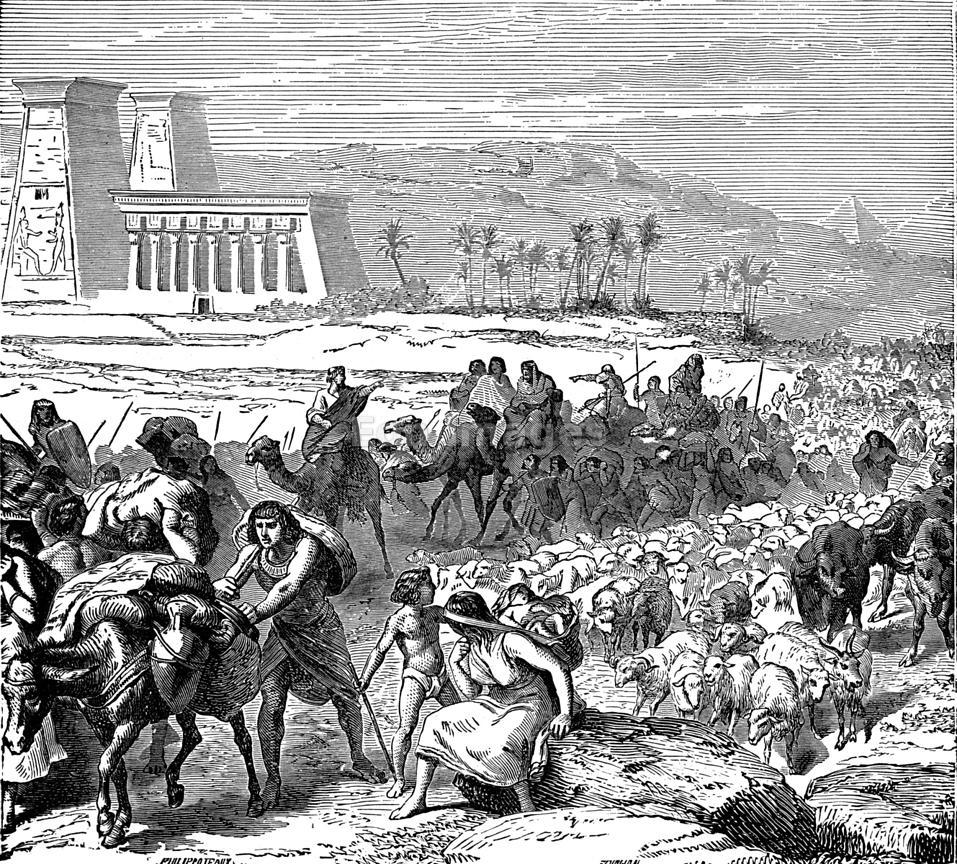
And the children of Israel pulled out from Ramses toward Sukkot, about 600,000 adult men on foot, aside from non-marchers. And also an eirev rav went up with them, and flocks and herds of very impressive property. (Exodus 12:37-38)
eirev rav (עֵרֶב רַב) = “mixed multitude”, motley crowd. (eirev (עֵרֶב) = mixed, mingled+ rav (רַב) = numerous, abundant.)
The duplicative rev-rav sound indicates that eirev rav is a pejorative, like “riffraff” and “ragtag” in English. The Israelites looked down on the eirev rav, but let them come along.
Philo of Alexandria wrote that there were two kinds of people in the eirev rav: fellow slaves looking for a better life, and those who wanted to change their allegiance to the God of Israel after witnessing the plagues and recognizing God’s power.1
The term eirev rav is never used again in the Hebrew Bible, although the book of Nehemiah uses the word eirev by itself to indicate the Ammonites and Moabites who came with the Israelites who returned to Judah from Babylon, who were then rejected.2
Man with an Egyptian father
The rest of the book of Exodus reads as if only Israelites travel to Mount Sinai and camp there for over a year. The Israelite-only approach continues in the book of Leviticus until the story of the blasphemer, which begins:
The son of an Israelite woman and an Egyptian man went out among the children of Israel; and the son of the Israelite woman and an Israelite man quarreled concerning the camp. (Leviticus 24:10)
The subject of the quarrel is not specified. But one traditional suggestion is that man with the Egyptian father resents being forbidden to pitch his tent inside the Israelite camp, in the area reserved for Dan, his mother’s tribe. “Outside the camp” is also where people with the skin disease tza-arat live,3 and where dead bodies are taken.4 Since the half-Egyptian man curses God during his quarrel with the full-blooded Israelite, he is executed for blasphemy. (See my post Emor: Blasphemy.)
Anxious riffraff
People from other ethnic groups who accompany the Israelites on their journey to Canaan are mentioned a third and final time in this week’s Torah portion.
When everyone heads north from Mount Sinai, the Israelites are organized to begin the conquest of Canaan. Their fighting men have been counted, and God has told them the marching order of the tribes and where each tribe will camp.5 The Levites have been ordered to march in the center of the line, carrying the disassembled pieces of God’s sanctuary, to camp immediately surrounding the reassembled sanctuary, serving guard duty. This week’s Torah portion lists not only the marching order of the tribes, but the captain of each tribe.6
The eirev rav who joined the exodus from Egypt are not members of any Israelite tribe, so they are not mustered into the army. The Israelite tribes all have assigned campsites, but the non-Israelites have to pitch their tents outside the Israelite camp. The Torah does not say where they go when all the tribes line up to march in their assigned order, but they probably trail along in the rear.
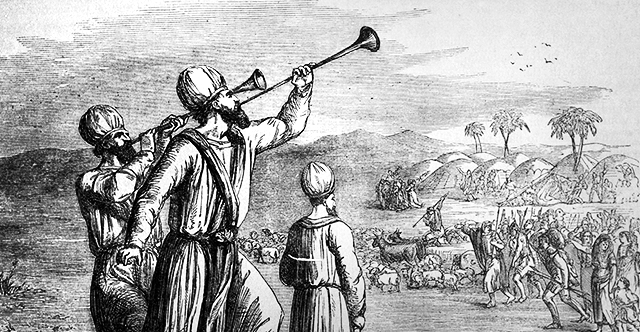
The priests blow two silver trumpets to signal when each Israelite tribe should fall into its place in the marching order. And God tells Moshe (“Moses” in English) to tell the Israelites:
“And when you enter into battle in your land against the attacker who attacks you, then the trumpets should blast, and you will be remembered before God, your God, and be delivered from your enemies.” (Numbers 10:9)
So the Israelites know that God is with them. But they also know that their men will be the troops on the ground, fighting battles as they take over Canaan. None of them were soldiers in Egypt. They have fought only one battle their whole lives, when the Amalekites attacked them on the way to Mount Sinai, and then they barely managed to drive the attackers away.7
Everyone marches north from Sinai for three days and camps in the wilderness of Paran, near the southern border of Canaan.8
And the people were like bad complainers in the ears of God. And God heard, and [God’s] nose heated up [with anger], and a fire of God burned against them and ate up the edge of the camp. Then the people cried out to Moshe, and Moshe interceded with God, and the fire sank down. (Numbers 11:1-2)
The Torah does not say who complains, or what they complain about. But everyone has been warned not to complain.
Yet the Israelites are in a state of anxiety about the approaching war. How do they deal with their anxiety? In my post Beha-alokha: Cold Feet, Dry Throat, I wrote that they long to return to Egypt, and they crave comfort food: the food they ate in Egypt.
What about the non-Israelites trailing along behind them? Since they are neither counted with the troops nor allowed to camp with the troops’ families, they probably figure that when the Israelites engage in battle with Canaanites, they will have to hide as best they can in a strange land. They can only hope that no Canaanites will find them and kill or enslave them. So they, too, would feel a lot of anxiety. They are desperate for a distraction to take their minds off the future.
Then the asafsuf who were among them lusted after a lust. And in turn the Israelites also wept. And they said: “Who will feed us basar?” (Numbers 11:4)
asafsuf (אֲסְפְּסֻף) = rabble, riffraff. (A reduplication of the verb aseif, אָסֵף = gather.)
basar (בָּשָׂר) = flesh; meat; human skin. (“All basar” = all living creatures. “My basar” = my blood relative.)
The duplicative saf-suf sound indicates that asafsuf is another pejorative. Like eirev rav, the word asafsuf appears only once in the Hebrew Bible. The 12th-century rabbi Abraham ibn Ezra gave his definitive opinion that asafsuf meant those “who were gathered unto the children of Israel but were not of Israelite stock. The asafsuf refers to the erev rav.”9 The asafsuf begin lusting first, longing for some sensual pleasure; the text does not say what kind. Then the Israelites join in.
What kind of flesh?
One tradition in the commentary is that the asafsuf lust for the kinds of sexual intercourse prohibited in Leviticus, mostly incest, and then the Israelites start lusting for incest as well. The Israelites ask “Who will feed us basar?” and then change the subject to the food of Egypt.
“We remember the fish that we ate in Egypt at no charge, the cucumbers and the melons and the leeks and the onions and the garlic! And now our throats are dry. There is nothing except for the manna before our eyes!” (Numbers 11:5-6)
Perhaps the Israelites cry “Who will feed us basar?” because that is what they hear the asafsuf wailing. After all, many of the Israelites own flocks and herds, and have the option of slaughtering one of their animals as an offering to God. In a thanksgiving offering, the fat parts of the animal are burned into smoke for God, but the priest, the donor, and the donor’s guests eat the roasted meat.
The asafsuf, living on the fringes of society, are not likely to be invited to a thanksgiving offering. The Israelites already get an occasional taste of roasted meat; what they long for is the fish and other foods they ate in Egypt.
After an explanation of manna, the story in this week’s Torah portion resumes with:
And Moshe heard the people weeping by their clans, each one at the entrance of his tent. And God’s nose got very hot [with anger], and it was bad in the eyes of Moshe. (Numbers 11:10)
Abraham ibn Ezra, the 12th-century linguist, wrote: “weeping, family by family. The families gathered together to cry, as they do when they mourn for the dead.”10
One emotional response to an imminent battle is to weep for those who may die before they are killed.
Yet the Talmud records a disagreement between two sages about whether “fish” is literal, or a euphemism for incest.11 In Midrash Tanchuma, written in the 6th to 8th centuries C.E., Rabbi Shimon makes an elaborate argument that “Who will feed us basar?” really means “that they desired to permit illicit intercourse for themselves; and so it says (in Numbers 11:10), ‘Now Moses heard the people weeping for their families.’”12
To me it seems highly unlikely that the men are weeping because they lust for sex with family members other than their wives.
Yet the interpretation that the Israelites, like the non-Israelites with them, were lusting after incest appears again in Rabbi Ovadiah Sforno’s 16th-century commentary. And in the 17th century, Rabbi Shlomo Ephraim of Luntschitz wrote:
“The repetition of the phrase lusted a lust reflects the nature of sexual immorality, where desire leads to more desire … And they said with a full mouth, Who will feed us meat? — referring to the “flesh” of immorality, using a euphemistic expression … And it is plausible to understand that this is all quite literal, but their intention was to request meat which heats the body more and increases sexual desire. This is the meaning of the double expression they craved a craving — they craved something that would increase sexual desire.”13
Even rabbis writing Torah commentary could not resist the temptation to talk about forbidden sex. But whatever the asafsuf and the Israelites are lusting for, I doubt it is as transgressive as incest. In times of great stress, most people want to be distracted by something that is absorbing or exciting, but also familiar. It is not the time to take a risk on a completely new activity, whether the activity is attempting incest or attempting to eat an animal you have never seen before.
So the asafsuf lust for either more sex or more meat, and the Israelites lust for the foods they ate in Egypt.
I remember the anxiety of my generation during the Vietnam War. Now many adult Americans fear the end of democracy and imposition of martial law in our own country. How do we live with our anxiety?
Sometimes we get together and complain, remembering the good old days, weeping that our own political party is not helping us. Some of us distract ourselves by writing letters to politicians and holding signs in protests. Some of us distract ourselves with electronic entertainment. And some of us indulge in sensual pleasure, reaching for our comfort foods or other soothing pleasures.
And what about our own asafsuf, the people in the United States who are excluded from the closed circle of the camp, the “outsiders” who suffer first in many a war or dictatorship? Do they even dare to weep in public?
- Philo of Alexandria (circa 30 B.C.E.-50 C.E.), De Vita Mosis; cited in Elie Munk, The Call of the Torah, translated by E.S. Mazer, Mesorah Publications, 1994, pp. 147-148.
- Nehemiah 13:3. See my post Bo: Minglers or Riffraff?
- Leviticus 13:45-46.
- Leviticus 10:4-5.
- Numbers 1:1-2:34.
- Numbers 10:13-28.
- Exodus 17:8-13.
- Numbers 10:12.
- Abraham ibn Ezra, 12th century, translation in www.sefaria.org.
- Ibid.
- Talmud Bavli, Yoma 75a.
- Midrash Tanchuma, c.500 – c.800 CE, translation in www.sefaria.org.
- Rabbi Shlomo Ephraim of Luntschitz, Kli Yakar, 17th century, translation in www.sefaria.org.


