
The holiday of Shavuot begins this Thursday evening, and most Jewish congregations will celebrate it by holding Torah study late into the night. But in the Hebrew Bible, Shavuot is a pilgrimage festival in which people bring offerings to the temple in Jerusalem to celebrate the wheat harvest.
A harvest pilgrimage
And you must make for yourselves the pilgrimage of Shavuot, of the first fruits of the wheat harvest … all your males must be seen in front of the lord, Y-H-V-H, the God of Israel. (Exodus 34:22-23)
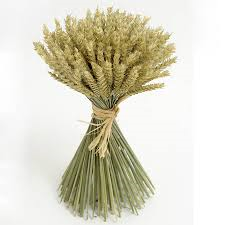
shavuot (שָּבֻעֺת) = weeks.
Shavuot falls seven weeks after the second day of Pesach (“Passover” in English). Pesach began as the first pilgrimage festival of the agricultural year, marking the beginning of the barley harvest. By Shavuot, the barley harvest has finished and it is time to harvest the wheat grown over the winter.
Seven shavuot you will count for yourself; from the beginning of the sickle in the standing grain you will begin counting seven weeks. Then you will make a pilgrimage festival, Shavuot, for Y-H-V-H, your God. You will give according to the voluntary offering of your hand; as Y-H-V-H, your God, blesses you. (Deuteronomy 16:9-10)
Although the book of Deuteronomy prescribes a Shavuot gift to the temple of whatever a man can reasonably afford, the book of Leviticus lists the animals that each head of household should bring to the altar. Men are also required to bring bread made from the new wheat.
From your settlements you must bring bread as a wave-offering, two [loaves of] two tenth-measures of fine flour they will be. You will bake them leavened, as first fruits to Y-H-V-H. (Leviticus 23:17)
Since only unleavened grain products could be burned on the altar, the two loaves of leavened (sourdough) bread are for the priest to eat after he has lifted them up in honor of God.
Shavuot without the temple
After the Romans razed the second temple in Jerusalem in 70 C.E., the rabbis recast the three pilgrimage festivals so that people could still observe them without the temple. The holiday of Pesach became a home observance in which people eat matzah and tell the story of the exodus from Egypt. (See my post Pesach: A History.) This was an easy move because the book of Exodus already combined a ban on leavened bread with instructions for the Israelites about to leave Egypt. The holiday of Sukkot became a home observance in which people eat inside huts with roofs of branches, and enact a ritual to pray for sufficient rain during the winter. This followed naturally from the books of Leviticus and Nehemiah, which described the people constructing huts out of branches when they made the pilgrimage to Jerusalem to make offerings and celebrate the last harvest of the year.1
But Shavuot is only mentioned in the Hebrew Bible in terms of bringing gifts to the temple. So the rabbis prescribed a different celebration after the temple was destroyed. Since hints in the book of Exodus indicate that the Israelites reach Mount Sinai roughly seven weeks after they leave Egypt, it made sense to claim that God’s revelation at Sinai and the “Ten Commandments” happened on Shavuot. A 3rd-century sage, Rabbi Elazar ben Pedat, is recorded in the Talmud as declaring that people should rejoice on Shavuot because that was “the day on which the Torah was given.” 2
If the Torah was given on Shavuot, why not spend the holiday studying Torah—especially the readings the rabbis assigned for that day?
The Torah reading for Shavuot became Exodus 19:1-20:23, which includes both the “Ten Commandments” and God’s mind-bending revelation at Mount Sinai. The accompanying haftarah reading from the prophets became Ezekiel 1:1-28 and 3:12, an account of the prophet’s own mind-bending vision of God. And since each of the pilgrimage festivals was matched with a book in the Ketuvim (“Writings”) section of the Hebrew Bible, the book to study on Shavuot became the book of Ruth, the story of a woman’s acceptance of the God of Israel.
Mount Sinai and Babylon
In the revelation at Mount Sinai, God manifests as fire and smoke on the mountain, and sounds of thunder and shofar blasts. The whole mountain trembles.3
And all the people were seeing the noises, and the torchlight, and sound of the shofar, and the mountain smoking. And the people saw, and they were shaken, and they stood at a distance. (Exodus 20:15)
Mount Sinai is called “the mountain of God” when Moshe (“Moses” in English) first meets God there at the burning bush.4 When the Israelites reach the mountain, they are terrified by God’s manifestation there. The following year, they create God’s portable tent-sanctuary at the foot of the mountain, and God manifests as cloud or fire above the tent at every campsite on the way to Canaan. When King Shlomoh (“Solomon” in English) builds a temple in Jerusalem, God manifests momentarily as a cloud inside it.5
But the prophet and priest Yechezkeil (“Ezekiel” in English) sees manifestations of God even in Babylon. While the Babylonian army was conquering Judah, it deported the city’s leading citizens to Babylon. Yechezkeil, who lives in a community of Israelite exiles in Babylon, anticipates that the Babylonians will soon take Jerusalem and destroy its temple (which they did in 587 B.C.E.). He also foresees that the Israelites will eventually return and build a new temple. But without the temple, how can anyone experience God? The prophet reports that on the bank of a canal in Babylon,
… the heavens opened and I saw visions of God. (Ezekiel 1:1)
And an explanatory note says:
… And it came upon him there: the hand of God. (Ezekiel 1:3)
At Mount Sinai the Israelites saw God as fire, smoke, flashing torchlight, and frightening sounds. Only the flashing fire is the same in Yechezkeil’s first vision.
I looked, and hey! A whirlwind came from the north, a huge cloud and flashing fire, and brightness all around it. And in the center of it, like an eyn of amber in the center of the fire. And in its center were also the likenesses of four living creatures. And this was their appearance: they had the likeness of a human. But each one had four faces, and each of them had four wings. And each one’s legs were like a single straight leg, and each one’s feet were like a single calf’s foot. And [their] radiance looked like polished bronze. (Ezekiel 1:4-7)
eyn (עֵין) = eye; fountain, spring.
Perhaps the center of the divine cloud reminds the prophet of an eye that sees everything going on. Or perhaps is like a fountain of amber sparks.
Yechezkeil (Ezekiel) does not know what to call the four bizarre creatures, but he knows that they are alive, and that although they have some human characteristics, they are not human beings. They have no knee joints because they never sit or lie down,6 and their legs and feet are notseparated because they move without walking. The manifestation of God at Mount Sinai was not accompanied by any attendant creatures, angelic or otherwise.
Faces and wheels
However, when the prophet Yesheyahu (“Isaiah” in English) has a vision of God in Jerusalem in the 8th century B.C.E., he sees God (not described) sitting on a throne, the skirts of God’s robe filling the temple, and serafim (שְׂרָפִים = burning ones) standing above in attendance. These are not the same creatures as Ezekiel’s, since each seraf has one face, two feet, and six wings, and uses two of the wings to fly. (See my post Haftarat Yitro—Isaiah: The Volunteer.)
Each of the heavenly attendants in the first vision in the book of Ezekiel has four faces, one foot, and four wings.
Human hands were under their wings on four sides. And their faces and their wings were on their four sides. Their wings were joined one to another. And they did not turn when they moved; when they moved, each could proceed in the direction of any of its faces. (Ezekiel 1:8-9)
Rashi clarified that the four faces were pointed in “the four directions of the world”: north, east, south, and west.7
And in front of them was the likeness of the face of a human. And the face of a lion was to the right for each of the four, and the face of a bull on the left for each of the four, and the face of an eagle for each of the four [in back]. (Ezekiel 1:10)
According to Pirkei DeRabbi Eliezer, the eagle faces point north, the bull faces point west, the human faces south, and the lion faces east.8 Why those four animals? In Shemot Rabbah,
“Rabbi Avin said: Four types of exalted ones were created in the world: The most exalted of living creatures is man; the most exalted of birds is the eagle; the most exalted of domesticated animals is the ox; the most exalted of beasts is the lion. All of them received kingship, they were granted prominence, and they are fixed beneath the chariot of the Holy One blessed be He …”9
After emphasizing that the creatures moved without turning their bodies, Yechezkeil (Ezekiel) adds that something like the fire of torches is moving among the four creatures, and lightning goes out from the fire.10 Then he notices something else.
And I looked at the creatures, and hey! One wheel was on the ground beside each creature of four faces. (Ezekiel 1:15)
Although the vision begins in the center of a cloud, now it seems to have touched down to the ground. Each wheel gleams like a gem, and looks like two wheels cutting through one another to make four quarters. Like the creatures, the wheels can move in any of the four directions without turning.
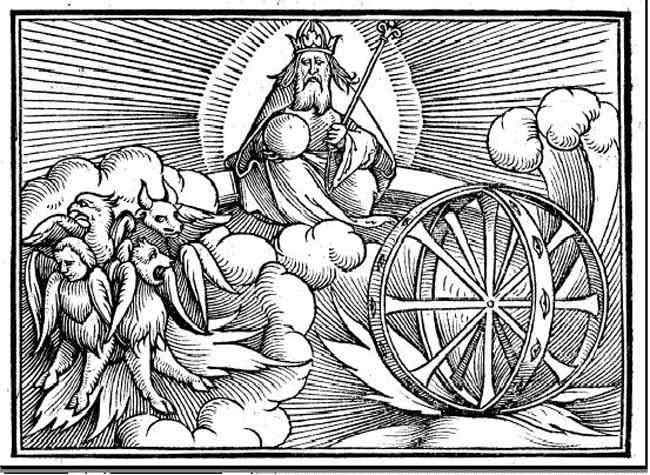
And their rims were tall and frightening; and the rims of all four were filled with eynayim, all around. (Ezekiel 1:18)
eynayim (עֵינַיִם) = pairs of eyes. (The duplex form of eyn.)
Steinsaltz explained: “The wheels were not merely implements for movement; rather, they were living beings with many eyes.”11
Visions in the Hebrew Bible are metaphorical, and the first vision in Ezekiel makes it clear that God and everything related to God is intently watching something—perhaps all humans on earth.
The wheels and the four-faced creatures move in tandem, Yechezkeil (Ezekiel) says. Some rabbis called the whole ensemble a merkavah, a chariot—perhaps because “Their wings were joined one to another” might mean the upper wings of one creature were fused to the upper wings of its neighbors, rather than merely touching them, as well as because of the synchronization of the living creatures and the wheels. The Merkavah school of mysticism, which began in the second century CE, focused on visions of God and God’s supernatural creatures, and the number four.
Then Yechezkeil (Ezekiel) tentatively describes what he saw above the four living creatures and their living wheels.
And the likeness over the head of the living creature: a vault like an eyn, awe-inspiring crystal spread out above their heads. … And above the vault like the appearance of sapphire that was over their heads was the shape of a throne, and on the appearance of the shape of a throne was a shape like the appearance of a human on it. (Ezekiel 1:22, 26)
Is the vault above the creatures’ heads like a vast crystalline eye, or like a vast crystalline spring of bubbling water? Either image is hard to comprehend.
Yechezkiel describes the “shape like the appearance of a human” as amber from the hips up, and fire from the hips down, surrounded by a rainbow radiance.
… That was the appearance of the likeness of glory of God. And I saw, and I fell on my face. And I heard the voice of someone speaking. (Ezekiel 1:28)
Then God gives him instructions.
Ezekiel’s first vision reads as if he saw something indescribable, and is laboring to describe it. The haftarah reading for Shavuot ends by skipping ahead to one more verse:
Then a spirit carried me away, and behind me I heard a great earthquake sound: “Blessed is the kavod of God in its place.” (Ezekiel 3:12)
kavod (כָּבוֹד) = glory, magnificence, weight. (In reference to God, kavod is sometimes translated as “presence”. It could also mean the splendor of a manifestation of God.)
Where is the place of God’s kavod?
For the Israelites in the book of Exodus, the place of God’s magnificent presence is Mount Sinai. For the people living in Judah during the time of the first temple, or in Judea during the time of the second temple, God’s earthly place was Jerusalem, and the way to connect with God was to bring gifts to the temple—practical gifts, like animals to burn into smoke for God, and bread for the priests to eat. And for the prophet in the book of Ezekiel, the place of God’s glory is wherever the hand of God comes upon him and God appears to him in a vision, even if he is in enemy territory.
For Jews today, the place of God’s manifestation might be in a group of people studying Exodus and Ezekiel all night on Shavuot, until physical exhaustion and the surreal visions of Ezekiel tip us over the edge into a brief mystical connection with the divine. There is more than one way to be awake.
- Leviticus 23:29-43, Nehemiah 8:14-17.
- Talmud Bavli, Pesachim 68b.
- Exodus 19:18. A shofar is a wind instrument consisting of the horn of a ram or goat with the tip modified as a mouthpiece.
- Exodus 3:1-4. The Torah alternates between calling the mountain Sinai and Choreiv, “Horeb” in English.
- 1 Kings 8:10-11.
- Rashi (11th-century rabbi Shlomoh Yitzchaki) on Ezekiel 1:7.
- Rashi on Ezekiel 1:8.
- Pirkei DeRabbi Eliezer 4:4, 8th-9th century C.E. midrash.
- Shemot Rabbah 23:13, 12th century, translation in www.sefaria.org.
- Ezekiel 1:13-14.
- Rabbi Adin Even-Israel Steinsaltz, The Steinsaltz Nevi’m, Koren Publishers, 2019, as reprinted in www.sefaria.org.


