
This week’s Torah portion, Bemidbar (Numbers 1:1-4:20) begins with God’s instructions for a census of all adult Israelite men (except the Levites, who get a separate census). The Israelites have spend over a year at Mount Sinai; they have completed making God’s new portable sanctuary and all its gear, they have consecrated new priests, and they have heard and promised to obey hundreds of laws. Now that it is time for them to resume their journey to Canaan, God orders Moshe (“Moses” in English):
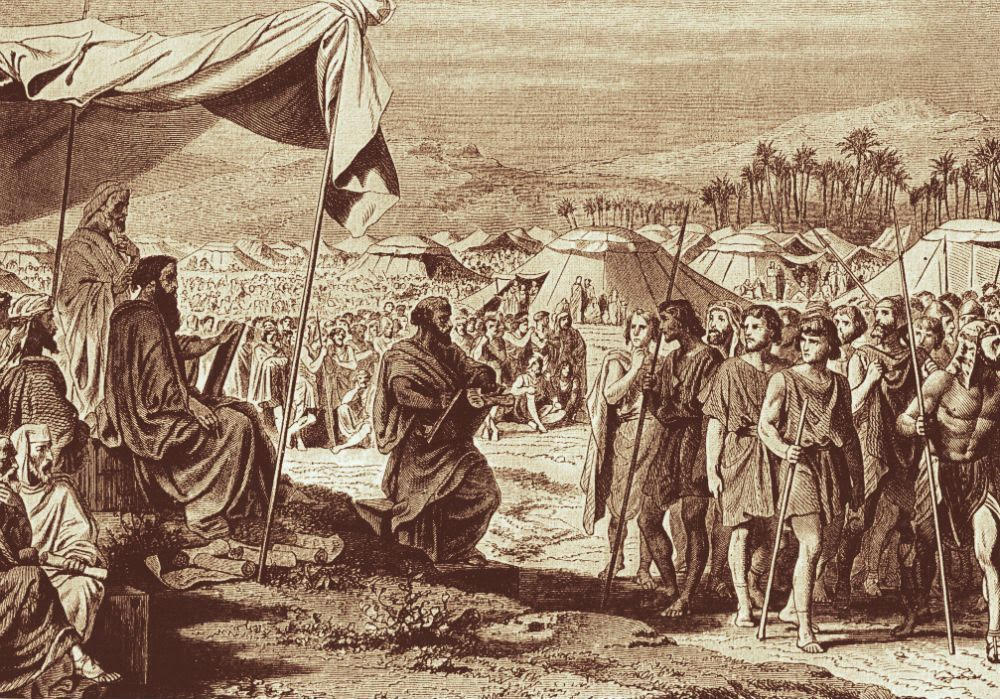
“Lift up the head of the whole community of Israelites by their clans, by their fathers’ house, according to the number of names: every male by head, from the age of twenty years and above … (Numbers 1:1-3)
“Lift up the head” is a Biblical Hebrew idiom either for pardoning people or for counting them in a census. Four times in the Hebrew Bible, God orders a census of Israelite men: once before they make the portable sanctuary (Exodus 30:12-14), once before they leave Mount Sinai (Numbers 1:1-3), once before they cross the Jordan River (Numbers 26:2), and once during the reign of King David (2 Samuel 24:1-10). Women are never counted. And each time God orders a census, there is a different reason for counting the men.
First Census
The first census, in the Torah portion Ki Tisa, counts men from all the tribes, including the tribe of Levi. While giving Moshe instructions for the sanctuary, God says:
“When you lift up the head of the Israelites for their counting, then each man must give … everyone who goes through the counting: one-half shekel … Everyone who goes through the counting, from the age of twenty years and above, will give the contribution of God.” (Exodus 30:12, 14)
A half-shekel was a small amount of silver, measured by weight.
“The rich must not increase, and the poor must not decrease, from the half-shekel [when] giving the contribution to God to ransom your souls. And you must take the silver for the ransoming from the Israelites and give it over for the service of the Tent of Meeting …” (Exodus 30:15-16)
According to Rashbam Moses collected the half-shekels at the same time as he assembled the Israelites to ask for donations to build the sanctuary. “He was to use this opportunity to count them. The silver would be given for the work in connection with the Tabernacle that required use of this metal.”1
The final Torah portion in the book of Exodus reports that the silver from this census was used to make silver sockets, hooks, and capitals for the posts supporting the curtain separating the main chamber from the Holy of Holies.2
But the purpose of the census cannot be solely to collect silver for the construction of the sanctuary, since all the other materials are freely donated.3 I think another reason is to provide an opportunity for even the poorest men among the Israelites to contribute to the sanctuary.
Women are not included in this census because they do not own property; everything belongs to their husbands, their fathers, or their sons. But all the men are equal in this first census. Every man gives the same amount of silver, and every man’s head is “lifted up”.
Second Census
The census in this week’s Torah portion, at the beginning of the book of Numbers, has a different purpose. Moshe’s instructions from God are:
“Lift up the head of the whole community of Israelites by their clans, by their fathers’ house, according to the number of names: every male by head, from the age of twenty years and up—everyone going out tzava in Israel—you will count them letzivotam, you and Aharon.” (Numbers 1:2-3)
tzava (צָבָא) = (verb) to serve in an army. (noun) army, unit of warriors, army service; assembly of attendants of God.
letzivotam (לְצִבְאֺתָם) = for their army service; for their service attending God.
The purpose of this census is to muster men for military service. Females and males under the age of twenty are not counted, because they do not serve in the army. Non-Israelite men who had joined the exodus from Egypt are also excluded from this census, which calls for the men to be listed by their “fathers’ house”, i.e. their tribe.4 And according to Siftei Hakhamim, men over twenty who are physically unfit for service are also not counted.5
Most significantly, men in the tribe of Levi are not counted. God orders a different census for them, since they serve by attending God, rather than by fighting in the army.
“However, the tribe of Levi you must not count, and their heads you must not raise among the Israelites. But you must count the Levites for the Dwelling-place of the Testimony [in the ark], and for all its gear, and for all that belongs to it. They themselves must carry the Dwelling-place and all its implements, and they themselves must minister to it, and they must camp surrounding the Dwelling-place.” (Numbers 1:49-50)
Bemidbar Rabbah compared the Levites to the palace guard, who remain to protect the king when all the other troops leave to do battle.6
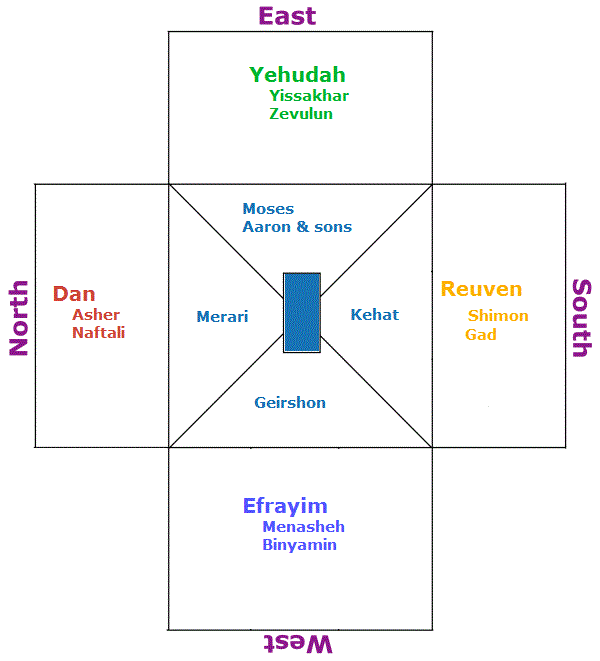
“And the Israelites will camp, each according to his encampment, each according to his banner, letzivotam. But the Levites will camp surrounding the Dwelling-place …” (Numbers 1:52-53)
The twelve non-Levite tribes are told to camp at a distance from the Dwelling-place or Tent of Meeting. The Torah gives the locations of their campsites, who the leader of each tribe will be, and how many men will be under him.7 Equally explicit instructions are also given for the marching order of the tribes (with the Levites carrying the dismantled Tent of Meeting in the middle of the line). The orders conclude:
“These are the countings of the Israelites by their fathers’ houses, all the countings of the camps, letzivotam: 603,550. But the Levites were not counted among the Israelites, as God had commanded Moshe.” (Numbers 2:32-33)
Why is this census necessary? Tur HaArokh explained:
“It was necessary for both Moses and the princes to know the numbers of each tribe and army group in order to be able to account for each soldier after the campaign, and to determine if there had been any casualties and how many there had been.”8
It is reasonable to organize the army now, before the Israelites leave Mount Sinai and march north to the Negev Desert. The southern border of Canaan is not many days away from Mount Sinai, by foot.
But although the people always knew they were headed for Canaan, they did not know they would have to fight to take the land until the census in the portion Bemidbar. Shortly after they arrived at Mount Sinai in the book of Exodus, God promised to “annihilate” the people already living in Canaan,9 and said:
“My terror I will send ahead of you, and I will panic all the peoples among whom you come. And I will give all your enemies to you by the nape of the neck. I will send the hornet of despair ahead of you, and it will drive out the Hivite, the Canaanite, and the Hittite from in front of you. … Little by little I will drive them out from in front of you, until you have been fruitful and taken possession of the land.” (Exodus 23:27-28, 30)
But now, after being counted in the census and receiving their marching orders, the Israelite men realize that they will have to do the driving out. And they have never been in an army before.
When they reach the border, Moshe sends scouts to check out the land of Canaan to the north. Upon their return, ten of the twelve scouts insist that the Canaanites are too big and strong for the Israelites to defeat in battle. The Israelite men refuse to fight. (See my post Shelach Lekha: Sticking Point.) So God puts the divine plan on hold while the people spend 40 years in the wilderness.
Third census
Mustering an army is also one purpose of the third census in the bible.
The next generation of Israelite men, more confident about fighting than their fathers, conquer two kingdoms: Cheshbon and Bashan, both east of the Jordan River. Across the Jordan to the west lies the northern part of Canaan, their final destination.
But while they are camped near the Jordan, many of the Israelite men are seduced into worshiping a foreign god. So God sends a plague that kills them. (See my post Balak & Pinchas: How to Stop a Plague, Part 1.) Then God tells Moshe:
“Lift up the head of the whole community of Israelites, from the age of twenty years and up, by their fathers’ house—everyone going out tzava in Israel.” (Numbers 26:2)
Naturally Moses and the leaders of the tribes will need to know how many soldiers each tribe can contribute to the conquest of Canaan. The Torah proceeds with the genealogy and totals for every tribe except Levi, and concludes:
These are the countings of the Israelites: 601,730. And God spoke to Moshe, saying: “To these you will distribute the land as an inheritance, by the enumerated names.” (Numbers 26:51-53)
After that there is a genealogy and count of the Levites,
… because they had not been counted among the Israelites, since they were not given an inheritance among the Israelites. (Numbers 26:62)
All the Israelite men except the Levites will be soldiers during the conquest of Canaan, and landowners afterward. The Levites will guard the sanctuary and keep the religion going during the conquest, and afterward they will continue to be religious functionaries; they can own houses in various towns, but not land.
Thus God orders the third census of Israelite men in order to determine both army divisions and land distribution.
Three censuses for the divine plan
The first three times that God orders a census of Israelite men, the purpose is to advance God’s big plan for the Israelites: to rescue them from Egypt, to give them the land of Canaan, and to make them a people who worship God exclusively and obey God’s rules for religion and government. This divine plan is first announced to Moshe at the burning bush on Mount Sinai, and its fulfillment is the underlying driver of the biblical story from that day until the end of the book of Joshua.
The first census, in the portion Ki Tisa in Exodus, requires every man to give a half-shekel toward the creation of God’s sanctuary. Every man counts. The God who orders this census seems to be considering the psychology of the Israelites as they are steered away from worshiping a golden idol and toward the religion God wants.
The second census, in the portion Bemidbar in Numbers, begins mustering an army to conquer Canaan. Although God has encouraged the Israelites by promising to make it easy, an army is still necessary for operations on the ground. This census is ordered by a practical God.
The third census, in the portion Pinchas in Numbers, prepares for the conquest of Canaan by the next generation of Israelite men. This census is even more practical than the second one, since it provides information for both military campaigns and the allotment of land once Canaan is vanquished.
The God portrayed in the Torah creates the whole world, including human beings, and continues to have total control of the weather. But history depends on what humans do. And God recognizes that the Israelite men must be counted and organized in order to carry out God’s plan.
(The fourth census, in the second book of Samuel, occurs after David has become king of the whole territory of Israel and Judah, the majority of the land called Canaan, and the Israelites live in security. This census differs from the first three, and I will discuss it in my post two weeks from now: 2 Samuel: Counting Men, Part 2.)
- 12th-century Rabbi Shmuel ben Meir, know by the acronym Rashbam, translation in www.sefaria.org.
- Exodus 38:25-28.
- Exodus 35:21, 36:5.
- C.f. 12th-century rabbi Abraham Ibn Ezra.
- Siftei Hakhamim is a 17th-century commentary on Rashi’s Torah commentary.
- Bemidbar Rabbah is an 11th-12th century collection of commentary on the book of Numbers.
- See my post Bemidbar & Naso: Four Directions of Service.
- Rabbi Yaakov ben Asher (1269-1343), Tur HaArokh, translation in www.sefaria.org.
- Exodus 23:23.


2 thoughts on “Bemidbar, Ki Tisa, & Pinchas: Counting Men, Part 1”