
How do the Israelites and the people who left Egypt with them clear out a year’s worth of guilt for misdeeds? And what should they be doing in order to be holy?
The Hebrew calendar has fewer weeks this year, so this week has a double Torah portion: Acharey Mot (Leviticus 16:1-18:30), with its annual ritual for atonement; and Kedoshim (Leviticus 19:1-20:27), with its holiness codes. We learn this week that we must cast out our misdeeds, but not the foreigners among us.
A ritual with two goats
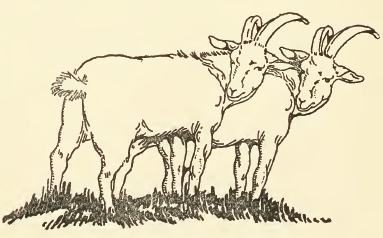
Once a year, on Yom Kippur (“Day of Atonement”), the high priest makes atonement for the wrongdoing of all the Israelites, rendering the people and their sanctuary pure again. The most important part of the long ritual requires two male goats, preferably identical.1
The rules for the ritual refer to Aharon (“Aaron” in English), the first high priest.
He must take the two se-irim and stand them in front of Y-H-V-H at the entrance of the Tent of Meeting. And Aharon must place lots upon the two se-irim: one lot for Y-H-V-H and one lot for Azazeil. (Leviticus/Vayikra 16:7-8)
se-irim (שְׂעִרִם) = goats; goat-demons. Singular: sa-ir (שָׂעִיר) = hairy male goat; long hair; rain shower.
We do not know who or what Azazeil is. (See my post Acharey Mot: Azazeil.)
Then Aharon must bring forward the sa-ir for which the lot for Y-H-V-H came up, and he must make it a chataat. But the sa-ir for which the lot for Azazeil came up, it shall stand alive in front of Y-H-V-H, to make atonement upon it—to send it to Azazeilin the wilderness. (Leviticus16:9-10)
chataat (חַטָּאת) = infraction, violation of a rule (often inadvertent); guilt offering, offering to atone for an infraction.
The goat designated for God is slaughtered and burned as a chataat, an offering that is normally made when individuals realize that they unintentionally violated one of God’s rules.2 Offering one hairy goat to God on Yom Kippur covers any violations that were not already atoned for, removing the impurity caused by those deeds.
The high priest sprinkles the blood of the slaughtered goat on the lid of the ark in the Holy of Holies (along with the blood of a bull that serves as the chataat for the priests). But this blood only purifies the Tent of Meeting. The high priest also sprinkles the blood of both animals on the altar outside the Tent of Meeting, purifying it as well.
This is not enough, however, to purify the people.
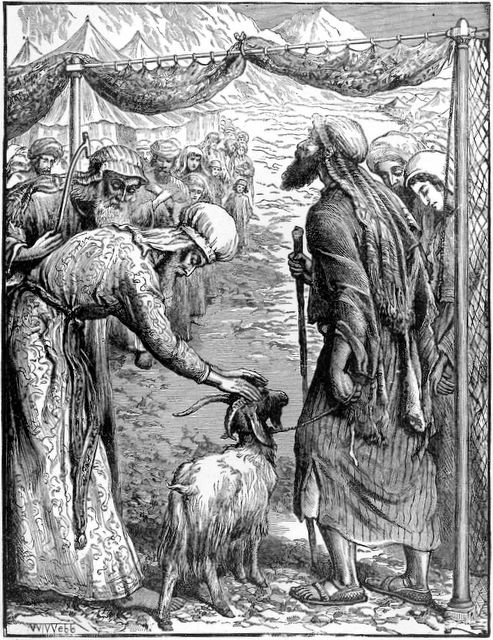
He finishes making atonement for the Holy place and the Tent of Meeting and the altar. Then he brings forward the live sa-ir. And Aharon must lean his two hands on the head of the live sa-ir and confess over it all the iniquities3 of the Israelites, and all their rebellious-transgressions,4 for all their chataat. And he will place them on the head of the sa-ir, and he will send it free by the hand of a designated man into the wilderness. (Leviticus 16:20-21)
What is the high priest’s confession on behalf of the Israelites? According to the early Talmudic work Sifra, the high priest recites:
“Please, God, atone, I beseech You, for the iniquities, and for the rebellious-transgressions, and for the infractions, which they have committed, and transgressed, and violated before You, Your people, the house of Israel.”5
According to the Talmud,6 the iniquities and the rebellious-transgressions are intentional sins, which individuals were not allowed to atone for by bringing chataat offerings during the year. But once a year, the high priest could make atonement for everyone’s iniquities and rebellious-transgressions by transferring them to the head of the hairy goat. Sifra explains:
“Once he confesses his iniquities and rebellious-transgressions, they are regarded as unwitting sins before Him.”7
In Yom Kippur services today there are no high priests or goats. The congregation confesses to more specific categories of wrongdoing: “We have betrayed, we have robbed, we have slandered …”8 Individuals are supposed to apologize and make amends to the people they have wronged before Yom Kippur begins. The purpose of the Yom Kippur ritual is to atone for the other ways we have fallen short, clearing our consciences so we can start again with a clean slate, at peace with God.
In both the ancient Yom Kippur ritual and the current one, according to 19th-century Rabbi Mecklenburg, “… the main understanding of confession and atonement is throwing away and abandoning the sin.”9
The instructions regarding the live goat conclude:
Then the sa-ir will carry off on itself all their iniquities, to a cut-off land. And he must send free the sa-ir into the wilderness. (Leviticus 16:22)
Perhaps when the book of Leviticus was written (possibly in the 6th century B.C.E.), there were still many stretches of desert wilderness that were inaccessible and unexplored—places where a goat could graze and live out its life without ever encountering a human being again. But by end of the second temple period in 70 C.E., no place was truly cut off from people.
By the first century C.E., the designated man took the goat to a cliff, tied its horns to a rock, and pushed the rock off. “And it would not reach halfway down the mountain until it was torn limb from limb.”10
Goat-demons
Later in the portion Acharey Mot, the word se-irim is used for goat-demons.
They must not slaughter any more of their slaughterings for the se-irim they are whoring after. This is a decree forever for them throughout their generations. (Leviticus 17:7)
The people must not slaughter a goat and burn it up into smoke for any supernatural being other than God.
The Torah often refers to worshiping other gods in terms of prostitution. We do not know whether some people worshiped goat-demons with animal sacrifices, or whether Azazeil was considered the god of the goat-demons. When the Israelites sent a live goat carrying their misdeeds out into the wilderness, were they sending it to where the goat-demons lived?
And to them you must say: Any man of the House of Israel, or of the geir who yagur in their midst, who offers a rising-offering or a slaughter, and does not bring it to the Tent of Meeting to make it [an offering] to Y-H-V-H: that man he will be cut off from among his people! (Leviticus 17:8-9)
geir (גֵר) =resident alien, immigrant. (From the root verb gur, גּוּר = sojourn, live somewhere as a resident alien.)
yagur (יָגוּר) = dwells as a resident alien. (Another form of the verb gur.)
Everyone, even residents who came from other countries, must make offerings only to Y-H-V-H, the God of Israel. Religious tolerance was not part of ancient Israelite thought.
The Immigrant
But acceptance and kindness toward immigrants was. The second Torah portion for this week, Kedoshim, lists rules for being holy—some from the Ten Commandments, some from other laws in Exodus, and some that prescribe other ethical behavior. Two of the laws in Kedoshim stand out because they use the word “love”.11
You must not hate your kinsman in your heart; you must definitely reprove your comrade; then you will not carry guilt because of him … And you must love your fellow as yourself. I am God! (Leviticus 19:17-18)
And when yagur with you a geir in your land, you must not oppress him. Like a native citizen among you he shall be to you, the geir who is a geir with you; and you must love him as yourself. For you were geirim in the land of Egypt! I am God, your god! (Leviticus 19:33-34)
geirim (גֵרִים) = plural of geir.
This is not the only Torah portion that dictates correct feelings. For example, the last of the Ten Commandments prohibits coveting.12 It is easier to act as if you love someone, but the feeling of love can be cultivated, with enough determination and practice.
Loving geirim goes hand in hand with treating them the same way you treat people in your own group—and the same way you want others to treat you. As Hillel the Elder said in the first century B.C.E., “That which is hateful to you do not do to another; that is the entire Torah, and the rest is its interpretation. Go study.”13
It helps to empathize with the person you want to love. The Torah portion Kedoshim reminds the Israelites that their own ancestors were resident aliens in Egypt, where they were mercilessly oppressed. Therefore geirim should not only be treated as well as the ethnic Israelites, but given extra consideration as a disadvantaged group.
The disadvantaged groups that must be given ample opportunities to glean fields and orchards are the poor, the fatherless, widows, and immigrants.14 Deuteronomy reminds the Israelites that God chose the Israelites because God loved their ancestors, and then describes God as—
The one who provides justice for the fatherless and the widow, and the one who loves the geir, giving him food and clothing. So you must love the geir, since you were geirim in the land of Egypt! (Deuteronomy 10:18-10:19).
The Hebrew Bible also specifies that geirim are subject to the same laws as natives, both the civil laws and some of the religious laws. One of the religious laws that also applies to geirim is a requirement for observing Yom Kippur:
And it is a decree for you forever: In the seventh month, on the tenth of the month, you must humble your souls [with fasting], and you must not do any labor—neither the native nor the geir who is a geir among you. Because on this day atonement will be made for you, to purify you from all your wrongdoing; you will become pure in front of Y-H-V-H. (Acharey Mot, Leviticus 16:29-30)
The implication is that when the live hairy goat carries the misdeeds of the whole community into the wilderness, it carries the misdeeds of the geirim as well as the native Israelites.
Leviticus urges us to purify ourselves by exiling our guilt to a place that is cut off from normal live. It is good to clear out your guilt after you have done something wrong, and confessed or apologized, and made amends in any way that is possible—whether you transfer it to a goat and send it to a faraway land, or spend over 24 hours fasting and praying on Yom Kippur.
Leviticus also orders us not to cut off immigrants and resident aliens, but to love them as we love ourselves and our own people. We must not oppress immigrants by subjecting them to slave labor making bricks—or by shooting at them, or by arresting and jailing them for reasons that do not apply to native citizens, or by deporting them to distant lands—lands that the immigrants may never have seen, lands that may be even more hostile than your own country.
We must not transfer our guilts or fears to a human scapegoat.
- Talmud Bavli, Yoma 62b.
- Leviticus 4:1-3, 4:13-15, 4:22-24, 4:27-29.
- The Hebrew word is avonot (עֲוֹנֺת) = iniquities, wicked deeds.
- The Hebrew word is pisheyhem (פִּשְֵׁיהֶם) = rebellious transgressions of God’s rules.
- Sifra (a book on Leviticus written 250-350 C.E.), “Acharei Mot”, Section 4:6.
- Talmud Yerushalmi, Yoma 3:7:6, and Talmud Bavli, Yoma 36b.
- Sifra, Ibid.
- Yom Kippur Machzor, Ashamnu section in the Amidah.
- Rabbi Yaakov Tzvi Mecklenburg, HaKesav veHaKabbalah, c. 1829-1839, translation in www.sefaria.org.
- Talmud Bavli, Yoma 6a, translated by Rabbi Adin Even-Israel Steinsaltz, William Davidson Edition, www.sefaria.org.
- The Hebrew word for “love” is ahav (אָהַב).
- Exodus 20:14, Deuteronomy 5:18.
- Talmud Bavli, Shabbat 31:1, translated by Rabbi Adin Even-Israel Steinsaltz, William Davidson Edition, www.sefaria.org.
- Leviticus 19:10 and 23:22.


