Deathbed Blessings

I finally finished writing about Isaac’s “deathbed” blessings for my book on Genesis.  Isaac does not actually die for many more years, but the blessings are so vital to him, Rebecca, and their sons Jacob and Esau that all four characters engage in morally dubious behavior to get what they want.  It took four essays and a Torah monologue to cover their moral psychology.

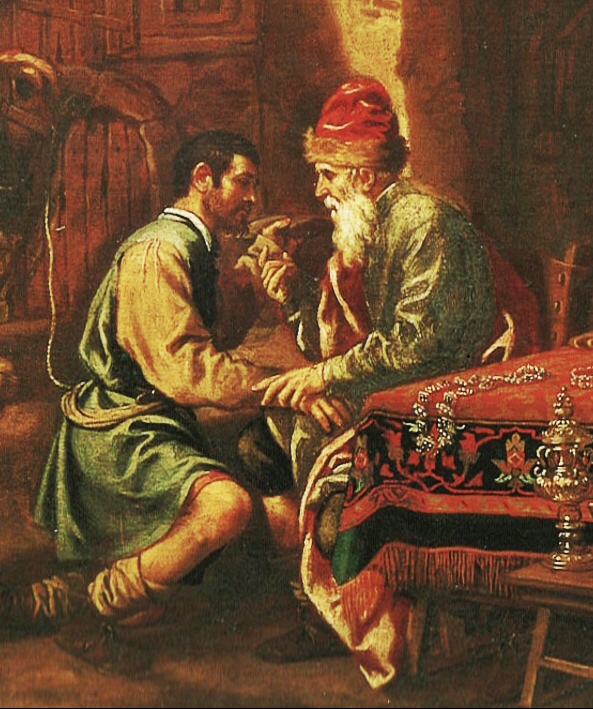
Isaac and Jacob, by Jose de Ribera, 1637

Isaac is the first person in the Torah to give what he believes is a deathbed blessing.  The next is his son Jacob, who gives blessings to all twelve of his sons and two of his grandsons just before he expires in this week’s Torah portion, Vayechi.  Here’s a link to my blog post about those blessings: Vayechi: Three Tribes Repudiated.

Both Isaac’s blessings in Toledot and Jacob’s blessings in Vayechi are like prophecies predicting what will happen the the descendants of the sons who are “blessed”—and the predictions are not all good.  All the characters in Genesis take them seriously, because if God chooses to carry out a blessing, it comes true.

The only deathbed blessing I received from my father was his smile when I told him I loved him, and that was fine with me.  If my mother gave me a Torah-style blessing when her life is about to end, I would find it creepy, even though I cannot believe there is a direct channel between her and God.

Will I want to give a deathbed blessing to my son?  He and his wife do not plan to have any children, so no prophecies about their descendants are necessary.  I would simply like to wish them good fortune and long lives.

Deception and Compassion

I have not finished writing the part of my book about Isaac’s blessings of his two sons, deceitful Jacob and straightforward Esau.  I realized that deception occurs throughout the book of Genesis, and deserves special treatment.  So I rewrote the questions I am addressing in my book on moral psychology in Genesis, and now deception gets its own heading.  So does controlling others, an important though less frequent theme.

In another day or two I expect to finish rewriting essays in earlier chapters of my book to reflect my new focus.  Then I can dive back into discussing both deception and control in the Torah portion Toledot, where I left old, blind Isaac struggling to give the right blessings.

Meanwhile, this week’s Torah reading is the portion Vayigash, which opens with Judah stepping forward to offer himself as a slave to the viceroy of Egypt in place of his little brother Benjamin.  The viceroy is actually their brother Joseph, who has been deceiving them…  You can read about it here: Vayigash: Compassion.

It’s one of my earliest blog posts, and in it I point out that although compassion is neither necessary nor sufficient for ethical behavior, the feeling of compassion does sometimes move people to step outside their usual habits and act with more kindness or generosity.

I pray that in the year 2021 all of us will be open to compassion.

1 Kings & Toledot: Bad Parents

Solomon reading from the Torah, North French 13th c.

King Solomon orders a living baby cut in half in the haftarah that accompanies this week’s Torah reading, Mikeitz.  It is his first act as a judge after God has granted him discernment between good and bad.

Two prostitutes who live in the same house come to him for judgment because they gave birth at about the same time, but one baby died in the night, and they do not agree on which of them is the mother of the living baby.  (See my post Haftarat Mikeitz–1 Kings: No Half Measures.)

Since there are no witnesses, King Solomon declares the baby will be cut in half and each claimant will get half a baby.  Then one woman begs him to save the baby’s life and give it to her adversary, while the other woman says dividing the baby is fair.  Solomon then awards the living baby (unharmed) to the woman who wants to save the baby’s life, and says she is the mother.

Whether she was the birth mother or not, she is the one who deserves to be a parent–because she who would rather save a child’s life than insist on her own legal rights .

This week, as I continue to compose my book on moral psychology in Genesis, I am writing about the blatant favoritism of the parents in the Torah portion Toledot.  In one scene, Rebecca disguises and instructs her favorite son, Jacob, so he can steal the blessing that Isaac wants to give his favorite son, Esau (Genesis 27:1-29).

The masquerade leads to one problem after another, and Jacob ends up fleeing to another country because Esau wants to kill him.  Neither Rebecca nor Isaac is as callous as the second prostitute in King Solomon’s case.  Rebecca never suggests anything that would physically harm Esau, and she chooses to lose her favorite son, Jacob, for an indefinite period of time in order to save his life.  Isaac, after blessing the “wrong” son, pronounces two more blessings, a blessing for Esau and a parting blessing for Isaac.

But both parents fail to ameliorate the psychological damage they did long ago by neglecting one son and lavishing attention on the other.  As the rest of Jacob’s life unfolds in the book of Genesis, he continues to feel unentitled, and to believe (like his mother) that he can only get what he wants through manipulation and deceit.

I think this is what the Torah means when it says God “visits the sins of the parents upon the children” (Exodus 34:7).  The punishment is built in; we are all handicapped to some extent because of our parents’ shortcomings.

Yet I believe that if we can examine our own histories, and work on discerning between good and bad like King Solomon, we can think of alternative choices for the future, and make life better for ourselves and our children and everyone around us.  May we all make it happen.

What Do You Seek?

And [Joseph] came to Shekhem.  And a man found him, and hey!  He was going astray in the field.  And the man asked him: “What do you seek?” (Genesis/Bereishit 37:14-15)

That is the opening of the first post I ever wrote on this week’s Torah portion, Vayeishev.  I dusted if off and polished it up today, and you can find it at this link: Vayeishev: The Question.

I plan to expand on  two of the points in that post when I write Chapter 9 of my book on moral psychology in Genesis.  This week I’ve been writing Chapter 5, on the Torah portion Chayyei Sarah, which includes the story of how Abraham and his steward acquire a wife for Abraham’s son Isaac.  “What do you seek?” is a good question for that story as well.

Abraham’s Solemn Charge, by Pedro Orrente, 17th cent., detail

When Abraham gives instructions to his steward for picking out the bride, he is seeking a woman who will keep Isaac on the path to provide descendants who will someday rule Canaan under God’s law.  Since Abraham believes his son is  weak and easily influenced, he wants Isaac to have a wife who is not a Canaanite but who will move to Canaan for the marriage.

Abraham’s steward has another agenda besides fulfilling his oath to his master.  He seeks a bride who is generous and strong–perhaps because Isaac is withdrawn and passive, and the steward hopes a wife like that will draw him out.

Isaac himself seeks solace after his mother’s death, but it does not occur to him to look for it in a wife.  He is surprised when his father’s steward arrives with a bride for him.

And the bride herself?  Rebecca, Isaac’s first cousin once removed, is the one all three men have been seeking.  But what does she seek, and does she find it in her marriage to Isaac?  The Torah is silent on that subject, so I am making it the theme of my Torah monologue for Chapter 5.

*

I like the word “seeking” because it means actively searching, not passively hoping that what you want will happen.  I have been seeking a life of writing books for most of my 66 years, but real life is complicated, and I have only achieved my goal a few times, during years that were never long enough.  This time, even though I am retired, I still have to keep saying no to all kinds of things in order to guard my writing time.  That’s the hard part.  The easy, delightful part is spending so many hours a day writing, and going to bed every night looking forward to writing again in the morning.

I have found what I was seeking.  What do you seek?

But Not Together

And it happened after these events, and God tested Abraham …  And he said: “Take, please, your son, your only one, whom you love, Isaac.  And get going to the land of the Moriyah, and bring him up there as a burnt offering on one of the hills …”  (Genesis 22:1-2)

Abraham almost does it.  Isaac is tied up on top of the stacked wood, and Abraham takes the knife in his hand before he hears the divine voice telling him to desist.

I spent four days writing about four possible tests God might have in mind, and whether Abraham passes or fails each version.  Whatever God wants to find out about Abraham, there is no doubt that slaughtering Isaac would be morally wrong.

Today I am writing one more essay for this chapter on the story of the Akedah, the Binding of Isaac, in the Torah portion Vayeira.  How can Abraham and Isaac reconcile after the near-sacrifice?  The Torah says twice that they walk up the hill yachdav (יַחְדָּו), together.  But  Abraham walks down alone.  (Genesis 22:6, 22:8, and 22:19)

I love writing this book on moral psychology is Genesis, but I have fallen several Torah portions behind the Jewish cycle of Torah readings.  This week we are reading Vayishlach, in which Jacob and Esau meet again, 20 years after Jacob cheated his brother Esau on his blessing and Esau vowed to kill him.  After 20 years apart, the twin brothers do reconcile–mostly.  You can read about it in the blog post I wrote in 2015: Vayishlach: A Partial Reconciliation.

The reconciliation between the two brothers is only partial because after they have embraced one another and shed tears, Esau suggests that they travel together.  (Genesis 33:12)  Jacob gives him an excuse, and heads in a different direction.

When someone has wronged you, togetherness can be even harder than forgiveness.