And [God] called to Moses, and God spoke to him from the Tent of Meeting. (Leviticus/Vayikra 1:1)
The opening of the book of Leviticus/Vayikra leads us to expect an important announcement. Instead, God explains how to make six kinds of offerings at the altar of the brand-new Tent of Meeting. The only technology on offer for pleasing or appeasing God involves slaughtering animals at the altar, splashing their blood around, butchering them, and burning them.
My 2014 posts on the first two Torah portions in the book, Vayikra and Tzav, reinterpret the six types of animal sacrifices from a vegetarian viewpoint. You can read a revised version of the first one here: Vayikra & Tzav: Fire-Offerings Without Slaughter, Part 1. (I will rewrite Part 2 for next week.)
This year I feel sadness and disgust once again at the gratuitous slaughter of innocent animals. I feel gratitude once again that Jews now serve God with prayer and good deeds instead. I stand by my earlier interpretations of fire-offerings as ways of dealing with anger, and of rising-offerings as ways of continuously directing our desires toward doing good.
But the let-down of learning that God’s first words from the new tent-sanctuary are instructions for animal offerings hit me harder this year. It reminds of the let-down I went through when I reached the climax of our journey, Jerusalem itself.
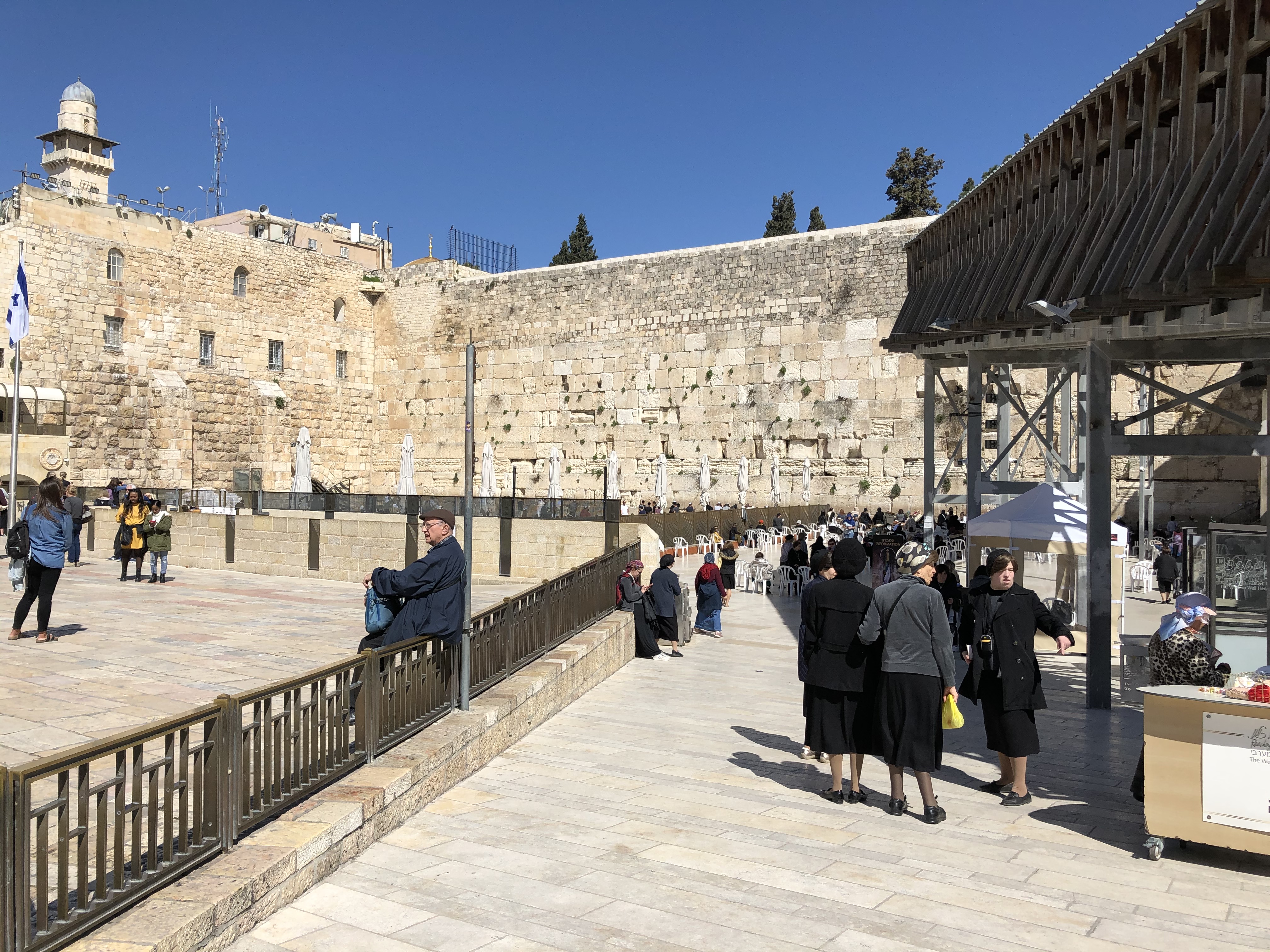
Men’s side of the western wall (kotel) on March 13, 2020, after most tourists left
My first disappointment was that although I prayed at the Western Wall (Herod’s retaining wall for the Temple Mount) three times, and stuck my own heartfelt written prayer into a crevice, I was unable to feel holiness emanating from the stones. I was sad, but not surprised. I have always been a practical person, capable of flights of imagination but untouched by the world that mystics sense so vividly.
My second disappointment was the abrupt end of my time in Israel. I wanted to attend a third teaching by Avivah Zornberg, one of my favorite biblical commentators. I wanted to go to several more archaeological sites and museums. I wanted to see some places outside Jerusalem that I had read about in the Torah and in later Jewish writings—the Dead Sea, the Negev, the Galilee, the kabbalistic town of Sfaat, the northern cities on the Mediterranean.
But like the United States, Israel shut down all public places in order to fight the spread of the coronavirus. Museums closed, tours ceased. There was no point sitting in our apartment day after day, watching teachings online that we could watch from anywhere in the world. And what if we could not return to the U.S., where we have health insurance, when we need medical care for our pre-existing conditions?
We canceled our flight to Athens, the next stop on our itinterary, and booked an earlier flight to the United States. Now we are repatriated in our home state of Oregon, looking for a new place to live. I remind myself that while the whole world is shut down, I will have time to work on both of the books I was writing when we left last September: my book on the ethics of free will in Genesis, and my fantasy novel. Staying home to write will not be so bad.
But I was expecting something bigger when I reached Jerusalem. I suppose I wanted a divine voice to call to me from a holy place and tell me something important. All I got was instructions on making sacrifices.
Now I will have to make my own meaning out of life during the pandemic.
Every part of the portable tent-sanctuary that God describes in the earlier Torah portion Terumah, the Israelites make exactly as specified in this week’s Torah portion, Vayakheil (“And he assembled”). Here is a link to my 2018 post on God’s description of the menorah or lampstand: Terumah: Tree of Light. The portion Vayakheil uses an almost identical description for the menorah the artist Betzaleil makes.1
Both descriptions leave room for argument about the actual appearance of the menorah. We know it is made in one piece out of pure hammered gold. A central shaft rises from a base and has three branches on each side. The shafts and each of its branches ends in a bowl for oil, so there are seven lamps across the top. But are the branches curved or straight? Smooth or knobby? Neither Torah portion makes these details clear.
Here is what this week’s Torah portion says about the shaft and branches:
Three bowls meshukadim on one side, on each a kaftor and a blossom, and three bowls meshukadim on the other side, on each a kaftor and a blossom; the same way for all six of the branches going out from the menorah. And on [the central shaft of] themenorah, four bowls meshukadim, [each with] its kaftor and its blossom: a kaftor under a pair of branches from it and a kaftor under a pair of branches from it and a kaftor under a pair of branches from it—for the six branches going out from it. (Exodus/Shemot 37:21-22)
Almond tree in Jerusalem (photo by M.C.)
meshukadim(מְשֻׁקָּדִים) = made like part of an almond tree.
kaftor (כַּפְתֺּר) = a drupe (a fruit with a pit, such as a peach, plum, or almond), a knob, a capital of a column resembling an almond drupe; a native of Crete.
We arrived in Jerusalem when the almond trees were blooming, and I took a picture of one that still had last year’s dried-up almond drupes as well as this year’s flowers. Inside those dark fruits are almonds.
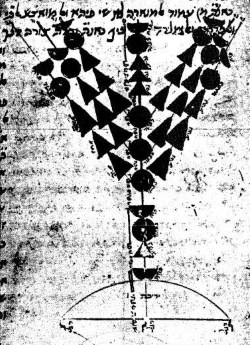
Menorah drawing by Maimonides, Commentary to the Mishneh
So the two shapes used to ornament the stems under the lamps are the flattened oval of the almond drupe, and a flower with five oval petals. But do the branches curve? And are there smooth tubes of gold between these decorations?
12th-century C.E. Rabbi Moshe ben Maimon, a.k.a. Maimonides or Rambam, drew this interpretation of the menorah’s shape in his “Commentary to the Mishneh”. His son, Rabbi Abraham ben HaRambam, wrote that the branches of the menorah were straight lines, like his father drew, not arcs. Rambam’s abstract geometric drawing also shows the ornaments on the branches as continuous, the top bowls for oil at different heights, and the base as a potentially sturdy slice off the top of a sphere. But obviously the line of the central shaft in the drawing is not intended to represent an actual shaft of gold that could support the structure.
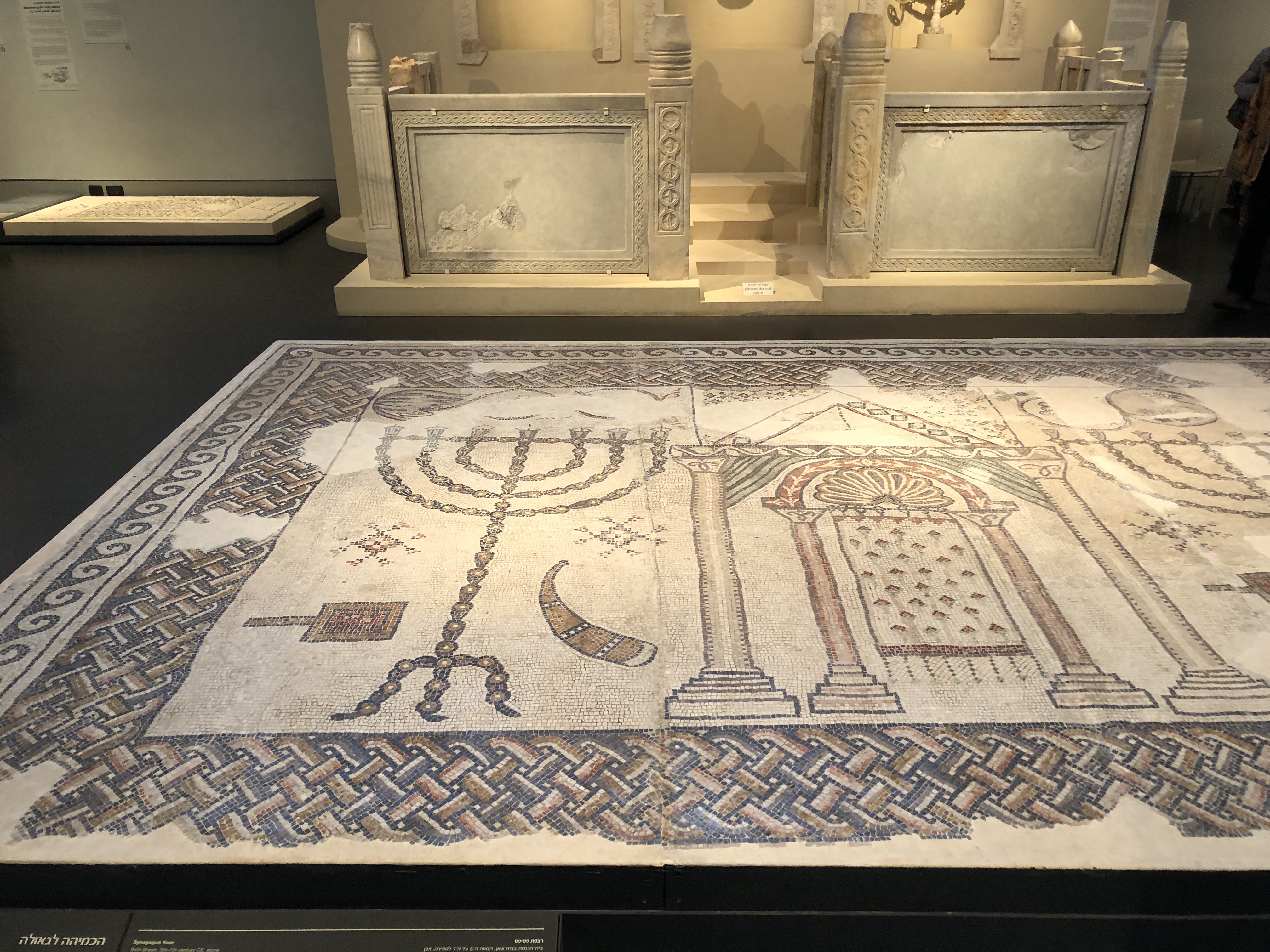
A mosaic in a 5-7th century synagogue in northern Israel depicts a menorah with long smooth curved branches. But it also shows a graceful base with thin legs that could not support the weight of the necessary gold. (See my photo below.)
Mosaic from Bet Shean synagogue, 5-7th century C.E., Israel Museum
How much further can we go back in history for evidence? If only there were another clue about the shape of the menorah later in the Torah! But all we have is this:
And thus Aaron did: toward the front of the menorah Aaron brought up its lamps, as God commanded Moses. And this was the making of the menorah: hammered-work of gold from its base to its fruit is was hammered-work; like the form that God had shown Moses, thus he made the menorah. (Numbers/Bemidbar 8:3-4)
Then the original menorah Betzaleil made disappears from the bible.
When King Solomon builds a temple in Jerusalem to replace the portable tent-sanctuary, he replaces most of the holy items and adds more. (See my post: Haftarat Pekudei—1 Kings: More, Bigger, Better.) Instead of the original single menorah, he sets up ten new ones inside the middle chamber of the temple, five on each side.2 Their shapes are not described.
According to Jeremiah 52:19, these ten gold lamp-stands are among the holy objects the Babylonian army carries away when it loots and destroys Solomon’s temple in 597 B.C.E. In 538 B.C.E. the new Persian empire lets Jews in exile in Babylonia return to Jerusalem and build a second temple. The book of Ezra says they even get to bring back thousands of gold and silver vessels and utensils that the Babylonians had taken with them, but the only gold items the book specifically mentions by type are 30 basins and 30 bowls—no lamp-stands, no bread table, no incense altar, and no ark.3
So the second temple in Jerusalem had to be furnished with another new menorah, if only so the priests serving inside the windowless room would have light. Its designer may have tried to follow the same instructions as Betzaleil did in this week’s Torah portion.
But this menorah, too, was replaced. In 169 B.C.E. the soldiers of Antiochus Epiphanes looted the temple, and after the Maccabean Revolt (167-160 B.C.E.) Judas Maccabeus had new utensils made for the re-consecrated temple, everything except the irreplaceable ark.4
Herod built the Temple Mount platform and rebuilt the second temple between 25 and 10 B.C.E., while the priests continued making offerings on the altar, and carried out the rebuilding of the temple interior. A gold menorah, bread table, and incense altar remained in the sanctuary, and the Holy of Holies behind the curtain in back remained empty.
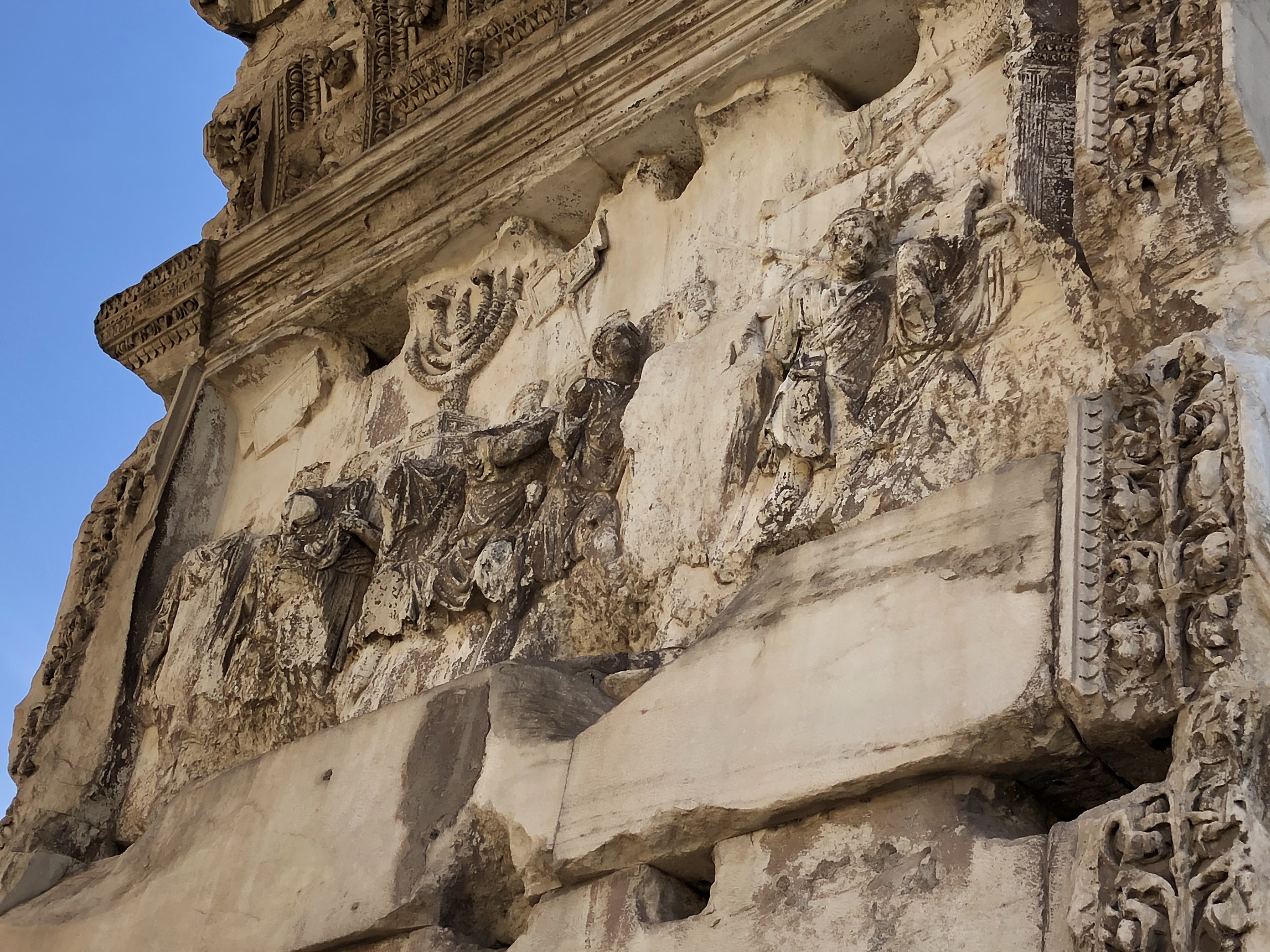
Roman soldiers putting down a Jewish rebellion sacked and destroyed this final temple in 70 A.D. Eleven years later a stone relief was carved on the Arch of Titus depicting soldiers carrying away the menorah and other trophies. The real menorah was on display in a temple in Rome—until that city was sacked by Vandals in 455 C.E. Nobody knows what happened to it after that.
Arch of Titus (photo by M.C., 2019)
For many centuries the relief on the inside of the Arch of Titus at was the oldest depiction of the second temple menorah. Old photographs of this relief show clearly that the menorah’s branches are rounded. Thanks to the air pollution in Rome, the menorah looked this when I saw it in December:
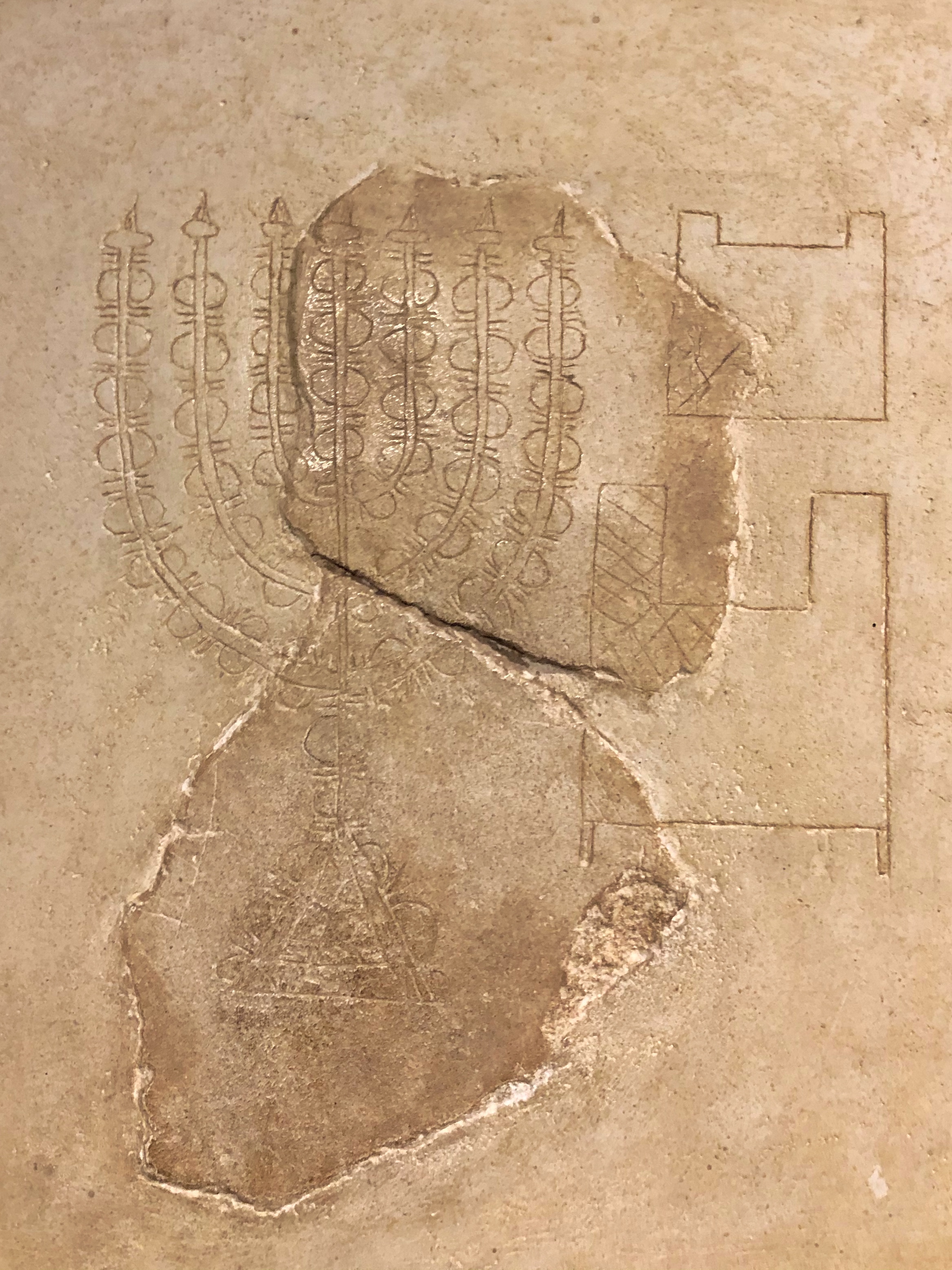
Commentators have questioned whether the menorah on the arch is an accurate likeness or an artist’s fantasy. Now we have a more authoritative drawing, discovered scratched into a plaster wall in an archaeological excavation of an upper-class house on the hill right next to the Temple Mount.5 This house, like the three adjacent houses or mansions, had mikvot (ritual baths) in the basement indicating that it belonged to a family in the caste of priests. Priests, and only priests, served inside the temple. They saw the menorah; some of them lit and tended its lamps.
Menorah at Wohl Archaeological Museum, Jerusalem (photo by M.C.)
This is a drawing of the Second Temple menorah by an eyewitness who lived during the time of King Herod. (The incised drawing to the right might be a view of the bread table.) This menorah has a base that is either a cone or a pyramid, and curved branches. The branches and shaft have no smooth sections; they are made with a continuous ornamentation, alternating flat round shapes like drupes with flat shapes that might even be derived from petals.
I wonder if the homeowner drew it as an object of meditation before immersion in the mikveh, or as an object of instruction for his sons. Either way, it is our closest connection with the sacred object that once lit the temple in Jerusalem. And that menorah was a recreation of the sacred object that Betzaleil creates in this week’s Torah portion to light up a new sanctuary for God, the creator of light.
*
I write this today on a hill in Jerusalem that is too far from the Temple Mount to walk. It does not matter, since now everyone in Israel is ordered to stay home except to get essential groceries and medicines. I hope no new measures to fight the Coronavirus pandemic will prevent me and my husband from flying back to Oregon in a few days.
The current situation seems dim for all the world’s people. I pray not only for healing, but for a new cooperation among all people, bringing new light into the world.
—
Exodus 37:17-24.
1 Kings 7:48-49.
Ezra 1:7-11.
1 Maccabbes 1:21.
Wohl Archaeological Museum, Ha Kara’im Street, Jerusalem.
Bull throne for a god 12th century BCE, Samaria, bronze, Israel Museum (photo by M.C.)
Aaron makes the golden calf. Moses brings down the first pair of stone tablets and sees the people ecstatically worshiping the idol. He orders the guilty slain (except for Aaron), and the Levites kill 3,000 men. Moses hikes back up Mount Sinai. God reveals the attributes of the divine nature, then inscribes the second pair of stone tablets. Moses returns to the people with a supernaturally radiant face due to his exposure to the divine.
Ki Tissa, this week’s Torah portion, is action-packed. Out of all my earlier blog posts I chose to rework this one: Ki Tisa: Heard But Not Seen. It addresses the question of why God orders the Israelites to make a pair of golden keruvim for God’s sanctuary, but completely rejects the golden calf. What makes the golden calf, but not the keruvim, an idol?
The Torah says an idol is inanimate and useless. For example:
Goddess Anat striking, 15th-13th century BCE, Tel Dan, bronze, Israel Museum (photo by M.C.)
Their idols are silver and gold,
Work of human hands.
They have a mouth but they cannot speak,
They have eyes but they cannot see,
They have ears but they cannot hear,
They have a nose but they cannot smell,
They have hands but they cannot feel,
They have feet but they cannot walk.
They cannot make a sound in their throat! (Psalm 115:4-7)
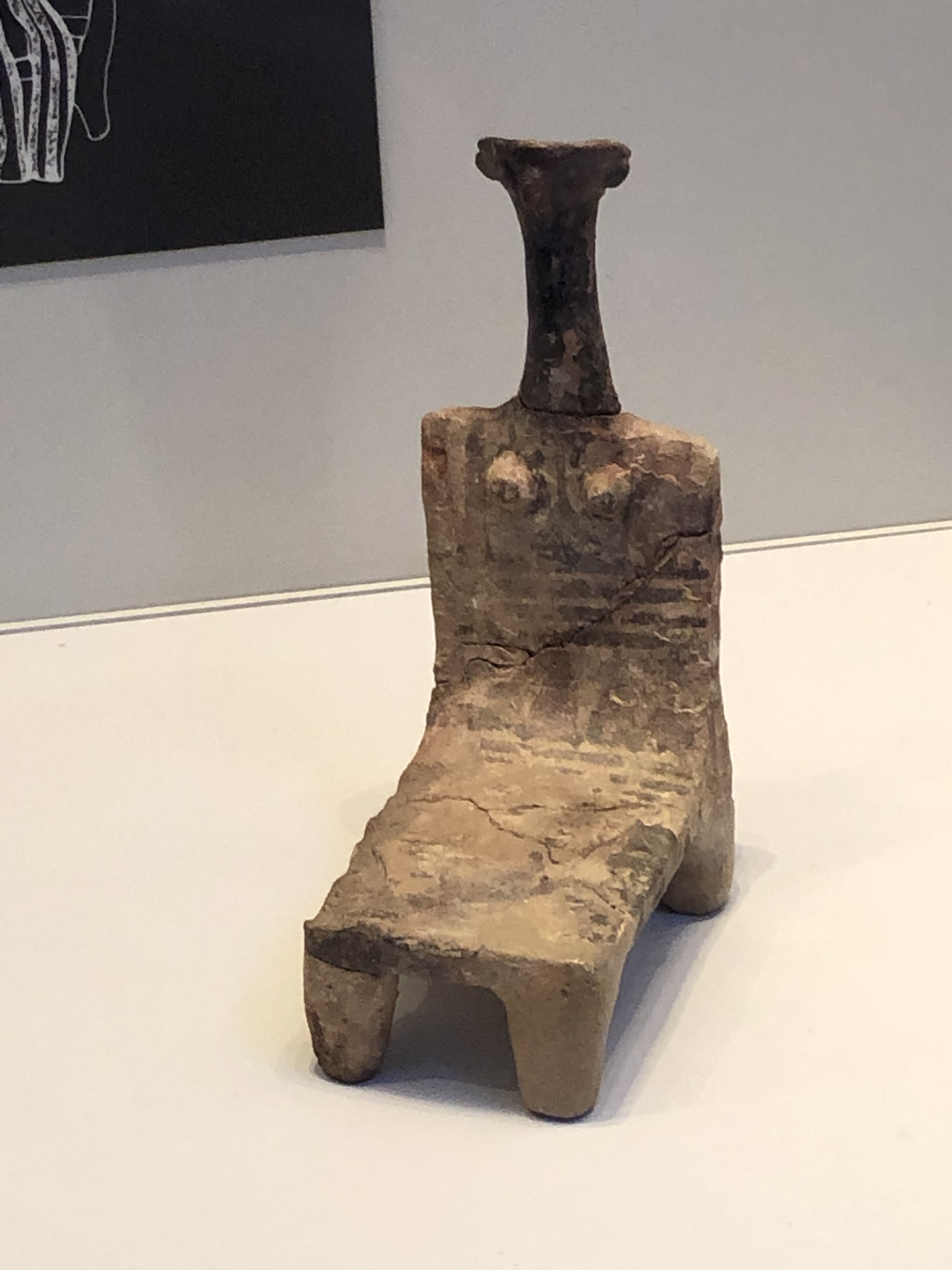
Goddess in the form of a throne, Philistine 12th century BCE, Ashdod, pottery, Israel Museum (photo by M.C.)
The Canaanites and Israelites who used idols were probably not as unsophisticated as the psalm makes them sound. Other writings from the Ancient Near East indicate that they did not expect the metal or pottery objects they made to see, hear, smell, feel, move, or speak. Instead, they hoped a god would inhabit the image from time to time, or use it as a throne. Then they could use the idol to communicate with the god behind it. But in the Torah, idols distract people from serving the God of Israel. So God forbids the creation or worship of idols.
Today we say people “idolize” a pop music star when they devote a lot of time to a useless fantasy. Or they “make an idol” out of the pursuit of money when they dedicate their lives to an activity that does nothing for their souls.
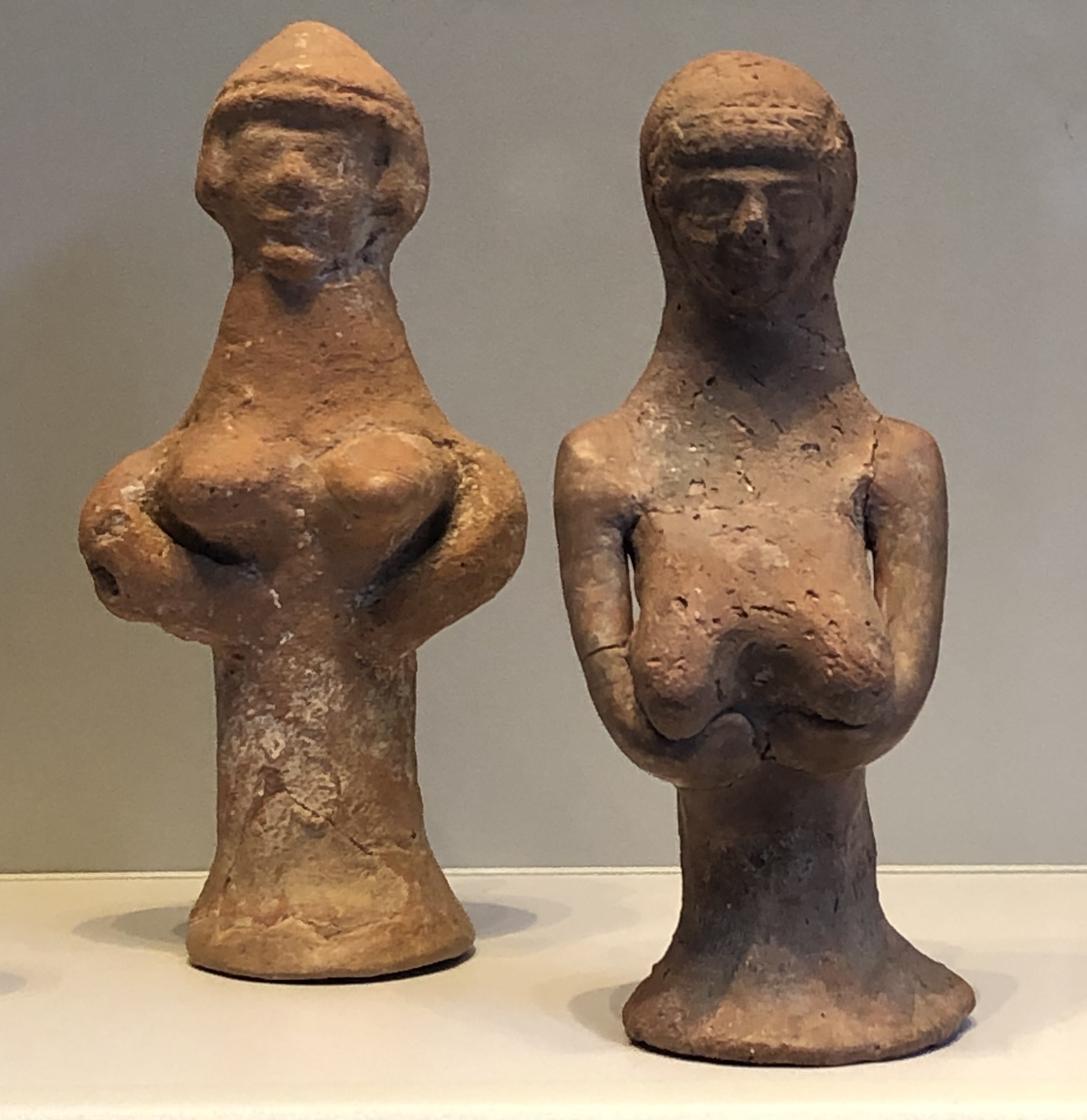
I have seen some fascinating idols in Jerusalem. I am not talking about metaphorical idols, though there are some. I am fascinated by the artifacts that archaeologists have uncovered in the region. I took all the photos on this post at the Israel Museum in Jerusalem. Not one of them is larger than my hand. But they evoked gods—divine powers that ruled the aspects of life humans cannot control, such as birth and death, not to mention the weather.
Asherah or Astarte, goddess for fertility and protection in childbirth, 8-6th century BCE, Judah, pottery, Israel Museum (photo by M.C.)
It must have been hard to give up these magical connections to various gods, and embrace the belief that a single intangible and invisible God is in control.
It must have been harder still, centuries later, to give up the “idols” representing the God of Israel: the Holy of Holies, the priests’ routines, the altar to turn offerings into smoke that rose to heaven.
Even today, I know people who cling to signs and omens, and people who strive perform rituals exactly the “right” way. It is hard to give up the illusion that following the correct esoteric procedure can bring you the comfort of certain knowledge. It is hard to embrace the mystery of the unknown.
This week’s Torah portion is Tetzaveh, which concludes God’s request for a tent sanctuary so God can dwell among the Israelites. Tetzaveh also describes the special garments the priests will wear as they perform their roles at the sanctuary.
Approach to Western Wall, Jerusalem (photo by M.C.)
Special garments are also a feature of the book of Esther, which Jews read every year during the holiday of Purim. In most of the world, Purim falls this year on the evening of Monday, March 9, and the day of March 10. But in Jerusalem and ancient walled cities, we celebrate “Shushan Purim” the evening of Tuesday, March 10, and the day of March 11. This is the first time in my life I will be able to celebrate Shushan Purim. I plan to join a group of women reading Megillat Esther, the biblical book behind this holiday, at the Western Wall in Jerusalem!
Next year in this blog I hope to compare the costuming in the book of Esther and the Torah portion Tetzaveh. But this year I wanted to repost my essay on the curious phrase “Tent of Meeting” which first appears in the portion Tetzaveh. Why does God call for a tent-sanctuary that will be the place for scheduled meetings?
The question spoke to me after I visited the Israel Museum in Jerusalem and looked at artifacts from other ancient places where people went to meet with their gods. So I spent some time rewriting my 2014 post. You can find the improved version here: Tetzaveh: Meeting Room.
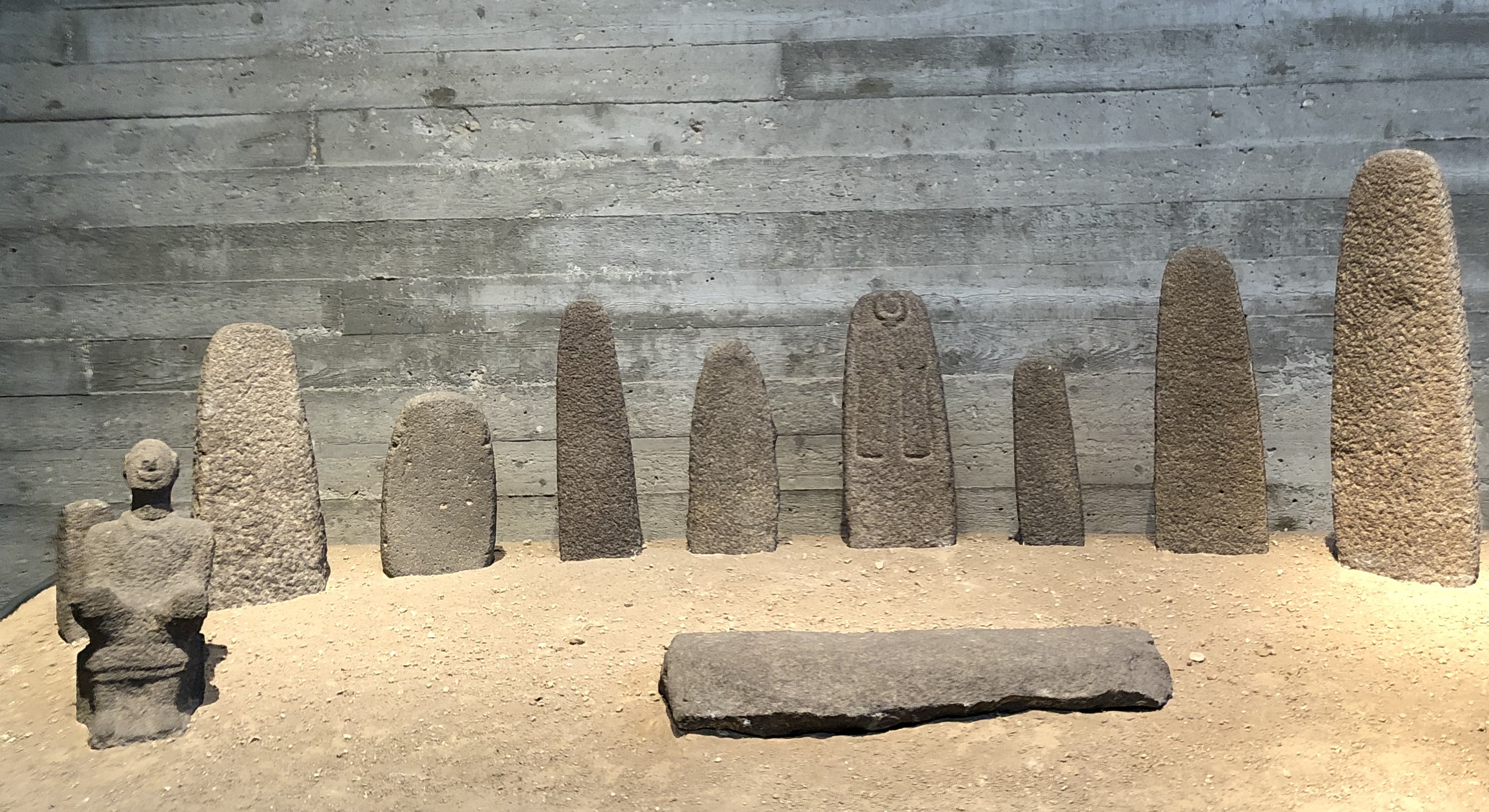
Standing stone from Hazor temple, 15th-13th century BCE, Israel Museum (photo by M.C.)
The standard floor plan for shrines and temples in the Ancient Near East had a large front room and a smaller, holier room in the back where the god was present. This is the plan of the Tent of Meeting in the book of Exodus, which is divided into a larger front chamber where the priests tend the menorah, the bread table, and the incense altar; and a smaller back chamber, the Holy of Holies where the ark stood.
A Canaanite temple and a small shrine archaeologists discovered in Hazor, north of the Sea of Galilee/Kinneret, follow the same basic plan. Both were built during the 15th to 13th century B.C.E. The temple’s back chamber or Holy of Holies contained a statue of the storm god and a standing stone or massebah carved with a horned sun disk.
One of the religious innovations in the Torah is the prohibition against making or worshiping either a god statue or a standing stone. The God of Israel must not be represented with a carved image, and the people must not worship any other gods.
From a shrine in Hazor, 15th-13th century BCE, Israel Museum (photo by M.C.)
The smaller shrine in Hazor from the same period had only one room, and a shallow niche in the back wall for the holiest objects. The niche was lined with standing stones, including a central stone carved with two hands and a moon symbol. In front of the standing stones stood a table for offerings and a statue of someone wearing the symbol of the moon god Sin. This shrine was a place to meet the moon god.
In the second book of Samuel, which is set in the 10th century B.C.E., the temple that King Solomon builds in Jerusalem follows the same pattern as the Canaanite shrines and the Tent of Meeting described in Exodus. The temple’s Holy of Holies contains not only the ark, but also two carved winged figures based on the two figures on the lid of the ark in the Tent of Meeting. These pairs of winged figures are not considered idols in the Torah, perhaps because God only manifests in the empty space above the ark. (See my post Terumah: Cherubs Are Not for Valentine’s Day.)
Holy of Holies, 8th century B.C.E. shrine in Arad, Israel Museum (photo by M.C.)
Given the biblical history of furnishing the Holy of Holies, I was not surprised to learn that when archaeologists unearthed the 8th century B.C.E. fortress of Arad they found a shrine with a standing stone inside its Holy of Holies—even though Arad was in the kingdom of Judah, where the God of Israel was worshiped. For the people of Arad, the standing stone meant that God was present in their shrine, their own “Tent of Meeting”.
Eight centuries later, the people of Judah were building the first synagogues even before the Romans razed the temple in Jerusalem. These synagogues were buildings where people could encounter God through prayer and study instead of through offerings on the altar. The Israel Museum has restored part of the interior of an early synagogue built in Susiya, near Hebron.
Susiya Synagogue, Israel Museum
Its sacred enclosed space had three niches in the back wall, which held a Torah scroll flanked by two menorahs. It is no coincidence that a Torah scroll inside its ark is reminiscent of the stone tablets of commandments inside the ark that stood in the Tent of Meeting’s Holy of Holies.
How different is the shrine in Arad, with its standing stone, from the synagogue in Susiya, with its ark?
Today Jews still come to synagogues to encounter God through communal prayer at appointed times. The holiest place inside a synagogue is still the ark containing the Torah scroll.
It must be human nature to want an appointed place to meet God. Perhaps that is why I am going to the Western Wall on Shushan Purim.







 Questioning Torah