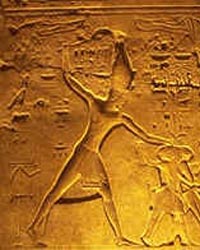
Va-eira & Bo; Psalm 78 & Psalm 105: Responding to Miracles

Pharaoh Merneptah subjugating Semites
(One of a series of posts comparing ideas in the book of Exodus/Shemot with related ideas in the book of Psalms.)

It takes two Torah portions (Va-eira this week and Bo next week) to describe the miraculous “plagues” that force the Pharaoh to let the enslaved Israelites walk out of Egypt. Two psalms, Psalm 78 and Psalm 105, offer briefer versions of the story. And the festival of Passover/Pesach tells the story of how God rescued the Israelites from Egypt in such detail that the seder (“order”;  ritual retelling of the story) can last half the night.

In the Torah portion Va-eira, God lays out the plan to Moses:

Therefore say to the children of Israel: “I am God, and I will bring you out from under the burden of Egypt, and I will rescue you from enslavement, and I will redeem you with an outstretched arm and with great acts of judgement. And I will take you to be My people, and I will be your god. And you will yada that I am God, your god, who is taking you out from under the burden of Egypt. (Exodus/Shemot 6:6-7)

yada (יָדַע) = know, realize, recognize, become acquainted, come to understand through direct experience. (Yada is the root verb. The Hebrew here uses the form viyda-etem (וִידַעְתֶּם) = and you will yada.)

Why does God inflict “great acts of judgement” on Egypt? The first reason given in this week’s Torah portion is so that the Israelites will yada God.
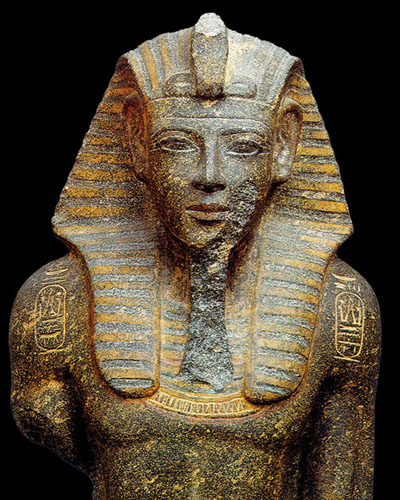
Pharaoh Mernptah, son of Ramses II
Pharaoh Merneptah, son of Ramses II

The second reason is so that the Pharaoh and the Egyptians will yada God, or at least recognize God’s existence and power:

And Egypt, they will yada that I am God when I stretch out my hand against Egypt and I bring out the children of Israel from their midst. (Exodus 7:5)

(The Hebrew in this verse uses form veyade-u (וְיָדְעוּ) = and they will yada.)

How many plagues does it take before both the Israelites and the Egyptians yada God?  Anyone who has participated in a Passover seder, spilling a drop of wine for each plague, knows the answer is ten. And in the book of Exodus/Shemot God does indeed inflict ten miracles on Egypt—the first seven in Va-eira (And I appeared), and the last three in Bo (Come).

However, the ten plagues are described in two different voices. Any close reader of  Va-eira and Bo, even in translation, notices points where the narrative suddenly stops and restarts, rephrasing a bit of the story that has already been told. Scholars examining the language itself have discovered that two stories of the plagues are woven together (but not seamlessly).

Both strands have something to say about the plagues of blood, frogs, and death of the firstborn. The other seven plagues are described by one strand or the other, not both. Maybe each of the two original stories had fewer than ten plagues. Or maybe the redactor(s) who combined the two stories decided to give both descriptions of three plagues, but chose only their favorite descriptions for the other seven.

Psalms 78 and 105 report fewer than ten plagues, and the order is different than in Exodus.

plagues-table

What accounts for these differences? We cannot identify any of these accounts as the original story. At least one strand in the composite story in Exodus was probably written in the 8th century B.C.E. Psalm 78 may have been written as early as the 10th century B.C.E., soon after the first Israelite temple was built in Jerusalem. Psalm 105 could have been written any time after that, maybe before the book of Exodus, maybe as late as the period of the second temple. Probably the story of God’s miracles in Egypt was familiar to all the authors before they began to write down their own versions.

The two psalms and the composite in Exodus borrow language from each other, not only using the same words for the plagues, but sharing pieces of description. For example, Exodus describes the plague of blood this way:
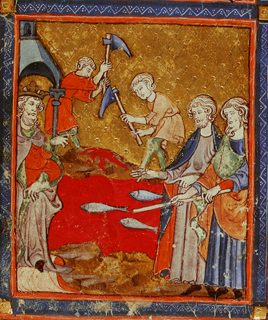
Plague of Blood, Golden Haggadah, c. 1320 Spain

…and he raised the staff and he struck the water that was in the Nile before the eyes of Pharaoh and his courtiers, and all the waters of the Nile turned into blood. And the fish that were in the Nile died. And the Nile stank and the Egyptians were not able to drink water from the Nile, and there was blood throughout the land of Egypt. (Exodus 7:20-21)

Psalm 78 focuses on the lack of drinking water:

And [God] turned into blood the Nile and its streams;

            They could not drink. (Psalm 78:34)

Psalm 105 focuses on the loss of an important food:

           [God] turned their waters into blood

                        And it made their fish die. (Psalm 105:39)

Whether the story is expanded in the book of Exodus, or contracted in a psalm, it is always offered as a decisive example of God’s miracles on behalf of the Israelites.

In the book of Exodus, the purpose of the plagues is to get both the Israelites and the Egyptians to yada God. But the Torah portion Bo also gives instructions several times for the earliest Passover rituals, which were conducted about 3,000 years ago. The purpose of these rituals is to remember the story of the exodus.

This day shall be for you for remembrance, and you shall celebrate it as a festival for God, through [all] your generations. It is a decree forever: you shall celebrate it. (Exodus 12:14)

While Exodus only calls for remembering the story of God’s miracles in Egypt, Psalms 78 and 105 tell the story in order to motivate the Israelites of Judah to action.

Psalms 78 hopes that if the Israelites remember the miracles God did for them, then they will stop backsliding, trust God, and obey God’s rules.

           What we have listened to, and we yada,

                      and our ancestors recounted to us,

           should not be concealed from their descendants,

                      to the last generation recounting

           praises of God and Its strength

                      and Its wonders that It did. (Psalm 78:3-4)

(The Hebrew in verse 3 uses form vaneida-eim (וַנֵּדָעֵם) = and we will yada.)

Why must God’s miracles be recounted to every generation?

           Then they will place their kesel in God,

                      and they will not forget the deeds of God,

                      and they will comply with Its commandments. (Psalm 78:7)

kesel (כֶּסֶל) = conviction, certitude, unwavering belief regardless of other evidence or arguments; folly, stupidity.

The section of Psalm 78 that tells about the miracles God inflicted on Egypt (78:42-51) is not designed to mention every single plague, but rather to bring the story to life in ten short verses. Psalm 78 leaves out the kinim, the shechin, and the darkness, but it adds a few details that are not in Exodus:
Plague of Hail, Haggadah by Judah Pinchas, 1747 Germany

—that the action happened at Tzoan, a specific place in the Nile Delta. (78:43)

—that the arov, the mixed hordes of vermin, ate the flesh of the Egyptians. (78:45)

—that when God sent hail, Egyptian flocks were hit by lightning. (78:48)

—that the hail killed grapevines and fig trees (important crops in Canaan, but not in Egypt). (78:47)

These additional details would make the story more vivid in the listener’s imagination.

Psalm 105 is less concerned than Psalm 78 about lack of faith and commitment among the people of Judah. I believe its purpose is to whip up enthusiasm for God and the religion among the worshipers at the temple.

           Thank God, call out Its name,

                      hodiyu among the peoples Its deeds!

           Sing to [God], make music to It,

                      consider all Its wonders!

           Revel in the name of Its holiness!

                      Let the heart of those who seek God rejoice! (Psalm 105:1-3)

hodiyu (הוֹדִיעוּ) = make known, inform, announce. (A different form of the root verb yada.)

Rylands Haggadah, 14th century Spain. Left: livestock pestilence. Right: Shechin.

Psalm 105 then tells the story of the people who became Jews, starting with God’s covenant with Abraham and ending with the Israelites’ conquest of part of Canaan. When it describes the plagues, it omits both livestock pestilence and shechin, perhaps because the thought of rashes and boils would depress the congregation.  Or, according to 19th-century rabbi Samson Raphael Hirsch, because diseases do not seem supernatural enough to count as miracles. But Psalm 105 uses some of same vivid details as Psalm 78.

*

Do the stories of God’s miracles in Egypt achieve their purpose?

Direct experience of miracles works in Exodus; both the Israelites and the Egyptians yada—know, realize, and recognize—a powerful god acting on behalf of the Israelites. The instruction to perform a ritual to remember what happened also worked; we have been celebrating Passover for about 3,000 years.

Does the account in Psalm 78 work, leading people to kesel, an unshakeable belief in God, and to a determination to obey God’s rules? I think it would depend on the listener. Some people believe any account that is vivid (like Psalm 78’s selection of details) and comes from an accepted source (such as the temple priests, or a particular news station, or a friend’s e-mail). Other people are skeptics by nature; they examine a story to see if it is logical and how it fits with personal experience and other information. This type of person would probably need direct experience, yada, to achieve kesel and commit themselves to obeying all the rules of the religion.

What about Psalm 105? I believe that an account of past miracles can inspire both kinds of people, especially when it is poetry set to uplifting music. Even natural skeptics can get caught up in singing joyful praise, and leave the temple (or synagogue) with a better attitude toward their God and their religion. And natural believers might be moved to proselytize, following the instruction hodiyu—make known, announce!

The singing of the psalms continued as part of both Jewish and Christian prayer after the fall of the second temple in Jerusalem in 70 C.E. It continues today. But Jewish liturgy concentrates on other psalms. It quotes only one verse from Psalm 78 and fifteen from Psalm 105, none of which are verses addressing the plagues in Egypt.

However, serious-minded Jews study the story of the plagues in the Torah portions Va-eira and Bo every winter, when we reach this time in the cycle of Torah readings. And in the spring many more Jews celebrate Passover, a festival of dramatic rituals, prayers, songs, and stories about how God freed the Israelites from slavery in Egypt.

The haggadah (“the telling”), the book that provides the texts and ritual instructions, includes many quotes from our two Torah portions in Exodus. Psalms 78 and 105 are not traditionally included. In a modern American haggadah, the song “Go Down Moses” usually is.

from an Iraqi haggadah, printed in Vienna 1930

Out of all the stories of God’s miracles in Egypt, I would say Passover is by far the most effective at getting Jews to remember the claim that God created miracles to rescue our people from Egypt. The ritual itself has changed and grown over the millennia, so it can speak to new generations. Even Jews who grew up in families that managed to conduct a boring seder  every year cannot help but remember the symbolic foods, the song that the youngest child must sing, the exodus story, spilling a drop of wine for each of the ten plagues, and hunting for the hidden piece of matzah.

Thus Passover still serves the purpose given in the book of Exodus: remembering the story. Whether we can go further and yada God (as in Exodus), or commit ourselves to kesel (as in Psalm 78), or be moved to joy and a desire to recommend the religion (as in Psalm 105) depends on the individual.

Personally, I have a skeptical nature, and I actively try to avoid kesel—while remaining committed to studying Torah and being a Jew in a liberal sense. But I remember the exodus story every winter when I study it in the Torah, as well as every spring when I participate in Passover. I do not yada the God of the ancient Israelites, but I do yada something I cannot describe that I call God. And when I sing psalms that have uplifting words and melodies, I am indeed moved to joy. I would recommend that to anyone!

Shemot and Psalm 137:  Cry Like a Baby

This week begins the reading of the book of Exodus/Shemot in the Jewish tradition. This year my posts on Exodus will relate each Torah portion to one of the psalms.

Too many foreigners live in the country, from the Pharaoh’s point of view in this week’s Torah portion. Unlike those who fear immigrants in our own time, the Pharaoh is not afraid that the Israelites will take jobs from native Egyptians. He is afraid that if another country makes war on Egypt, these foreigners will join Egypt’s enemies.

Pharaoh's decree, by Michiel van der Borch, 1332
Pharaoh’s decree, by Michiel van der Borch, 1332

Instead of integrating the Israelites into Egyptian society to win their loyalty, the Pharoah enslaves them, requiring that the men do forced labor. He also tries to reduce the population.

Then Pharaoh commanded his entire people, saying: “Every son that is born, you shall throw him into the Nile. But every daughter you shall keep alive”. (Exodus/Shemot 1:22)

And a man from the house of Levi went out and married a daughter of Levi. And the woman conceived and she bore a son, and she saw that he was good, and she hid him for three months. (Exodus 2:1-2)

Commentators have suggested many reasons why the baby (later named Moses) is “good”. But since his mother (later identified as Yokheved) is able to hide the baby for three months, the simple answer is that he is placid and quiet. As long as his mother is there whenever he wakes up, Moses does not cry.

Why could Yokheved no longer hide him after three months? The commentary offers different theories. I suspect that Moses happens to be three months old when Egyptian bullies start searching the houses of Israelites for baby boys to drown.

It occurs to Yokheved that the best hiding place for an Israelite baby boy is the Nile itself. She tars a floating box made of papyrus stems, and places Moses inside. Then she carries it to the pool where a woman of the royal family goes to bathe, and wedges it among the reeds so the current will not carry it away. The care with which Yokheved picks the spot shows that she hopes her baby will be discovered and adopted.

detail, Golden Haggadah, c.1420 Spain

And the daughter of Pharaoh went down to bathe in the Nile, and her maidens were walking next to the Nile. And she saw the floating box among the reeds, and she sent her slave-girl to fetch it. (Exodus 2:5)

The princess sees the box; she does not hear any crying. Moses, rocking gently inside, is probably asleep.

And she opened it and she saw the child, and hey! It was a boy, bokheh! And she felt pity for him, and she said: “This is one of the children of the Ivrim”. (Exodus 2:6)

bokheh (בֺּכֶה) = weeping, crying, sobbing, wailing. (From the root bakhah, ּבָּכָה = wept.)

Ivrim (עִבְרִים) = Hebrews; immigrants. (From the root avar, עָבַר = passed over, crossed through, emigrated.) Egyptians in the book of Exodus sometimes call the Israelites the Ivrim.

The story continues like a fairy tale, as the Pharaoh’s daughter ends up paying Moses’s own mother to nurse him, then adopts him after he is weaned. But why does Moses begin to cry when the princess opens the lid of the box? Probably the sudden sunlight wakes him—and then, instead of seeing the familiar face of his mother, he sees a stranger.

All infants cry when they are suddenly deprived of their primary caregivers, just as adults cry when someone they are deeply attached to dies. The world is strange and frightening without that familiar presence.

People may also cry when they are forced to leave their homes and live in a strange place. Yet when the Israelites and their fellow travelers follow the adult Moses out of Egypt, they “leave with a high hand” (Exodus 14:8). They rejoice rather than weep because they are choosing to leave a life of slavery and seek a new land to make their home.

On the other hand, in Psalm 137 the Israelites weep when the Babylonian army deports them from Jerusalem many centuries later, circa 586 B.C.E. They have no choice; they are forced to leave their homeland and live as foreigners in a strange place.

psalm-137-1

           By the rivers of Babylon

           There we sat down, bakhinu,

           when we remembered Tziyon. (Psalm 137:1)

bakhinu (בָּכִינוּ) = we wept, cried, sobbed, wailed. (From the same root, bakhah, as in Exodus 2:6.)

Tziyon (צִיוֹן) = Zion; a hill overlooking Jerusalem; Jerusalem itself as a religious center.

The deportees weep when they see the place where they must now live. It even looks different from their motherland.         

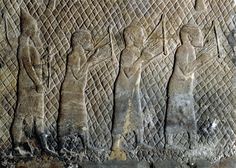
Prisoners playing lyres from Sennacherib's palace, Nineveh, circa 700 B.C.E.
Prisoners carrying lyres, palace of Sennacherib, Nineveh, c. 700 B.C.E.

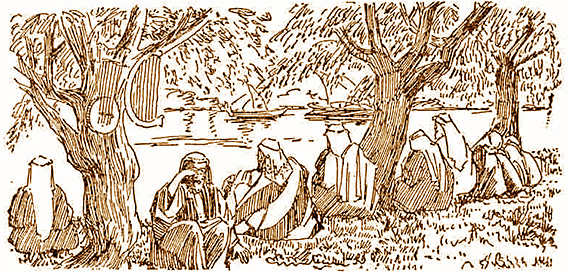
           Upon the poplars in her [Babylon’s] midst,

            Our lyres will remain hung. (137:2)

            Because there our captors asked us for words of song,

            Our oppressors for rejoicing:

            “Sing to us some song of Tziyon!” (137:3)

The Babylonian officers ask the deportees to entertain them by singing one of their quaint, provincial songs from Tziyon. If the officers merely wanted a folk song, they might have asked for a song from Jerusalem or Judah. By using the word Tziyon, the Babylonians are referring to Jerusalem as a religious center. Thus they remind the Israelites how helpless they are, even in matters of religion, now that the Babylonian army has razed the temple and deported them.

            How can we sing a song of God

           On the soil of a foreign land? (137:4)

The Israelites, and the Jews descended from them, do eventually sing sacred songs in foreign lands—including the psalms once sung in the temple. But in Psalm 137, they recoil from the idea of singing a hymn to God in order to let the Babylonians mock and humiliate them.

            If I forget you, Jerusalem,

            May my right hand forget. (137:5)

            May my tongue cling to my palate,

            If I do not remember you,

            If I do not exalt you, Jerusalem,

           Above my highest joy. (137:6)

            Remember, God, the Edomites

           On the day of Jerusalem, who said:

            “Strip it! Strip it down to the foundations!” (137:7)

According to the book of Obadiah, probably also written in the 6th century B.C.E., the men of the nearby land of Edom joined the Babylonians in sacking the city of Jerusalem (Obadiah 1:11-13).

            Babylon the despoiler,

            Fortunate are those who will retaliate for your retaliation against us! (137:8)

            Fortunate are those who will seize and smash

           Your little children on the rock! (137:9)

I picture the Israelites reacting like children, full of desperation at the loss of their mother land and religion, suddenly under the thumb of cruel and all-powerful foreigners. Toddlers in that situation might well scream with outrage and hatred at the mean strangers who have kidnapped them. It takes time to cool down, grow up, and consider the ramifications of one’s initial reaction. For a whole society, it can take centuries.

When the infant Moses cries at the sight of a stranger, it is because the stranger is not his mother, and he fears he has lost his mother forever. When the Israelite deportees cry at the sight of the rivers of Babylon, it is because Babylon is not their home, and they fear they will lose everything that means home to them: their identity, their way of life, and their religion.

They promise themselves they will never forget Jerusalem. Perhaps they recall the stories about Moses as an adult, who breaks with his royal Egyptian family to rescue the Israelite slaves.  He never forgets his mother and his own people.

May every one of us remember those we have loved and lost. May we remember our true homes—whether they are the homes we were born into (like the Israelites in Psalm 137), or the homes we adopt (like the Israelites that Moses leads out of Egypt in the book of Exodus).

Haftarat Vayechi—1 Kings: Last Words

Every week of the year has its own Torah portion (a reading from the first five books of the Bible) and its own haftarah (an accompanying reading from the books of the prophets) in the Jewish tradition. This week’s Torah portion is Vayechi (Genesis 47:28-50:26), and the haftarah is 1 Kings 2:1-12.
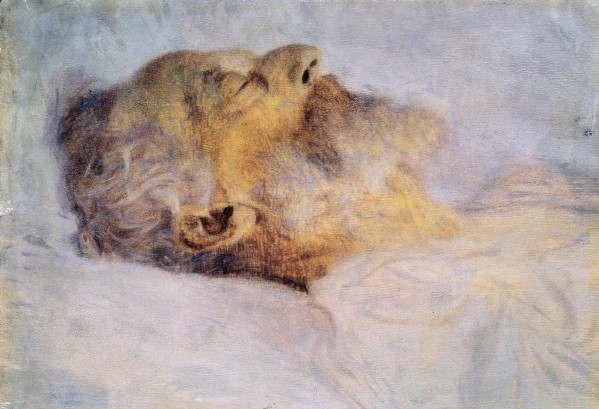
Old Man on his Deathbed, by Gustav Klimt
by Gustav Klimt

Sometimes a deathbed scene is silent; the dying person is unable to speak, or cannot even recognize the one waiting and hoping for a goodbye. But sometimes there are last words. These words might express acknowledgement, affection, even appreciation. Or the dying person might complain, give advice, or issue an order.

Giving a deathbed blessing is different from extracting a deathbed promise.

The Hebrew Bible offers two complete deathbed scenes: Jacob’s speeches to his twelve sons in this week’s Torah portion, and David’s final words to his son Solomon in this week’s haftarah.

Jacob

The Torah portion Vayechi offers three stories of the death of Jacob (also called “Israel”). In the first, Jacob gives an extremely polite order.

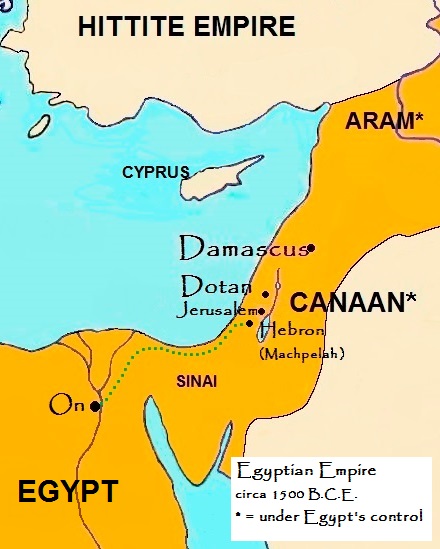
Route of Jacob's funeral cortege
Route of Jacob’s funeral cortege

And the time came close for Israel to die, and he summoned his son Joseph, and he said to him: “If, please, I have found favor in your eyes, please place your hand under my thigh and do with me chesed and fidelity: please do not bury me in Egypt. When I lie down with my fathers, then take me out of Egypt and bury me in their burial place.” And he [Joseph] said: “I myself will do as you have spoken”. And he [Jacob] said: “Swear to me!” And he swore to him. And Israel bowed down at the head of the bed. (Genesis 47:29-31)

chesed (חֶסֶד) = expected kindness; kindness out of loyalty to a family member or treaty partner.

In Egypt, Joseph is the pharaoh’s viceroy, and his father Jacob is only a guest. Although Jacob uses subservient language, he still reminds Joseph that he owes his father loyalty. Then he extracts a deathbed promise from Joseph: to bury him in Canaan, in the cave of Machpelah where Jacob’s parents and grandparents are buried.

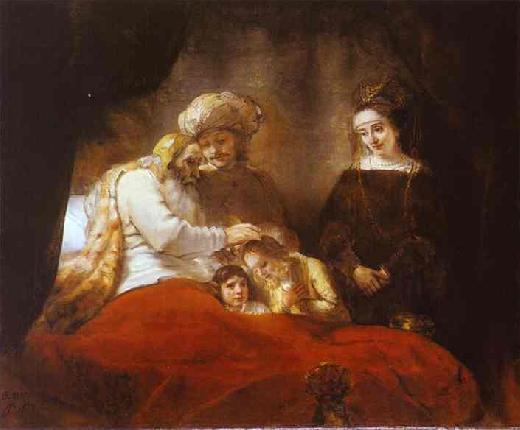
Jacob Blessing the Sons of Joseph, by Rembrandt

And it happened after these things, someone said to Joseph: “Hey! Your father is weakening.” So he took his two sons with him, Menasheh and Efrayim. And Jacob was told: “Hey! Your son Joseph has come to you.” And Israel mustered his strength and sat up on the bed. (Genesis 48:1-2)

In this second story, Jacob adopts Joseph’s two sons, giving them each a share of his estate. He kisses them, then blesses Joseph and his sons: the ultimate expression of acknowledgement and appreciation.

But Jacob has eleven other sons, and he addresses all twelve sons in a third deathbed story.

And Jacob summoned his sons, and he said: “Gather and I will tell you what will meet you in the end of days.” (Genesis 49:1)

Jacob delivers a long poem with a prophecy about the tribe that will descend from each of his sons. Only one remark is unmistakably about the son himself: a complaint about Reuben.

For when you climbed up on the lying-down place of your father

That was when you profaned it. My couch he climbed!  (Genesis 49:4)

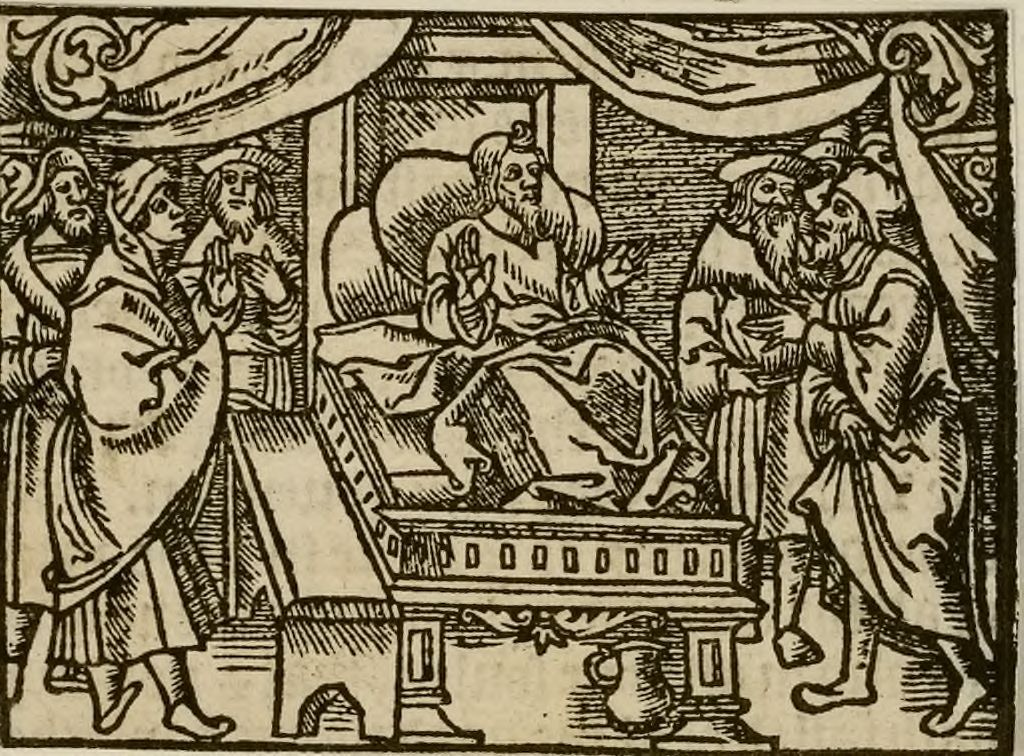
Jacob on his Deathbed, 1539 woodcut

Jacob still holds a grudge against Reuben for having intercourse with Jacob’s concubine Bilhah some 40 years earlier1. At the conclusion of the poem, a sentence that scholars attribute to a later redactor of the Hebrew Bible credits Jacob with blessing all his sons.

All these are the tribes of Israel, twelve, and this is what their father spoke to them. And he blessed them, each one according to his blessing he blessed them. (Genesis 49:28)

Finally Jacob returns to the subject most on his mind.

Vayetzav them, and he said to them: “I am being gathered to my people. Bury me with my fathers, in the cave … And Jacob finished letzavotwith his sons, and he gathered his feet into the bed, and he expired, and he was gathered to his people. (Genesis 49:29, 49:33)

Vayetzav (וַיְצַו) = And he commanded, and he ordered. (From the root verb tzivah (צִוָּה)= commanded.)

letzavot  (לְצַוֺּת) = Commanding, giving orders. (Also from the root verb tzivah.)

In his three deathbed speeches, Jacob expresses acknowledgement and appreciation of his twelve sons (and two of his grandsons) by blessing them. He complains about Reuben. He gives prophecies rather than advice. And he repeats his orders about where he must be buried, but he has no other final requests.

David

And David came close to the time of death, vayetzav his son Solomon, saying: I am going according to the way of all the earth. And you must be strong and you must be an adult. (1 Kings 2:1-2)

David’s first command or order to Solomon sounds more like advice. Now that his young son has become the king of Israel, he must behave like a strong adult.

david-on-deathbed

Next come two sentences in a different linguistic style, using synonyms in multiple phrases. Modern scholar Robert Alter has argued that these verses were added later by the editor of Deuteronomy, in order to improve David’s reputation.

And you must guard the custody of God, your god, to walk according to Its ways, to guard Its decrees, Its commandments, and Its rules, and Its admonitions, as written in the Teaching of Moses, so that you shall act with insight in everything that you do and everywhere you turn. So that God will establish Its word that It spoke concerning me, saying: if your descendants guard the way they take before Me faithfully, with all their heart and with all their soul—saying: yours will not be cut off from upon the throne of Israel. (1 Kings 2:3-4)

David reminds Solomon that as king, he must be a guardian of the religion of Israel, and base his own royal decisions on its rules. Then he gives the reason for his pious advice: so that his descendants to rule as kings of Israel forever.

The language of David’s deathbed speech reverts to a simpler style as he remembers the worst part of his life, when his beloved older son Absalom staged a coup and took over Jerusalem. Now he broods about unfinished business from those days.

He tells his son Solomon:

And furthermore, you know what Joab son of Tzeruyah did to me, what he did to two commanders of armies of Israel, to Avneir son of Neir and to Amasa son of Yeter: he killed them and he shed the blood of war beshalom(1 Kings 2:5)

beshalom  (בְּשָׁלֺם) = in peace, in peacetime.

David became the king of all Israel through a treaty with his opponent’s general, Avneir. Then David’s general, Joab, assassinated Avneir.2

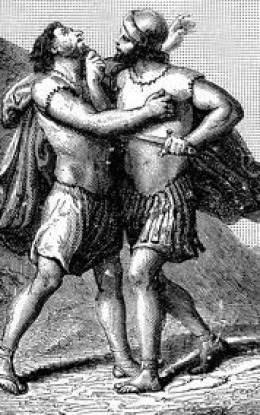
Joab kills Amasa
Joab kills Amasa

About 20 years later, Absalom usurped his father’s throne. David fled with his supporters, including Joab. When David’s army defeated Absalom’s, Joab quickly killed Absalom despite David’s order to the contrary.3 After David was reinstalled as king, he pardoned Absalom’s general, Amasa, but this did not stop Joab from murdering him under the cover of a friendly embrace.4 David did not dare punish Joab for either killing.

And so you must act in accordance with your wisdom, and you must not let his gray hair go down beshalom to Sheol. (1 Kings 2:6)

Even as David criticizes Joab for killing two generals in times of peace, he orders Solomon to kill Joab in peacetimeand make sure he does not die peacefully.

But with the sons of Barzillai of the Gilead, you shall do chesed. And they must eat at your table, because they came close to me when I fled from Absalom, your brother. (1 Kings 2:7)

While Absalom controlled Jerusalem, Barzillai had fed David and his men in exile at Machanayim. When David returned to the capital, he promised to reward Barzillai and provide for his son.5 Now David orders his son Solomon to honor that promise.

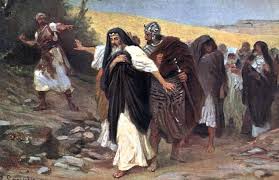
Shimi throws stones at David

Then he issues a third command. When David fled from Jerusalem, Shimi son of Geira hurled stones and insults at him on the road.6 When he returned in triumph, Shimi apologized for his wrongdoing, accompanied by a thousand Benjaminites who offered to serve King David. David had little choice but to accept the apology and swear not to execute him.7 But David still resents Shimi.

So you must not leave him unpunished, because you are a wise man, and you know what you will do to him and send down his gray hair in blood to Sheol. (1 Kings 2:9)

That is the last thing David says before he dies. Once again, he compliments his son for being wise enough to figure out how to carry out his father’s revenge, but does not trust him to make his own decision.

And David slept with his fathers, and he was buried in the City of David. (1 Kings 2:10)

His acknowledgement of Solomon’s wisdom is overshadowed by his demands that Solomon carry out his orders, including finding pretexts to execute two powerful men. Is David so self-centered that his only concern on his deathbed is making his successor promise to avenge him?  Or is David urging Solomon to get rid of Joab and Shimi before they make Solomon suffer, too?

Either way, David’s death is not peaceful. He expresses appreciation for Solomon’s wisdom only in order to assure him he can carry out his father’s commands.  He complains bitterly about Joab and Shimi. He gives Solomon advice about following his religion, but he also issues commands about killing Joab, rewarding Barzillai, and killing Shimi. His last thoughts are about murder and revenge.

Although Jacob is self-centered earlier in his life, on his deathbed he has a broader view than David.  His only command concerns his own burial. He is affectionate with one of his sons, Joseph, and two grandsons. He blesses them, and gives prophecies and blessings to his other sons, despite his complaint about Reuben. Jacob dies with dignity, passing on more blessings than obligations to the next generation.


I pray that my own last words (many years from now, God willing!) will be only blessings. And in case I am not granted a deathbed scene in which I can speak to those I am leaving, I am resolved to express acknowledgement and appreciation every day, and avoid complaining about people and giving excessive advice. May the Holy One grant me the strength!


1 Genesis 35:22.

2 After the death of King Saul, David took control of Judah and Saul’s son Ish-Boshet took over the Israelite lands to the north. For two years they fought for the kingship of all Israel, until Ish-Boshet’s general, Avneir, persuaded him to let David be the king. Avneir made a treaty with David, but afterward Joab tracked him down and assassinated him. David cursed Joab, but did not dare demote him. (2 Samuel 3:6-34)

Later, King David got Bathsheba pregnant, and used General Joab to get rid of her husband Uriah. (2 Samuel 11:1-21)  After that, the already powerful Joab was ungovernable.

3 2 Samuel 18:5-17.

4 After Joab kills Absalom, David sends a message to Absalom’s general, Amasa. “And to Amasa you shall say: Aren’t you my own bone and flesh? May God do this and more to me if you do not become my army commander for all time instead of Joab! (2 Samuel 19:14) David succeeds in recruiting Amasa as one of his own commanders, but his attempt to replace Joab fails; when they are chasing down a band of rebels, Joab tricks Amasa by reaching to kiss him with one hand and knifing him with the other (2 Samuel 20:8-13).

5  2 Samuel 19:32-39.

6  2 Samuel 16:5-8.

7  2 Samuel 19:17-24.  When David became bedridden and his older son Adoniyah made a bid for the kingship, Shimi joined Solomon’s faction (1 Kings 1:8).

Haftarat Vayigash—Ezekiel: You Can’t Go Home Again

Every week of the year has its own Torah portion (a reading from the first five books of the Bible) and its own haftarah (an accompanying reading from the books of the prophets) in the Jewish tradition. This week’s Torah portion is Vayiggash (Genesis 44:18-47:27), and the haftarah is Ezekiel 37:15-28.

Cut a board into two pieces, then glue them back together. The glued board is not identical to the original board.

Ezekiel, by Michelangelo

Yet Ezekiel, in this week’s haftarah, says two separate ethnic groups that once shared a religion will again become one nation.

And the speech of God happened to me, saying:  “And you, son of Adam, take yourself one piece of wood and write on it “belonging to Judah and to the Children of Israel, its chaveirim.  And take another piece of wood and write on it “belonging to Joseph, the wood of Ephraim and all the household of Israel, its chaveirim. And bring them close, one to the other, to [make] yourself one piece of wood; and it will be as one in your hand.”  (Ezekiel 37:15-18)

chaveirim (חֲבֵרִים) = comrades, companions, partners.  (From the root verb chavar, חָבַר = allied, joined forces.)

In the book of Genesis/Bereishit, Jacob has twelve sons and acquires a second name, Israel. Jacob’s favorite son, Joseph, alienates his ten older brothers.  Led by Judah, the ten young men sell Joseph to a slave caravan bound for Egypt.  (Jacob’s twelfth son, Benjamin, is still a baby at the time.)  In this week’s Torah portion, the brothers are reunited after a final confrontation between Joseph and a reformed Judah.  Their descendants become the twelve tribes of Israel—who escape from Egypt 400 years later, as one people called the “Children of Israel”.

All twelve tribes settle in Canaan, but they only become a unified nation called “Israel” under King David, according to the second book of Samuel.  After the death of the next king, Solomon, the northern part of the country secedes.

circa 800 B.C.E.
circa 800 B.C.E.

The new northern kingdom calls itself Israel, since it includes the traditional lands of most of the original tribes.  Its richest and most dominant tribe is Ephraim, which is the name of one of Joseph’s sons.  In Ezekiel’s time this northern kingdom no longer exists.  Yet God says one piece of wood will represent the descendants of its people, the chaveirim or companion tribes from the former northern kingdom.

The truncated southern kingdom calls itself Judah/Yehudah. It includes only two tribal lands: the large area of Judah and the small territory of Benjamin. These tribes, too, are Children of Israel.

For two centuries the kingdoms of Israel and Judah were uneasy neighbors—sometimes allies, sometimes enemies.  What they continued to have in common was their attachment to the same God (often called “the God of Israel”)—though they disagreed about the correct number of temples and how to furnish them.1

map-assyrian-babylonian-deportations

The Neo-Assyrian Empire conquered the northern kingdom of Israel in 740-721 B.C.E. and deported its leading citizens, leaving only its peasants and a few puppet administrators.  During several waves of deportation, some northerners escaped to Judah.

The southern kingdom of Judah survived another 150 years or so by paying tribute to Assyria.  Then the Neo-Babylonian Empire swallowed the Assyrian Empire and went on to conquer Judah and its capital, Jerusalem, in 601-586.  King Nebuchadnezzar’s army deported Judah’s leading citizens (including Ezekiel) to Babylon, leaving only peasants and puppet administrators.

God instructs Ezekiel to continue his performance art with the two pieces of wood until someone asks him to explain it.  Then, God says, Ezekiel must recite this explanation:

Thus says my lord God:  Hey! I myself … will be making it one piece of wood. And they will be one in My hand…  (Ezekiel 37:19)

Thus says my lord God: Hey! I myself will be taking the Children of Israel from among the nations where they have gone, and I will collect them from all around, and I will bring them to their land.  And I will make them a single nation on the land, in the hills of Israel, and one king will be king for all of them.  And never again will they be two nations… (Ezekiel 37:21-22)

Ezekiel can only hold the “Judah” stick and the “Joseph” stick together to make one piece of wood symbolically.  But God promises to reunite the two peoples literally, making them chaveirim who are not merely allies, but a single, seamless kingdom as in the time of David.  This kingdom will be a home for everyone who worships the God of Israel; one land with one king, one capital (Jerusalem), and one temple, greater than the first.

Yet boards cut from a tree can never become a tree again.  In human experience, time is unidirectional.  We cannot go backward; our world never returns to the way it used to be.  We can only go forward, building with the material we have now.  We might make boards into a chair.

Ezekiel’s prophesy never came true.  After the Persian Empire took Babylon in 539 B.C.E., some of the exiles from Judah did return to Jerusalem and build a second temple, and some of their descendants served as provincial governors of Judea.  Other Judahites stayed behind, building a thriving Jewish community that eventually produced the Babylonian Talmud.  Most of the exiles the Assyrians deported from Israel were assimilated and lost their identity and religion.

There never was another independent kingdom of Israel.  The third “temple” in Jerusalem is a mosque.  After millions of Jews were killed by the Nazis and their collaborators, the nation of Israel was created in 1948 C.E., and its population now includes almost half the Jews in the world.  (Almost as many Jews live in the United States.)  If Ezekiel were here to prophesy today, would he write “Israel” on one piece of wood and “U.S.A.” on the other?

American and Israeli Jews feel a kinship, but are so dissimilar that there is only a trickle of emigration from one nation to the other.  Currently, American Jews are generally respected by their fellow Americans, while Israeli Jews are blamed by non-Jewish residents of Israel for poverty, suppression, and abuse.

I cannot imagine the two groups forming a single nation in a single land, even if there were room for all of us.


May all human beings, of any religion or tradition, recognize that we can’t go home again; if we try, we find that our old home has changed.  Change is the nature of this world, the world of the God whose personal name is a form of the verb meaning “to become”.2

I pray that we may all move beyond Ezekiel’s vision; that we may all find new ways to help our own identities, our communities, and our religions grow, wherever we live.  And may we also find new ways to work together with people who were once strangers.


1 The opinion of Judah prevailed in the Hebrew Bible: that there should be only one temple, in Jerusalem, and the only statues allowed are the two keruvim, mythical winged creatures. (See my post Cherubs Are Not for Valentine’s Day.) The Bible criticizes the northern kingdom of Israel for maintaining temples at Dan and Beit-El as well as its capital, Samaria, and for the golden calves standing at the entrances of the temples in Beit-El and Dan (2 Kings 10:29).

2 YHVH = the Tetragrammaton or four-letter personal name of God that Jews consider most sacred. The name appears to be a form of havah or hayah (הוה or היה), the root of the verb “to be”, “to happen”, or “to become”, although it is a form that does not fit any standard Hebrew verb conjugations.