Pinchas: Fairness

Children passionately want life to be fair. For the sake of fairness, they can even be persuaded to share their possessions. But if a young child is the victim of unfairness, prepare for a tantrum.

Adults know that life is not fair. People in power are biased, and bad luck happens. Nevertheless, most of us feel bitter when we do all the right things, and still get the short end of the stick.

When is the distribution of benefits “fair”?  Merriam-Webster’s dictionary gives two possible answers: when the distributor is impartial, i.e. free from self-interest, prejudice, or favoritism; or when everyone is given their due according to established rules.

Unfairness to Canaanites

This week’s Torah portion, Pinchas, looks ahead to how the land of Canaan will be distributed after the Israelites have conquered it by killing or subjugating the Canaanites. The question of fairness to the indigenous Canaanites never comes up in the Torah. Over and over again, from the book of Genesis/Bereishit through the conquest of the land in the book of Joshua, we read that God is giving the land of Canaan to the children of Israel. And what God wants trumps any human notion of fairness. Although later Jewish writings paint the Canaanites as evil perverts, the only objection to Canaanites in the Torah itself is that they worship different gods.

Fairness among Israelites
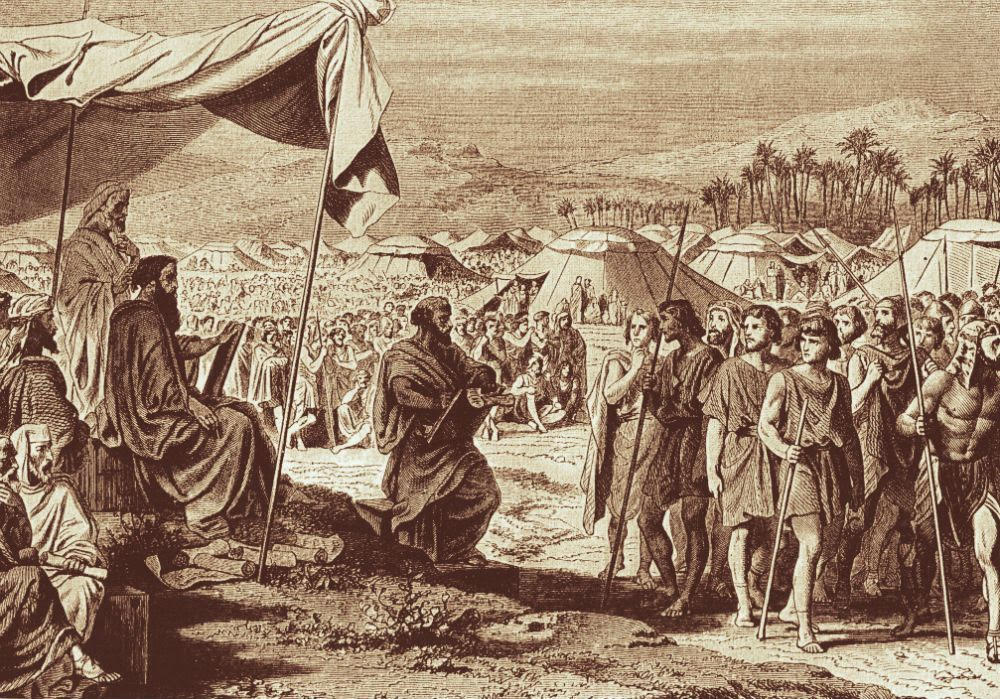
Numbering of the Israelites, by H.F.E. Philippoteaux,
19th century

In this week’s Torah portion, God prescribes how the land the Israelites are about to conquer should be divided among themselves. The first step is to take a census of men aged 20 and older. The census serves both as a mustering of eligible fighters for the upcoming conquest, and as a count of the households that will own plots of land once Canaan has been conquered.

The census of adult men raises two questions: What about women? And why should the land be divided according to the current population on the banks of the Jordan, rather than the previous generation, or the next generation? The Torah addresses these issues in the story of the daughters of Tzelofchad, which begins in the portion Pinchas and resumes in the portion Masey. I plan to examine that two-part story in next week’s blog post.

Right or wrong, the census clearly defines the in-group for the distribution of land: male heads of households. The next step is to divide the land fairly among the tribes of the in-group.

This is the census of the sons of  Israel: 601,730. Then God spoke to Moses, saying: “For these the land shall be divided as a nachal, by the account of names. The abundant [tribe] will have an abundant nachal, and the scanty [tribe] will have a scanty nachal; each one shall be given its nachal according to the bidding of the census. Yet the land shall be divided according to the bidding of a lottery; nachal [will be assigned] to the names of the tribes of their fathers.  According to the bidding of the lottery you shall divide [land] among the abundant [tribes] and the scanty [tribes], giving each its nachal.” (Numbers/Bemidbar 25:51-55)

nachal (נָחַל)=a permanent possession to pass on as an inheritance; a hereditary land-holding.

In other words, each tribe will get a territory proportionate to the number of adult men in the tribe, and tribes will be matched with territories through a lottery. This procedure goes out of its way to achieve fairness. The land will be distributed according to population, and an impartial lottery will match each tribe with its territory. (After that, the leaders of each tribe are to use a similar process to allocate land to individual clans and households.)

According to the Talmud Bavli, tractate Bava Batra 121b-122a, every man in the census will end up with his own plot of land, and all the plots will be equal—not in size, but in value. Where the land is more fertile, the plots will be smaller. This seems fair because each male Israelite head of household, i.e. each member of the in-group, will get his due.

The purpose of the lottery is to make sure this distribution is carried out without favoritism. Later in the Hebrew Bible, lotteries express the will of God, but here a lottery might be merely a randomizing mechanism, as it is today. The choice is left up to blind chance rather than a human decision. A lottery seems to meet the dictionary definition of fairness as impartial distribution, free from self-interest, prejudice, or favoritism.

But there is a catch. Each tribe must get a territory whose total value matches its total count of adult males. And the tribes are different sizes. The tribe with the largest head-count is Yehudah (Judah in English), with a total of 76,500 men. The smallest is Shimon (Simeon in English) with a total of 22,200. In a truly random lottery, the high priest might draw the name Yehudah the same time as the description of a territory that could only support Shimon. Thus the leaders cannot conduct a random lottery and still give each tribe land according to its head-count. Either the land will not be not distributed equally, or the lottery will be rigged.

Fairness versus foreknowledge

The Talmud explained that when the lottery took place, the high priest Elazar already knew which tribe would be matched with which territory, because he was supported by the ruach hakodesh, the holy spirit of God. First he would predict the tribe and its territory. Then he would shake the urn of tribe names and pick one, and shake the urn of land boundaries and pick one. Every time, the two lots matched his prediction (Talmud Bavli, Bava Batra 122a). In other words, the whole lottery was predetermined by God.

Thus God’s orders for land distribution are fair only for the group counted in the census, and only if God is impartial and does not play favorites. The obvious question is: Is God fair?

God wears a human face in the Torah; “He” is an anthropomorphic character who feels emotions such as regret (for creating this world) and rage (every time the Israelites disobey him). Nevertheless, God is the creator of the universe, far greater than any other gods, if they even exist. Sometimes this God character is benevolent. When God tells Moses “His” 13 attributes in Exodus/Shemot 34:6, the list begins with compassion, grace, patience, abundant kindness, and truth. Fairness is not mentioned.

And it is hard to attribute fairness to the god who saves Noah’s family but drowns the rest of the world, including innocent children; or to the god who routinely wipes out thousands of Israelites with plagues that make no distinction between the innocent and the guilty.


Some people still assume that the God character in the Torah is the same being as the theologian’s omnipotent all-benevolent God, and that both are the same as God the Unknowable. After all, the three versions of God all have the same name. It is hard for these people to believe that life is unfair. If God is human enough to care about fairness, and God runs everything in the universe, then why does bad luck strike some people and not others? Surely the unlucky must deserve a worse deal than their luckier neighbors. Otherwise, God would be unfair.

This confusion about God led some Jews to believe that they must have deserved the Holocaust; if only they had been more observant, God would have intervened to prevent it. During the current long recession, some Americans who lose their houses and jobs blame themselves for not working hard enough, or for making the wrong decisions.  It is easier for them to believe they are undeserving than to believe that either God or the American system is unfair.

Other people embrace the reality that life is not fair, and campaign to change the system to make it more fair. Still others view the desire for fairness as childish, and focus on moral values they find less simplistic.

Life is not fair.  What do you want to do about it?
Balak: Carnal Appetites

As the Israelites approach the northeast border of Canaan, after serving their 40 years in the wilderness, they find out that God is on their side.  When the  king of Cheshbon attacks them, they conquer all of his and his brother’s land.

Bilam Prophecies,
by James Tissot

Then in the first part of this week’s Torah portion, Balak, God blesses the Israelites through a prophet other than Moses. Balak, king of Moab, hires the prophet Bilam to curse them, but every time Bilam opens his mouth, God makes him speak prophecies of blessing instead. (See my post Balak: Anxiety.)

You might expect the Israelites to rejoice, look forward to their next conquest, and serve God wholeheartedly. But human beings are not always reasonable.

Israel settled among the acacias, and the people began liznot with the daughters of Moab. (Numbers/Bemidbar 25:1)

 liznot (לִזְנוֹת)= to engage in illicit sex, infidelity, or cult prostitution.

Traditional commentary assumes it is the men of Israel who are screwing up. Commentators differ over whether they are having sex with non-Israelite women, or because they are participating in what scholars call “cult prostitution”: ritual sex between a man and a Mesopotamian priestess in order to influence a god to make the land fertile.

At any rate, exotic sex is the first attraction offered by the women of Moab. The second attraction is meat.

They invited the people to sacrificial-slaughter-feasts for their gods, and the people ate, and they bowed down to their gods. (Numbers 25:2)

The Israelites already had their own sacrificial-slaughter-feasts, laid out in the book of Leviticus/Vayikra. Why would they be attracted to something they could get at home? Maybe the Moabites provided the sacrificial animals, so the Israelites got meat for free. Maybe it was exciting to make an offering to a different god, following slightly different customs.

The new generation of Israelites appears to be no more mature than the old one. They are still easily distracted, easily seduced by novelty. They fail to learn from the past or prepare for the future. They cannot resist a good party, and all they can pay attention to is free sex and free food, the more exotic the better. The only problem is that partying with the Moabite women means being unfaithful to their own god.

And Israel yoked itself to the ba-al of Pe-or, and God became angry against Israel. (Numbers 25:3)

ba-al (בַּעַל)=a local god; an owner or master.

When God becomes angry (literally, “hot-nosed”) against Israel, a plague usually follows. Moses spends a lot of time in the book of Numbers/Bemidbar doing things to change God’s mood, so God will stop the latest plague. In this scene, the Torah does not tell us when the plague begins, only when it ends. But as soon as God gets angry, God tells Moses what to do.

Impalements in Assyrian relief, Tiglath Pileser II

Then God said to Moses: Take all the leaders of the people and hoka them for God, in front of  the sun; and it will turn My anger back from Israel. (Numbers 25:4)

hoka (הוֹקַע) = display a dislocation. (Another form of the verb is yaka, which the Torah uses to describe both what Jacob’s wrestling partner does to his hip, and a  disjointed, alienated feeling.) Translations of the verb hoka in this verse include “hang”, “impale”, and “hang up their bodies”.

God’s instruction to Moses is not easy to interpret. Does “all the leaders of the people”  mean every chieftain (since the leaders are supposed to stop bad behavior instead of looking the other way)?  Or does it mean every ringleader who is encouraging others to worship the god of Pe-or? The Midrash Rabbah, written in Talmudic times, offers both interpretations.

What is Moses supposed to do to these leaders? Rashi (11th-century Rabbi Shlomo Yitzchaki) wrote that the leaders were to be stoned, the usual punishment for idolaters, and then their corpses hoka, hung up on display. Later commentators speculated that God was requesting an unusual punishment such as impaling. Since the Torah consistently prescribes the death penalty for any Israelite who worships another god, one of these interpretations is probably correct.

Yet I am attracted to the idea that God is asking Moses to expose how dislocated the leaders are from the main body of their community, how alienated they are from the true path.

Here is my interpretive translation of Numbers 25:4:

Then God said to Moses: Take all the leaders of the [unfaithful] people and expose their dislocation and alienation from God, in front of the sun; and that will turn back the plague Israel has brought upon itself.

Traditional commentary is divided over whether Moses ever carried out God’s instructions. The plague stops when Aaron’s grandson Pinchas spears a leader of the tribe of Shimon and a Moabite (or Midianite) princess as they are fornicating in Israel’s sacred Tent of Meeting.  (See my blog post Balak: Being Open.) This double impalement is so shocking, that the Israelites wake up to their reality and abandon the god of Pe-or.

 As I read the book of Numbers, I often feel exasperated with the Israelite men for being so immature and short-sighted. Why can’t they accept that they have no choice but to continue the journey that began when they left Egypt? Why can’t they be grateful for the food, teaching, and protection that God is giving them (as long as they behave themselves), and work on becoming better and holier people?

I used to feel the same way about “party animals” back when I was in college. I thought I was more mature because I had better things to do with my time. Now, I wonder if I am really any better. I need to lose weight, yet I could not resist eating several bowls of ice cream today. The difference between me and the Israelites who worshiped Ba-al Pe-or is that my ice cream did not violate my religion. It was even kosher! And eating ice cream is much more virtuous than having sex with strangers or bowing down to somebody else’s god. Nevertheless, you could argue that when I ate all those calories, I failed to honor God by failing to honor my body, which is a gift from God.

It is part of human nature to be seduced by things that are unreasonable. May we all be thankful for those moments of shock that wake us up.

Chukkat: Passing Through

Kings are often synonymous with their countries in the Bible. For example, in this week’s Torah portion, Chukkat (“Decree”), the king of Edom is simply called “Edom”, and when he refuses to give the Israelite permission to pass through his country, he says: “You shall not pass through me.” (Numbers/Bemidbar 20:18)

We all have rules about other people entering our personal space. Whether our personal space is an inch or an arm’s-length away from our bodies, we only want people we are intimate with to enter that zone. When anyone else, however benign, comes too close, it feels like an invasion.

In the Torah, the king of Edom acts as though his personal space covers his entire country. After all, he is Edom. He gives no reason for refusing permission for the Israelites to pass through him, and there is no obvious political reason. Although the Israelites have  601,730 fighting men, they are planning to conquer Canaan, not Edom.

Moses sent messengers from Kadeish to the king of Edom: Thus says your brother Israel: “You know all the hardships that have found us. Our forefathers went down to Egypt, and we dwelled in Egypt many years, and the Egyptians were bad to us and to our forefathers. And we cried out for help to God, and God listened to our voice, and sent a messenger and brought us out from Egypt. And hey! We are in Kadeish, a town at the edge of your territory. Please let us pass through your land. We will not pass through a field nor a vineyard, nor will we drink water from a well. On the king’s road we will go; we will not turn aside to the right or the left, until we have passed through beyond your territory.” (Numbers 20:14-17)

Kadeish = making holy.

Edom = a large Semitic kingdom south of the Dead Sea, including the mountain range of Seir; a variant of the word adom = red.

According to Genesis/BereishitEdom was Esau’s nickname, and became the name of the country he founded. Esau was the brother of Jacob, who became known as Israel. When Moses calls Edom and Israel brothers, he reminds the king that the Israelites are not only fellow Semites, but family. Edom should treat Israel like a brother, feeling empathy for its abuse at the hands of Egypt, and recognizing that God is on the Israelites’ side. By sending his message from Kadeish, rather than any other town on the border, Moses might even be hinting that Israel and Edom are both holy.

His request could hardly be more polite and humble. He does not want to disturb Edom; his goal is to get the Israelites into Canaan, the land God promised them.

The first time the Israelites reached the border of Canaan, 38 years before, they refused to cross it, because they did not trust God to help them take the land.  (See my blog post Shelach-Lekha: Too Late.) God sentenced them to spend a total of 40 years in the wilderness, while the mistrustful generation died off. In this week’s Torah portion, the people have served their time, and the 120-year-old Moses takes responsibility for getting the next generation to Canaan, even though he knows he will die before they cross over.

This time, God does not tell Moses where the Israelites should cross. Nor does Moses ask God. On his own, Moses decides to avoid the southern border and lead his people around the eastern shore of the Dead Sea, so they can enter Canaan from the northeast, across the Jordan River. The first part of this route crosses the kingdom of Edom, which lies south of the Dead Sea.

But Edom said to him: You shall not pass through me, lest I go out with the sword to oppose you. (Numbers 20:18)

Then the children of Israel said to him: We will go up on the high path, and if we drink your water, I myself or my livestock, then I will give their price. Only nothing will happen. On foot I will pass through it. (Numbers 20:19)

The change from plural to singular in Moses’s second request implies that he identifies with the children of Israel in the way a king identifies with his country. Moses gives up on the convenient road through the farmland of Edom, and asks permission to take the high path over the Seir mountains. Perhaps he thinks the king would find this road less threatening because it does not pass near the Edom’s capitol.  Moses also gives the king of Edom a financial incentive by offering to pay for water. But Edom still feels as if his personal space is threatened.

And he said: “You shall not pass through! And Edom went out to oppose him, with a serious fighting-people and a strong hand. And Edom refused to let Israel pass through his territory, and Israel turned away from him.” (Numbers 20:20-21)

Moses accepts that the king of Edom does not consider the children of Israel close enough relatives to welcome them into his personal space. Instead of fighting about it, he makes his disgruntled people march over a much longer route. They circle all the way around Edom, going south almost as far as the Gulf of Aqaba, before finally heading north again toward the Jordan River and Canaan.


When do you let someone “pass through” your personal space, coming uncomfortably close before leaving again? When do you insist on passing through someone else’s personal space?

These questions are easy in some settings, such as a medical office, or an elevator in which all the passengers come from the same culture. It can be harder to decide whether to let someone in through your front door. And I often find myself puzzled by the question of whether to hug someone when we say hello or goodbye. I watch my friends and acquaintances to see if they are stepping forward with their hands rising, or keeping their distance.  To be polite, I need to match them—and they need to match me.

I feel invaded when I get a greeting-hug from a stranger, or an acquaintance I don’t like.  I don’t want to let them pass through my personal space. Unfortunately, a few of the people I want to keep at arm’s length are my relatives, and American culture assumes that relatives are intimate.

I can empathize with the king of Edom refusing passage to Israel, even though the Israelites and Edomites have the same great-great-great-great-great-great-great-great-great-great-grandfather. To Edom, these people from Egypt are strangers.

And I admire Moses for respecting the king of Edom, and turning away after the king rejects his second polite request. Civilized life requires good boundaries for everyone.

Yet the Israelites are on their way to Canaan, which they conquer by the sword in the book of Joshua. If the old generation had trusted God and crossed the southern border of Canaan when God told them to, 38 years before, would God have arranged for the Canaanites to surrender without bloodshed?  Maybe when the Israelites try again, they have to invade Canaan with battles and sieges because they no longer have God’s full support. Yet they do not give up on the land God promised them, 40 years before. After all, if 601,730 of them are men over 20, the whole population must number at least two million. Two million people need a land. And God promised their parents the land of Canaan.

So in the book of Joshua, the Israelites cross into the personal space of the Canaanite peoples, and insist on staying. Their desperation for a homeland leads to war.

In a just world, every family would have its own home, and every people would have its own country, uncontested. In a just world, every border would be clear, and it would be easy for people to respect each other’s boundaries. But we do not live in a just world. God is not fixing the world for us, so our responsibility is to fix the world for each other. I know I can have only a small effect on the world, but it does make a difference if I treat other humans with respect.

May we all learn to respect boundaries, to compromise without giving up our journey, and to seek peace, like Moses.