Beshalach: Singing

by Melissa Carpenter, maggidah

The first time the Torah refers to singing, it is something that does not happen.  In the book of Genesis/Bereishit, Jacob works as an indentured servant for his uncle and father-in-law, Lavan, for twenty years.  Then while Lavan is out of town, Jacob flees with his own wives, children, servants, herds, and flocks.  Lavan catches up with Jacob on the road and says:

Why did you hide and run away? And you robbed me and you did not tell me—and I would have sent you off with gladness, and with shirim, with tambourine, and with lyre. (Genesis 31:27)

shirim (שִׁרִים) = songs.  (Singular: shirah, שִׁירָה)

Although I think Lavan is lying, this first reference to song does tell us that musical celebrations of departure were customary in ancient Aram.
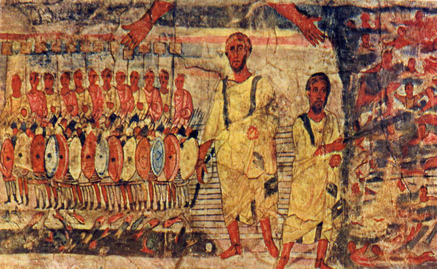
"Moses Crossing the Red Sea", Dura Europas Synagogue, 245 C.E.
“Moses Crossing the Red Sea”, Dura Europas Synagogue, 245 C.E.

The first singing that does happen in the Torah is in this week’s portion, Beshalach (“When he sent out”).  God splits the Reed Sea, the Israelites cross over on the damp sea-bottom, the Egyptian army pursues them, and the wheels of their chariots get stuck in the mud.  As soon as all the Israelites and their fellow-travelers are safe on the other side, God makes the waters return and drown all the Egyptians.  The Israelites see the dead bodies of the soldiers on the shore, and start to sing.

This is when Moses yashir, along with the children of Israel, this shirah to Y-H-V-H; and they said, saying:

Ashirah to Y-H-V-H, for He rises up in triumph;

    horse and its rider He threw into the sea!  (Exodus/Shemot 15:1)

yashir (יָשִׁיר) = he sings.

ashirah (אָשִׁירָה) = I sing, I will sing, let me sing.

(I am using “He” to translate the pronoun prefixes and suffixes in the “Song of the Sea’, since later lines in this hymn picture God as a “man of war”, i.e., warrior.  For the name of God indicated by Y-H-V-H, see my blog post: Va-eira: The Right Name.)

The hymn continues:

My strength is the melody of Yah, it is my salvation;

     this is my god, and I extol Him;

    the god of my father, and I exalt Him. (Exodus 15:2)

God is man of war; Y-H-V-H is His name. (Exodus 15:3)

Yah (יָהּ) = a name for God, possibly an abbreviation of Y-H-V-H.

Since God has single-handedly defeated and killed the enemy, the Israelites sing a hymn celebrating God as the ultimate warrior.

(The Song of the Sea continues for 16 more verses, using a more archaic Hebrew than the text surrounding it. Modern scholars agree that whoever compiled and wrote down the first version of the book of Exodus, some time after 900 B.C.E., inserted a much older hymn here and attributed it to Moses.)
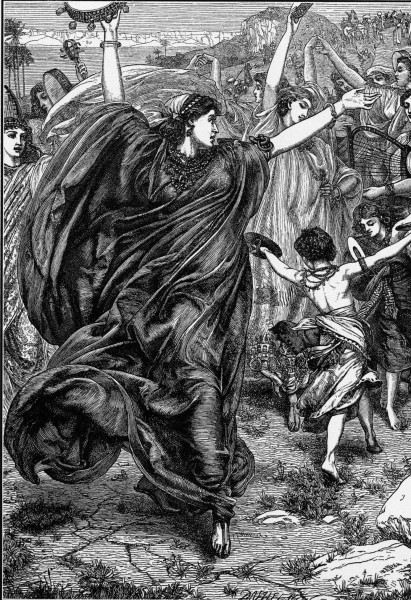
Miriams-Song 1909

At the end of the “Song of the Sea”, the women sing and dance. 

And Miriam the prophetess, the sister of Aaron, took the tambourine in her hand, and all the women went out after her, with tambourines and with circle-dances. And Miriam ta-an to them:

Shiru to Y-H-V-H, for He rises up in triumph;

    horse and its rider He threw into the sea!  (Exodus 15:20-21)

ta-an (תַּעַן) = she sang call-and-response; she answered, she responded (from the root anah, ענה).

Shiru (שִׁירוּ) = Sing!

Miriam appears to be leading singing, dancing, and percussion at the same time!

The next time the Torah reports singing is in the book of Numbers/Bemidbar, when it inserts a short archaic song in honor of a well of water into a list of places the Israelites traveled through.

This is when Israel yashir this shirah:

Rise up, well! Enu for it!

The well that captains dug,

That donors of the people excavated,

With a scepter, with their walking stick. (Numbers 21:17-18)

Enu (עֱנוּ) = let us sing call-and-response (also from the root anah, ענה).

The only other reference to singing in the first five books of the Hebrew Bible precedes a long hymn inserted into the book of Deuteronomy/Devarim. To introduce this song, God tells Moses:

And now, write for yourselves this shirah, and teach it to the children of Israel; put it in their mouths, so that this shirah will be a witness for me against the children of Israel. (Deuteronomy 31:19)

Although the hymn inserted at this point does praise God, it also criticizes the people for backsliding, and warns them about God’s vengeance.  The overall message is that the Israelites do not appreciate everything God has done for them, and they had better behave, or else. The purpose of the song, according to the Torah, is to make this message easy to remember.

King David is the first professional musician named in the Bible. In the second book of Samuel, he composes and sings not only another hymn praising God, but also the first two dirges in the Bible, one for Saul and Jonathan, and one for Avner. Both dirges are introduced by a new verb, va-yekonein (וַיְקֹנֵן) = and he sung a lamentation.

Besides songs of celebration and lamentation, the Bible contains many references to hymns addressed to God; and all 150 psalms are the lyrics of hymns.  There are psalms of praise and of thanksgiving.  The majority of the psalms plead with God: to reward those who worship God and do good, and punish the wicked; to rescue God’s followers from poverty or enemies; to grant us long life and to kill our enemies; to teach us how to do good; and—a plea that moves me today—to stop being silent and remote, to answer and prove that our God exists.

"The Concert Singer", by Thomas Eakins, 1892
“The Concert Singer”, by Thomas Eakins, 1892

I remember that when I was I small child, I sang spontaneously whenever  happiness came over me, making up melodies and nonsense words as I went along.  When I was in elementary school, I learned a variety of songs, and sang both to entertain myself, and to have fun with other people.  I was singing when it was the custom, and when I wanted to celebrate—like the singers in the first part of the Hebrew Bible.

I admit that as a young teenager, I sang “Ding, dong, the witch is dead” when I was consumed with frustration over someone who seemed to be my enemy.  I did not know that many psalms also begged God to kill the singer’s enemies.

After that, I learned that when I was feeling down, singing sad songs lifted my spirits.  I had discovered the equivalent of the Biblical dirge.  When I needed to vent my romantic frustrations and thwarted physical desires, singing certain popular songs gave my feelings an outlet.

When I was over 30, and searching for God, none of the popular songs I once loved met my needs.  Then I stumbled upon a Jewish Renewal congregation, P’nai Or of Portland, that supplied me with all the songs I wanted.  Finally, I could sing to express the yearning of my soul for both a good direction in life and a connection with the divine.  And many of those songs and chants come from the book of psalms.

Recently, I was singing a chant by Rabbi Shefa Gold using two lines that appear in the Song of the Sea in today’s Torah portion, and are so evocative the Torah repeats them in Isaiah and Psalms:

Ozi ve-zimrat Yah, vayehi li liyshuah (עָזִּי וְזִמְרָת יָהּ וַיְהִי לִי לִישׁוּעָה). Or in English:

My strength and the melody of Yah, it is my salvation. (Exodus 15:2, Isaiah 12:3, Psalm 118:14)

At this stage of my life, what saves my spirit is my own strength (which is a divine gift), combined with the ability to sing my own songs (both literally and figuratively) in praise of Yah, of the divine as I know it.

May we all be blessed with such music in our lives.

Bo: Impenetrable Darkness

by Melissa Carpenter, maggidah

Blood.  Frogs.  Lice.  Insect swarms (“wild beasts” in earlier translations).  Pestilence.  Boils.  Hail.  Locusts.  Darkness.  Death of the Firstborn.

These are the ten “plagues”—miraculous calamities—that God inflicts on Egypt before the Pharaoh lets the Israelites go.  Jews recite the ten plagues every spring during Passover/Pesach, the holiday commemorating the exodus from Egypt. We also read about the last three plagues in this week’s portion, Bo (“Come”).

Most of the plagues inflict pain on humans, kill livestock, and destroy crops. The last plague kills humans. But the ninth plague, darkness, seems harmless at first glance.

Seder Haggadah shel Pesach: Plague of Darkness

God said to Moses:  Stretch out your hand against the skies, and it will become choshekh over the land of Egypt, and the choshekh will be felt.  And Moses stretched out his hand against the skies, and it became choshekh of afeilah throughout all the land of Egypt, for three days.  No one could see his brother, and no one could get up from under it, for three days.  But for all the Children of Israel, there was light in their dwellings. (Exodus/Shemot 10:21-23)

choshekh (חֹשֶׁךְ) = dark, darkness.

afeilah (אֲפֵלָה) = cut off from any light, complete darkness, impenetrable darkness.

The three days of total darkness terrorize the Egyptians so much that Pharaoh makes his best offer yet to Moses: the Israelites could go with their women and children, leaving merely their livestock behind. (Moses rejects this offer, so that God can produce the final plague and Pharaoh’s complete capitulation.)

What is so terrible about this darkness?  If it were merely three days of blindness, the Egyptians might be able to wait it out.  They would have to feel their way around, but they could still talk with each other. They could cooperate to make sure everyone got food and water.  They could comfort each other.

But the plague of darkness is not physical blindness; it is psychological darkness.

This darkness can be felt.  The Midrash Rabbah (a collection of commentary from Talmudic times) explains that the darkness has “substance”.1  Maybe when the Egyptians grope around to find things they cannot see, all they feel is “darkness”. 19th-century rabbi Samson Raphael Hirsch wrote that groping means uncertainty, and in the impenetrable darkness of afeilah, everything seems uncertain and doubtful.2

In this condition, stray thoughts that a person would normally dismiss in an instant become obsessions.  What if there is no god?  Does that person wish I were dead?  What if I don’t really love them?  Is my whole life meaningless? What if I am insane? A person living in spiritual darkness keeps groping for true answers, but feels only darkness.

The Torah adds: “No one could see his brother”.  This is the darkness of extreme egotism, exemplified by the Pharaoh.  As the plagues roll through Egypt, Pharaoh’s advisors and the Egyptian people protest that it would be better to give Moses and his god what they want than to put the land through more plagues.  Pharaoh ignores them because he cares only about himself and his own pride; he does not recognize anyone as a “brother” human being.

Thus he is cut off not only from affection, but also from any possibility of enlightenment; he is incapable of learning from others.  Similarly, the afeilah cuts off the Egyptians from any possibility of light.

At first, Pharaoh hardens his own heart.  Over time, it becomes a habit from which only a divine intervention could shake him loose. But God keeps his heart hardened, so Pharaoh does not change. In the plague of darkness, all the Egyptians experience Pharaoh’s immobility.  The Torah says “and no one could get up from under” the darkness.  The Midrash Rabbah explains that anyone who was sitting could not stand, anyone standing could not sit, and anyone lying down could not rise up.3  Like the Pharaoh, the Egyptians cannot change their positions—or their beliefs.

Imagine experiencing a “dark night of the soul” or spiritual crisis so impenetrable that you cannot distract yourself by looking at anything; you cannot trust anything you feel; you cannot care about anyone else, or believe anyone cares about you; and you cannot get a new idea, or see life from a different perspective.

The plague of darkness terrifies the Egyptians because for three days, they experience what it is like to be the Pharaoh.  Maybe it terrifies the Pharaoh himself because at the end of the three days, when the darkness lifts, he sees a glimmer of what his own soul is like.  But it is only a glimmer; his habit of hardening his heart is too strong for actual enlightenment.

As I write this, my eyes are filling with tears for some people I know who appear to be living in a psychological darkness, unconsciously isolating themselves from others because they can neither trust nor respect them, and immobilizing themselves because they cannot change their perspective.

stars in blackAnd I know that any of us can fall into a temporary state of darkness.  I pray that whenever healthy uncertainty turns into doubting everything, we find the power to stop our obsessive groping.  I pray that whenever we fall into the trap of justifying our own behavior instead of noticing and appreciating what others are doing, we realize that we are isolating ourselves, and make an effort to see our brothers and sisters.  And I pray that whenever we are so depressed that change seems impossible, we follow any glimmer of light that gives us a view from a different perspective.

May every human being escape from the plague of darkness.

  1. Shemot Rabbah 14:1, Soncino translation.
  2. Samson Raphael Hirsch, p. 144-145.
  3. Shemot Rabbah 14:3, Soncino translation.

Va-eira: The Right Name

by Melissa Carpenter, maggidah

Go to the king of Egypt, and tell him to declare a three-day holiday for his labor force, so they can go out into the wilderness and worship a god the king has never heard of.

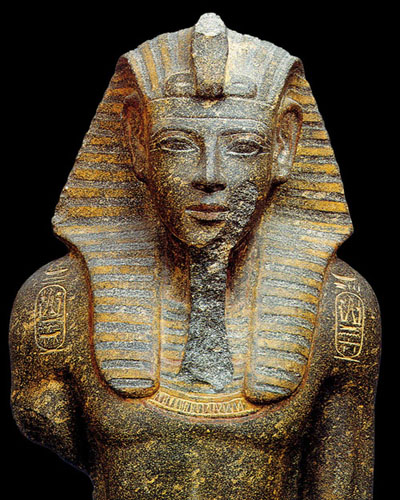
Pharaoh Merneptah, son of Rameses II

This is the mission God gives Moses in the first Torah portion of Exodus/Shemot. Moses tries to get out of it, but God insists, and Moses gives in.

And afterward Moses and Aaron came and said to Pharaoh: Thus says YHWH, god of Israel: Send out My people and they will celebrate-a-festival for Me in the wilderness. And Pharaoh said: Who is YHWH that I should listen to His voice and send out the Israelites? I do not know YHWH… (Exodus/Shemot 5:2)

YHWH = probably a form of the verb hayah (היה) = be, exist, become, occur. A variant spelling of this verb is havah or hawah (הוה). If the initial Y (י) indicates a third-person singular imperfect form, YHWH = he/it becomes, he/it exists, he/it will be.  If the four-letter word is a unique verb form, YHWH = us-was-will be; being-becoming.

(YHWH is considered the most sacred name of God, God’s four-letter personal name. I do not include the Hebrew spelling here because according to Jewish tradition, any text containing the personal name of God must be treated with respect and disposed of by special means. Furthermore, the name YHWH is not supposed to be pronounced except once a year inside the Holy of Holies—which has not existed since the fall of the second temple in Jerusalem in 70 C.E., almost 2,000 years ago.)

Since Pharaoh does not know YHWH, he refuses to give the Israelites three days off.  Instead he doubles the work of the Israelites forced to build his cities. The Israelite foremen complain to Moses, and Moses complains to God:

Since I came to Pharaoh to speak in Your name, he has done evil to this people, and You certainly did not rescue Your people! (Exodus 5:23)

Moses’ complaint implies that using the name of God was ineffective. But for God, everything is going according to plan.  As God tells Moses repeatedly in this week’s portion, Va-eira (“And I appeared”), God’s purpose in performing miracles in Egypt is: 1) so that the Israelites will know their own God as YHWH, and 2) so that the Egyptians will know the power of the god YHWH.

From God’s point of view, the ten miraculous “plagues” God plans to create will be all the more effective coming from a previously unknown god. God assures Moses that although it will be a long process, at its conclusion God will indeed rescue the Israelites from Egypt and bring them to Canaan.

But first God insists on being known by the right name.

And Elohim spoke to Moses, and said to him:  I am YHWH. And I appeared to Abraham, to Isaac, and to Jacob as Eil Shaddai, but [by] my name YHWH I was not known to them. (Exodus 6:2-3)

elohim (אֱלֹהִים) = gods (when used with a plural verb suffix); God (when used with a singular verb suffix).

eil (אֵל) = god

shaddai (שַׁדָּי) = of breasts (if it comes from shad = breast), of devastation (if it comes from shadad = devastate), of the mountain (if it comes from the Akkadian word shadu).

In the book of Genesis Abraham, Isaac, and Jacob certainly know that YHWH is one of God’s names; all three of them sometimes use that name to refer to God. So why does God claim, in this week’s Torah portion, “my name YHWH I did not make known to them”?

Most commentators explain that the three patriarchs knew God in terms of the attribute or power associated with the name Eil Shaddai, but not in terms of the power associated with the name YHWH.

In fact, the name Shaddai only appears six times in the book of Genesis, four times followed by blessings for being fruitful and multiplying (17:1, 28:3, 35:11, and 48:3). Jacob also uses that name of God to pray for rachamim (רַחֲמִים) = mercy (literally, “wombs”—43:14) and to bless Joseph with “blessings of breasts and womb” (49:25).

Although Eil Shaddai took on other meanings in later books of the Hebrew Bible, it seems safe to say that as far as the three patriarchs are concerned, Eil Shaddai is the name of the god of fertility. Abraham, Isaac, and Jacob are all concerned with the question of fertility, and want to be founders of a people or nation.

But in the book of Exodus, the Israelites in Egypt are already fertile. (The first pharaoh worries about the rapid birth rate of the Israelites; his son, the pharoah Moses speaks to in God’s name, agrees that there are far too many Israelites.) So a different aspect of God is needed to impress both Israelites and Egyptians. And God Itself seems eager to promote a new identity.

One can deduce the divine power associated with Eil Shaddai from context, but this cannot be done with the name YHWH.  The four-letter name appears 162 times in the book of Genesis alone, in a wide variety of actions and statements by God.

Commentary on which divine aspect is represented by the name YHWH ranges from the god of miracles (12th-century rabbi Abraham Ibn Ezra); to the god expressed by all ten sefirot, i.e. divine emanations (Sefer Yetzirah, a book of kabbalah possibly written in the 4th century); to the preserver of existence (16th-century rabbi Ovadiah Sforno).

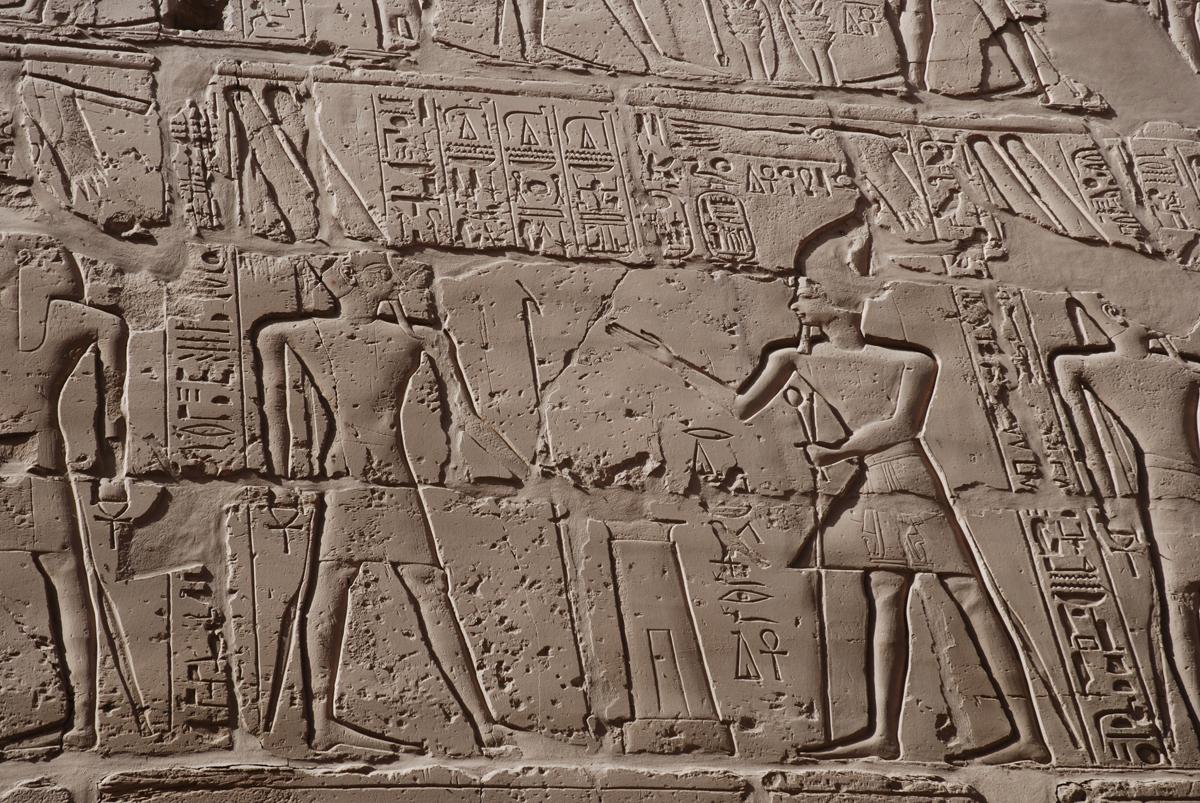
Rameses II (right) dedicating a temple to his god, Amun-Ra

All three of these interpretations boil down to the idea that God is the supreme deity; if any other gods can be said to exist, they are only emanations of YHWH, the god whose name means existence itself.

In the Exodus story, God wants Egypt to know that the god of the Israelites is the most powerful god in world, far more powerful than any of Egypt’s gods. And God wants the Israelites to know that the god who is making a covenant with them is not merely a fertility god, but a god with power over everything. Once everyone knows that God is YHWH, nobody can question God’s existence or decisions.

Or so God thinks, in the first two portions of the book of Exodus.

As the story continues, we read that after each time Pharaoh admitted the superior power of the god of the Israelites, he changed his mind and behaved as if he could win the contest with YHWH.  Even after the tenth and final plague, when Pharaoh finally lets the Israelites leave Egypt, he changes his mind again and sends his army to pursue them.  He only gives up after God splits the Reed Sea for the Israelites, then drowns the Egyptian army.

The Israelites themselves keep forgetting their god’s awesome power over life and death. As they travel through the wilderness of Sinai they worry whenever they run out of water or food, when Moses does not return from the top of Mount Sinai for 40 days, and when they face enemy forces. They cannot seem to trust the god who has taken them as Its people, even when the name of that god is YHWH.

Why doesn’t the name work?

I think that the idea of God as “being” or “becoming” is intellectually appealing. And sometimes I feel grateful that this universe exists, or that everything is in the process of becoming.

But psychologically, human beings cannot have a relationship with “existence” or “becoming”; the concepts are too abstract. To be followed, or loved, or feared, or trusted, God must be named after a more human attribute.

Eil Shaddai, the god of fertility, is not a useful divine name for most people today. When we lack children, we take practical steps; otherwise, we enjoy being fruitful in our own creative endeavors. Elohim, the God who combines the powers of all gods, is an irrelevant name at a time when nearly everyone is either an atheist or a monotheist. And YHWH, the concept of being and becoming, is too abstract for a relationship.

Then what name can inspire us to strive to “know” God? I welcome your suggestions.


Shemot: Choosing Life

by Melissa Carpenter, maggidah

At the end of his life, Moses says:

…life and death I place before you, blessing and curse; and you must choose life, so that you will live, you and your offspring: le-ahavah God, your god; lishmoa [God’s] voice; and ledavkah [God] … (Deuteronomy/Devarim 30:19-20)

le-ahavah (לְאַהַוָה) = to love, by loving.

lishmoa (לִשְׁמֹעַ) = to listen, by listening.

ledavkah (לְדָוְחָה) = to be attached to, to stick with, to be faithful to; by sticking with, etc.

At the beginning of his life, in the first Torah portion of the book of Exodus/Shemot, Moses survives only because the women in the story choose life—by loving, listening, and being attached.

The character who wants to restrict life is Pharaoh, a xenophobe. He is frightened by the large number of Israelites living in Egypt (called “Hebrews” or ivrit in this Torah portion, from the Egyptian word habiru). This unnamed king of Egypt says:

…it may be if a war happens, then they will even be added to our enemies and wage war against us, and go up from the land. (Exodus/Shemot 1:10)

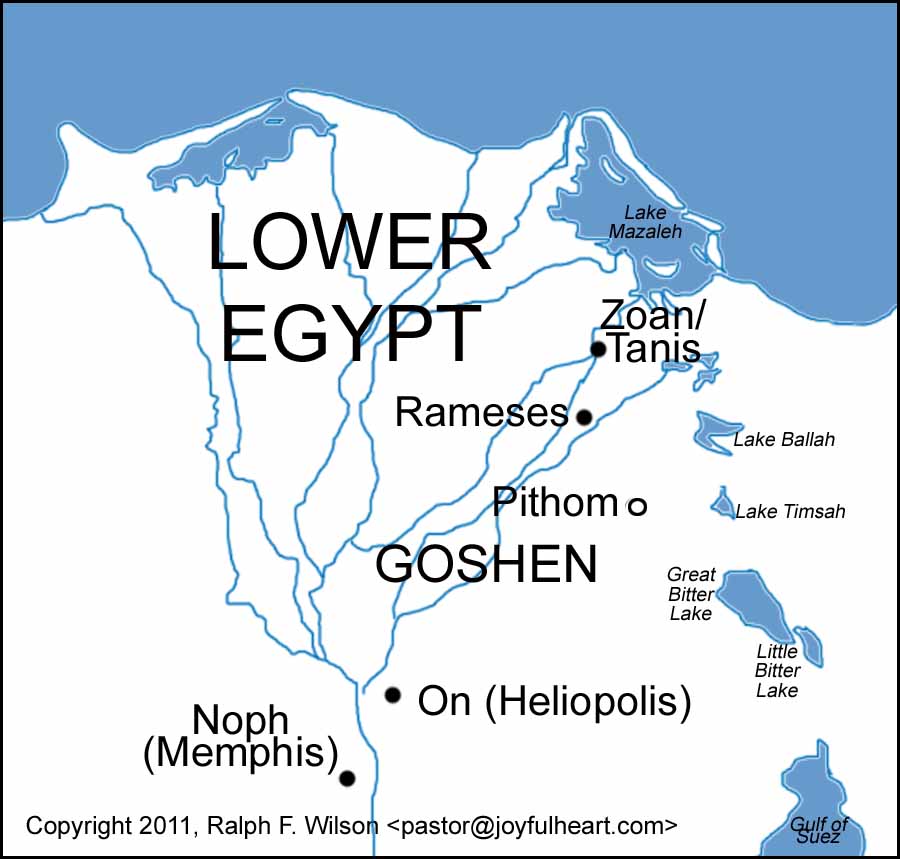
Goshen and the new cities of Ramses and Pitom
Nile delta circa 1250 B.C.E., with the capital, Tanis, and the new cities of Ramses and Pitom

Pharaoh fears that the Hebrews will either stay in Egypt and fight against the Egyptians, or leave Egypt and deprive the land of workers. His solution to this double anxiety is to reduce the population of Hebrews gradually. First he drafts large numbers of them into forced labor building the new cities of Pitom and Ramses (which were actually built in the Nile delta, in the Goshen region, during the reign of Rameses II). But so many Hebrew men survive and have relations with their wives, the population of Hebrews continues to increase.

Pharaoh’s next ploy is to order the midwives of the Hebrews to kill all the boys as they are born, but let the girls live. At that time, more than 3,000 years ago, only men would go to battle, and only men would lead their families to another country. Women would do whatever their masters or husbands ordered them to do. Pharaoh is thinking ahead, assuming that a future surplus of Hebrew women is no threat, since they would all become slaves or wives of native Egyptians. All he wants to do is reduce or even eliminate the future population of Hebrew men.

But the midwives feared God, and they did not do as the king of Egypt spoke to them, and they kept the boys alive. Then the midwives said to Pharaoh: “Because the Hebrews are not like Egyptian women, for [they are] lively animals; hey!—before the midwife comes to them, they have given birth.” (Exodus 1:17-18)

In biblical Hebrew, to “fear God” is an idiom meaning to act righteously or ethically. The Hebrew midwives save lives, instead of following orders, because it us the right thing to do. They are listening—not to Pharaoh, but to the God of good deeds.

Then Pharaoh commanded his entire people, saying: “Every son that is born, you shall throw him into the Nile. But every daughter you shall keep alive.” (Exodus 1:22)

The Torah does not say how many baby boys are drowned, but we can tell that this command is also ineffective at reducing the number of Hebrew men; many years later, after that Pharaoh (probably Rameses II) has died and been replaced by a new Pharaoh (probably his son Merneptah), the new Pharaoh says: Hey, the people are numerous now in the land! (Exodus 5:5)

During the period when the previous Pharaoh was encouraging Egyptians to drown Hebrew male infants, a man and woman from the tribe of Levi have a son. (Later in the Torah, their names are given as Amram and Yokheved.)

And the woman conceived, and she gave birth to a son. And she saw him, ki tov hu, and she hid him for three months. (Exodus 2:2)

ki tov hu (כִּי־טוֹב הוּא) = that he was good.

Commentators have puzzled over whether the mother saw that her baby was exceptionally healthy, or beautiful, or placid and quiet, or good in some other sense. Both the Talmud (in Sotah 12a) and the Midrash Rabbah (in Shemot Rabbah 1:20) report the opinion of the Sages (i.e. authoritative rabbinic commentators from about 200 B.C.E. to 500 C.E.) that when Moses was born, the whole house was flooded with light. Their proof text is in the first chapter of Genesis/Bereishit, where God creates light.

And God said: Light will be! And light was. And God saw the light, ki tov. (Genesis/Bereishit 1:3-4)

Since both texts use the phrase ki tov, they must be talking about the same thing: light.

I find this interpretation a stretch. But I can imagine that when the mother sees her new baby, her heart is flooded with (metaphorical) light. Just as God creates light, and sees that it is good, a human experiences creation as good.  When I “create” a story, it feels as if I only shaping a story that comes to me from some unknown place, and when I have finished writing it down, I feel elated, knowing that something good has happened. Similarly, when I was pregnant, I felt as if I were a container for a mysterious process, and when my son was born, I felt elated, knowing that something good had happened.

Moses’ mother hides him to preserve his life because she sees the goodness of creation; in other words, she appreciates God the Creator. She loves her son, and she loves God. As a mother, she attaches herself to her son until she can no longer protect him.

Then she was not able to hide him anymore, so she took for him an ark of papyrus, and asphalted it with asphalt and pitch, and she place the child in it, and she placed it in the reeds at the bank of the Nile. And his sister stationed herself meirachok, to know what would be done to him. (Exodus 2:3-4)

meirachok (מֵרָחֹק) = at a distance, long ago, mysteriously.

In context, Moses’ older sister Miriam obviously stands at a distance from the riverbank. But the Torah’s choice of words hints that Miriam has a connection with mysteries.  When we see her as an adult, the Torah calls her a prophet.

Miriam stands by, ready to intervene and make whatever happens to her baby brother the best possible outcome. This is a different kind of attachment than a mother’s attachment to her baby. Miriam the prophet is faithful to a vision of the future that she wants to help realize.

Meritamun, one of Rameses II's daughters
Meritamun, one of Rameses II’s daughters

Then the daughter of Pharaoh went down to wash in the river, and her serving-women walked on the riverbank; and she saw the ark among the reeds, and she sent her slave-woman, and she took it. And she opened it, and she saw the child, and hey!—the boy was sobbing. And she felt compassion over him, and she said: This is one of the children of the Hebrews! (Exodus 2:5-6)

Pharaoh’s daughter decides to disobey her father’s command and save the life of the baby because she listens to him sobbing, and her heart is moved by compassion. This is another kind of love, the instinctive and generous love for a living being who needs help. It leads to another attachment, as she decides to protect the child by adopting him as her own.

Miriam emerges and offers to find a woman to nurse the infant. If Pharaoh’s daughter can see that the baby in the ark is a Hebrew, she can certainly see that Miriam is also a Hebrew, and she may suspect that the girl is offering to fetch the baby’s own birth mother. A jealous woman would not agree to this, but Pharaoh’s daughter has so much compassion that it includes the baby’s family. When Miriam returns with her mother, Pharaoh’s daughter says:

Carry away this child and nurse him for me, and I myself will give [you] your wages.” (Exodus 2:9)

Pharaoh’s daughter not only gives the baby to his natural mother until he is weaned, but even pays her, so the whole family will thrive. Then Moses’ mother proves to be as righteous as the midwives at the beginning of the story, because when her son is old enough, she duly returns him to his adoptive mother.

Thus Moses grows up as a prince of Egypt, and launches on a long life that results in the liberation of thousands of slaves. They leave Egypt (as Pharaoh feared) and walk into a new life.

All the women in this story—the midwives, Moses’ first mother, his sister, and Pharaoh’s daughter—choose life by disobeying the fearful Pharaoh, and keeping a child alive. They are motivated by all three ways of choosing life that Moses describes near the end of his own life, 120 years later: loving, listening, and faithful attachment.

May we all be blessed with open hearts so that we can do the same.

Vayeitzei & Vayechi: No Substitute

by Melissa Carpenter, maggidah

Am I tachat God? (Genesis/Bereshit 50:19)

tachat (תַּחַת) = underneath, under the authority of; instead of, a substitute for, in exchange for.

Only two people in the Hebrew Bible ask this question. Jacob says it to his favorite wife, Rachel, in the Torah portion Vayeitzei (“and he went”). Almost 60 years later, their son Joseph says it to his brothers in this week’s Torah portion, Vayechi (“and he lived”).

Jacob instead of God

from "Jacob and Rachel" by William Dyce
from “Jacob and Rachel” by William Dyce

Jacob throws the question at Rachel right after she has spoken for the first time in the Torah, more than ten years after Jacob first meets her and kisses her. Their romance is not smooth. Jacob serves her father Lavan for seven years as Rachel’s bride-price, and then on his wedding day, Lavan tricks him and marries him to Rachel’s sister Leah. Jacob’s wedding with Rachel follows a week later, once he commits to working an additional seven years. Leah has four sons before Rachel speaks up.

And Rachel saw that she had not borne children to Jacob, and she was envious of her sister. And she said to Jacob: “Give me children!—and if not, I am dead.” Then Jacob was angry with Rachel, and he said: “Am I tachat God, who withheld from you fruit of the womb?” (Genesis 30:1-2)

Rachel’s demand makes Jacob angry for more than one reason. When she says that without children, she is dead, Rachel implies that Jacob’s devotion is not enough to make her life worthwhile. Naturally Jacob’s anger flashes. And it is not his fault that Rachel is infertile. So he demands: Am I tachat God?

He cannot be a substitute for God. In the Hebrew bible, only God can “open the womb” of a woman, resulting in pregnancy.

It does not occur to Jacob to pray to God, as his father Isaac prayed for his mother Rebecca to conceive. But his rebuff does lead Rachel to take her own action. She gives her slave-woman, Bilhah, to Jacob as a wife, then adopts Bilhah’s two sons as her own.

Through this human solution, Jacob actually does give Rachel children, tachat—instead of—God.

Joseph instead of God

After Rachel has two adopted sons, God finally opens her womb, and she gives birth to Joseph. The family continues to be dysfunctional; Joseph’s ten older brothers hate him and sell him as a slave bound for Egypt. When they are reunited twenty years later, Joseph tells them not to worry about their past crime, because God planned it all in order to get him to Egypt and elevate him to viceroy so he could feed everyone during the seven-year famine. The whole clan, including the patriarch Jacob, Joseph’s brothers, and their families, immigrate to Egypt under Joseph’s protection.

But after Jacob dies, we learn that Joseph’s brothers are still worried about retribution. Like Rachel, they see a problem.

And Joseph’s brothers saw that their father was dead, and they said: “If Joseph bears a grudge against us, then he will certainly pay us back for all the evil that we did to him!” (Genesis 50:15)

They assume that their father’s words would carry more weight with Joseph than their own, and they send Joseph what they claim is a deathbed request from Jacob:

Please sa, please, the crime and the offense of your brothers, when they did evil to you; now sa, please, the crime of the servants of your father’s god.” (Genesis 50:17)

sa (שָׂא) = lift up. (To lift up a man’s head was to legally pardon him.)

And Joseph sobbed when they spoke to him. (Genesis 50:17)

Unlike Jacob, Joseph is not angry before he asks “Am I tachat God?” Instead, his brothers’ clumsy and obsequious request makes him cry. Perhaps he cries because his brothers cannot speak to him directly. Or perhaps he cries in frustration, because he thought everything was settled, and now he has to deal with the issue all over again.

And his brothers also went and flung themselves down in front of him, and they said: “Here we are, your slaves.” (Genesis 50:17-18)

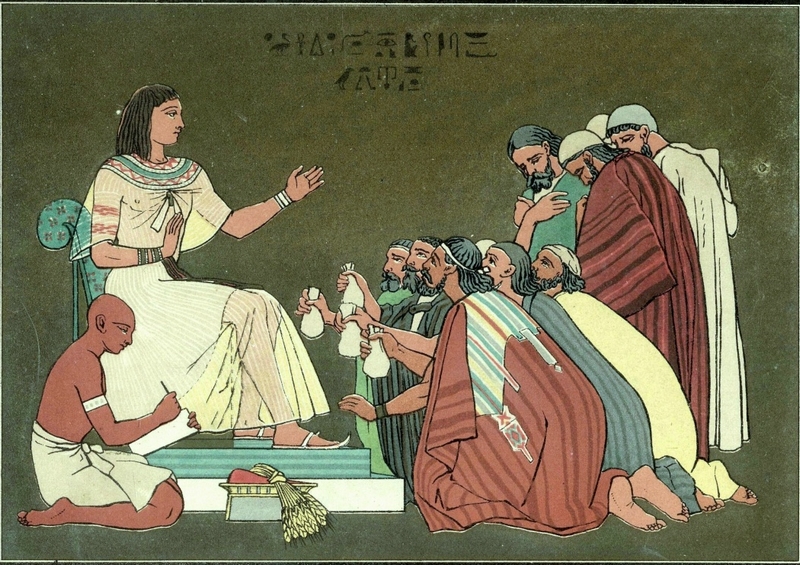
Joseph’s Brothers Bow Down, by Owen Jones, 1865

Nothing has changed in the seventeen years since Joseph revealed his identity to his brothers. His older brothers still feel guilty. Joseph is sobbing again.  His brothers bow down to him again, and offer to be his slaves again. (See my  post Vayiggash: A Serial Sobber.)

And Joseph said to them: “Do not be afraid. For am I tachat God? While you planned evil against me, God planned it for good, in order to accomplish what is today, keeping many people alive.” (Genesis 50:19-20)

Joseph said something similar seventeen years before:

And now, do not be worried and do not be angry at yourselves because you sold me here; because God sent me ahead of you for preservation of life.” (Genesis 45:5)

Contemporary commentator Avivah Gottlieb Zornberg made the case that the first time Joseph tells his brothers their crime is part of God’s plan, he is suddenly seeing the big picture. His enslavement was a necessary step to reach his present position as the viceroy, enabling him to save his own family and many other people from starvation. Joseph drops his own resentment against his brothers, and he hopes that sharing his vision of big picture will let his brothers drop their guilt.

But years later, when their father dies, Joseph finds out that his brothers still feel guilty. And he still does not realize that what they need is forgiveness, or at least a pardon. (See my  post Vayiggash & Vayechi: Forgiving.) Instead, he once again declares that their evil deed turned out to be part of God’s plan. Joseph continues:

And now, do not be afraid; I myself will sustain you and your little ones. And he comforted them, and he spoke to their hearts. (Genesis 50:21)

Joseph’s brothers are comforted because his promise to sustain them—to keep them alive and well—implies that he no longer hates or resents them. Even though they do not get the relief of explicit forgiveness, they know that at least they do not need to worry about future retribution from their powerful brother.

Targum Onkelos, written around 100 C.E., translated Joseph’s statement “For am I tachat God?” as: “For I am subordinate to God”. In other words, this time tachat means “under” instead of “a substitute for”. In the 16th century, Rabbi Ovadiah Sforno took this interpretation further by explaining that Joseph considered his brothers God’s agents. It was not his place to judge God’s agents, just as it was not his place to judge God’s plans.

Nevertheless, Joseph acts almost like a substitute for God. As viceroy of Egypt and distributor of food, he decides who will live and who will die.

A substitution when there is no substitute

When Jacob tells Rachel he is no substitute for God as an opener of wombs, she finds another way he can give her the children she wants.  When Joseph tells his brothers he is no substitute for God as a judge of men, they do not find another way to get the human pardon or forgiveness they want.  They still cannot speak to Joseph directly. But he offers them a substitute for forgiveness: the reassurance that he will not punish them.


Am I tachat God?” is a good question for us to ask ourselves today. Am I trying to do something no human can do? If so, is there another way to achieve a desirable outcome? Or am I acting like God when I should be acting like a human being toward someone? If so, how can I come down off my pedestal and have a true heart-to-heart conversation?

Mikeitz & Vayiggash: Serial Sobber, Part 1

Joseph cries eight times in the book of Genesis/Bereishit, more often than any other individual in the Hebrew Bible.  Only the Israelites as a whole are recorded as breaking into sobs more often.

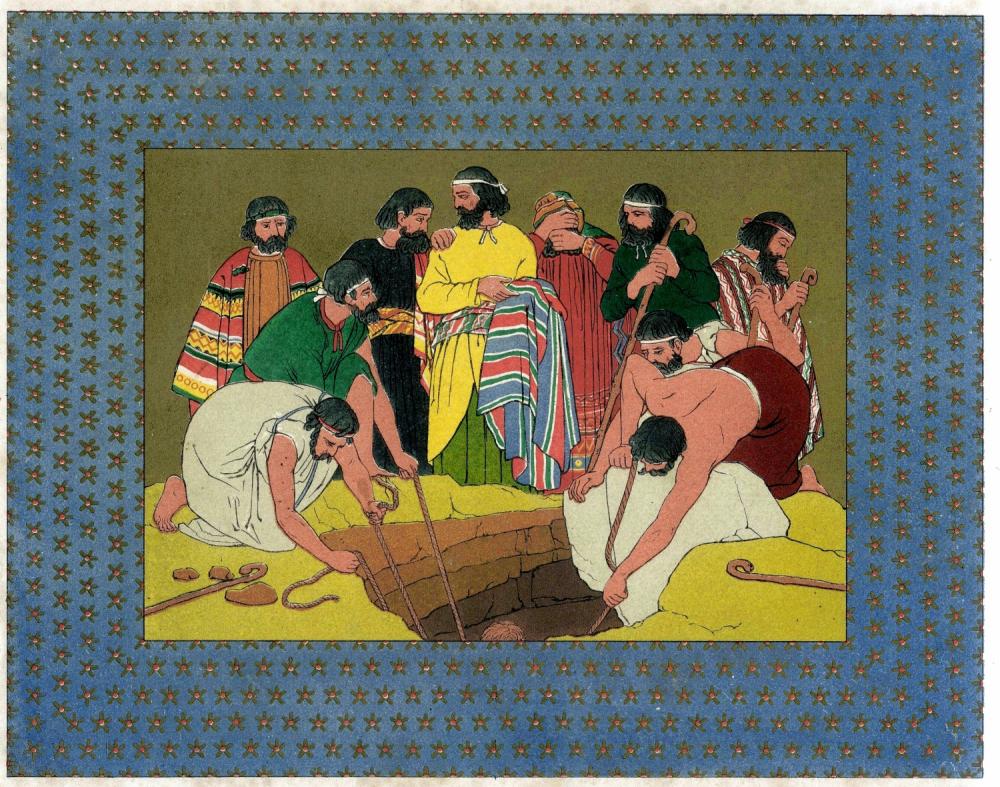
Joseph Cast into the Pit, by Owen Jones

Although Joseph is the most lachrymose character, he does not start crying in the Torah story until he is 37 years old and the viceroy of Egypt.  When he is 17, his ten older brothers throw him into a pit, argue about whether to kill him, then sell him as a slave to a caravan bound for Egypt.1  Later, the brothers remember that he pleaded for mercy;2 but nowhere does the Torah say he cried during that ordeal.  Nor does the Torah report any crying when Joseph, as a head house slave in Egypt, is falsely accused and thrown into prison.3

If Joseph does not cry when he feels frightened or sorry for himself, when does he cry?

Bowing to the ground in Egypt
Egyptian relief of slaves bowing

First sob

The first time Joseph cries is in the Torah portion Mikeitz (“In the end”).  After a year of drought and famine, Joseph’s older brothers travel to Egypt to buy grain.  They bow down to the viceroy of Egypt, not recognizing him as their brother Joseph 20 years later.  Joseph speaks to them in Egyptian, using an interpreter so they will not suspect he knows their language.

He accuses them of spying, and they protest that they are all brothers, and honest men.  When the viceroy says no, they are not, the brothers babble:

“We, your servants, are twelve brothers, sons of one man in the land of Canaan.  And hey!  The youngest is with our father now, and the other—is absent.”  (Genesis 42:13)

Joseph throws them into prison for three days, then confronts them again.  As they talk among themselves, they do not know he understands every word when they agree that although they are not spies, they deserve punishment because they did not listen to Joseph pleading from the bottom of the pit 20 years before.

And he [Joseph] turned away from them, vayeivek.  Then he returned to them and he spoke to them, and he took Shimon from them and tied him up in front of their eyes.  (Genesis/Bereishit 42:24)

vayeivek (וַיֵּבְךְּ) = and he sobbed, and he wept audibly.  (From the root verb bakah, בָּכָּה, wept, shed tears.)

Joseph is overwhelmed when he hears them admit, in effect, that they were wrong to leave him in the pit.  He steps out to break down in private, and returns only when he can control himself again.

When he recovers his composure he tells them he will sell them grain, but he will keep one brother hostage until they prove they are honest men by returning with their youngest brother, the one who stayed home in Canaan.

Maybe Joseph embarks on this elaborate game in order to punish his older brothers for their old crime.  But most commentary assumes Joseph is testing his brothers to see if they have truly changed.  The youngest brother is Benjamin, who was a small child when Joseph’s older brothers sold him, and the only one who has the same mother.  Will the older brothers treat Benjamin as callously as they once treated Joseph?

Second sob

Joseph is Governor, by Owen Jones

After a second year of famine, the brothers finally return with Benjamin.  When they arrive at the viceroy’s palace a servant brings Shimon to them, none the worse for imprisonment, and says the viceroy invites them to stay for a meal.

All eleven brothers prostrate themselves when the viceroy of Egypt walks in.  Joseph asks them whether their father is still alive and well, and they say yes.

Then he lifted his eyes, and he saw Benjamin, his brother, the son of his mother …  And Joseph hurried, because his compassion fermented, and he was close to bekot; so he came into the inner room vayeivek there.  Then he washed his face, and he went out and he restrained himself, and he said: “Serve the food.”  (Genesis 43:29-31)

bekot (בֶּכּוֹת) =  weeping.  (Also from the root bakah.)

This time the Torah attributes Joseph’s emotional ferment to a sudden feeling of compassion.  The sight of his brother Benjamin triggers the compassion, but who is the object of it?  Does he feel compassion toward all his brothers, for the ordeal he is putting them through now?  Toward his father, who had to let Benjamin go?  Or toward Benjamin himself, for growing up surrounded by brutal older brothers?  The Torah does not say.

Joseph resumes his game, giving Benjamin five times as much food as the others.4  The older brothers do not act jealous.  Next Joseph has a silver goblet planted in Benjamin’s pack before they leave, and sends his steward to catch them on their way out of town. The steward, following Joseph’s script, insists on searching their packs, and declares that the owner of the pack containing the missing goblet must return to the viceroy’s palace as a slave.  When the goblet is found in Benjamin’s pack, the ten older brothers are free to travel on without him.  But they choose to return with Benjamin to confront the viceroy.5

Third sob

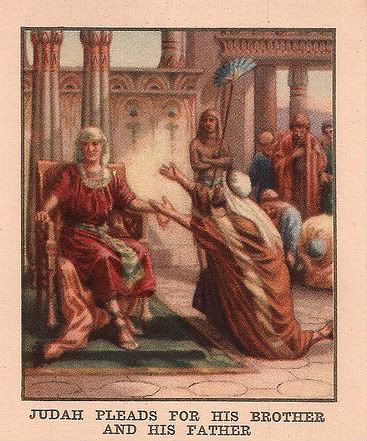
The third time Joseph cries is during the confrontation at the beginning the next Torah portion, Vayiggash (“And he approached”).  Judah, the leader of Joseph’s brothers, steps up and volunteers to become the viceroy’s slave in place of Benjamin.  He says he is doing it in order to spare their father from dying of grief.  Joseph is moved by the revelation that Judah, at least, has changed from a man who would sell his own brother into a man who would sacrifice himself for the sake of a father who does not even love him.6

Then Joseph was not able to restrain himself in front of everyone stationed around him, so he called out: “Remove everyone from me!”  And no one stood with him when Joseph revealed himself to his brothers.  And he gave his voice to bekhi, and Egypt heard, and the house of Pharaoh heard.  (Genesis 45:1-2)

bekhi (בְּכִי) = weeping, wailing, sobbing; distilling water.  (Also from the root bakah.)

Once Egyptians are cleared out of the room, a tearful Joseph finally identifies himself to his brothers.  He excuses their old crime as the working out of divine providence, and tells them to bring their father and their own families to Egypt, where they will have plenty of food.7

The cause of Joseph’s sobbing this time is the shock of Judah’s revelation.  An enemy who despised and sold him 20 years before has become a moral paragon, sacrificing himself to spare two other people.  Perhaps Joseph’s compassion ferments again, this time toward Judah.

Fourth sob

Benjamin Returns to Egypt, by Owen Jones

Then he [Joseph] fell upon the neck of Benjamin, his brother, vayeivek, and Benjamin bakha upon his neck.  (Genesis 45:14)

bakha (בָּכָה) = he sobbed. (Also from the root bakah.)

For the first time, Joseph’s sobbing is reciprocated; Benjamin also sobs, in a mutual embrace.  The two full brothers are full of emotion at their reunion after 20 years.  They have no bad history with one another, so they simply weep tears of joy.  (Benjamin probably weeps with relief as well, since his status has just changed from prospective slave to honored brother of the viceroy.)

Fifth sob

Then he kissed all this brothers vayevek on them, and after that his brothers spoke with him.  (Genesis 45:15)

By kissing, embracing, and crying on the ten men, Joseph accepts them at last as his older brothers.  They are more reserved, because for them the situation is still unresolved.  Joseph appears to have forgiven them, but he does explicitly pardon them; he only excuses their past crime as God’s means for getting him, Joseph, to Egypt.  In their lingering anxiety about the possibility of future retribution, they remain suspended in a state of emotional tension.8  They do not embrace Joseph, but they do become able to speak with him.9

*

So what makes Joseph cry?  The first five times he breaks down and sobs, he is emotionally overwhelmed when he suddenly sees one or more of his brothers from a new point of view.

First he is moved when his older brothers realize they deserve punishment (Genesis 42:24).  Joseph thought his older brothers were irredeemable, but now he realizes they feel guilty.  Next he sees Benjamin for the first time in 20 years and feels compassion (Genesis 43:29-31).  Joseph had written off his baby brother, whom he thought was lost to him forever, but now he sees Benjamin in front of him.

The third time Joseph weeps is when Judah offers to become a slave to spare Jacob and Benjamin (Genesis 44:27-34 and 45:1-2).  He thought none of his brothers would sacrifice his freedom for the sake of another person, but now Judah volunteers to do it.  And the fourth time is when Joseph embraces Benjamin (Genesis 45:14).  Joseph was completely committed to his life as an Egyptian, determined to forget his whole family in Canaan, but now he embraces his relationship with his innocent brother.

Joseph cries for the fifth time when he embraces the rest of his brothers, even though they do not reciprocate.  He had considered them his implacable enemies.  Now he sees them as the instruments of fate—but also as men who blundered and later felt guilty and are trying to do the right thing now; as human beings and brothers.

Joseph sobs three more times in Genesis, all in the last Torah portion, Vayechi.  He sobs at his reunion with his father, when his father dies, and when his brothers plead with him afterward.  We will listen to those sobs in my next blog post.

*

Have you ever felt moved to tears, or to a “ferment of compassion”, when an important person in your life is suddenly revealed in a new and better light?  Did it change your relationship?

May we all be able to notice when things are different, and embrace relationships we had turned away from.

  1. Genesis 37:19-28.
  2. Genesis 42:21.
  3. Genesis 38:1-23.
  4. Genesis 43:34.
  5. Genesis 44:1-14.
  6. In the first Torah portion of Joseph’s story, Vayeishev, Jacob’s ten older sons noticed when Joseph was an adolescent that their father displayed extreme favoritism toward Joseph, giving him the “coat of many colors” and asking him to his older brothers’ misdeeds to him.  That is why, when they are away from home and Joseph shows up in his fancy coat to spy on them again, they throw Joseph into a pit and then sell him into slavery.  When they return home they tell their father that Joseph is dead, torn by a wild animal.  Jacob goes into deep mourning and refuses to be comforted by any of them.
  7. Genesis 45:9-11.
  8. See Genesis 50:15 for evidence that the brothers felt lingering anxiety about the possibility of future retribution for years.
  9. At the beginning of the Joseph story, when Joseph is 17, the Torah says:  “And his brothers saw that their father loved him more than all his brothers, and they hated him, and they were not able to speak to him in peace.” (Genesis 34:4)  Now, finally, they are able to do it.


Vayeishev & Mikeitz: Identity Crisis

by Melissa Carpenter, maggidah

The last four Torah portions in the book of Genesis/Bereishit tell the story of Jacob’s two most dynamic sons: Joseph, who changes from a foreign slave into a viceroy of Egypt; and Judah, who changes from an amoral egotist into a man of integrity. This double post looks at Judah’s transformation in the first half of the story: the Torah portions Vayeishev and Mikeitz, and Judah’s speech at the beginning of Vayiggash.

(My next post, on later events in the portion Vayiggash, will appear two weeks from now.)

Vayeishev (“And he stayed”)

The story begins when Joseph is seventeen. He tends the flocks with his ten older brothers, who are in their twenties, and brings his father bad reports about them. Jacob dotes on Joseph, since he and baby Benjamin are the sons of his second and most beloved wife, Rachel, who died when Benjamin was born. Jacob gives Joseph a fancy tunic or coat. Then Joseph has two dreams in which his brothers are bowing down to him, and he makes the mistake of telling them. Naturally, his older brothers hate him.  As soon as they get a chance, they seize their obnoxious little brother and throw him into a pit.

Joseph's Coast Brought to Jacob, by Giovanni Andrea de Ferarri
Joseph’s Coast Brought to Jacob, by Giovanni Andrea de Ferarri

First they argue over whether to kill him. Then Judah persuades the others to sell Joseph to some slavers heading for Egypt.  The brothers dip Joseph’s fancy tunic in goat blood and bring it to Jacob, saying: This we found; hakker na, is it your son’s tunic or not? (Genesis/Bereishit 37:32)

hakker (הַכֶּר) = recognize, identify.

na (נָא) = please.

The trick works; Jacob concludes a wild beast has killed his favorite son. He goes into inconsolable mourning. And Judah suddenly moves south.

Rashi (11th-century rabbi Shlomo Yitzchaki) wrote that Judah’s brothers blame him for selling Joseph and tricking their father, and claim that if Judah had proposed a better course of action, they would have listened to him. So Judah moves to get away from his father’s grief and his brothers’ resentment—the reminders of his own guilt.

Judah starts a new life by marrying a Canaanite woman and having three sons with her: Eir, Onan, and Shelah.

Judah took a wife for Eir, his firstborn, and her name was Tamar. And Eir, the firstborn of Judah, was bad in God’s eyes, and God made him die. Then Judah said to Onan: Come into the wife of your brother and yabeim with her, and establish offspring for your brother. (Genesis/Bereishit 38:6-8)

yabeim (יַבֵּם) = impregnate the childless widow of one’s deceased brother or close male relative. (Yabeim is an imperative verb; the noun for the act is yibum, also called levirate “marriage”.)

According to the law of both Canaan and Israel, a son born from yibum receives the inheritance of the deceased man. Without a son from yibum, the inheritance goes to the man’s surviving brothers.

Onan knew that the offspring would not be his, so when coming into the wife of his brother, he wasted his seed on the ground, so as not to give offspring to his brother. And it was bad in God’s eyes, what he did, and [God] made him die, also. (Genesis/Bereishit 38:9-10)

Judah’s remaining son, Shelah, is not yet old enough to impregnate Tamar. Judah uses this as an excuse to send her back to her father’s house.

Then Judah said to Tamar, his daughter-in-law: Return as a widow to your father’s house until my son Shelah grows up. For he said [to himself]: lest he dies, also, like his brothers. And Tamar went, and she sat in her father’s house. (Genesis 37:11)

Judah has no intention of letting Shelah yabeim with Tamar. He assumes that she, not God, somehow caused of the death of Eir and Onan. Determined to protect his remaining son, Judah dooms Tamar to the disgrace of returning to her father’s house, and to the limited life of a woman who is legally forbidden to remarry, have a child, or do anything without her father-in-law’s consent.

Shelah grows up, but Judah does not send him to Tamar. Judah’s wife dies, and after he has finished mourning for her, he heads to a sheep-shearing festival in Timnah to have a good time. Tamar decides to risk her life in an attempt to win a new life.

She took off her widow’s clothing and she covered herself in a shawl and she wrapped herself, and she sat at petach eynayim, which is on the road to Timnah… And Yehudah saw her and he considered her a prostitute, for she had covered her face. (Genesis 37:14-15)

petach eynayim (פֶּתַח עֵינַיִם) = the entrance to a pair of wells; the opening of the eyes.

Prostitutes in Canaan did not cover their faces; Tamar’s face-covering merely prevents Judah from recognizing her.  He assumes she is a prostitute because she is sitting by a public road, where no woman except a prostitute would linger. She may also have wrapped herself in clothing typical for a prostitute.

At petach eynayim, Tamar’s eyes are open behind her shawl; she sees that Judah will never give her Shelah. Judah’s eyes are still closed. Not only does he fail to recognize his daughter-in-law; he cannot see his own past behavior clearly. He propositions the woman sitting by the road.

And she said: What will you give me if you come into me? And he said: I will give a goat kid from the flock. And she said: If you give an eiravon until you send it. (Genesis 37:16-17)

eiravon (עֵרָבוֹן) = guarantee, security deposit, pledge.

And he said: What is the eiravon that I shall give you? And she said: Your seal and your cord, and your staff that is in your hand. And he gave them to her, and he came into her, and she conceived. (Genesis 37:18)

453px-Babylonian_-_Cylinder_Seal_with_Three_Standing_Figures_and_Inscriptions_-_Walters_42692_-_Side_D

Important men in ancient Canaan wore seals on cords around their necks. A seal was a small (about an inch long) cylinder carved with a name or a design indicating the owner’s identity. At that time, documents were written in cuneiform on clay tablets. In order to sign a document, a man rolled his seal along one edge of the clay tablet while it was still wet.

A man’s staff was the emblem of his authority over his own household, clan, or tribe. Thus Judah hands Tamar the symbols of his personal and social identities. When he gets home, he sends his friend to find the prostitute and exchange a goat kid for the eiravon, but she cannot be found.

A few months later Judah learns that Tamar is pregnant, even though she is not allowed to have any sex outside of yibum. This flouting of society’s rules requires the man in charge of Tamar to take immediate action.  Judah might be secretly relieved that now he can order Tamar’s death, and save Shelah for good.

Judah said: Take her out and she shall be burned. Taken out she was; and she sent to her father-in-law, saying: By the man to whom these belong I am pregnant. And she said: hakker na, whose are this seal and cord and staff? Judah recognized them, and he said: She is more in the right than I, since I did not give her to my son Shelah. (Genesis 38:25-26)

Judah is shocked into facing the truth by the sight of his own guarantee. On a literal level, these objects prove he is the father, and Tamar’s sexual encounter with him was for the sake of the yibum he had denied her. On another level, the symbols of identity make him see who he really is: not the righteous ruler of his household, but a man who circumvented the law and ruined an innocent woman’s life.

Tamar’s expression hakker na (“Recognize please” or “Identify please”) surely reminds Judah of when he and his brothers showed Joseph’s bloody tunic to their father and said hakker na. So Judah must also face his identity as the ringleader who sold his little brother and tricked his father.

Recognizing your own bad behavior is painful; staying in denial is much more comfortable. In my own life, I have reacted to the realization that I did something wrong in two different ways: Either I feel irrevocably guilty and unable to change into the person I want to be; or I forgive myself for the past but know that I can, and therefore must, behave better from now on.

Judah starts down the second path, publicly admitting his wrongdoing and vindicating Tamar. She returns to Judah’s house, and gives birth to twin sons.

Mikeitz (“In the end”)

When we next see Judah, he has rejoined his father and brothers.  There is a famine in Canaan, but Egypt has grain for sale—thanks to the advance preparations of Joseph, the Pharaoh’s new viceroy. He has risen from rags to riches due to his good attitude, management skills, and a God-given gift of dream interpretation.

Jacob sends his ten older sons to Egypt to buy grain, keeping only Benjamin at home. The loss of one of Rachel’s sons has made Jacob determined to keep the other one safe.

sack-of-grain

The ten more disposable sons of Jacob bow down to the viceroy of Egypt without recognizing him; Joseph was a teenager when they sold him, and during the last twenty years or so his face and voice have changed, he dresses like an Egyptian nobleman, and he speaks Egyptian. Joseph, however, recognizes the brothers who sold him into slavery. He accuses them of being spies, the first crime that comes into his mind. They protest that they are honest men, and all brothers. Joseph repeats his accusation, so they elaborate, saying they are twelve brothers, but one is gone and the youngest is home with their father. 

Joseph imprisons them for three days, keeps one of them (Simon) as a hostage, and sends the rest back to Canaan under orders to return to Egypt with their youngest brother. He also supplies them with grain, and hides the silver they paid inside their packs.

The nine brothers who return to Canaan explain the situation to Jacob, who responds: As for me, you have deprived me of children! Joseph is gone, and Simon is gone, and now Benjamin you would take! Upon me everything happens! (Genesis 42:36)

As Jacob complains that they have deprived him of children, Judah could not help but remember that for years he also deprived Tamar of children.

Jacob’s oldest son, Reuben, replies: My two sons you may kill if I do not bring him back to you. Put him in my hands, and I will personally return him to you. (Genesis 42:37)

Jacob refuses the offer, perhaps because Reuben’s guarantee is so unappealing, and Reuben does not speak again in the Torah. The famine continues, and when the extended family has eaten the last of the grain from Egypt, Jacob tells his older sons to go back to Egypt to buy more food. Then Judah steps forward again as a leader.

The first time Judah speaks in the Torah, he arranges for the brothers to sell Joseph as a slave instead of killing him. He speaks often during the story of Tamar, giving orders, haggling with the woman he takes as a prostitute, and admitting his own wrongdoing.

Now Judah points out that the Pharaoh’s viceroy will not let them return to Egypt without their youngest brother, Benjamin. Then, after Jacob has complained, Judah takes another step down the path of transformation, saying:

Send the youth with me, and let us get up and go, so we will live and not die: we and also you and also our children!  I, personally, ervenu; from my hand you may seek him; if I do not bring him to you and set him before you, I will be guilty before you for all time. (Genesis 43:8-9)

ervenu (אֶעֶרְבֶנּוּ) = I will guarantee it. (From the same root as eiravon = a guarantee.)

Earlier in the story, Tamar asked Judah for a guarantee consisting of the physical emblems of his identity as the ruler of a household. Now Judah offers his father a guarantee based solely on his own commitment to do the right thing. And Jacob accepts it.

In Egypt, Joseph treats Benjamin better than his brothers. Then he plants a silver goblet in Benjamin’s pack, and has the brothers stopped on their way out. When the goblet is “discovered” in Benjamin’s pack, they all return to the viceroy’s house, and Joseph declares Benjamin must stay as his slave. This is his final test of his brothers; will they enslave Benjamin, as they once enslaved him?

Judah, the leader, speaks for his brothers. He acknowledges that they cannot defend themselves against the charge of theft, and therefore they are all slaves to the Pharaoh’s viceroy. But Joseph insists that only Benjamin will be his slave.

Vayiggash (“And he stepped forward”)

The next Torah portion opens with Judah stepping closer to the viceroy and delivering a passionate plea to let Benjamin go home with his brothers. Otherwise, he says, their father will die of grief. Judah concludes:

So now, please let your servant stay instead of the youth, as a slave to my lord, and let the youth go up with his brothers. For how could I go up to my father when the youth is not with me, and see the evil that would come upon my father? (Genesis 44:33-34)

Then Joseph finally breaks down and reveals his own identity. The whole family is reunited in Egypt.

Why did Judah volunteer to take the punishment for something he did not do?  He guaranteed he would not return to Jacob without Benjamin, and he is determined to be true to his commitment— even if it means losing his position as a free man and household ruler, losing his seal and his staff for good. And although he is not guilty of theft, he knows he is guilty of other bad deeds: selling Joseph into slavery, tricking their father into thinking Joseph is dead, and abusing his power over Tamar.

Judah chooses to be an honest and compassionate slave, rather than an independent agent who is selfish and eternally guilty. By making that choice, he also becomes a man of integrity, and an impressive ancestor for the tribe of Judah and its eponymous kingdom.

We are all born into certain identities, and assigned others by our own society. Not everyone gets a seal and a staff. But we all make moral choices, even though we do not always know we are doing it.

May we all become able to recognize ourselves and identify our own behavior, good and bad. May we become able to consciously choose our moral identities, and may we be inspired to make the right choices.

Vayishlach: Blessing Yourself

by Melissa Carpenter, maggidah

Jacob finally gets a blessing he can believe this week, in the Torah portion Vayishlach (“And he sent”).

In the book of Genesis/Bereishit, a blessing usually means a transmission from God that improves the recipient’s lot in life. When a human being blesses someone, it is a request that God will transmit that blessing. God’s blessings grant people eventual success in practical affairs, including numerous descendants, wealth, land, authority over others, a good reputation, and becoming a by-word for other people’s blessings.

Hands raised in blessing
Hands raised in  blessing of Temple priests

Before this week’s Torah portion, Jacob receives three blessings: two from his father Isaac (one while Jacob is impersonating his brother Esau, and one as himself), and one blessing from God. But he still does not feel blessed—partly because of his guilt over cheating his brother, and partly because of his habit of calculating how to take advantage of others. (See my posts Toledot: To Bless Someone and Vayeitzei: Guilty Conscience.)

During his 20 years working for his uncle Lavan in Charan, Jacob acquires two of the material advantages promised in the blessings by Isaac and God: many children (eleven sons and a daughter), and material wealth (abundant flocks, herds, and servants). He does not yet own land, but God reminds him he must return to Canaan.

Even though he appears to be blessed by God, Jacob is afraid to go. First he fears that his uncle Lavan will prevent him from leaving. After the two men make a peace treaty, he is afraid that his brother will kill him and his family. In this week’s Torah portion, Vayishlach, Jacob sends messengers to Seir, where Esau is living, as he travels west toward Canaan. When he reaches the Yabbok River, the messengers return with the news that Esau is coming to meet him—with 400 armed men. Jacob frantically makes arrangements to prevent his whole family from being annihilated:

1) He divides his family and servants into two camps, hoping that if Esau’s men attack one camp, the other camp will escape.

2) He prays to God:

I am too small for all the kindnesses and all the fidelity that you have done for your servant; for with my walking-stick I crossed this Jordan, and now I have become two camps. Deliver me, please, from the hand of my brother, from the hand of Esau, for I, I am afraid of him, lest he come and strike me down, mother and children. And You, You said: I will certainly be good to you, and I will set up your offspring like the sand of the sea, which cannot be counted in its abundance. (Genesis 32:11-13)

Here Jacob expresses his own unworthiness for blessing, admits that God has aided him, and reminds God of the blessing from 20 years before. He views the blessings he has received so far as temporary and easily wiped out.

3) He sends gifts of livestock ahead to Esau, hoping to appease him.

4) He takes his family and servants across the river, then returns to the other side of the ford to spend the rest of the night alone—because he senses that there is one more thing he must do. Jacob may not know consciously that the fourth and final thing he needs to prepare for Esau’s arrival is a new blessing, a fourth blessing that comes from neither his father nor his god. But he waits alone in the dark.

And Jacob was left alone, vayei-aveik, a man, with him until the dawn rose. And he [the “man”] saw that he had not prevailed against him, so he touched the hollow of his hip; he struck the hollow of Jacob’s hip during hei-avko with him. (Genesis 32:25-26) 

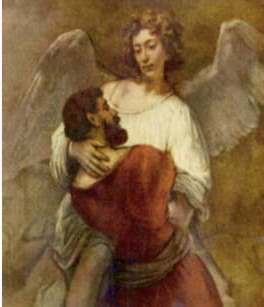
Rembrandt, "Jacob Wrestling with the Angel"
Rembrandt, “Jacob Wrestling with the Angel”

vayei-aveik (וַיֵּאָבֵק) = and he wrestled (?); and he kicked up dust (?)

hei-avko (הֵאָבְקוֹ) = his wrestling (?); his kicking up dust (?)

(The verb אבק occurs only here in the entire Hebrew Bible. It has been translated as wrestling for at least  two thousand years, based on the description in this passage. But the root of the verb is shared with the noun avak (אָבַק) = cloud of fine dust.)

Elsewhere in the Torah a “man” appears out of nowhere, and later turns out to be a malakh Elohim, a messenger of God (sometimes translated as an “angel”). For example, earlier in Genesis, three “men” appear when Abraham is sitting at the entrance of his tent, and they turn out to be divine messengers who announce that Sarah will give birth to Isaac. When a “man” appears to Jacob out of nowhere, we expect a divine emissary with a message for him.

The other “men” who appear in the Bible speak, walk, and appear to eat. But a “man” that wrestles is unique to this passage. Jacob and the “man” struggle all night without a victory.

Then he [the “man”] said: Let me go, for the dawn rises. But he [Jacob] said: I will not let you go unless you bless me. Then he said to him: What is your name?  And he said: Jacob. (Genesis 32:27-28)

For the first time, Jacob is asking for a blessing as himself, Jacob. Perhaps wrestling his opponent to a standstill has given him both courage and the feeling that he deserves recognition. In this case, both the message from God and the blessing he requests are a new name.

And he said: Your name will no longer be said “Jacob”, but instead Yisrael, because sarita with God and with men, and you prevailed. Then Jacob asked and said: Please tell your name.  And he said: Why do you ask for my name? And he blessed him there. (Genesis 32:29-30)

Yisrael  (יִשׂרָאֵל) = Israel; probably yasar  = he contends for dominion, he rules + el = god; “He contends with God”, “God rules”. (Another possible etymology is yashar = upright, level, straight + el = god; “He is upright with God”, “God is straight”.)

sarita (שָׂרִתָ) = you contended for dominion; you ruled.

So Jacob called the name of the place Peniel, “Because I saw God face to face, and my soul was spared”. And the sun rose for him as he passed Penuel, and he was limping on his hip. (Genesis 32:31-32)

Through the rest of the book of Genesis, Jacob sometimes acts decisively and correctly, living up to his new name. At other times he is fearful, hesitant, and calculating, like the old Jacob. He does not always prevail. However, he does proceed as if he expects God to be on his side. He also gives more blessings to others than any other person in the Torah.

Many of us are like Jacob before he wrestled. We can see our wealth and success in the material world, yet we do not believe we have received a divine blessing. We do not feel the peace of being blessed.

When we are alone at night, does a “man” come to wrestle with us? Shmuel Klitsner wrote that “And Jacob was left alone, and a man wrestled with him until the dawn rose” (Genesis 32:24) could be read as happening at the same time. In that case, the man Jacob is wrestling with is himself. Furthermore, Klitsner suggested, when Jacob’s wrestling partner says “you contended with God and with men, and you prevailed” the “man” is identifying himself as both divine and human.1

May each one of us be blessed to wrestle with our own inner divine force, and to emerge with a blessing we can believe in, a blessing of the peace and personal authority that comes from being Yisrael, upright with God—even when we walk into the sunrise with a limp.


  1. Shmuel Klitsner, Wrestling Jacob, Urim Publications, Jerusalem, 2006.

Vayeitzei: A Den of Thieves

by Melissa Carpenter, maggidah

There are three kinds of theft in the Torah:

geizel (“robbery”), in which one takes something belonging to another by force;

goneiv (“stealing”), in which one takes something belonging to another with secrecy; and

goneiv leiv (“stealing the heart”), an idiom for rama-ut (“deception”).

In English, “He stole my heart” means “I didn’t expect to fall in love with him, but he was irresistible”. In Biblical Hebrew, “He stole my heart” means “He deceived me”. Ancient Israelites considered the heart the seat of thoughts as well as feelings: the whole conscious mind. When we deceive someone, according to the Torah, we appropriate their thoughts and feelings, replacing what they would normally think (if they knew the truth) with what we want them to think and feel.

The words for all three kinds of theft appear in this week’s Torah portion, Vayeitzei (“And he left”). The first appearance of any form of the word goneiv (“stealing”) is in this portion, and it shows up eight times! Veiled-Woman

In last week’s Torah portion, Jacob cheats his brother, Esau, out of both his inheritance as the firstborn, and his father’s first blessing. (See my post Toledot: To Bless Someone.) He leaves home to escape Esau’s murderous rage.

In this week’s portion, he arrives at his uncle Lavan’s house in Aram, and immediately falls in love with Lavan’s younger daughter, Rachel. Jacob volunteers to work seven years for her bride-price. But on the wedding day, Lavan deceives him by substituting his older daughter, Leah, hidden by a veil.

And it happened in the morning, hey! She was Leah! So he said to Lavan: What is this you did to me? Was it not for Rachel I served you? Then why rimitani? (Genesis/Bereishit 29:25)

rimitani (רִמִּיתָנִי) = you deceived me.

Lavan cleverly reminds Jacob of his own guilt when he replies: It is not done thus in our place, to give the younger one before the firstborn. (Genesis 29:26)

Jacob agrees to serve Lavan another seven years so he can marry both daughters. (See my post Vayeitzei: Guilty Conscience.) But the damage has been done. Jacob cannot escape his guilt over “stealing the heart” of Esau.  And once Lavan deceives him, Jacob can no longer trust his uncle and father-in-law.

At the end of fourteen years, Jacob tells Lavan that he wants to go back to Canaan. They bargain, and agree that Jacob will work for another six years in exchange for flocks of his own: all the spotted goats and dark sheep. Jacob declares:

And tzidkati will testify for me, on the future day when you bring my earnings in front of you: any goat that is not spotted, or any sheep that is not dark, [consider] it as ganuv by me. (Genesis 30:33)

tzidkati  (צִדְקָתִי) = my righteousness, my honesty, my integrity

ganuv (גָּנוּב) = stolen

This is the biblical equivalent of declaring, “I am not a crook!” It is also the first time any form of the word ganav (גָּנַב), “steal”, appears in the Torah. The word comes up in Jacob’s mind (or heart) because he still feels like a thief.

Jacob does engage in selective breeding over the next six years to increase his own flock, but when he is ready to go, he sticks to his word and takes only the spotted goats and dark sheep. He also checks with Leah and Rachel, and they enthusiastically agreement to leave and start a new life in Canaan. Jacob scrupulously takes only his own wives, children, servants, and property—and sneaks away while Lavan is out of town.

Then Lavan went to shear his sheep, and Rachel, vatignov the terafim that belonged to her father. And Jacob, vayignov the leiv of Lavan the Aramean, by not telling him that he was fleeing from him. (Genesis 31:19-20)

vatignov (וַתִּגְנֹב) = she stole

terafim (תְּרָפִים) = household idols (figurines of gods)

vayignov (וָיִּגְנֹב) = he stole

leiv (לֵב) = the heart

Canaanite goddess, 14-13th century BCE 2Rachel steals actual objects: figurines of gods cast in bronze, molded in clay, or carved out of stone. These small sculptures were commonly found in houses throughout Mesopotamia and Canaan during the second millennium B.C.E. Scholars still do not know their purpose, but they may have been used for divination or to protect the household. (See my post: Vayeitzei: Clinging to Magic.)

But Jacob’s theft is intangible. He takes only what is already his.  He does not lie to his uncle/father-in-law; he merely acts as though nothing is going to happen while Lavan is away.

When Lavan finds out Jacob has left, he gathers his men and chases his son-in-law, catching up with him on the border of Canaan.

And Lavan said to Jacob: What have you done? Vatignov my heart, and you drove my daughters like captives of the sword! Why did you hide, fleeing? Vatignov from me, and you did not tell me! (Genesis 31:26-27)

vatignov (וַתִּגְנֹב) = you stole.

Lavan rants on a bit longer, then ends with a second accusation:

And now, certainly you left because certainly you longed for the house of your father; but why ganavta my gods? (Genesis 31:30)

ganavta (גָנַבְתָּ) = did you steal

At this point Jacob gives a two-point rebuttal.

And Jacob answered, and he said to Lavan: Because I was afraid, for I said: What if tigzol your daughters from me! (Genesis 31:31)

tigzol (תִּגְזֹל) = you take by force, you rob.

In other words, he had to “steal the heart” of Lavan, because he was afraid that if Lavan knew they were going, he would “rob” Jacob of his wives. As for stealing Lavan’s gods, Jacob knows he is innocent. If one of his servants turns out to be guilty, he is willing to go along with a death penalty.

With whomever you find your gods, he shall not live; in front of our kinsmen, identify what is yours with me, and take it for yourself! And Jacob did not know that Rachel ginavatam. (Genesis 31:32)

ginavatam (גִּנָבָתַם) = she had stolen them.

Lavan is upset enough to go through Jacob’s camp tent by tent, looking for stolen goods. But he finds nothing—thanks to Rachel’s cleverness.

And Rachel had taken the terafim, and she had put them in the camel pack, and she sat upon them. And Lavan rummaged through everything in the tent, but he did not find [them]. And she said to her father: Let there be no anger in the eyes of my lord, that I am not able to rise before you, because the way of women is on me. So he searched, but he did not find the terafim. (Genesis 31:34-35)

Lavan reluctantly makes a peace treaty with Jacob, and they go their separate ways: Lavan back to his home in Aram, and Jacob back to the land of his birth, Canaan. I think Jacob hopes to leave his guilt behind, and return to Canaan a new man: not only a rich patriarch in his own right, but also a man of proven integrity. Alas, it is not that easy.

In next week’s Torah portion (Vayishlach), Jacob reconciles with his brother, but he still cannot believe Esau has entirely forgiven him for his deceit twenty years before. So he refuses his brother’s offer of company on the road, and tells Esau he will join him in Seir. Then as soon as Esau and his men have left, Jacob heads toward Shekhem instead. Although the Torah does not say so, he is deceiving Esau the same way he “stole the heart” of Lavan: pretending everything is fine, when really he has other plans. He cannot trust Esau, because he cannot trust himself.

A chain of deception continues through the rest of the book of Genesis, as Jacob’s sons deceive him and each other.

Yet deception is a natural strategy when someone is in a weak position.

Before he leaves Canaan, Jacob cannot compete on a level playing field with his brother, Esau, because the laws in his society favor the firstborn. He probably sees deception as his only option to get what he desperately wants: a household of his own, and a divine blessing. In Lavan’s house, Jacob goes to great lengths to earn what he wants by honest labor. But since Lavan is his master, and he is always afraid Lavan will cheat him again, Jacob remains in a weak position. So he “steals” his father-in-law’s heart—by stealing away. And maybe he is right. Maybe Lavan would never have let Jacob take his own wives, children, and property to Canaan.

In my own life I, too, have found it hard to speak with integrity when I am in a weak position. I am afraid of people who blow up easily, and I am still trying to figure out how to be honest with them, instead of “stealing their hearts” by smiling and pretending nothing is wrong.

I do not rob. I do not steal. I pray that someday I can say, honestly, that I do not ever deceive.


Chayei Sarah: Rebecca’s Camel

Camels are the key to Isaac’s marriage in this week’s Torah portion, Chayyei Sarah (“the life of Sarah”), so called because it opens with the death of Isaac’s mother, Sarah.

Isaac does not pick out his own wife.  When he turns 40—a good time for a man to marry, by Torah standards—his father, Abraham, orders his steward to find Isaac a wife.  Isaac is not present, and as far as we know, the father and son are not on speaking terms.  In last week’s Torah portion, Vayeira, Isaac let his father bind him on an altar as a sacrifice for God. An angelic voice stopped Abraham when his knife touched his son’s throat. After sacrificing a ram instead, Abraham left the hilltop alone.  Isaac is missing from the story for a while; he does not even appear at his mother’s funeral.  Only in this week’s portion do we learn  that he is living in a remote and isolated spot south of Beer-sheva, near Beer-lachai-Roi, “Well of the Living One Who Sees Me”. (See my earlier post, Chayyei Sarah: A Holy Place.)

Nevertheless, Abraham sends off  his steward to make a match for his missing son, stipulating only that the woman must come from his own extended family in Charan (the Aramaean town Abraham left 65 years before), and that she must be willing to move to Canaan.

The steward selects ten of Abraham’s riding camels, some treasures for his own pack, and some servants to lead the camels.  (In the world of the Hebrew Bible, the only people who ride camels or donkeys are women, children, and disabled men.)  The camels and men walk all the way to Charan.

And he made the gemalim kneel outside the city, toward the well of water, at evening time, the time when the women drawing water go out. (Genesis 24:11)

gemalim (גְמַלִּים) = dromedary (one-hump) camels. (The singular is gamal (גָּמָל). The verb from the same root, gamal (גָּמַל) = wean a child or ripen a fruit; repay someone in kind for good or evil actions.)

Egyptian petroglyph ca. 2200 B.C.E.

In the late 20th century, many scholars thought camels were not domesticated in the Middle East until after 1200 B.C.E.  Since the Abraham stories are set in circa 2000 B.C.E., they considered the camels an anachronism. This opinion is now contested.  For example, a rock carving in Upper Egypt dated to circa 2200 B.C.E. shows someone leading a camel on a rope.

In the Torah, Abraham first acquires camels in Egypt, as a gift from the pharaoh. Presumably the ten riding camels his steward takes are their descendants.

One reason the steward brings camels, as well as jewelry and fine clothing, is that camels are more impressive and expensive mounts than donkeys.  A display of wealth would help to persuade the prospective bride’s family to let her emigrate to Canaan. But the steward has another reason. After the ten camels are kneeling by the well outside Charan, the steward prays to the god of Abraham:

Let it be the young woman to whom I say: Tilt, please, your jug so I may drink; and she says: Drink, and I will even give a drink to your gemalim—you have marked her out for your servant for Isaac… (Genesis 24:14)

By asking for this particular divine sign, Abraham’s servant is asking for more than his master did. The steward wants Isaac’s wife to be generous and hospitable, even to servants and animals, and even when it involves labor on her part.

Excavated well at Gibeon

And it happened before he finished speaking: hey! Rebecca, who was born to Betueil son of Milkah wife of Nachor brother of Abraham, went out, and her jug was on her shoulder. …and she went down to the spring and she filled her jug and she went up. (Genesis 24:15-16)

Wells in Mesopotamia and Canaan at that time were dug not only deep enough to reach a natural spring or underground river, but also wide enough to accommodate stairs. Water-drawers climbed down to the bottom to fill their jugs.

When Rebecca, Abraham’s great-niece, climbs back up, Eliezer calls to her: Let me sip, please, a little water from your jug. (Genesis 24:17)

And she said: Drink, my lord; and she hurried over she lowered her jug onto her hand and she gave him a drink. She let him drink his fill, and she said: Also I will draw for your gemalim until they have drunk their fill.  And she hurried over and she poured out her jug to give them a drink, and she ran again to the well to draw for all his gemalim. (Genesis 24:18-20)

A camel drinks at least 25 gallons of water after a long journey. To water ten camels, Rebecca runs up and down the steps of the well with her jug more than 100 times!  This is the first feat of heroic strength recorded in the Torah.

The wedding negotiations are successful, and Rebecca declares she will go to Canaan. She and her female attendants mount the camels and follow Eliezer.

They travel not to Abraham, but directly to Isaac in the desert. He is walking alone across a field in the early evening, returning from the holy well.

And he raised his eyes and he saw, and hey! Gemalim were coming! (Genesis 24:63)

The travelers are not close enough for Isaac to identify anyone, but if he can see that the animals are camels, he can also see that they carry riders, not packs. I can imagine Isaac’s dismay, realizing he will have to step out of his solitude and greet these visitors.

And Rebecca raised her eyes, and she saw Isaac, vatipol the gamal. And she said to the servant: Who is that man walking in the field to meet us? (Genesis 24:64-65)

vatipol (וַתִּפֹּל) = and she fell off.

What does Rebecca see in Isaac’s face and walk that makes her fall off the camel?

Maybe she sees darkness in his soul, from having been bound on the altar by his own father.  Or maybe she sees light in his soul, from volunteering to be the sacrifice and hearing God’s voice.  Maybe she sees his innocence and preoccupation with the unworldly—something she had never seen in Charan.

Whatever she sees, this moment reveals two more of Rebecca’s qualities: her sensitive perception of people’s characters, and her awareness of the divine. All of Rebecca’s characteristics—assertiveness, generosity, strength, adventurousness, perceptiveness, and orientation toward the divine—will shape the story in next week’s portion, Toledot.

The Torah story uses camels, gemalim, both to make the match and to reveal Rebecca’s character. I suspect the text is hinting that this wedding is about the verb gamal = wean, ripen, or repay.

And Isaac brought her into the tent of Sarah, his mother, and he took Rivkah as his wife, and he loved her, and Isaac had a change of heart after his mother. (Genesis 24:67)

Here the Torah indicates that Rebecca weans Isaac from his attachment to his mother. Maybe he is stuck in life because of the trauma of his binding and near-sacrifice, and Rebecca completes his ripening into a mature adult. In next week’s Torah portion, Isaac emerges from his solitude and assumes the leadership of his tribe after Abraham’s death.

Rebecca might also be Isaac’s reward or repayment for his faith in Abraham and God when he let himself be bound. She is an exceptional woman (as well as young, beautiful, and a virgin), and Isaac loves her. This is the first time the Torah says a man loves his wife.

May everyone who is stuck and unable to ripen meet a “camel” to help them ride into a fuller life.  And may everyone who draws water for others, and carries them from an old home to a new one, be repaid with a good life.