
Bereishit: Divine Inner Voices

The first Torah portion in the first book of the Torah (both called Bereishit, “In a beginning”) opens with God’s creation of the world. It closes with God’s decision to destroy the world and start over again.

Just before God makes this decision, the Torah gives us a curious story fragment:

And beney ha-elohim saw the daughters of the human, how tov they were, and they took themselves wives from whomever they chose. (Genesis 6:2)

The Nefilim were on the earth in those days, and also afterward, for beney ha-elohim came into the daughters of the human, and they bore children to them. They were the mighty ones from long ago, men of renown. (Genesis 6:4)

beney ha-elohim = the sons of God.

tov = good, attractive.

What does “the sons of God” mean? Some traditional commentary claims the phrase refers to superior human men, who make the mistake of marrying an inferior class of women. Other commentators say the “sons of God” are angels, angels of a lower grade than the malachim (“messengers”) that appear in the Torah in human form in order to speak as mouthpieces for God.

What strikes me is that the phrase beney ha-elohim appears only four times in the whole Hebrew Bible: twice in the passage above, and twice in the book of Job. The book of Job begins by describing how upright, good, and God-fearing Job is. Then the scene shifts to the court of God:

One day beney ha-elohim came to present themselves in front of God, and ha-satan came too, in the middle of them. And God said to ha-satan: Where do you come from? And ha-satan answered God, and said: From roving about on the earth and from going back and forth on it. (Job 1:6-7)

ha-satan = the adversary, the obstacle

God pays attention to ha-satan, and does not question any of the other “sons of God”. The Adversary doubts whether Job is genuinely good and God-fearing, and persuades God to test Job’s faithfulness. God assigns the Adversary to strike all Job’s possessions. Ha-satan eliminates Job’s wealth and all his children—for no good reason—but Job still blesses God.

Then one day beney ha-elohim came to present themselves in front of God, and ha-satan came too, in the middle of them, to present itself in front of God. And God said to ha-satan: Where do you come from this? And ha-satan answered God, and said: From roving about on the earth and from going back and forth on it. (Job 2:1-2)

Once again God only converses with ha-satan. The Adversary persuades God to test Job again, this time by afflicting his body, and God authorizes another injustice in order to find out what Job will do.

The book of Job is a theological conversation in the guise of a story about a man who lived long ago and far away. In order to set up the question of whether God is just, the story uses an allegory of God in His court, receiving His sons, the lesser gods (a scene obviously borrowed from one of the pantheistic religions in the region).

But on another level, I see both stories about beney ha-elohim as allegories for the human mind.

In the book of Job, I think God’s court represents the human mind. The decision-making ego is visited by various sub-personalities, including one that takes an adversarial role and obstructs the ego by planting doubt, then tempting the ego to abandon morality in order to find out for sure.

In the book of Genesis, the interaction between “the sons of God” and the “daughters of the human” can also represent the human mind. Like ha-satan in Job, beney ha-elohim in Genesis  visit the earth. The purpose of the visit in Job is to observe the human beings from a different perspective than God’s, and bring that perspective into the heavenly court that I think represents the human mind.

The purpose of the visit in Genesis is to marry and “come into” human women. When the book of Genesis says “for beney ha-elohim came into the daughters of the human, and they bore children to them”, we can read it as simply a description of the sons of God having sex with their wives, who then give birth to mighty and famous men. But we can also read it as a representation of subconscious aspects of the mind coming into the consciousness of human women, and inspiring them to give birth to new ideas and notions.

In the Bible divine inspiration, ruach elohim, can be good or bad; good when a prophet is moved to speak out and warn people they are doing wrong, but bad when King Saul is seized by divinely-induced madness. What if divine inspiration comes from different aspects of God, different “sons”? One aspect might give us an impulse to speak out against injustice. Another aspect (such as ha-satan in Job) might give us an impulse to commit any injustice in order to prove a point.

The “sons of God” in Genesis are apparently bad impulses, leading to bad thoughts and actions.

And God saw the abundant badness of the human on the earth, that the shape of every idea of his heart was only bad all the time. And God nicham that It had made the human on the earth, and It was heartbroken. (Genesis/Bereishit 6:5-6)

nicham = had a change of heart, reconsidered. (This verb covers at least two kinds of change of heart: regret, and consolation.)

Before the beney ha-elohim show up, the humans on earth seem like a mixed lot, more good than bad. Cain is a murderer, and his great-great-great grandson Lemekh boasts to his wives about vengeance, but the other people the Torah mentions seem innocent enough. When Enosh is born, people start invoking the four-letter name of God. One of Enosh’s descendants, Enoch (Chanokh), “walked with God”.

Only after the beney ha-elohim influence the human race does God consider the ideas of the human heart “only bad all the time”. Perhaps these “sons of God” are like ha-satan in Job. The Adversary in Job corrupts the ruling god with feelings of doubt. The sons of God in Genesis apparently introduce urges that corrupt the conscious mind of the human “daughter”, and become obstacles to good behavior.

And God said: I will wipe away the human that I created from the face of the earth, from human to beast to creeper to flyer in the sky, because I have nicham that I made them. But Noah found grace in the eyes of God. (Genesis/Bereishit 6:7-8)

In next week’s Torah portion, God decides to start the world over again with Noah and his family (as well as pairs of all the animals). This is like deciding to eliminate all those awkward feelings of beney ha-elohim, and reduce the mind to a single virtuous ego. Yet when the flood ends, God reaches the more mature conclusion that the human mind is always subject to evil, and decides to put up with it.

Today, we all hear the mental voices of divine inspiration inside our own minds. Sometimes they are Adversaries, trying to push us off the right path and make us act out of doubt or resentment or another negative urge. Sometimes they enter with enlightenment, and impregnate us with ideas that lead to good actions.

May we all learn to put up with the many shapes of our ideas, as the god in Genesis did. And may we all become more discriminating about our inner promptings than the god in Job.
Chukkat: Passing Through

Kings are often synonymous with their countries in the Bible. For example, in this week’s Torah portion, Chukat (“Decree”), the king of Edom is simply called “Edom”, and when he refuses to give the Israelite permission to pass through his country, he says: “You shall not pass through me.” (Numbers/Bemidbar 20:18)

We all have rules about other people entering our personal space. Whether our personal space is an inch or an arm’s-length away from our bodies, we only want people we are intimate with to enter that zone. When anyone else, however benign, comes too close, it feels like an invasion.

In the Torah, the king of Edom acts as though his personal space covers his entire country. After all, he is Edom. He gives no reason for refusing permission for the Israelites to pass through him.

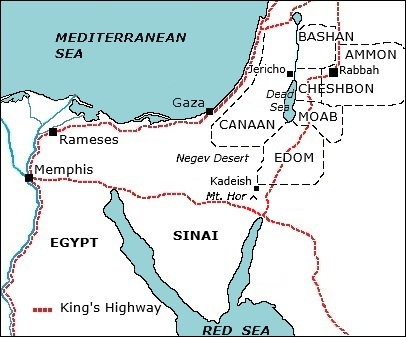
Moses sent messengers from Kadeish to the king of Edom: Thus says your brother Israel: “You know all the hardships that have found us. Our forefathers went down to Egypt, and we dwelled in Egypt many years, and the Egyptians were bad to us and to our forefathers. And we cried out for help to God, and God listened to our voice, and sent a messenger and brought us out from Egypt. And hey! We are in Kadeish, a town at the edge of your territory. Please let us pass through your land. We will not pass through a field nor a vineyard, nor will we drink water from a well. On the king’s road we will go; we will not turn aside to the right or the left, until we have passed through beyond your territory.” (Numbers 20:14-17)

Edom = a large Semitic kingdom south of the Dead Sea, including the mountain range of Seir; a variant of the word adom = red.

According to Genesis/BereishitEdom was Esau’s nickname, and became the name of the country he founded. Esau was the brother of Jacob, who became known as Israel. When Moses calls Edom and Israel brothers, he reminds the king that the Israelites are not only fellow Semites, but family. Edom should treat Israel like a brother, feeling empathy for its abuse at the hands of Egypt, and recognizing that God is on the Israelites’ side. By sending his message from Kadeish, rather than any other town on the border, Moses might even be hinting that Israel and Edom are both holy.

His request could hardly be more polite and humble. He does not want to disturb Edom; his goal is to get the Israelites into Canaan, the land God promised them.

The first time the Israelites reached the border of Canaan, 38 years before, they refused to cross it, because they did not trust God to help them take the land.  (See my blog post Shelach-Lekha: Too Late.) God sentenced them to spend a total of 40 years in the wilderness, while the mistrustful generation died off. In this week’s Torah portion, the people have served their time, and the 120-year-old Moses takes responsibility for getting the next generation to Canaan, even though he knows he will die before they cross over.

This time, God does not tell Moses where the Israelites should cross. Nor does Moses ask God. On his own, Moses decides to avoid the southern border and lead his people around the eastern shore of the Dead Sea, so they can enter Canaan from the northeast, across the Jordan River. The first part of this route crosses the kingdom of Edom, which lies south of the Dead Sea.

But Edom said to him: You shall not pass through me, lest I go out with the sword to oppose you. (Numbers 20:18)

Then the children of Israel said to him: We will go up on the highway, and if we drink your water, I myself or my livestock, then I will give their price. Only nothing will happen. On foot I will pass through it. (Numbers 20:19)

The change from plural to singular in Moses’s second request implies that he identifies with the children of Israel in the way a king identifies with his country. Moses now gives the king of Edom a financial incentive by offering to pay for water. But Edom still feels as if his personal space is threatened.

And he said: “You shall not pass through! And Edom went out to oppose him, with a serious fighting-people and a strong hand. And Edom refused to let Israel pass through his territory, and Israel turned away from him.” (Numbers 20:20-21)

Moses accepts that the king of Edom does not consider the children of Israel close enough relatives to welcome them into his personal space. Instead of fighting about it, he makes his disgruntled people march over a much longer route. They circle all the way around Edom, going south almost as far as the Gulf of Aqaba, before finally heading north again toward the Jordan River and Canaan.


When do you let someone “pass through” your personal space, coming uncomfortably close before leaving again? When do you insist on passing through someone else’s personal space?

These questions are easy in some settings, such as a medical office, or an elevator in which all the passengers come from the same culture. It can be harder to decide whether to let someone in through your front door. And I often find myself puzzled by the question of whether to hug someone when we say hello or goodbye. I watch my friends and acquaintances to see if they are stepping forward with their hands rising, or keeping their distance.  To be polite, I need to match them—and they need to match me.

I feel invaded when I get a greeting-hug from a stranger, or an acquaintance I don’t like.  I don’t want to let them pass through my personal space. Unfortunately, a few of the people I want to keep at arm’s length are my relatives, and American culture assumes that relatives are intimate.

I can empathize with the king of Edom refusing passage to Israel, even though the Israelites and Edomites have the same great-great-great-great-great-great-great-great-great-great-grandfather. To Edom, these people from Egypt are strangers.

And I admire Moses for respecting the king of Edom, and turning away after the king rejects his second polite request. Civilized life requires good boundaries for everyone.

Yet the Israelites are on their way to Canaan, which they conquer by the sword in the book of Joshua. If the old generation had trusted God and crossed the southern border of Canaan when God told them to, 38 years before, would God have arranged for the Canaanites to surrender without bloodshed?  Maybe when the Israelites try again, they have to invade Canaan with battles and sieges because they no longer have God’s full support. Yet they do not give up on the land God promised them, 40 years before. After all, if 601,730 of them are men over 20, the whole population must number at least two million. Two million people need a land. And God promised their parents the land of Canaan.

So in the book of Joshua, the Israelites cross into the personal space of the Canaanite peoples, and insist on staying. Their desperation for a homeland leads to war.

In a just world, every family would have its own home, and every people would have its own country, uncontested. In a just world, every border would be clear, and it would be easy for people to respect each other’s boundaries. But we do not live in a just world. God is not fixing the world for us, so our responsibility is to fix the world for each other. I know I can have only a small effect on the world, but it does make a difference if I treat other humans with respect.

May we all learn to respect boundaries, to compromise without giving up our journey, and to seek peace, like Moses.