Va-eira: The Right Name

by Melissa Carpenter, maggidah

Go to the king of Egypt, and tell him to declare a three-day holiday for his labor force, so they can go out into the wilderness and worship a god the king has never heard of.
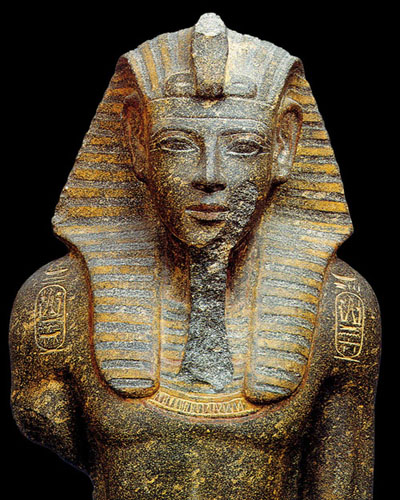
Pharaoh Merneptah, son of Rameses II

This is the mission God gives Moses in the first Torah portion of Exodus/Shemot. Moses tries to get out of it, but God insists, and Moses gives in.

And afterward Moses and Aaron came and said to Pharaoh: Thus says YHWH, god of Israel: Send out My people and they will celebrate-a-festival for Me in the wilderness. And Pharaoh said: Who is YHWH that I should listen to His voice and send out the Israelites? I do not know YHWH… (Exodus/Shemot 5:2)

YHWH = probably a form of the verb hayah (היה) = be, exist, become, occur. A variant spelling of this verb is havah or hawah (הוה). If the initial Y (י) indicates a third-person singular imperfect form, YHWH = he/it becomes, he/it exists, he/it will be.  If the four-letter word is a unique verb form, YHWH = us-was-will be; being-becoming.

(YHWH is considered the most sacred name of God, God’s four-letter personal name. I do not include the Hebrew spelling here because according to Jewish tradition, any text containing the personal name of God must be treated with respect and disposed of by special means. Furthermore, the name YHWH is not supposed to be pronounced except once a year inside the Holy of Holies—which has not existed since the fall of the second temple in Jerusalem in 70 C.E., almost 2,000 years ago.)

Since Pharaoh does not know YHWH, he refuses to give the Israelites three days off.  Instead he doubles the work of the Israelites forced to build his cities. The Israelite foremen complain to Moses, and Moses complains to God:

Since I came to Pharaoh to speak in Your name, he has done evil to this people, and You certainly did not rescue Your people! (Exodus 5:23)

Moses’ complaint implies that using the name of God was ineffective. But for God, everything is going according to plan.  As God tells Moses repeatedly in this week’s portion, Va-eira (“And I appeared”), God’s purpose in performing miracles in Egypt is: 1) so that the Israelites will know their own God as YHWH, and 2) so that the Egyptians will know the power of the god YHWH.

From God’s point of view, the ten miraculous “plagues” God plans to create will be all the more effective coming from a previously unknown god. God assures Moses that although it will be a long process, at its conclusion God will indeed rescue the Israelites from Egypt and bring them to Canaan.

But first God insists on being known by the right name.

And Elohim spoke to Moses, and said to him:  I am YHWH. And I appeared to Abraham, to Isaac, and to Jacob as Eil Shaddai, but [by] my name YHWH I was not known to them. (Exodus 6:2-3)

elohim (אֱלֹהִים) = gods (when used with a plural verb suffix); God (when used with a singular verb suffix).

eil (אֵל) = god

shaddai (שַׁדָּי) = of breasts (if it comes from shad = breast), of devastation (if it comes from shadad = devastate), of the mountain (if it comes from the Akkadian word shadu).

In the book of Genesis Abraham, Isaac, and Jacob certainly know that YHWH is one of God’s names; all three of them sometimes use that name to refer to God. So why does God claim, in this week’s Torah portion, “my name YHWH I did not make known to them”?

Most commentators explain that the three patriarchs knew God in terms of the attribute or power associated with the name Eil Shaddai, but not in terms of the power associated with the name YHWH.

In fact, the name Shaddai only appears six times in the book of Genesis, four times followed by blessings for being fruitful and multiplying (17:1, 28:3, 35:11, and 48:3). Jacob also uses that name of God to pray for rachamim (רַחֲמִים) = mercy (literally, “wombs”—43:14) and to bless Joseph with “blessings of breasts and womb” (49:25).

Although Eil Shaddai took on other meanings in later books of the Hebrew Bible, it seems safe to say that as far as the three patriarchs are concerned, Eil Shaddai is the name of the god of fertility. Abraham, Isaac, and Jacob are all concerned with the question of fertility, and want to be founders of a people or nation.

But in the book of Exodus, the Israelites in Egypt are already fertile. (The first pharaoh worries about the rapid birth rate of the Israelites; his son, the pharoah Moses speaks to in God’s name, agrees that there are far too many Israelites.) So a different aspect of God is needed to impress both Israelites and Egyptians. And God Itself seems eager to promote a new identity.

One can deduce the divine power associated with Eil Shaddai from context, but this cannot be done with the name YHWH.  The four-letter name appears 162 times in the book of Genesis alone, in a wide variety of actions and statements by God.

Commentary on which divine aspect is represented by the name YHWH ranges from the god of miracles (12th-century rabbi Abraham Ibn Ezra); to the god expressed by all ten sefirot, i.e. divine emanations (Sefer Yetzirah, a book of kabbalah possibly written in the 4th century); to the preserver of existence (16th-century rabbi Ovadiah Sforno).
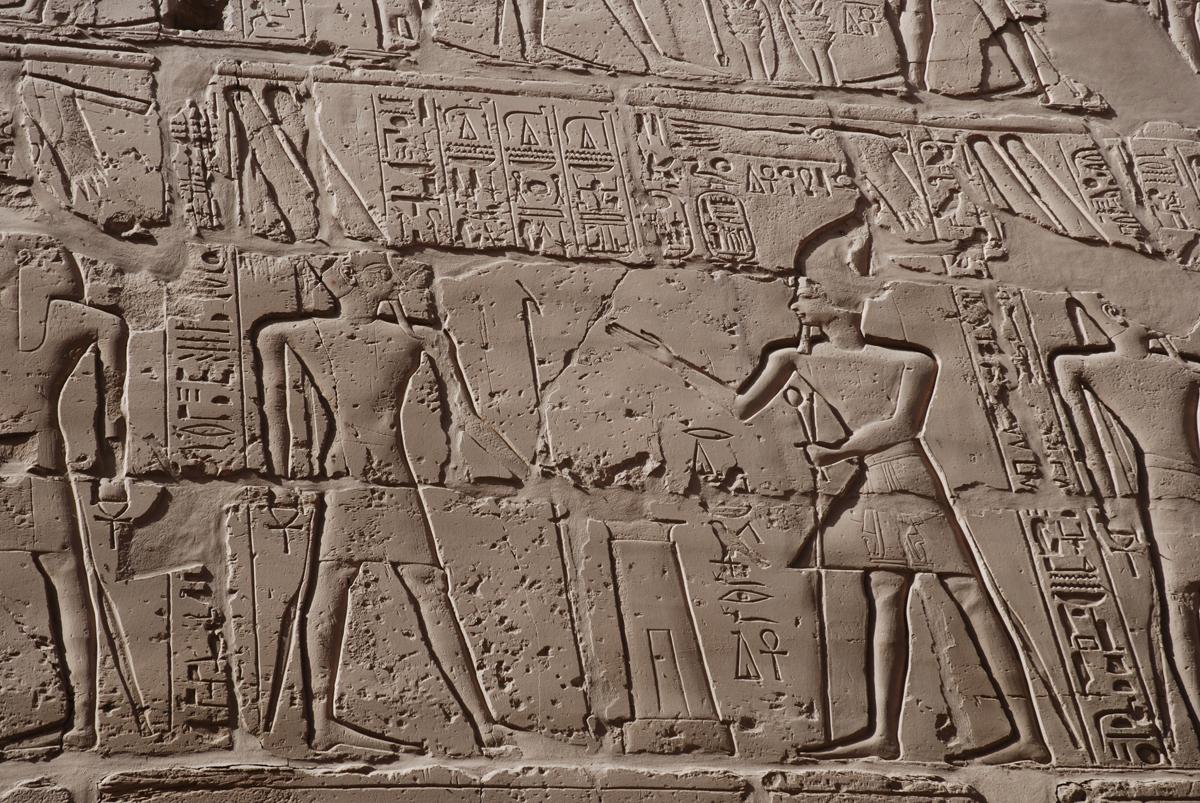
Rameses II (right) dedicating a temple to his god, Amun-Ra

All three of these interpretations boil down to the idea that God is the supreme deity; if any other gods can be said to exist, they are only emanations of YHWH, the god whose name means existence itself.

In the Exodus story, God wants Egypt to know that the god of the Israelites is the most powerful god in world, far more powerful than any of Egypt’s gods. And God wants the Israelites to know that the god who is making a covenant with them is not merely a fertility god, but a god with power over everything. Once everyone knows that God is YHWH, nobody can question God’s existence or decisions.

Or so God thinks, in the first two portions of the book of Exodus.

As the story continues, we read that after each time Pharaoh admitted the superior power of the god of the Israelites, he changed his mind and behaved as if he could win the contest with YHWH.  Even after the tenth and final plague, when Pharaoh finally lets the Israelites leave Egypt, he changes his mind again and sends his army to pursue them.  He only gives up after God splits the Reed Sea for the Israelites, then drowns the Egyptian army.

The Israelites themselves keep forgetting their god’s awesome power over life and death. As they travel through the wilderness of Sinai they worry whenever they run out of water or food, when Moses does not return from the top of Mount Sinai for 40 days, and when they face enemy forces. They cannot seem to trust the god who has taken them as Its people, even when the name of that god is YHWH.

Why doesn’t the name work?

I think that the idea of God as “being” or “becoming” is intellectually appealing. And sometimes I feel grateful that this universe exists, or that everything is in the process of becoming.

But psychologically, human beings cannot have a relationship with “existence” or “becoming”; the concepts are too abstract. To be followed, or loved, or feared, or trusted, God must be named after a more human attribute.

Eil Shaddai, the god of fertility, is not a useful divine name for most people today. When we lack children, we take practical steps; otherwise, we enjoy being fruitful in our own creative endeavors. Elohim, the God who combines the powers of all gods, is an irrelevant name at a time when nearly everyone is either an atheist or a monotheist. And YHWH, the concept of being and becoming, is too abstract for a relationship.

Then what name can inspire us to strive to “know” God? I welcome your suggestions.


Vayishlach: Blessing Yourself

by Melissa Carpenter, maggidah

Jacob finally gets a blessing he can believe this week, in the Torah portion Vayishlach (“And he sent”).

In the book of Genesis/Bereishit, a blessing usually means a transmission from God that improves the recipient’s lot in life. When a human being blesses someone, it is a request that God will transmit that blessing. God’s blessings grant people eventual success in practical affairs, including numerous descendants, wealth, land, authority over others, a good reputation, and becoming a by-word for other people’s blessings.

Hands raised in blessing
Hands raised in  blessing of Temple priests

Before this week’s Torah portion, Jacob receives three blessings: two from his father Isaac (one while Jacob is impersonating his brother Esau, and one as himself), and one blessing from God. But he still does not feel blessed—partly because of his guilt over cheating his brother, and partly because of his habit of calculating how to take advantage of others. (See my posts Toledot: To Bless Someone and Vayeitzei: Guilty Conscience.)

During his 20 years working for his uncle Lavan in Charan, Jacob acquires two of the material advantages promised in the blessings by Isaac and God: many children (eleven sons and a daughter), and material wealth (abundant flocks, herds, and servants). He does not yet own land, but God reminds him he must return to Canaan.

Even though he appears to be blessed by God, Jacob is afraid to go. First he fears that his uncle Lavan will prevent him from leaving. After the two men make a peace treaty, he is afraid that his brother will kill him and his family. In this week’s Torah portion, Vayishlach, Jacob sends messengers to Seir, where Esau is living, as he travels west toward Canaan. When he reaches the Yabbok River, the messengers return with the news that Esau is coming to meet him—with 400 armed men. Jacob frantically makes arrangements to prevent his whole family from being annihilated:

1) He divides his family and servants into two camps, hoping that if Esau’s men attack one camp, the other camp will escape.

2) He prays to God:

I am too small for all the kindnesses and all the fidelity that you have done for your servant; for with my walking-stick I crossed this Jordan, and now I have become two camps. Deliver me, please, from the hand of my brother, from the hand of Esau, for I, I am afraid of him, lest he come and strike me down, mother and children. And You, You said: I will certainly be good to you, and I will set up your offspring like the sand of the sea, which cannot be counted in its abundance. (Genesis 32:11-13)

Here Jacob expresses his own unworthiness for blessing, admits that God has aided him, and reminds God of the blessing from 20 years before. He views the blessings he has received so far as temporary and easily wiped out.

3) He sends gifts of livestock ahead to Esau, hoping to appease him.

4) He takes his family and servants across the river, then returns to the other side of the ford to spend the rest of the night alone—because he senses that there is one more thing he must do. Jacob may not know consciously that the fourth and final thing he needs to prepare for Esau’s arrival is a new blessing, a fourth blessing that comes from neither his father nor his god. But he waits alone in the dark.

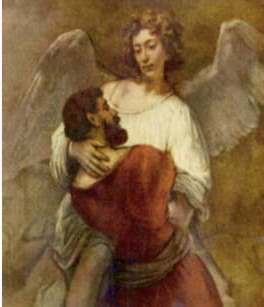
And Jacob was left alone, vayei-aveik, a man, with him until the dawn rose. And he [the “man”] saw that he had not prevailed against him, so he touched the hollow of his hip; he struck the hollow of Jacob’s hip during hei-avko with him. (Genesis 32:25-26) 

Rembrandt, "Jacob Wrestling with the Angel"
Rembrandt, “Jacob Wrestling with the Angel”

vayei-aveik (וַיֵּאָבֵק) = and he wrestled (?); and he kicked up dust (?)

hei-avko (הֵאָבְקוֹ) = his wrestling (?); his kicking up dust (?)

(The verb אבק occurs only here in the entire Hebrew Bible. It has been translated as wrestling for at least  two thousand years, based on the description in this passage. But the root of the verb is shared with the noun avak (אָבַק) = cloud of fine dust.)

Elsewhere in the Torah a “man” appears out of nowhere, and later turns out to be a malakh Elohim, a messenger of God (sometimes translated as an “angel”). For example, earlier in Genesis, three “men” appear when Abraham is sitting at the entrance of his tent, and they turn out to be divine messengers who announce that Sarah will give birth to Isaac. When a “man” appears to Jacob out of nowhere, we expect a divine emissary with a message for him.

The other “men” who appear in the Bible speak, walk, and appear to eat. But a “man” that wrestles is unique to this passage. Jacob and the “man” struggle all night without a victory.

Then he [the “man”] said: Let me go, for the dawn rises. But he [Jacob] said: I will not let you go unless you bless me. Then he said to him: What is your name?  And he said: Jacob. (Genesis 32:27-28)

For the first time, Jacob is asking for a blessing as himself, Jacob. Perhaps wrestling his opponent to a standstill has given him both courage and the feeling that he deserves recognition. In this case, both the message from God and the blessing he requests are a new name.

And he said: Your name will no longer be said “Jacob”, but instead Yisrael, because sarita with God and with men, and you prevailed. Then Jacob asked and said: Please tell your name.  And he said: Why do you ask for my name? And he blessed him there. (Genesis 32:29-30)

Yisrael  (יִשׂרָאֵל) = Israel; probably yasar  = he contends for dominion, he rules + el = god; “He contends with God”, “God rules”. (Another possible etymology is yashar = upright, level, straight + el = god; “He is upright with God”, “God is straight”.)

sarita (שָׂרִתָ) = you contended for dominion; you ruled.

So Jacob called the name of the place Peniel, “Because I saw God face to face, and my soul was spared”. And the sun rose for him as he passed Penuel, and he was limping on his hip. (Genesis 32:31-32)

Through the rest of the book of Genesis, Jacob sometimes acts decisively and correctly, living up to his new name. At other times he is fearful, hesitant, and calculating, like the old Jacob. He does not always prevail. However, he does proceed as if he expects God to be on his side. He also gives more blessings to others than any other person in the Torah.

Many of us are like Jacob before he wrestled. We can see our wealth and success in the material world, yet we do not believe we have received a divine blessing. We do not feel the peace of being blessed.

When we are alone at night, does a “man” come to wrestle with us? Shmuel Klitsner wrote that “And Jacob was left alone, and a man wrestled with him until the dawn rose” (Genesis 32:24) could be read as happening at the same time. In that case, the man Jacob is wrestling with is himself. Furthermore, Klitsner suggested, when Jacob’s wrestling partner says “you contended with God and with men, and you prevailed” the “man” is identifying himself as both divine and human.1

May each one of us be blessed to wrestle with our own inner divine force, and to emerge with a blessing we can believe in, a blessing of the peace and personal authority that comes from being Yisrael, upright with God—even when we walk into the sunrise with a limp.


  1. Shmuel Klitsner, Wrestling Jacob, Urim Publications, Jerusalem, 2006.

Vezot Habrakhah: Zevulun’s Secret

This week Jews celebrate Rosh Hashanah, the beginning of the year. This Saturday is Shabbat Shuva, and the Torah portion is Ha-azinu (Use your ears). In the last few years, I have written four posts on Ha-azinu: Upright, Devious, and Struggling; The Tohu Within; Raining Insights; and Hovering. But since I will be traveling for three weeks, from Rosh Hashanah through Yom Kippur and Sukkot, this post will look at the Torah portion Vezot Habrakhah (“And this is the blessing”), the last portion in the book of Deuteronomy/Devarim.

On Simchat Torah (October 16-17 this year) a Jewish tradition is to finish Deuteronomy and start the new annual cycle of Torah readings with the opening of Genesis/Bereishit. That first Torah portion will be the subject of my first post when I get home in a few weeks!

Zevulun
Zevulun

Zevulun’s Secret

In the last Torah portion of Deuteronomy, Moses pronounces prophecies for each of the tribes of Israel, as well as blessing all the Israelites, before he climbs Mount Nevo to die. The text of the “blessings” of the tribes that has been handed down to us is somewhat corrupted by scribal error, according to modern scholars. But it still expands Jacob’s “blessings” of the tribes near the end of Genesis/Bereishit.

Jacob pronounces blessings, or prophecies, about his twelve sons before he pulls his feet up into his bed and dies. Each prophecy is really about the tribe that will bear that son’s name. (See my earlier post, Vayechi: Fierce Brothers.) But earlier in Genesis, Jacob’s sons are characters in the story.

Half of the twelve sons are the equivalent of spear-carriers; the Torah gives them neither lines nor stage business. Unlike their eponymous tribes, the only identities these six sons have are their names—Dan, Naftali, Gad, Asher, Yissakhar, and Zevulun—and the meanings their mothers or adoptive mothers assign to their names.

The youngest spear-carrier is Zevulun, Leah’s sixth and last son. When he is born, Leah says: God gave a gift to me, a good gift; [this] time my husband yizbeleini because I bore him six sons. And she called his name Zevulun. (Genesis/Bereishit 30:20)

yisbeleini (יִזְבְּלֵנִי) = he will elevate me, he will exalt me, he will honor me. (The root of this verb, זבל, is the same as the root of the name Zevulun.)

Zevulun (זְבֻלוּן) = exalted place, place of honor.

As with all the other baby-namings in the Torah, the name indicates the parent’s state of mind. We learn nothing about the character of Leah’s sixth son from his name.

But we do learn something about Zevulun’s tribe when Jacob recites his prophetic poem about the tribes from his deathbed.  He says:  Zevulun, at the shore of the sea he will dwell; and he will be a shore for ships, and his flank will be upon Tzidon. (Genesis 49:13)

Tzidon (צִידֹן) = Sidon; one of the first Phoenician port cities on the Mediterranean Sea. (Tzidon is now the city of Sayda in Lebanon).

The second prophetic poem about the tribes, spoken by Moses in the last Torah portion of Deuteronomy, combines the tribe of Zevulun with the tribe that bears the name of Leah’s fifth son, Yissakhar (often spelled Issachar in English).

And to Zevulun he said: Rejoice, Zevulun, in your going out, and Yissakhar, in your tents. They will call peoples to the mountain; there they will slaughter slaughter-offerings of righteousness; for they will suckle on the abundance of the seas, and the hidden treasures of the sand. (Deuteronomy/Devarim 33:18-20)

Canaan at Joshua's Death
Canaan at Joshua’s Death

Both poems about the tribes of Israel claim that the territory of Zevulun includes a piece of the Mediterranean coast. Jacob’s poem says Zevulun will extend as far as Tzidon, but in the book of Joshua, when the tribal territories are allocated by lot, it is Asher, Zevulun’s northern neighbor, that reaches as far as the great city of Tzidon.

The boundaries of Zevulun given in the book Joshua include many place-names we cannot identify today, and do not mention any coastline. The one identifiable place in the description of Zevulun’s land is Beit-Lechem. The coast west of Beit-Lechem of Galilee is Haifa Bay, which lies south of both Tzidon and Tzor (Sidon and Tyre ), the two major Phoenician cities at the time.  But the Phoenicians had coastal villages farther south, as far as Dor.

The coast south of Dor, from Ashdod to Gaza, was being invaded by the Plishtim (Philistines) around the time of Joshua’s conquest of Canaan, which the Bible places circa 1300 B.C.E. The Plishtim migrated from Crete and other islands across the sea, and after seizing their beachheads on the coast, they fought for centuries to conquer more of Canaan.

But the Bible does not record any hostile actions by Phoenicians against Israelites. Could Zevulun have shared the Mediterranean coast with them?

I think so.  Historically, both the Israelites and the Phoenicians spoke a Canaanite dialect in the Semetic language family, and the writings of both peoples reveal roots in Canaanite culture.

In the Bible, the people of Zevulun get along with non-Israelite neighbors. Although Moses instructs the Israelites to dispossess the Canaanites and drive all the natives out of the land, the first book of Judges lists the tribes that did not do so. Zevulun is one of the tribes that lives alongside the Canaanites.

Furthermore, even Moses’ poem about the tribes predicts that Zevulun and Yissakhar will call peoples to the mountain; there they will slaughter slaughter-offerings of righteousness. (Deuteronomy 33:19) Rather than trekking all the way to Israel’s central place of worship, they invite neighboring peoples to join them in offering animal sacrifices at a local mountain in the Galilee. And even though Deuteronomy is full of warnings to worship God at only one place, the poem Moses recites at the end of his life calls the neighborly offerings on a local mountain “righteous”.

Zevulun’s reward for friendly relations with its Phoenician neighbors is a share of Phoenician wealth, which came from maritime trade, fishing, and the sale of valuable purple dye and white (milk) glass. The dye came from mollusks found on that part of the coast, and the glass was made from the high-quality sand on the shore. The commentaries agree that these Phoenician products must be the hidden treasures of the sand mentioned in Deuteronomy 33:20.

This glimpse into the ways of Zebulun is a welcome contrast with all the times the Hebrew Bible urges the Israelites to treat other peoples as enemies. The Bible often condones vicious pre-emptive wars against Canaanites, Amorites, Midianites, and assorted other peoples in the region. (For an example, see my post Va-etchannan: Haunted by Shame.) Apparently God, Moses, and many of the prophets (at least as portrayed in the Bible) believe the Israelites are so easily tempted to abandon their own religion, they must commit genocide lest they learn about another attractive cult.

There is a better way to prevent people from discarding their God and their religion: make the religious practices more inspiring and more likely to touch the heart. The Torah illustrates this method in the book of Exodus, when the anxious people turn to the Golden Calf, but then turn back to God with joy and dedication when Moses gives them the chance to make a beautiful sanctuary for God.

Zevulun offers another illustration, by adopting the Phoenician way of making a livelihood, and inviting their foreign friends to join them in making offerings to God on a nearby mountain. They drop the rule about worshiping God only at the central sanctuary. But in exchange they gain peace with their neighbors—without abandoning their own god. And the Torah portion Vezot Habrakhah says their offerings are righteous.

I think the hidden treasures of the sand that Zevulun enjoys are not only milk glass and purple dye, but also the treasures that come from tolerance and goodwill.

May all people learn how to preserve their religions by offering friendship to strangers as they offer their hearts to their own gods.


Nitzavim: Concealed and Revealed

Hanistarot is for God, our god; and haniglot is for us and for our children forever to do all the words of this Torah. (Deuteronomy/Devarim 29:18)

hanistarot (הַנִּסְתָּרֹת) = what is hidden, concealed, secret.

haniglot (הַנִּגְלֹת) = what is revealed, uncovered, exposed.

In this week’s Torah portion, Nitzavim (“taking a stand”), the sentence above is wedged in between two predictions. The first is that the Israelites will worship other gods and then God will destroy their land and exile them. The second is that eventually the Israelites will return to God and God will return them to the land.

Does the sentence about what is concealed and revealed have anything to do with Moses’ two predictions?  Since the sentence follows Moses’ prediction that the Israelites will commit the “sin” of worshiping other gods, some commentary assumes the hanistarot/haniglot statement is about sins. According to Rashi (11th-century rabbi Shlomo Yitzchaki), it means that if a sin is committed so secretly that nobody could discover it, then God is responsible for punishing the individual offender. But if a sin is committed openly, it is up to the community to punish the offender; “and if we do not execute judgment upon these, then the whole community will be punished” by God.

Other commentators relate the hanistarot/haniglot statement to the sentence that follows it, where Moses predicts that the exiled Israelites will return to God, and then God will gather them back into the land of Canaan. In this case, what is concealed is the length of the exile. The future is always hidden from human beings. What is revealed is what we should do in the meantime: all the words of this Torah.  In other words, we and our descendants must strive to obey the 613 rules in the Torah as much as we can. (See last week’s post, Ki Tavo: Writing in Stone.)

A third strand of commentary, starting in the Talmud, interprets “what is secret (hanistarot) is for God” as a warning to individuals against pursuing arcane mystical knowledge.  “What is revealed (haniglot)” is the Torah, which is good for us to study.

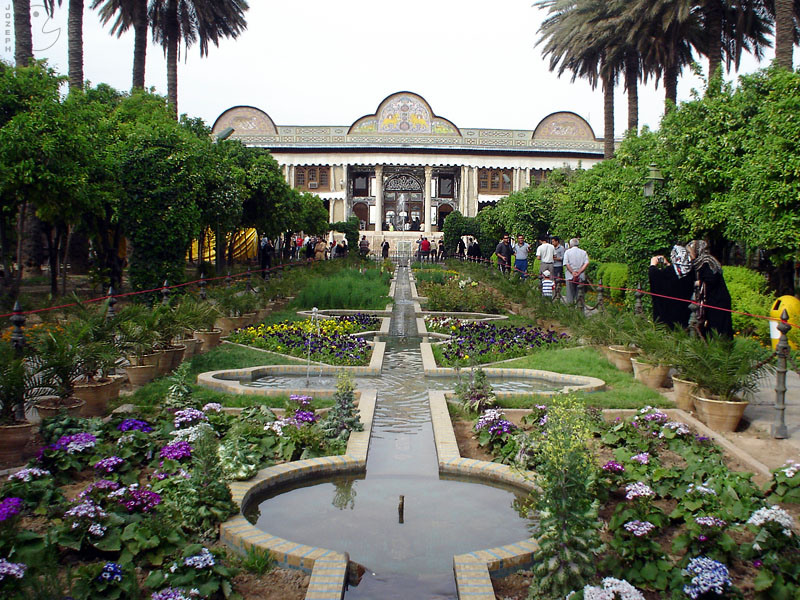
A pardeis at Shiraz (modeled after a garden of King Cyrus of Persia)

In the Babylonian Talmud (written by rabbis living under Persian rule in the first few centuries C.E.) the tractate Chaggigah mentions rabbis who taught about Ezekiel’s mystical vision of the chariot. Then it points out the dangers of pursuing arcane knowledge by offering a story about four great Torah scholars who entered a pardeis.

Pardeis (פַּרְדֵּס), often translated as “paradise”, is a Persian word for an orchard or an enclosed garden. Chaggigah 14b uses a pardeis as an image of the “upper worlds” of heaven, a realm of spiritual truth divorced from the physical world.

The four famous scholars who enter the pardeis in this story are Ben Azzai, Ben Zoma, the “other” (Elisha ben Avuya), and Rabbi Akiva, their senior. Ben Azzai glimpses the divine presence, abandons his body, and dies. Ben Zoma glimpses the divine presence, suffers from a consuming a surfeit of “honey”, and loses his mind. Elisha ben Avuya, the “other”, glimpses the divine presence, but sees a duality: God versus an angel (Metatron) who is sitting and recording the merits of Israel. The Talmud says Elisha “chopped down the shoots” of saplings, i.e. became a heretic who separated God (the root) from the angel (the shoot). Only Rabbi Akiva comes out of the pardeis safely.

When the scholars are entering the pardeis, Akiva warns them that they will see pure marble stones that appear to be water, but they must not say “water, water”. Perhaps Ben Azzai, Ben Zoma, and Elisha ben Avuya were unable to distinguish between polished marble and water—that is, between two key points in mystical understanding of the divine—and the result was death, madness, or heresy.  Hanistarot, what is secret, belongs to God, and very few can perceive one of God’s secrets and remain whole.

In the 12th century B.C.E., Rambam (Moses Maimonides) wrote that the hidden secret (hanistarot) in the sentence from this week’s Torah portion is Kabbalah, and the revealed wisdom (haniglot) is the Torah.  Those who learn Kabbalah must still take care to observe the rules of the Torah in the world of physical action.

*

Today I encounter people who are so fascinated by mysticism that they ignore the Rambam’s advice, and spend all their energy pursuing an “oh, wow!” state of mind. Sometimes I get the impression that anything arcane and mysterious attracts these people, as long as it is non-logical and only tenuously related to the world we live in. These ungrounded mystics seem to assume they can transcend the rules in the Torah and rise above their own psychological (soul) issues.  They appear to be more concerned with feeling love, than with figuring out what actions might be loving.

I also encounter people who want to “do all the words of this Torah”, but prefer specific rules about physical actions over admonitions to change their heart and soul.  If they are Jews, they may be strict about keeping kosher, but not so thorough about loving their fellows as themselves. Examining their own psyches in order to love other people is too much for them.

In between these two types are the people who cautiously mine mystical claims for insight without trying to enter pardeis.  They are enthusiastic about how religion can be applied to ethics and personal insight. Figuring out how to love one’s fellow as oneself, for example, is more important to them than either feeling ecstatic or following all the rules.

I want to belong to that third group. I want to investigate my own soul and stay grounded in my life here on earth. I want to borrow an occasional idea from Kabbalah without getting lost in it, and I want to use the Torah’s concrete rules as guidelines for behavior, to be reinterpreted if following the letter of the law gets in the way of following its spirit.

So I can subscribe to first part of the sentence from this week’s Torah portion:

Hanistarot [what is hidden] is for God, our god, and haniglot [what is revealed] is for us and for our children …

But I would like to end the sentence this way:

to study all the words of this Torah, and apply them thoughtfully to our lives.


Ki Tavo: Carved in Stone

Carve something on a stone, and set it upright as a memorial or a boundary marker.  People have been doing this all over the world for millennia.  Americans today still erect gravestones and mark historic sites with upright stones bearing text.

Anyone can read the inscribed stone or stele and learn something—about the battle that took place at that spot, or the boundary it marks, or the person who is buried there.

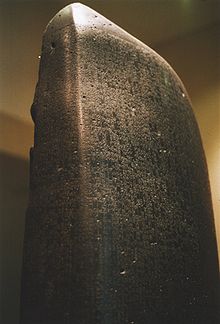
Code of Hammurabi, 1750 B.C.E.

In the ancient Middle East, most steles recorded victories in battle. But the oldest stele discovered so far from that region is a stone seven and a half feet high, with the Code of Hammurabi carved into it during the 18th century B.C.E.  The 282 laws of the reigning Babylonian king are written in Akkadian.

Standing stones without any words carved into them are even older. Only oral tradition can tell subsequent generations what the stones commemorated. A stranger from another place or a later time who sees a blank monument, or a circle of tall stones, knows only that they are significant, not what they signify.

The first standing stones in the Torah are uncarved.  In the book of Genesis/Bereishit, Jacob erects four different matzeivot or standing stones, marking the sites of his dream of angels, the boundary  between his area of influence and his father-in-law Lavan’s, and his wife Rachel’s grave.

Moses erects twelve standing stones at the foot of Mount Sinai in the book of Exodus/Shemot, to represent the twelve tribes of Israel in their covenant with God.  But the only engraved stones in Exodus are the two small tablets bearing the ten commandments, and they are so sacred that they are carried inside the ark, which must never be touched or opened.

At Mount Sinai and in the wilderness, the blank stones that depend on mutable oral tradition are out in public.  But the immutable, fixed written words are hidden in a sacred place.

Moses does not call for standing stones with writing on them until this week’s Torah portion, Ki Tavo (“When you enter”), in the book of Deuteromy/Devarim.

Moses and the elders of Israel commanded the people, saying:  Observe the entire commandment that I command you this day.  And it shall be, on the day that you cross over the Jordan into the land that God, your god, is giving to you, you shall erect for yourself great stones, vesadeta them with the siyd. And you shall write on them all the words of this torah when you cross over, so that you may come into the land that God, your god, is giving to you, a land flowing with milk and honey, as God, the god of your forefathers, has spoken to you. (Deuteronomy 27:1-3)

vesadeta (וְשַׂדְתָּ) = and you shall limewash (coat them with a paint-like mixture of lime and water).

siyd (שִׂיד) = lime, quicklime, limewash.

torah (תוֹרָה) = teaching. (The word torah also refers to the first five books of the Bible, to the whole Hebrew Bible, and to any teaching of Jewish law or religion.)

The people of the ancient Middle East made quicklime (calcium oxide powder) by burning bones. Adding enough water to slake the lime turns it into calcium hydroxide, which can be mixed with additional water to make limewash.  Limewash is still used to coat surfaces in order to make them smooth and white; the coating hardens into a thin shell of limestone, which may last for millennia in dry conditions. Remnants survive of a text painted in ink on a white limewashed wall in the 8th century B.C.E.

Fragments of 8th-century B.C.E. Balaam story on limewash at Deir Alla, Jordan

Thus the text on Moses’ limewashed stones could have been readable for many centuries. The Hebrew Bible does not specify which torah Moses wants on the stones, but it must include some or all of the laws from the written Torah we have today—the first five books of the Bible, as copied and recopied on parchment and paper. According to 12th-century rabbi Abraham Ibn Ezra, Moses means the 613 commandments that the Talmud (Makkot 23b) says are in the five books. Other commentary speculates that Moses is calling for the code of laws in the book of Deuteronomy (chapters 13-26), or for the whole book of Deuteronomy (which would fit on two stones the size of the one used for the Code of Hammurabi).

Until this point in the Torah, Moses passes down God’s laws by announcing them verbally to the assembly of Israelites. Only in this week’s Torah portion does Moses call for laws to be “carved in stone”—or at least painted on limestone—and set out in a public place: the top of Mount Eyval, next to the ancient town of Shekhem.

And it shall be when you cross over the Jordan, you shall erect these stones, as I command you this day, on Mount Eyval; vesadeta them with the siyd. And you shall build there an altar for God, your god … (Deuteronomy 27:4-5)

Moses continues with orders for offerings at the altar, followed by a ritual of blessings and curses to indicate acceptance of God’s law.  (See my earlier post, Ki Tavo: Cursing Yourself.)

On the bare summit of Mount Eyval, the stones would be visible from a distance, as shining white pillars against the sky.

Perhaps the author of this section of Deuteronomy imagined that the steles on Mount Eyval would be like the Code of Hammurabi, which many scribes over the centuries copied onto clay tablets. In the Talmud (Sotah 35b), Rabbi Yehudah imagines scribes from different Canaanite tribes visiting the stones on Mount Eyval and bringing home copies of their text.

Yet ancient scribes, including those who copied the Hebrew Bible, not only made copying errors, but also felt free to insert additional material. The steles on Mount Eyval would stand as a permanent record of the original laws of Moses, whatever amendments people made later.

From the viewpoint of the storyline within the book of Deuteronomy, Moses’ desire for a permanent, immutable, and public record of the laws is understandable. He is about to die, and he believes the Israelites, with their history of backsliding, will eventually abandon God’s laws and convert to Canaanite religions. Moses’ last hope of preserving his religion is to write it down.

He writes multiple copies of “this torah” in Deuteronomy 31:9, and a book of “this torah” to be placed inside the ark in Deuteronomy 31:24-26. All of these writings appear to be on parchment scrolls. But he also wants a more permanent record, so he orders the limewashed standing stones.

From the viewpoint of modern scholarship, Deuteronomy was written much later than Numbers, probably after the fall of the Northern Kingdom of Israel.  King Josiah of Judah, the southern kingdom, wanted public support for conquering the old northern territory and reinstating the old religion the two kingdoms shared. The description of a permanent monument bearing the laws of Moses might make King Josiah’s people feel that the religion of the God of Israel should persist.

From the viewpoint of a practicing Jew today, I would say the religion could not have survived this long without additions and reinterpretations. Of the 613 mitzvot or commandments in the five books of the Torah, as compiled by Rambam (12th-century rabbi Moses Maimonides), only 271 can be observed at all today. (Many of the old laws were about sacrifices at the temple, a method of worship that ended about 2,000 years ago with the fall of the second temple in Jerusalem.)

And some of the commandments are clearly inferior to ethical customs that Jews adopted later in their history. For example, although the Torah includes highly ethical commandments (such as not to insult, embarrass, or slander people), it also contains commandments such as the requirement that a rapist must marry his victim if she is single (Deuteronomy 22:29). There was a reason for that law in Judah 2,700 years ago, but 21st-century American society has better ways of handling the situation.

If archaeologists ever discover limewashed stones with some laws of Moses written on them, I pray that we may view the laws as artifacts, not immutable rules to follow forever. Reinterpretations of both oral traditions and traditional writings are what keep a religion alive, and let it walk farther on the path of virtue.

Masey: Magic of an Egyptian Province

The Torah does not name the pharaoh in its story about the exodus from Egypt. But some scholars guess the story is set in the 13th century B.C.E., during the reign of Rameses II. At that time the land of Canaan was a remote province of the Egyptian empire. Canaanite vassals ruled individual villages and their surrounding regions, but they reported to the Egyptian government in the provincial capital, Gaza. Egyptian garrisons were scattered around the province.

The two biggest powers then were the Egyptians and the Hittites. The capital of Egypt was in the Nile delta; the capital of Hatti was in present-day Turkey. Naturally the two empires fought over the land in between, until their kings, Rameses II and Hattusili III, made a peace treaty circa 1260 B.C.E. that froze the border. A long period of peace followed—as far as the Egyptians and Hittites were concerned. If one Canaanite vassal overthrew another, that was not their business.

In this week’s Torah portion, Masey (“Journeys”), the Israelites are preparing to cross the Jordan River and overthrow every ruler in the province of Canaan.

God spoke to Moses, saying: Command the Children of Israel, and you shall say to them: When you enter the land of Canaan, this is the land that will fall to you as a hereditary possession: the land of Canaan by its boundaries. Your southern limit shall be from the wilderness of Tzin next to Edom … (Numbers/Bemidbar 34:1-3) 

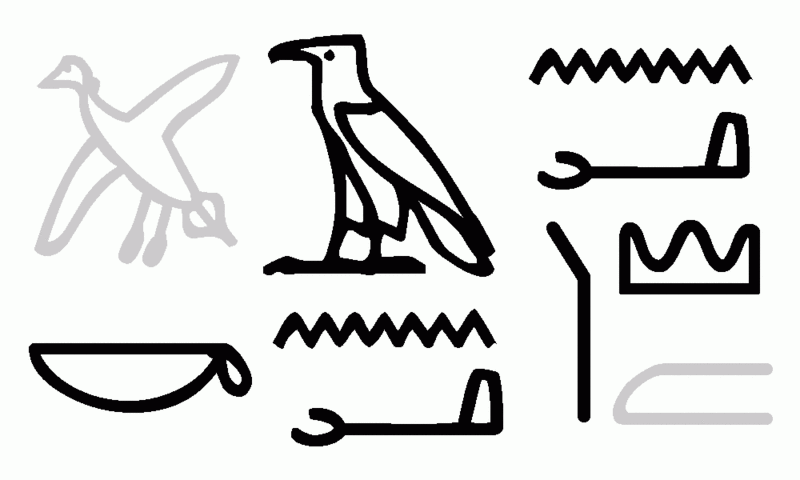
"Canaan" in Egyptian heiroglyphs, Merneptah Stele
“Canaan” in Egyptian heiroglyphs, Merneptah Stele

Canaan (כְּנָעַן) = a territory roughly including present-day Israel, Lebanon, and part of Syria—but not Jordan. (Probably from the Egyptian name Kanana, though it may also be related to the Hebrew verb root kana (כּנע) = humble, subdue, subjugate. Much later, in the Second Temple period, a kinani (כְּנַעֲנִי) was a merchant or tradesman rather than a Canaanite.)

God promises to give the land of Canaan to Abraham’s descendants in the book of Genesis,and to the descendants of Abraham’s grandson Jacob in the book of Exodus.

When God delineates the boundaries of the promised land in this week’s Torah portion, Masey (“Journeys”), the northern boundary is about the same as the boundary between the Egyptian and Hittite empires, as set by their treaty. Like the province of Canaan, Israel is to include the coastline from Wadi el-Arish all the way to a Mount Hor north of Byblos (now the Lebanese city of Jubayl). (This is different from the Mount Hor east of Edom where Aaron dies.)

Canaan in Numbers 34

The northern boundary goes from the Mediterranean to a point deep in present-day Syra. The eastern boundary swings around to the Sea of Kinneret and follows the Jordan River to the Dead Sea, like the eastern boundary of Canaan in the 13th century B.C.E.

The Israelites never rule the entire province. But they are so attached to Canaan as their promised land, that Moses gets upset in last week’s Torah portion (Mattot) when two and a half tribes want to settle on the east side of the Jordan River, in the land the Israelites recently captured from a pair of Amorite kings.

In this week’s Torah portion, Moses makes the distinction between Canaan and the land east of the Jordan again.

And Moses commanded the Children of Israel, saying: This is the land that you will divide for hereditary property by lot, that God commanded to give to the nine tribes and the half tribe. For the tribe of the Reubenites…the tribe of the Gadites… and the half-tribe of Menashe, they have taken their hereditary possession. The two tribes and the half-tribe took their hereditary possession from across the Jordan at Jericho, eastward toward the sunrise. (Numbers 34:13-15)

Why must the land promised to the Israelites be no more nor less than the Egyptian province of Canaan?

One answer is that the Israelites are Canaanites. Some archaeologists suspect the exodus was a literary invention, and that although a small band of slaves may have run away from Egypt, the majority of ethnic Israelites lived in the hills of eastern Canaan all along. When the kingdom of Judah conquered more of Canaan during the reign of King Josiah (Yoshiyahu), 600 years later, they rewrote some of the Torah to justify their expansionism.

The Torah, on the other hand, implies that Israelites are Canaanites because an extended family of 70 (plus wives and servants) go down from Canaan to Egypt, and 430 years later in the exodus 600,000 men (plus wives and children and a multitude of like-minded Egyptians) come back up. During their four centuries in Egypt, the Israelites retain their identity and language. Returning to Canaan, therefore, is returning home.

But they do not return to rejoin their fellow Canaanites. The god of Israel orders them to conquer the current population and drive them out of their towns, so that the people and religion of Israel will rule the land. The Torah gives two kinds of justifications for taking over Canaan. One is that Canaanite religious practices are evil in God’s eyes, and therefore must be eliminated. The other is that the Israelites, as descendants of Abraham, are supposed to be a blessing to the rest of the world. Presumably part of this blessing is setting an example of a country run according to God’s laws.

Some mystical commentary claims that the promised land had to include Jerusalem. According to these mystics, the Temple Mount is also Mount Moriyah, where Abraham nearly sacrifices his son Isaac. This is the holiest spot in the world. (Mount Sinai, which lies outside Canaan, is somehow less important!)

I think all of these explanations ignore the power of myth and legend. As an American child, I grew up reading English stories full of menhirs, dolmens, fairy circles, and henges, where magical things happened to previously ordinary people. When I visited England as an adult, it moves me to tears to see these legendary structures cropping up in the woods and in the middle of farms. This was the world of the stories I grew up with, the world my imagination lived in. Every day I spent in the English and Welsh countryside filled me with awe. I can only imagine the awe I will feel when I finally get to Israel and see the places I keep reading about in the Torah as an adult.

The ancient Israelites, whether they stayed in Canaan or migrated to Egypt and back, grew up with the legends that found their way into the book of Genesis. Imagine what it would mean to them to see Mount Moriah, the grove of Mamre, the cave of Makhpelah, Beeir-sheva, or Beeir-lachai-roi.

Never underestimate the power of story. It can turn a rural Egyptian province into the Promised Land.

Beha-alotkha & Beshalach: Stomach versus Soul

When we doubt the meaning of our lives, mere food cannot address the problem. Yet many people divert anxiety about their futures into craving for food—both today and in the Torah.

When the Israelites and their fellow-travelers leave Egypt, they take all their herds and flocks with them. They are never forbidden to use their livestock for milk or meat, so they are in no danger of starving. Yet a month and a half after they leave Egypt, they complain about food.

The entire assembly of the Children of Israel grumbled against Moses and against Aaron in the wilderness.  The Children of Israel said to them: “If only we had died by God’s hand in the land of Egypt, when we sat beside a pot of meat, when we ate bread until [we were] sated; for you brought us out to this wilderness to put to death this whole congregation by famine!” (Exodus/Shemot 16:2-3, in the Torah portion Beshalach)

How could dying in Egypt with a full stomach be better than journeying with God’s protection? These are the people who chose to follow Moses and his god out of Egypt, who sang and danced after God rescued them from the Egyptian army at the Reed Sea. How could they feel so discouraged in the second month of their trek across the wilderness?

God diagnoses the problem, and solves it—temporarily—with manna.

Then God said to Moses: Here I am, raining down food from the heavens… (Exodus 16:4)

Manna satisfies the people for a while—not because they need additional food, I think, but because it reminds them daily that God loves them like a parent. They are already following the divine pillar of cloud and fire across the wilderness. Now they know that they are not wandering aimlessly; serving God gives them a purpose in life.

The Israelites forget their purpose and fail to serve God whenever they are idle or afraid during their sojourn at Mount Sinai. But they are in good spirits when they march away from the mountain in this week’s Torah portion, Beha-alotkha (“When you raise up”) in the book of Numbers/Bemidbar. They head toward their promised land supplied not only with the manna God provides, and the livestock they brought up from Egypt, but also with a splendid portable sanctuary and its numinous objects, as well as a set of God-given rules and principles to live by.

Alas, after only three days of marching they lapse into complaining again. The Torah does not tell us the content of their complaint at Taverah. It merely says God hears and reacts with anger, consuming the edge of the camp with fire. Then the people switch from complaining to sobbing.

And the riff-raff that was in its midst felt strong cravings, and they sobbed, and the Children of Israel also [sobbed], and they said: Who will feed us meat? We remember the fish that we ate in Egypt for free, and the cucumbers and watermelons and leeks and onions and garlic. And now our nefesh is dried up; there is nothing except the manna for our eyes. (Numbers/Bemidbar 11:4-6)

nefesh (נֶפֶשׁ) = appetite, throat, animating soul, life

Why, when they are on the verge of getting their own land, do the people yearn for the food in Egypt again? Psalm 78 answers:

They tested God in their hearts by asking for food for their nefesh. (Psalm 78:18)

To me, this shows that the people are not complaining about dry throats, but about dry lives. They have not lost their appetite for food, but they have lost their appetite for being God’s people.

For the survivors of the Golden calf incident, life at Mount Sinai was both pleasant and meaningful. They had the pleasure of serving God by making donations, but their donations were the treasures they took from their Egyptian neighbors, rather than anything personal. They also had the pleasure of serving God by skilled creative work, as they made the sanctuary and its holy objects.

Now, as they march north, the people are approaching the border of Canaan. They know their next service to God will be taking over a land inhabited by other people. As we learn in next week’s Torah portion, Shelach, very few Israelites believe that God will single-handedly drive out the inhabitants and leave them empty cities and farms. Instead they are anticipating war, which means many hardships and deaths.

Now the thought of serving God fills them with anxiety instead of purpose. So, as the psalm says, they sob for Egyptian food to (unconsciously) test whether God will nourish their souls.

God correctly interprets the sobbing as indicating a lack of faith, rather than a desire for tasty food. But instead of reassuring the people that their lives will be filled with meaning, God takes a punitive approach, and tells Moses:

To the people you shall say: Consecrate yourselves for tomorrow; then you will eat meat … Not for one day will you eat, nor for a couple of days, nor for five days, nor for ten days, nor for twenty days. Until a month of days, until it comes out of your nostrils and you are nauseated because of it! For you rejected God, who is in your midst … saying: Why did we leave Egypt for this? (Numbers 11:18-20)

I confess I am like the Israelites in this week’s Torah portion. My life is full of meaning and purpose right now, while my material needs are met and I spend my days drawing insights and inspirations from the Torah, and sharing my life with people I love. Yet there are empty times in my day, when I need to rest or alleviate chronic pain. At those times, anxiety about the future haunts me. What if my sense of purpose is not strong enough to carry my through old age, when I must face hardships and the deaths of people I love?

My first impulse, as these times, is to comfort myself by eating something tasty. Yet I know that if I eat too much, I will make myself sick in the long run. I would rather keep faith that God is with me, and my life will continue to be worthwhile no matter what happens.  But how can I do that?

The only solution I know is to refocus and cultivate gratitude for the good life I have now. Do you have another solution to the anxiety of the Israelite? Please comment!

Behar: Choosing a God

Feeling a sense of the numinous from time to time is human nature. So is the impulse to acknowledge and reach out to the ineffable. For thousands of years, many human beings have channeled this impulse into worship of one or more gods.

The Hebrew Bible does not have a separate word corresponding to the English word “worship”. But it does have words for prayer (tefillah); bowing down or prostrating oneself (hishtachavot); service (avodah—often meaning the tasks of priests); and bringing offerings to a god (hakriv korban). Prayer and prostration usually happen on the impulse of the moment in the Torah.  Priestly service and bringing offerings, on the other hand, are rituals for which the book of Leviticus/Vayikra gives detailed rules.

What matters most is which god one is addressing. The Torah repeatedly warms its readers to restrict themselves to only one god out of the many available in the ancient Middle East. This week’s Torah portion, Behar (“on the mountain”) ends with these instructions:

You must not make for yourselves eliylim, or a pesel; and a matzeivah you must not erect for yourselves; and a maskit stone you must not place in your land for prostrations upon it; because I, God, am your elohim. (Leviticus/Vayikra 26:1)

eliylim (אֱלִילִם) = pseudo-gods (often used to refer to gods in other religions)

pesel (פֶּסֶל) = carved image; idol of cut stone or wood (from the verb pasal = carve)

matzeivah (מַצֵּבָה) = standing-stone

maskit (מַשׂכּית) = paving-stone with a design on it, set into the floor of a shrine

elohim (אֱלֹהִים) = gods (plural of eloha = god); God

What strikes me about this warning is that after the general reference to pseudo-gods, we get three examples of idols associated with stone. In contrast, the God of the four-letter name (approximated in English by Y-H-V-H) is associated with a day of rest and a holy place in the next verse:

Shabbetotai you must guard, and mikdashi you must hold in awe; I am God. (Leviticus 26:2)

shabbetotai (שַׁבְּתֹתַי) = my sabbaths

mikdashi (מִקְדָּשִׁי) = my holy place

Shabbat, the sabbath, is a holy time: one day a week when the people must refrain from labor and honor God. A mikdash is a holy place. A shrine with a pesel, matzeivah, or maskit stone might be a mikdash for another god. But this week’s Torah portion quotes the god of Israel as saying mikdashi, MY mikdash. Throughout the book of Leviticus, God’s mikdash is the portable sanctuary Moses assembles in the book of Exodus; God becomes present above the ark in the sanctuary’s innermost chamber. Later in the Bible, the holy place where God becomes present is the temple in Jerusalem. Since the fall of the second temple, some Jews have continued to view Jerusalem as God’s holy place, while others have said the holy place is any spot where God becomes present to a human being—as long as it is the correct god.

Both the pseudo-gods and the God of Israel require human actions before they can be worshipped. Humans carve the pseudo-gods out of stones. Humans set aside times and places as holy to the God of the four-letter name.

Like many religious seekers today, I like the more abstract idea of how to approach God. Thinking about time and space dazzles me; looking at a stone sculpture only stimulates my aesthetic sense. But in Biblical times, the sanctuary or the temple was full of tangible objects and decorations made of metals, wood, and thread. Gold flashed, rich colors glowed. And the second temple was built of stone.

A visit to the temple meant not only a feast for the eyes, but an overwhelming experience for the other senses. The Levites chanted psalms and played musical instruments. Priests burned aromatic incense. When you brought any animal offering, you laid your hands on the beast’s hairy head. When you brought a wholeness-offering, a priest burned selected portions into smoke for God, and ate his own portion, but the donor and his guests ate the rest of the meat and bread.

When we make God too abstract, we approach the divine with only one part of ourselves, the rational function of our minds. But our minds are much bigger than that. Reading a prayer silently makes me think about the meaning of words; singing a prayer lifts my spirit. Thinking about time and space dazzles my intellect; looking at a blossoming tree or a smiling face moves my heart with a feeling of the divine.

So I have to reinterpret the phrase:  I, God (the four-letter Y-H-V-H name), am your elohim. Most translations use “the LORD”, a variation of “Y-H-V-H”, or Hashem (“the Name”) for the first god-word, and “God” (always capitalized) for elohim. Yet elohim is a plural, and the Torah occasionally uses the word to refer to multiple gods worshipped by other peoples.

When I come to that phrase, in prayers or in this passage from the portion Behar, I think: I, God, am all gods to you.

In other words, do not get stranded in abstract theories, however dazzling to the intellect. And do not get stuck at the level of a stone carving. Let the stone, or the singing of psalms, or the taste of bread move your heart. Use your head to recognize that the divine is also more than an exalted feeling. And then acknowledge that these things are all part of the holy One.

Ki Tisa: Fighting or Singing?

After God’s revelation to the Israelites at Mount Sinai, the people repeatedly promise to do everything God says. Then Moses and Aaron lead the elders halfway up the mountain, where they have a vision of God’s feet. (See my earlier post, Mishpatim: After the Vision, Eat Something.)

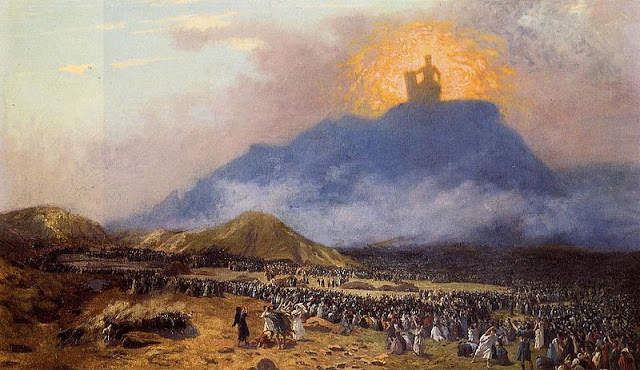
Moses on Mt. Sinai,
by Jean-Leon Gerome, 19th century

This is their high point. After this, Aaron and the Israelite leaders go downhill, both literally and figuratively. Joshua, Moses’ attendant and war-leader, stays partway up the mountain. And Moses climbs to the summit again. There he disappears into God’s cloud—or fire, from the point of view of the Israelites below. (See my earlier post, Mishpatim: Seeing the Cloud.)

Inside the cloud, Moses listens to God’s instructions for 40 days . Meanwhile, the Israelites below conclude that their prophet has died in the fire on the mountaintop and will never return. And without Moses, how can their god lead them to their promised land?

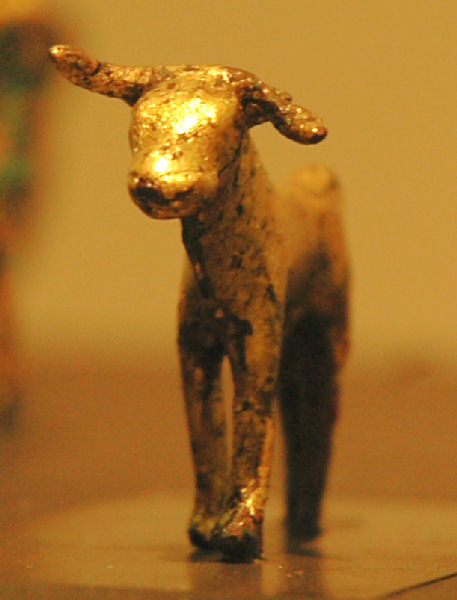
Gold calf from Temple of Baalat, Byblos

They fall back on an old and familiar solution in this week’s portion, Ki Tissa (“When you bring up”): a physical image or idol for the god to inhabit. They give Aaron their gold earrings, and get him to mold an image in the shape of a calf. On his own initiative, Aaron builds an altar and declares a festival for God the next day.

The same day that the Israelites bring animal offerings to the new altar, God hands Moses the two stone tablets written by the finger of God (Exodus/Shemot 31:18), tells him to go down the mountain, and then tells him what the Israelites have done.

Quickly they deserted the path that I commanded them! They made for themselves a cast image of a calf, and they bowed down to it and they slaughtered offerings to it, and they said: These are your gods, Israel, that brought you from the land of Egypt. (Exodus 32:8)

God offers to consume the Israelites and make Moses into a great nation instead. But Moses refuses the offer and tramps down the slope, still holding the two stone tablets on which God wrote, among other things, the commandment against making idols.

Joshua joins his mentor partway down. He has spent 40 days waiting on the mountainside, unaware of what was happening either to Moses at the top or to the Israelites at the bottom.

Then Joshua heard the sound of the people as they shouted, and he said to Moses: The sound of battle is in the camp! (Exodus 32:17)

Moses does not reply. Joshua listens carefully as they continue to descend.

And he said: Not the sound of anot of prevailing, and not the sound of anot of defeat. A sound of annot I am hearing. (Exodus 32:18)

anot (עֲנוֹת) = responding, answering; humiliating, abusing; call-and-response singing (such as kirtan or antiphony).

annot (עַנּוֹת) = (This form of the verb anot is used most often for humiliation, but it is also used in at least one other place, Isaiah 27:2, for singing.)

If there were indeed a battle in camp, Joshua would hear the winners raising their voices in war-cries, abuse, or battle-songs. He would also hear the losers raising their voices in pain, fear, or grief. Because he does not hear these sounds, he concludes that there is no battle. The camp has not been attacked by strangers. Nor has it divided into two sides fighting each other. Whatever the people are doing, nobody in the camp is objecting to it.

What sound does Joshua decide he is hearing? Here are two possible translations:

“A sound of humiliation I am hearing.” In other words, he is hearing the sound of people who have abandoned reason and conscience. Maybe sexual excess has turned into rape. Or maybe the people’s wild party is humiliating for Joshua and Moses, the only two Israelites left to stand against the worship of the Golden Calf.

“A sound of call-and-response singing I am hearing.” In other words, he is hearing a joyful celebration. Elsewhere in the Bible, people use call-and-response singing, along with dancing, to rejoice over God’s success (as Miriam does after they cross the Reed Sea), and to rejoice over David’s victories in battle.

I can imagine Joshua realizing that something happened in the camp, while Moses was gone, and now the Israelites are either holding an orgy, or singing and dancing to rejoice over—what?

The Torah returns to Moses’ point of view.

Moses Breaking the Tablets, by Rembrandt

And it happened as he drew near to the camp, he saw the calf and dancing. Then Moses’ anger flared up, and he threw down from his hand the tablets, and he shattered them under the mountain. (Exodus 32:19)

Moses already knows about the Calf, so why does his anger flare up now? One frequent answer by commentators is that now he sees the people dancing. If the Israelites were worshiping the Calf in a state of doubt and anxiety, they might reject their idol as soon as they saw Moses. Instead, they are rejoicing over the Golden Calf, as if they like the old-time religion better than following Moses’ lead.

It takes the shock of the shattering tablets to yank them back into their former state of mind, when they promised to obey the god of Moses.

Joshua already knows the Israelites are singing. He can assume they are also dancing; elsewhere in the Bible call-and-response singing is usually accompanied by dancing. Now Joshua sees the Golden Calf and the smoking altar in front of it, so he knows the reason for the people’s ecstasy. He also hears the sound of stone shattering. The singing stops.

Moses grinds the Calf into gold dust, adds it to water, and makes the people drink it. He questions Aaron briefly, then stands at the gateway of the camp and shouts: Whoever is for God, to me! (Exodus 32:26)

All the men from the tribe of Levi go over to the side of Moses and Joshua. Moses orders the Levite men, in the name of God, to take their swords and go through the camp from gate to gate.  The Levites kill 3,000 Israelite men. The Torah reports no casualties on the Levite side; apparently the Calf worshippers were too cowed or ashamed to fight back.

So Joshua finally does hear the battle cries of the winners, and the screams of pain and humiliation of the losers. There is no more singing of any kind in the Torah until the book of Numbers/Bemidbar.

I have always wondered if killing 3,000 Calf-worshippers was overkill. After all, everyone was shocked when Moses shattered the tablets God gave him. Everyone drank the gold dust from the Calf. What if Moses’ next move had been to start up a song, instead of a massacre?

What if he had changed the words of the call-and-response song the people were singing for the Calf? Their song is not recorded, but here are two other call-and-response songs in the Torah:

Sing to God because He is the highest;

Horse and its rider He threw into the sea! (Exodus 15:21)

Saul struck down his platoons;

And David struck down his armies! (I Samuel 21:12)

Some people need the outlet of ecstatic song and dance. Maybe another call-and-response song would have turned the hearts of the apostate ecstatics toward the God of Moses. Here is my proposal for the people who rejoiced in the Golden Calf:

“Sing to God because He is the highest;

Higher than idols and higher than gold.”

Just set it to a catchy melody, and let Miriam lead the dancing.

Tetzaveh: Meeting Room

Who will meet in the “Tent of Meeting”?

Moses receives instructions for making a portable tent-sanctuary for God in last week’s portion, Terumah.  This week’s portion, Tetzaveh (“you shall command”), is the first one to call the sanctuary the ohel mo-eid, the “Tent of Meeting”—an expression that appears 137 times in the books of Exodus through Deuteronomy.

This week’s portion is also the first to reveal who will meet at or inside the tent.  But in its first appearance, the phrase “Tent of Meeting” is merely a location.  God tells Moses:

And you, you shall command the children of Israel, so they will take for you pure oil of beaten olives for the light, to make the lamp go up regularly.  In the ohel mo-eid, outside the dividing curtain that is in front of the testimony [in the ark], Aaron and his sons shall set it up from evening until morning before God.  [This is] a decree forever for the generations from the children of Israel. (Exodus/Shemot 27:20-21)

ohel (אֹהֶל) = tent.

mo-eid (מוֹעֵד) = appointed place for meeting with God; appointed time (usually for a religious festival).  (From the root ya-ad, יָעַד = appoint a time or place.)

ohel mo-eid (אֹהֶל מוֹעֵד) = Tent of Meeting (i.e. the tent appointed for meeting with God).

The ohel mo-eid is the portable tent-sanctuary God described to Moses in last week’s Torah portion, a two-chamber tent with a dividing curtain screening off the Holy of Holies from the larger front chamber.1  The menorah whose lamps the priests must fill is inside the tent’s front chamber.

The portion Tetzaveh then describes the vestments to be made for the new priests, followed by the ritual for ordaining them.  First Moses must assemble Aaron and his four sons, a bull and two rams, three kinds of bread, and the new priestly garments.

Then you shall bring Aaron and his sons to the entrance of the ohel mo-eid and you shall wash them in water.  (Exodus 29:4)

Both the basin for the priests’ ritual washing and the altar for burnt offerings are located outside the Tent of Meeting, in front of the entrance.

And you shall bring the bull to the front of the ohel mo-eid, and Aaron and his sons shall lean their hands on the head of the bull.  And you shall slaughter the bull before God, at the entrance of the ohel mo-eid.  (Exodus 29:10-11)

After washing and dressing Aaron and his sons, Moses must make the first offerings on the new altar, and sprinkle some of the blood on both the altar and the five men.After Moses has made all the offerings, the remaining bread and the remaining meat from the second ram go to the men being ordained.

And Aaron and his sons shall eat the flesh of the ram, and the bread that is in the basket, at the entrance of the ohel mo-eid.  (Exodus 29:32)

The whole process, from washing to eating, must be carried out in front of the Tent of Meeting, and must be repeated every day for a total of seven days in order to sanctify both the priests and the altar.  After that, the priests will make daily offerings, which are briefly listed.  With the last one, an evening offering of a lamb, God finally mentions why the portable sanctuary is called the “Tent of Meeting”.

[It is] a perpetual rising-offering3 for your generations at the entrance of the ohel mo-eid, in front of God, where iva-eid with you, to speak to you there.  (Exodus 29:42)

iva-eid (אִוָּעֵד) = I shall meet, I shall arrange meeting(s).  (Also from the root ya-ad.)

The “you” in this sentence is plural.  The next sentence declares that the ohel mo-eid will be the locus or focus where all the Israelites can meet God.

Veno-adeti there for the Children of Israel, and it will be sanctified by my glory.  (Exodus 29:43)

veno-adeti (וְנֹעַדְתִּי) = And I will arrange meeting(s).  (Also from the root ya-ad.)

The Torah does not explain what kind of meeting or meetings will occur between God and the Israelites.  But God does say:

And I will dwell in the midst of the Children of Israel and I will be their god.  (Exodus 29:45)

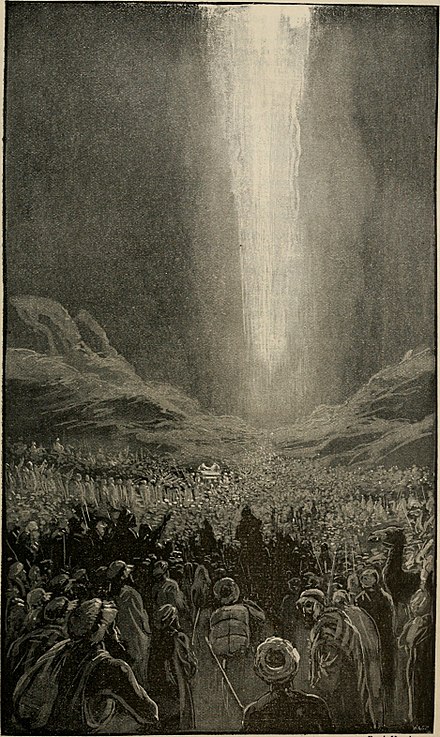
Pillar of cloud, from Collectie Nederland

Maybe the Israelites have a meeting with God whenever they see the pillar of cloud and fire that rests over the Tent of Meeting when they are encamped.4  Or when they brings offerings to the courtyard in front of the tent and watch while the priests perform the ritual actions to send them up to God.  Or maybe living so close to the Tent of Meeting is enough for the Israelites to meet God.

The Torah portion then describes the incense altar, and God adds:

And you shall place it in front of the dividing curtain that is in front of the Ark of the Testimony, in front of the atonement-cover that is over the testimony, where iva-eid with you.  (Exodus 30:6)

This time “you” is singular.  Only Moses, to whom God is speaking, will meet with God inside the back chamber of the tent, the Holy of Holies, in front of the atonement-cover on the ark.

Thus the innermost chamber the Tent of Meeting is the appointed place where Moses and God meet, while the tent as a whole is the focus for meetings between rest of the people and the God who dwells in their midst.

*

Before there is a Tent of Meeting, people in the Torah never know where God might speak to them.  God’s voice might come in a dream, or from a stranger who turns out to be not human after all, or from a burning bush.  But in this week’s Torah portion Moses learns that God has designated the Tent of Meeting as the appointed place.  God still speaks to Moses at odd moments, but a formal meeting takes place inside or in front of the tent.

When the Israelites have finished making all the items for the Tent of Meeting and Moses assembles it for the first time, God fills the tent with the divine manifestations of cloud and glory (or impressiveness).

And Moses was not able to enter the ohel mo-eid because the cloud rested upon it and the glory of God filled the sanctuary.  (Exodus 40:35)

The presence of God is too strong for the meeting to take place!  So the book of Leviticus/Vayikra begins with God summoning Moses and speaking to him from the Tent of Meeting, as if God has changed the divine frequency in order to meet the appointment with Moses.

*

Many people today believe they have an appointed place to meet with God: their synagogue or church or mosque or temple.  Some religions still claim that God gives direct instructions to their leaders.  And all too many people believe that the “real” God can only be found in their religion’s sacred places.

I pray that someday people will notice the glory of God outside their own exclusive Tent of Meeting, and the divine will dwell in the midst of everyone on earth.

  1. Exodus 26:31-33.
  2. See my posts Tzav: Oil and Blood and Tzav: Horns, Ears, Thumbs, and Toes.
  3. olah (עֹלָה) = rising-offering.  (From the root alah (עלה) = go up.) In an olah the entire slaughtered animal is burned up into smoke, which rises to the heavens.
  4. Exodus 40:36-38, Numbers 9:15-17.