Noach: The Soother

by Melissa Carpenter, maggidah

By the end of the first Torah portion in the book of Genesis/Bereishit, God regrets creating human beings, and decides to wipe them out. I offered theories about why God thought the human race was spoiled in two of my earlier blog posts: Noach: Spoiled, and  Bereishit: Inner Voices. This year, when I reread the Torah portion named after Noah—Noach in Hebrew—I wondered why such a discouraged God made one exception, and saved Noach and his immediate family from the flood.

Last week’s Torah portion ends:

But Noach found favor in the eyes of God. (Genesis/Bereishit 6:8)

This week’s Torah portion, named after Noach, begins:

These are the histories of Noach. Noach was a righteous man; in his generations, Noach walked with God. (Genesis 6:9)

Noach (נֹחַ) = Noah; an alternate spelling of noach נוֹחַ)), a form of the verb nuch (נוּח) = come down to rest, settle down.

Noah Leaving the Ark, by Sisto Badalocchio

The first appearance of the verb nuch in the Torah is when Noach’s ark comes to rest on Mount Ararat at the end of the flood in Genesis 8:4. This is also Noach’s turning point, when he finally begins (at the age of 600) to take some initiative: sending out the birds to test the water level, making an animal offering to God, and planting a vineyard.

Before the flood, God tells His favorite person, Noach, that people are evil and the whole world has been spoiled.  He gives Noach instructions for making a wooden ark, and says He will flood the earth and destroy all flesh—except for the few humans and animals on the ark.

(I used the pronoun “He” in case because the God character the Torah presents here is quite anthropomorphic, making sweeping generalizations and acting emotionally.)

Later in the Torah, when Abraham is God’s favorite person of the era, and God tells him that He is about to commit genocide, Abraham talks God out of it.  He persuades God to refrain from burning up Sodom if there are even ten innocent people in the city. In the book of Exodus, Moses persuades God to give the Israelites a second chance after they worship the Golden Calf.

But Noach is silent. After God has spoken to him, all the Torah says is: And Noach did everything that God commanded him; thus he did. (Genesis 6:22)

God tells Noach to load seven pairs of each of the ritually-pure animals on board, as well as one pair of each of the impure animals. Then He rephrases His plan, saying that He is going make a flood and

wipe out everything standing on the face of the earth (Genesis 7:4).

Again, Noach is silent. The Torah repeats:

And Noach did everything that God commanded him.

Both times, Noach makes no protest, but only does what God commands. So God floods the earth.

After the flood is over and Noach empties the ark, his first order of business is acting on the hint implied in God’s order to carry seven times as many of the animals that are ritually pure (according to the rules for purity laid out later, in the book of Leviticus/Vayikra).

Then Noach built an altar for God, and he took from all of the ritually-pure animals and from all of the ritually-pure birds; and rising-offerings went up [in smoke] on the altar. And God smelled the nichoach aroma, and God said to His heart:  I will not again draw back to curse the earth on account of the human, for the impulse of the human heart is bad in its youth … (Genesis/Bereishit, 8:20-21)

nichoach (נִיחֹחַ) = soothing or pleasing to a god. (The use of this word may be a play on Noach’s name, and may also imply that the god in question will be inclined to come down and rest its presence over the sacrifice.)

Noach’s action puts God in a better mood. God has another change of heart, and views the human condition more optimistically and rationally. According to classic commentary, God decides that it is only natural for children to act on their bad impulses, but adults can learn to control these impulses and be good. So God tells Himself not to overreact to human misdeeds again.

Why does the aroma of Noach’s offering soothe God?

Maybe the God character in the Torah, like other Canaanite gods, loves the smell of burning animals. This would explain why God favored Abel’s animal offering and rejected Cain’s plant offering. It would also explain why slaughtering and burning livestock was the primary method of worshiping God from the time of Genesis down to the fall of the second temple 70 BCE. God really liked that barbecue smell, so that’s what the Israelites gave Him.

On the other hand, maybe God provided Noach with excess ritually-pure animals because He remembered Cain and Abel’s spontaneous offerings, and wanted to make sure Noach had something to offer if he happened to feel spontaneous gratitude for being saved from the flood. The thick clouds of smoke from the combustion of more than 33 kinds of birds and beasts reassures God that Noach does, indeed, feel grateful. So God concludes that adults, at least, can feel and act on good impulses.

So have many commentators, from Philo of Alexandria in the first century C.E. to Rabbi Samson Raphael Hirsch in the 19th century. But I think both those commentators and the God character in the Torah still had more to learn about human psychology.

Why Noach Burned the Animals

I can imagine Noach acting purely out of fear of this God of wholesale destruction, who cares nothing about innocent children or animals. Noach might well be moved to burn as many animals as possible in the hope of forestalling the Destroyer’s next whimsy.

Another possibility is that Noach acts out of despair. When the flood begins, he had to hustle his own family and the animals he has collected into the ark, then keep everyone else out of it.  God closes the door into the ark, but perhaps Noach could still hear the cries of his own neighbors and the sobbing of frightened children.

When the flood waters sink, Noach would see not only mud and broken trees, but floating corpses. He goes ahead and sacrifices the excess ritually-pure animals because he has figured out God wants him to. There is no point in disobeying God now. He wishes he had spoken up earlier, before the earth was destroyed.  Did God leave another hint that he missed? Could he have done anything to save more people? Now it is too late, and Noach has to live with himself.

He listens to God’s speech giving instructions for living in the new world, and promising that a flood will never destroy the earth again. But I think Noach is too depressed to care.  As soon as God is done talking, Noach plants a vineyard. In the next sentence, he gets drunk.

Some commentators criticize Noach for his silent obedience. But when I reflect on my own life, I know that the number of times I spoke up in favor of justice or mercy were few in comparison with all the times I felt powerless and kept my mouth shut. When the person in authority has absolute power and does not show compassion, it is hard to risk a loss of acceptance, loss of a job, or even loss of one’s life. I can only feel sorry for Noach.

The most frightening thing about the Torah portion Noach is that the person in authority is a god, a god who gets carried away by egotistical emotions and has only a primitive sense of justice. Even today, natural disasters such as earthquakes, hurricanes, and volcanic eruptions can be taken as evidence of a morally deficient god.

That’s why, when I write about these parts of the Torah, I often refer to “the God character”. The anthropomorphic character that the Torah stories refer to by various names of God is simply not the same as the creator of the universe; or the theologians’ omnipotent, omniscient, omnibenevolent being; or the essence and totality of existence; or even the mysterious unknown we sometimes sense with our non-rational minds.

Yet we can still learn from Torah stories in which the God character not only creates and tests and destroys human beings, but also learns from them. There is a God character inside each of our psyches, as well as a Noach, and an Abraham, and maybe even a Moses.


Bereishit: The Other Tree

In the first creation story in the book of Genesis/Bereishit, God makes human beings in Its image, male and female, and ends the sixth “day” by deciding that everything is “very good”. The Torah does not say in what way human beings resemble God.

Then we get a second creation story. In this story (attributed by scholars to an older source), God creates a single human before inventing plants or other animals.

And God formed ha-adam of dust from ha-adamah, and [God] blew into its nostrils the breath of life, and ha-adam became a nefesh chayah. (Genesis/Bereishit 2:7)

ha-adam (הָאָדָם) = the human, humankind, the earthling.

ha-adamah (הָאֲדָמָה) = the earth, the dirt.

nefesh chayah (נֶפֶשׁ חַיָּה) = animated animal, living creature.

Instead of simply making humans in God’s image, as in the first creation story, God shapes a human body and breathes life into it—the same process God uses later in the story to create various birds and mammals. Then God makes a place outside the world where the archetypal human can acquire a divine trait, and thereby become an image of God, unlike other animals. Peaches_clip_art_hight

Then God planted a garden in Eiden mikedem, and It put there ha-adam that It had formed. And God made sprout from the earth every tree that was desirable in appearance and good for food, and the Tree of Life in the middle of the garden, and the Tree of Knowledge of Good and Bad.  (Genesis 2:8-9)

Eiden (עֵדֶן) = Eden; luxury, pampering, delight.

mikedem (מִקֶּדֶם) = from the east, from primeval time.

God invites the human to eat from all but one of the trees in the garden.

And God laid an order on ha-adam, saying: From every tree in the garden you may certainly eat. But from the Tree of Knowledge of Good and Bad, you may not eat from it, because on the day you eat from it, you will certainly die. (Genesis 2:16-17)

What about the Tree of Life, which is also in the middle of the garden? By giving the human permission to eat from every tree except the Tree of Knowledge, God offers the human the option of eating from the Tree of Life—whose fruit, we learn later in the story, confers immortality.

When I reread the story this year, I realized that God subtly gives ha-adam a choice between the two trees.  If the archetypal human eats from the Tree of Knowledge, it will gain the divine characteristic of moral knowledge, but it will be doomed to die.  If it eats from the Tree of Life, it will gain the divine characteristic of immortality–but will it lose the ability to discover morality?

The first human being is not yet human enough to react with curiosity. It asks no questions, and apparently refrains from the fruit of both the trees in the middle of the garden. Eventually God separates the two sides of the human into two individuals, one male and one female. This does the trick; the woman is curious enough to hear the questions and arguments of the snake (another of God’s creations), including the comment:

For God knows that on the day you eat from it, your eyes will be opened, and you will become like God, knowing good and bad. (Genesis 3:5)

We already know that every tree in the garden is desirable in appearance and good for food (Genesis 2:9). The woman now notices a third way in which the Tree of Knowledge is “good”.

The woman saw that the tree was good for food and that it satisfied a craving of the eyes, and the tree was desirable for haskil, so she took some fruit and she ate; and she gave also her to her man with her, and he ate. (Genesis 3:7)

haskil (הַשְׂכִּיל) = understanding, having insight.

Both humans want divine insight so much, they forget about the Tree of Life and eat from the Tree of Knowledge of Good and Bad. They gain a basic concept of morality, and the ability to figure out what is good and bad on their own.

The two primeval humans do not keel over dead that day.  Instead, they become mortal.  God tells them they will return to the world, where life will be hard, and eventually they will die and turn back into dust. God mentions the pain of childbirth, and the man notices that there will be birth as well as death in the world.

So ha-adam called the name of his woman Chavah, because she herself had become a mother of all life. (Genesis 3:20)

Chavah (חַוָּה) = Eve; a variant of chayah = living animal, vigorous, to bring to life.

Instead of immortality, humankind chooses moral knowledge and life in this world, which is inseparable from birth and death.

And God said: Here, the human has become like one of us, knowing good and bad, and now, lest he stretch out its hand and take also from the Tree of Life and eat and live forever—! (Genesis 3:22)

This sentence raises obvious two questions. What does God mean by saying the human has become like one of us? (Next year I want to write about all the hints of multiple gods in this first Torah portion, including in the passage above.) Secondly, why can’t the humans eat from both trees? Why shouldn’t they acquire a second divine characteristic?

I think the answer is that in our universe, everything is in flux, constantly changing.  Even stars burn out.  And every living thing is born, grows, experiences pain, and dies. Life in this world is mortal.  Immortality can only apply to something outside our universe, outside time and space—like the garden of Eiden.

But our world also presents human beings with moral choices that matter. We can choose actions that increase the life and well-being of others, or actions that increase death and pain. Our ability to puzzle out good and bad depends on living in this world.

So God sent [the human] out from the garden of Eiden, to serve the earth from which it had been taken. And [God] banished the human, and It set up in front of the garden of Eiden the cherubim and the flame of the whirling sword, to guard the way to the Tree of Life. (Genesis 3:23-24)

Human beings in the real world can resemble God in having moral understanding, but we cannot resemble God by living forever.

Other ancient religions told stories about how human heroes tried, but failed, to become like the gods by eating or bringing home plants that would confer immortality. The remarkable thing about the second creation story in Genesis is that humankind gets a different divine characteristic: moral insight.

The rest of the book of Genesis can be read as a story about how both humans and God begin to learn how to apply moral insight to situations in the world. For example, when Cain becomes enraged, God tries to warn him against killing his brother, but it takes the rest of the book for the humans to figure out how brothers can tolerate each other.  When God decides to wipe out Sodom, Abraham tries to teach God to judge humans individually instead of punishing the innocent with the guilty, but God does not always apply the lesson.

We are still learning how to behave ethically. As our moral insights develop, many humans have learned how to be good in ways that neither the people nor the God-character in the Torah imagined. (For example, see my earlier post, Va-etchannan: Haunted by Shame.)

We can never acquire immortality in this world, but we are still tasting the fruit from the Tree of Knowledge of Good and Evil. May we all remember how precious and desirable our moral insight is, and pause to think about our moral choices.

Vezot Habrakhah: Zevulun’s Secret

This week Jews celebrate Rosh Hashanah, the beginning of the year. This Saturday is Shabbat Shuva, and the Torah portion is Ha-azinu (Use your ears). In the last few years, I have written four posts on Ha-azinu: Upright, Devious, and Struggling; The Tohu Within; Raining Insights; and Hovering. But since I will be traveling for three weeks, from Rosh Hashanah through Yom Kippur and Sukkot, this post will look at the Torah portion Vezot Habrakhah (“And this is the blessing”), the last portion in the book of Deuteronomy/Devarim.

On Simchat Torah (October 16-17 this year) a Jewish tradition is to finish Deuteronomy and start the new annual cycle of Torah readings with the opening of Genesis/Bereishit. That first Torah portion will be the subject of my first post when I get home in a few weeks!

Zevulun
Zevulun

Zevulun’s Secret

In the last Torah portion of Deuteronomy, Moses pronounces prophecies for each of the tribes of Israel, as well as blessing all the Israelites, before he climbs Mount Nevo to die. The text of the “blessings” of the tribes that has been handed down to us is somewhat corrupted by scribal error, according to modern scholars. But it still expands Jacob’s “blessings” of the tribes near the end of Genesis/Bereishit.

Jacob pronounces blessings, or prophecies, about his twelve sons before he pulls his feet up into his bed and dies. Each prophecy is really about the tribe that will bear that son’s name. (See my earlier post, Vayechi: Fierce Brothers.) But earlier in Genesis, Jacob’s sons are characters in the story.

Half of the twelve sons are the equivalent of spear-carriers; the Torah gives them neither lines nor stage business. Unlike their eponymous tribes, the only identities these six sons have are their names—Dan, Naftali, Gad, Asher, Yissakhar, and Zevulun—and the meanings their mothers or adoptive mothers assign to their names.

The youngest spear-carrier is Zevulun, Leah’s sixth and last son. When he is born, Leah says: God gave a gift to me, a good gift; [this] time my husband yizbeleini because I bore him six sons. And she called his name Zevulun. (Genesis/Bereishit 30:20)

yisbeleini (יִזְבְּלֵנִי) = he will elevate me, he will exalt me, he will honor me. (The root of this verb, זבל, is the same as the root of the name Zevulun.)

Zevulun (זְבֻלוּן) = exalted place, place of honor.

As with all the other baby-namings in the Torah, the name indicates the parent’s state of mind. We learn nothing about the character of Leah’s sixth son from his name.

But we do learn something about Zevulun’s tribe when Jacob recites his prophetic poem about the tribes from his deathbed.  He says:  Zevulun, at the shore of the sea he will dwell; and he will be a shore for ships, and his flank will be upon Tzidon. (Genesis 49:13)

Tzidon (צִידֹן) = Sidon; one of the first Phoenician port cities on the Mediterranean Sea. (Tzidon is now the city of Sayda in Lebanon).

The second prophetic poem about the tribes, spoken by Moses in the last Torah portion of Deuteronomy, combines the tribe of Zevulun with the tribe that bears the name of Leah’s fifth son, Yissakhar (often spelled Issachar in English).

And to Zevulun he said: Rejoice, Zevulun, in your going out, and Yissakhar, in your tents. They will call peoples to the mountain; there they will slaughter slaughter-offerings of righteousness; for they will suckle on the abundance of the seas, and the hidden treasures of the sand. (Deuteronomy/Devarim 33:18-20)

Canaan at Joshua's Death
Canaan at Joshua’s Death

Both poems about the tribes of Israel claim that the territory of Zevulun includes a piece of the Mediterranean coast. Jacob’s poem says Zevulun will extend as far as Tzidon, but in the book of Joshua, when the tribal territories are allocated by lot, it is Asher, Zevulun’s northern neighbor, that reaches as far as the great city of Tzidon.

The boundaries of Zevulun given in the book Joshua include many place-names we cannot identify today, and do not mention any coastline. The one identifiable place in the description of Zevulun’s land is Beit-Lechem. The coast west of Beit-Lechem of Galilee is Haifa Bay, which lies south of both Tzidon and Tzor (Sidon and Tyre ), the two major Phoenician cities at the time.  But the Phoenicians had coastal villages farther south, as far as Dor.

The coast south of Dor, from Ashdod to Gaza, was being invaded by the Plishtim (Philistines) around the time of Joshua’s conquest of Canaan, which the Bible places circa 1300 B.C.E. The Plishtim migrated from Crete and other islands across the sea, and after seizing their beachheads on the coast, they fought for centuries to conquer more of Canaan.

But the Bible does not record any hostile actions by Phoenicians against Israelites. Could Zevulun have shared the Mediterranean coast with them?

I think so.  Historically, both the Israelites and the Phoenicians spoke a Canaanite dialect in the Semetic language family, and the writings of both peoples reveal roots in Canaanite culture.

In the Bible, the people of Zevulun get along with non-Israelite neighbors. Although Moses instructs the Israelites to dispossess the Canaanites and drive all the natives out of the land, the first book of Judges lists the tribes that did not do so. Zevulun is one of the tribes that lives alongside the Canaanites.

Furthermore, even Moses’ poem about the tribes predicts that Zevulun and Yissakhar will call peoples to the mountain; there they will slaughter slaughter-offerings of righteousness. (Deuteronomy 33:19) Rather than trekking all the way to Israel’s central place of worship, they invite neighboring peoples to join them in offering animal sacrifices at a local mountain in the Galilee. And even though Deuteronomy is full of warnings to worship God at only one place, the poem Moses recites at the end of his life calls the neighborly offerings on a local mountain “righteous”.

Zevulun’s reward for friendly relations with its Phoenician neighbors is a share of Phoenician wealth, which came from maritime trade, fishing, and the sale of valuable purple dye and white (milk) glass. The dye came from mollusks found on that part of the coast, and the glass was made from the high-quality sand on the shore. The commentaries agree that these Phoenician products must be the hidden treasures of the sand mentioned in Deuteronomy 33:20.

This glimpse into the ways of Zebulun is a welcome contrast with all the times the Hebrew Bible urges the Israelites to treat other peoples as enemies. The Bible often condones vicious pre-emptive wars against Canaanites, Amorites, Midianites, and assorted other peoples in the region. (For an example, see my post Va-etchannan: Haunted by Shame.) Apparently God, Moses, and many of the prophets (at least as portrayed in the Bible) believe the Israelites are so easily tempted to abandon their own religion, they must commit genocide lest they learn about another attractive cult.

There is a better way to prevent people from discarding their God and their religion: make the religious practices more inspiring and more likely to touch the heart. The Torah illustrates this method in the book of Exodus, when the anxious people turn to the Golden Calf, but then turn back to God with joy and dedication when Moses gives them the chance to make a beautiful sanctuary for God.

Zevulun offers another illustration, by adopting the Phoenician way of making a livelihood, and inviting their foreign friends to join them in making offerings to God on a nearby mountain. They drop the rule about worshiping God only at the central sanctuary. But in exchange they gain peace with their neighbors—without abandoning their own god. And the Torah portion Vezot Habrakhah says their offerings are righteous.

I think the hidden treasures of the sand that Zevulun enjoys are not only milk glass and purple dye, but also the treasures that come from tolerance and goodwill.

May all people learn how to preserve their religions by offering friendship to strangers as they offer their hearts to their own gods.


Vayeishev: Stripped Naked

What does it mean to be stripped naked and exposed in public? Joseph finds out—twice—in this week’s Torah portion, Vayeishev (“And he stayed”).

When Joseph is growing up, his father, Jacob, treats him as superior to all ten of his older brothers. Naturally his brothers are jealous. They also hate Joseph because he tells them his two dreams, both of which predict his brothers will bow down to him.

Jacob makes things worse by giving a special garment only to his favorite son, Joseph.

Jacob Blesses Joseph and Gives Him the Coat, by Owen Jones, 1865

…and he made for him a ketonet passim. And his brothers saw that it was he their father loved most out of all his brothers, so they hated him, and they were not able to speak to him with peace. (Genesis/Bereishit 37:3-4)

ketonet  = a long tunic

passim = ? (Newer translations include “ornamented” and “long-sleeved”. Pas = palm of hand (or sole of foot). A garment with sleeves below the wrist would be impractical for physical labor, and therefore a sign of high rank.  The only other biblical reference to passim is in 2 Samuel 13:18-19, which explains that King David dresses his unmarried daughters in katenot passim.)

The King James Bible translated ketonet passim, inaccurately, as a “coat of many colors”. I wonder if the translators chose the word “coat” in order to imply that Jacob is fully dressed underneath the garment his brothers strip off. But a coat or cloak would be a simlah or me-iyl in biblical Hebrew, not a ketonet. And as far as we know, nothing was worn under a ketonet.

Jacob sends Joseph to check up on his brothers, who are pasturing the family flocks far away in Dotan. Although Joseph knows his brothers could not speak to him in peace” (Genesis 37:4), he does not imagine that while they watch him approach they are debating whether to kill him.

And so it was, when Joseph came to his brothers, then they stripped off Joseph his ketonet, the ketonet of the passim, which was on him. And they took him and threw him down into the pit; and the pit was empty, there was no water in it. (Genesis 37:23-24)

The brothers decide to sell Joseph as a slave instead of killing him. They have no trouble selling him to a passing merchant caravan; a naked adolescent boy at the bottom of an empty cistern is unlikely to be anyone of importance. When the merchants reach Egypt, they resell Joseph to the Pharaoh’s chief butcher, Potifar.

What if you found yourself in a foreign country with no clothes, no money, and no identification, being handed over to your new owner? Would you scream that it was a mistake, and keep trying to explain who you are?

At age 17, Joseph accepts his new situation with remarkable equanimity. He sees that without his father’s ketonet and his father’s authority, he has no identity. Naked, he has only the blessings God gave him at birth: brains and beauty. So he applies his intelligence to his new situation and makes the best of it.

God was with him and he became a successful man, and it happened in the house of his master, the Egyptian. (Genesis 39:2)

Joseph’s master, Potifar, promotes him from field slave to steward of his entire household. Egyptian field slaves worked naked, but a steward would wear a linen kilt called a shenti or shendyt.

Once Joseph is nicely dressed, his beauty attracts Potiphar’s wife. She propositions him day after day, but Joseph refuses her on the grounds that it would be unfair to his master and an offense against God.

A less mature young man would assume his elevation to steward was entirely due to his own cleverness and hard work. But Joseph’s reply to Potifar’s wife shows that he knows he would still be working in the field naked without the goodwill of his human and divine masters.

Then it happened one day, he came into the house to do his work, and none of the men of the house were there inside the house. And she seized him by his beged, saying: Lie with me! But he left his beged in her hand, and he fled and he went outside. (Genesis 39:11-12)

beged = garment (of any kind), clothing, cloth covering; treachery.

Joseph Flees Potiphar’s Wife, by Julius Schnorr von Carlsfeld, 19th century

Joseph’s wrap-around linen kilt would be tied in front, and if the knot came loose—or were pulled loose by a lustful woman—the garment would fall off onto the floor.

What does an Egyptian wear under his kilt? In the time of the Middle Kingdom, an Egyptian nobleman wore a sheer linen shendyt and a short under-skirt. But Joseph, as a high-ranking slave, would wear a coarse linen shendyt and nothing underneath. When he flees and goes outside, he is naked.

Potifar’s wife is afraid that other servants will see Joseph naked, and find Joseph’s garment in her room. To avoid being accused of adultery, she screams, and then accuses Joseph of imposing himself on her. As a result, Joseph finds himself back in a pit: Potifar sends him to prison.

Once again, Joseph has been stripped of his clothing and his position due to the treachery of someone whom he never suspected would go that far.

Joseph continues to use his brains in prison, and God continues to bless him with success. He becomes the chief jailer’s steward. After two years, Joseph is given an opportunity to interpret the Pharaoh’s dreams, and he succeeds at this, too. Pharaoh elevates him to viceroy of Egypt, and Joseph wears a gold ring and the finest sheer linen. This time he keeps his public identity, along with his clothes.


Clothing still gives people visible status and identity today. We treat a man wearing a suit and tie differently from one wearing a torn sweatshirt. And even today, we might lose our social identities at any time, no matter how wonderful our innate qualities are.

But we increase the odds of keeping our public identities when we treat other people not as clothes hangers, but as human beings with their own feelings and desires. We do better if we are grateful to the Potifars in our lives, and extremely cautious with the jealous brothers and philandering wives.

We are all naked under our clothes. May we all become humble enough, like Joseph, to learn from the times we are exposed, and reinvent our lives for the better.

Toldedot: To Bless Someone

For most of my life, the closest I came to giving or receiving a blessing was “Good luck!” When I converted to Judaism, I learned how to bless God as a way to express my appreciation for food and other good things in life. But the idea blessing another person never occurred to me.

Yes, I had read about Isaac blessing his sons in this week’s Torah portion, Toledot (“Lineages”). I gathered that giving a blessing means both stating the good outcomes you want for another person, and calling on (or praying to) God to make your words come true. But I did not believe that the actual words mattered, or that a formal blessing would be any more effective than “Good luck!” I felt sorry for Isaac and his family for taking the blessing business so seriously. I was 48 before I discovered Jewish Renewal and the potential power of blessing.

What makes a blessing a living force instead of a formality?

The blessings in the book of Genesis/Bereishit use formal poetic language. Even when they are personal blessings, they focus material prosperity, fertility, and/or victory over enemies, and use customary phrases. For example, Rebecca’s mother and brother bless her as she leaves home to get married, saying: Our sister, may you become a thousand multitudes, and may your descendants take possession of their enemies’ gate.” (Genesis/Bereishit 25:60)

Another kind of blessing in Genesis is “the blessing of Abraham”, a phrase the Torah uses to refer both to God’s promise that Abraham’s descendants will possess the land of Canaan, and to the first blessing God gives Abraham:

I will make you a great nation, and I will bless you and I will make your name great, and you will become a blessing. And I will bless those who bless you, and those who curse you I will curse. And all the clans of the earth will find blessing through you. (Genesis 12:2-3)

In this week’s Torah portion, Isaac decides to give a blessing to Esau, the firstborn of his twin sons. The Torah does not say whether Isaac is planning to give Esau his personal blessing, or the blessing of Abraham, but it does say what part of himself Isaac hopes will deliver the blessing.

Isaac Sends Esau to Hunt, by James Tissot, ca. 1900

He said: I have grown old, and I do not know the day of my death. So now, please pick up your gear, your quiver and your bow, and go out to the field and hunt game for me. Then make me tasty tidbits, the kind that I love, and bring them to me, and I will eat, so that my nefesh may bless you before I die.” (Genesis/Bereishit 27:2-4)

nefesh (נֶפֶשׁ) = animating soul; seat of appetite, desire, yearning, instinct; person

Isaac wants the blessing to come from his nefesh, his instinctual self, without any interference from his conscious mind. Isaac loves Esau and could invent a formula of blessing. But he wants his blessing to express the will of God as it moves through him, not his own conscious will.

When Isaac’s wife, Rebecca, overhears him, she assumes he intends to give Esau the blessing of Abraham. She panics, not only because she loves Jacob more, but also because she knows that Jacob is the one who will carry on the worship of the God of Abraham.

Apparently Rebecca and Isaac are having communication problems, because she does not march into Isaac’s tent and straighten him out. Instead, she says to Jacob:

Hey, I heard your father speaking to your brother Esau, saying: Bring game to me and make me tasty tidbits, and I will eat them, and I will bless you lifnei God, before my death.” (Genesis 27:6-7)

lifnei (לִפְנֵי) = in the presence of, before

Rebecca interprets Isaac’s reference to blessing with his nefesh as blessing “in the presence of God”, and she associates this with God’s blessing of Abraham.

She quickly cooks some tasty tidbits from goat meat, and orders Jacob to bring them to his father. Jacob protests that he is not a hairy man, like his brother, so his blind father will know he is not Esau as soon as he touches him. So Rebecca disguises Jacob by dressing him in Esau’s spare clothes and fastening the skins of goat kids around his hands and neck.

Of course as soon as Jacob comes in and says, My father, Isaac recognizes Jacob’s voice, and asks:

Who are you, my son?” Then Jacob said to his father: “I am Esau, your firstborn. I have done as you spoke to me. Get up, please, sit, and eat some of my game, so that your nefesh may bless me.” (Genesis 27:18)

Jacob thinks like his father. He hears Rebecca’s “in the presence of God”, and interprets it in terms of Isaac’s nefesh!

Isaac tests his son several times, unable to believe that this man with Jacob’s voice is really Esau, no matter how hairy his hands feel. Then he decides to bless the son in front of him anyway. Now it is even more important that the blessing come from God, so he repeats:

I will eat some of the game of my son, so that my nefesh may bless you.” (Genesis 27:25)

After Isaac has eaten and received a kiss from his son, he delivers the blessing:

May God give to you from the dew of the heavens, and from the fat of the land, and abundant grain and wine. May peoples serve you, and may nations bow down to you. Be a leader to your kinsmen, and may the descendants of your mother bow down to you. Cursed be those who curse you, and may those who bless you be blessed.” (Genesis 27:28-29)

The blessing begins with the standard themes of material abundance and victory over other nations. Then Isaac adds part of God’s blessing of Abraham:  Cursed be those who curse you, and blessed be those who bless you. He does not say the other part of the blessing of Abraham—that he will have many descendants, and they will possess the whole land of Canaan—until later in the Torah portion, when he gives a blessing to Jacob as Jacob.

I think that Isaac gives Jacob-in-disguise part of the blessing of Abraham because he is indeed speaking from his instinctual self, channeling divine inspiration without thinking it through. His words naturally mirror the words of the blessing of Abraham.

When his other son shows up a moment later with his own tasty tidbits, Isaac recognizes Esau’s voice, and comes out of his trance and back to earth. He trembles, partly because he knows he cannot repeat the same blessing to Esau, and partly because he realizes that the blessing he just gave Jacob is indeed an expression of God’s will.

Then Isaac trembled, full of fear, and said: “Who is it, then, who hunted game and brought it to me and I ate everything before you came and I blessed him? He must be truly blessed!” (Genesis 27:33)


Is it possible to channel a blessing from God, as Isaac apparently channels his first blessing? I do not know. But when I was 48 and I wandered into a Jewish Renewal service, I saw the rabbi of P’nai Or of Portland, Aryeh Hirschfield zt”l, blessing people. I could tell he was connecting with some inner source of energy, and the people he blessed were taking in that energy.

Is that kind of blessing from the instinctual self, the nefesh, confirmed by God and therefore bound to come true? Again, I do not know. What I do know is that a blessing given with what seems to be divine energy makes a big impression on both giver and receiver. No doubt the words of the blessing are absorbed deep into the subconscious mind of the one blessed, where they affect one’s outlook and behavior for years to come. That alone might make a blessing come true.

May everyone who needs a blessing be truly blessed. And may everyone who sees the need for a blessing be inspired to give a true blessing.

Chayei Sarah & Lekh-Lekha: A Holy Place

What makes a place holy?

The word for “holy”, kadosh, means separated from mundane use, dedicated to God, or simply inspiring religious awe.  Kadosh appears only once in the book of Genesis/Bereishit, in verb form, when God blesses the seventh day of creation and makes it holy.  The word does not show up again until the book of Exodus/Shemot, when Moses stops to look at the burning bush, and God tells him to take off his shoes, because the place where you are standing is holy ground (Exodus 3:5).  Later in Exodus, Mount Sinai becomes holy ground for a whole people.  Eventually the Bible names Jerusalem as a holy city.

Even though there are no places called kadosh, “holy”, in the book of Genesis, there many sites where God makes first contact with a human being.  At two of the locations where God speaks to a human, the human dedicates the spot, and later someone returns to the same place to connect with God.  These places, Be-eir Lachai Ro-i and Beit-El, must surely count as holy!

Isaac and his bride Rebecca meet in a field next to Be-eir Lachai Ro-i (“Well for the Living One Who Sees Me”) in this week’s Torah portion, Chayei Sarah (“the life of Sarah”).  But it is Hagar, an Egyptian, who first encounters God there.

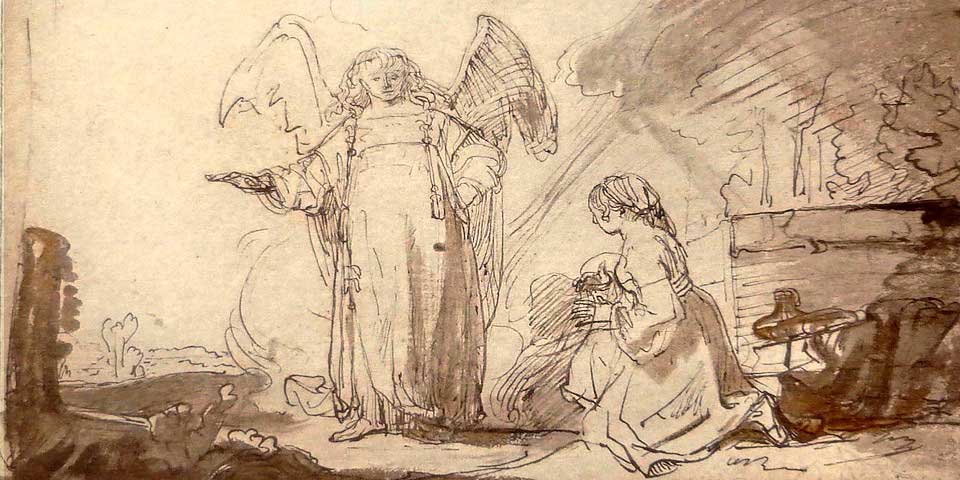
Hagar and the Angel, by Rembrandt

When Abraham and his wife Sarah leave Egypt in the Torah portion Lekh-Lekha (“Go for Yourself”), Hagar goes with them as Sarah’s servant.  Sarah gives Hagar to her husband for the purpose of producing a child Sarah can adopt.  But once Hagar is pregnant, Sarah abuses her, and Hagar runs away across the Negev Desert, back toward Egypt.  A messenger of God  finds her at a spring, a watering-place by the road.  God speaks to Hagar through the messenger and convinces her to return to Abraham and Sarah.

And she called the name of God, the one speaking to her: You are the God of Ro-i; for she said: Even as far as here, I saw after ro-i! Therefore the be-eir is called Be-eir Lachai Ro-i. (Genesis 16:13-14)

ro-i = seeing me, one who sees me.

be-eir = well, watering-place.

lachai = for the living one.

For Hagar, accustomed to being a pawn in Sarah’s schemes, the most amazing thing is that God actually notices her—and she survives.  Hagar does return, and gives birth to Ishmael.  Sarah adopts Ishmael, but later bears her own son, Isaac, and sends Hagar and Ishmael into exile.

Isaac is 40 years old before the Torah once again mentions Be-eir Lachai Ro-i, the Well of the Living One Who Sees Me.  At this point, Isaac is estranged from his father.  In last week’s Torah portion, Vayeira (“And He Saw”), Abraham bound Isaac as a sacrificial offering, and raised the knife to his son’s throat before a voice from God called him off.  After that, Isaac did not go home with his father.  In this week’s Torah portion, Abraham buries Sarah, Isaac’s mother, without Isaac’s presence.  Then he arranges for Isaac to marry an Aramean without even informing his son.  Apparently they are not on speaking terms.

Abraham lives in Beersheba (Be-eir Sheva), and Isaac lives farther south, in the Negev Desert.

And Isaac, he came from coming to Be-eir Lachai Ro-i, and he himself lived in the land of the Negev.  And Isaac went out lasuach in the field, in the face of the sunset; and he raised his eyes and he saw—hey!  Camels were coming. (Genesis 24:62-63)

lasuach = to ?? (This is the only occurrence of the word in the Bible, and though it is in the form of an infinitive verb, scholars do not agree on its meaning.  Lasuach has been translated as to stroll, to pray, to supplicate, and to meditate.  It might be a variant spelling of the verb siyach = meditate, go over a matter, contemplate something.)

I like the literal translation he came from coming to; it emphasizes that a holy well is a place you come to.  Isaac is avoiding his father, but he comes to the well where God noticed and spoke to Hagar.  Since he has no intention of traveling to Egypt on the road that runs past the well, he must come there because he knows about Hagar’s experience.

Like Hagar, Isaac is used to being overlooked as a person, accustomed to being a pawn in his father’s schemes.  Maybe he hopes that God will notice him at Hagar’s well, or maybe he hopes he will be able to see himself.

Coming from the Well of the Living One Who Sees Me, Isaac heads out into the field at sunset to lasuach.  Maybe Isaac senses the holy presence of God at the well, and he walks back through the field slowly to absorb the experience.

Lost in thought, he raises his eyes and is surprised to see camels approaching.  He is not far from the road between Beersheba and Egypt, but these camels have left the road and are heading across the field toward him.  The first rider to dismount is Rebecca, the bride that Abraham’s servant is bringing to Isaac.  They meet in the field, he loves her, and he begins his new life.

Near the end of the Torah portion, Isaac and his half-brother, Hagar’s son Ishmael, bury Abraham in the family cave to the north.  Then Isaac returns to Hagar’s well.

And it was after the death of Abraham when God blessed Isaac, his son; and he settled next to Be-eir Lachai Ro-i. (Genesis 25:11)

The only other place in the book of Genesis that remains holy years later, under the same name, is Beit-El (sometimes called Bethel in English).  In the upcoming Torah portion Vayeitzei (“And he went”), Jacob stops for the night on his way to Charan and dreams of a stairway between heaven and earth. God speaks to him for the first time.  When Jacob wakes, he says:

Truly God yesh in this place and I, I did not know! And he was awestricken, and he said: How awesome is this place! This is nowhere but Beit El, and this is the gate of the heavens! (Genesis 28:16-17)

yesh = it exists, it is present, there is.

Beit El = the house of God.

For Jacob, the most amazing thing is not that God notices him, but that God exists at all in this world.

Jacob dedicates the spot by setting up a stone pillar and pouring oil over it, and naming it Beit-El.  More than 20 years later, God tells him to return to Beit-El.  Jacob first buries all the idols belonging to his household.  Then he leads them to the spot and builds an altar. God blesses him again, and Jacob pours a libation as well as oil on the stone pillar before moving on.  By returning to the place where God first spoke to him, Jacob rededicates himself to God.

*

Few of us today hear God speaking to us in Biblical Hebrew.  But once in a while, we notice God, or God notices us, and we are amazed.  Suddenly our usual mundane perspective changes, and the world is suffused with new meaning.

Sometimes this happens because a place strikes us as holy, awe-inspiring, connected with God.  It might be a liminal place in nature—the edge of the ocean, deep in a forest, a remote spot with a brilliant night sky.  I have also felt that mysterious awe inside medieval cathedrals, though as a Jew I do not go looking for God there.

Sometimes we go back later, and find God again.  Sometimes we go back and discover that the place seems ordinary now; the holiness was in our own heart.  Either way, it is a blessing to be able to stand on holy ground.

Bereishit: Divine Inner Voices

The first Torah portion in the first book of the Torah (both called Bereishit, “In a beginning”) opens with God’s creation of the world. It closes with God’s decision to destroy the world and start over again.

Just before God makes this decision, the Torah gives us a curious story fragment:

And beney ha-elohim saw the daughters of the human, how tov they were, and they took themselves wives from whomever they chose. (Genesis 6:2)

The Nefilim were on the earth in those days, and also afterward, for beney ha-elohim came into the daughters of the human, and they bore children to them. They were the mighty ones from long ago, men of renown. (Genesis 6:4)

beney ha-elohim = the sons of God.

tov = good, attractive.

What does “the sons of God” mean? Some traditional commentary claims the phrase refers to superior human men, who make the mistake of marrying an inferior class of women. Other commentators say the “sons of God” are angels, angels of a lower grade than the malachim (“messengers”) that appear in the Torah in human form in order to speak as mouthpieces for God.

What strikes me is that the phrase beney ha-elohim appears only four times in the whole Hebrew Bible: twice in the passage above, and twice in the book of Job. The book of Job begins by describing how upright, good, and God-fearing Job is. Then the scene shifts to the court of God:

One day beney ha-elohim came to present themselves in front of God, and ha-satan came too, in the middle of them. And God said to ha-satan: Where do you come from? And ha-satan answered God, and said: From roving about on the earth and from going back and forth on it. (Job 1:6-7)

ha-satan = the adversary, the obstacle

God pays attention to ha-satan, and does not question any of the other “sons of God”. The Adversary doubts whether Job is genuinely good and God-fearing, and persuades God to test Job’s faithfulness. God assigns the Adversary to strike all Job’s possessions. Ha-satan eliminates Job’s wealth and all his children—for no good reason—but Job still blesses God.

Then one day beney ha-elohim came to present themselves in front of God, and ha-satan came too, in the middle of them, to present itself in front of God. And God said to ha-satan: Where do you come from this? And ha-satan answered God, and said: From roving about on the earth and from going back and forth on it. (Job 2:1-2)

Once again God only converses with ha-satan. The Adversary persuades God to test Job again, this time by afflicting his body, and God authorizes another injustice in order to find out what Job will do.

The book of Job is a theological conversation in the guise of a story about a man who lived long ago and far away. In order to set up the question of whether God is just, the story uses an allegory of God in His court, receiving His sons, the lesser gods (a scene obviously borrowed from one of the pantheistic religions in the region).

But on another level, I see both stories about beney ha-elohim as allegories for the human mind.

In the book of Job, I think God’s court represents the human mind. The decision-making ego is visited by various sub-personalities, including one that takes an adversarial role and obstructs the ego by planting doubt, then tempting the ego to abandon morality in order to find out for sure.

In the book of Genesis, the interaction between “the sons of God” and the “daughters of the human” can also represent the human mind. Like ha-satan in Job, beney ha-elohim in Genesis  visit the earth. The purpose of the visit in Job is to observe the human beings from a different perspective than God’s, and bring that perspective into the heavenly court that I think represents the human mind.

The purpose of the visit in Genesis is to marry and “come into” human women. When the book of Genesis says “for beney ha-elohim came into the daughters of the human, and they bore children to them”, we can read it as simply a description of the sons of God having sex with their wives, who then give birth to mighty and famous men. But we can also read it as a representation of subconscious aspects of the mind coming into the consciousness of human women, and inspiring them to give birth to new ideas and notions.

In the Bible divine inspiration, ruach elohim, can be good or bad; good when a prophet is moved to speak out and warn people they are doing wrong, but bad when King Saul is seized by divinely-induced madness. What if divine inspiration comes from different aspects of God, different “sons”? One aspect might give us an impulse to speak out against injustice. Another aspect (such as ha-satan in Job) might give us an impulse to commit any injustice in order to prove a point.

The “sons of God” in Genesis are apparently bad impulses, leading to bad thoughts and actions.

And God saw the abundant badness of the human on the earth, that the shape of every idea of his heart was only bad all the time. And God nicham that It had made the human on the earth, and It was heartbroken. (Genesis/Bereishit 6:5-6)

nicham = had a change of heart, reconsidered. (This verb covers at least two kinds of change of heart: regret, and consolation.)

Before the beney ha-elohim show up, the humans on earth seem like a mixed lot, more good than bad. Cain is a murderer, and his great-great-great grandson Lemekh boasts to his wives about vengeance, but the other people the Torah mentions seem innocent enough. When Enosh is born, people start invoking the four-letter name of God. One of Enosh’s descendants, Enoch (Chanokh), “walked with God”.

Only after the beney ha-elohim influence the human race does God consider the ideas of the human heart “only bad all the time”. Perhaps these “sons of God” are like ha-satan in Job. The Adversary in Job corrupts the ruling god with feelings of doubt. The sons of God in Genesis apparently introduce urges that corrupt the conscious mind of the human “daughter”, and become obstacles to good behavior.

And God said: I will wipe away the human that I created from the face of the earth, from human to beast to creeper to flyer in the sky, because I have nicham that I made them. But Noah found grace in the eyes of God. (Genesis/Bereishit 6:7-8)

In next week’s Torah portion, God decides to start the world over again with Noah and his family (as well as pairs of all the animals). This is like deciding to eliminate all those awkward feelings of beney ha-elohim, and reduce the mind to a single virtuous ego. Yet when the flood ends, God reaches the more mature conclusion that the human mind is always subject to evil, and decides to put up with it.

Today, we all hear the mental voices of divine inspiration inside our own minds. Sometimes they are Adversaries, trying to push us off the right path and make us act out of doubt or resentment or another negative urge. Sometimes they enter with enlightenment, and impregnate us with ideas that lead to good actions.

May we all learn to put up with the many shapes of our ideas, as the god in Genesis did. And may we all become more discriminating about our inner promptings than the god in Job.