Toledot & Vayeitzei & Vayishlach: Goat Versus Snake

Esau and Jacob are twin brothers, but because of their personality differences they can never build a real partnership—any more than a goat can partner with a snake.
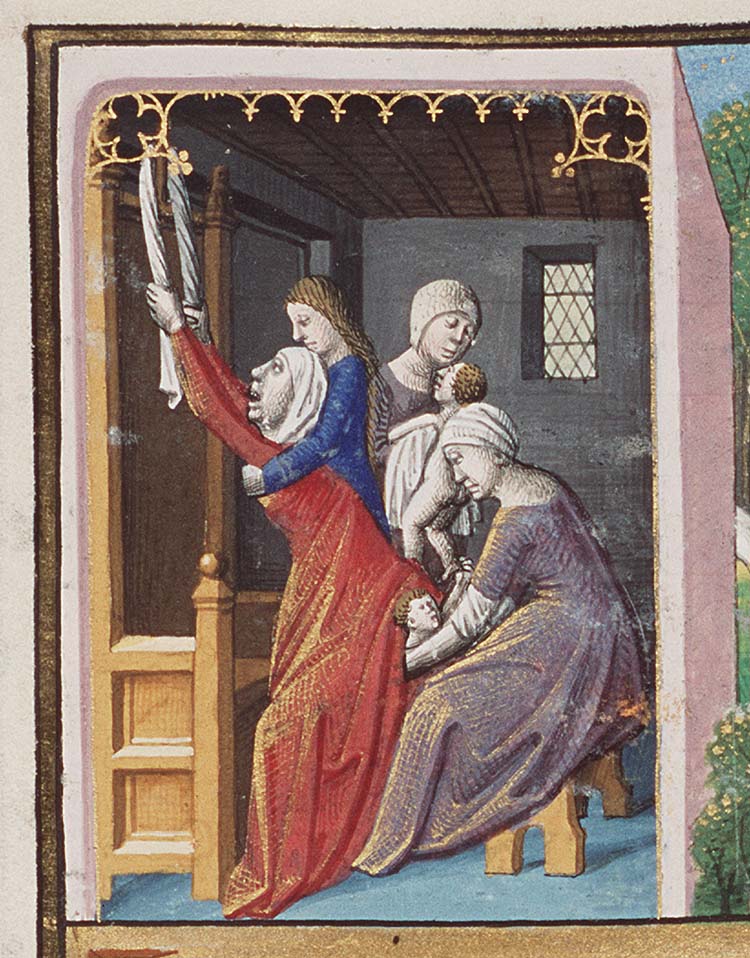
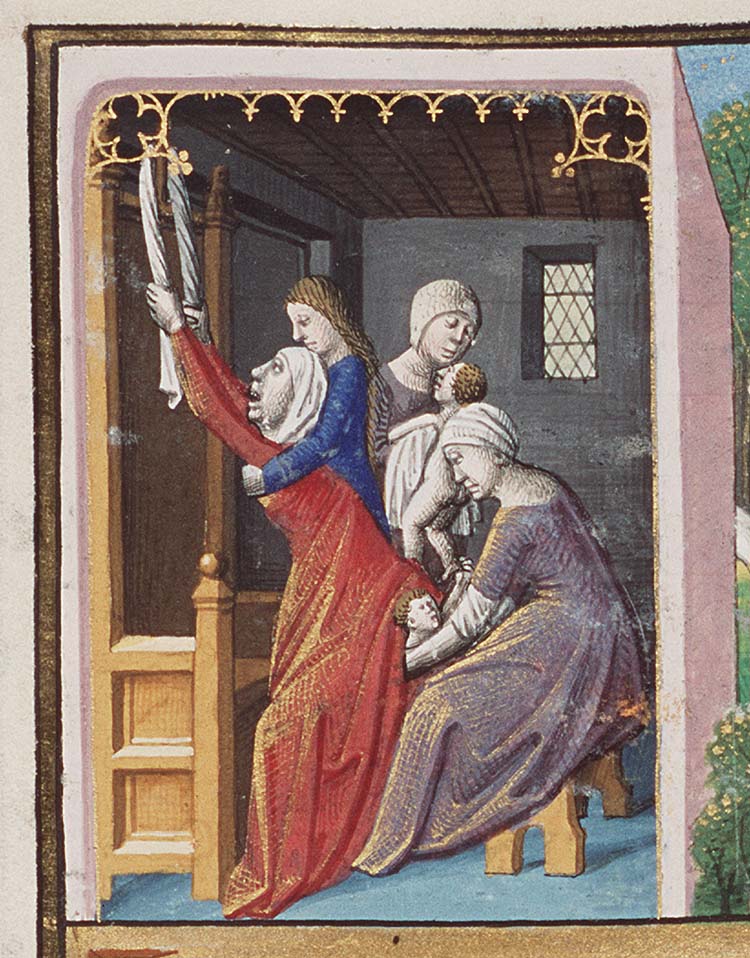
Birth of Esau and Jacob, by Francois Maitre, ca. 1480

The Torah identifies the twins with these two animals when they are born in this week’s Torah portion, Toledot (“Lineages”):

The first emerged red [and] completely like a robe of sei-ar, so they called his name Eisav.  And after that his brother emerged, and his hand was holding fast to the heel of Eisav, so he called his name Ya-akov …  (Genesis/Bereishit 25:25-26)

sei-ar (שֵׂעָר) = goat hair, bristling hair.  (From the same root as sa-ir, שָׂעִיר = he-goat.)

Eisav (עֵשָׂו) = (Esau in English)  Doer, Made.  (From the root verb asahעָשָׂה = do, make.)

Ya-akov (יַעֲקֹב) = (Jacob in English)  Heel-grabber, Sneak.  (From the same root as akeiv, עָקֵב = heel, which derives from the verb akav,  עָקַב= came from behind.)

The Torah explains why Jacob and Rebekah, the parents of the twins, named the second one Ya-akov: he emerged hanging onto his brother’s heel.  But why did they name the first one Eisav?  Rashi (11th-century rabbi Shlomoh Yiztchaki) wrote that because he was covered with hair, he looked like an adult, completely “made”.

Toledot

At birth, Esau is hairy like a goat.  Goats are also known for being “horny” beasts, which fits Esau’s personality when he grows up.  He brings home not one, but two Hittite wives against his parents’ objections.1

Jacob’s grip on his twin’s heel is a reminder of the snake in the garden of Eden, whom God cursed to crawl on his belly and bite humans on the heel.2  The Torah describes the heel-biting snake as arum (עָרוּם) = naked; clever, cunning.3  Jacob is hairless, and therefore naked compared to Esau; and when he grows up he is the clever one.  We first see this when Esau comes home famished and Jacob talks him into trading his birthright for a bowl of stew.4

In the next scene about Esau and Jacob, their blind father, Isaac, wants to give his firstborn son a blessing.  But first he tells Esau to go hunt game and make it into the delicacy he loves.   Rebecca, the twins’ mother, overhears.  She is certain that Jacob should get the blessing instead.  So she orders Jacob:

“Please go to the flock and take for me two good goat kids, and I will make them a delicacy for your father like [those] he loves.”  (Genesis 27:9)

Rebecca’s favorite son can bring back goats from the flock faster than Esau can hunt, and she knows how to make them taste like the game Esau often cooks for his father.  On another level, Rebecca may be implying that Jacob should overpower his hairy he-goat of a brother.

And why does she need two goats for one old man’s meal?  Is she subconsciously sacrificing both of her sons to make sure the right one gets Isaac’s blessing?
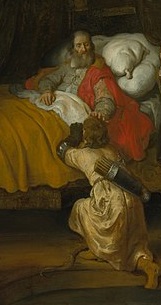
Isaac Blessing Jacob, by Gerbrand van den Eeckhout, 1642, detail

Jacob protests:

Hey, my brother Esau is a sa-ir man, and I am a smooth man!  (Genesis 27:11)

sa-ir (שָׂעִר) = hairy.  (Also from the same root as sa-ir, שָׂעִיר = he-goat.)

Physically, Jacob is still as smooth as a snake.  So Rebecca fixes it.  After dressing Jacob in Esau’s clothes, she covers his hands and neck “with skins of goat kids” (Genesis 27:16).  When he brings in the dish of meat, his blind father is not sure which son he is.  He speaks like Jacob, so Isaac asks him to come closer, and touches his son’s hands.

And he did not recognize him because his hands were like the hands of his brother, se-irot.  And he blessed him.  (Genesis 27:23)

se-irot (שְׂעִרֹת) = hairy.  (The plural of sa-ir above.)

Isaac gives Jacob the blessing he intended for Esau.  Enraged by the “theft” of his blessing, Esau rashly swears he will murder his brother, and Jacob quickly slips away and heads for his uncle Lavan’s house in Aram.

Vayeitzei

In the next Torah portion, Vayeitzei (“And he went”), Jacob marries his uncle Lavan’s daughters, Leah and Rachel, and serves Lavan for fourteen years in lieu of bride-prices for them.  When his time is up, his employer/uncle/father-in-law does not want to let him go.

And Lavan said to him: “If, please, I have found favor in your eyes!  Nichashti, and God has blessed me on account of you.”  And he [Lavan] said: “Designate your wage to me, and I will give it.”  (Genesis 30:27-28)

nichashti (נִחַשְׁתִּי) = I received an omen.  (From the same root as nachash, נָחָשׁ = snake.  Snakes were associated with omens and magic in the ancient Near East.)

Lavan comes close to saying, “I sought a snake, and God has blessed me on account of you.”

The serpentine Jacob makes a clever bargain with Lavan and works for another six years in exchange for far more livestock than his employer expected.  Then twenty years after Jacob fled to avoid being murdered by his brother, he finally heads back toward Canaan with his family, servants, and flocks.

Vayishlach

The next Torah portion begins:

And Jacob sent messengers ahead of himself to his brother Esau, to the land of Sei-ir, the country of Edom.  (Genesis 32:4)

sei-ir (שֵׂעִר) = hairy goat.

Esau has become the chieftain of “The Land of the Hairy Goat”, also called Edom.  Jacob’s messengers return with the news that Esau is already marching to meet him—with 400 men.

Reconciliation of Jacob and Esau, by Peter Paul Rubens, 1624

This time, instead of bargaining with his twin brother, Jacob sends him extravagant gifts of livestock.  (See my post Vayishlach: Two Camps.)  In the morning, after Jacob has wrestled with a “man” who turns out to be a messenger of God, the estranged brothers meet.  They embrace one another and weep out loud.  Esau offers to return Jacob’s gifts, and Jacob insists that he keep everything.

“Because I have seen your face, which is like seeing the face of God, and you have accepted me.”  (Genesis 33:10)

Then Esau offers to travel with Jacob as far as Sei-ir.  But Jacob politely says his group has to go more slowly, so Esau and his men should go ahead, and he will catch up later.  As soon Esau and his warriors are out of sight, Jacob heads in another direction.  The two brothers do not see one another again until their father’s funeral.5


Esau and Jacob do better than Cain and Abel; they manage a peaceful reunion, and nobody dies.  Yet a goat and a snake cannot become close friends and go home together.  They have separate destinies.

May each of us be blessed, like Jacob, to see God’s face in people who are fundamentally different from us.  And may we learn to greet them in peace, and part from them in peace.


  1. Genesis 26:34, 27:46.
  2. Genesis 3:15.
  3. Genesis 3:1.
  4. Genesis 29:25-34.
  5. Genesis 35:29.

Toledot: Rebecca Gets It Wrong

Rebecca tries so hard to set up her son Jacob for a good life—and everything she does turns out to be a mistake.

Birth of Esau and Jacob, by Francois Maitre, ca. 1480

In this week’s Torah portion, Toledot (“Histories”), Rebecca and Isaac have twins who are opposites. Esau, the firstborn, is big and hairy, emotional and impulsive, fixated on food and sex.1 Jacob, born holding onto Esau’s heel, is smooth-skinned and smooth-tongued, clever and scheming, fixated on becoming a patriarch someday. He makes his first move when Esau comes home hungry after a long day of hunting, and Jacob trades a bowl of  stew for his his brother’s birthright as the firstborn.2

Esau expresses his love for his 100-year-old blind father, Isaac, by feeding him meat from his hunts. Esau’s needs are as simple as his intellect, and he takes care of himself. Rebecca does not worry about her firstborn son.

Isaac loved Esau because of the hunted-meat in his mouth, but Rebecca was loving Jacob. (Genesis/Bereishit 25:28)

Rebecca does worry about her son Jacob. Although he has the intelligence and desire to carry on the legacy of his grandfather Abraham, he sticks close to the family’s tents, and at age 40 he remains unmarried. He will never be able to serve Abraham’s god unless he gets out into the world, and he will never continue the line of Abraham’s descent unless he marries a suitable woman.

What Rebecca wants for Jacob is a good wife and Abraham’s blessing from God. But only her husband Isaac can make these things happen. They live in Canaan, where marriages are arranged by men. And although God did answer Rebecca’s question once, when she was pregnant, Isaac has a stronger connection with the divine. After all, when he prayed to God to let her bear children, God responded.

Also God gave Isaac the blessing of Abraham. Rebecca knows that he has the power to pass it on to  Jacob before he dies. And Isaac’s health is failing. When the twins were born, Isaac was 60. Now he is over 100. He is blind and finds it hard to stand up. One day, Rebecca overhears Isaac tell Esau:

“… go out in the field and hunt meat for me. Then make for me some tasty food that I love, and bring it to me, and I will eat it, so that my nefesh will bless you before I die.” (Genesis 27:3-4)

nefesh (נֶפֶשׁ) = soul, self, animating spirit, appetite.

Rebecca jumps to the conclusion that Isaac is about to give Esau the blessing of Abraham. But God’s blessing would be wasted on Esau; it has to go to Jacob!

Isaac Blessing Jacob,
by Gerbrand van den Eeckhout,
1642 (detail)

Rebecca orders Jacob to bring Isaac the tasty food and secure the blessing before Esau gets back from the field. When Esau and Isaac find out what happened, she will take care of the consequences somehow. The charade spins out from there. Rebecca fastens goat-skins around Jacob’s hands and neck to imitate Esau’s hairiness. Isaac, after some uncertainty, gives Jacob the blessing he intended for Esau: a prayer for a life of material abundance and power, with no reference to God or Abraham.

I can imagine Rebecca listening in and discovering her mistake. Isaac merely wanted to bond with Esau the only way he could, through food, and  then leave him with a father’s blessing–the blessing of his personal self, or even the blessing of his appetite. Isaac was saving the blessing of Abraham for Jacob after all. Now what can she do?

Of course the subterfuge is discovered as soon as Esau returns from his hunt. Esau weeps and begs his father for another blessing, and Isaac does the best he can. But Rebecca finds out that Esau is so enraged, he wants to kill Jacob as soon as their father dies.

Rebecca does not try to talk him down. Instead, she sees another opportunity to promote Yaakov’s welfare. She tells Yaakov he must flee to her brother in Charan in order to escape Esau’s murderous rage. Then she reminds Isaac of how much they dislike Esau’s Hittite wives, and hints that he must send Yaakov away to get a wife.

Rebecca said to Isaac: “I am disgusted with my life because of the Hittite women. If Jacob takes a wife from the Hittite women like these, why should I go on living?” (Genesis 27.46)

So Isaac summoned Jacob and he blessed him and  commanded him, and he said to him: “You must not take a wife from the daughters of Canaan. Get up, go to Padan of Aram, to the house of Betu-el, your mother’s father, and take yourself a wife from there, from the daughters of Lavan, your mother’s brother.” (Genesis 28:1-2)

Then Isaac, who never loses his temper, gives Jacob the blessing of Abraham.

“May God give you the blessing of Abraham for yourself, and for your offspring as well, so as to possess the land from your sojournings, which God gave to Abraham.” (Genesis 28:4)

Most commentary says that Rebecca’s motivation is to save Yaakov’s life, and her marriage scheme is an excuse. I think it is the other way around. As modern commentator Tikva Frymer-Kensky writes, Jacob would be just as safe if Isaac sent him to his ally, King Avimlelkh, or to his half-brother Ishmael, both of whom live nearby. Rivkah is smart enough to think of a pretext for sending Jacob to either man. Instead, she deliberately brings up the subject of Jacob’s marriage, knowing that Isaac’s first thought will be to get Jacob a wife from the relatives in Aram, just as Abraham did for him.

Why does Rebecca want Jacob to marry one of her brother Lavan’s daughters? The Torah does not say, but her desire is similar to Abraham’s; both want to keep the intermarriage among the descendants of Terach going.  At least Lavan worships the same god as Abraham, even if he is not exclusive about it.

Rebecca also knows that her brother thinks in terms of material wealth. In last week’s Torah portion, we read that Lavan was willing to marry off his sister once he saw the jewelry Abraham’s steward had given her, and the ten camels carrying packs. Lavan would not accept a husband for any of the women in his household without receiving a hefty bride-price.

Yet in next week’s Torah portion, Vayeitzei (And he went), Jacob leaves home on foot, carrying nothing but a staff (and a few personal supplies, such as the oil he pours on the stone where he has his famous dream of the ladder of angels). Surely neither Isaac nor Rebecca would send their son off to Lavan to take a wife without giving him a mount, some servants, and a generous bride-price!

In my blog post Vayeitzei: Guilty Conscience, I speculated that Jacob’s guilt  drives him to leave home before his parents have time to give him anything, and then to sentence himself to seven years of servitude to Lavan as the price for a wife. Now I think Jacob’s hasty departure might be due to fear as well as guilt. And Rebecca is to blame for this fear, since she tells Jacob Esau is determined to kill him, and urges him to flee.

Poor Rebecca. What she wants for Jacob is God’s blessing and the right wife. But everything she does to help Jacob has the opposite effect. Isaac planned all along to give God’s blessing to Jacob. By making Jacob masquerade as Esau, Rebecca only makes Jacob guilty and Esau enraged. Then Rebecca tries to get Jacob the right wife by telling him to flee to his uncle Lavan before Esau tries to murder him. The combination of fear and guilt make Jacob leave too soon, without a bride-price, and stay with Lavan for 20 years.

Jacob does, eventually, get what his mother wants for him: God’s blessing, both from Isaac’s lips and from God in a vision; and both of Lavan’s daughters as his wives. Yet Rebecca dies without ever seeing her favorite son again, or his children.

Could she do better? What if, as soon as she overheard her husband promising to give Esau the blessing of his nefesh, she went straight to Isaac and asked him what he intended? Or what if she spoke to Jacob directly about why he should marry one of Lavan’s daughters? Could Rebecca achieve her goals by being honest?

I know from my own experience that being honest and direct works well with someone who can listen to me, and ask for clarification when necessary. It does not work well with someone who becomes emotionally overwhelmed because a childhood complex is triggered, or with someone who simply cannot focus on what I am saying.

Isaac is passive and traumatized because his father nearly sacrificed him as a burnt offering, lifting the knife off his throat only at the last moment. Everything relating to fathers and sons might be emotionally overwhelming for him. And he is 100 years old, infirm, and blind. When the Torah says his eyes have dimmed, it may mean his mind has also dimmed, and he cannot focus long enough to hear Rebecca out.

And Jacob?  He would be shocked by the consequences of obeying his mother and stealing Esau’s blessing, and expect a rejection from his father or an attack by his brother at any moment. In the middle of this crisis, how could he listen to someone talk about marriage?

Perhaps there are times when we are all like Rebecca, longing for the best outcome, but knowing there is no use in going for it directly and honestly. Yet if we try to manipulate the situation, we may discover that we have misread another person’s heart, and done everything wrong. We are only human. Yet sometimes, even if it comes too late for us, the best outcome arrives after all.


  1. Esau is hairy from birth (Genesis 24:25), becomes a hunter (Genesis 25:27), is more interested in eating than in preserving his future (Genesis 25:29-34), and violates custom by bringing home two local Hittite women as wives without his parents’ permission (Genesis 26:34-35).
  2. Genesis 25:29-34.

Chayyei Sarah: Consenting Bride

Biblical Hebrew has no separate verb for “marry”.  Instead, a man “takes a wife”, or someone else takes a wife for him.  In a culture dominated by men, a woman never “takes” a husband for herself.

The book of Genesis/Bereishit uses the verb “take” 138 times, and fully 40 of those times refer to taking a wife or concubine.  Some individual men take wives for themselves: Lamekh, Abraham, Nachor, Pharaoh, Avimelekh, Esau, and Judah.  But Sarah “takes” her slave-woman Hagar and gives her to Abraham as a second wife. Hagar takes a wife for her son Ishmael from the land of Egypt (Genesis 21:21).  Lavan takes his daughter Leah to be a wife for Jacob.  Both of Jacob’s wives, Leah and Rachel, take their slave-women and give them to Jacob as wives.  Judah takes a wife for his son Eir.  And in this week’s Torah portion, Chayyei Sarah (Life of Sarah), Abraham’s steward takes a wife for Abraham’s son Isaac.

Abraham does not even tell Isaac he is arranging a marriage for him. (They may not be on speaking terms, since Abraham put a knife to his son’s throat in last week’s Torah portion.) Instead, Abraham has his steward (possibly Eliezer, who was his steward before Yitzchak was born) arrange the marriage, and he makes the man swear, in a formal ceremony, that he will not take a Canaanite wife for Isaac. (See my earlier blog posting, “Chayyei Sarah: A Peculiar Oath“.) The steward, who is called Abraham’s “senior servant”, must go to his master’s relatives back in Aram to find the wife.

The servant said to him: “Perhaps the woman will not consent to go after me to this land; then, surely, won’t I bring your son back to the land which you left?” (Genesis/Bereishit 24:5)

This is the only marriage arrangement in the Torah in which the woman’s consent is mentioned. As the story unfolds, it becomes clear that her consent is not necessary for the marriage, only for moving to the land where her bridegroom lives. If the bride refuses to move, then Isaac could only fulfill his duties as a husband by moving to the bride’s city.

But Abraham tells his steward that he must not bring Isaac to the land of Aram under any circumstances. If the wife he finds in Aram refuses to follow him to Canaan, then the marriage is off, and the steward is absolved of his oath. As many commentators have pointed out, Abraham seems to fear that if Isaac ever leaves Canaan, he will never return. He knows Isaac is a  peacemaker who lacks initiative. But God has promised the land of Canaan to Abraham’s descendants through Isaac. So he insists that Isaac must stay in Canaan.

Why does he also insist that Isaac must not marry a Canaanite, and send his steward off to take a wife for Isaac from his relatives in Aram? For one theory on why Abraham’s family does so much intermarriage, see my post Book of Genesis: Inbreeding. Traditional commentary also points out that Isaac’s ideal wife must resemble Abraham; Abraham stipulates that she must come from the same family, and she, too, must be willing to to to a strange land, while Abraham’s steward stipulates that she must be as generously hospitable as Abraham.

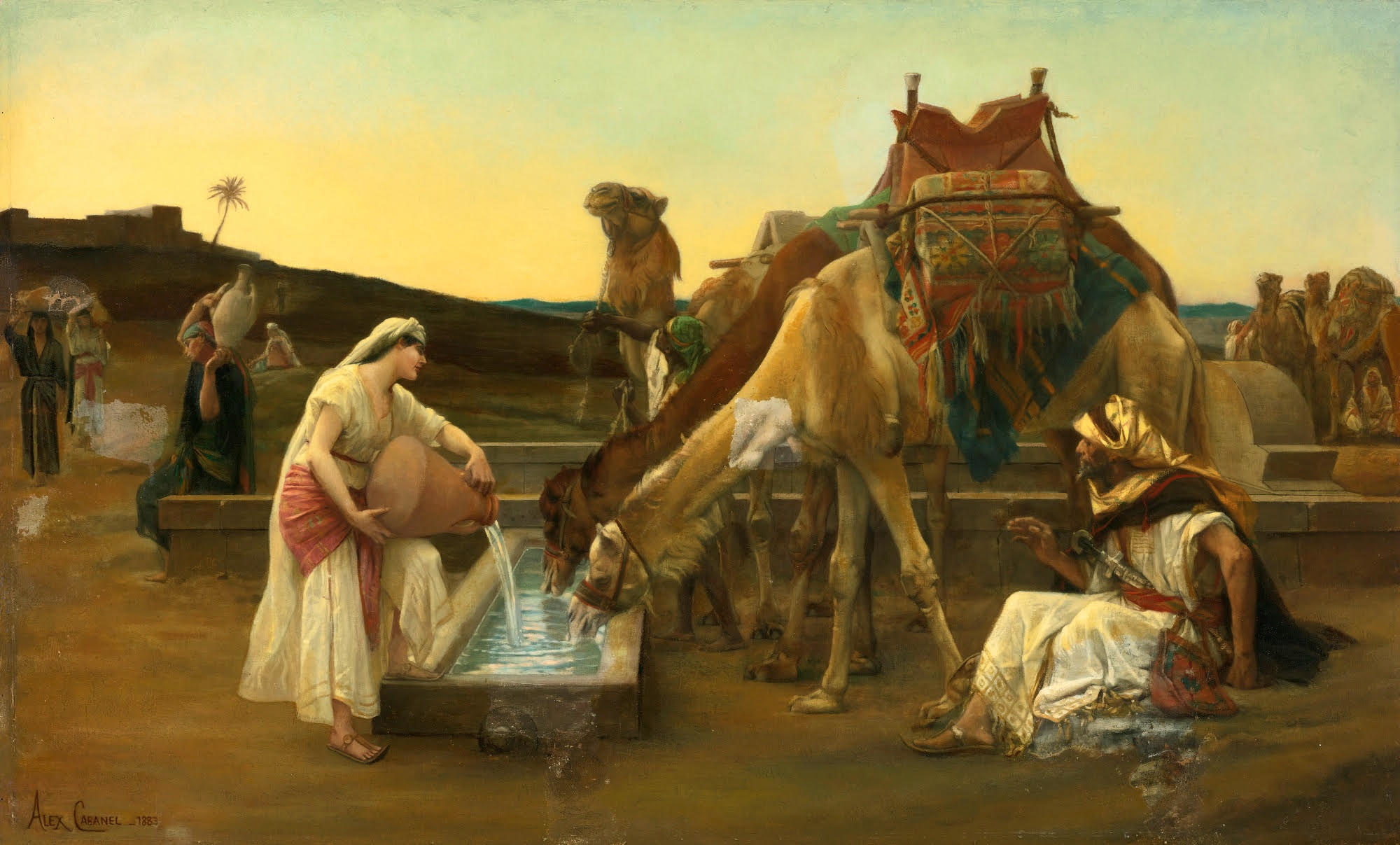
Rebecca et Eliezer, by Alexandre Cabanel, 1883

When the steward reaches the city of Nachor in Aram, the first teenage girl he encounters is Rebecca, who proves to be extraordinarily generous, watering all ten of his camels and offering his whole caravan food and lodging for the night. She is also a close relative: the granddaughter of Nachor (Abraham’s brother) and Milkah (Abraham’s niece by another brother). The only requirement left is that she will agree to go to Canaan.

But first Rebecca’s parents must agree to the marriage. The steward has loaded the ten camels with gifts, and before he even asks her about her lineage, he gives Rebecca a gold nose ring and two gold bracelets. The Torah does not describe her reaction to this gift, but she would recognize it as first installment of the bride-price for a marriage arrangement.

The teenage girl ran, and she told her mother’s household about these events. (Genesis 24:28)

Why does the male-oriented Torah refer to her mother’s household, when both her father Betu-el and her brother Lavan are living there? Perhaps when Rebecca’s parents married, her father Betu-el went to live with his wife’s family–just as later in the book of Genesis, Jacob lives with his father-in-law and uncle, Lavan. Rabbi Elyse Goldstein has suggested that it was the custom in Rebecca’s family of origin for the groom to join the bride’s household, rather than the groom’s household.

The stories about Abraham’s family are probably set sometime between 1800 and 1500 BCE, when Aram was a region of Assyria in northern Mesopotamia, and would have followed the Babylonian customs during the reign of Hammurabi.  The Code of Hammurabi includes both a law relating to when a young married couple is living with the groom’s parents, and a law relating to when they are living with the bride’s parents. So it is plausible that an Aramean family might have a tradition that the groom always moves in with bride’s family.

Presumably both Abraham and his steward know about this family tradition, and therefore know that the bride’s willingness to leave her mother’s house and travel to Canaan will be critical.

Rebecca’s father, mother, and brother agree to the proposed marriage on the same day the steward arrives in their house–perhaps because of the large bride-price, or perhaps because the steward’s story proves that the marriage is the will of the god that they, as well as Abraham, worship. But accepting the bride-price is only the first step in an arranged marriage.

Ancient Mesopotamian texts match the sequence in this week’s Torah portion:

1) The prospective husband, or his representative, gives the prospective bride’s parents the bride-price (her purchase price) as a “gift”. The parents (but not the bride) decide whether to accept the bride-price.

2) The two families draw up a marriage contract, which lists the bride-price and any stipulations. Now the bride and groom are betrothed, but the bride remains in her parents’ house.

3) The bride’s family gives the bride all or most of the bride-price, and adds some of their own wealth as a dowry for their daughter. This combined wealth will be controlled by the husband until he dies or divorces his wife; then the property (land, slaves, furniture, jewelry, gold, or silver) reverts to the wife.

4) The bride and groom themselves join hands (sometimes meeting for the first time) and the groom utters a wedding formula in front of a qualified witness.

5) The marriage is consummated in private.

Abraham’s steward gives Rebecca’s family a handsome bride-price, and they accept it. Presumably they write a marriage contract. The next morning, the steward asks permission to return to his master.

Her brother said, and her mother: “The (teenage) girl will stay with us, yamim or ten; afterward, she will go.” (Genesis 24:55)

yamim = days (literally); some while, about a year (figuratively)

And he said to them: “Don’t hold back on me, when God made my journey successful; send me, and I will go to my lord.” And they said: “We will call the girl, and we will ask her [for a decision from] her mouth.” And they called to Rebecca and they said to her: “Will you go with this man? And she said: I will go.” (Genesis 24:56-58)

Rebecca has a choice. She could insist on staying with her family in Aram, betrothed but not yet married, until Isaac himself shows up. Instead, she decides to go with the steward she met only the day before, and live with her new husband in Canaan. She willingly commits herself not only to a man she has never met, but also to a land she has never seen.

I admire Rebecca’s courage–all the more so because  she must have grown up expecting that her parents would marry her to a man who would come and live with them. Her husband would be new, but the rest of her household would remain the same. And she would have no say in the arrangement.

With the arrival of Abraham’s steward, Rebecca suddenly gets a choice. And she makes her choice instantly and decisively, just as she decides to water all ten camels despite the great effort required.


I am fortunate enough to live in a society in which women can make many choices about their lives. But if someday I am given a totally unexpected choice, I pray that I may see the opportunity, and choose as boldly as Rebecca.

Noach: Spoiled

Noah’s ark is a favorite theme for children’s illustrators. Who can resist the animals climbing into, or out of, the ark in pairs? But the larger story is unnerving for adults: God decides to wipe out all life on earth because humans have “spoiled” it, and the most righteous man around makes no protest. His name, and the name of this week’s Torah portion, is Noach in Hebrew.

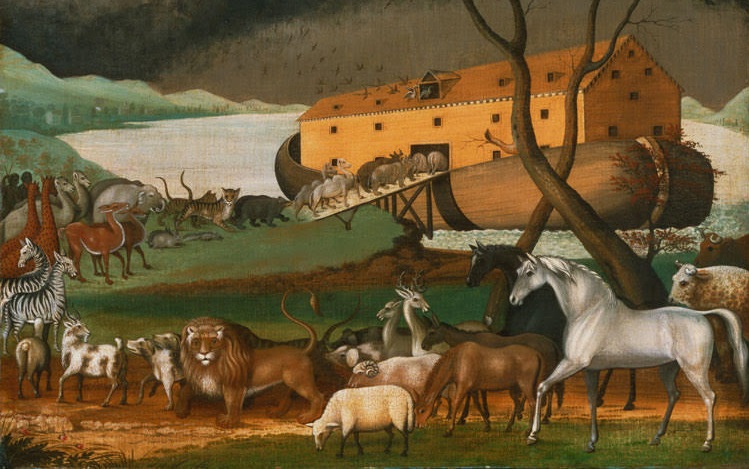
Noah’s Ark, by Edward Hicks, 1846 (detail)

God looked at the earth, and hey! nishechatah, because all flesh hishechit its way upon the land. And God said to Noah: “The end of all flesh is coming before Me, because the earth is filled with violence on account of them, so hey! —mashechitam along with the land. Make for yourself an ark … (Genesis/Bereishit 6:12-6:14)

nishechatah (נִשְׁחָתָה) = it had become spoiled, ruined. (A form of the verb shachat, שׁחת = spoil, ruin, corrupt.)

hishechit (הִשְׁחִית) = has spoiled, ruined; has wiped out. (Also a form of the verb shachat.)

mashechitam (מַשְׁחִיתָם) = spoiling themselves, ruining themselves. (Another form shachat.)

The God-character here sounds like a small child wailing, “They spoiled my toys!  Now everything is ruined! I’m going to kill them all, and wipe out the whole world! But me and my friends, we’ll build a boat and escape …”

Is God actually being childish in this passage? Is the Flood an overreaction? Or is humanity in this story irredeemable?

And is there any reason for wiping out all the other living things on the land?

One clue about the people of Noah’s generation is that the Torah calls them neither “humanity” (adam) nor “men” (anashim), but “all flesh” (kol basar). Perhaps the relationship between flesh and spirit in those early humans is spoiled; people’s spirits are unable to master their physical cravings. (See my post Bereishit & Noach: All Flesh.)

In the previous Torah portion, God creates the human out of two materials: dirt and the divine breath. Body and soul. Flesh and spirit. By Noah’s time, according to traditional commentary, the desires of human “flesh” have taken over. People think only of gratifying their physical appetites, and the desires of their spirits disappear.

According to some commentary, the people of Noah’s generation avoid having children, so they can devote more time to their own animal pleasures. Modern commentator Avivah Gottleib Zornberg argues that the real problem is the narcissism of these pleasure-seekers. If someone has no curiosity, no interest in other people, then love and kindness are impossible.1 I would add that if you do not care about other people, then you will speak and act with violence  whenever you feel like it (and believe you can get away with it).

According to the Torah, before the Flood all humans are wallowing in selfish sensuality, their souls beyond recovery, except for Noah (and possibly the other seven people God allowed on the ark: Noah’s wife, sons, and daughters-in-law). Noah is not a paragon; the Torah portion opens with this description:

These are the histories of Noah: Noah was a righteous man–he was unblemished in his generations–Noah walked with God. (Genesis 6:9)

In other words, compared to everyone else at the time, Noah is good. Presumably he retains the proper balance between his spirit and flesh, paying enough attention to his divine side to “walk with God”. But he never questions God’s plan to wipe out all life on earth. He is deficient in compassion, yet there is hope for him or his descendants.

So God decides not to give up on the human experiment altogether, but instead to destroy the failures, and start over again with Noah and his family. Then why does God choose to flood the earth, and wipe out millions of land animals and birds along with the irredeemable humans?

Traditional commentary claims that God made all the other animals, and everything else on earth, only for the sake of the human. Non-human life on earth has no value in itself. When humans use other living things for corrupt purposes, they have to be destroyed, too.

To me, this opinion demonstrates a lack of interest in, or curiosity about, the rest of the world. When a  commentator views other animals as merely tools for humans to use in carrying out God’s laws, he is committing the same error as the antediluvian man who views other animals as merely tools to use in the pursuit of selfish pleasure.

This is the kind of selfish attitude that leads people today to “spoil” nature: to pollute the air and water, to cut down forests, to disregard extinctions of species, and to do nothing about global climate change. They focus only on their own immediate desires, and take no interest in the earth and its life.

Clearly, human beings are still spoiled, and still spoiling the earth. In the Torah, after the Flood is over and Noah makes an animal sacrifice, God says to God’s heart:

Never again will I draw back to curse the earth (adamah) for the sake of the human (adam), because the shapings of the human heart are evil from its adolescence; and never again will I strike down every living being, as I have done. (Genesis 8:21)

God reseeds the earth with human beings who are still mixtures of dirt and divine breath, body and soul. God continues to grant humans free will, and accepts that sometimes adolescents and adults, people who are old enough to know better, will nevertheless choose evil. God’s experiment with humanity continues.

Today, we do not need an anthropomorphic God to create a flood. We humans have the ability to strike down every living being, all on our own. We are the ones melting the glaciers and ice caps, threatening to flood the earth. I just hope we have not completely spoiled it.


  1. Avivah Gottlieb Zornberg, The Beginning of Desire: Reflections on Genesis, Doubleday, New York, 1995, p. 46, 53, 54, 63.

Bereishit: A First-Rate Beginning

In the beginning God created the heaven and the earth. (Genesis/Bereishit 1:1, King James Version)

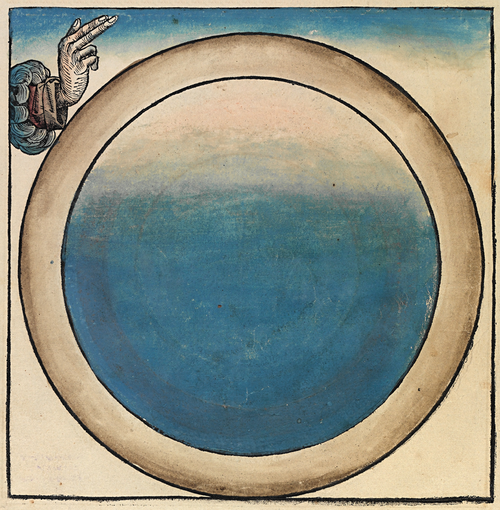
First Day of Creation, Nuremberg Chronicle, 1493

I used to find flaws in the King James translation of the first line of the Bible: 

Bereishit bara Elohim eit hashamayim ve-eit ha-aretz— (Genesis 1:1)

Consider the first word, a compound of be- (בְּ) = a prefix meaning “in”, “at”, “by”, “through”, or “when”, depending on context and idiomatic usage.

+ reishit (רֵאשִׁית) = (noun) beginning, first step, starting point; (adjective) first-rate, choicest, best.

I knew that “in the” was ba(בַּ), not be- (בְּ). So I preferred modern translations of bereishit, such as “In a beginning”. Then I checked all the other places where the word reishit appears in the Hebrew bible, and I discovered that reishit is an unusual word, in that it does not take a definite article even in contexts where the English translation would be “the beginning” or “the first step”. So in 50 of the 51 times that reishit appears in the Hebrew Bible, there is no prefix indicating a definite article (“the”).1 And the word bereishit appears four times in the book of Jeremiah in the phrase “at the beginning of the reign of”.2 I had to conclude that the King James version’s “In the beginning” is an acceptable translation after all.

The second Hebrew word is bara (בָּרָא) = “created”. Before I learned Biblical Hebrew grammar, I made the translation mistake that the Talmud warns against3, and wondered if bereishit bara Elohim meant that “In-a-beginning” created God. Then I found out that the subject follows the verb in Hebrew, so the correct translation of bara Elohim is “God created”, not “created God”.

What about the word Elohim? It is a plural noun, used in the Torah for both God and for other peoples’ gods. But the book of Genesis/Bereishit would hardly say that other peoples’ gods created the heavens and the earth!

The word translated in the King James version as “the heaven” is hashamayim (הַשָּׁמַיִם) = the heavens. But insisting on the plural is nit-picking.

When I began researching this blog, I still hoped I could come up with a more interesting, yet accurate, translation. Over the years I have enjoyed reading alternate translations, especially when they lead to intriguing ideas about the nature of God.

For example, here is one of 19th-century Rabbi Raphael Samson Hirsch’s translations: 

From the very beginning God created the heaven and the earth.4 

I notice that this version implies not only that God is the original, and perhaps the only, creator, but also that creating the heavens and the earth is an ongoing process.

Another is Rabbi David Cooper’s 20th-century translation: 

With a beginning, [It] created God (Elohim), the heavens and the earth.5 

Cooper explained that in kabbalah, the ein sof (“without end”) precedes Nothingness, and out of Nothingness comes Beginningness. From Beginningness comes Elohim, the plural name of God, and then plural creation follows, starting with the heavens and the earth. The first part of this amazing progression occured before the first word of the Torah. The word bereishit catches the kabbalistic progression at the stage of Beginningness.

Yet the 17th-century King James translation, prosaic as it seems, is closer to the original Hebrew. So then I wondered if I could invent an interesting alternate translation by using one of the other meanings of reishit.

The word reishit appears in the Hebrew bible 50 times. It is used most often (23 times) to indicate one kind of offering to the temple: an offering of the first or the finest sample of an agricultural product–usually fruit or grain, but sometimes bread, oil, or livestock. Another common use of the word (10 times) is to indicate that something else is first-rate: a person, a group of people, a father’s vigor, a land’s fertility, a fig’s flavor.

If the reishit part of the first word in the Bible meant “first-rate”, the first sentence could be translated: With the best, God created the heaven and the earth. We would learn that our universe is first-rate (or at least the best of all possible worlds), and that God also created other, inferior universes!

Is this stretching too far? The Hebrew bible uses reishit to mean “the beginning” at least 17 more times after the opening Bereishit. Twelve of these occurrences refer to the beginning of something that unfolds over a period of time: a year, an episode in someone’s life, a king’s reign, a person’s lifetime, a kingdom’s duration. Two more occurrences refer to the beginning of a process of divine creation: the book of Job claims the behemoth was the beginning of God’s creation of animals, while the book of Proverbs claims wisdom was the beginning of God’s creation of the world. The word reishit is also used three  times for a more abstract beginning, as in Psalm 111:10: The beginning of wisdom is awe of God.

The compound word bereishit shows up four times in the book of Jeremiah.2 All four times, bereishit merely gives the approximate date of a prophecy, by placing it “in the beginning of the reign of” a certain king. So the bereishit in the first sentence of the Torah must also be the beginning of something that unfolds over time, like a king’s reign. But this beginning came before everything. It is the beginning of time as we know it (one new thing after another), or the beginning of being.

Maybe Elohim, the god of plurals, means God the Creator, the God of Time, and the God of Endless Beginnings. Then what came before the beginning of time and creation, before Elohim? If the answer is God, this is a god we cannot even imagine. The Ein Sof (“Without End”) of kabbalah is, by definition, inconceivable. As the Zohar says, “No thought can grasp You at all.” Yet Elohim, the God that we can think about, points back at the Ein Sof, the inconceivable God  that began Rabbi David Cooper’s kabbalistic progression.

In the beginning God created the heaven and the earth” is more profound than I thought.


  1. The exception is the word lareishit (לָרֵאשִׁית) = “for the first [fruits]” (Nehemiah 12:44).
  2. Jeremiah 26:1, 27:1, 28:1, and 49:34.
  3. Talmud Bavli, Megillah 9a.
  4. Samson Raphael Hirsch, The Hirsch Chumash, English translation by Daniel Haberman, Feldheim Publishers, Jerusalem, 2002, p. 1.
  5. David A. Cooper, God is a Verb, Riverhead Books, Pernguin Putnam Inc., New York, 1997.

Vezot Habrakhah: Broad Daylight

And this is the blessing with which Moses himself, the man of God, blessed the children of Israel, before his death. (Deuteronomy/Devarim 33:1)

The book of Deuteronomy/Devarim is a series of speeches by Moses, sometimes in God’s name, sometimes in his own words, to the generation that is about to cross the Jordan without him. Moses repeatedly tells the Israelites that they have screwed up before, and God will punish them if they screw up again. The second-to-last Torah portion, Ha-Azinu, is God’s rather dark poem prophesying that they will, indeed, screw up again. But the last portion in Deuteronomy (the very last one in the Torah scroll) takes a brighter tone.

In this portion, Vezot Habrakhah (And this is the blessing), Moses blesses each tribe with prophesies of good outcomes: life, strength, religious knowledge, security, and plenty. After these unusually positive parting words, Moses climbs Mount Nevo and dies.

Before Moses blesses the first tribe, Reuben, he introduces his blessings with a few obscure poetic verses.  Modern scholars view these verses as quoted from a much older poem, with some bits lost in the transmission. One piece of evidence for this theory is that the mountain where the Israelites received the “Ten Commandments” is called Mount Sinai, just as it is in the book of Exodus/Shemot.  This is the only appearance of the name “Sinai” in the whole book of Deuteronomy; the rest of the time, Deuteronomy calls the mountain Choreiv (Horeb).

Here is the first obscure verse:  And he [Moses] said:

God entered from Sinai

and dawned from Se-ir for them;

shone out from a mountain of Paran,

and came from holy myriads;

from Its right side is אשדת for them. (Deuteronomy/Devarim 33:2)

אשדת = ?  These four Hebrew letters do not make a word anywhere else in the Hebrew bible. Commentators generally agree they indicate a compound word beginning with eish = fire.  For the second part of the word, we have only the two letters ד and ת, corresponding to “d” and “t”.   Traditional commentary assumes the two letters stand for dat = edict, a word borrowed from Persian that does not appear in Hebrew texts until  centuries later. They translate the whole word as “fiery law”.  Most modern scholars assume that d-t is a fragment of the word daleket = flaming, and translate the whole word as “fire-bolts” or “lightning”.

What does the verse mean? Se-ir is the land southeast of Canaan where, in the book of Genesis/Bereishit, Esau founds the kingdom of Edom.  The Talmud associates Se-ir with Rome. Paran is a wilderness south of Canaan where Ishmael settles in Genesis. The Talmud associates Paran with Islam.

Most commentary from the Talmud through the 19th century assumes that Moses is once again insisting that the religion of the Israelites is the only acceptable creed. The light of God, they said, is the Torah, and this verse means that God offered to Torah to the Israelites at Sinai, to the  Edomites (standing in for Romans or Christians) at Se-ir, and to the Ishmaelites (standing for Muslims) at Paran. But only the Israelites accepted the Torah. The “holy myriads” are God’s angels, who do not need the Torah to instruct them on how to live properly in the world. So God’s right hand gives Israel alone  the eish-dat, the fiery law.

I am not persuaded. Yes, Moses spends 40 years denigrating other religions and reminding the Israelites that God chose them– 40 years of warning and criticizing and yelling and laying down the law. But in Vezot Habrakhah, Moses finally drops that role and blesses the tribes with good fortune and plenty. He wants to leave the world with blessings rather than curses. In his softened mood, maybe he quotes part of an old poem not to reinforce Israelite triumphalism, but to hint that divine enlightenment can reach people who belong to other groups, other religions.

The simple meaning of the verse appears to be that God’s light shone on at least three different peoples south of Canaan. And I think the next verse continues this theme, despite traditional commentary’s insistence that it must mean God has power over all peoples, but loves only Israel.

One difficulty in translating verse 33:3 is that it seems to switch back and forth between referring to God in the second person singular and the third person singular. But this is not unusual in the Torah. To make the verse easier to read, I will use [God] instead of a confusing pronoun.

Indeed, [God] is a lover of peoples;

all of [God’s] holy ones are in [God’s] hand;

and they place themselves at [God’s] feet;

yissa from [God’s] pronouncements. (Deuteronomy 3:3)

yissa = he/it lifts; he/it carries

Traditional translations ignore the fact that the word amim means “peoples”, and change the word to “tribes” or “the people” in the singular. These translators assume that God would never be described as a lover of more than one people:  the people Israel.

But why not take the Hebrew word for “peoples” literally? What if God really is a lover of many “peoples”, many ethnicities, many religions? Then, as the next line says, all of God’s holy ones, from every population, are in God’s hand.  And they humbly position themselves at God’s feet.

In the last line of the verse, God lifts, or carries, from God’s pronouncements. Modern scholar Robert Alter, who translated the line as “he bears your utterances”, noted that its meaning is so unclear, it must have been altered in transmission from the original poem.

True, pronouncements are normally neither lifted nor carried nor borne. But I wonder if the word yissa is an abbreviation of an idiom. One common biblical Hebrew idiom is yissa rosh, “he lifts the head of”, and means “he pardons”. Maybe God pardons the holy ones at God’s feet for disregarding God’s pronouncements. Maybe, contrary to Talmudic thinking,  God pardons the more righteous members of many religions when they transgress God’s decrees.

With such obscure Hebrew, it is all guesswork.  But my guess is that the two verses together mean that the divine light is not like a laser focusing on just the children of Israel, but rather like the sun, that rises over every height where a people seeks inspiration. God offers enlightenment to everyone, in broad daylight.  Furthermore, God loves not just the Israelites, but many peoples. The Roman Christians of Se-ir and the Muslims of Paran can also count as holy. God does pronounce laws and requirements; but all holy ones who transgress them can be pardoned, if they place themselves humbly at God’s feet.

This is the poem Moses quotes before he blesses the tribes of Israel and climbs up the mountain to die. After spending 40 years of his life browbeating his people into committing themselves to God, maybe Moses feels that his great task is finished. Now, at last, he can let go of his anger and frustration and give blessings–not just to the tribes of Israel, but to all peoples.

If only we let go of our prejudices, and listen.

Ha-azinu: The Tohu Within

Before Moses dies, he teaches the Israelites a long song.  The words are recorded in this week’s Torah portion: Ha-azinu (“Use your Ears”).

The two main messages in the song are that God is all-powerful, and that God wreaks vengeance on the Israelites when they worship other gods.  This is not news; the God-character portrayed in the Torah has no concept of modern educational methods.

Yet within the song are some gems of inspiration.  One of them employs the relatively rare word tohu.

[God] found it/him in a land of wilderness

And in the tohu of a howling desolation;

[God] surrounded it/him and gave it/him understanding,

[God] protected it/him like the pupil of [God’s] eye. (Deuteronomy/Devarim 32:10)

tohu (תֹהוּ) = chaos, nothingness, formlessness, unreality.

Hebrew prefixes and suffixes indicating the third person singular can be translated as either “it” or “him”.  So what or who did God find in the wilderness of chaotic, howling desolation?

One third-century commentary says God found, or encountered, Abraham there.1  But the book of Genesis/Bereishit states that God called to Abraham when he was living in Charan and told him to go to Canaan.2   Charan was a civilized town, not a howling wilderness.

Most commentaries take their cue from the preceding line of the song, Because God’s portion is [God’s] people, Jacob …  (Deuteronomy 32:9) and assume that “it” is the people named after their ancestor “Jacob” or “Israel”.  (The Torah often refers to a people, an ethnic or political group, in the singular.)

Yet in the book of Exodus/Shemot, God does not find Israel in the wilderness.  God notices the Israelite slaves in Egypt when God hears their cries of distress.  Then God leads them out of Egyptian civilization and into the wilderness.

Modern scholars who take the verse about tohu literally explain these discrepancies by attributing the poem in Deuteronomy and the stories in Genesis and Exodus to different myths explaining the origin of the Israelite people.

But why get stuck on a literal reading? The Torah often uses metaphor and analogy, especially in its poetry. I think the word tohu  in this verse points toward a more profound meaning.

This is only the second occurrence of the word tohu in the Torah.  The first use of tohu is in the sentence just before God says “Let there be light”:

And the earth was tohu and vohu, and darkness over the face of the deep, and the wind/spirit of God hovering over the face of the deep.  (Genesis/Bereishit 1:2)

vohu (בֹהוּ= a poetic extension of tohu, translated as “unformed”, “void”, “empty”.   (The word vohu appears only three times in the Hebrew bible, always paired with tohu; here, in Isaiah 34:11, and in Jeremiah 4:24.)

I think the meaning that best fits all 19 appearances of the tohu in the Hebrew Bible is “unreal” or “unreality”.

Translating tohu as “unreality” in this week’s Torah portion is awkward if you take our verse literally.  But if “wilderness”, tohu, and “howling desolation” all describe a psychological state, tohu as “unreality” makes sense.  When you feel desperate and desolate, as if there is no hope and you are utterly alone, you experience an inner howling, and your mind no longer anchors itself in familiar habits and beliefs.  You wander in a mental wilderness, and your former world-view seems unreal.

What if someone in a mental state of unreality and howling desolation encounters God?  What if God then encircles them, gives them understanding, and protects them until they pull themselves together and reorganize their lives to fit their new outlook?  During this process, God protects the person’s soul as if it were the pupil of an eye, which can perceive reality and apply insights only if it is both uncovered and unharmed.

Atheists today might object that God itself is unreal, so believing that God is finding and protecting you is an indulgence in unreality.  I don’t blame them.  I am an atheist myself, if you define God as either the anthropomorphic jealous king who lives in the sky, or as the omni-being of medieval theologians.  But many people, including me, use the word “God” for something else, something we have no better word for in English.  Something that defies a clear definition, a mystery that we experience or intuit.

Connecting with this holy mystery is a real experience, one in which the phrases “God finds you” and “you find God” mean the same thing.  I have found that if it happens when my life is falling apart, the connection really does protect me, stabilize me, and give me understanding.

These days, when my emotions begin to overwhelm me, I don’t wait for God to find me.  I take preemptive action by singing prayers, singing until the tightness in my throat relaxes.  Then my mind becomes calmer and clearer, and understanding becomes possible.

So here is my version of the verse from Ha-azinu, with different pronouns.  Maybe this interpretation will ring true for you.

     I found God in a land of wilderness

     And in the unreality of a howling desolation;

     God surrounded me and understanding came;

     God protected me like the pupil of an eye, and I saw.

  1. Sifrei Devarim 313:1.
  2. Genesis 12:1-5.

Nitzavim: Still Standing

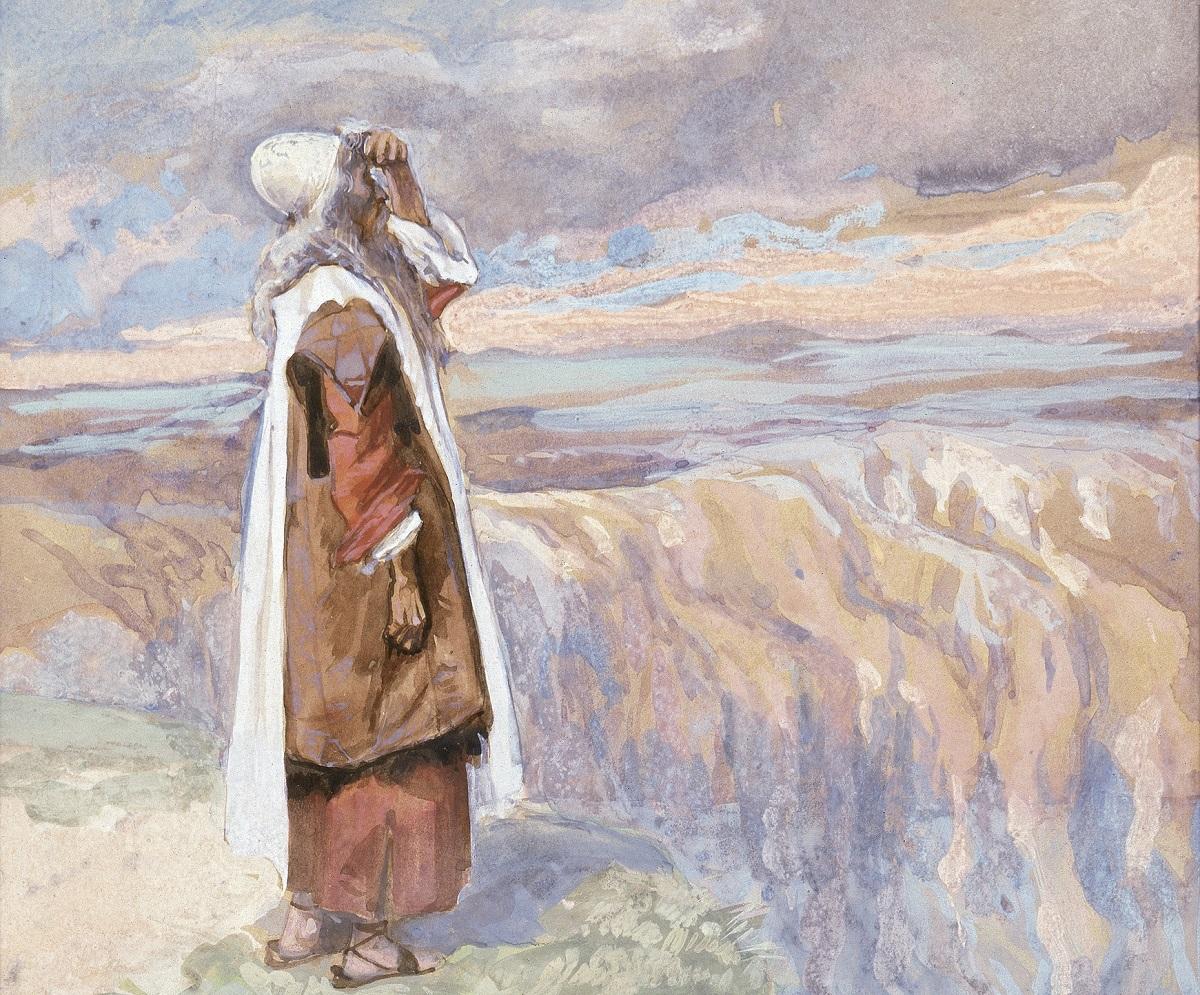
Moses by J.J. Tissot

Moses leads the refugees from Egypt for 40 years and brings them to the Jordan River.  There, he knows, he will die and they will cross over into a new life.  The book of  Deuteronomy/Devarim is his farewell speech to the people, and in this week’s Torah portion, Nitzavim (“taking a stand”) he launches into his conclusion.

Everyone standing there

First Moses lists everyone included in the renewed covenant with God that will take effect when the people cross into the “promised land” of Canaan.

You are the ones who are nitzavim today, all of you, before God, your God—your heads, your tribes(men), your elders, and your officials, every man of Israel; your young children, your women, and your stranger who is in the midst of your camps, from the gatherer of your wood to the drawer of your water—in order to cross into the covenant of God, your God, with its alah that God, your God, is cutting with you today.  (Deuteronomy/Devarim 29:9-11)

nitzavim = taking a stand, stepping up, stationing yourselves, standing firm.

alah = an obligation which puts a curse on anyone who fails to meet it; a penalty clause in a contract.

Moses includes not only all the men of Israel, regardless of rank, but also all the women and all the children.  Moreover, he includes the strangers in their midst: those who are not of the same blood, but who voluntarily chose to join the Israelites when they left Egyptin other words, the converts.  Moses even includes low-status converts, those who gather wood and draw water for the Israelites.

Journey from one border to another

This is not the same group of Israelites and converts who followed Moses out of Egypt.  Most of the adults in the original group  have died during the 40 years in the wilderness.  Some died when God punished various revolts with plague, fire, earthquake, or snakebite.  Others died of old age during the 38 years that passed between the group’s arrival at the southern border of Canaan in the desert, and their arrival at the more northern border of Canaan at the Jordan River.1

Now the survivors are standing on the river bank, ready to cross.  Most of them were children, or not born yet, when the original group embraced the original covenant with God at Mount Sinai.  So Moses says God is cutting a covenant with this new group.

It is a covenant with a penalty clause, an alah.  If they do not live up to their side of the covenant, following God’s laws and refraining from worshiping any other god, then the long list of curses in last week’s Torah portion would come to pass.  (For example, parents would eat their own children as they are starved by crop failure and besieging enemies.)

When God gave a covenant to the earlier generation at Mount Sinai, they replied, “We will do and we will hear!”  But in this week’s Torah portion, when Moses announces the covenant to the later generation, they say nothing.  No response is recorded in the Torah.

So why does Moses describe this passive group as nitzavimAre they really taking a stand in favor of God?  Are they standing firm, as the word nitzavim implies?  Or are they merely standing there waiting for Moses to finish his speech so that they can do the next thing they are required to do? Are they following orders because they want to serve God, or because they have grown up knowing that serving the God of Israel is better than the alternative?

Are they standing firm, or are they merely still standing?

Everyone else

Then Moses expands the group included in the covenant, quoting God:

And I, Myself, am cutting this covenant and this alah not with you alone, but with whoever is here standing with us today before God, our God, and whoever is not here with us today. (Deuteronomy 29:14)

Who are these additional people who are not standing in front of God that day?

According to Rashi2 they are the souls of all future Jews, yet to be born.  Traditional commentary agrees and includes both everyone who ever had or will convert to Judiasm, along with everyone who was or will be born to a Jewish mother.

(Converts enter the covenant with God at the time of their conversion, but people who are born Jewish have no choice; they are simply included.  Different commentators have held different opinions about whether individuals who were born Jewish can opt out of the covenant or not.)

What I wonder is whether traditional Jewish commentary is too narrow in its definition of who is included in “whoever is not here with us today”.  What if the covenant applies to every human being on earth, forever?  That would fit the plain sense of the words.

Is Moses saying that all human beings will become Torah-observant Jews?

No.  I think “whoever is not here with us today” means that all human beings ought to be standing before God.  And that means we should avoid acting as if we were gods.  Only through humility and responsibility can we avoid the curse of (psychologically) devouring our children, the curse of (metaphorically) devouring any other human being, the curse of devouring our own planet.

We should remember that we are small parts of the whole creation.  And we should remember that all human beings are in a covenant together, living on the earth.


  1. At the southern border, most of the people were afraid and refused to cross into Canaan.  (See my post Shelach Lekha: Sticking Point.)  God’s punishment was to make them wait until all but two men from that generation had died before they could attempt a second crossing into Canaanhence the 40 years of wandering in the wilderness.
  2. 11th-century rabbi Shlomo Yitzchaki.

Ki Teitzei: Too Many Vows

When did you last make a vow or swear an oath?  In our society, we often sign contracts and promise to do things; but a solemn, witnessed vow is usually reserved for a wedding, an oath of office, or (in some religions) an initiation into a religious order.  Nevertheless, when we violate solemn promises we have made to ourselves, we find ourselves in the same position as ancient Israelites who failed to fulfill their vows.

One warning about vows appears in this week’s Torah portion, Ki Teitzei (“when you go out”):

When you vow a vow to God, your god, you shall not delay in fulfilling it, because God, your god, will certainly call you to account, and there will be guilt in you. But if you refrain from vowing, there will not be guilt in you. You must guard what comes out of your lips; and you must make any voluntary gift that you spoke with your mouth, as you have vowed to God, your god. (Deuteronomy/Devarim 23:22-24)

The majority of vows mentioned in the Hebrew bible are vows to give something to God. People vow to offer an animal at the altar, or to give money to the Temple treasury, just because they want to do something extra for their religion. Both this week’s Torah portion and a similar passage in Ecclesiastes/Kohelet state that when you vow to make a gift to God, you must fulfill it with minimum delay, or you will be guilty of wrongdoing. Someone today would be guilty of similar wrongdoing if they promised to donate extra money to their congregation, but then took years to get around to it.

Another type of vow is the vow of self-denial. The most common vow of self-denial in the Torah is the vow to be a nazir, someone who abstains from haircuts and from wine (or anything else made with grapes) for a fixed period of time. (See my post Naso: Distanced by Hair.)

But like us, Israelites and Jews thousands of years ago made individual vows of self-denial, which are mentioned in the Hebrew bible and discussed in detail in the Talmud tractate Nedarim (“Vows”).  In modern American one common individual vow of self-denial is to abstain from certain foods.  Two thousand years ago this was also a possible vow, but vows to refrain from sex with your spouse get more coverage in the Talmud.

Carrying out your vow without delay is also a requirement for vows of of self-denial. The book of Numbers/Bemidbar says: If someone vows a vow to God or swears an oath to abstain an abstention for himself, he shall not desecrate his word; according to anything that goes out of his mouth he must do. (Numbers 30:3)

Making a vow before God seems to be a common human impulse.  Yet both Deuteronomy and Ecclesiastes, as well as the Talmud, emphasize that it is better to simply do what you intend without making a vow.

What is so bad about making vows? The Torah and the Talmud discourage vowing because the consequences are terrible if you do not fulfill your vow. All too often, people make vows and then fail to live up to them because of circumstances they did not anticipate.  Some people are simply stymied by bad luck. But others are carried away by their emotions at the time of the vow, and rashly promise more than they can realistically deliver. Some people make vows they regret the next morning.

Traditional commentary points out that people tend to find excuses to justify their failure to deliver on a vow, and comfort themselves with the thought that at least they meant well. This is a form of self-delusion that leads some people to substitute making vows for actually doing the right thing. Thus people who makes rash vows end up behaving less ethically.  They also suffer because other people stop believing what they say.

I have also noticed another reaction to the failure to fulfill a rash vow. I know people who made solemn promises to themselves to increase their Jewish religious observance–not just by adding one daily blessing or one small restriction, but by taking on a full day of orthodox Shabbat observance every week, or by switching from a diet of bacon cheeseburgers to keeping kosher so strictly that they can no longer eat out. And when they failed to fulfill their rash vows, they did not excuse themselves on the grounds of good intentions.  Instead, they gave up on their religion–an easy thing to do, in our modern society. And that, too, can be bad for the soul.

I agree with the Torah and Talmud that it is better to guard your lips and stop yourself from making vows. But if you need to make a vow, consider it carefully, over a period of time, to make sure it is something reasonable that you can fulfill.

But what if you have made a vow you cannot, or no longer want to, fulfill?  In Talmudic times, people called upon rabbis to annul their ill-considered vows of self-denial. Jews today have Yom Kippur, the annual Day of Atonement.  If we break our vows to other people, we can only make things right by going through a process of atonement with those individuals. But if we have failed to carry out our vows to ourselves, or to God, then we can atone in our communal prayers on Yom Kippur.

The holy day begins with the singing of “Kol Nidrei”, which means “All vows” in Aramaic. The Kol Nidrei prayer may have begun as a way to absolve Jews from vows of conversion to another religion, since so many Jews had to pretend to convert to Christianity in order to save their lives. Now it serves as a heartfelt introduction to the day when we can release ourselves from guilt over the personal vows before God that we now wish we had not made.

This week is the second week of Elul, the month leading up to Rosh Hashannah and Yom Kippur. The Jewish tradition is to spend this month examining ourselves, apologizing and atoning for the wrongs we have done to other people, and recognizing where we have failed the God inside each of us.

This month of Elul, may we all catch up on the good deeds we promised to do but never got around to; may we find ways to clear ourselves and start fresh with every person we have wronged; may we recognize and accept our failures to fulfill our personal vows; and may we figure out ways to improve ourselves gently, without making any rash vows.

Re-eih: Two Paths

Moses opens this week’s Torah portion, Re-eih (“See”), by giving a choice to the Israelites camped at the Jordan River, waiting to cross over into Canaan.

See, I am setting before you today a blessing and a curse. The blessing: asher you listen to the commandments of God, your god, that I command you today. And the curse: im you do not listen to the commandments of  God, your god, and you rebel from the path that I command you today, to walk after other gods that you did not know.  (Deuteronomy/Devarim 11:26-28)

asher (אֲשֶׁר) = that, which, whom

im (אִם) = if.

The Torah does not say here what material results will come from God’s blessing or God’s curse. But results can be inferred, either by looking at a parallel passage in the book of Leviticus/Vayikra, or by paying attention to several words in the passage above that are usually unimportant, and often mistranslated.

First let’s compare the warning in this week’s Torah portion with the two alternatives presented in Leviticus.  

Im you follow my decrees and observe my commandments and do them … (Leviticus/Vayikra 26:3)

Then God will make it rain in the right seasons, so you (plural) will have abundant crops and eat your fill; God will grant peace in your land, keeping away both vicious beasts and swords; God will give you many offspring; and God will always be present in your midst.

But im you do not listen to me and you to do not do all these commandments … (Leviticus 26:14) 

God continues, then God will afflict you with diseases, and crop failure, and wild beasts that kill your children and livestock, and enemies with swords who besiege you until you commit cannibalism and starve to death.

Words for blessing and curse are absent from the passage in Leviticus, but elsewhere in the Torah the word brakhah (“blessing”) implies an increase in fertility, health, and prosperity–as indicated in the list of results for following God’s decrees and commandments in Leviticus. The word for “curse” used in this week’s Torah portion, kelalah, implies diminishment in status and power, as well as disgrace and falling into a lower state of being. These conditions do seem to be graphically illustrated in the results given in Leviticus for disobeying God’s commandments.

Furthermore, obeying God’s commandments is what makes the difference in both the passage in Leviticus and the one in Deuteronomy this week. So it would be reasonable to assume that the two alternatives in Leviticus represent the results of God’s blessing and God’s curse.

Yet some Torah commentary draws a different conclusion, based on the words asher (“that”) and im (“if”).

In Leviticus, both the good result and the bad result are introduced by “if”; if you people obey God, then you will be collectively rewarded in life; if you people do not listen and do not obey every commandment, then you will be collectively punished in life. (Individual exceptions are not addressed, and as usual in the Torah, no reference is made to any reward or punishment after death.)

But this week, in Deuteronomy, the original Hebrew says:  The blessing: that you listen to the commandments of God, your god, that I command you today. (11:27)

Some English translations change the word asher (“that”) into an “if”. But two major 19th-century commentators, the mystical rabbi Yehudah Leib Alter of Ger (in Sefat Emet) and the scientific grammarian rabbi Meir Leibush (a.k.a. Malbim), argued that the original sentence means the blessing is listening to and obeying God’s commandments. Virtue is its own reward, because listening to God and doing good deeds elevates and expands your soul. Sefat Emet says that the choice between the path of blessing and the path of curse lies before everyone, at all times; and the reward for choosing the right path is to advance to the next choice, the next opportunity to choose good, as you climb higher on the ladder.

This interpretation speaks to me, not only because I care about the original words in Hebrew, but also because it moves from the communal blessing implied by the Torah’s plural “you” to an individual, personal blessing. If you live in a community of people who make bad choices, you will inevitably suffer materially for their mistakes and misdeeds.  In a material sense, you will be cursed. Nevertheless, if you, personally, choose what is good and right, you will get the more important reward of becoming a better person.