Haftarat Beshalach—Judges: Overlooking the Underdog

Every week of the year has its own Torah portion (a reading from the first five books of the Bible) and its own haftarah (an accompanying reading from the books of the prophets). This week the Torah portion is Beshallach (Exodus 13:17-17:16), and the haftarah is Judges 4:4-5:31.

The underdog triumphs in many biblical stories. Jacob, the beardless weakling, outsmarts his strong, hairy brother Esau. Joseph rules over the older brothers who once enslaved him. The boy David kills the giant Goliath.

In this week’s Torah portion, Beshalach (“when he sent out”), the Israelite slaves leave Egypt as free people while Pharaoh’s army drowns behind them. In the haftarah from the book of Judges, two Israelite women triumph over the Canaanite general Sisera and his army.

How do you defeat an enemy stronger than you?  In the Hebrew Bible, two effective ways are by receiving and using inside information from God, like Moses; and by taking action on your own initiative with intelligence, courage, and guile, like Jacob and Joseph.

The haftarah from Judges tells the story of two women, the ultimate underdogs in the patriarchal society of the ancient Israelites, triumphing over Israel’s enemies through both methods. Devorah the prophet gets her people to act on God’s promise to help them defeat the army of their Canaanite overlord, and Jael/Yael the Kenite acts on her own initiative and kills the enemy’s general.

War chariots, ivory plaque from Megiddo

When this week’s haftarah begins, the Israelites are scattered tribes who have been ruled by the chief king of Canaan, Yavin, for twenty years. They are oppressed by King Yavin’s general, Sisera, who commands a force that includes 900 chariots, the most fearsome war technology of the time.

Still, instead of relying on the Canaanite king’s dubious justice, the Israelites go to their own judges, including one outstanding judge.

Devorah was a woman, a prophet, a woman of lapidot; she was a shoftah of Israel at that time. (Judges/Shoftim 4:4)

Devorah (דְבוֹרָה) = “Deborah” in English; honey bee. (From the same root as doveir  = speaker, and divrah  = legal case.)

lapidot (לַפִּידוֹת) = a feminine plural form of the masculine noun lapid = torchlight, torch, flash of light. (Some translations consider lapidot a place-name or the name of Devorah’s husband.)

shoftah (שֹׁפְטָה) = the feminine form of shofet = judge; a man who decides legal cases and resolves disputes.

The bible emphasizes that Devorah is a woman; all the other judges in the bible were men. Moreover, she is a prophet, a woman of flashes of light. Even her name is significant: she is a speaker, both for justice and for God.

Date palm tree
Date palm tree

And she was the one who sat under the Date-Palm of Devorah, between Ramah and Bethel in the hills of Efrayim. And the children of Israel went up to her for the law. (Judges 4:5)

Unlike the judges of villages, Devorah serves as the authority for a wider area, and holds her own law court in a sacred place. In ancient Israel, many holy places were indicated by trees or groves with names, such as the Oak of Weeping (Genesis 35:8), the Grove of Teaching (Genesis 12:6), or the Grove of Mamre (Genesis 13:18). Devorah’s own presence is what makes this particular palm tree the marker of a holy site.

And she sent and summoned Barak, son of Avinoam, from Kedesh in Naftali. And she said to him: Did not God, the god of Israel, command: “Go!—and draw up your position on Mount Tabor, and you shall take with you ten thousand men from Naftali and Zevulun. Then I will draw up to you, to the wadi of Kishon, the commander of the army of Yavin, Sisera, and his charioteers, and his infantry; and I will give them into your hand.” (Judges 4:6-7)

If Barak musters troops from the two Israelite tribes of Naftali and Zevulun and marches them up Mount Tabor, God will arrange for the defeat of the enemy’s army. But Barak is afraid.

And Barak said to her: If you go with me, then I will go; but if you will not go with me, I will not go. (Judges 4:8)

Devorah agrees to go with him, but prophesies that Barak will get no glory from the battle, because

into the hand  of a woman God will deliver Sisera. (Judges 4:9)

Deborah, by Gustave Dore

Devorah walks with Barak both to Kedesh to inspire the men to volunteer for the ad hoc army, and to the top of Mount Tabor to announce when the men should charge down. God panics Sisera’s army (through a flash flood in the wadi, according to the accompanying poem) and the Israelite foot soldiers kill every enemy soldier except General Sisera.

Devorah is supremely successful as the instigator of the battle because she is God’s prophet. Receiving divine communication and cooperating with God both inspires people to trust her and results in a successful campaign—even though she is a woman, who would normally be powerless.

Sisera gets down from his chariot in the middle of the battle and flees on foot. Where can he find refuge? He heads for the nearby camp of Chever the Kenite, a vassal of King Yavin.

Sisera fled on foot to the tent of Yael, wife of Chever the Kenite … (Judges 4:17)

Study of Jael, by Carlo Maratta

Yael (יָעֵל) = a variant of ya-al (יָעַל) = he will ascend, he will climb, he will mount for mating.

Normally, a fugitive would go to the tent of the man who heads the household or encampment, the only person who can take the role of host and decide to shelter the unexpected guest.  In that culture, a woman’s tent was her private domain that no man outside her immediate family would dare to enter. Why does Sisera enter Yael’s tent instead of heading straight for her husband’s tent?

One line of commentary claims that Sisera’s motivation was to rape Yael, and then claim Chever’s household as his own. By taking ownership of a chieftain’s women, a man signaled that he was the new chieftain. Later in the Bible, King David’s son Absalom shows Israel that he is the new king by having sexual intercourse with the concubines King David leaves behind in Jerusalem. Sisera might plausibly decide he would rather be the head of a camp of Kenites than a disgraced ex-general.

But I think Sisera is on his way to Chever’s tent when Yael appears and suggests a different plan.

And Yael went out to meet Sisera, and she said to him: Surah, my lord, surah eilai, do not fear. Vayasar to her, to her tent, and she concealed him with the curtain. (Judges 4:18)

surah (סוּרָה) = turn aside, go away, desert, avoid.

eilai (אֵלַי) = to me.

vayasar (וַיָּסַר) = and he turned aside, went away, deserted, avoided.

Normally a woman would warn an intruder who slipped past the sentries around her husband’s camp to get away from her. But since Yael says surah eilai, she must be saying either “turn aside to me” or “desert to me” (knowing that Sisera has already deserted his own army).

Yael is a quick thinker with a cool head. She may view Sisera as an enemy; the Kenites are usually allies with the Israelites in the Bible, and Chever might have sworn vassalage to King Yavin because he had no alternative. But now Yavin’s army no longer exists, and the time is ripe for change.  Sizing up the situation, Yael steps out of her tent and tempts Sisera with an ambiguous sentence.

And he falls for it. Suddenly he imagines he can take Chever’s wife, and then take over his whole household. He steps inside her tent, and she lets the curtain fall behind him. He asks for water, and she brings him a yogurt drink and puts covers over him. He orders her to stand at the entrance of the tent and tell anyone who comes that there is no one inside. Then, secure in his belief that she is his and they will eventually seal the deal with sex, Sisera falls asleep.

Jael and Sisera, by Jan de Bray

Then Yael, wife of Chever, took a tent peg and took the hammer in her hand, and she came to him quietly, and she drove the peg into his temple, and she hammered it into the ground. And he was fast asleep, exhausted, and he died. (Judges 4:21)

Deborah’s prophesy is fulfilled; Sisera dies by the hand of a woman.

Yael acts on her own initiative, taking advantage of the situation and employing her sharp wits and her ability to deceive without actually lying. The text does not say whether Sisera carries a weapon on his body, but he is a career soldier, and under ordinary circumstances could overpower (and rape) any woman in his path.  Yael courageously uses guile, the weapon of the underdog, to overpower and “rape” him with her tent peg.


Never assume you can take advantage of an underdog who has always held a rank beneath your own. People who have been slaves for hundreds of years might turn out to have God on their side, and defeat you, as in this week’s Torah portion from Exodus. And women who have been ordered around by men for hundreds of years might turn out to be prophets and judges, like Devorah, or extraordinary executioners, like Yael.

Never overlook the underdog.
Haftarat Bo—Jeremiah: The Ruler of All Armies

Every week of the year has its own Torah portion (a reading from the first five books of the Bible) and its own haftarah (an accompanying reading from the books of the prophets). This week the Torah portion is Bo (Exodus 10:1-13:16), and the haftarah is Jeremiah 46:13-28.

In the book of Exodus, God inflicts ten miraculous plagues on Egypt to punish the pharaoh for refusing to let the Israelite slaves go. Pharaoh finally sets the Israelites free in this week’s Torah portion, Bo—but only after the final miracle: the death of the firstborn.

In this week’s haftarah, Jeremiah predicts that God will once again punish the pharaoh of Egypt for mistreating the Israelites.  This time God will not create miracles, but instead will use another empire’s army to achieve the goal.

The political history

There were three kinds of nations in the Near East during the era of 800-500 B.C.E.: superpowers that ran empires (the Egyptian, Neo-Assyrian, and Neo-Babylonian empires); countries that were directly controlled by a superpower; and semi-independent vassal states that paid tribute to a superpower in exchange for protection against outside attacks. Being a vassal state was the best hope for a small country like Judah, the only remaining Israelite kingdom after the northern kingdom of Israel was swallowed by the Neo-Assyrian Empire in 732 B.C.E.

Judah sent tribute to Assyria for about a century, except for a brief and doomed rebellion in 705-701 B.C.E. The Neo-Assyrian Empire expanded southwest to include northern Egypt, and southeast to the Persian Gulf.

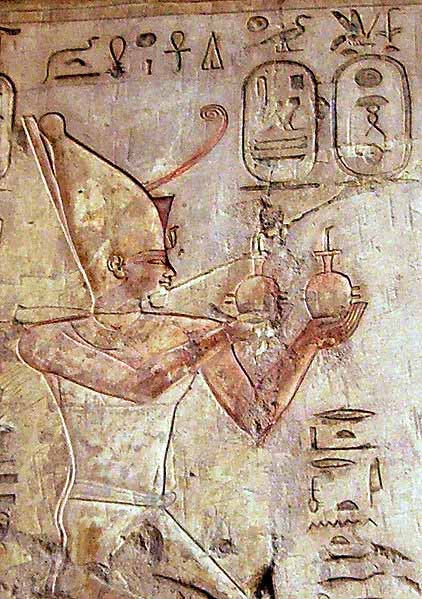
Pharaoh Psamtik I
Pharaoh Psamtik I unites Egypt

But no empire lasts forever. Psamtik, the son of one of Assyria’s puppet governors in northern Egypt, hired Greek mercenaries to drive out the Assyrian occupiers. By 654 B.C.E. he was pharaoh over a united Egypt. He went on to conquer the western half of the Neo-Assyrian Empire, and by 630 B.C.E. King Josiah of Judah had become a vassal of Pharaoh Psamtik.

Next Assyria was assailed from the southeast. In 626 B.C.E. Babylon revolted under its new king, Narbopolassar. A shrunken Assyria allied itself with Egypt, and Psamtik’s son, Pharaoh Nekho II, sent his armies north to fight Narbopolassar’s son, Nebuchadnezzar II.

It was a slow march, interrupted by rebellions of vassal states along the way. King Josiah of Judah took his own army to Megiddo to challenge the Egyptians in 609 B.C.E., but the Egyptians trounced the Israelites, and Pharaoh Nekho killed Josiah.

The armies of Egypt and Babylon met in 605 B.C.E. at Carchemish, about 2,000 miles north of Jerusalem (on the present border between Turkey and Syria). The Egyptian army was crushed, and its surviving soldiers fled south.

According to Jeremiah, Egypt did not lose the battle because of any deficiency of its own; Egypt lost because the God of Israel made it happen.

Why have your strong ones been cut down?
They did not stand
Because God shoved them down. (Jeremiah 46:15)
map Neo-Babylonian Empire B

After the battle at Carchemish, all of Egypt’s vassal states became vassals of Babylonia, and Assyria disappeared. The prophet Jeremiah repeatedly warned the new king of Judah, Yehoyakhim, to stay out of trouble and keep sending tribute to the Babylonian king, Nebuchadnezzar.

But Yehoyakhim revolted against Babylonia in 599 B.C.E. and sent Judah’s tribute to Pharaoh Nekho II (the same pharaoh who had killed his father, Josiah).

Nebuchadnezzar retaliated by besieging Jerusalem. After a year and a half the city fell and Judah came under direct control of the Neo-Babylonian Empire. Both Jeremiah and Ezekiel criticized Egypt for failing to send troops to defend its new vassal Judah.

Judah’s king, the prophet Ezekiel, and other leading citizens were deported to Babylon. Jeremiah stayed behind in the ruins of Jerusalem until some of his fellow countrymen took him into exile in Egypt.

The prophecy

Both Jeremiah and Ezekiel prophesied that because Egypt had failed keep its promise to help Judah, God would send an army from the north to destroy Egypt.  Both prophets said it would be King Nebuchadnezzar’s army, but in actual history, Nebuchadnezzar failed in his 568 B.C.E. attempt to conquer Egypt. The country remained independent until the Persians took it—from the north—in 526 B.C.E.

The Chaldees [Babylonians] Destroy Jerusalem,
by James Tissot, circa 1900

In Ezekiel’s prophecy, God would arrange for Nebuchadnezzar to devastate Egypt not just to punish it, but so that the pharaoh would know who God is. (See last week’s post, Va-eira—Ezekiel: How to Know God.)

Jeremiah’s prophecy also includes more than punishment. He uses a name for God that never appears in Ezekiel:

As I live, declares the kingY-H-V-H of Tzevaot is his name
As Tabor is among the mountains,
And Carmel is by the sea,
It will come!
Prepare for yourself the gear of exile ...
For Nof will become a horror,
A desolation without inhabitants.
Egypt is a heifer with a beautiful mouth,
But a stinging fly from the north is coming, coming! (Jeremiah 46:18-20)

Y-H-V-H = the four-letter personal name of God, possibly related to the Hebrew verb “to be”.

Tzevaot (צְבָאוֹת) = armies; companies of soldiers. (Singular tzava, צָבָא. The Bible also uses the word metaphorically for armies of stars.  See my post Bemidbar: Two Kinds of Troops.)

The first biblical book that calls the God of Israel HVH of Tzevaot is Samuel I, which modern scholars date to 630–540 BCE—the same period as the book of Jeremiah. Jeremiah uses this term 70 times!

Why does Jeremiah emphasize that YHWH, the god of existence itself, is the god of armies?

Jeremiah lived through at least 60 years of wars and reversals of fortune in the Near East, 60 years in which Judah was always a pawn, unable to take charge of its own destiny.

The common belief in the ancient Near East was that each country had its own god. When that god was happy with the people of his country, he made their army succeed. When the god was unhappy with them, their army failed.

The Bible also attributes many failures of Israelite armies to Israelite rejections of God. But why were God’s people suffering so many defeats, if their god was the most powerful?

Jeremiah was inspired to preach that the God of Israel is unlike the gods of other nations. Israel’s god, the supreme God of all existence, controls all the armies in the world. God decides which armies will win and which will lose, even when Israelites are not involved in the battle.

For Jeremiah, the prophetic insight that God rules all armies made the wars of his own lifetime meaningful. God had a master plan. Egypt would be humbled. Eventually the Babylonians would also be defeated. And in the long run, the Israelites would outlast all other peoples.

You must not fear, my servant Jacob,
—declares Y-H-V-H—
For I am with you.
For I will make an end of all the nations
Among which I have banished you.
But with you, I will not make an end. (Jeremiah 46:28)

Personally, I shrink inside when I sing a prayer that includes the term Y-H-V-H Tzevaot. If God is the ruler of all armies, then God is responsible for the carnage and suffering of all wars—which are apparently necessary for God’s master plan.

Yet if God were the Master Planner, controlling all the actions of mutable human beings, surely God could come up with a better plan than war after war. And if human beings hold ultimate responsibility for wars, then God is not the Master Planner, and not the God of Armies.

Sorry, Jeremiah.

Hafarat Va-eira—Ezekiel: How to Know God

Every week of the year has its own Torah portion (a reading from the first five books of the Bible) and its own haftarah (an accompanying reading from the books of the prophets). This week the Torah portion is Va-eira (Exodus 6:2-9:35), and the haftarah is Ezekiel 28:25-29:21.

Apparently God really wants Egypt to know who God is. The god of Israel asks the prophet Moses to tell Pharaoh “and you will know that I am God” three times in this week’s Torah portion, Va-eira. And God tells the prophet Ezekiel how God will bring down the Egyptians “and they will know that I am God” four times in this week’s haftarah.

Plague of Blood, as depicted in 14th century CE

Before God inflicts the first of ten terrible miracles on Egypt, God instructs Moses to meet Pharaoh on the shore of the Nile and warn him that the water will turn into blood.

And you shall say to him: YHVH, the god of the Hebrews, sent me to you to say, ‘Let My people go and they shall serve Me in the wilderness’, but hey—you did not listen before now. Thus says YHVH: ‘By this teida that ani YHVH’. (Exodus 7:16-17)

YHVH = the Tetragrammaton or four-letter personal name of God that Jews consider most sacred. The name appears to be a form of havah  or hayah (הוה or היה) the root of the verb “to be”, “to happen”, or “to become”, but it is a form that does not fit any Hebrew verb conjugations.

teida (תֵּדַע) = you will know, experience, be acquainted with, recognize, realize, have intercourse with.

ani (אֲנִי) = I [am].

Pharaoh hardens his heart during the seven days of bloody water, claiming it is not a divine miracle, so he does not experience or recognize the god of Israel.

God’s goal of being known by Pharaoh reappears when Moses talks about the second miracle, the plague of frogs:

… so that teida that there is none like YHVH our god. (Exodus 8:6)

—and again when God tells Moses the fourth plague will be more miraculous, because the swarm will be excluded from the place where the Israelites live,

…so that teida that ani YHVH in the midst of the land. (Exodus 8:18)

It takes ten miracles or plagues before Pharaoh finally knows YHVH, and can no longer harden his heart in denial. The knowledge comes from experiencing what God can do in the world.

The haftarah for this week’s Torah portion is a passage from the book of Ezekiel, set many centuries later during the Babylonian exile after King Nebuchadnezzar conquered the Israelite nation of Judah in 597 BCE. Judah had asked Egypt to help it fight the Babylonians, and Egypt had not come to the rescue. So Ezekiel prophesies that God will restore the land to the Israelites and punish Egypt, and both peoples will “know” God.

build houses and plant vineyards…then they will dwell on their soil that I gave to My servant, to Jacob. And they will dwell on it in safety, and they will build houses and plant vineyards, and they will dwell on it in safety when I have passed judgments on all those who despise them from all around; veyad-u that ani YHVH their god. (Ezekiel 28:25-26)

veyad-u (וְיָדְעוּ) = and they will know, realize, experience, etc. (A form of the same verb as teida.)

The Israelites will once again know YHVH is their god when they have first-hand experience of this amazing reversal in fortune.

The hafatarah continues with a poem describing the future downfall of Egypt. Then Ezekiel says:

Thus said my master, YHVH: Here I am over you, Pharaoh, king of Egypt …To the beasts of the earth and to the birds of the sky I have given you for food. Veyade-u, all the inhabitants of Egypt, that ani YHVH; because you were a walking-stick of reed to the House of Israel; when their hand grasped you, you would break…(Ezekiel 29:3-6)

The implication is that because Egypt failed to support the Israelites, God will make sure all Egyptians know from experience who YHVH is.

And the land of Egypt will become a deserted place and a ruin; veyade-u that ani YHVH, because he [Pharaoh] said: The Nile is mine and I made it. (Ezekiel 29:9)

Egyptians must also realize that although their pharaoh claimed he created the Nile, really YHVH created everything. In order to accomplish this, God will reduce Egypt to the lowest of nations.

And never again will they inspire trust in the House of Israel … veyade-u that ani the lord YHVH. (Ezekiel 29:16)

Therefore, thus says my master YHVH: Here I am, giving the land of Egypt to Nebuchadnezzar, king of Babylon. And he will carry off her wealth and loot her loot and plunder her plunder, and she will be a reward for his army. …On that day… veyade-u that ani YHVH. (Ezekiel 29:19, 29:21)

In all of these cases in Exodus and Ezekiel, people are expected to realize who God is after they have experienced an unexpected disaster or triumph, a miraculous change in fortune. The experience is supposed to be so powerful that both Israelites and Egyptians will realize that only the most powerful god in the world could create such a miracle, and that this supreme god is the god of Israel.

Furthermore, both peoples will know God by the name YHVH, the four-letter name based on the verb “to be”.  Is this detail repeatedly included simply because it is the name the Israelites use for their god? Or does it carry another meaning?

In last year’s post on this Torah portion (Va-eira: The Right Name) I suggested that the idea of God as “being” or “becoming” is intellectually appealing, but too abstract for an emotional relationship with God. Now I notice that the phrase “know that I am YHVH” always occurs in the Torah and haftarah portions in the context of knowing God’s power to change fate and to create. What is most important is for the Egyptians and for the defeated and deported Israelites to realize that the god of Israel is the god of existence itself. Nothing can have power over YHVH.

I have experienced no inexplicable miracles or reversals of fortune in my own life. I do not know God in that way. I acknowledge the reality of being, that there is something rather than nothing, and I could call that God, even if it is irrelevant to the anthropomorphic god of the Bible.

But I will not. My unmiraculous life is full of meaning and my soul is full of awe, so “I know”—yadati (יָדַעְתִּי)—that there is something I might as well call God that goes beyond the fact of existence.

Teida that ani YHVH = You will know that I am Being.

Then what, or who, is the “I”?

The Fall and Rise of Joseph, Daniel, and Esther—Part 5

This is the final post in a series comparing three stories of Jews who rise from captivity to high positions in a foreign land: the story of Joseph in the book of Genesis, the book of Daniel, and the book of Esther.  After Joseph. Daniel, and Esther’s cousin Mordecai have all become viceroys of empires, all three stories continue with the themes “The hero gets revenge on the rivals who wanted him dead”, and “Thanks to the hero, the children of Israel prosper in a foreign land”.

* The hero gets revenge on the rivals who wanted him dead. *

Joseph’s revenge is the most complex and psychological. When he is seventeen, his ten jealous older brothers throw him in a pit, discuss killing him, then sell him as a slave to a caravan bound for Egypt.  Twenty-one years later, the brothers come to Egypt to buy grain during the first of what will be seven years of famine.  They bow down to the Egyptian viceroy Tzafnot-Paneiach, who wears Egyptian linens and a gold collar and speaks through an interpreter, without recognizing their little brother Joseph, all grown up and in charge of Egypt. But Joseph recognizes them.

Joseph and brothers in EgyptJoseph has absolute power; he could order his brothers’ execution and no one would question it.  Instead, he accuses them of being spies, and they explain they are ten of twelve brothers. He says he will keep one of the brothers in prison while the others bring grain back to their households in Canaan. But then they must bring back their youngest brother, Joseph’s innocent little brother Benjamin, to prove they are telling the truth.

Then they said, each to his brother: Ah, we are carryng guilt over our brother because we saw the tzarah of his soul when he pleaded with us for pity, and we did not listen. Therefore this tzarah has come upon us. (Genesis/Bereishit 42:21)

tzarah (צָּרָה) = distress.

They intuit that Joseph’s distress resulted, somehow, in their current distress—even without knowing that the Egyptian viceroy is Joseph (or that he knows Hebrew and understands their every word).

Joseph throws them all into prison for three days—an echo of when Joseph’s brothers threw him into a pit. Then he sends off nine of his brothers with sacks full of grain (and the silver they paid for the grain hidden in the sacks).  He keeps one of his nastier older brothers, Shimon, in prison, and promises to release him only when the others return with Benjamin.

They do not return until the second year of famine; it takes that long before their father, Jacob, will let his beloved son Benjamin go with them. Then Joseph gets revenge for being sold as a slave—without actually enslaving anyone.

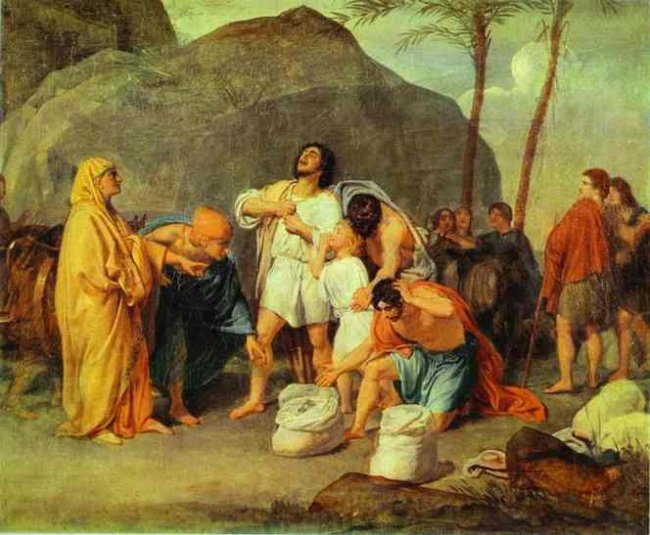
Joseph's Brothers Find the Silver Goblet in Benjamin's Sack, by Alexander Ivanov
Joseph’s Brothers Find the Silver Goblet in Benjamin’s Sack, by Alexander Ivanov

He releases Shimon and treats all eleven of his brothers to a feast. When their sacks are filled with grain, he plants a silver goblet in Benjamin’s sack. Then he sends a servant after them, who finds the goblet, claims it was stolen, and declares that Benjamin—the one innocent brother—must stay in Egypt as Joseph’s slave.

This is a test to see whether the ten older men have reformed and will no longer abandon the brother their father loves best. The test causes the brothers further psychological distress, but they do get a passing grade. First they all volunteer to be slaves along with Benjamin, and then when they are brought before Joseph, a.k.a. Tzafnot-Paneiach, Judah volunteers to replace Benjamin and become the viceroy’s slave instead. Only then does Joseph tell them his true identity.

*

Joseph arranges his own revenge on his brothers, but in the books of Daniel and Esther the revenge happens at the king’s command, in the form of a simple tit-for-tat. The bad guys get exactly the same punishment they had intended for the hero.

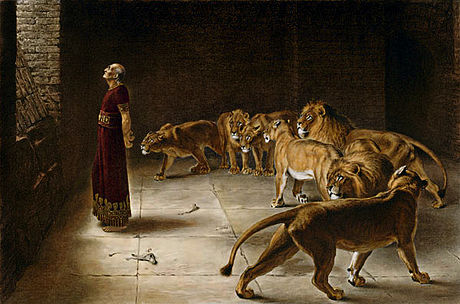
Daniel in the Lions' Den, by Briton Riviere
Daniel in the Lions’ Den, by Briton Riviere

Daniel’s rivals for the post of viceroy set him up so that he will be sealed overnight into a den of lions. (See Part 3.)  Daniel survives, thanks to a divine miracle.

Then by order of the king, those men who had slandered Daniel were brought and, together with their children and wives, were thrown into the lions’ den. They had hardly reached the bottom of the den when the lions overpowered them and crushed all their bones. (Daniel 6:25, Jewish Publication Society translation of the Aramaic)

In the book of Esther, the bad guy is Haman, whose pride is wounded because Mordecai the Jew refuses to bow to him when he is made viceroy of Persia. Haman persuades the king to issue an edict that everyone in the Persian Empire may kill all Jews on the 13th of the month of Adar. Haman also erects a tall stake so he can personally impale Mordecai when the day comes.

His plot is foiled when Queen Esther, Mordecai’s cousin, reveals that she is a Jew.

Haman Begging the Mercy of Esther, by Rembrandt

Then Charvonah, one of the eunuchs before the king, said: Also there is a wood [stake] that Haman made for Mordecai, whose good words saved the king [from an assassination plot]. It is standing at the house of Haman, 50 cubits tall.  And the king said: Impale him on it! And they impaled Haman on the wood [stake] that he had prepared for Mordecai, and the anger of the king abated. That day King Achashverosh gave to Queen Esther the property of Haman, enemy of the Jews. And Mordecai came before the king, since Esther had told what his relationship was to her. Then the king removed his signet ring, which he had taken back from Haman, and he gave it to Mordecai. (Esther 7:9-8:1)

Instead of Haman being viceroy and Mordecai being impaled, Mordecai is viceroy and Haman is impaled. The king’s edict permitting the massacre of the Jews cannot be rescinded, but Esther persuades the king to issue a counter-edict that on the same day, the 13th of Adar, the Jews of every city may assemble and fight anyone who attacks them. Between that edict and Mordecai’s new position, nobody dares to kill a Jew.

The enemies of the Jews hoped lishlot them, but the opposite happened, and the Jews shalat those who hated them. (Esther 9:1)

lishlot (לִשְׁלוֹט) = to gain power over.

shalat (שָׁלַט) = gained power over.

* Thanks to the hero, the children of Israel prosper in a foreign land. *

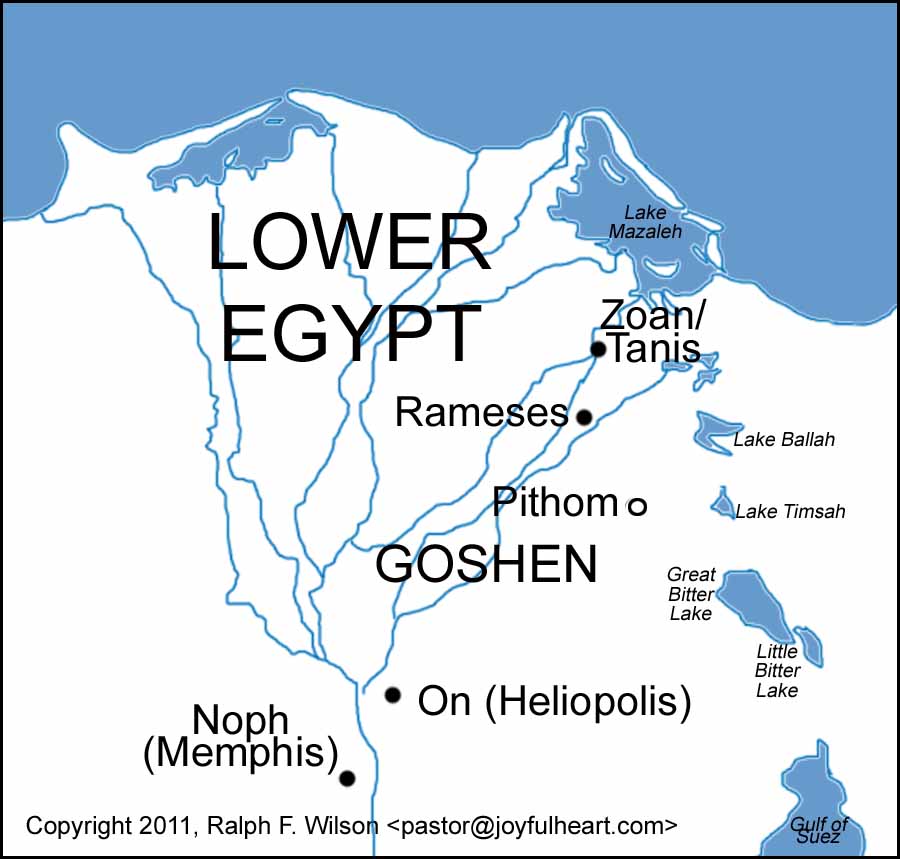
Goshen Rameses PitomJust as Joseph arranges his own non-lethal revenge, he arranges to move the children of Israel to a foreign land. After he ends his game of testing his brothers, he reveals his identity and tells them to fetch their father and their own families and move to a fertile district of Egypt called Goshen.

And I shall provide for you there, because there will be five more years of famine, so that you will not be deprived, you and your households and all that you own. (Genesis/Bereishit 45:11)

Pharaoh happily ratifies Joseph’s offer and sends wagons north to help Jacob and all his descendants move to Egypt. These original 70 children of Israel do not leave Egypt when the famine ends five years later. They stay on for four centuries, until a new dynasty rules Egypt and enslaves them to build Pharaoh’s cities. So although the children of Israel prosper during Joseph’s lifetime, eventually their lives in Egypt become intolerable, and they need God and Moses to rescue them—in the story that begins with this week’s Torah portion, Shemot (Names) in the book of Exodus.

*

The book of Daniel only implies that the Jews in the new Persian Empire benefit from Daniel’s prayers three times a day, which he continues even when his rivals trick the king into ordering that no one shall bow to a god for 30 days. Daniel emerges unscathed from the lion’s den, but when the king throws Daniel’s enemies into the den, the lions kill them at once. At this additional proof that a powerful god is on Daniel’s side,

King Darius wrote to all peoples and nations of every language that inhabit the earth, ‘May your well-being abound! I have hereby given an order that throughout my royal domain men must tremble in fear before the God of Daniel, for He is the living God who endures forever …He delivers and saves, and performs signs and wonders in heaven and on earth, for He delivered Daniel from the power of the lions.’ Thus Daniel prospered during the reign of Darius and during the reign of Cyrus the Persian. (Daniel 6:26-29)

Although the book does not specifically say that all Jews in the empire prospered along with the viceroy Daniel, the official elevation of their god implies that their position also improves. The rest of the book of Daniel consists of a series of prophetic visions Daniel experiences, with no mention of any further discrimination against the children of Israel in the Persian Empire.

*

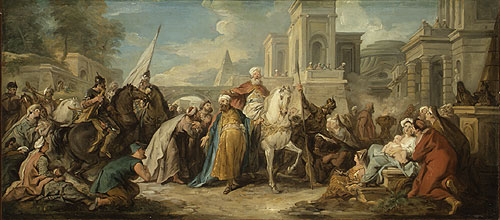
Triumph of Mordecai, by Jean Francois de Troy

In the book of Esther, the new prestige of the Jews in the Persian Empire is an inseparable part of the revenge against Haman. First the king executes Haman and makes Mordecai the viceroy in his place—giving a known Jew great power. Then the king counteracts Haman’s edict urging everyone to kill Jews on a certain date by issuing a new edict permitting the Jews to assemble and kill their enemies on that day.

Due to both Mordecai’s power and the king’s new edict, people throughout the empire show deference to the Jews among them, being careful not to offend them.

…and many of the people of the land mityahadim because the terror of the Jews fell upon them. (Esther 8:17)

mityahadim (מִתְיַהַדִים) = were pretending to be Yehudim = Jews.

The Jews kill their few remaining enemies on the official day, the 13th of Adar, which becomes the holiday of Purim.

*

The stories of Joseph, Daniel, and the Esther and Mordecai duo put a different spin on each of the seven themes they have in common, including the final theme of Jews prospering in a foreign land.

The children of Israel prosper in Egypt (for several generations, at least) because Joseph moves his extended family to he fertile district of Goshen. The Israelites secure religious freedom under the first king of the Persian Empire because Daniel proves the power of the God of Israel. And the Jews acquire more status and power later because Esther (King Achashveirosh’s chosen queen) and Mordecai (who saves Achaveirosh’s life) identify themselves as Jews, and persuade the king to reverse every action of Haman, the prime enemy of the Jews.

Together, the stories of Joseph, Daniel, and Esther demonstrate that it is possible for Jews to succeed in exile (galut), outside their former land.

What do you need to live successfully in a new place? A way to make a living and secure the physical necessities of life, according to the Joseph story in the book of Genesis. Freedom of worship, according to the book of Daniel. And the respect of the people around you, according to the book of Esther.

I pray that more and more nations in today’s world will let everyone within their borders make a living, follow their own religion, and live in peace and mutual respect.

The Fall and Rise of Joseph, Daniel, and Esther: Part 4

Joseph, Daniel, and Esther are all Israelites who attain success outside of their native land. Their stories have seven themes in common; the fifth is:

* The hero gets a foreign name. *

Actually only Joseph gets his new name and his new rank at the same time. When he is brought up from prison to interpret Pharaoh’s dreams in the Torah Portion Mikeitz (see Part 3), he is still the Hebrew slave Joseph. When he leaves Pharaoh, he is the Egyptian viceroy Tzafnat Panei-ach.

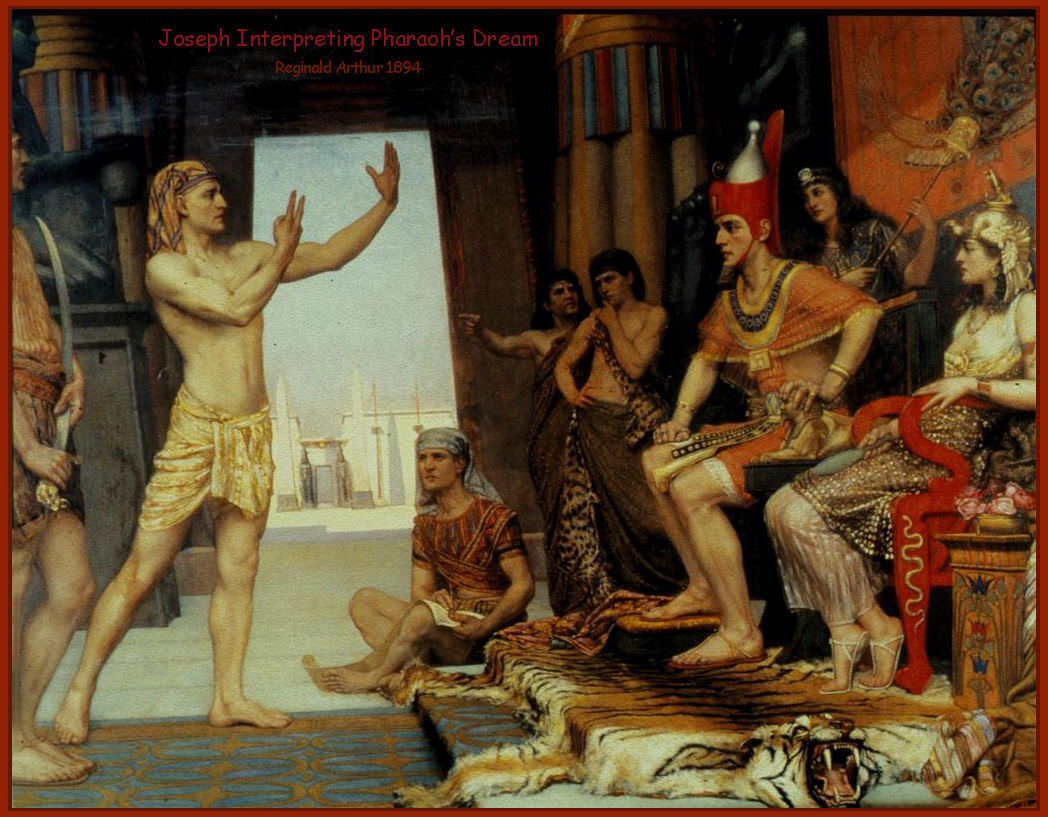
Joseph Interprets Pharaoh's Dream, by Reginald Arthur, 1894
Joseph Interprets Pharaoh’s Dream, by Reginald Arthur, 1894

Joseph explains that Pharoah’s two dreams are prophecies of seven years of plenty followed by seven years of famine. Then he gratuitously advises Pharoah to find a discerning and wise man to appoint a bureaucracy to collect a fifth of Egypt’s harvest during the next seven years and stockpile it against the coming famine.

And Pharaoh said to his servants: Could we find [another] man like this, who has the spirit of God in him? …Then Pharaoh said to Joseph: See, I have placed you over all the land of Egypt. And Pharaoh did more, and placed his signet ring from his hand on the hand of Joseph. And he dressed him in clothes of fine linen, and he put the gold collar over his neck. (Genesis 41:39-42)

Then Pharaoh gives Joseph a new name and an Egyptian wife.

And Pharaoh called the sheim of Joseph: Tzafnat Panei-ach, and he gave to him Asnat, daughter of Poti-Fera, priest of On, for a wife. And Joseph went out over the land of Egypt. (Genesis 41:45)

sheim (שֵׁם) = name; standing, reputation, renown, fame.

Joseph = English for Yoseif (יוֹסֵף) = adding, increasing.

Tzafnat Panei-ach (צָפְנַת פַּעְנֵחַ) = (Phonetic spelling of an Egyptian phrase, probably meaning “The God Speaks, He Lives”.)

The new name and new wife are further symbols of Joseph’s new rank and position, but I believe they serve a second purpose.  In order for the people of Egypt to accept the Pharaoh’s appointee as their ruler, Joseph must seem less foreign, more Egyptian. Besides wearing the fine linen of the Egyptian upper class, he must go by an Egyptian name.  An Egyptian wife makes him look even more assimilated, and may also increase his loyalty to Egypt.

*

Joseph acquires an Egyptian name the day he is appointed viceroy, at age 30. Daniel and his three friends are given Babylonian names when they are still adolescent boys, captives from the conquered city of Jerusalem. King Nebuchadnezzar orders his head eunuch, Ashpenaz, to bring him some descendants of the royalty and nobility of Judah, boys who are attractive, healthy, and educable. For three years Ashpenaz must teach these foreign boys to read and write Chadean (Babylonian), and give them rations from the king’s food and the king’s wine.

Among those from Judah there were Daniel, Chananyah, Misha-eil, and Azaryah. And the head of the eunuchs put sheimot for them; and he put for Dani-el Beilteshatzar, and for Chananyah Shadrakh, and for Misha-eil Meyshakh, and for Azaryah Aved-nego. (Daniel 1:6-7)

sheimot (שֶׁמוֹת) = names. (plural of sheim)

Daniel = English for Danyeil (דָּנִיֵּאל) = Hebrew: My Judge (Dany) is God (Eil).

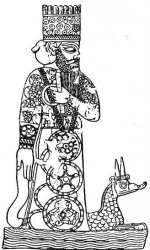
Beil fights the dragon on a Babylonian cylinder seal

Beilteshatzar (בֵּלְטְשַׁאצּר) = Babylonian: ?? Theories include three possible Babylonian phrases: Protect his Life, Beilat Protect the King, and Beil Keeps Secret Treasures. Beil is the Babylonian creator god, and Beilat is the goddess wife of Beil.

All four boys arrive in Babylon with Jewish names that include a word for the God of Israel, either Eil or Yah. But King Nebuchadnezzar hopes to use these boys as advisors, after they have learned the language and culture of Babylon. It is essential to his plan that the four boys switch their loyalty to him, instead of remaining attached to their native land and their native god.

The first step is to give them new names—monikers that contain names for Babylonian gods instead of the God of Israel. (See postscript below for the other three boys.) And the first thing the four boys do after they are renamed is to request a kosher diet! (See Part 2.)

In fact, Daniel and his friends do something Nebuchadnezzar did not expect: they remain faithful to the God of Israel, and they also become loyal servants of the king of Babylon. Daniel rises to become the viceroy of the empire. Although they answer to their Babylonian names in public, in their own hearts their real names are their Jewish names.

*

In the book of Esther, the two Jewish heroes have Persian names from the start. Here is how Esther’s cousin and guardian Mordecai is introduced:

A Jew was in the citadel of Shushan, and shemo was Mordecai, son of Ya-ir, son of Shimi, son of Kish, a man of [the tribe of] Benjamin, who was deported from Jerusalem with the deportees that were deported with Yekanyah, king of Judah, in the deportation of Nebuchadnezzar, king of Babylon. (Esther 2:5-6)

shemo (שְׁמוֹ) = his name.

Mordecai (מַרְדָּכַי) = English for Mordakhai = My Marduks. Marduk was a Babylonian god adopted by the Persians.

Ya-ir (יָאִיר) = He Shines.

Shimi (שִׁמְעִי) = I Listen.

Kish (קִישׁ) = (etymology unknown; also the name of the father of Saul, the first king of Israel.)

Marduk and his snake-dragon, from the reign of Cyrus

Mordecai’s father Yair, his grandfather Shimi, and his great-grandfather Kish all have Hebrew names. But Mordecai, a third-generation exile, seems to have only a Persian name. And what a name! But nobody in the story questions that a Jew carries the name of a foreign god.

And he became the foster parent of Hadassah, who was Esther, the daughter of his uncle, because she had no father or mother. (Esther 2:7)

Hadassah (הֲדַסָּה) = Hebrew: Myrtle.

Esther (אֶסְתֵּר) = English for Esteir = Persian: star.

Esther has a Hebrew name, but this is the only time it is mentioned in the whole book of Esther.  The rest of the time she goes by her Persian name.

God is never mentioned in the book of Esther, and neither Mordecai nor Esther prays or does any specifically religious act. But Mordecai refuses to bow to Haman because it is not his custom as a Jew (see Part 3), and when Haman arranges for the execution of Jews, Esther tells the king she is a Jew, and saves her people.

*

Each of the three stories illustrates a different stage of exile. Joseph embraces Egyptian dress and an Egyptian wife, but he never fully assimilates. When he reveals his identity to his brothers, he says simply I am Joseph.  He lets his father give his two sons the heritage of the children of Israel, and he requests his own burial in Canaan.

Some American Jews who use only one first name, a Hebrew name, for everything. Some feel as though Israel is their real home; they consider emigrating, and they want to be buried there. They remind me of Joseph.

Daniel also serves the country where he was brought as a captive, and he flourishes in exile. He becomes a man of Babylon, and never considers returning to Jerusalem. But he continues to keep kosher and to pray to the God of Israel every day for his whole life. And although he is given a Babylonian name, he remains Daniel in the Bible and in his heart.

Most American Jews today have a Hebrew name we use for religious ritual, and a secular name we use for everything else. My Hebrew name is Tzipporah, and I only use it in religious contexts; the rest of the time I am Melissa. Like Daniel and his friends, I am loyal to my religion, but I am attached to the land of the United States (even when its government goes crazy). I want to make a pilgrimage to Israel, but I would not emigrate there.

Esther and Mordecai apparently use Persian names from birth, and their lives revolve around the Persian court. We do not see them do anything religious. Yet they identify themselves as Jews, even at the risk of death.

Some American Jews also never use a Hebrew name, and do not bother much with religion. Yet when identity is an issue, they affirm that they are Jews.

Thus thousands of years after the stories of Joseph, Daniel, and Esther were written down, Jews are still following all three models for holding a Jewish identity in another land!


Postscript:

Here are the Hebrew and Babylonian names of Daniel’s fellow captives:

Chananyah (חֲנַנְיָה) = Hebrew: Gracious (Chanan) is God (Yah).

            Shadrakh (שַׁדְרַךְ) = Babylonian: Command (Shuddur) of Aku. Aku is a Babylonian moon god.

Misha-eil (מִישָׁאֵל) = Hebrew: Who is (Mi) That Which (She-) is God (Eil).

            Meyshakh (מֵישַׁךְ) = Babylonian: Who is That Which is Aku.

Azaryah (עַזַרְיָה) = Hebrew: Help (Azar) is God (Yah).

            Aved-nego (עֲוֶד נְגוֹ) = Servant of Nego. Nego is a mispronunciation of one of two Babylonian gods: Nabu, co-ruler of Babylon with the god Marduk, or Nergal, a god of death.


The Fall and Rise of Joseph, Daniel, and Esther—Part 3

by Melissa Carpenter, Maggidah

Someone tries to kill Joseph twice in the book of Genesis/Bereishit. When he is seventeen, his jealous older brothers throw him into a pit, then sit down and discuss killing him. This fits the first of seven themes that the stories of Joseph, Daniel, and Esther have in common: Resentful rivals conspire to kill the hero.  (see Part 1.)

Joseph’s brothers sell him into slavery instead of murdering him, but while he is a slave in Egypt a woman tries to get him executed for a different reason. This time, the theme is:

*  The hero is punished for refusing to obey an order because of religious scruples, but God rescues the hero.  *

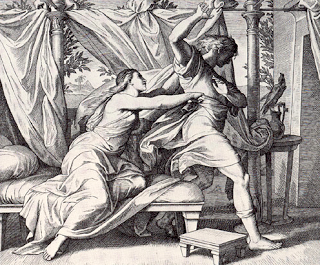
Joseph and Potiphar's Wife, by Schnorr von Carolsfeld
Joseph and Potiphar’s Wife, by Schnorr von Carolsfeld

And it happened after these things, then the wife of his master raised her eyes to Joseph, and she said: Lie with me.  And he mei-ein, and he said to the wife of his master: Hey, having me here, my master has no concern about anything in the house, and everything that belongs to him he has put into my hand. There is no one greater in his house than I am, and he has not withheld anything from me except you, since you are his wife, so how could I do this great evil and transgress against God? (Genesis/Bereishit 39:7-9)

mei-ein (מֵאֵן) = refused. (In Biblical Hebrew, this is not a polite demurral, but a stubborn refusal.)

For Joseph, an ethical transgressions is a transgression against God. He refuses, even though he knows it is dangerous to anger his master’s wife. But she keeps propositioning him day after day, until one day when the house is empty,

…she grabbed him by his garment, saying: Lie with me! But he abandoned his garment in her hand and he fled outside. (Genesis 39:12)

What difference does it make that the house is empty? Potifar’s wife seems unconcerned about whether they are caught in the act, since she propositions him many times when other people are nearby. But the lack of witnesses this time gives her an opportunity to get revenge and slander Joseph. She claims he tried to rape her, and left his garment behind when (she says) she screamed.

The few examples we have of ancient Egyptian law on sexual relations indicate that rape was punished by death (though the punishment might be commuted to exile in the case of a free foreigner). Potifar is the head of the royal executioners, and Joseph is his slave. But instead of arranging a summary execution, Potifar puts Joseph in the king’s prison indefinitely. He is alive, but stuck until God rescues him.

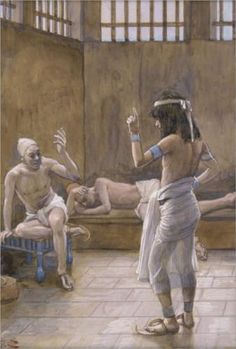
Joseph in Prison, by James Tissot

Then Pharaoh sends his chief cupbearer and chief baker to the prison (see Part 2),

and they said to him: a dream we dreamed, and there is no interpreter. Then Joseph said to them: Do not interpretations belong to God? Recount [your dreams] to me, please. (Genesis 40:8)

Inspired by God, Joseph reads the dreams as prophecies that the chief cupbearer will be restored to his post in three days, but the chief baker will be beheaded. This is exactly what happens.

When Pharaoh has two dreams that his magicians cannot interpret, the chief cupbearer tells him about Joseph, and God gives Joseph the correct interpretation of Pharaoh’s prophetic dreams.  Joseph adds some advice on what to do about it, and Pharaoh elevates Joseph from imprisoned slave to viceroy of Egypt.

Thus God rescues Joseph from his punishment—presumably because he did the right thing by rejecting Potifar’s wife.

*

While Joseph escapes death twice, Daniel is threatened with death only once. In his case, resentful rivals conspire to kill the hero by using his well-known religious scruples against him, immediately bringing in the theme the hero is punished for refusing to obey an order because of religious scruples, but God rescues the hero.

Daniel and three other boys are taken as captives from Jerusalem when King Nebuchadnezzar conquers the city, and spend the rest of their lives in Babylon. Daniel becomes head of the king’s wise men and dream interpreters, and his friends, Shadrach, Meyshach, and Aveid-nego, become administrators of the province of Babylon. At one point, Daniel’s three friends are thrown into a furnace for refusing to bow to a golden idol of Nebuchadnezzar, and God prevents the flames from even singeing their hair. Daniel is not mentioned in the furnace story.

Many years later, when Persia conquers Babylon, Daniel is serving as one of three governors over the Neo-Babylonian Empire. The new king (whom the story identifies sometimes as Cyrus, sometimes as Darius) considers promoting Daniel to viceroy over the entire Persian empire.

Only then do resentful rivals—other high government officials—conspire to kill the hero. They know that Daniel adheres to a kosher diet and prays three times a day, bowing down in the direction of Jerusalem. There are no laws against this, so they persuade the king to decree that anyone who petitions any god or man other than the king during the next 30 days shall be thrown into a lion’s den. (See Part 1.) It does not occur to the king that this decree will affect Daniel.

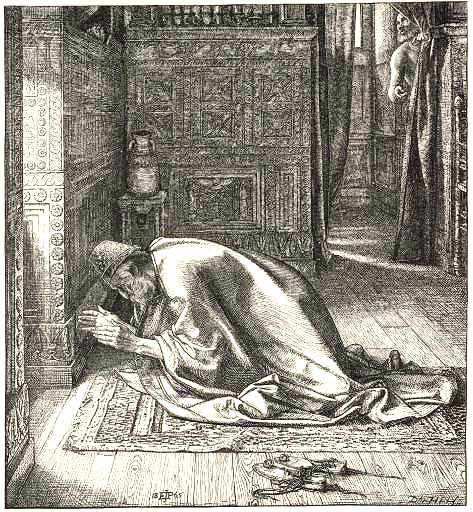
Daniel's Prayer, by E.J. Poynter
Daniel’s Prayer, by E.J. Poynter

When Daniel learned that it had been put in writing, he went to his house, in whose upper chamber he had had windows made facing Jerusalem, and three times a day he knelt down, prayed, and made confession to his God as he had always done. Then those men came thronging in and found Daniel petitioning his God in supplication. (Daniel, 6:11-12, Jewish Publication Society translation of the Aramaic)

As in the book of Esther, the Persian king cannot countermand his own decree, and he cannot find any way around it. Thus the resentful rivals succeed in having Daniel punished for refusing to obey an order because of religious scruples.

By the king’s order, Daniel was then brought and thrown into the lions’ den. The king spoke to Daniel and said, ‘Your God, whom you serve so regularly, will deliver you’.  (Daniel 6:17, JPS translation)

Daniel in the Lions' Den, by Briton Riviere
Daniel in the Lions’ Den, by Briton Riviere

The king worries all night and rushes back at dawn to unseal the den.

Daniel then talked with the king, ‘O King, live forever! My God sent His angel, who shut the mouths of the lions… Daniel was brought up out of the den, and no injury was found on him, for he had trusted in his God. (Daniel 6:22-24, JPS translation)

God rescues Daniel from death because of his dedication to God, expressed in his thrice-daily prayers.

*

The book of Esther also combines the themes of resentful rivals and refusing to obey an order because of religious scruples.

The story has two heroes, the young and beautiful Esther, and her older cousin and guardian Mordecai. When Esther becomes a captive in the king’s harem, she follows her cousin’s instruction and pretends she is not Jewish.

Mordecai, however, incites jealousy in the king’s new viceroy, Haman, by disobeying a royal order to bow down whenever Haman passes through the palace gate. (See Part 1.)

And the royal servants who were in the gate of the king said to Mordecai: Why are you oveir the command of the king? And they spoke to him day after day and he did not listen to them. Then they told Haman, to see if the matter of Mordecai would stand, for he had explained to them that he was a Jew. (Esther 3:3-4)

oveir  (עוֹוֵר) = crossing, going through.

The Bible does not say that Mordecai refused (mei-ein) the king’s command, but rather that he ploughed right across it as if it did not exist. When his fellow royal servants in the gate question him, he says he ignores the order to bow to Haman because he is a Jew.

Nothing in the Bible forbids Jews to bow down to human beings. Esther Rabbah (a collection of midrash from 500-1050 C.E.) claimed Haman must have sewn a picture of a god on his clothing, so Mordecai was really refusing to bow down to an image of an alien god. Other commentary suggests that Mordecai would not bow because Haman was a descendant of King Agag of Amalek (so identified in Esther 3:1), and the Torah calls for eternal enmity between the Israelites and the Amalekites. But the text of Esther does not explain.

Mordecai never bows to Haman

And Haman saw that Mordecai never knelt or bowed down to him, and Haman filled up with rage. And it seemed too contemptible in his eyes to send a hand against Mordecai alone, because they had told him the people of Mordecai, and Haman sought to exterminate all the Jews who were in all the kingdom of Achashveirosh, all the people of Mordecai. (Esther 3:5-6)

Haman talks the king into issuing an irrevocable decree that on a certain date (the 13th of Adar, now the holiday of Purim) every province of the Persian Empire must kill all its Jews. Haman personally erects a tall stake on which to impale Mordecai.

Does God rescue Mordecai and the rest of the Jews in Persia? Not really. Esther reveals that she and Mordecai are Jews, and Haman has arranged their death. She persuades the king to write a second decree (since the first one cannot be revoked) that on the 13th of Adar all Jews may strike down all their enemies, and on the big day nobody touches the Jews. The king impales Haman and promotes Mordecai to viceroy. But God is not mentioned here or anywhere else in the book of Esther.

*

Joseph risks death for a moral principle, and God rescues him. Daniel risks death for the right to pray, and God rescues him. Mordecai risks death to make a point about being Jewish, and Esther rescues him.

What are your religious scruples?  Which ones would you refuse to cross, even at the risk of losing your job? Or even at the risk of death?


The Fall and Rise of Joseph, Daniel, and Esther—Part 2

Two more themes shared by the stories of Joseph, Daniel, and Esther are: “The hero is taken away from home and held captive” and “A court eunuch admires and helps the hero”.

*The hero is taken away from home and held captive.*

Joseph is sold in Dotan, bought in Memphis

In the first Torah portion devoted to Joseph, Vayeishev, Joseph’s ten older brothers can hardly stand him. (See The Fall and Rise of Joseph, Daniel, and Esther—Part 1.) They take the family flocks to Dotan, about a hundred miles away from their home in Hebron, and their father sends Joseph to check on them.  When he arrives, his brothers throw him into an empty cistern and conspire to kill him.

But Judah said to his brothers: What profit [is there] if we kill our brother and cover up his blood? Let’s go and sell him to the Ishmaelites… So they pulled Joseph and they brought him up from the pit. Then they sold Joseph to the Ishmaelites for 20 pieces of silver, and they brought Joseph to Egypt. (Genesis/Bereishit 37:26-28)

The brothers believe Joseph will never return from slavery in Egypt.

While Joseph is singled out by his brothers, Daniel and Esther are removed from their homes merely because they happen to meet the criteria for a category of people the king summons.

King Nebuchadnezzar brings Daniel from Jerusalem to Babylon

The book of Daniel opens when King Nebuchadnezzar of Babylon captures Jerusalem. The king orders his chief eunuch to transport some young Israelite boys to Babylon. The boys must be:

…from Israel and descended from the royalty and the nobility; boys who have no blemishes, and are tovey mareh, and understand all wisdom, and have practical knowledge and some understanding of academic knowledge, and who have the ability to serve in the palace of the king, and to learn the writing and the tongue of the Chaldeans. (Daniel 1:3-4)

tovey mareh (טוֹבֵי מַרְאֶה) = good-looking (masculine form).

The boys will be educated for three years, and then will serve Nebuchadnezzar in some capacity. Young Daniel is taken away from home and transported to a foreign court merely because he fits the king’s description.

Similarly, in the book of Esther the king of Persia orders a certain class of girls to be rounded up and brought to the royal residence in Shushan. King Achashveirosh wants a new wife, and his advisors respond:

Let the king appoint appointees in every province of his kingdom, and let them gather all the virgin girls tovat mareh to the citadel at Shushan, to the house of the women, to the hand of Heigai, the chief eunuch of the king, guard over the women… And the girl who is good in the eyes of the king will become queen instead of Vashti. (Esther 2:3-4)

tovat mareh (טוֹבַת מַרְאֶה) = good-looking (feminine form).

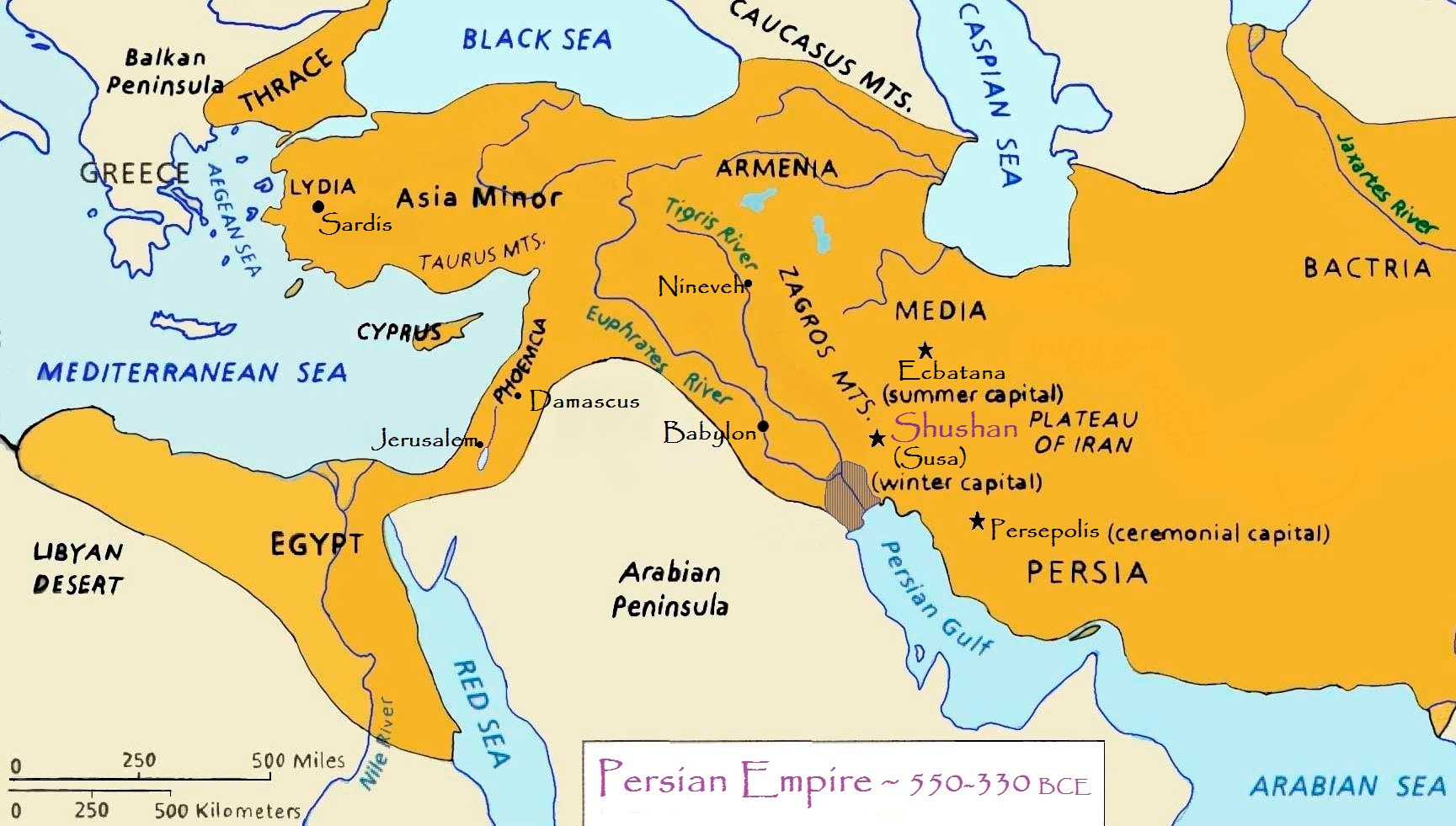
map Persian Empire
Esther is taken to the harem of King Achashveirosh (Xerxes?) in Shushan

Esther happens to live in Shushan with her cousin and guardian Mordecai, but she is taken out of her home and put under guard in the “house of the women”, i.e. the harem, simply because she fits the description:

…and the girl was beautiful in shape and tovat mareh… (Esther 2:7)

Joseph, Daniel, and Esther are all good-looking adolescents when their stories begin. All three live in comfort, Joseph with his doting father, Daniel in the royal court of Jerusalem, and Esther with her fond and wealthy cousin Mordecai.  Then the earth shifts under their feet.  Joseph is sold as a slave in Egypt. Daniel is deported for re-education in Babylon. Esther becomes a captive in the Persian king’s harem.

Yet all three heroes rise from the fall in their fortunes—with some assistance from a eunuch in the royal court.

*A court eunuch admires and helps the hero.*

And Joseph had been brought down to Egypt; and Potifar, a saris of Pharaoh, the sar of the tabachim, acquired him from the hands of the Ishmaelites who had brought him there. (Genesis 39:1)

saris (סָרִיס) = eunuch; court official. Plural=sarisim. (From the Assyrian title sa resi = royal official. In Assyria, as in many ancient Near Eastern empires, employees in the king’s house were often eunuchs, so later in the Bible saris came to mean any eunuch.)

sar (שַׂר) = head, chief, official in charge. (From the Assyrian sarru = king, chieftain, captain.)

tabachim (טַבָּחִים) = meat-handlers (butchers, meat cooks, and meat servers); executioners.

Joseph’s new master, Potifar, owns an estate and reports directly to the Pharaoh as the head of a group of servants.  He is also in charge of the prison where men are detained until their trials.

Since the Torah refers to Potifar as both a saris and a sar, the additional title of saris probably means “eunuch” rather than a repetition of “court official”—even though he is married. Traditional commentary speculates that Potifar was castrated at some point after his marriage.

And his master [Potifar] saw that God was with him [Joseph], and everything that he did, God made a success.  And Joseph found favor in his eyes, and he became his attendant. Then he [Potifar] appointed him over his household, and he gave everything he owned into his hand. (Genesis 39:3-4)

When Potifar’s wife falsely accuses Joseph of trying to rape her, Potifar has to take action to preserve her honor. Normally a slave would be executed for such an attempt, but Potifar appreciates Joseph so much, he imprisons him instead—in the prison for the king’s detainees, which Potifar manages.

Joseph in Prison, by James Tissot

Then Potifar appoints Joseph to wait on two detainees with high court positions.

Pharaoh became angry at two of his sarisim, the sar of the cup-bearers, and the sar of the  bakers.  And he placed them in the custody of the sar of the tabachim [Potifar], in the house of the round prison, the place where Joseph was imprisoned. Then the sar of the tabachim appointed Joseph to be with them, and he waited on them… (Genesis 40:2-4)

Like Potifar, these court officials are called both sar (chief official) and saris (eunuch). Joseph correctly interprets their dreams, and in the Torah portion Mikeitz, the head cup-bearer mentions Joseph when the Pharaoh needs a dream interpreter. Pharaoh calls for him at once, and Joseph’s career takes off.

Thus Joseph is helped along by two different eunuchs, the king’s head executioner and the king’s head cup-bearer.

In the book of Daniel, a Babylonian officer named Ashpenaz is called both the high saris, and the sar of the sarisim. I think the title sar covers his position as a captain, so the word saris gives the additional information that he and those he supervises are eunuchs. After Ashpenaz’s boss, King Nebuchadnezzar, has conquered Jerusalem, he sends his high-ranking eunuch on a mission.

The king said to Ashpenaz, his high saris: Bring some sons of Israel, descendants of the royalty and the nobility. (Daniel 1:3)

Nebuchadnezzar orders Ashpenaz to educate these foreign boys for three years and give them rations from the king’s food and the king’s wine. But Daniel and his three companions from Jerusalem object to eating anything that is not kosher.

Daniel silently vowed that he would not make himself impure with the king’s fine food or with the wine he drank, and he sought to obtain [permission] from the sar of the sarisim that he need not make himself impure. And God disposed the sar of the sarisim to be kind and compassionate toward Daniel. And the sar of the sarisim said to Daniel: As for me, I am afraid of my master, the king, who allotted your food and your drink; what if your faces look pitiful compared to the other boys your age, and they forfeit my head to the king?  (Daniel 1:8-10)

Daniel proposes a ten-day trial during which he and the other three boys from Jerusalem will eat seeds or legumes and drink water.  At the end of ten days, they look healthier than the others. So the chief eunuch lets them continue their religious dietary restrictions. When he brings them to the king at the end of their three years of training, Nebuchadnezzar is pleased with them and appoints them to entry-level jobs among his “wise men”.

In the book of Esther, the head eunuch, Heigai, is the guard over King Achashveirosh’s “house of women” or harem. Esther is delivered to him along with the other beautiful young virgins rounded up for the king.

And she was good in his eyes, and she inspired kindness in him, and he was quick to give her her massage ointments and her rations and the seven girls who were her due from the king’s house. And he moved her and her girls to a better [room] in the house of women. (Esther 2:9)

Esther Present to Ahasuerus. detail by Rembrandt

Each virgin is kept in the harem for one year while she gets beauty treatments, then taken to spend a night with the king. The virgin of the night is allowed any clothes and cosmetics she requests.  When it is Esther’s turn,

she did not seek to obtain anything except what Heigai, saris of the king, guard of the women, said. And it was Esther who inspired favor in the eyes of everyone who saw her. The king loved Esther more than all the other women… And he put a crown of royalty on her head, and he made her queen instead of Vashti. (Esther 2:15, 2:17)

*

The court eunuchs who help Joseph appreciate his competence. According to the Torah, God makes all Joseph’s work successful and gives him dream interpretations that are true prophecies.

The court eunuch who helps Daniel admires his fortitude and his adherence to his religion. Probably due to these qualities, the God of Israel later rescues him from lions and gives him his own dream interpretations and prophecies.

The court eunuch who helps Esther probably appreciates her respect for his advice. He responds by making her life more comfortable and advising her well.

All three young heroes accept their sudden enslavement without complaining, withdrawing, or rebelling.  They do their work and treat the eunuchs overseeing them with respect, making the best of it. Because of their good attitudes, the eunuchs help them to appear in a favorable light before the king.

May we all be blessed with the ability to ride out our misfortunes with realism, patience, and respect!


The Fall and Rise of Joseph, Daniel, and Esther–Part 1

Joseph is sold as a slave and becomes the viceroy of Egypt. Daniel is a war captive and becomes the viceroy of Persia. Esther is imprisoned in a harem and becomes the queen of Persia, while her cousin Mordecai escapes impalement and becomes the empire’s viceroy.

Each of these three rags-to-riches stories has a different plot and different characters. But many of the same themes emerge, appearing in a new light in each story.

The story of Joseph begins in this week’s Torah portion, Vayeishev (“and he stayed”), and continues through three more weekly portions. So this month I am writing a series of posts comparing seven dramatic themes in Joseph’s story, the book of Daniel, and the book of Esther:

          Resentful rivals conspire to kill the hero.

          The hero is taken away from home and held captive.

          A court eunuch admires and helps the hero.

          The hero is punished for refusing to obey an order because of religious scruples, but God rescues the hero.

          The hero gets a foreign name.

          The hero gets revenge on the rivals who wanted him dead.

          Thanks to the hero, the children of Israel prosper in a foreign land.


Vayeishev, the first Torah portion in the Joseph story, introduces the first theme:

*Resentful rivals conspire to kill the hero.*

Joseph’s story in Genesis/Bereishit begins with jealousy.

Israel loved Joseph most out of all his sons, because he was a child of old age to him, and he made him a special long-sleeved tunic. And his brothers saw that their father loved him most out of all his brothers, so they hated him, and they were not able to speak to him in peace. (Genesis/Bereishit 37:3-4)

Upright sheaves
Upright sheaves

Joseph has two dreams in which his brothers (symbolized first by sheaves of grain, then by stars) are bowing down to him, and he makes the mistake of telling them his dreams.

…we were binding sheaves in the middle of the field, and hey! My sheaf stood up and actually stayed [upright], and hey! Your sheaves circled around vatishtachavena my sheaf. (Genesis/Bereishit 37:6-7)

vatishtachavena (וַתִּשְׁתַּחֲוֶיןָ) = and prostrated themselves to, bowed down to the ground toward.

After hearing that, his brothers hate him even more.

When the ten older brothers take the family’s flocks far to the north, their father Israel (also known as Jacob) sends Joseph out to find his brothers and report back.

They saw him from afar, before he reached them, and they plotted against him, to kill him.  And they said to each other: Hey! The master of dreams is coming! Now let’s go and kill him, and we will throw him down into one of the pits, and we will say a wild beast ate him.  Then we shall see what becomes of his dreams! (Genesis 37:18-20)

They do throw Joseph into an empty cistern, though instead of killing him they sell him as a slave to a caravan heading for Egypt. Their intense jealousy causes Joseph’s downfall—down into a pit, down into slavery, and down to Egypt.

Daniel, on the other hand, rises from being a foreign captive to being the viceroy of the Babylonian empire without offending anyone’s pride. King Nebuchadnezzar makes Daniel his chief magician.  A later Babylonian king, Belshazzar, appoints Daniel as one of three administrators over all the provinces in the empire. When Darius conquers the empire, he appoints the same three administrators as supervisors over the 120 district managers.

This man Daniel surpassed the other ministers and satraps by virtue of his extraordinary spirit, and the king considered setting him over the whole kingdom. The administrators and managers looked for some fault in Daniel’s conduct in matters of state, but they could find neither fault nor corruption…

Daniel's Prayer, by E.J. Poynter
Daniel’s Prayer, by E.J. Poynter

Then those men said: We are not going to find any fault with this Daniel unless we find something against him in connection with the laws of his god. (Daniel 6:4-6)

Daniel’s fellow administrators and managers are determined to bring him down. Like Joseph’s brothers, their resentment is so extreme, they want him dead. So they persuade King Darius to issue an edict that for the next 30 days, anyone who petitions any man or god other than Darius will be thrown into a den of lions. Daniel continues to kneel and pray to God three times a day in front of his windows. His rivals rush into his room, then go and inform the king, who reluctantly obeys his own written edict and throws Daniel into the lions’ den, placing a rock over the mouth of the cave so Daniel must spend the night inside.

The book of Esther has two Jewish heroes: Esther, and her cousin and guardian Mordecai. King Achashveirosh makes Esther his queen; Mordecai merely becomes one of the elders who sits in the gate of Shushan and judges minor cases. Meanwhile the king promotes Haman, one of his advisors, to viceroy.

Mordecai refuses to bow

And all the servants of the king who were in the gate of the king were kneeling umishtachavim to Haman, because that was what the king ordered. But Mordecai would not kneel and lo yishtachaveh. …Haman saw that Mordecai was not kneeling umishtachaveh to him, and Haman filled up with rage. (Esther 3:2, 3:5)

umishtachavim (וּמִשְׁתַּחֲוִים) = (plural) and bowing down to the ground.

lo yishtachaveh (לֹא יִשְׁתַּחֲוֶה) = he would not bow down to the ground.

umishtachaveh (וּמִשְׁתַּחֲוֶה) = (singular) and bowing down to the ground.

Haman learns that Mordecai is not bowing because he is a Jew. Commentators generally conclude that he refuses to bow—either because Haman expects the kind of full bow (kneeling, then touching one’s head to the ground) that is reserved for God; or because Haman is a  descendant of Amalek, God’s enemy in every generation.

…Then Haman sought to exterminate all the Jews that were in all the kingdom of Achashveirosh—Mordecai’s people. (Esther 3:6)

He persuades Achashveirosh that “a certain people” in his empire do not obey the king’s laws, and should therefore be eliminated. The king (who is fairly brainless throughout the story, perhaps because of all his drinking feasts) does not question Haman, but immediately gives him permission to issue a royal edict.

So thanks to jealousy and wounded pride, Joseph is thrown into a pit, Daniel is sealed into a lions’ den, and all the Jews in Persia are threatened by an edict of destruction.

Is this theme a warning on the part of the Biblical authors that it is dangerous, even deadly, to threaten the pride of others?

If so, the Joseph story offers a lesson, since Joseph wounds his brothers’ pride further by telling them his dreams of overlordship. If he had considered his brothers’ feelings and kept silent, he would not have been enslaved—but his brothers would still have held a grudge against him because of their father’s favoritism.

In the Daniel story, Daniel is promoted only because of his own excellent work, not because he is lording it over anyone. Although he is caught praying and thrown into the lions’ den, he does not brag about his god, or try to convert anyone else. Sometimes nothing can be done about the jealousy and pride of others.

In the book of Esther, all the Jews in Persia are put under a death sentence because Mordecai insists on following a religious scruple to the letter. Haman is clearly the villain, yet Mordecai is also responsible for the threat to his people. Perhaps Mordecai is emulating Daniel, whose prayers affect only his own fate.  He fails to take into account that when one member of a group offends a prideful person, that person is likely to consider everyone in the group offensive. Prejudice is always dangerous.

Sometimes it is better to be silent in the face of enemies. Sometimes it is even better to bow when everyone else is bowing.

*

The danger of wounding someone’s pride is only one of the themes that the stories of Joseph, Daniel, and Esther have in common.  Watch for my upcoming blogs on the twists and turns of other themes!


Vayishlach: A Partial Reconciliation

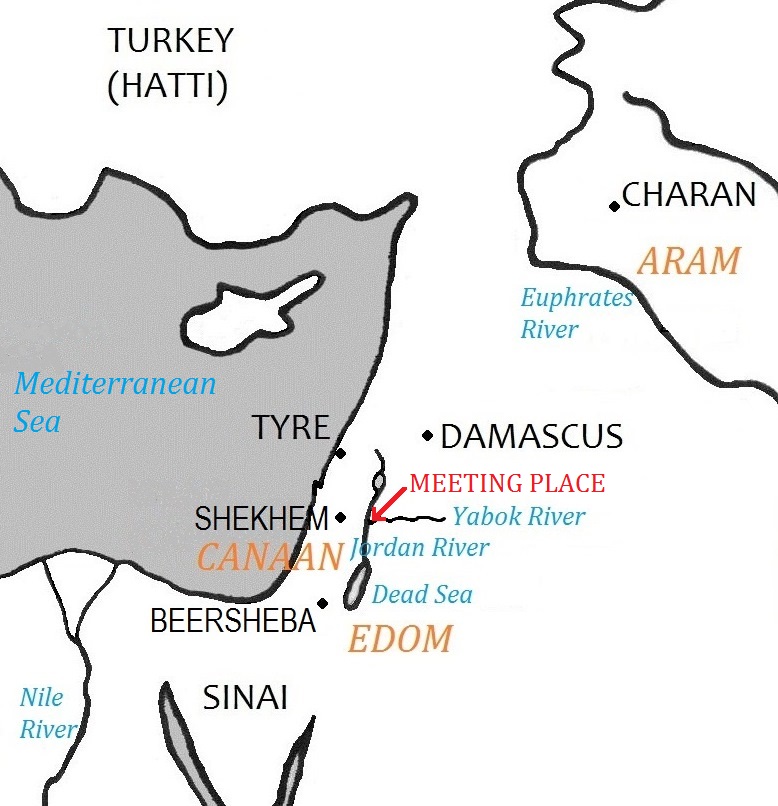
Jacob finally heads back to Canaan at the opening of this week’s Torah portion, Vayishlach (“And he sent”)—after living 20 years in the Aramean town of Charan. In Canaan, Jacob cheated his twin brother Esau out of an inheritance and a blessing. In Aram, Jacob’s uncle Lavan cheated him into working for two wives when he only wanted one.1 Now Jacob now has his own large family and plenty of wealth to make a fresh start.  But one thing hangs over his head: when he fled Canaan 20 years before, his resentful brother Esau was planning to murder him.

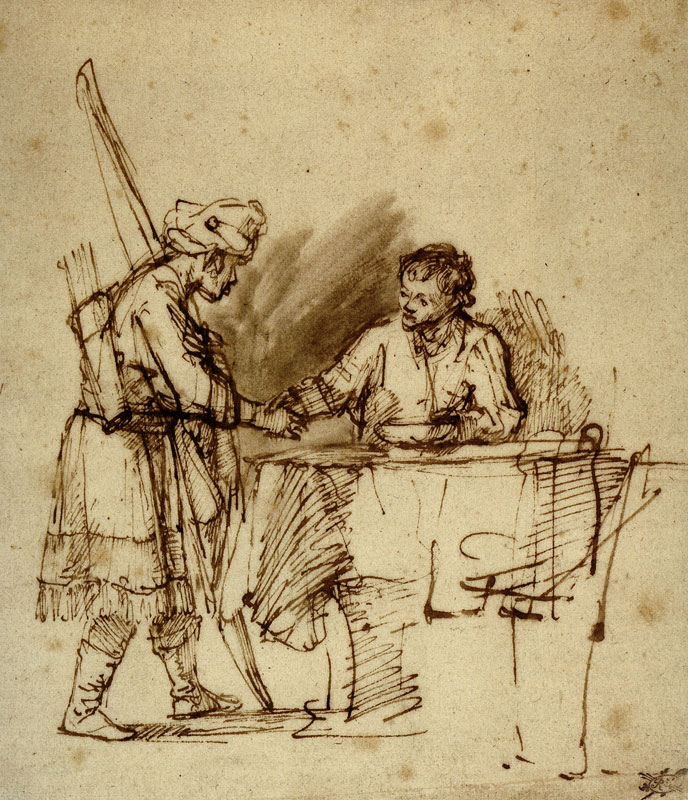
Esau Sells his Birthright, by Rembrandt

Esau was enraged because his brother had cheated him twice.  First Jacob had traded Esau a bowl of stew for Esau’s larger inheritance as the firstborn.2  Then Jacob had disguised himself as Esau to steal their blind father Isaac’s blessing.3

Jacob’s guilt over his own behavior and anxiety about Esau are still strong 20 years later.  He knows that Esau has moved to the region of Sei-ir and founded his own kingdom, Edom.  What he does not know is whether Esau still wants to kill him.

map middle east 1

The first thing Jacob does after he crosses the hills of Gilead east of the Jordan is to send messengers to his brother.

And he gave them orders, saying: Thus you shall say: “To my lord, to Esau: Thus says your servant Jacob: I sojourned with Lavan, and I lingered until now. And it happened I acquired oxen and donkeys, flocks and male slaves and female slaves. And now I send ahead to tell my lord, to find chein in your eyes.” (Genesis/Bereishit 32:5-6)

chein (חֵן) = favor, approval.

Jacob words his message to his brother carefully. He addresses Esau as “my lord” instead of “my brother”; calls himself “your servant Jacob”; and mentions “finding favor in your eyes” as if Esau were his king.

The blessing that Isaac gave to Jacob instead of Esau included the words:

Be an overlord to your kinsmen, and may the sons of your mother bow down to you. (Genesis 27:29)

Now Jacob’s message intimates that the reverse of the blessing is true: Esau is Jacob’s overlord, and Jacob will bow down to him.

But Esau does not trust his brother’s words.  (See my post Vayishlach: Message to a Brother, in which I speculate on how Esau might misinterpret Jacob’s message.)

And the messengers returned to Jacob, saying: “We came to your brother, to Esau, and he is actually going out to meet you, and 400 men are with him”.  Jacob became very frightened … (Genesis 32:7-8)

Jacob concludes that Esau still carries a grudge from 20 years before. Why else would he head north with a troop of 400 men?

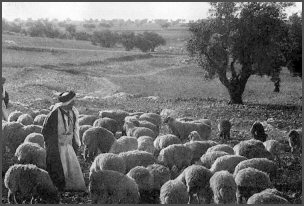
shepherd and sheep

He reacts by dividing his family and possessions into two camps, so Esau’s men cannot wipe out everyone at once; by praying to God; and by sending several ridiculously large gifts of livestock ahead to Esau on the road.  Jacob instructs the servant in charge of each drove of livestock that when he reaches Esau and his men, he should tell Esau the animals are a gift from Jacob.  Again, he uses language that flips Isaac’s blessing.

And you shall say: From your servant, from Jacob, it is a minchah sent to my lord, to Esau; and hey!—he is also behind us. (Genesis 32:19)

minchah (מִנְחָה) = a gift of respect, thanks, homage, or allegiance; a tribute.

In the Bible, a person gives a minchah to a king or to God.  Thus Jacob’s messages continue to emphasize that he is subservient to Esau—just as if Isaac had given the blessing to Esau after all, and it had taken effect.

For he said [to himself]: I will appease him with the minchah that is going before me, and after that I will see his face; perhaps he will pardon me.  (Genesis 32:21)

Jacob then spends the night on the bank of the Yabok River, wrestling with a mysterious being and coming to terms with his own identity.  (See my post Vayishlach: Blessing Yourself.)  In the morning he crosses over and goes to meet Esau—still limping from his wrestling match.

… and he bowed down to the ground seven times until he drew up to his brother. (Genesis 33:3)

Bowing to the ground seven times was the correct procedure for approaching a Canaanite king in the second millennium B.C.E.  By literally bowing down to his brother, Jacob is, in effect, transferring Isaac’s blessing to Esau.

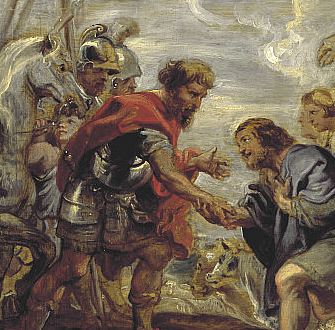
Reconciliation of Jacob and Esau, by Peter Paul Rubens, detail

And Esau’s hostility evaporates.  He might question Jacob’s words; he might view the gifts of livestock with suspicion; but when he sees his brother limping toward him and bowing his gray head to the ground seven times, he realizes that his brother has changed.  Jacob is not trying to cheat him again.

Then Esau ran to meet him, and he embraced him, and he fell on his neck, and he kissed him, and they wept. (Genesis 33:4)

Jacob introduces Esau to his family.  Next Esau politely refuses to keep Jacob’s gift, and Jacob politely urges him to accept it, according to the usual social ritual.  At first Jacob says: “If, please, I have found chein in your eyes, then take my minchah from my hand … (Genesis 33:10)

Esau still demurs, so Jacob urges him to accept the gift a second time, saying: Take, please, birkhati that was brought to you, because God chanani and because I have everything.”  And he urged him, and he took [it]. (Genesis 33:11)

birkhati (בִּרְכָתִי) = my blessing.

chanani (חַנַּנִי) = favored me.  (From the same root as chein.)

The gift of livestock is so large it probably equals the inheritance of the firstborn that Jacob once traded him for.  (The Torah does not say how much each brother actually inherits when Isaac dies later in the story, but both are already wealthy.)  Jacob urges Esau to accept not only the equivalent of the inheritance, but also a blessing.  Thus Jacob returns everything he cheated Esau to get.

Are the brothers reconciled?  Not quite.  Esau, no longer angry or anxious about Jacob, invites him to come home with him to Sei-ir.  But Jacob refuses, on the pretext that the children and the nursing animals cannot travel fast enough.  He falsely promises to catch up with Esau later.  Then he heads in the other direction.

Jacob has made amends for his bad deeds, so his conscience is cleared.  He no longer has a rational reason to believe Esau holds a grudge.  Yet he still cannot get over his fear of Esau.

I think the reason is that Esau has not changed.  Jacob has changed; he has faced who he is, and taken steps to right past wrongs.  But Esau is essentially the same: impulsive, emotional, easy to persuade.  At that moment, Esau loves him because he believes Jacob had become a good brother.  But in the future, who knows what random act or remark might sway Esau’s heart?


I have similar problems in my own life. I can think of at least three people with whom I have reconciled—up to a point.  I have thought of good reasons why they did not reciprocate my apologies, and I am careful to treat them with respect.  Yet all three seem unpredictable to me, moved by mental complexes I do not understand.  Like Jacob, I am still afraid of what they might do next.

Sometimes only a partial reconciliation is possible.  Perhaps Jacob is wise to realize this, and to travel away from his brother Esau.


  1. Genesis 29:15-28.
  2. Genesis 25:29-34.
  3. Genesis 27:1-33. See my post Toledot: To Bless Someone.

Vayeitzei: Fathers and Stripes

Running away from Isaac

Jacob runs away from home at the beginning of this week’s Torah portion, Vayeitzei (“And he went”). His mother, Rebecca, has told him to flee from his twin brother, Esau.  Esau has been threatening to murder Jacob for cheating him twice: first by trading him a bowl of stew in exchange for his inheritance, and then by impersonating him in order to steal their father Isaac’s blessing.

Jacob might also be running away from his mother, who inveigled him into the impersonation. He might be running away from his father, who loves Esau but not Jacob. Or he might be running away from a household in which he is and always will be the second-born (emerging from the womb holding onto Esau’s heel) and second-best.

Officially, Jacob is not running away at all, but following Isaac’s instruction to go to Charan and take a wife from among the daughters of Rebecca’s brother, Lavan.  But Jacob does not wait for his wealthy father to give him a bride-price, riding animals, and servants for the journey.  Instead, he dashes away with only his walking stick.

I think Jacob is determined to leave his past behind, and never again try to take anything from his father: neither an inheritance, nor a blessing, nor even a bag of silver.

Running away from Lavan

When Jacob arrives in Charan, he falls in love with his uncle Lavan’s younger daughter, Rachel, and proposes to pay her bride-price by working as Lavan’s shepherd for seven years.

Lavan agrees to Jacob’s deal, but when the seven years are up, he substitutes his older daughter, Leah, as the bride. Jacob does not dare challenge his authoritarian, unloving uncle/father-in-law—any more than he could directly challenge his father. He ends up working an additional seven years so he can marry Rachel, too.

After fourteen years, Jacob says he is ready to return to Canaan with his two wives.  But Lavan is not ready to lose such an excellent shepherd.  So he asks what wages would induce Jacob to continue working for him.

Black sheep
Black sheep

He said: What shall I give you?  And Jacob said: You shall not give me anything at all.  If you will do for me this thing, I will go back to shepherd your flocks and watch over them. Let me pass through all your flocks today, and remove from them every speckled or spotted young animal, every dark or spotted one among the lambs and every spotted or specked one among the goat-kids. That will be my wages. (Genesis 30:31-32)

In other words, Lavan will give Jacob all the spotted goat-kids and dark lambs that day, and when any new spotted kids or dark lambs are born, they will also belong to Jacob. This seems like a reasonable offer, since the majority of goats in that area are entirely black or brown, and the majority of sheep are entirely white. Jacob will own only the animals with unusual coloring.

And Lavan said: “Right! Let it be as you have spoken.” (Genesis 30:34)

But Lavan is lying. Before Jacob can go through the flocks, Lavan removes all the oddly colored goats and sheep, both young and adult, and sends them off with his own sons.

And he turned aside on that day the he-goats with akudim or spots or speckles, and all the speckled and spotted she-goats, every one that had lavan on it, and all the dark sheep; and he gave them into the hands of his sons. And he put a journey of three days between himself and Jacob…(Genesis 30:35-36)

akudim (עַקֻדִּים) = stripes; marks from being bound with ropes; bindings. (From the root akad (עקד).)

lavan (לָבָן) = white; brick.  (Also the name of Jacob’s uncle and father-in-law.)

Only the monochromatic animals are left for Jacob to tend. Lavan believes that it would take a miracle for all-black goats to have multi-colored offspring, or for all-white sheep to have dark offspring, so Jacob will never own any animals.

Goats striped
Striped goats

Jacob did not mention stripes in his proposal, but Lavan also removes the striped goats.

Stripes

In the whole bible, words from the root akad (עקד) appear only in the book of Genesis: once when Abraham binds Isaac, and six times in this week’s Torah portion, in descriptions of goats and sheep.

In the story Jews call the Akedah (“Binding”), God tells Abraham to sacrifice his 37-year-old son Isaac.

And they came to the place that God said to him, and Abraham built altar there, and he arranged the wood, vaya-akod Isaac, his son, and he placed him on the later on top of the wood.  And Abraham stretched out his hand, and he took the knife to slaughter his son. (Genesis 22:9-10)

vaya-akod (וַיַּעֲקֹד) = and he bound. (Also from the same root akad (עקד).)

God stops Abraham at the last minute, but the near-sacrifice is the defining moment of Isaac’s life. Isaac, who clearly acquiesced in the binding, is bound for the rest of his life not only to God,  but also to Abraham.  He avoids his father for the rest of the old man’s life, but after Abraham dies, Isaac takes over his livestock business, redigs his father’s wells, and repeats his father’s trick of passing off his wife as his unmarried sister (see my post Toledot: Generations of Impersonations). Isaac remains akudim, as if you could still see the stripes from his binding.

When Lavan goes through his flocks ahead of Jacob, he removes all the he-goats that are akudim like Jacob’s father Isaac, as well as all the she-goats that bear patches of lavan, his own name, and all the dark-colored sheep.

Thus Jacob is symbolically deprived of both his father and his uncle/father-in-law. At last he has no father figure!

Unfortunately, he also has no independent means to feed his own large family.

Jacob tries sympathetic magic, mating the best goats in front of sticks with the dark bark peeled off in strips to reveal the white (lavan) wood underneath, so the she-goats will be thinking of black-and-white mixtures when they conceive. The Torah assumes this method is effective for breeding multi-colored goats.

And the flock went into heat at the sticks, and they gave birth to the flock of akudim, speckled ones, and spotted ones. (Genesis 30:39)

Today we know that while the genetics of coat color for goats and sheep is complicated, involving several pairs of genes, it is possible for two all-black goats carrying the right recessive genes to produce a spotted kid, and for two all-white sheep carrying the recessive gene for pigment production to produce a black or brown lamb.

Lavan’s large flocks of all-black goats and all-white sheep would include many animals carrying recessive genes.  So with or without peeled sticks, some of their offspring would have two recessive genes leading to multi-colored coats—and Jacob would have breeding stock for his own flocks.

Goat female with 2 kids
She-goat with two kids

After six years Jacob has large flocks and ample wealth. As soon as the untrustworthy Lavan is out of town, Jacob sneaks away with his own wives and children and his own flocks. But he does not escape all reminders of his uncle or his father; all his own goats have spots of lavan on them, and many are akudim.

The last time a form of the word akad appears in the Bible is when Jacob tells Rachel and Leah that God said:

Raise your eyes, please, and see: All the he-goats going up on the flocks are akudim, speckled, and dappled, because I have seen everything that Lavan is doing to you. (Genesis 31:12)

Thus God becomes the ultimate father-figure for Jacob—but at least this divine father-figure recompenses Jacob for the injustice he suffered.

After that last reference to akudim, Jacob no longer lets himself be bound by Isaac, Lavan, or any other head of a household.  He becomes the head of his own household, and when Jacob’s authority falters, it is only when his own sons take charge.

Psychologically, Isaac never loses the stripes from when his father bound him.  Jacob finally outgrows his own father complex, but not until he is over 60.

As we read their stories, may the stripes on the goats, and even sheep, remind us of the endurance of father-figures, and help us to outgrow our dependence on them.