Lekh Lekha, Vayeira, & Toledot: The Wife-Sister Trick, Part 1

The tale

A man and his beautiful wife immigrate to a foreign kingdom.  The man assumes that if the local king knew they were married, he would be killed and the king would marry his widow.  So he asks his wife to pretend to be his unmarried sister.  He knows the king will still take her, but as her nearest male relative, the man might live—and receive the customary bride-price.

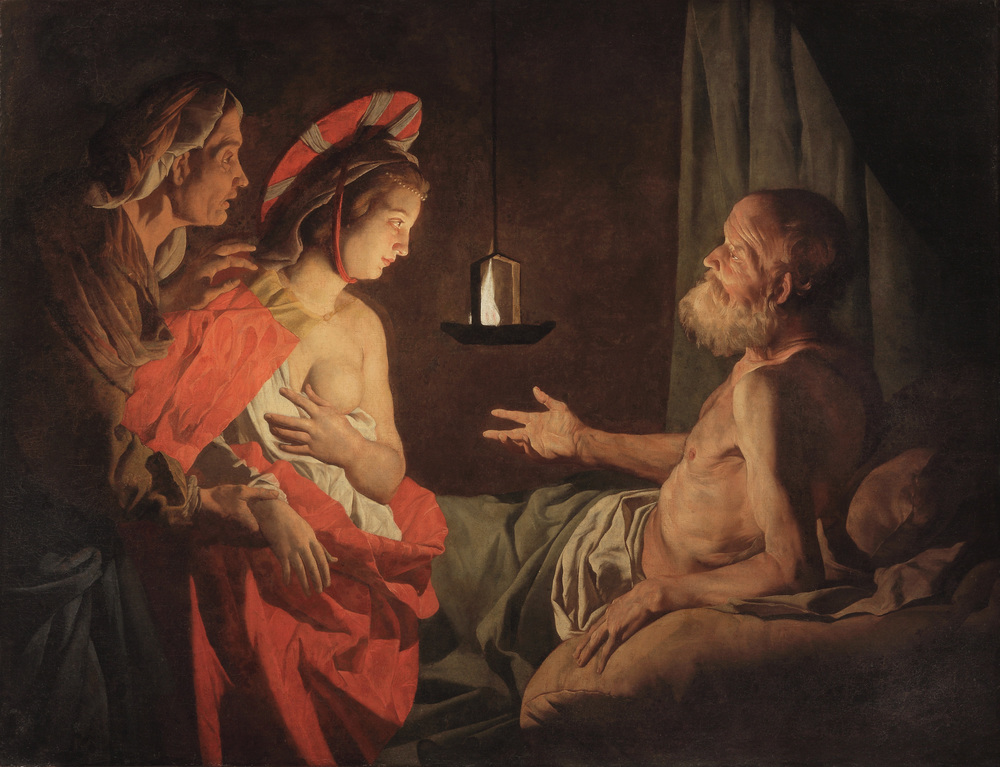
Sarah is seized (artist unknown)

The beautiful woman does become one of the king’s wives (or concubines).  Then the hoax is revealed.  The horrified king releases her and sends off the man and his wife with gifts to buy their silence, and their god’s favor.  The couple journeys on, richer than when the story began.

A version of this sordid tale appears two and a half times in the book of Genesis/Bereishit.  The first time, in the portion Lekh Lekha (“Go for yourself”), the husband is Abraham and the king is the Pharaoh of Egypt.

And Pharaoh summoned Abraham and said: “What is this you have done to me?  Why didn’t you tell me that she is your wife?  Why did you say ‘She is my sister’, va-ekach her for my wife?”  (Genesis/Bereishit 12:18-19)

va-ekach (וָאֶקַּח) = and I took; and I married.

In this week’s portion, Vayeira (“And he appeared”), Abraham and Sarah do it again with Avimelekh, King of Gerar.

And Abraham said of Sarah, his wife: “She is my sister”.  And Avimelekh, the king of Gerar, sent vayikach Sarah.  (Genesis 20:2) … Avimelekh summoned Abraham and said: “What have you done to us?” (Genesis 20:9)

vayikach (וַיִּקַּח) = and he took; and he married.

In a later portion, Toledot (“Lineages”), Abraham’s son Isaac passes off his wife Rebecca as his sister.  This time the tale is cut short because the king (also called Avimelekh)1 never takes her as a wife.  The aborted version begins the same way as the first two iterations, but it reverses the lessons of the Abraham tales.

In this series about the wife-sister tales, my first two posts will present different explanations of the first two wife-sister tales, in which the trickster is Abraham.  The third post will show how Isaac’s attempt to use the wife-sister lie challenges the conclusions of all three interpretations.

Explanation A: Exculpating the patriarchs

Early commentary such as Bereishit Rabbah2 takes the wife-sister stories as literal history, and assumes that Abraham and Sarah are more virtuous than Pharaoh or Avimelekh.  It does not question Abraham’s claims that the men of both Egypt and Gerar routinely seize beautiful female immigrants, and kill their husbands if they are married.

And it happened, as he [Abraham] was close to entering Egypt, he said to Sarah, his wife: “Hey, please!  I know that you are a woman of beautiful appearance.   And it will happen that the Egyptians will see you and they will say: ‘This is his wife!”  And they will kill me, but they will let you live.”  (Genesis/12:11-12)

Abraham implies that the Egyptian border guards routinely detain beautiful women of all ages (Sarah is at least 65)4 and then kill their husbands if they are married.  With these orders, the guards would have to murder a lot of foreign men.  But perhaps the idea is not so preposterous, given that in 2018 American guards on the border of Mexico jailed the children of would-be immigrants separately from their parents, without making any provision for reuniting the families.  Foreigners have been fair game in many cultures.

Babylon Marriage Market, by Edward Long, 1875, detail

The first part of Abraham’s claim, that beautiful immigrants will be seized, turns out to be true in both episodes.

And it happened, that Abraham came to Egypt and the Egyptians saw that the woman was very beautiful.  The officials of Pharaoh saw her, and they praised her to Pharaoh, vatukach ha-ishah to the House of Pharaoh.  (Genesis 12:14-15)

vatukach ha-ishah (וַתֻּקַּח הָאִשָּׁה) = and the woman was taken; and the wife was taken.

And Abraham said of Sarah, his wife: “She is my sister”.  And Avimelekh, the king of Gerar, sent vayikach Sarah.  (Genesis 20:2)

For both stories, the early commentary only needed to explain:

  • why Sarah is so beautiful,
  • why she is never molested by a king, and
  • why Abraham’s behavior is excusable.
  1. Pharaoh
from Bisson, La Fiancee, 1895

Although Sarah is in her sixties when Pharaoh takes her, early commentary maintains that she is extraordinarily beautiful.  Talmud Bavli, Megillah 15a, lists Sarah as one of the four most beautiful women in the world.5  According to Bereshit Rabbah 40, the whole land of Egypt was illuminated by her beauty.

The Torah does not say whether Pharaoh has sexual intercourse with Sarah.  But early commentators wrote that both times when Abraham passes her off as his sister, God protects her from being molested by afflicting the king with a disease that prevents intercourse.

And God afflicted Pharaoh and his household with great afflictions over the matter of Sarah, the wife of Abraham.  And Pharaoh summoned Abraham and said: “What is this you have done to me?  Why didn’t you tell me that she is your wife?” (Genesis 12:17-18)

The Torah does not describe the nature of the affliction.  Bereishit Rabbah 41 suggested lupus or another disease that affects the skin.  Rashi6 wrote that this affliction made intercourse harmful to Pharaoh.  Whatever God’s affliction is, according to classic commentary it prevents Pharaoh from molesting his new wife, and alerts him that things are not what they seem.  Then Sarah tells him the truth, and he is outraged that he was tricked into marrying another man’s wife.  He sends Abraham and Sarah out of the country, and lets them take all their new wealth with them.7

Abraham and Sarah Before Pharaoh, by Comnenian, Byzantine

Pre-modern commentators differ when it comes to the question of Abraham’s virtue.  The Zohar says that Abraham sees the divine presence is with Sarah, and an angel confirms it, so he knows she will be safe.8  But Ramban wrote: “Know that our father Abraham inadvertently committed a great sin by placing his virtuous wife in a compromising situation because of his fear of being killed.  He should have trusted in God.”9

Even if Abraham is not guilty of putting his wife in peril, what about his deception?  Some commentators view Abraham’s lie as his only alternative, given the nastiness of the Pharaoh and the famine in Canaan.

  1. Avimelekh

The second version of the wife-sister tale appears in the Torah portion Vayeira, after God has promised Abraham and Sarah they will have a child at last.  They settle in the Negev Desert, but travel west to Gerar to live there as resident aliens for a while.  Once again Abraham calls Sarah his sister.  The king of Gerar, Avimelekh, “takes” her.

At this point in the Torah, Sarah is 89 years old.10  So classic commentary needs to explain why Sarah is still beautiful enough to tempt a king.  Before Abraham takes her to Gerar, three angels announce that in a year she will have a son.  (See my earlier post, Vayeira: Laughter, Part 1.)  In Talmud Bavli, Bava Metzia 87a, Rav Hisda explains that after the annunciation, Sarah’s worn and wrinkled skin is rejuvenated, and her beauty returns.
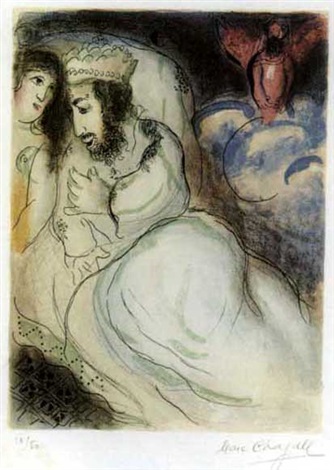
Sarah and Abimelech, by Marc Chagall

In this iteration of the wife-sister tale, God speaks to the king in a dream after he has married Sarah.  God informs him that Sarah is another man’s wife, and declares that Avimelekh and his people must die for this sinful marriage.

But Avimelekh had not come close to her.  And he said: “My Lord, will you slay even innocent people?  Did not he himself [Avraham] say: ‘She is my sister’?  And she even said: ‘He is my brother’!  With a pure heart and with clean palms I did this.”

And God said to him in the dream: “Even I myself knew that you did this with a pure heart, so I restrained you from sinning against me, even I myself.  Therefore I did not let you touch her.”  (Genesis 20:4-6)

How does God restrain Avimelekh from having intercourse with Sarah?  Through “a closing up of orifices” according to Bereishit Rabbah.  Rashi wrote that God closes the orifices of Avimelekh and his household, including their ears and noses as well as genital and urinary openings.

The rabbis of Bereishit Rabbah overlooked Avimelekh’s protest that his intention were good, and give God all the credit for the king’s restraint.  “R. Aibuil said: It is like the case of a warrior who was riding his horse at full speed, when seeing a child lying in the path, he reined in the horse, so that the child was not hurt. Whom do all praise, the horse or the rider? Surely the rider!”11

And Avimelekh summon Abraham and said to him: “What did you do to us?  And what is my sin against you, that you brought [this] upon me and my kingdom?  [You committed] a great sin, doing what should not be done against me!” (Genesis 20:9)

Abraham explains his poor opinion of the morals of Gerar, and adds that Sarah really is his half-sister as well as his wife.  Avimelekh then gives Abraham a flock, a herd, and slaves, and permission to settle wherever he likes in the land of Gerar.  He gives Sarah a thousand silver pieces as hush money.

Then Abraham prayed to God, and God healed Avimelekh and his wife and his slave-women, and they gave birth.  For God had shut every womb in the house of Avimelekh on account of the matter of Sarah, the wife of Abraham.  (Genesis 20:18)

This is the verse that Bereishit Rabbah and Rashi interpreted as meaning that God had “closed up every orifice”.  Other commentators, including Ramban and 18th century Rabbi Chayim ben Moshe ibn Attar, wrote that the men’s genitals were also closed, and this proved that Avimelkh could not be the biological father of Sarah’s son Isaac.

Is Abraham’s behavior excusable in this case?  The idea that Abraham knew God would protect Sarah still applies in the story of Avimlekh, but why does he take Sarah to Gerar in the first place, when they could just continue grazing their livestock in the Negev?  The classic commentary has no answer.

*

Traditional commentators assumed the first two wife-sister stories relate what actually happened to Abraham and Sarah.  They talked up Sarah’s beauty to explain why she was brought straight to the king both times, and they worried about and how Sarah and Abraham retained their virtue.  But they offered no insights on why these stories are included in the Torah; traditional commentary views the tales as part of history.

When one considers the Torah as an ancient composite crafted by one or more religious editors, the questions that traditional commentary answered are not the important ones.  What is the purpose of including the sordid story at all?  And why does the patriarch Abraham tell lies and sell his wife to a foreign king—twice?  What kind of sacred book is this, anyway?

These questions illustrate the frequent problems that arise when one both takes the bible literally and believes that the designated heroes are good, and the designated villains are bad.  Some people feel a psychological need to have faith in a religion that contains contradictions, so the classic explanations serve them well.

What about the rest of us?  Next week’s post will examine two other explanations, one from the viewpoint of a modern scholar and one from the viewpoint of a modern storyteller.


  1. Avimelekh can be translated as “My Father King”; avi (אֲבִי) = my father + melekh (מֶלֶךְ) = king. Avimelekh may be a title, like “Pharaoh”, and the second Avimelekh may be the first one’s successor.
  2. Bereishit Rabbah, also called Genesis Rabbah, is a collection of commentary on the book of Genesis by rabbis from the Talmudic period of about 300-500 C.E.
  3. 2 Samuel 11:1-17.
  4. Sarai and Avram leave Charan when Avram is 75 (Genesis 12:4). Avram is ten years older than Sarai (Genesis 17:17).
  5. The other three beautiful women in Megillah 15a are Rahab, Abigail, and Esther.
  6. 11th-century C.E. Rabbi Shlomoh Yitzchaki.
  7. Genesis 12:20.
  8. Moses de Leon, 13th century Spain, Zohar 1:181b, 3:52a.
  9. Ramban (13th-century Rabbi Moses ben Nachman, a.k.a. Nachmanides), translated in Etz Hayim, ed. David L. Lieber, Jewish Publication Society, 2001, p. 73.
  10. In Genesis 17:15-17 and 18:10 Abraham learns that Sarah will give birth at age 90. An alternative to early commentators’ claim that Sarah miraculously regains the beauty of youth is a theory that the border officials single her out for a different reason.  Twentieth-century commentator Savina Teubal (Sarah the Priestess, Swallow Press Reprint edition, 1984) suggests that Sarai was the priestess of a god or goddess in Charan, and her marriages with Pharaoh and Avimelekh were examples of hieros gamos, an ancient ritual in which a high priestess and a king had intercourse in order to enact the coupling of the gods who made the land fertile.  Teubal did not explain why a king would employ a priestess from a foreign land for this ritual, instead of using the priestess of one of his own country’s gods.
  11. Bereishit Rabbah, translation by H. Freedman, Soncino Press, London, 1939.

Lekh-lekha: Please

Sarai and Avram (later renamed Sarah and Abraham) are an unusual couple.  In a society dominated by men, Sarai appears to have authority equal to her husband’s.  Neither can give unilateral orders to the other.

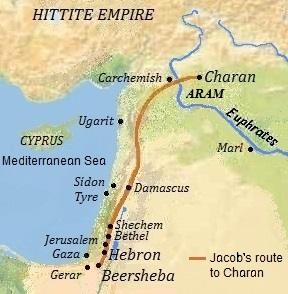
The Torah portion Lekh-lekha (“Go for yourself”) begins with Avram, Sarai, and their nephew Lot leaving Charan (along with all their livestock and servants) and traveling through Canaan.  Since there is a famine in that land, they continue south to Egypt.

Abraham Gives his Wife to Pharaoh

It happened, as he was close to entering Egypt, he said to Sarai, his wife: “Hey, na!  I know that you are a woman of beautiful appearance.  And it will happen that the Egyptians will see you and they will say: ‘This is his wife!”  And they will kill me, but they will let you live.  Say, na, you are my sister, so that it will go well for me for your sake, and my soul will live on account of you.”  (Genesis my12:11-13)

na (נָא) = Please!  (An indicator of courtesy and urgency.)

Avram believes that Sarai will end up in an Egyptian’s bed one way or another: either they will kill her husband to get her, or they will pay her brother to get her.  (I will discuss Avram’s peculiar assumptions about Egyptian customs in my next two posts, Lekh-Lekha, Vayeira, & Toledot: The Wife-Sister Trick, Part 1 and Part 2.)

Even though Avram believes his life is on the line, he does not command Sarai to masquerade as his  unmarried sister.  He implores her, saying na twice.

Sarai cooperates, and the Egyptian officials at the border take her to the Pharaoh’s harem.  Perhaps she foresees that her stay there will be temporary, and then they will both leave Egypt with extra wealth.  Or perhaps the childless 65-year-old is making her last bid for a baby.1  (Her menopause might be late, and at this point she does not know whether Avram is fertile.)  The Torah does not tell us Sarai’s motivation.

Avram and Sarai return from Egypt to Canaan with more more livestock, slaves, gold, and silver, but no pregnancy.  This is a problem for both of them.  God promised to give the land of Canaan to Avram’s descendants, yet he has no descendants.  Sarai does not need a child to take care of her after her husband dies, like other biblical women.  She appears to have wealth of her own, enough so that in very old age she can afford to leave Avram in Beersheba, move north with her retinue, and pitch her own tent near Hebron.2  But like Avram, she would want a child to inherit her possessions and continue her name.

Later in this week’s Torah portion, Sarai concludes that her best option is to adopt a baby.  A long-standing legal custom in the ancient Near East was for a childless wife to give her personal slave to her husband as a surrogate, and then adopt the resulting child as her own.3

Since Avram is Sarai’s equal, she does not command him to comply with this arrangement; she implores him.

Sarah Presents Hagar to Abraham, by Matthias Stomer

Sarai, the wife of Avram, had not borne children to him, but she had an Egyptian female slave, and her name was Hagar.  Sarai said to Avram: Hey, na! God has shut me off from childbirth.  Enter, na, my slave; perhaps I will be built up through her.”  And Avram listened to the voice of Sarai.  Sarai, the wife of Avram, took Hagar the Egyptian, her slave, at the end of ten years of Avram’s dwelling in the land of Canaan; and she gave her to Avram, her husband, as a woman for him. (Genesis 16:1-3)

Sarai uses the same approach that Avram used on the border of Egypt, opening with “Hey, na!”4 then stating the problem, then asking for a favor with a second na.  (These are the only two speeches in the Hebrew Bible in which the word na appears twice.)  Like Sarai, Avraham agrees to go along with his partner’s scheme.

Although Sarai says “please” to her high-status husband, she can command her personal slave to do anything, so she does not bother to ask Hagar about the arrangement.  When Sarai says “perhaps I will be built up through her” she indicates her intention to adopt the child Hagar bears as her own.

But once Hagar is pregnant with Avram’s child, she is not as subservient as Sarai expected.

When she [Hagar] saw that she was pregnant, [her] mistress was demeaned in her eyes. Then Sarai said to Avram: “The violence against me is because of you! I myself put my slave into your lap.  Now she sees that she is pregnant, and I am demeaned in her eyes. May God judge between me and you!”  (Genesis 16:4-5)

Sarai, accustomed to having complete authority over her own slaves, cannot bear to be snubbed and ignored by Hagar.  She has lost some of her power.

Why does she blame Avram?  Although Sarai may not feel sexual jealousy about the arrangement, I believe she is jealous in another way.  Perhaps Sarai’s husband and business partner is continuing to spend time with Hagar instead of with her, thus reinforcing Hagar’s idea that her status has increased.  Others in the household who notice this might also begin to treat Sarai with less respect, and Hagar with more.

So Sarai accuses Avram of encouraging Hagar’s new behavior.  Then she cries, “May God judge between me and you!”  She still believes that she and Avram are supposed to have equal authority.  Anything that demeans Sarai challenges her God-given status.  And Avram recognizes this.

Then Avram said to Sarai: “Hey!  Your female-slave is in your hand; do to her as you see fit.”  And Sarai oppressed her.  And she [Hagar] ran away from her.  (Genesis 16:6)

Angel of the Lord Appearing to Hagar,
by Gheorge Tattarescu ca. 1870

An angelic messenger from God reassures Hagar that her son will prosper in the long run, and tells her to return to Sarai and “submit yourself to her hand” (Genesis 16:9)   Hagar obeys God.  Sarai does not adopt the baby; instead of reporting a birth on Sarai’s lap or knees (the usual adoption ritual), the Torah says:

And Hagar bore to Avram a son, and Avram named his son that Hagar bore: Ishmael.  (Genesis 16:15)

Thirteen years later God changes the names of Avram and Sarai to Avraham and Sarah, and tells Avraham that Sarah will bear him a son when she is 90.5  In next week’s Torah portion, Vayeira, Avraham holds a celebration on the day Sarah weans her own son, Isaac.

And Sarah saw the son of Hagar the Egyptian, whom she had borne to Avraham, making fun!  And she said to Avraham: “Drive out this slave-woman and her son, so that the son of this slave-woman will not inherit with my son, with Isaac!”  (Genesis 21:9-10)

Now Sarah is giving Abraham orders without saying “please”.  Abraham does not argue with her, but he is worried about his son Ishmael.  God reassures him that Ishmael and his progeny will become a great nation, and tells him:

“Everything that Sarah says to you, listen to her voice; because through Isaac your descendants shall be identified.”  (Genesis 21:12)

Abraham follows Sarah’s orders and exiles Hagar and Ishmael the next morning.  At this point, Sarah has more authority than Abraham.  What she says, goes—because God is backing her up.

*

Unlike Sarai/Sarah, I have never had much authority.  I never had staff working under me in any of my paid jobs.  In one congregation I became a leader by dint of years of hard work, continuing Jewish education, and volunteering, but I learned that my opinions held no more weight than anyone else’s.  Sometimes even when I thought we had reached a consensus, other volunteers ignored it.  I felt snubbed and demeaned, like Sarai in response to Hagar.

I wonder if any of the other volunteers felt like Hagar under Sarai’s—my—thumb?

Or was I like Hagar, pregnant with knowledge and know-how, slaving away day and night without remuneration, sometimes appreciated and sometimes snubbed?

Authority and deference are still hard to balance, even when you say “please”.

  1. Sarai and Avram leave Charan when Avram is 75 (Genesis 12:4) and Avram is ten years older than Sarai (Genesis 17:17). Therefore Sarai is 65 or so when they emigrate to Egypt.
  2. And Avraham stayed in Beersheba (Genesis 22:19). Sarah died in Kiryat Arba, which is [now] Hebron … (Genesis 17:17).  Isaac inherits his mother’s tent (Genesis 24:67).
  3. The Code of Hammurabi specifies that when a wife gives one of her female slaves to her husband for the purpose of bearing his child (or children), she remains a slave until the husband dies, and her children by him are free. The man’s wife has the option of adopting her child.
  4. Hey, na = הִנֵּה־נָא. Hineh (הִנֵּה) is often translated as “Behold!” or “Look!” or “Here!”, but since it is an attention-getting exclamation, I have been translating hineh as “Hey!”
  5. Genesis 17:17.

Bereishit: Is It Good?

And God saw all that [God] had made, and hey!—[It was] very tov.  And it was evening and it was morning, day six.  (Genesis/Bereishit 1:31)

tov (טוֹב) = good.

First Day of Creation, 1493 Nuremberg Chronicle

In the first creation story in this week’s Torah portion, Bereishit (“In a beginning”)—chapter 1 of the bible—the God-character sees that seven things “he” has created are “good”: light (day 1); the separation of dry land from waters (day 3); plants (day 3); the sun, moon, and stars (day 4); swimming and flying animals (day 5); land animals (day 6); and the whole world including humans (also day 6).1

The underlying message is that our world or universe is fundamentally good.  But in what way?  Like the English word “good”, tov can mean a number of different things, which fall into four categories:

  • Morally virtuous. (When we classify people as “good” in the moral sense, we mean that they consistently act in ways that benefit other people  and/or other living things.)
  • Acceptable to, or approved by, an authority. The authority might be an individual, a social group, or a doctrine (a set of beliefs and principles).
  • Pleasurable, beautiful, enjoyable.
  • Beneficial, helpful to achieve a specific purpose.

Moral virtue cannot be attributed to such things as “dry land” or “the sun”.  And in the first chapter of Genesis there is no authority other than God.  Therefore God calls the world tov either because God finds it beautiful, or because it is helpful for furthering a divine purpose—probably a purpose concerning God’s final creation, the human being.

The word tov appears again in the second creation story, in the Garden of Eden.

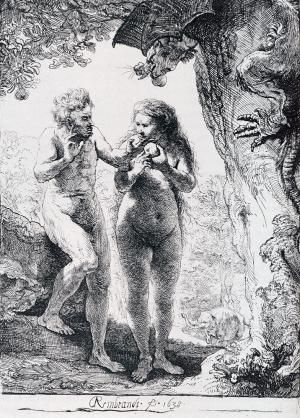
Adam and Eve under the Tree of Knowledge (Rembrandt)

And God made sprout from the earth every tree pleasant in appearance and tov for eating, and the Tree of Life in the middle of the garden and the Tree of the Knowledge of Tov and Ra.  (Genesis 2:9)

ra (רָע) = bad; evil, ugly, useless.  (The opposite of tov.)

Which of the four definitions of tov (and ra) apply to the name of the Tree of Knowledge?  Genesis 2:9 says that all trees in the Garden of Eden are “pleasant in appearance” (i.e. pleasurable, beautiful) and have fruit that is “tov for eating” (i.e. beneficial, helpful for the purpose of nutrition).  The Tree of Life and the Tree of Knowledge of Tov and Ra are distinguished by qualities that none of the other trees in the garden possess.

We learn later in the story that eating fruit from the Tree of Life makes one immortal.  After the male and female humans have eaten fruit from the Tree of Knowledge,

God said: “Hey, the human has become like one of us, knowing tov and ra!  And now, what if he stretches out his hand and takes also from the Tree of Life and eats, and he lives forever!”  (Genesis 3:22)

This remark also confirms that eating from the Tree of the Knowledge of Tov and Ra results in some type of knowledge of good and bad that God (and some other unnamed beings) already have.  It cannot be knowledge of what is pleasurable or of what is beneficial, since all the trees in the garden are “good” in those ways.  Nor can it be knowledge of what is acceptable to an authority, even if one interprets Genesis 3:22 above as meaning that God already knows what is acceptable to God (and so do the unnamed beings). Earlier in the story,

God commanded the human, saying: “From every tree of the garden you may/will certainly eat.  But from the Tree of the Knowledge of Tov and Ra, you should not eat from it, because on the day you eat from it you may/will certainly die.”  (Genesis 2:16-17)

If the Tree of Knowledge of Tov and Ra gives humanity some insight into what is “acceptable” and “unacceptable” to God, then in this passage God is both

  • urging the human to be acceptable by avoiding any knowledge of what is acceptable, and
  • holding up death as a reward for learning how to be acceptable to God.

The God character in the first Torah portion of the book may be devious, but this explanation is too convoluted to be credible.  Therefore, by the process of elimination, “the Tree of the Knowledge of Tov and Ra” must mean “the Tree of the Knowledge of Virtue and Vice”—in other words, “the Tree of Moral Knowledge”.

Moral Knowledge

Cain, by Henri Vidal

Humankind does not emerge from the Garden of Eden with complete knowledge of the morally right action in every possible situation.  This is obvious in history, in our own lives, and in the Torah, starting when Cain thoughtlessly kills his brother Abel.2

Then what kind of moral knowledge does humanity acquire in the Garden of Eden, rather than through experiences in the real world?  What kind of moral knowledge are humans equipped with at birth?

Perhaps we are born with an instinctive feeling that some actions are virtuous and some are wicked.  Perhaps empathy is hard-wired in our brains like our instinct for personal survival.3  (The exception might be psychopaths, estimated at 1 to 4% of the human population.)

In the 21st century, experiments have demonstrated that even infants make basic moral judgments, distinguishing between acts of kindness and cruelty.4

Toddlers see themselves as moral agents who can help or hurt other people, and when they feel secure they volunteer to help.5  They also understand the basic idea of fairness.  Other research shows that human beings with normal brains have an instinctive aversion to killing people.  They can only bring themselves to do it after their natural aversion has been overcome by a barrage of information (or misinformation).6

Thus the majority of human beings are born with a taste of the knowledge of moral good and evil.  During the rest of our lives we expand our moral knowledge through thinking about our experiences, developing our feelings, and learning from other people:  their examples, their teachings, and their writings—perhaps even the book of Genesis.

According to the story of the Garden of Eden, if the first humans had never eaten from the Tree of Knowledge of Tov and Ra, humankind would have had no sense of morality.  We would have been a species of psychopaths, acting exclusively for our loveless self-interest, unable to balance our natural selfishness with social cooperation and affection.  Without the interplay between selfish and generous desires, humankind probably would never have developed a high intelligence, and we certainly would have been incapable of any form of civilization.7  Would there be any point in the existence of such a species?

The humans in the Garden of Eden had to eat the fruit of that tree.  Otherwise there would be no story—no stories at all.

  1. Genesis 1:4, 1:10, 1:12, 1:18, 1:21, 1:25, and 1:31.
  2. Genesis 4:2-8.
  3. Edward O. Wilson, The Meaning of Human Existence, W. Norton & Co., New York, 2014, pp. 75, 179-180.
  4. Paul Bloom, Just Babies: The Origins of Good and Evil, Crown Publishers, New York, 2013, p. 31.
  5. Ibid, p. 13, on an experiment in which toddlers open a door, unprompted, to help someone whose arms are too full to open it.
  6. Ralph D. Mecklenburger, Our Religious Brains, Jewish Lights Publishing, Woodstock, VT, 2012, p. 122.
  7. E.O. Wilson, The Meaning of Human Existence, 2014, pp. 21-22, 179-180.

Vezot Habrakhah: By Mouth

On Simchat Torah(“Rejoicing in Torah”) Jews read the end of the Torah scroll, where Deuteronomy/Devarim comes to a close, then roll the scroll all the way back to the beginning and read the opening of Genesis/Bereishit(We also dance with the scroll when it is rolled up and dressed in its cover.)

How does the Torah scroll end?  The final scene in the final Torah portion, Vezot Habrakhah (“And these are the blessings”) is the death of Moses.

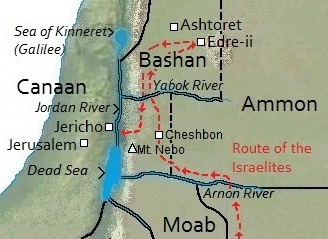
The book of Deuteronomy is set in the lowland (below sea level) at the north end of the Dead Sea, where the Israelites are encamped on the east bank of the Jordan River.  Moses speaks at length to the people he has led for 40 years.  Then at the end of the book, following God’s instructions, he climbs Mount Nebo in the Pigsah range of mountains near the border of Moab.1

Moses knows that God will not let him cross the Jordan River with the people he has shepherded all the way from Egypt.  But God does miraculously enable him to see the entire “promised land” of Canaan from the mountaintop.  (There is a good view from Mt. Nebo, but not good enough to see all the way to the Mediterranean without supernatural help.)

And Moses, the servant of God, died there in the land of Moab, al pi God.  (Deuteronomy 34:5)

al pi (עַל־פִּי) = at the bidding of, by the order of; at the peh of.  peh (פֶּה) = mouth; opening, edge; statement, command.

The Torah makes it clear that even though he is 120, Moses does not die of old age:

Moses was 120 years at his death; his eye was not dim, and his vigor was not gone.  (Deuteronomy 34:7)

He dies because it is time for the Israelites to cross the Jordan and begin conquering Canaan without him.  But what kills him?

The phrase al pi God” (always using the four-letter name of God)2 appears 25 times in the bible.  Twelve of these times Moses, or Moses and Aaron together, take action at the bidding of God.3  Ten times the Israelites act al pi God, though they do not know they are obeying the God of the Israelites.  God “sends” raiding parties from Babylon and its vassal states to exterminate the kingdom of Judah, and “indeed, al pi God it happened to Judah to clear it away from God’s presence…” (2 Kings 24:3)

One other time Aaron acts by himself at the bidding of God:  And Aaron the Priest ascended Mount Hor al pi God, and he died there… (Numbers/Bemidbar 33:38)

That leaves only one instance in which something simply happens al pi God, without any information about who did it:  when Moses dies at the end of Deuteronomy. Does this unusual use of the phrase “al pi” mean that Moses deliberately died in order to carry out God’s order?  Or does it mean that he died by the “mouth” of God?

Death with an Exhale

Most English translations imply that Moses died when God ordered him to die.5 He does not need to commit suicide; he simply knows God wants him to die now, and he releases life, exhales, and dies.

Is Moses the kind of person who would obediently die at God’s bidding?  When he first becomes God’s prophet at the burning bush, he accepts the job of being God’s mouthpiece only because God will not take no for an answer—and then he tries one last time to get out of it, on the ground that he has a defective mouth.  (See my post Va-era & Shemot: Uncircumcised, Part 2.)

While he is leading the Israelites across the wilderness for 40 years, his relationship with God is mouth-to-mouth, as God says to Miriam and Aaron:

“Listen to my words: If a prophet of God happens among you, in a vision I make myself known to him, in a dream I speak to him.  Not so my servant Moses; he is trusted in all my household.  Peh to peh I speak with him; and appearing, not in riddles; and the likeness of God he looks at.”  (Numbers 12:6-8)

Ironically, the less advanced prophets Miriam and Aaron hear God directly in this passage.  But they never speak directly to God in the Torah, so in this regard they and God are not in a peh to peh relationship.

Moses, however, often has direct conversations with God.  Sometimes God starts the conversation, sometimes Moses does.  Sometimes they argue, sometimes they negotiate.  Sometimes God threatens to do something and Moses talks God out of it.6

But in the book of Deuteronomy, Moses looks back on the 40-year adventure with resentment at how much trouble the Israelites gave him, and resignation that God will not let him cross the Jordan.  (See my post Devarim: In God We Trust?)  By the time he has retold the history, restated and elaborated on God’s laws, and finally blessed the Israelites earlier in the portion Vezot Habrakhah, perhaps he is willing to die.  Why not leave the world in a final act of obedience to God?

Death with a Kiss

On the other hand, medieval commentary interpreted the word peh literally, and wrote that God took Moses’ life with a kiss, mouth to mouth.  Here is one version:

God said: “Moses, fold your eyelids over your eyes,” and he did so. He then said: “Place your hands upon your breast,” and he did so. He then said: “Put your feet next to one another,” and he did so. Forthwith the Holy One, blessed be He, summoned the soul from the midst of the body, saying to her:7 “My daughter, I have fixed the period of your stay in the body of Moses at a hundred and twenty years; now your end has come, depart, delay not … Thereupon God kissed Moses and took away his soul with a kiss of the mouth … (Devarim Rabbah 11:10, circa 900 CE.)8

In this anthropomorphic interpretation, just as God’s mouth blows the first human’s soul into the body,9 God’s mouth inhales Moses’ soul out of the body.

This is a more intimate way of being peh to peh with God.

*

This week’s Torah portion, the book of Deuteronomy, and the Torah scroll end:

Never again did a prophet rise in Israel like Moses, whom God knew face to face, for all the signs and the omens that God sent [him] to do in the land of Egypt for Pharaoh and for all his servants and for all his land; and for all the strong power and for all the great awe that Moses achieved in the eyes of all Israel.  (Deuteronomy 34:10-12)

In other words, Moses is unique as a prophet in his tremendous effect on both Egypt and the Israelites.  And by the way, God knew Moses face to face.

And spoke with Moses mouth to mouth.  And, perhaps, took Moses’ soul, his life, with a kiss.

At the end of the Torah scroll, Moses dies al pi God, by God’s mouth or bidding.  Then, on Simchat Torah, Jews roll the scroll back to the beginning, and we read how God created the heavens and the earth through speech.

And God said: “Light will be,” and light was.  (Genesis/Bereishit 1:3)

Both the death of Moses and the creation of the world come, in one way or another, from the mouth of God.

Maybe this is another way of saying that both death and birth are too mysterious for humans to ever understand.

  1. This is the same mountain range where King Balak of Moab led the Mesopotamian prophet Bilam so he could look down on the Israelites and curse them. The king was foiled when God put words of blessing in Bilam’s mouth instead.  (See my post Balak: Three Places to Be Blessed.)
  2. See my post Lekh-Lekha: New Names for God.
  3. Moses act al pi God in Numbers 3:16, 3:39, 3:51, 4:37, 4:41, 4:45, 4:49, 10:13, 13:3, 33:2, 36:5; and Joshua 22:9.
  4. The Israelites act al pi God in Exodus 17:1, Leviticus 24:12, Numbers 9:18-23, and Joshua 19:50.
  5. E.g. “at the command of the Lord” (Jewish Publication Society), “according to the word of the Lord” (King James Version), “as the Lord had said” (New International Version), “at the order of YHWH” (Everett Fox, The Five Books of Moses, Schoken Books, New York, 1995), and “by the word of the Lord” (Robert Alter, The Five Books of Moses,W. Norton & Co., New York, 2004).
  6. For example, after the Israelites worship the golden calf, God and Moses take turns getting angry and calming one another down (Exodus 32:7-35). Then they negotiate, and God reveals some divine attributes to Moses (Exodus 33:1-34:10).
  7. All Hebrew words for “soul” are feminine.
  8. Translation of Devarim Rabbah 11:10 from Simcha Paull Raphael, Living the Dying in Ancient Times, Albion-Andalus Books, Boulder, Colorado, 2015, p. 78-79.
  9. Genesis 2:7.
  10. Talmud Bavli: Mishnah Sotah 1:9, Sotah Gemara 14:a.
  11. Rashi (11th-century CE rabbi Shlomoh Yitzchaki), commentary to Deuteronomy 34:6; explained by 16th-century CE rabbi Obadiah Sforno.
  12. Talmud Bavli Sotah 14:a, commenting on the incident in Numbers 25:1-3.

Ha-azinu: Raining Wisdom

When Moses is 120, his main worry is that the Israelites and their fellow-travelers will continue to disobey their God.  So in last week’s Torah portion, Vayeilekh (“And he went”), before he climbs up Mount Nebo to die, he gives the people a written scroll called the Torah, and teaches them a song.  Both are intended to remind the people of how they ought to behave.  But while the Torah will be read out loud to the people, the song will become so familiar that the people themselves will sing it and teach it to future generations.

So God orders Moses:

by James Tissot

“And now, write for yourself this shirah and teach it to the Israelites; put it in their mouths, so that this song will be a witness against the Israelites.”  … And Moses wrote this shirah on that day, and he taught it to the Israelites.  (Deuteronomy 31:19, 22)

shirah (שִׁירָה) = song.  (Poem set to music.)

The portion Vayeilekh ends by referring to the song:

Then Moses spoke in the ears of the whole congregation of Israel the words of this shirah, until the end.  (Deuteronomy 31:30)

The song is the Torah portion Ha-Azinu (“Use your ears”), which falls this year of 5779 in between Yom Kippur and Sukkot.

Whenever I read the words, Ha-Azinu strikes me as a poor summary of the rules Moses laid out earlier in the Torah.  Instead it seems to be yet another long-winded warning that the Israelites will screw up again once they are living in Canaan.

Perhaps if I heard Ha-Azinu as a song, with its own ancient melody, it would have a different effect on me.  Perhaps the words and melody together moved the Israelites the same way that the liturgy of Rosh Hashanah and Yom Kippur moves me when we sing it to traditional melodies, even though I might find fault with some of the words.

And even without the melody, the introduction to this poem does stir my heart.

Use your ears, Heavens, and I will speak;

Listen, Earth, to what my mouth says.

May my insights drop like rain;

May my utterances drip like dew;

Like showers upon deshe,

And like downpours upon eisev growing plants.  (Deuteronomy/Devarim 32:1-2)

deshe (דֶשֶׁא) = green sprouts, new grass.

eisev (עֵשֶׂב) = annual plants that grow during the rainy season; grass, herbs, vegetables, and weeds.

In the first two lines, Moses is calling upon Heaven and Earth to witness his poetic address to the Israelites.  The next four lines (verse 32:2) express how Moses hopes his words will be received by his audience—both by the children of Israel assembled on the bank of the Jordan, and by everyone who will hear the song in the future.

Most poetry in the Torah is written in paired statements.  The second line may appear to be merely a repetition of the first line, substituting synonyms for some of the words, but actually it adds another shade of meaning.

What is implied by the pairing of rain and dew?  16th-century rabbi Obadiah Sforno wrote that wisdom from the Torah rains down on intellectuals, but even the common people benefit from the dew of some small knowledge of God.  (He sounds like a snob, but it is true that the more one studies a text, the more one can draw insights out it.)  According to the Zohar, a 13th-century kabbalistic work, the rain is the written Torah, given from heaven, and the dew is the oral Torah, our human interpretations here on earth.  19th-century rabbi S.R. Hirsch wrote that rain breaks up clods of dirt and prepares the soil of our minds to receive insights, while dew encourages and revives wilting spirits.

I think this couplet considers the two ways that plants get watered in the hills of Israel: by rain during the winter rainy season, and by dew after the rains have ended but there is still enough moisture in the air to condense on low plants overnight, then drip down into the ground.  After divine insights have watered people’s minds, additional bits of enlightenment continue to reach them.

The next couplet refers to effect of rain on annuals, the plants that spring up during the rainy season in Israel.  Rain showers make seeds sprout and send up green shoots; downpours water well-rooted plants so they can continue growing.

Like deshe and eisev, humans find it hard to grow in arid conditions.  A little dampness deep below the surface of the soil might suffice for a tree in the desert, but we need rain showers for our awareness to sprout.  Once we have reached one level of insight, we are ready for downpours, ready to be flooded with teachings, explanations, rules, stories, and poems.  As wise words continue to rain down on us, our souls can grow and stretch out branches and leaves, green with our own new wisdom.

May we all be thirsty for more teachings.

(An earlier version of this essay was published in 2011.)

Jonah: Turning Around

Yom Kippur, the “Day of Atonement”, is when Jews spend 25 hours trying to turn around and get back to God.  It is the last of ten days of teshuvah (תְּשׁוּבָה), often translated as “repentance”, though teshuvah literally means “returning, turning around’.  On Yom Kippur we acknowledge our collective as well as individual sins and misdeeds against the inner and/or outer force we call God.  And we pray for forgiveness and a new start on a more righteous life.

Jonah, National Library of the Netherlands

Late in the afternoon of Yom Kippur, Jews read one last passage from the bible.  What could be uplifting and inspiring enough to help us finally turn around and enter the gates of heaven?

The book of Jonah.

Did the ancient rabbis play a joke on us?  What is the story of this reluctant and ridiculous prophet good for, besides comic relief?

The meaning of Nineveh

The word of God happened to Jonah, son of Amittai, saying: “Kum!  Go to the great city of Nineveh and proclaim about it, because the perversity of their wickedness [has come] before me.”  (Jonah 1:1-2)

Kum (קוּם) = Get up!  Stand up!  Rise!  Arise!

750 BCE

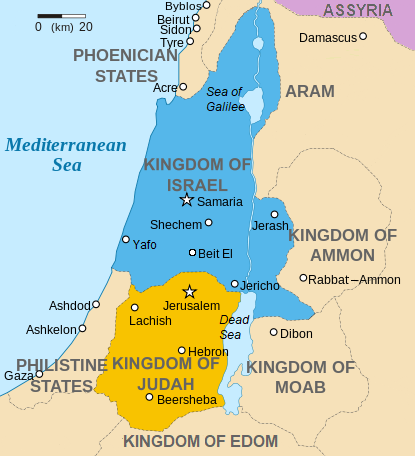
Jonah son of Amittai is not a new prophet; he appears earlier in the bible as a prophet from Gat-Hachefer in the northern kingdom of Israel.1  At that time, Jonah tells King Jereboam II that God wants him to conquer some Aramean territory from Lebo-Hamat to the Dead Sea.  The king does so.

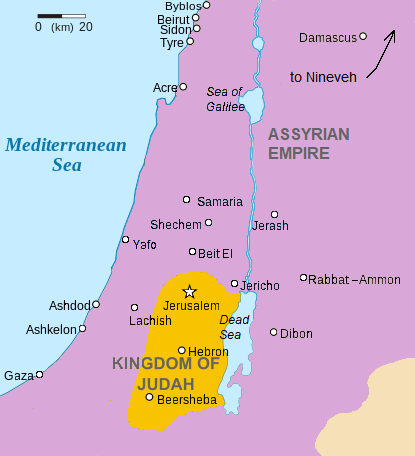
Jereboam II expanded the kingdom of Israel circa 790-750 B.C.E.  About ten years after his death, the king of the Neo-Assyrian Empire, Tiglath-Pileser III, began chipping away at Israel, capturing town after town and deporting its leading citizens.  In 722 B.C.E. the Assyrian king Sargon II conquered its capital, Samaria, and the northern kingdom of Israel ceased to exist.

700 BCE

Some of its residents escaped deportation by fleeing to the southern kingdom of Judah, which the Assyrian armies had reduced to a small vassal state required to send annual tribute to Assyria.

The capital of the Neo-Assyrian Empire was Nineveh.2  When the book of Jonah was written down, probably in 3rd century B.C.E. Judah, any Israelite would think of “Nineveh” as an evil enemy.

Jonah’s descent

Vayakam, Jonah, to run away to Tarshish, away from God.  Vayeired to Yafo and found a ship going to Tarshish, and he paid [his] fare, vayeired into her to go with them to Tarshish, away from God.  (Jonah 1:3)

vayakam (וַיָּקָם) = but he got up, and he rose.  (Another form of the verb kum.)

vayeired (וַיֵּרֶד) = and he went down, and he descended.  (A form of the verb yarad (יָרַד) = went down, descended.)

Jonah gets up, but then instead of heading northeast to Nineveh, he flees toward Tarshish, the westernmost city on the Mediterranean known to the ancient Israelites.

Does he think he can run away from God?  Probably not.  Jonah simply does not want to hear God’s call, either because he is afraid of prophesying in Nineveh or, as he says later, because he does not want God to forgive Nineveh for any reason.  So he gets up—and then flees inside himself, going down into denial: down to the seaport and down into the ship.  When a storm threatens to break up the ship, Jonah goes even farther down.

But Jonah yarad to the hold of the vessel, and he lay down, and he fell into a deep sleep.  (Jonah 1:5)

Unconsciousness is the only way he can escape his feelings of fear and hatred regarding Nineveh, or his guilt over disobeying God.

The captain wakes up Jonah and says:

“How are you sleeping so soundly?  Kum, call to your god!  Maybe the god will take notice of us and we will not perish.”  (Jonah 1:6)

The sailors cast lots to see whose god is responsible for the storm, and the lot falls on Jonah.  Jonah admits he is running away from his god, and asks them to throw him overboard in order to end the storm.  He would rather die than do teshuvah.  But at least he is honest, and makes an effort to save the lives of innocent bystanders.

The men rowed hard lehashiv to dry land, but they could not, because the sea was going violently about them.  (Jonah 1:13)

lehashiv (לְהָשִׁיב) = to return, to bring back or restore something.  (From the same root as teshuvah.)

Only Jonah has turned away from God; only Jonah needs to do teshuvah.  Finally the sailors give up and follow Jonah’s orders.  The prophet begins to sink—but God will not let him descend any farther.

Jonah and the Whale,
by Pieter Lastman, 1621

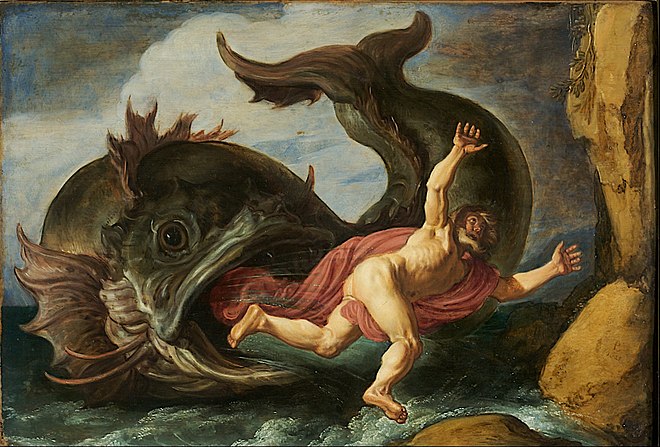
And God supplied a big fish to swallow Jonah, and Jonah was in the belly of the fish for three days and three nights.  And Jonah prayed to God, his God, from the belly of the fish.  (Jonah 2:1-2)

In the subsequent hymn Jonah even expresses thanks to God for saving his life.3  He appears to have turned around.

And God spoke to the fish, and it vomited Jonah onto the dry land.  And the word of God happened to Jonah a second time, saying: “Kum!  Go to the great city of Nineveh and proclaim to it the appeal that I will be speaking to you!”  Vayakum, Jonah, and he went to Nineveh, as God had spoken.  (Jonah 2:11-3:3)

Jonah in Nineveh,
by Jakob Steinhardt, 1923

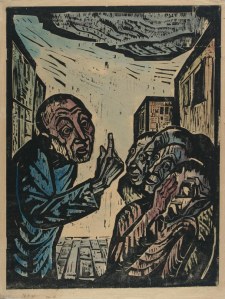
This time Jonah gets up and walks in the right direction.  But we soon learn that despite his poetic prayer inside the fish, he has not really turned around inside his mind.  He obeys God only minimally: he walks into the city, utters five words in Hebrew (“Another forty days and Nineveh will be overthrown”), and leaves with no explanation.

Hope for Ninevites

Today we do teshuvah by praying and searching our souls.  Many Jews also fast during the day of Yom Kippur.  In the Hebrew Bible people do teshuvah by fasting, wearing scratchy sackcloth, and lying in ashes.

That is exactly what the Ninevites do.  Somehow they realize at once that God wants them to repent.  They all fast and put on sackcloth, even the king, who decrees from his ash-heap:

“They shall cover themselves with sackcloth, human and beast, and they shall call out mightily to God.  And every man yashuvu from his evil ways and from the violence in his palm.  Who knows, God yashuv and have a change of heart, veshav from his wrath, and we will not perish.”  (Jonah 3:8-9)

yashuvu (יָשֻׁבוּ) = they shall turn back, turn around.  (From the same root as teshuvah.)

yashuv (יָשׁוּב) = he shall turn back, turn around.  (Also from the same root as teshuvah.)

veshav (וְשָׁב) = and he shall turn back.  (Also from the same root as teshuvah.)

And God saw their deeds, that shavu from their evil ways, and God had a change of heart over the bad thing he [intended] to do to them, and did not do it.  (Jonah 3:10)

shavu (שָׁבוּ) = they had turned away, repented.  (Also from the same root as teshuvah.)

Someone listening to the book of Jonah at a Yom Kippur service might think: If even the Ninevites could do teshuvah, then so could anyone.  And if God could forgive Nineveh, then I could forgive all those people I believe have harmed my people.

Hope for Jonah

Jonah is enraged at God’s forgiveness.  He wants retribution, not compassion, when it comes to Israel’s worst enemy.  He tells God:

“Isn’t this what I spoke of when I was in my own land?  This is why I fled to Tarshish in the first place, because I know that you are a gracious and compassionate god4 …  So now, God, please take my life from me, because better I die than I live.”  And God said: “Is your anger good?”  (Jonah 4:2-4)

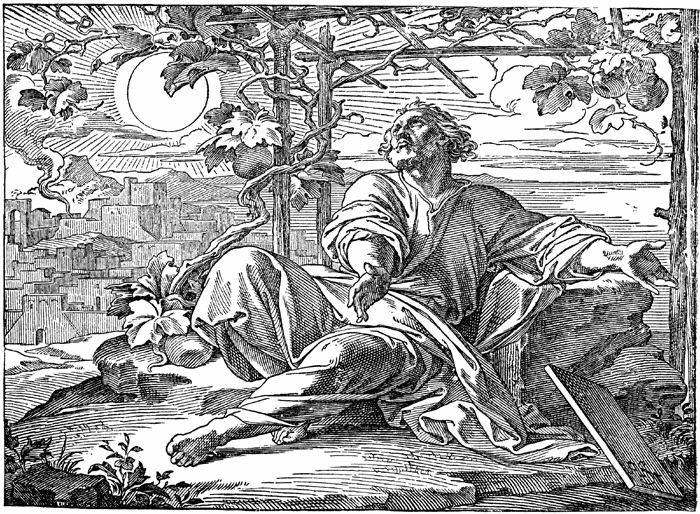
With that question hanging in the air, Jonah builds himself a sukkah5 where he has a view of the city, and sits down to wait 40 days to see what happens.  God supplies a vine to give Jonah shade; the next day God makes it wither and sends a hot east wind.  This triggers Jonah’s anger and death-wish again.

The patience of God with his perverse prophet is remarkable.  God keeps giving Jonah another chance—after he runs away toward Tarshish, after he utters a single half-hearted prophecy, after he is angry with God for forgiving Nineveh, and after he is angry about the death of the vine.

God even tries to teach Jonah to stay aware when he wants to be unconscious (during the storm at sea), to realize his anger is not good, and to be compassionate toward the innocent (especially children and animals):

And God said: “You were concerned about the vine, which you did not exert yourself over …  And I, shall I not be concerned about Nineveh, the great city that has 120,000 humans in it who do not know the difference between their right and their left, and also many beasts?”  (Jonah 4:10-11)

Someone at a Yom Kippur service might think: I keep screwing up, like Jonah, but maybe God will be patient and give me another chance, too.  Maybe God will even teach me how to be less angry, more aware, and more compassionate.

Behind the humor of the story, the book of Jonah can indeed inspire listeners to complete the work of Yom Kippur, to finally do teshuvah and atone with God—whether we think of God as the ruler of the universe and creator of miracles (such as a fish a man can live inside for three days), or as a mysterious force inside ourselves.

Anyway, a little humor near the end of a long fast can only help.

(I published some of the material in this post in September 2010.)


  1. 2 Kings 14:25. From about 930 to 722 B.C.E., Israelites lived in two kingdoms, the more prosperous northern kingdom of Israel (capital: Samaria) and the poorer southern kingdom of Judah (capital: Jerusalem).
  2. King Sargon II moved the capital of the Neo-Assyrian Empire from Kalhu/Nimrud to the district of Nineveh circa 710 B.C.E., when he built a new city called Dur Sharrukin (Sargon’s City) close to the old walled city of Nineveh.
  3. Jonah 2:10.
  4. Jonah actually recites the first five of the 13 attributes of God, given in Exodus 34:6-7 and repeated during Yom Kippur.
  5. Sukkah (סֻכָּה) hut, temporary shelter. It is a Jewish tradition to take meals in a sukkah during the week of Sukkot, which follows Yom Kippur.

Rosh Hashanah: Remembering

A new year begins on the evening of September 9, 2018: the first day of the month of Tishrei and the year 5779 in the Hebrew calendar.

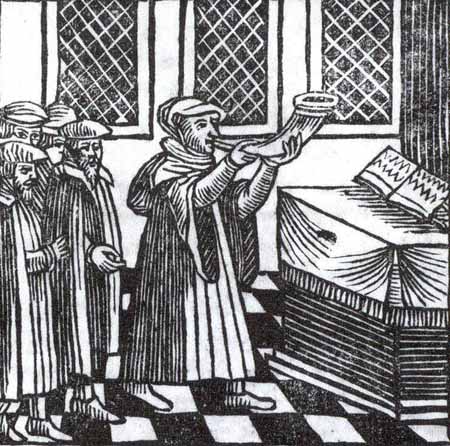
Shofar (horn for blasts)

… the first of the month1 will be for you a day of complete rest, of zikhron, of horn blasts; a holy convocation.  (Leviticus/Vayikra 23:24)

zikhron (זִכְרוֹן), zikaron (זִכָּרוֹן) = remembrance, memorial, record.  (Derived from the verb zakhar, זָכָר = remembered, brought to mind.)

Rosh Hashanah (“Head of the Year”) is also called Yom Ha-zikaron (“Day of Remembrance”), even though it lasts for two days.2

Who is doing the remembering on Yom Ha-zikaron?  And what is remembered?

In the Torah

In the Hebrew Bible, prophets in Deuteronomy through Malachi warn the Israelites to keep God in mind, so that they will obey God’s laws and worship only the God of Israel.  When the Israelites forget God and worship other gods, they are punished.3  When times are good, Moses says, the people must remember that their bounty comes from God.  (See my post Eikev, Ve-etchannan, & Noach: Who Built It?)  In many psalms, the poets remember God when they are suffering, and ask why God has forgotten them.4

Channah Prays,
by Marc Chagall

God also remembers the Israelites again and again.  The bible portrays God remembering the covenant with the patriarchs Abraham, Isaac, and Jacob, with the Israelites who left Egypt, and with all the children of Israel.5  God also remembers individuals; for example, when a long-childless woman finally becomes pregnant, the bible says that God remembers her and opens her womb.  The haftarah reading for the first morning of Rosh Hashanah is the story of Channah’s successful prayer for a child.6

In the Rosh Hashanah liturgy

Just as some psalmists pray for God to remember them, on Rosh Hashanah Jews pray for God to remember us for a good life—and to keep this in mind by writing down the names of everyone who will live for another year in a “Book of Life”. 7

The following sentences asking God to remember us in the Book of Life are inserted in every Amidah (“standing prayer”) during Rosh Hashanah:

by Jakub Weinles

In the first prayer:  Zakhreinu for life, king who desires life, and inscribe us in the Book of Life, for your sake, God of life!  (Avot)

zakhreinu (זָכְרֵנוּ) = remember us, bring us to mind.    (An imperative of the verb zakhar.)

In the second prayer:  Who is like you, merciful father, zokheir his creatures for life!  (Gevurot)

zokheir (זוֹכֵר) = who remembers, who brings to mind.  (A participle of the verb zakhar.)

In the fourth prayer:  … on this Yom Ha-zikaron.  Zakhreinu on it for goodness, God, our God, and commission us on it for blessing …  (Kedushat Hayom)

In the sixth prayer:  And inscribe all the children of your covenant for a good life!  (Modim)

And in the seventh prayer:  In the Book of Life, [for] blessing and peace and a good livelihood and good decisions, salvations and consolations, nizakheir and may we be inscribed before you, we and all the people of the House of Israel, for a good life and for peace. (Shalom)

nizakheir (נִזָּכֵר) = may we be remembered, may we come to mind.  (The nifil imperfect of the verb zakhar.)

On regular weekdays, Jews traditionally pray the Amidah three times a day, in the morning, afternoon, and evening.8  But during the two days of Rosh Hashanah, we pray the Amidah 18 times!9  And each time, we pray for God to remember us and record our names in the Book of Life.

from Minhagim, 1707

The repetitions of the Amidah in the morning services and musaf (additional) services also include extra prayers for Rosh Hashanah.  The musaf services add three sections of liturgy on Rosh Hashanah themes (Kingship, Remembrance, and Shofars), with quotations from the bible and shofar10 blowing for each section.  The section on Remembrance is called Zikhronot (זִכְרֺנוֹת), the plural of zikaron.  Its opening prayer includes:

And regarding regions, it is said on [this day] which [region] is destined for the sword and which for peace, which for starvation and which for satiation.  And regarding creatures, they are accounted for on [this day] to hazkir for life or for death.

hazkir (הַזְכִּיר) = prompt recollection.  (The hifil infinitive of the verb zakhar.)

Then the Zikhronot section mentions instances of God remembering characters in the bible and doing good things for them, most notably when God remembers Noah and makes the flood subside,11 and when God remembers the covenant with Abraham, Isaac, and Jacob and brings their descendants out of Egypt.12

The service leader’s repetition of the Amidah in the musaf service includes not only the three sections with shofar blowing described above, but also a dramatic recitation that begins:

On Rosh Hashanah it is inscribed, and on Yom Kippur it is sealed:

          how many will pass away and how many will be created;

          who will live and who will die,

          who will be cut off [before his time] and who will not;

          who by water and who by fire,

          who by the sword and who by the beast,

          who by hunger and who by thirst …

The list goes on until the declaration:  But turning around, prayer, and charity bypass the evil decree!

On Rosh Hashanah we may get into the Book of Life despite our earlier bad deeds, if we sincerely turn around. On Yom Kippur, nine days later, the Book of Life is sealed.

*

In the Rosh Hashanah liturgy we plead with God to remember us, the heirs of the Israelites, and to grant us life because whatever our past faults, now we are turning around, praying, and doing good deeds.

But before we can beg God to remember us in the Book of Life, we must remember God.

My God, my soul is prostrate;

            Therefore ezkarekha.  (Psalm 42:7)

I say to God, my rock:

            Why have you forgotten me?  (Psalm 42:10)

ezkarekha (אֶזְכָּרְךָ) = I remember you.  (Another imperfect of the verb zakhar.)

When we feel alienated from our better selves, when we feel that we have not lived up to our own ideals, that we have missed the mark, then we feel alienated from God.  Some of us assume God will punish us, even decree an early death; others assume that our alienation is the punishment.

Either way, our personal task is the same as the communal task of Rosh Hashanah and Yom Kippur:  to make amends with people we have wronged, and to pray for atonement with God.  When we remember God (and listen to the inner voice), God remembers us (and the inner voice speaks).  Then our lives improve.

Leshanah tovah tikateivu—May you all be inscribed for a good year!

  1. Leviticus 23:24 specifies the first day of the seventh month. The Hebrew calendar starts counting months in the spring, the first month being Nissan, from the Akkadian word for “first produce”.  But the agricultural year begins in the autumn, when fields are plowed and sown with winter wheat before the rain comes.  The first month of this year is Tishrei, from the Akkadian word for “beginning”.  This is also the time when the first temple is dedicated in 1 Kings 8:2.  (See Yael Avrahami, “Why Do We Eat Matzah in the Spring?”, http://thetorah.com/why-do-we-eat-matzah-in-the-spring/)
  2. Many Jewish holy days are observed for an extra day outside Israel. Rosh Hashanah is the only one that is observed for two days in Israel as well as in the rest of the world.
  3. g. Deuteronomy 8:19-20, 1 Samuel 12:9, Jeremiah 13:24-26, and Ezekiel 6:9.
  4. g. Psalms 42:7-10, 44:18-27, 77:2-12, and 143:1-7.)
  5. g. Exodus 2:24 and 6:5, Leviticus 26:42-45, Jeremiah 14:21, and Psalms 105:8-11 and 42-43, 106:44-5, and 111.
  6. 1 Samuel 1:10-20.
  7. The Rosh Hashanah liturgy was codified in the 9th century CE.
  8. The Ma-ariv service in the evening, the Shacharit service in the morning, and the Mincha service in the afternoon, corresponding to the three times for offerings at the altar in ancient Israel. When one of these services is prayed by a congregation, as on Shabbat and various holy days, the Amidah is traditionally prayed in an undertone first, then repeated out loud by the service leader (with the congregation chiming in).
  9. On Rosh Hashanah we pray the Amidah twice during each of the three evening services, twice during each of the two morning services, twice during each musaf (additional) service following the morning service, and twice during each afternoon service.
  10. A shofar (שׁוֹפָר) is a musical instrument made out of the horn of an animal, usually a ram. The tip of the horn is modified to serve as a mouthpiece.
  11. Genesis 8:1.
  12. Exodus 2:24 and Leviticus 26:45.

Ki Tavo: A Perishing Aramean

Still life by Caravaggio, 1605

Do we own land, prosper in business, or put food on the table entirely because of our own efforts?  The book of Deuteronomy/Devarim says no.  Moses tells the Israelites that they will conquer Canaan only with God’s help.  (See my post Re-eih: Ownership.)  Then they will acquire cities, houses, and farms that other people built.  (See my post Eikev, Va-etchannan, & Noach: Who Built It?)  After that they will build more houses, and all their enterprises will prosper, making their wealth increase.  Moses predicts they will then forget God, and think:

“My ability and the power of my hand made me this wealth.”  Then you must remember God, your God, who gives you the ability to make wealth …”  (Deuteronomy 8:11, 17-18)

Furthermore, the Israelites must not confuse taking possession of land, or inheriting it from their fathers, with actual ownership.1

Hey!  The heavens and the heavens of the heavens, the land and everything in it, belongs to God, your God.  (Deuteronomy 10:14)


In this week’s Torah portion, Ki Tavo (“When you come”), Moses prescribes an annual ritual to thank God for the land we pretend we own, and for the harvest we pretend comes exclusively from our own labors.

Bible card by Providence Lithograph Co., ca. 1900

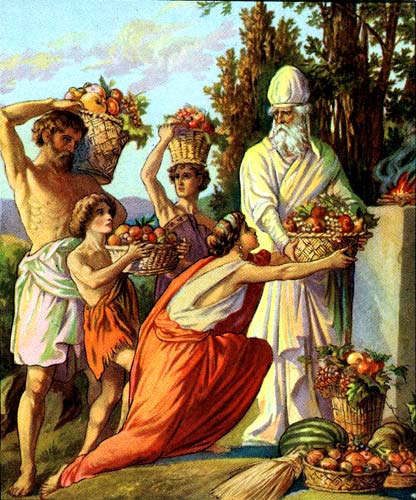
You shall take some of the first of every fruit of the earth that you bring in from your land that God, your god, is giving to you.  And you shall place them in a basket and go to the place that God, your God, will choose to let [God’s] name dwell.  (Deuteronomy/Devarim 26:2)

The place that “God will choose” is Jerusalem.2  The head of each household brings the basket to the temple. and affirms that the land on which his family grew the fruits is a gift from God.

And you shall come to whoever is the priest in those days, and you shall say to him: “I declare today to God, your God, that I came to the land that God swore to our forefathers to give to us.”  (Deuteronomy 26:3)

The priest sets the basket in front of the altar.

And you shall respond, and you shall say in front of God, your God: “Arami oveid avi.  And he went down to Egypt and he sojourned there with few men, but he became there a nation great and powerful and populous.”  (Deuteronomy 26:5-6)

Arami (אֲרַמִּי) = a male Aramean, a man from the country of Aram (roughly corresponding to present-day Syria and northern Iraq).

oveid (אֺבֵד) = wandering lost; being ruined; perishing.  (Oveid is the kal participle of the verb avad, אָבַד, and implies that the subject is lost, ruined, or perishing.)3

avi (אָבִי) = my father, my forefather.

Who is the Arami?  The book of Genesis/Bereishit tells us that Abraham lives in the Aramean city of Charan (also called Paddan-Aram) before God tells him to go to Canaan.  Later in Genesis, Abraham’s grandson Jacob flees to Charan and lives there with his uncle Lavan for 20 years before returning to Canaan.  So we have three candidates for the Aramean in this declaration: Abraham, Lavan, or Jacob.  And only two of those, Abraham and his grandson Jacob, qualify as a forefather of the Israelites.

Rashi4 identified the Arami as Lavan and the avi as Jacob.  His interpretation, “Lavan sought to uproot everyone [all Jews] as he chased after Jacob,” requires translating Arami oveid avi as “An Aramean was ruining my forefather.”  But oveid cannot mean “ruining”, only “being ruined”.(see 3)  Furthermore, Biblical Hebrew grammar allows for an implied verb “to be” anywhere in the phrase Arami oveid avi, but not for the Arami to be the subject doing something to avi as a direct object.5  So Arami and avi must be the same person.

Rashbam6 recognized this, and identified the person as Abraham.  He associated oveid with wandering when one is exiled from one’s own land, and rephrased Arami oveid avi as “My father Abraham, an Arami was he, oveid and exiled from the land of Aram.”  Then he cited Genesis 12:1, where God tells Abraham: “Go forth from your land and from your relatives and from your father’s house to the land that I will show you.”  If Aram is Abraham’s own land, Rashbam must have reasoned, then in Canaan he is an exile.

Calling Abraham an exile seems like a stretch to me.  Abraham hears God and decides to leave.  He brings along his wife, his nephew, the people who work for them, and the wealth he has accumulated in livestock and goods.  It sounds like a comfortable emigration.

Rashbam’s explanation also fails to account for the sentence immediately following Arami oveid avi in Deuteronomy 12:5 above.  Abraham and his household do visit Egypt, but the same group returns to Canaan after a very short sojourn there.  They may pick up a few Egyptian slaves, but Abraham’s returning household is far from being “a nation great and powerful and populous”.

That leaves Abraham’s grandson Jacob as the Arami who is the speaker’s forefather.  Jacob, a.k.a. “Israel”, moves to Egypt to join his son Joseph and brings along 66 of his descendants, not counting the wives of the adult men.7  These “children of Israel” stay in Egypt for 430 years.8  When they leave in the book of Exodus, there are “about 600,000 men on foot” along with their families and fellow travelers9—enough to count as a nation in the Ancient Near East.  The sentence following Arami oveid avi fits only Jacob.

If Jacob is the Aramean and “my forefather”, why is he called oveid?  The translation of oveid that best describes Jacob’s life at the time he emigrates to Egypt is “perishing”, since he and his extended family are suffering through a second year of famine in Canaan.  Therefore, Arami oveid avi should be translated: “A perishing Aramean was my forefather”.

A man bringing his first fruits to the temple does identify himself as an Israelite with these three words, but it would be simpler to say “Jacob is my forefather” or “Israel is my forefather”.  The clause Arami oveid avi acknowledges two other things: that his ancestors had not always lived in Canaan/Judah, and that at a critical time they were perishing in a famine.  Remembering these things, the farmer is more likely to feel grateful that God gave the Israelites land, and that the God who makes famines has provided him with agricultural abundance.


The recitation and ritual actions continue in this week’s Torah portion without mentioning that they are part of Shavuot, one of the three annual pilgrimages to Jerusalem dictated in the Torah.  In Exodus 34:22 Shavuot is described as a celebration the first fruits of the wheat harvest, and in Numbers 28:26 Shavuot is identified as the “Day of First Fruits” (Yom Habikkurim).

But the recitation beginning Arami oveid avi has also become part of Passover/PesachIn 220 C.E., when Judah HaNasi recorded the Mishnah (the core of the Talmud), the farmer’s declaration before the priest was already included in the seder (the Passover service at home around the table).10  It still is.

Arami oveid avi is a humbling opening line.  If God could let Jacob, one of God’s favorite people, come close to perishing of hunger, any of us might be ruined.  And every human being will eventually perish from this earth.

Yes, while we are alive we must cultivate our crops.  Our own efforts are necessary, but not sufficient, for prosperity; other necessary factors are out of our hands.  The good life is a fragile and temporary blessing.

May we notice the first fruit of every blessing in our lives, and express our gratitude.

(An earlier version of this essay was published in September 2011.)


  1. The real owner of the land is also revealed in Leviticus 25:23, when God declares: “But the land must not be sold to forfeit reacquisition, because the land is Mind; for you are resident aliens with Me.” (See my post Behar: Owning Land.)
  2. Modern critical scholars agree that the earliest form of book of Deuteronomy was written no earlier than the 7th century B.C.E., after the northern kingdom of Israel had been wiped out by the Assyrians, and the only remaining Israelite kingdom was Judah, with its capital and temple at Jerusalem.
  3. The piel participle, me-abeid (מְאַבֵּד = giving up as lost, ruining, letting perish) implies that the subject is abandoning, ruining, or destroying someone else.)
  4. Rashi is the acronym for 11th-century rabbi Shlomoh Yitzchaki.
  5. In Biblical Hebrew, if avi were a definite direct object instead of a subject, it would be preceded by the word et (אֶת).
  6. Rashbam is the acronym for Rashi’s grandson, the 12th-century rabbi Shmuel ben Meir.
  7. Genesis 46:26.
  8. Exodus 12:40. (In Genesis 15:13 God predicts it will be 400 years.)
  9. Exodus 1:7, 12:37-38.
  10. Talmud Bavli, Pesachim 116a, Mishnah.

Ki Teitzei: Virtues of a Parapet

When you build a new house, then you shall make a ma-akeh for your roof; then you will not put blood-guilt on your house if the faller falls from it.  (Deuteronomy/Devarim 22:8)

ma-akeh (מַעֲקֶה) = parapet: a low wall along the edge of a roof or another structure.

This verse appears in a compilation of practical laws in this week’s Torah portion, Ki Teitzei (“When you go out”).  At the most literal level, it simply requires a parapet around a roof as a safety precaution to prevent anyone from falling.  If the faller were being injured or killed the owner of the house would be liable, bearing the “blood-guilt”.

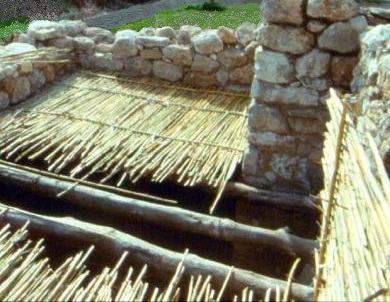
Roofs from Egypt to Babylon (as well as in other parts of the world with dry climates and mild winters) were usually flat and built to bear weight, so people could walk, sit, sleep, and work on them.  In the Ancient Near East, builders ran wooden beams or whole logs from wall to wall.  They covered the beams with framed straw or reed mats, then topped the roof with several layers of clay compacted with stone rollers.  Sometimes they added latticed rooftop structures to provide shade for people using the roof.  A parapet around the edge made the top layer more durable, as well as improving safety.

The Hebrew Bible mentions using rooftops for private conversations,1 for sleeping,2 for storage,3 and for making sacrifices at altars for other gods.4  The Talmud also mentions keeping small lambs or goat kids on one’s roof.5

Safety

A roof without a parapet is unsafe not only because a person might fall off, but also because something might fall, or get pushed, from the roof onto a person below.  When an unsavory king in the book of Judges, Avimelekh of Shechem, captures the town of Teiveitz, its residents flee to the tower in the middle of their town.

And they shut themselves inside and they went up onto the roof of the tower.  And Avimelekh came up to the tower… to set it on fire.  Then a woman sent down an upper millstone onto the head of Avimelekh, and it cracked his skull.  (Judges 9:51-53)

The Talmud (Bava Kamma 15b) extends the requirement for a parapet around a roof to all other hazards in a house, such as keeping a vicious dog or setting up an unstable ladder.  If the owner does not remove the hazard, he is liable for damages and a court can even excommunicate him.

Even if the owner is the only person who lives in the house, he must still make it safe for the benefit of guests and future residents.6

Privacy

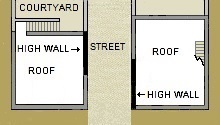
A sufficiently high parapet also provides privacy.  According to the Talmud (Bava Batra 2b) if the roof of one house adjoins the courtyard of another house, the owner of the first house must build a parapet four cubits high,7 so he cannot look into the neighbor’s courtyard when he is using his roof.  A similar ruling is that a wall separating the courtyards of two adjacent houses should be four cubits high, so neighbors cannot see into each other’s courtyards  (Bava Batra 5a).

Even if houses are not adjacent, a higher parapet may be needed for privacy.  If two houses are on opposite sides of a public road (Bava Batra 6a), both owners are likely to build a parapet high enough to prevent anyone on the road below from seeing them; but each owner must also build one side of his front parapet high enough to block the view from the opposite roof.  Then both families will have privacy (and share the expense equally).

A story in the bible illustrates another situation in which a high parapet would have provided privacy.

Bathsheba, by Jean-Leon Gerome, 1889

It was evening time, and David rose from his bed and walked around on the roof of the king’s house.  And he saw a woman bathing, from up on the roof, and the woman was very good in appearance.  (2 Samuel 11:2)

For the sake of privacy, Bathsheba would have been bathing either on her own lower roof, or in the enclosed courtyard of her own house.  But King David’s view was not blocked by a high enough parapet.  Enamored of her naked beauty, he found out who she was and sent for her, assuming that since  her husband Uriah was away at war, he would never know.  When Bathsheba became pregnant, King David had Uriah sent home from the front, but he refused to sleep with his wife until the war was over.  So David arranged for the death of the innocent man.  None of this would have happened if King David’s parapet had been four cubits high.

Metaphor for pride

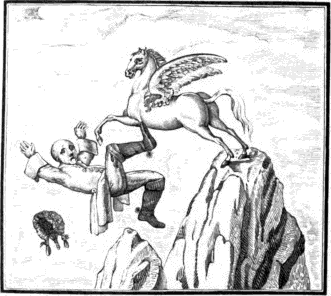
The original injunction in this week’s Torah portion has also been interpreted allegorically, with the rooftop standing for pride.  Philo of Alexandria wrote in the first century C.E. that when people give themselves credit for intellectual and social advancement, instead of crediting God, they are likely to fall from their high positions and be destroyed.

For the most grievous of all falls is for a man to stumble and fall from the honour due to God; crowning himself rather than God, and committing domestic murder. For he who does not duly honour the living God kills his own soul …8 

A Poet’s Fall, 1760

The Hassidic commentator Dov Baer Friedman interpreted Deuteronomy 22:8 by applying the metaphor of pride before a fall9 to a Torah scholar’s pride in coming up with a new interpretation:

This refers to one offering a new interpretation of Torah.  “Make a railing for your upper storey.”  If the verse were referring to a literal house, it would have said: “for its upper storey.”  As it is, the upper storey is on you, referring to the swelling of your pride at this new teaching.  Do not let your head get turned by pride!  Even though this is a bit of Torah that no ear has ever heard, it comes not from you, but from God. “Should somebody fall from it.”  You are all set for such a fall.10


Building a Mental Parapet

Safety: We can be dangerous to ourselves when we get so carried away by our emotions that we act without thinking it through. Burning with anger, we hurl words, or worse, at the enemy we think is below. Overcome by sexual attraction, we throw ourselves at another person, and fall off. Thick with bitterness, we trudge ahead without looking where we are going.

The ensuing disasters could all be avoided if we built a strong mental parapet: a habit of stopping until our passion fades enough so we can rationally consider consequences and alternatives.

Privacy:  We can also find an inner meaning of the Talmud’s extension of the law in Ki Teitzei to cover privacy. Besides physical privacy, humans need privacy in our mental lives.  We can share personal information, random thoughts, and emotional reactions with a trusted partner who knows us well.  But sharing these things with neighbors, friends, or strangers can cause them to feel uncomfortable, to make false assumptions about us, or to feel burdened by our apparent neediness.  It can even give false friends information they can use against us or against people we know.

We can build a mental parapet, a habit of pausing before sharing something that might be out of bounds, so that we do not reveal the wrong things–whether in response to an inappropriate question, or in a gush of good will or exhibitionism.

Pride: As both Philo of Alexandria and Dov Baer Friedman wrote, we can fall into the self-delusion of pride over any personal achievement. If giving God credit for our deeds does not work for us, we can build a mental parapet out of reminders that all our successes depend on the deeds of other human beings, on the family and society we inherit, and on the genes that we are born with.

Those of us who actually live in buildings with flat, inhabitable roofs still need parapets to prevent people and things from falling off.  But we all need parapets when it comes to the contents of our own minds.

  1. Examples of using a roof for private conversations: Joshua 2:6, 1 Samuel 9:25-26.
  2. Examples of using a roof for sleeping: Joshua 2:6, 2 Samuel 11:2.
  3. A roof is used for storing flax in Joshua 2:6.
  4. Examples of using a roof for altars to worship other gods: 2 Kings 23:12, Jeremiah 19:13 and 32:29, Zephanaiah 1:5.
  5. Talmud Bavli, Bava Batra 6b.
  6. 19th-century rabbi Samson Raphael Hirsch, The Hirsch Chumash: Sefer Devarim, translated by Daniel Haberman, Feldheim Publishers, Jerusalem, 2009, p. 513.
  7. A cubit is the length of a forearm from elbow to fingertips. Four cubits would be over 6 feet, or almost 2 meters.  (Bava Batra 2b also provides rules for window and courtyard partition placements to prevent a neighbor from being able to look inside the house next door.)
  8. Philo of Alexandria, The Works of Philo, trans. by C.D. Yonge, “XXXIX, On Husbandry, 171”.
  9. Proverbs 16:18.
  10. Dov Baer Friedman of Miedzyrzec, Or Torah (1804), translated by Arthur Green in Arthur Green, Speaking Torah, vol. 2, Jewish Lights Publishing, Woodstock, Vermont, 2013, p. 124.

Shoftim: To Do Justice

Tzedek, tzedek you must pursue. (Deuteronomy/Devarim 16:20)

tzedek (צֶדֶק) = right behavior; ethical standards; justice.

The pursuit of justice and/or ethical behavior is an obligation incumbent upon all of us.  But in this week’s Torah portion, Shoftim (“Judges”), the pursuit of tzedek is an instruction to judges.  The portion begins:

Shoftim and officers you shall appoint in all your gates [of towns] that God is giving to you according to your tribes; veshaftu the people [with] rulings of tzedek.  (Deuteronomy 16:18)

shoftim (שֺׁפְטִים) = judges; those who decide cases; those who deliver justice.

veshaftu (וְשָׁפְטוּ) = and they shall judge, make settlements among, deliver justice to.

Samson, also a judge

The shoftim in this week’s portion are not the kind of shoftim we see in the book of Judges/Shoftim.  There, most shoftim were chieftains or war leaders during a time of frequent conflicts among small states.  They deliver justice to the people by leading an army that frees them from their latest conquerors.  Afterward they usually serve as chieftains who are also judges.1

City gate at Megiddo

The shoftim in this week’s Torah portion also differ from the town elders who serve as judges in biblical passages referring to the time before Israel and Judah had kings. During that period, an individual with a claim to press, or two household heads seeking arbitration, would go to the town gate or the village threshing floor at daybreak and call ten of the settlement’s elders (respected male heads of households) to come over and adjudicate.2  A decision required the consensus of all ten men.3

Although the book of Deuteronomy is set on the bank of the Jordan at the end of Moses’ life, it was written for the citizens of the kingdom of Judah, and refers to their legal system.4  The shoftim in this week’s portion are appointed judges, not the first ten respected elders to pass by.

These appointed shoftim must judge the people with “rulings of tzedek” as follows:

You may not skew a ruling; you may not recognize a face; and you may not take a bribe, since a bribe blinds the eyes of the wise and distorts the words of the tzaddikimTzedek, tzedek you must pursue, so you may live and take possession of the land that God, your God, is giving to you.  (Deuteronomy 16:19-20)

tzaddikim (צַדִּיקִם) = the innocent; the righteous, the ethically good, the just.  (From the same root as tzedek.)

To “recognize a face” means to show favoritism, not just in the decision but also in how the parties are treated during the hearing.5

Why would pursuing justice enable the Israelites to live and conquer more and more of the land of Canaan?  Deuteronomy predicts that they will only win battle victories with God’s help.  (See my post Re-eih: Ownership.)  Therefore it pays to do what God wants.

Moses frequently restates what God wants from the Israelites, which includes just decisions about legal claims.  It also includes avoiding the worship of other deities (the first of the Ten Commandments).  If local appointed judges hear that someone has been worshiping other gods, they must investigate thoroughly.  If the rumor proves true,

Stoning, from Piola Domenico, 17th century

Then you shall bring out to your gates that man or that woman who did the wicked thing, and stone them with stones so they will die.  On the word of two or three witnesses they shall definitely be executed, [but] they shall not be put to death on the word of one.  (Deuteronomy 17:5-6)

At least two eye-witnesses must agree that they saw the accused bow down to, or otherwise serve, an alien god before the judges can declare the accused guilty.  One or zero witnesses are insufficient for a guilty verdict, no matter what the circumstantial evidence.6

The Torah portion Shoftim also addresses what local judges should do when it is hard to connect a legal case with the appropriate law or ruling.

If a matter of law is too difficult for you, … then you shall get up and go up to the place God, your God, chooses.  And you shall come to the priests of the Levites, or to the judge who is [serving] at that time, and you shall inquire; and he shall tell you the matter of the law.  (Deuteronomy 17:8-9)

The next few verses say that the local judges must carry out the ruling from Jerusalem (the place God chooses) exactly as instructed.  This passage parallels the scene in Exodus/Shemot where Yitro tells his son-in-law Moses to appoint judges to settle minor disputes, and ask them to bring the major cases to him.7  Yitro explains that the major cases should go to Moses not because he is the central authority, but because God talks to him and gives him the laws.  Perhaps difficult cases must be referred to the priests and judges in Jerusalem not because they are the central authority, but because they are more experienced in interpreting God’s laws.

*

Just as “Tzedek, tzedek you must pursue” should be a goal for every human being in some sphere of life, we can take to heart other instructions to the shoftim in this week’s portion.  How do you judge the actions of another person?

Do you act like the chieftains and war leaders in the book of Judges, convinced that your own cause is just and therefore you have the right to dictate to everyone else?  Or do you act like the elders in the gate, taking action against someone only if your sense of what is right matches the opinions of other respected people in your community?

Do you “recognize a face” or show favoritism, making excuses for someone you like while judging someone you dislike harshly?  Do you feel obligated to refrain from correcting someone who has given you a gift, such as a job or status?

If one person tells you about the terrible thing a third person did, do you believe it?  Or do you wait until two eye-witnesses confirm it?  Do you draw conclusions about someone from circumstantial evidence?

If you cannot make up your mind about whether another person is guilty of wrongdoing, or whether you need to do anything about it, to whom do you take the case?  Who can you trust?

It is not so easy to pursue justice.

  1. Judges 2:16-19. Specific war-leaders whom the book of Judges cites as shoftim administering justice are Otniel (3:9), Jepthah/Yiftach (12:7), and Samson/Shimshon. (15:20, 16:31).  The shoftim named in Judges who appear to be chieftains who also judge cases are Tola (10:1-2), Ya-ir (10:3), Ivtzan (12:8-9), Eilon (12:11), and Avdon (12:13-14).  One woman, Devorah, takes a dual role.  She is introduced as “a prophetess, a woman of Lapidot, [who] administered justice in Israel at that time … and Israelites went up to her for rulings” (Judges 4:4-5), but then she calls for war and accompanies a general into battle.
  2. Ruth 4:1-11, Proverbs 31:23, and Lamentations 5:14. Also see Victor H. Matthews & Don C. Benjamin, Social World of Ancient Israel 1250-587 BCE, Hendrickson Publishers, Peabody, MA, 1993, pp. 122-124.  Deuteronomy 25:7 calls for the elders at the gate to rule on the case of a new husband who accuses his bride of not being a virgin; perhaps the older system of town elders survived, modified by later laws and rulings imposed by the kingdom’s priests and other higher-ranking judges (see Deuteronomy 17:8-13).
  3. Matthews & Benjamin, p. 124.
  4. Most modern critical scholars date the composition of Deuteronomy chapters 12-25 to the reign of King Josiah of Judah in the 7th century B.C.E., with some editing later.
  5. Rashi (11th-century rabbi Shlomoh Yitzchaki) on Deuteronomy 16:19.
  6. Talmud Bavli, Sanhedrin 37b.
  7. Exodus 18:22.