Bereishit, Lekh-Lekha, & Vayeira: Talking Back

When characters in the Torah hear God speak, some simply obey. Others some talk back to God, either to ask questions or to make excuses. In this week’s Torah portion, Vayeira (Genesis 18:1-22:21), Avraham raises talking back to God to a new level.

Bereishit: shifting the blame

The first human being to whom God speaks is the first human being: the adam (אָדָם = human being) in the first Torah portion of Genesis/Bereishit (Genesis 1:1-6:8). The God character warns the adam that eating from the Tree of the Knowledge of Good and Evil would result in death.

Nothing happens. I suspect that the human does not understand, never having seen anything die, but nevertheless follows God’s advice and avoids the Tree of Knowledge.  Then God separates the human into male and female, and provides a talking snake. Finally the two humans eat the fruit.

The next time they hear God in the garden, they hide. Then God asks:

“Where are you?” (Genesis 3:9)

The male human answers:

“I heard your sound in the garden, and I was afraid because I am naked, and I hid.” (Genesis 3:10)

Before the two humans ate the fruit, they did not notice they were naked; so were all the other animals in Eden. But once they know that some things are good and some are bad, they become self-conscious. (See my post Bereishit: In Hiding.) God asks:

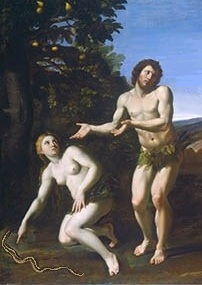
The Rebuke of Adam and Eve, by Domenichino, 1626, detail

“Who told you that you are naked? From the tree about which I ordered you not to eat, did you eat?” And the human said: “The woman whom you gave to be with me, she gave to me from the tree, and I ate.” (Genesis 3:11-12)

The man admits that he ate from the tree, but only after blaming the woman. When God questions the woman, she blames the snake. Then the God character “curses” the snake, the woman, and the man with the ordinary hardships of life outside the mythical garden of Eden, and expels them from the garden so that they will not eat from the Tree of Life and become immortal.

Throughout the conversation, the God character is the authority figure, and the two humans are like children making excuses to avoid being blamed and punished.

Bereishit: lying and begging

The next human God speaks to is the oldest child of the first two humans, Kayin (קַיִן, “Cain” in English). He makes a spontaneous offering to God, and his younger brother Hevel (הֶבֶל, “Abel” in English) follows suit. Kayin gets upset because God only pays attention to Hevel’s offering. Then God warns Kayin to rule over his impulse to do evil, but the warning goes over Kayin’s head.

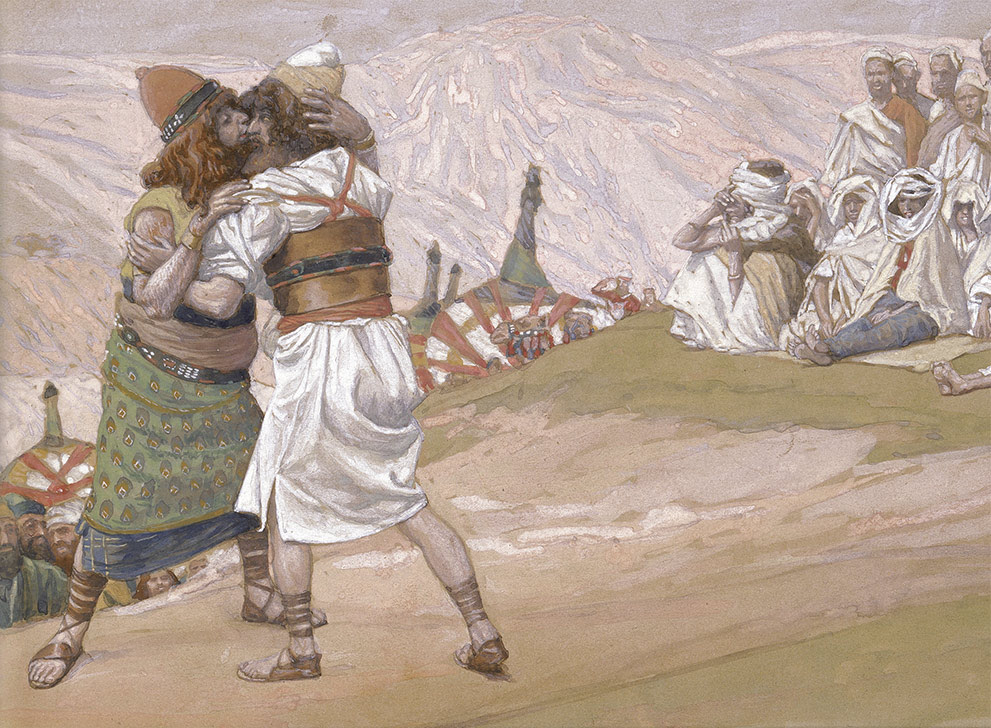
Cain Leads Abel to Death, by James Tissot, circa 1890

And it happened when they were in the field, and Kayin rose up against his brother Hevel, and he killed him. Then God said to Kayin: “Where is Hevel, your brother?” And Kayin said: “I don’t know. Am I my brother’s shomeir?” (Genesis 4:8-9)

Shomeir (שֺׁמֵר) = watcher, guard, protector, keeper.

Kayin certainly knows where he left Hevel’s body, so his answer “I don’t know” is a lie. He might not have understood what death is before he killed his brother, but he knows now, and he suspects that he did something wrong. So he lies in an effort to escape being blamed.

Next Kayin asks what might be an honest question. Was he supposed to watch over his brother, the way he tends his vegetables and Hevel used to tend his sheep?

On the other hand, his question might be a protest that he is not responsible for protecting his brother, so he should not be blamed for what happened when he “rose up against” Hevel.

The God character does not bother to answer. Instead God curses him with a life of wandering instead of farming. Kayin cries out in alarm:

“My punishment is too great to bear! … Anyone who encounters me will kill me!” (Genesis 4:13-14)

Kayin might be thinking that his future relatives will be angry with him, and kill him the way he killed Hevel.

Then God said to him: “Therefore, anyone who kills Kayin, sevenfold it will be avenged!” And God set a sign for Kayin, so that anyone who encountered him would not strike him down. (Genesis 4:15)

Once again, the God character is the authority figure. Kayin lies to avoid being blamed, but he also (indirectly) begs God for protection, which God provides.

Lekh-Lekha: doubting

The next human to whom God speaks is Noach (נֺחַ, “Noah” in English). God gives Noach orders, and Noach follows them without a word. (See my post Noach: Silent Obedience.) There are no questions.

Avram (אַבְרָם, “Abram” in English) begins his relationship with God on the Noach model. But after God has promised him twice that he will have vast numbers of descendants,1 and twice that his descendants will own the land of Canaan,2 Avram cannot resist speaking up. He points out that at age 75 he is still childless. Then he asks God for more than verbal promises.

“My lord God, how will I know that I will possess it [the land]?” (Genesis 15:8)

The God character responds by staging an elaborate covenant ceremony. (See my post Lekh-Lekha: Conversation.) At its conclusion, God repeats once more that Avram’s descendants will own the land of Canaan.

When Avram is 86, he has a son by his wife Sarai’s servant Hagar, and names the boy Yishmael (יִשְׁמָעֵאל, “Ishmael” in English). Although a divine messenger speaks to Hagar when she is pregnant,3 God does not speak to Avram again until he is 99 years old. Then God manifests to him and announces:

“I am Eil Shadai! Walk about in my presence, and be unblemished!” (Genesis 17:1)

Eil Shadai (אֵל שַׁדַּי) = God who is enough, God of pouring-forth, God of overpowering.

This is the first use in the bible of the name Eil Shaddai. This name for God occurs most often in the context of fertility. Here, the name might encourage Avram to believe God has the power to make even a 99-year-old man and his 89-year-old wife fertile. God continues:

“I set my covenant between me and you, and I will multiply you very much.” (Genesis 17:2)

Avram responds by silently prostrating himself. He already has a covenant with God, and the only multiplication that has happened during all the years since is the birth of Yishmael.

But God outlines a new covenant, this time one in which both parties have responsibilities. First there is the question of names: just as God is now Eil Shadai, Avram will henceforth be Avraham (אַבְרָהָם; “Abraham” in English),

“… because I will make you the av of a throng of nations!”

av (אַב) = father. (Raham is not a word in Biblical Hebrew.)

The God character expands on the usual theme, promising that Avraham’s descendants will include many kings, and they will rule the whole land of Canaan. In return, Avraham must circumcise himself and every male in his household, including slaves, and so must all his descendants.

Next God changes the name of Avraham’s 89-year-old wife from Sarai to Sarah (שָׂרָה = princess, noblewoman), and promises to bless her so that she will bear Avraham a son.

But Avraham flung himself on his face and laughed. And he said in his heart: “Will a hundred-year-old man procreate? And if Sarah, a ninety-year-old woman, gives birth—!” (Genesis 17:17)

In other words, Avraham does not believe God, who has been making the same promise for years. But he does want blessings for the thirteen-year-old son he already has from Hagar.

And Avraham said to God: “If only Yishmael might live in your presence!” (Genesis 17:18)

Then God promises that Yishmael will also be a great nation, but the covenant will go through Avraham’s son from Sarah, who will be born the following year and will be called Yitzchak (יִצְחָק = he laughs; Isaac in English). The God character noticed when Avraham laughed.

The Torah portion closes with Avraham circumcising himself and all the males in his household, including Yishmael. Whether Avraham believes Sarah will give birth or not, he wants to fulfill his own part of the covenant. Why would he risk upsetting God?

In the portion Lekh-Lekha, the God character is more powerful than the man, and Avram/Avraham is careful not to incur God’s displeasure–but he has his own opinions.

Vayeira: teaching

This week’s Torah portion, Vayeira, opens when Avraham sees three men approaching his tent. At least they look like men, and Avraham lavishes hospitality upon them as if they were weary travelers. But the “men” turn out to be divine messengers. Through one of them, God speaks to both Avraham and Sarah, announcing that Sarah will give birth the next year. (See my post Vayeira: On Speaking Terms.)

Abraham and the Three Angels, by Bartolome Esteban Muriollo, ca. 1670

Then Avraham walks with the three “men” to a lookout point, where God says:

“The outcry of Sodom and Gomorrah is great, because their abundant guilt is very heavy. Indeed I will go down, and I will see: Are they doing like the outcry coming to me? [If so,] Annihilation! And if not, I will know.” (Genesis 18:20-21)

Two of the divine messengers continue down to Sodom to see if its people really are as evil as God has heard,4 while God stays with Avraham at the lookout.

Avraham came forward and said: “Would you sweep away the tzadik with the wicked? What if there are fifty tzadikim inside the city? Would you sweep away and not pardon the place for the sake of the fifty tzadikim who are in it? Far be it from you to do this thing, to bring death to the tzadik with the wicked! Then the tzadik would be like the wicked. Far be it from you! The judge of all the earth should do justice!” (Genesis 18:23-25)

tzadik (צַדִּיק) = righteous, innocent. tzadikim (צַדִּיקִם) = people who are righteous or innocent.

This is a new thing in the world: a human being arguing with God and telling God the right thing to do.

Is Avraham the teacher now, and the God character his pupil? How does God react?

See my post next week: Vayeira: Persuasion.


  1. Genesis 12:2, 13:16.
  2. Genesis 12:7, 13:15-17.
  3. Genesis 16:7-12. See my post Lekh-Lekha: First Encounter.
  4. The God character in the Torah is not omniscient.

Lekh-Lekha: Conversation

(corrected version)

In last week’s Torah portion, Noach, God gives Noach (Noah in English) orders, and Noach obeys. The communication is strictly one-way; Noach never says anything to God. (See my post Noach: Silent Obedience.)

In this week’s Torah portion, Lekh-Lekha (Genesis/Bereishit 12:1-17:27), God speaks to Abraham, and Abraham responds—at first with action, like Noach, but eventually with questions.

An order or an offer?

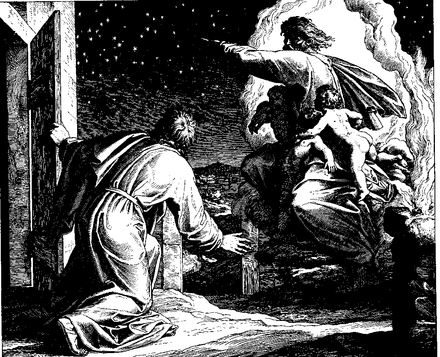
The Lord Directing Abraham, by Julius Schnorr von Carolsfeld, 1860

The Torah portion opens when God first addresses Avram. (“Avram” is Abraham’s original name before God changes it.)

Then God said to Avram: “Go for yourself, from your land, from your kindred, and from your father’s house, to the land that I will show you. And I will make you into a great nation, and I will bless you, and I will magnify your name.” (Genesis 12:1-2)

The beginning of God’s first speech to Avram sounds more like an offer than an order. If Avram leaves and goes to the land God indicates, then God will make Avram’s descendants into a great nation, bless Avram with success, and make his name famous.

Although God could simply command Avram to move to Canaan, God seems to want Avram to choose going to Canaan over staying in Charan. 19th-century Rabbi S.R. Hirsch explained that God’s first promise would compensate Avram for giving up his nationality in the Aramean kingdom where he and his family lived; the second promise would compensate him for his prosperity there; and the third promise would compensate him for starting over again without his family’s reputation.1

Next God says:

Veheyeih brakhah!” (Genesis 12:2)

veheyeih (וֶהְיֵה) = Then become! (The prefix ve- (וֶ) is a conjunction that means either “and” or “then”. Heyeih (הְיֵה) is the imperative of the verb hayah (הָיָה), which means either “be” or “become”.)

brakhah (בְּרָכָה) = blessing, a blessing. (In the Hebrew Bible, humans are considered blessed when they have prosperity, good health, fertility, victory over enemies, or power over subordinates.)  

What does God’s imperative “Then become a blessing!” mean?

One tradition from the 13th century to the present is that the word veheyeih was assigned the wrong vowels, and actually means “then you will be”. According to this line of commentary, God is predicting that Avram will become part of peoples’ prayers for blessing. For example, Ramban wrote: “You will be the blessing by whom people will be blessed, saying, ‘God make you like Abraham.’”2 And eight centuries later Steinsaltz wrote: “… people will use you as a paradigm for blessings. When they bless one another, they will say: May you merit to be like Abram.”3

I prefer the alternate tradition, that God is telling Avram to act in such a way as to be a blessing to others. In Bereishit Rabbah (circa 400 C.E.), Avram becomes a blessing by praying for childless women, who then become pregnant, and for the sick, who then heal.4

Then God finishes:

“And I will bless those blessing you, and those demeaning you I will curse. And all the clans of the earth, nivrekhu vekha.” (Genesis 12:3)

nivrekhu vekha (נִבְרְכוּ בְךָ) = they will want to be blessed like you. (Nivrekhu (נִבְרְכוּ) is the third person plural of the rare nifil form of verb barakh (בָּרוּךְ), “be blessed”, and means “they seek to be blessed”. Vekha(בְךָ) in other contexts could mean “in you”, “by you”, or “through you”, but immediately after nivrekhu it means “like you”.)5

The second part of God’s initial speech to Avram, from “Become a blessing” through “they will want to be blessed like you” sounds like another if-then statement. If Avram becomes a blessing, then God will bless or curse everyone Avram encounters according to how they treat him, and everyone in the world will want the kind of blessing Avram has.

And Avram went, as God had spoken to him … (Genesis 12:4)

Avram’s first blessing from God

Avram brings along his wife Sarai (whom God later renames Sarah), his nephew Lot, all their servants, and all their livestock. When they reach a sacred tree near Shekhem in Canaan, God appears to Avram and says:

“To your descendants I give this land!” And he built an altar there to God, who had appeared to him. (Genesis 12:7)

Avram does not mention to God that he is still childless at age 75. He and his household keep traveling south, and when there is a famine in Canaan, they go all the way to Egypt.

There Avram scams the pharaoh by claiming Sarai is his sister, not his wife. (See my post Lekh-Lekha, Vayeira, & Toledot: The Wife-Sister Trick, Part 2.) The pharaoh takes Sarai as a concubine, and pays Avram a generous bride-price. The God character plays along and afflicts the pharaoh with an unmentionable disease. Then the pharaoh has Avram escorted out of Egypt—along with Sarai, all the other humans and animals who came with him, and the bride-price. Thanks to God’s assistance, Avram is blessed with even more prosperity.

Avram talks back

Enriched by more slaves, livestock, silver, and gold, Avram returns to the hills east of Beit-Eil. There he and his nephew Lot separate, with Avram staying in the highlands, while Lot takes his men and livestock down to the plain of Sodom.

And God said to Avram, after Lot had separated from him: “Raise your eyes, please, and look from the place where you are … For all the land that you yourself see, I will give it to you and to your descendants forever. And I will make your descendants like the dust of the earth, so that if a man were able to count the dust of the earth, your descendants could also be counted.” (Genesis 13:14-17)

Again Avram responds by building an altar to God, rather than by saying anything. Avram’s name is magnified (i.e. his reputation rises) in the central part of Canaan because he defeats four invading kings and returns the captives and the loot to their own communities. Then the priest-king Melchizedek says to Avram:

“Blessed be Avram by God Most High, founder of heaven and earth! And blessed be God Most High, who delivered your adversaries into your hand!” (Genesis 14:19-20)

So if this mysterious priest-king is correct, and if his god is Avram’s God, then God rewarded Avram for moving to Canaan with the blessing of success in battle.

But what about the blessing of fertility, which is necessary for God’s promise of a great nation of descendants?

The next time God makes him a promise involving descendants, Avram speaks up.

After these events, the word of God happened to Avram in a vision, saying: “Don’t be afraid, Avram! I myself am a shield to you; your reward multiplies exceedingly!” Then Avram said: “My lord God, what will you give to me? And I am going childless, and the heir of my household is a Damascan, Eliezer.” And Avram said: “Hey, you have not given a descendant to me, and hey! The heir of my household will inherit from me.” (Genesis 15:1-3)

The repetition of “Avram said” in the middle of a speech is a biblical convention indicating that the speaker pauses, but the one being addressed does not respond, so the speaker says more. In this case, the God character may be surprised that Avram asked a question; it is the first time someone questions God in the book of Genesis.6

After Avram rephrases his issue, God does respond:

“This one will not inherit from you. Instead, one going out from your innards, he will inherit from you.” And [God] brought him outside and said: “Look, please, toward the heavens and count the stars, if you are able to count them.” And [God] said to him: “Thus will be your descendants.” (Genesis 15:4-5)

Does Avram believe God’s promise that he will father a son, who will have countless descendants? The text says:

And he trusted in God, and [God] reckoned it as righteousness on his part. (Genesis 15:6)

Yet after God repeats the promise to give Avram the land of Canaan (through his descendants), Avram says:

“My lord God, how will I know that I will possess it [the land]?” (Genesis 15:8)

Now he sounds as if he has some doubts about God’s promises, and wants something more reassuring than words. So God arranges an elaborate ceremony commonly called the “Covenant of the Pieces”. Following God’s instructions, Avram cuts in half a heifer, a she-goat, and a ram, and lines up the pieces facing each other. He adds two birds, so each row has three half-animals and a bird. One ritual in the Ancient Near East was for two leaders “cutting” a treaty to cut an animal in half and then walk between the two parts.7

Abraham falls into a deep sleep or trance at sunset, and hears God reveal that his descendants will suffer a 400-year exile in Egypt, but then return to Canaan. Then he sees an oven smoking, and a flaming torch passing between the pieces of the animals. The story concludes:

On that day, God cut a covenant with Avram, saying: “To your descendants I give this land, from the river of Egypt to the great river, the river Euphrates.” (Genesis 15:18)

Is God’s first covenant with Avram lop-sided, with only God vowing to do something? Or will God give Avram’s descendants all that land only if Avram “becomes a blessing”?


This year I am moved by Hirsch’s commentary saying that Jews, as Avram’s descendants, are also required to “become a blessing”:

“Honesty, humanity, and love are duties incumbent upon the individual, but are regarded as folly in relations between nations and are viewed as unimportant by statesmen and politicians. … In the midst of a world where mankind’s … ambition is to increase its power and extend its domain no matter what the cost, the nation of Avraham is—in private and public life—to heed only one call: Veheyeih brakhah! Its life is to be devoted to the Divine aims of bringing harmony to mankind and to the world and restoring man to his former glory.”8

May all human beings finally learn to be a blessing to others.


  1. Rabbi Samson Raphael Hirsch, The Hirsch Chumash, Sefer Bereshis, English translation by Daniel Haberman, Feldheim Publishers, Jerusalem, 2002, p. 290.
  2. Ramban (the acronym for 13th-century Rabbi Moshe ben Nachman, or Nachmanides), translated in www.sefaria.org.
  3. Rabbi Adin Even-Israel Steinsaltz, The Steinsaltz Tanakh, Koren Publishers, 2019.
  4. Bereishit Rabbah 39:11, ca. 400 CE, translated in www.sefaria.org.
  5. William L. Holladay, A Concise Hebrew and Aramaic Lexicon of the Old Testament, William B. Eerdmans Publishing Co., Grand Rapids, MI, 1971, p. 49. (On the other hand, the 1906 edition of The Brown-Driver-Briggs Hebrew and English Lexicon states that the nifil form of barakh means the same as the hitpael form: “bless oneself” or “congratulate oneself”.
  6. Not counting Cain’s remark “Am I my brother’s keeper?”, which is an excuse rather than a true question.
  7. E.g. Jeremiah 34:18. Also see my post Lekh-Lekha: Unconditional Covenant.
  8. Hirsch, p. 292-293.

Noach: Silent Obedience

This week’s Torah portion, Noach (Genesis 6:9-11:31), begins:

These are the histories of Noach: Noach was a tzadik man; he was tamim in his generations; Noach hithalekh God. (Genesis/Bereishit 6:9)

Noach (נֺחַ) = rest, resting-place; “Noah” in English.

tzadik (צַדִּיק) = in the right, just, God-fearing, innocent.

tamim (תָּמִים) = whole, intact, unblemished, perfect, unobjectionable.

hithalekh (הִתְהַלֶּךְ) = walked around with, went around with, followed around.

Is Noach being praised as a morally and religiously superior person?

Tzadik could mean righteous, or merely innocent. Tamim could mean perfect, or merely unobjectionable relative to others. The verb hithalekh could mean that Noach followed direct instructions from God, but did not take initiative to follow the spirit of God’s directives like Abraham and Hezekiah, who “walked around in God’s presence”.1

As the story of the flood unfolds, Noach does everything God tells him to. But does this make him virtuous? Or is he merely resting, like his name, because it is easier not to think for himself?

Not too awful

Just before the Torah portion begins, the text sets the scene:

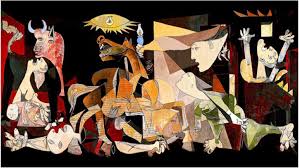
Guernica, by Pablo Picasso, 1937

Then God saw that great was the evil-doing of the human on the earth, and every shape of its conscious planning was only evil all the time. And God had a change of heart about making the human on the earth, and [God] felt mental anguish. And God said: “I will wipe out humankind, which I created, from the face of the earth, from human to beast to crawling thing to flying thing of the sky, because I have had a change of heart about making them.” But Noach found favor in the eyes of God. (Genesis 6:5-8)

(See my post Noach: Spoiled on why God wipes out all the other land animals, as well as human beings, except those on Noach’s ark.)

In the context of massive evil-doing by nearly all human beings, it need not take much for the God character to view Noach favorably. At least Noach is innocent and unobjectionable, and takes orders.

According to Avivah Gottlieb Zornberg, “So, here, God chooses Noah, not because he has achieved significant wisdom or virtue, but because He seeks to convey to some one the knowledge of Himself.”2

I find it hard to believe that out of the entire human population, Noach is the only family head who is innocent, unobjectionable, and obedient (and has some carpentry skills). Surely there must be a few other meek and non-violent men. So why does God choose Noach?

According to Daniel Feldman, God chooses Noach because he is calm. “… the prized attribute he possessed is hinted at in his name, Noach, which suggested calmness. In other words, he was in control of his temperament, and did not give himself to anger … On the other hand, a failure to anger can sometimes reflect a failure to respond to, or even to notice, injustice and immoral behavior in one’s orbit. Accordingly, the source of Noach’s chein [favor] may equally have been the source of his criticized passivity.”3

Noach’s silence

Noah is minding his own business when God suddenly speaks to him.

And God said to Noah: “The end of all flesh is coming before Me, because the earth is filled with violence because of them. So here I am, ruining them along with the land. Make for yourself an ark of gofer wood …” (Genesis 6:12-6:14)

Noah listens silently to the instructions of the voice in his head, and follows them to the letter.

And Noah did everything God commanded him; that is what he did. (Genesis 6:22)

Another person might ask why God plans to drown all the animals on earth except for those in the ark: eight humans (Noah, his wife, their three sons, and the sons’ wives) and one pair of each of other species.4 Even if almost all adult humans are violent and do evil, some of them might repent if they were warned. Some children might learn better behavior. And what about all the non-human animals God has doomed?

But Noah only does what he is told.

Then God said to Noah: “Come into the ark, you and your whole household, for I have seen you are a tzadik before me in this generation.” (Genesis 7:1)

The “you” in this sentence is singular, not plural; it does not seem to matter whether Noah’s wife, sons, and daughters-in-law are innocent.

After giving some additional instructions about animals, God says:

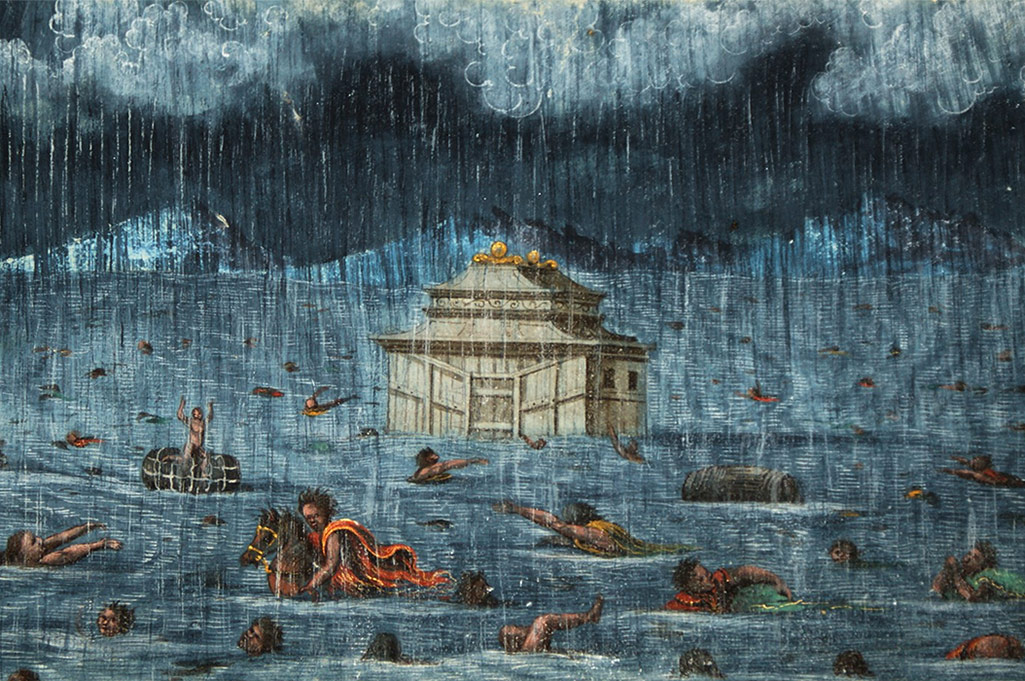
Noah’s Ark and the Flood, Augsburg Book of Miracles, ca. 1552

“For in another seven days, I will be sending rain upon the earth forty days and forty nights, and I will wipe out everything that exists, that I made, from the surface of the land.” (Genesis 7:4)

Apparently this explicit warning still does not inspire Noach to speak—either to question God, or to tell any humans outside his immediate family what is about to happen.5 The text only repeats:

And Noach did everything that God had commanded him. (Genesis 7:5)

Failure to question or pray

According to one 18th-century commentary, Or HaChayim, “Noach became convinced from what God told him that any prayer of his would be futile, that the fate of these people had been sealed beyond reprieve. All of this is contained in the words: ‘the end of all flesh has come before Me, here I am about to destroy them.’”6

Another 18th-century commentary, Kedushat Levi, attributed Noach’s decision to remain silent to his own self-evaluation: “Now even though Noah was a great and blameless tsaddik, he was very small in his own eyes and did not have faith that he was a powerful tsaddik with the ability to annul the decree of the flood. In fact, he thought of himself as being equal to the rest of his generation. …Therefore, he did not pray to save the people of his generation.”7

But this is a poor excuse, wrote Arthur Green. “The question is whether we choose to stand up and act for the good, even while knowing that we may not succeed and that our actions will be imperfect.”8

Modern commentator Norman Cohen, on the other hand, wrote that Noach is passive because he is self-centered.  “Noah saw the world through the narrow prism of his own life and his own needs. He was concerned only with himself—a trait evident in most young children. He seemed to show a lack of compassion for all the rest of humanity, which was about to be destroyed. All that mattered to him was that the ark would guarantee his survival and that of his household.”9

Failure to warn

The same explanations for why Noach fails to speak up to God also apply to the question of why Noach fails to warn other human beings.

Irreversible fate. Just as God seems adamant about wiping out all humans and land animals except for those on the ark, Noach’s neighbors might seem unyielding in their determination to do wholesale violence. He might believe that warning them about their fate would be useless, since they would never reform. (He might also think that even if a few people did repent, God would not let him smuggle them on the ark, or let them build their own boats.)

Low self-esteem. Just as Noach does not believe God would listen to him, Noach would not believe that other people would listen to him. A low self-opinion makes everyone else look more powerful. Feldman wrote: “In order to react proactively to injustice, one must first have faith in their own ability to make a difference. A lack of such faith can result in the perception that all reaction is futile, and not worth the effort.”10

Egocentrism. If the problem is that Noach is so self-centered that he lacks compassion, he has no motivation to go to the trouble of warning people about the coming flood. Avivah Gottlieb Zornberg wrote: “It is not surprising that he is not effective in swaying his contemporaries. … Noah’s silence, I suggest, is essentially a metastasis of the sickness of his time. He is incurious, he does not know and does not care what happens to others. He suffers from the incapacity to speak meaningfully to God or to his fellow human beings.”11 Zornberg added that Noach’s time in the ark teaches him about compassion, since he and his family must spend all their time feeding the various animals. “… there is feeding, the acute awareness of timing and taste in nurturing the other. I suggest that feeding animals becomes a year-long workshop in … kindness.”12


Noach’s name means “rest”. When he is born, his father, Lemekh, gives him that name as an expression of hope, saying:

“May this one give us a change of heart from our labor and from the toil of our hands, from the ground that God cursed.” (Genesis 5:29)

Eight long generations after God cursed the ground so that Adam would have to work hard to farm it,13 Lemekh is fed up with the endless labor and wants some rest.

We all want rest from hard labor, time off to do the things that please us. Over the millennia, humans have found ways to reduce the hardship—through inventing technologies, yes, but mostly through cooperating and helping each other. When we engage in too much violence, the system falls apart and people starve. The cure for a world of violence, as the God character realizes at the end of the story of the flood,14 is not to make an ark to rescue a select few and start a new world. The cure is the mutual aid that can only happen if we are not like Noach—only if we care about our fellow creatures, and do not rest silently in the belief that our efforts would be futile.


  1. Noach and Enoch (Genesis 5:24) “walked around with God” (et ha-Elohim hithalekh, אֶת הָאֱלֺהִים הִתְהַלֶּךְ). The Hebrew Bible also refers three times to walking around in God’s presence (lehithaleikh lifnei Elohim, לְהִתְהַלֵּךְ לִפְנֵי אֱלֺהִים), by Abraham in Genesis 24:40, Hezekiah in 2 Kings 20:3 and Isaiah 38:3, and the psalmist in Psalm 56:14. The injunction to “walk humbly with your God” in Micah 6:8 uses the infinitive kal form of the verb halakh (lekhet, לֶכֶת = “to walk”), rather than the infinitive hitpael form of the verb (hithaleikh, הִתְְהַלֵּךְ = to walk around).
  2. Avivah Gottlieb Zornberg, The Beginning of Desire: Reflections on Genesis, Doubleday, New York, 1995, p. 41.
  3. Daniel Z. Feldman, “Noach: Of Rage, Rainbows, and Redemption”, Mitokh Ha-Ohel: Essages on the Weekly Parashah from the Rabbis and Professors of Yeshiva University, Yeshiva University, New York, 2010.
  4. Genesis 6:19-20.
  5. See my 2013 post Noach: Righteous Choices.
  6. Chayim ben Moshe ibn Attar (c.1718 – c.1742), Or HaChayim, on 6:13, translated in www.sefaria.org.
  7. Levi Yitzchak of Berdyczow (1740-1809), Kedushat Levi, translated by Arthur Green in Speaking Torah: Vol. 1, Jewish Lights Publishing, Woodstock, VT, 2013, p. 90.
  8. Arthur Green, Speaking Torah Vol. 1, commentary on Kedushat Levi, p. 90.
  9. Norman J. Cohen, Voices from Genesis, Jewish Lights Publishing, Woodstock, VT, 2001, p. 52.
  10. Feldman, ibid.
  11. Zornberg,p. 58.
  12. Ibid, p. 61.
  13. Genesis 3:17.
  14. Genesis 8:21.

Bereishit: Darkness First

Simchat Torah (“Joy of the Torah”) is the day when, besides dancing with the Torah scroll, Jews read the end of Deuteronomy/Devarim, then roll the Torah scroll all the way back to the beginning and start reading Genesis/Bereishit. The annual cycle of Torah portions begins again!1

Then for Shabbat this Saturday morning we read from the first Torah portion in Genesis. In this blog post, let’s look at the darkness at the beginning of the book.

Darkness before light

The book of Genesis begins with a grand poetic work describing six days of creation and a seventh day of rest. It opens by stating the subject of the composition:

At the beginning God created the heavens and ha-aretz. (Genesis/Bereishit 1:1)

ha-aretz (הָאָרֶץ) = the earth, the land, the ground; the world.

In Genesis 1:1 it means “the earth”, since the heavens and the earth together make the created world. In the next verse, we learn that God does not create the world ex nihilo, out of nothing. What already existed before God begins to speak was dark, shapeless, and watery.

And ha-aretz had been2 undifferentiated unreality, and darkness over the face of tehom; and the breath of God hovered over the surface of the water. (Genesis 1:2)

In this verse, the best translation for ha-aretz is “world”, since it refers to what existed before there was a solid mass of earth (or, in today’s terms, a planet). “Undifferentiated unreality” is one translation for tohu vavohu (תֺטוּ וָבֺהטוּ). The “breath” of God is one translation for God’s ruach (רוּחַ). (See my post Bereishit: Before the Beginning for alternate translations of tohu vavohu and ruach.)

The Hebrew word for darkness is choshekh (חֺשֶׁךְ), which captures both the literal usage and many of the same metaphorical usages as in English. But the darkness is over the surface of something else: tehom.

tehom (תְהוֹם) = a source of deep water, i.e. an underground spring; the subterranean water beneath the earth.

In the second verse of Genesis, tehom probably means infinitely deep water, since the breathof God hovers “over the surface of the water”.

Hieronymus Bosch, exterior shutters of The Garden of Earthly Delights, 15th century. In ancient Israelite cosmology, the black background would represent the waters above and below.

(As in much literature from the Ancient Near East, the Hebrew Bible pictures the universe as having four layers. The bottom is tehom, the water below, which extends downward infinitely, but is capped at the top by a layer of solid earth (with some rivers, lakes, and so forth). Above the earth is air and sky, the lower part of the heavens. The upper part of the heavens consists of more water: the water above, which extends upward infinitely.)

Both darkness and God’s “breath” are described as being over, or above, the tehom. So even though everything is undifferentiated unreality before God begins to create, there is in fact one distinction before creation: above and below. Either God is one of the things in the undifferentiated unreality above the tehom, or God is another category altogether, and only God’s hovering breath is there above the tehom.

Having established the situation before God begins to create, the text continues:

And God said: “Light, be!” And light was. And God saw the light, that it was good. And God separated the light from the darkness. And God called the light day, and the darkness night. And it was evening and it was morning, one day. (Genesis 1:3-5)

The separation of light from darkness creates the first day, consisting of a period of light (newly created) and a period of darkness (already there before God spoke).

So what does “darkness”, choshekh, mean in the first five verses of Genesis?

Is darkness visible?

Does “darkness” mean the absence of light, or is it something that is present, the way light is present? The clause “… and darkness was over the face of tehom …” implies that there was something above the surface of the water. If darkness meant the mere absence of light, the Torah could have said “… and nothing was over the face of tehom …”.

Furthermore, the curious sentence “And God separated the light from the darkness” implies that when light popped into being, it was mixed together with darkness at first. Then God began creating the orderly world by separating these two opposites, in time if not in space. The next verse says: “God called the light day, and the darkness night”.3

When God creates the plague of darkness in the book of Exodus, darkness seems like a visible and tangible substance.

And God said to Moses: “Stretch out your hand up to the heavens, and darkness will be over the land of Egypt, and [the Egyptians] will feel darkness!” And Moses stretched his hand up to the heavens, and gloomy darkness was in all the land of Egypt three days. A man could not see his brother, a man could not get up from his spot, for three days. But for all the Israelites, light was in their dwelling-places. (Exodus/Shemot 10:21-23)

The poetic image is of a darkness so dense that it presses against the skin. But then it becomes clear that the Egyptians are totally blind for three days, while the Israelites can still see light.

One tradition in Jewish commentary is that darkness did exist before God spoke light into being, but the darkness was invisible. (This begs the question of whether something can be invisible if there is nobody to see it.) The writer known as Pseudo-Philo, who lived circa 70-150 C.E., imagined King David singing: “Darkness and silence were before the world was made, and silence spoke and the darkness became visible.”4

This implies that God was the primordial silence, and darkness was the primordial light. First God changed, by speaking. Then God’s first words, “Light, be!” changed darkness into light, making it visible.

In the 12th or 13th century, Radak wrote that the darkness before God spoke was actually a type of fire, but it was invisible because it could not produce light. He added that this invisible fire is still present at night. “If this primordial fire would give off light, we would be able to see at nighttime. The night would appear to us as if it were aflame.”5

Is darkness bad?

And God saw the light, that it was good … (Genesis 1:4)

Does that mean merely that God identifies light as good? Or does it mean that darkness is bad by contrast?

The implication that light is good and darkness is bad appears as early as Second Isaiah, written in the 6th century B.C.E.:

Forming light and creating darkness, making peace and creating evil—I, God, am doing all these. (Isaiah 45:7)

But many commentators have objected to the idea that God creates, or created, evil. They take the view that there is only one God and God is good, so therefore evil must come from a different source. But what is the source? One common answer to the “Problem of Evil” is that God gave human beings free will, and therefore we sometimes choose to commit evil acts. But this does not explain another category of evil: the natural causes of diseases and disasters that make innocent people suffer.

One solution to the problem is that our world is “the best of all possible worlds”, the explanation of Gottfried Leibniz in his 1710 book known as the Theodicy. But the first chapter of Genesis indicates a different solution. Israel Knohl wrote:

“In my view, the Priestly description of Creation is an effort to solve this fundamental dilemma. The primeval elements tohu [undifferentiation], choshekh [darkness], and tehom [water below] all belong to the evil sphere. The three elements comprising the preexistent cosmic substance are the roots (put another way, the substance) of the evil in the world. At the conclusion of the Priestly account of Creation, it is written: ‘And God saw all that He had made, and found it very good’ (Gen. 1:31). All that God had made was very good. Evil was not made by God. It predated the Creation in Genesis 1!”6

But S.R. Hirsch pointed out that if we assume that God did not create darkness, we end up limiting God’s abilities:

“If matter had antedated Creation, then the Creator of the universe would have been able to fashion from the material given Him not a world that was absolutely good, but only the best world possible within the limitations of the material. In that case, all evil—natural and moral—would be due to the inherent faultiness of the material, and not even God would be able to save the world from evil, natural or moral.”8

Since Hirsch could not accept the idea that God is not omnipotent, he insisted that God created everything that ever was, including the darkness that existed before God created light. Then he maintained that God is omnibenevolent, and this is not merely the best of all possible worlds, but the only ultimately good world.

“This world—with all its seeming flaws—corresponds with the wise plan of the creator; He could have created a different world, has such a world corresponded with His Will. … Both, the world and man, will reach the highest ideal of the good, for which both were created. They will achieve this level of good because God, Who has placed this goal before them, has created them both for this goal, in accordance with His free and unlimited Will.”9

Assigning a goal to not just human beings, but the whole natural world, strains credulity. Is it worth denying the plain meaning of Genesis 1:2—that chaotic undifferentiation, darkness, and the mysterious deeps existed before God started creating the world—in order to defend the post-biblical belief that God is omnipotent, omniscient, and omnibenevolent?


The beginning of Genesis does not say that God created darkness. Nor does it say that darkness is evil. Darkness is just there, like God’s hovering breath. Evil does not come into the picture until after God has created humankind.

After all, we humans decide what we classify as evil.


  1. Some congregations read an entire Torah portion each week, while others read a third of the Torah portion on that week. (One year it is the first third, the next year it is the middle third, and the third year it is the last third.) By either system, Jewish congregations finish Deuteronomy and start Genesis again on Simchat Torah.
  2. In Genesis 1:2, the noun ha-aretz comes before the verb, haitah (הָיְתתָה), which is in the perfect form. This syntax is used in Biblical Hebrew to indicate the past perfect, so the correct translation is “And the earth had been …” (Richard Elliott Friedman, Commentary on the Torah, HarperCollins Publishers, New York, 2001, p. 6) 
  3. God does not create the sun until the fourth day. However, on the fourth day God says that the purpose of the sun, moon, and stars is: “to separate the day from the night”(Genesis 1:14).
  4. Pseudo-Philo, Book of Biblical Antiquities, translated by Howard Jacobson, Outside the Bible, Jewish Publication Society, 2013, p. 601.
  5. Radak (Rabbi David Kimchi, 1160-1235), translated in www.sefaria.org.
  6. Israel Knohl, The Divine Symphony: The Bible’s Many Voices, The Jewish Publication Society, Philadelphia, 2003, p. 12.
  7. See my post Psalm 73: When Good Things Happen.
  8. Samson Raphael Hirsch, The Hirsch Chumash: Sefer Bereshis, English translation by Daniel Haberman, Feldheim Publishers, Jerusalem, 2002, p. 1.
  9. Ibid, p. 2.

Yom Kippur & 2 Samuel: When David Goes Too Far

Below is the eighth and final post in my series on why David is God’s favorite king. It is also a post for Yom Kippur, which begins this Wednesday evening.


Yom Kippur

Yom Kippur (יוֹם כִּפּוּר) means “Day of Atonement”. Atonement is a good translation because, like  kippur, it means making amends or reparations for something a person or a whole group did wrong. The wrong might be ethical and/or it might be a violation against God. The Torah imagines God as a person who issues lots of rules for behavior, and is offended when we disobey them. One of the ways of imagining God today is as our own inner core, the seat of our conscience, from which we are alienated when we violate what we know inside is right.

The Hebrew word kippur can also be translated as “reconciliation”, since we hope that making reparations will lead to forgiveness and a cleaner, better relationship with the people we have wronged, with God, with ourselves. And historically, the English word “atonement” includes the concept of reconciliation. It was coined in the 16th century out of the words “at” and “one”, to express the idea of reunification.

All humans make mistakes. Some are so inconsequential that as soon as we realize we did something wrong, we can apologize, be forgiven, and be reunited in just a minute or two. Others are more serious.

Jews Praying in the Synagogue on Yom Kippur, by Maurycy Gottlieb, 19th century

In Ancient Israel, a day was set aside once a year for an elaborate ritual using two hairy goats to atone for the outstanding misdeeds of the whole community. (See my post Yom Kippur: We.) The nature of the ritual changed almost two thousand years ago, when temple sacrifices were replaced with communal prayer. But the purpose of Yom Kippur is the same. Jewish tradition now encourages people to spend the month leading up to Yom Kippur reflecting on their misdeeds against other people and making whatever apologies and reparations we can—as well as working on forgiving those who wronged us. We also reflect on our misdeeds against God—or ourselves—in the hope of finding forgiveness for them on Yom Kippur.

What counts as an immediately forgivable mistake, and what mistake is so serious that its effects are still outstanding when we reach this time of year?

There is a different answer for each person. In the first and second books of Samuel, David commits a number of errors that count as peccadilloes in the fond eyes of God. But then he goes too far.

David’s peccadilloes

When David first flees from King Saul’s attempts to kill him, he lies to the high priest, who then colludes with him to break God’s rule that the sacred bread laid out for God inside the sanctuary can only be eaten later by priests. The high priest gives him five flat loaves, which he eats on his flight. (See my post 1 Samuel: David the Devious.) The God character stands by when King Saul has the high priest killed for letting David escape; David goes unpunished.

When David has become the leader of a large band of outlaws, he runs a protection racket; he guards Nabal’s sheep and shepherds without any previous arrangement, then asks for payment in food. Nabal refuses, and David sets off with 400 of his men with the intention of killing Nabal and every male in his house. Killing an Israelite without a previous court order of execution is so serious a crime that it gets the death penalty.1 Fortunately, Nabal’s wife intercepts David and persuades him that murder would be a bad idea. Since David does not actually commit the crime, God kills Nabal the next day. (See my post 1 Samuel: David the Devious.)

When David and his outlaw band have moved to the Phillistine state of Gat to avoid King Saul, David deceives the king of Gat into believing that he is a trustworthy defector and vassal. He claims that he is raiding Israelite villages and bringing the loot back to the king of Gat, but actually he is getting the loot by raiding Canaanite villages. David leaves no survivors—no one to reveal his deception. (See my post 1 Samuel: David and the King of Gat.) The God character does not object, since in the Hebrew Bible it is perfectly acceptable to make unprovoked attacks on non-Israelite villages and exterminate everyone, as long as the villages are within the boundaries of the land God assigned to the future kingdom of Israel.2

When David is the king of Judah, General Abner unites the rest of Israel under a puppet king and the two sides fight. Then Abner proposes a peaceful reunification, and concludes a treaty with David in which David will become the king of all Israel. But Joab, David’s nephew and general, kills Abner. King David denounces the murder, but does nothing to punish Joab, who remains his general for the rest of David’s life. (See my post 2 Samuel: David the King.) This is a serious mistake for a king, whose job is to dispense justice. But God looks the other way.

From the time he is secretly anointed as Israel’s next king as a young adolescent, until he actually becomes the king of Israel at age 30, David often misses the mark. But he also demonstrates good qualities for a king, such as intelligence, courage, cleverness, eloquence, charm, and solidarity with his followers. And at key times he inquires of God3 and follows God’s advice. So God, who chose him in the first place, continues to help him despite his peccadillos.

Then David goes too far.

David’s unforgiveable act

By the time he becomes the king of Israel, David already has seven wives.4 Some years pass while King David builds his new capital in Jerusalem and engages in various conquests. Then, while General Joab and his troops are besieging the capital of the kingdom of Ammon, David goes for an evening stroll on the roof of his palace in Jerusalem.

Bathsheba, by Jean-Leon Gerome, 1889

And from upon the roof he saw a woman bathing. And the woman was very good-looking. And David sent [someone] and he inquired about the woman. And he said: “Isn’t this Bathsheba, daughter of Eliam, wife of Uriyah the Hittite?5 (2 Samuel 11:2-3)

An upright man would sigh and perhaps distract himself with one of his own wives. Adultery is forbidden in the Ten Commandments, and a man who has sex with a married woman gets the death penalty—if he gets caught.6

Then David sent messengers and had her taken. And she came to him and he lay down with her. And she had just purified herself from her [menstrual] impurity. And she returned to her house. And the woman became pregnant, and she sent and had it told to David; she said: “I am pregnant!” (2 Samuel 11:4-5)

Bathsheba has just had a ritual bath to purify herself after the end of her period, and her husband is away at the war in Ammon. David’s first thought is that he can still cover up his crime by getting Uriyah to come home and have sex with his wife before her pregnancy shows.

King David summons Uriyah, has a plausible conversation with him about what is happening at the battlefront, then tells him to go home, wash his feet, and relax.

But Uriyah lay down at the entrance of the king’s house with all his lord’s servants, and he did not go down to his own house. (2 Samuel 11:9)

In the morning David asks him why, and Uriyah replies that when his fellow soldiers are camping on the bare ground in Ammon,

“… then I, should I come into my house to eat and to drink and to lie down with my wife?” (2 Samuel 11:11)

Uriyah’s refined moral scruples are blocking David’s unscrupulousness. The next day David gets Uriyah drunk, but the man still refuses the comforts of home. So David sends him back to Ammon with a letter for General Joab: a secret order to put Uriyah in a position where Ammonite soldiers will be sure to kill him. It works; Uriyah is shot down.

And Uriyah’s wife heard that Uriyah, her man, was dead, and she lamented over her husband. And when the mourning period was past, David sent and had her removed to his house, and she became his wife, and she bore him a son.  (2 Samuel 11:26-27)

Problem solved, from King David’s point of view. But not from God’s point of view.

And the thing that David had done was evil in the eyes of God. And God sent Nathan to David. (2 Samuel 11:27-12:1)

The prophet Nathan tells King David a parable in which a rich man with many flocks seizes and slaughters a poor man’s only lamb, whom the poor man had nurtured like his own child. Outraged, David declares that the rich man deserves death. Then, probably remembering that the legal penalty for theft is restitution,7 he declares that the rich man must compensate the poor man by paying him four times the price of the lamb—

“—because he did this thing, and since he had no pity!” Then Nathan said to David: “You are the man!  (2 Samuel 12:6-7)

The prophet then repeats a long speech by God, including these two key sentences:

“Why have you despised the word of God, to do what is evil in my eyes?” (2 Samuel 12:9)

“Here I am, making evil rise up against you from your own house!” (2 Samuel 12:11)

When the speech is over,

Then David said to Nathan: “I am guilty before God!” And Nathan said to David: “Furthermore God has passed along your guilt. You will not die … the son who was born to you, he will definitely die.” (2 Samuel 12:13-14)

Then God afflicts the baby with sickness, and seven days later he dies. But David and Bathsheba have another son, Solomon, who eventually becomes the next king of Israel.

Atonement

Is it enough for David to realize his crime, admit his guilt, and suffer the punishment of the death of his son? Has he now achieved atonement or reconciliation with God?

No. That would be too easy for such a heinous crime. Evil does indeed rise up against David from his own house. As the Talmud points out,

“The lamb was a metaphor for Bathsheba, and ultimately David was indeed given a fourfold punishment for taking Bathsheba: The first child born to Bathsheba and David died (see 2 Samuel 12:13–23); David’s son Amnon was killed; Tamar, his daughter, was raped by Amnon (see 2 Samuel 13); and his son Avshalom rebelled against him and was ultimately killed (see 2 Samuel 15–18).”8

The character of God does not appear during that whole complicated story. There is no divine interference even when David’s son Avshalom (Absalom) claims Jerusalem, and David is forced into exile. After Joab kills Avshalom in a battle between the two sides, a grieving David laboriously puts his kingdom back in order. After those years of suffering, there is a three-year famine. Then King David finally turns back to God and asks what to do, and God answers.9


The story of King David illustrates that a person who is blessed, like God’s favorite king, can get away with a lot of missteps. But if someone who seems to have a charmed life strays too far from fundamental morality, a chasm opens inside, and it takes many years to find atonement, reconciliation, and reintegration. One Yom Kippur, I believe, is not enough. In this new year of 5786 in the Hebrew calendar, I pray that all those who remember to return to the right path will rejoice to find their feet on it once more. And I pray that those who have gone too far will begin the long journey back.


  1. Exodus 21:12, Deuteronomy 17:6-12.
  2. See my post Eikev & Judges: Love or Kill the Stranger?
  3. See my post 2 Samuel: David the King.
  4. Mikhal, King Saul’s daughter; Achinoam of Jezreel; Abigail, Nabal’s widow; Maacah, daughter of the king of Geshur; and three wives of unknown provenance from his time as the king of Judah, Chagit, Avital, and Eglah. See 1 Samuel 18:20-27, 2 Samuel 3:2-5.
  5. He is called “Uriyah the Hittite” to identify his ethnicity. The troops of Israelite kings in the Hebrew Bible often include men from non-Israelite lineages who nevertheless are treated as citizens of Israel. His name is Hebrew: Uri-yah (אוּרִיָּה) = My Light is God.
  6. Leviticus 20:10.
  7. The Torah prescribes different amounts of financial restitution for different objects stolen. Exodus 21:37 lists the penalty for stealing a sheep as paying the owner four times the value of the sheep.
  8. Talmud Bavli, Yoma 22b, William Davidson (Steinsaltz) translation, in www.sefaria.org. The sources in parentheses are included in the text.
  9. 2 Samuel 21:1.

2 Samuel: David the King

(Below is the seventh post in my series on why David is God’s favorite king—whether he acts ethically or not. If you want to read one of my posts on this week’s Torah portion in Deuteronomy, you might try Vayeilekh: Two Transitions. And since the Jewish new year, Rosh Hashanah, begins tonight, I wish you all a good year, shanah tovah, in this time of uncertainty!)


The first book of Samuel ends with a major battle in the Jezreel Valley between the Israelites and the Philistines. The Philistines win and take over the large valley. Both King Saul and his oldest son, Jonathan, die in battle. But David, who once was King Saul’s most famous commander, is absent. (See my post 1 Samuel: David and the King of Gat.)

The second book of Samuel opens with a man bringing David news about the Philistine victory and the deaths of King Saul and his oldest son, Jonathan. David mourns for his enemy, Saul, as well as for his ally, Jonathan.

And it was after this when David inquired of God, saying: “Should I go up into one of the towns of Judah?” (2 Samuel 2:1)

Inquiring of God

The eifod over the long blue tunic of a high priest

The phrase “inquired of God” does not mean asking God directly; in the Hebrew Bible, only the most advanced prophets can do that. Anyone else with a question for God goes to either a prophet, or a priest with a divining instrument called an eifod (אֵפוֹד).

One member of David’s outlaw band is Evyatar, the son of the high priest of Nov, who escaped with his father’s eifod when King Saul had every resident of Nov massacred. (See my post 1 Samuel: David the Devious.) David previously asked Evyatar to “inquire of God” before he ordered his band of 600 men to rescue the Israelite town of Ke-ilah from the Philistines, and before they left Ke-ilah because King Saul was bringing troops to capture him.1 He did it again when he and his men returned to Ziklag and found that Amalekite raiders had destroyed the village and taken all of their wives and children.2

All three times, David did what the eifod said God wanted, and the results were good (at least for David and his men).

Now that King Saul and his firstborn son are dead, David “inquires of God” to find out whether it is time to rally support in the territory of his own tribe, the tribe of Judah.

The answer is yes. When David asks which town in Judah he should “go up into”, i.e. make his headquarters, the priest uses his eifod again and comes up with the answer: Hebron. So David and his whole outlaw band move into Hebron and its surrounding villages.

And the men of Judah came, and there they anointed David as king over the house of Judah. (2 Samuel 2:4)

David, king of Judah

This is not David’s first anointment. When he was still a boy, the prophet Samuel secretly anointed him as the next king of all Israel. (See my post 1 Samuel: Anointment.) Now the leaders of Judah anoint him as the king of their tribe. A single tribe has never had its own king before, and never does again.3

While David is ruling as the king of Judah, Abner, who served as Saul’s general after David fled, is uniting all the other tribes to recognize Saul’s fourth son, Ishboshet, as the king of all Israel. (Saul’s three oldest sons died in the battle with the Philistines in Jezreel.) Once Abner has consolidated power under his puppet king, the two sides go to war.

And the war was long between the house of Saul and the house of David, and David was growing stronger and the house of Saul was growing weaker. (2 Samuel 3:1)

Eventually Abner meets with David in Hebron and offers to get all the other tribes of Israel to accept David as their king. David accepts the peace treaty. But after Abner leaves, Joab, David’s nephew and general, send a message to him. Abner returns, and Joab meets him at the city gate.

And Joab took him aside into the middle of the [double walls of the city] gate to speak with him privately. Then he struck him there in the belly, so he died in exchange for the blood of his brother Asaheil. (2 Samuel 3:27)

In an earlier battle Abner had killed Joab’s brother Asaheil with a blow to the belly,4 so it seems like a revenge killing. But I wonder if Joab has second motive; he would not want to be demoted in favor of General Abner when the kingdom of Israel is reunited.

David distances himself from the murder by cursing Joab and his descendants (without using God’s name to make the curse more effective) and by elaborately mourning for Abner. He even makes Joab and all the troops tear their clothes and lament at the funeral procession. After burying Abner, David praises the dead general and concludes:

“May God repay the doer of the evil according to his evil!” (2 Samuel 3:39)

But David does not fire his nephew Joab. Nor does he inquire of God about what to do with him.

Joab serves as the chief commander of the Israelites for the rest of King David’s life, with no interference from God. Even though Joab killed Abner for personal reasons rather than for the good of King David or Israel, David is still God’s beloved. As long as David wants to keep Joab, God looks the other way.

King Ishboshet is soon assassinated, and leaders from all the tribes of Israel come to Hebron to pledge their allegiance to David. They tell him:

And God said to you: “You yourself will shepherd my people Israel, and you yourself will be ruler over Israel.” (2 Samuel 5:2)

Of course they have no idea what God actually said to David. But according to Robert Alter, attributing those words to God provides “the divine declaration of David’s legitimacy as ruler”.5

And all the elders of Israel came to the king at Hebron, and King David cut a covenant with them in Hebron before God. And they anointed David king over Israel. David was 30 years old when he became king, and he ruled for 40 years. (2 Samuel 5:3-4)

Rabbi Steinsaltz explained: “This was a bilateral agreement. The people accepted David’s reign upon themselves, while he granted a general amnesty, committing to take no actions to settle old scores, as some of the people had not supported him in the past.”6

Fifteen to twenty years have past since the prophet Samuel secretly anointed young David at God’s behest.7 Now, at age 30, he is publicly anointed king by “all the elders of Israel”.

David, king of Israel

Without consulting God, David captures the Jebusite town of Jerusalem by sending his men through a water conduit in a surprise attack. He turns the town into the new capital of Israel.

And David settled in the fortress, and he called it the City of David. And David built all around, from the rampart inward. And David went on and on and became great; and God, the god of armies, was with him. (2 Samuel 5:9-10)

As soon as the Philistines hear that David is now the king of Israel, they send a united army to Jerusalem, and camp just west of the city. Although they could not conquer Israel during the reign of King Saul, they hope to win a battle with the new king.

Then David inquired of God, saying: “Should I go up against the Philistines? Will you give them into my hand?” (2 Samuel 5:19)

A major battle with the Philistine army is more perilous than a surprise attack on the town of the Jebusites. So David turns to divination to ask if God will help him. And God says yes. The Israelites win the battle, but the Philistines regroup, come back, and try again. Again David inquires of God whether he should go up against the Philistines. This time God answers no—he should lead his men around behind the Philistine army.

And let it be, when you hear the sound of marching in the tops of the balsam trees, that is when God will go out before you, to strike down the camp of the Philistines. And David did so, as God had commanded him. And he struck down the Philistines from Geva until you come to Gazer. (2 Samuel 5:24-25)

With God’s help, David wins such a decisive victory that the Philistines do not cross over the border into the kingdom of Israel again.

Next King David makes Jerusalem the religious, as well as political, capital of Israel. He brings the ark to Jerusalem and places it in a tent until he can build a temple for it. Then he consults the prophet Nathan, who has a dream in which God dictates a long message to David. Nathan recites the message to his king, telling him that God does not want him to build the temple, but one of David’s sons will be king after him and build it, and his descendants will be kings of Israel forever.8

David Addresses God, Petrus Comestor Bible Historiale, 1372 (The artist has replaced the ark with a bush.)

David sits in front of the ark inside the tent, tells God his gratitude for everything God has done, and concludes:

“And now, be pleased and bless the house of your servant to be forever in your presence, since you, my lord God, you have spoken. And through your blessing may the house of your servant be blessed forever!” (2 Samuel 7:29) So far, so good. But later, David gets a married woman pregnant, than arranges the death of one of his own soldiers to cover it up. That is too much; he loses God’s approval. After that, bad things start happening to David. (See my next blog post.)


Sometimes David inquires of God through his priest’s eifod or through his prophet. Asking God what he should do, and then doing what God says, is a way to ensure that God will back him up when he initiates a battle or makes a critical move.

The rest of the time, David acts on his own initiative, and—so far—it goes well. God does not intervene. The God character seems to have chosen David as a boy because of his pluck as well as his intelligence, and probably God remains happy to see his protégé exercising these traits as an adult.

Like David, when we are young we can often succeed through our own initiative, but it helps to have an authority figure to consult with for advice and the promise of back-up. When we grow old, we are the only authority figures. At least we can draw on more experience at 60 than at 30. But we are fooling ourselves if we think we can consult God through a divining device, or through someone’s dream. In our world, we always have to figure out the best course of action on our own.


  1. 1 Samuel 23:2-4 and 1 Samuel 23:11-12. See my post 1 Samuel: David the Devious.
  2. 1 Samuel 30:7-8. See my post 1 Samuel: David and the King of Gat.
  3. Even when the kingdom of Israel divides into two kingdoms in the first book of Kings, the land of the tribe of Benjamin is included in the kingdom named Judah.
  4. 2 Samuel 2:18-24.
  5. Robert Alter, Ancient Israel: The Former Prophets, W.W. Norton & Co., New York, 2013, p. 450.
  6. Adin Even-Israel Steinsaltz, Introductions to Tanakh, 2 Samuel, as quoted in www.sefaria.org.
  7. See my post 1 Samuel: Anointment.
  8. 2 Samuel 7:1-17.

The Rooster Princess

If you want to read one of my earlier posts on this week’s Torah portion, Nitzavim (Deuteronomy 29:9-30:20) you might try: Nitzavim: From Mouth to Heart. If you want to read one of my posts on Rosh Hashanah, which begins on the evening of September 22 in 2025 (as we welcome the Jewish year of 5786), you might try: Rosh Hashanah: Remembering.

But if you want to read my next post in the series about why David is God’s beloved, I’m afraid you’ll have to wait until next week.

Right now I’m getting ready for September 17. In the afternoon I will be giving a talk on Rosh Hashanah, and in the evening I will join three collaborators for a book launch event in Portland, Oregon, for:

The Rooster Princess and Other Tales, Monkfish Book Publishing, Sept. 2025.

Every story in this groundbreaking anthology by The Jewish Women’s Storytelling Collective has a female protagonist. Some are original stories, some are old Jewish tales rewritten with a new perspective. My own contribution is a Torah monologue from the viewpoint of the prophetess Miriam, sister of Moses and Aaron.

The books are available at powells.orgbookshop.org, and Amazon.com, or at our local readings.

If you are in Portland, please join me (Maggidah Melissa Carpenter), Rabbi Rivkah Coburn,  Maggidah Gail Pasternak, Maggidah Cassandra Sagan, and Maggidah Debra Zaslow for one of our first two readings/storytellings:

Wednesday, September 17th, 7:00 pm, at Eastside Jewish Commons, 2420 NE Sandy Blvd.

Monday, October 6, 7:00 pm, at Annie Bloom’s Books, 7834 SW Capitol Hwy.

1 Samuel: David and the King of Gat

(If you want to read one of my earlier posts on this week’s Torah portion, Ki Tavo (Deuteronomy 26:1-29:8) you might try: Ki Tavo: Milk and Honey. Below is the sixth post in my series on why David is God’s favorite king—whether he acts ethically or not.)


After King Saul’s first few attempts to kill him, David goes to Nob for bread and a sword, then flees alone across the border into Philistine territory. (See my post 1 Samuel: David the Devious.) He arrives in the city of Gat, Goliath’s hometown. Assuming that nobody there will recognize him, he comes to Akhish, the king of Gat. But the king’s courtiers immediately tell their king that this is David, the famous Israelite army commander—in other words, the Philistines’ greatest enemy.

Despite his sudden fear, David thinks fast.

And he changed his good judgment in their eyes, and acted like a madman in their hands; and he scratched marks on the doors of the gate and let saliva run down his beard. And Akhish said to his servants: “Hey! You see a man raving mad! Why do you bring him to me?” (1 Samuel 21:14-15)

David’s act succeeds. Forgetting anything else, the king of Gat just wants his servants to kick the madman out. David returns to Israelite territory, where his brothers and cousins join him, followed by hundreds of men who are impoverished by debt or frustrated by King Saul’s government.

But David and his outlaw band have to keep moving from hideout to hideout, since King Saul keeps trying to hunt them down. Finally David decides to go back to the king of Gat, this time with his 600 fighting men.

Change of alleigance

And David stayed with Akhish in Gat, he and his men; each man and his household, David and his two wives: Achinoam the Jezreelite, and Abigail the wife of Nabal the Carmelite.1 (1 Samuel 27:3)

The king of Gat takes in David and his whole outlaw band as defectors. David politely asks King Akhish to give him a town in the country where he and his people can live. Probably relieved, Akhish gives him the town of Ziklag, near the Israelite town of Beersheba but still within the city-state of Gat.

In exchange for this gift, David becomes a vassal of the king of Gat. Like all vassals, he must regularly send his own “gifts” to the king. And since his men are outlaws, not farmers, he sends Akhish loot from his raids on towns and villages in the Negev Desert.

The God character would normally turn against an Israelite who defected to Israel’s chief enemy, the Philistines. But since David is God’s beloved, God waits to see what he does next.

David and his outlaws spend a year and four months living in Philistine territory and attacking not Beersheba or the nearby Israelite villages in the Negev, but villages belonging to Canaanites, who are the enemies of both the Israelites and the Philistines.

And David struck the land, and he did not leave alive any man or woman. But he took flocks and cattle and donkeys and camels and clothing, and then he returned and came to Akhish. And Akhish would say: “Against whom did you raid today?” And David would say: “Against the Negev region of Judah” or “Against the Negev region of the Yerachmeilites” or “Against the Negev region of the Kenites”. (1 Samuel 27:9-10)

Judah is the southern part of Saul’s kingdom. The Yerachmeilites are considered descendants of a grandson of the tribe of Judah’s eponymous founder. And the Kenites are the Israelites’ allies. If David actually raided any of these peoples, he would become an enemy of his people and his God. Instead he collects his loot from Canaanite tribes, and lies to the king of Gat.

Every time David raids a Canaanite settlement, he kills everyone in it. That way no one is left to expose him as a liar to King Akhish.2

And Akhish trusted David, saying: “He has definitely made himself stink to his own people, to Israel. So he will be mine as a vassal forever!” (1 Samuel 27:12)

The confrontation

And it was in those days that the Philistines gathered their companies into an army, to wage war against Israel … (1 Samuel 28:1)

Up to this point, Philistine kings have been sending their military companies to nibble at the edges of Israel and seize a little more land for themselves. Now the kings of the five Philistine states cooperate to launch an all-out war by forming an army to confront the Israelites in the fertile Jezreel Valley.

Then the Philistine overlords were advancing by hundreds and by thousands, and David and his men were advancing in the rear with Akhish. And the Philistine commanders said: “What are these Hebrews [doing here]?” (1 Samuel 29:2)

King Akhish replies that the Hebrews are under David, Saul’s former servant, who has been with him a long time now without doing anything suspicious. But the commanders sent by the kings of the other four Philistine states are furious, and tell Akhish to send David back to Gat.

“… Then he will not be an adversary to us in the battle! For how else would this one make himself acceptable to his [former] lord?” (1 Samuel 29:4)

Even though King Akhish trusts David, the Philistine commanders reason that David might well be tempted to ingratiate himself with the king of Israel again by betraying Akhish and turning on the Philistines.3

King Akhish regretfully summons David and tells him to go home to Ziklag. David, playing his part to the hilt, replies:

“But what have I done? And what have you found in your servant, from the day I came before you until this day, that I may not come and battle against the enemies of my lord the king?” (1 Samuel 29:8)

But Akhish says David and his men must leave at dawn, and they do. Given his history of bending the rules, dissembling, and manipulating kings, it seems likely that David is relieved he can return safely to Ziklag without either being killed, or killing any Israelites. I can imagine him reasoning that since God anointed him as Israel’s next king, his duty to God is to stay alive until he is given the throne. And the next episode in the story indicates that God agrees.

Trouble in Ziklag

When David and his men arrive at Ziklag, they discover that Amalekites have burned down the town. But at least there are no corpses.

They had taken captive the women who were in it, from young to old. But they had not put anyone to death; they had driven them on and gone on their way. (1 Samuel 30:2)

The raiding Amalekites kept the children alive as well as the women. When David’s outlaws were raiding Amalekite villages during the past year, they took all the livestock and other loot, but killed every single person so there would be no witnesses to report which village David had raided. But the Amalekites have conducted a normal raid, in which women and children were considered part of the booty, because they could be sold—or used—as slaves.

And David was in dire straits, because the people [i.e. his men] said to stone him—because all the people’s souls were bitter, each one over his sons and over his daughters. But David strengthened himself through God, his God. (1 Samuel30:6)

Two leading 21st-century commentators disagreed on how David “strengthened himself through God”. Rabbi Steinsaltz explained: “He cleaved to God, trusted in Him, and was not dispirited.”4

Robert Alter’s explanation was more practical: “He finds encouragement in the face of mortal despair—specifically, as the next verse explains, by calling for the oracle. In this fashion, he staves off the assault his men are contemplating by dramatically showing that they still have means of redress against the Amalekites, and that he has a special channel of communication with God.”5

And David said to the priest Evyatar son of Achimelekh: “Please bring the eifod up to me.” And Evyatar brought up the eifod, and David inquired of God, saying: “Should I chase after this raiding band? Would I overtake them?” And it said to him: Chase, because you will certainly overtake, and certainly rescue. (1 Samuel 30:7-8)

Eifod and robe of high priest

eifod (אֵפוֹד) = a priest’s ritual tabard. The chest-piece of the high priest’s eifod is studded with gems representing the twelve tribes, and contains a pocket with the urim and tumim, used for divining.

Only prophets can hear God speak, but the high priest can ask God yes-or-no questions using the eifod. Evyatar, son of the high priest Achimelekh, was the only survivor of Saul’s massacre of the priests at Nov, and he escaped with his father’s eifod.6

David asks two questions and the eifod answers three. The commentary has different ways of explaining this, but I think the easiest solution is that David asks an unreported third question, “Would I rescue our wives and children?”, and the eifod indicates “yes”. (Information gets left out, as well as added, when a scribe writes down an oral story.)

When David consults God through the priest’s eifod, he is not just asking for an accurate prediction of the future; he is asking God to influence events in his favor. When the eifod answers yes,it means that God will shift the circumstances, without going so far as to make any miracles, so that David will succeed. The three “yes” answers mean that God supports David’s decision to return to Ziklag.

David leads his men south, then leaves the 200 most exhausted behind at a wadi so the remaining 400 can pursue the raiders more swiftly. They surprise the Amalekites, who are sprawled on the ground feasting and drinking, surrounded by their loot from Ziklag and several other towns. David and his men kill all the Amalekites except for 400 young men who escape on camels.

And David rescued everything that Amalek had taken, and he rescued his own two wives, and nothing of theirs was lacking, from small to great and sons and daughters, or from the booty [from Ziklag] to everything else that [the Amalekites] had taken for themselves. David recovered everything. And David took all the flocks and the herds … (1 Samuel 30:18-20)

Some of the men who helped David kill Amalekites say that the 200 men who stayed behind should get their wives and children back, but none of the loot. David, however, declares that everyone must get an equal share, saying:

“You must not do thus, my brothers, with what God gave us! And [God] guarded us, and gave the raiding band that came against us into our hand.” (1 Samuel 30:23)

David gives God the credit for their success in raiding the Amalekite raiders. After all, the Amalekites far outnumbered David’s troop of 400. And God promised through the eifod that David would rescue their wives and children. Perhaps God arranged for the Amalekites to be too drunk to defend themselves.

Then David, anticipating that someday he really will become king of the Israelites, sends a portion of the Amalekite loot to the elders of a number of towns and villages in Judah, with the message:

“Here is a blessing for you from the plunder of God’s enemies.” (1 Samuel 30:26)

David is careful to keep honoring God—and he also takes initiative and buys the goodwill of some of the people he plans to reign over.

The first book of Samuel ends with the battle in the Jezreel Yalley, where both King Saul and his son Jonathan die. The second book of Samuel opens with an Amalekite resident alien in the Jezreel bringing the news to David, along with the king’s crown and bracelet. The Amalekite claims he obeyed Saul’s order to give him the death blow, and David executes him for his sacrilege. (See my post 1 Samuel: Sacred Kings.) David mourns for King Saul as well as for his devoted ally Jonathan.

Then he asks God, through his priest’s eifod:

“Should I go up into one of the towns of Judah?” (2 Samuel 2:1)

The answer is yes. David and his whole outlaw band move into Hebron, where the men of Judah make him their king.


What if you could use a divining device like the eifod—perhaps a lottery or a Ouija board or a Magic 8 Ball—to find out what God wanted you to do? What if you knew that a “yes” meant that God would help you make it happen?

For David, this knowledge makes him work at impressing God by frequently asking for God’s advice through the eifod. But he also uses his eifod consultations to impress his followers with his piety. Knowing God wants him to be the next king of Israel, David takes his own steps toward this end, including maintaining a loyal core of 600 fighting men, and sending gifts to various towns in Judah so they will think of him favorably when the time comes.

If your divining device indicated that God wanted you to have a certain job, you, too, would probably take additional actions to get it. On the other hand, if you believed that divining devices operate by chance, and that there is no anthropomorphic God character meddling in the lives of individuals, you would still work hard at getting the job you want.

The real difference is that if you knew God was on your side, you would not question your right to the job or your ability to handle it—even if it were as outrageous a promotion as David’s promotion from outlaw to king.


  1. Technically, David is still married to Saul’s daughter Mikhal, but we find out later that Saul has treated her as if she were divorced and given her to another man. Meanwhile, David has taken two more wives: first Achinoam, whom he met while the outlaws were in the Jezreel Valley, and then Abigail, the widow of Nabal. See my post 1 Samuel: David the Devious.
  2. 1 Samuel 27:11.
  3. Adin Even-Israel Steinsaltz, Introductions to Tanakh, I Samuel, as quoted in www.sefaria.org.
  4. Ibid.
  5. Robert Alter, Ancient Israel: The Former Prophets, W.W. Norton & Co., New York, 2013, p. 415.
  6. 1 Samuel 22:18-23:4.

1 Samuel: Sacred Kings

(If you want to read one of my earlier posts on this week’s Torah portion, Ki Teitzei (Deuteronomy 21:10-25:19) you might try: Ki Teitzei: Virtues of a Parapet. Below is the fifth post in my series on why David is God’s favorite king—whether he acts ethically or not.)


The first king of the Israelites is Saul, who was anointed by the prophet Samuel at God’s command. But Saul turns out to be an unsatisfactory king, from Samuel and God’s point of view; he is more concerned about keeping his troops happy than about following God’s rules.1 So God tells Samuel to secretly anoint David as the next king.

And Samuel took a horn of oil and anointed him in the midst of his brothers. And the ruach of God rushed through David from that day and onward. Then Samuel got up and went [back] to Ramah. Then the ruach of God turned away from Saul, and a malignant ruach from God terrified him. (1 Samuel 16:13-14)

ruach (רוּחַ) = wind; spirit, disposition.

Saul Casts a Javelin at Jonathan, by James Tissot, ca. 1900

The malignant ruach afflicts King Saul with bouts of paranoia, in which he is terrified that David, his loyal army commander, will kill him and seize his throne. While he is in the grip of this spirit, he throws a spear or javelin at David twice. Later, when Saul’s own son and heir, Jonathan, questions his plan to kill David, Saul throws a spear at him, too. The king even orders a whole town of Israelite priests and their families massacred because the high priest helped David to escape.2

David becomes the leader of an outlaw band moving from place to place as King Saul tries to hunt them down. Yet there is no revolution, and no coup. David does not become the king until many years later, after Saul has died in a battle with the Philistines. Why does David wait?

The king’s robe

On one expedition Saul takes 3,000 men to En-Gedi, where he has heard that David and his 600 outlaws are hiding. Saul steps into a cave to defecate in private. He has no idea that the cave is large enough to hide hundreds of men, who are sitting in the recesses of the cave behind him.

Then David’s men said to him: “Here is the day about which God said to you: ‘Hey, I myself give your enemy into your hand!’ And you can do whatever seems good in your eyes to him!” And David got up and stealthily cut off the corner of Saul’s me-il. (1 Samuel 24:5)

me-il (מְעִיל) = a robe worn over the tunic by members of the royal family, high priests, and Samuel (who was a priest before becoming a prophet and judge).

Nowhere in the first book of Samuel does God promise to give an enemy into David’s hand. But David’s men are hoping to motivate him to kill Saul, without saying so directly.

They fail. Instead of stabbing Saul from behind, David merely collects evidence that he could have done so if he had chosen.

And he said to his men: “Far be it from me, by God, if I should do this thing to my lord, to God’s anointed, to stretch out my hand against him! For he is God’s anointed!” (1 Samuel 24:7)

This is an interesting statement by someone who is also God’s anointed. Perhaps David is so awed by his own anointment that he is also awed by Saul’s status. Or perhaps he is planning ahead, setting an example so that when he himself is the king, his subjects will treat his life as sacred, too.

When Saul stands up and walks out, David restrains his men. Then he steps out of the cave and calls after the king. Saul turns around, and David prostrates himself at a distance. He  immediately starts talking, probably so that Saul will listen to him instead of calling his soldiers. Partway through his oration, David points out that he could have killed Saul while the king was squatting in the cave.

“But I had compassion on you, and I said: ‘I will not stretch out my hand against my lord, for he is God’s anointed.’ And see too, my father: see the corner of your me-il in my hand! For when I cut off the corner of your me-il I did not kill you! Know and see that there is no evil or rebellion in my hand, and I did not do wrong against you. Yet you are lying in wait to take my life!” (1 Samuel 24:9-12)

By saying he had compassion on Saul, David puts the idea of compassion into Saul’s mind. By prostrating himself to Saul and calling him “my father” (which acknowledges Saul’s position as both his king and his father-in-law3), he subtly invites the king to be solicitous toward his inferior.

Although David promises that he will never make a move against Saul, he implies that God will:

“Let God judge between me and you, and let God take vengeance for me upon you, but my hand will not be against you!” (1 Samuel 24:13)

If David is hinting to God, God does not respond. David elaborates on his theme until Saul finally answers.

“Is this your voice, my son David?” And Saul lifted up his voice and wept. And he said to David: “You are more righteous than I am, because you have repaid me with goodness, and I have repaid you with evil.” (1 Samuel 24:17-18)

David has succeeded in touching Saul’s good (and rational) ruach. His gamble pays off. Instead of ordering his troops to attack the cave, Saul goes home. The king does not go as far as inviting David to resume his old position in court, and David knows better than to ask.

Before long, Saul’s paranoid ruach overcomes his good ruach again, and he sets off with another troop of soldiers to hunt down David in the wilderness.

Since he knows how changeable Saul is, why does David cut off the corner of the royal robe, then step out to speak to Saul? He could have just stayed in hiding.

My guess is that David puts on a show to satisfy his men. Since he is unwilling to kill Saul, he stages a piece of theater for them that makes him look bold and noble.

The king’s spear

When David and his outlaws are in the wilderness of Zif, some locals report it to King Saul, who collects 3,000 men and sets out again. At night David looks down at the king’s campsite from a hilltop. Saul and his general, Abner, are asleep in the middle of the camp, surrounded by their sleeping troops. Near Saul’s head is a water jug, and the king’s spear, thrust into the ground. David’s nephew Avishai says:

“Today God has delivered up your enemy into your hand! And now, please let me strike him into the ground with the spear, one time! I will not [need to do it] twice to him!” (1 Samuel 26:8)

Avishai is bragging that he can kill Saul with one blow, so nobody in the camp will hear a cry. He is confident that he is a better spear thrower than the king, who missed David twice and Jonathan once.

But David said to Avishai: “You must not destroy him! Because who stretches out his hand against God’s anointed and is exempt from punishment?” (1 Samuel 26:9)

David’s disappointed nephew is silent. David says:

“… God will smite him instead. Either his day will come and he will die, or he will go down in battle and be snatched away. Far be it from me, by God, to stretch out my hand against God’s anointed! And now, please take the spear that is at his head, and the jug of water, and we will go on our way.” (1 Samuel 26:10)

Once again, David emphasizes the importance of doing no harm to God’s anointed king. Taking a symbol of kingship is different, however, whether it is the king’s spear or a corner of his robe.

Then David steals down and takes the spear and water jug himself, perhaps concerned that his young nephew might kill Saul despite his orders. This is when God enters the picture and demonstrates approval of David’s restraint.

And there was no one who saw, and no one who knew, and no one who was rousing, because all of them were sleeping—because the deep slumber of God had fallen upon them. (1 Samuel 26:12)

When David is safely back on the hilltop, he shouts and wakes up everyone below. He accuses General Abner and his men of failing at their job.

“… You did not keep watch over your lord, over God’s anointed! And now, see: Where are the king’s spear, and the jug of water that was at his head?” (1 Samuel 26:16)

Once again, David refers to “God’s anointed”. This way of describing a king reflects his own attitude toward kingship, but it is also a good seed to plant in the minds of the soldiers for the day when David reveals he, too, is God’s anointed.

And Saul recognized David’s voice, and said: “Is this your voice, my son David?” And David said: “My voice, my lord king.” (1 Samuel 26:17)

This time Saul begs David to come back, and promises that he will never do anything bad to David again. But David merely orders someone to return the king’s spear. His last words to Saul are:

“Today God gave you into my hand, but I was not willing to stretch out my hand against God’s anointed.  And hey! As your life has been important today in my eyes, so may my life be important in God’s eyes, and may [God] rescue me from every distress!” (1 Samuel 26:23-24)

Here David is really addressing God. Robert Alter wrote that David “hopes that God will note his own proper conduct and therefore protect him.”5

The king’s death

Tired of being hunted by King Saul, David takes his whole band of outlaws across the border into Philistine territory. While David and his men are in the Philistine village of Ziklag, there is a major battle between the Philistines and the Israelites in the Jezreel Valley in Israelite territory. The Philistines win and occupy the Jezreel, the Israelites who are not killed flee, and Saul and three of his sons, including Jonathan, die on the battlefield. Saul, wounded by arrows, asks his weapons-bearer to finish him off, but the man is feel so awed and fearful that he refuses. David is not the only Israelite who believes a king anointed by God is sacrosanct! So Saul dies by falling on his own sword.6

The second book of Samuel opens with a young man running from the battlefield all the way to Ziklag. He prostrates himself to David, then tells him what happened. His story of how King Saul died is different:

“… he turned around and he saw me and he called out to me, and I said: ‘Here I am’. And he said to me: ‘Who are you?’ And I said to him: ‘I am an Amalekite”. And he said to me: ‘Stand over me, please, and give me the death-blow, because weakness has seized me, though life is still in me.’ Then I stood over him and I gave him the death-blow, since I knew that he could not live long after having fallen. Then I took the circlet that was on his head and the bracelet that was on his arm, and I brought them to my lord here.” (2 Samuel 1:7-10)

According to Robert Alter: “A more likely scenario is that the Amalekite came onto the battlefield immediately after the fighting as a scavenger, found Saul’s corpse before the Philistines did, and removed the regalia. … he sees a great opportunity for himself: he will bring Saul’s regalia to David, claim personally to have finished off the man known to be David’s archenemy and rival, and thereby overcome his marginality as a resident alien … by receiving a benefaction from the new king …”7

But the Amalekite does not know that an anointed king is sacrosanct in David’s eyes. David rips a tear in his clothes in mourning, and demands:

“How were you not afraid to stretch out your hand to destroy God’s anointed!” (2 Samuel 1:14)

Then he has the Amalekite executed.


David could have interpreted his anointment by a prophet in the name of God as permission to supersede the previously anointed king as soon as possible. Instead, he takes the position that anyone who is “God’s anointed” is sacrosanct, and any attempt to kill that person is a crime against God.

During the period when David is an outlaw, he bends a few rules. But he also consults God through oracular devices and does what God says;8 and he maintains that the life of anyone whom God has had anointed is sacred. His attitude toward God keeps him in God’s favor. So God helps him by casting a deep sleep over Saul’s camp while David steals the king’s spear.

Can this warm relationship between David and the God character continue even when David goes to work for the Philistine king who is the chief the enemy of Israel? We shall see in next week’s post, 1 Samuel: David and the King of Gat.


  1. 1 Samuel 10:19-22, 15:9-11. See my first post in this series: 1 Samuel: Anointment.
  2. Saul throws spears at David in 1 Samuel 18:9-12, 19:9-11, and at Jonathan in 1 Samuel 20:30-33. (See my third post in this series: 1 Samuel: David the Beloved.) Saul has everyone in the town of Nov massacred in 1 Samuel 22:16-19. (See my fourth post in this series: 1 Samuel: David the Devious.)
  3. David is married to Saul’s second daughter, Mikhal. She helped him to escape their house when Saul’s men came to kill him, but David never tried to arrange for her to leave and join the outlaws. See my post: 1 Samuel: David the Beloved.
  4. 1 Samuel 24:20-21.
  5. Robert Alter, Ancient Israel: The Former Prophets, W.W. Norton &Co., New York, 2013, p. 399.
  6. 1 Samuel 31:1-7.
  7. Alter, pp. 426-427.
  8. See my post: 1 Samuel: David the Devious.

1 Samuel: David the Devious

(If you want to read one of my earlier posts on this week’s Torah portion, Shoftim (Deuteronomy 16:18-21:9) you might try: Shoftim: More Important Than War: Part 2. Below is the third post in my series on why David is God’s favorite king—whether he acts ethically or not.)


David first comes to King Saul’s court to play the lyre, which calms the king when a fit of irrational terror seizes him. While he is working for Saul, advancing from musician to army commander, David attracts love and loyalty from everyone—Jonathan, the king’s oldest son and heir; Mikhal, the king’s daughter who becomes David’s wife; the king’s troops; and the women in every Israelite city, who celebrate David’s military successes. Why not? He is young, handsome, daring, quick-witted, and eloquent. He quickly learns the arts of war and leadership. He has natural charisma, and God’s blessing. (See my revised version of last week’s post: 1 Samuel: David the Beloved.)

But King Saul becomes jealous of David’s popularity. Even though he does not know that the prophet Samuel, at God’s command, secretly anointed the adolescent David as the next king, Saul comes to suspect that David is scheming to seize his throne.

In fact, David is happy to wait for the throne. But after King Saul makes several attempts to kill him, he flees from the king’s court. For his new life on the run, David adjusts his ethical standards. Although he still worships the God of the Israelites, he lies to a priest, violates a religious rule, and runs a protection racket.

Violating a religious rule

David’s first stop after he parts from Jonathan in the field outside the king’s settlement is Nov, a town of Israelite priests.

And David came to Nov, to Achimelekh the Priest. And Achimelekh trembled to meet David, and said to him: “Why are you alone, and there is no one with you?” (1 Samuel 21:2)

As the king’s top commander and brother-in-law, David would normally travel with an entourage. But why does the high priest tremble? According to Pamela Tamarkin Reis,1 Achimelekh’s fear is due to the presence of a third person.

And a man was there that day from the servants of Saul. He was detained in front of God, and his name was Doeig the Edomite, chief of Saul’s shepherds. (1 Samuel 21:8)

Whatever business Doeig has at the sanctuary, he lingers after David arrives. Both Achimelekh and David would notice him hanging around. Whether the high priest knows that David has fled from King Saul or not, he would be anxious about the presence of someone who might report David’s unusual visit to the jealous and irrational king.   

Instead of telling the truth, David says:

“The king commanded me [about] a matter, and he said to me: ‘Not a man must know anything about the matter on which I am sending you and on which I commanded you!’ So I let the young men know about such-and-such a place [to meet me]. And now, what is there at hand? Give five loaves of bread to my hand, or whatever can be found.” (1 Samuel 21:3-4)

David speaks to Achimelekh as if he were still an important official, and invents a tale about a secret mission. Either he is lying to mislead the priest, or, according to Reis, he is lying to mislead Doeig.

The Priest answered David and said: “There is no ordinary bread under my hand. Rather, there is only sacred bread. If the young men kept themselves away, surely, from women …” (1 Samuel 21:5)

The high priest is suggesting violating a religious rule. Inside the sanctuary, in the room that only priests may enter, is a gold-plated bread table displaying twelve flat, round loaves of bread, along with frankincense. The high priest must lay out new bread every week.

Every sabbath day, perpetually, he must arrange them before the presence of God, from the Israelites as a covenant forever. And they will be for Aaron and his sons [i.e. the hereditary priests], and they will eat them in a holy place; because they are the holiest for him out of the fire-offerings of God. A decree forever. (Leviticus 24:8-9)

According to this law, after the twelve loaves are replaced with fresh bread on Shabbat, the priests must eat the old bread. But Achimelekh is so eager to help David, the national hero, that he offers to break the rule and let David and his young men eat last week’s sacred bread. He mollifies his conscience by stipulating that they must at least be ritually pure when they eat the bread, and asks discreetly if they have avoided an emission of semen.

David assures him that he and the (fictional) young men have kept away from women for the last two days, and all their gear was purified before they set out.

Then the Priest gave him sacred [bread], since there was no bread there except for the Bread of the Presence that had been removed from the presence of God in order to set out warm bread on the day it was taken away. (1 Samuel 21:7)

Thus both Achimelekh and David bend the rules. After that, David asks:

“Don’t you have on hand here a spear or a sword? Because my sword and my gear I also did not take along in my hand, since it was an urgent matter of the king!” (1 Samuel 21:9)

Achimelekh Giving the Sword to David,
by Aert de Gelder, ca. 1700

The high priest replies that the only weapon around is the sword of Goliath, whom David killed with his slingshot. He hands the trophy over to David. Supplied with food and a sword, David leaves and heads for the Philistine border.

The God character does not punish David for this transgression. But God does nothing to help Achimelekh, David’s partner in rule-bending, when Doeig tells King Saul what happened. Saul summons the high priest and all the lesser priests for questioning, and demands:

“Why did you band together against me, you and the son of Jesse, by your giving him bread and a sword … to rise up against me as an ambusher, as it is this day?” (1 Samuel 22:13)

Achimelekh replies:

“But who among all your servants is like David, trustworthy and the king’s son-in-law and commander of your bodyguard and honored in your house?” (1 Samuel 22:14)

Then he pleads innocence on the grounds of ignorance. King Saul orders the palace guard to execute all the priests, but they refuse. So Saul tells Doeg to do it, and he kills all the priests, then massacres the whole population of Nov, man, woman, and child, and all the livestock. Only one person escapes: Ahimelekh’s son Evyatar.

And the God character stands by and lets it happen. Throughout the Hebrew Bible, God delivers collective punishment without distinguishing between innocent and guilty individuals. In the first book of Samuel, it is enough that David, God’s favorite, escapes—along with a priest whom David can consult in the future.

Leading an outlaw band

David crosses the border into Philistine territory, where he is recognized by the servants of the Philistine king of Gat. He escapes by feigning madness, and crosses back into Israelite territory, but only as far as the Cave of Adulam, between Gat and Bethlehem. David’s seven older brothers in Bethlehem hear that he is there, and join him. So does the priest Evyatar, who is also hiding from Saul.

And they gathered to him, every man in distress, and every man who had a creditor, and every man whose soul was bitter. And he became commander over them, and with him were about 400 men. (1 Samuel 22:2)

David’s band of outlaws has grown to about 600 men when he hears that Philistines are attacking the Israelite town of Ke-ilah, south of Adulam. He asks God whether he should rescue the town. (In the Hebrew Bible, God speaks directly only to selected prophets. Everyone else hears from God in dreams, or gets answers from God through divining devices such as casting lots or consulting the priest’s eifod (אֶפוֹד), a ritual tabard worn on the chest. Evyatar brings an eifod when he joins David.)

Although God answers yes, he should rescue Ke-ilah, David’s men are afraid to go. So David asks God again, even though fighting Philistines is no longer his job. Maybe he is still a hero at heart. Or maybe he wants to win allies in the south of Judah for the sake of his future plans.

And once again David inquired of God, and God answered him, and said: “Arise, go down to Ke-ilah, because I am giving the Philistines into your hand!” (1 Samuel 23:4)

The God character, who no doubt likes being consulted, helps David win a victory. When King Saul hears that David and his men are now inside the walls of Ke-ilah, he prepares to besiege the town. David asks the priest Evyatar to use his eifod and addresses two more questions to God:

“Will Saul come down, as your servant has heard? … Will the citizens of Ke-ilah deliver me and my men into his hands?” (1 Samuel 23:11-12)

Through the eifod God answers yes to both questions. Apparently God is aware of the fears of the people of Ke-ilah. They are grateful to David for rescuing them from the Philistines, but they are too afraid of King Saul to defend their rescuers. After all, Saul has recently massacred all the Israelites in the town of Nov. Turning over David and his men to the king would be the townspeople’s best hope of escaping the same fate.

David pays attention to God’s answers, and he and his men leave town before Saul sends an army to beseige it—thus saving both themselves and the townspeople. The outlaw band keeps moving from one location to another in Israelite territory.

And Saul sought him all the days, but God did not give him [David] into his hand. (1 Samuel 22:14)

The God character is still planning for David to replace Saul as the king someday. If God did nothing, Saul would presumably track down a band of 600 men roaming around his kingdom. But God prevents that from happening. Apparently God likes a hero who takes initiative, but also respects and consults God—even if he bends the rules about sacred bread.

Running a protection racket

David seems both noble and pious in the story about rescuing the town of Ke-ilah. But he also uses his outlaw band for a dubious enterprise.

When an exceedingly wealthy man named Nabal is having his 3,000 sheep sheared at Carmel, David sends ten young men to Nabal to wish him well and say:

“And now, I have heard that you have shearers. Now, the shepherds that belong to you were with us. We did not humiliate them, and they did not find anything missing the whole time we were in Carmel. Ask your boys, and they will tell you. And may [my] boys find favor in your eyes, since we have come on a good day. Please give whatever you can find in your hand to your servant, to your ‘son’ David!” (1 Samuel 25:7-8)

In other words, David’s men, without being asked, protected Nabal’s shepherds and flock from thieves and raiders, and did not take any sheep themselves. Now David requests a gift in return, hinting that it is “a good day”, since a sheep shearing was normally celebrated with feasting. His message is polite and deferential. He refers to himself as Nabal’s inferior twice, by calling himself “servant” and “son”.

Then Nabal answered David’s servants, and he said: “Who is David? Who is the son of Jesse? Today there are many slaves who are breaking away, each one from his master! And I should take my bread and my water and my butchered meat that I butchered for my shearers, and I should give it to men who are from I don’t know where?” (1 Samuel 25:10-11)

Comparing someone with a private army of 600 men to a runaway slave is not a smart move. Neither is refusing to give him any food supplies. David’s ten young men report back.

Then David said to his men: “Each man gird on his sword!” And each man girded on his sword, and David also girded on his sword, and they went up behind David, about 400 men. And 200 stayed with the gear. (1 Samuel 25:13)

As they head toward Nabal’s house in Maon, the next town south of Carmel, David says to himself:

“Surely in vain did I guard everything that belongs to this one in the wilderness, and nothing was missing that belongs to him. And he returned evil to me instead of good! Thus may God do to the enemies of David, and thus may [God] add, if by morning I leave alive out of all that belongs to him [even one] pisser against the wall!” (1 Samuel 25:21-22)

Meanwhile Nabal’s wife Abigail, who is described as “intelligent and beautiful”, finds out what happened, and hurriedly loads a train of donkeys with 200 loaves of bread, five butchered sheep, and some wine, grain, raisin cakes, and dried figs. She intercepts David and his 400 men, drops down from her own donkey, and prostrates herself in front of David.

Abigail does not hesitate to denounce her husband and give David all the food. She explains her interception as God’s way of preventing David from becoming guilty of murder.

“… God restrained you from coming to shed blood, and rescued you from avenging yourself by your own hand … for my lord battles the battles of God, and may no evil be found in all your days!”  (1 Samuel 25:26, 25:28)

When God makes David king, she adds, it would be a problem if he had a reputation for spilling blood for no good cause. And David, his cool intelligence restored, thanks her:

“Blessed is God, the God of Israel, who sent you this day to meet me! And blessed is your judgement, and blessed are you, who prevented me this day from shedding blood, and rescued me from avenging myself by my own hand!” (1 Samuel 25:32-33)

David returns to his camp, and Abigail goes home to find her husband getting drunk. She waits until morning, when he has a hangover, to tell him what she did. Nabal has a stroke.

And it happened in about ten days: God struck Nabal, and he died. (1 Samuel 25:38)

David immediately sends a marriage proposal to Abigail, and she accepts.2

David may be guilty of implicit extortion. But since the outlaws cannot farm or engage in trade, they have to get food some other way. They refrain from either stealing sheep or, thanks to Abigail, from killing any Israelites. So God avenges David by killing Nabal.


Although David intends to kill innocent Israelite men in Nabal’s household, he changes his mind. His actual transgressions during his time as an outlaw are peccadilloes, excusable on the grounds that he has to eat sacred bread, dissemble, and run a protection racket simply in order to survive. And David still honors God and follows God’s instruction to rescue an Israelite village from Philistines. So the God character excuses him, and continues to provide a little help now and then as David makes his own way on the road to kingship.

This is the kind of personal God anyone would hope for. But in the first book of Samuel, only David wins God’s forgiveness.


  1. Pamela Tamarkin Reis, Reading the Lines: A Fresh Look at the Hebrew Bible, Hendrickson Publishers, Peabody, Mass., 2002, pp. 136-142.
  2. In ancient Israel, a man could have multiple wives, but a woman could have only one husband.