Metzora: Time to Learn, Part 2

When circumstances force us to learn a new way of life, rules and a schedule help us to navigate the transition.

One major life transition is the birth of a child. Last week we looked at the rules and timelines in the Torah portion Tazria that provide procedures for ritual purification after post-partum vaginal discharge—and allow time for mothers to reintegrate with their communities after their lives are changed by the birth of a new infant. (See my post Tazria: Time to Learn, Part 1.)

Vitiligo, one of the skin conditions covered by the designation tzara-at.

The portion Tazria also provides instructions for diagnosing and isolating anyone with a skin condition called tzara-at (צָרַעַת). The term appears to cover several skin conditions characterized by patches of skin that are discolored, scaly, or depressed. Someone with tzara-at must live outside the camp or town, and avoid contact with any healthy person.

This week’s Torah portion, Metzora, includes a ritual for returning to normal life in your community if you are cured of tzara-at.

If the disease disappears, a series of four rituals reintegrate someone into the community step by step.

1) When a priest goes outside the camp and sees that the skin disease has healed, he conducts the first ritual using two items associated with the color of blood, and two birds—one which is slaughtered and one which is set free. (For more information, see my 2011 post, Metzora & Acharey Mot: Doubles, and next week’s post, Pesach, Metzora, & Chukkat: Blood and Oregano.) At the end of this ritual the priest sprinkles the blood of the slaughtered bird on the recovered person seven times.

2) Those who have healed from tzara-at perform the second ritual by cleaning their clothes, shaving off their hair, and washing in water. This raises their status so they can enter the camp or town without making anyone who happens to touch them ritually impure.

3) However, they must wait seven days and perform an additional ritual of shaving and washing before they can return to live in their own tent or house inside the community.

And it will be on the seventh day he shall shave all of his hair and his beard and his eyebrows; all his hair he will shave. And he shall clean his clothes and wash his flesh in water, vetaheir. (Leviticus 14:9)

vetaheir (וְטָהֵר) = and he will be “pure”. (From the same root as tahor, טָהוֹר = clean; pure; ritually pure and therefore fit to touch sacred items and bring offerings to God.)

4) After this third ritual is completed, the healed person must bring three lambs, flour mixed with olive oil, and a log (about 2/3 pint or 290 ml) of oil to the priest at the sanctuary. The priest uses these items to make three offerings to God: an asham (אָשָׁם) = guilt offering; a chattat (חַטָּאת) = reparation-offering for unintentionally violating a religious rule; and an olah (עֹלָה) = rising-offering to maintain the column of smoke constantly rising from the altar to the heavens.

The asham is the fourth ritual needed to reintegrate the healed person into the community. But why do people who were afflicted with tzara-at need to make guilt-offerings? What are they guilty of?

The book of Leviticus does not say. But centuries later the Talmud claimed that God struck people with tzara-at to punish them for malicious gossip.1 That was a secondary reason to isolate them from the camp or town. It could also be the reason they needed to acknowledge their guilt before they could engage in community worship again.

The portion Metzora instructs the priest slaughter one of the three lambs brought by the person who has been healed of tzara-at for the asham. Then the priest daubs its blood on the same three parts of the healed person’s anatomy as in a consecration offering to anoint a new priest.

And the priest shall take some of the blood of the asham, and the priest shall put it on the rim of the ear of the mitaheir, the right one; and on the thumb of his right hand, and on the thumb [big toe] of his right foot. (Leviticus 14:14)

mitaheir (מִטַּהֵר) = one being purified, going through the steps to become acceptable again for religious life. (Also from the same root as tahor.)

When Moses ordains the first five priests (Aaron and his four sons) earlier in Leviticus, he daubs blood from a slaughtered ram on in same three places—the rim of the right ear, the right thumb, and the right big toe.2 After burning the ram, Moses sprinkles anointing oil, along with blood from the altar, over the five new priests and their vestments.3

The procedure for reintegrating a person healed of tzara-at does not call for a general sprinkling. Instead,

The priest shall take some of the … oil and pour it onto his own left palm. Then the priest shall dip his right finger in the oil that is on his left palm and sprinkle some oil with his finger seven times in front of God. And some of the remaining oil that is on his palm, the priest shall put on the ridge of the right ear of the mitaheir, and on the thumb of his right hand, and on the thumb of his right foot, over the blood of the guilt-offering. And the rest of the oil that is on his palm, the priest shall put on the head of the mitaheir, and make atonement for him in front of God. (Leviticus 14:15-18)

The oil that the healed person brings the priest for this purpose is not anointing oil to ordain a priest, but only regular olive oil to achieve atonement between God and the person whom God had afflicted with tzara-at. The fact that God removed the skin disease is not enough; the authors of Leviticus, and presumably all ancient Israelites, were not satisfied until the final ritual brought atonement, confirming that the healed person and God were reconciled. Only then could they be sure that the person who was once afflicted with tzara-at had fully returned to the pure state necessary to serve God.


The seven-day period with four rituals was no longer possible after the final destruction of the temple in Jerusalem in 70 C.E.—and by that time there were no reports of anyone contracting a skin disease that matched the symptoms of tzara-at.

Still, sometimes people recover from other serious diseases, and need to return to normal life. A ritual of transition would help.

Their family, co-workers, and friends need to change their attitudes and assumptions about the formerly sick person. A ritual of transition would help them, too.

Although the four rituals for someone healed of tzara-at no longer apply, Jews still have a prayer that serves the same purpose. After the Torah reading at a Saturday morning service, anyone who has recovered from a major illness is called to recite or read out loud the following blessing of thanksgiving:

Blessed are you, God, our God, ruler of the universe, who bestows goodness upon the unworthy, who has bestowed upon me every goodness.4

The congregation responds:

Amen! The one who has bestowed on you every goodness, may he continue to bestow on you every goodness. Selah!

Thus the person’s healing is publicly recognized and celebrated. Instead of wondering if the afflicted person is dying, everyone understands that it is time to treat them as a healthy member of the community once more.


  1. Talmud Bavli, Arachin 15b-16b.
  2. Exodus 20:19, Leviticus 8:22-24.
  3. Exodus 20:21, Leviticus 8:30.
  4. This blessing is called the gomeil (גוֹמֵל) = bestowing, rendering, ripening. It is also recited by someone who has survived a dangerous journey, or any other life-threatening situation.
Tazria: Time to Learn, Part 1

How long does it take to learn something new?

For new information, it depends on the person’s intelligence, concentration, and memory. Smart children can read or hear something once and grasp it. Smart adults, when they are distracted by their own children or by fellow workers demanding attention, need to ask for a repetition or a clarification. And some very old intelligent people, like my mother, have such poor memories that they must read or be told new information dozens of times before it sinks in.

How long does it take to learn a new way of life?

I believe it depends partly on the person’s own flexibility—including willingness to adapt, practice at changing, and ability to observe both oneself and others. But it also depends on external inflexibility: rules and customs that you must comply with. In our world, it is easier to adapt to school, to the armed services, to many jobs, and to senior residence centers because there are set times for meals and other activities. At 8:00 you must be here, and at noon you must be somewhere else.

Less structured changes are harder. How do I handle a new baby? A new serious medical diagnosis?

Humans had to learn new skills and habits in biblical times as well as today. This week’s Torah portion in Leviticus, Tazria (“She conceives”), describes structured rules that helped people learn new ways of life in two situations that have no set rules today: caring for a new infant, and dealing with a new disability.

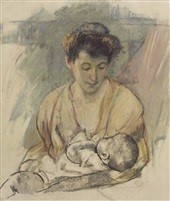
A new baby

by Mary Cassat

The life of all flesh is its blood … (Leviticus 17:14)

The blood, it is the life … (Deutereonomy 12:23)

The ancient Israelites identified blood with the animating force of life (nefesh, נֶפֶשׁ) in a person or animal. Some of the religious rules in the book of Leviticus address the fears that go with blood loss—fears that today are addressed by medical information.

This week’s Torah portion begins by establishing periods of isolation following childbirth, which causes women to bleed.

When a woman conceives and gives birth to a male, then tamei-ah for seven days; titema as in the days of the regulation about her menstruation. And on the eighth day the skin of his foreskin will be circumcised. Then for 33 days she will stay in bloodshed of purification; she may not touch anything holy, and she may not come into the holy place, until her days of purification have been filled. (Leviticus 12:2-4)

tamei-ah (טָמְאָה) = she has become ritually impure, excluded from religious rituals, desanctified. (A kal form of the verb tamei, טָמֵא = become ritually impure, which may be derived from the noun tamei, טָמֵא = someone or something that is ritually impure, desanctified, unsuitable for normal contact; “unclean” in old translations.)

titema (תִּטְמָא) = she has incurred ritual impurity. (A hitpael form of the verb tamei.)

The mother’s vaginal discharge is her “bloodshed of purification”: the natural release of elements used to nourish the fetus that are no longer needed. The process of purification is the mother’s transition from the state of pregnancy to the state in which she can once again engage in the sacred rituals of her religion. The number of days the woman must stay away from the sanctuary and all other sacred things is arbitrary, like the seven days of ritual impurity that Leviticus decrees for a menstrual period—regardless of whether the woman stops bleeding sooner.1

The first clue that the rule in the portion Tazria is not just about post-partum discharge is that the number of days before the mother is no longer tamei is different if her baby is a girl.

And if she gives birth to a female, then tamei-ah as in her menstrual period for a pair of weeks, and for 66 days she must stay in her bloodshed of purification. (Leviticus 12:5)

Post-partum bleeding normally lasts for four to fourteen days (followed by a scanty white discharge for several more weeks). This timeline might fit the 7+33 day period for the mother of a boy, but it does not fit the 14+66 day period for the mother of a girl.

And when the days of her purification for a son or for a daughter are filled, she shall bring a yearling lamb for a rising-offering and a dove or a turtle-dove for a reparation-offering to the entrance of the Tent of Meeting, to the priest. And he shall offer it in front of God and make atonement over her, and she will be purified from the source of her bloodshed. (Leviticus 12:6-7)

“Rising-offering” is my literal translation of olah (עֺלָה), in which the sacrificial animal is completely burned up into smoke. The usual purpose of a rising offering is to please God with the smell of the smoke; 2 it is required twice a day, to keep the smoke rising perpetually. Additional rising-offerings are made to observe holy days, and to bring individuals who have been isolated back into a normal relationship with God and their community—which is dedicated to perpetual service to God.

A “reparation-offering” or chatat (חַטָּאת), sometimes translated as a “sin-offering”, is usually brought to the altar in order to atone for unintentionally violating one of God’s rules.3 But giving birth is the opposite of a violation. After all, God keeps ordering humans to be fruitful and multiply!

However, the mother may feel guilty that for several weeks all her care and attention was focused on her newborn, rather than on God. A reparation-offering would reassure her that God pardons her for her period of distraction.

Perhaps the infant boy’s circumcision reminded the mother of her separation from her child, so she was prepared to return to her religious community sooner than if her baby was a girl. Either way, the Torah prescribes a fixed period of isolation from regular life, followed by a ceremony of reintegration.

In modern society the mothers—or other primary caregivers—of newborn infants have no rules for managing the transition to a new way of life, a life in which they must both care for a new person and maintain their previous roles in the community. It might be helpful today to establish a fixed time period when they are excused from all social obligations, followed by a ceremony of reentry.

Next week I will consider the Torah’s structure for dealing with a new diagnosis in Tazria & Metzora: Time to Learn, Part 2.

  1. Leviticus15:19-24.
  2. Leviticus 1:17. See my post Vayikra & Tzav: Fire Offerings Without Slaughter, Part 2.
  3. See Leviticus 4:27-31 and my post Vayikra & Tzav: Fire Offerings Without Slaughter, Part 2.

Shemini: Realities

Every day I explain to my 92-year-old mother why I moved her into assisted living near me. Every day she says she managed just fine living alone, and every day I remind her of serious problems that she ignored and then forgot about.

Sometimes I explain reality to her in person, sometimes over the phone. And she believes me—until she forgets what I said. I am touched that she trusts me now, and relieved that she has moved beyond her old habit of inventing her personal version of reality and defending it.

This week I am still solving problems and helping my mother unpack, so I do not have the quiet time I need to write a new blog post. But I have been thinking about this week’s Torah portion, Shemini, in which God creates a fire that sweeps out of the new tent-sanctuary and ignites the animal offerings on the altar. Immediately after this divine consecration of the altar, the high priest Aaron’s two older sons, Nadav and Avihu, bring their own incense into the tent-sanctuary. They, too, are immolated by divine fire.

Do they want to sacrifice themselves to God? Or do they ignore the plain evidence of God’s ferocious power, and stroll into the sanctuary without even asking Moses or Aaron if they are doing the right thing? Are they so swept away by their desire for divine union that they forget how dangerous God is? Or are they in denial about reality?

For more on the possible motivations of Nadav and Avihu, see my 2018 post: Shemini: Fire Meets Fire.

Relief on Purim

Two brown-eyed, gray-haired women are working hard to be pleasant and patient with one another as they achieve a difficult task: picking and packing items to move to a studio apartment in an assisted living residence.  The mother, age 92, is anxious about leaving her familiar home and going to a strange place. The daughter (me) is anxious about getting the packing done in time when her mother asks the same questions over and over, and takes hours to make decisions.

I give us both credit for rising above our anxiety and keeping our tempers.

By Wednesday evening, my mother will be in her new home. I hope both of us will feel relieved and glad about what we have achieved.

Wednesday evening is also Purim, the holiday when Jews read the book of Esther and turn life upside down. It’s a time for masks and unmasking, for outrageous skits based on the Esther story, for cross-dressing, for drinking, for eating hamantaschen cookies, for whooping it up. It’s a time to take a break from your anxieties and be glad.

I have no time to write anything new about the book of Esther now, but below are links to blog posts I wrote seven years ago concerning the journeys of the two heroes: Esther herself, and her uncle Mordecai. Between them, they save the Jews of Persia.

The Fall and Rise of Joseph, Daniel, and Esther: Part 1

The Fall and Rise of Joseph, Daniel, and Esther: Part 2

The Fall and Rise of Joseph, Daniel, and Esther: Part 3

The Fall and Rise of Joseph, Daniel, and Esther: Part 4

The Fall and Rise of Joseph, Daniel, and Esther: Part 5


Vayikra & Kedoshim: Guilty Speech

I thought that when the Jewish cycle of readings reached the book of Leviticus, I would be too busy moving my 92-year-old mother to write a post. I also thought there was nothing about the Ten Commandments in the book’s first Torah portion, Vayikra.

I was wrong on both counts. But next week the packing and moving begin!

The Third Commandment

The “Ten Commandments” appear both in Exodus (in the Torah portion Yitro) and Deuteronomy (in the portion Va-etchanan). The first commandment prohibits other gods, and the second prohibits idols. The third commandment reads:

You must not raise the name of Y-H-V-H, your God, for a worthless reason,1 since Y-H-V-H will not acquit anyone who raises [God’s] name for a worthless reason. (Exodus 20:7; Deuteronomy 5:11)

“Raising” the name of God means using God’s name in an oath, vow, or promise, according to the Talmud tractate Shevuot (“Oaths”). This tractate distinguishes two kinds of worthless oaths:

  • empty oaths that use God’s name to declare something true when it is either false or impossible;2 and
  • false oaths that use God’s name to make a promise that the speaker does not carry out.3

One Talmudic example of an empty oath is attaching God’s name to the declaration: “If I did not see a camel flying through the air!”4

Kedoshim: Any Name

Does the third commandment prohibit swearing by any of God’s names for a worthless reason, or only swearing by God’s four-letter personal name? The text is ambiguous. A command from God in the “holiness code” which appears later in the book of Leviticus in the portion Kedoshim elaborates:

Velo tishavu in my name for a falsehood; then you would profane the name of your God. (Leviticus 19:12)

velo tishavu (וְלֺא־תִשָּׁבְעוּ) = and you must not swear, vow, or pledge. (From the root verb shava.)

The author of Sifra, a commentary on Leviticus from early in the Talmudic period, wrote that the third commandment could be interpreted as forbidding a worthless use only of God’s personal name Y-H-V-H. Therefore the command in Kedoshim says “in my name” — any name that I have.5

According to this reasoning, the Torah tells us not to profane any name of God by misusing it. Yet people who are in the habit of swearing might argue that they are not demeaning God when they say something harmless.

A deceitful vow is unethical whether the speaker swears by God or not. But is it really so bad to use one of God’s names in an empty way?

Yes, according to both this week’s Torah portion, Vayikra, and the later portion Kedoshim.

Vayikra and Kedoshim: An Empty Oath

This week’s Torah portion lists the correct offerings to bring to the altar for various purposes, including two types of atonement for inadvertently disobeying God’s rules: a reparation-offering (chattat, חַטָּאת), and a guilt-offering (asham, אָשָׁם).6 The section on reparation-offerings specifically addresses a harmless or empty violation of the third commandment:

… Or a person tishava with the lips, to do evil or to do good—whatever a human [says] bishevuah—and it was hidden from him; and then he realizes that he is carrying guilt because of one of these [oaths]; then it shall be that he shall accept guilt for one of these, and he shall confess what he did wrong concerning it. (Leviticus 5:4-5)

tishava (תִשָׁבַע) = swears, vows, or pledges in God’s name. (A form of the verb shava, שׁבע = swore an oath, vowed, or pledged using God’s name.)

bishevuah (בִּשְׁבֻעָה) = in a oath or vow using God’s name. (Also from the root verb shava.)

In this case the person is guilty merely of misusing God’s name, even if the outcome is good. The text goes on to prescribe that after the person realizes what they said and confesses to using God’s name for a worthless reason, they must bring a female sheep or goat to the altar as a reparation-offering.

What needs to be repaired? Swearing a pointless or empty oath is like swearing a false oath in the portion Kedoshim; it “would profane the name of your God.” 12th-century commentator Ibn Ezra wrote:

“Now the one who is constantly swearing, although there is no need for him to do so publicly, desecrates the name of God without deriving any benefit from his act.7

This forbidden act is different from the ninth commandment, which prohibits a witness in court from affirming a falsehood. Violating the ninth commandment can harm another person. Violating the third commandment cannot harm God, but it does demean God.

Vayikra: A Compounding Oath

The section on guilt-offerings in this week’s Torah portion considers a case in which one person inadvertently takes or keeps the property of another, and then the perpetrator swears they did nothing wrong.

And it shall be when he does a misdeed and realizes his guilt, then he will restore the robbed item that he robbed, or the deposit that was deposited with him, or the lost item that he found, or anything that yishava about falsely. And he will make amends for it by its principal and a fifth of it in addition; he will give it at that time to the one whose it is, as compensation for guilt. (Leviticus 5:23-24)

yishava (יִשָּׁבַע) = he swears in God’s name. (Another form of the verb shava.)

This time the perpetrator must compensate the victim, and also bring a ram as a guilt-offering to God.

Vayikra: Forgiveness

And the priest will make atonement for him in front of God, and he will be pardoned for everything that he did to incur guilt. (Leviticus 5:26)

The third commandment says God will not acquit anyone who swears an empty or false vow in God’s name. Yet God’s instructions in Vayikra say that after making recompense and offering the appropriate animal to God, the perpetrator will be pardoned. In other words, although the person who swears falsely will not be declared innocent, that person may still be forgiven.

This week’s Torah portion sets out the requirements for forgiveness: perpetrators must realize what they did wrong, confess it, compensate their victims, and make a public offering to God.

This model for forgiveness from God can also work to get forgiveness from a human. Although some crimes seem unforgivable to us, we are generally willing to forgive people for committing lesser crimes or doing personal harm if they recognize what they did, apologize, provide whatever recompense is possible, and—if they violated a civil law—serve their sentence.

*

Although confession, apology, and forgiveness can be done all year round, Jews set aside the month of Elul (in the late summer or early fall) for searching our consciences, apologizing to our fellow humans, and accepting the apologies of others. After Elul ends, we confess our sins against God and beseech God for forgiveness on Yom Kippur.

I find that in real life, only some of the people who have harmed me apologize. I figure the others do not realize that they said anything wrong—but although I can pardon them for their ignorance, I do not fully forgive them in my heart.

This week’s Torah portion does not say what to do if someone transgresses inadvertently and does not realize it. But the portion Kedoshim, later in Leviticus, says:

You must not hate your brother in your heart; you must definitely reprove your comrade, and then  you will not carry guilt because of him. (Leviticus 19:17)

One standard interpretation of this directive is that you must alert your fellow human beings to the consequences of their bad behaviors, so they become motivated to change their ways. But perhaps it is also good to let people know what they did that hurt you, so they receive an opportunity to realize it and apologize to you.

I wonder if I will ever be both brave and thoughtful enough to provide this kind of information, gently, to someone I wish I could forgive?

  1. lashaveh (לַשָּׁוְא) = for a worthless reason; in emptiness or in falsehood. (The traditional English translation is “in vain”.)
  2. Talmud Bavli, Shevuot
  3. Talmud Bavli, Shevuot
  4. Talmud Bavli, Shevuot 29a, Mishna.
  5. Sifra is a commentary on Leviticus written in 250-350 C.E. that influenced the Talmud. This quote is from Sifra, Kedoshim, Section 2:6, translated in sefaria.org.
  6. See my post Vayikra & Tzav: Fire Offerings Without Slaughter, Part 2.
  7. Abraham ben Meir Ibn Ezra, translated in sefaria.org.

Pekudei, Yitro, & Ki Tisa: Not Like Other Gods

The Ten Commandments are delivered in thunder at Mount Sinai partway through the book of Exodus. As I wait to move my mother into assisted living (an example of obeying  the fifth commandment), I have been writing about how these famous directives play out in the rest of the book.

This week’s reading is the last Torah portion in Exodus, Pekudei, which confirms that the Israelites are finally on the right track about the first two commandments.  

*

The first two of the Ten Commandments in the Torah portion Yitro both warn the Israelites not to treat their God like other gods. By the end of the book of Exodus, they have succeeded—at least temporarily.

First Commandment

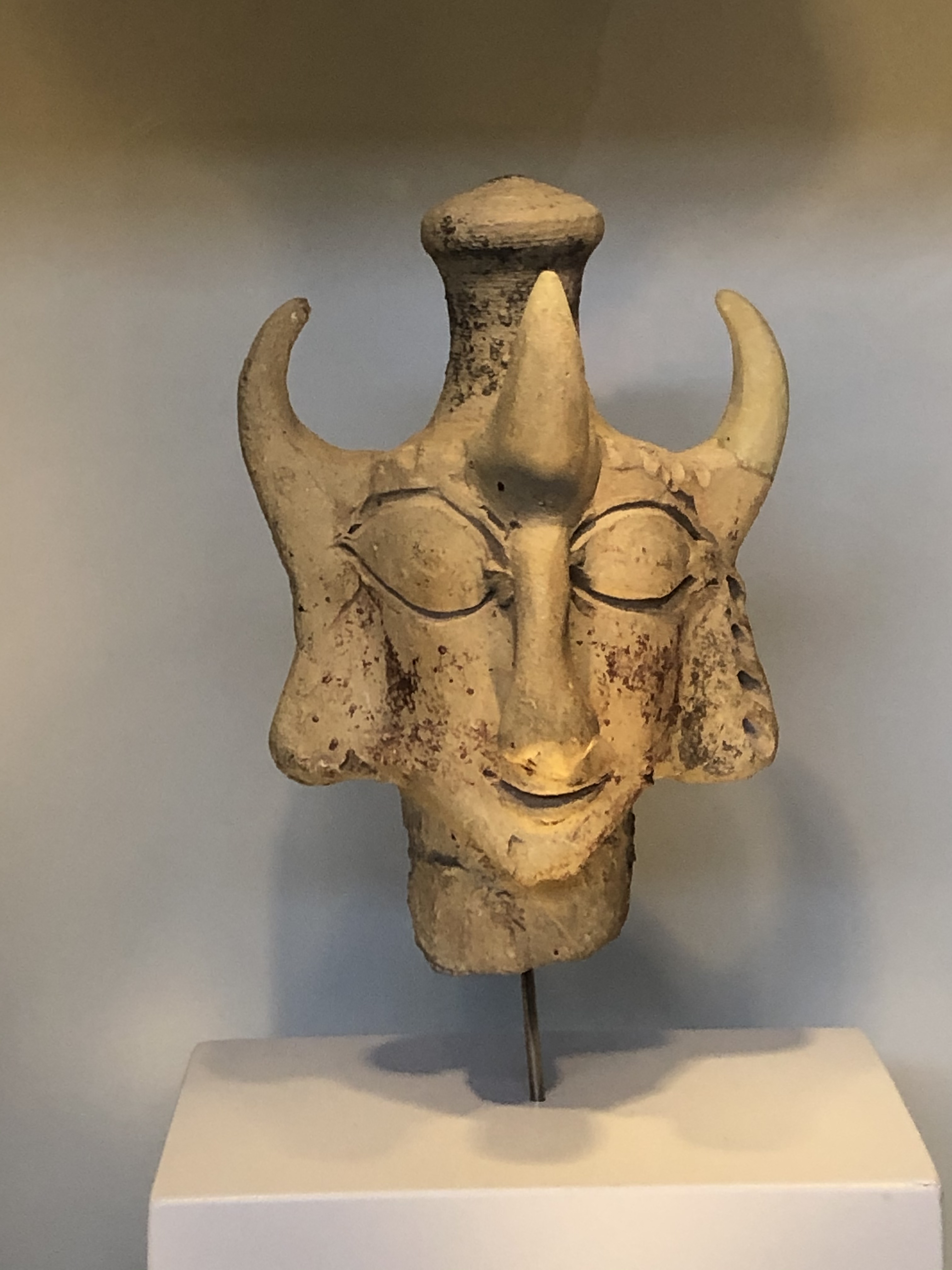
Edomite goddess, 7th-6th century BCE, Israel Museum (photo by M.C.)

I am Y-H-V-H, your God who brought you out of the land of Egypt, out of the house of slavery. You must have no other gods al panai. (Exodus 20:2-3)

al panai (עַל פָּּנָי) = over my face, above me, in front of me, in addition to me. (Panai is the first person singular possessive of panim, פָּּנִים = face, surface, self, presence.)

First God identifies “himself” in two ways:

  • as the god of the four-letter name that riffs on the verb for being and becoming,1 and
  • as the god who brought the Israelites out of slavery in Egypt with ten miraculous disasters.

Then God utters one of the following commands, depending on translation:

  • You must have no other gods above me.
  • You must have no other gods in addition to me.

It is not clear whether God wants to be considered the supreme god, or the only god.2 But the existence or non-existence of other gods is not the issue; the important point is that the God called Y-H-V-H is incomparable to any other god.3

Second Commandment

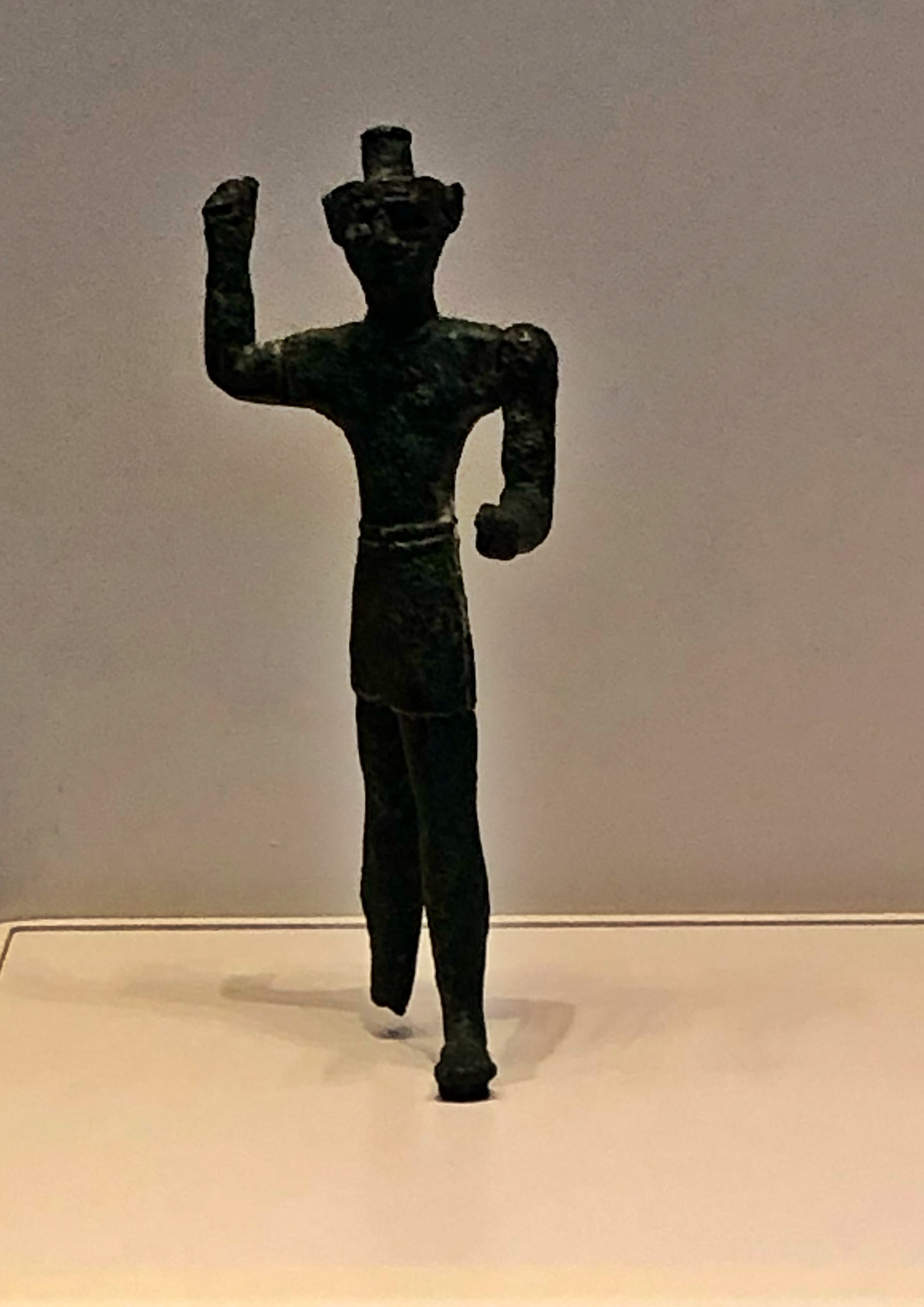
Idol of Hazor storm-god, 15th-13th century BCE, Israel Museum (photo by M.C.)

One way that the God of the Israelites is not like any other god is Y-H-V-H’s objection to being worshiped through an idol.

You must not make yourself a carved idol or any likeness of what is in the heavens above or what is on the earth below or what is in the waters below the earth. You must not bow down to them, and you must not serve them. Because I, Y-H-V-H, your God, am a jealous god … (Exodus 20:4-5)

Is God jealous of other gods? I think a better reading is that God is jealous of the privilege of manifesting only in sounds, earthquakes, and amorphous sights such as cloud and fire. Only other gods are willing to inhabit man-made idols.

A divine pillar of cloud by day and fire by night leads the Israelites from Egypt to Mount Sinai. Then in the Torah portion Ki Tisa the people panic about forty days after Moses has disappeared into the cloud or fire on top of the mountain. They tell Moses’ brother, Aaron:

“Get up! Make us a god that will go before us! Because this Moses, the man who brought us up from the land of Egypt, we do not know what has happened to him!” (Exodus 32:1)

So Aaron makes them an idol out of gold.4 The Israelites call the golden calf the god who brought them out of Egypt, and Aaron identifies it by God’s four-letter personal name, Y-H-V-H. They are not disobeying the first commandment and worshiping another god. Yet their God is furious.5

If the God of the Israelites were like other gods, Aaron’s only mistake would be making a golden calf instead of a golden bull. After all, a bull is more powerful than its juvenile offspring.

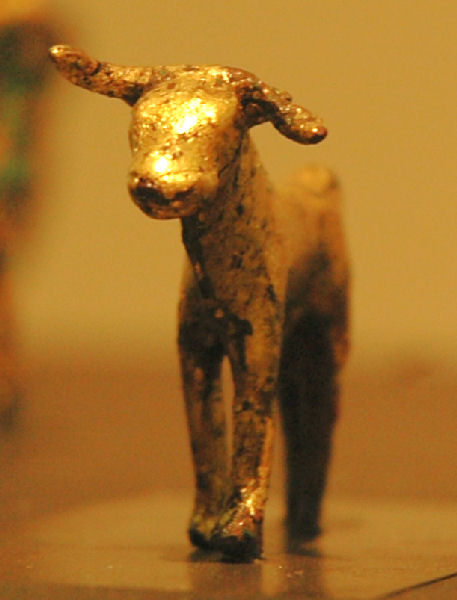
Gold calf from temple of Baalat in Byblos

Bulls represented Egyptian, Mesopotamian, and Canaanite gods. And 1 Kings 12:28-29 reports that golden “calves” were placed in the sanctuaries of Beit-El and Dan in the northern Kingdom of Israel. (They were probably bulls, which the southern kingdom of Judah belittled by calling them calves.)6

Most idols in the Ancient Near East were shaped like humans, animals, or fanciful hybrids. Archaeologists have found many small enough to hold in one hand. Neither Egyptians nor Mesopotamians nor Canaanites appear to have believed that the statues or figurines were gods. What they did believe was that gods could be enticed into temporarily inhabiting their idols. A god inhabiting a statue was easier to address with promises and bribes so it would act for your benefit.

The God of the Israelites, however, refuses to inhabit an idol. God cannot be represented by the shape of any physical object in the world because God has an entirely different, transcendent, kind of being.

In the first four portions of Exodus, God manifests as a voice coming from a burning bush, and as a moving pillar of cloud by day and fire by night.7 During the revelation at Mount Sinai, God manifests as thunder and shofar blasts, earthquake tremors, and lightning, fire, cloud, and smoke.8 The visible—but intangible and unbounded—manifestation of God as cloud and fire reappears in the portion Pekudei at the end of Exodus.

*

This gives the book of Exodus a happy ending. In the portion Ki Tisa, thousands of are punished with death for worshiping the golden calf. Then Moses tells the Israelites that God wants them to make a portable tent-sanctuary so God can dwell among them.9 The people eagerly donate materials and labor.

In this week’s portion, Pekudei, Moses assembles the tent and places the ark inside. Rising from the lid of the ark are two gold winged creatures called keruvim,10 but they are not considered idols, since God will speak from the empty space between the wings of the keruvim.

And Moses completed the work. Then the cloud covered the Tent of Meeting, and the kavod of God filled the dwelling-place. And Moses was not able to come into the Tent of Meeting because the cloud dwelled in it, and the kavod of God filled the dwelling-place. (Exodus 40:33-35)

kavod (כָּבוֹד, כָּבֺד) = weight, impressiveness, magnificence, glory, honor.

The cloud covering the tent looks like the pillar of cloud by day and fire by night that led the Israelites from Egypt to Mount Sinai.10  The kavod of God inside is not described.11 Nevertheless, the people can see that God is with them again.

The book of Exodus concludes with a summary the movements of the divine manifestation for the next 38 years:

Pillar of cloud over the sanctuary, Collectie Nederland

And when the cloud lifted from the dwelling-place, the Israelites pulled out on all their journeys. And if the cloud did not lift, then they did not pull out until the day it did lift. Because the cloud of God was above the dwelling-place by day, and it became fire by night, in the eyes of the whole house of Israel on all their journeys. (Exodus 40:36-38)

In other words, God’s pillar of cloud and fire returns to lead the Israelites from Mount Sinai to the land of Canaan. The people get what they need, a God who provides a visible sign to follow—without violating the second commandment.

May we all find ways to invite the divine spirit to be with us, without trying to contain and idolize that spirit through magical thinking.

  1. Also called the “tetragrammaton”. See my post Beshallach & Shemot: Knowing the Name.
  2. Jerome Segal, in his analysis of God’s psychology as presented in the Torah, wrote: “… it may be that God is happy to have the Israelites believe in multiple gods, as that makes it all the more significant that they worship only Yahweh.” (Jerome M. Segal, Joseph’s Bones, Riverhead Books/Penguin Group, New York, 2007, p. 223)
  3. 16th-century commentator Ovadiah Sforno imagined God explaining: “I cannot tolerate that someone who worships me worships also someone beside me. The reason is that there is absolutely no comparison between Me and any other phenomenon in the universe. I am therefore entitled to stand on My dignity by refusing to be compared.” (translation by http://www.sefaria.org)
  4. See my post Ki Tisa: Golden Calf, Stone Commandments.
  5. Exodus 32:4-5, 32:7-10.
  6. See Rami Arav, “The Golden Calf: Bull-El Worship”, https://www.thetorah.com/article/the-golden-calf-bull-el-worship.
  7. Exodus 32:4-5.
  8. Exodus 3:1-17, Exodus 13:20-22.
  9. Exodus 19:16-20. A shofar is a trumpet-like instrument made from the horn of a ram or goat.
  10. Exodus 35:4-38:20 (most of the Torah portion Vayakheil).
  11. See my post Terumah: Cherubs Are Not for Valentine’s Day.
  12. See my post Pekudei: Cloud of Glory.

Vayakheil+4: Not on Shabbat

“Hurry up and wait” describes a lot of life. Two weeks ago I was frantically getting ready to move my mother into assisted living. Now my effort to fulfill the Fifth Commandment and honor my mother is on hold until I get a moving date from the center—and wouldn’t you know it, she had another fall while she was alone in her house …

Talmud Readers, by Adolf Behrman, 1876-1943. What could be more absorbing?

I wish this period of waiting instead of doing labor were like the day of shabbat, the sabbath day of rest, but these days my soul is too heavy to rise to either refreshment or holiness. So this week I took my mind off my troubles by researching the commandment about shabbat. Here is a new post for this week’s Torah portion, Vayakheil—and four other portions in the book of Exodus, Beshallach, Yitro, Mishpatim, and Ki Tisa, that include variations on the command to desist from labor on the seventh day.

*

The first three of the Ten Commandments order us not to underestimate God.1 The last six are ethical precepts for human relations with other humans.2 In between, the fourth commandment combines holiness and ethics. It opens:

Remember the day of the shabbat, to treat it as holy. (Exodus 20:8) 3

shabbat (שַׁבַּת) = sabbath, day of rest. (From the same root as shavat, שָׁבַת = cease, stop, desist; stop working.)

This command is followed by explanatory notes in the Torah portion Yitro. More details are added every time the observance of shabbat is commanded in the book of Exodus—from the first time, in the portion Beshallach, when the Israelites are collecting manna, to the sixth time, in this week’s portion, Vayakheil, after God has given Moses a second set of tablets with the Ten Commandments carved in stone.

1) Don’t move

Manna Raining from Heaven, Maciejowski Bible, c. 1250 C.E.

Moses first mentions shabbat in the Torah portion Beshallach, when God provides manna for the hungry Israelites to gather up from the ground six, and only six, days a week. Moses says:

“See that God has given you the shabbat. Therefore on the sixth day [God] is giving you food for two days. Everyone in his place! No one go out from his spot on the seventh day!” (Exodus 16:29—Beshallach)

This introduces shabbat as a day of rest, at least in terms of going out and gathering food.

2) Holy break

The next order regarding shabbat is the one in the Ten Commandments in Yitro. The full fourth commandment states:

The Creation, by Lucas Cranach, 1534, Luther Bible

Remember the day of the shabbat, to make it holy. Six days you may work and you may do all your labor. But the seventh day is a shabbat for God, your God; you must not do any labor, you or your son or your daughter, your male slave or your female slave or your livestock or your immigrant within your gates. Because in six days God made the heavens and the earth and the sea and everything that is in them, and [God] took a break on the seventh day. Therefore God blessed the day of the shabbat and made it holy. (Exodus 20:8-11)

The emphasis in this commandment is on the holiness of shabbat. Since the day itself is holy, it must be set aside from mundane labor by all humans and animals in an Israelite’s household, and even by God.

3) Ethical refreshment

The third injunction about shabbat is in the portion Mishpatim:

Six days you may do your doings, but on the seventh day tishbot so that your ox and your donkey can take a break, veyinafeish, your slave and the immigrant. (Exodus 23:12)

tishbot (תּשְׁבֺּת) = you must cease, stop, stop working. (A form of the verb shavat.)

veyinafeish (וְיִנָּפֵשׁ) = and he can refresh himself, reanimate himself, catch his breath. (From the same root as nefesh, נֶפֶשׁ = throat, breath, appetite, mood, animating soul.)

This time Moses, speaking for God, gives a reason why even slaves, immigrants, and beasts must be given a day off from work on shabbat: so that draft animals can rest their muscles, and human laborers can rest their souls, becoming refreshed and revitalized.

Providing a day of rest is an ethical mandate; the moral principle of kindness calls for helping others to have a better life, and the moral principle of fairness supports giving everyone a day off when the landowner has a day off. Shabbat is the opposite of Pharaoh’s unethical subjection of the Israelite slaves to unremitting labor.4

4) Be holy or die

The fourth command about shabbat appears in the Torah portion Ki Tisa, after God finishes telling Moses what the Israelites must make to set up the sanctuary and the priests of their new religion. God warns that all of this construction must pause on the day of shabbat.

Nevertheless, you must observe shabtotai, because it is a sign between me and you for your generations, for knowledge that I, God, have made you holy. And you must observe the shabbat because it is holy for you. Whoever profanes it must definitely be put to death, because whoever does labor on it, his life will be cut off from among his people. (Exodus 31:12-14)

shabtotai (שַׁבְּתֺתַי) = my shabbats.

This order not only reiterates that shabbat is holy, but adds that observing it is a reminder that the Israelite people themselves are holy, i.e. set aside for God.

In addition, profaning shabbat by doing labor on that day is such a serious transgression that God assigns it the death penalty.

This rule about observing shabbat is the source text for the Talmud’s list of 39 categories of labor forbidden on the seventh day. The rabbis assume that since God warns that the work of building the sanctuary and fabricating the priests’ clothing must cease on shabbat, the labors involved in doing those tasks are the labors forbidden on shabbat from then on.5

This injunction in Ki Tisa continues:

The Israelites must observe the shabbat, doing the shabbat throughout their generations as a covenant forever. Between me and the Israelites it will be a sign forever, because for six days God make the heavens and the earth, and on the seventh day [God] shavat vayinafash. (Exodus 31:16-17)

vayinafash (וַיִּנָּפַשׁ) = and he refreshed himself, reanimated himself, caught his breath.   (A variant of veyinafeish.)

Since the divine life of the universe pauses every seven “days” for refreshment and redirection, so must our own souls. (See my earlier post,  Mishpatim, Ki Tisa, & 2 Samuel: Soul Recovery.)

5) No farming

Shabbat comes up again later in the portion Ki Tisa when God gives Moses additional instructions for the Israelites.

Six days you may work, but on the seventh day tishbot; at plowing and at grain-cutting tishbot. (Exodus 34:21)

The book of Exodus gives no reason why agricultural labor in particular is prohibited on shabbat. One possibility is that this sentence refers to the ethical law about shabbat in Mishpatim, since landowners used draft animals (oxen and donkeys) to plow, and teams of underlings including slaves and immigrants to scythe down ripe grain.

Sheaves of grain

On the other hand, the list in the Talmud of activities prohibited on shabbat includes farming chores that eventually lead to the bread that must be displayed on the gold-plated table in the sanctuary.6 The first eleven of the 39 prohibited labors in the Talmud are sowing grain, plowing, reaping, gathering sheaves, threshing, winnowing, selecting the edible kernels, grinding them into flour, sifting the flour, kneading dough, and baking bread. By this interpretation, the ban on plowing and reaping on shabbat might mean the holiness of the day surpasses the holiness of the sanctuary.

6) Light no fires

The sixth and final shabbat instruction in the book of Exodus occurs in this week’s Torah portion, Vayakheil. Again the seventh day is called holy, and doing labor on that day is punishable by death.

Six days you may do labor, but the seventh day must be holy for you, a shabbat shabbaton for God. Anyone who does labor on it must be put to death. You must not kindle a fire in any of your settlements on the day of shabbat. (Exodus 35:2-3)

shabbaton (שַׁבָּתוֹן) = most solemn shabbat, feast day of shabbat, day of absolute stopping.

Here Moses repeats God’s commands that the day of shabbat must be treated as holy and that anyone who does not desist from labor on that day must be executed.

The new information in Vayakheil is that lighting a fire is prohibited on shabbat. Before this, the only specific examples of labor forbidden on shabbat are agricultural: gathering manna, using draft animals, sowing and reaping . Now, in Vayakheil, Moses gives another example of labor: lighting a fire.

The purpose of this prohibition cannot be ethical, since lighting a fire is not in itself a heavy labor, and it benefits other humans by giving them heat, light, and a way to cook food.

Since the previous verse reminds us that the seventh day must be holy, refraining from kindling a fire must be another religious rule associated with holiness.

Kindling a fire is number 37 in the Talmud’s list of 39 labors banned on shabbat, right after extinguishing a fire. It may allude to the fire on the altar. Although burnt offerings continue during shabbat according to the Torah, the fire is not rekindled. In fact, it must never go out.7 The altar fire is holy because it is dedicated to God, and because God kindled it.8

*

Thus the book of Exodus presents the law against working on shabbat as a religious rule (guarding what is holy) three to five times.9 It presents the law as an ethical rule (promoting kindness and fairness) only twice.10

Yet when we observe the day of shabbat we can remember that it is not solely a religious requirement reminding us of holiness. We will not be put to death for doing forbidden work on shabbat, since that part of the order in this week’s Torah portion is no longer followed. But when we try to set aside mundane concerns in order to elevate our souls on the seventh day, we can also remember the ethical values in the last six commandments, which address kindness, fairness, and respect for other human beings.

And I can pray that soon I will be able to obey the fifth commandment, and treat my mother with kindness and respect by moving her into a safe place.

  1. See my upcoming post, Pekudei, Yitro, & Ki Tisa: Not Like Other Gods.
  2. See my posts Yitro, Mishpatin, & Va-etchanan: Relative or Relevant? Part 1, Part 2, and Part 3 on the last six commandments.
  3. This is the opening in Exodus. When Moses repeats the Ten Commandments in Deuteronomy, the fourth commandment opens: Observe the day of the shabbat and treat it as holy. (Deuteronomy 5:12)
  4. Exodus 5:1-9, 6:9.
  5. Talmud Bavli, Shabbat 73a, Mishna.
  6. Exodus 25:23-30.
  7. Leviticus 6:5-6.
  8. Leviticus 9:24 for the portable sanctuary in the wilderness.
  9. Exodus 16:29, 20:8 and 11, 31:12-13 at a minimum. According to the Talmud Exodus 34:21 and 35:2-3 are also rules for religious purposes.
  10. Exodus 20:9-10, 23:12.

Ki Tisa: Golden Calf, Stone Commandments

Mount Sinai, by Elijah Walton, 19th century

The Torah gives the Ten Commandments1 top priority out of all the rules and orders God gives to the Israelites through Moses. God utters them in the Torah portion Yitro after manifesting in smoke, fire, and thunder, and Moses tells the people what God said.

At the beginning of this week’s Torah portion, Ki Tisa, God engraves the Ten Commandments in stone.

Then [God] gave to Moses, as [God] finished speaking with him on Mount Sinai, the two tablets of the Testimony, stone tablets engraved by the finger of God. (Exodus/Shemot 31:18)

Aaron and the second commandment

While God is giving Moses the first pair of stone tablets, the Israelites at the foot of the mountain are losing hope that Moses will ever come back down. After they have waited for almost forty days, they tell Moses’ brother Aaron:

“Get up! Make us a god that will go before us! Because this Moses, the man who brought us up from the land of Egypt, we do not know what has happened to him!” (Exodus 32:1)

The people desperately want an intermediary between themselves and the invisible, remote, and terrifying God that Moses says has adopted them. Moses was a visible human being, and he could tell them what God wanted, so he was a satisfactory intermediary—until   he vanished into the cloud on top of Mount Sinai.2

Now the people demand a new intermediary. They know the “god” they ask Aaron to make could not speak, like Moses, but at least it would be visible and familiar, like the idols in Egypt.

Aaron is not only Moses’ older brother, but his second-in-command. Yet God has not yet spoken directly to him, and does not do so until Leviticus 10:8-11. The Israelites turn to Aaron as their default leader, but do not expect him to replace Moses as God’s prophet.

Aaron could ask the people to wait another day for Moses to return before taking any rash action. He could remind them of God’s second commandment, which Moses told them during the revelation at Sinai:

You must not make for yourself a statue or any likeness of what is in the heavens above or what is on the earth below or what is in the waters below the earth. You must not bow down to them, and you must not serve them … (Exodus 20:4-5)

He could frighten the people by predicting that their God would surely smite them all if they violated this commandment. But he does not.

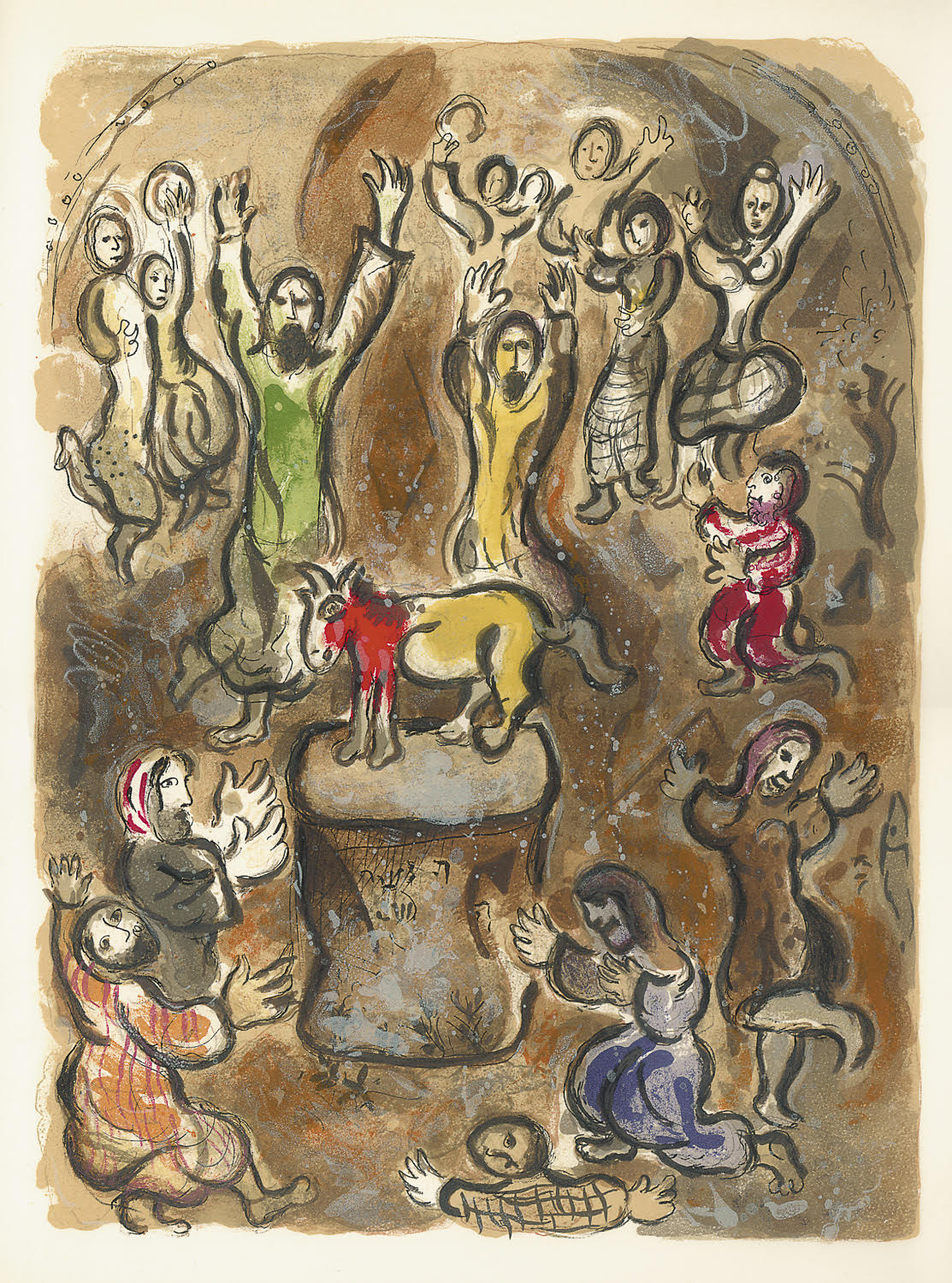
The Adoration of the Golden Calf, by Marc Chagall, 1966

Instead, Aaron asks the people to bring him their gold earrings, and casts the gold in the shape of a calf.

And they said: “This is your God, Israel, who brought you up from the land of Egypt!” And Aaron saw, and he built an altar in front of it. And Aaron made an announcement, and said: “Tomorrow is a festival for Y-H-V-H!” (Exodus 32:4-5)

Aaron uses the four-letter proper name of the God of Israel, so he is not violating the first commandment, “You must have no other gods before me.” But he is violating the second commandment, which prohibits making or worshiping an idol.

He has not had a chance to read the commandments on the stone tablets Moses is about to bring down from Mount Sinai. But he has heard Moses declare them. He cannot claim ignorance as an excuse.

Moses and the sixth commandment

The next day the Israelites make burnt offerings in front of the golden calf. By the time Moses reached the bottom of Mount Sinai, they are eating, drinking, and enjoying themselves.

Moses Breaking the Tablets of the Law, by Gustave Dore, 19th cent.

Moses smashes God’s stone tablets.3 Then he melts down the calf, grinds the gold into powder, mixes it with water, and makes the Israelites drink it. He questions his brother Aaron, who gives a feeble excuse, and Moses lets it pass.

Then Moses saw that the people were parua, because Aaron peraoh for a non-entity … (Exodus 32:25)

parua (פָּרֻעַ) = wild, out of control.

peraoh (פְּרָעֺה) = he let [them] get out of control.

Apparently after they have watched Moses melt the calf and grind its gold into dust, some of the Israelites feel wild agitation over losing their idol.

Then Moses stood in the gate of the camp and said: “Who is for Y-H-V-H? To me!” And all the Levite men gathered around him. And he said to them: “Thus says Y-H-V-H, the God of Israel: Every man, put his sword on his hip! Cross and return from gate to gate of the camp, and every man kill his brother and his fellow and his close relatives!” And the Levite men did as Moses spoke, and about 3,000 men of the people fell on that day. (Exodus 32:26-28)

Do the Levites violate the sixth commandment?

Lo tirtzach. (Exodus 20:13)

lo tirtzach (לֺא תִרְצָח) = you must not kill without a legal sanction. (From the verb ratzach, רָצַח.)

Other uses of the verb ratzach in the Torah indicate that this commandment only covers deliberate murder of a fellow Israelite. (See my post Yitro, Mishpatim, & Va-etchanan: Relative or Relevant? Part 1.) God does not prohibit causing accidental death, executing someone who was given the death penalty, or killing the enemy in war. But the Levites deliberately kill fellow Israelites who have not been tried in court with witnesses and sentenced to death.

If each Levite man were individually choosing a fellow Israelite to kill (presumably one who is still parua after the golden calf fiasco), then he would be violating the sixth commandment. But the Levites have to sweep through the camp and back with lightning speed before the other Israelites either escape or fight back. They do not have time to pause and identify who they are killing.

Individual Levite men make one conscious choice: Moses calls out “Who is for God? To me!” and they gather around him. After that they simply obey his orders in the name of God. If Moses had not announced that God wanted them to run through the camp killing people, the Levites would not have taken up their swords.

Bronze Age Short Sword

Moses bears the primary responsibility for the massacre. Does he merely pass on God’s orders word-for-word? Not according to Rashi,4 who wrote that Moses’ order to the Levites was based on an earlier order from God:

“Whoever offers a slaughter-sacrifice to any god except Y-H-V-H alone will be dedicated to destruction.” (Exodus 22:19).

This law in the Torah portion Mishpatim is an elaboration of the second commandment.

Moses might be applying God’s ruling in Mishpatim when he says God wants the Levite men to run through the camp killing people. Or he might be speaking impulsively in a potentially dangerous moment, based on God’s outrage over the golden calf worship, and perhaps a sense that God continues to feel outrage.

What he does not do is pronounce death penalties on about 3,000 men and ask the Levites to execute them. Moses is the chief judge for all the Israelites,5 so he certainly has the legal authority to pronounce death penalties. However, in the Torah a judge rules on individual cases, and only after hearing the testimony of witnesses concerning the accused. Moses asks only Aaron for information about his role in the golden calf fiasco. He calls no witnesses, and pronounces no individual sentences.

Moses violates the sixth commandment by ordering the men of his tribe, the Levites, to murder Israelites without the proper legal sanction. Does he at least achieve what God wants?

The primary effect of the Levites’ lightning-strike massacre would be shock and fear—which might be just what Moses intends. Fear may not be the best motivator for long-term obedience, but it does work in the short run, and Moses and God use it repeatedly in the Torah. The shattering of the stone tablets and the destruction and consumption of the golden calf are not enough to frighten all the Israelites into obedience, but the massacre by the Levites does the trick.

The next day, Moses asks God to forgive the Israelites for the sin of the golden calf. But apparently God is not fully satisfied with the results of the massacre.

And Y-H-V-H said to Moses: “Whoever has offended against me, I will wipe out from my record … and on the day of my accounting, I will bring them to account for their offenses.” And God struck a blow against the people over what they did with the calf that Aaron made. (Exodus 32:33-35)

Classic commentators6 interpreted God’s blow as a plague of disease that killed a particular group of golden calf worshippers who were still alive after the massacre by the Levites.


Neither Aaron nor Moses is punished for his violation of one of the Ten Commandments. Moses says in Deuteronomy 9:20 that he prayed for his brother Aaron, and God forgave him. Moses’ good relationship with God continues; in the remainder of the portion Ki Tisa, Moses asks God to resume leading the people in person (presumably as the pillar of cloud and fire) and God agrees. Then God tells Moses:

“Carve yourself two stone tablets like the first ones, and I will engrave upon the tablets the words that were on the first tablets, which you shattered.” (Exodus 34:1)

Moses climbs Mount Sinai again, carrying blank tablets, and God engraves them with the same ten commandments. Perhaps this shows that God both forgave Moses and reaffirmed that the Ten Commandments as fundamental precepts.

Or perhaps this shows that God plays favorites, approving of the death of thousands of Israelites because they worshiped an idol, but preserving the lives of his two darlings, Moses and Aaron.


  1. What we call “the Ten Commandments” in English are ten “statements” in the bible. Exodus introduces the ten with “And God spoke all these ” (Exodus 20:1) Devarim, דְּבָרִים = words, statements, things. Moses repeats them in Deuteronomy 5:6-18, then concludes: “These devarim God spoke to your whole congregation at the mountain, in a great voice from the midst of the fire and the cloud and the gloom, and … engraved them on two stone tablets.” (Deuteronomy 5:19)
  2. Exodus 24:15-18.
  3. Exodus 32:15-19.
  4. Rashi is the acronym of 11th-century Rabbi Shlomo Yitzchaki.
  5. Exodus 18:13-26.
  6. Including Rashi, Ibn Ezra (12th-century commentator Abraham ben Meir Ibn Ezra), and Ramban (13th-century Rabbi Moses ben Nachman).
  7. In Leviticus 10:1-3.

Taking the Fifth

Doing what I love includes writing about the Torah. Doing what I must includes honoring my mother (the fifth of the Ten Commandments) by moving her into assisted living so she can get the help she needs.

This heroic labor means that I will have little time for my blog over the next few weeks. I started working on a new essay for next week’s Torah portion, Ki Tisa, and I hope I can squeeze in enough writing time to finish it soon. Meanwhile, I will send out links to earlier posts every week until my mother is safe and settled.

If you want to read one of my earlier posts about this week’s potion, Tetzaveh, you can click on this link: Tetzaveh & Psalms 141, 51, and 40: Smoke and Prayer.

Or go to “POSTS BY TORAH PORTION OR BOOK” in the sidebar on the right side of this page, click the down-arrow next to CATEGORIES, and navigate to any previous post you want to read … while I am being a mother to my mother.

Mother and Child, by Mary Cassat


Yitro, Mishpatim, and Va-etchanan: Relative or Relevant? Part 3

Ten Commandments by Jekuthiel Sofer, 1768

Universal ethical principles are relevant in all places and times. While the first four of the Ten Commandments1 are religious injunctions rather than universal ethical rules, the last six are sometimes considered universal.

In my last two blog posts I discussed commandments five through eight,2 and suggested that the following versions would be more comprehensively relevant:

  1. Parents must respect their children, and children must respect their parents. (To replace “Honor your father and your mother.”)
  2. You must not kill except to prevent someone from being killed. (To replace “You must not kill-without-a-legal-sanction.”)
  3. You must not break a vow to another person without formally dissolving it first. (To replace “You must not commit adultery-between-a-man-and a married-woman.”)
  4. You must not covertly take what rightfully belongs to another. (To replace “You must not steal.”)

What about commandments nine and ten, on false testimony and coveting? Are they morally relative, guides to good behavior only within Ancient Israelite culture? Are they moral absolutes? Or do they, too, need some revision to become universal ethical precepts?

*

The Ninth Commandment

Witness stand, by Ida Libby Dengrove

Lo ta-aneh against your fellow [as] a witness to a falsehood. (Exodus/Shemot 20:13)

lo ta-aneh (ֺלֺא תַעֲנֶה) = you must not answer, testify; stoop.

Like the previous four commandments, the ninth is followed by more specific statutes in Mishpatim, last week’s Torah portion.

You must not take up an empty rumor. You shall not put in your hand with the wicked to become a malicious witness. (Exodus 23:1)

In other words, ethical witnesses in a court of law must testify only to what they have perceived with their own senses, discounting anything they have heard that might be a rumor, and ignoring what other witnesses say. (In Torah law, a person cannot be convicted without the testimony of at least two witnesses.3)

You must not follow rabim for evil, and lo ta-aneh on a legal dispute to turn aside [and] follow the majority4 to mislead. (Exodus 23:2)

Using that definition, this law specifies that a witness must not support popular sentiment against the defendant by making misleading statements.

Ibn Ezra pointed out that even a large number of witnesses can be wrong: “Thou shalt not follow a multitude to do evil. If you see many people testifying concerning something that you know nothing of, do not say to yourself all of these people cannot be lying.”5

The book of Exodus continues by warning witnesses not to give misleading testimony in order to help out the poor.6

And you must not favor the powerless in his legal dispute. (Exodus 23:3)

Kindness to the poor is an important moral value in the Torah,7 but when someone is being tried for a crime, honesty is more important.

Is honesty always the best policy? Many cultures consider a “white lie” harmless and even ethical when it is used to avoid hurting someone’s feelings and has no negative consequences. A “white lie” might include rejecting an invitation by falsely saying you are busy that night, or complimenting someone on a new haircut that you actually think is ugly.

The ninth commandment only addresses giving honest testimony as a witness. But is honesty always the best, most ethical policy when you are testifying to legal authorities? What if you live in a society that punishes the crime of shoplifting with death or the loss of a hand, and you hold the conviction that this punishment is unethical? Should you tell a falsehood?

Your society would consider it ethical to report everything you saw the shoplifter do. But if your own belief is morally better, complete honesty as a witness cannot be a universal ethical precept.

However, the ninth commandment only says: You must not testify against your fellow as a witness to a falsehood. It does not require full disclosure in a morally difficult situation, but only prohibits lying when a falsehood could result in conviction and punishment of an innocent person.

This strict interpretation of the ninth commandment is relevant in all cultures. It could even be rephrased to cover situations outside of court, and remain a universal principle:

You must not speak falsehood that might cause harm to another.

The Tenth Commandment

The other nine commandments all forbid or require certain actions. (Commandment five, “Honor your father and your mother”, requires certain actions rather than an internal feeling of honor or respect. See my post Yitro, Mishpatim, and Va-etchanan: Relative or Relevant? Part 1.) At first glance, the final commandment seems to be forbidding a feeling rather than an action.

Thou Shalt Not Covet Thy Neighbor’s House, postcard by The Rose Co., 1908

Lo tachmod your fellow’s house; lo tachmod your fellow’s wife, or his male slave, or his female slave, or his bull, or his donkey, or anything that belongs to your fellow. (Exodus 20:14)

lo tachmod (לֺא תַחְמֺד) = you must not covet, crave, desire to possess. (From the root verb chamad, חָמַד = desired and tried to acquire, coveted, craved.)

Although many of the other commandments are elaborated by statutes given in the Torah portion Mishpatim, no laws in Mishpatim refer to coveting or craving.8

Another way to determine the meaning of the tenth commandment is to look at how the verb chamad is used elsewhere in the Hebrew Bible.9 In ten of the twenty occurrences of the verb chamad, it is connected with taking possession of the thing coveted. Therefore some commentary has interpreted the tenth commandment as prohibiting robbery, under the assumption that coveting inevitably leads to an attempt to steal by force.10

The repetition of the tenth commandment in the book of Deuteronomy is worded slightly differently, putting another man’s wife first, and using a synonym to prohibit an unhealthy desire for any other possessions:

And lo tachmod your fellow’s wife, and lo titaveh your fellow’s house, his field, or his male slave, or his female slave or his bull, or his donkey, or anything that belongs to your fellow. (Deuteronomy/Devarim 5:18)

lo titaveh (לֺא תִתְאַוֶּה) = you must not crave. (A form of the verb aveh, אוּה = craved, longed for.)

Why does Deuteronomy use the verb chamad only for coveting someone else’s wife, and the verb aveh for everything else? The Mekhilta d’Rabbi Yishmael claims that craving leads to coveting, and coveting leads to robbing.11 Certainly the verb aveh indicates a visceral desire; out of the 27 times it appears in the Hebrew Bible, thirteen are about craving a particular food or drink.12

But why does the tenth commandment prohibit coveting rather than the action that follows it, the attempt to take by force? I suspect that the Torah is distinguishing between taking a fellow Israelite’s possessions when one is obsessed with desire, from taking foreigners’ possessions when one is authorized to do so in war. The Torah is full of commands to the Israelites to strip the Canaanites of all their possessions as they conquer the land. Other rules in the Torah discuss the correct ways of taking booty in battles with other countries. This is not the kind of robbing the Torah would include in the Ten Commandments.

Those who covet what belongs to others also harm themselves; envious obsession does not make for a happy life.  But is it possible to legislate feelings?

Yes, according to 11th-century commentator Abraham ben Meir Ibn Ezra. He wrote that just as a man does not desire to sleep with his mother, although she be beautiful, because he has been trained from his childhood to know that she is prohibited to him,” sensible people may notice that certain people or things owned by others are desirable, but they dismiss any covetous thoughts about possessions that are obviously off-limits.13

The remaining question is why the tenth commandment prohibits a feeling, when the other nine commandments prohibit or require an action.

While classic commentary claims that the tenth commandment really prohibits the act of robbery, I would argue that this final commandment caps the Decalogue by implying that obsessive thoughts about illegal deeds can lead to everything the Torah considers evil, from worshiping other gods (Commandment 1) to murder (6), adultery (7), and theft (8). Failing to honor one’s parents (5) could be the result of nursing resentment against them for their own bad deeds, and giving false testimony (9) could be the result of a consuming desire for popularity in the crowd that is accusing the defendant.

Therefore an appropriate update of the tenth commandment could be simply:

You must not covet anything that belongs to another person.

An alternative that encompasses a wider range of negative obsessions is:

You must not dwell on desires that would cause harm to others.

  1. The “Ten Commandments” is the popular English designation for the ten precepts God utters at Mount Sinai, listed in both Exodus 20:2-14 (in the Torah portion Yitro) and Deuteronomy 5:6-18 (in Va-etchanan).
  2. See Yitro, Mishpatim, and Va-etchanan: Relative or Relevant? Part 1 and Part 2.
  3. At least two witnesses are required for conviction in a legal case according to Deuteronomy 17:6, 19:15.
  4. Many English verstions of Exodus 23:2 including the standard JPS (Jewish Publication Society) translation, interpret the word rabim (רַבִּים) as the wealthy, even though its usual meaning is “the many”. But the Talmud, Rashi, and at least two careful modern translations interpret rabim as the many or the majority.4 Talmud Bavli, Bava Metzia 59b, Chullin 11a, Sanhedrin 2a. Rashi on 23:2. Robert Alter, The Five Books of Moses, W.W. Norton & Co., New York, 2004, p. 448. Everett Fox, The Five Books of Moses, Schocken Books, New York, 1983, p. 383.
  5. 17th-century commentator Abraham ben Meir Ibn Ezra, translated in sefaria.org.
  6. Exodus 23:6-8 instructs judges not to bend the truth to help or harm the poor, as well as to reject bribes—presumably from the wealthy. Also see Leviticus 19:15.
  7. g. Exodus 22:20-26 in the Torah portion Mishpatim, which also reiterates the commandment against favoring the poor in a legal case (Exodus 23:3).
  8. The laws in Mishpatim on theft (Exodus 21:37-22:3 and 22:6-8) are more closely related to the eighth commandment, “You must not steal”, and are covered in my post Yitro, Mishpatim, and Va-etchanan: Relative or Relevant? Part 2.
  9. See Leonard Greenspoon, “Do Not Covet: Is It a Feeling or an Action?”, https://www.thetorah.com/article/do-not-covet-is-it-a-feeling-or-an-action.
  10. The proof text given in Mekhilta d’Rabbi Yishmael 20:14:1-3 (2nd-3rd century C.E.) and other early commentaries is Micah 2:1-2. This line of reasoning considers the eighth commandment, “You must not steal”, a prohibition against kidnapping a man who is not the property of anyone else. (E.g. Sanhedrin 86a).
  11. Mekhilta d’Rabbi Yishmael 20:14:1-3, from sefaria.org.
  12. Numbers 11:4, 11:34, and 34:10; Deuteronomy 12:20 and 14:26; 1 Samuel 2:16; 2 Samuel 23:15 and 1 Chronicles 11:17; Micah 7:1; Psalm 106:13-14; Proverbs 23:3 and 23:6.
  13. Translation of Ibn Ezra in sefaria.org.