Psalm 127: Anxiety and Security

Vigilance can be contemplative, as when one keeps a vigil.  Or vigilance can be stressful, as when one keeps watch for the least sign of trouble, afraid to blink.
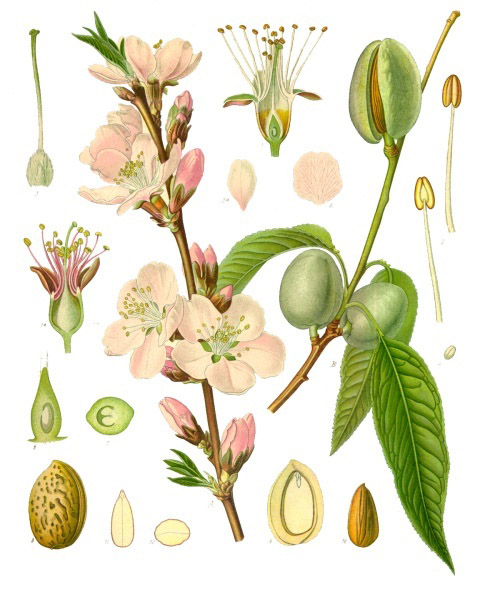
Parts of an almond tree

In last week’s post, Terumah: Tree of Light, I explored how the Hebrew word shakad (שָׁקַד) has two different meanings: “it was like an almond”, and “he was vigilant”.  In the Hebrew Bible, some words based on shakad describe how the menorah is made like parts of an almond tree.1   Others refer to God’s vigilant attention to the Israelites,2 human vigilant alertness for chances to do evil,3 a leopard watching vigilantly for someone to leave a town and become its prey,4 and people who stay awake and alert at night.5  One appearance of shakad that refers to staying alert at night is in Psalm 127:1.

This week I noticed that Psalm 127 as a whole is a meditation on the anxiety of vigilance and the serenity of acceptance.

Humans are easily gripped by anxiety.  In simple situations, a bit of anxiety can be helpful, motivating a person to take action against a threat, or to create a more secure life.  But continuous anxiety, like continuous suffering, damages both one’s physical health and one’s ability to make good decisions.

Psalm 127 begins with three different examples of how we cannot guarantee our own security, no matter how much we do.  Knowing this makes humans anxious.  How can we find serenity despite our insecurity?  According to Psalm 127, the answer is God.

(A song of ascents for Solomon.)

          Unless God builds a bayit

                        In vain do its builders labor.

          Unless God watches over a city

                        In vain is the watchman shakad. (Psalm 127:1)

bayit (בַּיִת) = house, home, household; temple.

Psalm 127 is dedicated to King Solomon, who built the first Israelite temple in Jerusalem.  He implication is that despite all the fine materials and the labor by both willing craftsmen and temporary slaves (corvée labor), the temple could not have become a home for God if God had not chosen to dwell there—or had not been welcomed into the hearts of the people.

The word bayit also means a physical house providing protection from the weather, wild beasts, and enemies; a home providing a place to rest in comfort and security; and a household or family providing mutual support.

City of Megiddo

A walled city also provided protection, security, and mutual support for its residents.  Its watchmen served as guards to sound the alarm if they saw anything threatening.  Today nation-states are supposed to fill the function of ancient cities, protecting their residents from external attack and internal crime, and providing systems for mutual aid and support.

The point of the first verse is that no matter how hard we work to achieve security, we cannot guarantee it.  A house with locks and alarms and bars over the windows might still be smashed by a bomb or an earthquake; while setting the locks and alarms and seeing the bars help to keep the inhabitants in a state of useless anxiety.  A nation with walls and guards on its borders, and X-ray machines in its airports, is still not safe from its own natives (especially when they are armed); while talking about “homeland security” generates more useless anxiety.

Real security comes not from anxious labor, but from a different state of mind, which this psalm attributes to God.

*

The next verse of Psalm 127 remains a puzzle for translators and commentators.

          In vain you rise early

                        And stop to sit late,

          Eating the bread of suffering;

                        Indeed [God] gives “his” beloved ones sheina.  (Psalm 127:2)

sheina (שֵׁנָא) = ?  (The usual translation of sheina here is “sleep”, but the word is a hapax legomenon, i.e. it occurs only once in the entire bible.  This translation is based on the word sheinah (שֵׁנָה) = sleep, which occurs 22 times.  Perhaps sheina in Psalm 127 is merely a misspelling.  On the other hand, sheina could be related to shena (שְׁנָא) = changed, altered.)

The psalm’s reference to eating “the bread of suffering” alludes to the story of the Garden of Eden.  There God tells Adam:

“… accursed is the earth on account of you; in suffering you shall eat from it all the days of your life.  Thorns and thistles it will sprout for you…  By the sweat of your face you will eat bread …”  (Genesis 3:17-19).

Psalm 127 suggests that even if people get up early and toil away at agriculture, only sitting down late in the day, their labor might still be in vain, unless God sends the right weather for their crops.  Yet those whom God loves have a different attitude.  They work, but they also rest—perhaps because God helps them to change.  They no longer suffer anxiety about their crops, since they find security in their own relationship with God.6

In the Garden of Eden story, God also predicts that Eve will suffer as she labors to bear children:

To the woman [God] said: “I will certainly multiply your suffering and your pregnancies; in suffering you will bear children …”  (Genesis 3:16) 7

*

The third verse of Psalm 127 points out that childbirth can be viewed either as a hardship or as a reward.

          Hey, an inheritance from God is sons;

                        A reward is the fruit of the womb.  (Psalm 127:3)

It takes more than the two parents to make a baby.  In the Torah, God is responsible for opening and closing wombs, i.e. making pregnancy possible.8
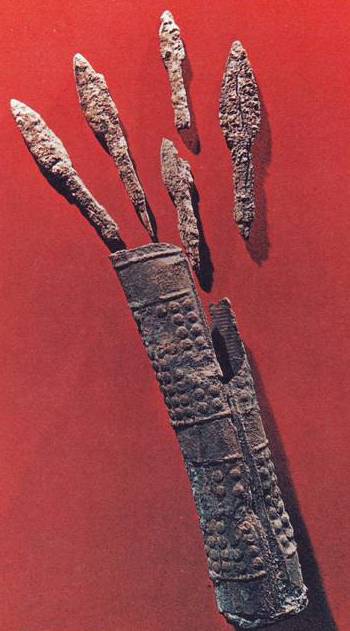
Quiver & arrowheads
16th century BCE

The praise of having children continues from the male point of view.

          Like arrows in the hand of a warrior

                      So are the sons of youth.

          Fortunate is the man

                    Who fills his quiver with them.

          They will not be shamed

                    When they speak to enemies in the gate.  (127:4-5)

These last two verses offer a resolution of the first verse.  If you want to build a household (one meaning of bayit), you will labor in vain unless God lets you have a son.  In ancient Israel and Judah, the head of a household was a man, who acquired a wife (or wives), children, and servants.  His household was worthless without at least one son to inherit his land, livestock, and/or business.  Sons could also defend his property if he were attacked.9  So a literal interpretation of the opening and closing of Psalm 127 is:

          Unless God builds a household,

                      In vain do its builders labor …

          Unless God opens a womb,

                      In vain does a man seek security.

*

An interpretation of Psalm 127 for our own time might be:

         Unless we see God in each other,

                        In vain does our household exist.

          Unless we want friends more than walls,

                      In vain do we watch out for foes.  (127:1)

          Unless we change suffering to love,

                      In vain do we work for our bread.  (127:2)

            From God we inherit our world;

                      The fruit of each womb is a gift.  (127:3)

            Fortunate is the human who learns

                      How to speak to an enemy in the gate.

            Accept what life brings with a full heart,

                      And you will not be insecure.  (127:4-5)

  1. Exodus 25:33-34, 37:19-20.
  2. Jeremiah 31:28, Jeremiah 44:27, Daniel 9:14.
  3. Isaiah 29:20.
  4. Jeremiah 5:6.
  5. Psalm 102:8, Psalm 127:1, Job 21:32.
  6. “An ordinary person, once he becomes aware of this inadequacy of all human endeavor, will worry without cease; he will be driven to overtax his energies; he will lose rest and sleep, and he will be unable to enjoy the very bread he eats. But it is through this same knowledge of inadequacy of all human effort that he who is aware of God’s tender love, of His friendship, as it were (ידיד is passive, i.e., ‘beloved’), will acquire that serenity which will enable him to sleep in peace.”  (Samson Raphael Hirsch, The Hirsch Tehillim, translated by Gertrude Hirschler, Feldheim Publishers, New York, 2014, pp. 1049-1050.)  Hirsch was a 19th-century Orthodox rabbi.
  7. The Hebrew words I translate as “suffering”—atzavim (עֲצָבִים) in Psalm 127:2, itzavon (עִצָּבוֹן) in Genesis 3:16 and 3:17, and etzev (עֶצֶב) in Genesis 3:16 all mean “suffering, hardship, pain, distress”. All three words come from the same root verb, atzav (עָצַב), which means “caused suffering or pain” in the kal form, and “felt distressed, anxious” in the nifil form.
  8. The belief that only God opens or closes a woman’s womb appears in Genesis 29:31, 30:2, and 30:22; and 1 Samuel 1:5-6.
  9. “The man who begets many sons in his youth creates the equivalent of a little army on which he can depend. In the social structure of ancient Israel, this may not have been an entirely fanciful notion.”  (Robert Alter, The Book of Psalms, W. Norton & Co., New York, 2007, p. 450)
Kohelet: Is Life Meaningless?

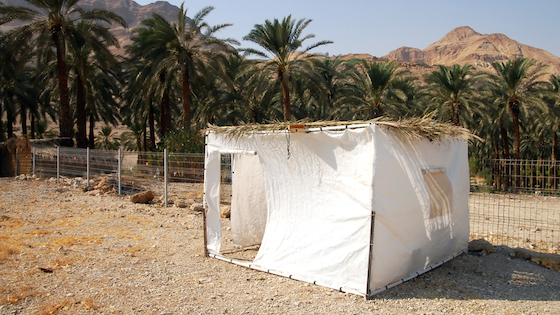
Modern sukkah in Israel

During the Jewish week of Sukkot, which began on Wednesday evening, the traditional reading is the book of Ecclesiastes/Kohelet. Sukkot is called zeman simchateynu, the “time of our rejoicing”. In the Torah Sukkot celebrates the harvest of autumn fruits (grapes, figs, pomegranates, and olives), and the people live in fragile temporary shelters called sukkot. Today Jews still erect and decorate sukkot and hold rituals and meals inside them.

Modern sukkah in America

Although these huts only last for a week, we rejoice inside them. The author of the book of Kohelet (“Assembler” or “Assemblyman”1), on the other hand, seems to be depressed.

The famous opening of the book in the King James Bible translation includes “Vanity of vanities; all is vanity.”

The word “vanity” here means doing something in vain, i.e. with no resulting change. Futility is is indeed one possible translation of the Hebrew word haveil.

Haveil havalim, said the Assembler.

          Haveil havalim! Everything is havel. (Kohelet 1:2)

haveil (הֲבֵל), havel (הָבֶל), hevel (הֶבֶל) = (noun) puff of air, vapor; (adjective) evanescent, futile, absurd. (Also the name of Adam and Eve’s second son, called “Abel” in English. See my post Bereishit: Fairness and Free Will.)

havalim (הֲבָלִים) = plural of haveil. In biblical Hebrew, a plural noun immediately following the same noun in the singular noun is an intensive.  Thus haveil havalim means utterly evanescent, utterly futile, or utterly absurd, though it can also be translated as “futility of futilities”.

The poetic introduction of the book of Kohelet describes how the cycles of nature never change; the sun keeps rising and setting, the wind keeps going around, water flows down to the sea and then returns to its sources.

What will happen has happened before

            and what is done has been done before.

And there is nothing new under the sun.  (Kohelet 1:9)

After the introductory poem, the writer uses an exclamation that becomes a refrain throughout the book:

Everything is hevel and herding ruach! (Kohelet 1:14)

ruach (רוּהַ) = wind; spirit; mood.

In a world of futility and absurdity, trying to achieve anything is like trying to herd the wind.

The rest of the book reports the writer’s fruitless attempts to find meaning in life despite the fact that everything in this world, “under the sun”, is hevel.  Chapter 2 points out that no matter how much you achieve, no matter how much luxury or wisdom you acquire, you still die, and whoever inherits from you also dies.

Chapter 3 starts with the famous poem beginning:

For everything there is a season

            and a time for every business under heaven:

A time to be born

            and a time to die… (Kohelet 3:1-2)

Humans also follow natural cycles, making no progress and doing nothing truly new. God has determined everything, according to Kohelet, and humans die just as beasts do.

Everything goes to one place; everything comes from the dust and returns to the dust. Who knows if the ruach of a human rises to [what is] above, and the ruach of the beast goes down [what is] below, to the earth? (Kohelet 3:20-21)

Judging by the rest of the book, the writer does not believe the spirit (ruach) of any human rises to another life after death. Death is simply an ending, and it usually comes before the person has had enough of life.

Yet life, according to Kohelet, is depressing. The author points out the inevitability of oppression, evil, envy, and folly.2 Wealth may disappear, and power is no good because every boss is at the mercy of a superior, and even the king is at the mercy of the crops of the land.3  God might grant someone every desire, along with wealth, possessions, honor, 100 children, and a long life, but that person will still die before being sated with good things; we can never live long enough.4 God makes good and bad things happen; humans have little effect.5

Here is hevel that is done on the earth: that there are righteous ones who God treats as if their deeds were like those of the wicked, and there are wicked ones who God treats as if their deeds were like those of the righteous. I say that this, too, is havel. (Kohelet 8:14)

Life is absurd, rather than meaningful, in the face of the “problem of evil” (also called the theodicy).

Sukkah roof

Kohelet also points out that wisdom is easily brought down by one foolish act6, and that we have decay to look forward to as well as death7. Yet our fragility is part of the celebration during Sukkot; every sukkah is designed to let the rain in, and every morning we stand inside and conduct a ritual to encourage the rainy season to begin.

The most the author of Kohelet can recommend is to enjoy life despite its meaninglessness:

Go eat your bread with joy and drink your wine with a good heart since God has already approved your deeds. At all times let your clothes be clean, and oil not lacking on your head. Choose life with a woman whom you love, all the days of your life of hevel that God granted you under the sun, all the days of your hevel, because that is your share in life and your exertion that you exert under the sun. Everything that your hand finds to do, do with all your power, because there is no doing nor reckoning nor knowledge nor wisdom in Sheol [underground], where you are going. (Kohelet 9:7-9)

*

I cannot argue with Kohelet’s advice about cultivating physical pleasure, loving companionship, and zest in your work. Nor would I deny that everything decays and dies. But unlike the author of Kohelet I believe that new things do happen, and humankind is making progress in some areas, however slow and faltering. And I believe that even though life is too short and reality is absurd, life has meaning. What gives life meaning to me is the conviction that even though so much is out of our hands, we humans can, with conscious attention, change our own minds.

So what if all my thoughts and experiences vanish when my body dies? So what if the whole earth and all human achievement is lost forever when the sun explodes? What happens right now, this moment, is still meaningful if we make it so.

The book of Kohelet ends (excluding the postscript) in the same place it begins:

And the dust returns to the earth, where it was,

            and the ruach returns to God, who gave it.

Haveil havalim, said the Assembler.

            Haveil havalim! Everything is havel. (Kohelet 12:7-8)

Yes, everything is like a puff of air, evanescent and absurd—but some things still matter. And yes, as long as we live, we humans are herding ruach. But we are not always futilely trying to herd the wind. Ruach can also mean mood or spirit. Sometimes we learn how to herd our own moods, so we can rise above them. Sometimes we can even herd our own spirits, nudging our own souls to make our lives meaningful.

Then it is easy to rejoice inside the fragile, evanescent, absurd sukkot of our lives.

  1. The word kohelet ( קֹהֶלֶת) comes from the root verb kahal (קהל) = assemble. But the -et ending is a mystery; it might indicate either a female or a vocation, and it might mean a member of an assembly rather than the one who calls the assembly. See Robert Alter, The Wisdom Books, W.W. Norton & Co., New York, 2010, p. 337.
  2. Kohelet chapter 4.
  3. Kohelet chapter 5.
  4. Kohelet chapter 6.
  5. Kohelet chapter 7.
  6. Kohelet chapter 10.
  7. Kohelet chapter 12.

Shemini: Prayer and Glory

For seven days after Moses consecrates Aaron and his sons as priests, they sit at the entrance of the Tent of Meeting. The Torah portion Shemini (“Eighth”) opens on the eighth day, when the new priests are ready to make their first offerings on the altar: two different offerings for the high priest Aaron, and four different offerings for the people.1 Moses explains:

Because today God will appear to you.  (Leviticus/Vayikra 9:4)

After the animals and the grain have been assembled, and the rest of the Israelites are standing in front of the altar, Moses gives further instructions, saying:

This is the thing that God commanded you must do; then the kavod of God will appear to you.  (Leviticus/Vayikra 9:6)

kavod (כָּבוֹד) = weight, importance, impressiveness, magnificence; a glorious manifestation (often translated as “glory”).

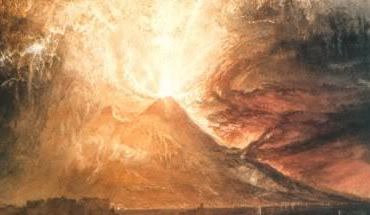
Vesuvius in Eruption, by J.M.W. Turner, 1817

The Israelites have already witnessed a long string of miracles in Egypt, culminating in the splitting of the Reed Sea.  They have followed the kavod of God, in the form of a pillar of cloud and fire, from Egypt to Mount Sinai. On the day of the revelation they experienced God’s kavod as lightning and smoke on the mountain itself, along with thunder and blasts of a shofar.2

Yet once miracles stop, it is hard to keep faith.  When Moses stayed on top of Mount Sinai for 40 days, and no pillar of cloud and fire reappeared near the camp, the Israelites felt abandoned.  Who would lead them to a new home?

In desperation, the men asked Aaron for an idol, then worshiped the golden calf he made.3  Moses returned to them, but God’s cloud and fire did not.  The Israelites were so anxious to see the kavod of God again that when Moses called for donations to make a dwelling-place for God, they donated more than enough treasure and labor.4  The dwelling-place, the new Tent of Meeting, is completed at the end of the book of Exodus/Shemot.

Then the cloud covered the Tent of Meeting, and the kavod of God filled the dwelling-place.  (Exodus/Shemot 40:34)

For the cloud of God was over the dwelling-place by day, and fire was in it at night, in the sight of all the house of Israel, on all their journeys.  (Exodus 40:38)

Presumably the cloud is resting over the Tent of Meeting on the day the new priests make their first offerings at the altar.  So why do the Israelites need another view of God’s kavod?

Perhaps God, or Moses, knows that the Israelites are still insecure. The survivors of the Golden Calf incident have committed their work and treasure to God, and they are ready to follow the new version of God-worship Moses has laid out, in which priests are intermediaries.  But they need divine confirmation that Aaron and his sons really are God’s chosen priests. After all, it was Aaron who made the Golden Calf—choosing to pacify the people rather than sticking to God’s commandment against idols. Could they trust him to serve only God from now on—and keep the Israelites in God’s favor?

While all the people watch, Aaron and his sons carry out the required procedures for the six offerings at the altar.

Then Aaron raised his hands toward the people and he blessed them …  (Leviticus  9:22)

The Torah doesn’t say what Aaron’s blessing is, but the Talmud assumes that it must be the blessing prescribed for priests in the book of Numbers/Bemidbar 5 (and still used in Jewish liturgy today):

May God bless you and guard you;

May God illuminate Its face for you and be gracious to you;

May God lift Its face to you and place peace over you.”  (Numbers/Bemidbar 6:22-27)

After this blessing, one might expect the kavod of God to appear as promised. It does not.

19th-century rabbi Samson Raphael Hirsch, claimed that God delays the divine manifestation on purpose so as to prevent any belief that animal offerings make God’s glory appear by magic.6  The kavod appears when God wants it to appear.

Then Moses came, and Aaron, into the Tent of Meeting. Then they went out and they blessed the people … (Leviticus 9:23)

What is this second blessing?  According to the Sifra, a 4th-century collection of commentary on the book of Leviticus, Moses says: “May it be God’s will to cause His Presence to rest upon the work of your hands!  May God, the God of your fathers, increase your numbers a thousand-fold and bless you, as He promised you!”

And the people respond with a verse that appears in Psalm 90:

May the comfort of God, our God, be upon us, and may the work of our hands be an enduring foundation for us.  (Psalm 90:17)7

Moses’ blessing is a prayer that God will indeed dwell in the new Tent of Meeting that the Israelite people made.  The people’s response, in this context, is a prayer that the work they did with their own hands will result in both divine comfort and an enduring commitment to serving God.

The children of Israel are moved to commit themselves further to God when Moses and Aaron, their human leaders, come out of God’s dwelling-place and bless them. After this commitment,

… and the kavod of God appeared to all the people. Fire went out from the presence of God, and it devoured the rising-offering and the fatty animal-parts on the altar. And all the people saw, and they shouted with joy and they fell on their faces.  (Leviticus 9:23-24)

At that sign of God’s acceptance, the people shout with joy—and relief.


A blessing from another person can seem like a useless exercise.  After all, a human being has no power to make the blessing come true.  We can only express the hope that God will make it happen.

And today, the sudden appearance of fire means an emergency, not divine acceptance.

Yet I remember when I received blessings from Rabbi Aryeh Hirschfield, of blessed memory, and I felt a transfer of good will and even a sense of kavod.  This feeling made a psychological difference to me, changing my attitude toward life and toward the divine.

I find I can be committed to an abstract principle, but not comforted by it. Comfort and joy come more naturally when the abstraction is connected with a human being, someone whose warm feelings are palpable.  Maybe a blessing in itself can be a manifestation of God.

Bless someone today.  It might make a difference.

(An earlier version of this essay was posted on March 20, 2010.)


1  First the new high priest, Aaron, makes a reparation-offering (חַטָּאת) and a rising-offering (עֺלָה) for himself. Then he makes a reparation-offering, a rising-offering, a grain offering (מִנְחָה), and a wholeness-offering (שְׁלָמִים) for the people.  For an explanation of these four types of offerings, see my posts Fire Offerings Without Slaughter, Part 1 and Part 2.

2  Shofar (שׁוֹפָר) = a ram’s horn modified for blowing as a wind instrument.

3  Exodus/Shemot  32:1-6.  See my post Ki Tissa: Heard and Not Seen.

4  Exodus/Shemot  35:4-29 and 36:2-7.

5  The Babylonian Talmud, Sotah 38a, assuming that Aaron’s first blessing of the people in Leviticus 9:22 is the same as the blessing God commands all priests to give in Numbers 6:22-23, argues that therefore the “priestly blessing” in Numbers 6:24-26 must be pronounced with the hands raised. Rashi (11th-century rabbi Shlomoh Yitzchaki) and the majority of medieval commentators agreed that Aaron spoke the “priestly blessing”.

6  Samson Raphael Hirsch, The Hirsch Chumash, Sefer Vayikra Part 1, translated by Daniel Haberman, Feldheim Publishers, Jerusalem, 2002,  p. 289-290.

7  Sifra, quoted by W. Gunther Plaut, The Torah: A Modern Commentary, Union of American Hebrew Congregations, New York, 1981, p. 804.

Vaykheil & Psalm 18: Wings for Chariots

(This is the last of a series of posts comparing ideas in the book of Exodus/Shemot with related ideas in the book of Psalms. Next week I will begin revisiting some sparks in the ancient priestly religion described in the book of Leviticus/Vayikra.)

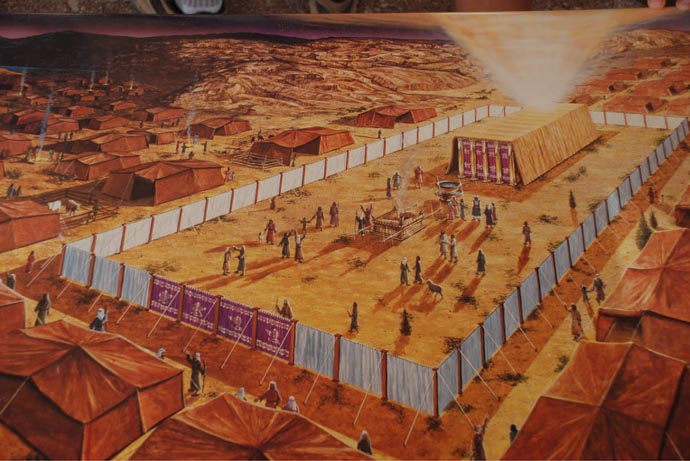
Skilled artisans among the Israelites make all the items for the portable tent that is to be a dwelling-place1 for God in the Torah portion Vayakheil. Moses then assembles the new Tent of Meeting, the divine fiery cloud covers it, and the glory of God fills the inside in the next Torah portion, Pekudei. The golden calf was a mistake, but this time the Israelites got it right! The success in this week’s double portion, Vayakheil-Pekudei, completes the book of Exodus/Shemot.

One replica of the ark, Jerusalem

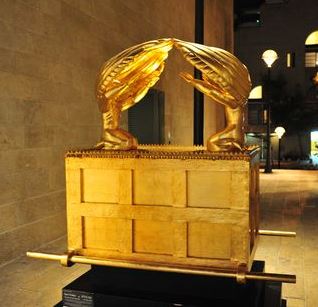
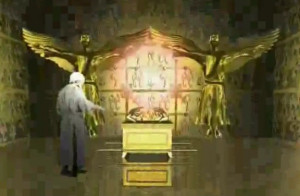
The focal point for God’s presence is the empty space above the ark inside the inner chamber of the tent.  The ark is a gold-plated wooden box holding the second pair of tablets Moses brought down from Mount Sinai. The master-artisan Betzaleil hammers out a solid gold lid for the ark—not just a slab of gold but a sculpture, with two winged creatures rising from the lid in one continuous piece of gold.

And he made two keruvim; of gold hammered work he made them, from two edges of the lid: one keruv from this edges and one keruv from that edges. From the lid he made the keruvim, from its edges. And the keruvim were spreading out wings above, shielding the lid with their wings. And each one faced its brother, and the faces of the keruvim were toward the lid.  (Exodus/Shemot 37:76-9)

keruv (כּרוּב) = a hybrid creature with wings and a human face. Plural: keruvim (כְּרוֻבִים  or  כְּרוּוִים). (The English word “cherub” is derived from the Hebrew keruv, but a keruv in the Bible does not look like a chubby baby with stubby white wings.)

Keruvim and ark in First Temple (one interpretation)

When King Solomon builds the first temple in Jerusalem, its back room, the Holy of Holies, contains two free-standing gold-plated sculptures representing keruvim. Each is 10 cubits tall (15 to 20 feet) and has a 10-cubit wingspan. Solomon has the ark carried in and placed under their wings. (See my post Pekudei & 1 Kings: A Throne for the Divine.)

The Hebrew word keruv may come from the Akkadian word kuribu, “blessed ones”, their name for the colossal statues of hybrid winged beasts guarding doorways and gates. Commentators have speculated that keruvim might have the bodies of bulls (like Assyrian shedu) or lions (like Egyptian sphinxes or Phoenician lammasu) or humans. Raanan Eichler has made a good argument that the keruvim spreading their wings over the ark must have stood upright on two legs, and therefore probably had human bodies.

Hybrid beings with wings and human faces appear in many Ancient Near Eastern sculptures. When they are not demons battling heroes, they are either guardians of gates, or servants transporting a god. Keruvim in the Hebrew Bible are never demons, but they do appear as both guardians and transportation.

Guardians

Kusarikku from palace of Sargon II

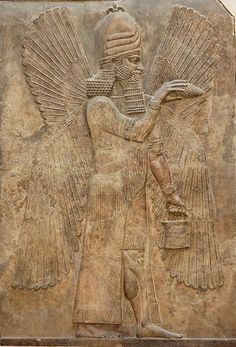
Assyrians placed sculptures of shedu, winged bulls, as guardians at either side of a gateway into a city or palace. Another guardian figure, called Gud-alim by Sumerians and Kusarikku by later Mesopotamians, represented a door-keeper who protected a house from intruders. He stood upright and looked fairly human, except that he often had wings, horns, or a bull’s legs. In some depictions he carries a bucket.

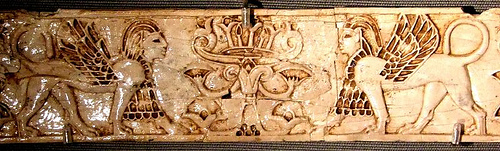
Phoenician artworks from coastal cities west of ancient Israel and Judah also feature a pair of hybrid winged creatures on either side of a tree of life. Their tree of life is a composite of a lotus and a papyrus (borrowed from Egyptian art) and sometimes a palm tree.

Phoenician sphinxes and tree of life

Similarly, the decorations carved in the walls of King Solomon’s temple—by artisans from the Phoenician city-state of Tyre—featured keruvim and palm trees.2

In the book of Genesis/Bereishit, two keruvim serve as guardians of the way back into the Garden of Eden, where the Tree of Life remains untasted.3

One of Ezekiel’s prophesies compares the king of Tyre with a keruv that is supposed to protect its city.4  In an earlier post, Terumah: Cherubs Are Not for Valentine’s Day, I suggested that since God speaks to Moses from the empty space above the ark,5 the two keruvim are also guardians of an entrance: a portal to the invisible God.

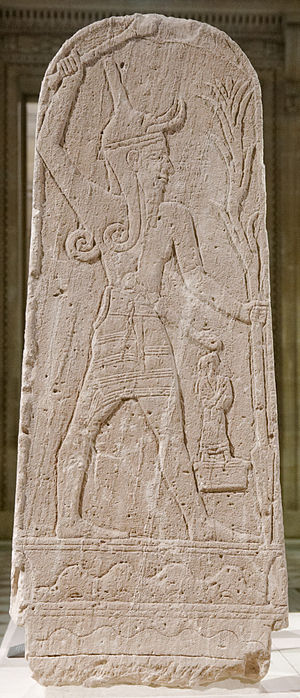
Baal Hadad with thunderbolt, Ugarit

Divine Transportation

Tarhunz from Arslantepe, Turkey

The gods of other religions in the ancient Near East rarely rode on the backs of winged creatures; instead they used these creatures to pull their chariots. Tarhunz, the high god of the Luwian people living north of Canaan, was in charge of weather and war. He used lightning as a weapon, and rode in a chariot pulled by winged horses. South of the Luwians and north of Israel, the Canaanites of Ugarit worshiped Baal Hadad (“Master of Thunder”), a weather and war god who also wielded lightning. The Ugarit writings call this Baal “Rider of Clouds”.

The God of Israel also seems to have a chariot of clouds, in the poetry of Jeremiah and Psalm 104.6

God’s cloud chariot is pulled by keruvim in a poem that appears twice in the Bible, once as chapter 22 in the second book of Samuel, and later (with only slight changes) as Psalm 18. The speaker, King David, faces death at the hands of an enemy army, and calls on God for help. God descends from the heavens.

            Smoke went up from His nostrils

                        And fire from His mouth devours.

                        Embers blazed from Him.

            He tilted the heavens and descended,

                        And a thundercloud was beneath His feet.

            And He drove a keruv and flew,

                        And He soared on the wings of the wind. (Psalm 18:9-11)

I use the pronoun “He” in this translation because God is presented as if “He” were Baal Hadad from the Canaanite pantheon of male and female gods. Psalm 18 continues with imagery of dark clouds, hail, thunder, and arrows of lightning. God then stages a dramatic rescue, and David wins the battle.

A Chariot Throne

The ark with its two keruvim is often considered God’s throne in the Bible—the authoritative location where God sits like a king. But sometimes this throne is movable, like a chariot.

Before David conquers Jerusalem, when the ark is housed in a temple at Shiloh, the Israelite army decides to carry it with them into battle against the Philistines, hoping that God will fight for them.

And they took away from there the ark of the covenant of God of Armies Sitting on the Keruvim … (1 Samuel 4:4)

Although the Israelite forces carry God’s throne, they lose the battle. The Philistines capture the ark, then later abandon it in Israelite territory. When King David retrieves it for his new capital in Jerusalem, it is called

the ark of the god whose name was invoked, the name of God of Armies Sitting upon the Keruvim.  (2 Samuel 6:2)

The title is also used in psalms 80 and 99.

            Listen, Shepherd of Israel, You who lead Joseph like a flock!

                        Sitter on the keruvim, shine forth!  (Psalm 80:2-3)

           God, King, the peoples will tremble!

                        Sitter on the keruvim, You will shake the earth!  (Psalm 99:1)

The Babylonian army razed the first temple in Jerusalem in 579 B.C.E., burning it to the ground. The army carried off some of its gold items as booty, but the ark and its keruvim disappeared from history. When some of the Israelites returned to Jerusalem under Persian rule and built a second temple, they left the Holy of Holies empty.

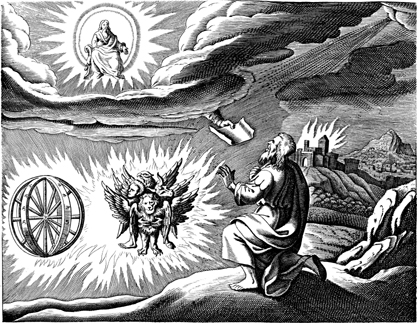
Ever since the destruction of the first temple with its ark and gold keruvim, God’s throne could only be an abstraction or a vision. The prophet Ezekiel reports two mystical visions of hybrid winged creatures during the exile in Babylon (Ezekiel 1:4-28; Ezekiel 10:1-22 and 11:22-23). In his second vision he identifies these creatures as keruvim.

Ezekiel’s Vision, by Matthuas Merian 1670 (some assembly required)

In both visions, the glory of God (not God Itself) appears as a fiery figure on a throne that looks like sapphire, suspended above four keruvim, each of which is accompanied by an interlocking wheel covered with eyes.  Each keruv has a single leg ending in a calf’s hoof, a human body, four wings, a human hand below each wing, and a head with four faces: one human, one lion, one eagle, and one that is called the face of an ox in the first vision and the face of a keruv in the second vision.

The keruvim and their wheels move up and down as well as in all four directions, and the throne suspended above them moves along with them. Although Ezekiel does not call this arrangement a chariot, subsequent Jewish writers developed a school of mysticism based on the merkavah (מֶרְכָּבָה = chariot) in the book of Ezekiel.

Clouds by John Constable

Even without a temple, even without keruvim, the human mind needs poetic images to think about God. Today many of us no longer need to assign God a face, a hand, or a body in robes; we can handle the paradox of God as both invisible and manifest in everything we see. Yet poetic images still well up around the notion of God:  clouds, beams of light, opalescent radiance, perhaps even wings. They are not God, yet God is in the imagery.

When God Itself seems too abstract, perhaps we can think of something like a keruv, a creation that pulls the presence of God toward us when we need rescue, and that stands at our gateways when we need a guardian.

1  (See my post Terumah & Psalm 74: Second Home.)

2  In the first (Israelite) temple in Jerusalem, keruvim and palms  are carved in relief on the wooden walls and two sets of double doors (1 Kings 6:29, 32, 34). Keruvim, palms, and lions are engraved on the stands for ten bronze wash-basins (1 Kings 7:36).

3  Genesis 3:24.

4  Ezekiel 28:14, 16.

5  Exodus 25:22, Numbers 7:89.

6           Hey! Like clouds it ascends;

            Like a whirlwind is [God’s] chariot;

            Lighter than eagles are His horses.  (Jeremiah 4:13)

In Psalm 104, God’s cloud chariot is pulled by the wind:

            Setting beams for [God’s] roof chambers in the waters [above the sky],

                        Making the clouds His chariot,

                        He goes on the wings of the wind.  (Psalm 104:3)


Ki Tissa & Psalms 109 & 69: Wiped Off the List

(One of a series of posts comparing ideas in the book of Exodus/Shemot with related ideas in the book of Psalms.)

Gold calf from Byblos

Of course God is angry about the golden calf. “You shall not make for yourself an idol, or any likeness of what is in the heavens above or what is on the earth below.” (Exodus/Shemot 20:4) It’s right there in the Ten Commandments. Why can’t these Israelites follow simple directions?

Moses is about to walk back down Mt. Sinai with the two stone tablets in this week’s Torah portion, Ki Tissa, when God warns him that the Israelites below have cast a golden calf and are worshiping it. (See my blog post Ki Tissa: Heard and Not Seen.)

And God said to Moses: “I have observed this people, and hey, it is a stiff-necked people! So now let Me be, and My anger will blaze over them and I will consume them, and I will make you into a great nation.” (Exodus 32:9-10)

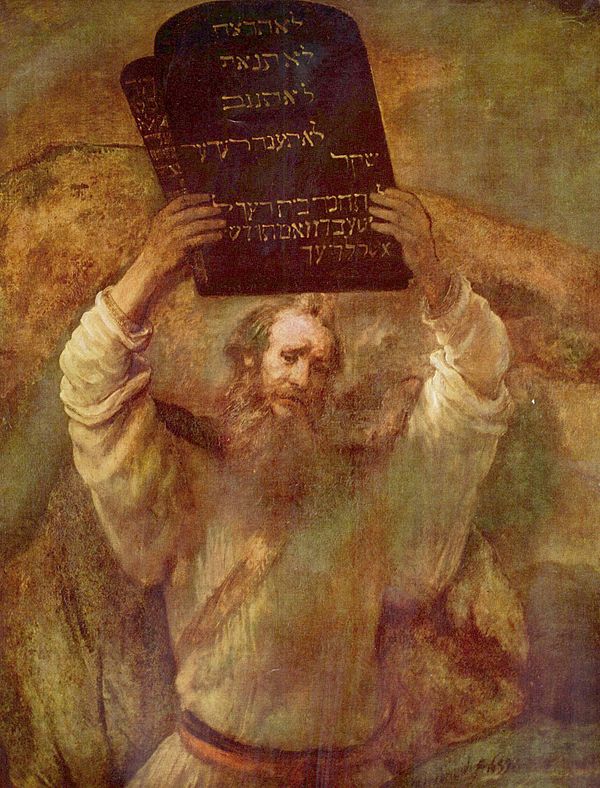
Moses talks God out of this idea. Then he walks down the mountain, smashes the two stone tablets, and gets the Levites to kill the 3,000 worst offenders.

Moses Breaking the Tablets, by Rembrandt, 1659

The next day he climbs back up Mt. Sinai to ask God to forgive the surviving Israelites.

“And now, if you will only lift their guilt!  But if not, please mecheini from your book that you have written.” But God said to Moses:  “Whoever sinned against Me, emechenu from My book.  Now go lead the people to [the place] that I have spoken of to you.”  (Exodus 32:32-33)
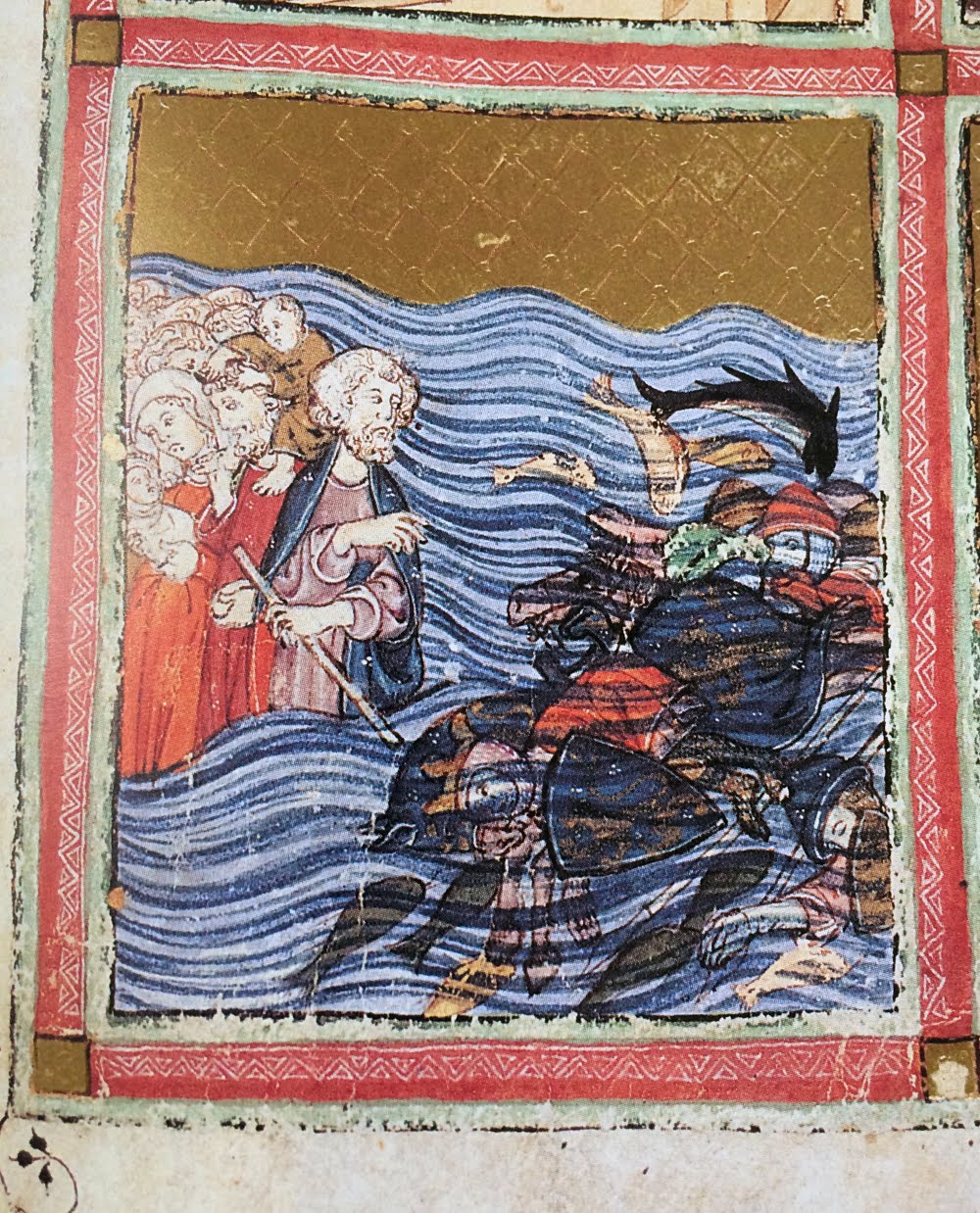
mecheini (מְחֵנִי) = wipe me away, erase me. (A form of the verb machah, מָחָה = wiped out, wiped off, destroyed, blotted out.1)

emechenu (אֶמְחֶנּוּ) = I will wipe them off, I will erase them. (Another form of the verb machah.)

In other words, Moses insists that his personal fate must not be separated from that of the Israelites. If God erases them from the book, God must erase him, too.  God replies that guilty individuals will erased, but the people of Israel as a whole will continue their journey under Moses’s leadership.

When the story is retold in the book of Deuteronomy/Devarim, God says to Moses:

“Hey! This is a stiff-necked people. Leave me alone, and I will exterminate them, and emecheh their name from under the heavens, and I will make you a nation greater than they.” (Deuteronomy 9:13-14)

emecheh (אֶמְחֶה) = I will wipe it out, I will erase it. (Another form of the verb machah.)

The Hebrew word for “name”, sheim (שֵׁם), means not only an appellation, but also someone’s reputation, standing, or renown (as in the English “making a name for herself”).

God’s book appears to be a list of names recorded at birth. Female names are not mentioned (the Bible reflects the male-centered, patriarchal society of its time), so we do not know if the list is comprehensive.

What happens when someone’s name is machah from the divine list?

One clue appears later in Deuteronomy. Lineage is important in the Bible; for a man to die without any male heirs is a terrible fate. So if a married man died without issue, his brother was obligated to impregnate the widow. If she bore a son, he would become the dead man’s heir.

And the firstborn that she bears shall be established on the name of his dead brother, and his name will not yimacheh from Israel. (Deuteronomy 25:6)

yimacheh (יִמָּחֶה) = be wiped out, be erased. (Another form of the verb machah.)

Similarly, a name is erased from God’s book if God decrees that the man will pass out of collective memory—perhaps by his own early death, or perhaps by dying without heirs to carry on his lineage.

*

Two of the psalms include pleas for God to punish enemies by erasing their names from the divine book. Psalm 109 opens with a complaint that certain people are lying about the psalmist, accusing him without cause. Verses 6-19 ask God to punish a personal enemy. These verses include separate requests for the man to be convicted of a crime, lose his job, and become impoverished while alive; for him to die before his time; for his children and his parents to suffer; and for his lineage to be exterminated.

            May no one extend kindness to him;

                        And may no one be gracious to his orphans.

            May his posterity be cut off;

                        In the next generation, may their names yimach. (Psalm 109:12-13)

yimach (יִמַּח) = be blotted out, erased. (Another form of the verb machah.)

In Psalm 69, the speaker feels as though he is drowning, and asks God to rescue him from being shamed and abused.  Then he asks God to punish all his enemies. This middle section concludes with:

            Place guilt upon their guilt,

                        and do not let them come into Your righteous deliverance.

            Yismachu from the book of life,

                        And among the righteous do not record them.  (Psalm 69:28-29)

yimachu (יִמַּחְוּ) = May they be blotted out, erased. (Another form of the verb machah.)

This passage alludes to two divine lists: a “book of life” or “book of the living” (seifer chayim, סֵפֶר חַיִּים), and a record of the righteous, which may or may not be the same scroll. When the psalmist asks for the names of his tormentors to be erased from the book of life, he may be asking God to deprive them of heirs, or he may be asking God to make them die soon.

The Hebrew Bible refers to God’s list of names as a “book of life” only in Psalm 69, which was written around 500 B.C.E.  Almost a thousand years later, the Babylonian Talmud (tractate Rosh Hashanah 16b) cited Psalm 69:29 as support for the idea that God keeps three books of names. According to this tractate, on the first day of each new year, Rosh Hashanah, God writes down the names of the righteous in one book and the names of the wicked in another.  People whose deeds are partly good and partly bad are listed in the third book until Yom Kippur, nine days later, when God decides which of these intermediate people to record in the book of the righteous and which in the book of the wicked.

What happens to the people listed in these books? The Talmud says that according to school of Shammai, those in the book of the righteous are rewarded with everlasting life, while those in the book of the wicked go to Gehinnom after death.2

But by the Rosh Hashanah liturgy, codified in the 9th century C.E.,  says simply that God writes down who will live and who will die that year; any possibility of life after death is omitted.3 Neither does the liturgy mention wiping out any names that were written earlier.

*

The image of God erasing names from a book expresses a biblical hope that people will be punished for bad deeds, either by untimely death or by the end of their lineage—equally bad fates from an ancient Israelite point of view.

Few people today believe God punishes miscreants in this way. Some folks still cling to the idea of reward or punishment after death.  I prefer the idea that virtue is its own reward, and I believe that people who enjoy being mean never get to experience the best things in life, such as true friendship and love.

Today the image of God keeping a book, or books, of names is still used in Rosh Hashanah and Yom Kippur services as a metaphor for the idea that God only knows when a person will die. The liturgy pleading to be written into this year’s “book of life” provides emotional reinforcement for the knowledge that the time of our death is unknown—and therefore it behooves us to use our present lives well.

May all human beings, whatever their past deeds and attitudes have been, wake up with new insight into the shortness of life and the value of goodness.  And may we all realize, like Moses in this week’s Torah portion, that there is no point in having our own names written in the book of life unless our fellow human beings are also listed there.

1  The Bible uses various forms of the verb machah not only for wiping away or erasing names, but also for wiping away tears, wiping a dish clean, or wiping out (killing) an entire population. God tells the Israelites to wipe out the memory of an enemy tribe called Amaleik; several Israelite leaders beg God not to wipe out, i.e. forget, someone’s good or bad deeds. When a husband accused his wife of adultery, a priest wrote a curse on a scroll, then machah it in water and made the woman drink it; the results determined her guilt or innocence (Numbers/Bemidbar 5:23-24).

2   Talmud Bavli, Rosh Hashanah 16b. There is also a Christian tradition about a “book of life” that is a divine record of who will “go to heaven” after death.

3  Prayers for God to “inscribe us in the book of life” were added to the Amidah sections of Rosh Hashanah liturgy by the Babylonian Geonim in the 9th century C.E. The “Unetaneh Tokef” prayer, an earlier addition to the liturgy, states that every year God decrees who will die, and by what means, during the coming year.

Ramban (13th century Rabbi Moses ben Nahman, known as Nachmanides) explained that the book of the righteous is the book of life, and the book of the wicked is the book of death. Everyone whose name is written in the book of life merits life until the following Rosh Hashanah, and everyone whose name is written in the book of death will die that year.

Tetzaveh & Psalms 141, 51, and 40: Smoke and Prayer

(One of a series of posts comparing ideas in the book of Exodus/Shemot with related ideas in the book of Psalms.)

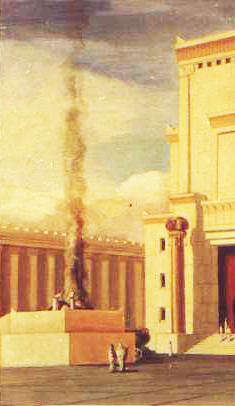
Outdoor altar at First Temple

Two kinds of smoke please God, according to the book of Exodus:

* the smoke from burning sacrificial animals and grain products on the copper altar in front of the Tent of Meeting described in last week’s Torah portion, Terumah,1 and

* the smoke from burning incense on the gold altar inside the tent, described in this week’s Torah portion, Tetzavveh (“you shall command”):

And you shall make an altar for miketar ketoret; from wood of acacias you shall make it. …And you shall plate it with pure gold …And place it in front of the curtain that is over the Ark of the Reminder, …where I will reveal myself to you. Vehiketeyr on it, Aaron, ketoret of spices …  (Exodus/Shemot 30:1-7) 

miketar (מִקְטַּר) = letting smoke rise; scenting with smoke. (A form of the verb ketar, קִטּר  = burned incense.)

ketoret  (קְטֺרֶת) = incense. (From the root verb ketar.)

vehiketeyr (וְהִקְטֵיר) = And he shall make smoke. (Another form of the verb ketar.)

In the Wilderness

The altar for burning animals and grain (which would otherwise be food for people) is outside the Tent of Meeting that the Israelites construct in the wilderness of Sinai.  The incense altar is inside, right in front of the Holy of Holies. All the Israelites worship God by bringing food offerings for the priests to burn on the outdoor altar. Only the high priest, Aaron, burns spices on the incense altar for God.

Food offerings are sent up in smoke for various reasons. Some offerings express gratitude to God, some atone for transgressing God’s rules, some mark a change in ritual status, and some observe holy days. The fragrance of the incense, however, is intended only to honor and please God.

The Israelites send columns of smoke up to God. And God sends columns of cloud and fire down to the people. When the Israelites are walking from Egypt to Mount Sinai,

God was walking in front of them in a column of cloud by day, to lead them on the way, and in a column of fire by night, to make light for them, [so they could] walk day and night.  (Exodus 13:21)

After God’s tent-dwelling is completed, the book of Exodus ends with:

For the cloud of God was over the dwelling-place by day, and there was fire in it by night, before the eyes of all the house of Israel, on all their journeys.  (Exodus 40:38)

During the Babylonian Exile

Israelites continue to use the smoke from burning food and incense as their main communication with God until the Babylonians destroyed the first Israelite temple in Jerusalem in 597 B.C.E. (The Bible also mentions a few individual prayers, but does not portray Levites as singing psalms until the time of the second temple.)

The Israelites deported to Babylon were not sure what to do.  Should they continue sending up smoke to God, even without the temple, the food altar, or the incense altar?  Or should they use another approach?

Psalm 141 is a plea for God to help the psalmist avoid harmful speech and bad company. The psalm opens with a request that this prayer be considered as a substitute for making smoke.

           God, I called You. Hurry to me!

                        Listen to my voice when I call to You!

            May my prayer endure as ketoret before You,

                        Lifting up my palms2 as an evening offering.  (Psalm 141:1-2)

After the Second Temple

After the Persians conquered Babylon, some of the Israelites returned to Jerusalem and built a second temple in 516 B.C.E. They reinstituted the sacrificial system in their new temple, making both an outside altar for burning food offerings and an inside altar for incense. This type of worship continued until the Romans destroyed the second temple in 70 C.E.

After the fall of the second temple, some Jews hoped for a third temple, and another return to worshiping God through smoke. The Amidah (“standing”) prayer, which is recited at morning and evening services to this day, begins with a verse from Psalm 51 about spoken prayer:

             My lord, may you open my lips,

                        And my mouth will declare Your praise.  (Psalm 51:17)

However, Psalm 51 ends:

            May You rebuild the walls of Jerusalem.

                        That is when You will want slaughter-offerings of righteousness,

                        Rising-offerings and complete offerings.  (Psalm 51:20)

Similarly, in traditional prayer books the Amidah3 includes this request: “And return the service to the inner sanctum of Your house, and the fire-offerings of Israel, and their prayer, with love, accepting it with favor.”  According to this tradition, prayer is good, but prayer and smoke together are better.

Many liberal prayer books produced in the last century or so omit or reinterpret this prayer in the Amidah, so as to avoid praying for either reinstituting animal sacrifices or building a third temple.

Psalm 40, composed at least 2,000 years ago, is bolder and more direct:

            Slaughter and grain offering You do not want.

                        You dug open a pair of ears for me!

                        Rising-offerings and guilt-offerings You do not request.

            That is when I said:

                        Hey, I will bring a scroll of the book written for me.

            I want to do what You want, my God,

                        And Your teaching is inside my guts.

            I delivered the news of right behavior to a large assembly.

                        Hey! I will not eat my lips.  (Psalm 40:7-10)

The speaker in Psalm 40 insists that God does not want smoke, only words. Nothing can make this prophetic poet recant; he will not “eat his lips”.

Tomorrow

I almost envy the simplicity of the early Israelite religion, in which people and priests burn something to make a column of smoke rise up to God in the sky or “heavens”, and God sends down a column of divine smoke (described as cloud and fire) to guide the people.

Personally, I could not even imitate this process by burning incense, since I am allergic to any type of smoke.  And these days, columns of cloud and fire do not descend from the sky; we only get lightning and general precipitation.

But I do pray to God with words, for all the reasons the ancient Israelites made smoke: to express gratitude, to ask for forgiveness and self-improvement, to observe holy days, and just to honor the divine. And though I often say, or sing, the words out loud, I do not pray to a God in the sky, but to a divine source I encounter “inside my guts”, like the author of Psalm 40.

I was brought up to be an atheist; I did not begin praying until I was 32.  My life for the past 30 years has been deeper, thanks to prayer; I have become more grateful, less egotistical, and more accepting.  And, God willing, I can continue to improve.

May everyone who would benefit from a prayer practice discover a good one.

            Oh God, may you open my lips,

                        And my mouth will declare Your praise.  (Amidah and Psalm 51:17)         

1  See my post Terumah & Psalm 74: Second Home about the Tent of Meeting, and my post Pinchas: Aromatherapy about smoke from animal sacrifices.

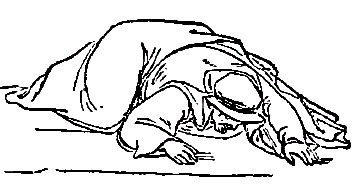
2  The Hebrew Bible describes two postures for prayer.  Prostration—bowing until you lie face down on the ground) indicates submission and the willingness to receive any word God might send you.  Raising your hands, palms up, toward the sky (with or without kneeling) indicates a petitionary prayer, in which you are asking God for something.

King Solomon

One example is when King Solomon dedicates the first temple in Jerusalem:

As Solomon was finishing praying to God all this prayer and this supplication, he got up from in front of the altar of God, from kneeling on his knees and his palms spread toward the heavens.  (1 Kings 8:54)

3   This prayer, called the Avodah (“Service”), is number 5 in the Shabbat Amidah, and number 17 in the longer weekday Amidah.


Terumah & Psalm 74: Second Home

(One of a series of posts comparing ideas in the book of Exodus/Shemot with related ideas in the book of Psalms.)

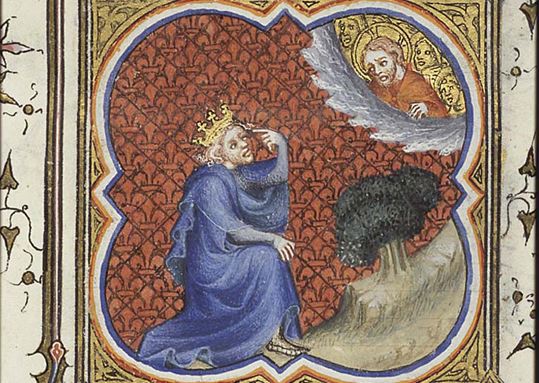
David Addresses God, P. Comestor Bible Historiale
David Addresses God, Petrus Comestor Bible Historiale, 1372

Where does God live?

The “heavens” are the primary residence of many gods, including the God of Israel in the Hebrew Bible.  In Canaanite and Babylonian religions, the gods inhabit both the heavens and any number of statues on earth.  The God of Israel flatly rejects idols, but still wants a second home on earth.  In this week’s Torah portion, Terumah (“Donations”), Moses is receiving instructions from God on top of Mount Sinai.  God tells him:

They shall make a holy place for me, veshakhanti among them. Like everything that I show you, the pattern of the mishkan and the pattern of all its furnishings, that is how you shall make it.  (Exodus/Shemot 25:8-9)

veshakhanti (וְשָׁכַנְתִּי) = and I will dwell, and I will stay.   (A form of the root verb shakhan (שָׁכַן) = stay, settle, dwell, inhabit.  This is the first occurrence in the Bible of the verb shakhan.)

mishkan (מִשְׁכָּן) =  dwelling-place, home.  (Also from the root verb shakhan. This is also the first occurrence in the Bible of the noun mishkan.)

Gold calf from the temple of Baalat in Byblos

Moses stays on top of Mount Sinai so long—40 days and 40 nights—that in the Torah portion Ki Tissa the Israelites at the foot of the mountain despair of seeing him again.  So they make a golden calf in the hope that God will inhabit it.1 God refuses the golden statue and threatens to destroy all the Israelites except Moses and his direct descendants.  Moses refuses God’s offer, and God settles for sending a plague.2

Cloud descends on the mishkan
Cloud on the mishkan

After the surviving Israelites have built an elaborate portable tent-sanctuary according to God’s instructions, God descends on it in a pillar of cloud.3  In the book of Leviticus/Vayikra, God speaks to Moses from the empty space above the ark in this mishkan’s innermost chamber.

Throughout the books of Exodus, Leviticus, and Numbers the only mishkan for God is the portable tent-sanctuary. In the first book of Samuel a temple in Shiloh houses the ark, and God speaks to Samuel there.4

King Solomon builds a temple of stone and wood in Jerusalem for God to inhabit.  (See my post Terumah & 1 Kings: Tent vs. Temple.)  This temple lasts until the Babylonian army razes it in 587 B.C.E., along with most of the city.

Psalm 74 argues that this act was not merely a political conquest by the expanding Babylonian empire, but an attempt to eradicate the worship of God by destroying God’s home on earth. The psalmist, like most prophets writing after the fall of the first temple, probably believed God arranged the fall of Jerusalem in order to punish the Israelites for worshiping idols. Now that the punishment is complete, the psalmist is waiting for God to rescue the deported Israelites (and punish the Babylonians).

            Why, God, do You endlessly reject us?

                        Your anger smokes at the flock You tended.

            Remember Your community You acquired long ago!

                        You redeemed the tribe of your possession.

                        Mount Zion is where shakhanta.  (Psalm 74:1-2)

shakhanta  (שָׁכַנְתָּ) = you dwelled, you lived. (Another form of the verb shakhan.)

History repeats itself: Siege and Destruction of Jerusalem by the Romans, by David Roberts, 1850 (history repeats itself)
History repeats itself:
Siege and Destruction of Jerusalem by the Romans, by David Roberts, 1850

The psalm then describes how the Babylonian army replaced all the emblems of the Israelite religion in the temple with their own emblems, hacked up the carved ornamentation, and burned the wooden parts of the building down to the ground.

            They set Your holy place on fire;

            They profaned the ground inside the mishkan of Your name.  (Psalm 74:7)

Given this disrespect, and given that the Israelites are the people God adopted and brought to Jerusalem in the first place, Psalm 74 asks why God is taking so long to restore God’s own mishkan, city, and people.

            Why do you draw back Your right hand,

                        Holding it in Your bosom?  (Psalm 74:11)

The psalm then points out that God created the world and the day and night, then did great deeds without a mishkan on earth. Lack of power is not holding God back.  And the Israelites, particularly the poor and needy, belong to God.

           Look to the covenant!  (Psalm 74:20)

If God would only pay attention, the psalm implies, God would honor Its covenant, restore the Israelites to Jerusalem, and cause a new mishkan to be built there to facilitate worship.

           Do not let the miserable turn back disgraced.

                        Let the poor and the needy praise Your name!  (Psalm 74:21)

In Psalm 74, the mishkan of God is also the mishkan of the people. They need their own home, and they need to have a home for God in their midst.  Then, instead of suffering miserably, the needy can praise God and rejoice.

*

Many Jews still want a home where we are free to praise God, to practice our own religion without fear or discrimination.

Half of the Jews in the world live in the nation of Israel, founded in 1948 as a homeland where Jews could escape the genocide, as well as less drastic forms of discrimination, inflicted on them in Europe. Yet over the next 69 years, the Jewish and Muslim residents of Israel have been attacked both by neighboring countries and by each other.

Most of the Jews living outside Israel today are American citizens. Discrimination against Jews in the United States has fallen over the past sixty years, and many of us view America as our real home, where we can participate in the life of our country and remain free to practice our own religion. God has many second homes among religious American Jews; every synagogue is a divine mishkan, and each of us can make a mishkan for God to dwell in our own hearts.

Yet in the past year, discrimination against ethnic and religious groups has become more socially acceptable in the United States.  Psalm 74 suddenly seems more relevant.

I pray that the divine spirit blooms in all of our hearts.  May we quickly reverse this dangerous trend.  And may all people, everywhere, find a safe home.

           Do not let the miserable turn back disgraced!

1  Exodus 32:1-5.

2  Exodus 32:35:  Then God struck the people over what they had done with the calf that Aaron made.

3  Exodus 40:33-34:  When Moses completed the work, the cloud covered the Tent of Meeting, and the magnificence of God filled the mishkan.

4  1 Samuel 3:1-10.

Mishpatim & Psalms 39 and 119: Foreigners

(One of a series of posts comparing ideas in the book of Exodus/Shemot with related ideas in the book of Psalms.)

Us and them.  Citizens and foreigners.  Friends and enemies.

Human nature always divides members of our species into two or more groups. But how we treat the “out” group depends on our ethical, religious, and political rules.

This week’s Torah portion, Mishpatim (“Laws”), is set at Mt. Sinai, long before the Israelites conquer part of Canaan and set up their own government. But it includes a series of laws written after the kingdoms of Israel and Judah were founded. One of the subjects these laws address is how to treat immigrants and conquered natives.

Egyptian beating a slave

A geir you shall not cheat nor oppress, since you were geirim in the land of Egypt. (Exodus/Shemot 22:20)

geir (גֵר) = foreigner, stranger, resident alien, sojourner, immigrant, non-citizen.  From the root verb gar (גָּר) = sojourned, stayed with, resided with.

geirim (גֵרִים) = Plural of geir.

(The meaning of geir shifted in Jewish writings after 100 C.E., coming to mean a proselyte or convert.)

After a few more laws, the Torah portion Mishpatim adds:

And a geir you shall not oppress, for you yourselves know the feelings of the geir, since you were geirim in the land of Egypt.  (Exodus/Shemot 23:9)

Unlike foreigners who are merely visiting another country, geirim are displaced persons who cannot call on their former clan chiefs (or national governments) for protection. They are at the mercy of the country where they now live, subject to the whims of its ruler and its wealthy citizens. Unless their new host country protects them, they are subject to deportation even when they no longer have a home to return to (like resident aliens in the United States today), or to slavery (like the Israelites in Egypt at the beginning of the book of Exodus).

This week’s Torah portion gives one example of not oppressing a geir who works for you:

Six days you shall do your doings, but on the seventh day you shall stop, so that your ox and your donkey shall rest, and the son of your slave woman and the geir shall refresh their souls.  (Exodus 23:12)

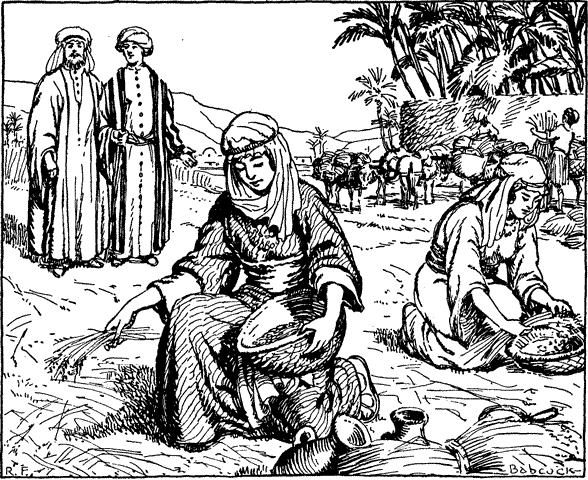
Ruth (a foreigner) Gleaning, by R.F. Babcock
Ruth (a foreigner) gleaning,
by R.F. Babcock

The Hebrew Bible includes many further injunctions to treat geirim with consideration.1  In summary, if geirim are servants of Israelites, they must get the same holiday feasts and days off as native slaves or servants.  If geirim are hired laborers, they must be paid daily, like Israelite laborers.  If geirim are not attached to an Israelite household and are impoverished, they get the same rights as impoverished citizens.  Geirim are even urged to flee to the same cities of refuge if they are unjustly accused of murder.

Since the kingdoms of Israel and Judah are theocracies, treating their geirim like citizens also means the geirim must conform at least outwardly to Israelite religious life, and suffer the same punishments for transgressions.2

However, two kinds of discrimination against geirim are sanctioned in the Torah: an Israelite may not charge interest on a loan to a kinsman, but may charge interest on a loan to a geir 3; and while an Israelite can always redeem a kinsman from slavery by paying the slave’s owner, a geir has no such right.4

Nevertheless, the Bible urges the Israelites to love the geirim living in their land.5

Mt. Gezerim left, Mt. Eival right.
Mt. Gezerim left,
Mt. Eival right.

In three books of the Bible, resident geirim are even included in the covenant with God.6  One example is when Joshua enters Canaan and enacts a ritual of covenant at Mt. Eival.

All Israel—its elders, its officials, and its judges—were standing on either side of the ark, facing the priests of the Levites, carriers of the ark of the covenant of God—the geir the same as the native.  (Joshua 8:33)

(In this case, “native” (ezrach, אֶזְרָח) means someone of Israelite ancestry, since both the Israelites and their fellow travelers are newcomers to Canaan.)

Another example is when the prophet Ezekiel predicts a new covenant with God once the Israelite deportees in Babylon move back to their old land.  In this covenant, people who were once geirim become citizens of the tribes they lived with.

You shall divide up this land for yourselves among the tribes of Israel. And you shall cast [lots] for hereditary possessions, for yourselves and for the geirim who are garim among you … And the geir will be in the tribe that gar with; there you will give him his hereditary possession—declares my Master, God.  (Ezekiel 47:21-23)

garim (גָּרִים) = sojourning, staying with, residing with as foreigners.  (From the root verb gar.)

gar (גָּר) = he sojourned, stayed with, resided with.

All these rules ensuring fairness to the geirim would not have been written unless some native Israelites were mistreating resident aliens.  The Torah correctly points out that the geirim are vulnerable outsiders, just as the Israelites were once vulnerable outsiders in Egypt.

*

Psalms 39 and 119 take the idea of the geir to the next level.  If non-citizens are vulnerable in the country where they live, then perhaps humans are vulnerable before God, whose ways are mysterious.

Psalm 39 introduces a speaker who is worried about the shortness of his life.  He alludes to a scourge from God, probably an illness.  The psalm concludes:

praying           Hear my prayer, God,

                        And listen to my cry for help!

                        Do not be silent to my tears.

            For I am a geir with You,

                        A resident alien, like all my forefathers.

            Look away from me, and I will recover,

                        Before I depart and I am not.  (Psalm 39:13-14)

Like a geir, this psalmist feels vulnerable and uncertain of God’s ultimate protection.  Instead of asking God to intervene, he begs God to ignore him so he can at least enjoy the remainder of his short life.  A geir does not dare to ask for too much.

*

Psalm 119, written during the time of the second temple, is the longest in the book of Psalms.  Its 176 verses begin with letters of the alphabet from alef to tav, the equivalent of the English A to Z.  There are eight verses for each letter, and all are variations on the theme of praying to God for help in learning and understanding God’s laws.  The verses that begin with the letter gimmel (ג) open with:

           Finish maturing (גְּמֺל) Your servant!  I will live and I will observe Your word.

            Uncover (גַּל) my eyes, and I will look upon the wonders of Your teaching.

            A geir (גֵּר) I am in the land; do not hide from me Your commands.

            My soul pines away (גָּרְסָה), longing for Your laws at all times.  (Psalm 119:17-20)

The psalmist expresses the feeling of being a vulnerable outsider who does not understand what is really going on.  Anyone who seeks to serve a God who has issued hundreds of laws yet remains inscrutable feels like a geir.  The overall theme of Psalm 119 is the longing to understand what God wants—which is like the longing of geirim to understand how things work in the strange country where they now live.                    

*

I appreciate how the Torah insists we must treat non-citizens with fairness and consideration, and reminds us that we have all been geirim at some time.  Even if we have enjoyed the rights of the innermost in-group of native citizens our whole lives, we are still geirim with God.

And even within our own social circles, we get along better if we keep working to understand what our friends are really saying, how the world really looks to them.  Ultimately, each of us is a geir with every other person, as well as with God—and perhaps even with ourselves.

1  Enjoying Shabbat and holidays:  Exodus 12:19, 12:48, 20:10, 23:12; Numbers 35:15; Deuteronomy 5:14, 16:14, 26:11-13.

Receiving wages promptly:  Deuteronomy 24:14.

Receiving assistance like the native poor:  Geirim are usually listed along with widows and fatherless children as entitled to glean produce from private fields, orchards and vineyards (Leviticus 19:10, 23:22; Deuteronomy 21:20, 24:17, 24:19, 24:20; also see Ruth ch. 2); to take home a share of the tithe for the poor (Deuteronomy 14:28-29); and to receive just redress (Deuteronomy 24:14; Jeremiah 7:6, 22:3; Zechariah 7:10; Malachi 3:5).

Using cities of refuge: Joshua 20:9.

2  Observing the native religion:  Both citizens and geirim must fast on Yom Kippur (Leviticus 16:29), bring their burnt offerings to the alter of the God of Israel (Leviticus 17:8-9, 22:18), refrain from eating blood (Leviticus 17:10, 17:13), obey Israelite laws about permitted sexual partners (Leviticus 18:26), avoid taking God’s name in vain (Leviticus 24:16), and refrain from worshiping idols (Leviticus 20:2; Numbers 15:26, 15:29, 15:30, 19:10; Ezekiel 14:7).

3  Paying interest:  Leviticus 25:35.

4  Lacking the right of redemption:  Leviticus 25:35-36.

5  Being loved: Leviticus 19:33-34; Deuteronomy 10:18-19, 24:14.

6  Being included in the covenant: Deuteronomy 29:9-11, 31:12; Joshua 8:33, 8:35; Ezekiel 47:21-23.


Yitro & Psalms 29, 82, & 97: Greater Than Other Gods

(One of a series of posts comparing ideas in the book of Exodus/Shemot with related ideas in the book of Psalms.)

The “Song of the Sea”, a psalm in last week’s Torah portion, Beshallach, includes the verse:

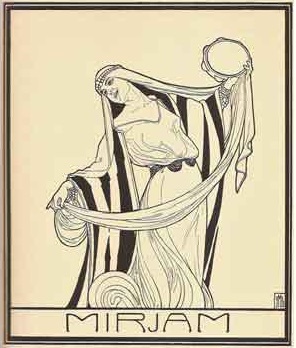
Miriam singing, by Ephraim Moshe Lilien, 1908

Who is like You among the eilim, Y-h-w-h?

Who is like You, glorious in holiness,

Awesome, praiseworthy, doing wonders! (Exodus 15:11)

Y-h-w-h (י־ה־ו־ה) = God’s personal four-letter name.  (Many English translations substitute “LORD” for this name, even though it is spelled using letters from several forms of the Hebrew verb “to be”, rather than from the Hebrew noun for “lord”.)1

eilim (אֵלִם) = plural of eil (אֵל) = a god. (In some Canaanite religions, Eil was the founding god of the pantheon.  In the Torah, Eil is another name for Y-h-w-h, but eilim always means multiple other gods.)

The Song of the Sea assumes that other gods exist, and rejoices that the God of Israel, Y-h-w-h, is more powerful than any of them.  This verse is included in the daily Jewish liturgy, morning and evening.  When Jews sing “Mi chamokha” (“Who is like You?”) we do not always remember that we are comparing our God with other gods.

Yitro and the First Commandment

In this week’s Torah portion, Yitro, the Midianite priest Yitro travels to Mount Sinai to meet his son-in-law Moses shortly after God and Moses have brought the Israelites out of Egypt.

And Yitro said: “Blessed be Y-h-w-h, Who rescued you from the hand of the Egyptians and from the hand of Pharaoh…  Now I know that Y-h-w-h is greater than all the elohim…” (Exodus/Shemot 18:11)

elohim (אֱלֺהִים) = gods, a god, God.  (Grammatically elohim is the plural of eloha, a rarely used word for a god.  The Torah uses the word elohim to refer to both multiple gods, as with eilim, and to a single god.  Sometimes elohim refers to a single foreign god2, but more often the word refers to the God of Israel, Y-h-w-h.)

Does Yitro believe in the existence of multiple gods only because he is a Midianite?  No; many passages in the Bible that were originally written before the destruction of the first temple in 587 B.C.E. share this belief.  Even the first of the “Ten Commandments” in this week’s Torah portion does not require monotheism, but only a henotheistic religion in which Y-h-w-h is the best god and the only one the people are allowed to worship:

I am Y-h-w-h, your elohim, Who brought you out from the land of Egypt, from the house of servitude.  You shall have no other elohim over and above My presence. (Exodus/Shemot 20:2-3)

(For other translations of this commandment, see my post Yitro: Not in My Face.)

The god Y-h-w-h does not say that there are no other gods, but only that the Israelites must not serve them.

A number of psalms3 are similarly henotheistic in the original Hebrew (though some translators strain to make them sound as monotheistic as later Biblical writings.)  These psalms treat other gods as real, but emphasize that they are weak and worthless compared with Y-h-w-h, the God of Israel.  Here are three examples:

Psalm 29

Psalm 29 is probably the oldest of the henotheistic psalms.  Its opening addresses the “children” or dependents of other gods:

           Assign to Y-h-w-h, children of eilim,

                        Assign to Y-h-w-h magnificence and might!

            Assign to Y-h-w-h the magnificence of [God’s] name,

                      Bow down to Y-h-w-h of holy beauty!

           The voice of Y-h-w-h is over the waters;

                      The eil of magnificence is thundering.  (Psalm 29:1-3)

“Children of eilim” might mean those dependent on other gods, i.e. their human worshipers.  Or, according to Ibn Ezra4 in his commentary on Exodus 15:11 (above), “children of eilim” refers to the stars, which were considered divine.

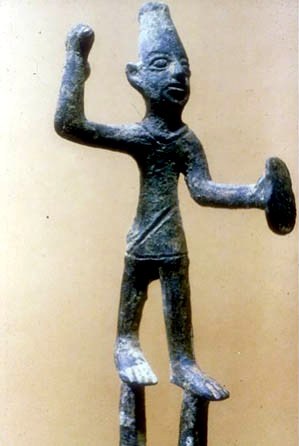
Baal preparing lightning, bronze
Baal preparing lightning

Psalm 29 goes on to describe the voice of Y-h-w-h as shattering cedars, making the mountains of Lebanon dance, kindling fire, shaking the wilderness, and startling deer into giving birth—all images related to thunderstorms and earthquakes.  Canaanite poems describe the god Baal as the weather god who speaks in thunder and makes lightning and earthquakes, but this Israelite poem says that God does all that.

In Canaanite literature the god Baal conquers the waters of chaos, builds a palace on a mountaintop, and becomes king over all the other gods except his father, Eil.

Psalm 29 gives God a palace and a throne:

          And in [God’s] palace everyone says: Magnificent!

                    Y-h-w-h sat enthroned for the flood,

          And Y-h-w-h sits enthroned as king forever.  (Exodus 29:10)

The purpose of Psalm 29 may have been to replace Baal-worship among the Israelites with the worship of Y-h-w-h, and to persuade them that all the other eilim are less powerful than Y-h-w-h.  These inferior gods acclaim and bow down to Y-h-w-h in God’s palace.

Psalm 82

In Canaanite writings from Ugarit, the father god Eil periodically convenes an assembly of the gods, each of whom has its own sphere of power.  After receiving advice from the other gods, Eil makes the major decisions about the world.5

Psalm 82 takes the idea a divine assembly in a different direction.

Elohim takes a stand in the assembly of Eil,

           Among elohim he pronounces judgment. (Psalm 82:1)

The Council of Gods, sketch by Peter Paul Rubens
The Council of Gods, sketch by Peter Paul Rubens

In the first line, “Elohim” refers to Y-h-w-h; in the second line “elohim” refers to all the assembled gods.  “Eil” in the first line might be either Y-h-w-h or the Canaanite father god.

Y-h-w-h then accuses the other gods of unjust rulings that favor the wicked and fail to rescue the poor.  But the other gods don’t get it.

            They neither know nor understand,

            They walk around in darkness;

            Causing all the foundations of the earth to totter.  (Psalm 82:5)

Without true divine justice, the whole human world is threatened.  So Y-h-w-h gets rid of the ignorant lesser gods, commenting:

           I used to say to myself: You are elohim,

                      And children of the Most High, all of you.

           Nevertheless, you will die like humans,

                      And you will fall like one of the princes.  (Psalm 82:6-7)

Psalm 82 might be an explanation of why the wicked are not always punished: inferior gods have been acting as their judges.

On the other hand, this psalm might be a story exhorting the Israelites to abandon other gods because those gods are wicked, stupid, and no longer immortal.  Only Y-h-w-h is worth worshiping, because only Y-h-w-h administers true justice and lives forever.

Psalm 97

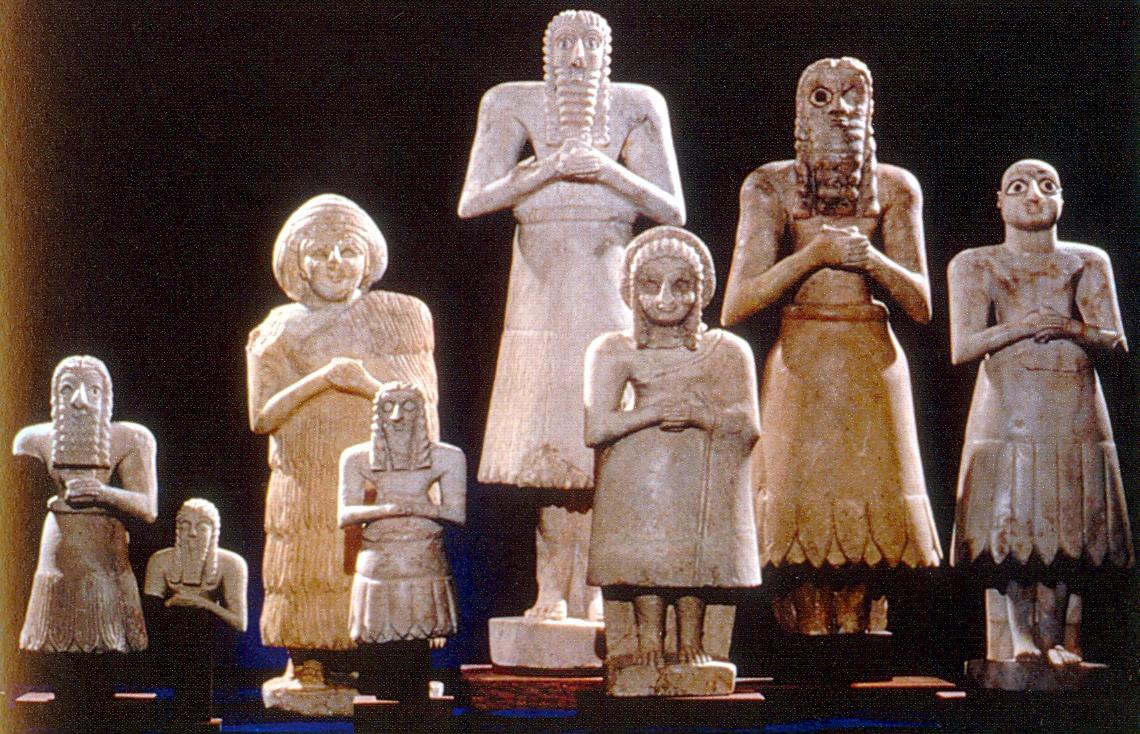
Sumerian annunaki (gods from the sky)
Sumerian annunaki (gods from the sky)

The heavens told of [God’s] true justice;

All the peoples saw [God’s] magnificence.

Every worshiper of a carved idol is shamed,

Those who boast of the elilim.

All elohim bowed down to [God]! (Psalm 97:6-7)

elilim (אֱלִילִים) = worthless gods, nonentities, not-gods, insignificant gods.

“The heavens” in verse 6 probably refers not to the sky, but to the gods (including stars) who dwell in the heavens.  Since even the other gods bow down to Y-h-w-h and acknowledge God’s justice, anyone silly enough to worship these insignificant gods should be ashamed.


It took many centuries for the Israelites to stop worshiping the old gods. People would declare their allegiance to Y-h-w-h, and then slide back into worshiping some other god, a god that “everyone” knew was especially effective at dealing with their current problem.  The Bible repeatedly shows Moses and other prophets scolding the Israelites for straying after other gods, but the scoldings must have been ineffective, since the people kept on backsliding.

It was hard for the Israelites to stick to henotheism, in which their God was supreme and the others were not worth worshiping.  How could they manage the radical idea of monotheism, which the Torah first introduced in Deuteronomy 4:35?  How long did it take, after the second Isaiah preached monotheism during the Babylonian exile, before most Israelites believed there was only one god in the universe?


1  I usually translate the four-letter name as “God”, but in this post it is important to distinguish Y-h-w-h from elohim. I insert hyphens because according to Jewish tradition, God’s personal name must not be spelled correctly in writings that are neither biblical nor liturgical. For many Jews this applies even to spelling the name with Roman letters. (The Hebrew for “lord” or “master” is adon (אָדוֹן). When Jews read out loud in religious services, we often substitute adonai  (“my lords”) for the four-letter name of God.)

2 The Bible uses “elohim” as a singular noun for the gods Baal, Baal-berit, Baal-zebub, Dagon, Kemosh, Milkom, and Nisrach; the goddesses Astarte and Ashtoret; and the golden calf.

3  Psalms 29, 82, 86, 89, 95, 96, 97, 135, and 136 all assume the existence of other gods.

4  Ibn Ezra was the 12th-century Spanish theologian Abraham ben Meir Ibn Ezra.

5  A divine assembly also appears in the book of Job and in Psalms 82 and 89.

Beshalach & Psalm 136: Miracle at Sea

(One of a series of posts comparing ideas in the book of Exodus/Shemot with related ideas in the book of Psalms.)

After the tenth plague, the pharaoh finally lets the Israelites go. Then he has another change of heart, and sends a brigade of charioteers after them. At nightfall the Egyptians catch up with the Israelites at the shore of the sea—the Red Sea in English, the Sea of Reeds (yam sufיַם סוּף) in the Hebrew Bible. Both parties camp for the night, with the Israelites trapped between the enemy and the water.

What happens next? The most familiar version of the story appears in this week’s Torah portion, Beshalach (“When he sent out”).

The Passage of the Red Sea, by William Hole,
The Passage of the Red Sea,
by William B. Hole (1846-1917)

The Prose Account

Moses stretched out his hand over the sea, and God made the sea move with a strong east wind all night. Vayasem the sea dry land, and the waters split. And the Israelites entered the middle of the sea on dry ground, and the waters were for them a wall on their right and on their left. (Exodus/Shemot 14:21-22)

vayasem (וַיָּשֶׂם) = and he/it placed, set, set up, put, put in.

Until I translated these verses, I had the impression that God simply splits the water down to the seabed, which becomes dry and firm enough for the Israelites to walk on. But the Torah says vayasem, as if there were no real bottom to the sea, so God has to install a strip of dry land.  (Many English translations say God “made” or “turned” the sea into dry ground—which has the same implication.)

In the cosmology of the ancient Israelites, beneath the land lies a subterranean ocean of water called the tehom (תְּהוֹם —singular) or tehomot (תְּהֺמֺת —plural). This deep water bubbles up through the earth in the form of springs. Under the ocean, it’s water all the way down, with no ocean floor.1

Pharoah Tutankhamen on a chariot, pursuing Nubians
Pharaoh Tutankhamen on a chariot, pursuing Nubians

And the Egyptians pursued, and all the horses of Pharoah, his chariots, and his horsemen entered after them into the middle of the sea. …And [God] made the wheels of their chariots swerve, and made them proceed laboriously. (Exodus 14:23, 25)

And Moses stretched out his hand over the sea, and the sea settled before morning into its normal flow. And the Egyptians were fleeing from it, and God na-ar the Egyptians into the middle of the sea. And the waters turned back, and they covered the chariots and the horsemen of all the army of Pharaoh, the one coming after them into the sea; not one remained. (Exodus 14:27-28)

na-ar (נָעַר) = shook out, shook off. (The form of this verb used in verse 14:27 is vayena-eir (וַיְנָעֵר). This verb appears only 12 times in the entire Hebrew Bible.)

Safe on the other side of the sea, the Israelites are awed by God’s miracle, and moved to sing along with Moses and Miriam.

The Song of the Sea

That was when Moses sang, along with the children of Israel, this song to God… (Exodus/Shemot 15:1)

The whole “Song of the Sea” that follows is a psalm written in archaic Hebrew, one of the two oldest texts in the Hebrew Bible.2 (The other is the Song of Deborah, Judge 5:1-31.) The scribe who redacted this week’s Torah portion inserted the well-known hymn without changing its archaic syntax and spellings.

The Song of the Sea does not mention God splitting the sea or the Israelites walking on dry land. Nevertheless, one early verse matches the prose account: 

from the Golden Haggadah, c. 1320 Spain
from the Golden Haggadah,
c. 1320 Spain

         Chariots of Pharaoh and his army

                        [God] pitched into the sea,

            And the best of his captains

                        sank in the Sea of Reeds. (Exodus 15:4)

Twice the Song of the Sea says the Egyptians sank all the way down into the tehomot.

           Tehomot covered them;

           They went down into the depths like a stone. (Exodus 15:5)

           In the wind of Your nostrils the waters were dammed up.

                        They stood up like a dike [made of] waves,

                        Congealed tehomot in the heart of the sea. (Exodus 15:8)   

Ice canyon, Antarctica, 2011 photo by NASA
Ice canyon, Antarctica,
2011 photo by NASA

         You blew Your wind; the sea covered them.

                        They sank like lead in the mighty waters. (Exodus 15:10)

This description led 16th-century rabbi Obadiah Sforno to explain that the water at the bottom of the sea became solid, and the Israelites walked across the congealed or frozen water.

Psalm 136

The Bible includes several briefer descriptions of the crossing of the Sea of Reeds, all used as examples of God’s miracles on behalf of the Israelites. But the descriptions in Second Isaiah (51:9-10) and Psalms 77, 106, and 136 do not explain how the Israelites got across the water.

Psalm 136 does, however, refer to God as the one who split the sea, and like the prose account in Exodus it uses the rare word na-ar.

reed-sea-2

           Who cut the Reed Sea into parts,

                        Because forever is [God’s] loyal kindness.

            And let Israel pass through the middle,

                        Because forever is [God’s] loyal kindness.

            Veni-eir Pharaoh and his army into the Sea of Reeds,

                        Because forever is [God’s] loyal kindness. (Psalm 136:13-15)

veni-eir (וְנִעֵר) = And [God] shook off, shook out. (Another form of the verb na-ar נָעַר.)

We do not know which text first used the poetic image of God shaking off the Egyptians into the sea: Psalm 136, or one of the stories woven into the prose account in this week’s Torah portion. 3

If we follow the prose account, the sea divides and a miraculous strip of earth appears over the tehomot. I can picture the earth getting soggy after the Israelites have crossed, so the chariot wheels of the Egyptians get stuck in mud. Then the bridge of earth buckles and shakes off the Egyptians, chariots, and horses into the water, before God’s second wind blows the walls of water down over them.

On the other hand, if we take the Song of the Sea as the oldest, most authoritative account, and follow Sforno’s explanation that the water congeals into a frozen roadway between dikes of ice, then I can imagine the chariot wheels skidding out of control on the slippery surface. This provides an alternate explanation of the detail in the prose account that God “made the wheels of their chariots swerve, and made them proceed laboriously”. (Exodus 14:25)  Then the ice-dikes break and the sea rushes over the Egyptians.

Either of these two pictures of the crossing of the Sea of Reeds is more vivid than most readers—and illustrators—of the Bible imagine.

Unless you are an eye witness, it takes vivid imagery to feel the impact of a miracle. The various Biblical accounts of crossing the Sea of Reeds are designed to make the descendants of the Israelites experience the feeling of a last-minute rescue, and to give them confidence that God has always been on their side. So for centuries the Israelites rejoiced over the miracle at the sea.

Yet after the second temple in Jerusalem fell in 70 C.E., some Jews questioned this attitude. In the Talmud, Rabbi Yochanan says God does not “rejoice in the downfall of the wicked”. He gives the crossing of the Sea of Reeds as an example, saying: “The ministering angels wanted to chant their hymns, but the Holy One, blessed be He, said: The work of my hands is being drowned in the sea, and shall you chant hymns?” (Babylonian Talmud, Soncino translation, Megilah 10b)

I, too, feel sympathy for the Egyptian soldiers. They have no more choice about following the Pharaoh’s orders than the Israelite slaves did before Pharaoh let them go. And their orders were to round up the Israelites (shooting arrows if necessary) and bring them back for re-enslavement.

Suddenly the Egyptians find themselves in the middle of a situation they never imagined was possible.  They are chasing the Israelites across a dirt bridge over the sea, or maybe down an ice canyon. They see the ex-slaves reach the far side, but their chariot wheels are either mired in mud or skidding on ice. Then the Egyptians are shaken off the path like crumbs.  And the sea crashes down on them.

Today people still experience events they never imagined were possible. Sometimes what seems like a good miracle to one group of people is worse than a nightmare to another group.

May we all learn the humanity to refrain from singing out with joy when our opponents are dying. And may God save us all when we find ourselves trapped in a situation we never imagined was possible.

___

1 This detail supports Richard Elliott Friedman’s argument in his Commentary on the Torah (HarperCollins 2001) that although the body of water in question is called the Sea of Reeds, it is no shallow lake, but the Gulf of Suez–the western arm of the Red Sea.

2 The exodus from Egypt is set during Egypt’s 19th Dynasty, which ruled during the 13th century B.C.E. The Song of the Sea mentions the Plashet (Philistines), who did not emigrate to Canaan until about 1175 B.C.E. Thus Moses could not have known or composed the Song of the Sea, but the writer of the Song of Sea might have known the story of the exodus. According to modern scholars, the prose version of the story in Exodus is a compilation of three different stories written in Biblical Hebrew sometime after 700 B.C.E. The redactor also inserted the ancient Song of the Sea.

3 Psalm 136 cannot be reliably dated. The language is consistent with the Hebrew in the book of Exodus (excluding the archaic Song of the Sea). But it could have been written much earlier, and rewritten centuries later with updated language. Or it could even have been written during the time of the second temple, 530 B.C.E.-70 C.E.