Yom Kippur & 2 Samuel: When David Goes Too Far

Below is the eighth and final post in my series on why David is God’s favorite king. It is also a post for Yom Kippur, which begins this Wednesday evening.


Yom Kippur

Yom Kippur (יוֹם כִּפּוּר) means “Day of Atonement”. Atonement is a good translation because, like  kippur, it means making amends or reparations for something a person or a whole group did wrong. The wrong might be ethical and/or it might be a violation against God. The Torah imagines God as a person who issues lots of rules for behavior, and is offended when we disobey them. One of the ways of imagining God today is as our own inner core, the seat of our conscience, from which we are alienated when we violate what we know inside is right.

The Hebrew word kippur can also be translated as “reconciliation”, since we hope that making reparations will lead to forgiveness and a cleaner, better relationship with the people we have wronged, with God, with ourselves. And historically, the English word “atonement” includes the concept of reconciliation. It was coined in the 16th century out of the words “at” and “one”, to express the idea of reunification.

All humans make mistakes. Some are so inconsequential that as soon as we realize we did something wrong, we can apologize, be forgiven, and be reunited in just a minute or two. Others are more serious.

Jews Praying in the Synagogue on Yom Kippur, by Maurycy Gottlieb, 19th century

In Ancient Israel, a day was set aside once a year for an elaborate ritual using two hairy goats to atone for the outstanding misdeeds of the whole community. (See my post Yom Kippur: We.) The nature of the ritual changed almost two thousand years ago, when temple sacrifices were replaced with communal prayer. But the purpose of Yom Kippur is the same. Jewish tradition now encourages people to spend the month leading up to Yom Kippur reflecting on their misdeeds against other people and making whatever apologies and reparations we can—as well as working on forgiving those who wronged us. We also reflect on our misdeeds against God—or ourselves—in the hope of finding forgiveness for them on Yom Kippur.

What counts as an immediately forgivable mistake, and what mistake is so serious that its effects are still outstanding when we reach this time of year?

There is a different answer for each person. In the first and second books of Samuel, David commits a number of errors that count as peccadilloes in the fond eyes of God. But then he goes too far.

David’s peccadilloes

When David first flees from King Saul’s attempts to kill him, he lies to the high priest, who then colludes with him to break God’s rule that the sacred bread laid out for God inside the sanctuary can only be eaten later by priests. The high priest gives him five flat loaves, which he eats on his flight. (See my post 1 Samuel: David the Devious.) The God character stands by when King Saul has the high priest killed for letting David escape; David goes unpunished.

When David has become the leader of a large band of outlaws, he runs a protection racket; he guards Nabal’s sheep and shepherds without any previous arrangement, then asks for payment in food. Nabal refuses, and David sets off with 400 of his men with the intention of killing Nabal and every male in his house. Killing an Israelite without a previous court order of execution is so serious a crime that it gets the death penalty.1 Fortunately, Nabal’s wife intercepts David and persuades him that murder would be a bad idea. Since David does not actually commit the crime, God kills Nabal the next day. (See my post 1 Samuel: David the Devious.)

When David and his outlaw band have moved to the Phillistine state of Gat to avoid King Saul, David deceives the king of Gat into believing that he is a trustworthy defector and vassal. He claims that he is raiding Israelite villages and bringing the loot back to the king of Gat, but actually he is getting the loot by raiding Canaanite villages. David leaves no survivors—no one to reveal his deception. (See my post 1 Samuel: David and the King of Gat.) The God character does not object, since in the Hebrew Bible it is perfectly acceptable to make unprovoked attacks on non-Israelite villages and exterminate everyone, as long as the villages are within the boundaries of the land God assigned to the future kingdom of Israel.2

When David is the king of Judah, General Abner unites the rest of Israel under a puppet king and the two sides fight. Then Abner proposes a peaceful reunification, and concludes a treaty with David in which David will become the king of all Israel. But Joab, David’s nephew and general, kills Abner. King David denounces the murder, but does nothing to punish Joab, who remains his general for the rest of David’s life. (See my post 2 Samuel: David the King.) This is a serious mistake for a king, whose job is to dispense justice. But God looks the other way.

From the time he is secretly anointed as Israel’s next king as a young adolescent, until he actually becomes the king of Israel at age 30, David often misses the mark. But he also demonstrates good qualities for a king, such as intelligence, courage, cleverness, eloquence, charm, and solidarity with his followers. And at key times he inquires of God3 and follows God’s advice. So God, who chose him in the first place, continues to help him despite his peccadillos.

Then David goes too far.

David’s unforgiveable act

By the time he becomes the king of Israel, David already has seven wives.4 Some years pass while King David builds his new capital in Jerusalem and engages in various conquests. Then, while General Joab and his troops are besieging the capital of the kingdom of Ammon, David goes for an evening stroll on the roof of his palace in Jerusalem.

Bathsheba, by Jean-Leon Gerome, 1889

And from upon the roof he saw a woman bathing. And the woman was very good-looking. And David sent [someone] and he inquired about the woman. And he said: “Isn’t this Bathsheba, daughter of Eliam, wife of Uriyah the Hittite?5 (2 Samuel 11:2-3)

An upright man would sigh and perhaps distract himself with one of his own wives. Adultery is forbidden in the Ten Commandments, and a man who has sex with a married woman gets the death penalty—if he gets caught.6

Then David sent messengers and had her taken. And she came to him and he lay down with her. And she had just purified herself from her [menstrual] impurity. And she returned to her house. And the woman became pregnant, and she sent and had it told to David; she said: “I am pregnant!” (2 Samuel 11:4-5)

Bathsheba has just had a ritual bath to purify herself after the end of her period, and her husband is away at the war in Ammon. David’s first thought is that he can still cover up his crime by getting Uriyah to come home and have sex with his wife before her pregnancy shows.

King David summons Uriyah, has a plausible conversation with him about what is happening at the battlefront, then tells him to go home, wash his feet, and relax.

But Uriyah lay down at the entrance of the king’s house with all his lord’s servants, and he did not go down to his own house. (2 Samuel 11:9)

In the morning David asks him why, and Uriyah replies that when his fellow soldiers are camping on the bare ground in Ammon,

“… then I, should I come into my house to eat and to drink and to lie down with my wife?” (2 Samuel 11:11)

Uriyah’s refined moral scruples are blocking David’s unscrupulousness. The next day David gets Uriyah drunk, but the man still refuses the comforts of home. So David sends him back to Ammon with a letter for General Joab: a secret order to put Uriyah in a position where Ammonite soldiers will be sure to kill him. It works; Uriyah is shot down.

And Uriyah’s wife heard that Uriyah, her man, was dead, and she lamented over her husband. And when the mourning period was past, David sent and had her removed to his house, and she became his wife, and she bore him a son.  (2 Samuel 11:26-27)

Problem solved, from King David’s point of view. But not from God’s point of view.

And the thing that David had done was evil in the eyes of God. And God sent Nathan to David. (2 Samuel 11:27-12:1)

The prophet Nathan tells King David a parable in which a rich man with many flocks seizes and slaughters a poor man’s only lamb, whom the poor man had nurtured like his own child. Outraged, David declares that the rich man deserves death. Then, probably remembering that the legal penalty for theft is restitution,7 he declares that the rich man must compensate the poor man by paying him four times the price of the lamb—

“—because he did this thing, and since he had no pity!” Then Nathan said to David: “You are the man!  (2 Samuel 12:6-7)

The prophet then repeats a long speech by God, including these two key sentences:

“Why have you despised the word of God, to do what is evil in my eyes?” (2 Samuel 12:9)

“Here I am, making evil rise up against you from your own house!” (2 Samuel 12:11)

When the speech is over,

Then David said to Nathan: “I am guilty before God!” And Nathan said to David: “Furthermore God has passed along your guilt. You will not die … the son who was born to you, he will definitely die.” (2 Samuel 12:13-14)

Then God afflicts the baby with sickness, and seven days later he dies. But David and Bathsheba have another son, Solomon, who eventually becomes the next king of Israel.

Atonement

Is it enough for David to realize his crime, admit his guilt, and suffer the punishment of the death of his son? Has he now achieved atonement or reconciliation with God?

No. That would be too easy for such a heinous crime. Evil does indeed rise up against David from his own house. As the Talmud points out,

“The lamb was a metaphor for Bathsheba, and ultimately David was indeed given a fourfold punishment for taking Bathsheba: The first child born to Bathsheba and David died (see 2 Samuel 12:13–23); David’s son Amnon was killed; Tamar, his daughter, was raped by Amnon (see 2 Samuel 13); and his son Avshalom rebelled against him and was ultimately killed (see 2 Samuel 15–18).”8

The character of God does not appear during that whole complicated story. There is no divine interference even when David’s son Avshalom (Absalom) claims Jerusalem, and David is forced into exile. After Joab kills Avshalom in a battle between the two sides, a grieving David laboriously puts his kingdom back in order. After those years of suffering, there is a three-year famine. Then King David finally turns back to God and asks what to do, and God answers.9


The story of King David illustrates that a person who is blessed, like God’s favorite king, can get away with a lot of missteps. But if someone who seems to have a charmed life strays too far from fundamental morality, a chasm opens inside, and it takes many years to find atonement, reconciliation, and reintegration. One Yom Kippur, I believe, is not enough. In this new year of 5786 in the Hebrew calendar, I pray that all those who remember to return to the right path will rejoice to find their feet on it once more. And I pray that those who have gone too far will begin the long journey back.


  1. Exodus 21:12, Deuteronomy 17:6-12.
  2. See my post Eikev & Judges: Love or Kill the Stranger?
  3. See my post 2 Samuel: David the King.
  4. Mikhal, King Saul’s daughter; Achinoam of Jezreel; Abigail, Nabal’s widow; Maacah, daughter of the king of Geshur; and three wives of unknown provenance from his time as the king of Judah, Chagit, Avital, and Eglah. See 1 Samuel 18:20-27, 2 Samuel 3:2-5.
  5. He is called “Uriyah the Hittite” to identify his ethnicity. The troops of Israelite kings in the Hebrew Bible often include men from non-Israelite lineages who nevertheless are treated as citizens of Israel. His name is Hebrew: Uri-yah (אוּרִיָּה) = My Light is God.
  6. Leviticus 20:10.
  7. The Torah prescribes different amounts of financial restitution for different objects stolen. Exodus 21:37 lists the penalty for stealing a sheep as paying the owner four times the value of the sheep.
  8. Talmud Bavli, Yoma 22b, William Davidson (Steinsaltz) translation, in www.sefaria.org. The sources in parentheses are included in the text.
  9. 2 Samuel 21:1.
2 Samuel: David the King

(Below is the seventh post in my series on why David is God’s favorite king—whether he acts ethically or not. If you want to read one of my posts on this week’s Torah portion in Deuteronomy, you might try Vayeilekh: Two Transitions. And since the Jewish new year, Rosh Hashanah, begins tonight, I wish you all a good year, shanah tovah, in this time of uncertainty!)


The first book of Samuel ends with a major battle in the Jezreel Valley between the Israelites and the Philistines. The Philistines win and take over the large valley. Both King Saul and his oldest son, Jonathan, die in battle. But David, who once was King Saul’s most famous commander, is absent. (See my post 1 Samuel: David and the King of Gat.)

The second book of Samuel opens with a man bringing David news about the Philistine victory and the deaths of King Saul and his oldest son, Jonathan. David mourns for his enemy, Saul, as well as for his ally, Jonathan.

And it was after this when David inquired of God, saying: “Should I go up into one of the towns of Judah?” (2 Samuel 2:1)

Inquiring of God

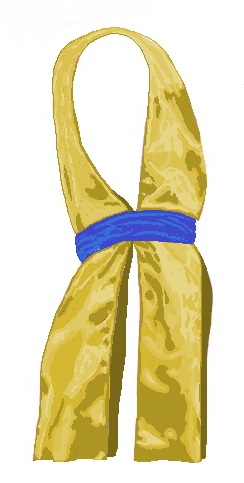
The eifod over the long blue tunic of a high priest

The phrase “inquired of God” does not mean asking God directly; in the Hebrew Bible, only the most advanced prophets can do that. Anyone else with a question for God goes to either a prophet, or a priest with a divining instrument called an eifod (אֵפוֹד).

One member of David’s outlaw band is Evyatar, the son of the high priest of Nov, who escaped with his father’s eifod when King Saul had every resident of Nov massacred. (See my post 1 Samuel: David the Devious.) David previously asked Evyatar to “inquire of God” before he ordered his band of 600 men to rescue the Israelite town of Ke-ilah from the Philistines, and before they left Ke-ilah because King Saul was bringing troops to capture him.1 He did it again when he and his men returned to Ziklag and found that Amalekite raiders had destroyed the village and taken all of their wives and children.2

All three times, David did what the eifod said God wanted, and the results were good (at least for David and his men).

Now that King Saul and his firstborn son are dead, David “inquires of God” to find out whether it is time to rally support in the territory of his own tribe, the tribe of Judah.

The answer is yes. When David asks which town in Judah he should “go up into”, i.e. make his headquarters, the priest uses his eifod again and comes up with the answer: Hebron. So David and his whole outlaw band move into Hebron and its surrounding villages.

And the men of Judah came, and there they anointed David as king over the house of Judah. (2 Samuel 2:4)

David, king of Judah

This is not David’s first anointment. When he was still a boy, the prophet Samuel secretly anointed him as the next king of all Israel. (See my post 1 Samuel: Anointment.) Now the leaders of Judah anoint him as the king of their tribe. A single tribe has never had its own king before, and never does again.3

While David is ruling as the king of Judah, Abner, who served as Saul’s general after David fled, is uniting all the other tribes to recognize Saul’s fourth son, Ishboshet, as the king of all Israel. (Saul’s three oldest sons died in the battle with the Philistines in Jezreel.) Once Abner has consolidated power under his puppet king, the two sides go to war.

And the war was long between the house of Saul and the house of David, and David was growing stronger and the house of Saul was growing weaker. (2 Samuel 3:1)

Eventually Abner meets with David in Hebron and offers to get all the other tribes of Israel to accept David as their king. David accepts the peace treaty. But after Abner leaves, Joab, David’s nephew and general, send a message to him. Abner returns, and Joab meets him at the city gate.

And Joab took him aside into the middle of the [double walls of the city] gate to speak with him privately. Then he struck him there in the belly, so he died in exchange for the blood of his brother Asaheil. (2 Samuel3:27)

In an earlier battle Abner had killed Joab’s brother Asaheil with a blow to the belly,4 so it seems like a revenge killing. But I wonder if Joab has second motive; he would not want to be demoted in favor of General Abner when the kingdom of Israel is reunited.

David distances himself from the murder by cursing Joab and his descendants (without using God’s name to make the curse more effective) and by elaborately mourning for Abner. He even makes Joab and all the troops tear their clothes and lament at the funeral procession. After burying Abner, David praises the dead general and concludes:

“May God repay the doer of the evil according to his evil!” (2 Samuel 3:39)

But David does not fire his nephew Joab. Nor does he inquire of God about what to do with him.

Joab serves as the chief commander of the Israelites for the rest of King David’s life, with no interference from God. Even though Joab killed Abner for personal reasons rather than for the good of King David or Israel, David is still God’s beloved. As long as David wants to keep Joab, God looks the other way.

King Ishboshet is soon assassinated, and leaders from all the tribes of Israel come to Hebron to pledge their allegiance to David. They tell him:

And God said to you: “You yourself will shepherd my people Israel, and you yourself will be ruler over Israel.” (2 Samuel 5:2)

Of course they have no idea what God actually said to David. But according to Robert Alter, attributing those words to God provides “the divine declaration of David’s legitimacy as ruler”.5

And all the elders of Israel came to the king at Hebron, and King David cut a covenant with them in Hebron before God. And they anointed David king over Israel. David was 30 years old when he became king, and he ruled for 40 years. (2 Samuel 5:3-4)

Rabbi Steinsaltz explained: “This was a bilateral agreement. The people accepted David’s reign upon themselves, while he granted a general amnesty, committing to take no actions to settle old scores, as some of the people had not supported him in the past.”6

Fifteen to twenty years have past since the prophet Samuel secretly anointed young David at God’s behest.7 Now, at age 30, he is publicly anointed king by “all the elders of Israel”.

David, king of Israel

Without consulting God, David captures the Jebusite town of Jerusalem by sending his men through a water conduit in a surprise attack. He turns the town into the new capital of Israel.

And David settled in the fortress, and he called it the City of David. And David built all around, from the rampart inward. And David went on and on and became great; and God, the god of armies, was with him. (2 Samuel 5:9-10)

As soon as the Philistines hear that David is now the king of Israel, they send a united army to Jerusalem, and camp just west of the city. Although they could not conquer Israel during the reign of King Saul, they hope to win a battle with the new king.

Then David inquired of God, saying: “Should I go up against the Philistines? Will you give them into my hand?” (2 Samuel 5:19)

A major battle with the Philistine army is more perilous than a surprise attack on the town of the Jebusites. So David turns to divination to ask if God will help him. And God says yes. The Israelites win the battle, but the Philistines regroup, come back, and try again. Again David inquires of God whether he should go up against the Philistines. This time God answers no—he should lead his men around behind the Philistine army.

And let it be, when you hear the sound of marching in the tops of the balsam trees, that is when God will go out before you, to strike down the camp of the Philistines. And David did so, as God had commanded him. And he struck down the Philistines from Geva until you come to Gazer. (2 Samuel 5:24-25)

With God’s help, David wins such a decisive victory that the Philistines do not cross over the border into the kingdom of Israel again.

Next King David makes Jerusalem the religious, as well as political, capital of Israel. He brings the ark to Jerusalem and places it in a tent until he can build a temple for it. Then he consults the prophet Nathan, who has a dream in which God dictates a long message to David. Nathan recites the message to his king, telling him that God does not want him to build the temple, but one of David’s sons will be king after him and build it, and his descendants will be kings of Israel forever.8

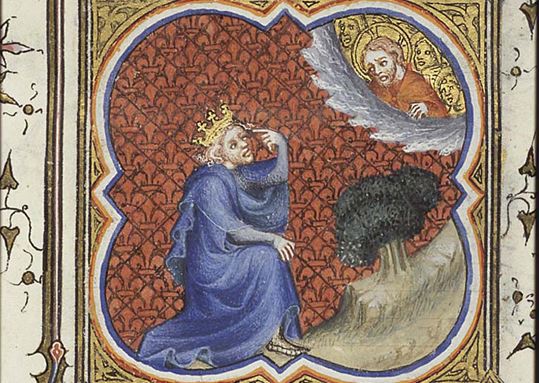
David Addresses God, Petrus Comestor Bible Historiale, 1372 (The artist has replaced the ark with a bush.)

David sits in front of the ark inside the tent, tells God his gratitude for everything God has done, and concludes:

“And now, be pleased and bless the house of your servant to be forever in your presence, since you, my lord God, you have spoken. And through your blessing may the house of your servant be blessed forever!” (2 Samuel 7:29) So far, so good. But later, David gets a married woman pregnant, than arranges the death of one of his own soldiers to cover it up. That is too much; he loses God’s approval. After that, bad things start happening to David. (See my next blog post.)


Sometimes David inquires of God through his priest’s eifod or through his prophet. Asking God what he should do, and then doing what God says, is a way to ensure that God will back him up when he initiates a battle or makes a critical move.

The rest of the time, David acts on his own initiative, and—so far—it goes well. God does not intervene. The God character seems to have chosen David as a boy because of his pluck as well as his intelligence, and probably God remains happy to see his protégé exercising these traits as an adult.

Like David, when we are young we can often succeed through our own initiative, but it helps to have an authority figure to consult with for advice and the promise of back-up. When we grow old, we are the only authority figures. At least we can draw on more experience at 60 than at 30. But we are fooling ourselves if we think we can consult God through a divining device, or through someone’s dream. In our world, we always have to figure out the best course of action on our own.


  1. 1 Samuel 23:2-4 and 1 Samuel 23:11-12. See my post 1 Samuel: David the Devious.
  2. 1 Samuel 30:7-8. See my post 1 Samuel: David and the King of Gat.
  3. Even when the kingdom of Israel divides into two kingdoms in the first book of Kings, the land of the tribe of Benjamin is included in the kingdom named Judah.
  4. 2 Samuel 2:18-24.
  5. Robert Alter, Ancient Israel: The Former Prophets, W.W. Norton & Co., New York, 2013, p. 450.
  6. Adin Even-Israel Steinsaltz, Introductions to Tanakh, 2 Samuel, as quoted in www.sefaria.org.
  7. See my post 1 Samuel: Anointment.
  8. 2 Samuel 7:1-17.

1 Samuel: Sacred Kings

(If you want to read one of my earlier posts on this week’s Torah portion, Ki Teitzei (Deuteronomy 21:10-25:19) you might try: Ki Teitzei: Virtues of a Parapet. Below is the fifth post in my series on why David is God’s favorite king—whether he acts ethically or not.)


The first king of the Israelites is Saul, who was anointed by the prophet Samuel at God’s command. But Saul turns out to be an unsatisfactory king, from Samuel and God’s point of view; he is more concerned about keeping his troops happy than about following God’s rules.1 So God tells Samuel to secretly anoint David as the next king.

And Samuel took a horn of oil and anointed him in the midst of his brothers. And the ruach of God rushed through David from that day and onward. Then Samuel got up and went [back] to Ramah. Then the ruach of God turned away from Saul, and a malignant ruach from God terrified him. (1 Samuel 16:13-14)

ruach (רוּחַ) = wind; spirit, disposition.

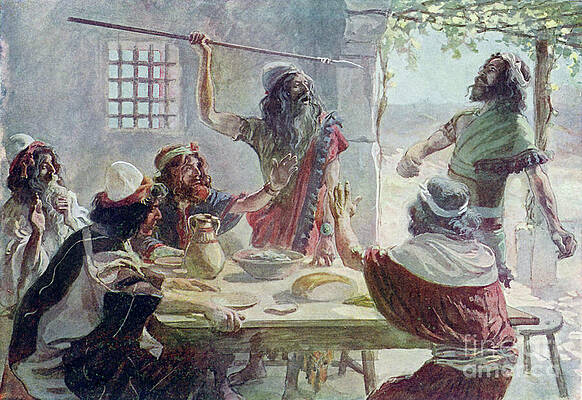
Saul Casts a Javelin at Jonathan, by James Tissot, ca. 1900

The malignant ruach afflicts King Saul with bouts of paranoia, in which he is terrified that David, his loyal army commander, will kill him and seize his throne. While he is in the grip of this spirit, he throws a spear or javelin at David twice. Later, when Saul’s own son and heir, Jonathan, questions his plan to kill David, Saul throws a spear at him, too. The king even orders a whole town of Israelite priests and their families massacred because the high priest helped David to escape.2

David becomes the leader of an outlaw band moving from place to place as King Saul tries to hunt them down. Yet there is no revolution, and no coup. David does not become the king until many years later, after Saul has died in a battle with the Philistines. Why does David wait?

The king’s robe

On one expedition Saul takes 3,000 men to En-Gedi, where he has heard that David and his 600 outlaws are hiding. Saul steps into a cave to defecate in private. He has no idea that the cave is large enough to hide hundreds of men, who are sitting in the recesses of the cave behind him.

Then David’s men said to him: “Here is the day about which God said to you: ‘Hey, I myself give your enemy into your hand!’ And you can do whatever seems good in your eyes to him!” And David got up and stealthily cut off the corner of Saul’s me-il. (1 Samuel 24:5)

me-il (מְעִיל) = a robe worn over the tunic by members of the royal family, high priests, and Samuel (who was a priest before becoming a prophet and judge).

Nowhere in the first book of Samuel does God promise to give an enemy into David’s hand. But David’s men are hoping to motivate him to kill Saul, without saying so directly.

They fail. Instead of stabbing Saul from behind, David merely collects evidence that he could have done so if he had chosen.

And he said to his men: “Far be it from me, by God, if I should do this thing to my lord, to God’s anointed, to stretch out my hand against him! For he is God’s anointed!” (1 Samuel 24:7)

This is an interesting statement by someone who is also God’s anointed. Perhaps David is so awed by his own anointment that he is also awed by Saul’s status. Or perhaps he is planning ahead, setting an example so that when he himself is the king, his subjects will treat his life as sacred, too.

When Saul stands up and walks out, David restrains his men. Then he steps out of the cave and calls after the king. Saul turns around, and David prostrates himself at a distance. He  immediately starts talking, probably so that Saul will listen to him instead of calling his soldiers. Partway through his oration, David points out that he could have killed Saul while the king was squatting in the cave.

“But I had compassion on you, and I said: ‘I will not stretch out my hand against my lord, for he is God’s anointed.’ And see too, my father: see the corner of your me-il in my hand! For when I cut off the corner of your me-il I did not kill you! Know and see that there is no evil or rebellion in my hand, and I did not do wrong against you. Yet you are lying in wait to take my life!” (1 Samuel 24:9-12)

By saying he had compassion on Saul, David puts the idea of compassion into Saul’s mind. By prostrating himself to Saul and calling him “my father” (which acknowledges Saul’s position as both his king and his father-in-law3), he subtly invites the king to be solicitous toward his inferior.

Although David promises that he will never make a move against Saul, he implies that God will:

“Let God judge between me and you, and let God take vengeance for me upon you, but my hand will not be against you!” (1 Samuel 24:13)

If David is hinting to God, God does not respond. David elaborates on his theme until Saul finally answers.

“Is this your voice, my son David?” And Saul lifted up his voice and wept. And he said to David: “You are more righteous than I am, because you have repaid me with goodness, and I have repaid you with evil.” (1 Samuel 24:17-18)

David has succeeded in touching Saul’s good (and rational) ruach. His gamble pays off. Instead of ordering his troops to attack the cave, Saul goes home. The king does not go as far as inviting David to resume his old position in court, and David knows better than to ask.

Before long, Saul’s paranoid ruach overcomes his good ruach again, and he sets off with another troop of soldiers to hunt down David in the wilderness.

Since he knows how changeable Saul is, why does David cut off the corner of the royal robe, then step out to speak to Saul? He could have just stayed in hiding.

My guess is that David puts on a show to satisfy his men. Since he is unwilling to kill Saul, he stages a piece of theater for them that makes him look bold and noble.

The king’s spear

When David and his outlaws are in the wilderness of Zif, some locals report it to King Saul, who collects 3,000 men and sets out again. At night David looks down at the king’s campsite from a hilltop. Saul and his general, Abner, are asleep in the middle of the camp, surrounded by their sleeping troops. Near Saul’s head is a water jug, and the king’s spear, thrust into the ground. David’s nephew Avishai says:

“Today God has delivered up your enemy into your hand! And now, please let me strike him into the ground with the spear, one time! I will not [need to do it] twice to him!” (1 Samuel 26:8)

Avishai is bragging that he can kill Saul with one blow, so nobody in the camp will hear a cry. He is confident that he is a better spear thrower than the king, who missed David twice and Jonathan once.

But David said to Avishai: “You must not destroy him! Because who stretches out his hand against God’s anointed and is exempt from punishment?” (1 Samuel 26:9)

David’s disappointed nephew is silent. David says:

“… God will smite him instead. Either his day will come and he will die, or he will go down in battle and be snatched away. Far be it from me, by God, to stretch out my hand against God’s anointed! And now, please take the spear that is at his head, and the jug of water, and we will go on our way.” (1 Samuel 26:10)

Once again, David emphasizes the importance of doing no harm to God’s anointed king. Taking a symbol of kingship is different, however, whether it is the king’s spear or a corner of his robe.

Then David steals down and takes the spear and water jug himself, perhaps concerned that his young nephew might kill Saul despite his orders. This is when God enters the picture and demonstrates approval of David’s restraint.

And there was no one who saw, and no one who knew, and no one who was rousing, because all of them were sleeping—because the deep slumber of God had fallen upon them. (1 Samuel 26:12)

When David is safely back on the hilltop, he shouts and wakes up everyone below. He accuses General Abner and his men of failing at their job.

“… You did not keep watch over your lord, over God’s anointed! And now, see: Where are the king’s spear, and the jug of water that was at his head?” (1 Samuel 26:16)

Once again, David refers to “God’s anointed”. This way of describing a king reflects his own attitude toward kingship, but it is also a good seed to plant in the minds of the soldiers for the day when David reveals he, too, is God’s anointed.

And Saul recognized David’s voice, and said: “Is this your voice, my son David?” And David said: “My voice, my lord king.” (1 Samuel 26:17)

This time Saul begs David to come back, and promises that he will never do anything bad to David again. But David merely orders someone to return the king’s spear. His last words to Saul are:

“Today God gave you into my hand, but I was not willing to stretch out my hand against God’s anointed.  And hey! As your life has been important today in my eyes, so may my life be important in God’s eyes, and may [God] rescue me from every distress!” (1 Samuel 26:23-24)

Here David is really addressing God. Robert Alter wrote that David “hopes that God will note his own proper conduct and therefore protect him.”5

The king’s death

Tired of being hunted by King Saul, David takes his whole band of outlaws across the border into Philistine territory. While David and his men are in the Philistine village of Ziklag, there is a major battle between the Philistines and the Israelites in the Jezreel Valley in Israelite territory. The Philistines win and occupy the Jezreel, the Israelites who are not killed flee, and Saul and three of his sons, including Jonathan, die on the battlefield. Saul, wounded by arrows, asks his weapons-bearer to finish him off, but the man is feel so awed and fearful that he refuses. David is not the only Israelite who believes a king anointed by God is sacrosanct! So Saul dies by falling on his own sword.6

The second book of Samuel opens with a young man running from the battlefield all the way to Ziklag. He prostrates himself to David, then tells him what happened. His story of how King Saul died is different:

“… he turned around and he saw me and he called out to me, and I said: ‘Here I am’. And he said to me: ‘Who are you?’ And I said to him: ‘I am an Amalekite”. And he said to me: ‘Stand over me, please, and give me the death-blow, because weakness has seized me, though life is still in me.’ Then I stood over him and I gave him the death-blow, since I knew that he could not live long after having fallen. Then I took the circlet that was on his head and the bracelet that was on his arm, and I brought them to my lord here.” (2 Samuel 1:7-10)

According to Robert Alter: “A more likely scenario is that the Amalekite came onto the battlefield immediately after the fighting as a scavenger, found Saul’s corpse before the Philistines did, and removed the regalia. … he sees a great opportunity for himself: he will bring Saul’s regalia to David, claim personally to have finished off the man known to be David’s archenemy and rival, and thereby overcome his marginality as a resident alien … by receiving a benefaction from the new king …”7

But the Amalekite does not know that an anointed king is sacrosanct in David’s eyes. David rips a tear in his clothes in mourning, and demands:

“How were you not afraid to stretch out your hand to destroy God’s anointed!” (2 Samuel 1:14)

Then he has the Amalekite executed.


David could have interpreted his anointment by a prophet in the name of God as permission to supersede the previously anointed king as soon as possible. Instead, he takes the position that anyone who is “God’s anointed” is sacrosanct, and any attempt to kill that person is a crime against God.

During the period when David is an outlaw, he bends a few rules. But he also consults God through oracular devices and does what God says;8 and he maintains that the life of anyone whom God has had anointed is sacred. His attitude toward God keeps him in God’s favor. So God helps him by casting a deep sleep over Saul’s camp while David steals the king’s spear.

Can this warm relationship between David and the God character continue even when David goes to work for the Philistine king who is the chief the enemy of Israel? We shall see in next week’s post, 1 Samuel: David and the King of Gat.


  1. 1 Samuel 10:19-22, 15:9-11. See my first post in this series: 1 Samuel: Anointment.
  2. Saul throws spears at David in 1 Samuel 18:9-12, 19:9-11, and at Jonathan in 1 Samuel 20:30-33. (See my third post in this series: 1 Samuel: David the Beloved.) Saul has everyone in the town of Nov massacred in 1 Samuel 22:16-19. (See my fourth post in this series: 1 Samuel: David the Devious.)
  3. David is married to Saul’s second daughter, Mikhal. She helped him to escape their house when Saul’s men came to kill him, but David never tried to arrange for her to leave and join the outlaws. See my post: 1 Samuel: David the Beloved.
  4. 1 Samuel 24:20-21.
  5. Robert Alter, Ancient Israel: The Former Prophets, W.W. Norton &Co., New York, 2013, p. 399.
  6. 1 Samuel 31:1-7.
  7. Alter, pp. 426-427.
  8. See my post: 1 Samuel: David the Devious.

Haftarat Shemini—2 Samuel: Legacy

The obvious connection between this week’s Torah portion and haftarah reading is the message that God might strike dead even people who are doing God’s work, if they don’t get proper authorization for every action.

In the Torah portion, Shemini (Leviticus 9:1-11:47), two of Aaron’s sons who have just been consecrated as priests bring unauthorized incense into the sanctuary; God consumes their souls with fire.1 (See my post Shemini: Fire Meets Fire.) In the accompanying haftarah reading from the prophets, 2 Samuel 6:1-7:17, King David is transporting the ark on an ox cart to Jerusalem. Uzza, one of the two ad-hoc priests walking beside it, puts his hand on the ark to steady it when the oxen stumble; God strikes him dead “over the irreverence”.2 (See my post Shemini & 2 Samuel: Segregating the Holy.)

Eifod with sash,
side view

But Uzza’s death during King David’s first attempt to bring the ark to Jerusalem is not long enough for a haftarah portion. So the reading for this week continues with David’s second, successful transportation of the ark to his new capital. In this story, he dances in front of the ark wearing only a tabard called an eifod, and whenever he whirls his genitals are exposed. His wife Mikhal scolds him, but God apparently does not find David’s half-naked dancing irreverent; God punishes Mikhal with childlessness, but does nothing to David. (See my post Haftarat Shemini—2 Samuel: A Dangerous Spirit.)

The third story

A third story, which completes the haftarah, begins:

And it happened that the king was settled in his bayit, and God gave him rest from all the enemies around him. And the king said to Natan the Prophet: “See, please! I myself am dwelling in a bayit of cedar, and the ark of God is dwelling within the curtains [of a tent]!” (2 Samuel 7:1-2)

bayit (בַּיִת) = 1) house; any building where humans or a god reside at least part-time. 2) household; everyone who lives in the householder’s compound, including slaves as well as family members. 3) dynasty, lineage (like today’s House of Windsor).

Earlier in the haftarah, David brought the ark—considered God’s throne—into a tent he had pitched near his new cedar palace in Jerusalem.3 Now, when he says the ark is “dwelling within the curtains”, we learn that part of that tent is screened off from the main area with curtains, like the curtain that screened off the Holy of Holies in the portable tent sanctuary the Israelites built at Mount Sinai in the book of Exodus.

According to 11th-century commentator Rashi,4 King David thinks it is time to fulfill one of Moses’ commands in Deuteronomy about building a temple:

And you will cross the Jordan and settle in the land that God, your God, is allotting as your possession, and you have rest for yourselves from all your enemies from all around, and you dwell in safety, then it will become the place where God, your God, chooses [God’s] name to inhabit. There you must bring all that I command you, your rising-offerings and your slaughter-offerings … (Deuteronomy 12:10-11)

But 21st-century commentator Everett Fox wrote: “In the ancient Near East, such a desire would have been prompted not merely by piety; temples were political statements as well, symbolizing a god’s approval and protection of the regime.”5

King David’s motivations for building a temple could include a desire to welcome God at a higher level, a need to show everyone that Israel has its own powerful god, and a wish to leave a legacy in a world where he might lose the kingship like his predecessor, King Saul.

But David is foiled when the prophet Natan hears from God that night.

Nathan Tells David, by Jacob Backer, ca. 1633

And that night, the word of God happened to Natan, saying: “Go and say to my servant David: Thus said God: Are you my builder of a bayit for me to stay in?” (2 Samuel 7:4-5)

Midrash Tehillim6 adds to the biblical story by adding to what God said, claiming that God refused to let David build the temple because he had “shed much blood”. This is probably not a reference to all the Philistines David killed when he was an Israelite general, but rather to David’s killing and looting when he was the leader of an outlaw band and worked for a Philistine king.7

Midrash Tehillim also points out that Psalm 30 begins: “A psalm song of the dedication of the bayit for David”. Therefore, the midrash says, even though David did not build the temple, it was named after him—“to teach you that whoever intends to perform a commandment but is prevented from doing so, the Holy One, blessed be He, credits him as if he had performed it.”8

But God gives Natan a different explanation in this week’s haftarah:

“For I have not stayed in a bayit from the day I brought up the Israelites from Egypt until this day; but I have been moving about in a tent and in a sanctuary. Wherever I have been moving about among the Israelites, have I ever spoken a word with one of the leaders of Israel whom I commanded to shepherd my people Israel, saying: Why didn’t you build me a bayit of cedar?” (2 Samuel 7:6-7)

Once again God has asked a rhetorical question whose answer is “No”.

“Now you must say thus to my servant David: Thus said the God of Armies: I myself took you from the pasture, from following the flock, to become ruler over the people, over Israel.” (2 Samuel 7:8)

When Natan repeats this to David, it will serve as a reminder both of how far he has come, and of how God is in charge. Next God affirms that the people will remain safe from enemies in the land David has finished conquering. Then comes a promise to David:

“And God declares to you that God will make a bayit for you.” (2 Samuel 7:11)

King David has already built his own cedar palace. Now God is promising a different kind of bayit for him: a dynasty.

“When your days [of life] are filled, and you lie with your forefathers, then I will raise up your seed after you, one who issued from your innards, and firmly establish his kingship. He will build a bayit for my name, and I will establish the throne of his kingship forever.” (2 Samuel 7:12-13)

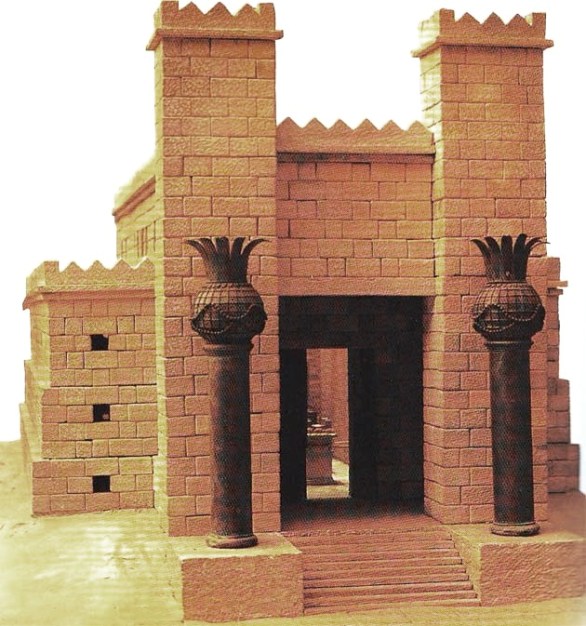
Reconstruction of Solomon’s temple,
Bible Museum, Amsterdam

David has not yet seen Batsheva at this time. But eventually David’s second child by Batsheva, Solomon, becomes the next king of Israel. Solomon does build a temple (bayit) dedicated God in Jerusalem.9 He is not as effective at building a dynasty (bayit) dedicated to God, and the northern half of his kingdom breaks away shortly after he dies. But kings from his line do rule Judah, the southern half of David and Solomon’s kingdom, until the Babylonian conquest over 200 years later.

Natan’s vision from God concludes with a reassurance that God will not replace David’s son with a new king, the way God replaced King Saul with David.

“I will be a father to him, and he will be a son to me. When he acts perversely, I will rebuke him with the rod of men and the affliction of humans. But my loyal kindness will not be removed from him as I removed it from Saul, whom I removed [to make room] for you. And your bayit and your kingship are confirmed forever before me; your throne will be established forever.” According to all these words and all this vision, thus Natan spoke to David. (2 Samuel 7:14-17)

In effect, God adopts David’s future son Solomon.

A qualification

What God does not say is that God’s promise to King David is contingent on the next king’s good behavior. In the first book of Kings, King Solomon completes the temple in Jerusalem and God fills it with a cloud of glory.10 Then Solomon makes a long speech to the assembled crowd, in which he says:

“And now, God of Israel, please let your word be confirmed that you promised to your servant David, my father.” (1 Kings 8:26)

Eight days later, after the people go home, God appears to King Solomon and says:

“And you, if you walk before me like your father David walked, with a whole heart and with uprightness, doing everything that I commanded you, keeping my decrees and my laws, then I will erect the throne of your kingship over Israel forever, as I spoke regarding your father David, saying: No one will cut you off from the throne of Israel. [But] if you actually turn away from me, you or your descendants, and do not keep my commands [and] decrees that I have set before you, and you go and serve other gods and bow down to them, then I will cut off Israel from the face of the soil that I gave them. And the bayit that I made holy to my name I will send away from my presence, and Israel will become a proverb and a taunt among all peoples.” (1 Kings 9:4-7)

Is the bayit that God made holy the temple? God hallowed it by filling it with the divine cloud of glory. But although God stay away from the temple, the physical building cannot be sent anwhere. A couple of centuries later, when the Babylonians loot and burn the temple,11 2 Kings and Jeremiah consider it a punishment for bad behavior.

What if the bayit that God made holy is the dynasty of King Solomon? Then the appearance of the cloud of glory shows that God has consecrated Solomon. And Solomon’s dynasty is “sent away from God’s presence” when the Babylonian army deports the last two kings of Judah, Jehoiachin and Zedekiah, to Babylon.


The yearning to leave a legacy, something that will last long after your death, is part of human nature. Parents hope their children’s children’s children will pass down their genes and their family history. Writers hope people will read their work after they are gone. Founders of businesses hope their companies will go on for decades without them.

The book of Ecclesiastes (Kohelet) notes:

The living know they will die. But the dead know nothing; they have no more reward, since even the memory of them is forgotten. Also their loves and their hates and their jealousies have already perished; and they have no share ever again in anything that is made under the sun. (Ecclesiastes 9:5-6)

King David does not get to build a bayit of cedar and stone to be God’s temple, but God consoles him with the promise that he will build a dynasty, a bayit of a royal line. But even that does not last forever.


  1. Leviticus 10:1-5.
  2. 2 Samuel 6:3-7.
  3. 2 Samuel 6:17.
  4. Rashi is the acronym of 11th-century Rabbi Shlomoh Yitzchaki.
  5. Everett Fox, The Early Prophets, Schocken Books, New York, 2014, p. 454.
  6. Midrash Tehillim on Psalm 62, 11th century.
  7. See 1 Samuel 27:8-12.
  8. Midrash Tehillim on Psalm 62. Translation from www.sefaria.org.
  9. 1 Kings 6:1-8:46.
  10. 1 Kings 8:10-11.
  11. 2 Kings 25:8-18.

Chayei Sarah & 1 Kings: Old Age for Scoundrels, Part 2

Both Abraham and King David have motley careers in the bible: brave and magnanimous in one scene, heartless and unscrupulous in the next. But in old age (about age 140-175 for Abraham, 60-70 for David) the two characters take different paths.

And Abraham expired and died at a good old age, old and satisfied, and he was gathered to his people. (Genesis 25:8)

Abraham, who is healthy and virile in extreme old age, takes a new concubine and raises a new family in last week’s Torah portion, Chayei Sarah (Genesis 23:1-25:18). But this time, instead of endangering his women and his sons, he acts responsibly. Abraham makes explicit arrangements for his eight sons so that each will carry on an independent life without internecine struggles. (See last week’s post: Chayei Sarah & 1 Kings: Old Age for Scoundrels, Part 1)

King David, however, is feeble and bitter during his last years. The haftarah reading for Chayei Sarah (1 Kings 1:1-1:31) sets the tone with its opening:

King David’s Deathbed, 1435

And the king, David, was old, coming on in years. And they covered him with bedclothes, but he never felt warm. (1 Kings 1:1)

This is the man who personally killed 200 Philistines in a single battle,1 who took at least eight wives and ten concubines,2 and who danced and leaped in front of the ark all the way into Jerusalem.3

David’s prime

As a young man, David is such a charismatic and popular military commander that King Saul is afraid David will steal his kingdom. Saul makes four attempts to kill him.4 David flees and becomes the leader of an outlaw band. At one point he seems to be running a protection racket.5

Later David defects to the Philistines, Israel’s longtime enemies, with his 600 men. The Philistine king of Gat welcomes the mercenaries and gives David the town of Ziklag. For over a year David and his men raid villages, kill the residents, and bring back booty (presumably sharing it with the king of Gat). This kind of raiding was common in the Ancient Near East, and the Hebrew Bible does not censure David; the text merely indicates that David lied to the king of Gat in order to avoid raiding Israelite villages.6

After King Saul and his son and heir Jonathan die in a battle with Philistines, David and his men relocate to Hebron, where David is proclaimed king of Judah, his own tribe. Meanwhile, Saul’s general Abner makes one of Saul’s sons7 the king of the northern Israelite territory.8 Right after David and Abner have made a truce, Joab, David’s army commander and nephew, assassinates Abner.9 Two other supporters of David assassinate Saul’s son in the north, and David becomes the king of all Israel—when he is only 30.

He captures the part of Jerusalem and turns it into his capitol, the City of David. One spring King David stays home while Joab leads a fight against the kingdom of Ammon. Walking on his rooftop in the evening, David sees a beautiful woman bathing on her rooftop. He finds out that she is Bathsheba (Batsheva), the wife of one of his own soldiers, Uriyah.

King David Sees Bathsheba, by Jean-Leon Gerome, 1889

Adultery is a sin in the Torah, a crime punishable by death.10 Nevertheless, David has Bathsheba brought to him. When she tells David she has become pregnant, he calls Uriyah home from the front so it will look as if she is pregnant by her husband. Uriyah, however, refuses to spend even one night in his own house at a time of war.

So David compounds his crime.

And it was in the morning when David wrote a letter to Joab, and he sent it by the hand of Uriyah. And the letter he wrote said: “Put Uriyah in the front of the hardest battle, then draw back from him, so he will be struck down and die.” (2 Samuel 11:15)

Joab obeys. The innocent Uriyah dies. As soon as Bathsheba finishes the mourning rituals for her husband, David marries her.

And the thing that David had done was evil in the eyes of God. (2 Samuel 11:27)

The prophet Natan transmits the words of God’s curse to the king:

“And now the sword will never swerve away from your house again, because you have despised me and have taken the wife of Uriyah the Hittite to be your wife. Thus says God: Here I am, raising up against you evil  from within your own house…” (2 Samuel 12:10-11)

The death of Bathsheba’s infant conceived in adultery is only the beginning. Amnon, who is David’s firstborn son by his wife Achinoam, rapes Tamar, David’s daughter by his wife Ma-akhah. David is responsible for justice, in both his household and his kingdom, but he does nothing about the rape. So Tamar’s full brother, Absalom (Avshalom), kills Amnon and goes into exile.

King David grieves over Amnon’s death for three years, then lets Absalom return to Jerusalem. Absalom usurps David’s throne after a long misinformation campaign, and King David leaves Jerusalem with his supporters. They camp at Machanayim on the other side of the Jordan River. On the way, a fellow named Shimi throws stones, dirt, and insults at David, but David is feeling either defeated or philosophical, and he tells his men to leave Shimi alone, since this, too, is God’s doing.11

David’s Grief over Absalom, Bible card, Providence Lithograph Co., 19th century

When Absalom’s army clashes with David’s army, David orders Joab and his other two commanders to go easy on Absalom. David’s troops win the battle, and Absalom is left dangling from a tree branch by his own long hair. Joab disregards David’s order and kills Absalom. David is heartbroken. His grief demoralizes his troops, until Joab persuades David to come down from his bedroom and act like a king.12 Shortly after that, David replaces Joab with Amasa, who was Absalom’s general.13

When David and his followers cross the Jordan back into Jerusalem, Shimi prostrates himself and apologizes for insulting the king and throwing rocks at him. Joab’s brother Avishai says:

“Shouldn’t Shimi be put to death instead, since he cursed God’s anointed?” (2 Samuel 19:22)

But David scolds Avishai and says no man of Israel should be killed on a day of national reconciliation.

And the king said to Shimi: “You will not be put to death.” And the king swore to him. (2 Samuel 19:24)

With David back on the throne, life continues as usual for ancient Israel, full of battles against neighboring countries. During one of them, Joab kills General Amasa, hides his bloody corpse with a cloak, and takes charge of the king’s troops. He defeats the enemy and returns to Jerusalem as the king’s general once more. King David takes no action.

 Unlike Abraham, David is punished during his lifetime for his worst sin (committing adultery and then having the woman’s husband killed). But his woes only make him more passive, not more ethical.

David’s old age

The first book of Kings begins:

And the king, David, was old, coming on in years. And they covered him with bedclothes, but he never felt warm. Then his courtiers said to him: “Let them seek for my lord the king a virgin young woman, and she will wait on the king, and she will be an administrator for him, and she will lie in your bosom and my lord the king will be warm.”  (1 Kings 1:1)

David and Abishag, Bible Illustration Cycle, 1432-35

They bring King David a beautiful young woman named Avishag.

And she became an attendant to the king and waited on him, but the king lo yeda-ah. (1 Kings 1:4)

lo yeda-ah (לֺא יְדָעָהּ) =he was not intimately acquainted with her. (lo, לֺא = not + yeda-ah, יְדָעָהּ = he was intimately acquainted with her. From the verb yada, יָדָע = he found out by experience,was acquainted with, had sexual relations with, understood, knew.)

Poor David! Even though Avishag is young and beautiful and lies down right next to him, he is too feeble to take advantage of the situation. And he used to be a man who loved spreading his seed around.

Unlike Abraham, David has not named his heir or distributed his property. His three oldest sons were Amnon (murdered by Absalom), Khiliav (Avigail’s son, who has disappeared from the story), and Absalom (killed in battle). Next in birth order is Adoniyah.

And Adoniyah, son of Chagit, was exalting himself, thinking: I myself will be king! … And his father had not found fault with him, or said “Why did you do that?” And also he was very good-looking … (1 Kings 1:5-6)

Adoniyah, the son whom David spoiled, gets support from General Joab and one of the top priests. He holds a coronation feast at on the southeast side of the City of David, and he invites everyone except his half-brother Solomon (a later son of David and Bathsheba) and Solomon’s supporters (the prophet Natan, the priest Tzadok, and King David’s personal guard, headed by Beneyahu).

Then Natan said to Solomon’s mother, Bathsheba: “Haven’t you heard that Adoniyah son of Chagit rules, and our lord David lo yada? And now, please take my advice, and save your life and the life of your son Solomon!” (1 Kings 1:11-12)

lo yada (לֺא יָדָע) = he does not know, does not understand.

King David, once an active and decisive leader, seems to have slipped into a state of passive ignorance. Perhaps he has become senile.

Following Natan’s script, Bathsheba comes to David’s bedchamber and bows.

And she said to him: “My lord, you yourself swore by God, your God, to your servant about Solomon, your son, ‘He will rule after me and he will sit on my throne.’ Yet now, hey! Adoniyah is king, and now, my lord the king, lo yadata! And he has slaughtered oxen and fatlings and many sheep, and he has invited all the king’s sons and Avyatar the priest and Joab commander of the army, but he has not sent for your servant Solomon. And you, my lord the king, the eyes of all Israel are upon you, to tell them who will sit on the throne of my lord the king after him. And it will happen when my lord the king lies down with his fathers, that I and my son Solomon will be considered guilty!” (1 Kings 1:18-21)

lo yadata (לֺא יָדָעתָּ) = you do not know; you do not understand. (Also from the verb yada.)

Natan comes in and corroborates. Then King David pulls himself together and issues orders for Solomon’s anointment as king.

The Solomon faction immediately holds a ceremony just east of Jerusalem, with shofar-blowing and music so loud that Adoniyah’s people hear it on the other side of the city. Solomon sits on the king’s throne before Adoniyah can get there.

Thus David, who had forgotten to take care of his most important business, makes Solomon his heir at the last minute. Adoniyah submits to his younger brother, and Solomon spares his life.

David’s last words to Solomon come right after last week’s haftarah reading, in the second chapter of 1 Kings. David opens with a formulaic directive to be strong and walk in God’s ways, but then he orders Solomon to take care of some unfinished business. Apparently David was too weak—politically, physically, or psychologically—to mete out rewards and punishments before he took to his bed. After his introduction, David tells Solomon:

“And also yadata yourself what Joab son of Tzeruyah did to me, what he did to the two commanders of the army of Israel, to Abner son of Neir and to Amasa son of Yeter. He killed them, and he put the bloodshed of war into a time of peace … So you must act in your wisdom, and his gray head will not go down in peace to Sheol. (1 Kings 2:5)

David reminds Solomon of what Joab did to Abner and Amasa, but does not say what Joab did to David. The obvious answer is that Joab killed David’s son Absalom, but David chooses not to go into that on his deathbed. He just wants Solomon to execute Joab, something David himself could not manage to do.

“But to the sons of Barzilai the Gileadite you must do loyal-kindness, and let them eat at your table, since [Barzilai] came close to me with blessings when I fled from the face of Absalom, your brother.” (1 Kings 2:7)

Here David is merely asking Solomon to continue the reward he set up for one of Barzilai’s sons after Barzilai had provided provisions for David and all his men during their exile from Jerusalem after Absalom usurped the kingship. But then David remembers someone who did not treat him well when he left Jerusalem.

“And hey! With you is Shimi son of Geira … and he, he insulted me with scathing insults on the day I went to Machanayim. Then he went down to meet me at the Jordan, and I swore to him by God, saying ‘I will not put you to death by the sword”. But now, do not hold him guiltless, because you are a wise man, veyadata what you should do to him. And you must bring his gray head down in blood to Sheol!” (1 Kings 2:8-9)

veyadata (וְיָדַעְתָּ) = and you will know. (Also from the verb yada.)

After David has laid these orders on Solomon, reminding him that he knows what to do, David dies—cold, ineffective, unforgiving, and bitter.


Abraham has a good and satisfied old age; David has the opposite. Abraham starts taking care of his family, instead of using them for his own selfish desires. David becomes so passive it takes both Natan and Bathsheba to get him to give orders to prevent a civil war, and on his deathbed he orders his son and heir to take revenge for him.

Why are the two characters so different?

Now, when I remember my mother’s suffering, senile incomprehension, and verbal sniping during her long journey toward death, I think that what matters most in the last part of life is autonomy and agency. During Abraham’s last years he is sound of mind; he gives thoughtful orders, and he continues to be obeyed. David retreats from thinking during the last half of his life. Instead of seeking more knowledge and understanding, he continues to make impulsive decisions that disregard both other people’s point of view and the good of his own kingdom. First Joab, and then Natan, manipulate him for the good of the kingdom. At the end, David takes no responsibility for anything, and asks his son Solomon to avenge him after he dies.

May each of us take responsibility while we still have autonomy and agency, and may we act in order to improve the situation for those who survive us. Even if we have a past record of misdeeds, may we be more like Abraham in old age, and less like King David.


  1. David killed 200 Philistines and harvested their foreskins (1 Samuel 18:25-27).
  2. The foreskins were the bride-price for marrying King Saul’s daughter Mikhal. David was leading an outlaw band when he married Avigail (1 Samuel 25:39-42) and Achinoam (1 Samuel 25:43). As king of Judah, he married Ma-akhah, Chagit, Avital, and Eglah (2 Samuel 3: 3-6); and as king of all Israel he took “more concubines and wives” (2 Samuel 5:13). He married Batsheva in 2 Samuel 11:27. We learn he had ten concubines in 2 Samuel 15:16.
  3. David danced in front of the ark, whirling and leaping, in 2 Samuel 6:13-16.
  4. King Saul tries to thrust a spear through David himself in 1 Samuel 18:8-2 and 19:10. He sends David into a difficult battle in the hope that Philistines will kill him in 1 Samuel 18:25-26. And Saul sends assassins to David’s house in 1 Samuel 19:11.
  5. 1 Samuel 25:2-44.
  6. 1 Samuel 27:10-13.
  7. The Hebrew Bible calls this son of Saul Ish-Boshet, meaning “Man of Shame”; we never learn his actual name.
  8. 2 Samuel 2:1-10.
  9. 2 Samuel 2:12-3:39.
  10. Leviticus 20:20.
  11. 2 Samuel 16:5-14.
  12. 2 Samuel 18:1-19:15.
  13. 2 Samuel 19:12-15. Amasa is another nephew of David’s, and a cousin of Absalom’s.

Haftarat Shemini—2 Samuel: Consolidation of Power

The Consecration of Aaron, Holman Bible, 1890

Religious and secular authority are combined in a new power structure both in this week’s Torah portion (Shemini, Leviticus 9:1-11:41) as well as in the haftarah reading (2 Samuel 6:1-7:17). In the Torah portion, Moses (the prophet and de facto ruler of the Israelites) consecrates his own brother Aaron as the first high priest. In the haftarah, King David installs the Ark of the Covenant in his new capital and serves as a priest.

Both stories include a reminder that the religion of the Israelites is perilous. After Aaron’s four sons are consecrated as priests, two of them bring incense into the tent-sanctuary without permission, and God kills them. (See my post: Shemini: Fire Meets Fire.) When King David is bringing the ark to Jerusalem and one of the ark’s priestly attendants steadies it with his hand, God kills the man instantly. (See my post: Shemini & 2 Samuel: Segregating the Holy.) Yet the consolidation of religious and secular authority is apparently worth the danger to both Moses and David.

In Leviticus, Moses is following God’s instructions for creating the priesthood and inaugurating the tent-sanctuary. But in 2 Samuel, David figures out what to do on his own.

The king before David

David became the second king of Israel after a career as a musician, a warrior—and a rival of the first king, Saul.

Saul was a tall, handsome young man searching ineffectually for his father’s lost donkeys when the prophet Samuel secretly anointed him king. Samuel then told Saul to walk to a meeting of tribal leaders.

Saul Prophesies with the Prophets, sketch by James Tissot, circa 1900

“And … you should come to the Hill of the Gods, where there is a Philistine outpost. And it will happen as you enter the town there, you will encounter a band of neviyim coming down from the hill-shrine, preceded by lute and drum and flute and lyre. And they will be mitnaviym. And the spirit of Y-H-V-H will come over you powerfully, vehitnaviyta along with them, and you will be transformed into another man.” (1 Samuel 10:5-6)

neviyim (נְוִיאִם) = professional ecstatics; prophets. (Singular נָבִיא.)

mitnaviym (מִתְנאבְּאִים) = speaking in ecstasy, raving, acting like an ecstatic; speaking prophecy.

vehitnaviyta (וְהִתְנַבִּים) = and you will act like an ecstatic.

It happened just as Samuel predicted.

And [Saul] finished meihitnavot, and he entered the hill-shrine. (1 Samuel 10:13)

meihitnavot (מֵהִתְנַבּוֹת) = from raving, from speaking in ecstasy.

The neviyim who came down from the hill-shrine were not prophets like Samuel, but professional ecstatics who were moved by the spirit of a god connected with the hill-shrine.1 Saul was moved by the spirit of Y-H-V-H, the God of Israel. Religion in the hill-country of Canaan at that time seems to have been a mixture of practices prescribed in the Torah and the customs of indigenous polytheists.

After Saul arrived at the meeting, he was chosen king by lot, and then everyone went home. But the next time a belligerent chieftain attacked an Israelite clan, Saul rallied the disorganized Israelite tribes, led a united army to battle, and won. Apparently his experience of raving and/or dancing in public had indeed transformed him.

Saul began a long campaign against the Philistines, who had been migrating in from the Mediterranean coast and capturing the hill country where the Israelites lived. But he did not follow Samuel’s orders closely enough for the prophet’s satisfaction, and Samuel secretly anointed a new king, a boy named David. Saul began having episodes of mental illness, and he hired David to soothe him at those times by playing the lyre. Then David volunteered for single combat with the Philistine giant Goliath. He became a successful and popular warrior and military leader, and Saul became insanely jealous. Saul ordered David’s murder, and David fled.

After King Saul died in a battle against the Philistines, David became the king—first of Judah, then of all the territory of Israel. He captured the southern part of Jerusalem from the Jebusites and made it his new capital, the City of David.

David as king, ecstatic, and priest

Meanwhile, the prophet Samuel has died, and there is no one in the land with his religious authority. King David, always inventive, figures out in this week’s haftarah how to acquire some religious authority himself.

His first idea is to move the Ark of the Covenant into the City of David. Back when the prophet Samuel was a child, the Philistines had captured the ark in battle. But when they brought it home, it destroyed one of their own idols and caused two plagues, so they returned it to Israelite territory. During all of King Saul’s reign, the ark remained near the border in a private Israelite household at Kiryat Yearim. (See my blog post Pedudei & 1 Kings: Is the Ark an Idol?)

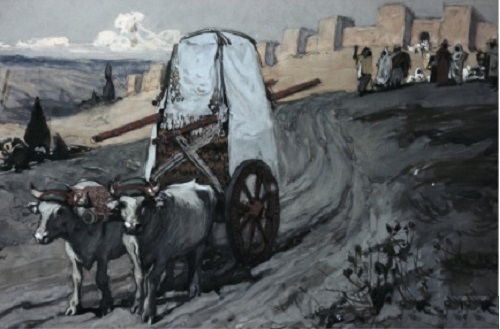
Then David and all the troops that were with him got up and went … to bring up from there the ark of God … And they mounted the ark of God on a new cart. (2 Samuel 6:2-3)

And David and the whole house of Israel were dancing before God with all their might, with lyres and with lutes and with drums and with castanets and with cymbals. (2 Samuel 6:5)

In other words, they were acting like the band of ecstatics that Saul had joined on his way to become king.

19th-century engraving featuring a sedate David with robes instead of eifod

The cart tips, and the attendant walking beside it lays a hand on the ark to steady it. He dies instantly.

And David was afraid of God that day, and he said: “How can the ark of God come to me?” (2 Samuel 6:9)

King David leaves the ark at a nearby house. But three months later he is told that the household has prospered because of the ark. David returns and escorts the ark the rest of the way to the City of David. Once again he behaves like an ecstatic overcome by the spirit of God, “whirling with all his might” (2 Samuel 6:14). This time he wears a priest’s linen tabard (eifod).2 King David is deliberately combining a priest’s garment with ecstatic dancing.

And they brought the ark of God, and they set it in its place inside the tent that David had pitched for it. And David brought up rising-offerings and wholeness-offerings in front of God. And David finished bringing up the rising-offering and the wholeness-offering, and he blessed the people in the name of God of Armies. Then he distributed to all the people, to all the multitude of Israel, to every man and woman, one round loaf of break, and one pan cake, and one raisin cake. And all the people left, each to his house. (2 Samuel 6:17-19)

Burning the animals offered to God is a priest’s job. So is blessing the people in the name of God; the high priest Aaron blesses the people in the inauguration in this week’s Torah portion.3

When David first fled from Saul, the priest Ahimelekh gave him and his men some of the priests’ bread.4 But King David has more resources than a priest, and distributes largesse like a king.

Thus the crowd at the ceremony in the City of David sees David as an ecstatic and a priest as well as a king. Secular power and the religious power of priest and prophet are consolidated in one person.


It is understandable that David wanted to cement his position as king by becoming a religious authority as well. But in today’s heterogeneous world, that kind of consolidation is dangerous.

The idea of “a wall of separation between church and state”5 has been promoted since the 17th century in northern Europe and America as a means to ensure religious freedom. All citizens must obey the laws of the government, but the rules of a particular religion must not become the law of any government.

This hands-off approach would have been unthinkable in the Ancient Near East, where every city and country had its reigning deity. And according to the Hebrew Bible, religion was inseparable from government in Israelite kingdoms. Many of God’s laws concerned relations between individuals. Citizens were defined by their inherited religion, and even resident aliens were required to refrain from work on Shabbat.6 But they were not required to make offerings on Israelite holy days.7

Later in the Hebrew Bible, kings sometimes keep tame prophets to say that God supports the government’s position. But God makes other prophets speak out against the policies of kings.

I am an American and a Jew, and I worry about recent calls for making some of the rules of conservative Christian religions (such as those on abortion) the law of the land. When a government and a particular religion are consolidated in the modern world (as in Iran and Saudi Arabia), the result is usually the oppression of minorities and dissenters.

May we all avoid taking King David’s path.


  1. Later in the bible God wants every hill-shrine (bamah, בָּמָה) destroyed (cf. 1 Kings 13:2, 2 Kings 17:9-11, 2 Kings 23:8-20, and Ezekiel 6:1-6). But these shrines pass without comment in the two books of Samuel.
  2. But he apparently omits the linen breeches priests must wear; one of his wives complains later about how he exposed himself (2 Samuel 6:20-22). See my blog post Haftarat Shemini—2 Samuel: a Dangerous Spirit.
  3. Leviticus 9:22.
  4. 1 Samuel 21:4-7.
  5. Thomas Jefferson, 1902, on the First Amendment to the United States constitution.
  6. Exodus 20:10, 23:12; Deuteronomy 5:14.
  7. Numbers 9:14.

Pekudei & 1 Kings: Is the Ark an Idol?

The ark and the curtain in front of it are the last two things Moses puts into the new Tent of Meeting in this week’s Torah portion, Pekudei (Exodus 38:21-40:38). Then the portable sanctuary that will be God’s new dwelling place is complete.

Then Moses finished the work. And the cloud covered the Tent of Meeting, and the kavod of God filled the Dwelling Place. And Moses was not able to enter the Tent of Meeting, because the cloud rested on it and the kavod of God filled the Dwelling Place.  (Exodus/Shemot 40:33-35)

kavod (כָּבוֹד) = weight, magnificence, honor, glory.

Thus all the Israelites who made things for the portable sanctuary, from the golden ark to the woven walls, did it right. God approved, and manifested inside.

The last thing King Solomon puts into the new permanent temple for God in this week’s haftarah (the reading from the Prophets that accompanies the Torah portion) is the ark. Then the first permanent temple for God in Jerusalem is complete.

And it was when the priests went out of the holy place, and the cloud filled the house of God. And the priests were not able to stand and serve in the presence of the cloud, because the kavod of God filled the house of God. (1 Kings 8:10-11)

Thus all the people who built and furnished the temple for King Solomonalso did it right; God approved, and manifested inside.

In both the tent and the temple, the ark is brought into the Holy of Holies, the innermost chamber in back. In both Exodus and 1 Kings, the ark is a box or chest with a lid and four feet. In both stories, it is carried by means of two poles that run through the rings attached to its feet. And in both stories, the ark contains the two stone tablets Moses brought down from his second forty-day stint on Mount Sinai.

Yet the two stories do not seem to be talking about the same ark.

The ark in Exodus

The master artist Betzaleil makes the lid of the ark in last week’s Torah portion in the book of Exodus, Vayakheil:

Then he made a kaporet of pure gold, two and a half cubits long and a cubit and a half wide. And he made two keruvim of gold; he made them hammered out from the two ends of the kaporet. One keruv out of this end and one keruv out of that end; from the kaporet he made the keruvim, from its two ends. And the keruvim were spreading wings above, screening off [the area] over the kaporet with their wings. And they faced each other, and the faces of the keruvim were toward the kaporet.(Exodus 37:6-9)

kaporet (כַּפֺּרֶת) = the lid of the ark in Exodus and Numbers; the lid of the ark as the seat of reconciliation or atonement with God in Leviticus. (From the root verb kafar, כָּפַר = covered; atoned, made amends.)1

keruvim (כְּרוּבִים) = plural of  kervuv (כְּרוּב) = “cherub” in English; a hybrid supernatural creature with wings and a human face. (Elsewhere in the Hebrew Bible, keruvim are guardians, steeds, or part of God’s heavenly entourage.)2

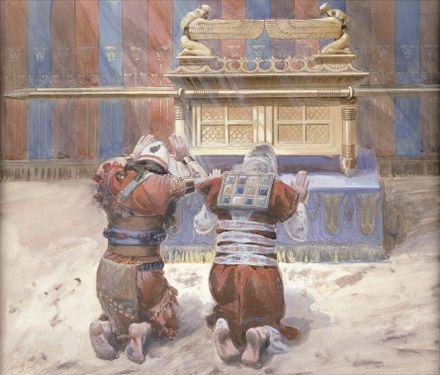
Moses and Aaron Bowing Before
the Ark, by James Tissot, ca. 1900

The bodies of the gold keruvim in Exodus are never described. Since each keruv sculpture has only one face, which gazes at the lid of the ark, it represents a different sort of hybrid creature from those in Ezekiel’s visions. The book of Ezekiel describes a keruv as having four faces, four wings with human hands under them, a single leg like a calf’s hoof, and eyes covering its whole body.3

The two gold keruvim on the ark in Exodus face one another, but they are looking down at the center of the lid. They might be guarding the stone tablets inside, or they might be guarding the empty space above the lid and below their wings. Earlier in the book of Exodus, God tells Moses:

And I will meet with you there and I will speak with you from above the lid, from between the two  keruvim (Exodus 25:22)

That means the gold keruvim in Exodus are not idols. In the Ancient Near East, an idol was a sculpture of a god that the god sometimes entered and inhabited. At those times, worshiping the idol was the same as worshiping the god.

But Exodus is careful to explain that God will not enter the ark or the keruvim sculptures on top of it; God will only manifest in the empty space between kaporet and the wings of the keruvim.

The ark and its lid are only two and a half cubits long—just under four feet (just over a meter)—so the empty space for God is not large. According to Exodus, God manifests there as a voice, but according to Leviticus 16:2, God appears there as a cloud.

The two small keruvim that Betzaleil hammers out of the extra gold on the ends of the lid of the ark are not mentioned again anywhere in the Hebrew Bible except once in the book of Numbers:

And when Moses came to the Tent of Meeting to speak with [God], then he heard the voice speaking to him from above the kaporet that was on the Ark of the Testimony, from between the two keruvim; thus [God] spoke to him. (Numbers/Bemidbar 7:89)

Here, too, the Torah clarifies that neither the keruvim nor the kaporet nor the ark are idols.

The ark in 1 Kings

Many generations pass before David creates the first kingdom of Israel, and his son Solomon builds the first permanent temple for God.  By the time King Solomon brings the ark into his new temple, there do not appear to be any keruvim on its lid. The first book of Kings reports the two large statues of keruvim in the Holy of Holies, and small keruvim decorations carved into the walls of the rest of the temple, but no keruvim on the ark.

Solomon has two colossal wood statues of keruvim brought into the Holy of Holies before the ark is carried in. Each keruv is ten cubits, about 15 feet (four and a half meters) tall, with a ten-cubit span from wingtip to wingtip.4

Then he placed the keruvim inside the House, in the innermost [chamber]. And the wings of the keruvim spread out so the wing of one keruv touched the wall, and the wing of the second keruv was touching the second wall, and in the middle of the chamber their wings touched. And he overlaid the keruvim with gold. (1 Kings 6:27-28)

Meanwhile the ark remains in King David’s tent of meeting, in another part of town, until the rest of the temple and its furnishings are completed.

That was when Solomon assembled the elders of Israel—all the heads of the tribes, chiefs of the fathers of the Children of Israel—before King Solomon in Jerusalem, to bring up the Ark of the Covenant from the City of David … And all the elders of Israel came, and the priests lifted the ark. (1 Kings 5:1-3)

Solomon Dedicates the Temple,
by James Tissot, 1902

King Solomon leads the sacrifice of livestock on the altar outside the new temple.

Then the priests brought the Ark of the Covenant of God into its place, into the back chamber of the house, to the Holy of Holies, to underneath the wings of the keruvim. For [each of] the keruvim was spreading a pair of wings toward the place of the ark, so the keruvim screened off the ark and its poles from above. (1 Kings 8:6-7)

Here the empty space reserved for God is larger than in Exodus, since the gap between the lid of the ark and the wings of the colossal statues of keruvim is about 11 feet (three and a half meters). Yet the Hebrew Bible does not mention God speaking from this space. Nor does a cloud appear there after God’s inaugural cloud of kavod has faded.

The contents of the Holy of Holies in Solomon’s temple seem to be merely symbolic. There is no mention of God manifesting in the empty space between the wings of the keruvim and the ark. Neither a statue nor the ark becomes an idol that God inhabits. According to one Talmudic source, ordinary Israelites can see the ark and the keruvim without any harmful consequences.5

Perhaps 1 Kings emphasizes that God does not inhabit the ark inside the new temple when it says:There was nothing in the ark but the two stone tablets that Moses set down there at Chorev [a.k.a. Sinai] which God cut … (1 Kings 8:9)

The ark as an idol

Exodus and 1 Kings reflect two different traditions about the relationship of the ark to its guardian keruvim. Current scholarship suggests both books were written in the 6th century B.C.E., and the descriptions of the Tent of Meeting in Exodus were modeled on the descriptions of Solomon’s temple, with adjustments to make the tent-sanctuary smaller and more portable. The descriptions of the ark in Exodus through Numbers are also more awe-inspiring than the bare mention of the ark in 1 Kings.

Both descriptions of the ark and the pair of keruvim make it clear that these furnishings are not idols. Yet other stories in the Hebrew Bible do treat the ark like an idol inhabited by God.

In the book of Joshua the priests carry the ark across the Jordan River, as the Levites had carried the ark (always covered from view by three layers of fabric)6 from Mount Sinai to the eastern bank of the Jordan. But then the priests carry it in a military parade around the walls of Jericho until God destroys the city.7

After the Israelites are unexpectedly defeated in a battle later in the book of Joshua, the ark apparently sits on the ground out in the open, rather than inside the tent-sanctuary:

And he fell on his face on the ground in front of the ark of God until evening, he and the elders of Israel, and they put dust on their heads. (Joshua 7:6)

In the first book of Samuel the ark is inside a sanctuary again: the temple at Shiloh, which has solid walls and doors, but a tent roof. However, the sons of the priest Eli take the ark out of the temple and onto the battlefield, where it is captured by the Philistines. In Philistine territory, the ark initiates two plagues and smashes an idol of the Philistine god Dagon.8  The God of Israel is working magic through the ark, which functions as an idol.

Ark Sent Away by the Philistines,
by James Tissot, 1902

The Philistines send the ark back into Israelite territory, where its magic power kills at least 70 Israelite men who look inside. The ark is removed to a private house where the owner’s son is consecrated as a priest to guard it.9

This version of the ark can be safely seen from outside, but must not be opened—or touched, except by its attached carrying poles. When King David sets out to retrieve the ark and transport it to Jerusalem, its two current priests load it on a cart. Partway to Jerusalem the oxen pulling it stumble, and the priest who touches the ark to steady it dies instantly.

And David was afraid of God that day, and he said: “How could I bring the ark of God to myself!” (2 Samuel 6:9)

Although it is possible to interpret this verse as indicating David’s fear of a remote God who chooses to kill anyone who touches the ark, it makes more sense if David conflates God and the ark, treating the ark as an idol God is inhabiting. Fear of God and fear of the ark are the same thing.

Three months later King David succeeds in bringing the ark the rest of the way to Jerusalem, and installs it in the new tent-sanctuary he has set up there for God.10 This is the ark that King Solomon brings into the Holy of Holies in his new temple, and positions under the wings of two new statues of keruvim. At that point the ark is no longer an idol, but merely a sacred object, the most sacred object in the temple.


Which version of the ark appeals to you the most:

The holy work of art in Exodus and Numbers, which only a priest is allowed to see?

The idol that travels around naked in Joshua and the two books of Samuel, zapping people right and left?

Or the piece of furniture in 1 Kings, which must be treated as sacred because it contains the two stone tablets, the way an ark in a synagogue today is treated with respect because it contains the Torah scroll?


  1. The only occurrence of the term kaporet  in the bible outside Exodus, Leviticus, and Numbers is when 1 Chronicles, written about 200 years later, says King David gave his son Solomon plans for the temple including “the shrine of the kaporet” (1 Chronicles 28:11). This is not a locution used in Exodus through Numbers.
  2. Keruvim are definitely guardians in Genesis 3:24 and Ezekiel 28:14-16. A keruv is a steed for God in 2 Samuel 22:11, Ezekiel 9:3, Psalm 18:11, and 1 Chron. 28:18. Keruvim are part of God’s large supernatural entourage in Ezekiel 1:5-14, 10:1-20, and 11:22.
  3. Ezekiel 10:1-20 and 1:5-14.
  4. 1 Kings 6:23-26.
  5. Talmud Bavli, Yoma 54a.
  6. See my post: Bemidbar: Don’t Look!
  7. Joshua 3:3-4:18, 6:4-13.
  8. 1 Samuel 4:3-6:12.
  9. 1 Samuel 6:19-7:1.
  10. 2 Samuel 6:13-17.

Shemini & 2 Samuel: Segregating the Holy

The Two Priests Are Destroyed, by James Tissot, ca.1900

Aaron and his four sons have just finished their eight days of ordination in this week’s Torah portion, Shemini (“Eighth”).  Then the two older sons, Nadav and Avihu, bring unauthorized incense into the Tent of Meeting, and the fire of God consumes them.  (See my post Shemini: Fire Meets Fire.)  After their bodies are dragged out,

Then God spoke to Aaron, saying: “Do not drink wine or strong drink, neither you nor your sons with you, when coming into the Tent of Meeting, and you shall not die.  [This is] a decree forever for your generations: to havdil between the holy and the ordinary, and between the ritually-impure and the ritually-pure; and to instruct the children of Israel on all the decrees that God spoke to them through Moses.” (Leviticus/Vayikra 10:10-11)

havdil (הַבְדֹּיל) = make a distinction, separate, segregate, distinguish.

The new priests already know they must officiate at the altar; tend the menorah, bread table, and incense altar inside the Tent of Meeting; and guard the ark in the curtained-off Holy of Holies in back.  Now God says they must distinguish between the holy and the ordinary and keep them separate; and teach God’s decrees to the Israelites.  (Since a priest would need a clear head to perform both duties, many commentators connect these duties with God’s injunction against drinking on the job.) 

Although Nadav and Avihu did not disobey a specific decree, they made a serious error when they brought unauthorized incense into the holy Tent of Meeting, perhaps into the Holy of Holies.  A priest must not violate a holy space.

What does it mean to distinguish and segregate the holy from the ordinary?


In the Hebrew Bible, holiness is not a feeling.  The holy (hakodesh, הַקֹּדֶשׁ) means whatever is dedicated to God.  Objects, places, and days are all holy if they are reserved for serving God.

Levites carry the ark properly, Bible card by Providence Lithograph Co., 1907

The holiest object is the ark, which holds two stone tablets that God gave Moses on top of Mount Sinai.  When the ark is inside the innermost chamber of the sanctuary, the Holy of Holies, God’s presence manifests in the empty space right above its lid.  No one but Moses and the high priest may see the ark inside the Holy of Holies.  When the tent-sanctuary is dismantled and Levites transport the ark to the Israelites’ next camp, priests drape three layers of coverings over it to protect people from seeing it.  No one may touch it except for the Levites carrying its poles.1

The haftarah reading accompanying this week’s Torah portion is a selection from the second book of Samuel which describes how King David transports the ark from a private house near the border of Philistia to his new capital in Jerusalem.2  In this story, as in Shemini, someone serving as a priest fails to differentiate between the holy and the ordinary.

The ark resides in a private house near the border because 20 years earlier, in the first book of Samuel, two priests who had a reputation for being derelict in their duties took the ark out of the sanctuary in Shiloh and into battle, where the Philistines captured it.3  After the enemy brought it home, their idol of Dagon fell over and broke, and the Philistines were plagued by mice and hemorrhoids.  They sent the ark back across the border into Israelite territory, where the people of Beit-Shemesh rejoiced and make animals offerings on the spot.  But then 70 men looked into the ark and died.4   Frightened, the remaining men of Beit-Shemesh sent the ark to the house of Avinadav in Kiryat-Yarim, where it remained for 20 years.5

In the haftarah reading from the second book of Samuel, King David decides to transport the ark to Jerusalem.

They mounted the ark of God on a new cart, and they carried it away from the house of Avinadav, which was on the hill.  Uzza and Achio, descendants of Avinadav, were guiding the new cart.  (2 Samuel 6:3)

Elazar, Avinidav’s “consecrated son”, had served as the first priest to guard the ark.6  But after 20 years there is a new generation of guardians.  Achio walks in front of the ox-cart, and Uzza has the honor of walking beside the ark.  The procession includes King David and thousands of Israelites dancing to the sound of musical instruments.  Then the oxen pulling the cart stumble.

The Chastisement of Uzza, by James Tissot, ca. 1900

They came as far as the threshing-place of Nakhon; then Uzza reached out to the ark of God and grabbed at it, because the cattle had let [the cart] go off by itself.  And God’s anger flared up against Uzza, and [God] struck him down there, over the heedless error.  And he died there beside the ark of God.  (2 Samuel 6:6-7)

While Uzza is accompanying the ark, he is serving as a priest, who must havdil the holy and the ordinary”.  His impulsive action, however well-meant, fails to distinguish between the perilously holy ark and an ordinary ox-cart load.

King David sends the ark to a nearby house, and tries again three months later.  This time the ark reaches the tent the king has prepared.  As the procession crosses the City of David in Jerusalem,

David was whirling around with all his might before God; and David had belted on a linen efod. (2 Samuel 6:14)

efod (אֵפוֹד) = a tunic or cuirass with the front and back tied together, worn by the high priest as part of his ritual costume.

David is dancing in front of the ark, but the ark is so holy that the Torah says he is dancing before God.  His whirling around with all his might” reminds me of the prophets who speak in ecstasy in Exodus and the two books of Samuel.  Although David is wearing a priest’s efod, he acts more like a prophet filled with the spirit of God—until the ark has been placed inside the tent in Jerusalem.

Then King David soberly plays the role of high priest, performing all the rituals without a hitch.

They brought the ark of God and set it up in its place inside the tent that David had pitched for it, and David brought up rising-offerings before God, and the wholeness-offerings.  And when David finished bringing up the rising-offerings and the wholeness offerings, then he blessed the people in the name of the God of Armies.  (2 Samuel 6:17-18)

David treats the ark as holy in two ways: first as a prophet filled with the spirit of God, second as a high priest conducting ritual.  Both responses to holiness are acceptable in the bible, at the appropriate time and place.


The ark was lost with the fall of the first temple in Jerusalem in 586 B.C.E.  The innermost chamber of the second temple was empty, but it was still called the Holy of Holies, and treated with awe and reverence.  The high priest still entered it only once a year, on Yom Kippur.

Since the fall of the second temple in 70 C.E., Jews have made do with objects and places of lesser holiness.  Instead of an ark, we have Torah scrolls, which are unrolled for everyone to see.  Instead of a sanctuary with a Holy of Holies, we have the foundation wall of the place where the temple once stood in Jerusalem.

But Jews still have the holy days set out in the Torah: our annual feast and fast days, and Shabbat every week.  On Friday night we light candles and say blessings to distinguish the new seventh day, and on Saturday night we make a havdallah, a separation, between the holy day of Shabbat that has ended and the ordinary days of the week to come.  The havdallah blessing concludes with words from God’s instructions to Aaron:

Blessed are you, God, [who] hamavdil between the holy and the ordinary.

I find treating a day as holy is harder than treating an object or a place as holy.  The sun sets and rises on Shabbat the way it does on any other day; the only difference is in what we do that day.  And even if we try to dedicate every moment to serving God on a Shabbat or on an annual holy day, and avoid any activity that counts as labor, we still have to spend some of our time getting dressed, eating, and so forth, just as on an ordinary day.

And Jews who fail to observe Shabbat properly are not struck dead.

Segregating the holy from the ordinary is critically important in the bible, where God is present as the threat of magical annihilation.  Today, treating Torah scrolls and other religious objects with reverence, and setting aside certain days for special prayers and actions, serve the purpose of helping humans to approach the whole idea of God with awe and love.

Is that enough?  Perhaps today we can serve God more by bringing the holy into the ordinary, by bringing awe and love into more places and more times.


  1. Numbers 4:4-5, 4:15, 4:20.
  2. The haftarah begins with 2 Samuel 6:1. It ends somewhere between 2 Samuel 6:19 and 7:17, depending on whether the community follows the Ashkenazi, Sefardi, Misrachi, or Italian tradition.
  3. 1 Samuel 2:12-17, 4:3-11.
  4. And [God’s] hand was on the people of Beit Shemesh, because they looked into the ark of God, and [God’s] hand [struck down] 70 men of Beit Shemesh, 50,000 men. And the people mourned because God had struck a great blow against the people. (1 Samuel 6:19).  Rashi (11th-century Rabbi Shlomoh Yitzchaki) wrote that this passage means each of the 70 men that God smote was the equal of 50,000.
  5. 1 Samuel 7:1-2.
  6. 1 Samuel 7:1.

Ki Teitzei: Virtues of a Parapet

When you build a new house, then you shall make a ma-akeh for your roof; then you will not put blood-guilt on your house if the faller falls from it.  (Deuteronomy/Devarim 22:8)

ma-akeh (מַעֲקֶה) = parapet: a low wall along the edge of a roof or another structure.

This verse appears in a compilation of practical laws in this week’s Torah portion, Ki Teitzei (“When you go out”).  At the most literal level, it simply requires a parapet around a roof as a safety precaution to prevent anyone from falling.  If the faller were being injured or killed the owner of the house would be liable, bearing the “blood-guilt”.

Roofs from Egypt to Babylon (as well as in other parts of the world with dry climates and mild winters) were usually flat and built to bear weight, so people could walk, sit, sleep, and work on them.  In the Ancient Near East, builders ran wooden beams or whole logs from wall to wall.  They covered the beams with framed straw or reed mats, then topped the roof with several layers of clay compacted with stone rollers.  Sometimes they added latticed rooftop structures to provide shade for people using the roof.  A parapet around the edge made the top layer more durable, as well as improving safety.

The Hebrew Bible mentions using rooftops for private conversations,1 for sleeping,2 for storage,3 and for making sacrifices at altars for other gods.4  The Talmud also mentions keeping small lambs or goat kids on one’s roof.5

Safety

A roof without a parapet is unsafe not only because a person might fall off, but also because something might fall, or get pushed, from the roof onto a person below.  When an unsavory king in the book of Judges, Avimelekh of Shechem, captures the town of Teiveitz, its residents flee to the tower in the middle of their town.

And they shut themselves inside and they went up onto the roof of the tower.  And Avimelekh came up to the tower… to set it on fire.  Then a woman sent down an upper millstone onto the head of Avimelekh, and it cracked his skull.  (Judges 9:51-53)

The Talmud (Bava Kamma 15b) extends the requirement for a parapet around a roof to all other hazards in a house, such as keeping a vicious dog or setting up an unstable ladder.  If the owner does not remove the hazard, he is liable for damages and a court can even excommunicate him.

Even if the owner is the only person who lives in the house, he must still make it safe for the benefit of guests and future residents.6

Privacy

A sufficiently high parapet also provides privacy.  According to the Talmud (Bava Batra 2b) if the roof of one house adjoins the courtyard of another house, the owner of the first house must build a parapet four cubits high,7 so he cannot look into the neighbor’s courtyard when he is using his roof.  A similar ruling is that a wall separating the courtyards of two adjacent houses should be four cubits high, so neighbors cannot see into each other’s courtyards  (Bava Batra 5a).

Even if houses are not adjacent, a higher parapet may be needed for privacy.  If two houses are on opposite sides of a public road (Bava Batra 6a), both owners are likely to build a parapet high enough to prevent anyone on the road below from seeing them; but each owner must also build one side of his front parapet high enough to block the view from the opposite roof.  Then both families will have privacy (and share the expense equally).

A story in the bible illustrates another situation in which a high parapet would have provided privacy.

Bathsheba, by Jean-Leon Gerome, 1889

It was evening time, and David rose from his bed and walked around on the roof of the king’s house.  And he saw a woman bathing, from up on the roof, and the woman was very good in appearance.  (2 Samuel 11:2)

For the sake of privacy, Bathsheba would have been bathing either on her own lower roof, or in the enclosed courtyard of her own house.  But King David’s view was not blocked by a high enough parapet.  Enamored of her naked beauty, he found out who she was and sent for her, assuming that since  her husband Uriah was away at war, he would never know.  When Bathsheba became pregnant, King David had Uriah sent home from the front, but he refused to sleep with his wife until the war was over.  So David arranged for the death of the innocent man.  None of this would have happened if King David’s parapet had been four cubits high.

Metaphor for pride

The original injunction in this week’s Torah portion has also been interpreted allegorically, with the rooftop standing for pride.  Philo of Alexandria wrote in the first century C.E. that when people give themselves credit for intellectual and social advancement, instead of crediting God, they are likely to fall from their high positions and be destroyed.

For the most grievous of all falls is for a man to stumble and fall from the honour due to God; crowning himself rather than God, and committing domestic murder. For he who does not duly honour the living God kills his own soul …8 

A Poet’s Fall, 1760

The Hassidic commentator Dov Baer Friedman interpreted Deuteronomy 22:8 by applying the metaphor of pride before a fall9 to a Torah scholar’s pride in coming up with a new interpretation:

This refers to one offering a new interpretation of Torah.  “Make a railing for your upper storey.”  If the verse were referring to a literal house, it would have said: “for its upper storey.”  As it is, the upper storey is on you, referring to the swelling of your pride at this new teaching.  Do not let your head get turned by pride!  Even though this is a bit of Torah that no ear has ever heard, it comes not from you, but from God. “Should somebody fall from it.”  You are all set for such a fall.10


Building a Mental Parapet

Safety: We can be dangerous to ourselves when we get so carried away by our emotions that we act without thinking it through. Burning with anger, we hurl words, or worse, at the enemy we think is below. Overcome by sexual attraction, we throw ourselves at another person, and fall off. Thick with bitterness, we trudge ahead without looking where we are going.

The ensuing disasters could all be avoided if we built a strong mental parapet: a habit of stopping until our passion fades enough so we can rationally consider consequences and alternatives.

Privacy:  We can also find an inner meaning of the Talmud’s extension of the law in Ki Teitzei to cover privacy. Besides physical privacy, humans need privacy in our mental lives.  We can share personal information, random thoughts, and emotional reactions with a trusted partner who knows us well.  But sharing these things with neighbors, friends, or strangers can cause them to feel uncomfortable, to make false assumptions about us, or to feel burdened by our apparent neediness.  It can even give false friends information they can use against us or against people we know.

We can build a mental parapet, a habit of pausing before sharing something that might be out of bounds, so that we do not reveal the wrong things–whether in response to an inappropriate question, or in a gush of good will or exhibitionism.

Pride: As both Philo of Alexandria and Dov Baer Friedman wrote, we can fall into the self-delusion of pride over any personal achievement. If giving God credit for our deeds does not work for us, we can build a mental parapet out of reminders that all our successes depend on the deeds of other human beings, on the family and society we inherit, and on the genes that we are born with.

Those of us who actually live in buildings with flat, inhabitable roofs still need parapets to prevent people and things from falling off.  But we all need parapets when it comes to the contents of our own minds.

  1. Examples of using a roof for private conversations: Joshua 2:6, 1 Samuel 9:25-26.
  2. Examples of using a roof for sleeping: Joshua 2:6, 2 Samuel 11:2.
  3. A roof is used for storing flax in Joshua 2:6.
  4. Examples of using a roof for altars to worship other gods: 2 Kings 23:12, Jeremiah 19:13 and 32:29, Zephanaiah 1:5.
  5. Talmud Bavli, Bava Batra 6b.
  6. 19th-century rabbi Samson Raphael Hirsch, The Hirsch Chumash: Sefer Devarim, translated by Daniel Haberman, Feldheim Publishers, Jerusalem, 2009, p. 513.
  7. A cubit is the length of a forearm from elbow to fingertips. Four cubits would be over 6 feet, or almost 2 meters.  (Bava Batra 2b also provides rules for window and courtyard partition placements to prevent a neighbor from being able to look inside the house next door.)
  8. Philo of Alexandria, The Works of Philo, trans. by C.D. Yonge, “XXXIX, On Husbandry, 171”.
  9. Proverbs 16:18.
  10. Dov Baer Friedman of Miedzyrzec, Or Torah (1804), translated by Arthur Green in Arthur Green, Speaking Torah, vol. 2, Jewish Lights Publishing, Woodstock, Vermont, 2013, p. 124.

Haftarot for Yom Kippur and Ha-azinu—Isaiah, Jonah, & 2 Samuel: Atonement

In this season of Jewish holy days, we once again have three haftarot (readings from the Prophets) in one week.  On Yom Kippur we read Isaiah 57:14-58:14 and the whole book of Jonah.  Then on Saturday we read 2 Samuel 22:1-51, the haftarah for Ha-azinu, the second to last Torah portion in Deuteronomy.

The English word “atone” was first used in the 16th century as a contraction of “at one”. Atonement is the process of making amends for wrongdoing in order to restore unity—especially unity with God.

In Biblical Hebrew, the word for atonement is kippurim (כִּפֻּרִים). It comes from the verb kipper (כִּפֶּר), which means cover, appease, make amends, reconcile.

goat-for-azazelThe first Torah reading on Yom Kippur (the Day of Atonement) is a selection from the Torah portion Acharey Mot in the book of Leviticus/Vayikra. The portion describes an annual ritual of atonement in which the high priest places lots on two goats. He sacrifices one goat to reunite the sanctuary with God, and places the sins of the Israelites on the head of the other goat before sending it off into the wilderness. (See my post Metzorah & Acharey Mot: Doubles.)

Today on Yom Kippur, Jews read this Torah portion about the ancient technology for atonement, but we also confess misdeeds, beg for forgiveness, and pray for atonement with the divine.

All three haftarot this week assume that God rewards the righteous and punishes the wicked—but if those who have been wicked repent and make amends, God welcomes them back.

First Haftarah on Yom Kippur: Isaiah 57:14-58:14

In this passage from second Isaiah, God promises to revive and heal the humble, but:

There is no shalom, said my God, for the wicked. (Isaiah 57:21)

shalom (שָׁלוֹם) = peace, safety, ease, well-being.

I believe this is true even without an all-seeing god who directly interferes in the lives of individuals. Everyone who acts immorally eventually suffers because most of the humans around them come to distrust and reject them.

People who have a moral sense and know they are doing wrong also suffer from nagging uneasiness. They can distract themselves and/or go into denial, but peaceful well-being is not an option for them. They cannot become “at one” with the still, small voice within themselves.

The haftarah from Isaiah goes on to say that fasting and bowing, sackcloth and ashes—the 6th-century B.C.E. formula for Yom Kippur—are useless for atonement unless one also frees the oppressed, feeds the hungry, shelters the poor, clothes the naked, and refrains from violence and evil speech. The way to be heard by God is to do good for your fellow human beings.

            That is when you will call and God will answer;

            You will cry for help and [God] will say: Here I am. (Isaiah 58:9)

Good deeds create atonement.

Second Haftarah on Yom Kippur: Jonah

Jonah Preaching in Nineveh, by Jakob Steinhardt, 1923
Jonah Preaching in Nineveh,
by Jakob Steinhardt, 1923

When the prophet Jonah finally submits to doing the mission God gave him, he walks into Nineveh, the capitol of the Assyria, oppressor of the Israelites, and calls out:

“Another forty days, and Nineveh shall be overthrown!” And the men of Nineveh believed in God, and they proclaimed a fast and they put on sackcloth, from the great to the small. And the word was told to the king of Nineveh, and he rose from his throne and he took off his robe and he put on sackcloth and he sat on the ashes. (Jonah 3:5-6)

The king issues a proclamation that all the human residents, and even the livestock, must fast, wear sackcloth, cry out to God, and repent of doing violence.

And God saw what they did, that they turned away from the evil path; and God had a change of heart about the bad thing [God] spoke about doing to them, and [God] did not do it. (Jonah 3:10)

God forgives the whole Assyrian capitol city of Nineveh even before its people do any good deeds.  It is enough for them to admit their bad behavior and sincerely intend to reform.

Repentance creates atonement.

Third Haftarah: Reading from 2 Samuel for Saturday

The haftarah for the Torah portion Ha-azinu is read on either the Saturday before Yom Kippur or the Saturday afterward, depending on that year’s Hebrew calendar.  This year it comes after Yom Kippur.

This haftarah is a psalm attributed to King David, looking back on his life. (The long poem reappears with only a few minor word changes as Psalm 18.) Most commentary praises David for attributing all his narrow escapes and military successes to God rather than to his own cleverness.

Yet after praising and thanking God for rescuing him from his enemies, David explains:

            He rescues me ki He is pleased with me.

            God treats me according to my righteousness,

            According to the cleanness of my hands He requites me.

            Ki I have kept the ways of God,

            And I have not done evil before my God.

            Ki all His laws are in front of me

            And from His decrees I do not swerve.

            And I am without blame or blemish for Him,

            And I have kept myself from wrongdoing. (2 Samuel 22:20-24)

ki (כִּי) = because, when, if.

How can David describe himself as a paragon? Earlier in the second book of Samuel, he clearly violates two of the Ten Commandments:

You shall not murder.  You shall not commit adultery. (Exodus/Shemot 20:13)

Bathsheba with a letter from King David, by Rembrandt
Bathsheba, by Rembrandt

Earlier in the second book of Samuel, David sees a beautiful woman bathing, and finds out that she is Bathsheba, the wife of Uriah the Hittite, who is one of David’s soldiers. Nevertheless, he summons her to his palace and lies down with her.

When she informs the king that she is pregnant, he sends a message to the battlefront for Uriah to come back to Jerusalem. King David urges Uriah to go home and spend the night with his wife.  But Uriah insists on sleeping with the king’s officers, so David cannot claim he got his own wife pregnant.

David sends Uriah back to the front with a letter for his general, Joab, instructing him to place Uriah in the most dangerous part of the battlefield, then fall back so Uriah will be killed.  General Joab carries out the king’s orders.

As soon as Bathsheba has finished the mourning period for Uriah, King David takes her as his eighth wife. But he has already committed both adultery and murder. The prophet Nathan tells David a parable illustrating why his actions were despicable, and informs him that God said:

Why then did you hold the word of God in contempt, doing what is evil in My eyes? (2 Samuel 12:9)

God then states the consequences: “the sword will not swerve from your household”, and someone from David’s household will lie with the king’s women.

And David said to Nathan: “I did wrong before God.”  Then Nathan said to David: “God will even let your wrongdoing pass; you will not die.  Nevertheless …the son, the one [about to be] born to you, he will die.” (2 Samuel 12:13-14)

So how can David say, in this Saturday’s haftarah: “I have not done evil before my God” and “From His decrees I do not swerve”?

Maybe David is living in a narcissist’s fantasy world, guilty of grandiosity and denial. Yet he did admit wrongdoing when Nathan pointed it out to him. Maybe David believed that God only rescues people who are perfectly good, so David painted himself that way.

But I think David knows he did wrong in the eyes of God when he took Uriah’s wife and had Uriah killed. His confession saved his own life, but he was thoroughly punished.  Bathsheba’s first son sickened and died soon after birth. Later, one of David’s older sons, Absalom, killed his half-brother Amnon, overthrew his father, and lay with his father’s concubines. In the ensuing war between father and son, Absalom was killed despite David’s orders to spare his life.

By the time King David writes the psalm comprising this Saturday’s haftarah, he probably considers that God had punished him enough for his heinous crimes, and his slate has been wiped clean. Since those terrible times, his behavior has been righteous.

When David says:

            He rescues me ki He is pleased with me. (2 Samuel 22:20)

he might mean that God rescues him when God is pleased with him, not because. And when David writes:

God treats me according to my righteousness,

            According to the cleanness of my hands He requites me. (2 Samuel 22:21)

he might mean that when he is righteous and keeps his hands clean, God rewards him, but when he fails to do the right things, God makes him suffer. He knows that God’s response varies according to his behavior, and that he was not always such a paragon. Realizing this, David says,

            I became without blame or blemish for Him,

            And I kept myself from wrongdoing. (2 Samuel 22: 24)

According to this reading, David’s message is that a human being can change. We suffer when we do evil, but we still have the ability to keep ourselves from doing wrong again.  We can still become good and righteous, without blame or blemish.

The two haftarot we read on Yom Kippur show that both good deeds and repentance create atonement with God. The haftarah for Ha-azinu this Saturday shows that even a murderer can repent and change himself into a righteous human being.  The conscientious effort to return to the right path and stay on it creates atonement.

May we all be blessed with the ability to return to oneness with God, and may we all be inscribed and sealed for a good year.