1 Samuel: How to Stop a Plague, Part 4

One mageifah is upon all [of you]and your princes! (1 Samuel 6:4)

mageifah (מַגֵפָה) = plague, epidemic, pestilence. (Plural = mageifot.)

Angry gods cause epidemics. This was the obvious to writers in Egypt, Mesopotamia, and Canaan several thousand years ago, long before the germ theory of disease. The best way to stop a plague or epidemic was to determine which god was responsible, and then appease that god.

Pinchas Impales Zimri & Cozbi, by J.C. Weigel

My last three posts on “How to Stop a Plague”1 concern an epidemic caused by the jealous rage of the God of Israel when “His” people are unfaithful to “Him” and worship a god named Baal Peor. The plague kills 24,000 Israelites before Pinchas halts it with an act that shocks the God-character out of “His” uncontrolled anger.2 This plague begins in the Torah portion Balak, but the repercussions continue through this week’s portion, Va-etchannan.

The God-character also kills thousands of Israelites with plagues after they worship the Golden Calf3, after they complain about the food God provided4, after they complain that God killed the 250 rebels led by Korach5, and after God becomes angry with the Israelites for some unreported reason and tells King David to order a census.6  In all of these cases, the plague is a direct result of God’s rage.

However, when the God of Israel afflicts other peoples with epidemics, God is offended, but calm. The God-character uses plagues to make the foreigners acknowledge the superior power of God and do the Israelites a favor. Once those objectives have been met, God simply stops the plague.

Pharoah Merneptah

In the book of Exodus/Shemot, God creates ten miraculous disasters in Egypt, two of which are infectious plagues.7 Yet the Pharaoh keeps refusing to do what the God of Israel wants. After the second epidemic, God orders Moses to tell the Pharaoh:

…Thus says God, God of the Hebrews: Let My people go so they may serve Me. Because this time I am sending all My mageifot to you and to your courtiers and to your people, so that you shall know that there is none like Me in all the world. (Exodus/Shemot 9:13-14)

Only after the tenth miracle, the overnight death of the firstborn, does the Pharaoh admit God’s superior power and free the Israelite slaves.


The Philistines are more rational when the God of Israel afflicts them with a plague.

The problem begins when the Philistines take God’s most sacred object, the ark of the covenant. Israelite soldiers in the first book of Samuel unwisely bring the ark with them from the sanctuary at Shiloh onto the battleground at Even Ha-eizer, hoping that the magic of its presence will give them victory. It does not; God wants “His” ark in a sanctuary, not on a battlefield.

Dagon

And the Philistines took the ark of God, and they brought it from Even Ha-eizer to Ashdod. And the Philistines took the ark of God and they brought it into the House of Dagon, and they placed it beside Dagon. (1 Samuel 5:1-2)

The next morning, the priests of Ashdod discover that the statue of their own chief god, Dagon, has fallen face-down in front of the ark. The second morning, the statue of Dagon has fallen again, and its head and hands are cut off. Naturally, the shocked Philistines move the ark out of the sanctuary and into a field.

Then the hand of God was heavy on the Ashdodites, and He devastated them, and He struck down Ashdod and her territory with ofalim. (1 Samuel 5:6)

ofalim (עֳפָלִים) = probably buboes—lymph nodes swollen to the size of chicken eggs due to the bubonic plague—in the groin area. (According to the Masoretic text, when this chapter is read out loud, the word ofalim is replaced with techorim (טְחֺררִים) = hemorrhoids or anal abscesses. Techorim was considered a more polite word to say in public.)

The people of Ashdod send the ark off to another Philistine city, Geit.
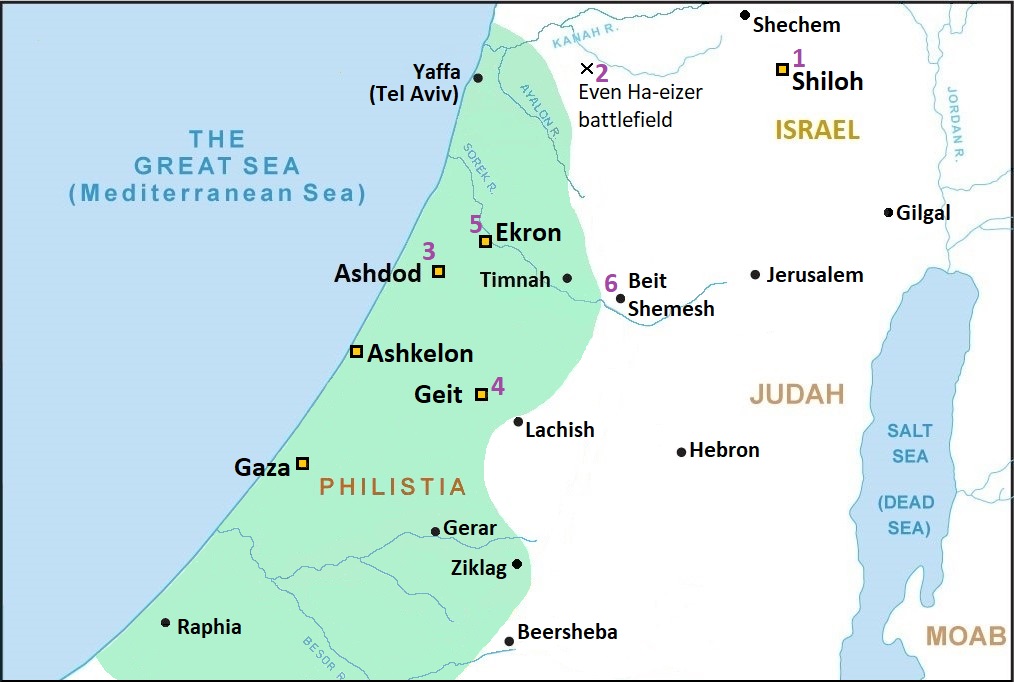
The ark journeys from Shiloh to Beit Shemesh in six stages

…and the hand of God was on the city, a very great panic, and the people of the town from young to old had ofalim in their secret parts. So they sent the ark of God to Ekron… (1 Samuel 5:9-10)

The people of Ekron protest even before they start dying of the bubonic plague, and the princes of all five Philistine city-states meet there to decide what to do. Philistine priests and diviners urge them to send the ark back to Israelite territory, along with a guilt-offering, in the hope that then the God of Israel will stop the plague and heal the survivors.

And they [the princes and the Ekronites] said: “What is the guilt-offering that we should send back to Him?” And they [the priests] said: “The number of princes of Philistine is five. Five golden ofalim and five golden rats—for one mageifah is upon all [of you]and your princes! So you must make images of your ofalim and images of your rats that are destroying the land, and you must give honor to the God of Israel. Perhaps them He will lighten His hand from upon you and from upon your gods and from upon your land.” (1 Samuel 6:4-5.)

The Philistines probably noticed a plethora of dying rats in same areas where humans were afflicted. Today we know that bubonic plague is carried by fleas that bite both rats and humans.

Perhaps the Philistine rulers hesitated to send the golden ark and ten gold statuettes to their enemies the Israelites, because the Philistine priests add:

Why should you harden your heart as Egypt and Pharaoh hardened their heart? Did He not make a fool of them, so they let [the Israelites] go, and off they went? (1 Samuel 6:6)

The five Philistine princes, unlike the Pharaoh, are willing to do whatever will end the plague. Their priests then give instructions that will prove whether the God of Israel is responsible for it. The Philistines must load a cart with the ark and also a box containing the ten gold images. Then they must take two milk cows that have never pulled a plow and separate them from their nursing calves. They must shut up the calves inside, and harness the cows to the cart.

Then you will see: If it [the ark] goes up on the road to its own territory, toward Beit Shemesh, He made this great evil for us. But if not, then we will know that His hand has not touched us; by happenstance it happened to us. (1 Samuel 6:9)
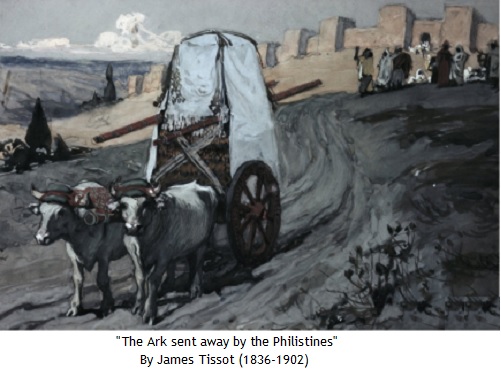
Normally, the two cows would refuse to pull the cart, since they have never been harnessed before. Furthermore, they would try to get back to their calves as soon as their udders were full. Only a divine miracle would make the cows pull the cart to the nearest town in Israelite territory.

And the cows went straight on the road, on the road to Beit Shemesh. On a single highway they kept walking, lowing as they walked, and they veered neither right nor left. And the Philistine princes were walking behind them as far as the border of Beit Shemesh. (1 Samuel 6:12)

The action then switches to the arrival of the cart in Beit Shemesh, but we can assume that God responds by halting the bubonic plague in Philistine. The Bible does not mention it again.

*

Today the prompt administration of antibiotics can cure people of even the bubonic plague. But humans still experience a psychological kind of plague when panic spreads because our neighbors seem like enemies. In the United States today, people have become deeply divided by their anger and fear over the perceived political and moral differences between the left and the right. On each side, we are afraid that our own compatriots will force us to change our way of life, or even let us die.

And on each side, we want to take away things that are sacred to the other side. Unlike the Philistines appropriating the ark, we may not even realize what our “enemies” on the left or right consider sacred.

The people of Ekron get upset when the people of Geit send the ark to their city, yet they neither pick a fight nor pass the ark on to the next city. They call a meeting, get expert advice, and save all the surviving Philistine people by sending off the cart, even though it means giving up some wealth and honor. The five Philistine city-states not only cooperate with each other, but also honor the sacred object of the Israelites, and make a peace offering to the God of their enemies.

May we all become realistic and flexible like the Philistines, rather than hard-hearted like the Pharaoh. May we determine the causes of our own country’s plague, and may we all find the strength to do what we must in order to bring health and peace to all people.

__

1.  Balak & Pinchas: How to Stop a Plague, Part 1; Mattot, Judges, & Joshua: How to Stop a Plague, Part 2; and Mattot, Va-etchannan, & Isaiah: How to Stop a Plague, Part 3.

2.  Numbers 25:6-8.

3.  Exodus 32:35.

4.  Numbers 11:31-35.

5.  Numbers 17:6-15.

6.  This story is included in the second book of Samuel, although its language and themes do not fit the rest of the book. After King David has followed God’s instructions to order a census of all Israelite men of fighting age, God makes him choose one out of three punishments for doing so. David chooses the plague, which kills 70,000 Israelites before David stops it with an animal offering (2 Samuel chapter 24).

7.  Ten according to Exodus; see my post Va-eira & Bo; Psalm 78 & Psalm 105: Responding to Miracles. The two plagues are livestock pestilence (dever) and an inflammation with boils (shechin).

Haftarot for Rosh Hashanah & Shabbat Shuvah—1 Samuel & Hosea:  From Smoke to Words

This week is especially rich in haftarot (plural of “haftarah”) because it includes the two days of Rosh Hashanah (the Jewish new year) and Shabbat Shuvah, the “Sabbath of Return” to God—all before we dive into Yom Kippur (the “Day of Atonement”) next week.

The haftarah for the first day of Rosh Hashanah is 1 Samuel 1:1-2:10.  The reading for the second day is Jeremiah 31:2-20.  And the haftarah for Shabbat Shuvah this Saturday is Hosea 14:2-10. Perhaps it is no accident that during this time of intense prayer from Rosh Hashanah through Yom Kippur, two of these three haftarot show that praying with words is better than slaughtering an animal and burning it up into smoke for God.

Prayer is not a dialogue with God, although persons in the Hebrew Bible from Adam to the prophet Malachi do talk with God and hear God’s responses in words—in fact in complete sentences. Sometimes prophets report what God said; other passages are like conversations between two human beings of different rank and power.

first-temple-altar

Prayer is more like smoke; it rises up toward God, but God does not answer in words.

Besides having many conversations with God, Moses also prays on behalf of the Israelites when they are traveling through the wilderness south of Edom, 40 years after their exodus from Egypt.  The Israelites complain again about their diet of manna, and God sends poisonous snakes.

Then the people came to Moses and they said: We did wrong when we spoke against God and against you. Hitpalleil to God so He will clear away from us the snakes!  Vayitpalleil, Moses, on behalf of the people. (Numbers/Bemidbar 21:7)

Hitpalleil (הִתְפַּלֵּל) = Pray!  (Probably from the same root as pilleil  = reassess. Prayer may be asking for a reassessment from God.)

Vayitpalleil (וַיִּתְפַּלֵּל) = And he prayed.

Here the Israelites confess their misdeed, but they do not believe they can pray to God directly, so they ask Moses, God’s prophet, to do it for them.

Temple altar
Temple altar

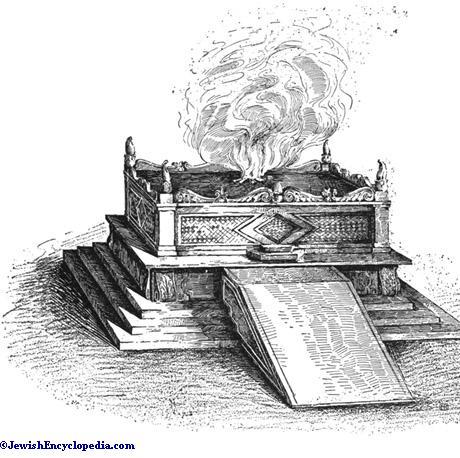
Smoke, not spoken prayer, is the primary way to worship God in the first seven books of the Bible. If you want to bring God your devotion, you slaughter an animal and burn up part or all of it on an altar, turning it into smoke. God appreciates the smell of the smoke.  (See my post Pinchas: Aromatherapy.)

The book of Leviticus/Vayikra lays out five categories of offerings burned up into smoke, and each one was transformed into a type of prayer.

1) olah (עֹלָה) = rising-offering, to maintain the relationship between the worshiper and God. This became liturgy, written prayers to read, recite, or sing at specific times and occasions.

2) minchah (מִנחָה) = allegiance-offering, to show homage or respect.  This corresponds to prayers of praise.

3) shelamim (שְׁלָמִים) = wholeness-offering, to thank God or to express devotion. This corresponds to prayers of thanksgiving.

4) chataat (חַטָּאת) = reparation-offering, to fix an unintentional transgression against one of God’s laws; and 5) asham (אָשָׁם) = guilt-offering, to atone for an intentional wrong (after making amends with the human whom you wronged).  Instead of these two animal offerings, we have prayers of confession asking for God’s forgiveness.

(For more on these smoke offerings, see my posts Vayikra & Tzav: Fire Offerings without Slaughter, Part 1 and Part 2.)

A additional type of prayer in the Bible is the petitionary prayer, in which we ask God to do us a favor. This category includes intercessory prayer, in which a prophet or someone else who is known to be on speaking terms with God utters a petitionary prayer on behalf of a community.

In the book of Genesis/Bereishit, any male head of a household can worship God by building an altar and turning an animal into smoke on it.  Gradually this right is restricted in the Hebrew Bible, until animal offerings can only be made at the temple in Jerusalem and under the supervision of priests. Meanwhile, the tradition of individual prayer expands until anyone can do it, and God will hear.

The first prayer in the Bible is an intercessory prayer.  King Avimelekh takes Sarah into his household thinking she is Abraham’s sister, not his wife.  God responds by afflicting the king and all his women with a disease.  Then in a dream, God tells Avimelekh: And now restore the wife to the husband, because he is a prophet vayitpalleil on your behalf, and you will live. But if you do no restoring, know that you will certainly die, you and all that are yours. (Genesis/Bereishit 20:7)

After the king gives Avraham his wife Sarah along with some gifts, Avraham does pray, and God removes the disease.

Intercessory prayers continue to be mentioned in the Bible, including Moses’ prayer regarding the poisonous snakes.  But not until the first book of Samuel, in the haftarah for the first day of Rosh Hashanah, does someone who has never conversed with God pray for her own sake. On her own initiative, Channah, who has been childless for many years, walks up to the doorway of the temple in Shiloh and prays for a son.

Channah praying from etching by Marc Chagall
Channah praying
from etching by
Marc Chagall

And she was bitter of spirit, vatitpalleil to God, and she wept continually. And she vowed a vow, and she said: God of Armies, if You really see the wretchedness of Your maidservant and You remember me and do not forget Your maidservant, and You give to Your maidservant a seed of men, then I will give him to God for all the days of his life…  (1 Samuel 1:10-11)

vatitpalleil (וַתִּתְפַּלֵּל) = and she prayed.

God does not answer Channah in words, but she does have a son (a “seed of men”), and she brings him to the temple in Shiloh once he is weaned. There she and her husband sacrifice a bull, following the established ritual, then give him to the priest so the boy can serve as an attendant at the temple. (Channah’s son, Samuel (Shmu-eil), later becomes a prophet and a judge of Israel.)

…and they bowed down there to God.  Vatitpalleil, Channah, and she said:

            My heart rejoices in God…

            There is no holy one like God,

            Because there are none except for You. (1 Samuel 2:1-2)

Channah continues with a long psalm praising God’s power. This time her prayer is not petitionary, but a prayer of praise, like a minchah offering.

This Saturday, on Shabbat Shuvah, we read in the book of Hosea:

            Shuvah, Israel, all the way to God, your god,

            For you have stumbled, through your wrongdoing.

            Take devarim with you

            And shuvu to God.

            Say to [God]:

            May You forgive all wrongdoing

            And take the good.

            And we will make amends of the bulls

            Of our lips.  (Hosea 14:2-3)

Shuvah (שׁוּבָה) = Return! (singular, addressing Israel)

shuvu (שׁוּבוּ) =  Return! (plural, addressing the people)

devarim (דְּבָרִים) = words; events, affairs.

Hosea asks the Israelites to make amends and return to God not by slaughtering bulls and burning them on an altar for God, but through the words of their lips, praying for God to forgive them. Instead of the smoke from a chataat or an asham offering, God wants people to return and atone with spoken prayer.

*

As we approach Yom Kippur, the Day of Atonement, the haftarah from 1 Samuel reminds us of the power of individual heartfelt prayer, and the haftarah from Hosea reminds us to return—shuvah!—to God through prayer.

A priest cuts the animal’s throat, blood gushes, smoke roils up into the sky—that kind of worship was sure to have an emotional impact.  But even if someone brought the animal for an asham offering to atone for his own misdeed, or even if the high priest was killing the goat for God on Yom Kippur, people watched the show from a distance.

Channah worked harder, pulling out her own words to plead with God.  Hosea asks us to work harder, bringing our own personal words of confession to God, and returning to the holy one by praying for forgiveness.

It is possible to mouth formulaic prayers without thinking about them. But I believe it is better for our souls if we plumb our own depths, find our own words to bring to God, and do the work.

Haftarat Korach—1 Samuel: The Man Who Would Not Be King

Every week of the year has its own Torah portion (a reading from the first five books of the Bible) and its own haftarah (an accompanying reading from the books of the prophets). This week the Torah portion is Korach (Numbers 16:1-18:32) and the haftarah is 1 Samuel 11:14-12:22.

The prophet Samuel feels insulted when the independent tribes of Israel ask him to appoint a king. God is the true ruler of the twelve tribes, he says. Samuel both interecedes with God, and serves as a circuit judge, deciding case law for the people.  What more do they need?

prophet 3

All the elders of Israel assembled themselves and came to Samuel at the Ramah. And they said to him: Hey! You have grown old and your sons have not walked in your ways. So now set up for us a king to judge us, like all the nations. (1 Samuel 8:4-5)

Samuel warns them that kings impoverish and enslave their subjects, and do not listen when their people cry out to them.

But the people refused to listen to the voice of Samuel, and they said: No! Because with a king over us, we, even we, will be like all the nations.  And our king will judge our disputes, and he will go out before us and fight our wars. (1 Samuel 8:19-20)

In other words, what the tribes are really looking for is not a judge, but a permanent war leader. They are tired of being picked on by the neighboring Philistines, Amorites, and Ammonites; they want to do their own conquering and nation-building.

Samuel tells God, and God promises to send a king to Samuel.  In this week’s haftarah he tells the assembled Israelites:

And now, here is the king who you have chosen, who she-eltem, and here—God has placed over you a king. (1 Samuel 12:13)

she-eltem (שְׁאֶלְתֶּם) = you asked for.  From the root verb sha-al (שָׁאַל) = ask.

The name of the first king of Israel is Saul, or in Hebrew, Shaul (שָׁאוּל) = asked.

How does Saul, a Benjaminite whose only outstanding trait is his height, come to be king?  The first book of Samuel gives us three different stories.

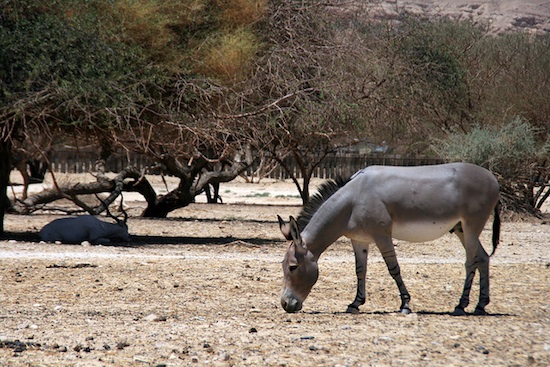
Donkey

In the first story, Saul is looking for his father’s lost donkeys.  He and his servant wander far from their home in Giveah.

They were just coming to the land of Tzuf when Saul said to his boy who was with him: Hey, let’s go turn back, or my father will stop worrying about the donkeys and worry about us. (1 Samuel 9:5)

tzuf (צוּף) = (noun) honeycomb dripping with honey; (verb) flooded, flowed over.

The servant talks Saul into entering the nearest town and paying the local seer to tell them where the donkeys are. The town is Ramah, and the seer is Samuel, who drags Saul to the hilltop shrine for a feast.

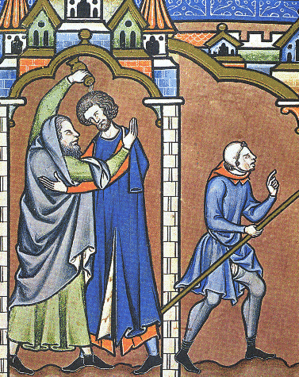
Samuel Anointing Saul

In the morning Samuel pours oil on Saul’s head and tells him God is anointing him king. On his way home Saul falls in with a band of ecstatic prophets and speaks in ecstasy.  But when he returns to his father’s house he tells nobody about his anointment.

In the land of Tzuf everything is overflowing: the food at the feast, the oil of anointment, and the ecstatic spirit of God.

In the second story,

Samuel summoned the people to God at the mitzpah. (1 Samuel 10:17)

mitzpah (מִצְפָּה) = watchtower, lookout post.

When all the important Israelite men have arrived, Samuel casts lots before God three times to find out who the king will be.  The lottery chooses first the tribe of Benjamin, then out of that tribe the clan of Matar, then out of that clan Saul. But nobody can find Saul.

Then God said: Hey!  He has hidden himself in the baggage!  So they ran and took him from there, and he stood himself up among the people, and he was head and shoulders taller than all the people.  And Samuel said to all the people: Do you see the one whom God chose?  For there is none like him among all the people! (1 Samuel 10:22-24)

Saul’s strategy of hiding does not work; even if the people cannot see him from the mitzpah, God can.  Saul is proclaimed king despite himself.

This week’s haftarah gives us a third and more serious installation of Saul as king.

And Samuel said to the people: Come and let us go to the gilgal, and we will renew the kingship there. So they all the people went to the gilgal and they made Saul king there before God, at the gilgal. And they slaughtered their wholeness-offering before God there, and Saul and all the men of Israel with him rejoiced there very much. (1 Samuel 11:14-15)

gilgal (גִּלְגָּל) = (probably) a stone circle. Related to the words gal (גַּל) = heap of stones, goleil (גֹּלֵל) = rolling, galgal (גַּלְגַּל) = wheel, and gulgolet (גֻּלְגֹּלֶת) = skull, head, headcount.

There is more than one gilgal mentioned in the Bible, but the most important one is probably the gilgal next to the city-state of Jericho. It is already standing when Joshua leads the Israelites into Canaan, and its circle of stones was probably used by an earlier religion. Joshua uses it as a sacred site for circumcising all the Israelite men and celebrating the first Passover in Canaan.  Then it becomes his headquarters for most of the book of Joshua.

The gilgal near the ruins of Jericho later becomes one of the four stops on Samuel’s circuit as a judge (along with the mitzpah, Beit-El, and Ramah in Tzuph).  Then it is the place where Saul is installed as king, and finally the site of King Saul’s main altar.

Why does it take two false starts, in the land of Tzuf and at the mitzpah, before Saul accepts his kingship at the gilgal?

When the redactor of the books of Samuel recorded three extant stories about Saul’s appointment, he put them in the most telling order.  First Saul is blessed with kingship as a gift of tzuf, an overflowing bounty of both oil and an ecstatic experience—but these are gifts he does not want, so he pretends he never received them. Next Saul is chosen by lot at a mitzpah, a lookout post—where he does not want to be seen.  He manages to hide even from everyone except God, even though he is a head taller than the other men.

Finally Samuel summons the reluctant king to the gilgal, the ancient circle of stones where Joshua made his headquarters. Here Saul succumbs to history and takes his place in the line of rulers of the Israelites, after Moses and Joshua.

Some people seize opportunities to become leaders, pushing forward eagerly in their conviction or ambition.  Others are like Saul, shy of fame and happy to lead ordinary lives.  But the first book of Samuel shows that when you are called, denial is useless.  Eventually you will have to answer God and take your place in the middle of the circle.

In your own life, do you step into a new responsibility even when it may not be your calling?  Or do you resist the call to take on an important job that you don’t really want?

Tetzaveh: Divining

What should I do?

Usually human beings carry on with their habitual behavior, but sometimes we have to make a deliberate decision.  And we do not know whether a particular choice will lead to good or evil, or to happiness or disaster.  If only we knew ahead of time!

The longing for foreknowledge has been with us for millennia.  Most cultures have had their own methods of divination, of gaining knowledge that is normally outside the human realm.

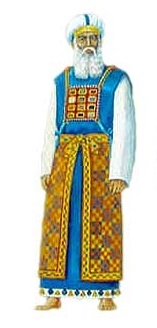
High priest’s vestments, artist unknown

In the Hebrew Bible, leaders and kings ask the high priest to consult the urim and tumim tucked into his breast-pouch. These mysterious items are introduced in this week’s Torah portion, Tetzaveh (“You shall command”), but we do not learn their purpose until the book of Numbers/Bemidbar, when God tells Moses what Joshua must do after Moses has died. Since Joshua, unlike Moses, cannot hear God directly, he must ask the high priest for divination when he needs to decide whether to go out to battle:

He shall stand before Eleazar the priest, and ask him for the ruling of the urim before God. (Numbers 27:21)

urim (אוּרִים) = firelight? illumination?

But the book of Joshua never refers to the urim. The only time the Torah says someone actually consults them is in the first book of Samuel:

And Saul inquired of God, but God did not answer him, either with dreams or with urim or with prophets.  (1 Samuel 28:6)

Several other times in that book both Saul and David “inquire of God” in the presence of a priest, and when David receive yes/no answers, we can assume the answers are indicated by the urim.  But no description is given.

This week’s Torah portion describes everything else the high priest wears, from his headband to his underpants. Over his sky-blue robe, the priest must wear an eifod, a kind of tabard with shoulder-straps and sewn-in ties at the waist.  A chosen, a square pouch, will hang from the shoulder-straps of the eifod, secured on the high priest’s breast.  This breast-pouch will be folded at the bottom, and twelve gems will be set into the front.  Each gem will be engraved with the name of one of the tribes of Israel.

And into the breast-pouch of the law you will place the urim and the tumim; and they will be over the heart of Aaron when he comes before God, and Aaron will carry the law of  the children of Israel over his heart before God constantly.  (Exodus/Shemot 28:30)

tumim (תֻּמִּים) = ? (a noun probably based on the adjective tamim, תָּמִים = whole, flawless, blameless.)

Obviously a high priest could not carry firelight and wholeness in a pouch on his chest; the names of the actual items are symbolic.  But what do they mean?  In Ezekiel, ur is a destroying fire. Throughout the book of Isaiah, urim means “fires” or “firelight”, not an object worn by a high priest.  Everywhere else in the Hebrew Bible, the word urim refers to the item worn by the high priest.

Traditional commentary says the word urim means light, illumination, clarity, because it has the same root letters as the word or = light. Some modern language scholars speculate that urim is derived from nei-arim (נֵאָרִים) = cursed, inflicted with a curse. In that case, urim and tumim would mean “cursed” and “blameless”. In other words, one object indicates a bad outcome and the other indicates a good one.

Rashi (11th-century rabbi Shlomo Yitzchaki) suggested that the two words urim and tumim were written on a single piece of parchment, and the high priest would look down through the open top of his breast-pouch to see which word was facing up.

In the Talmud tractate Yoma 73b, the rabbis seem to use the phrase “urim and tumim” interchangeably with the phrase “breast-pouch of the law”.   Some speculated that the names of the twelve tribes were inscribed on the urim and tumim, and the letters lit up or moved around to create an oracular message.  Others said that the urim and tumim caused the stones on the front of the breast-pouch to light up, and the message could be deciphered from the pattern of flashing lights.  The important thing was that both the person with the question and the high priest had to direct their minds toward God.


Some passages in the Torah appear to forbid using any kind of divination, along with any other kind of magic.  For example:

No one must be found among you who sacrifices his son or his daughter in the fire, or who reads omens, a cloud-conjurer or a diviner, or a sorcerer; or a charm-binder, or a medium who consults ghosts or a medium who possesses a familiar spirit, or who questions the dead.  For anyone who does these is an abomination of God, and on account of these abominations, God, your god, is dispossessing them before you.  You shall be whole with God, your god.   (Deuteronomy/Devarim 18:10-13)

Here Moses is banning all the divination practices of the people surrounding the Israelites.  In other places, the Torah approves of a few practices for getting a bit of divine knowledge.

The two most common ways that God shares foreknowledge with humans is through dreams, and through communication with prophets.  In the absence of dreams or prophetic utterances, a person can take the initiative by casting lots, or by consulting the high priest’s urim and tumim.


When this week’s Torah portion introduces the urim and tumim, it says “they will be over the heart of Aaron when he comes before God”—like the gems representing twelve tribes of Israel.  Maybe the primary purpose of the urim and tumim is not to enable divination, but to keep light and wholeness in the high priest’s awareness whenever he approaches God.

Even today, people who want to make the right decision resort to dubious divination methods.  Instead of reading omens in entrails or conjuring clouds, they flip a coin, or buy something from a New Age shop, or consult a medium who channels the spirit of a dead person.  It is hard to accept that we cannot have foreknowledge, only good guesses.

Yet we can answer the question “What should I do?” without knowing the outcome of our choice.  And when our intuitions are not clear, we can use approaches similar to the kind of “divination” the Torah approves of.  Dreams still help by connecting us with hidden parts of ourselves that are connected with the divine.  And we can improve our conscious thought by keeping certain ideas in our awareness, carrying them upon our hearts like high priests.   We can consciously stay in touch with urim, the light shed by the fire of our passions; tumim, the continual effort to complete ourselves and become whole; and on the outside, the gemstones of our own tribes, our own families, friends, and communities.