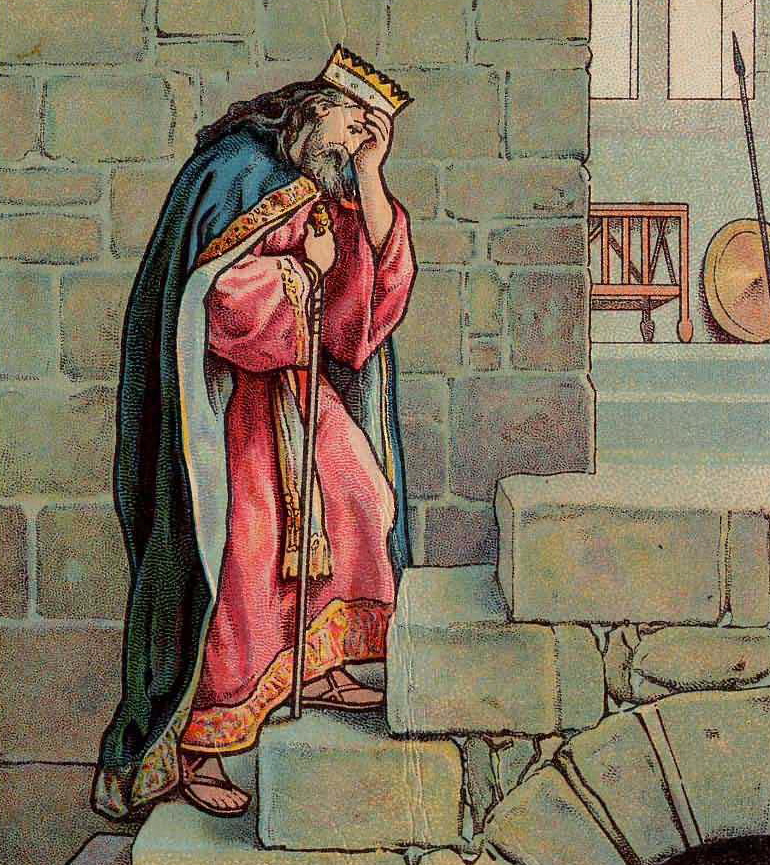
Yom Kippur & 2 Samuel: When David Goes Too Far

Below is the eighth and final post in my series on why David is God’s favorite king. It is also a post for Yom Kippur, which begins this Wednesday evening.


Yom Kippur

Yom Kippur (יוֹם כִּפּוּר) means “Day of Atonement”. Atonement is a good translation because, like  kippur, it means making amends or reparations for something a person or a whole group did wrong. The wrong might be ethical and/or it might be a violation against God. The Torah imagines God as a person who issues lots of rules for behavior, and is offended when we disobey them. One of the ways of imagining God today is as our own inner core, the seat of our conscience, from which we are alienated when we violate what we know inside is right.

The Hebrew word kippur can also be translated as “reconciliation”, since we hope that making reparations will lead to forgiveness and a cleaner, better relationship with the people we have wronged, with God, with ourselves. And historically, the English word “atonement” includes the concept of reconciliation. It was coined in the 16th century out of the words “at” and “one”, to express the idea of reunification.

All humans make mistakes. Some are so inconsequential that as soon as we realize we did something wrong, we can apologize, be forgiven, and be reunited in just a minute or two. Others are more serious.

Jews Praying in the Synagogue on Yom Kippur, by Maurycy Gottlieb, 19th century

In Ancient Israel, a day was set aside once a year for an elaborate ritual using two hairy goats to atone for the outstanding misdeeds of the whole community. (See my post Yom Kippur: We.) The nature of the ritual changed almost two thousand years ago, when temple sacrifices were replaced with communal prayer. But the purpose of Yom Kippur is the same. Jewish tradition now encourages people to spend the month leading up to Yom Kippur reflecting on their misdeeds against other people and making whatever apologies and reparations we can—as well as working on forgiving those who wronged us. We also reflect on our misdeeds against God—or ourselves—in the hope of finding forgiveness for them on Yom Kippur.

What counts as an immediately forgivable mistake, and what mistake is so serious that its effects are still outstanding when we reach this time of year?

There is a different answer for each person. In the first and second books of Samuel, David commits a number of errors that count as peccadilloes in the fond eyes of God. But then he goes too far.

David’s peccadilloes

When David first flees from King Saul’s attempts to kill him, he lies to the high priest, who then colludes with him to break God’s rule that the sacred bread laid out for God inside the sanctuary can only be eaten later by priests. The high priest gives him five flat loaves, which he eats on his flight. (See my post 1 Samuel: David the Devious.) The God character stands by when King Saul has the high priest killed for letting David escape; David goes unpunished.

When David has become the leader of a large band of outlaws, he runs a protection racket; he guards Nabal’s sheep and shepherds without any previous arrangement, then asks for payment in food. Nabal refuses, and David sets off with 400 of his men with the intention of killing Nabal and every male in his house. Killing an Israelite without a previous court order of execution is so serious a crime that it gets the death penalty.1 Fortunately, Nabal’s wife intercepts David and persuades him that murder would be a bad idea. Since David does not actually commit the crime, God kills Nabal the next day. (See my post 1 Samuel: David the Devious.)

When David and his outlaw band have moved to the Phillistine state of Gat to avoid King Saul, David deceives the king of Gat into believing that he is a trustworthy defector and vassal. He claims that he is raiding Israelite villages and bringing the loot back to the king of Gat, but actually he is getting the loot by raiding Canaanite villages. David leaves no survivors—no one to reveal his deception. (See my post 1 Samuel: David and the King of Gat.) The God character does not object, since in the Hebrew Bible it is perfectly acceptable to make unprovoked attacks on non-Israelite villages and exterminate everyone, as long as the villages are within the boundaries of the land God assigned to the future kingdom of Israel.2

When David is the king of Judah, General Abner unites the rest of Israel under a puppet king and the two sides fight. Then Abner proposes a peaceful reunification, and concludes a treaty with David in which David will become the king of all Israel. But Joab, David’s nephew and general, kills Abner. King David denounces the murder, but does nothing to punish Joab, who remains his general for the rest of David’s life. (See my post 2 Samuel: David the King.) This is a serious mistake for a king, whose job is to dispense justice. But God looks the other way.

From the time he is secretly anointed as Israel’s next king as a young adolescent, until he actually becomes the king of Israel at age 30, David often misses the mark. But he also demonstrates good qualities for a king, such as intelligence, courage, cleverness, eloquence, charm, and solidarity with his followers. And at key times he inquires of God3 and follows God’s advice. So God, who chose him in the first place, continues to help him despite his peccadillos.

Then David goes too far.

David’s unforgiveable act

By the time he becomes the king of Israel, David already has seven wives.4 Some years pass while King David builds his new capital in Jerusalem and engages in various conquests. Then, while General Joab and his troops are besieging the capital of the kingdom of Ammon, David goes for an evening stroll on the roof of his palace in Jerusalem.

Bathsheba, by Jean-Leon Gerome, 1889

And from upon the roof he saw a woman bathing. And the woman was very good-looking. And David sent [someone] and he inquired about the woman. And he said: “Isn’t this Bathsheba, daughter of Eliam, wife of Uriyah the Hittite?5 (2 Samuel 11:2-3)

An upright man would sigh and perhaps distract himself with one of his own wives. Adultery is forbidden in the Ten Commandments, and a man who has sex with a married woman gets the death penalty—if he gets caught.6

Then David sent messengers and had her taken. And she came to him and he lay down with her. And she had just purified herself from her [menstrual] impurity. And she returned to her house. And the woman became pregnant, and she sent and had it told to David; she said: “I am pregnant!” (2 Samuel 11:4-5)

Bathsheba has just had a ritual bath to purify herself after the end of her period, and her husband is away at the war in Ammon. David’s first thought is that he can still cover up his crime by getting Uriyah to come home and have sex with his wife before her pregnancy shows.

King David summons Uriyah, has a plausible conversation with him about what is happening at the battlefront, then tells him to go home, wash his feet, and relax.

But Uriyah lay down at the entrance of the king’s house with all his lord’s servants, and he did not go down to his own house. (2 Samuel 11:9)

In the morning David asks him why, and Uriyah replies that when his fellow soldiers are camping on the bare ground in Ammon,

“… then I, should I come into my house to eat and to drink and to lie down with my wife?” (2 Samuel 11:11)

Uriyah’s refined moral scruples are blocking David’s unscrupulousness. The next day David gets Uriyah drunk, but the man still refuses the comforts of home. So David sends him back to Ammon with a letter for General Joab: a secret order to put Uriyah in a position where Ammonite soldiers will be sure to kill him. It works; Uriyah is shot down.

And Uriyah’s wife heard that Uriyah, her man, was dead, and she lamented over her husband. And when the mourning period was past, David sent and had her removed to his house, and she became his wife, and she bore him a son.  (2 Samuel 11:26-27)

Problem solved, from King David’s point of view. But not from God’s point of view.

And the thing that David had done was evil in the eyes of God. And God sent Nathan to David. (2 Samuel 11:27-12:1)

The prophet Nathan tells King David a parable in which a rich man with many flocks seizes and slaughters a poor man’s only lamb, whom the poor man had nurtured like his own child. Outraged, David declares that the rich man deserves death. Then, probably remembering that the legal penalty for theft is restitution,7 he declares that the rich man must compensate the poor man by paying him four times the price of the lamb—

“—because he did this thing, and since he had no pity!” Then Nathan said to David: “You are the man!  (2 Samuel 12:6-7)

The prophet then repeats a long speech by God, including these two key sentences:

“Why have you despised the word of God, to do what is evil in my eyes?” (2 Samuel 12:9)

“Here I am, making evil rise up against you from your own house!” (2 Samuel 12:11)

When the speech is over,

Then David said to Nathan: “I am guilty before God!” And Nathan said to David: “Furthermore God has passed along your guilt. You will not die … the son who was born to you, he will definitely die.” (2 Samuel 12:13-14)

Then God afflicts the baby with sickness, and seven days later he dies. But David and Bathsheba have another son, Solomon, who eventually becomes the next king of Israel.

Atonement

Is it enough for David to realize his crime, admit his guilt, and suffer the punishment of the death of his son? Has he now achieved atonement or reconciliation with God?

No. That would be too easy for such a heinous crime. Evil does indeed rise up against David from his own house. As the Talmud points out,

“The lamb was a metaphor for Bathsheba, and ultimately David was indeed given a fourfold punishment for taking Bathsheba: The first child born to Bathsheba and David died (see 2 Samuel 12:13–23); David’s son Amnon was killed; Tamar, his daughter, was raped by Amnon (see 2 Samuel 13); and his son Avshalom rebelled against him and was ultimately killed (see 2 Samuel 15–18).”8

The character of God does not appear during that whole complicated story. There is no divine interference even when David’s son Avshalom (Absalom) claims Jerusalem, and David is forced into exile. After Joab kills Avshalom in a battle between the two sides, a grieving David laboriously puts his kingdom back in order. After those years of suffering, there is a three-year famine. Then King David finally turns back to God and asks what to do, and God answers.9


The story of King David illustrates that a person who is blessed, like God’s favorite king, can get away with a lot of missteps. But if someone who seems to have a charmed life strays too far from fundamental morality, a chasm opens inside, and it takes many years to find atonement, reconciliation, and reintegration. One Yom Kippur, I believe, is not enough. In this new year of 5786 in the Hebrew calendar, I pray that all those who remember to return to the right path will rejoice to find their feet on it once more. And I pray that those who have gone too far will begin the long journey back.


  1. Exodus 21:12, Deuteronomy 17:6-12.
  2. See my post Eikev & Judges: Love or Kill the Stranger?
  3. See my post 2 Samuel: David the King.
  4. Mikhal, King Saul’s daughter; Achinoam of Jezreel; Abigail, Nabal’s widow; Maacah, daughter of the king of Geshur; and three wives of unknown provenance from his time as the king of Judah, Chagit, Avital, and Eglah. See 1 Samuel 18:20-27, 2 Samuel 3:2-5.
  5. He is called “Uriyah the Hittite” to identify his ethnicity. The troops of Israelite kings in the Hebrew Bible often include men from non-Israelite lineages who nevertheless are treated as citizens of Israel. His name is Hebrew: Uri-yah (אוּרִיָּה) = My Light is God.
  6. Leviticus 20:10.
  7. The Torah prescribes different amounts of financial restitution for different objects stolen. Exodus 21:37 lists the penalty for stealing a sheep as paying the owner four times the value of the sheep.
  8. Talmud Bavli, Yoma 22b, William Davidson (Steinsaltz) translation, in www.sefaria.org. The sources in parentheses are included in the text.
  9. 2 Samuel 21:1.

1 Samuel: David and the King of Gat

(If you want to read one of my earlier posts on this week’s Torah portion, Ki Tavo (Deuteronomy 26:1-29:8) you might try: Ki Tavo: Milk and Honey. Below is the sixth post in my series on why David is God’s favorite king—whether he acts ethically or not.)


After King Saul’s first few attempts to kill him, David goes to Nob for bread and a sword, then flees alone across the border into Philistine territory. (See my post 1 Samuel: David the Devious.) He arrives in the city of Gat, Goliath’s hometown. Assuming that nobody there will recognize him, he comes to Akhish, the king of Gat. But the king’s courtiers immediately tell their king that this is David, the famous Israelite army commander—in other words, the Philistines’ greatest enemy.

Despite his sudden fear, David thinks fast.

And he changed his good judgment in their eyes, and acted like a madman in their hands; and he scratched marks on the doors of the gate and let saliva run down his beard. And Akhish said to his servants: “Hey! You see a man raving mad! Why do you bring him to me?” (1 Samuel 21:14-15)

David’s act succeeds. Forgetting anything else, the king of Gat just wants his servants to kick the madman out. David returns to Israelite territory, where his brothers and cousins join him, followed by hundreds of men who are impoverished by debt or frustrated by King Saul’s government.

But David and his outlaw band have to keep moving from hideout to hideout, since King Saul keeps trying to hunt them down. Finally David decides to go back to the king of Gat, this time with his 600 fighting men.

Change of alleigance

And David stayed with Akhish in Gat, he and his men; each man and his household, David and his two wives: Achinoam the Jezreelite, and Abigail the wife of Nabal the Carmelite.1 (1 Samuel 27:3)

The king of Gat takes in David and his whole outlaw band as defectors. David politely asks King Akhish to give him a town in the country where he and his people can live. Probably relieved, Akhish gives him the town of Ziklag, near the Israelite town of Beersheba but still within the city-state of Gat.

In exchange for this gift, David becomes a vassal of the king of Gat. Like all vassals, he must regularly send his own “gifts” to the king. And since his men are outlaws, not farmers, he sends Akhish loot from his raids on towns and villages in the Negev Desert.

The God character would normally turn against an Israelite who defected to Israel’s chief enemy, the Philistines. But since David is God’s beloved, God waits to see what he does next.

David and his outlaws spend a year and four months living in Philistine territory and attacking not Beersheba or the nearby Israelite villages in the Negev, but villages belonging to Canaanites, who are the enemies of both the Israelites and the Philistines.

And David struck the land, and he did not leave alive any man or woman. But he took flocks and cattle and donkeys and camels and clothing, and then he returned and came to Akhish. And Akhish would say: “Against whom did you raid today?” And David would say: “Against the Negev region of Judah” or “Against the Negev region of the Yerachmeilites” or “Against the Negev region of the Kenites”. (1 Samuel 27:9-10)

Judah is the southern part of Saul’s kingdom. The Yerachmeilites are considered descendants of a grandson of the tribe of Judah’s eponymous founder. And the Kenites are the Israelites’ allies. If David actually raided any of these peoples, he would become an enemy of his people and his God. Instead he collects his loot from Canaanite tribes, and lies to the king of Gat.

Every time David raids a Canaanite settlement, he kills everyone in it. That way no one is left to expose him as a liar to King Akhish.2

And Akhish trusted David, saying: “He has definitely made himself stink to his own people, to Israel. So he will be mine as a vassal forever!” (1 Samuel 27:12)

The confrontation

And it was in those days that the Philistines gathered their companies into an army, to wage war against Israel … (1 Samuel 28:1)

Up to this point, Philistine kings have been sending their military companies to nibble at the edges of Israel and seize a little more land for themselves. Now the kings of the five Philistine states cooperate to launch an all-out war by forming an army to confront the Israelites in the fertile Jezreel Valley.

Then the Philistine overlords were advancing by hundreds and by thousands, and David and his men were advancing in the rear with Akhish. And the Philistine commanders said: “What are these Hebrews [doing here]?” (1 Samuel 29:2)

King Akhish replies that the Hebrews are under David, Saul’s former servant, who has been with him a long time now without doing anything suspicious. But the commanders sent by the kings of the other four Philistine states are furious, and tell Akhish to send David back to Gat.

“… Then he will not be an adversary to us in the battle! For how else would this one make himself acceptable to his [former] lord?” (1 Samuel 29:4)

Even though King Akhish trusts David, the Philistine commanders reason that David might well be tempted to ingratiate himself with the king of Israel again by betraying Akhish and turning on the Philistines.3

King Akhish regretfully summons David and tells him to go home to Ziklag. David, playing his part to the hilt, replies:

“But what have I done? And what have you found in your servant, from the day I came before you until this day, that I may not come and battle against the enemies of my lord the king?” (1 Samuel 29:8)

But Akhish says David and his men must leave at dawn, and they do. Given his history of bending the rules, dissembling, and manipulating kings, it seems likely that David is relieved he can return safely to Ziklag without either being killed, or killing any Israelites. I can imagine him reasoning that since God anointed him as Israel’s next king, his duty to God is to stay alive until he is given the throne. And the next episode in the story indicates that God agrees.

Trouble in Ziklag

When David and his men arrive at Ziklag, they discover that Amalekites have burned down the town. But at least there are no corpses.

They had taken captive the women who were in it, from young to old. But they had not put anyone to death; they had driven them on and gone on their way. (1 Samuel 30:2)

The raiding Amalekites kept the children alive as well as the women. When David’s outlaws were raiding Amalekite villages during the past year, they took all the livestock and other loot, but killed every single person so there would be no witnesses to report which village David had raided. But the Amalekites have conducted a normal raid, in which women and children were considered part of the booty, because they could be sold—or used—as slaves.

And David was in dire straits, because the people [i.e. his men] said to stone him—because all the people’s souls were bitter, each one over his sons and over his daughters. But David strengthened himself through God, his God. (1 Samuel30:6)

Two leading 21st-century commentators disagreed on how David “strengthened himself through God”. Rabbi Steinsaltz explained: “He cleaved to God, trusted in Him, and was not dispirited.”4

Robert Alter’s explanation was more practical: “He finds encouragement in the face of mortal despair—specifically, as the next verse explains, by calling for the oracle. In this fashion, he staves off the assault his men are contemplating by dramatically showing that they still have means of redress against the Amalekites, and that he has a special channel of communication with God.”5

And David said to the priest Evyatar son of Achimelekh: “Please bring the eifod up to me.” And Evyatar brought up the eifod, and David inquired of God, saying: “Should I chase after this raiding band? Would I overtake them?” And it said to him: Chase, because you will certainly overtake, and certainly rescue. (1 Samuel 30:7-8)

Eifod and robe of high priest

eifod (אֵפוֹד) = a priest’s ritual tabard. The chest-piece of the high priest’s eifod is studded with gems representing the twelve tribes, and contains a pocket with the urim and tumim, used for divining.

Only prophets can hear God speak, but the high priest can ask God yes-or-no questions using the eifod. Evyatar, son of the high priest Achimelekh, was the only survivor of Saul’s massacre of the priests at Nov, and he escaped with his father’s eifod.6

David asks two questions and the eifod answers three. The commentary has different ways of explaining this, but I think the easiest solution is that David asks an unreported third question, “Would I rescue our wives and children?”, and the eifod indicates “yes”. (Information gets left out, as well as added, when a scribe writes down an oral story.)

When David consults God through the priest’s eifod, he is not just asking for an accurate prediction of the future; he is asking God to influence events in his favor. When the eifod answers yes,it means that God will shift the circumstances, without going so far as to make any miracles, so that David will succeed. The three “yes” answers mean that God supports David’s decision to return to Ziklag.

David leads his men south, then leaves the 200 most exhausted behind at a wadi so the remaining 400 can pursue the raiders more swiftly. They surprise the Amalekites, who are sprawled on the ground feasting and drinking, surrounded by their loot from Ziklag and several other towns. David and his men kill all the Amalekites except for 400 young men who escape on camels.

And David rescued everything that Amalek had taken, and he rescued his own two wives, and nothing of theirs was lacking, from small to great and sons and daughters, or from the booty [from Ziklag] to everything else that [the Amalekites] had taken for themselves. David recovered everything. And David took all the flocks and the herds … (1 Samuel 30:18-20)

Some of the men who helped David kill Amalekites say that the 200 men who stayed behind should get their wives and children back, but none of the loot. David, however, declares that everyone must get an equal share, saying:

“You must not do thus, my brothers, with what God gave us! And [God] guarded us, and gave the raiding band that came against us into our hand.” (1 Samuel 30:23)

David gives God the credit for their success in raiding the Amalekite raiders. After all, the Amalekites far outnumbered David’s troop of 400. And God promised through the eifod that David would rescue their wives and children. Perhaps God arranged for the Amalekites to be too drunk to defend themselves.

Then David, anticipating that someday he really will become king of the Israelites, sends a portion of the Amalekite loot to the elders of a number of towns and villages in Judah, with the message:

“Here is a blessing for you from the plunder of God’s enemies.” (1 Samuel 30:26)

David is careful to keep honoring God—and he also takes initiative and buys the goodwill of some of the people he plans to reign over.

The first book of Samuel ends with the battle in the Jezreel Yalley, where both King Saul and his son Jonathan die. The second book of Samuel opens with an Amalekite resident alien in the Jezreel bringing the news to David, along with the king’s crown and bracelet. The Amalekite claims he obeyed Saul’s order to give him the death blow, and David executes him for his sacrilege. (See my post 1 Samuel: Sacred Kings.) David mourns for King Saul as well as for his devoted ally Jonathan.

Then he asks God, through his priest’s eifod:

“Should I go up into one of the towns of Judah?” (2 Samuel 2:1)

The answer is yes. David and his whole outlaw band move into Hebron, where the men of Judah make him their king.


What if you could use a divining device like the eifod—perhaps a lottery or a Ouija board or a Magic 8 Ball—to find out what God wanted you to do? What if you knew that a “yes” meant that God would help you make it happen?

For David, this knowledge makes him work at impressing God by frequently asking for God’s advice through the eifod. But he also uses his eifod consultations to impress his followers with his piety. Knowing God wants him to be the next king of Israel, David takes his own steps toward this end, including maintaining a loyal core of 600 fighting men, and sending gifts to various towns in Judah so they will think of him favorably when the time comes.

If your divining device indicated that God wanted you to have a certain job, you, too, would probably take additional actions to get it. On the other hand, if you believed that divining devices operate by chance, and that there is no anthropomorphic God character meddling in the lives of individuals, you would still work hard at getting the job you want.

The real difference is that if you knew God was on your side, you would not question your right to the job or your ability to handle it—even if it were as outrageous a promotion as David’s promotion from outlaw to king.


  1. Technically, David is still married to Saul’s daughter Mikhal, but we find out later that Saul has treated her as if she were divorced and given her to another man. Meanwhile, David has taken two more wives: first Achinoam, whom he met while the outlaws were in the Jezreel Valley, and then Abigail, the widow of Nabal. See my post 1 Samuel: David the Devious.
  2. 1 Samuel 27:11.
  3. Adin Even-Israel Steinsaltz, Introductions to Tanakh, I Samuel, as quoted in www.sefaria.org.
  4. Ibid.
  5. Robert Alter, Ancient Israel: The Former Prophets, W.W. Norton & Co., New York, 2013, p. 415.
  6. 1 Samuel 22:18-23:4.

1 Samuel: Sacred Kings

(If you want to read one of my earlier posts on this week’s Torah portion, Ki Teitzei (Deuteronomy 21:10-25:19) you might try: Ki Teitzei: Virtues of a Parapet. Below is the fifth post in my series on why David is God’s favorite king—whether he acts ethically or not.)


The first king of the Israelites is Saul, who was anointed by the prophet Samuel at God’s command. But Saul turns out to be an unsatisfactory king, from Samuel and God’s point of view; he is more concerned about keeping his troops happy than about following God’s rules.1 So God tells Samuel to secretly anoint David as the next king.

And Samuel took a horn of oil and anointed him in the midst of his brothers. And the ruach of God rushed through David from that day and onward. Then Samuel got up and went [back] to Ramah. Then the ruach of God turned away from Saul, and a malignant ruach from God terrified him. (1 Samuel 16:13-14)

ruach (רוּחַ) = wind; spirit, disposition.

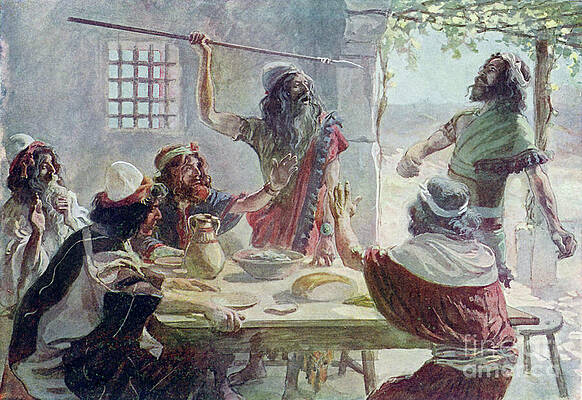
Saul Casts a Javelin at Jonathan, by James Tissot, ca. 1900

The malignant ruach afflicts King Saul with bouts of paranoia, in which he is terrified that David, his loyal army commander, will kill him and seize his throne. While he is in the grip of this spirit, he throws a spear or javelin at David twice. Later, when Saul’s own son and heir, Jonathan, questions his plan to kill David, Saul throws a spear at him, too. The king even orders a whole town of Israelite priests and their families massacred because the high priest helped David to escape.2

David becomes the leader of an outlaw band moving from place to place as King Saul tries to hunt them down. Yet there is no revolution, and no coup. David does not become the king until many years later, after Saul has died in a battle with the Philistines. Why does David wait?

The king’s robe

On one expedition Saul takes 3,000 men to En-Gedi, where he has heard that David and his 600 outlaws are hiding. Saul steps into a cave to defecate in private. He has no idea that the cave is large enough to hide hundreds of men, who are sitting in the recesses of the cave behind him.

Then David’s men said to him: “Here is the day about which God said to you: ‘Hey, I myself give your enemy into your hand!’ And you can do whatever seems good in your eyes to him!” And David got up and stealthily cut off the corner of Saul’s me-il. (1 Samuel 24:5)

me-il (מְעִיל) = a robe worn over the tunic by members of the royal family, high priests, and Samuel (who was a priest before becoming a prophet and judge).

Nowhere in the first book of Samuel does God promise to give an enemy into David’s hand. But David’s men are hoping to motivate him to kill Saul, without saying so directly.

They fail. Instead of stabbing Saul from behind, David merely collects evidence that he could have done so if he had chosen.

And he said to his men: “Far be it from me, by God, if I should do this thing to my lord, to God’s anointed, to stretch out my hand against him! For he is God’s anointed!” (1 Samuel 24:7)

This is an interesting statement by someone who is also God’s anointed. Perhaps David is so awed by his own anointment that he is also awed by Saul’s status. Or perhaps he is planning ahead, setting an example so that when he himself is the king, his subjects will treat his life as sacred, too.

When Saul stands up and walks out, David restrains his men. Then he steps out of the cave and calls after the king. Saul turns around, and David prostrates himself at a distance. He  immediately starts talking, probably so that Saul will listen to him instead of calling his soldiers. Partway through his oration, David points out that he could have killed Saul while the king was squatting in the cave.

“But I had compassion on you, and I said: ‘I will not stretch out my hand against my lord, for he is God’s anointed.’ And see too, my father: see the corner of your me-il in my hand! For when I cut off the corner of your me-il I did not kill you! Know and see that there is no evil or rebellion in my hand, and I did not do wrong against you. Yet you are lying in wait to take my life!” (1 Samuel 24:9-12)

By saying he had compassion on Saul, David puts the idea of compassion into Saul’s mind. By prostrating himself to Saul and calling him “my father” (which acknowledges Saul’s position as both his king and his father-in-law3), he subtly invites the king to be solicitous toward his inferior.

Although David promises that he will never make a move against Saul, he implies that God will:

“Let God judge between me and you, and let God take vengeance for me upon you, but my hand will not be against you!” (1 Samuel 24:13)

If David is hinting to God, God does not respond. David elaborates on his theme until Saul finally answers.

“Is this your voice, my son David?” And Saul lifted up his voice and wept. And he said to David: “You are more righteous than I am, because you have repaid me with goodness, and I have repaid you with evil.” (1 Samuel 24:17-18)

David has succeeded in touching Saul’s good (and rational) ruach. His gamble pays off. Instead of ordering his troops to attack the cave, Saul goes home. The king does not go as far as inviting David to resume his old position in court, and David knows better than to ask.

Before long, Saul’s paranoid ruach overcomes his good ruach again, and he sets off with another troop of soldiers to hunt down David in the wilderness.

Since he knows how changeable Saul is, why does David cut off the corner of the royal robe, then step out to speak to Saul? He could have just stayed in hiding.

My guess is that David puts on a show to satisfy his men. Since he is unwilling to kill Saul, he stages a piece of theater for them that makes him look bold and noble.

The king’s spear

When David and his outlaws are in the wilderness of Zif, some locals report it to King Saul, who collects 3,000 men and sets out again. At night David looks down at the king’s campsite from a hilltop. Saul and his general, Abner, are asleep in the middle of the camp, surrounded by their sleeping troops. Near Saul’s head is a water jug, and the king’s spear, thrust into the ground. David’s nephew Avishai says:

“Today God has delivered up your enemy into your hand! And now, please let me strike him into the ground with the spear, one time! I will not [need to do it] twice to him!” (1 Samuel 26:8)

Avishai is bragging that he can kill Saul with one blow, so nobody in the camp will hear a cry. He is confident that he is a better spear thrower than the king, who missed David twice and Jonathan once.

But David said to Avishai: “You must not destroy him! Because who stretches out his hand against God’s anointed and is exempt from punishment?” (1 Samuel 26:9)

David’s disappointed nephew is silent. David says:

“… God will smite him instead. Either his day will come and he will die, or he will go down in battle and be snatched away. Far be it from me, by God, to stretch out my hand against God’s anointed! And now, please take the spear that is at his head, and the jug of water, and we will go on our way.” (1 Samuel 26:10)

Once again, David emphasizes the importance of doing no harm to God’s anointed king. Taking a symbol of kingship is different, however, whether it is the king’s spear or a corner of his robe.

Then David steals down and takes the spear and water jug himself, perhaps concerned that his young nephew might kill Saul despite his orders. This is when God enters the picture and demonstrates approval of David’s restraint.

And there was no one who saw, and no one who knew, and no one who was rousing, because all of them were sleeping—because the deep slumber of God had fallen upon them. (1 Samuel 26:12)

When David is safely back on the hilltop, he shouts and wakes up everyone below. He accuses General Abner and his men of failing at their job.

“… You did not keep watch over your lord, over God’s anointed! And now, see: Where are the king’s spear, and the jug of water that was at his head?” (1 Samuel 26:16)

Once again, David refers to “God’s anointed”. This way of describing a king reflects his own attitude toward kingship, but it is also a good seed to plant in the minds of the soldiers for the day when David reveals he, too, is God’s anointed.

And Saul recognized David’s voice, and said: “Is this your voice, my son David?” And David said: “My voice, my lord king.” (1 Samuel 26:17)

This time Saul begs David to come back, and promises that he will never do anything bad to David again. But David merely orders someone to return the king’s spear. His last words to Saul are:

“Today God gave you into my hand, but I was not willing to stretch out my hand against God’s anointed.  And hey! As your life has been important today in my eyes, so may my life be important in God’s eyes, and may [God] rescue me from every distress!” (1 Samuel 26:23-24)

Here David is really addressing God. Robert Alter wrote that David “hopes that God will note his own proper conduct and therefore protect him.”5

The king’s death

Tired of being hunted by King Saul, David takes his whole band of outlaws across the border into Philistine territory. While David and his men are in the Philistine village of Ziklag, there is a major battle between the Philistines and the Israelites in the Jezreel Valley in Israelite territory. The Philistines win and occupy the Jezreel, the Israelites who are not killed flee, and Saul and three of his sons, including Jonathan, die on the battlefield. Saul, wounded by arrows, asks his weapons-bearer to finish him off, but the man is feel so awed and fearful that he refuses. David is not the only Israelite who believes a king anointed by God is sacrosanct! So Saul dies by falling on his own sword.6

The second book of Samuel opens with a young man running from the battlefield all the way to Ziklag. He prostrates himself to David, then tells him what happened. His story of how King Saul died is different:

“… he turned around and he saw me and he called out to me, and I said: ‘Here I am’. And he said to me: ‘Who are you?’ And I said to him: ‘I am an Amalekite”. And he said to me: ‘Stand over me, please, and give me the death-blow, because weakness has seized me, though life is still in me.’ Then I stood over him and I gave him the death-blow, since I knew that he could not live long after having fallen. Then I took the circlet that was on his head and the bracelet that was on his arm, and I brought them to my lord here.” (2 Samuel 1:7-10)

According to Robert Alter: “A more likely scenario is that the Amalekite came onto the battlefield immediately after the fighting as a scavenger, found Saul’s corpse before the Philistines did, and removed the regalia. … he sees a great opportunity for himself: he will bring Saul’s regalia to David, claim personally to have finished off the man known to be David’s archenemy and rival, and thereby overcome his marginality as a resident alien … by receiving a benefaction from the new king …”7

But the Amalekite does not know that an anointed king is sacrosanct in David’s eyes. David rips a tear in his clothes in mourning, and demands:

“How were you not afraid to stretch out your hand to destroy God’s anointed!” (2 Samuel 1:14)

Then he has the Amalekite executed.


David could have interpreted his anointment by a prophet in the name of God as permission to supersede the previously anointed king as soon as possible. Instead, he takes the position that anyone who is “God’s anointed” is sacrosanct, and any attempt to kill that person is a crime against God.

During the period when David is an outlaw, he bends a few rules. But he also consults God through oracular devices and does what God says;8 and he maintains that the life of anyone whom God has had anointed is sacred. His attitude toward God keeps him in God’s favor. So God helps him by casting a deep sleep over Saul’s camp while David steals the king’s spear.

Can this warm relationship between David and the God character continue even when David goes to work for the Philistine king who is the chief the enemy of Israel? We shall see in next week’s post, 1 Samuel: David and the King of Gat.


  1. 1 Samuel 10:19-22, 15:9-11. See my first post in this series: 1 Samuel: Anointment.
  2. Saul throws spears at David in 1 Samuel 18:9-12, 19:9-11, and at Jonathan in 1 Samuel 20:30-33. (See my third post in this series: 1 Samuel: David the Beloved.) Saul has everyone in the town of Nov massacred in 1 Samuel 22:16-19. (See my fourth post in this series: 1 Samuel: David the Devious.)
  3. David is married to Saul’s second daughter, Mikhal. She helped him to escape their house when Saul’s men came to kill him, but David never tried to arrange for her to leave and join the outlaws. See my post: 1 Samuel: David the Beloved.
  4. 1 Samuel 24:20-21.
  5. Robert Alter, Ancient Israel: The Former Prophets, W.W. Norton &Co., New York, 2013, p. 399.
  6. 1 Samuel 31:1-7.
  7. Alter, pp. 426-427.
  8. See my post: 1 Samuel: David the Devious.

1 Samuel: David the Devious

(If you want to read one of my earlier posts on this week’s Torah portion, Shoftim (Deuteronomy 16:18-21:9) you might try: Shoftim: More Important Than War: Part 2. Below is the third post in my series on why David is God’s favorite king—whether he acts ethically or not.)


David first comes to King Saul’s court to play the lyre, which calms the king when a fit of irrational terror seizes him. While he is working for Saul, advancing from musician to army commander, David attracts love and loyalty from everyone—Jonathan, the king’s oldest son and heir; Mikhal, the king’s daughter who becomes David’s wife; the king’s troops; and the women in every Israelite city, who celebrate David’s military successes. Why not? He is young, handsome, daring, quick-witted, and eloquent. He quickly learns the arts of war and leadership. He has natural charisma, and God’s blessing. (See my revised version of last week’s post: 1 Samuel: David the Beloved.)

But King Saul becomes jealous of David’s popularity. Even though he does not know that the prophet Samuel, at God’s command, secretly anointed the adolescent David as the next king, Saul comes to suspect that David is scheming to seize his throne.

In fact, David is happy to wait for the throne. But after King Saul makes several attempts to kill him, he flees from the king’s court. For his new life on the run, David adjusts his ethical standards. Although he still worships the God of the Israelites, he lies to a priest, violates a religious rule, and runs a protection racket.

Violating a religious rule

David’s first stop after he parts from Jonathan in the field outside the king’s settlement is Nov, a town of Israelite priests.

And David came to Nov, to Achimelekh the Priest. And Achimelekh trembled to meet David, and said to him: “Why are you alone, and there is no one with you?” (1 Samuel 21:2)

As the king’s top commander and brother-in-law, David would normally travel with an entourage. But why does the high priest tremble? According to Pamela Tamarkin Reis,1 Achimelekh’s fear is due to the presence of a third person.

And a man was there that day from the servants of Saul. He was detained in front of God, and his name was Doeig the Edomite, chief of Saul’s shepherds. (1 Samuel 21:8)

Whatever business Doeig has at the sanctuary, he lingers after David arrives. Both Achimelekh and David would notice him hanging around. Whether the high priest knows that David has fled from King Saul or not, he would be anxious about the presence of someone who might report David’s unusual visit to the jealous and irrational king.   

Instead of telling the truth, David says:

“The king commanded me [about] a matter, and he said to me: ‘Not a man must know anything about the matter on which I am sending you and on which I commanded you!’ So I let the young men know about such-and-such a place [to meet me]. And now, what is there at hand? Give five loaves of bread to my hand, or whatever can be found.” (1 Samuel 21:3-4)

David speaks to Achimelekh as if he were still an important official, and invents a tale about a secret mission. Either he is lying to mislead the priest, or, according to Reis, he is lying to mislead Doeig.

The Priest answered David and said: “There is no ordinary bread under my hand. Rather, there is only sacred bread. If the young men kept themselves away, surely, from women …” (1 Samuel 21:5)

The high priest is suggesting violating a religious rule. Inside the sanctuary, in the room that only priests may enter, is a gold-plated bread table displaying twelve flat, round loaves of bread, along with frankincense. The high priest must lay out new bread every week.

Every sabbath day, perpetually, he must arrange them before the presence of God, from the Israelites as a covenant forever. And they will be for Aaron and his sons [i.e. the hereditary priests], and they will eat them in a holy place; because they are the holiest for him out of the fire-offerings of God. A decree forever. (Leviticus 24:8-9)

According to this law, after the twelve loaves are replaced with fresh bread on Shabbat, the priests must eat the old bread. But Achimelekh is so eager to help David, the national hero, that he offers to break the rule and let David and his young men eat last week’s sacred bread. He mollifies his conscience by stipulating that they must at least be ritually pure when they eat the bread, and asks discreetly if they have avoided an emission of semen.

David assures him that he and the (fictional) young men have kept away from women for the last two days, and all their gear was purified before they set out.

Then the Priest gave him sacred [bread], since there was no bread there except for the Bread of the Presence that had been removed from the presence of God in order to set out warm bread on the day it was taken away. (1 Samuel 21:7)

Thus both Achimelekh and David bend the rules. After that, David asks:

“Don’t you have on hand here a spear or a sword? Because my sword and my gear I also did not take along in my hand, since it was an urgent matter of the king!” (1 Samuel 21:9)

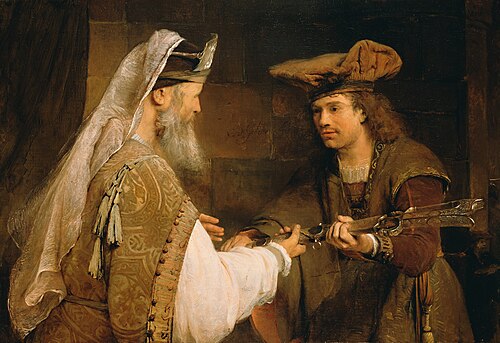
Achimelekh Giving the Sword to David,
by Aert de Gelder, ca. 1700

The high priest replies that the only weapon around is the sword of Goliath, whom David killed with his slingshot. He hands the trophy over to David. Supplied with food and a sword, David leaves and heads for the Philistine border.

The God character does not punish David for this transgression. But God does nothing to help Achimelekh, David’s partner in rule-bending, when Doeig tells King Saul what happened. Saul summons the high priest and all the lesser priests for questioning, and demands:

“Why did you band together against me, you and the son of Jesse, by your giving him bread and a sword … to rise up against me as an ambusher, as it is this day?” (1 Samuel 22:13)

Achimelekh replies:

“But who among all your servants is like David, trustworthy and the king’s son-in-law and commander of your bodyguard and honored in your house?” (1 Samuel 22:14)

Then he pleads innocence on the grounds of ignorance. King Saul orders the palace guard to execute all the priests, but they refuse. So Saul tells Doeg to do it, and he kills all the priests, then massacres the whole population of Nov, man, woman, and child, and all the livestock. Only one person escapes: Ahimelekh’s son Evyatar.

And the God character stands by and lets it happen. Throughout the Hebrew Bible, God delivers collective punishment without distinguishing between innocent and guilty individuals. In the first book of Samuel, it is enough that David, God’s favorite, escapes—along with a priest whom David can consult in the future.

Leading an outlaw band

David crosses the border into Philistine territory, where he is recognized by the servants of the Philistine king of Gat. He escapes by feigning madness, and crosses back into Israelite territory, but only as far as the Cave of Adulam, between Gat and Bethlehem. David’s seven older brothers in Bethlehem hear that he is there, and join him. So does the priest Evyatar, who is also hiding from Saul.

And they gathered to him, every man in distress, and every man who had a creditor, and every man whose soul was bitter. And he became commander over them, and with him were about 400 men. (1 Samuel 22:2)

David’s band of outlaws has grown to about 600 men when he hears that Philistines are attacking the Israelite town of Ke-ilah, south of Adulam. He asks God whether he should rescue the town. (In the Hebrew Bible, God speaks directly only to selected prophets. Everyone else hears from God in dreams, or gets answers from God through divining devices such as casting lots or consulting the priest’s eifod (אֶפוֹד), a ritual tabard worn on the chest. Evyatar brings an eifod when he joins David.)

Although God answers yes, he should rescue Ke-ilah, David’s men are afraid to go. So David asks God again, even though fighting Philistines is no longer his job. Maybe he is still a hero at heart. Or maybe he wants to win allies in the south of Judah for the sake of his future plans.

And once again David inquired of God, and God answered him, and said: “Arise, go down to Ke-ilah, because I am giving the Philistines into your hand!” (1 Samuel 23:4)

The God character, who no doubt likes being consulted, helps David win a victory. When King Saul hears that David and his men are now inside the walls of Ke-ilah, he prepares to besiege the town. David asks the priest Evyatar to use his eifod and addresses two more questions to God:

“Will Saul come down, as your servant has heard? … Will the citizens of Ke-ilah deliver me and my men into his hands?” (1 Samuel 23:11-12)

Through the eifod God answers yes to both questions. Apparently God is aware of the fears of the people of Ke-ilah. They are grateful to David for rescuing them from the Philistines, but they are too afraid of King Saul to defend their rescuers. After all, Saul has recently massacred all the Israelites in the town of Nov. Turning over David and his men to the king would be the townspeople’s best hope of escaping the same fate.

David pays attention to God’s answers, and he and his men leave town before Saul sends an army to beseige it—thus saving both themselves and the townspeople. The outlaw band keeps moving from one location to another in Israelite territory.

And Saul sought him all the days, but God did not give him [David] into his hand. (1 Samuel 22:14)

The God character is still planning for David to replace Saul as the king someday. If God did nothing, Saul would presumably track down a band of 600 men roaming around his kingdom. But God prevents that from happening. Apparently God likes a hero who takes initiative, but also respects and consults God—even if he bends the rules about sacred bread.

Running a protection racket

David seems both noble and pious in the story about rescuing the town of Ke-ilah. But he also uses his outlaw band for a dubious enterprise.

When an exceedingly wealthy man named Nabal is having his 3,000 sheep sheared at Carmel, David sends ten young men to Nabal to wish him well and say:

“And now, I have heard that you have shearers. Now, the shepherds that belong to you were with us. We did not humiliate them, and they did not find anything missing the whole time we were in Carmel. Ask your boys, and they will tell you. And may [my] boys find favor in your eyes, since we have come on a good day. Please give whatever you can find in your hand to your servant, to your ‘son’ David!” (1 Samuel 25:7-8)

In other words, David’s men, without being asked, protected Nabal’s shepherds and flock from thieves and raiders, and did not take any sheep themselves. Now David requests a gift in return, hinting that it is “a good day”, since a sheep shearing was normally celebrated with feasting. His message is polite and deferential. He refers to himself as Nabal’s inferior twice, by calling himself “servant” and “son”.

Then Nabal answered David’s servants, and he said: “Who is David? Who is the son of Jesse? Today there are many slaves who are breaking away, each one from his master! And I should take my bread and my water and my butchered meat that I butchered for my shearers, and I should give it to men who are from I don’t know where?” (1 Samuel 25:10-11)

Comparing someone with a private army of 600 men to a runaway slave is not a smart move. Neither is refusing to give him any food supplies. David’s ten young men report back.

Then David said to his men: “Each man gird on his sword!” And each man girded on his sword, and David also girded on his sword, and they went up behind David, about 400 men. And 200 stayed with the gear. (1 Samuel 25:13)

As they head toward Nabal’s house in Maon, the next town south of Carmel, David says to himself:

“Surely in vain did I guard everything that belongs to this one in the wilderness, and nothing was missing that belongs to him. And he returned evil to me instead of good! Thus may God do to the enemies of David, and thus may [God] add, if by morning I leave alive out of all that belongs to him [even one] pisser against the wall!” (1 Samuel 25:21-22)

Meanwhile Nabal’s wife Abigail, who is described as “intelligent and beautiful”, finds out what happened, and hurriedly loads a train of donkeys with 200 loaves of bread, five butchered sheep, and some wine, grain, raisin cakes, and dried figs. She intercepts David and his 400 men, drops down from her own donkey, and prostrates herself in front of David.

Abigail does not hesitate to denounce her husband and give David all the food. She explains her interception as God’s way of preventing David from becoming guilty of murder.

“… God restrained you from coming to shed blood, and rescued you from avenging yourself by your own hand … for my lord battles the battles of God, and may no evil be found in all your days!”  (1 Samuel 25:26, 25:28)

When God makes David king, she adds, it would be a problem if he had a reputation for spilling blood for no good cause. And David, his cool intelligence restored, thanks her:

“Blessed is God, the God of Israel, who sent you this day to meet me! And blessed is your judgement, and blessed are you, who prevented me this day from shedding blood, and rescued me from avenging myself by my own hand!” (1 Samuel 25:32-33)

David returns to his camp, and Abigail goes home to find her husband getting drunk. She waits until morning, when he has a hangover, to tell him what she did. Nabal has a stroke.

And it happened in about ten days: God struck Nabal, and he died. (1 Samuel 25:38)

David immediately sends a marriage proposal to Abigail, and she accepts.2

David may be guilty of implicit extortion. But since the outlaws cannot farm or engage in trade, they have to get food some other way. They refrain from either stealing sheep or, thanks to Abigail, from killing any Israelites. So God avenges David by killing Nabal.


Although David intends to kill innocent Israelite men in Nabal’s household, he changes his mind. His actual transgressions during his time as an outlaw are peccadilloes, excusable on the grounds that he has to eat sacred bread, dissemble, and run a protection racket simply in order to survive. And David still honors God and follows God’s instruction to rescue an Israelite village from Philistines. So the God character excuses him, and continues to provide a little help now and then as David makes his own way on the road to kingship.

This is the kind of personal God anyone would hope for. But in the first book of Samuel, only David wins God’s forgiveness.


  1. Pamela Tamarkin Reis, Reading the Lines: A Fresh Look at the Hebrew Bible, Hendrickson Publishers, Peabody, Mass., 2002, pp. 136-142.
  2. In ancient Israel, a man could have multiple wives, but a woman could have only one husband.

1 Samuel: David the Beloved

(If you want to read one of my earlier posts on this week’s Torah portion, Re-eih (Deuteronomy 11:26-16:17), you might try: Re-eih: Ownership. Below is the second post in my new series on why David is God’s favorite king.)


David’s name (דָוִד) means “beloved”. He is already God’s beloved when God tells the prophet Samuel to anoint him as the future king of Israel.1 King Saul also loves young David at first, and employs him as his lyre-player and weapons bearer.2 After David kills Goliath with his slingshot, everyone else seems to fall in love with him, including two of the king’s children, the king’s troops, and the women in every Israelite city.

Jonathan

Right after David kills Goliath he returns to King Saul.

And it was as he finished speaking to Saul, then the nefesh of Jonathan became bound up with the nefesh of David. And Jonathan loved him like his own nefesh. (1 Samuel 18:1)

nefesh (נֶפֶשׁ) = self, personality; throat; what makes a body alive.

Jonathan is Saul’s oldest son. Shortly after Saul was acclaimed king, he put Jonathan in charge of one-third of the Israelite troops.3 An able commander, Jonathan won two battles against the Philistines before Saul hired David to play the lyre.

Why does young David captivate Jonathan? Perhaps he sees in David a younger but grander version of himself. Jonathan had led a daring raid against all odds on a Philistine garrison;4 David volunteered to face Goliath with nothing but his slingshot. Both of them had more practical intelligence than Saul, both attracted people’s loyalty, and both spoke piously about God.

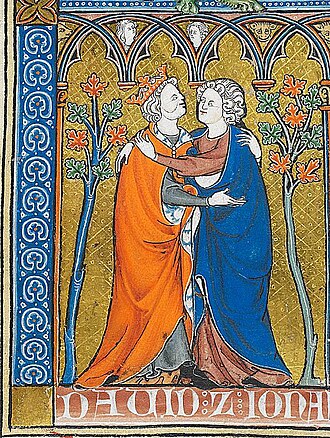
Jonathan and David, “La Somme le Roi”, French illuminated ms., 1290

And Jonathan and David, he cut a covenant because of his love for him like his own nefesh. (1 Samuel 18:2-3)

Although the subject is plural, the pronoun and verb following it are third person plural. The usual biblical covenant is “cut” (a biblical idiom) between two parties.5 But the covenant between Jonathan and David is one-sided. Jonathan cuts the covenant, promising something; David merely accepts Jonathan’s promise. The next verse indicates what the lopsided covenant is about.

And Jonathan stripped himself of the me-il that was on him and he gave it to David, and his [military] garb, and even his sword, and even his bow, and even his belt. (1 Samuel 18:4)

me-il (מְעִיל) = robe worn over the tunic by members of the royal family, high priests, and Samuel (who was a priest before becoming a prophet and judge).

Jonathan is symbolically replacing himself with David, either consciously or unconsciously. The robe signifies that David is now the heir to the throne. The armor and weapons hint that David will replace Jonathan as the king’s chief commander. (King Saul loaned David his armor to fight Goliath, and David politely rejected it.6 But Jonathan’s armor and weapons are not a loan for a particular battle; they seem to be a gift.)

Classic and modern commentators have disagreed about whether Jonathan’s love for David is sexual. Pirkei Avot declares:

“All love that is dependent on something, when the thing ceases, the love ceases. But [love] that is not dependent on something never ceases. Which is love that is dependent on something? This is the love of Amnon for Tamar.7 And which is the love that is not dependent on something? This is the love of David and Jonathan.”8

Whether Jonathan’s love for David has a sexual element or not, it does seem to be unconditional. Yet this does not fully explain Jonathan’s covenant. Turning over one’s whole identity to another person is an unusual act of love.

Soldiers and women

And David went out [with the troops], and everywhere Saul sent him, he was successful. And Saul placed him over men of war, and it was good in the eyes of all the people, and also in the eyes of Saul’s servants. And it was when they came back, when David returned from striking down the Philistine, women went out from all the towns for singing and dancing, to meet King Saul with timbrels, with rejoicing, and with triangles. And the women who were playing chanted, and they said: “Saul struck down his thousands, and David his tens of thousands!” (1 Samuel 18:5-7)

Everybody loves success—except for a jealous competitor. Jonathan does not protest when the chanting women do not even mention him. But Saul smolders with anger, thinking:

“They give to David tens of thousands, and to me the thousands. There remains for him only the kingdom!” (1 Samuel 18:8)

The next day Saul has one of his fits of madness, and as usual David plays the lyre to calm him down. But this time Saul throws a spear at David, twice. David dodges the spear both times.

And Saul was afraid in the face of David, because God was with him, and had turned away from Saul. (1 Samuel 18:12)

King Saul’s diagnosis is correct. David is now God’s beloved, not Saul.

Then Saul removed him from his side, and appointed him commander of a thousand. And he went out and came back before the people. (1 Samuel 18:13)

Going out and coming back is a biblical idiom for leading a military action. David now has Jonathan’s old job. Perhaps, during a rational period, Saul realizes that his own support from the people depends on continued success in the war with the Philistines, and for that he needs David as his chief military leader. But if David continued to serve as his personal musician between campaigns, Saul might try to kill him again in his next fit of madness. So Saul removes David from court to prevent it.

And David was prospering in all his ways, and God was with him. And Saul saw that he was prospering very much and was afraid of his presence. And all Israel and Judah were loving David, since he was going out and coming back before them. (1 Samuel 18:14-16)

Mikhal

Suddenly Saul invites David to marry his older daughter, Meirav. Some commentators speculate that Saul is trying to put David in a position where he has no choice but to continue fighting Philistines for the king. But I wonder if David reminded Saul about the reward he promised to the man who killed Goliath, a reward that included wealth and the king’s daughter.9

David gives a politely humble reply to the proposed marriage. When it is time for the wedding, the mercurial king marries Meirav to another man.

But Mikhal, daughter of Saul, had fallen in love with David. And it was told to Saul, and the matter was agreeable in his eyes. Saul said [to himself]: “I will give her to him, and she will become a trap to him, and the Philisitines’ hand will be against him.” Then Saul said to David: “With the second one you will become a son-in-law to me today!” (1 Samuel 18:20-21)

Again David answers humbly. He sends this message through the king’s servants:

“I am a poor man, and lightly esteemed.” (1 Samuel 18:23)

Perhaps David is suggesting that King Saul still owes him the reward of “great wealth”. If he received that wealth, he could afford to pay a bride-price worthy of a king’s daughter. But Saul has a different idea about the bride-price. He has his servants tell David:

“There is no pleasure for the king in a bride-price—except for a hundred Philistine foreskins, for vengeance on the king’s enemies.” And Saul planned to cause David’s fall at the hand of the Philistines. (1 Samuel 18:25)

But David is God’s beloved, and he has no trouble slaying 200 Philistine men. He gives their foreskins to King Saul, who then gives David his daughter Mikhal.

Two rescuers

And Saul spoke to his son Jonathan, and to all his servants, to put David to death. But Saul’s son Jonathan delighted in David very much. (1 Samuel 19:1)

Jonathan manages to change his father’s mind, and Saul lets David return to the royal house whenever he is not fighting Philistines. But once again a malign spirit overcomes the king, David plays the lyre for him, and Saul hurls a spear at him. David flees to his own house.

And Saul sent messengers to David’s house, to keep watch and to kill him in the morning. And Mikhal, his wife, told David, saying: “If you don’t escape with your life tonight, tomorrow you will be put to death!” And she let David down through the window, and he went, and he hurried away, and he escaped. (1 Samuel 19:12)

Then Mikhal tucks a statue into the bed, puts a tangle of goat’s hair at its head, and pulls up the covers. When Saul’s messengers demand to see David, she says he is sick. When they insist, she shows them the bed. But they uncover the truth. Her father scolds her for deceiving him and letting his “enemy” escape. Mikhal lies and pretends that David threatened to kill her if she did not help him. Like Jonathan, she loves David more than she loves her father. There is no indication of whether David loves her.

David flees to Ramah, the prophet Samuel’s home base. Saul sends messengers to Ramah three times, and each time the spirit of God overcomes them and they babble in ecstasy; God is still looking after David. After the third time, David leaves Ramah and finds Jonathan, asking him:

“What have I done? What is my crime, and what is my offense before your father, so that he seeks my life?” (1 Samuel 20:1)

When Jonathan says he had no idea that his father was trying to kill David, David replies:

“You father surely knows that I have found favor in your eyes. So he said [to himself]:‘Don’t let Jonathan know about this, lest he be pained.’ However, by the life of God and the life of yourself, it is indeed like one step between me and death!” (1 Samuel 20:3)

Jonathan believes him, and promises to do whatever David says. David’s plan is to hide in the countryside while Jonathan tests his father’s intentions. Calling himself “your servant” (since Jonathan still has higher rank, as the king’s heir), David says:

“And you should act with loyal-kindness toward your servant, because you brought your servant into a covenant of God with you …” (1 Samuel 20:8)

Robert Alter noted: “David’s formulation of the arrangement is pointed and quite accurate: it was Jonathan who initiated the pledge of mutual fealty out of his love for David, and who drew David into the commitment.”10

Jonathan swears that he will let David know if King Saul is plotting against him. He adds:

“And may YHWH be with you, as he was with my father!” (1 Samuel 20:13)

Here Jonathan believes that David will be the next king, and privately waives his own claim to the throne. But he asks for reassurance that David will try to keep him and his family alive.

“… Will you not act toward me with the loyal-kindness of God, so I will not die? And you must not cut off your loyal-kindness to my house, ever …” (1 Samuel 20:14-15)

David does not say a word. We can hope he at least nods.

Jonathan attends the king’s New Moon dinner, and makes an excuse for David’s absence. Saul explodes, calling his son-in-law David by the disrespectful appellation “son of Jesse”, and his own son by more insulting names. He accuses Jonathan of the truth:

“Don’t I know that you yourself are choosing the son of Jesse, to your shame? … All the days that the son of Jesse is alive on earth, you will not be secure, you or your kingdom! And now send and fetch him to me, because he is a dead man!” And Jonathan answered his father Saul and said: “Why should he be put to death? What has he done?” (1 Samuel 20:30-32)

In fact, all David has done is to succeed as a warrior and military commander, defending Saul’s kingdom from the Philistines and winning public adulation. But the question tips Saul into madness again, and he throws his spear at his own son and heir. Jonathan leaves the table without eating, and the next morning he gives David their pre-arranged signal in the field. When the two men are alone, David throws himself on his face in prostration to Jonathan.

And he prostrated himself three times, and each man kissed his friend, and each man wept with his friend, until David had made it [the weeping] greater. (1 Samuel 20:41)

People in the Hebrew Bible usually prostrate themselves to God, or to humans who are much higher-ranking than themselves. But in the book of Genesis, Jacob prostrates himself to his brother Esau seven times as part of his effort to mollify his Esau, who had threatened to kill him 20 years before after Jacob had cheated him. Esau then embraces and kisses Jacob, and both of them weep.11  

Why does David prostrate himself to Jonathan in a scene reminiscent of Jacob’s reunion with Esau? David knows, thanks to his secret anointment by Samuel, that he, not Jonathan, is the future king of Israel. Perhaps he is moved by Jonathan’s loyalty and love, and knows that he cannot equal it.

According to Alter, “It is noteworthy that throughout this narrative David is repeatedly the object but never the subject of the verb ‘to love’…”12

Both men weep, though David weeps longer. His tears might be a parting gift to his devoted friend, or they might simply reflect David’s inner turmoil as he faces an unknown future in exile.

Final parting

David and Jonathan meet one more time, when David has become the leader of a large band of outlaws moving from hideout to hideout to evade capture by King Saul. Although Saul never tracks them down, Jonathan obviously has inside information; he visits David at his camp in a forest, and says:

“Don’t be afraid, for the hand of my father Saul will not find you. And you yourself will become king over Israel, and I myself will be your second. And even my father Saul knows this.” (1 Samuel 23:17)

Jonathan’s love for David no longer obliterates his sense of self. Now he asks David to appoint him as viceroy once his beloved becomes king. David’s response is not reported.

The two men reaffirm their covenant, and Jonathan goes home. But he never becomes David’s viceroy; Jonathan dies in the same battle as Saul, and David mourns for both of them as he is proclaimed king.


“What have I done now?” David asked when his oldest brother scolded him for running to the front lines facing Goliath and the Philistines.13 The question comes up again when David asks Jonathan:

“What have I done? What is my crime, and what is my offense before your father, so that he seeks my life?” (1 Samuel 20:1)

And Jonathan answered his father Saul and said: “Why should he be put to death? What has he done?” (1 Samuel 20:32)

What has David done? One answer is that he is young and handsome, bold and confident. He thinks on his feet and speaks eloquently. He quickly learns the crafts of war and military leadership. He is clever, but not deceitful. No wonder David is beloved by every sane person in the kingdom of Israel.

Last week I gave David credit for taking initiative, setting his own goals, and working resolutely to achieve them. Before he was anointed, he made himself an expert at the lyre and slingshot. After he is anointed, he dedicates himself to becoming a hero and next in line for king.

These goals would be ridiculous if David were not naturally talented—and if he did not know that God had chosen him as the next king. But being chosen by God does not necessarily mean succeeding. After all, God originally chose Saul as king. But Saul lacked confidence, vacillated, and did not think things through. No wonder God withdrew support from Saul and promised it to David.

It is not enough to be chosen. One must develop the right character traits, and hold oneself to the necessary standards. Only then will one continue to be beloved—by an individual, by the general public, or by God.

I know that I certainly do not have what it takes to be a hero. But I am grateful that I have the right character traits and standards of behavior to be a worthy spouse.


  1. See my post: 1 Samuel: Anointment.
  2. See my post: 1 Samuel: Lyre and Slingshot.
  3. 1 Samuel 13:1-3.
  4. 1 Samuel 14:1-15.
  5. The key exception is when God makes a unilateral covenant with Noah and every living creature not to drown the world again (Genesis 9:8-12). More normal covenants between humans occur in Genesis 21:22-33, 26:23-33, and 31:44-54, and Joshua 9:3-15.
  6. See my post: 1 Samuel: Lyre and Slingshot.
  7. Amnon feels sexual desire for half-sister Tamar, which disappears after he rapes her (2 Samuel 13:1-15).
  8. Pirkei Avot 5, c.190–c.230 C.E.
  9. See my post: 1 Samuel: Lyre and Slingshot.
  10. Robert Alter, Ancient Israel: The Former Prophets: Joshua, Judges, Samuel, and Kings, W.W. Norton & Co., New York, 2013, p. 358.
  11. Genesis 33:3-4.
  12. Alter, p. 347.
  13. 1 Samuel 17:29.

1 Samuel: Lyre and Slingshot

(If you want to read one of my earlier posts on this week’s Torah portion, Eikev (Deuteronomy 7:12-11:25), you might try: Eikev: Not by Bread Alone. Below is the second post in my new series on why David is God’s favorite king.)


When the prophet Samuel secretly anoints David as the future king of Israel,1 all we know about David is:

  • He is the eighth and youngest son of Jesse (Yishai) the Bethlehemite, and his job is to shepherd his father’s flock. (1 Samuel 16:11)
  • He is “ruddy, with beautiful eyes, and good-looking” (1 Samuel 16:12), but not exceptionally tall.
  • God chooses him not because of his appearance, but because of his leivav (לֵבָב) = heart, seat of thoughts and feelings; mind, character, understanding. (1 Samuel 16:7)
  • His name is David (דָוִד) = beloved.(1 Samuel 16:13)

In the next two stories in the first book of Samuel, David exhibits some of the mental qualities that make him God’s beloved. And God demoralizes Saul, while encouraging David.

David the musician

When Samuel anointed Saul, no one witnessed it. The prophet told him that later that day he would briefly join a band of ecstatics2 led by people playing “lyre and timbrel, flute and harp” and this ecstatic experience would change him “into another man”. When it happened, Saul’s neighbors observed him babbling in ecstasy.3

David’s secret anointment, unlike Saul’s, is witnessed by his immediate family.

And Samuel took a horn of oil and anointed him in the midst of his brothers. And the ruach of God rushed through David from that day and onward. Then Samuel got up and went [back] to Ramah. Then the ruach of God turned away from Saul, and a malignant ruach from God terrified him. (1 Samuel 16:13-14)

ruach (רוּחַ) = wind; spirit, disposition.

Instead of a single ecstatic experience, David is supported continuously by a more subtle ruach of God. Perhaps God changes Saul’s ruach on purpose in order to pave to way for David.

And Saul’s servants said to him: “Hey, please! A malignant ruach of God is terrifying you. May our lord please say [the word], and your courtiers in front of you will look for a man who knows how to play the lyre. And it will be, whenever the malignant ruach of God happens to you, he will play with his hand, and it will be better for you.” (1 Samuel 16:15-16)

King Saul’s courtiers probably know about Saul’s ecstatic experience that included the music of the lyre.

And Saul said to his servants: “Please look for me a man who is good at playing, and bring him to me!” And one of the ne-arim answered and said: “Hey, I have seen a son of Jesse the Bethlehemite who knows how to play—a strong man of ability, and a warrior, and one discerning with words, and a handsome man, and God is with him!” (1 Samuel 16:16-18)

ne-arim (נְעָרִים) = male adolescents, young unmarried men; young male servants. (Singular: na-ar, נַעַר.)

The young servant, probably a few years younger than David, is so star-struck that he calls David a man and a warrior—even though David has never been in a battle. Rabbi Steinsaltz explained: “The young man sought to stress that David was not merely a talented musician, but also one who would be suitable to accompany the king for his other qualities.”4

King Saul sends a message to Jesse, and Jesse sends his youngest son with gifts for the king.

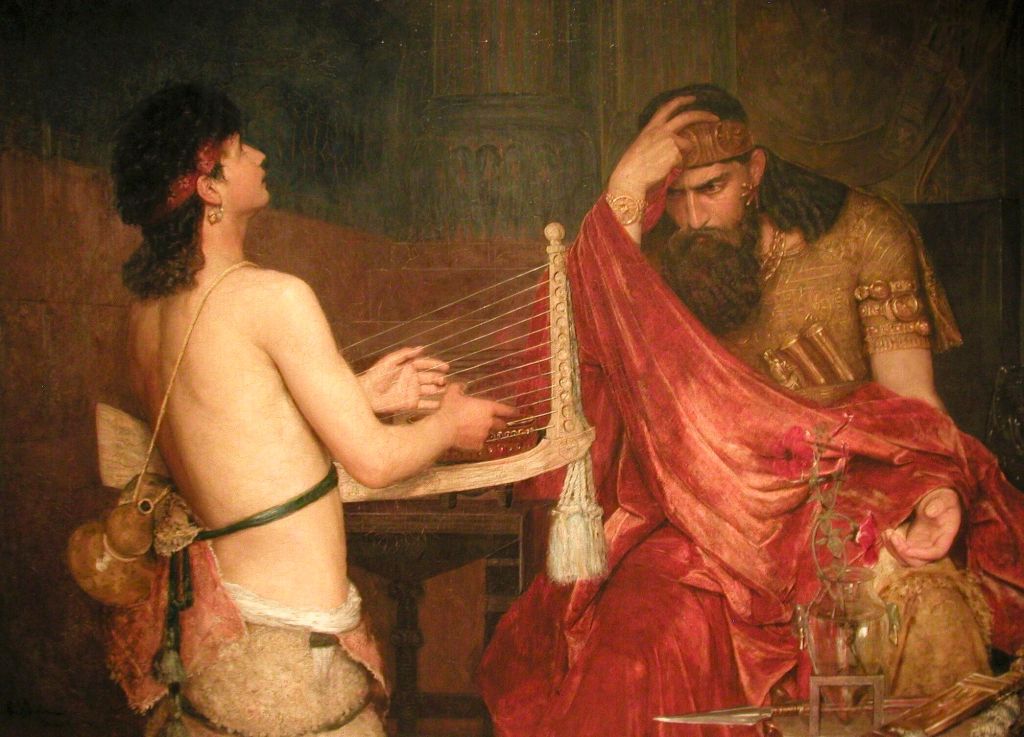
David and Saul, by Ernst Josephson, 1878

And David came and stood before Saul. And Saul loved him very much, and he became his weapons bearer. And Saul sent to Jesse, saying: “Please let David stand [in attendance] before me, because he has found favor in my eyes.” And it was when the ruach of God happened to Saul, then David took his lyre and played it with his hand, and Saul found respite, and it was better for him, and the malignant ruach turned away and went up from him. (1 Samuel 16:21-23)

Even King Saul loves David—at first.

David the marksman

In the next story, a Philistine army and an Israelite army face one another across a ravine in the valley of Elah, about 25 miles (40 km) from Bethlehem. A Philistine champion comes forward—a giant of a man with a scimitar and a spear, wearing heavy bronze armor.5 His name is Goliath (Galyat, גׇּלְיַת = revealer; exiler).

Goliath crosses the ravine and challenges the Israelites to send their own champion down to meet him in single combat. His terms are that the loser’s people will become slaves to the winner’s.

And Saul and all Israel heard these words of the Philistine, and they were dismayed and very afraid. (1 Samuel 17:11)

At least King Saul now has something to be terrified about. Although he himself is a tall warrior, he does not volunteer to fight Goliath. Nor do any of Jesse’s three oldest sons, who are in the army on the Israelite side of the ravine.

And David was going and returning from [waiting] on Saul, to shepherd his father’s flock in Bethlehem. And the Philistine approached and presented himself, in the early morning and in the evening, for forty days. (1 Samuel 17:15-16)

Jesse sends David to the Israelite camp with bread for his three older brothers and cheese for their commander, and asks him to return with news of how his brothers are faring. This reminds me of how Jacob sends Joseph to check up on his older brothers and report back to him.6 Joseph’s jealous older brothers seize him and sell him into slavery; but David’s older brothers are fond of him.

When young David arrives at the army camp, he leaves the gifts of food with a watchman and runs to the front lines.

And a man of Israel said: “Do you see this man [Goliath] who comes up? Indeed, he comes up to taunt Israel! And it will be [that] the man who strikes him down, the king will enrich with great wealth, and will give him his daughter, and will make his father’s household free [of taxes] in Israel!” (1 Samuel 17:25)

David gives no sign that he hears this. Instead, he speaks for the first time in the story, asking the men near him:

“What will be done for the man who strikes down the Philistine yonder and removes the disgrace from upon Israel? For who is this uncircumcised Philistine that he should taunt the battle lines of the living God?” (1 Samuel 17:26)

According to Robert Alter, “His first words express his wanting to know what will be gained—implicitly, in political terms—by the man who defeats Goliath. The inquiry about personal profit is then immediately balanced (or covered up) by the patriotic pronouncement … David has, of course, just heard one of the troops stipulate the reward for vanquishing the Philistine, but he wants to be perfectly sure before he makes his move, and so he asks for the details to be repeated.”7

David’s patriotic speech also honors God, who just might be listening. But why would a thoughtful, even calculating, adolescent with no battle experience consider fighting the armed and armored giant? Has he grown up so beloved by his own family and everyone who meets him that he assumes he can do anything? Does he think that nothing can kill him until his anointment has been realized and he has been acclaimed king? Or is he feeling the ruach of God inside him?

David’s oldest brother, Eliav, accuses him of sneaking into the front lines just to see the battle.

And David said: “What have I done now? Wasn’t it only words?” (1 Samuel 17:29)

David’s “What have I done now?” says a lot. Eliav, and probably David’s other brothers, see him as a headstrong scamp, exasperating but lovable.

David then checks with other soldiers about the king’s promised reward. Someone reports his questions to Saul, who has David fetched.

And David said to Saul: “Don’t let the leiv of a human fall on him! Your servant will go and do battle with this Philistine!” (1 Samuel 17:32)

leiv (לֵב) = heart, seat of thoughts and feelings; mind, character, understanding. (Alternate spelling of leivav.)

Perhaps David omits a courtly introduction to his speech because he is young and excited—and he is already familiar with the king, having played the lyre for him. Yet he is polite enough to refer to the feelings of “a human” falling, instead of the feelings of Saul.

But Saul said to David: “You cannot prevail in going against this Philistine to do battle with him, because you are a na-ar, and he has been a man of battle since he was a na-ar!” (1 Samuel 17:33)

David retorts that when lions and bears carried off lambs from his father’s flock, he went after them and killed them.

“And I held onto its beard and struck it down and put it to death! Even the lion, even the bear, your servant struck down. And this uncircumcised Philistine will be like one of them, since he has taunted the battle lines of the living God!” (1 Samuel 17:35-36)

Perhaps the God character, like a fond grandfather, loves David for his courage as well as for his quick wit. David exhibited his courage before God decided he should be anointed. And David knows God loves him.

And David said: “God, who rescued me from the hand of the lion and the hand of the bear, he himself will rescue me from the hand of this Philistine!” Then Saul said to David: “Go, and may God be with you!” And Saul dressed David in his own garb, and put a bronze helmet on his head, and dressed him in armor. Then David strapped his sword over his garb and he tried to walk, but he was not trained. Then David said to Saul: “I am unable to walk in these, since I am not trained.” And David removed them from upon himself. (1 Samuel 17:37-39)

If King Saul were not so desperate to get rid of the threat of Goliath, he might have second thoughts about sending out a young musician who does not even know how to walk in armor. But he merely stands by while David takes only his staff and his slingshot, and heads for the ravine. He picks up five smooth stones on the way and tucks them into his shepherd’s pouch.

David walks toward Goliath alone, but Goliath is preceded by his shield-bearer. Goliath jeers at David, and David asserts that God will be the victor.

And David said to the Philistine: “You come to me with sword and spear and scimitar, but I come to you with the name of the God of Armies, the God of the battle lines of Israel, whom you have taunted! Today God will deliver you to my hand, and I will strike you down and remove your head … And all this assembly will know that not with a sword or a spear does God grant victory; for the battle is God’s, and he will give all of you into our hand!” (1 Samuel 17:45-47)

How could the God character resist this speech?

David only needs one of his five stones to kill Goliath. He slings it, and hits Goliath smack on the forehead.

And the stone sank into his forehead, and he fell on his face to the ground. (1 Samuel 17:49)

Commentators have wondered why Goliath did not fall backward. Rashi wrote that God arranged it that way “in order that David should not be troubled to walk [the extra distance] and cut off his head”.8

The term “fell on his face” often occurs in the Torah to describe a deliberate prostration toward God or toward a superior. Goliath is, in a sense, prostrating himself to either David or David’s God in defeat.

Robert Alter noted: “David speaks almost as though he expects to prevail through a miracle of divine intervention … but in fact his victory depends on his resourcefulness in exploiting an unconventional weapon, one which he would have learned to use skillfully as a shepherd.”9

In case Goliath is unconscious but not dead, David runs up to the body.

David Beheads Goliath, by Michelangelo, Sistine Chapel, 1509

…and there was no sword in David’s hand. And David ran and stood over the Philistine, and he took his [Goliath’s] sword and drew it from its sheath and killed him; he cut off his head. And the Philistines saw that their champion was dead, and they fled. (1 Samuel 17:50-51)

The Philistines do not become slaves of the Israelites, as Goliath had promised. But the Israelites do pursue them and kill some of their soldiers before they reach the gate of the fortified Philistine city of Ekron.


As the youngest of eight sons, David could have been as spoiled as Joseph is in the book of Genesis. But all Joseph does, before he becomes a slave in Egypt, is tell his prophetic dreams and rat on his brothers. David grows up in a more reasonable family, and he is a self-starter. Before his surprise anointment, he takes the time to practice with both the lyre and the slingshot. His musicianship becomes good enough for the king to hire him, and he is so good a marksman that he slays Goliath with a single stone.

Probably the God character loves David for his courage, his cleverness, and his habit of praising God. But what I admire most about David as a youth is that he takes initiative, sets goals for himself, and keeps working until he achieves them.

Next week we will see how David becomes the beloved of Jonathan, Michal, the troops, and the women of Israel—everyone except King Saul—without risking the loss of God’s affection. He knows how to be successful. But does he know how to return anyone’s love?


  1. See last week’s post, 1 Samuel: Anointment.
  2. The Hebrew word navi (נָבִיא) is used for both rational prophets like Samuel who hear God speaking to them, and irrational “prophets” who experience God’s presence with fits of ecstasy that include singing and dancing.
  3. 1 Samuel 10:5-11.
  4. Adin Even-Israel Steinsaltz, Introductions to Tanakh, I Samuel, as quoted in www.sefaria.org.
  5. Robert Alter translates the measurements in the story, explaining that Goliath is over 8 feet tall, and his armor weighs about 125 pounds. (Robert Alter, Ancient Israel: The Former Prophets: Joshua, Judges, Samuel, and Kings, W.W. Norton & Co., New York, 2013, pp.  334-335.
  6. Genesis 7:17-23.
  7. Alter, p. 338.
  8. Rashi (11th-century Rabbi Shlomoh Yitzchaki), translated in www.sefaria.org.
  9. Alter, p. 341.

1 Samuel: Anointment

(This week’s Torah portion is Va-etchanan, Deuteronomy 3:23-7:11. If you want to read one of my earlier posts on this portion, you might try: Va-etchanan: Fire, Not Idols. Below is the first in a new series of posts on why David is God’s favorite king, which I am offering in place of the rest of Deuteronomy.)


When a prophet anoints a man as king, it is only the first step on the road to rulership. The prophet Samuel anoints the first two kings of Israel, Saul and David. But they both have to wait for popular acceptance before they can begin to govern.

The anointing of Saul

Samuel Anoints Saul, Maciejowski Bible, ca. 1250

Samuel is not only a prophet, but also a circuit judge for four towns in the hills between Shiloh and Jerusalem: Bethel, Gilgal, Mitzpah, and Ramah.1 When Samuel grows old, the elders of the area ask him to appoint a king to govern them. (See my post: Haftarat Korach—1 Samuel: No Kings?) He warns them that a king would seize their property and their children, and treat them like slaves. But the people are undeterred, and God tells Samuel:

“About this time tomorrow I will send to you a man from the land of Benjamin, and you will anoint him as a ruler over my people Israel. He will deliver my people from the hand of the Philistines. For I have seen my people, since their cry of distress has come to me.” (1 Samuel 9:16)

The next day, Samuel arrives at the next town on his circuit at the same time as Saul2, a young man who is a head taller than anyone else. After he has been searching for three days for his father’s lost donkeys, his servant suggests that he ask the seer in the nearby town. When Saul says he has nothing to pay the seer, his servant gives him a piece of silver. Compared to his servant, Saul seems be clueless and not to be trusted with money.

At the town gate, God tells Samuel:

“Hey! It’s the man about whom I said to you: This one will restrain my people!” (1 Samuel 9:17)

Saul asks Samuel how to get to the seer’s house, and Samuel replies that he is the seer. Then before Saul can ask about his father’s donkeys, the prophet tells him they have been found, and invites him to a feast at the local sanctuary. At dawn, Samuel accompanies Saul back to the town gate and tells Saul’s servant to go on ahead.

Then Samuel took a flask of oil and poured it on his head, and he kissed him, and he said: “Is it not so that God meshachakha as a ruler over [God’s] inheritance?” (1 Samuel 10:1)

meshachakha (מְשָׁכהֲךָ) = has anointed you. (From the same root as moshiach, מָשִׁיחַ = annointed one. In the Hebrew Bible, a moshiach is a king or a priest. This word was translated into English as “messiah”.)

The “inheritance” Samuel refers to is the Israelites.

Saul says nothing—either because he is dumbfounded, or because Samuel keeps on talking. He tells Saul what will happen to him the rest of the day—including an encounter with a band of ecstatic prophets playing lyres, timbrels, flutes, and harps.

“Then the spirit of God will rush over you, and you will speak in ecstasy with them, and you will be changed into another man.” (1 Samuel 10:6)

Somehow this experience of an altered state will change Saul so he will become capable of assuming command. Samuel concludes by ordering Saul to meet him in seven days at Gilgal.

A note on anointments

The first anointment in the Hebrew Bible is of a stone. Jacob wakes up from his dream of the ladder or stairway between heaven and earth. He takes the stone he was using as head-rest, sets it upright as a pillar, and pours oil on top of it, thus dedicating it as a sacred spot.3

The book of Exodus calls for the anointment of the first five priests of the new centralized religion, as well as all the sanctuary furnishings, and the matzah wafers used in the consecration. God gives Moses the recipe for the anointing oil: three spices and olive oil.4 A public ritual of consecration by anointment finally occurs in Leviticus 8:10-12.

The first anointment of a human being who is not a priest is Samuel’s anointment of Saul. After that, five more men are anointed as kings of Israelites: David, Solomon, Jehu (in Samaria), Joash (in Judah), and Jehoahaz (in Judah).5 All of these kings are anointed with olive oil poured on their heads, but no spices are mentioned.

Maimonides explained: “A son who succeeds his father as king is not anointed unless he assumes his position amid a dispute over the inheritance or during a civil war. Under these circumstances, he should be anointed in order to remove all disagreement. Therefore, they anointed Solomon because of the claim of Adoniyahu; Joash, because of the usurpation of Atalyah; and Jehoahaz, because of the claim of his brother, Jehoyakim.” (Mishneh Torah, Kings and Wars)6

Saul, David, and Jehu are anointed by prophets. But Solomon and Joash are anointed by priests,7 and Jehoahaz is anointed by “the people of the land”.7

After Saul’s anointment

The secret anointment of Saul is only the first step toward making him the king of the Israelites. The prophet Samuel assembles the people seven days later at Ha-Mitzpah, “the watchtower”, perhaps a landmark near Gilgal. He addresses them and casts lots to determine who will be their king. The lot falls on Saul, but nobody can find him. Then God tells Samuel that Saul is hiding in the baggage.8 When the young man is fetched and brought in front of the people, everyone sees that he stands a head taller than anyone else.

And all the people shouted and said: “May the king live!” And Samuel spoke to the people the rules of kingship, and he wrote them in a scroll, and he set it in front of God. Then Samuel sent away the people, each to his own house, and Saul also went to his house in Give-ah. And with him went the able people whose hearts God had touched. (1 Samuel 10:24-26)

Others are skeptical. But when the king of Ammon threatens a town in Gilead, God inspires Saul to unite the tribes and defeat the Ammonite army. After the victory, Samuel assembles the Israelites again for a ceremony confirming Saul’s kingship. (See my post: Haftarat Korach—1 Samuel: No Kings?) Now all the Israelites are enthusiastic about King Saul—except for Samuel.

Saul recruits an army to fight the Philistines, and waits seven days for Samuel to arrive and make the offerings to God. Then, seeing his troops begin to scatter, Saul makes the offerings himself—just before the prophet shows up and scolds him for not waiting.9

The last straw for Samuel is when Saul follows his order to conquer the main town of the Amalekites, but then fails to carry out the rest of his directions: to renounce the spoils and devote all its people and livestock to destruction in God’s name.

And Saul and the troops spared Agag [king of Amalek] and the best of the flocks and cattle, the fat ones, the lambs, and all the good ones … And the word of God happened to Samuel, saying: “I have had a change of heart that I kinged Saul as king, because he has turned away from [following] after me, and my word has not been established!” (1 Samuel 15:9-11)

Samuel does not accept King Saul’s explanations and apologies. After Samuel kills King Agag himself and goes home to Ramah, God speaks to him again: “How long will you keep lamenting for Saul, when I have rejected him from reigning over Israel? Fill your horn with oil and go. I send you to Jesse the Bethlehemite,10 because I have seen among his sons a king for me.” (1 Samuel 16:1)

The anointing of David

Once again Samuel performs a secret anointment. He travels to Bethlehem, sacrifices a calf, and invites Jesse and his sons to eat the approved portions.

And it was when they came and [Samuel] saw Eliav, then he said [to himself]: Indeed, facing God is meshicho! But God said to Samuel: “Don’t pay attention to his appearance, or to the height of his stature, because I have rejected him. For it is not what the human sees. For the human sees [what is] for the eyes, but God sees the heart.” (1 Samuel 16:6-7)

meshicho (מְשִׁיחוֹ) = his anointed one. (A form of moshiach.)  

Jesse brings seven sons to Samuel, and God rejects each one. Then Samuel asks Jesse if he has any more sons, and Jesse replies that his youngest is still out shepherding the flock.

And he sent and had him brought in. And he was ruddy, with beautiful eyes, and good to see. And God said: “Arise, meshacheihu, because this is he!” And Samuel took a horn of oil vayimeshach him in the midst of his brothers. And the spirit of God rushed through David from that day and onward. Then Samuel got up and went [back] to Ramah. (1 Samuel 16:12-13)

meshacheihu (מְשָׁחֵהוּ) =anoint him!

vayimeshach (ואיִּמְשַׁח) = and he anointed.

David (דָּוִד) = beloved. (An alternative form of dod, דוֹד or דֺּד = beloved; uncle.)

Saul is acclaimed as king the same year that Samuel anointed him. But David has to wait for decades after his anointment, until King Saul dies in battle, before he becomes the king—first of Judah, then of all Israel.

When he is acclaimed king of all Israel, he is anointed again!

All the tribal leaders of Israel came to the king at Hebron,11 and the king, David, cut a covenant with them at Hebron in front of God, vayimshechu David as king over Israel. (2 Samuel 5:3-4)

 vayimshechu (וַיִּמְשְׁחוּ) =and they anointed him. At least during his long wait between anointments, David has the comfort of knowing that he is God’s chosen king. In fact, he is already God’s beloved.


How would you feel if you were secretly anointed to a high position? If you were like Saul, you might doubt that you could rise to the challenge. After all, a single ecstatic experience of the divine is not enough to change someone’s personality. And when the position came open, you might even hide in the baggage.

But if you were like David, you might take your anointment in stride, and immediately make your own plans to be in the right place at the right time. Maybe that quality is what God sees in David’s heart.

Next week we will start looking at look at David’s plans, why he is God’s beloved.


  1. For the convenience of readers unfamiliar with Hebrew, I am giving all the commonly-known proper names in their usual English formulation—with footnotes on their Hebrew pronunciations and meanings. Samuel is Shmuel, שְׁמוּאֵל = “his name/reputation is God”. Bethel is Beit-Eilבֵּית-אֵל = “House of God”.
  2. Saul is Sha-ul, שָׁאוּל = “asked for”.
  3. Genesis 28:17-18.
  4. Exodus 30:24
  5. In 1 Kings 19:15, God commands the prophet Elijah to anoint Chazaeil as king of Aram, Jehu as king of the northern kingdom of Israel, and Elisha as Elijah’s successor. Only one of these anointments is described in the bible, when Elisha has one of his student prophets anoint Jehu in 2 Kings 9:1-10. Jehu takes the throne from King Ahab. Jehu is Yeihu, (יֵהוּא), “God is he”. Joash is Yeho-ash (יְהוֹאָשׁ), “God is fire”, and Jehoahaz is Yeho-achaz (יְהוֹאָחָז), “God grasped”. (I use a transliteration system in which “ch” is a soft gutteral, as in the Scottish “loch” or German “ich”.
  6. Moses ben Maimon, a.k.a. Ramban or Maimonides (12th century), Mishneh Torah, Kings and Wars, 1:12, translated by Eliyahu Touger, Moznaim Publishing.
  7. 1 Kings 1:39, 2 Kings 11:12.
  8. 2 Kings 23:30.
  9. 1 Samuel 10:19-22.
  10. Jesse is Yishai (יִשַׁי), “my man”. Bethlehem is Beit-Lechem (בֵּית-לֶחֶם), “House of Bread”.
  11. Hebron is Chevron (חֶברוֹן), “alliance”.

Haftarat Chukat–Judges: Outlaws

The leader of a band of outlaws becomes a ruler by popular acclaim twice in the Hebrew Bible. It happens to Yiftach (“Jepthah” in English) in the book of Judges, and to David in the first book of Samuel. But the story of Yiftach’s ascent is a tragedy, while David rises to kingship with confidence and unlimited success. The biggest difference between them is their relationship with God.

Yiftach the outlaw

This week’s haftarah reading from the Prophets (Judges 11:1-33) begins:

Yiftach, by Hieronymus Francken, 17th century, cropped

Yiftach the Giladite was a mighty man of ability, and he was the son of a prostitute woman. And Gilad begot Yiftach. (Judges 11:1)

Gilad (often spelled “Gilead” in English) is both the name of Yiftach’s father, and the name of the Israelite territory east of the Jordan River.1 The name of Yiftach’s father implies that he is the most important man in Gilad. No one would believe a prostitute who identified someone important as the father of her child—unless she had given up her trade to live in that man’s house.

“The plain meaning of this statement is that Yiftah’s mother was a licentious woman who became Gilad’s concubine.” (Steinsaltz)2

And Gilad’s wife bore sons to him. But when the wife’s sons had grown up, they cast out Yiftach, and said to him: “You will not inherit in our father’s household, because you are the son of the other woman!” (Judges 11:2)

This is an illegal move in Israelite tradition. If Yiftach grew up in his father’s house, that means his father acknowledged him as a son. All of a man’s acknowledged sons split his property when he died, and the firstborn son inherited a double portion.3 The order in which the story reports the births of Gilad’s sons implies that Yiftach is the firstborn. His half-brothers may want larger shares of the inheritance, and they may also be jealous of Yiftach’s strength and prowess. So they kick him out of the house.

Vayivrach, Yiftach, from the presence of his brothers, and he settled in the land of Tov. And worthless men collected around Yiftach, and they went out with him. (Judges 11:3)

vayivrach (וַיִּבְרַח) = and he fled, went quickly.

They went out with him” means that Yiftach and his followers went out raiding farms and villages. For a man who had no property and no trade, the only alternatives to raiding (or stealing) were to find employment as a seasonal agricultural worker, or to sell oneself as a slave.

Worthless men—men without land or jobs—are attracted to Yiftach because he is a “mighty man of ability”, a natural leader for activities involving aggression. The text does not say who the men raid, but if Tov was close to the northern border of Gilad, as some scholars argue, then outlaws living in Tov could raid Aramean villages just over the border without making enemies in Gilad.

The Ammonite threat

The first three verses about Yiftach fill in the background for a situation that the bible describes immediately before this week’s haftarah reading:

The Ammonites mustered and camped inside Gilad. And the Israelites gathered and camped at Mitzpah.4 And the people, the leaders of Gilad, said, each to his fellow: “Who is the man who will begin to do battle against the Ammonites? He will be the head of all the inhabitants of Gilad!”  (Judges 10:17-18)

“They scarcely permit themselves to imagine victory but are prepared to proclaim as chief whoever will dare to fight the Ammonites.” (Alter)5

At this point, Yiftach and his band of outlaws have been raiding for some time from their base in Tov. Stories of daring raids have probably spread across Gilad. So the elders of Gilad travel to Tov.

And they said to Yiftach: “Go, and become a commander for us, and we will wage war against the Ammonites!” And Yiftach said to the elders of Gilad: “Aren’t you the ones who hate me, and drove me away from my father’s house? Then why have you come to me, now that you are in a tight place?” (Judges 11:6-7)

The answer is obvious: Yiftach is the only man they know who is capable of conducting a military campaign. But he cannot resist pointing out that the elders should have thought of that before they kicked him out.

Then the elders of Gilad said to Yiftach: “Just so. Now we have returned to you [so that] you will go with us and wage war against the Ammonites. And you will become our head, out of all the inhabitants of Gilad.” (Judges 11:8)

They need the man whom they cast out so much, they even offer to make him the governor of the region as well as their war general.

And Yiftach said to the elders of Gilad: “If you yourselves bring me back to wage war against the Ammonites, and God gives them to me, I myself will be your head.” (Judges 11:9)

Exum6 pointed out that Yiftach’s counter-offer specifies that he will be the head of the Giladites even after the military action is over. It also brings God into the picture.

The elders agree, and Yiftach goes with them to Mitzpah, where he repeats the agreement so everyone there can hear it, too. Then he exchanges messages with the Ammonite commander, who pays no attention to Yiftach’s explanation of why Gilad belongs to the Israelites.7 His explanation concludes:

“May God, the judge, judge today between the Israelites and the Ammonites!” (Judges 11:27)

Up to this point, God has been silent.

Then a spirit of God came over Yiftach, and he crossed over Gilead … to the Ammonites. (Judges 11:29)

In most biblical stories about ad-hoc war leaders, God’s spirit inspires them to volunteer. But Yiftach is recruited by human beings, and the spirit of God does not come over him until he has already negotiated the terms of his service with the elders, and attempted negotiation with the enemy. (See my post Haftarat Chukat—Judges: A Peculiar Vow.)

Yiftach has been talking as if he knows God is on his side, but he is actually unsure and insecure. Even feeling a divine spirit come over him and move him to lead the battle does not reassure him. Yiftach desperately wants to become the “head” or governor of the whole region, and he knows it will only happen if God grants him victory, no matter how good his strategy and leadership are. And if he loses the battle with the Ammonites, they will kill him.

So he utters a vow that could be considered a prayer—or a bribe.

Yiftach’s vow

Then Yiftach vowed a vow to God, and said: “If you definitely give the Ammonites into my hand, then it will be the one going out—whoever goes out the doors of my house to meet me when I return safely from the Ammonites—will be God’s; and I will offer up [that one] as a burnt offering.” (Judges 11:30-31)

Yiftach’s Sacrifice, Maciejowski Bible, ca. 1250

The battle is a rout, with total victory for the Israelites. When Yiftach returns, his daughter, who is his only child, comes dancing out of the house playing a drum in celebration. Yiftach is shocked, even though it is customary for women to greet returning warriors with dancing, singing, and drumming. (See my post Judges, Jeremiah, and 1 Samuel: More Dancing.) But he carries out his vow. (See my post Haftarat Balak—Micah: Bribing the Divine.)

Why would Yiftach utter a vow that leaves so much room for disaster? One theory is that Yiftach expected his daughter to emerge, and his vow to sacrifice her reflected extreme trust in God; he was waiting for God to stop him the way God stopped Abraham from sacrificing Isaac.8 But since God disapproves of Yiftach’s vow, God lets the sacrifice go forward.9

Another theory is that Yiftach suppressed the knowledge that his daughter was likely to come out the door.

“A psychological study of Jephthah might suggest that punishing himself was, if only unconsciously, the purpose of the vow.  The man who was considered to be unworthy because of his birth, and maybe in his heart of hearts accepted this, made sure, through the vow, that there would be no continuity beyond his own lifetime. To put it another way, the stain of his illegitimate birth would end with his death. Perhaps that is why he does not take a second wife and try again.” (Magonet)10

Since Yiftach’s own brothers cast him out, he believes God will eventually cast him out. And the God-character in this story silently collaborates with Yiftach to blight his success.

David the outlaw

The name of the other biblical leader of an outlaw band is David (דָּוִד), which comes from the noun dod (דּוֹד), meaning “beloved”. He is the beloved of God, as well as of King Saul’s son Jonathan.

I will explore King David’s relationship with God in greater detail in a series of blog posts in August. Here, I will point out that David’s history before he becomes the leader of an outlaw band is different from Yiftach’s.

David is an adolescent, the youngest of eight sons of Jesse, when God commands the prophet Samuel to secretly anoint him as the next king of Israel, after Saul.

And Samuel took the horn of oil and anointed him in the midst of his brothers. And the spirit of God made David prosper from that day on. (1 Samuel 16:13)

Samuel Anoints David, Dura Europos Synagogue, 3rd century CE

David’s brothers seem happy with his anointment. While Yiftach flees from his brothers, David flees from King Saul, who is insanely jealous of David’s military successes and keeps threatening to kill him. After a quick stop for provisions,

Then David stood up, vayivrach that day from the presence of Saul … (1 Samuel 21:11)

When David finds a hiding place in the cave of Adulam,

… his brothers and his father’s whole household heard, and they went down to him there. And they gathered themselves to him, every man in distress, and every man who had a creditor, and every man with bitter feelings. And he became a commander over them. And there were with him about 400 men. (1 Samuel 22:2)

David’s band of outlaws includes “worthless men”, like Yiftach’s. But it also includes all of David’s brothers and their families and servants.

The book of 1 Samuel provides two clues about how David and his outlaws support themselves. Instead of raiding villages like Yiftach’s band, they rescue the town of Keilah from Philistine raiders, with God’s approval—after leading away the Philistine’s livestock. Later, David appears to be running a protection racket. He and his men stand around in the field by Carmel where Naval’s 3,000 sheep are being sheared. Afterward, David sends ten of his young men to Naval to wish him peace, mention the shearing, and give him this message:

“Now, the shepherds that belong to you were with us. We did not humiliate them, and nothing was missed by them the whole time they were in Carmel. Ask your lads, and they will tell you … Please give whatever you can find in your hand to your servants [David’s men] and to your ‘son’ David!” (1 Samuel 25:7-8)

When Naval refuses to give anything to David for guarding his sheep, David and his men head toward Naval’s house armed with swords, intending to kill every male there. They refrain only because Naval’s wife intercepts them with a troop of donkeys loaded with provisions.

King Saul keeps hunting them down, so finally David offers his outlaws (600 now) as mercenaries to the Philistine king of Gath. He brings his employer booty from the villages they raid, claiming they are Israelite villages, when really they are places affiliated with neither Israelites nor Philistines.11

Finally, when all the Philistine kings unite to make war on the Israelites, David sends booty to the elders in more than two dozen towns in the territory of Judah. He is absent from the battle, but when he learns that King Saul was killed, he and his outlaws move to Judah.

And the men of Judah came, and they anointed David as king there over the House of Judah … (2 Samuel 2:4)

David has become the “head” or chief of Judah without making a single vow to God. He does not need to, because unlike Yiftach, he grew up confident about his family, and he has known that God is on his side ever since Samuel anointed him when he was a teenager.


  1. Numbers 32:33-42. This region is currently the northwestern corner of Jordan.
  2. Rabbi Adin Even-Israel Steinsaltz, Introductions to Tanakh: Judges, reprinted in www.sefaria.org.
  3. Genesis 25:31-34, Deuteronomy 21:17.
  4. The Hebrew Bible refers to at least two towns named Mitzpah (מִצְפָּה), one in Gilad and one in the territory of Benjamin, where Samuel assembles the Israelites to cast lots for a king in 1 Samuel 10:22.
  5. Robert Alter, Ancient Israel: The Former Prophets, W.W. Norton & Co., New York, 2013,p. 164.
  6. J. Cheryl Exum, Tragedy and Biblical Narrative, Cambridge University Press, Cambridge, 1992, p. 55.
  7. Judges 11:21, 23.
  8. Rabbi Yosef ibn Kaspi, Gevia Kesef, 14th century, citing Genesis 22:9-13.
  9. Jonathan Kirsch, The Harlot by the Side of the Road: Forbidden Tales of the Bible, Penguin Random House, 1998, p. 207.
  10. Jonathan Magonet, “Did Jephthah Actually Kill his Daughter?”, footnote 11, www.thetorah.com, 6/25/2015.
  11. 1 Samuel 27:1-12.

Haftarat Korach—1 Samuel: No Kings?

“You said to me: ‘No, for a king must be king over us!’ But Y-H-V-H, your God, is your king!” (1 Samuel 12:12)

A king makes the rules and wields absolute power over his people, the prophet Samuel warns in this week’s haftarah1 reading (1 Samuel 11:14-12:22). Like other biblical prophets, Samuel insists that this role belongs only to God. Yet the Israelites demand a human king.

The government of the Israelites is decentralized and minimal until Saul becomes king in the first book of Samuel. Prophets communicate God’s laws and decrees to the people. In each town and village, respected elders meet to judge cases and interpret the laws. The general community enforces its elders’ rulings. And when an enemy threatens more than one town, the elders of the region call for a war leader to command their fighting men until the threat is over.

Occasionally a notable Israelite holds two of these positions, but never three. Moses and Samuel serve as both the prophet and the appeals judge for the Israelites,2 but neither is a war leader. Joshua is a judge and war leader, but not a prophet.3 In the book of Judges, Gideon and Yiftach are war leaders who become local judges.4

But after the Israelites ask Samuel to appoint a king, everything changes.

Samuel’s first warning

The initial reason for their request is that Samuel is preparing for retirement as the circuit judge. He appoints his two sons as judges in Beer-sheva, a town about 59 miles (95 km) south of his own home base in Ramah.

But his sons did not walk in his ways, and they were bent on following profit, and they took bribes and bent justice. So all the elders of Israel gathered together and came to Samuel at Ramah. And they said to him: “Hey! You have grown old, and your sons have not walked in your ways. Now appoint a king for us, leshaftanu, like all the nations!”  (1 Samuel 8:3-5)

leshaftanu (לְשָׁפְטַנוּ) = to judge us, to govern us. (From the verb shafat, שָׁפַת.)

In other words, the elders of all the Israelite towns and villages demand a king to replace Samuel and his sons as the court of appeals. They overlook the facts that kings are also succeeded by their sons, and that kings govern through more than judging cases.

Rabbi Steinsaltz explained: “… the rule of judges is unstable and national leadership has begun in Israel … The elders did not wish to dismiss Samuel from his position, but they wanted to regularize and facilitate the continuation of a central authority. They turned to the prophet because he had the power to decide on behalf of all Israel.”5

And the matter was bad in Samuel’s eyes … and Samuel prayed to God. And God said: ‘Listen to the voice of the people … However, you must definitely warn them; and you must tell them the procedures of the king who will be king over them.” (1 Samuel 8:6-9)

The kings of other countries in the Ancient Near East, especially Egypt and Assyria, issued new laws as well as administrative decrees. They served as appeals judges, and they also enforced their own rulings. They conducted all foreign policy, including war. They funded their personal and administrative costs through taxes, and imposed corvée labor6 and military service on their people.

So Samuel tells the Israelites:

Chariots in ivory plaque from Megiddo

“This will be the procedure of the king who will be king over you: he will take your sons for himself, and put them in his chariots and on his horses … and to plow his plowing and to harvest his harvest, and to make his battle weapons and his chariot weapons. And he will take away your daughters for ointment-makers, and cooks, and bakers. And he will take away your fields and your vineyards and your olive groves, the best ones, and give them to his courtiers.” (1 Samuel 8:11-14)

Samuel adds that a king will also take slaves owned by the Israelites for himself, and tithe everyone’s produce and livestock.

But the people refused to pay attention to Samuel’s voice, and they said: “No! Rather, let a king be over us, and we, we too, will be like all the nations! Ushefatanu, our king, and he will go out in front of us and fight our battles!” (1 Samuel 8:19-20)

ushefatanu (וּשְׁפָטָנוּ) = and he will judge us, and he will govern us. (Also from the verb shafat.)

The people are so swept up in the idea of having their own king, one man to serve as both judge and war leader for all the tribes, that Samuel’s warning makes no impression on them. They probably cannot imagine their own king commandeering their sons and daughters, farms, slaves, and livestock. They would only have experienced these losses when a foreign king conquered part of their territory. So Samuel resigns himself to finding a king for the Israelites.

Samuel makes Saul the first king

In another town on Samuel’s circuit as an appeals judge, God identifies the future king of Israel: Saul, a tall, handsome young man who has never done anything. And Samuel anoints him.7

Samuel gathers the Israelites at Mitzpah, and casts lots, knowing that God will make the lot indicate Saul. But when it does, Saul “has hidden himself among the baggage” (1 Samuel 10:22), and the elders have to haul him out to be presented.

Not everyone is enthusiastic about the new king. But when the king of Ammon threatens a town in Gilead, God inspires Saul to unite the tribes and defeat the Ammonite army. In this week’s haftarah reading, after the victory, Samuel assembles the Israelites at Gilgal for a ceremony confirming Saul’s kingship. Now all the Israelites are enthusiastic about King Saul—except for Samuel.

In this week’s haftarah, Samuel first asks the crowd whether he has ever abused his position as a circuit judge.

And they said: “You have not defrauded us, and you have not oppressed us, and you have not taken anything from anyone’s hand!” (1 Samuel 12:4)

The implication is that they do not need a king as a judge.

Next Samuel argues that the Israelites do not need a permanent war leader. In the past, he says, when Israelites needed to be rescued from enemies, God inspired someone to step forward as a temporary war leader.

“And he rescued you from your enemies all around, and you lived in security. But you saw that Nachash, king of the Ammonites, was coming against you. And you said to me: ‘No! For a king must be king over us!’ Yet God is your king. But now here is the king whom you have chosen, whom you have requested. And here, God has set a king over you!” (1 Samuel 12:11-13)

The kings of the Israelites

Later, Samuel replaces King Saul with King David, who is succeeded by his son Solomon. After King Solomon dies, the Kingdom of Israel splits into two kingdoms because Solomon’s son and successor, Rehoboam, imposes harsher corvée labor than his father.8

Yet according to the Hebrew Bible, none of the kings of the northern kingdom of Israel and the southern kingdom of Judah make the Israelites quite “like all the nations”. Although Israelite kings do issue decrees, judge cases, conduct wars and other foreign affairs, and impose taxes and obligatory labor, they do not wield absolute power. Unlike neighboring kings, they are not considered divine, and they are forbidden to interfere with the priests—or to ignore the laws in the Torah.9


The “No Kings” protests on June 14, 2025, made me wonder what Samuel would think of President Donald Trump.

(The inspiration for the “No Kings” protests included Trump’s own comment “Long live the king!” on a social media platform in February, and his deluge of executive orders that exceeded previous restraints on presidential power. The date for “No Kings” coincided with a military parade Trump had arranged. The slogan “No Kings” was also reminder of the American Revolution and the Constitutional Convention, both dedicated to the ideal of democratic self-governance.)

On laws and decrees. Samuel believed that God was the people’s true king, and that any government could not transgress God’s laws recorded in the Torah. In the United States, the constitution fills a similar function—although unlike the Torah, it can be amended. (Samuel would probably disapprove of the freedom of religion clause in the first amendment to the U.S. constitution. But he never questions freedom of speech, or the right of people to assemble and petition him.)

No one had real power to make new rules until there were kings, who issued unilateral decrees. Samuel warned that kings ruling by decree could seize family members and personal property.

The American constitution established an elected legislative branch to write new laws as needed, and an elected president to administer those laws. But in the 20th century, as Congress became increasingly impotent, presidents issued executive orders that did not just administer programs, but also initiated or effectively eliminated programs. This “imperial presidency” has reached its peak (so far) in the first part of Trump’s second term as president. I suspect Samuel would disapprove of any head of state ruling by unilateral decree, even if courtiers or lawyers justified the decrees by referring to laws written for other purposes.

On judges. In ancient Israelite territory, judges interpreted the written laws and determined whether they have been transgressed. Local judges, i.e. a court of elders in a village or town, referred difficult cases to appeals judges like Samuel. Samuel would have approved of the separate judicial branch in the U.S. constitution—especially the right of the Supreme Court to overthrow laws it deemed unconstitutional.

On enforcement. Samuel preferred the self-policing communities of the Israelites before they had a king. He did not specifically address the question of who would enforce a king’s decrees, but he denounced the seizures of human beings and personal property that he said were the typical results of those decrees.

In the United States today, municipalities, counties, and states provide police to enforce the law, but technically there is no federal police. The national guard of each state serves as a militia in the event of an emergency, and Trump recently mobilized California’s national guard over the governor’s protests. He has also expanded the policing authority of ICE, the U.S. Immigration and Customs Authority. Samuel would have denounced both moves as the unethical actions of a king.

On war and foreign policy. Samuel advocated for the old Israelite custom that in the event of a war, the elders of collaborating towns would call for a volunteer general, and the communities would muster their own soldiers. Samuel warned against setting up a permanent war leader, and he accused kings of drafting soldiers. He would have denounced the clause in Article 2 of the U.S. constitution, which makes the president the commander in chief of all the armed forces.

He would have had a more favorable opinion of the clauses in Article 1 of the constitution that assign Congress the right to declare war and to regulate commerce with foreign nations.

But the delay in declaring war became unwieldy in the mid-20th century, and presidents began issuing executive orders to engage in military actions—wars in all but name. This year, President Trump has executed a military action against Iran, as well as ordering tariffs on goods from foreign nations. Samuel would consider these the actions of a king.

The only kings today are constitutional monarchs with ceremonial roles, so “king” has become a friendlier word. People who have the powers of Ancient Near Eastern kings are called autocrats instead. Some autocrats begin their careers with an election. But then they take the law into their own hands, like the ancient kings, and deprive people of their customary rights and freedoms. Voters do not always know who will turn out to be an autocrat.

At this point, Samuel would probably consider President Trump a king.


  1. The haftarah is the weekly reading from the Prophets that accompanies the Torah portion. This week’s Torah portion is Korach in the book of Numbers.
  2. Samuel is a circuit-court judge who travels from town to town judging cases that the elders cannot resolve (1 Samuel 7:15-17). However, Deuteronomy 17:8-9 decrees that in the future, when a town’s elders cannot reach a verdict, they must take the case to the priests or appointed judge at the yet-to-be-built temple. This temple is built by King Solomon in 1 Kings.
  3. The high priest uses lots and magical devices to interpret God’s desires in the book of Joshua.  
  4. Judges 6-8, 11.
  5. Rabbi Adin Even-Israel Steinsaltz, Introductions to Tanakh, I Samuel, reprinted in www.sefaria.org.
  6. Corvée labor is unpaid, forced labor imposed by the government on some of its residents for a fixed period of time. The pharaohs in the book of Exodus imposed a corvée on the Israelites then extended the time period indefinitely.
  7. 1 Samuel 9:1-21.
  8. 1 Kings 12:1-20.
  9. Deuteronomy 17:19-20.

Chayei Sarah & 1 Kings: Old Age for Scoundrels, Part 2

Both Abraham and King David have motley careers in the bible: brave and magnanimous in one scene, heartless and unscrupulous in the next. But in old age (about age 140-175 for Abraham, 60-70 for David) the two characters take different paths.

And Abraham expired and died at a good old age, old and satisfied, and he was gathered to his people. (Genesis 25:8)

Abraham, who is healthy and virile in extreme old age, takes a new concubine and raises a new family in last week’s Torah portion, Chayei Sarah (Genesis 23:1-25:18). But this time, instead of endangering his women and his sons, he acts responsibly. Abraham makes explicit arrangements for his eight sons so that each will carry on an independent life without internecine struggles. (See last week’s post: Chayei Sarah & 1 Kings: Old Age for Scoundrels, Part 1)

King David, however, is feeble and bitter during his last years. The haftarah reading for Chayei Sarah (1 Kings 1:1-1:31) sets the tone with its opening:

King David’s Deathbed, 1435

And the king, David, was old, coming on in years. And they covered him with bedclothes, but he never felt warm. (1 Kings 1:1)

This is the man who personally killed 200 Philistines in a single battle,1 who took at least eight wives and ten concubines,2 and who danced and leaped in front of the ark all the way into Jerusalem.3

David’s prime

As a young man, David is such a charismatic and popular military commander that King Saul is afraid David will steal his kingdom. Saul makes four attempts to kill him.4 David flees and becomes the leader of an outlaw band. At one point he seems to be running a protection racket.5

Later David defects to the Philistines, Israel’s longtime enemies, with his 600 men. The Philistine king of Gat welcomes the mercenaries and gives David the town of Ziklag. For over a year David and his men raid villages, kill the residents, and bring back booty (presumably sharing it with the king of Gat). This kind of raiding was common in the Ancient Near East, and the Hebrew Bible does not censure David; the text merely indicates that David lied to the king of Gat in order to avoid raiding Israelite villages.6

After King Saul and his son and heir Jonathan die in a battle with Philistines, David and his men relocate to Hebron, where David is proclaimed king of Judah, his own tribe. Meanwhile, Saul’s general Abner makes one of Saul’s sons7 the king of the northern Israelite territory.8 Right after David and Abner have made a truce, Joab, David’s army commander and nephew, assassinates Abner.9 Two other supporters of David assassinate Saul’s son in the north, and David becomes the king of all Israel—when he is only 30.

He captures the part of Jerusalem and turns it into his capitol, the City of David. One spring King David stays home while Joab leads a fight against the kingdom of Ammon. Walking on his rooftop in the evening, David sees a beautiful woman bathing on her rooftop. He finds out that she is Bathsheba (Batsheva), the wife of one of his own soldiers, Uriyah.

King David Sees Bathsheba, by Jean-Leon Gerome, 1889

Adultery is a sin in the Torah, a crime punishable by death.10 Nevertheless, David has Bathsheba brought to him. When she tells David she has become pregnant, he calls Uriyah home from the front so it will look as if she is pregnant by her husband. Uriyah, however, refuses to spend even one night in his own house at a time of war.

So David compounds his crime.

And it was in the morning when David wrote a letter to Joab, and he sent it by the hand of Uriyah. And the letter he wrote said: “Put Uriyah in the front of the hardest battle, then draw back from him, so he will be struck down and die.” (2 Samuel 11:15)

Joab obeys. The innocent Uriyah dies. As soon as Bathsheba finishes the mourning rituals for her husband, David marries her.

And the thing that David had done was evil in the eyes of God. (2 Samuel 11:27)

The prophet Natan transmits the words of God’s curse to the king:

“And now the sword will never swerve away from your house again, because you have despised me and have taken the wife of Uriyah the Hittite to be your wife. Thus says God: Here I am, raising up against you evil  from within your own house…” (2 Samuel 12:10-11)

The death of Bathsheba’s infant conceived in adultery is only the beginning. Amnon, who is David’s firstborn son by his wife Achinoam, rapes Tamar, David’s daughter by his wife Ma-akhah. David is responsible for justice, in both his household and his kingdom, but he does nothing about the rape. So Tamar’s full brother, Absalom (Avshalom), kills Amnon and goes into exile.

King David grieves over Amnon’s death for three years, then lets Absalom return to Jerusalem. Absalom usurps David’s throne after a long misinformation campaign, and King David leaves Jerusalem with his supporters. They camp at Machanayim on the other side of the Jordan River. On the way, a fellow named Shimi throws stones, dirt, and insults at David, but David is feeling either defeated or philosophical, and he tells his men to leave Shimi alone, since this, too, is God’s doing.11

David’s Grief over Absalom, Bible card, Providence Lithograph Co., 19th century

When Absalom’s army clashes with David’s army, David orders Joab and his other two commanders to go easy on Absalom. David’s troops win the battle, and Absalom is left dangling from a tree branch by his own long hair. Joab disregards David’s order and kills Absalom. David is heartbroken. His grief demoralizes his troops, until Joab persuades David to come down from his bedroom and act like a king.12 Shortly after that, David replaces Joab with Amasa, who was Absalom’s general.13

When David and his followers cross the Jordan back into Jerusalem, Shimi prostrates himself and apologizes for insulting the king and throwing rocks at him. Joab’s brother Avishai says:

“Shouldn’t Shimi be put to death instead, since he cursed God’s anointed?” (2 Samuel 19:22)

But David scolds Avishai and says no man of Israel should be killed on a day of national reconciliation.

And the king said to Shimi: “You will not be put to death.” And the king swore to him. (2 Samuel 19:24)

With David back on the throne, life continues as usual for ancient Israel, full of battles against neighboring countries. During one of them, Joab kills General Amasa, hides his bloody corpse with a cloak, and takes charge of the king’s troops. He defeats the enemy and returns to Jerusalem as the king’s general once more. King David takes no action.

 Unlike Abraham, David is punished during his lifetime for his worst sin (committing adultery and then having the woman’s husband killed). But his woes only make him more passive, not more ethical.

David’s old age

The first book of Kings begins:

And the king, David, was old, coming on in years. And they covered him with bedclothes, but he never felt warm. Then his courtiers said to him: “Let them seek for my lord the king a virgin young woman, and she will wait on the king, and she will be an administrator for him, and she will lie in your bosom and my lord the king will be warm.”  (1 Kings 1:1)

David and Abishag, Bible Illustration Cycle, 1432-35

They bring King David a beautiful young woman named Avishag.

And she became an attendant to the king and waited on him, but the king lo yeda-ah. (1 Kings 1:4)

lo yeda-ah (לֺא יְדָעָהּ) =he was not intimately acquainted with her. (lo, לֺא = not + yeda-ah, יְדָעָהּ = he was intimately acquainted with her. From the verb yada, יָדָע = he found out by experience,was acquainted with, had sexual relations with, understood, knew.)

Poor David! Even though Avishag is young and beautiful and lies down right next to him, he is too feeble to take advantage of the situation. And he used to be a man who loved spreading his seed around.

Unlike Abraham, David has not named his heir or distributed his property. His three oldest sons were Amnon (murdered by Absalom), Khiliav (Avigail’s son, who has disappeared from the story), and Absalom (killed in battle). Next in birth order is Adoniyah.

And Adoniyah, son of Chagit, was exalting himself, thinking: I myself will be king! … And his father had not found fault with him, or said “Why did you do that?” And also he was very good-looking … (1 Kings 1:5-6)

Adoniyah, the son whom David spoiled, gets support from General Joab and one of the top priests. He holds a coronation feast at on the southeast side of the City of David, and he invites everyone except his half-brother Solomon (a later son of David and Bathsheba) and Solomon’s supporters (the prophet Natan, the priest Tzadok, and King David’s personal guard, headed by Beneyahu).

Then Natan said to Solomon’s mother, Bathsheba: “Haven’t you heard that Adoniyah son of Chagit rules, and our lord David lo yada? And now, please take my advice, and save your life and the life of your son Solomon!” (1 Kings 1:11-12)

lo yada (לֺא יָדָע) = he does not know, does not understand.

King David, once an active and decisive leader, seems to have slipped into a state of passive ignorance. Perhaps he has become senile.

Following Natan’s script, Bathsheba comes to David’s bedchamber and bows.

And she said to him: “My lord, you yourself swore by God, your God, to your servant about Solomon, your son, ‘He will rule after me and he will sit on my throne.’ Yet now, hey! Adoniyah is king, and now, my lord the king, lo yadata! And he has slaughtered oxen and fatlings and many sheep, and he has invited all the king’s sons and Avyatar the priest and Joab commander of the army, but he has not sent for your servant Solomon. And you, my lord the king, the eyes of all Israel are upon you, to tell them who will sit on the throne of my lord the king after him. And it will happen when my lord the king lies down with his fathers, that I and my son Solomon will be considered guilty!” (1 Kings 1:18-21)

lo yadata (לֺא יָדָעתָּ) = you do not know; you do not understand. (Also from the verb yada.)

Natan comes in and corroborates. Then King David pulls himself together and issues orders for Solomon’s anointment as king.

The Solomon faction immediately holds a ceremony just east of Jerusalem, with shofar-blowing and music so loud that Adoniyah’s people hear it on the other side of the city. Solomon sits on the king’s throne before Adoniyah can get there.

Thus David, who had forgotten to take care of his most important business, makes Solomon his heir at the last minute. Adoniyah submits to his younger brother, and Solomon spares his life.

David’s last words to Solomon come right after last week’s haftarah reading, in the second chapter of 1 Kings. David opens with a formulaic directive to be strong and walk in God’s ways, but then he orders Solomon to take care of some unfinished business. Apparently David was too weak—politically, physically, or psychologically—to mete out rewards and punishments before he took to his bed. After his introduction, David tells Solomon:

“And also yadata yourself what Joab son of Tzeruyah did to me, what he did to the two commanders of the army of Israel, to Abner son of Neir and to Amasa son of Yeter. He killed them, and he put the bloodshed of war into a time of peace … So you must act in your wisdom, and his gray head will not go down in peace to Sheol. (1 Kings 2:5)

David reminds Solomon of what Joab did to Abner and Amasa, but does not say what Joab did to David. The obvious answer is that Joab killed David’s son Absalom, but David chooses not to go into that on his deathbed. He just wants Solomon to execute Joab, something David himself could not manage to do.

“But to the sons of Barzilai the Gileadite you must do loyal-kindness, and let them eat at your table, since [Barzilai] came close to me with blessings when I fled from the face of Absalom, your brother.” (1 Kings 2:7)

Here David is merely asking Solomon to continue the reward he set up for one of Barzilai’s sons after Barzilai had provided provisions for David and all his men during their exile from Jerusalem after Absalom usurped the kingship. But then David remembers someone who did not treat him well when he left Jerusalem.

“And hey! With you is Shimi son of Geira … and he, he insulted me with scathing insults on the day I went to Machanayim. Then he went down to meet me at the Jordan, and I swore to him by God, saying ‘I will not put you to death by the sword”. But now, do not hold him guiltless, because you are a wise man, veyadata what you should do to him. And you must bring his gray head down in blood to Sheol!” (1 Kings 2:8-9)

veyadata (וְיָדַעְתָּ) = and you will know. (Also from the verb yada.)

After David has laid these orders on Solomon, reminding him that he knows what to do, David dies—cold, ineffective, unforgiving, and bitter.


Abraham has a good and satisfied old age; David has the opposite. Abraham starts taking care of his family, instead of using them for his own selfish desires. David becomes so passive it takes both Natan and Bathsheba to get him to give orders to prevent a civil war, and on his deathbed he orders his son and heir to take revenge for him.

Why are the two characters so different?

Now, when I remember my mother’s suffering, senile incomprehension, and verbal sniping during her long journey toward death, I think that what matters most in the last part of life is autonomy and agency. During Abraham’s last years he is sound of mind; he gives thoughtful orders, and he continues to be obeyed. David retreats from thinking during the last half of his life. Instead of seeking more knowledge and understanding, he continues to make impulsive decisions that disregard both other people’s point of view and the good of his own kingdom. First Joab, and then Natan, manipulate him for the good of the kingdom. At the end, David takes no responsibility for anything, and asks his son Solomon to avenge him after he dies.

May each of us take responsibility while we still have autonomy and agency, and may we act in order to improve the situation for those who survive us. Even if we have a past record of misdeeds, may we be more like Abraham in old age, and less like King David.


  1. David killed 200 Philistines and harvested their foreskins (1 Samuel 18:25-27).
  2. The foreskins were the bride-price for marrying King Saul’s daughter Mikhal. David was leading an outlaw band when he married Avigail (1 Samuel 25:39-42) and Achinoam (1 Samuel 25:43). As king of Judah, he married Ma-akhah, Chagit, Avital, and Eglah (2 Samuel 3: 3-6); and as king of all Israel he took “more concubines and wives” (2 Samuel 5:13). He married Batsheva in 2 Samuel 11:27. We learn he had ten concubines in 2 Samuel 15:16.
  3. David danced in front of the ark, whirling and leaping, in 2 Samuel 6:13-16.
  4. King Saul tries to thrust a spear through David himself in 1 Samuel 18:8-2 and 19:10. He sends David into a difficult battle in the hope that Philistines will kill him in 1 Samuel 18:25-26. And Saul sends assassins to David’s house in 1 Samuel 19:11.
  5. 1 Samuel 25:2-44.
  6. 1 Samuel 27:10-13.
  7. The Hebrew Bible calls this son of Saul Ish-Boshet, meaning “Man of Shame”; we never learn his actual name.
  8. 2 Samuel 2:1-10.
  9. 2 Samuel 2:12-3:39.
  10. Leviticus 20:20.
  11. 2 Samuel 16:5-14.
  12. 2 Samuel 18:1-19:15.
  13. 2 Samuel 19:12-15. Amasa is another nephew of David’s, and a cousin of Absalom’s.