Lekh Lekha & Isaiah: Faith and Promises

Moving to another country is risky. You don’t know all the rules, all the dangers. And even if you believe God wants you to go, how do you know you will prosper? If life is not so terrible where you are, isn’t it safer to stay put?

Abraham and his household face the question of emigration in this week’s Torah portion, Lekh-Lekha (Genesis 12:1-17:27). So do the Israelite exiles in the accompanying haftarah reading, Isaiah 40:27-41:16. In both cases, God asks people who live in Mesopotamia to emigrate to Canaan. And God promises to reward them for doing so. But in both cases, there are reasons for doubt.

Lekh Lekha

Last week’s Torah portion, Noach, tells us that Abraham (originally named Avram) has already relocated once. He is the first of three sons Terach begets in Ur, a city in southern Mesopotamia.

And this is the genealogy of Terach: Terach begot Avram, Nachor, and Haran, and Haran begot Lot. And Haran died before his father Terach, in the land of his kin, in Ur of the Mesopotamians. (Genesis/Bereishit 11:27-28)

After naming the wives of Avram and Nachor and mentioning that Avram’s wife Sarai had no children, the story continues:

Then Terach took his son Avram; and his grandson Lot, son of Haran; and his daughter-in-law Sarai, the wife of his son Avram; and they left with him from Ur of the Mesopotamians to go to the land of Canaan. And they came as far as Charan, and they settled there. The days of Terach were 205 years, and Terach died in Charan. (Genesis 11:31-32)

The book of Genesis never says why Terach was heading for Canaan, or why he stops halfway and settles in northern Mesopotamia.

Then God said to Avram: “Go for yourself, from your land and from your kindred and from your father’s house, to the land that I will show you! And I will make you a great nation, and I will bless you, and I will make your name great. Then be a blessing! And I will bless those who bless you, and curse those who demean you. And all the clans of the earth will seek to be blessed through you.” (Genesis 12:1-3)

There are no divine threats that anything bad will happen if Avram does not emigrate to Canaan. Is he tempted by the reward God promises? In the Torah, a blessing from God means longevity, material prosperity, and fertility. A great name means fame. When God makes someone a great nation, it means that person’s descendants will someday own a country.

Avram went as God had spoken to him, and Lot went with him. And Avram was seventy-five years old when he left Charan. (Genesis 12:4)

Since Avram is already 75 and still healthy enough to walk all the way from Charan to Canaan, a journey of about 600 miles or 1,000 kilometers, he could assume he is already set for a long life. He does not need to emigrate to be blessed with longevity.

What about the blessing of prosperity?

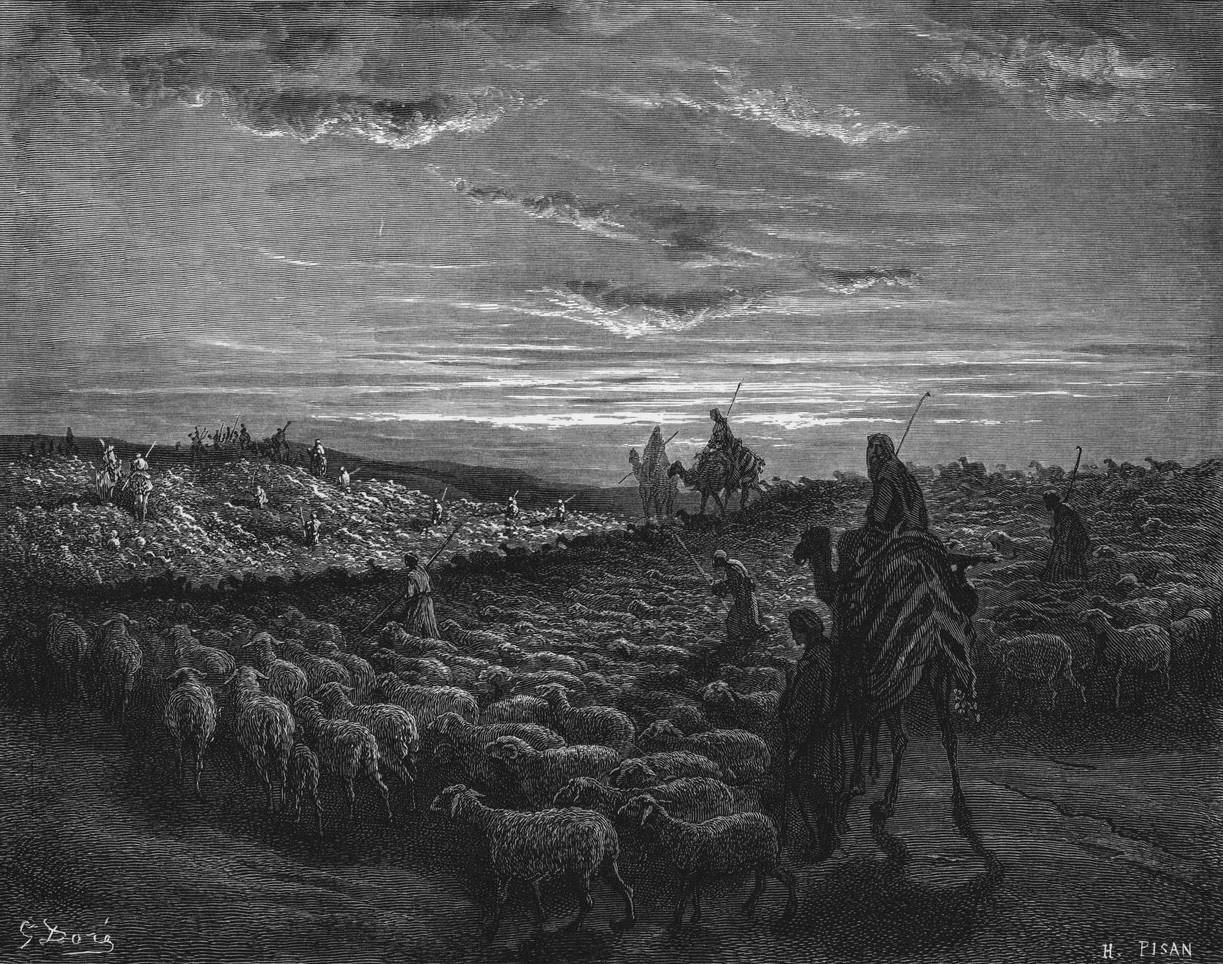
Abraham Journeying into the Land of Canaan,
by Gustave Doré, 1866

Avram took his wife Sarai and his brother’s son Lot, and all the property that they had acquired, and the people that they had acquired in Charan, and they left to go to the land of Canaan. And they entered the land of Canaan. (Genesis 12:4-5)

Avram, Sarai, and Lot have already acquired a lot of moveable property by the time they emigrate to Canaan, including animals, goods, and slaves.1 They do not need to emigrate to be blessed with material prosperity.

What about the blessing of fertility? We already know Sarai is childless, and we learn later that she is only ten years younger than Avram, so she is 65. Avram has not had any children in Charan, and unless he has a son in old age, he will have no descendants to become “a great nation”.

Perhaps the promise of fertility is the reason Avram obeys God and heads for Canaan. And the rest of his household, including his wife, his nephew, and his employees and slaves, have no say in the matter. They might have (unrecorded) opinions, but in their culture, the male head of household decides for everyone.

Unlike Terach, Avram and his people finish the trip to Canaan. They arrive at a sacred site near the Canaanite town of Shekhem.2

Then God appeared to Avram and said: “To your see [descendants] I give this land.” So he [Avram] built an altar there for God, whom he had seen. (Exodus 12:7)

I imagine that seeing some manifestation of God as well as hearing God speak about descendants again would confirm to Avram that he had made the right choice in following God’s instruction to move to Canaan. Yet when Canaan experiences a famine,

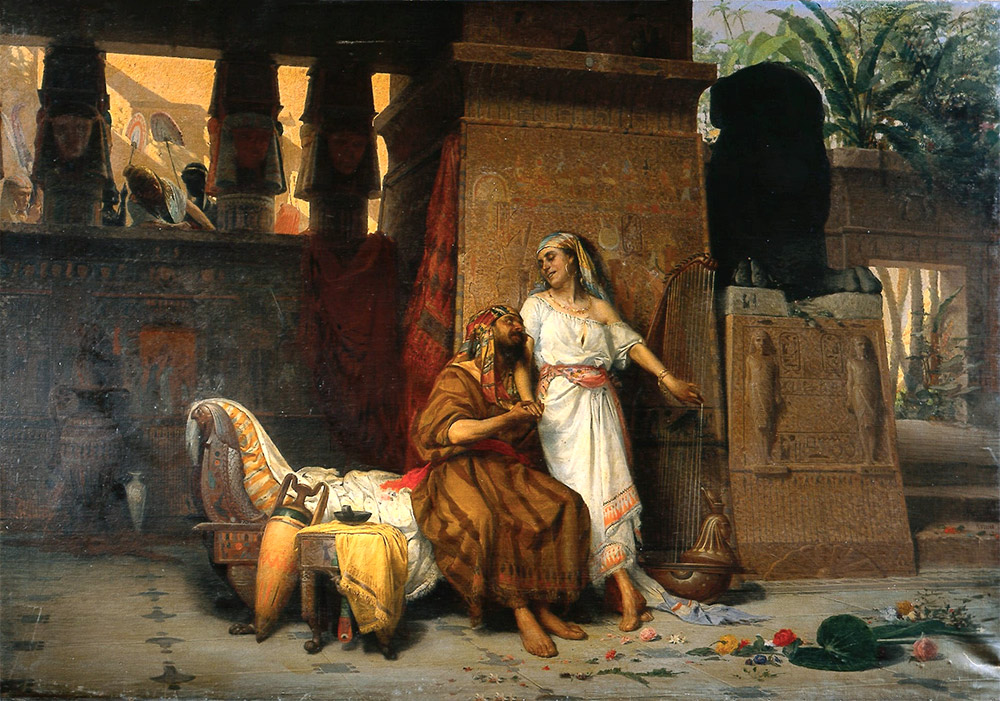
Avram went down to Egypt, lagur there, since the famine was severe in the land. (Exodus 12:10)

Abraham and Sarah in Pharaoh’s Palace,
by Giovanni Muzzioli, 1875

lagur (לָגוּר) = to live as a resident alien, to sojourn, to become a migrant.

And God does not object. In fact, God helps Avram pull off a scam that results in pharaoh giving Avram additional animals, silver and gold, and slaves—and ordering men to escort Avram and his household back to the border. (See my post Lekh Lekha, Vayeira, & Toledot: The Wife-Sister Trick, Part 1 and Part 2.)

Avram has further adventures in Canaan, and then the unsolved problem of his lack of descendants comes up again.

After these things, the word of God happened to Avram in a vision, saying: “Don’t be afraid, Avram. I myself am a shield for you; your reward will be very big!” But Avram said: “My lord God, what will you give me? I am going accursed, and the heir of my household is the Damascan, Eliezer!” And Avram said: “To me you have not given seed [a descendant], so hey! The head servant of my household is my heir!”  (Genesis 15:1-3)

When the same person says two things in a row, with nothing in between except “And he said”, it indicates a pause while the one being addressed fails to respond. In this case, God does not respond to Avram’s first statement, so Avram adds an explanation.

Then hey! The word of God happened to him, saying: “This one will not be your heir; but rather, the one who goes out from your inward parts will be your heir.” (Genesis 15:4) Another vague promise. So Avram’s wife Sarai tackles the problem herself by arranging for her husband to impregnate her female Egyptian slave. Avram no longer has to have faith that somehow God will provide.

Second Isaiah

Avram at least has the advantage of hearing God tell him directly to emigrate to Canaan from Mesopotamia. When the Babylonian Empire falls, the Israelites living in exile there have only the words of a human prophet who tells them that God wants them to move back and rebuild the razed city of Jerusalem. The prophet is not named, but since the prophecies compose the second half of the book of Isaiah, the speaker is known as “Second Isaiah”. In this week’s haftarah, God declares (through Second Isaiah):

Don’t be afraid, for I am with you.
Don’t look around anxiously, for I am your God.
I will strengthen you.
Also I will help you.
Also I will hold you up by the right hand of my righteousness. (Isaiah 41:10)

The Israelites living in Mesopotamia are anxious about returning to Jerusalem for understandable reasons. Between 597 and 587 B.C.E., while the Babylonian army was conquering the Kingdom of Judah, many Israelites were forcibly deported to Babylon.

Seal of Cyrus I (from Anshan)

Half a century later, when Second Isaiah began prophesying, the new Persian Empire had swallowed up the Babylonian empire. The first Persian king, Cyrus, gave all deportees and children of deportees permission to return to their former homes and rebuild their former temples. But after their traumatic experience, the Israelites are reluctant to believe it would really be safe to move back to Jerusalem. Besides, they saw the city burning down.

Assuring the exiles that their Babylonian conquerors are now powerless, God says:

Hey, everyone who was infuriated with you
will be shamed and humiliated;
They will be like nothingness,
And the men who contended with you will perish. (Isaiah 41:11)

But before the exiles can believe God will eliminate their enemies, they must believe that God is on their side now. And that is hard for people who remember when God failed to rescue them from death and deportation at the hands of the Babylonians. Then God promises to make the Israelites, not just the Persians, a weapon for defeating the Babylonian armies that seem as strong as mountains.

Hey, I will transform you into a new sharp thresher,
An owner of teeth,
You will thresh the mountains
And crush the hills, make them like chaff.
You will scatter them,
And the wind will carry them off,
And a whirlwind will disperse them.
And you, you will rejoice in God
And you will praise the Holy One of Israel. (Isaiah 41:15-16)

The Israelites in Babylonia hear (or read) the prophet’s speeches quoting God. But do they believe the quotes are real? Do they believe God will help them now? Do they set off for Jerusalem?

The Burning of Jerusalem by Nebuchadnezzar’s Army,
by the circle of Juan de la Corte, 1630-1660

The book of Isaiah does not give an answer. The conclusion of book of Jeremiah reports that a total of 4,600 people were deported by Babylonian King Nebuchadnezzar.3 (The poorest citizens of Judah were kept in the land to serve as “vine-dressers and field hands”.)4

The book of Ezra describes the return of 42,360 exiles to Jerusalem, along with their 7,337 slaves and 200 singers,5 but the archeological record indicates that the numbers are inflated.

It is also hard to determine how many of the exiles stayed in Babylonia under Persian rule. The city of Babylon had a large Jewish population when Philo of Alexandria wrote in the first century C.E., and had become the center of Jewish law and culture by the time the Talmud was written in the 3rd-5th centuries C.E.6 There is no historical record of a large in-migration of Jews to Babylon, so a lot of deported Israelites and their children must have stayed behind when Ezra and his group set off for Jerusalem.


Believing that God will help you is not so hard when your life has already been good, like Abraham’s. Believing that God will help you is harder when you, or your parents, can remember a time when God failed to rescue you from enemies—enemies who burned your city, killed many of your family and friends, and marched you off to a strange land. Jeremiah explains that God punished the Kingdom of Judah for the bad policies of its kings and for the widespread worship of other gods. Second Isaiah insists that now all that is forgiven.

What would it take for you to believe that God wants you to emigrate? What would it take for you to actually do it?

What if you were a Jew thinking about “making aliyah”—moving to Israel?


  1. An alternative reading from Talmudic times says that Avram, Sarai, and Lot had not acquired slaves in Charan, but rather made converts. This reading, however, does not fit the society of the time, and is not supported by any other reference in the Hebrew Bible.
  2. The site is named Eilon Moreh. An eilon (אֵל֣וֹן) is a large and significant tree, the kind that was involved in Asherah worship. Moreh (מוֹרֶה) means “teaching, instruction”.
  3. Jeremiah 52:30.
  4. Jeremiah 52:16.
  5. Ezra 2:65-66.
  6. Talmudic volumes were written both in Jerusalem (the Talmud Yerushalmi) and in Babylon (the Talmud Bavli), the two centers of Jewish scholarship. The Talmud Bavli is more complete and authoritative.

Re-eih & Isaiah: Only in Jerusalem

Go to Jerusalem! That’s where God wants to be worshiped!

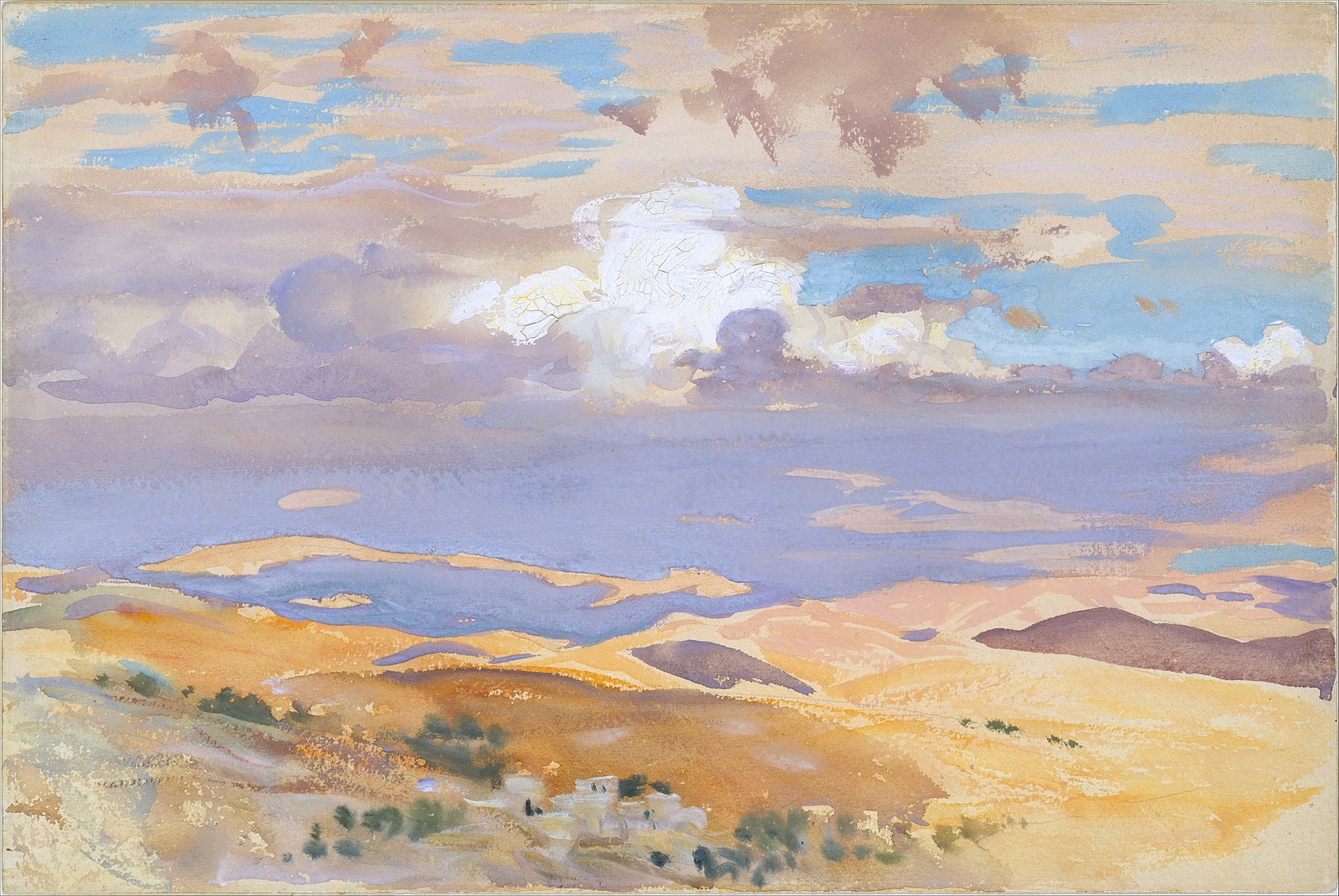
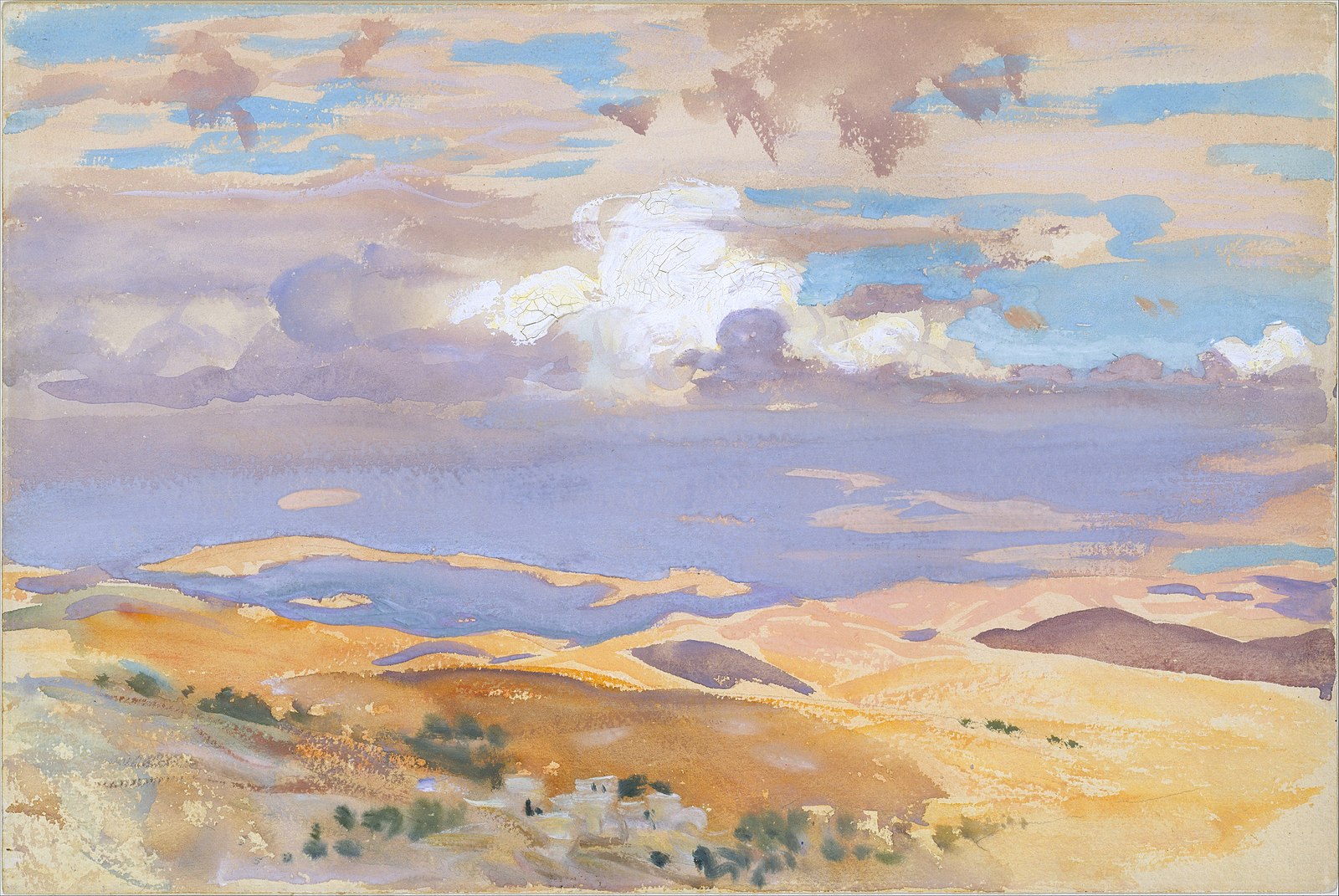
From Jerusalem, by John Singer Sargeant, 1906

This message is repeated insistently in both this week’s Torah portion, Re-eih (Deuteronomy 11:26-16:17) and in the haftarah reading, the “Third Haftarah of Consolation” from Second Isaiah1 (Isaiah 54:11-55:5).

Moses is addressing the Israelites who have spent forty years in the wilderness after leaving Egypt, and are finally about to cross the river and conquer Canaan. He promises in this week’s Torah portion that God will grant them security on their new homeland. Then, he says, they must all travel three times a year to one place, “the place that God will choose”, to worship God with burnt offerings and gifts to the priesthood. Although Deuteronomy does not say where that place will be, the writers of even the first draft of that book in the 7th century B.C.E. knew the exact location: the temple in Jerusalem.

The poet called Second Isaiah is addressing the Israelites who were deported to Babylon in the 6th century B.C.E. He promises in this week’s haftarah reading that God will grant them security on their old homeland. Then, he says, they must rebuild the temple in Jerusalem and worship God there.

Deuteronomy: The place that God will choose

The Hebrew Bible is full of commands to worship only the God of Israel and no other gods or idols. This week’s Torah portion adds that the places where other gods were once worshiped are forbidden as worship sites, and even the names of those places must be changed.

You must definitely demolish all the places where the nations that you will dispossess served their gods: on high mountains and on hills and under any verdant tree. And you must tear down their altars, and you must smash their standing-stones, and ashereyhem you must burn in fire, and you must chop up the carved idols of their gods; and you must eradicate their name from that place. (Deuteronomy 12:2-3)

ashereyhem (אֲשֵׁרֵיהֶם) = their trees or wooden poles used as idols for the goddess Asherah.

Then Moses says, ambiguously:

You must not do likewise for God, your God. (Deuteronomy 12:4)

The Talmudic rabbis in the 5th century C.E. said this means the Israelites must not eradicate God’s name, i.e. erase the name of God from any writings. Rashi (Rabbi Shlomoh Yitzchaki) in the 11th century wrote that this verse also meant you must not burn offerings to God at any place you choose, but only at the place God chooses.

This restriction on the place of worship will begin after the Israelites have conquered Canaan and are secure in their new land.

And you will cross the Jordan and you will settle down in the land that God, your God, is giving you as a possession, and [God] will give you rest from all your enemies all around, and you will settle down in security. Then it will be to the place that God, your God, chooses to have [God’s] name dwell that you will bring everything that I command you: your rising-offerings and your slaughter-offerings, your tithes and the contributions of your hands, and all the choice vow-offerings that you vow to God.  (Deuteronomy 12:10-11)

Moses Pleading with Israel, Providence Lithograph Co., 1907

It would be unreasonable to expect people to leave their farms for trips to Jerusalem and back if they had to worry about enemy raids, so Moses reassures the people that God will grant them safety. The last chapter of the portion Re-eih describes the three annual festivals when the people must bring these things to “the place that God will choose”.

Three times in the year all your males must appear in front of God, your God, at the place that [God] will choose: at the festival of matzah, and the festival of Shavuot, and the festival of Sukkot. And they must not appear in front of God empty-handed. (Deuteronomy 16:16)

Worship at the place (the temple in Jerusalem) is obligatory. But Moses also makes the festivals in Jerusalem sound, well, festive.

And you will rejoice before God, your God—you and your sons and your daughters and your male slaves and your female slaves—and the Levite who is within your gates, since he has no portion of land among you. Watch yourself, lest you bring up [the smoke of] your rising-offerings in [just] any place that you see! (Deuteronomy 12:12-13)

The rejoicing includes feasting; the donors of most types of sacrifices get a portion of the roasted meat to share. The portion Re-eih continues the Torah’s concern with making sure everyone eats well, including slaves and the religious officials (Levites) who have no land of their own to farm. But it also emphasizes the importance of bringing offerings to “the place that God will choose”: Jerusalem, the center of government and religion for the kingdom of Judah.

Isaiah: the place that God already chose

This week’s haftarah is an excerpt from a longer section of Second Isaiah tin which God addresses Jerusalem personified as a woman. The address begins:

Awake, awake, dress yourself in your strength, Zion!
Clothe yourself in your splendor, Jerusalem, holy city! (Isaiah 52:1)

This week’s haftarah reading picks up with God’s poetic description of Jerusalem as a desolate woman.

Wretched, storm-tossed one, not consoled! (Isaiah 54:11)

Jerusalem is miserable because the Babylonian army tore down her city walls and her temple, and deported her “children” (citizens) to Babylon. But God promises Jerusalem that she will be rebuilt—not with stones, but with gems.

And all your children will be God’s disciples,
And they will have abundant well-being. (Isaiah 54:13)

The reason why God let the Babylonians take Jerusalem in 587 B.C.E., according to the Isaiah, Jeremiah, and Ezekiel, was that its citizens were flagrantly violating God’s rules, both by worshiping other gods and by oppressing the poor. Here Second Isaiah prophesies that when the exiles (Jerusalem’s “children”) return, they will behave quite differently; they will be dedicated to learning God’s laws. Therefore, instead of sending in an enemy army, God will grant the Israelites of Jerusalem peace and prosperity.

Through tzedakah you will be established.
You will be distant from oppression,
So that you will not be afraid,
Because ruin will not come near you. (Isaiah 54:14)

tzedakah (צְדָקָה) = righteousness, honesty, justice.

Righteous people are “distant from oppression” because they do not commit it—regardless of whether others are oppressing them or not. Will their righteousness make them unafraid? Or is it God’s promise to keep ruin away that will give them courage?

The late Rabbi Steinsalz explained that the verse means:

“…you will be rebuilt on a foundation of honesty and justice. Distance yourself from exploitation, for you need not fear. Sometimes, one acts dishonestly out of fear. Since you will live in tranquility, you will be capable of distancing yourselves from such behavior.”2

In the next verse, God says that the people will be secure because God will make sure the only force that has any power over them is God itself.

Hey, definitely nothing will attack unless it is from me;
Whoever would attack would fall over you. (Isaiah 54:15)
… This is the portion of God’s servants,
And their tzedek is through me, declares God. (Isaiah 54:17)

tzedek (צֶדֶק) = what is right, what is just; vindication. (From the same root as tzedakah.)

“And their tzedek is through me” could mean that doing the right thing always involves serving God. Or it could mean that God will inspire them to do the right thing. The haftarah goes on to urge the Israelites to choose the nourishment of God’s covenant over the material advantages of staying in Babylon. (See my post: Haftarat Re-eih—Isaiah: Drink Up.) Second Isaiah knows the exiles will choose to travel to Jerusalem and renew the covenant only if they are no longer afraid of either human enemies, or their own God.


Both the Torah portion and the haftarah urge the people to stick to worshiping only their own God. Both also say they must worship God in the place God chose: Jerusalem.

Why is Jerusalem so important? Since God created the whole world, why can’t the Israelites worship God anywhere?

In the Hebrew Bible the Israelites are constantly tempted to worship the gods of other places. Insisting on worship in Jerusalem, where God’s temple was located for many centuries, is one way of reinforcing the worship of only one god.

In the books of Ezra and Nehemiah, at least two parties of Israelites do move from Babylon back to the ruins of Jerusalem, rebuild the city walls, and build a second temple for God, which lasted from around 500 B.C.E. until the Roman destruction of the temple in 70 C.E.3

Since then, for almost two millennia, Jews have worshiped God in every place they lived, all over the world—through prayers rather than animal sacrifices. Yet in our liturgy we still hope to return to Jerusalem personally, not just as a people. Actually moving there (“making aliyah”, ascent) is considered especially virtuous, but visiting is also good.

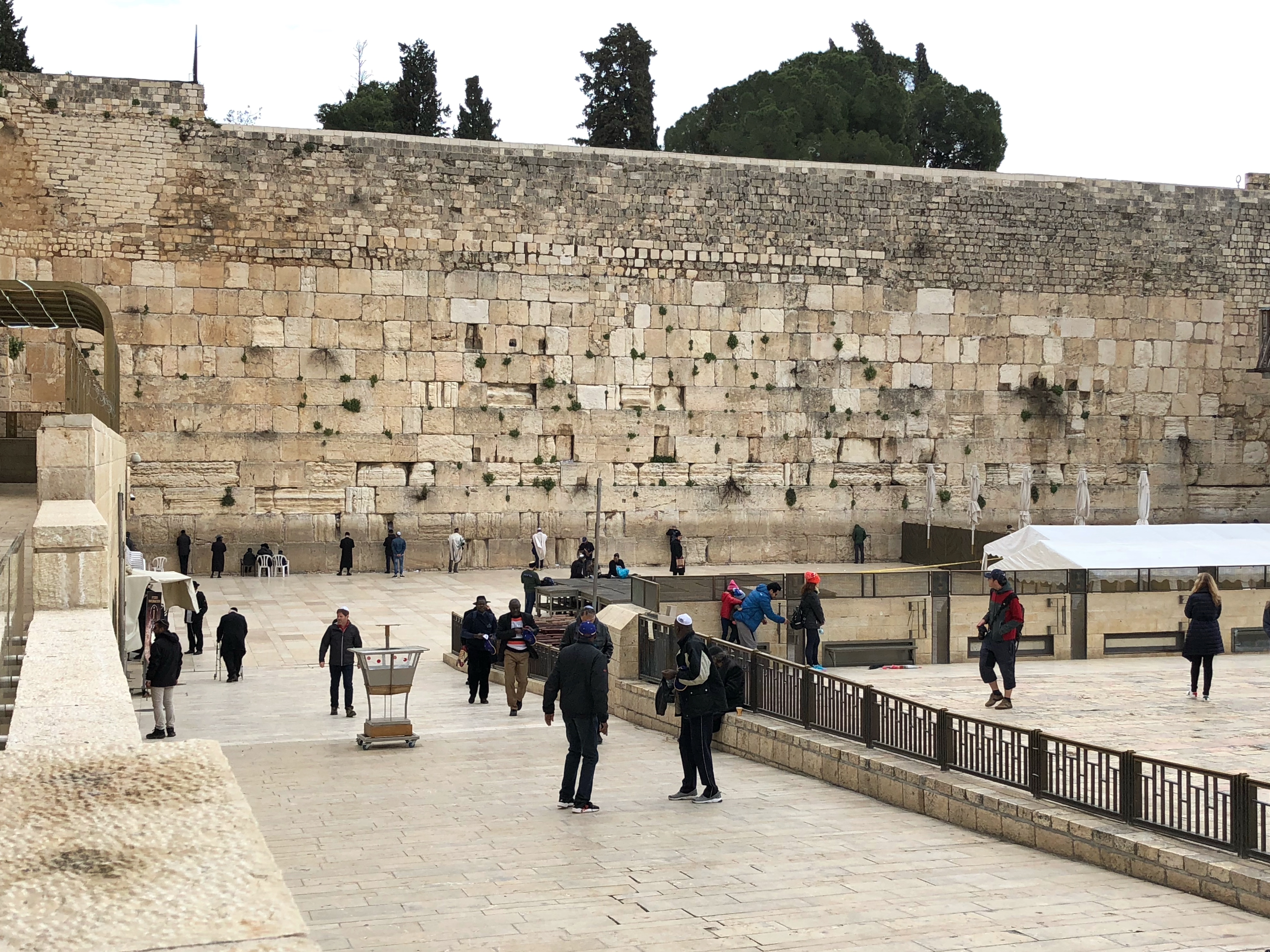
Kotel (Western Wall), Jerusalem, photo by M.C.

I finally visited Jerusalem myself in early 2020 (and left sooner than I had planned because of the Covid pandemic). Twice I stood at the Western Wall (Kotel)4 and prayed, grateful that at least there is a section of the wall designated for women now.

I have friends who felt the presence of God when they stood at the Wall. But I did not, despite my excitement over actually being there. The only times I have felt God’s presence have been when I was singing prayers with my congregation, or whispering prayers as I walked alone in the forest.

The writers of Deuteronomy and Second Isaiah probably took the best approach to bring people at that time (around the 6th century B.C.E.) closer to God and tzedek. But please don’t give me that old time religion.


  1. The first 39 chapters of Isaiah record the prophecies of Isaiah (Yesheyahu) son of Amotz, who lived in the 8th and 7th centuries B.C.E. Second Isaiah (also called Deutero-Isaiah) was appended to the original book, and records the poetry of an unknown prophet who prophesied in the 6th century B.C.E. after the Persians had conquered the Babylonians and give the exiles in Babylon permission to return to their homelands.
  2. Rabbi Adin Even-Israel Steinsaltz, The Steinsaltz Nevi-im, Koren Publishers, Jerusalem, 2016, quoted in www.sefaria.org.
  3. Herod saved key elements from the second temple when he rebuilt it on a grander scale in the first century B.C.E.
  4. The Western Wall, formerly called the Wailing Wall, is the only structure left from Herod’s temple. It was a high, thick foundation wall around the Temple Mount which was then backfilled and topped with a large stone platform. The temple and its associated buildings and stairs were erected on that platform.

Haftarat Eikev—Isaiah: Trust in the Darkness

Darkness is bad; light is good. Darkness means ignorance, light means understanding.

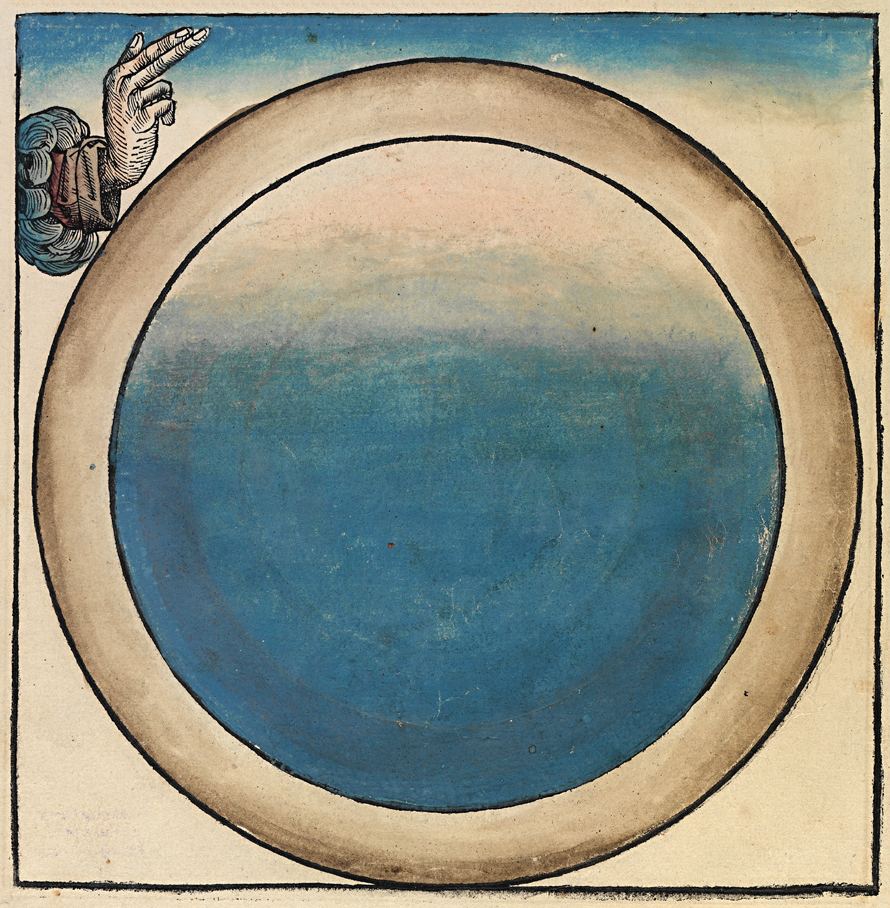
First Day of Creation, Nuremburg Chronicle, 1493

These pairings are common in biblical Hebrew and in English today—probably because humans function better when we can see clearly. The book of Genesis begins with darkness.

And God said “Let light be!” and light was. And God saw the light, that it was good, and God separated the light from the darkness. (Genesis 1:3-4)

Both meanings of darkness versus light appear in this week’s haftarah reading, Isaiah 49:14-51:3, which accompanies the Torah portion Eikev in Deuteronomy. Jews call this week’s reading the “Second Haftarah of Consolation”—consolation after the annual fast of Tisha Be-Av, which commemorates the destruction of Jerusalem’s temple by the Babylonians in 587 B.C.E. (See my post two weeks ago: Isaiah & Lamentations: Any Hope?)

Babylonian King Nebuchadnezzar II deported most of the leading citizens of Judah and its capital, Jerusalem, to Babylon. About fifty years later, in 539 B.C.E., the Persians conquered Babylon and gave all the exiles there permission to return to their homelands. Many of the Judahites did not want to return; they were comfortable in Babylon, and Persian rule was benign.

The prophet of Second Isaiah1 does not challenge the biblical assumption that God punishes disobedient populations of Israelites by letting their enemies win wars. But his main message is that God’s punishment is now over, and if only they return to Jerusalem and rebuild its temple, God will reward them.

In this week’s haftarah, the prophet imagines God puzzling over why so many Israelites in Babylon have not returned.2 God asks:

"Why, when I came, was nobody there?
I called, and nobody answered!
Is my hand really too short to redeem?
And is there no power in it to rescue?” (Isaiah 50:2)

God can make darkness

Second Isaiah reminds his audience that God has plenty of power, enough to dry up the sea, and adds that God said:

“I clothe the skies in kadrut,
And turn their coverings into sackcloth!" (Isaiah 50:3)

kadrut (קַדְרוּת) = darkness (in most English translations; but this word is a hapax legomenon, appearing only here in the Hebrew Bible, so the translation cannot be cross-checked. The more common words for darkness are choshekh and chasheikhah).

The skies are normally covered with diaphanous clouds, but God can turn them into sackcloth, the crude black fabric worn for mourning in the Hebrew Bible. One 12th-century commentator explained: “Some understand it to refer to an eclipse of the sun, when the sky becomes obscure in the middle of the day, and appears as if covered with sackcloth, which is usually black.” (Ibn Ezra)3

A 17th-century explanation is: “The Holy One said: I have done even more in Egypt. I clothed the skies in black. That is to say, I caused three days of darkness in Egypt.” (Tze-enah Ure-enah)4

Either way God, who created light and saw that it was good, also has the power to afflict whole populations with miraculous darkness, which is bad.

People walk in darkness

The prophet of Second Isaiah points out that he keeps on patiently communicating what God tells him, and ignores the people who yank his beard and spit on him. Then he asks them to trust God despite the lack of visible evidence—a metaphorical darkness.

Who among you is in awe of God,
Paying attention to the voice of [God’s] servant?
Though he walks in chasheikhim,
And there is no radiance for him,
Yivtach in the name of God,
And lean on his God. (Isaiah 50:10)

chasheikhim (חֲשֵׁכִים) = darknesses. (Plural of chasheikhah, חֲשֵׁכָה = darkness, a variant of the common Hebrew noun for darkness, choshekh, חֺשֶׁךְ.)

yivtach (יִבְטַח) = he will trust, he trusts, let him trust.

Commentators have interpreted this verse two different ways. One interpretation is that the prophet asks a rhetorical question, recognizing that nobody in Babylon is paying attention to him. The prophet trust in the name of God and leans on his God even though he “walks in darknesses”—in other words, bad things happen to him while he is prophesying.5

The other interpretation is that the prophet’s question is genuine, and he goes on to address anyone who actually is paying attention to him and does revere (but does not quite trust) God. Second Isaiah recognizes that such a person “walks in darknesses” of ignorance and misunderstanding, and begs him to have faith that God will reward him for returning to Jerusalem. Those who subscribe to this interpretation of the verse translate yivtach as “Let him trust”.

False enlightenment

In the next verse, Second Isaiah warns the exiles against inventing their own enlightenment.

But hey, all of you igniters of fire,
Clasping burning arrows!
Walk by the flame of your fire,
By the burning arrows you lit!
This comes from my hand to you:
In a place of grief you will lie down. (Isaiah 50:11)

What kind of fire are these Judahites igniting? Rashi wrote that the fire is God’s wrath, and that my hand in the fifth line refers to God’s hand, which will punish them.6

Other commentators have identified the fire in this verse as the manufactured light of false understanding, and my hand as the prophet’s hand warning the exiles that they will come to grief if they persist in their false beliefs . For example, 21st century commentator Robert Alter wrote:

“The poet now turns around the imagery of the light 180 degrees. Instead of the radiance God provides that liberates from darkness, there are those who prefer the light generated by their own fire. Whether this is simply arrogant self-reliance or the false light of fabricated gods is not clear. But this is a destructive source of light, its burning rather than its illumination salient in the language of these lines.” (Alter)7

I believe that this verse is from the prophet’s point of view. He address the exiles who are in the dark about God’s plans, and invent their own version of reality, believing they are enlightened when they choose to stay and assimilate in Babylon. But ignoring God’s prophet and following your own opinion is as dangerous as hugging burning arrows. The false light of their self-ignited fires will only lead to grief.

Ibn Ezra wrote that the last line, In a place of grief you will lie down, means: “You shall die in sorrow.”8

Tze-enah Ure-enah says it means: “You will all be burned with wrath from the Holy One. This is to say, the fire from His nose [and therefore] … You will lie in mourning; you will lie in every sickness. You will have no strength against your enemies.”9

In the 21st century, Rabbi Steinsaltz wrote that Second Isaiah is saying: “You, however, mistakenly consider yourselves enlightened. … Guard your flimsy light as best you can and follow it. … you will lie in suffering, without peace, consumed by worry and doubt. The light you produced will fade, and you will be left in the dark.”10


Walking in darkness is not easy. How do you pick your direction? How do you find the light switch, get to the place of enlightenment, or arrive at a good future?

I confess I am like the exiles from Judah whom Second Isaiah keeps pleading with. I may be in awe of God, but I do not trust God to do anything for me personally, because I cannot view God as a person. I do not trust any prophet who claims God-given authority, either. Instead, I try to use verifiable facts and my own reason to create my own illumination so I can choose my own way through life. Am I actually clasping burning arrows?

I doubt it. As I reflect back on my seventy years of life, I can see where I stumbled in the darkness of ignorance. I subjected myself to the most danger and grief when I was young and naïve, and trusted other people’s opinions too much. But I survived, and made better decisions, and grew. And now my life is good, sometimes even radiant.

Back in the 6th century B.C.E., some of the exiles in Babylon did return and rebuild Jerusalem and its temple under the leadership of Ezra and Nehemiah, who have their own books in the bible. Others stayed in Babylonia under the Persians, and became a thriving community with many rabbis and scholars. By 500 C.E. there were two versions of the Talmudic collection of Jewish laws, legends, and arguments: the Jerusalem Talmud and the Babylonian Talmud.

Maybe there is more than one path to enlightenment.


  1. “Second Isaiah” (or Deutero-Isaiah) starts with chapter 40 of the book of Isaiah. The first 39 chapters of the book report the prophecies of Isaiah (Yeshayahu) son of Amotz in the 8th and 7th centuries B.C.E. in Judah. A later scribe appended the poetry of one or more unknown prophets living among the Judahites in Babylon in the 6th century B.C.E. For convenience, I refer to that narrator in Second Isaiah as “he”.
  2. See my post: Hafatarat Eikev—Isaiah: Homesick or Scared?
  3. Rabbi Abraham ben Meir ibn Ezra, translation in www.sefaria.org.
  4. Tze-enah Ure-enah, compiled by Rabbi Jacob ben Isaac Ashkenazi, translation from Yiddish in www.sefaria.org.
  5. This is the view of Ibn Ezra (see footnote 3).
  6. Rashi is the acronym of 11th-century Rabbi Shlomoh Yitzchaki, consulted by all subsequent Jewish commentators.
  7. Robert Alter, The Hebrew Bible, Volume 2: Prophets, WE.W. Norton & Co., New York, 2019, p. 793.
  8. Ibid. ibn Ezra, my footnote 2.
  9. Ibid. Tze-enah Ure-enah, my footnote 3.
  10. Rabbi Adin Even-Israel Steinsaltz, The Steinsaltz Nevi-im, Koren Publishers, Jerusalem, 2016, quoted in www.sefaria.org.

Balak, Isaiah, & Micah: The Blessing of Water

After the humorous story of the greedy Mesopotamian prophet Bilam and his talking donkey,1 Bilam delivers a series of poetic prophecies to King Balak of Moab in this week’s Torah portion, Balak (Numbers 22:2-25:9).  Balak has promised to pay Bilam to curse the Israelites camped at his border, so he can defeat them if there is a battle. But Bilam is a true prophet, and can only utter a curse if God approves.

When Bilam arrives in Moab, he warns King Balak:

“Am I really able to speak anything at all? The speech that God puts in my mouth, only that can I speak.” (Numbers 22:38)

Bilam Prepares to Prophesy, by James Tissot, circa 1900

Then God proceeds to use Bilam as a mouthpiece for four prophecies. And every prophecy that mentions the Israelites blesses them instead of cursing them. Some of the blessings predict that the Israelites will destroy their enemies. (See my post: Balak & Micah: Divine Favor.) Others predict continued fertility and future abundance of resources.

The blessing of fertility

The dry climate of the Ancient Near East meant there was no natural surplus of food, and in the millennia before modern agricultural technology, it took intensive labor to till land, transport water, and bring in harvests. Fertile soil helped, and so did fecund livestock. But large families were also important, producing more people to do all the labor. In the book of Genesis, God commands humans three times to “Be fruitful and multiply”2.  In Deuteronomy, the blessings humans can expect if they obey God include “the fruit of your womb, and the fruit of your soil, and the fruit of your livestock”3.

Bilam’s first prophecy in this week’s Torah portion says that God has already blessed the Israelites; the evidence is that they have multiplied until they cannot be counted.

How could I curse
Where God has not cursed?
How could I denounce
Where God has not denounced?
For from the top of cliffs I can see them,
And from hills I can observe them.
Here a people dwells alone
And it does not count itself among the nations.
Who can number the dust of Jacob,
Or reckon a quarter of Israel? (Numbers 23:8-10)

The blessing of water in Balak

Water was the most critical requirement for fruitful land in the Ancient Near East, since rain was not abundant and fell mostly during winter. (Egypt was so dry that crops depended exclusively on water from the Nile.) In Deuteronomy, Moses reminds the Israelites that “God, your God, is bringing you to a good land, a land with streams of water, pools, and springs going out from valley and hill”.4 Canaan did indeed have more natural sources of water, as well as some winter rain. But water was still a limiting factor for agriculture.

In one of Bilam’s prophecies (the third out of four), he praises the Israelites with a couplet still used in today’s Jewish liturgy, then compares the Israelites’ homes to well-watered land.

Mah tovu, your tents, Jacob
Your dwellings, Israel!
Like palm-groves they stretch out
Like gardens beside a river,
Like aloes planted by God,
Like cedars beside the water.
Water drips from their branches
And their seeds have abundant water. (Numbers 24:5-7)

Mah tovu (נַה־טֺּווּ) = How good they are. (Mah = what, how + tovu = they are good. A form of the adjective tov, טוֹב = good, i.e. desirable, useful, beautiful, or virtuous.)

Bedouins in the desert, by Eugene Alexis Girardet, 19th century

The dwellings of the Israelites are good because they are desirable, like water. They are also good, according to 20th-century commentator Nehama Leibowitz, because the people living in them are virtuous.

Leibowitz cited four passages in the Hebrew Bible which use images of abundant water to indicate God’s reward for good behavior.5 Her best example is from second (or third) Isaiah:

If you remove the yoke from your midst,
Send away the pointing finger and the evil word,
And you extend yourself toward the hungry
And you satisfy the impoverished,
Then your light will shine in darkness
And your gloom will become like noon.
And God will give you rest always,
And satisfy your body in parched places,
And your bones will be strong,
And you will be like a well-watered garden,
And like a spring of water that does not disappoint,
Whose water never fails. (Isaiah 58:9-11)

The blessing of water in Micah

The haftarah reading that accompanies the Torah portion Balak is from the book of Micah. This reading begins with Micah’s prophecy for the Israelites (a.k.a. descendants of Jacob) who remain in what was once the northern kingdom of Israel before the Assyrian empire conquered it in 732-721 B.C.E. The Assyrians followed their usual strategy of deporting much of the native population to distant places, while moving other people into the newly conquered land.

Micah predicts what will happen to the small population of Israelites who are allowed to stay.

And it will be, the remnant of Jacob
In the midst of many peoples
Like dew from God,
Like gentle rain on grass,
That does not expect anything from a man,
And does not wait for human beings. (Micah 5:6)

Dew condenses regardless of what humans do, and the gentle rains of winter make grasses and grains grow without being watered by people. Micah’s implication, according to Rashi6 is that the remaining Israelites should not expect any help from other people, but God will help them. Micah goes on to predict that God will give “the remnant of Jacob” the strength of lions, the top predator in nature.7


Both fertility and water are powerful blessings in the Hebrew Bible. But human fertility is no longer a blessing today. Through overpopulation and pollution, we humans have created global climate change, making water even scarcer in dry regions while increasing flooding in the wetter parts of the world. The increase in dryness sets off larger forest fires, and the increase in extreme heat means humans, other animals, and plants need more water than before just to stay alive.

For all our advanced technology today, we cannot reverse the damage we have done; we can only hope to keep it from getting worse.

How can we keep it from getting worse? Yes, technology can help—but only if the powerful people of the world act not for their own selfish short-term profit, but for the welfare of all humankind, or indeed all life on earth. I wish the prophet in the book of Isaiah could enter the minds of all the decision-makers in corporations and governments, and persistently whisper: “extend yourself toward the hungry, and satisfy the impoverished”.

Only if the powerful decide in favor of life, rather than money or status, will we keep some remnant of “cedars beside the water”—as a metaphor, or in reality.


  1. See my post: Balak: Prophet and Donkey.
  2. Genesis 1:28, 9:1, 9:7, 35:11.
  3. Deuteronomy 28:4. 28:11, 30:9.
  4. Deuteronomy 8:7.
  5. Nehama Leibowitz, Studies in Bamidbar, trans. by Aryeh Newman, The World Zionist Organization, Jerusalem, 1980, p. 293. She cites Psalm 1:3, Jeremiah 17:8, Isaiah 58:11, and Jeremiah 31:12.
  6. Rashi is the acronym for 11th-century Rabbi Shlomoh Yitzchaki, the most cited classic Jewish commentator.
  7. See my post: Balak & Micah: Divine Favor.

Bechukotai, Va-eria, & Isaiah: Redeeming a Pledge

“Redeeming” can mean exchanging something less important to you for something more important. Last week’s Torah portion, Behar, prescribed redemption for Israelites who had fallen into poverty and debt. If they were forced to sell the family farm, or if they had to sell themselves as slaves, the sale was never permanent; Israelite land was “sold” as a long-term lease, and Israelite persons were “sold” as indentured servants. Both land and human beings could be redeemed if a family member paid off the remainder of the contract. (See my post: Behar: Redeeming an Identity.)

“Redeeming” can also mean making good on a pledge, through either an exchange or a rescue. When a human being pledges a donation to God, they must give the donated item to the priests at the temple—or else redeem it by exchanging the pledged item for something more valuable. But when God makes a pledge to the Israelites, God makes good on the pledge by rescuing them from a foreign power. No exchange is necessary.

Bechukotai: When an Israelite redeems a pledge to God

A pledge to God is actually a pledge to support a religion’s service to God. Today someone who wants to make an extra donation to their congregation, over and above the membership dues, might send an electronic payment. But in ancient Judah, an extra donation, over and above the mandatory tithes, offerings, and contributions of firstborn animals and first fruits, could only be made by bringing an object of value to the priests at the temple in Jerusalem. So the donor would make a verbal pledge, and redeem it later by traveling to the temple and delivering either the item pledged or its value in silver.

The item pledged could even be a human being. The Talmud tractate Arakhin explains that a person often pledged his or her own value in silver to the temple in Jerusalem. But someone could also vow to donate the value of any person belonging to him or her at the time—i.e. someone the vower owned and could legally sell.  In that era, people could sell their slaves or their own underage sons and daughters.

This week’s Torah portion, Bechukotai (Leviticus 26:3-27:34), explains the rules for redeeming a person who has been pledged as a donation to God.

When anyone explicitly vows the assessment of persons to God, the assessment will be: the assessment of the male from twenty to sixty years old will be fifty shekels of silver … (Leviticus 27:2-3)

A list follows giving the assessment in silver for male and female human beings in four age categories. (See my post: Bechukotai: Gender, Age, and Personal Value.) The persons themselves are not being given to God; they stand in as pledges until the donor pays their assessed values in silver to the temple.

But if [the donor vowed] an animal that can be brought as an offering to God, anything that he gives to God becomes consecrated. One may not replace or exchange it, either a better one for a worse one, or a worse one for a better one. And if one actually does exchange one animal for another, both it and its substitute will become consecrated. (Leviticus 27:9-10)

This means that when anyone pledges an animal that can be legally offered at the altar, it becomes temple property at that instant. The donor no longer owns it, so he has no choice but to bring it in to its rightful owner, the temple. If he tries to substitute a different animal, then both the original and the substitute must be brought and slaughtered for God. I suspect the priests knew that people who felt moved to give more to God sometimes had second thoughts later, and tried to skimp when it was time to fulfill their pledges.

If someone pledges an animal that is kosher, but unfit for the altar because of some blemish, the priest assesses its equivalent value. Then the person who pledged the animal to God must donate that amount in silver to the temple—and also leave the blemished but edible animal with the priests.

If the donor prefers to keep the unfit animal, he can redeem it by making a larger payment in silver.

But if definitely yigalenah, then he must add one-fifth to its assessment. (Leviticus 27:13)

yigalenah (יִגְאָלֶנָּה) = “he would redeem it”. (From the root verb ga-al, גָּאַל = redeem, ransom, rescue.)

The same law applies when a donor—perhaps overcome by religious ecstasy or a generous impulse—pledges his house to God, thus making it consecrated property.

And if the consecrator yigal his house, then he must add one-fifth in silver to the assessment; then it will be his. (Leviticus 27:15)

yigal (יִגְאַל) = he would redeem. (Also from the root verb ga-al.)

The donation of a field to God is more complicated, since the procedure must also meet the rules in last week’s Torah portion about land reverting to its original owner in the yoveil year. (See my post: Behar: Redeeming an Identity.) But if the current owner wants the field back before the yoveil year, he must pay silver equal to the assessment for the remaining years plus one-fifth to redeem it.

Va-eira & Second Isaiah: When God redeems a pledge to the Israelites

Israelites redeem their pledges to God by exchanging silver for whatever they pledged. But when God redeems a pledge to the Israelites, God simply rescues them by arranging their liberation from a foreign power and sending them “home” to Canaan. In the book of Exodus, God rescues the Israelites from bondage in Egypt. In the book of Isaiah, God rescues them from exile in Babylon.

In Exodus, in the Torah portion Va-eira1, God tells Moses:

“And now I myself have listened to the moaning of the Israelites because the Egyptians are enslaving them, and I have remembered my covenant. Therefore say to the Israelites: I am Y-H-V-H, and I will bring you out from under the bondage of Egypt. And I will rescue you from your servitude, vega-alti you with an outstretched arm and with great punishments. And I will take you as my people, and I will be your God. … And I will bring you to the land that I raised my hand to give to Abraham, to Isaac, and to Jacob, and I will give it to you as a possession. I am Y-H-V-H.” (Exodus 6:5-6, 6:8)

vega-alti(וְגָאַלתִּי) = and I will redeem, and I will rescue. (Also from the root ga-al.)

Leading the Israelites
with a Pillar of Fire,
by John Jacob Scheuchzer,
1731

The pledge or covenant God made in the book of Genesis to Abraham, Isaac, and Jacob by “raising a hand” was that God would give their descendants the land of Canaan. Now God affirms that God will fulfill the pledge. Just as written proclamations in the Ancient Near East ended with the king identifying himself by name, God concludes this statement with I am Y-H-V-H, confirming it as a legal pledge.

Then God makes good on the divine pledge with an elaborate rescue operation. First God stages ten miracles to liberate those descendants, the Israelites, from Egypt. Then God leads them to a new home in Canaan.

Second Isaiah2 states that God created the Israelites for a unique role, which implies a pledge to make sure they continue to exist as a people on the land God chose for them.

And now thus said God:
Who created you, Jacob?
Who formed you, Israel?
Do not fear, because ge-altikha.
I have called by name;
You are mine. (Isaiah 43:1)

ge-altikha (גְאַלְתִּיךָ) = I have redeemed you, I have rescued you. (Also from the root ga-al.)

Therefore, the prophet says, God is in the process of rescuing the Israelites from Babylon by arranging the destruction of the Babylonian Empire.

Thus said God,
Your Go-eil, the Holy One of Israel:
For your sake I send to Babylon
And I bring down the bars, all of them,
And the Babylonians sing out in lamentations. (Isaiah 43:14)

go-eil (גֺּאֵל) = redeemer, rescuer. (Also from the root ga-al.)

This is one of eleven times that second Isaiah makes go-eil part of God’s title.3

The “bars” in this verse are either the bars of the gates of the city,4 or by extension, the borders of their whole territory.5 Second Isaiah credits God with sending Cyrus, the first king of the Persian Empire, to conquer Babylon6 (a feat Cyrus I achieved quickly in 539 B.C.E.).

Next the redemption of the Israelites from Babylon is connected with their redemption from Egypt. The prophet reminds us that God parted the Red Sea to arrange the escape of the Israelites from Pharaoh’s army of chariots.

Thus said God:
Who placed a road in the sea,
And a path through powerful waters?
Who met chariots and horses,
The mighty and the strong?
Together they lay down, never to rise;
They were extinguished, quenched like a wick. (Isaiah 43:16-17)

When second Isaiah is praying to God for redemption from Babylon, he reminds the exiled Israelites again about how God redeemed the Israelites from Egypt.7

Like other biblical prophets, second Isaiah says God let the Babylonians conquer Judah and Jerusalem because its citizens were disobeying God. But now, according to the book of Isaiah, God says:

I have wiped away your rebellions like fog,
And your misdeeds like cloud.
Return to me, because ge-altikha! (Isaiah 44:22)

Once God has redeemed the Israelites from their past sins, God can rescue them from Babylon. The book of Isaiah confirms that redemption by God is a rescue, not an exchange:

For no price you were sold,
And not for silver tiga-eilu. (Isaiah 52:3)

tiga-eilu (תִּגָּאֵלוּ) = you will be redeemed.

But being rescued and liberated is not enough. The Israelites must fall in with God’s plan by taking advantage of the opportunity to leave Babylon and return to Jerusalem.

Go forth from Babylon!
Flee from Chaldea!
Declare in a loud voice,
Make this heard,
Bring it out to the ends of the earth!
Say: God ga-al [God’s] servant Jacob! (Isaiah 48:20)

The kind of exchange outlined in this week’s Torah portion, Bechukotai, is good business practice: making a pledge, posting something as security, and then redeeming the security by handing over the required monetary payment. Both the donor and the priests who receive the silver know and follow the rules.

But sometimes we humans imitate God by pledging to do something that has no monetary value. One example is the traditional marriage vow to “forsake all others”.

And sometimes we help another person voluntarily, for no reward, with no expectation of tit-for-tat—not because we have formally pledged to do so, but just out of the goodness of our hearts.

All humans make moral errors. When we do something good, above and beyond what we have promised, we redeem ourselves. So helping someone out of the goodness of our hearts is a double redemption: we rescue the other person from distress, and we also redeem ourselves.

May we all aspire to be voluntary redeemers.


  1. The portion Va-eira is Exodus 6:2-9:34.
  2. The first 39 chapters of the book of Isaiah were written in the 8th century B.C.E., and are attributed in the first verse to the prophet Yesheyahu (Isaiah) son of Amotz. Chapters 40-55 were written in the 6th century B.C.E., after the Babylonians conquered Jerusalem and deported its leading citizens to Babylon; this section is often called Second Isaiah or Deutero-Isaiah. Chapters 56-66 were written after Babylon fell to the Persian Empire in 539 B.C.E. and the exiles living there were allowed to return to their old homes. Some scholars include this last section in Second Isaiah, while others call it Third Isaiah, or Trito-Isaiah.
  3. Go-eil is part of God’s title in Isaiah 41:14, 43:14, 44:6, 44:24, 47:4, 48:17, 49:7, 49:26, 54:8, 60:16, and 63:16.
  4. Ibn Ezra (12th century), citing Lamentations 2:9: Her gates have sunk into the ground, He has shattered to bits her bars.
  5. Adin Steinsaltz, The Steinsaltz Humash: Isaiah, Koren Publishers, 2019.
  6. See Isaiah 44:1.
  7. Isaiah 51:10-11.

Ki Tavo & 2 Isaiah: Enlightenment

Enlightenment is a theme in both this week’s Torah portion, Ki Tavo (Deuteronomy 26:1-29:8) and this week’s haftarah reading (Isaiah 60:1-22). At any other time of year, this synchrony would be no accident. When the rabbis of the second century C.E. paired haftarah readings from the prophets with the weekly readings from the Torah proper (Genesis through Deuteronomy), they picked haftarot that had related themes—at least most of the year.

But during seven weeks in late summer, between Tisha B’Av1 and Rosh Hashanah2, the Torah readings continue working through the book of Deuteronomy, while the haftarot all explore the same theme in second Isaiah—an unknown prophet recorded in chapters 40-66 of the book of Isaiah. Second Isaiah addresses the Israelites who were deported to Babylon when King Nebuchadnezzar captured and razed Jerusalem.3

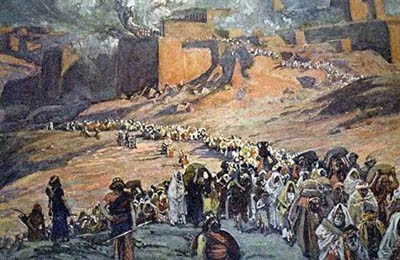
March of the Prisoners from Jerusalem, by James Tissot, 1896

The prophet promises the exiles that if they return, God will forgive them for their past disobediences, and their ruined city will become glorious. This week we read the Sixth Haftarah of Consolation, which describes how God will make Jerusalem shine like a beacon to other nations.

Ki Tavo: Enlightenment

At Mount Sinai, when Moses led the Israelites through a formal covenant ritual with God (including splashing blood on the altar and the people),

Moses came and recounted to the people all God’s words and the laws, and all the people answered with one voice, and they said: “All the things that God has spoken, we will do!” (Exodus 24:3)

In this week’s Torah portion, Moses gives instructions for conducting another covenant ritual once the Israelites have entered Canaan.4 But first he declares:

Today you have affirmed God to be your god, and to walk on [God’s] paths, and to keep [God’s] decrees and commands and laws, and to pay attention to [God’s] voice. (Deuteronomy 26:17)

The Israelites do not shout out their agreement in the book of Deuteronomy, the way they did in the book of Exodus, but neither do they grumble. Moses continues as if everyone agrees.

And God has affirmed to you today that you are [God’s] treasured people, as [God] spoke to you, and keeping all [God’s] commands. And [God will] set you high above all the nations that [God] made, in praise and in reputation and in splendor. And you will become a holy people to God, as [God] spoke. 5 (Deuteronomy 26:18-19)

Moses is describing a covenant, originating at Sinai and affirmed on the east bank of Jordan River where the people can see Canaan. The Israelites as a people promise to single out God as their only god, and to obey God. God promises to single out the Israelites as God’s unique treasure, and to elevate them relative to other nations.

Including the phrase and keeping all [God’s] commands” makes the statement of God’s side of the covenant awkward reading. Probably it means that God promises to give the Israelites special treatment only if they keep their promise to obey all of God’s commands. But the commentary includes alternate interpretations. One is that God gives all the rules to the people Israel, and only some of them to the other, lesser nations.6 Another is that God will act to help the Israelites achieve the difficult task of keeping all God’s laws and decrees.7

Next Moses recites the blessings God will give those who obey God’s rules, and the curses God will inflict on those who disobey. Then he says:

You have seen all that God did before your eyes in the land of Egypt, to Pharaoh and to all his attendants and to all his land—the great trials that your eyes saw, the great signs and marvels. Yet God has not given you a leiv for da-at, or eyes for seeing, or ears for listening, until this day. (Deuteronomy 29:1-3)

leiv (לֵב) or leivav (לֵבָב) = the heart; the seat of both thinking and feeling, therefore the conscious mind.

da-at (דַעַת) = knowledge; intimate acquaintance, insight, understanding. (From the root verb yada, יָדַע = notice, find out, recognize, become acquainted, know, understand.)

In Egypt, the Israelite slaves witnessed the trials of Pharaoh and his advisors when God afflicted Egypt with ten miraculous plagues. Forty years later, the next generation of Israelites includes many who were children in Egypt and can vouch for God’s miracles.

But during the Israelites’ long journey through the wilderness, they often complained about God and said they were better off as slaves in Egypt. In the last of the forty years, many of the men went to Moabite feasts and worshiped Ba-al Pe-or, disobeying their own God’s repeated command that they must not worship other gods.8

They heard, but did not have “ears for listening” to God’s words as transmitted by Moses. They saw more divine miracles on their journey, but did not have “eyes for seeing” that God was still taking care of them, leading the way with the pillar of cloud and fire, and providing water to drink and manna to eat. They did not use their leiv to think about the evidence of their senses, and so they did not reach any understanding about God’s long-term plan. They did not find any enlightenment.

The Torah switches briefly to God’s point of view9:

And I brought you up, all of you, for forty years in the wilderness. Your cloak did not wear out from upon you, and your sandal did not wear out from on your foot. You did not eat bread or drink wine or liquor—in order that teide-u that I am God, your God. (Deuteronomy 29:4-5)

teide-u (תֵּדְעוּ) = you would know, you would understand. (Also from the root verb yada.)

But God’s demonstration did not result in any enlightenment. As Moses has just said, “Yet God has not given you a leiv for da-at, or eyes for seeing, or ears for listening, until this day.”

What has changed now that the Israelites are about to cross the Jordan into Canaan? The answer in this week’s Torah portion is not that Moses’ long oration has enlightened them. Moses hints at a different answer when he concludes:

And you came up to this place. And Sichon, king of Cheshbon, and Og, king of the Bashan, went out to meet us in battle, but we struck them down. And we took their land and gave it as hereditary property to the Reubenites and to the Gadites and to half of the tribe of Menashe. So you must keep the words of this covenant and you must do them, in order that taskilu everything that you do. (Deuteronomy 29:6-8)

taskilu (תַּשְׂכִּילוּ) = you (plural) will succeed; understand; act with religious insight. (A form of the verb sakhal, שָׂכַל; its meaning overlaps but does not coincide with yada.)

In this context, taskilu means “you will succeed”. Yet the success depends on the understanding and religious insight that would motivate the Israelites to keep the covenant and obey God.

When the Israelites defeat the armies of kings Sichon and Og and take their lands, they learn in the most direct way that God’s pledge to give them the much larger land of Canaan is not an empty promise. They could actually do it!—with God’s help. There is nothing like an exciting experience to change your thinking. Now, at last, they see the light.

And for a while, at least through the whole book of Joshua, they enthusiastically obey God’s rules.

Second Isaiah: Illumination

In the chapter of Isaiah before the sixth haftarah of consolation, the prophet repeats his or her message that the people of Judah were defeated and exiled because they disobeyed God; but now God will forgive and redeem all of them who repent and head back to Jerusalem.10

From Jerusalem, by John Singer Sargent, 1905-6

This week’s haftarah then opens with imagery of light:

Arise! Brighten! For your light is coming,

And the glory of God shines on you.

Because hey! The darkness will cover the land,

And thick fog, the peoples.

But upon you God will shine

            And  [God’s] glory will be seen upon you. (Isaiah 60:1-2)

We can see sources of light, such as stars, and every material thing that light shines on. But without light, we are blind. No wonder cultures around the world associate light with knowledge. No wonder the English language calls understanding “enlightenment”.

Many cultures also associate light with good behavior, and darkness with bad behavior. The book of Proverbs says:

The route of the righteous is like radiant light,

            Going on and brightening until the day is established.

The path of the wicked is like darkness;

            They do not know what they stumble on. (Proverbs 4:18-19)

The wicked—which in the bible means not only those who wrong their fellow humans, but all those who disobey God—stumble and fall in the darkness. But the righteous, who can see everything in front of them, know how to avoid tripping.

Furthermore, when the righteous settle in Jerusalem, God will shine light on the city, and the people of other nations will notice it. Second Isaiah continues:

And nations will walk by your light,

And kings, by the radiance of your shining. (Isaiah 60:3)

Ibn Ezra commented: “He who is in darkness usually sees those that are dwelling in light.”11 Naturally they are drawn to the clarity and well-being that light provides.

According to second Isaiah, peace and prosperity will govern Jerusalem, and riches will flow into the city from places as far away as Sheba and Tarshish.

Because God will be your light forever,

            And your days of mourning will be done.

And your people, all of them righteous,

            Will possess the land forever. (Isaiah 60:20-21)

According to Ibn Ezra, “The mourner sits, as it were, in darkness.” Death is associated with darkness, and a good life with light.


This week’s Torah portion, Ki Tavo, points out that despite all of God’s efforts at enlightening the Israelites in the wilderness, they do not fully throw in their lot with God until they win a couple of battles and camp across the Jordan River from Canaan. Only then do they understand God’s plan; only then do their minds open to illumination. Only then do they settle into obeying God. On the other hand, this week’s haftarah, Isaiah chapter 60, declares that the reward of obeying God’s commands is illumination.

Today we no longer receive signs from the God-character in the bible. We must make do with telling coincidences and unforeseen results that are enlightening in retrospect. Individuals stumble along in the darkness, making mistake after mistake. Nations are governed by politicians who cannot agree on, or even see, a path to peace and prosperity. And world-wide climate change is accelerating because we humans have fouled our own nest and failed to cooperate enough to clean it.

What would a Moses or a second Isaiah say to us? What would make us stop and reconsider? How do get enough illumination to see the right path and redeem ourselves?


  1. Tisha B-Av is the annual day of mourning for the destruction of the temple in Jerusalem. See my post: Lamentations: Seeking Comfort.
  2. Rosh Hashanah is the first day of the Jewish year. See my post: Rosh Hashanah: Remembering.
  3. The Babylonian campaign to eliminate rebellion in their vassal state of Judah included deporting all of its leading citizens to Babylon in two waves, after each of Nebuchadnezzar’s successful sieges of Jerusalem in 597 and 587 B.C.E.
  4. On two hills in front of the Canaanite town of Shekhem. See my posts: Ki Tavo: Making It Clear, and Ki Tavo: Cursing Yourself.
  5. Moses is alluding to God’s statement at Mount Sinai: And now, if you really pay attention to my voice and keep my covenant, then you will be my treasure among all the peoples. For all the earth is mine, but you will be my kingdom of priests and a holy nation. (Exodus 19:5-6)
  6. See Ovadiah Sforno (16th century) on Deuteronomy 26:18.
  7. See Or HaChayim (18th century) on Deuteronomy 26:18
  8. Numbers 25:1-9.
  9. Probably because of an error in editing when a 6th-century BCE redactor revised an older text to frame it as part of Moses’ oration.
  10. Isaiah 59:9-21.
  11. 12th century rabbi Abraham ben Meir ibn Ezra, translation in www.sefaria.org.

Re-eih & Isaiah: Rights of the Poor

Beggars, by Rembrandt

Let the poor glean the leftovers from your harvest. If a debtor pawns their only cloak to you, return it at night so they can sleep. That’s the way the books of Exodus and Leviticus address poverty.1

But what if scraps are not enough?

Two laws given in this week’s Torah portion, Rei-eh (Deuteronomy 11:26-16:17), treat the rights of the poor with new seriousness. This serious approach becomes impassioned in second Isaiah—not in this week’s Haftarah of Consolation (the third in the series of seven readings from Isaiah), but in the haftarah for Yom Kippur  six weeks from now.

Re-eih: Debt relief

Yet there will not be among you an evyon, because God will definitely bless you in the land that God, your God, is giving to you to hold as a possession—if only you really listen to the voice of God, your God, and take care to do all these commands that I command today. (Deuteronomy 15:4-5)

evyon (אֶבְיוֹן) = pauper, needy person, impoverished person.

What if people who suffer a run of bad luck become so poor they cannot even make payments on their debts?

A modern solution is to convict and imprison them—not just in Britain during the time of Charles Dickens, but in the United States today. When these debtors they have served their prison term, they are released—with no job, no new skills, and no money or property to make a fresh start. Unless someone helps them privately, they are likely to end up in debtor’s prison again.

The Torah portion Rei-eh has two more permanent solutions to the problem. The first is a time limit on indebtedness.

At the end of every seven years you must do shmitah. And this is the procedure of the shmitah: every owner of a loan in his hand, which he has loaned to his fellow, shamot. He must not press his fellow or his kinsman [for payment], since the shmitah of God has been proclaimed. (Deuteronomy 15:1-2)

shmitah (שְׁמִטָּה) = remission (cancellation) of debts. (From the root verb shamat, שָׁמַט = drop, let fall, release.)

shamot (שָׁמוֹט) = he must drop, let fall, release, remit.

In other words, every seventh year, the shmitah year, all debts are canceled. A business arrangement that includes repayment of a loan is written to take this seven-year pattern into account. But those who incurred debts because of poverty, and have not been able to pay off their debts in seven years, get relief.

In the books of Exodus and Leviticus, the seventh year is merely when farmland must lie fallow and rest for a year. During that year, paupers as well as the owner’s household may eat whatever food the land produces without cultivation; but no debts are remitted.2 Leviticus also provides a form of relief from poverty every fiftieth year, with a rule that families who had to sell their ancestral land get it back without payment.3 Then, with luck, they can make a living by farming their land again.

But these approaches only nibble around the edge of the problem of poverty. Deuteronomy takes a big step forward with its seven-year limit on debt.

Re-eih: Debt slavery

The second solution to chronic poverty in the portion Rei-eh concerns the institution of debt slavery.

Exodus declares that a male debt slave—a man who sold himself because he could not pay his debt any other way—must be freed after six years of service (unless the slave himself then signs up for life). But if a man sells his daughter as a slave, she is not freed unless a judge rules that her owner deprived her of food, clothing, or sex. Debt slaves of both genders are freed if their owner hits them and ruins an eye or knocks out a tooth.4

Leviticus adds that those who make loans to poor citizens may not charge interest. If impoverished borrowers cannot pay off their debts they can be taken as debt slaves, but they must be treated like employees, as well as being given room and board. However, debt slaves and their children must be freed only in the fiftieth year (if they live that long), the yoveil or “jubilee” year when all lands revert to the families of their original owners at the founding of the kingdom of Israel.5

These partial solutions are not enough, according to Deuteronomy. This week’s Torah portion imagines two scenarios in which these rules in Exodus and Leviticus do not help the poor at all.

For one thing, if the shmittah year is coming right up, lenders might refuse to make any further loans, and the poor might starve. So the portion Re-eih says:

If there is an evyon among you … you must not harden your heart and you must not draw shut your hand against your brother the evyon. Instead you must definitely open your hand to him and you must definitely pledge to him enough [to make up for] his lack that he lacks. Watch yourself, lest you have a wicked thought saying “The seventh year, the year of the shmitah, is approaching,” and you are bad to your poor, the evyon among your brothers, and do not give to him! (Deuteronomy 15:7-9)

Another problem is that if a debt slave is freed in the seventh year of service, he will be like American debtors today who finish their prison terms but have no job nor money nor property to make a fresh start. So this week’s Torah portion decrees:

When your brother is sold to you, a Hebrew man or a Hebrew woman, then he will serve you six years, and in the seventh year you must send him out free from beside you. And when you send him out free from beside you, you must not send him out empty-handed. You must definitely outfit him from your flock and from your threshing floor and from your wine-vat, your blessing which God, your God, has given you. (Deuteronomy 15:12-14)

This is an improvement over Exodus, since women must also be freed, and an improvement over Leviticus, since nobody has to be a debt slave for more than seven years. And the provision in this week’s portion of Deuteronomy also provides the freed slaves with products to sell or eat until they find employment.

Second Isaiah: Doing more

At first the desperately poor are mentioned in second Isaiah only in a promise that God will take care of them.

The poor and the evyonim

            Are seeking water, and there is none.

Their tongue is dry with thirst.

I, God will answer them.

            The God of Israeli will not forsake them.

I will open up streams on bare hills … (Isaiah 41:17-18)

evyonim (אֶבְיוֹנִים) = plural of evyon.

This week’s haftarah of Consolation, Isaiah 54:1-55:5, returns to second Isaiah’s continuing focus on motivating the Israelites in Babylon to go back to Jerusalem. But the prophet bursts into a rousing call for rescuing and embracing the poor in the haftarah for fast day of Yom Kippur.

Is the fast I prefer like this:

            A day of mortifying a human’s appetite?

Is it to bow one’s head like a reed,

            And go out in sackcloth and ashes?

Is it this you call a fast,

            A day pleasing to Y-H-V-H?

Isn’t this is the fast I prefer:

            Opening the shackles of wickedness,

            Untying the bonds of the yoke,

And sending out the downtrodden free,

            And breaking off every yoke?

Isn’t it offering your bread to the hungry,

            And bringing the homeless poor into your house?

When you see the naked, then clothe him,

            And do not ignore your own flesh!

That is when your light will break forth like the dawn …

That is when you call and Y-H-V-H will answer. (Isaiah 58:5-9)


The laws in this week’s Torah portion, Re-eih, cancel all debts at the end of seven years, free all debt slaves, and require the lender-owner to send them off with a grubstake. This is an improvement over the laws in Exodus, Leviticus, and the United States.

Then Isaiah 58 urges people to go beyond the law, and do even more to rescue the impoverished: feed them, clothe them, let them sleep in your own house! And stop treating your slaves or employees like dirt instead of human beings!

It is a tall order for private individuals, and we can only do so much. But in a modern democracy, we can also campaign and vote to help the poverty-stricken, instead of pretending that all their woes are their own fault and they deserve to die. We can reform our government and dedicate our joint resources to preventing sudden misfortune from driving people into unpayable debts, to habilitating those who resort to drugs in despair, to making sure every human being has food and health care.

The Torah portion Re-eih says:

However, there should be no evyon among you, since Y-H-V-H will certainly bless you in the land that Y-H-V-H, your God, is giving to you. (Deuteronomy 15:4)

We, too, live in a land of plenty; there should be no evyon among us.


  1. Exodus 22:24, 23:6, 23:11; Leviticus 19:10, 23:22.
  2. Exodus 23:10-11 and Leviticus 25:2-7.
  3. Leviticus 25:8-24.
  4. Exodus 21:2-11, 21:26-27.
  5. Leviticus 25:35-43.

Haftarat Eikev—Isaiah: Homesick or Scared

My lord God opened my ears,
And I, I did not rebel;
I did not shrink back.
I gave my back to floggers,
And my cheeks to [beard-] pullers.
I did not hide my face
From shaming and spittle. (Isaiah 50:5-6)
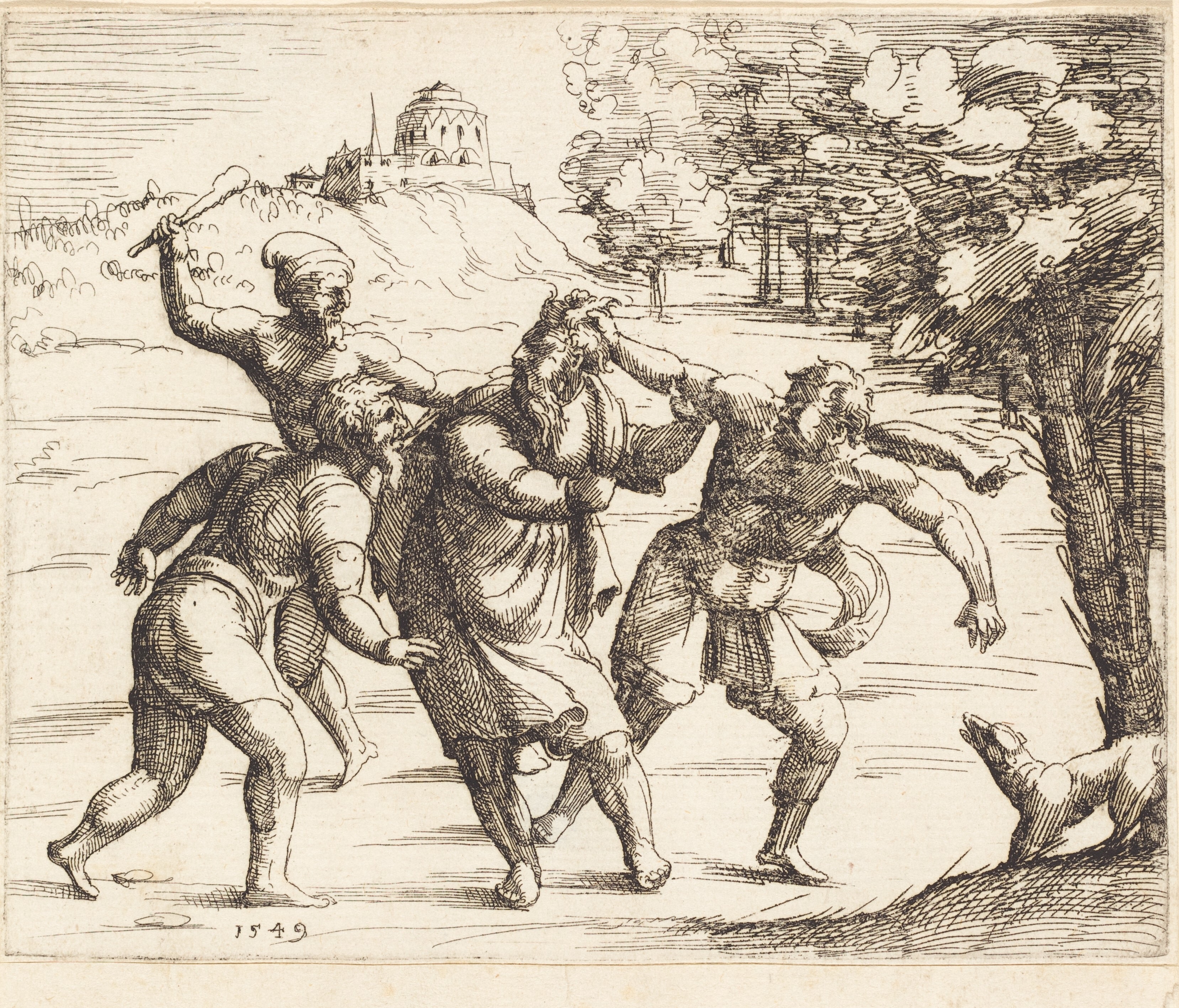
Isaiah Accepts Mockery Because of His Faith, by Augustin Hirschvogel, 1549

Many prophets in the Hebrew Bible report being abused because people do not want to hear their message—usually that if they don’t stop worshiping idols and cheating the poor, God will punish them. The unnamed prophet known as “second Isaiah” has a different message, but it, too, is unpopular.

This prophet probably wrote Isaiah chapters 40-66 after the Persian emperor Cyrus took Babylonia in 539 B.C.E., which was about 47 years after the Babylonians burned down Jerusalem and finished deporting the survivors to their own capital. Cyrus instituted a policy allowing his new subjects to return to their homelands, rebuild their temples, and engage in local self-rule. Some of the exiles from Jerusalem did return, under the leadership of Ezra and Nehemiah. But many more remained in Babylon, where life was not bad under the Persians.

Second Isaiah tries to persuade all the exiles to return—especially in the passages known as the seven “Haftarot of Consolation”, which Jews read at Shabbat services between Tisha Be-Av (the annual day of mourning for the Babylonian destruction of Jerusalem and its temple in in 586 B.C.E.) and Rosh Hashanah (the Jewish new year).

This week’s haftarah, Isaiah 49:14-51:3, is the second “Haftarah of Consolation”. Second Isaiah offers two different reasons why the people from Judah should abandon their new lives in Babylon and return to Jerusalem—and then he reports that his audience is abusing him.

First reason to return: Homesickness

At the beginning of the second Haftarah of Consolation, second Isaiah personifies “Zion”: the name of a hill in Jerusalem that is often used poetically to refer to the whole city, or even all of Judah. He depicts Zion as the mother of the Judahites in Babylon, forlorn because she has lost her children. She is also forlorn because she thinks she has lost her God. Zion says:

"God has forsaken me,
My lord shekheichani!" (Isaiah 49:14)

shekheichani (שְׁכֵחָנִי) = has wiped out all memory of me. (A piel form of the verb shakhach, שָׁכַח = forget.)

God replies to Zion:

"Does a woman tishkach the baby she bore,
Lose compassion for the child of her womb?
Even if tishkachnah,
I myself, lo eshkacheikh.
Hey, I have engraved you on my own palms.
Your walls are always in front of me.
Your children hasten.
Those who ravaged and ruined you will leave." (Isaiah 49:15-19)

tishkach (תִשְׁכַּח) = she forgets. (A kal form of shakhach.)

tishkachnah (תִשְׁכָּחְנָה) = she would forget her. (A kal form of shakhach.)

lo eshkacheikh (לֺא אֶשְׁכָּחֵךְ) = I would not forget you. (lo = not + a kal form of shakhach.)

When Zion’s children arrive, God says, she will be crowded with settlers. Furthermore, her children will be tended and returned by the kings of foreign nations—an allusion to the rulers of the new Persian empire.

"And they will bring your sons in their bosoms,
And your daughters they will carry on their shoulders.
Kings will be your babysitters,
And their princesses will be your wet-nurses." (Isaiah 49:22-23)

Picturing the land of Zion as a mother longing for her missing children might soften the hearts of the exiles living in Babylon. (See my post: Haftarat Eikev—Isaiah: Abandonment or Yearning?) If they believe their country misses them, they might discover they miss their country. And homesickness can be a strong motivator.

Then second Isaiah’s focus shifts to the estrangement between Zion and God.

Second reason to return: Safety in obedience

Addressing the Judahite expatriates, the children of Zion, second Isaiah reports:

Thus said God:
"Where is the divorce document of your mother, whom I sent away?
And to which of my creditors did I sell you?
Hey, you were sold because of your sins,
And your mother was sent away because of your revolts." (Isaiah 50:1)

Several prophets compare the relationship between God and the Israelites to a marriage in which the wife (Israel) cheats on her husband (God). They imagine God divorcing Israel by sending her out of the house, then welcoming her back later.1 Sometimes the unfaithful wife stands for the Israelites; sometimes the Israelites are called the children of the unfaithful wife.

In second Isaiah’s iteration of this analogy, being “sent away” expresses both the metaphorical divorce and the actual relocation of the Israelites from Judah to Babylon.

Many prophets in the Hebrew Bible predict that if the Israelites persist in worshiping other gods and/or being unethical to the poor, God will punish them by granting foreign armies victory in battle. Here, second Isaiah reports that God carried out that punishment—and then some. After the Babylonian army devasted Judah, God divorced Israel and sold her into slavery.

There is no divorce document, and God has no creditors to pay off by selling a family member as a slave. God simply reacted to the sins and revolts of the Judahites, which were so bad they deserved two more punishments after military defeat: exile and slavery under the Babylonians.

But now things have changed; the Persians have taken over the empire, and the people deported from Judah are no longer slaves. The punishment has ended, and God wants them back. God asks:

"Why, when I came, was nobody there?
I called, and nobody answered!" (Isaiah 50:2)

If second Isaiah had stopped there, perhaps the Judahite expatriates would have wondered if their God loved them after all. After all, children who are punished need to believe that Daddy still loves them.

Instead, the prophet returns to the theory in the first Haftarah of Consolation that the Israelites are reluctant to return to Jerusalem because they doubt God is powerful enough to rescue them and restore Jerusalem. (See my post: Haftarat Va-etchanan—Isaiah: Faith in the Creator.) God demands:

"Is my hand really too short to redeem?
          And is there no power in it to rescue?
Hey, when I rebuke, I dry up the sea!
          I turn rivers into desert!
The fish stink where there is no water,
          And they are dead of thirst.
I clothe the skies in black,
          And turn their robes to sackcloth!" (Isaiah 50:2-3)

Uh-oh. The ancient Israelites enjoyed images of God destroying their enemies in various gory ways, judging by other poetry in the Hebrew Bible.3 But images of God drying up rivers and turning the sky into black sackcloth are not so thrilling. What kind of God destroys nature? Is it the same kind of God who destroyed God’s own people in Jerusalem?

According to second Isaiah and Jeremiah, it was all God’s punishment: that the common people starved to death during the two-year siege; that the Babylonians burned down the temple, the palace, and every house in Jerusalem; that the remaining residents (those who had not died of starvation or been deported to Babylon during previous siege) were killed or marched off into exile, leaving only the poorest to work as field hands; and that the Judahites in Babylon were treated like slaves.2 Did they really deserve all that? Or was it a divine overreaction?

Even if God does want them back now, how could they be sure God would not destroy them again?

Children whose father had starved them, destroyed all their belongings, and sold them as slaves, might console themselves with the belief that the punishment was all their own fault, and their father really loved them underneath. Psychologically, it is easier for the powerless to blame themselves than to blame the ruler of their universe. But if a different adult liberated those children and took them into a benign household, the way the Persians did to the Judahites in Babylon, the children might arrive at a different opinion.

Then they would not want to go back God’s house. It would be safer to stay in Babylon under the Persians.

Back to the first reason: Homesickness

Right after second Isaiah delivers God’s disturbing rant about power, he switches to the aside in which he declares he is true to God’s message even though the Judahite expatriates are flogging and spitting on him. It does not occur to the prophet that their abuse might be a reaction to being urged to return to a God of desertification and mourning. Instead he tells them to fear and trust God in the darkness, instead of trying to see by kindling their own lights.4

The  haftarah ends with a positive image, one that returns to the draw of homesickness and the personification of the land of Zion as a woman feeling forsaken by her children.

For God has comforted Zion,
Comforted all her ruins.
And [God] has made her wilderness like Eden,
And her desert like the garden of God.
Thanksgiving and the sound of singing! (Isaiah 51:3)

However God treated the people of Jerusalem, God cannot forget the city. So God uses God’s vast power not for destruction, but to turn the wasteland into a garden. And, the prophet’s listeners would remember, Zion cannot forget her missing children. When Jerusalem is like the Garden of Eden, those who return to her will be glad and thankful.

Going home to Jerusalem sounds better now.


  1. Hosea 2, Jeremiah 3:1-10, and Ezekiel 16.
  2. According to 2 Kings 25:1-21.
  3. And by God’s promise to Zion in this haftarah: “I myself will contend with your contender/And I myself will rescue your children./And I will make your oppressors eat their own flesh/And like grape juice their own blood will make them drunk.” (Isaiah 49:25-26)
  4. Isaiah 50:10-11. 

Haftarat Va-etchanan—Isaiah: Faith in the Creator

After grief, consolation. Every year, on the day of Tisha Be-Av, Jews engage in ritual mourning for the destruction of the temple in Jerusalem in 586 B.C.E. The shabbat after Tisha Be-Av, the haftarah reading from the Prophets (Isaiah 40:1-26) begins:

“Comfort, comfort my people,”

Says your God. (Isaiah 40:1)

These are the words of “second Isaiah”, the unknown prophet whose words begin with chapter 40 in the book of Isaiah.1 He (or she) offers comfort by promising that God will rescue the Israelites deported to Babylonia, return them to their own land, and make Jerusalem glorious again.2 Then second Isaiah reminds the exiles that their God is powerful enough to do the job.

The Tent-Maker

Do you not know?

            Have you not listened?

Creation, doors of The Garden of Earthly Delights, by Heironymus Bosch, 15th century

Have you not been told from the beginning?

            Have you not discerned the earth’s foundation?

[By] the one who sits enthroned above the disk of the earth,

            And its inhabitants are like grasshoppers;

The one who spreads out shamayim like gauze,

            And stretches them out like a tent to dwell in. (Isaiah 40:21-22)

shamayim (שָׁמַיִם) = heavens, skies, firmament. (Always in the plural form, indicated by the suffix -im, or perhaps in the duplex form, in which the suffix -ayim indicates a pair.)

Let us take these metaphors one line at a time.

[By] the one who sits enthroned above the disk of the earth

When God is not in the sanctuary the Israelites built for God on earth, God is often described as enthroned in the shamayim, the heavens. From a vantage point that includes most of the horizon, the earth does look like a circular disk, and the sky looks like a dome.

And its inhabitants are like grasshoppers

To someone sitting at the top of the sky, human beings down on earth would indeed look tiny. The scouts in the book of Numbers use the same word for grasshoppers, chagavim (חֲגָבִים), to describe how they thought they looked to the giant people in Canaan.3 The grasshopper simile is an exaggeration for giants, who would be no more than twice as tall as the scouts. But it is an understatement for God, who looks down from the clouds and stars.

The one who spreads out shamayim like gauze

Clouds do look like gauze. The skies cannot be made entirely out of clouds, since there are also clear days. But poetry does not have to be technically accurate.

And stretches them out like a tent to dwell in

On a cloudy day the dome of the sky might look like the inside of a gigantic tent—which is a type of home. The description of God in a tent of sky is similar to Psalm 104, which begins:

May my soul bless God!

            God, my god, you are very great.

You are clothed in majesty and splendor,

            Wrapped in light like a robe,

Spreading out shamayim like tent-fabric. (Psalm 104:1-2)

The Master Gardener

After second Isaiah shows us God enthroned high in the sky—which God created in the first place—the prophet points out that compared to God, even the most powerful human beings are less important than grasshoppers. God is:

The one who appoints princes to nothingness,

            Who makes judges of the earth tohu (Isaiah 40:24)

tohu (תֺהוּ) = unreality; emptiness; chaos, confusion; worthlessness. 

Here tohu means as insignificant as a “nothing”.

The word tohu appears 20 times in the Hebrew Bible. The most well-known appearance is in the first sentence of the first creation story in Genesis:

In a beginning, God created the shamayim and the earth, and the earth was tohu vavohu (Genesis 1:1-2)

vavohu (וָבֺהוּ) = a rhyming addition to tohu used for emphasis. (It never appears except in “tohu vavohu”, and it does not add another shade of meaning.)

Before God begins creating the world (the heavens and earth) by saying “Let light be!”, there is tohu: a confused chaos without reality. God finds the state of tohu worthless, and therefore introduces order into the world.

Although the word tohu is a synonym for “nothingness” in Isaiah 40:24: “The one who appoints princes to nothingness, Who makes judges of the earth tohu”, the prophet’s audience would also remember the word tohu in Genesis, and think of those dignitaries as confused and worthless, as well as nothing compared to God.

After saying that God makes the princes and judges of the world mere tohu, the prophet finishes verse 4:24 with a metaphor from the plant world:

Job’s Tears (millet), by Leonardo da Vinci, 15th century

Hardly are they planted,

            Hardly are they sown

Hardly have they rooted in the earth,

When [God] blows on them and they wither,

            And the gale carries them off like chaff. (Isaiah 40:24)

From God’s point of view, a century is less than a month. But when God notices that a noxious empire has sprouted on earth, God pulls it out like a weed and it vanishes, carried off in the wind like chaff.

The Shepherd

The haftarah ends by declaring that God is so powerful, God even controls the “host” in the heavens.

“Then to whom can you liken me, so I can be compared?”

            Says the Holy One.

Raise your eyes high and see:

            Who created these?

The one who is mustering tzeva-am by number,

            Who calls each by name.

Through [God’s] abundant power and might,

            Not one is missing. (Isaiah 40:25)

tzeva-am (צְבָאָם) their “host”; tzava (צָבָא) = army, host, large organized force. (The tzeva of God in the Hebrew Bible seems to be either the stars and other heavenly bodies, or a group of lesser gods under God’s command, or both.)

Surely a God powerful enough to create the stars—or subordinate gods—will have no trouble returning the exiled Israelites to Jerusalem, and making their city flourish again.

And if God keeps track of every star in the sky, so not one is missing, perhaps God also keeps track of us grasshoppers down on earth.


The purpose of second Isaiah’s exhortation in this week’s haftarah is to encourage the exiled Israelites to return to Jerusalem after the fall of the Babylonian Empire. The Persian emperor Cyrus took Babylon in 539 B.C.E., only 47 years after the fall of Jerusalem, and instituted a policy allowing deportees to return to their homelands, rebuild their temples, and engage in local self-rule.

Why would the exiles need second Isaiah’s encouragement to return to Jerusalem, in these circumstances?

One answer is that they no longer believe their God is both powerful and on their side. After all, they or their parents remember when the Babylonian Army conquered all of Judah, burned down Jerusalem and its temple, deported their leading citizens, and left the rest (except for a puppet government) to starve. And their God did not lift a finger against their enemy.

During the siege of Jerusalem, the prophet Jeremiah insisted that God was collectively punishing the Israelites because too many of them they were unethical and worshiped other gods. Probably some Israelites considered the punishment out of proportion compared to the crime.

All the prophets promised that God would rescue and reward them if they worshiped only their own God, and refrained from unethical deeds such as cheating, stealing, bribing, and oppressing the poor. But could the Israelites reform enough to satisfy God? And could they count on their neighbors and leaders to do the same?

Life in Babylonia was not that bad, especially after the reasonable Persians took over. Why risk returning to Jerusalem? Even if they believe God has the power to reward them, why depend on such a touchy God?


  1. “First Isaiah”, Isaiah son of Amotz in Isaiah chapters 1-39, lived in the 8th century B.C.E. during the Assyrian attack on Jerusalem. “Second Isaiah” lived in the 6th century B.C.E. during the Babylonian destruction of Jerusalem and the subsequent exile of its citizens in Babylonia.
  2. See my blog post: Haftarat Va-etchannan—Isaiah: How to Comfort Yourself.
  3. Numbers 13:33. See my post: Shelach Lekha: Who Is Stronger.

Haftarat Nitzavim—Isaiah: Doing the Right Thing

Model of Herod’s Jerusalem with temple, Israel Museum, Jerusalem (photo by M.C.)

The seventh and last “haftarah of consolation” is read the week before Rosh Hashanah. Like last week’s haftarah, this week’s passage from second Isaiah celebrates a glorious future when the world will revolve around the Israelites and their God in Jerusalem.1

No doubt many Israelites were consoled by the belief that God, who had previously arranged for the Babylonians to conquer and exile them, would soon bless them again. Even today, many individuals who have suffered irreversible losses are consoled by the belief that God works in mysterious ways2 and will be good to them from now on.

I am not one of those people. But this year I found a different consolation in the seventh haftarah of consolation: the word tzedakah.

High priest, detail from bible card by Providence Lithograph Co., 1907

This week’s reading uses the word tzedakah five times, starting with:

I certainly rejoice in God!

            My soul exults in my God.

For [God] has clothed me in garments of liberation,

            Has wrapped me in a royal robe of tzedakah,

As a bridegroom puts on a turban like a priest’s

            And as a bride adorns herself with ornaments. (Isaiah 61:10)

tzedakah (צְדָקָה) = right behavior, righteousness. (The root verb, tzadak (צָדַק) = was justified, judged rightly, was not guilty, was righteous, was ethical.)3

Tzedakah can mean ethical behavior in general, or it can refer to a particular arena of right behavior. In the Hebrew bible and in modern Hebrew, it most often means social justice.

In verse 61:10 above, tzedakah is pictured as splendid outer garment provided by God. Perhaps the Israelites who hear that God will rescue them from Babylon find the prophesy as majestic as the robe of a priest or princess, and beautiful as a bride’s adornments.

The next verse elaborates:

For as the earth brings forth her sprouts

            And as a garden sprouts growing plants,

Thus will my lord God sow tzedakah

            And praise, in front of all the nations. (Isaiah 61:11)

All the nations on earth will witness the transformation of the exiled Israelites. Both tzedakah and praise from other nations will flourish.

What does tzedakah mean in this context? The Jewish Publication Society and some other respected translations use the English word “victory” for all five occurrences of the word tzedakah in this week’s haftarah. Translator Robert Alter explained that the primary meanings of words derived from the root verb tzadak have to do with winning a just case in court. The idea of winning came to include winning in battle4 (as long as the winning side is the right side).

The metaphor in Isaiah 60:10 is vague enough so tzedakah can be translated equally well as “victory” or “justice” or “righteousness”. But in Isaiah 60:11, “victory” does not make sense to me. Why is tzedakah paired with praise? People may praise their own kings or gods for being victorious, but outsiders praise victors only when they need to appease them. Nowhere does the Hebrew Bible praise the Babylonians for being victorious!

Furthermore, the metaphor of sprouting plants is a better fit for the growth of good deeds and justice in Jerusalem. People in other nations might well praise the people of Jerusalem for their kindness and justice. After all, the books of Ezra and Nehemiah praise the Persian emperors who replaced the Babylonians because the Persian policies are more ethical and fair to downtrodden populations like the Israelites.

Does God deserve credit for making righteousness sprout in the Israelites? Yes, according to the bible. Second Isaiah, Jeremiah, and Ezekiel agree that God let the Babylonians conquer Jerusalem for two reasons: its citizens were unethical in their dealings with other humans, and they worshiped idols. When second Isaiah and Ezekiel prophesy the return of the exiled Israelites to Jerusalem, they say that the people will improve and God will forgive them.

Ezekiel even quotes God as saying:

I will give you a new heart, and a new spirit I will put into you. And I will remove the heart of stone from your body, and I will give you a heart of flesh. And I will put my spirit into you. And I will act [so that] you follow my decrees and my laws; you will observe and do them. (Ezekiel 36:26-27)

In short, God will make the Israelites want to be ethical and follow God’s rules. This is how God  sows tzedakah in the Israelites.


The next verse of this week’s haftarah also refers to tzedakah:

For the sake of Zion I will not be silent,

            And for the sake of Jerusalem I will not be quiet,

Until her tzedakah emerges like radiance

            And her rescue burns like a torch. (Isaiah 62:1)

The “her” in “Until her tzedakah emerges like radiance” refers to Jerusalem and its natives. These Israelites will not be responsible for any victory over the Babylonians; that is up to God (who fulfills the prophecy by arranging for the Persians to take over the Babylonian Empire). Therefore “righteousness” or “justice” is a more reasonable translation than “victory” in verse 62:1.

The focus then shifts to God, Jerusalem’s rescuer, addressed as “you”.

And nations will see your tzedakah

            And all kings, your magnificence … (Isaiah 62:2)

What, exactly, will the nations and their kings observe? The Israelites might think of God’s tzedakah as “victory”, since the bible gives God credit for the Persian victory over the Babylonian Empire. But the people and kings of other nations could not be expected to give the God of Israel credit for this victory. If anything, they would attribute it to a/ Persian god; in the Ancient Near East, each god was considered responsible for the fate of its own people.

The most that kings of other nations might notice is that the change of empires allowed the homecoming of the Israelites, who (according to the previous verse) are a manifestly just and righteous people. This much could count as a good deed on the part of the God of Israel.


The fifth time this week’s haftarah uses the word tzedakah is more ambiguous. God is imagined as wearing clothes covered with blood, like a victor in battle:

Gideon and His 300, detail from bible card by Providence Lithograph Co., 1907

Who is this coming from Edom,

            In bloody clothes from Bozra?

[Who] is this, splendid in his attire,

            Striding in his abundant power?

“I am one who speaks with tzedakah,

            Abundant for rescuing.” (Isaiah 63:1)

The blood in this image does identify God as a victor in war. Nevertheless, given all the occurrences throughout the bible of tzedakah as justice or right behavior, God could be “one who speaks with justice” or “one who speaks about ethics”, and provides many rescues to carry out justice—even if some of the rescues are bloody.


The final “haftarah of consolation” is read on the last Shabbat before Rosh Hashanah, which begins on Sunday evening this year. During Rosh Hashanah services, Jews pray to be “inscribed in the Book of Life” for the next year, a theme that continues ten days later on Yom Kippur, when we beg God to forgive is for all our ethical shortcomings.

For me, this is another reason to read this week’s haftarah in terms of tzedakah as right behavior, rather than in terms of victory in war.

The idea of tzedakah also comforts and consoles me for my mother’s death. I went out of my way to do everything I could to lovingly help her this past year, despite various difficulties. Whatever other ethical shortcomings I have, I know I am not guilty in that area of life. And I thank God for the strength to do the right thing. 

I wish all of my readers a good new year, a shanah tovah of life and tzedakah—whenever the year begins for you!


  1. For more on this haftarah reading, see my post Haftarat Nitzavim—Isaiah: Power of Names.
  2. See my post Psalm 73: When Good Things Happen.
  3. In the bible, a tzadik (צַדִּיק, also from the root tzadak) is a just or ethical person. In Chassidic writings, a tzadik is a spiritual master, a man who devotes himself to Torah study in order to come close to God. The Chassidic movement within Judaism began in the 17th century, and emphasizes passionate attachment to the divine.
  4. Robert Alter, The Hebrew Bible: Volume 2, Prophets, W.W. Norton & Co., New York, 2019, p. 776, footnote on 45:25.
  5. The founder of the Persian emperor, Cyrus the Great, established policies allowing former exiles to return to their homes, allowing the people in each province to rebuild the shrines and temples of their own religions, and instituting limited self-government in provinces—including the province of Judea.