
Every week of the year has its own Torah portion (a reading from the first five books of the Bible) and its own haftarah (an accompanying reading from the books of the prophets). This week the Torah portion is Bo (Exodus 10:1-13:16), and the haftarah is Jeremiah 46:13-28.
In the book of Exodus, God inflicts ten miraculous plagues on Egypt to punish the pharaoh for refusing to let the Israelite slaves go. Pharaoh finally sets the Israelites free in this week’s Torah portion, Bo—but only after the final miracle: the death of the firstborn.
In this week’s haftarah, Jeremiah predicts that God will once again punish the pharaoh of Egypt for mistreating the Israelites. This time God will not create miracles, but instead will use another empire’s army to achieve the goal.
The political history
There were three kinds of nations in the Near East during the era of 800-500 B.C.E.: superpowers that ran empires (the Egyptian, Neo-Assyrian, and Neo-Babylonian empires); countries that were directly controlled by a superpower; and semi-independent vassal states that paid tribute to a superpower in exchange for protection against outside attacks. Being a vassal state was the best hope for a small country like Judah, the only remaining Israelite kingdom after the northern kingdom of Israel was swallowed by the Neo-Assyrian Empire in 732 B.C.E.
Judah sent tribute to Assyria for about a century, except for a brief and doomed rebellion in 705-701 B.C.E. The Neo-Assyrian Empire expanded southwest to include northern Egypt, and southeast to the Persian Gulf.
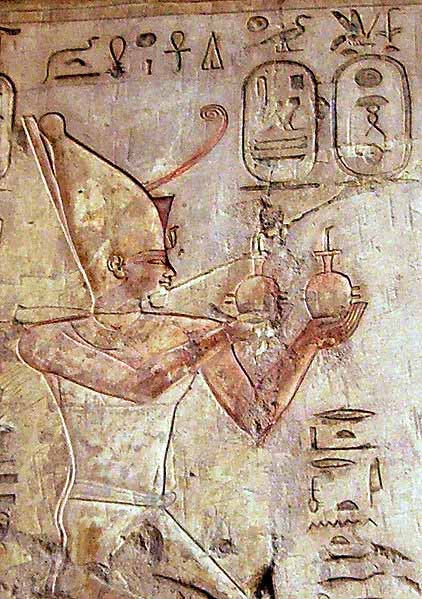
But no empire lasts forever. Psamtik, the son of one of Assyria’s puppet governors in northern Egypt, hired Greek mercenaries to drive out the Assyrian occupiers. By 654 B.C.E. he was pharaoh over a united Egypt. He went on to conquer the western half of the Neo-Assyrian Empire, and by 630 B.C.E. King Josiah of Judah had become a vassal of Pharaoh Psamtik.
Next Assyria was assailed from the southeast. In 626 B.C.E. Babylon revolted under its new king, Narbopolassar. A shrunken Assyria allied itself with Egypt, and Psamtik’s son, Pharaoh Nekho II, sent his armies north to fight Narbopolassar’s son, Nebuchadnezzar II.
It was a slow march, interrupted by rebellions of vassal states along the way. King Josiah of Judah took his own army to Megiddo to challenge the Egyptians in 609 B.C.E., but the Egyptians trounced the Israelites, and Pharaoh Nekho killed Josiah.
The armies of Egypt and Babylon met in 605 B.C.E. at Carchemish, about 2,000 miles north of Jerusalem (on the present border between Turkey and Syria). The Egyptian army was crushed, and its surviving soldiers fled south.
According to Jeremiah, Egypt did not lose the battle because of any deficiency of its own; Egypt lost because the God of Israel made it happen.
Why have your strong ones been cut down?
They did not stand
Because God shoved them down. (Jeremiah 46:15)

After the battle at Carchemish, all of Egypt’s vassal states became vassals of Babylonia, and Assyria disappeared. The prophet Jeremiah repeatedly warned the new king of Judah, Yehoyakhim, to stay out of trouble and keep sending tribute to the Babylonian king, Nebuchadnezzar.
But Yehoyakhim revolted against Babylonia in 599 B.C.E. and sent Judah’s tribute to Pharaoh Nekho II (the same pharaoh who had killed his father, Josiah).
Nebuchadnezzar retaliated by besieging Jerusalem. After a year and a half the city fell and Judah came under direct control of the Neo-Babylonian Empire. Both Jeremiah and Ezekiel criticized Egypt for failing to send troops to defend its new vassal Judah.
Judah’s king, the prophet Ezekiel, and other leading citizens were deported to Babylon. Jeremiah stayed behind in the ruins of Jerusalem until some of his fellow countrymen took him into exile in Egypt.
The prophecy
Both Jeremiah and Ezekiel prophesied that because Egypt had failed keep its promise to help Judah, God would send an army from the north to destroy Egypt. Both prophets said it would be King Nebuchadnezzar’s army, but in actual history, Nebuchadnezzar failed in his 568 B.C.E. attempt to conquer Egypt. The country remained independent until the Persians took it—from the north—in 526 B.C.E.
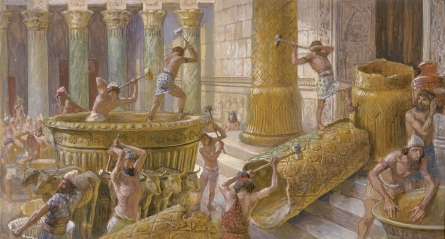
by James Tissot, circa 1900
In Ezekiel’s prophecy, God would arrange for Nebuchadnezzar to devastate Egypt not just to punish it, but so that the pharaoh would know who God is. (See last week’s post, Va-eira—Ezekiel: How to Know God.)
Jeremiah’s prophecy also includes more than punishment. He uses a name for God that never appears in Ezekiel:
As I live, declares the king—Y-H-V-H of Tzevaot is his name—
As Tabor is among the mountains,
And Carmel is by the sea,
It will come!
Prepare for yourself the gear of exile ...
For Nof will become a horror,
A desolation without inhabitants.
Egypt is a heifer with a beautiful mouth,
But a stinging fly from the north is coming, coming! (Jeremiah 46:18-20)
Y-H-V-H = the four-letter personal name of God, possibly related to the Hebrew verb “to be”.
Tzevaot (צְבָאוֹת) = armies; companies of soldiers. (Singular tzava, צָבָא. The Bible also uses the word metaphorically for armies of stars. See my post Bemidbar: Two Kinds of Troops.)
The first biblical book that calls the God of Israel HVH of Tzevaot is Samuel I, which modern scholars date to 630–540 BCE—the same period as the book of Jeremiah. Jeremiah uses this term 70 times!
Why does Jeremiah emphasize that YHWH, the god of existence itself, is the god of armies?
Jeremiah lived through at least 60 years of wars and reversals of fortune in the Near East, 60 years in which Judah was always a pawn, unable to take charge of its own destiny.
The common belief in the ancient Near East was that each country had its own god. When that god was happy with the people of his country, he made their army succeed. When the god was unhappy with them, their army failed.
The Bible also attributes many failures of Israelite armies to Israelite rejections of God. But why were God’s people suffering so many defeats, if their god was the most powerful?
Jeremiah was inspired to preach that the God of Israel is unlike the gods of other nations. Israel’s god, the supreme God of all existence, controls all the armies in the world. God decides which armies will win and which will lose, even when Israelites are not involved in the battle.
For Jeremiah, the prophetic insight that God rules all armies made the wars of his own lifetime meaningful. God had a master plan. Egypt would be humbled. Eventually the Babylonians would also be defeated. And in the long run, the Israelites would outlast all other peoples.
You must not fear, my servant Jacob,
—declares Y-H-V-H—
For I am with you.
For I will make an end of all the nations
Among which I have banished you.
But with you, I will not make an end. (Jeremiah 46:28)
Personally, I shrink inside when I sing a prayer that includes the term Y-H-V-H Tzevaot. If God is the ruler of all armies, then God is responsible for the carnage and suffering of all wars—which are apparently necessary for God’s master plan.
Yet if God were the Master Planner, controlling all the actions of mutable human beings, surely God could come up with a better plan than war after war. And if human beings hold ultimate responsibility for wars, then God is not the Master Planner, and not the God of Armies.
Sorry, Jeremiah.



 Questioning Torah