Haftarat Shelach-Lekha—Joshua: The Defector

Every week of the year has its own Torah portion (a reading from the first five books of the Bible) and its own haftarah (an accompanying reading from the books of the prophets). This week the Torah portion is Shelach-Lekha (Numbers 13:1-15:41) and the haftarah is Joshua 2:1-2:24.

Spies scout out land that the Israelites will conquer in both the Torah portion and the haftarah reading this week. The twelve spies whom Moses sends in the book of Numbers do not speak to anyone in Canaan, and ten of them say the natives are fearsome giants who the Israelites could never defeat.  The results of this report are disastrous.  (See my post Shelach-Lekha: Too Late.)
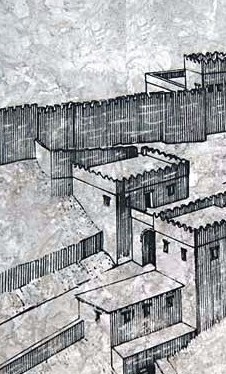
City gate at Megiddo
City gate (at Megiddo)

When God lets the next generation of Israelites enter Canaan (after 40 years in the wilderness) their new leader, Joshua, sends two spies across the Jordan River into the nearest town, the walled city of Jericho. These spies view the Canaanites of Jericho as ordinary human beings.  They go through the city gate during the day, when strangers are allowed in for trading, and converse with at least one of the natives.

And Joshua son of Nun secretly sent two men, spies, from Shittim, saying: Go see the land and Jericho.  So they went, and they came into the house of a woman, a zonah, and her name was Rachav, and they lay down there.  (Joshua 2:1)

zonah (זוֹנָה) = prostitute. From the verb zanah (זָנַָה) = have illicit intercourse, practice prostitution for profit or for a Canaanite religion, be faithless to a husband or to God.

rachav (רָחָב) = broad, wide. (The proper name Rachav appears as Rahab in many English translations.)

In the ancient Near East the custom was for strangers to wait in the town plaza (or rachov (רָחֹב) = open place) until someone offered them shelter (as in Judges 19:15-20).  Joshua’s spies would not want to be that conspicuous, so they go into the prostitute’s house instead.

The story gets off to a racy start, with the men “coming into” and “lying down” in her house, and the sexual humor continues with more double meanings as the tale unfolds.

Someone observes the two men entering Rachav’s house, recognizes them as Israelites from the vast camp across the Jordan, and reports it to the king of Jericho.

And the king of Jericho sent to Rachav, saying: Bring out the men, the ones who came into your house, because they came to scout out the land!  (Joshua 2:3)

At this point, a loyal citizen of Jericho would produce the two spies.  But Rachav seizes the opportunity to switch her loyalty.

Rachav Helping the Two Spies, by F.R. Pickersgill, 1897
Rachav Helping the Two Spies, by F.R. Pickersgill, 1897

And the woman took the two men and she hid them. Then she said: Indeed, the men came to me, but I did not know where they were from.  And the gate was going to close at dark, and the men went out.  I do not know where the men went. Chase after them quickly, because you can overtake them!” But she had taken them up to the roof, and she had hidden them among the flax stalks, the ones stacked for her on the roof.  (Joshua 2:4-6)

After the king’s men are gone, Rachav follows up on her defection by climbing up to her roof and speaking to the two Israelite spies. She begins:

“I know that God has given you the land, because terror of you fell over us…” (Joshua 2:9)

Everyone in Jericho heard how the God of Israel dammed the Reed Sea for the Israelites when they left Egypt, she says, and how the Israelites recently destroyed the Amorite kingdoms of Sichon and Og.

“And we listened, and it made our heart melt, and the will to live could not rise again in any man facing you. Because God, your god, is god in the heavens above and over the land below.”  (Joshua 2:11)

In Biblical Hebrew, a “melting” heart means a heart weakening from fear. Here Rachav declares her faith in the God of Israel over the local god or gods of Jericho.  Next, she asks the two spies to help her and her family defect to the Israelites.

“And now swear, please, to me, by the God, because I acted chessed with you, and so you should act chessed with my father’s household.” (Joshua 2:12)

chessed (חֶסֶד) = loyally, faithfully, in solidarity, in kindness.

They agree on a deal: Rachav will not tell on the two spies, and she will leave a red cord hanging from her window, so they can identify her house when the Israelites attack.  Then the Israelites will rescue everyone inside her house from the destruction of Jericho.

Ruins of a casemate wall: a double wall with living quarters inside
Ruins of a casemate (double) city wall. Larger casemates had living quarters inside.

And she let them down by the rope through the window, for her house was in the city wall, the casemate wall, and she was living in the casemate wall.  (Joshua 2:15)


Most commentary, from the Tamud on, views Rachav’s defection as a sincere conversion to the God of Israel. Tikva Frymer-Kensky, in her brilliant analysis in Reading the Women of the Bible (2002), interpreted Rachav’s statements “I know that God has given to you the land” and “God, your god, is god in the heavens above and over the land below” as a formal declaration of her faith in the God of Israel and conversion to Israel’s religion.

Some modern commentators also interpret Rachav’s chessed as kindness to the spies.  Tikva Frymer-Kensky translated chessed as “benevolently”.  Although Rachav may have been moved by kindness, like the stereotypical hooker with the heart of gold, she uses her initial act of hiding the spies as a bargaining chip: in exchange for her loyalty to them, they must swear loyalty to her.


Why does a person defect to another religion and/or to another country?  What motivates someone to abandon a lifelong allegiance and commit to a new loyalty—becoming a traitor or apostate to their former people?

Some defectors do switch sides because of a passionate conviction in a matter of principle.  If Rachav is one of these, maybe she is so impressed by the story of the parting of the Reed Sea that she becomes convinced that the god of Israel is the highest god in the world, and decides she must become an Israelite even if it means betraying her people.

On the other hand, some people defect, or emigrate, because their lives have become too difficult in the old religion or the old country. The economy has tanked and they can no longer make a living; the sub-group they belong to is suffering from discrimination; or war has come to their country and they fear for their lives.  Unlike their compatriots who blindly continue to serve their old allegiances, these defectors use intelligence and courage to seize an opportunity for radical change—in the hope that the group they are joining will provide them with a better life.

I think Rachav is this second kind of defector.

As a zonah, a prostitute, she occupies a marginal role in the society of Jericho, symbolized by her living quarters in the wall marking the edge of the city.

The word zonah comes from the verb zanah, which means both practicing prostitution and being faithless to a god.  She is willing to be faithless to her old god, and commit herself to a new one, if it seems like the best solution.

Her name, Rachav, is related to the word rachov = open place, town plaza, where strangers wait hoping someone will offer them shelter for the night. Rachav shelters the spies overnight, then asks them for shelter from the coming destruction of Jericho.

Her belief that the Israelites and their god will destroy Jericho is rational. There are hundreds of thousands of Israelites, and they have a record of success: their God made a miracle for them at the Reed Sea, and they vanquished the kingdoms ruled by Sichon and Og on the east side of the Jordan. And even if Jericho’s double wall withstood an onslaught of Israelites, her town would lose in a siege.

Desperate to save herself and her family from death, Rachav courageously seizes the opportunity to switch sides by helping the Israelite spies, converting on the spot to their religion, and making them swear to rescue everyone in her house when the city falls.  She is an opportunist for a good cause—saving the lives of her whole family.  She is a rational defector.

And she succeeds.

And Joshua let her live, Rachav the zonah and her father’s household and everyone who was hers, and she [her clan] dwell in the midst of Israel to this day…  (Joshua 6:25)

May we all have the courage to seize the moment and abandon old allegiances when we must do so for a greater good.  And may we honor all people who courageously escape with their families from war, and commit to a new country.


Yom Kippur: Broken Promises

Yom Kippur is the annual day for atonement: for forgiving, being forgiven, and reuniting with God. This year my congregation, P’nai Or of Portland, chose an alternative  Torah reading for the Minchah (afternoon) service, from Shelach Lekha in the Book of Numbers/Bemidbar:

God said to Moses:  How long will this people disrespect Me, and how long will they not trust Me, despite all the signs I have made in their midst?  Let me strike them with the plague and disinherit them, and I will make you a greater and mightier nation than they.  Then Moses said to God: …Please forgive the sin of this people according to the greatness of Your kindness, and as You have carried this people from Egypt until now.  And God said:  I forgive, as you have spoken.  (Numbers/Bemidbar 14:11-12, 14:19-20)

I am pleased to post this thoughtful guest commentary that Chellema Qolus delivered  on Yom Kippur 5776 (2015).


hands reaching

by Chellema Qolus

Our Torah reading today is from the Book of Numbers, or Bamidbar. It’s the one where twelve scouts journey to check out the holy land. Ten come back and say “Oh no! It’s full of giants and scary stuff!” Two come back and say “It’s the land of milk and honey.”

Imagine you are God. You just gave your people some wonderful land. But instead of being grateful, 10 of 12 responses are “oooh no – it’s scary!” God in this case reacts like many of us often do when we feel unappreciated—God gets mad and says to Moses “Oh these people! I’m done with them! Forget it, I’ve changed my mind – I’m not going to play with them anymore!”

This happened before – when the Israelites made the golden calf God said the same thing. And who talked God out if it? Moses. Moses does a repeat performance here. Moses says “You promised—it’ll look bad if you go back on your promise. Come on, please? Forgive your people.”

Now, how is it that the all-knowing omniscient Infinite Oneness makes an agreement, gets mad, wants to break that agreement and then is convinced to keep it? I mean, if God knows everything that’s going to happen, how does this make sense?

God is infinite. All possibilities exist. God makes light and dark, good and evil. How this plays out at this level has a lot to do with us. If we are made in the image of God, then our portrayal of God in the Torah is also a reflection of us. Our relationship with God is a participatory process. That means we have to make the case, like Moses did, that forgiveness is included in the covenant.

If you look at the stories in Torah – the golden calf, the scouts, pretty much every story, people are breaking promises or betraying trusts right, left and sideways – EVERYONE!   Even Moses literally breaks the tablets of the covenant when he comes down from the mountain and sees the people dancing around the golden calf.

Here’s the thing. We ALL break our promises. We ALL betray trusts. We ALL hurt each other whether we mean to or not. That’s the way the world is. That’s the way we are. The great Kabbalist Isaac Luria said that when the universe was first created God’s infinite light was too much for the vessels of existence to hold and they shattered. So our universe has brokenness and so do we. Or, as the ten scouts would say “There’s giants and scary stuff! Oh no!”. The two scouts would say “Our souls are pure—direct from the Infinite. In nature we see the Glory, the cosmic pattern of wholeness of The Eternal. And in our kindness with each other, our hearts are one with God.”

These two perspectives, together, fuel our hopes and fears. We get so hurt and mad sometimes because it means so much. Early in my time with this congregation, I enjoyed a wonderful service and a warm and friendly oneg meal. I was feeling so much love for everyone and it struck me – I saw the patterns, my own patterns: how much community means to me, how much I love  the people here… and how I stumble, make mistakes, am misunderstood, and how inevitably, my heart is broken. After this wonderful service where I felt so much love … I went home and cried. Because I knew—I knew my heart would break with this community. And it did—in small ways, and large ways. But one thing is different from my previous experiences of this—I’m still here. And right now, in this moment, we’re all here.

We are all the characters in the story. Sometimes, like the two scouts Caleb and Joshua, we are in tune with God’s dance and understand how everything fits together and revel in God’s glory. Sometimes, like the ten scouts, we are overwhelmed by our pain and our fears and we project and perpetuate the negative. Sometimes, like God in this story, the God-spark in us feels unappreciated and we are hurt and lash out and just want to call everything off. Sometimes, like Moses, we plead with each other and the Divine Infinite for mercy and compassion.

To call on the Infinite for forgiveness that is attuned to us, here, on this level, we must first forgive ourselves and each other. Our forgiveness is like a homing beacon for God’s forgiveness. It creates a container made from the pieces of our brokenness, made to receive God’s Shalom, God’s Wholeness.handshake

…I call to Torah everyone who wants to bring our broken pieces together, creating a container to receive the Infinite One’s forgiveness and wholeness. Shalom.


Shelach-Lekha: Mutual Distrust

by Melissa Carpenter, maggidah

Moses reaches the end of his rope in last week’s Torah portion, Beha-alotkha, and protests to God:

Child in a Tantrum, by Rembrandt van Rijn

Did I myself become pregnant with all this people, or did I myself give birth to them, that you say to me: Carry them in your bosom, like the omein carries the one who suckles, to the land that You swore to their forefathers? … I am not able to carry all this people by myself alone, because they are too heavy for me! If at must do thus to me, please kill me altogether, if I have found favor in Your eyes, and don’t let me see my badness! (Numbers/Bemidbar 11:12-15)

omein (אֹמֵן) = guardian, substitute parent. (The feminine form, omenet (אֹמֶנֶת) means a wet nurse or nanny.  Moses views himself as both omein and omenet. See my post Beha-alotkha & Shemot: Moses as Wet-Nurse.)

at (אַתְּ) = you, feminine form.  (The masculine form of “you” is atah, אַתָּה.)

I think Moses calls God “you” in the feminine form here in an allusion to God’s responsibility for the people. If Moses is like an omenet for the Israelites, so is God.

Another exasperated parent

In this week’s Torah portion, Shelach-Lekha (“Send for yourself”), the God character reaches the end of his (or her) rope.

God said to Moses: How long will this people spurn me, and how long lo ya-aminu me, despite all the signs that I have performed in their midst? (Numbers 14:11)

lo ya-aminu = will they not trust.  Lo (לֹא) = not. Ya-aminu (יַאֲמִינוּ) = they will believe, be convinced by, put trust in, have faith in, rely upon.

Ya-aminu comes from the same root verb, aman (אמן), as the nouns omein and omenet. An omein and an omenet must be reliable so that their young charges can believe and trust them.

Both Moses and God are reliable parental substitutes during the Israelites’ journey from Egypt to Mount Sinai. Whenever something bad happens—the Egyptian army catching up with them at the Reed Sea, or a shortage of water or food—the people panic, afraid that their god has abandoned them.  Each time, Moses speaks to God, and God takes care of the problem.

Exasperating children

One breach of trust is recorded in the book of Exodus/Shemot: the episode of the Golden Calf.  Moses and God take turns becoming enraged; Moses has 3,000 calf-worshiping men killed by the sword, and God strikes down many of the survivors. Moses has to talk God out of annihilating the Israelites altogether.

scouts with grapes 1

After that, the remaining Israelites spend a quiet year eating God’s manna and fabricating the tent sanctuary and its holy objects. God issues rules with dire penalties, but does not kill any more people—until the book of Numbers/Bemidbar, after they leave Mount Sinai.

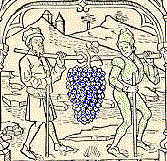
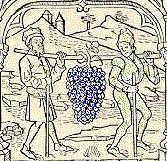
In this week’s Torah portion, the people reach the wilderness of Paran on the border of Canaan.  Moses sends twelve men to scout out the land, and they return 40 days later with a gigantic grape cluster as well as pomegranates and figs.  Ten of the scouts report that the human inhabitants of Canaan are also gigantic, and say:

We are not able to go up against that population, because it is stronger than we! …and all the people that we saw in its midst were men of unusual size …and we were in our own eyes like grasshoppers, and so we were in their eyes.  (13:31-33)

The ten pessimistic scouts assume the Israelites would have to conquer Canaan by their own efforts, without any help from God.  The rest of the Israelite men—except for Moses, Aaron, and the other two scouts, Caleb and Joshua—make the same assumption. The people weep all night, complaining:

If only we had died in the land of Egypt, or in this wilderness, if only we had died!  And why is God bringing us to this land to fall by the sword? And our young children will be the [enemy’s] plunder.  Wouldn’t it be better for us to return to Egypt?—So they said, each man to his brother: Let us pick a leader and return to Egypt! (Numbers 14:2-4)

The next morning everyone assembles.  Caleb and Joshua say:

If God is pleased with us, then [God] will bring us to this land and give it to us, a land that flows with milk and honey. However, do not rebel against God! And you, do not be afraid of the people of the land, because … God is with us! (14:8-9)

Lack of trust

The trouble with this argument is that it begins: “If God is pleased with us”.  The people have every reason to think God is not pleased with them. After all, since they left Mount Sinai they have complained twice, and both times God flew into a rage and killed many of them.  Now they have just spent the night complaining about God’s plan to send them into Canaan.

Perhaps because they feel doomed anyway, the people vent their frustration on Caleb and Joshua, threatening to stone them.

Then the glory of God appeared in the Tent of Meeting to all the Children of Israel. God said to Moses: How long will this people spurn Me, and how long lo ya-aminu Me, despite all the signs that I have performed in their midst? (14:10-11)

Apparently the God character in this story thinks that the Israelites doubt his ability to give them a miraculous victory in Canaan. In fact, the people never doubt God’s power, only God’s love.  They doubt God’s commitment to protecting them.

And they are right. In a private conversation with Moses, God once again declares he will wipe out the Israelites and start over:

I will strike with a pestilence, and I will dispossess them, and I will make you a greater and more powerful nation than they!  (Numbers 14:12)

Moses once again talks him out of it. God still kills the ten scouts who spoke against entering Canaan immediately.  And God swears that only Caleb, Joshua, and the Israelites who are currently under age 20 will enter Canaan and get a share of the land. Everyone else will die in the wilderness—gradually, over the next 38 years. The people must now spend 40 years in the wilderness before they can enter Canaan.  (This total includes the two years that have already passed since the people left Egypt.)

The next morning, some of the men confess they were wrong, and try to get back into God’s good graces by launching an assault across the border of Canaan. But God has made up his mind; he lets the Canaanites defeat them.

It is possible to argue that God does care about the Israelites—if you grant that:

1) God has so little respect for the people that “he” administers corporeal punishment without attempting to explain himself, and

2) God considers the Israelites a single entity, rather than a group of individuals.

This is not the kind of omein that medieval theologians pictured when they decided that God must be omniscient, omnipotent, omnipresent, omnibenevolent, and personal. Nor is it the kind of deity that anyone today would want to trust or believe in.

God said to Moses: How long will this people spurn me, and how long lo ya-aminu me, despite all the signs that I have performed in their midst? (14:11)

I think the answer that this god deserves is: “As long as it takes for You to become as wise, just, and kind as the best human being.”

Needless to say, I do not believe in the existence of the anthropomorphic God in the first five books of the Torah, the one who has vast magical powers but very limited understanding.

But what was life like for the people who took this part of the Bible literally, and not only believed the God character in this story existed, but thought of him as a father-figure (omein), and strove to trust him?

What is life like for the people who still do so today?

Devarim & Shelach-Lekha: A Giant Detour

The first time the Israelites reach the border of Canaan, they refuse to cross because they are afraid of giants. The second time, they delay crossing the border because of a giant.

The first time, the Israelites come from Mount Sinai directly to the southern border of the land God promised to give them. In the Torah portion Shelach-Lekha in Numbers/Bemidbar, Moses sends scouts into Canaan. The scouts return saying the land is full of giants.

And all the people that we saw in it were men of unusual size. There we saw the Nefilim—children of Anak from the Nefilim—and we were like grasshoppers in our own eyes, and so we were in their eyes! (Numbers/Bemidbar 13:32-33)

Nefilim (נְפִילִים) = “fallen ones”, giants; offspring of “the gods” and human women before the Flood.

Anak = founder of the Anakim (עֲנָקִים) = “necklace people”, giants.

There are three groups of people in the Torah who are tall enough to be considered giants: the Nefilim, the Anakim, and the Refa-im. The passage above confirms that the Nefilim and Anakim are giants.

At the southern border of Canaan, the Israelites refuse to go into a promised land that is full of giants. God declares they must wait until 40 years have passed since the exodus from Egypt, and all the men of that generation have died (except for Joshua, and Caleb, the two scouts in favor of  going).

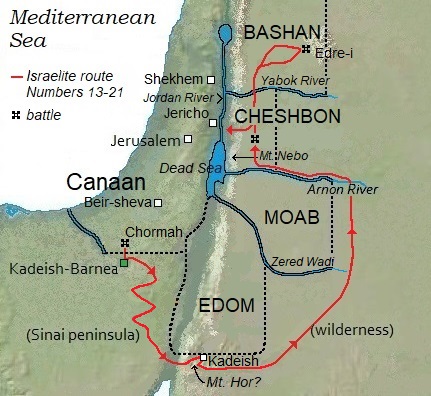
In the 39th year, in the Torah portion Chukkat in Numbers, Moses leads the Israelites around the kingdoms of Edom and Moab, and they camp on the Arnon River.  Now all that lies between them and the Jordan River, the eastern border of Canaan, is the kingdom of Cheshbon.

Moses asks Sichon, king of Cheshbon, for permission to pass through his land on the king’s highway. Sichon not only refuses, but calls up his army and goes to battle. The Israelites win, and take over Cheshbon.

Then, instead of heading straight for the Jordan River, they take a long detour to the north, all the way to Edre-ii.

Then they turned their faces and they went up the Bashan road; and Og, king of the Bashan, went out to come against them to do battle, he and all his people, at Edre-ii. And God said to Moses: Do not be afraid of him, because into your hand I have given him, and all his people, and all his land; and you shall do to him as you did to Sichon, king of the Emori, who was living in Cheshbon. So they struck him down, and his sons and all his people, until there were no survivors left, and they took possession of his land. Then the Children of Israel pulled out, and they pitched camp on the plains of Moab, across the Jordan from Jericho. (Numbers/Bemidbar 21:33- 22:1)

Og (עוֹג) = a proper name. (In Biblical Hebrew, the closest word is oog (עוּג) = bake a cake. In Phoenician, og = a supernatural being who attacks grave-desecrators.)

Why do the Israelites make this gratuitous detour to conquer an extra country—a country that is not even part of the “promised land” of Canaan?

According to most traditional commentary, King Og would have come south and attacked the Israelites anyway, as soon as they conquered Cheshbon. Some commentators have claimed that Og and Sichon were allies, others that they were both hired by the Canaanites to guard the Jordan River against invaders from the east. In the Talmud, Niddah 61a says Og and Sichon were brother giants who escaped the Flood in Noah’s day. (According to one old story, baby Sichon was a stowaway in the ark, and Og rode on the roof.)

Yet when the Israelites head up the Bashan road, they do not meet Og and his army until they get all the way to the fortress of Edre-ii, King Og’s second capital. Therefore, according to the Torah itself, Og is not on his way to attack the Israelites in Cheshbon. The Israelites’ detour to the Bashan is unnecessary.

So why do they do it—with Moses’ cooperation, and God’s consent and reassurance?

When Moses retells the story in this week’s Torah portion, Devarim (“Words”), his account begins the same way as in Numbers. But then he gives us new information about King Og.

For only Og, king of the Bashan, remained from the rest of the Refa-im. Hey! His bedstead was a bedstead of iron! Is it not in Rabbah of the Ammonim? Nine cubits is its length, and four cubits its width, according to the cubit of a man. (Deuteronomy 3:11)

Refa-im  (רְפָאִים) = an ancient people of huge size; the dead.

A bed that size indicates that Og is about ten to twelve feet tall (about 300 to 370 cm)—twice as tall as an ordinary man. No wonder God tells Moses not to be afraid!

After the Nefilim and the Anakim, the third group of extra-large people in the Torah is the Refa-im. We know the Refa-im are giants not only because Og is a Refa-i, but also because of another aside in this week’s Torah portion. Moses remembers that God told him not to provoke the Ammonites on the way to the Jordan, since God reserved their land for the descendants of Lot’s son Ammon. Then Moses adds that Ammon

…is also considered the land of Refa-im; Refa-im used to live there previously … a great people, and numerous and tall as the Anakim. God exterminated them before [the Ammonim], and displaced them, so they live in their place instead. (2:10-11)

This explanation ties together the two meanings of refa-im. The refa-im are giants; and they are also extinct, by the time of Moses’ speech in Deuteronomy; the Israelites kill the last Refa-ii, King Og. The refa-im are the dead.

When the scouts reported that Canaan was full of gigantic Anakim, the Israelite men of the older generation are afraid to cross the southern border of Canaan. Now a new generation is preparing to enter Canaan across a different border, the Jordan River at the eastern edge of Canaan. These young men need to prove to themselves that unlike their fathers, they are not afraid of giants.

Fortunately, from their point of view, there is a giant ruling the country just north of Cheshbon. The chance to attack King Og is irresistible.

Many of us today are haunted by giants from the past. When Jews say “Never again”, we are thinking of Nazi giants. Individuals also remember feeling like grasshoppers in the face of those who used to have power over them: an abusive parent, a menacing teacher, the draft board, “the system”. It takes many years for us to grow and develop our own power.

Eventually, we may believe we are strong enough and brave enough to prevent anyone from seizing power over us. But our memories still haunt us. How can we be sure we are now safe from giants?

I have even caught myself wishing a giant would attack me, just so I could prove to myself that I can stand up to it!

Some of us might be tempted to attack potential giants who are minding their own business—just  to prove we have to courage to do it. It takes even greater strength to refrain, and not turn onto the Bashan road.

I pray that everyone may find not only the strength to stand up to giants, but also the greater strength to refrain from provoking them. May we wait for an actual threat before acting. And may we use our newfound power and courage with wisdom and compassion, so we do not turn anyone into a grasshopper.


Shelach-Lekha: Fear and Kindness

The Israelites march to the southern border of Canaan in this week’s Torah portion, Shelach-Lekha (“Send for yourself”). Then Moses sends twelve men to scout out the land God promised them. The scouts return after forty days, carrying pomegranates, figs, and a gigantic cluster of grapes.  Ten of the scouts report to Moses and the whole assembly of Israel, saying:

We came into the land where you sent us, and indeed it is flowing with milk and honey, and this is its fruit. But it is all for nothing, for the dwellers in the land are strong, and the cities are fortified and very big, and also we saw the offspring of the Anak there. (Numbers/Bemidbar 13:27-28)

They list other hostile peoples living in the land of Canaan, reinforcing their hint that it does not matter how fertile the land is, since the Israelites have no hope of conquering its inhabitants.  Then one scout, Caleb, objects.

Caleb hushed the people toward Moses, and he said: “We must certainly go up and we must certainly take possession of it, because we are certainly able to do it!”  But the men who had gone up with him said: “We will not be able to go up against those people, because they are stronger mimenu.” (Numbers 13:30-31)

mimenu (מִמֶּנּוּ) = than us; than him, than it.

In the Talmud (Sotah 35a), Rabbi Hanina bar Papa interprets mimenu as meaning “than Him”, than God—“as if even the master of the house cannot remove his furniture from it!”  Other commentators interpret mimenu as “than us”, and conclude that the ten scouts did not believe God would simply remove the inhabitants from the land before the Israelites walked in. Instead, they assumed they would have to fight for every farm and city, and they despaired.

Whether the scouts give up on God or give up on the people, their next move is to exaggerate the dangers of Canaan, emphasizing that …all the people that we saw inside it were men of unusual size. (Numbers 13:32)

The Israelites despair along with the ten scouts, and sob all night.

A frightened rebellion

Then the Israelites rebel against Moses, Aaron, and God’s master plan.

And all the Children of Israel grumbled against Moses and Aaron, and the whole assembly said to them: If only we had died in the land of Egypt, or in this wilderness! If only we had died! Why is God bringing us to this land to fall by the sword? Our wives and our little children will become booty. Is it not better for us to turn back toward Egypt? (Numbers 14:2-3)

If they actually returned to Egypt, they would be punished as runaway slaves and their wives and children would be treated just like booty.  But the men do not think of this, and they decide to pick a new leader and head back. Moses and Aaron fall on their faces—but this time no divine inspiration comes. (See my earlier post, Korach: Falling on Your Face.) The crowd stops only because the two dissenting scouts, Caleb and Joshua, rip their clothing—an action that is normally performed as a sign of mourning. Now that they have the Israelites’ attention, they explain why the people should go up into Canaan:

The land that we passed through to scout out, it is very, very good land. If God favors us, then [God] will bring us into this land and give it to us, a land that flows with milk and honey. However, do not rebel against God! And do not be afraid of the people of the land, for they are our food, and the shade of protection has left them. God is with us; do not be afraid of them! (Numbers 14:7-9)

The people are not convinced.  They are about to stone Caleb and Joshua, when the glory of God appears at the Tent of Meeting and stops them. I suspect the message that they are supposed to trust God makes them so uncomfortable they cannot bear to think about it, so they want to kill the messengers instead.

A kind punishment

As in the golden calf episode in Exodus, God threatens to wipe out all the Israelites and start over again with Moses. And once again Moses persuades God to let go of anger and forgive the people, concluding:

“Pardon, please, the transgression of this people according to the greatness of your loyal kindness, as you have forgiven this people from Egypt until now.” And God said: “I pardon, as you have spoken. However, as I live and as the glory of God fills the whole earth, indeed all the men who have seen my glory and my signs that I performed in Egypt and in the wilderness, and tested me many times and did not listen to my voice–they will not see the land that I vowed to their fathers! Everyone who has scroned me will not see it!” (Numbers 14:19-23).

Only Caleb, Joshua, and the Israelites who are currently under age 20 will enter Canaan and get a share of the land. Everyone else, God declares, will die in the wilderness—gradually, over a period of 40 years.

It sounds like a spiteful punishment; God gives them what they said they wanted, death in the wilderness.  But I believe this apparent punishment is actually a great kindness.  The adults among the Children of Israel mustered the courage to leave Egypt in the first place, and to face an unknown future following the mysterious and obviously dangerous God who inflicted the ten plagues on Egypt. But someone who can act with great courage in desperate situations, such as worsening slavery, does not necessarily have the willpower to take risks when life is pretty good.

At the time the Israelites refuse to enter Canaan, they are camped in the oasis of Kadeish-Barnea, where there is enough vegetation for them and their livestock to live indefinitely, even without manna. They are not required to do any unusual labor, only to follow a set of reasonable laws and easy rituals. Why not just stay there for the rest of their lives?

The answer is that God is urging them to do something further. For Caleb and Joshua, and for Moses and his brother and sister, this urging is stronger than natural inertia and fear of the unknown.  But for others, the need for security and comfort is stronger.

So God kindly lets the Israelites stay at the oasis in the wilderness, living out their lives until each one dies at age 60. God recognizes that it is too much for most of the people to summon the willpower for another big act of courage.

Each of us today faces similar turning points in our lives. Sometimes we find ourselves trapped in a desperate situation, and it still takes a lot of inner strength to escape to a new life, but finally we do it. Other times life is pretty good, but something inside keeps urging us to make a change, to step out and take a risk that frightens us. Do we do it?

Whether we pick up the challenge or not depends on how fragile or strong our souls are. In this week’s Torah portion, God says:

But my servant Caleb, because there is a different ruach with him, and he followed me fully, I shall bring him into the land… (Numbers 14:24)

ruach (רוּחַ) = wind, spirit, mood, state of mind, driving impulse, motivation, temperament.

Perhaps when we hesitate between sticking with a pretty good life and taking a chance on the inner urge for change, all we can do is pray for wisdom and the right ruach.

May God, and life, be kind both to those who do not have the ruach to change, and to those who do.

Shelach-Lekha: Too Late

The Israelites are on the verge of entering Canaan at the opening of this week’s Torah portion, Shelach-Lekha (“Send for yourself”). They are in Kadesh-Barnea, an oasis in the wilderness of Paran that is close to a hilly ridge on the border of Canaan. The tribes are camped in marching formation, and all the men over 20, who will fight any upcoming battles, have been counted. The portable sanctuary (mishkan) is completed, and God’s cloud hovers over the inner sanctum, where the ark of the covenant rests.

The only problem is that the people keep complaining, and God keeps dealing with it by killing the worst complainers. Nevertheless, God has led the survivors all the way to the border of Canaan. This week’s portion begins with God giving Moses permission to send scouts for himself into Canaan.

Scouts with grapes from Canaan

Sending in scouts is standard military procedure before a conquest. When Moses’s twelve scouts return, they all agree that Canaan is good land, full of milk, honey, and fruit. (They bring back a gigantic bunch of grapes as evidence.) Two of them, Caleb and Joshua, predict that the Israelites will go up and conquer the land, with God’s help. But the other ten scouts say that the inhabitants of Canaan are giants, too strong for the Israelites to conquer. Then the “entire assembly” of Israel wails:

If only we had died in the land of Egypt, or if only we had died in this wilderness! Why is God bringing us to this land to fall by the sword? Our wives and our little ones will be taken captive. Isn’t it better for us to return to Egypt? Let’s appoint a leader and return to Egypt! (Numbers/Bemidbar 14:3-4)

God (according to this story) is infuriated by the people’s rejection, and assumes that they doubt God has the power to make their conquest successful.

I think that what the Israelites actually doubt is God’s commitment to them. And they have a point. Once again, Moses has to persuade God not to simply annihilate everybody on the spot. God compromises by decreeing that the Israelites must wander in the wilderness for another 40 years, until everyone over 20 has died—except for Caleb and Joshua, who in reward for their faithfulness will live long enough to enter Canaan. God sensibly decides to presume that those under 20 are innocent, so they can enter the land as adults at the end of the 40 years.

Ironically, God is giving the Israelites what they said they wanted, when they despaired of conquering Canaan and wailed: If only we had died in this wilderness!  But when Moses gives them the news, they are not pleased.

Moses spoke these words to all the children of Israel, and the people cursed themselves very much. They got up early in the morning and they went up to the top of the hill, saying: Here we are! And we will go up to the place that God said, because we were wrong! (Numbers/Bemidbar 14:39-40)

But Moses said: Why are you going beyond the word of God? That will not succeed! Do not go up, because God is not in your midst, and you will be defeated in the face of your enemies. For the Amalekite and the Canaanite are there in front of you, and you will fall by the sword; since you turned away from following God, then God will not be with you.  (Numbers 14:41-43)

Yet they stormed up to the top of the hill. But the ark of the covenant of God, and Moses, did not budge from the middle of the camp. Then the Amalekite and the Canaanite, who were staying on that hill, came south and beat and battered them until the chormah. (Numbers 14:44-45)

chormah (חָרְמָה) = a possible place-name; the verb charam (חָרַם)= destroy utterly, dedicate to utter destruction for the sake of God + the suffix ah = toward

I feel sorry for the men who admit they were wrong, and try to correct their mistake, only to be utterly destroyed for the sake of God. I am also impressed by their sheer stupidity. How can they fail to see that they will fail?

These men know they did something wrong, or God would not have sentenced them to die in the wilderness.  The men assume their misdeed was simply refusing to climb the ridge into the land of Canaan. It does not occur to them that a more serious misdeed was refusing to obey God, or that the worst of all was deciding to abandon God and return to Egypt.

Moses points out that rushing up the ridge without God’s permission will never succeed, because they turned away from following God. But the men do not listen to Moses, even though he has spoken for God ever since he and God freed them from slavery in Egypt. Neither do they do not attach any meaning to the fact that Moses and the ark remain in the camp with the women and children (and, presumably, the subset of men who did not try to storm the ridge). Ignoring all evidence, the men who rush up the ridge actually believe that by doing what God ordered in the first place, they can change God’s mind and win a reprieve from being sentenced to die in the wilderness.

They are only human. I bet all human beings, at some point in their lives, realize that they have made a terrible mistake, and try to fix it by turning back the clock and doing it right this time. The problem is that we cannot turn back time. There are no second chances.

Once the Israelite men reject God and God’s plan for entering Canaan, they cannot change themselves back into innocent followers of God. Saying we were wrong is a good beginning of an apology, although they also need to acknowledge their rejection of God, and repent. That is the best they could do. Then they would merit whatever fate God deemed appropriate for people who had been unfaithful, but now were reforming. They could not have started conquering Canaan as if nothing had happened, but perhaps God would have softened their sentence.

Similarly, someone who has lied or cheated on a spouse cannot return to the original situation and do it over again, getting it right this time. Once you have betrayed someone’s trust, the best you can do is to apologize and repent. And even if the betrayed spouse forgives the betrayer, the marriage will not be the same. The same principle applies to a betrayal between friends, or between a parent and child.

There are no second chances; the story of the men who rush up the hill after it is too late only illustrates how our world works. Nevertheless, we can do better than that band of Israelites, if we are willing to study our own mistakes and misdeeds. With humility and deep reflection, we can change our approach to life, and make better choices when we encounter challenges in the future.

May we receive the strength to do this had inner work. May we receive the grace to accept where we are now, even if we wish we had never left Egypt. And may we receive the insight to make better and better choices.