Naso, Bemidabar, & Vayakheil: Reconstructing

(It is a pleasure to type effortlessly and comfortably again! I am glad return to my favorite work: writing about Torah.)

Model of Tent of Meeting in Timna Valley Park, Israel

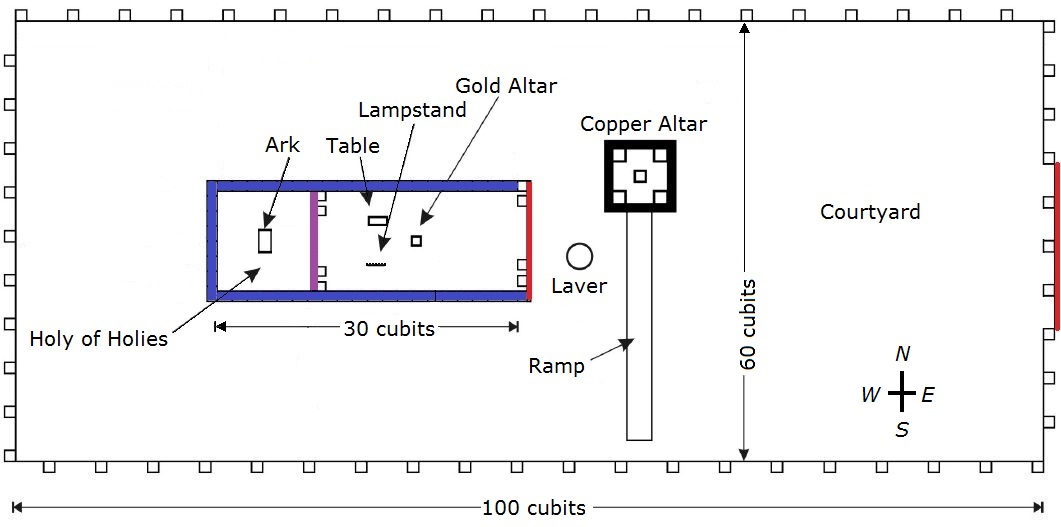
The Tent of Meeting that the Israelites make as a dwelling for God in the book of Exodus is 10 cubits wide, 10 cubits high, and 30 cubits long. (Ten cubits equals about 15½ feet, or 4¾ meters.) This boxy tent stands in the back half of an open courtyard, slightly smaller than an Olympic-sized swimming pool, with a linen wall stretched between acacia wood posts around its periphery.

Neither the tent nor the courtyard is a permanent structure.

In the first two Torah portions of the book of Numbers, we learn how everything is dismantled, transported, and reassembled at the next campsite on the Israelites’ long journey north from Mount Sinai—and who is responsible for the wood, the fabric, and the holy furnishings.

Exodus: Vayakheil

Neither the inside cloth nor the outside cloth of the Tent of Meeting is sewn into a continuous shell.

And all the wise of mind among the makers of the work, the mishkan, made ten cloths of fine twisted linen threads and blue, purple, and red [dyes]; they were made with a design of keruvim.  (Exodus 36:8)

mishkan (מִשְׁכָּן) = (literally) dwelling place. (In the books of Exodus through Numbers, mishkan always refers to the portable tent-sanctuary where God dwells, at least part-time, in the tent’s back chamber, the Holy of Holies. After its first assembly, in Exodus 40:17-33, it is also called the Tent of Meeting and the Tent of Testimony. One common English translation for mishkan is “tabernacle”.)

Keruv, ivory from Samaria, 9th-8th century BCE

keruvim (כְּרֻבִים or כְּרוּבִים) = hybrid creatures with wings. Singular keruv. (Two gold keruvim rise from either end of the gold lid of the ark in the Holy of Holies, the back chamber of the mishkan, and keruvim are woven or embroidered into some of the fabrics of the mishkan as well.)1

Each of these ten tapestries is 4 cubits wide (about 2 yards or meters) by 28 cubits long (about 14 yards or meters), long enough to drape across the ceiling frame and hang down on both sides just short of the ground. Fifty loops of blue wool are sewn down both side edges of each cloth, and the loops are connected with gold clasps.

And fifty gold clasps were made, and the cloths were joined, each one to the other, with the clasps. And the mishkan became one [piece]. (Exodus 36:13)

Someone has to fasten a row of 50 clasps nine times, every time the Tent of Meeting is assembled; and unfasten them all when the tent is dismantled again. (The open end of the mishkan is covered with a free-hanging curtain, so it serves at the entrance. A hanging curtain also separates the Holy of Holies from the main chamber inside the tent.)

The outside of the framework is covered with similar cloths woven from goat-hair, joined together by bronze clasps. Two layers of leather lie on top of the goat-hair cloth over the roof.

The frame of the tent roof is made from acacia wood bars, but the three walls are solid acacia wood: wide upright planks stabilized with cross-bars. Two tenons at the bottom of each plank fit into silver sockets in wood bases. And even though these wooden elements are hidden by linen inside and goat-hair fabric outside, they are covered with gold!2 Each of the 48 upright planks is over 15 feet tall and 3 feet wide, so erecting and dismantling the underlying wooden structure means a lot of heavy labor.

Numbers: Bemidbar

The book of Numbers opens after the Israelites have made the Tent of Meeting and all its furnishings (in Exodus), and ordained new priests for the revised religion (in Leviticus). Before the people leave Mount Sinai and head north, God organizes them for the coming conquest of Canaan.

The first Torah portion, Bemidbar, opens with God calling for a census of soldiers for future combat: the men age 20 and older in every tribe except Levi. The Levites are exempt from battle because they are assigned their own “army” duty: transporting and guarding the Tent of Meeting.

And they will be in charge of all the gear of the Tent of Meeting, and the Israelites’ charge to serve the service of the mishkan. (Numbers 3:8)
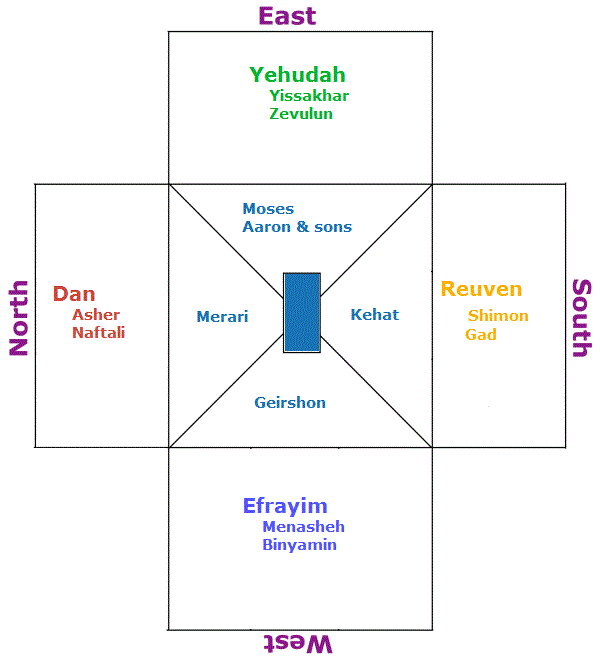
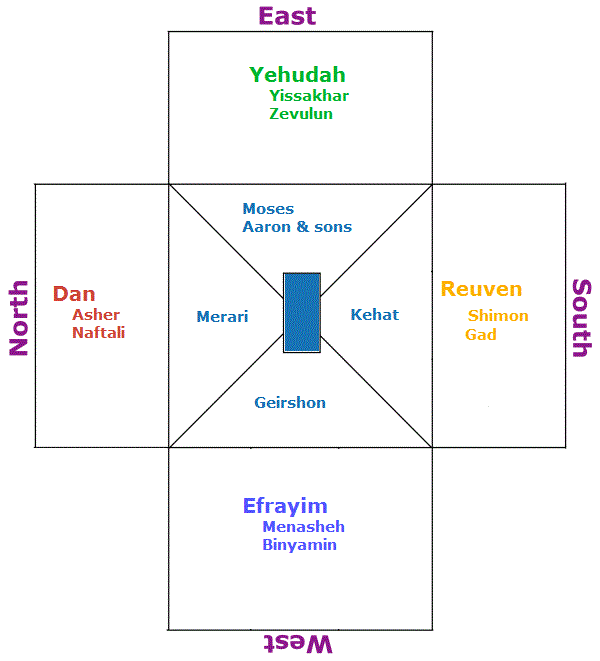
Campsites of 12 tribes and 3 clans of Levites

When God signals that the people must pull up stakes, the Levites dismantle the Tent of Meeting. They carry the furnishings, the fabric, and the wood on every journey. When the Israelites pitch camp again, the Levites erect God’s tent in the middle and the courtyard wall around it. They pitch their own tents immediately around the courtyard, and serve as guards to prevent any unauthorized persons from encroaching on the sacred space.

There are three clans of Levites, named after the three sons of Levi listed in Genesis 46:11: Gershon, Kohat (or Kehat), and Merari. Sons in a biblical genealogy are list by birth order, so Gershon was born first, then Kohat, then Merari last.

And the charge of the Gershonites at the Tent of Meeting was the mishkan and the tent: its coverings, and the curtain of the entrance to the Tent of Meeting, and the cloths of the courtyard, and the curtain of the entrance of the gate of the coutyard, which is near the mishkan and near the altar—all around; and their cords, and all its service. (Numbers 3:25-26)

The descendants of Levi’s middle son, Kohat, are responsible for transporting the holy items inside the mishkan, and the bronze altar in the courtyard.

Their charge was the ark, the table, and lampstand, and the altars, and the holy utensils for ministering to them, and the curtain, and all their service. (Numbers 3:31)

The only curtain that this clan is responsible for is the one inside the tent that divides the main chamber from the Holy of Holies.

But why are the descendants of Levi’s middle son responsible for the holiest items of the mishkan? In the book of Genesis, the firstborn son of each extended family becomes responsible for making burnt offerings to God. If the people followed this precedent, the descendants of Levi’s oldest son, Gershon, would be in charge of the holiest things.

However, in Exodus and Numbers, the job of burning offerings for God is transferred to the priests, with assistance from Levites. All priests are descended from the first high priest, Moses’ brother Aaron. Moses and Aaron’s father, Amram, is a descendant of Kohat, the middle son of Levi.3 That means the rest of the Kohatites are Moses’ and Aaron’s closest relatives. No wonder they become responsible for transporting the holiest items in the mishkan.

As for the descendants of Levi’s youngest son:

The Merarites are appointed for the charge of the beams of the mishkan and its bars, and its uprights, and its sockets, and all its gear, and all its service; and the uprights of the courtyard, all around, and their sockets, and their tent-pegs, and their cords. (Numbers 3:36-37)

While the men in the other tribes of Israel are mustered into the army at age 20, the work of disassembling, carrying, reassembling , and guarding the Tent of Meeting is restricted to Levite men between the ages of 30 and 50. (See my post Bemidbar: Two Kinds of Troops.)

When God’s cloud lifts from above the mishkan, indicating that it is time for the Israelites to journey on, the priests enter the tent first. Aaron and his sons Elazar and Itamar wrap up the ark, bread table, lampstand, and gold incense altar inside, and the bronze altar in the courtyard. (See my post Bemidbar: Covering the Sacred.) The embroidered curtain that divides the Holy of Holies from the main chamber of the mishkan becomes the first of three layers covering the ark.

Only after these holy objects are completely covered, so they cannot be seen or touched, may the other Kohatite men pick them up by their carrying poles. And only after the Tent of Meeting is empty may the Gershonites and Merarites begin dismantling it.

Numbers: Naso

This week’s Torah portion, Naso, opens with God’s instructions regarding the Gershonites and Merarites between the ages of 30 and 50—

—everyone who enters to do military service of the military, to serve the service at the Tent of Meeting. (Numbers 4:23 for Gershonites, Numbers 4:30 for Merarites)

They are non-combatants in any future battle because they must be continuously responsible for all the elements of the tent itself, as well as its unroofed courtyard.

Once the sacred objects have been removed, the Gershonites take down all the lengths of fabric and leather, carefully undoing 950 clasps. They handle the lightest objects, so their work requires the least physical strength. But it requires the most patience and delicacy.

The Merarites do heavy physical labor. Furthermore, disassembling and reassembly the wooden structure with its upright plants, cross-bars, and bases, is a team effort requiring coordination between the men so that nothing collapses.

Once the wooden structure is stable, the fabric layers have all been fastened to make continuous walls and roofs, and the holy objects are all in place, only the priests may enter the mishkan. But the Levites remain on duty, assisting in the courtyard, and guarding the sacred space they have rebuilt.


Some people excel at fine detail work, like the Gershonites. Others are good at team projects on a grand scale, like the Merarites, whether they help organize the team or do the heavy lifting. We need both kinds of people to build a community.

And although everyone who has contributed tries to guard their community and keep it going, no congregation, association, institute, or enterprise continues forever unchanged. At some point, it will fall apart—unless the Gershonites and Merarites in the group pitch in to carefully dismantle the old structure, help everyone move to a place that meets the people’s new needs, and then use the elements of the old structure to build a new one. And we need people like the Kohatites to carry the most sacred goals and values of the community into the next stage.

Never underestimate a Levite.


  1. For more on keruvim, see my post Terumah: Cherubs are Not for Valentine’s Day.
  2. Exodus 36:34.
  3. Exodus 6:20.
  4. Numbers 4:5-6. See my post Bemidbar: Covering the Sacred.
Naso: Divine Verdict

The Hebrew Bible rejects most efforts to force God to reveal inside information.1 But there are a few exceptions:

Casting Lots for Tribal Inheritance,
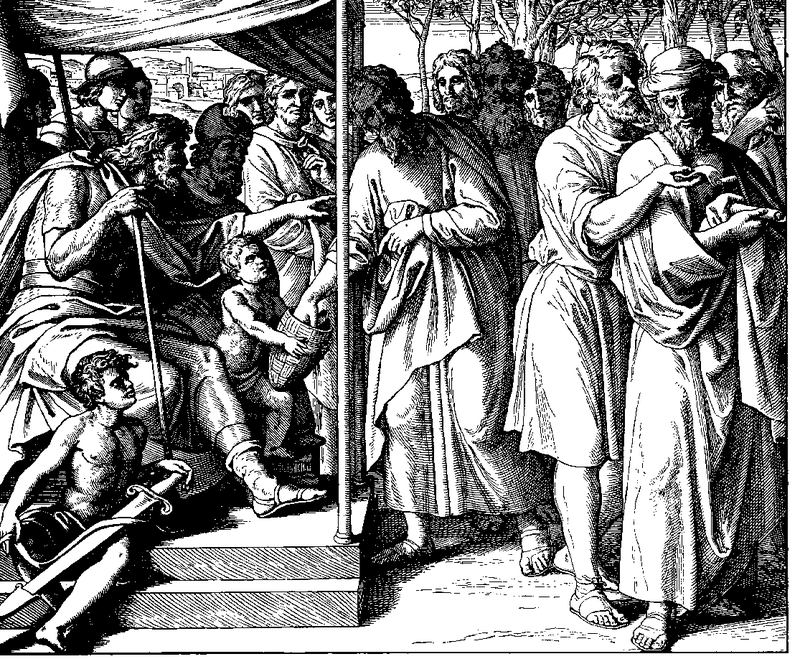
by Schnorr von Carolsfeld, Bibel in Bildern, 1860
  • When the high priest consults two items called the urim and tumim, kept in the inside pocket of his jeweled breast-piece, for yes-or-no answers to a king’s questions.2 Yet once when King Saul tried it, God refused to respond.3
  • When Joshua casts lots to find out how God wants the newly conquered lands of Canaan to be allocated among the tribes and their clans. He does not ask the high priest to check with God ahead of time, but simply orders men to travel and write descriptions of the geography, then casts lots on his own initiative as he stands next to the high priest at the entrance of God’s Tent of Meeting in Shiloh.4
  • When a priest conducts a magic ritual to reveal whether a wife has been unfaithful to her husband.

The ritual of the jealous husband is described in this week’s Torah portion, Naso (4:21-7:89). The passage begins by attributing the authorship of the ritual to God:

And God spoke to Moses, saying: “Speak to the Israelites and say to them: Any man, if his wife tisteh and breaks faith with him faithlessly— (Numbers 5:12)

tisteh (תִּשְׂטֶה) = she goes astray, she deviates from the right path. (A form of the verb satah, שָׂטָה = turn aside, go astray.5 The noun from the same root, sotah (שׂוֹטָה), refers to this passage in Numbers, to a Talmud tractate about it, and to the wife who is under suspicion.)

Breaking faith

The first condition for a priest to conduct the magic ritual is that a wife breaks faith with her husband. This does not necessarily mean she is sexually unfaithful. The Talmud tractate Sotah opens:

“With regard to one who issues a warning to his wife not to seclude herself with a particular man, so that if she does not heed his warning she will assume the status of a woman suspected by her husband of having been unfaithful [sotah]… However, if after he told her not to speak with so-and-so, she entered into a secluded place and remained with that man long enough to become defiled, i.e., sufficient time to engage in sexual intercourse, she is forbidden to her home from that moment until she undergoes the sotah rite.” (Talmud Bavli, Sotah 2a)6

According to the mores of the Ancient Israelites, if a husband gives his wife an order, she is obligated to obey. According the mores of the West today, she is under no obligation unless she explicitly agrees that she will comply with his order. (But perhaps she has a moral obligation to tell him her own views on the matter, so she is not guilty of dishonesty.)

Secrecy

—and a man lay down with her, a lying-down of seed, and it was hidden from her man’s eyes, and she kept it secret, and she made herself tamei, and there is no witness, and she was not caught— (Numbers 5:13)

 tamei = contaminated, ritually impure, unfit to enter God’s sanctuary, unfit for marriage.

This verse further defines the circumstances under which a priest should conduct the ritual for the sotah. It stipulates that the husband must suspect his wife of full intercourse including ejaculation with possible insemination (a lying-down of seed); that she has not confessed adultery to him (she kept it secret), and that nobody saw the guilty couple or caught them in the act.

Jealousy

—and a spirit of jealousy crossed over him, and he was jealous about his wife, and she has contaminated herself; or a spirit of jealousy crossed over him and he was jealous about his wife, but she has not contaminated herself—then the man shall bring his wife to the priest.” (Numbers 5:14-15)

What matters is the husband’s jealousy. The magic of the ritual will determine whether the wife is actually guilty of adultery.

The Torah portion does not offer a remedy if a woman is jealous and suspects her husband of adultery. But then, the Torah is providing laws for a patriarchal society. So married men are allowed to have sexual intercourse not only with their wives, but also with concubines, their female slaves, and prostitutes. But married women  are forbidden to have sexual intercourse with anyone but their husbands. If they are caught in the act, and the court does not rule that it was a rape, both the wife and her lover get the death penalty.7

Revealing the truth

The Torah portion Naso provides a remedy if the husband only suspects his wife of adultery, but has no proof.

The jealous husband brings his wife to a priest at the temple, along with a small offering. The priest mixes dust from the floor of the sanctuary into a bowl of water, thereby making it holy. Then he declares:

“May this water of bitterness come inside you, making your belly inflate and your yareikh fall.” And the woman must say: “Amen, amen!” (Numbers 5:22)

yareikh (יָרֵךְ) = thigh, loins, or a euphemism for genitals.

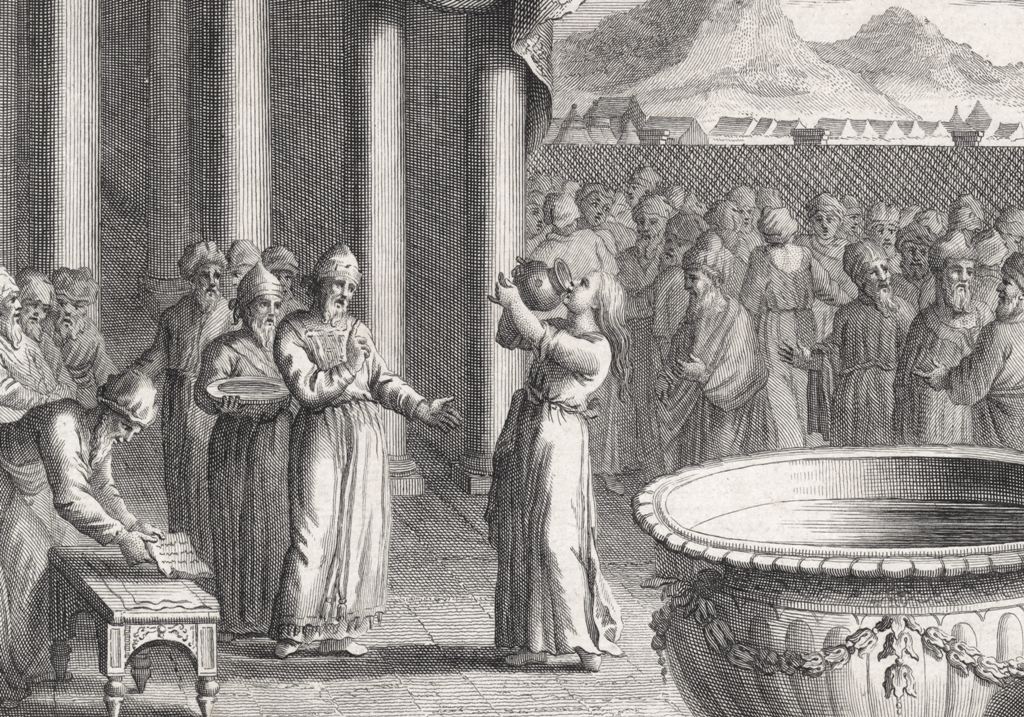
Sotah Ordeal, by Ephraim Moshe Lilien, 1908, detail

The woman’s “Amen, amen!” counts as an oath that she will accept God’s verdict as to her innocence or guilt. The priest writes it all on a scroll, then dissolves the ink from the scroll into the holy water. He makes the sotah drink this mixture. If she is guilty, she suffers the described symptoms—perhaps a miscarriage or worse. If she is innocent, she remains healthy and bears a legitimate child to her husband. (See my blog post Naso: Ordeal of Trust.)

According to the Torah, it is God who opens or closes a womb.8 God determines whether a woman conceives, and whether she miscarries or gives birth. The ritual of the sotah forces God to determine the fate of the woman’s womb according to whether she committed secret adultery.


Why does the Torah provide a magical ritual to make God reveal whether a wife committed adultery or not?

A husband who suspects his wife of adultery could, according to Torah law, simply divorce her without proving anything.9 Alternatively, he could decide that he wants to continue the marriage no matter what she did or did not do.

But the Torah portion Naso addresses the case of a jealous husband—someone who wants the marriage to continue, but cannot shrug off the thought that his wife might have cheated on him. If he believes in the solemn and impressive ritual at the temple (and if his wife does not have a miscarriage), his jealousy will disappear and he will welcome his wife with open arms.

His wife, on the other hand, will have to live with the knowledge that her husband did not trust her, either to remain sexually faithful or to tell him the truth. In ancient Israelite society, she would probably be willing to settle for the good fortune of retaining her status as a married woman, continuing to live with her own children, and enjoying her husband’s financial support.

In modern western society, she might prefer to divorce a man who did not trust her. And we have no ritual to make God indicate whether a wife, or a husband, has broken a promise to be sexually faithful. Nor do we have an easy way to prove that a spouse was honest, or that a spouse will no longer be suspicious and jealous.

How can two people be contented lifelong companions without mutual trust?


  1. Three kinds of diviners are denounced in Deuteronomy 18:10-11; see my post: Shoftim: Is Magic Abominable? Part 1.
  2. E.g. Numbers 27:21.
  3. 1 Samuel 28:6.
  4. Joshua 18:4-10, 19:51.
  5. The verb satah appears only six times in the entire Hebrew Bible: four times in this week’s Torah portion, and twice in the book of Proverbsa collection of advice from a father to a son. Proverbs 4:15 advises the son to “turn aside” from the path of the wicked. Proverbs 7:25 urges him not to “turn aside” from the right path toward the paths of prostitutes.
  6. William Davidson Talmud translation, from www.sefaria.org.
  7. Leviticus 20:10.
  8. E.g. Genesis 29:31, 30:22-23.
  9. Deuteronomy 24:1

Bemidbar & Naso: Why Cover the Altar?

Moses assembles the tent-sanctuary for God at Mount Sinai at the end of the book of Exodus. At the beginning of the book of Numbers, the people prepare to leave Mount Sinai and head to Canaan—with their portable tent-sanctuary, where God is present. So God gives instructions for dismantling, covering, and carrying all the pieces of the sanctuary in the first two Torah portions of the book of Numbers: last week’s portion, Bemidbar (Numbers 1:1-4:20), and this week’s portion, Naso (Numbers 4:21-7:89).

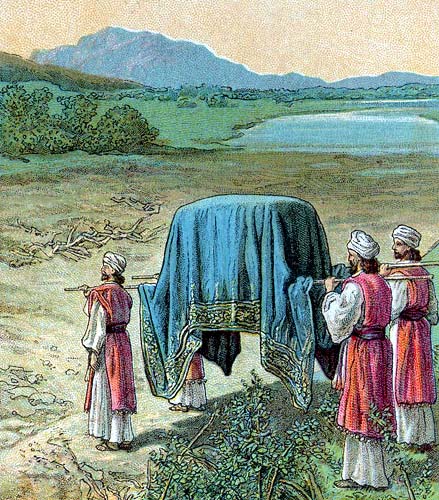
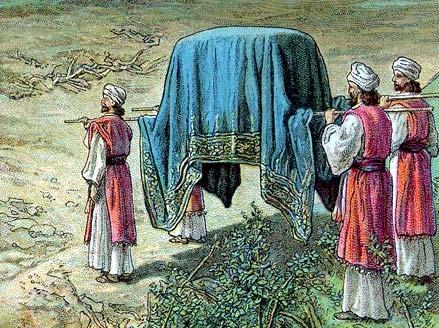
Kohatites carry the ark, detail from “Israel Enters the Land of Promise” Bible card, Providence Lithograph Co,, c. 1907

The priests must hide the holy objects inside the tent-sanctuary from view before the tent can be dismantled. Aaron and his two surviving sons must take down the curtain separating the Holy of Holies from the front chamber. They must cover the ark with the curtain, then add two more coverings. They also spread three coverings over the gold bread table, two over the gold lampstand, and two over the gold incense altar. The Levites are not allowed to touch, or even look at, these most sacred objects until they have been covered. Only they can they pick up the objects by their carrying poles and transport them to the next campsite.

The three priests must also cover the copper altar outside the tent.

And they must clean fatty ashes off the mizbeiach, and they must spread a cloth of red-violet wool over it. And they must place upon [the cloth] all the utensils with which they serve at it: the cinder pails, the meat-forks and the scrapers, and the sprinkling basins, all the utensils of the mizbeiach. And they must spread out over them a cover of tachash skin, and they must place its carrying poles. (Numbers 4:13-14)

mizbeiach (מִזְבֵּחַ) = altar for offerings. (From the root verb zavach, זָבַח = slaughter livestock, make a slaughter offering. Altars were built of stone in Genesis and the first part of Exodus. Then God asked the Israelites to make a copper altar to stand in front of the new tent-sanctuary.)

tachash (תַחַשׁ) = an animal that has not been conclusively identified. Its skin must be fairly waterproof, since it is used as the top layer of the tent-sanctuary roof as well as one of the coverings of all the sacred objects the Levites carry when the Israelites are traveling.

Levites carry the altar

The second Torah portion in Numbers, Naso, opens with a census of the Levite clan of Gershon, then assigns its men aged 30 to 50 the duty of carrying the mizbeiach, the outdoor copper altar, as well as the swaths of fabric and skin hanging in (and on) the wooden frameworks of the tent and the courtyard wall.

This is the service of the clans of the Gershunites, for serving and for carrying: They must carry the cloths of the mishkan, and along with the Tent of Meeting its [cloth] covering and the tachash covering that is over on top of it, and the curtain at the entrance of the Tent of Meeting, and the hangings [enclosing] the courtyard, and the curtain at the entrance—the gate of the courtyard that is around the mishkan and the mizbeiach; and their cords, and all the equipment for their service. (Naso 4:24-26)

mishkan (מִשְׁכָּן) = dwelling place. (Usually God’s dwelling place, i.e. the portable sanctuary. From the root verb shakkan, שָׁכַן = settle, dwell, stay.)

During the 39 years the Israelites travel through the wilderness from Mount Sinai to the Jordan River, the mishkan and the Tent of Meeting are synonymous.

This is the service of the clans of the Gershunites regarding the Tent of Meeting, and their custody is in the hand of Itamar, son of Aaron the High Priest. (Numbers 4:28)

This week’s Torah portion assigns the remaining transport duties to two other divisions of Levites. The Kohatites will transport the holy furnishings inside the tent: the ark, table, lampstand, and incense altar. And the Merarites will transport the disassembled wooden frames of the tent and the courtyard wall.

Covering up

When the Israelites are encamped and the sanctuary is in place, only the priests are allowed to enter the Tent of Meeting. Only they may see the sacred objects inside. The Levites assist the priests outside the tent, and guard it from lay intruders. So it makes sense that the priests must cover objects inside, and insert their carrying-poles, before turning them over to the Kohatites to carry. That way, Levites cannot glimpse the sacred objects even when they are breaking camp. (See my post Bemidbar: Don’t Look.)

The copper altar, from Treasures of the Bible, Northrop, 1894

But why must the priests also cover the mizbeiach before it is carried off? The copper altar stands outside the Tent of Meeting. Everyone who enters the courtyard can see it. People bring animal and grain offerings right up to the altar, and watch the priests burn their offerings on it. The mizbeiach hardly needs to be hidden from sight when the Israelites are traveling.

Symbolic colors

The key, according to 19th-century Rabbi Samson Raphael Hirsch, is that the copper altar is covered with cloth dyed red-violet. Three colors of wool are used in the cloths the Israelite women weave for the mishkan and its courtyard: twilight blue (techeilet, תְכֵלֶת), red-violet (argaman, אַרְגָּמָן), and scarlet (tola-at shani, תוֹלַעַת שָׁנִי).1 Hirsch wrote that scarlet represents the color of blood, and therefore life at the animal level. Red-violet represents life at the higher, human level. And blue, the color of the sky, represents the limits of our horizon, the divine.

The most holy object, the ark, is covered first with the curtain that normally screens off the back room of the mishkan, the Holy of Holies; in the book of Exodus, this curtain is embroidered using all three colors of wool yarn, as well as fine linen.2 Then comes a layer of tachash skin, and after that a layer of wool cloth dyed with techeilet—an expensive blue dye made from murex sea snails.3. The first coverings over the bread table, the lampstand, and the incense altar are also wool dyed with techeilet. This blue, Hirsch wrote, is “close to God in highest holiness.”4

The first cloth covering the bread table is blue, but then after its utensils are placed on it, it is covered with a second cloth, this one scarlet. Hirsch explained, “The means of existence and prosperity are granted by God’s ‘Countenance,’ but all these ensure only “shani” [scarlet], animal-bodily life.”5

The copper altar, where the animal offerings are burned, does not get a layer of blue cloth. It is unique in that its first covering is red-violet wool.

Argaman cloth

Hirsch explained: “Argaman [red-violet], on the other hand, the higher, human level of life, is not granted by God. Rather, man must attain this level himself by freely mastering his own desires; he must harness all his animal-bodily powers and subordinate them to God’s will. This is symbolized by the offering altar and by the offering procedures performed on it.”6 Following Hirsch’s line of thought, the copper altar might be covered with red-violet cloth in order to illustrate that the sacrificial service at the altar is a method of achieving the human level, the level of free choice, which is symbolized by the red-violet color.

Honor

It is possible that the author of the Torah portions Bemidbar and Naso (which scholars attribute to the same Priestly source as most of Leviticus) found meanings in the colors of the coverings. But I propose a less symbolic explanation.

I think the priests cover the gold objects from inside the mishkan not only to prevent the Levites from seeing them, but also in order to treat God’s sacred objects with honor and respect. I can imagine them ceremonial spreading the blue cloth over each item.

They do not cover the copper outside altar with techeilet blue, but they do use cloth dyed with the next highest-ranking color. Red-violet cloth (also made from murex shells and also expensive) was used for the robes of the Kings of Midian and the seat of King Solomon’s throne.7 Covering the mizbeach with this royal color gives it honor and status. Using tachash skin as the top covering would also honor the altar, since the same kind of skin covers the roof of the mishkan.

When the Israelites are encamped, the mizabeiach is used to burn up the fat parts of cattle, sheep, and goats—and sometimes the entire animal—in order to make smoke rise to the heavens for God’s pleasure. This religious act is feasible only because God provides enough abundance so that surplus (mostly male) animals can be slaughtered and offered up.

Since the copper altar is used to honor God and thank God for abundance, it deserves to be honored itself. When the Israelites break camp, the priests honor the altar by draping an expensive royal red-violet cloth over it. This ritual was not as grand as the coronation of a king. But at least it was a way for the priests to show respect for God and their religion.


  1. See my post Bemidbar: Covering the Sacred.
  2. Numbers 4:5 and Exodus 26:31, 36:35.
  3. Numbers 4:7-11.
  4. Rabbi Samson Raphael Hirsch, The Hirsch Chumash: Bemidbar, translated by Daniel Haberman, Feldheim Publishers, Jerusalem, p. 51.
  5. Ibid.
  6. Ibid.
  7. The kings of Midian appear in Judges 8:26. King Solomon’s throne is in Song of Songs 3:10.

Bemidbar & Naso: Dangerous Duty

Two dangers face the Israelites as they leave Mount Sinai in the book of Numbers/Bemidbar: the risk of attack by an enemy in the wilderness, and the risk of annihilation by God.

They have already experienced both dangers. On their way from Egypt to Sinai the Amalekites attacked them, and the Israelites beat them off with the help of God.1 When they stood at the foot of Mount Sinai to hear God speak, the earth quaked—and so did the Israelites.

Mount Vesuvius in Eruption, by Jacob More, 18th cent., detail

And all the people were seeing the thunder and the flashes and the sound of the ram’s horn, and the mountain was smoking; and the people saw and they quaked and drew back and stood at a distance. And they said to Moses: “You speak to us and we will listen; but don’t let God speak to us, or else we will die!” (Exodus 20:15-16)

The Jewish day of Shavuot commemorates the revelation at Sinai, when the Israelites were terrified and God uttered the “ten commandments”. This holiday always falls the same week as the Torah reading Bemidbar, the first portion in the book of Bemidbar.

This Torah portion begins with God telling Moses to take a census of the men in all the tribes except Levi.2 The purpose of this census is to learn how many troops can be mustered in the event of a battle after the Israelites leave Mount Sinai and resume their journey to Canaan.

Israelite service

Numbering of the Israelites, by Henri F.E. Philippoteaux, 19th cent.

And all the [male] Israelites were mustered from the houses of their forefathers, from the age of twenty years and up, all who were going out in the tzava in Israel. (Numbers 1:45)

tzava (צָבָא) = army, unit of warriors, army service.

The qualifying phrase “all who were going out in the tzava” implies that the census counted only men aged 20 and over who were able to march and wield weapons.

Then God spoke to Moses saying: “However, the tribe of Levi you shall not muster, and you must not make a head count of them among the Israelites.” (Numbers 1:48-49)

In the second Torah portion of Numbers, Naso, there is a census of the three Levite clans.

And Moses and Aaron and the chieftains of the community enrolled the sons of the Kehatites by their families and by the house of their father, from the age of thirty years and over, up to the age of fifty years, all who were entering the tzava for the service of the Tent of Meeting. (Numbers 4:34-35)

The censuses of the Geirshonite and Merarite clans also count men aged 30 to 50, and also add “all who were entering the tzava for the service of the Tent of Meeting”.3

Why does the Torah call the Levites an army?

Levite service

Before telling Moses to take a separate census for the tribe of Levi, God says:

“Assign the Levites over the Sanctuary of the Testimony and over all its equipment and over everything that belongs to it. They themselves shall carry the sanctuary and all its equipment, and they shall attend it, and they shall camp around the sanctuary. And when [it is time for] the sanctuary to pull out, the Levites shall take it down; and when [it is time for] the sanctuary to be pitched, the Levites shall erect it. And any unauthorized person who comes close must be put to death.” (Numbers 1:50-51)

Thus one of the duties of the Levites is to guard the tent-sanctuary and kill any unauthorized person who persists in coming too close to the tent, or even entering it.4 That is the military aspect of their service, but it is not the most dangerous.

“And the Israelites shall encamp, each man in his camp and each man at the banner for his troop. But the Levites shall encamp around the Sanctuary of the Testimony, and then there will be no fury against the community of Israelites; and the Levites shall guard the guardianship of the Sanctuary of the Testimony.” (Numbers 1:52-53)

Whose fury? When the Torah portions Bemidbar and Naso describe the duties of the Levites whenever the people break camp, it becomes clear that the fury would come from God.

First the priests (Aaron and his two surviving sons) must go inside the tent and wrap up the most holy items before anyone else can see them, and place them on carrying frames with poles. The holiest items are the ark, lampstand (menorah), the bread table, and the gold incense altar. The priests also wrap up the gold tools used for the rituals inside the tent.5

And Aaron and his sons shall finish covering the holy items and all the holy equipment when breaking camp, and after that the Kehatites shall come in to pick them up, so they do not touch the holy objects and die. These things in the Tent of Meeting are the burdens the Kehatites. (Numbers 4:15)

Each of the three clans in the tribe of Levi is responsible for carrying some part of the tent-sanctuary. The Kehatites must carry the most holy items, while the Geirshonites and Merarites carry the outside altar and the disassembled parts of the tent and the wall around it—cloth hangings, posts, planks, bars, pegs, sockets, and cords.

No touching

Certainly Betzaleil touched the holiest items when he hammered them out of gold in the book of Exodus.6 But later in the book of Numbers, God tells Aaron that the priests must not touch them, or they will be killed.7 Somehow the priests must light the menorah, lay bread on the table, and place coals and incense into the incense altar without touching their gold surfaces. And they must wrap these items in cloths without directly touching them.

Model of ark, Jerusalem

In the first book of Samuel the ark sits for twenty years in the house of Avinadav at Kiryat Ye-arim. His son Elazar is consecrated as an ad-hoc priest to look after it.8 Then King David decides to move it to his new capital in Jerusalem. The ark is lifted up onto a new cart, and two other sons of Avinadav, Uzah and Achyo (presumably younger replacements for Elazar) walk beside it. Partway to Jerusalem,  the oxen pulling cart stumble, and Uzah puts his hand on the ark to steady it.

And God’s anger flared up against Uzah, and God struck him down there … and he died there beside the ark of God. (2 Samuel 6:7)

Uzah’s impulse is good, but nevertheless a divine power zaps him the instant he touches the ark.

No looking

No one in the bible is harmed from carrying the ark by its two poles, but touching the ark itself is deadly. The ark takes a circuitous route to Kiryat Ye-arim in the first book of Samuel. After the Philistines capture the ark in battle they bring it to their town of Ashdod, but everyone there is stricken with a plague. They send it on to Gath, then to Ekron, each time with the same result. So they load the ark onto a cart pulled by two cows and send it back into Israelite territory. The cows stop in a field near the town of Beit Shemesh, where seventy curious Israelites look inside. God strikes down every one of them.9

Kehataties carrying ark on a bible card by Providence Lithograph Co., 1907

In the portion Bemidbar: Don’t Look, the priests cover all the holiest items not only to prevent the Kehatites from touching them, but also to prevent these Levites from seeing them, even from the outside.

And God spoke to Moses and to Aaron, saying: “Do not cause the staff of the families of the Kehatites to be cut down from among the Levites!  Do this for them, so they will live and not die: when they approach the Holy of Holies, Aaron and his sons shall come in and assign each individual man his service and his burden.  And they must not come inside [the tent] to look as the holy things are swallowed [by the wrappings], or they will die.”  (Numbers 4:17-20) 

I speculated that the Levites are not allowed a glimpse of the holiest items either because it might make them feel as powerful as the priests, or because it might make them treat the holy items (and therefore God) with insufficient reverence.

Transporting the wrapped-up holy things might be nerve-wracking for the Kehatites. They carry them by hand, not on carts. What if they stumble and drop something? What if one of the coverings slips off?

For the “armies” traveling north from Mount Sinai, guard duty is more dangerous than combat duty.


  1. Exodus 17:8-13.
  2. In the book of Genesis Jacob has twelve sons; Levi is his third son, and Joseph is his eleventh. In other books of the Torah eleven tribes are named after Jacob’s sons, but there is no tribe of Joseph; instead two tribes are named after Joseph’s two sons, Efrayim and Menashe. That makes thirteen tribes—but even in the Torah, the tradition is that there were twelve tribes of Israel. The solution in the first three portions of Numbers is that there are twelve tribes of Israel plus one tribe of Levi.
  3. Numbers 4:39, 4:43.
  4. See Numbers 25:6-8.
  5. Numbers 4:5-14. See my post Bemidbar: Covering the Sacred.
  6. Exodus 37:1-29.
  7. Numbers 18:3.
  8. 1 Samuel 6:21-7:2.
  9. 1 Samuel 6:10-20.

Naso, Lekh Lekha, & Vayeira: No Jealousy

Marriage as always been a strange institution.

The default marriage in the west today is an exclusive covenant between two people who care for one another and restrict their sexual activity to one another. This arrangement is feasible and rewarding for many couples, but not for everyone. So some people try polyamory or “open marriage”, some cheat on their covenant by secretly having sex with others, and some opt for divorce.

The default marriage in the Torah is a different kind of contract. A man with sufficient wealth can take multiple wives, concubines, and female slaves. Another option is to pay prostitutes.  A woman who is not a prostitute is expected to restrict her sexual activity to the man who owns her.  A girl or unmarried women is supposed to remain a virgin and live with her father until he either sells her as a slave,1 or accepts a bride-price for her.

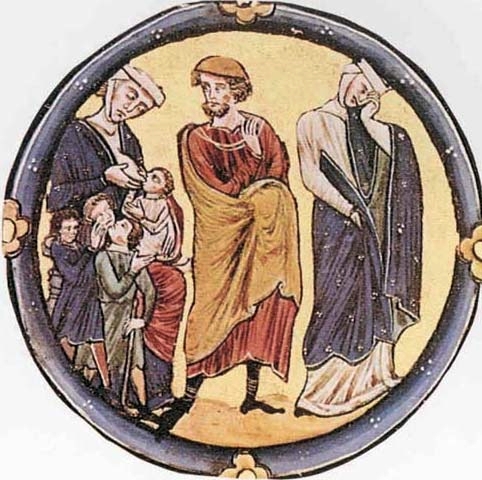
Elkanah and His Wives, from musicformass.blog

In this unequal kind of marriage, one wife might feel jealous of her husband’s other wife because she has some advantage: more children, or more affection from their husband. 2  But a wife does not complain that her husband is unfaithful to her when he takes another woman.

A husband, however, considers it a serious breach of contract if one of his wives has sex with another man.  In the Torah, if a married woman is witnessed committing adultery, both she and her lover get the death penalty.3  A man expects exclusive possession of any woman he purchases, as a wife or as a slave.  If he merely suspects his wife has been unfaithful, but there are no witnesses to prove it, he can divorce her; a man can divorce a wife for any reason.4

What if she has been in an apparently compromising position, but there are no witnesses, and he does not want to divorce her?  The question arises both in this week’s Torah portion, Naso (“Lift it”) in the book of Numbers, and in the book I am writing on moral psychology in the book of Genesis.

Naso in the book of Numbers/Bemidbar

A spirit of kinah passes over him and he is kinei of his wife and she defiled herself, or a spirit of kinah passes over him and he is kinei of his wife and she did not defile herself.  Then the man shall bring his wife to the priest, and he shall bring an offering over her, one-tenth of an eifah of barley flour.  He shall not pour oil over it and he shall not place frankincense on it, because it is a grain-offering of kena-ot, a grain-offering of an acknowledging reminder of a bad deed.   (Numbers/Bemidbar 5:14-15)

kinah (קִנְאָה) = jealousy, envy; passion, fury, zeal.5  (Plural: kena-ot, קְנָאֺת.  In all cases kinah is a powerful feeling that may overwhelm reason.)

kinei (קִנֵּא) = he is jealous, envious, zealous.

Ceremony of the Suspected Adulteress, by Matthijs Pool, 1686-1727

The priest pronounces a curse on the woman, asking God to inflict a particular physical calamity on her if she did lie down with a man other than her husband.  (Biblical scholars do not agree on the exact nature of the calamity, which involves her belly and her crotch; it may be a miscarriage.)  The woman must say “Amen, amen!”  The priest writes down the curse, then rubs the lettering off into water mixed with dirt from the floor of the sanctuary and makes the woman drink it then and there.

After this impressive ordeal, the verdict is up to God.

When he has made her drink the water, it happens: if she defiled herself and she was unfaithful with unfaithfulness to her man, then the water will enter her, inflicting a curse for bitterness, and her belly will swell and her crotch will fall, and the woman will become am object of cursing among her people.  But if the woman has not defiled herself and she is pure, she is cleared and she will bear seed.  (Numbers 5:27-28)

Her husband no longer has any reason for jealousy, and becomes able to trust his wife again.  The rest of the community also accepts that she is innocent.

Vayeira in the book of Genesis/Bereishit

In the book of Genesis, Abraham puts his wife, Sarah, in a compromising position twice by telling a king that she is his sister, accepting the king’s bride-price, and cheerfully sending her off to the king’s harem.  Is he incapable of jealousy?

On the first occasion, in the Torah portion Lekh-Lekha, Abraham, Sarah, and the rest of his household travel to Egypt to escape a famine.  Abraham asks his wife to lie when they reach the border of Egypt.

“Hey, please, I know that you are a woman of beautiful appearance.  And if the Egyptians see you and say, ‘This is his wife’, then they will kill me and let you live.  Say, please, you are my sister, so that it will be good for me because of you, and I will remain alive on account of you.”   (Genesis 12:11-13)

Abraham’s extraordinary request assumes that Egyptians abhor adultery, but have no qualms about killing a man in order to marry his wife.  The pharaoh himself makes Sarah his concubine and pays Abraham a lavish bride-price.  Then God afflicts the pharaoh and his household with a disease.  The pharaoh scolds Abraham and has him and Sarah escorted out of Egypt, but they get to keep the bride-price.

Avimelekh Returns Sarah to Abraham, by Elias van Nijmegen (1667-1755)

So Abraham tries it again with King Avimelekh of Gerar in the Torah portion Vayeira.  This time God speaks to the king in a dream after he has paid the bride-price and welcomed Sarah into his house.  God threatens to kill Avimelekh, who protests his innocence due to ignorance.

And God said to him in the dream: “Also I knew that you did this with a blameless heart, and I, even I, restrained you from erring against me.  Therefore I did not let you touch her.  And now, restore the man’s wife.  Since he is a prophet, he will pray for your benefit and life.”  (Genesis 20:6-7)

The early commentary assumes that the king of Gerar also executes husbands in order to marry their wives, so Abraham’s deception is once again justified.   Furthermore, since God calls Abraham a prophet, both the Talmud and Bereishit Rabbah conclude that Abraham knows ahead of time that God will protect Sarah.6   Therefore he is not guilty of pimping his wife.

I disagree.  After traveling toward Egypt for weeks, does Abraham suddenly remember the bizarre ethics of Egyptians?   It is more likely that he gets a brilliant idea for acquiring a lot more wealth in livestock and slaves—if his scam comes off.  That would also explain why he does not return the bride-price after the pharaoh discovers his scam.

He destroys his wife’s honor by putting her in a position where she, too, is exposed as a liar, and where she stays in Pharaoh’s harem long enough for her chastity to be in question.  He is careless about her reputation and does not even consider her self-esteem.

Years later, Abraham uses the same scam to swindle Avimelekh of Gerar—apparently for no reason except that he can get away with it and make a profit.  No sense of honor stops him, nor does any consideration for either his wife or the afflicted king.

Abraham is an amusing trickster, and nobody is killed on his account.   He happily prays for healing for Avimelekh—once he has received the king’s gifts.   But he fails to meet his moral obligations either to his wife or to the kings of the countries where he is a guest.

Abraham does, in effect, pimp his wife.  Why does he feel no jealousy?  If marrying the two kings were Sarah’s idea, then he might be granting her the freedom he enjoys as a man.  But Abraham, not Sarah, is the one who initiates the scam both times.

If he knows ahead of time that God will prevent both kings from touching Sarah, then he is spared from jealousy over his property, i.e. his wife.

Or perhaps Abraham does not really care what happens to Sarah.  The Torah says Isaac loves his wife, Rebecca,7 and Jacob loves one of his wives, Rachel,8 but it does not say Abraham loves any of the three women he has children with.9

There is more than one way to avoid jealousy in a marriage.

  1. In Exodus 21:7-11, sexual duties are part of the job description of a daughter sold as a slave.
  2. For example, in Genesis 29:31-30:24, Leah envies Rachel because their mutual husband, Jacob, loves Rachel more. Rachel envies Leah because Leah regularly bears Jacob children. In 1 Samuel 1:1-8, Hannah is jealous of her husband Elkanah’s other wife, Peninah, because Peninah has children.2
  3. Leviticus 20:10, Deuteronomy 22:22. The Talmud later added so many extra requirements for conviction of adultery that the death penalty was no longer practiced. A man is free to have sexual intercourse with an unbetrothed virgin as long as he then pays her father a bride-price and marries her (Deuteronomy 22:28).
  4. Deuteronomy 24:1.
  5. Kinah for God is usually translated as “zeal”, and kinah of one human over another human is usually translated as “jealousy”. God’s kinah regarding humans is often translated as “fury”, though Isaiah and Zecharaiah refer to God’s kinah meaning God’s zeal to ensure a good future for the Israelites (Isaiah 9:6, 11:11, 37:32; Zechariah 1:14, 8:2).
  6. Talmud Makkot 9b, Bereishit Rabbah.
  7. When God tells him to obey Sarah and send away Hagar and her son Ishmael, he is only troubled about Ishmael (Genesis 21:9-12).
  8. Genesis 24:67.
  9. Genesis 29:18.
  10. Sarah (Genesis 21:2), Hagar (Genesis 16:15), and Keturah (Genesis 25:1-2).

Naso: Raising a Blessing

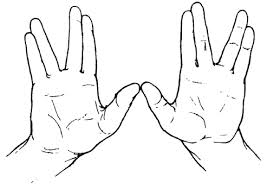
Hand position for Priestly Blessing

May God bless you and protect you!

May God shine the light of panav toward you and be compassionate to you!

May God yissa panav to you and grant you peace!  (Numbers/Bemidbar 6:24-26)

yissa (יִשָֹּא) = he will lift, raise; may he lift, raise.  (Imperfect form of the verb nasa = lift, raise.)

panav (פָּנָיו) = his face, his presence.

yissa panav = may he lift his face.  When God is the subject, this is an idiom meaning “May [God] be benevolent.”

This “Priestly Blessing” or “Threefold Blessing” is chanted at peak moments in Jewish services to this day.  (The first sentence has three words in Hebrew, the second has five words, and the third has seven words.  Chanting these lines out loud, with a pause or melodic phrase after each sentence, produces the effect of increasing blessing.)

The Threefold Blessing comes directly from this week’s Torah portion, Naso (“Lift up”).  The portion opens with God’s instructions to Moses for taking a census of the men between 30 and 50 in the Gershonite clan of the tribe of Levi and assigning them their duties.

Numbering of the Israelites, by Henri Felix Emmanuel Philippoteaux, 19th century

And God spoke to Moses, saying:  “Naso et rosh of the sons of Gershon also, by their ancestral houses and by their clans, from the age of 30 years up to the age of 50 years you will count them…  (Numbers 6:21-23)

naso (נָשֹא) = Lift!  Raise up!  (Imperative form of the verb nasa.)

rosh (רֺאשׁ) = head.

naso et rosh = Lift the head!  (An idiom meaning either “take a census” or “pardon”.)

You lift someone else’s head when you are taking a head count, or when you are pardoning that person.  You lift your own head, raising your face, when you acknowledge someone’s presence.  God lifts God’s face in order to face people with benevolence—like humans raising their heads to smile at someone.1

The idiom of lifting someone else’s head, which is used merely for counting at the start of the portion Naso, is later transformed into the idiom of lifting one’s own face, which God does to bless people with benign attention.

Initiating a blessing

The climax of this week’s Torah portion, in my opinion, is when God instructs Moses on the way the priests should bless the Israelites as a whole.

And God spoke to Moses, saying: “Speak to Aaron and to his sons, saying, ‘Thus you shall bless the Children of Israel.  Say to them: May God bless you and protect you!  May God shine the light of panav toward you and be compassionate to you!  May God yissa panav to you and grant you peace!’”  (Numbers 6:23-26)

After giving the three sentences of blessing, God concludes with this instruction:

Place my name upon the Children of Israel, and I myself will bless them. (Numbers 6:27)

In other words, the priests must recite the correct three-line formula in front of the people.  Then God, not the priests, will bless them.  God’s blessing is triggered not by the wishes of the priests, but by the words that the people hear, the three sentences that include the personal name of God.

If we imagine an external being called God, who bestows gifts like a good king or a loving parent, then the Threefold Blessing expresses what we want God to give us in the world. We want the universe, personified, to bless us with success; to protect us from harm; to shine with kindness toward us; to treat us with compassion; to give us benign attention; and to arrange for us to live in peace.

Traditional Jewish blessings, like the Threefold Blessing, follow the form “May God bless you with—”, perhaps because we know that even a parent blessing a child cannot actually make any of these good things happen.  Only God can do that—if God is a semi-anthropomorphic being who runs the universe.

Hearing a blessing

There is plenty of evidence that blessing in our universe does not work that way. Many people are hapless, damaged, confused, starved, or punished too harshly. That makes the Threefold Blessing either a fantasy, or a prayer that the whole universe will change.

But maybe there is a deeper truth in the instructions in this week’s Torah portion about how the priests can initiate God’s blessings.  Maybe something happens when the people who need blessing hear God’s name in the blessing formula.

The prophet Elijah learns that God is not in the wind, not in the earthquake, not in the fire, but in a soft murmur—a “still, small voice” in the King James translation.2  If we want to be blessed with a life in which God seems to be smiling at us and easing our way, then we must learn to hear the small voice of God inside us.

“May God bless you with—” is also a way to say “Listen for God and the blessing of—”.

May we all find a way to listen.

*

Last week, when other Jews were celebrating Shavuot and the giving of the Torah at Mount Sinai, I could only imitate the mountain, shaking uncontrollably.  This week, fortunately, I have a smaller set of (non-Covid) symptoms, less frightening than an earthquake, less painful than fire.  I continue to get medical tests and to hope for a fuller diagnosis and further improvement.  But I also notice that every time I lie down (which is often) I feel grateful for my life, for the bed underneath me, for my own thoughts, and for the soft murmur deep inside me that sometimes releases a word in a still, small voice.  God is blessing me.

  1. In a similar idiom, people’s faces “fall” (nafal, נָפַל) when they lower their heads in anger at whomever they are facing. When God does not welcome Cain’s offering, Cain became very hot with anger, and his face fell. (Genesis 4:5)  This idiom can also apply to God’s face.  God tells the prophet Jeremiah to say: Continue turning back [to me], declares God; I will not make my face fall at you, because I am kind, declares God.  (Jeremiah 3:12)
  2. 1 Kings 19:11-13.


Haftarat Naso—Judges: Spot the Angel

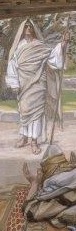
Abraham Sees an Angel, by James Tissot, detail

Would you recognize an angel if you saw one?

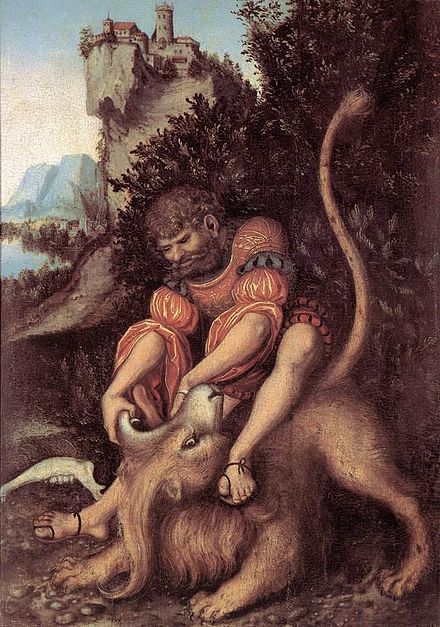
The haftarah reading1 accompanying this week’s Torah portion, Naso, introduces a childless couple from the tribe of Dan, Manoach and his unnamed wife, who will become the parents of Samson.

A malakh of God appeared to the ishah, and he said to her: “Hey, please! You are childless and you have not given birth, but you shall conceive and give birth to a son. (Judges 13:3)

malakh (מַלְאַךְ) = messenger, emissary. (Often translated as “angel” when it is a messenger of God.)

ishah (אִשָּׁה) = woman, wife.

Men in the Hebrew Bible sometimes send human messengers to one another. But a malakh of God is a temporary manifestation of the divine. It appears to a human being and delivers its message, then disappears again.  Frequently the malakh looks like a man at first, although it looks like a fire when Moses sees the burning bush ,2 and it is sometimes only a disembodied voice.3 (Angels with wings appear to Isaiah and Ezekiel, but they are called serafim or keruvim, and do not deliver messages from God.)

The malakh who appears to Manoach’s wife continues:

So now guard yourself, please, and don’t you drink wine or alcohol, and don’t you eat anything ritually impure.  Because here you are, pregnant, and you will give birth to a son.  And a razor must not go over his head, because the boy will be a nazir of God from the womb.  And he will begin to rescue Israel from the hand of the Philistines.” (Judges 13:4-5)

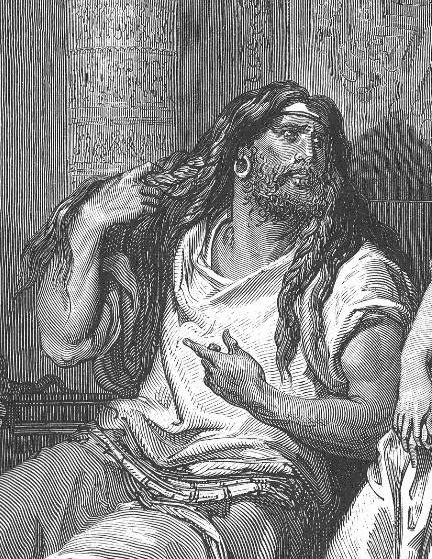
Samson and Delilah,
by Gustave Dore, detail

nazir (נָזִיר) = someone consecrated to God through abstaining from wine, haircuts, and mourning rites.  (From the root verb nazar, נזר = dedicate to a god; exercise abstention.)

Becoming a nazir is a choice, according to this week’s Torah portion.  Only an adult man or woman may make the vow to live as a nazir for a period of time.4  Yet in the haftarah, neither Samson nor his mother gets to choose whether or not to make a vow.

After the annunciation, the woman whose status has suddenly changed from childless to pregnant goes into the house.5

The ishah came in, and she said to her husband, saying: “A man of God came to me, and his appearance was like the appearance of a malakh of the God, very awesome.  And I did not ask him where he was from, and he did not tell me his name.”  (Judges 13:6)

The woman tells Manoach that the malakh looked like a man, but more awesome.  She knows this messenger came from God, and she knows enough not to ask the kind of personal questions you would ask a human traveler, such as where he came from or what his name is. She continues telling her husband what happened:

“And he said to me: “Here you are, pregnant!  And you will give birth to a son.  And you, don’t you drink wine or strong drink, and don’t you eat anything ritually impure, because the boy will be a nazir of God from the womb until the day he dies.”  (Judges 13:7)

It does not occur to Manoach that anyone else might have impregnated his wife, or that she might have actually seen an angel.  Furthermore, although she reports what the malakh told her to do while she is pregnant, Manoach does not take her word for it.

Then Manoach pleaded with God, and he said: “If you please, my lord, the man of the God whom you sent, please may he come again to us, and teach us what we should do for the boy who will be born.”  And the God heard the voice of Manoach.  And the malakh of the God again came to the ishah.”  (Judges 13:8-9)

The malakh of God does not appear to Manoach.  So his wife runs home and tells her husband what she just saw.

And Manoach got up and followed his ishah, and he came to the man and he said to him: “Are you the man who spoke to the ishah?”  And he said: “I am.”  (Judges 13:11)

Manoach does not refer to his wife by her name, or even as “my wife”, but merely calls her “the wife” or “the woman”.

I remember sexism in the United States in the early 1960’s, when it was common for men to refer to their spouses as “the wife” or “the little woman”.  It struck me as odd to hear my father refer to my mother that way when he was chatting with a fellow man.  The traditional male role in the 1960’s also included working outside the home, as it did in Canaan in the 11th century BCE. Yet in the story of Samson’s conception, the wife is usually outdoors, and the husband is inside the house.

Manoach asks the malakh of God what they should do about the boy.  The angel replies:

“From everything I said to the ishah, she must guard herself: she must not eat from anything that goes out from a grapevine, and she must not drink wine or strong drink, and she must not eat anything ritually impure.  Everything that I commanded her, she must observe.”  (Judges 13:13-14)

Manoach did not believe his wife, but now that he has confirmation from a strange man, he is satisfied.  However, he still does not believe his wife’s assessment that the man is really an angel.

And Manoach said to the malakh of God: “Let us detain [you], please, and we will prepare a goat-kid for you.”  But the malakh of God said to Manoach: “If you detain me, I cannot eat your food, and if you prepare a rising-offering, offer it up to God.”  Because Manoach did not know that he was a malakh of God.  (Judges 13:15)

Manoach still does not grasp the situation.  But he is eager to find some way to be polite to the man who has promised his wife a son.

Sacrifice of Manoah, by Eustache Le Sueur, 1640-1650

And Manoach said to the malakh of God: “Who—  Your name?  Because when your word comes [true], then we can honor you.”  And the messenger of God said to him: “Why do you ask for my name?  It is a mystery!”  (Judges 13:17-18)

Manoach prepares a goat-kid and a grain-offering for God, and lights a fire to roast them.

And the flame was climbing from upon the altar toward the heavens, and the malakh of God went up in a flame from the altar.  And Manoach and his wife saw, and they fell on their faces to the ground.  And the malakh of God did not appear again to Manoach or to his wife.  That was when Manoach knew that he was a malakh of God.  (Judges 13:20-21)


Why does it take so long for Manoach to realize the visitor was an angel, when his wife notices something numinous about the “man” right away?

Part of the reason must be for comic effect.  But I think Manoach’s inability to recognize what is in front of him is also related to his sexism.

The bible portrays society in ancient Israel realistically, so its laws assume that men own all the land, and women are dependent on their men: their fathers before marriage, their husbands during marriage, and their sons after they are widowed.  But the bible does not portray women as interchangeable or stupid or unworthy of being listened to.  (In Genesis 21:12, God even tells Abraham: “Everything that Sarah says to you, listen to her voice.”  And he obeys his wife.)

Maybe if a man cannot listen to his wife, he has trouble listening to a malakh of God.  Maybe if he cannot see his wife as a human being who might do something surprising, he cannot see someone who looks superficially like a man as someone who might really be an angel.  This applies not just to men, but to women and all humans who classify people into categories instead of being curious about them as individuals.

Would you recognize an angel if you saw one?


  1. Every week of the year is assigned its own Torah portion (from the first five books of the bible, the Torah) and its own haftarah (an accompanying reading from the Prophets). The haftarah for Naso is Judges 13:2-13:25.Exodus 3:2-3, which is also an example of how an angel’s voice becomes God’s voice.
  2. e. the angel who speaks to Abraham in Genesis 22:11-16.
  3. See my post Naso: Distanced by Hair.
  4. For arguments in favor of the angel doing the impregnating, see Marc Zvi Brettler, “Who Was Samson’s Real Father?”, thetorah.com.

Bemidbar & Naso: Four Directions of Service

East, south, west, and north.  The book of Numbers/Bemidbar (“In the wilderness of”) begins by organizing the Israelites before they set off from Mount Sinai.  The first Torah portion, also called Bemidbar, lays out where each tribe camps and what order the tribes march in when they travel.

The Israelites camp in two concentric rings around the portable sanctuary called the Tent of Meeting.  The outer ring is for the twelve tribes, excluding the Levites and counting Efrayim and Menasheh (named after Joseph’s sons) as two separate tribes. This outer ring is divided into four quadrants, with three tribes camping in each cardinal direction.  (See my post Bemidbar: Tribes in Four Directions.)

Next God says that the Levite men will be responsible for the sanctuary, and camp in a protective inner circle around it.1

When the Israelites break camp and set out, the three tribes camping to the east march first, then the three tribes to the south, then the Levites in the middle (carrying the disassembled pieces of the sanctuary), followed by the three tribes to the west, and finally the three tribes to the north.2

These camping and marching orders have little to do with where the tribes eventually settle in the “promised land”.  But the allocation of the Levites in the four quadrants of the inner ring may be related to double meanings of the Hebrew words for east, south, west, and north.

East

The eastern part of the inner ring is where the leaders of the people as a whole camp with their families:  the prophet Moses and the priests Aaron, Elazar, and Itamar.

Those camping in front of the sanctuary keidmah, in front of the Tent of Meeting mizrachah, [shall be] Moses and Aaron and his sons, watching over the duties of the holy place, as a duty to the Israelites.  (Numbers/Bemidbar 3:38)

keidmah (קֵדְמָה) = to the east.  From the root verb kadam (קָדַם) = came toward, went first, confronted, preceded.  Kedem, קֶדֶם = east, front, origin, ancient time.

mizrachah (מִזרָחָה) = to the east.  Mizrach, מִזְּרָח = east, sunrise.  (From the root verb zarach (זָרַח) = shone forth.)

(Entrance curtains shown in red)

The east is where the sun rises and God’s world began; it represents birth and the past.  The garden of Eden is in kedem, the east or the ancient past.3  The entrances into the holy courtyard, into the Tent of Meeting, and into the back chamber called the Holy of Holies, are all in their eastern walls, implying that the presence of God faces east.  Moses and the priests camp just outside the courtyard gate.  They must serve as the doorway between God and the people, passing on God’s words to the people and the people’s worship to God.

When the Israelites travel, everything in the sanctuary must be packed up and carried, from the gate of the courtyard to the ark in the Holy of Holies.  The priests do the most dangerous packing.

Aaron and his sons shall come in at the breaking of camp and take down the screening curtain and cover the ark of the testimony with it.  (Numbers 4:5)

The ark is the most sacred object; God speaks from the empty space above it.  It stands in the back chamber of the tent, the Holy of Holies.  No one may enter that small room except Moses and the high priest, and the high priest may enter only on Yom Kippur.  (See my post Acharey Mot & Shemini: So He Will Not Die.)  So how can all three priests go in and cover the ark?  Perhaps when they take down the curtain separating that inner chamber from the rest of the Tent of Meeting, the Holy of Holies ceases to exist.

The priests must cover the ark with three layers of wrappings, so no one can see it.  The priests must also cover the lampstand, the gold incense altar, the bread table, and the copper altar for animal and grain offerings, as well as all their utensils.4  (See my post Bemidbar: Covering the Sacred.)

Only after the sacred objects are wrapped in multiple layers and the priests have inserted their carrying-poles can the Levites come and carry them away.

South

The other three quadrants of the inner ring of the camp are assigned to the Levites, who are divided into three clans.  Each clan is descended from one of the original Levi’s three sons: Kehat, Geirshon, and Merari.  (Moses and Aaron are also grandsons of Kehat,5 but by this time they are not counted among the Levites.)

The families of the sons of Kehat shall camp along the side of the sanctuary teymanah.  (Numbers/Bemidbar 3:29)

teymanah (תֵּימָנָה) = to the south.  (From yamin = right hand, the hand of favor and power.)

When one faces east, the south is on one’s right.  The Kehatites serve as the right hand of the priests, trusted to carry the most sacred things.

And their duties [shall be] the ark and the table and the lampstand and the altars and the holy utensils that they keep in them, and the curtain [at the tent entrance], and all their service.  (Numbers 3:31)

Aaron and his sons shall finish covering the holy objects and all the holy utensils at the breaking of camp.  And after this the sons of Kehat shall come to carry them away; and they must not touch the holy items or they will die.  These are the burdens of the sons of Kehat regarding the Tent of Meeting.  (Numbers 4:15)

And they shall not enter to see the holy as it is swallowed up [by the coverings], or they will die.  (Numbers 4:20)

The items kept inside the Tent of Meeting are too dangerous for the Kehatites to touch or even see.  They can only lift them by their carrying poles after the priests have wrapped each one in cloth and leather.

West

The families of the Geirshonites shall camp behind the sanctuary, yamah. (Numbers 3:23)

yamah (יָמָּה) = to the west; toward the (Mediterranean) sea.  (Yam, יָם = sea.)

The west wall of the Tent of Meeting is the back, behind the ark in the Holy of Holies, at the opposite end from the entrance.  West is the direction of both the sea and the setting sun.  It represents the future, including death.  The Geirshonites camp behind the sanctuary, in the west, to protect it from any encroachment in the rear.

In this week’s Torah portion, Naso (“Lift”), the Geirshonites are assigned the duty of dismantling, carrying, and reassembling the fabric of the Tent of Meeting:  its roof coverings, its cloth walls, and the cloth walls of the open courtyard around it.

This is the service of the duties of the Geirshonites …  They shall carry the tent-cloths of [the walls of] the sanctuary and the roof-covering of the Tent of Meeting, and the leather covering that is above and over it, and the curtain at the entrance of the Tent of Meeting; and the fabric-walls of the courtyard and the curtain at the gate of the courtyard that surrounds the sanctuary and the altar; and their cords, and all their equipment …  (Numbers 4:24-26)

North

… Merari … along the side of the sanctuary tzafonah they shall camp.  (Numbers 3:35)

tzafonah צָפֺנָה)) = toward the north.  From tzafan, צָפַן = hid, stored up, treasured.

The sons of Merari … this is their duty of carrying, for all their service in the Tent of Meeting:  the planks of the sanctuary and its cross-pieces and its posts and its sockets; and the posts of the courtyard all around, and their sockets and their pegs and their cords, including all of their tools for all of their duty; and you shall assign, by name, the tools for their duty and their burden.  (Numbers 4:31-32)

In other words, the Merarites disassemble, carry, and reassemble the framework of the Tent of Meeting and of the courtyard wall.

Four Duties for Leaders

East

Out of all those who camp in the inner ring around the sanctuary, the priests have the most perilous duty; they must touch the holiest objects in order to wrap them for transport.  They are also responsible for what the Levites do.  Their place is in the east, toward the ancient time, the origin of humankind.

Today, if we take on religious leadership, we need to remember that some people look up to us, and look to us for guidance.  Whatever we model, as well as teach, will have a deep effect on other human beings.  This is indeed a perilous duty.

South

The Kohatites have the next most dangerous job, carrying the holy objects without touching or seeing them directly.  Their place is in the south, at the right hand of the priests.

Today, when we choose to follow a religious leader and serve at their right hand, we receive the gift of extra learning, and the honor of reflected greatness.  But we are also responsible for carrying and passing on the leader’s teachings in a way that continues their good work—and does not degenerate into the idol-worship of mere appearances.

West

The Geirshonites are responsible for roofs and walls.  Their place is to the west, toward the sea.

If we put up a psychological roof, how long can we operate in the mundane world without worrying about any inscrutable mysteries, anything that might be called God?  When will a change in our lives force us to break camp and take down the roof?

What if we put up an inner wall against something we do not want to face?  Like the wall of water that let the Israelites cross the Reed Sea and then crashed down on the Egyptian army, our psychological wall might crumble and drown us in reality.

If we hope to serve our communities, or the divine spirit inside us, we must be able to take down our own roofs and walls when we need to.

North

The Merarites are responsible for the supporting framework of the sanctuary.  Their place is to the north, the place of hidden treasure.

Knowledge and insight are among the treasures that are often hidden from us.  We cannot even fully know ourselves.  The only way to receive a hidden insight is to dismantle the structure of our beliefs, carry the pieces to a new place, wherever the divine pillar of cloud touches down.  Then we can erect a new framework of theories and supporting beliefs.


Sometimes we can follow leaders who have been able to reframe their lives.  Sometimes we must become those leaders.

 Whenever we have to rebuild our lives, we are called to do the work of the priests and Levites in all four directions.  First, like the Merarites, we must erect a new framework, a new set of ideas about life that will support us and allow us to uncover more hidden insights.  Next, like the Geirshonites, we must hang walls and drape roofs, separating our interior space from the exterior world—while recognizing that the barriers are fluid.  Then, like the Kehatites, we set down our most sacred convictions in their proper places, so they are no longer burdens.  And finally, like the priests, we unwrap what is holy, revealing the golden treasures of our souls just enough so we can influence the world for the good.

(An earlier version of this essay was published in July 2011.)


  1. The Levite men officially replace the first-born males of each tribe as the men who are dedicated to God in Numbers 3:40-45.
  2. Numbers 2:1-31.
  3. Genesis 2:8.
  4. Numbers 4:7-14.
  5. Exodus 6:16-26.
  6. According to Canaanite literature, Mount Tzafon north of Ugarit (in present-day Syria) was where the god Baal built his palace.  Psalm 48:3 equates Mt. Tzafon with Mt. Zion.


Naso: Distanced by Hair

A man suspects his wife of adultery, and takes her to the temple to test her with a magic ritual.

A man or woman takes a vow to live as a holy ascetic and avoid wine.

What do the instructions for the sotah1 (the wife suspected of adultery) have in common with the instructions for the nazir (the holy ascetic)—besides that they appear in the same Torah portion, Naso (“Lift it”)? One answer is:  unbound hair.

The ordeal to establish the guilt or innocence of a woman whose husband suspects her of adultery begins with the priest unbinding the woman’s hair.

And the priest shall make the woman stand before God, and para the head of the woman. Then he shall place upon her palms the grain-offering of the reminding: it is the grain-offering of jealousies. And the water of the bitterness of the cursings shall be in the hand of the priest. (Numbers/Bemidbar 5:18)

para (פָּרַע) = let loose, remove from restraint, let go wild and uncontrolled. (For a head of hair, para = unbind, unbraid.)

The ordeal turns on what happens when wife drinks the magic water in the priest’s hand. (See my post Naso: Ordeal of Trust.) But the first step is to unbind the suspected woman’s hair. The Torah does not say whether married women before the time of the Second Temple bound their hair in cloth, or merely put up their hair in braids or pins. Either way, a wife was probably shamed if her hair came down in public.2

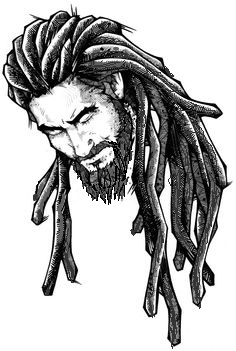
Loose hair marks the suspected wife as outside normal society, at least for the duration of the ordeal. In normal situations both men and women in the Torah restrain their hair in public. The only people who appear in public with unbound or uncovered hair are the mourner3, the metzora (someone afflicted with a certain disease) 4, the sotah, and the nazir.

Speak to the Children of Israel and say to them: Any man or woman who vows the extraordinary vow of a nazir, lehazir for God: From wine or alcohol yazir … (Numbers 6:2-3)

nazir (נָזִיר) = someone dedicated for a period of time to devotion to God through abstaining from the usual norms concerning wine, hair, and mourning. (Plural nezirim, נְזִרִים. From the root verb nazar, נזר = dedicate to a god, exercise abstention.)

lehazir (לְהַזִּיר) = to separate oneself through abstention; to live as a nazir. (From the root nazar.)

yazir (יַזִּיר) = he shall abstain. (From the root nazar.)

Nezerim must abstain not only from drinking any form of alcohol, but also from consuming any grape products. They must avoid all contact with any corpses—even if a family member dies. But even as they restrain themselves from drinking or mourning, they must let their hair grow unrestrained.

All the days of his vow of nizro, no blade shall pass over his head; until the fulfillment of the days that yazir to God, his big, pera head of hair will be holy to God.  (Numbers 6:5)

nizro (נִזְרוֹ) = his dedication to undertaking the abstentions of a nazir. (From the root nazar.)

pera (פֶּּרַע) = unbound, loose, unrestrained, wild and out of control. (From the verb para; see above.)

Nezirim choose to set themselves apart from normal society for a period of time, like ascetics in other cultures. (See my post Haftarat Naso—Judges: Restraining the Abstainer.) Israelite ascetics, unlike those in most cultures, do not leave their community or their family; but they do follow different rules regarding hair, wine, and corpses.

The unconventional hair of nezirim is a visible sign that they must be treated differently in society—perhaps with extra consideration for the thoughts that absorb them, as the Israelites in the Torah, and Jews today, treat people who are visibly mourning. Similarly, they are distanced from the rest of society by avoiding not only wine, but even grape juice (which might substitute for wine when their friends are drinking).  This social distance marks nezirim as holy, separated and dedicated to God.

When the period of their vow ends, nezirim shave their heads and put their hair on the altar fire, under the wholeness-offering, thus making their wild manes offerings to God.5

Israelite captives with tidy hair in Assyrian relief, 8th Century BCE

Hair is an indicator of a person’s relationship to the rest of society—in the Torah, and today. When I am getting ready to leave the house, I always “fix” my hair. Even today, an acceptable appearance in public includes hair that looks trimmed, combed, and arranged (sometimes in a carefully tousled style).  When someone appears in public with unkempt hair, it means that the person does not belong in normal society, for good reasons or bad.

In the Torah, the pera hair of mourners signals that their thoughts and feelings are so overwhelmed by the death in the family that they should not be expected to engage in normal social intercourse.

The pera hair of metzora-im signals that they are both ritually impure (and so excluded from communal worship) and socially impure (and so excluded from communal life).

The pera hair of the sotah (the wife suspected of adultery) is a sign of shame. Since she has behaved in a socially unacceptable way by being alone with a man other than her husband for even a short time, she is shamed even if it turns out she is not guilty of adultery. (There is no equivalent ordeal for a husband suspected of adultery, since in the Torah marital fidelity is not required of men.)

The pera hair of nezerim signals that their attention is on spiritual communion with God, rather than on social intercourse.

On the streets of my city, people whose hair is greasy and pera are often homeless and/or mentally ill.  Not wanting to be identified with these categories, I make sure my hair is clean and pulled back in a barrette when I go out.

But I have had times of mourning, and times when I am absorbed in questions about the meaning of my life and God.  At those times, when I go out in public for necessary errands, I wish I had a visible signal that would separate me from normal chatter and frivolity, while granting me the respect the Israelites granted to mourners and nezirim.

(An earlier version of this blog was published in May 2010.)

1  The noun sotah does not appear in the Hebrew Bible, though in this week’s Torah portion, Naso, the verb satah is used three times to describe an adulterous woman. (Numbers 5:19, 5:20, 5:29)  The passage concludes: This is the teaching of the kena-ot, when tisteh, a wife, from under her husband, and she becomes impure. (Numbers 5:29)

tisteh (תִּשְׁטֶה) = she goes aside, goes astray. (Satah (שָׁטָה) = he went aside, went astray.)

2  The Babylonian Talmud, Ketuvot 22a, states that when a woman goes out with an uncovered head, she transgresses Jewish practice, and cites Numbers 5:18 as a proof text.  19th-century rabbi S.R. Hirsch explained: “…the uncovering of the woman’s hair is intended to expose the woman as immodest. The head covering that hides the woman’s hair is an external symbol of her marital fidelity.” (Samson Raphael Hirsch, The Hirsch Chumash, Sefer Bemidbar, trans. by Daniel Haberman, Feldheim Publishers, Jerusalem, 2007, p. 83.)

3  Mourners in the Torah let their hair hang loose and tear their clothing.  In Leviticus/Vayikra 10:6 and 21:10, priests are instructed to refrain from mourning by not doing those two things.  It is still customary for Jews to make a small tear in a shirt or a symbolic ribbon at the funeral of a family member, and then refrain from cutting their hair or shaving their beards for 30 days.

4  A metzora is someone with the skin disease called tzara-at in the Torah. Until a priest declares them cured, metzora-im must be thoroughly segregated from the community, and therefore they must tear their clothing, para their hair, cover their upper lips, call out “Impure! Impure!” when they pass others, and live outside the town or camp. (Leviticus 13:45-46)

5  Numbers 6:18.  According to 19th-century rabbi S.R. Hirsch, this indicates that the purpose of living for a time as a nazir is self-improvement, so the nazir will rejoin society as a better member of the community—less vain, perhaps, or wiser because of the extra time for self-reflection. (Samson Raphael Hirsch, The Hirsch Chumash, Sefer Bemidbar, trans. by Daniel Haberman, Feldheim Publishers, Jerusalem, 2007, p. 116.)


Haftarat Naso—Judges: Restraining the Abstainer

Every week of the year has its own Torah portion (a reading from the first five books of the Bible) and its own haftarah (an accompanying reading from the books of the prophets). This week the Torah portion is Naso (Numbers 4:21-7:89) and the haftarah is Judges13:2-13:25.

Every religion has members who go beyond what is required of the whole community. In ancient Israel, there were priests, prophets, and nezirim.

drunk woman

And I raised up some of your sons for prophets

And some of your young men for nezirim.

Is there nothing in this, Children of Israel?

—declares God.

But you made the nezirim drink wine

And you ordered the prophets not to prophesy!  (Amos 2:11-12)

nezirim (נְזִרִים) = “nazirites”: men and women who are dedicated and separated from the rest of the community as holy because they abstain from grooming their hair and drinking alcohol. Nezirim is the plural of nazir (נָזִיר), from the root verb נזר = separate, dedicate, restrain, abstain.

Samson, whose story begins in this week’s haftarah, is a nazir from the womb to the grave, but he fails to make his life holy. Perhaps that is why this week’s Torah portion lays out strict rules and term limits for living as a nazir.

Although the book of Numbers/Bemidbar is set at an earlier time in history than Samson’s story in the book of Judges, modern scholars agree that Judges was written long before the Torah portion Naso in Numbers.  Judges is a collection of old stories of heroes from the 11th century B.C.E. and earlier, stories which were probably compiled and rewritten in the 8th century B.C.E. Large parts of the book of Numbers, however, including the instructions for the nazir, were written after the Babylonian exile of the 6th century B.C.E., when priests were writing religious instructions for the time of the second temple.

Samson’s story begins in this week’s haftarah when an angel appears to the wife of a Danite named Manoach and announces that she will give birth to a nazir.

A messenger of God appeared to the woman, and he said to her: Hey, please! You are childless and you have not given birth, but you shall conceive and give birth to a son. So now guard yourself, please, and don’t you drink wine or alcohol, and don’t you eat anything ritually impure.  Because you are about to conceive, and you will give birth to a son, and a razor will not go upon his head, because the boy will be a nazir of God from the womb.  And he will begin to rescue Israel from the hand of the Philistines. (Judges 13:3-5)

Samson's Fight with the Lion, by Lucas Cranach the Elder, 1525
Samson’s Fight with the Lion, by Lucas Cranach the Elder, 1525

Samson’s first act (after the haftarah’s opening scene) is to ask his parents to marry him to a Philistine woman he finds attractive. They protest feebly that he should marry one of his own people, but they follow him to the Philistine village of Timnah to arrange the marriage. Samson discovers his superhuman strength on the way, when “a strong spirit of God came over him” and he rips apart a lion with his bare hands. (Judges 14:6)  For the wedding a year later, Samson hosts a seven-day drinking-party where he makes a wager and ends up killing 30 strangers in order to pay his gambling debt with their clothing.

As Samson’s adventures continue, the only thing he abstains from is cutting his hair.  His main interests are sex, and inventing spectacular ways of killing people.  He only prays to God at the end of his life, when Delilah has shaved his head and her co-conspirators have blinded and imprisoned him.  Then Samson asks God to return his super-human strength so he can bring down the temple of Dagon and all the Philistines in it—not for the sake of Israel or God, but for his own personal vengeance.

Samson does succeed in killing thousands of Philistines, but he is hardly the holy man that Manoach and his wife expected when the angel said their son would be a nazir.

The book of Numbers makes it clear that a nazir along the lines of Samson is unacceptable. For one thing, this week’s Torah portion says nobody is allowed to be a nazir from birth; only an adult man or woman can vow to live as a nazir, and the person making the vow sets a finite period of time for his or her dedication.  The instructions begin:

If a man or a woman vows the extraordinary vow of a nazir, lehazir for God… (Numbers/Bemidbar 6:2)

lehazir (לְהַזִּיר) = to restrain oneself, to abstain.  (From the root נזר.)

After describing what a nazir must abstain from, the Torah portion continues:

And this is the teaching of the nazir: On the day completing the days of nizro, he shall be brought to the entrance of the Tent of Meeting. (Numbers/Bemidbar 6:13)

nizro (נִזְרוֹ) = his life as a nazir, the term of his vow dedicating him to separateness; his crown. (Also from the root נזר.).

At the Tent of Meeting the nazir makes offerings, shaves his or her head, and returns to ordinary life.  Thus all nezirim consciously dedicate themselves to restraint for a fixed period of time for the sake of God.

Their restraint consists of three kinds of abstention. The first category is alcohol and all grape products.

wine and grapes

From wine and other alcohol yazir; nor shall he drink wine vinegar or vinegar from other alcohol, nor any grape juice; nor shall he eat grapes, wet or dried.  All the days of nizro he must not eat anything that is made from grapevines, from seeds to skin.  (Numbers/Bemidbar 6:3-4)

yazir (יַזִּיר) = he will abstain.  (Also from the root נזר.)

Abstaining from alcohol would not only improve the nazir’s ability to focus on being holy to God, but would also emphasis the nazir’s separation from the rest of society.

nazir hair

The second thing nezirim must abstain from is cutting, binding, or even combing their hair.

All the days of the vow of nizro, no razor will pass over his head; until the fulfillment of the days that yazir, his big, unbound, bristling hair will be holy to God.  (Numbers 6:5)

In the Bible, the only other people who let their hair grow untrimmed and unbound are mourners. Mourners are expected to disregard the social norms while grief commands all of their attention. Nezirim must let their hair grow wild while God commands all of their attention.  (See my post Naso: Distanced by Hair.)

Old Man on his Deathbed, by Gustav Klimt

The third thing a nazir must avoid is contact with the dead. (See my post Emor: The God of Life.)

All the days of hazayro to God, he must not come upon a dead body. For his father or his mother, for his brother or his sister, he will not make himself ritually impure for them in their death, because the neizer of his god is on his head. All the days of nizro he is holy to God. (Numbers 6:6-8)

haziro (הַזִּירוֹ) = his time as a nazir(Also from the root נזר.)

neizer (נֵזֶר) = consecration; crown.  (Also from the root נזר.)

In the book of Numbers ordinary people who touch or come near a dead body are ritually impure for seven days; then a ritual sprinkling restores them to purity and they rejoin the religious community. But for a nazir, the rules are as strict as for the high priest, who must avoid all corpses, even those of his own parents. If a nazir touches or comes close to any corpse, the term of his or her vow ends prematurely. Then after seven days, the would-be nazir must shave his or her head, make offerings, and start all over again. Once again, nezerim must pay attention—and, perhaps, emulate the high priest.

According to these rules, parents cannot say an angel told them their child would be a lifelong nazir, or treat him as especially privileged.  No nezirim can expect God to give them superpowers from time to time.  Staying sober, they have no excuse for wild behavior like Samson’s at the end of his drinking-party.

And since nezirim must avoid being near dead bodies, they cannot kill people.  Although all of the people Samson killed were Philistines, none of them were actual soldiers engaged in war against Israelites. Impulsive murder was no longer acceptable by the time of the second temple.

*

I have known individuals who were overwhelmed by spiritual impulses that cannot be integrated into normal life in modern western society. We have roles for spiritual leaders and teachers, but few outlets for people who would have been prophets or nezirim in ancient Israel.

When prophets in the Bible are overcome by the spirit of God they can at least speak, turning the divine message into human language.  But nezirim have no words.  When Samson feels the divine spirit, he is filled with physical strength that he uses for killing.

In the book of Numbers, nezirim can still be identified by big, unbound, bristling hair, but they are also required to follow extra rules.  Perhaps these rules and abstentions satisfy the spiritual impulse of the nezirim enough so that when the spirit of God comes over them, they can rejoice in their self-discipline—as well as in their neizer, their visible crown of consecration.

I wonder if an equivalent discipline would work today to provide an outlet for those with the spirit of a nazir?