Korach: Face Down

Moses falls on his face three times in this week’s Torah portion, Korach—and each time, he does it on purpose.

The Torah portion begins with a Levite named Korach challenging his cousins Moses and Aaron. Standing with him are three rebels from the tribe of Reuben and 250 prestigious men (described first as chieftains, then as Levites for the rest of the story).

And they assembled against Moses and against Aaron, and they said to them: “You have too much! Because all the congregation, all of them, are holy, and God is in their midst. So why do you raise yourselves over the assembly of God?” Moses listened. Vayipol on his face. (Numbers/Bemidbar 16:3-4)

Vayipol (ו־יּפֺּל) = Then he fell (by accident or on purpose), then he threw himself down.

Why does Moses suddenly drop to the ground, face down?

Bowing all the way down

The Hebrew Bible refers to prostration in two ways: nofeil al panav (נֺפֵל עַל פָּנָיו, falling on one’s face) and mishtachaveh (מִשְׁתַּחֲוֶה, bowing low). Mishtachaveh could be to anything from a deep standing bow, to kneeling and putting one’s forehead to the floor, to stretching out full length. It is a formal and deliberate act in the Torah, signifying deference, obeisance, or worship. Extrabiblical sources confirm that mishtachaveh was required before kings and other persons of authority in ancient Egyptian and Persian courts. In the Bible, Joseph’s brothers bow down to Joseph when he is an Egyptian viceroy,1 and when Hamaan is the Persian viceroy all the king’s employees except Mordecai bow down to him.2

Falling down

Falling on one’s face, or throwing oneself down onto one’s face, is a more dramatic prostration. People fall on their faces 28 times in Hebrew Bible3:

—7 times before another person, as an expression of submission4,

—11 times before a manifestation of God, from being overcome with awe5, and

—9 times in order to initiate communication with God.6

Only Abraham, Joshua, Ezekiel (twice), and Moses (once by himself and four times with Aaron) are brave enough to initiate communication with God. They want God to speak to them directly and answer their question and/or tell them what to do next. To grab God’s attention, they have to do something more dramatic than a formal prostration.

The first time Moses falls on his face is in last week’s portion, Shelach-Lekha. The Israelites have been weeping all night in despair of taking over Canaan, and they decide to choose a new leader and go back to Egypt. In the morning,
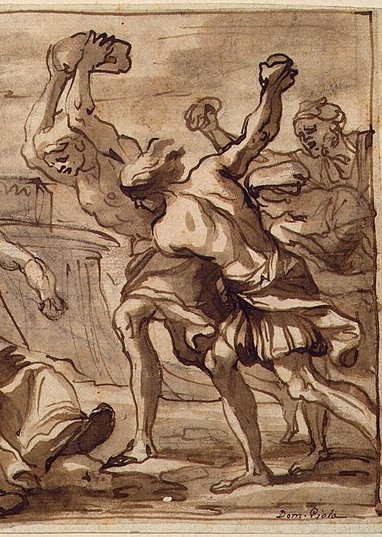
Stoning, from a sketch by Piola Domenico, 17th century

Vayipol, Moses and Aaron, on their faces in front of the whole assembly of the community of Israelites. (Numbers 14:5)

Some commentators7 propose that Moses and Aaron are prostrating themselves to the Israelites as a silent gesture pleading for them to change their minds. I cannot agree. Moses may be humble, but nowhere else in the bible does someone in authority bow down or fall on his face to someone under his own supervision. It is Joshua and Caleb who use a silent gesture to plead with the Israelites, tearing their clothes as mourners do. Then Joshua and Caleb try verbal persuasion, while Moses and Aaron remain silent. I believe Moses and Aaron fling themselves down and wait for God to respond. God finally manifests just in time to stop the Israelites from stoning Joshua and Caleb.

Attracting divine attention

Moses gets a faster response when he throws himself on his face at the opening of this week’s Torah portion. Although God’s words are not recorded, God apparently tells Moses what to do about Korach’s challenge, because Moses then tells Korach and his men there will be a divine test.

“Do this: Take for yourselves fire-pans, Korach and all his company. And you shall place embers in them, and put incense on them, in front of God tomorrow. And the man who, God chooses, he is the holy one.” (Numbers 16:6-7)

The next morning, when Korach and his 250 Levites arrive at the Tent of Meeting with their fire-pans and incense, God tells Moses and Aaron to stand at a safe distance while God annihilates the challengers. This time Moses and Aaron fall on their faces in order to get God to listen to them.

Vayiplu [Moses and Aaron] on their faces, and they said: “God, God of the spirits of all flesh, one man is guilty, and you rage against the whole community? (Numbers 16:22)

Vayiplu (וַיִּפְּלוּ) = and they fell, and they threw themselves down. (Another form of the verb nafal, נָפַל.)

The action suddenly shifts to where three ringleaders—the Ruevenites Datan and Aviram, and the Levite Korach—are standing defiantly at the entrances of their own tents. God instructs Moses to tell everyone to stand back from the three tents. Then God makes the earth swallow the tents, the three ringleaders, and their families.

In a thoroughly edited story8, the reader might now expect God to respond to Moses and Aaron’s plea by pardoning the 250 Levites who had stood with Korach. Instead, the action hops back to the story of the Levite rebellion:

And fire went out from God and it consumed the 250 men offering the incense. (Numbers 16:35)

The next day all the Israelites protest against Moses and Aaron, blaming them for the death of 253 people.

And God spoke to Moses, saying: “Get up away from the midst of this community, and I will consume them in an instant.”  Vayiplu on their faces.  Then Moses said to Aaron: “Take the incense pan and place fire on it from the altar, and put in incense, and go quickly to the community and atone for them, because the rage has gone out from before God.  The affliction has begun.”  (Numbers 17:9-11)

Instead of following God’s order and running away, Moses and Aaron throw themselves down on their faces. This time they catch God in the middle of slaughtering the Israelites with a fast-acting disease. But Moses finds out how to stop the epidemic, and Aaron’s incense does the trick. If they had not fallen on their faces, perhaps God would have wiped out everyone.

Moses and Aaron fall on their faces one more time, in next week’s Torah portion, Chukkat. The Israelites are complaining that there is no water to drink.

And Moses and Aaron moved from facing the assembly to the entrance of the Tent of Meeting, vayiplu on their faces, and the glory of God appeared. (Numbers 20:6)

They get God’s attention, and God gives Moses instructions for getting water from a rock.


Thus Moses throws himself down on his face both to ask God for instructions, and to persuade God to do something different.  Falling on his face gets God’s attention and indicates humility before God. But it also means dropping his own pride and external identity—losing face, in a way. This helps Moses to reopen communication with God.

Today worshipers in many religions use gestures of humility in prayer such as bowing or kneeling, and some even perform prostrations.  But these gestures fall short of the passionate abandon of flinging oneself face-down.

Would falling on our faces help us to get answers from God?

(An earlier version of this essay was published in June 2010.)


1  Genesis 42:6, 43:26, 43:28.

2  Esther 3:2.

3  There are also two occasions when an idol of the Philistine god Dagon falls on its face. The Philisties of Ashdod capture the ark of the God of Israel and put it in their temple of Dagon. For two mornings in a row, when they enter the temple, they discover: Hey! Dagon nofeil (נֺפֵל = is fallen) to his face to the ground before the ark of God! (1 Samuel 5:3, 5:4).

4  People fall on their faces to express submission to David in 1 Samuel 17:49 and 25:23; and 2 Samuel 9:6, 14:22, and 14:33.  The lesser prophet Ovadiah falls on his face before Elijah in surprise and obeisance in 1 Kings 18:7.  Ruth falls on her face before her benefactor Boaz in Ruth 2:10.

5  People fall on their faces before a manifestation of God as a vision (Ezekiel 1:28, 3:23, 43:3, and 44:4; Daniel 8:17; and 1 Chronicles 21:16), a supernatural fire (Leviticus 9:24, I Kings 18:39), or a man who turns out to be an angel of God (Joshua 5:14, Judges 13:20). In 2 Chronicles 20:18, the people throw themselves on their faces before God after someone utters an unexpected prophecy.

6  Abraham only falls on his face before God once; the result is that God speaks again and gives him further information (Genesis 17:3). Joshua and the elders of Israel fall face down in front of the ark in order to get God to speak to them (Joshua 7:10). Twice, in his visions, Ezekiel throws himself on his face before speaking to God (Ezekiel 9:8, 11:13). Moses alone or Moses and Aaron fall on their faces in order to receive a communication from God in Numbers 16:4, 16:22, 17:10, and 20:6; and, presumably, Numbers 14:5.

7  E.g. Robert Alter, The Five Books of Moses, W.W. Norton & Co., New York, 2004, p. 750, and Ramban (the acronym for 13th-century rabbi Moses ben Nachman, a.k.a. Nachmanides).

8  The text provides two different responses from God because this Torah portion combines two original stories: one about a rebellion by two or three leaders in the tribe of Reuben, and one about a challenge from Korach on behalf of all Levites, who take care of the Tent of Meeting but are excluded from serving as priests.


 

Haftarat Korach—1 Samuel: The Man Who Would Not Be King

Every week of the year has its own Torah portion (a reading from the first five books of the Bible) and its own haftarah (an accompanying reading from the books of the prophets). This week the Torah portion is Korach (Numbers 16:1-18:32) and the haftarah is 1 Samuel 11:14-12:22.

The prophet Samuel feels insulted when the independent tribes of Israel ask him to appoint a king. God is the true ruler of the twelve tribes, he says. Samuel both interecedes with God, and serves as a circuit judge, deciding case law for the people.  What more do they need?

prophet 3

All the elders of Israel assembled themselves and came to Samuel at the Ramah. And they said to him: Hey! You have grown old and your sons have not walked in your ways. So now set up for us a king to judge us, like all the nations. (1 Samuel 8:4-5)

Samuel warns them that kings impoverish and enslave their subjects, and do not listen when their people cry out to them.

But the people refused to listen to the voice of Samuel, and they said: No! Because with a king over us, we, even we, will be like all the nations.  And our king will judge our disputes, and he will go out before us and fight our wars. (1 Samuel 8:19-20)

In other words, what the tribes are really looking for is not a judge, but a permanent war leader. They are tired of being picked on by the neighboring Philistines, Amorites, and Ammonites; they want to do their own conquering and nation-building.

Samuel tells God, and God promises to send a king to Samuel.  In this week’s haftarah he tells the assembled Israelites:

And now, here is the king who you have chosen, who she-eltem, and here—God has placed over you a king. (1 Samuel 12:13)

she-eltem (שְׁאֶלְתֶּם) = you asked for.  From the root verb sha-al (שָׁאַל) = ask.

The name of the first king of Israel is Saul, or in Hebrew, Shaul (שָׁאוּל) = asked.

How does Saul, a Benjaminite whose only outstanding trait is his height, come to be king?  The first book of Samuel gives us three different stories.

Donkey

In the first story, Saul is looking for his father’s lost donkeys.  He and his servant wander far from their home in Giveah.

They were just coming to the land of Tzuf when Saul said to his boy who was with him: Hey, let’s go turn back, or my father will stop worrying about the donkeys and worry about us. (1 Samuel 9:5)

tzuf (צוּף) = (noun) honeycomb dripping with honey; (verb) flooded, flowed over.

The servant talks Saul into entering the nearest town and paying the local seer to tell them where the donkeys are. The town is Ramah, and the seer is Samuel, who drags Saul to the hilltop shrine for a feast.

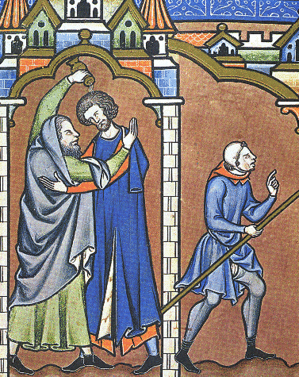
Samuel Anointing Saul

In the morning Samuel pours oil on Saul’s head and tells him God is anointing him king. On his way home Saul falls in with a band of ecstatic prophets and speaks in ecstasy.  But when he returns to his father’s house he tells nobody about his anointment.

In the land of Tzuf everything is overflowing: the food at the feast, the oil of anointment, and the ecstatic spirit of God.

In the second story,

Samuel summoned the people to God at the mitzpah. (1 Samuel 10:17)

mitzpah (מִצְפָּה) = watchtower, lookout post.

When all the important Israelite men have arrived, Samuel casts lots before God three times to find out who the king will be.  The lottery chooses first the tribe of Benjamin, then out of that tribe the clan of Matar, then out of that clan Saul. But nobody can find Saul.

Then God said: Hey!  He has hidden himself in the baggage!  So they ran and took him from there, and he stood himself up among the people, and he was head and shoulders taller than all the people.  And Samuel said to all the people: Do you see the one whom God chose?  For there is none like him among all the people! (1 Samuel 10:22-24)

Saul’s strategy of hiding does not work; even if the people cannot see him from the mitzpah, God can.  Saul is proclaimed king despite himself.

This week’s haftarah gives us a third and more serious installation of Saul as king.

And Samuel said to the people: Come and let us go to the gilgal, and we will renew the kingship there. So they all the people went to the gilgal and they made Saul king there before God, at the gilgal. And they slaughtered their wholeness-offering before God there, and Saul and all the men of Israel with him rejoiced there very much. (1 Samuel 11:14-15)

gilgal (גִּלְגָּל) = (probably) a stone circle. Related to the words gal (גַּל) = heap of stones, goleil (גֹּלֵל) = rolling, galgal (גַּלְגַּל) = wheel, and gulgolet (גֻּלְגֹּלֶת) = skull, head, headcount.

There is more than one gilgal mentioned in the Bible, but the most important one is probably the gilgal next to the city-state of Jericho. It is already standing when Joshua leads the Israelites into Canaan, and its circle of stones was probably used by an earlier religion. Joshua uses it as a sacred site for circumcising all the Israelite men and celebrating the first Passover in Canaan.  Then it becomes his headquarters for most of the book of Joshua.

The gilgal near the ruins of Jericho later becomes one of the four stops on Samuel’s circuit as a judge (along with the mitzpah, Beit-El, and Ramah in Tzuph).  Then it is the place where Saul is installed as king, and finally the site of King Saul’s main altar.

Why does it take two false starts, in the land of Tzuf and at the mitzpah, before Saul accepts his kingship at the gilgal?

When the redactor of the books of Samuel recorded three extant stories about Saul’s appointment, he put them in the most telling order.  First Saul is blessed with kingship as a gift of tzuf, an overflowing bounty of both oil and an ecstatic experience—but these are gifts he does not want, so he pretends he never received them. Next Saul is chosen by lot at a mitzpah, a lookout post—where he does not want to be seen.  He manages to hide even from everyone except God, even though he is a head taller than the other men.

Finally Samuel summons the reluctant king to the gilgal, the ancient circle of stones where Joshua made his headquarters. Here Saul succumbs to history and takes his place in the line of rulers of the Israelites, after Moses and Joshua.

Some people seize opportunities to become leaders, pushing forward eagerly in their conviction or ambition.  Others are like Saul, shy of fame and happy to lead ordinary lives.  But the first book of Samuel shows that when you are called, denial is useless.  Eventually you will have to answer God and take your place in the middle of the circle.

In your own life, do you step into a new responsibility even when it may not be your calling?  Or do you resist the call to take on an important job that you don’t really want?

Korach: Buried Alive

by Melissa Carpenter, maggidah

Two rebellions against authority are interwoven in this week’s Torah portion, Korach. Korach and 250 Levites demand the status and perquisites of the priests, Aaron and his sons. Meanwhile Datan and Aviram, chieftains in the tribe of Reuben, claim that Moses has mismanaged the leadership of the Israelites and they should take over.

And Moses summoned Datan and Aviram, sons of Eliav. But they said: “No, we will not come up! Is it so little that you brought us up from a land flowing with milk and honey to cause our death in the wilderness, that you also lord it over us?” (Numbers/Bemidbar 16:12-13)

They do not mention that God decreed they must spend 40 years in the wilderness because all the men of Israel except Moses, Aaron, Caleb, and Joshua refused to cross the border into Canaan.  (See last week’s post, Shelach-Lekha: Mutual Distrust.)

After both sets of rebels have complained about the leadership of Aaron and Moses, God threatens to annihilate the whole community. But Moses and Aaron prostrate themselves and address God, saying:

“God, God of the breath of all flesh! Is it one man is guilty, and you are furious with the whole community?” (Numbers 16:22)

Then God decides to annihilate the three ringleaders of the rebellion, but spare everyone who stands back from them.

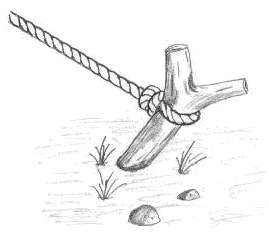
tent peg

Then Moses got up and went to Datan and Aviram, and the elders of Israel went after him. And he spoke to the assembly, saying: “Please move away from the tents of these wicked men, and do not touch anything that is theirs, lest you are swept away with their offense!” So they went up away from around the dwelling-place of Korach, Datan, and Aviram. But Datan and Aviram went out and were standing at the entrance of their tents, and their wives and their children and their little ones. (Numbers16:25-27)

Datan and Aviram can hear Moses’ warning, so they have an opportunity to send their own families out of harm’s way, but they do not. And in the patriarchal society of the ancient Israelites, it is rare for women or children to act on their own.

Do the two rebels believe that God will not “sweep them away” for their offense? After more than two years of miracles demonstrating cooperation between God and Moses, do they think God will let them—and their families—live?

If so, Moses is determined to prove once and for all that he is only serving God, not grabbing power on his own initiative.

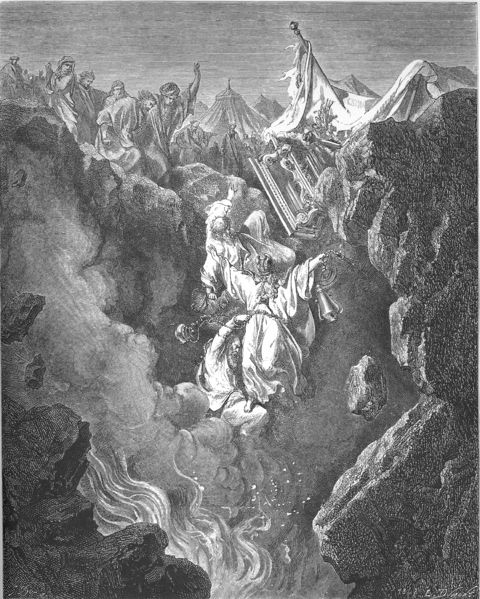
The Death of Korach, Datan, and Abiram, by Gustave Dore

And Moses said: Through this you will know that God sent me to do all these deeds, that they did not [come] from my own mind. If these die like every human dies, and if the fate of every human is their fate, God did not send me. But if Hashem creates a [new] creation, and the ground opens up her mouth and swallows them and all that is theirs, and they go down alive to Sheol, then you will know that these men did not respect God. (Numbers 16:28-30)

Sheol (שְׁאוֹל) = the underworld of the dead; a lightless, silent place where the  spirits of the dead lie in graves—as their bodies lie in graves closer to the surface of the earth. (The etymology of Sheol is uncertain, but the word may come from the root verb sha-al, שׁאל = inquired, asked for, asked about.)

In the Hebrew Bible, all the dead “go down” to Sheolafter they die.  The “new creation” Moses promises is that Datan, Aviram, and “all that is theirs” will go down to Sheol while they are still alive.

And it happened, as he finished speaking all these words: the ground that was underneath them split. And the earth opened her mouth, and she swallowed them and their households … And they went down, they and all that was theirs, alive to Sheol, and the earth covered over them, and they were carried off from the midst of the congregation.  And all Israel that was around them fled at their noise, for they said: Lest the earth swallow us! (Numbers 16:31-34)

It sounds as if the families of Datan and Aviram go down screaming.

What happens to them after the earth swallows them? The Torah is silent. But the other 61 references to Sheol in the Bible make it clear that no one lives there.  It is the abode of all the dead, and only the dead. When the two families in this week’s Torah portion are buried alive, they suffocate and die.  Their corpses remain deep underground, and the spirits that had animated their bodies “sleep” forever in Sheol.

The Bible has no concept of an immortal soul that reunites with God after death.  Later Jewish writings use the Hebrew word neshamah  for such a soul, but in the Bible neshamah means only “breath” or “breathing person”. What goes to Sheol in the Bible, particularly in the Psalms, is the nefesh.

What man alive will never see death,            will save his nefesh from the grip of Sheol? (Psalm 89:49)

nefesh (נֶפֶשׁ) = the “soul” that animates the body; throat, appetite, personality, individual, an individual’s life.

A nefesh in Sheol retains the identity of the formerly living person, but it does not speak, experience feelings, or do anything except perhaps sleep. Unlike the Egyptian ka, which can eat, drink, and be waited on in the tomb after death, the Israelite nefesh simply lies or sleeps in Sheol. The best a man can hope for in Biblical eschatology is to die peacefully, so he can lie among his ancestors.

Jews did not develop any theory of an afterlife until the second century B.C.E.  The book of Daniel, written around 165 B.C.E., never mentions Sheol, but it does predict the bodily resurrection of the dead at the end of the world as we know it. The idea that an individual’s soul survives the death of the body and has its own experiences crept into Jewish writings in the first century C.E.  In the Talmud this independent, conscious soul might be punished for misdeeds after death in a hellish place called Gehenna.

But neither hell nor conscious souls exist in the book of Numbers. Datan and Aviram know they are risking immediate death without a conscious afterlife. And they know they are risking the same oblivion for their wives, children, and infants, who will receive no heavenly reward after death.

The last thing that they experience is the terror of being swallowed by the earth.  They go down alive to Sheol, and then their corpses, as well as their personalities, lie there inert, forever.

Datan and Aviram are stupid to dispute Moses’ leadership and his status as God’s favorite servant. But I think their real crime is ignoring the next generation, including their own children. By modern standards, these two men are so self-absorbed they view their wives and children as mere possessions, part of “all that is theirs”—as if these human beings who depend on them are already inanimate, silent, dead.


How many of us today are so caught up in the drama of our own lives that we ignore everyone else? That we find no comfort in the thought that our children, our students, the next generation, might lead good lives after we have died?

May we all learn to live as if there is no afterlife, as if our deeds in this world really matter, and as if the life of every other human being really matters.

Korach: Early and Late Bloomers

When people do the wrong thing in the Torah, God gets angry and kills a lot of them. This happens over and over again in the books of Exodus and Numbers. We see the same pattern today when parents (standing in for God) overreact to children’s mistakes and lash out at them. And it happens when individuals do something they regret and then cut themselves down.

Does this approach lead to reform and improvement? Rarely. Does the Torah offer a better approach?

In this week’s Torah portion, Korach (“bald”), a Levite named Korach, his 250 followers, and two leaders from the tribe of Reuben, all rebel at once. Their common goal is to depose the leader Moses and high priest Aaron, and take over their jobs. The God-character in the Torah takes this rebellion personally, since God chose Moses and Aaron.  Rebelling against their God-given authority is tantamount to rebelling against God.

First God responds the usual way, with overkill. The ground opens and swallows not only the two Reubenites and Korach, but also everyone in their families who did not run away. Fire pours out from God’s sanctuary and kills Korach’s 250 followers who wanted to be priests. The next day, the Israelites blame Moses and Aaron for all the deaths, and God sends with a plague that kills 14,700 more people. (See my earlier post, Korach: Saying No, Saying Yes.)

At this point, everyone even slightly involved in the attempted coup has suffered one of three kinds of horrible deaths.  The surviving Israelites become meek and passive for a while, but fear rarely motivates inner change. Later in the book of Numbers/Bemidbar, a number of Israelite men disobey God again, by worshiping Ba-al Pe-or.

However, the Torah portion Korach also provides a counter-example. After all the killing, the God character responds to the attempted coup with a more positive teaching.

God tells Moses to take a staff  from the chieftain of each of the twelve tribes of Israel.

You shall carve each man’s name upon his matteh. And you shall carve the name of Aaron upon the matteh of Levi, because there is one matteh for the head of each forefather’s house. Then lay them in the Tent of Meeting before ha-eidut, where I meet with you. And it will happen that the man whom I choose, his matteh will blossom. (Numbers/Bemidbar 17:16-20)

matteh (מַטֶּה) (plural mattot) = staff, branch, tribe.

ha-eidut (הָעֵדוּת) = the “testimony” of God inside the ark. (Either the stone tablets God inscribed on Mount Sinai, or a parchment scroll on which Moses wrote down the first part of the Torah, or both.)

The ark with the testimony of God resides inside the Holy of Holies, the innermost chamber of the Tent of Meeting. God manifests in the empty space above the ark—as a voice for Moses, and as the source of the fiery glory that the Israelites see emanating from the sanctuary tent. Any miracles happening in the Holy of Holies would be a direct expression of God’s will.

The next day, when Moses came into the Tent of the Testimony, hey!—the matteh of Aaron, for the house of Levi, had blossomed. It brought forth blossoms, and it sprouted sprouts, and it ripened shekeidim. Then Moses brought out all the mattot from in front of God, to all the Children of Israel. And they saw, and each man took his staff. (Numbers 17:22-24)

shekeidim (שְׁקֵדִים) = almonds. (The root verb, shakad, means vigilant, alert, attentive.)

Almond Tree
Almond Tree

Now there is no question that God chooses Aaron as the high priest, and the tribe of Levi to conduct the religious service at the sanctuary.

The almond flowers and fruits also carry extra symbolism. The gold menorah (lampstand) inside the sanctuary is designed so that its seven branches and various decorative elements look an almond tree, complete with flowers and drupes (fruits containing almonds in their pits). (See my earlier post, Terumah: Waking Up.)  Lamps are symbols of enlightenment. Almond trees are the first to bloom, are called attentive and alert. Thus the tribe of Levi, and especially Aaron and his fellow priests, will be the first and the most vigilant servants of God.

What the other tribal leaders do not notice at the time is that their tribes have also been consecrated for service. The matteh that is both Aaron’s staff and the tribe of Levi becomes an early-blooming tree.  The implication is that the other eleven staffs/tribes could bloom later. They, too, have spent the night in the Holy of Holies, in front of the ark.  They, too, are confirmed as important to God. And when the 40 years in the wilderness end, and the Israelites cross the Jordan into Canaan, every tribe does its job and obeys God’s orders—as transmitted by Joshua, from the tribe of Efrayim.

Alas, in this week’s Torah portion the Israelites overlook the positive symbolism of the twelve staffs. Right after viewing the staffs, they wail: We perish, we are lost, all of us are lost. Everyone who comes close, who comes close to the sanctuary of God dies. Will we ever be done with perishing? (Numbers 17:27-28)

Maybe they are too traumatized by all of God’s death sentences to notice a gentler message. But we can be more alert. What if parents who feel frustrated by their children’s mistakes consider them late bloomers?  Instead of cutting them down, these parents might correct the children firmly but gently, and take care to nourish them until they finally bud.

What if when we get upset at our own mistakes, we remind ourselves that we are late bloomers? It is frustrating to be a bare branch—or staff—when we want to be full of flowers and fruit. But as long as we are alive and growing, we can learn better behavior. And we can learn to serve the divine with our own souls, in our own way.

May all late-bloomers be so blessed.