Beha-alotkha: Cold Feet, Dry Throat

The Israelites followed Moses out of Egypt in an adrenaline rush. After years of being treated as sub-human disposable labor by the pharaoh and most Egyptians, they were free! Their Egyptian neighbors gave them gold, silver, jewels, clothes, swords—anything to make them leave so the plagues would end.1 Moses told his followers that God would give them the whole land of Canaan as their own country.2 They did not wonder what would happen to Canaan’s current inhabitants. All they had to do was follow God and God’s prophet, Moses, to happiness and glory.

An adrenaline rush does not last. Anxiety plagued the people along the way, because everything depended on God’s help. They panicked when God delayed in rescuing them from the Egyptian chariots at the Reed Sea,3 and they panicked whenever they were uncertain about food or water.4 When Moses disappeared into the fire on top of Mount Sinai for 40 days, they panicked so much that they made a golden calf for God to inhabit.5 Then God gave them an alternative, and they spent a contented year making a portable tent-sanctuary for God to dwell in.

But once the new Tent of Meeting was completed and its new priests were ordained, it was time to leave Mount Sinai and head north toward Canaan.

Military service

When the book of Numbers opens, God tells Moses to take a census of men aged 20 and over—

“—everyone in Israel going out to war; you will muster them for their troops, you and Aaron.” (Numbers 1:2)

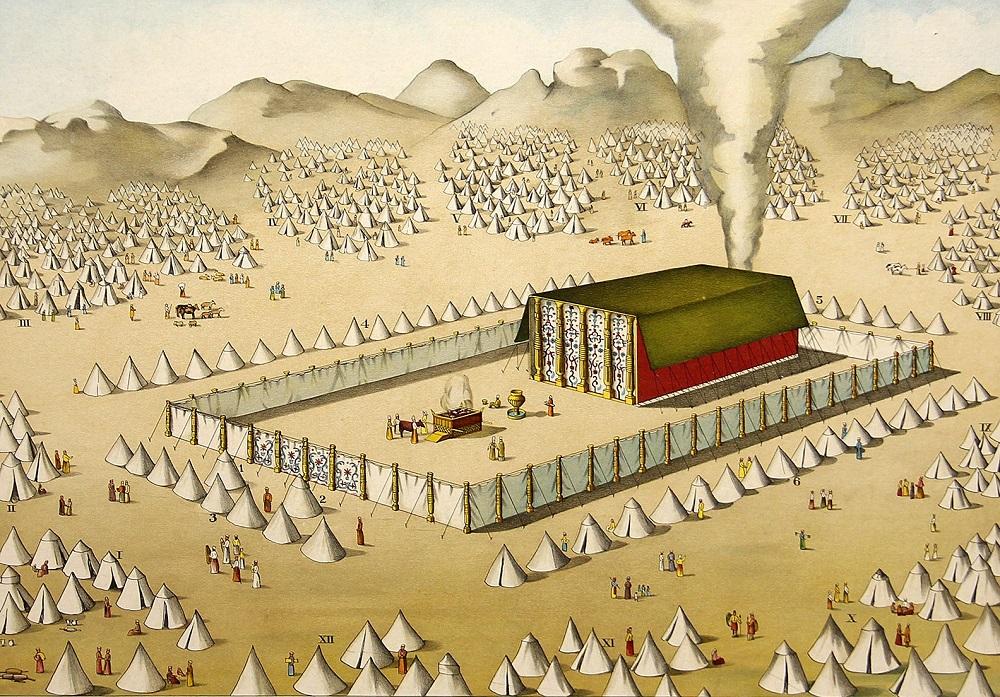
Illustration of Numbers 2, by Jan Luyken, 1673

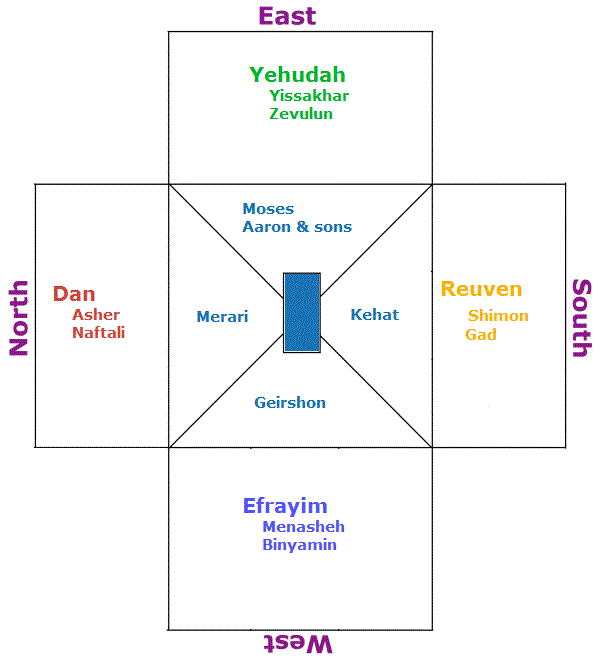
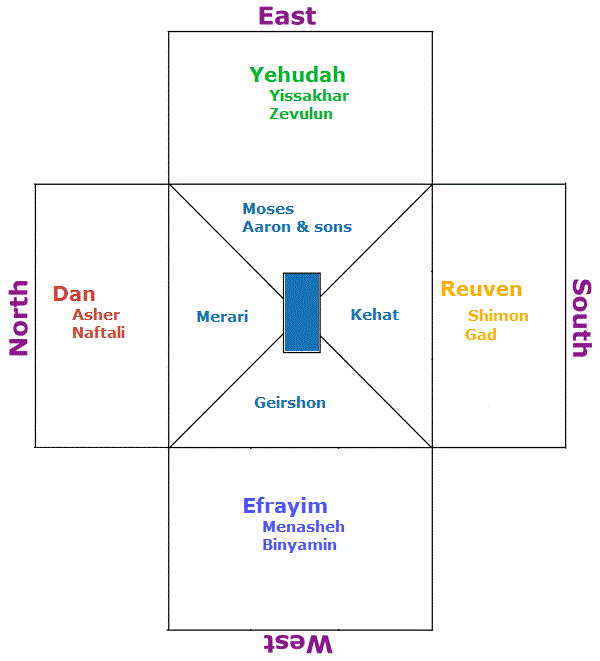
There is a separate census of the Levites, whose war duty is to guard the Tent of Meeting while the Israelites are encamped. Each Levite clan is assigned a campsite next to one side of the Tent, and the other twelve tribes must camp in a larger square around them. (There are twelve tribes not counting the tribe of Levi, because at this point the descendants of Joseph count as two tribes, Efrayim and Menashe.)

And God spoke to Moses and to Aaron, saying: “Each in its contingent, under the banner of their fathers’ house, the Israelites will camp, at a distance surrounding the Tent of Meeting they will camp. Those camping eastward, toward sunrise: the contingent of the camp of Judah, by their troops … (Numbers 2:1-3)

When they pull up stakes, they will travel in military formation, from Judah at the front to Naftali at the rear. (The Torah does not tell us where the women and children are in this army; we are left to assume they are walking with the men of their tribes.) And God will give the marching orders. This week’s Torah portion, Beha-alotkha, reminds us:

At God’s order the cloud would rise up from above the tent, and after that the Israelites would break camp; and in the place where the cloud would settle down, there the Israelites would camp. (Numbers 9:17)
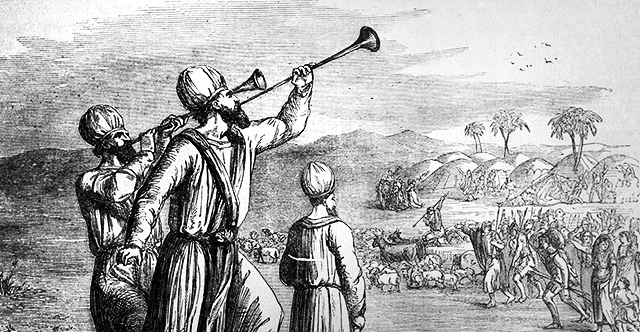
Silver trumpets in Numbers 10, 19th-century illustration

But then we learn that the signal of the divine cloud is not enough; God also calls for two silver trumpets. When a priest blows a single short blast, the leaders of the Israelites must assemble at the Tent of Meeting for instructions. A longer, trilling blast means that that the people must march.

And when you enter into battle in your land with an attacker who attacks you, then the trumpets should cry out, and you will be remembered before God, your God, and you will be delivered from your enemies. (Numbers 10:9)

Thus when the Israelites finally leave Mount Sinai, they leave as an army expecting to fight for the land of Canaan.

Rebellion

They march north for three days, then camp in the Wilderness of Paran.

And the people became like bad complainers in the ears of God. God heard, and [God’s] nose heated up [with anger]. And a fire of God burned against them, and it ate up the outer edge of the camp.  Then they wailed to Moses for help, and Moses prayed to God, and the fire sank down. (Numbers 11:1-3)

The book of Numbers does not tell us what the people are complaining about this time. According to Rashi, they felt sorry for themselves because they had walked for three days without stopping to camp, and they were weary.6 But according to Da-at Zekinim,

“The people were already mourning the potential casualties they would incur when going into battle against the Canaanites in order to conquer their land. They were lacking in faith and dreading warfare.”7

After the fire, people start complaining again.

Still Life with a Plate of Onions, by Van Gogh, 1889

Then the asafsuf who were among them felt a lusting lust. And moreover, the Israelites turned away and wept, and they said: “Who will feed us meat? We remember the fish that we ate in Egypt at no charge, the cucumbers and the melons and the leeks and the onions and the garlic! And now our nefesh is dry. There is nothing except for the manna before our eyes!” (Numbers 11:4-6)

asafsuf (אֲסְפְּסֻף) = rabble, riffraff; the non-Israelites who joined the exodus from Egypt. (They are called the eirev rav (עֵרֶב רַב)—the“mixed multitude”—in Exodus 12:38.)

nefesh (נֶפֶשׁ) =throat, appetite, life (in the sense of the animating force that makes one’s body alive).

First the asafsuf feel a lusting lust. Some commentators have written that they crave forbidden sexual relations; others that they lust for meat, and the Israelites pick up on their complaint. The manna that God provides every morning magically meets everyone’s nutritional needs, but not their emotional needs.

Their fond memories of some of the foods they ate in Egypt reveal that sometimes they wish they were still Pharaoh’s servants, instead of God’s. “… we are confronted by yearnings and nostalgia for a humdrum, small-time existence, a life of serfdom subject to their habits, passions and desires.” (Leibowitz)8

Life as God’s people seems too hard. In Egypt, they did not need to exercise any self-discipline, or follow so many rules. As long as they did whatever their foremen told them to, for as many hours as they were forced to work, they were fed “at no charge” and they could indulge in whatever pleasures they liked during their miniscule amounts of free time.

“The terrible price they had to pay for this give-away diet—slavery, suffering, persecution, murder of their children—is conveniently forgotten.” (Abravanel)9

Yet they lived at Mount Sinai for a year without complaining, the year when they were engaged in making the Tent of Meeting for God—a cooperative project calling for skilled craftsmanship. What has changed now, a three-day journey north of the mountain?

I would argue that now they are facing war, against unknown enemies. None of the Israelites were soldiers in Egypt. They engaged in only a single battle on their journey to Mount Sinai, when Amalek attacked them.10 The only other time anyone used the swords they took from Egypt was right after the golden calf worship, when Moses ordered the Levite men to go through the camp and kill the worst offenders.11

Yes, God rescued them many times on the way to Mount Sinai. But how could God make it easy to fight a long war against the Canaanites and seize all their land? They are not soldiers. How can they face all those battles? If God will no longer let them live quietly in the wilderness, they would rather be slaves in Egypt. Just thinking about the war ahead fills them with fear and dread. And they are close to the southern border of Canaan now. Desperate for a distraction and a respite from anxiety, the people long for comfort food.


We all live with anxiety about what will happen next. We might be afraid of an attack, or we might worry about our health, our work, our family, our country, our world. And most of us know about “good” strategies for managing anxiety and carrying on. I used to take long walks while singing prayers. These days, I find respite by studying and writing about Torah, and I fortify myself with naps, physical therapy, and nutritious food such as fish and leeks.

But when too many appointments and obligations use up my self-discipline, and I feel overwhelmed, I sit down with a pint of gelato. I crave sensual distraction. So I slowly savor every spoonful of gelato. Sometimes it takes a whole pint before I calm down.

I feel sorry for the people in this week’s Torah portion, who only have manna and memories.


  1. Exodus 11:1-3, 12:33-36 and 13:18.
  2. Exodus 6:2-8, 12:25, 13:5, 13:11
  3. Exodus 14:1-31.
  4. Exodus 15:22-25, 16:2-3, 17:1-7.
  5. Exodus 24:17-18, 32:1-6. See my post: Vayakheil & Ki Tisa: Second Chance.
  6. Rashi is the acronym of 11th-century rabbi Shlomoh ben Yitzchak.
  7. Da-at Zekinim, a 12th-13th century collection of commentary by tosafists, translation in www.sefaria.org.
  8. Nehama Leibowitz, Studies in Bamidbar (Numbers), translated by Aryeh Newman, The World Zionist Organization, Jerusalem, 1980, pp. 95.
  9. Yitzchak Abravanel, 15th century, quoted and translated in Leibowitz, p. 99.
  10. Exodus 17:8-13.
  11. Exodus 32:26-28.
Naso, Bemidabar, & Vayakheil: Reconstructing

(It is a pleasure to type effortlessly and comfortably again! I am glad return to my favorite work: writing about Torah.)

Model of Tent of Meeting in Timna Valley Park, Israel

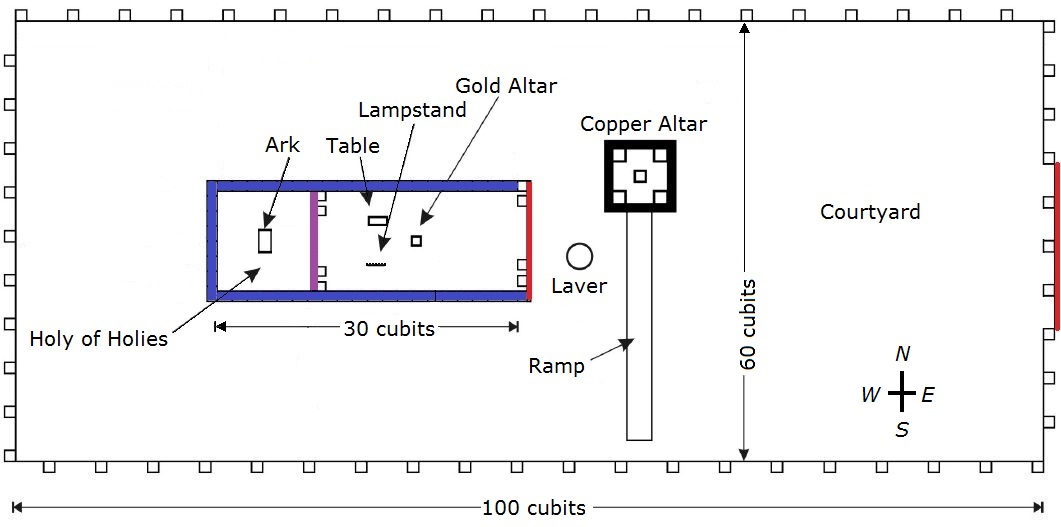
The Tent of Meeting that the Israelites make as a dwelling for God in the book of Exodus is 10 cubits wide, 10 cubits high, and 30 cubits long. (Ten cubits equals about 15½ feet, or 4¾ meters.) This boxy tent stands in the back half of an open courtyard, slightly smaller than an Olympic-sized swimming pool, with a linen wall stretched between acacia wood posts around its periphery.

Neither the tent nor the courtyard is a permanent structure.

In the first two Torah portions of the book of Numbers, we learn how everything is dismantled, transported, and reassembled at the next campsite on the Israelites’ long journey north from Mount Sinai—and who is responsible for the wood, the fabric, and the holy furnishings.

Exodus: Vayakheil

Neither the inside cloth nor the outside cloth of the Tent of Meeting is sewn into a continuous shell.

And all the wise of mind among the makers of the work, the mishkan, made ten cloths of fine twisted linen threads and blue, purple, and red [dyes]; they were made with a design of keruvim.  (Exodus 36:8)

mishkan (מִשְׁכָּן) = (literally) dwelling place. (In the books of Exodus through Numbers, mishkan always refers to the portable tent-sanctuary where God dwells, at least part-time, in the tent’s back chamber, the Holy of Holies. After its first assembly, in Exodus 40:17-33, it is also called the Tent of Meeting and the Tent of Testimony. One common English translation for mishkan is “tabernacle”.)

Keruv, ivory from Samaria, 9th-8th century BCE

keruvim (כְּרֻבִים or כְּרוּבִים) = hybrid creatures with wings. Singular keruv. (Two gold keruvim rise from either end of the gold lid of the ark in the Holy of Holies, the back chamber of the mishkan, and keruvim are woven or embroidered into some of the fabrics of the mishkan as well.)1

Each of these ten tapestries is 4 cubits wide (about 2 yards or meters) by 28 cubits long (about 14 yards or meters), long enough to drape across the ceiling frame and hang down on both sides just short of the ground. Fifty loops of blue wool are sewn down both side edges of each cloth, and the loops are connected with gold clasps.

And fifty gold clasps were made, and the cloths were joined, each one to the other, with the clasps. And the mishkan became one [piece]. (Exodus 36:13)

Someone has to fasten a row of 50 clasps nine times, every time the Tent of Meeting is assembled; and unfasten them all when the tent is dismantled again. (The open end of the mishkan is covered with a free-hanging curtain, so it serves at the entrance. A hanging curtain also separates the Holy of Holies from the main chamber inside the tent.)

The outside of the framework is covered with similar cloths woven from goat-hair, joined together by bronze clasps. Two layers of leather lie on top of the goat-hair cloth over the roof.

The frame of the tent roof is made from acacia wood bars, but the three walls are solid acacia wood: wide upright planks stabilized with cross-bars. Two tenons at the bottom of each plank fit into silver sockets in wood bases. And even though these wooden elements are hidden by linen inside and goat-hair fabric outside, they are covered with gold!2 Each of the 48 upright planks is over 15 feet tall and 3 feet wide, so erecting and dismantling the underlying wooden structure means a lot of heavy labor.

Numbers: Bemidbar

The book of Numbers opens after the Israelites have made the Tent of Meeting and all its furnishings (in Exodus), and ordained new priests for the revised religion (in Leviticus). Before the people leave Mount Sinai and head north, God organizes them for the coming conquest of Canaan.

The first Torah portion, Bemidbar, opens with God calling for a census of soldiers for future combat: the men age 20 and older in every tribe except Levi. The Levites are exempt from battle because they are assigned their own “army” duty: transporting and guarding the Tent of Meeting.

And they will be in charge of all the gear of the Tent of Meeting, and the Israelites’ charge to serve the service of the mishkan. (Numbers 3:8)

Campsites of 12 tribes and 3 clans of Levites

When God signals that the people must pull up stakes, the Levites dismantle the Tent of Meeting. They carry the furnishings, the fabric, and the wood on every journey. When the Israelites pitch camp again, the Levites erect God’s tent in the middle and the courtyard wall around it. They pitch their own tents immediately around the courtyard, and serve as guards to prevent any unauthorized persons from encroaching on the sacred space.

There are three clans of Levites, named after the three sons of Levi listed in Genesis 46:11: Gershon, Kohat (or Kehat), and Merari. Sons in a biblical genealogy are list by birth order, so Gershon was born first, then Kohat, then Merari last.

And the charge of the Gershonites at the Tent of Meeting was the mishkan and the tent: its coverings, and the curtain of the entrance to the Tent of Meeting, and the cloths of the courtyard, and the curtain of the entrance of the gate of the coutyard, which is near the mishkan and near the altar—all around; and their cords, and all its service. (Numbers 3:25-26)

The descendants of Levi’s middle son, Kohat, are responsible for transporting the holy items inside the mishkan, and the bronze altar in the courtyard.

Their charge was the ark, the table, and lampstand, and the altars, and the holy utensils for ministering to them, and the curtain, and all their service. (Numbers 3:31)

The only curtain that this clan is responsible for is the one inside the tent that divides the main chamber from the Holy of Holies.

But why are the descendants of Levi’s middle son responsible for the holiest items of the mishkan? In the book of Genesis, the firstborn son of each extended family becomes responsible for making burnt offerings to God. If the people followed this precedent, the descendants of Levi’s oldest son, Gershon, would be in charge of the holiest things.

However, in Exodus and Numbers, the job of burning offerings for God is transferred to the priests, with assistance from Levites. All priests are descended from the first high priest, Moses’ brother Aaron. Moses and Aaron’s father, Amram, is a descendant of Kohat, the middle son of Levi.3 That means the rest of the Kohatites are Moses’ and Aaron’s closest relatives. No wonder they become responsible for transporting the holiest items in the mishkan.

As for the descendants of Levi’s youngest son:

The Merarites are appointed for the charge of the beams of the mishkan and its bars, and its uprights, and its sockets, and all its gear, and all its service; and the uprights of the courtyard, all around, and their sockets, and their tent-pegs, and their cords. (Numbers 3:36-37)

While the men in the other tribes of Israel are mustered into the army at age 20, the work of disassembling, carrying, reassembling , and guarding the Tent of Meeting is restricted to Levite men between the ages of 30 and 50. (See my post Bemidbar: Two Kinds of Troops.)

When God’s cloud lifts from above the mishkan, indicating that it is time for the Israelites to journey on, the priests enter the tent first. Aaron and his sons Elazar and Itamar wrap up the ark, bread table, lampstand, and gold incense altar inside, and the bronze altar in the courtyard. (See my post Bemidbar: Covering the Sacred.) The embroidered curtain that divides the Holy of Holies from the main chamber of the mishkan becomes the first of three layers covering the ark.

Only after these holy objects are completely covered, so they cannot be seen or touched, may the other Kohatite men pick them up by their carrying poles. And only after the Tent of Meeting is empty may the Gershonites and Merarites begin dismantling it.

Numbers: Naso

This week’s Torah portion, Naso, opens with God’s instructions regarding the Gershonites and Merarites between the ages of 30 and 50—

—everyone who enters to do military service of the military, to serve the service at the Tent of Meeting. (Numbers 4:23 for Gershonites, Numbers 4:30 for Merarites)

They are non-combatants in any future battle because they must be continuously responsible for all the elements of the tent itself, as well as its unroofed courtyard.

Once the sacred objects have been removed, the Gershonites take down all the lengths of fabric and leather, carefully undoing 950 clasps. They handle the lightest objects, so their work requires the least physical strength. But it requires the most patience and delicacy.

The Merarites do heavy physical labor. Furthermore, disassembling and reassembly the wooden structure with its upright plants, cross-bars, and bases, is a team effort requiring coordination between the men so that nothing collapses.

Once the wooden structure is stable, the fabric layers have all been fastened to make continuous walls and roofs, and the holy objects are all in place, only the priests may enter the mishkan. But the Levites remain on duty, assisting in the courtyard, and guarding the sacred space they have rebuilt.


Some people excel at fine detail work, like the Gershonites. Others are good at team projects on a grand scale, like the Merarites, whether they help organize the team or do the heavy lifting. We need both kinds of people to build a community.

And although everyone who has contributed tries to guard their community and keep it going, no congregation, association, institute, or enterprise continues forever unchanged. At some point, it will fall apart—unless the Gershonites and Merarites in the group pitch in to carefully dismantle the old structure, help everyone move to a place that meets the people’s new needs, and then use the elements of the old structure to build a new one. And we need people like the Kohatites to carry the most sacred goals and values of the community into the next stage.

Never underestimate a Levite.


  1. For more on keruvim, see my post Terumah: Cherubs are Not for Valentine’s Day.
  2. Exodus 36:34.
  3. Exodus 6:20.
  4. Numbers 4:5-6. See my post Bemidbar: Covering the Sacred.

Bemidbar: Too Close

Both army duty and sanctuary duty are dangerous in the Torah; they can result in death.

Numbering of the Israelites, by H.F.E. Philippoteaux,
19th century

The book of Numbers (Bemidbar, “In the wilderness of”) opens when the people are preparing to leave Mount Sinai and conquer Canaan. So the first Torah portion, also called Bemidbar, begins with a census of all the Israelite men age 20 and over who can serve in the army. The twelve tribes of Israel1 are assigned campsites and marching positions by tribe. In the center of the camp is God’s Tent of Meeting, and in the center of the traveling troop are the disassembled parts of that tent.

The implication is that the Israelite men are protecting the Tent of Meeting from attack by local armed bands.

But the sanctuary itself is dangerous when God is in residence, and the holiest items inside it have power even when the tent is down. So God calls for a separate census of adult Levite men, who cannot serve in the army because their duty is to transport and safeguard the Tent of Meeting.

And when the mishkan is to set out, the Levites will take it down. And when the mishkan is in camp, the Levites will erect it. And the outsider who comes close yumat. (Numbers 1:51)

mishkan (מִשׁכָּן) = dwelling place of God; sanctuary. (From the root verb shakan, שָׁכַן = dwell, reside, live in, sojourn in, stop at.)

yumat (יוּמָת) = will be put to death. (A form of the verb meit, מות = die.)

When Israelites get too close

The outsiders who must not come too close to the mishkan include all the Israelites who are not Levites. Who will execute these outsiders? The classic commentators disagree, with Rashi’s camp claiming that “heaven” will smite the trespasser, and Ibn Ezra’s camp claiming that a human law court must sentence the trespasser to death.2

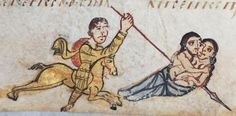
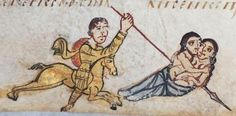
Pinchas, Sacra Paralella, Byzantine,
9th century CE

The Hebrew Bible provides only one example of this transgression, a story later in the book of Numbers. An Israelite man who is the chief’s son in the tribe of Shimon, and a Midianite woman who is the chief’s daughter in a tribe of Midian, walk right into the mishkan for a sexual ritual. A Levite named Pinchas spears them both, thereby executing the death penalty without the benefit of a trial. Then God tells Moses that if Pinchas had not acted so promptly, God’s rage would have destroyed the entire Israelite community.3

Given the danger of setting off God’s rage, the best strategy is to set a guard around the mishkan to intercept anyone who gets too close. And that is what this week’s Torah portion prescribes.

And the Levites will encamp around the mishkan of the Testimony,4 so that there will be no fury against the Israelites; and the Levites will observe the guard duty of the mishkan of the Testimony. (Numbers 1:53)

When Levites get too close

The campsites of the Levites are a buffer zone between the mishkan and the Israelites. The Levite clan of Merari camps along the north side of the Tent of Meeting, the clan of Gershon along the west side, and the clan of Kehat along the south side. The east side, which has the only entrance into the mishkan, is reserved for the tents Moses and the three priests: Aaron and his two surviving sons, Elazar and Itamar.

In front of the curtained entrance is a courtyard containing the copper altar, where animal and grain offerings are burned. Ordinary Israelites bring their offerings to this outdoor altar by entering the courtyard, so they must be allowed to come at least that close to the mishkan. But any Israelites who attempt to go past the altar and touch the curtain across the entrance must be put to death.

… and the outsider who comes close yumat. (Numbers 3:38)

Levites are allowed to touch the fabric of the tent, but only Moses and the priests can safely enter the Tent of Meeting.

Yet the Gershonite clan of Levites is responsible for taking down and setting up the entrance curtain, along with all the cloths forming the walls and roof of the mishkan. And the Merarites are responsible for disassembling and reassembling all the structural timbers and fasteners. How could they avoid stepping into the holy space inside?

Chizkuni5 explains: “They may not enter these holy precincts once the Tabernacle had been reassembled. Assembling or dissembling did not require their entering, and when the Tabernacle had been taken apart, the site it had stood on was no longer considered as a holy site.”

However, the objects inside the mishkan—the ark, the bread table, the lampstand, and the gold incense altar—are always holy. So before the tent is disassembled, the priests must cover these sacred objects, along with the tools used for their service, with multiple layers of cloth and leather, and place them on carrying poles or frames. (See my post Bemidbar: Covering the Sacred.) Only then are the Gershonites and Merarites allowed to take down the tent.

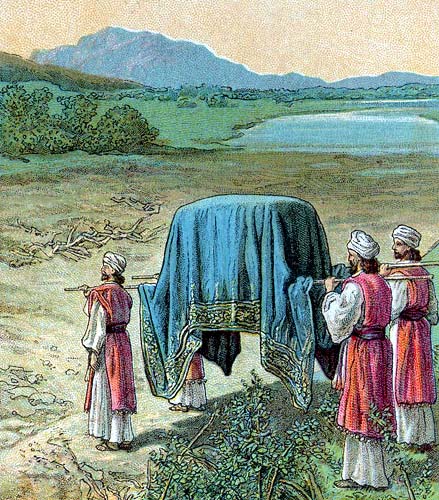
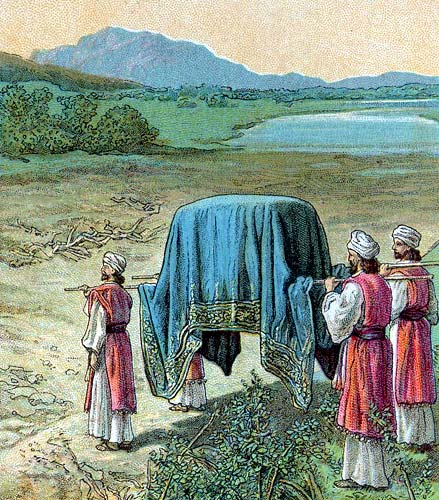
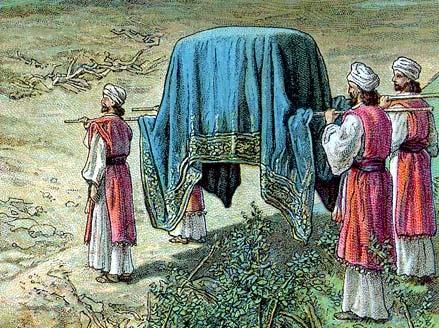
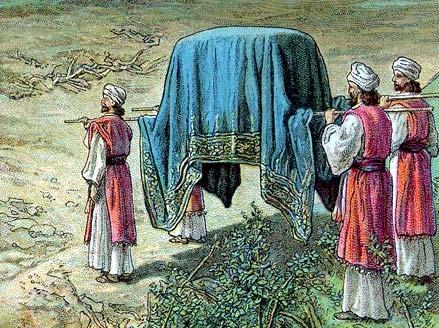
(Kehatites carrying the ark)
Bible Card,
Providence Lithograph Co.,
1907

The Kehatite clan of Levites gets the duty of transporting the holy objects after the three priests have covered them.6

And Aaron and his sons are to finish covering the holy things and all the tools of the holy things at the breaking of camp. And after that, the Kehatites will come to lift them; and they must not touch the holy, vameitu. (Numbers 4:15)

vameitu (וָמֵתוּ) = or they will die. (Another form of the verb meit.)

Nobody except the three priests can touch the holy things themselves without dying. Furthermore, the Kehatites must not see the priests wrapping them.

And they must not come in to look as the holy things are swallowed up, vameitu.  (Numbers 4:20)

The verses prohibiting the Kehatites from touching or looking at the holiest objects state that transgressors will die, not that they will be put to death. It would kill them to look at the holy objects while the priests are covering them. Does the Torah mean this literally?

Some commentators have argued that seeing the ark is deadly by citing a story in the first book of Samuel in which the two sons of the current high priest, Eli, bring the ark to the battlefield, where the Israelite soldiers raise a cheer. The sight of the ark does not kill them, but the Philistines do.7 The Philistines capture the ark and take it back to their own land, where it is moved from city to city. Each time the ark enters a new city, a plague strikes. Eventually the Philistines load the ark onto a wagon steered only by oxen, and send it back into Israelite territory. The oxen stop at the Israelite village of Beit Shemesh, and the men there look inside the ark. God strikes them dead for their lack of respect.8

Nobody dies from looking at the outside the of ark in that story.9 But in this week’s Torah portion, the Levites will die if they merely watch the priests cover up the ark and the other holy objects in the mishkan.

I wonder if their sudden terror at this unaccustomed sight would give them heart attacks. Or perhaps it is not their bodies that will die, but their souls. A soul radiant with awe is not the same as a soul divorced from all feeling.

When biblical scholars get too close

Rabbi Adin Steinsaltz compared the problem of the Levites in the Torah portion Bemidbar with the problem of recovering one’s religious awe after doing an analysis of the Torah and Talmud. He explained:

“As long as one stands at a distance from the sacred … one can see the sacred and stand in awe of it. But what happens when one has to dismantle the sacred? … It is a problem inherent in Torah study, in faith, and in Judaism: How can one question, take apart, demolish, and rebuild, and at the same time preserve the sense that one is in the realm of holiness? Only those who can bear it—the sons of Aaron, the Priests—may enter the inner Sanctuary and dismantle it. … Only one who does inner, hidden service, totally committed to serving God, may enter the Sanctuary and cover the sacred.”10


Human beings seem to need a sense that some thing or concept is sacred. Some people today feel that way about tangible things such as holy books or national flags. Some feel that way about a holy place. For others the most sacred thing is an idea—for example, an ethical imperative, a conception of God, or a belief in reason.

When someone violates or disgraces what you hold sacred, your emotional reaction is swift and negative. A patriot who considers the national flag sacred automatically labels flag-burning an abomination, and wants immediate punishment for the perpetrator. For some Jews, dropping a Torah scroll on the floor, even accidentally, causes shock and guilt; throwing one down deliberately would mean automatic de facto excommunication.

And if you hold an idea sacred, you automatically reject all arguments against it. But once in a while the unthinkable happens. A well-meaning outsider succeeds in persuading you that your sacred belief is a fallacy. Or an event in your life or in the world violates your whole conception of what is true. Then your loss is hard to bear, since a sacred thing gives life meaning.

In the Torah portion Bemidbar, for an unauthorized person to touch the mishkan when God is in residence, or to see its most sacred objects, results in the death penalty. In our lives today, the demolition of a sacred idea causes a psychological death, as the believer is swamped by a sudden loss of meaning.

May every person who has this experience be granted the strength and resilience of a Levite, or even a priest, and rebuild the sacred in a new place of wisdom.


  1. The Torah portion Bemidbar, as well as later Jewish tradition, distinguishes between three kinds of people for religious purposes: the priests (kohanim), who are an elite subset of Levites; the Levites (Levi-im), who are a tribe of Israel but not counted as part of the Israelites because they have specific religious functions; and the twelve tribes of Israelites (benei Yisrael), counting Joseph’s sons Efrayim and Menashe as two tribes and not counting the Levites.
  2. Rashi is the acronym for 11th-century Rabbi Shlomoh Yitzchaki. He explained that the fury in Numbers 1:53 refers to God executing outsiders who get too close to the tent. Ibn Ezra is the 12th-century rabbi Avraham ben Meir ibn Ezra.
  3. Numbers 25:6-15.
  4. The “testimony” (eidut, עֵדֻת) here is the pair of stone tablets inside the ark. The book of Exodus frequently refers to the ark of the testimony, while the book of Numbers refers nine times to the tent or mishkan of the testimony. (Numbers 1:50, 1:53 (twice), 9:15, 10:11, 17:19, 17:22, 17:23, and 18:2.)
  5. Rabbi Hezekiah ben Manoah compiled commentary in the book Chizkuni in 13th century.
  6. In addition, the priests cover and the Kehatites transport the copper altar where offerings are burned in the courtyard. See my post: Bemidbar & Naso: Why Cover the Altar?.
  7. 1 Samuel 4:3-11. See my post: Pekudei & 1 Kings: Is the Ark an Idol?.
  8. 1 Samuel 6:19; Talmud Bavli, Sota 35a-b.
  9. This has led some commentators to posit two arks, a mishkan ark and a battle ark—or at least two literary traditions about the ark.
  10. Adin Even-Israel Steinsaltz, Talks on the Parasha, Koren Publishers, Jerusalem, 2015, pp. 281-287.

Bemidbar & Naso: Why Cover the Altar?

Moses assembles the tent-sanctuary for God at Mount Sinai at the end of the book of Exodus. At the beginning of the book of Numbers, the people prepare to leave Mount Sinai and head to Canaan—with their portable tent-sanctuary, where God is present. So God gives instructions for dismantling, covering, and carrying all the pieces of the sanctuary in the first two Torah portions of the book of Numbers: last week’s portion, Bemidbar (Numbers 1:1-4:20), and this week’s portion, Naso (Numbers 4:21-7:89).

Kohatites carry the ark, detail from “Israel Enters the Land of Promise” Bible card, Providence Lithograph Co,, c. 1907

The priests must hide the holy objects inside the tent-sanctuary from view before the tent can be dismantled. Aaron and his two surviving sons must take down the curtain separating the Holy of Holies from the front chamber. They must cover the ark with the curtain, then add two more coverings. They also spread three coverings over the gold bread table, two over the gold lampstand, and two over the gold incense altar. The Levites are not allowed to touch, or even look at, these most sacred objects until they have been covered. Only they can they pick up the objects by their carrying poles and transport them to the next campsite.

The three priests must also cover the copper altar outside the tent.

And they must clean fatty ashes off the mizbeiach, and they must spread a cloth of red-violet wool over it. And they must place upon [the cloth] all the utensils with which they serve at it: the cinder pails, the meat-forks and the scrapers, and the sprinkling basins, all the utensils of the mizbeiach. And they must spread out over them a cover of tachash skin, and they must place its carrying poles. (Numbers 4:13-14)

mizbeiach (מִזְבֵּחַ) = altar for offerings. (From the root verb zavach, זָבַח = slaughter livestock, make a slaughter offering. Altars were built of stone in Genesis and the first part of Exodus. Then God asked the Israelites to make a copper altar to stand in front of the new tent-sanctuary.)

tachash (תַחַשׁ) = an animal that has not been conclusively identified. Its skin must be fairly waterproof, since it is used as the top layer of the tent-sanctuary roof as well as one of the coverings of all the sacred objects the Levites carry when the Israelites are traveling.

Levites carry the altar

The second Torah portion in Numbers, Naso, opens with a census of the Levite clan of Gershon, then assigns its men aged 30 to 50 the duty of carrying the mizbeiach, the outdoor copper altar, as well as the swaths of fabric and skin hanging in (and on) the wooden frameworks of the tent and the courtyard wall.

This is the service of the clans of the Gershunites, for serving and for carrying: They must carry the cloths of the mishkan, and along with the Tent of Meeting its [cloth] covering and the tachash covering that is over on top of it, and the curtain at the entrance of the Tent of Meeting, and the hangings [enclosing] the courtyard, and the curtain at the entrance—the gate of the courtyard that is around the mishkan and the mizbeiach; and their cords, and all the equipment for their service. (Naso 4:24-26)

mishkan (מִשְׁכָּן) = dwelling place. (Usually God’s dwelling place, i.e. the portable sanctuary. From the root verb shakkan, שָׁכַן = settle, dwell, stay.)

During the 39 years the Israelites travel through the wilderness from Mount Sinai to the Jordan River, the mishkan and the Tent of Meeting are synonymous.

This is the service of the clans of the Gershunites regarding the Tent of Meeting, and their custody is in the hand of Itamar, son of Aaron the High Priest. (Numbers 4:28)

This week’s Torah portion assigns the remaining transport duties to two other divisions of Levites. The Kohatites will transport the holy furnishings inside the tent: the ark, table, lampstand, and incense altar. And the Merarites will transport the disassembled wooden frames of the tent and the courtyard wall.

Covering up

When the Israelites are encamped and the sanctuary is in place, only the priests are allowed to enter the Tent of Meeting. Only they may see the sacred objects inside. The Levites assist the priests outside the tent, and guard it from lay intruders. So it makes sense that the priests must cover objects inside, and insert their carrying-poles, before turning them over to the Kohatites to carry. That way, Levites cannot glimpse the sacred objects even when they are breaking camp. (See my post Bemidbar: Don’t Look.)

The copper altar, from Treasures of the Bible, Northrop, 1894

But why must the priests also cover the mizbeiach before it is carried off? The copper altar stands outside the Tent of Meeting. Everyone who enters the courtyard can see it. People bring animal and grain offerings right up to the altar, and watch the priests burn their offerings on it. The mizbeiach hardly needs to be hidden from sight when the Israelites are traveling.

Symbolic colors

The key, according to 19th-century Rabbi Samson Raphael Hirsch, is that the copper altar is covered with cloth dyed red-violet. Three colors of wool are used in the cloths the Israelite women weave for the mishkan and its courtyard: twilight blue (techeilet, תְכֵלֶת), red-violet (argaman, אַרְגָּמָן), and scarlet (tola-at shani, תוֹלַעַת שָׁנִי).1 Hirsch wrote that scarlet represents the color of blood, and therefore life at the animal level. Red-violet represents life at the higher, human level. And blue, the color of the sky, represents the limits of our horizon, the divine.

The most holy object, the ark, is covered first with the curtain that normally screens off the back room of the mishkan, the Holy of Holies; in the book of Exodus, this curtain is embroidered using all three colors of wool yarn, as well as fine linen.2 Then comes a layer of tachash skin, and after that a layer of wool cloth dyed with techeilet—an expensive blue dye made from murex sea snails.3. The first coverings over the bread table, the lampstand, and the incense altar are also wool dyed with techeilet. This blue, Hirsch wrote, is “close to God in highest holiness.”4

The first cloth covering the bread table is blue, but then after its utensils are placed on it, it is covered with a second cloth, this one scarlet. Hirsch explained, “The means of existence and prosperity are granted by God’s ‘Countenance,’ but all these ensure only “shani” [scarlet], animal-bodily life.”5

The copper altar, where the animal offerings are burned, does not get a layer of blue cloth. It is unique in that its first covering is red-violet wool.

Argaman cloth

Hirsch explained: “Argaman [red-violet], on the other hand, the higher, human level of life, is not granted by God. Rather, man must attain this level himself by freely mastering his own desires; he must harness all his animal-bodily powers and subordinate them to God’s will. This is symbolized by the offering altar and by the offering procedures performed on it.”6 Following Hirsch’s line of thought, the copper altar might be covered with red-violet cloth in order to illustrate that the sacrificial service at the altar is a method of achieving the human level, the level of free choice, which is symbolized by the red-violet color.

Honor

It is possible that the author of the Torah portions Bemidbar and Naso (which scholars attribute to the same Priestly source as most of Leviticus) found meanings in the colors of the coverings. But I propose a less symbolic explanation.

I think the priests cover the gold objects from inside the mishkan not only to prevent the Levites from seeing them, but also in order to treat God’s sacred objects with honor and respect. I can imagine them ceremonial spreading the blue cloth over each item.

They do not cover the copper outside altar with techeilet blue, but they do use cloth dyed with the next highest-ranking color. Red-violet cloth (also made from murex shells and also expensive) was used for the robes of the Kings of Midian and the seat of King Solomon’s throne.7 Covering the mizbeach with this royal color gives it honor and status. Using tachash skin as the top covering would also honor the altar, since the same kind of skin covers the roof of the mishkan.

When the Israelites are encamped, the mizabeiach is used to burn up the fat parts of cattle, sheep, and goats—and sometimes the entire animal—in order to make smoke rise to the heavens for God’s pleasure. This religious act is feasible only because God provides enough abundance so that surplus (mostly male) animals can be slaughtered and offered up.

Since the copper altar is used to honor God and thank God for abundance, it deserves to be honored itself. When the Israelites break camp, the priests honor the altar by draping an expensive royal red-violet cloth over it. This ritual was not as grand as the coronation of a king. But at least it was a way for the priests to show respect for God and their religion.


  1. See my post Bemidbar: Covering the Sacred.
  2. Numbers 4:5 and Exodus 26:31, 36:35.
  3. Numbers 4:7-11.
  4. Rabbi Samson Raphael Hirsch, The Hirsch Chumash: Bemidbar, translated by Daniel Haberman, Feldheim Publishers, Jerusalem, p. 51.
  5. Ibid.
  6. Ibid.
  7. The kings of Midian appear in Judges 8:26. King Solomon’s throne is in Song of Songs 3:10.

Haftarat Bemidbar—Hosea: An Unequal Marriage

Everyone obeys God in this week’s Torah portion, the opening of the book of Numbers/Bemidbar (“in a wilderness”). Moses passes on God’s instructions for preparing to leave Mount Sinai and head off through the wilderness again. And the Israelites all organize themselves accordingly.

And the children of Israel did everything that God commanded Moses; thus they did. (Numbers/Bemidbar 1:54)

The people’s compliance falls apart before they reach the border of Canaan. But for a while, in the wilderness, Israel and God enjoy a honeymoon.

Metaphors of courtship and marriage are often used later in the Hebrew Bible to express the covenant between God and the Israelites. Going by the order of the books in the canon, the first occurrence is in the book of Isaiah.1 But going by the prophets in historical order, the first occurrence is in the book of Hosea, a prophet who lived in the northern kingdom of Israel in the 8th century B.C.E.

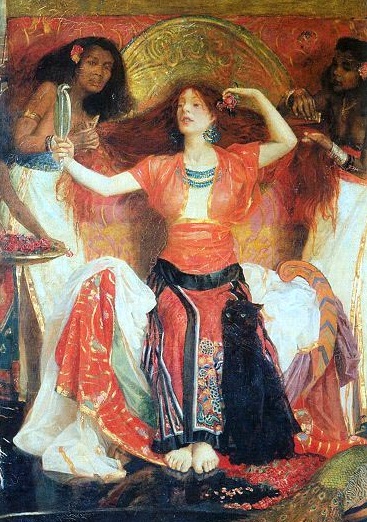
In this week’s haftarah (the reading from the Prophets that accompanies the Torah portion), Hosea criticizes the northern kingdom for worshiping other gods. He calls the kingdom the “mother” of the Israelites, and declares that she has abandoned her legitimate “husband”, God. As God’s mouthpiece, he urges the kingdom’s children, the Israelite people:

Jezebel, by John Liston Byam Shaw, 19th c. (cropped)

Bring a case against your mother, a case!

For she is not my ishah,

And I am not her ish.

She must clear away the whoredom from her face,

And the sign of adultery from between her breasts.

If not, I will strip her down to her nakedness

            And display her as on the day she was born.

And I will turn her into a wilderness

            And make her like waterless land,

            And let her die of thirst. (Hosea 2:4-5)

ishah (אִשָּׁה) = woman; wife.

ish (אִישׁ) = man; husband.

The kingdom of Israel and God had a covenant like a marriage. But Israel broke it by engaging with other gods, and now God, her husband, is rejecting her. “She is not my ishah, and I am not her ish might be part of an ancient declaration of divorce.

At this point in Hosea’s poem, the God of Israel is still a jealous god, as in the Second Commandment:

You must not bow down to them and you must not serve them; because I, Y-H-V-H, your God, am a jealous god … (Exodus 20:5 and Deuteronomy 5:9)

Israel must clean herself up, like a  prostitute who stops working and removes the make-up (whoredom) from her face, and the sachet of perfume (sign of adultery) from between her breasts.2  If she does not clean up her act, God will humiliate her by stripping her naked. In Israel’s case, God will strip away her fields, orchards, vineyards, and even water sources, making the land a desolate wilderness. God will accomplish this by afflicting the kingdom with severe drought.

The drought will affect the children of Israel—all its residents. But God says:

And I will not feel compassion for her children

            Since they are children of whoredom;

Since their mother whored.

            She who conceived them acted shamelessly,

For she thought:

            “I will go after my lovers,

            Who give me my bread and my water,

            My wool and my linen,

            My oil and my drink.” (Hosea 2:6-7)

But Israel deceived herself about the source of her food, shelter, and clothing; it was God who gave her everything.

She will pursue her lovers, but she will not catch them.

She will seek them, but she will not find them.

Then she will say: “I will go and return to my first ish,

Because it was better for me then than now.” (Hosea 2:9)

After Israel makes this cold and calculating decision, the prophecy says, God will continue to deprive her of grain, wine, wool, and flax for a while.

And I will make a reckoning against her for the days of the be-alim

            For which she burned incense

And adorned herself with her nose-ring and her jewelry

            And went after her lovers,

And forgot me!—declares God. (Hosea 2:15)

be-alim (בְּעָלִים) = different local versions of Ba-al (singular of be-alim), a West Semitic god of weather, fertility, and war. (Ba-al (בַּעַל) = master, husband, owner; a West Semitic god.)

The angry God-character in the Torah would probably tell Moses, once again, that it was time to start over and choose a new people to rule Canaan, and then Moses would have to talk God down again. But in the book of Hosea, God will eventually forgive. Once the kingdom of Israel has become a wilderness, God will woo Israel back. 

Therefore, hey! I will be her seducer

            And I will lead her through the wilderness

            And I will speak upon her heart. (Hosea 2:16)

In the Hebrew Bible, speaking upon someone’s heart means changing their feelings. (See my post: Vayishlach: Change of Heart, Part 1.)

And I will give her grapevines from there,

And the Valley of Akhor as an opening for hope.

She will respond there as in the days of her youth,

As on the day she came up from the land of Egypt.

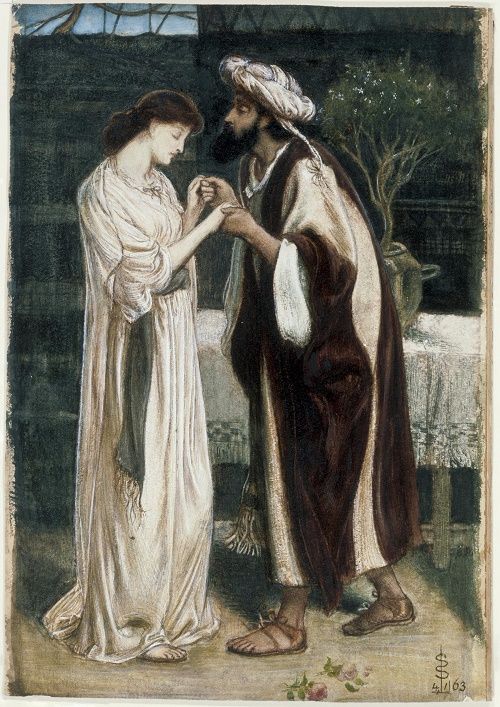
Marriage of Isaac and Rebecca, by Simeon Solomon, 1863

And it will be on that day—declares God—

You will call me “my ish”,

And you will no longer call me “my ba-al”.

I will remove the names of the be-alim from her mouth,

and their names will no longer be remembered. (Hosea 2:17-19)

The statement that Israel will cease to call God her ba-al has a double meaning. Israel will think of God affectionately, as a husband who is her ish (her man), rather than her ba-al (her master). But also she will no longer call upon Ba-al, the Canaanite deity.

The haftarah ends with a marriage formula (which has become part of the prayer for putting on tefillin3):

I will betroth you to me forever,

And I will betroth you to me with rightness and with lawfulness,

And with loyalty and with mercy;

And I will betroth you to me with faithfulness,

And you will know God. (Hosea 2:21-22)

This strikes me as an amazing betrothal. In our modern world, when two human beings get engaged, we assume both parties want the marriage and are independently motivated to commit to it. But in this passage, all the commitment comes from God.

Are rightness, lawfulness, loyalty, mercy, and faithfulness the qualities that God is promising to exhibit as Israel’s future husband? Or are they the qualities that God intends to instill in Israel, so the marriage can last?

Either way, all Israel does is respond when God speaks upon her heart. God does not require any prior searching, repentance, or reform on Israel’s part. God will take care of everything. And then, the text promises, you will know God. The verb for “know” here, yada (יָדַ), is used for knowledge from direct experience, including sexual knowledge.


During the periods of my life when I felt lost in a wilderness, I continued to sing prayers, but I did not have the heart to passionately seek God. I recited the Shema, with its command: You must love God, your God, with all your heart and with all your soul and with all your might (Deuteronomy 6:5). But I have never achieved it. I love my husband that way, but then, I know him much better than I know God.

I am acquainted with people who claim to know (have direct experience of) God. I have had a few fleeting transcendent experiences myself, but I would not presume to claim that they were direct experiences of God. And I am content with not knowing—as well as grateful for all the blessings in my life, whatever their source. Paradoxically, one great blessing is that I am able to engage with Torah and think about God.

Yet some people need more than that. So I pray that everyone who needs a personal commitment to God will be blessed to hear God speak upon their hearts, and to know God.


  1. Isaiah 54:1-10.
  2. See Song of Songs 1:13.
  3. Tefillin (תְּפִלִין) is the Hebrew word for the set of two black leather boxes with straps which a Jewish man traditionally wraps around his head and none-dominant arm before praying. (The Hebrew word for prayer is tefilah, תְּפִלַּה.) “Laying” or wrapping oneself with tefillin is like putting on a wedding ring: a tangible sign of commitment.

Bemidbar & Naso: Dangerous Duty

Two dangers face the Israelites as they leave Mount Sinai in the book of Numbers/Bemidbar: the risk of attack by an enemy in the wilderness, and the risk of annihilation by God.

They have already experienced both dangers. On their way from Egypt to Sinai the Amalekites attacked them, and the Israelites beat them off with the help of God.1 When they stood at the foot of Mount Sinai to hear God speak, the earth quaked—and so did the Israelites.

Mount Vesuvius in Eruption, by Jacob More, 18th cent., detail

And all the people were seeing the thunder and the flashes and the sound of the ram’s horn, and the mountain was smoking; and the people saw and they quaked and drew back and stood at a distance. And they said to Moses: “You speak to us and we will listen; but don’t let God speak to us, or else we will die!” (Exodus 20:15-16)

The Jewish day of Shavuot commemorates the revelation at Sinai, when the Israelites were terrified and God uttered the “ten commandments”. This holiday always falls the same week as the Torah reading Bemidbar, the first portion in the book of Bemidbar.

This Torah portion begins with God telling Moses to take a census of the men in all the tribes except Levi.2 The purpose of this census is to learn how many troops can be mustered in the event of a battle after the Israelites leave Mount Sinai and resume their journey to Canaan.

Israelite service

Numbering of the Israelites, by Henri F.E. Philippoteaux, 19th cent.

And all the [male] Israelites were mustered from the houses of their forefathers, from the age of twenty years and up, all who were going out in the tzava in Israel. (Numbers 1:45)

tzava (צָבָא) = army, unit of warriors, army service.

The qualifying phrase “all who were going out in the tzava” implies that the census counted only men aged 20 and over who were able to march and wield weapons.

Then God spoke to Moses saying: “However, the tribe of Levi you shall not muster, and you must not make a head count of them among the Israelites.” (Numbers 1:48-49)

In the second Torah portion of Numbers, Naso, there is a census of the three Levite clans.

And Moses and Aaron and the chieftains of the community enrolled the sons of the Kehatites by their families and by the house of their father, from the age of thirty years and over, up to the age of fifty years, all who were entering the tzava for the service of the Tent of Meeting. (Numbers 4:34-35)

The censuses of the Geirshonite and Merarite clans also count men aged 30 to 50, and also add “all who were entering the tzava for the service of the Tent of Meeting”.3

Why does the Torah call the Levites an army?

Levite service

Before telling Moses to take a separate census for the tribe of Levi, God says:

“Assign the Levites over the Sanctuary of the Testimony and over all its equipment and over everything that belongs to it. They themselves shall carry the sanctuary and all its equipment, and they shall attend it, and they shall camp around the sanctuary. And when [it is time for] the sanctuary to pull out, the Levites shall take it down; and when [it is time for] the sanctuary to be pitched, the Levites shall erect it. And any unauthorized person who comes close must be put to death.” (Numbers 1:50-51)

Thus one of the duties of the Levites is to guard the tent-sanctuary and kill any unauthorized person who persists in coming too close to the tent, or even entering it.4 That is the military aspect of their service, but it is not the most dangerous.

“And the Israelites shall encamp, each man in his camp and each man at the banner for his troop. But the Levites shall encamp around the Sanctuary of the Testimony, and then there will be no fury against the community of Israelites; and the Levites shall guard the guardianship of the Sanctuary of the Testimony.” (Numbers 1:52-53)

Whose fury? When the Torah portions Bemidbar and Naso describe the duties of the Levites whenever the people break camp, it becomes clear that the fury would come from God.

First the priests (Aaron and his two surviving sons) must go inside the tent and wrap up the most holy items before anyone else can see them, and place them on carrying frames with poles. The holiest items are the ark, lampstand (menorah), the bread table, and the gold incense altar. The priests also wrap up the gold tools used for the rituals inside the tent.5

And Aaron and his sons shall finish covering the holy items and all the holy equipment when breaking camp, and after that the Kehatites shall come in to pick them up, so they do not touch the holy objects and die. These things in the Tent of Meeting are the burdens the Kehatites. (Numbers 4:15)

Each of the three clans in the tribe of Levi is responsible for carrying some part of the tent-sanctuary. The Kehatites must carry the most holy items, while the Geirshonites and Merarites carry the outside altar and the disassembled parts of the tent and the wall around it—cloth hangings, posts, planks, bars, pegs, sockets, and cords.

No touching

Certainly Betzaleil touched the holiest items when he hammered them out of gold in the book of Exodus.6 But later in the book of Numbers, God tells Aaron that the priests must not touch them, or they will be killed.7 Somehow the priests must light the menorah, lay bread on the table, and place coals and incense into the incense altar without touching their gold surfaces. And they must wrap these items in cloths without directly touching them.

Model of ark, Jerusalem

In the first book of Samuel the ark sits for twenty years in the house of Avinadav at Kiryat Ye-arim. His son Elazar is consecrated as an ad-hoc priest to look after it.8 Then King David decides to move it to his new capital in Jerusalem. The ark is lifted up onto a new cart, and two other sons of Avinadav, Uzah and Achyo (presumably younger replacements for Elazar) walk beside it. Partway to Jerusalem,  the oxen pulling cart stumble, and Uzah puts his hand on the ark to steady it.

And God’s anger flared up against Uzah, and God struck him down there … and he died there beside the ark of God. (2 Samuel 6:7)

Uzah’s impulse is good, but nevertheless a divine power zaps him the instant he touches the ark.

No looking

No one in the bible is harmed from carrying the ark by its two poles, but touching the ark itself is deadly. The ark takes a circuitous route to Kiryat Ye-arim in the first book of Samuel. After the Philistines capture the ark in battle they bring it to their town of Ashdod, but everyone there is stricken with a plague. They send it on to Gath, then to Ekron, each time with the same result. So they load the ark onto a cart pulled by two cows and send it back into Israelite territory. The cows stop in a field near the town of Beit Shemesh, where seventy curious Israelites look inside. God strikes down every one of them.9

Kehataties carrying ark on a bible card by Providence Lithograph Co., 1907

In the portion Bemidbar: Don’t Look, the priests cover all the holiest items not only to prevent the Kehatites from touching them, but also to prevent these Levites from seeing them, even from the outside.

And God spoke to Moses and to Aaron, saying: “Do not cause the staff of the families of the Kehatites to be cut down from among the Levites!  Do this for them, so they will live and not die: when they approach the Holy of Holies, Aaron and his sons shall come in and assign each individual man his service and his burden.  And they must not come inside [the tent] to look as the holy things are swallowed [by the wrappings], or they will die.”  (Numbers 4:17-20) 

I speculated that the Levites are not allowed a glimpse of the holiest items either because it might make them feel as powerful as the priests, or because it might make them treat the holy items (and therefore God) with insufficient reverence.

Transporting the wrapped-up holy things might be nerve-wracking for the Kehatites. They carry them by hand, not on carts. What if they stumble and drop something? What if one of the coverings slips off?

For the “armies” traveling north from Mount Sinai, guard duty is more dangerous than combat duty.


  1. Exodus 17:8-13.
  2. In the book of Genesis Jacob has twelve sons; Levi is his third son, and Joseph is his eleventh. In other books of the Torah eleven tribes are named after Jacob’s sons, but there is no tribe of Joseph; instead two tribes are named after Joseph’s two sons, Efrayim and Menashe. That makes thirteen tribes—but even in the Torah, the tradition is that there were twelve tribes of Israel. The solution in the first three portions of Numbers is that there are twelve tribes of Israel plus one tribe of Levi.
  3. Numbers 4:39, 4:43.
  4. See Numbers 25:6-8.
  5. Numbers 4:5-14. See my post Bemidbar: Covering the Sacred.
  6. Exodus 37:1-29.
  7. Numbers 18:3.
  8. 1 Samuel 6:21-7:2.
  9. 1 Samuel 6:10-20.

Bemidbar: Don’t Look

Idol of a bull for a god to ride, 12th century BCE,
Samaria, Israel Museum (photo by M.C.)

At Mount Sinai the Israelites experience God, lose hope and make the Golden Calf, reform and make the portable sanctuary for God, and learn how to practice their religion.  After a year and a month, they are ready when the book of Numbers/Bemidbar begins, to dismantle the sanctuary and journey north to Canaan.

On the way, how will they safely carry the sacred items in the sanctuary’s Tent of Meeting from one campsite to the next?

This week’s Torah portion, also called Bemidbar (“In the wilderness of”), is not concerned about the safety of the safety of the ark, the table, the menorah, or the incense altar on the road.  It is concerned about the safety of the Levites who will carry the holy items.

Aaron shall enter, and his sons, when the camp is going to pull out, and they shall take down the dividing curtain and kisu the ark of testimony.  (Numbers/Bemidbar 4:5)

kisu (כִּסּוּ) = they shall cover.  (A form of the verb kasah, כָּסָה = covered, covered over, clothed, concealed.)

The Torah describes how many layers of what materials the priests will use to cover the gold ark, bread table, menorah, and incense altar that normally stand inside the Tent of Meeting, which only priests may enter.  (See my post Bemidbar: Covering the Sacred.)  The word for “cover” in this passage is always the verb kasah.

And Aaron and his sons shall finish lekhasot the Holy and all the implements of the Holy when the camp is going to pull out, and after that the Kohatites shall come in to carry [them], but they shall not touch the Holy or they will die.  (Numbers 4:15)

lekhasot (לְכַסֺּת) = to cover, covering.  (Another form of the verb kasah.)

Bible Card by the
Providence Lithograph
Company, 1907.

One reason to wrap up the holy items is so that the Levites cannot touch them; unauthorized contact results in death.1   The Levites from the Kohat tribe are only authorized to touch the carrying poles for each furnishing.

They are also endangered if they see any part of the Holy as it is being wrapped.  The Torah uses a different term for wrapping or covering to describe this unauthorized view.

And God spoke to Moses and to Aaron, saying: “Do not cause the tribe of the families of the Kohatites to be cut down from among the Levites!  Do this for them, and they will live and not die: when they approach the Holy of Holies, Aaron and his sons shall come in and assign each individual man his service and his burden.  And they shall not come in to look as the Holy [are] bala, or they will die.”  (Numbers 4:17-20)

bala (בָּלַע) = swallowed down, devoured, engulfed.

Where did that menacing image come from?  Do the holy items suddenly look as if they are being devoured by their own wrappings?


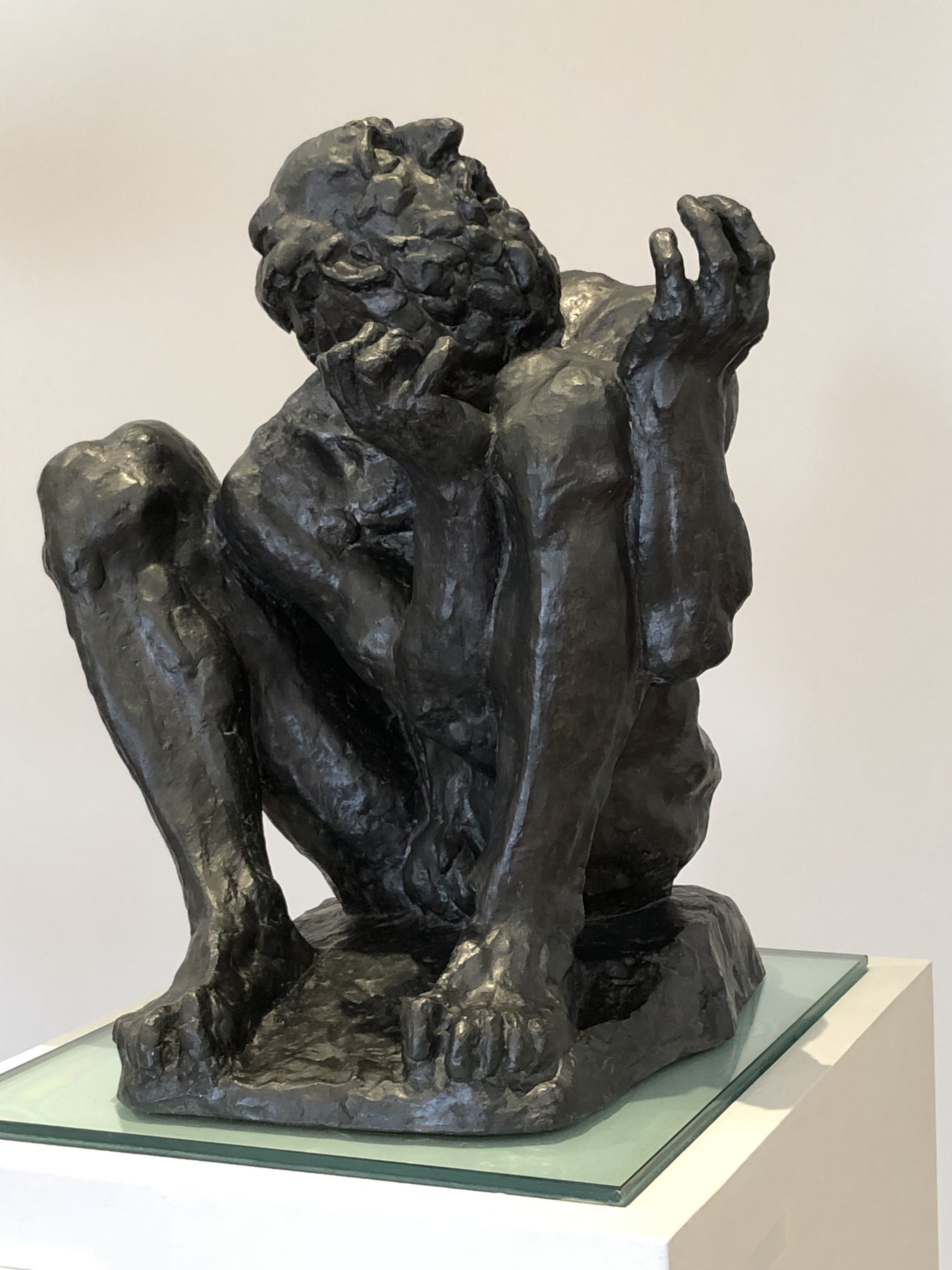
Job, by Ivan Mestrovic, 1943 (photo by M.C.)

Usually when the verb bala appears in the Torah it means either “destroyed” in general, or  specifically “swallowed”.  One exception is when Job complains that God is persecuting him.

“Will you not look away from me, leave me alone, until I bala my own spit?”  (Job 7:19)

Here Job uses a form of bala to mean “swallow” in an idiom for a moment or instant—the brief time it takes to swallow spit.

Taking off from this idiom, some translators conclude that bala in our Torah portion at the beginning of the book of Numbers does not mean “swallowed”, but rather “the time it takes to swallow”.  Here is a version by Everett Fox2:

But they are not to enter and see (even) for-a-moment (the dismantling of) the Holy-Shrine, lest they die. (Numbers 4:20)

Perhaps the Levites must not see the holy items for even as long as it takes to swallow.  Or perhaps the Levites must not see the holy items as small objects being swallowed or engulfed by their coverings.

Why not?

Pride.  A tantalizing glimpse of something normally out-of-bounds could lead a Levite porter to steal another chance to look at part of holy item.  He might feel powerful, familiar with the most holy, almost like a priest.  Yet peeking under the wrapping, for example, would result automatically in the Levite’s death.

Disenchantment.  On the other hand, seeing one of the holy items being wrapped as if it were any other physical object might lead a Levite to treat it with less reverence, which is also a bad idea.  The Levite might even start thinking of God as a mere physical object.

These same arguments might apply to the priests wrapping the holy items.  When the Tent of Meeting is set up and in operation, all of the priests get to see the bread table, menorah, and incense altar.  But the ark stands behind a dividing curtain in the Holy of Holies, where only the high priest may go, once a year.

Yet this week’s Torah portion implies that lesser priests are allowed to see the ark every time they dismantle and reassemble the sanctuary.  Perhaps the priests cover the ark with the specified layers of cloths without actually looking at it (or touching it directly).  I think the Torah assumes they have the willpower to do this.

But the Kohatites waiting to receive the covered-up ark might not be able to resist peeking—unless the priests assigned them tasks that would keep them busy from the time the curtains came down until the ark was covered.  After all, when you are faced with a deadly temptation, it is easier to redirect your mind if you stay busy.

Maybe if Adam and Eve had been given the job of weeding around the Tree of Knowledge in the garden of Eden, they could have resisted the temptation to taste its fruit.

What tempts you?  Hot fudge?  The body of a person who is off-limits for you?  Personal power?

What is it like to be tempted by divine power?  To crave something beyond awe in the face of the mystery?  To want to touch something beyond reason, something so alien to normal human thinking that contact with it could destroy you?


  1. See my post Shemini & 2 Samuel: Segregating the Holy.
  2. Everett Fox, The Five Books of Moses, Schocken Books, New York, 1983, p. 673.

(Based on an essay I published in 2011.)

Bemidbar: Two Kinds of Troops

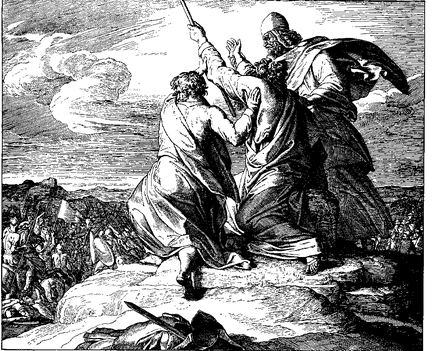
Battle with the Amalekites, by J. Schnorr von Carolsfeld, 1860

The Israelite ex-slaves won their first battle, but it was a close call.  The tribe of Amalek attacked them in the wilderness between Egypt and Mt. Sinai, in the book of Exodus/Shemot.  Moses asked his aide, Joshua, to choose some men to fight back.  They eventually defeated the Amalekites only because Moses was sitting on a hill above, holding up the staff of God with the the help of two men.1  It was an ad-hoc battle; none of the Israelite men had been organized or prepared.

When the Israelites leave Mt. Sinai in the book of Numbers/Bemidbar, over a year later, they are heading for the southern border of Canaan, only an 11-day march away.2  And this time they expect to be the ones doing the attacking, as they began the process of conquering the “promised land”—with God’s help.

The first Torah portion in the book of Numbers, also called Bemidbar (“in the wilderness of”)3 describes the organization of the Israelites into formations for marching and camping.  God tells Moses:

“Take a head-count of the whole congregation of the sons of Israel by their clans, by their ancestral houses, by counting the names of every male, head by head.  From age 20 years and above, everyone going out in the tzava of Israel, you shall enroll them for their tzava, you and Aaron.”  (Numbers/Bemidbar 1:2-3)

tzava (צָבָא) = army, troop; military service.  (This noun was later extended to include any community of people engaged in organized service for a specific purpose.  But in the bible from Genesis through Malachi, it always refers either to human military troops, or to God’s organization of the stars or divine forces.4)

“Everyone going into the tzava” turns out to be all the adult men of every tribe except Levi.  As Moses and his committee count the adult men in each tribe, the Torah introduces the total with:

every male from the age of 20 years and above, everyone going out in the tzava: those enrolled from the tribe of …5

This week’s Torah portion lists twelve tribes going out in the tzava; it splits the tribe of Joseph into two tribes, named after his two sons Efrayim and Menasheh.  That makes Levi the thirteenth tribe of Israelites.

However, the tribe of Levi you shall not enroll, and you shall not count their heads among the sons of Israel.  (Numbers 1:49)

Are the Levite men excused from military service?  Not quite.  Instead of being assigned to battalions, they are assigned to guard duty.

Enroll the Levites over the Dwelling-Place of the Testimony, and over all the equipment that belongs to it.  They shall carry the Dwelling-Place and all its equipment, and they themselves shall attend to it, and they shall camp surrounding the Dwelling-Place.  (Numbers 1:50)

The “Dwelling-Place” (mishkan, מִשְׁכַּן )  is God’s part-time residence, also called the Tent of Meeting since Moses receives the instructions from God there.  This tent contains the most sacred objects: the ark, the menorah, the bread table, and the incense altar.  The priests must wrap these sacred objects when it is time to move, since even Levites may not see them.

from Collectie Nederland

The Levites actually camp outside the walls of the courtyard around the tent, to make sure that no one from the other tribes gets too close at the wrong time.

When pulling out, the Levites shall take down the Dwelling-Place, and when setting up camp, the Levites shall erect it.  But an unauthorized person who comes close shall be put to death.  (Numbers 1:51)

The Torah portion Bemidbar does not say who is responsible for putting an interloper to death.    The Talmud suggests that the death would be “at the hand of Heaven”,6 but the only example in the Torah of a mysterious death of a trespasser is in Leviticus/Vayikra, when two newly ordained priests, Nadav and Avihu, bring unauthorized incense all the way into the Holy of Holies at the back of the tent.7

from Sacra Parallela, 9th century Byzantine

Then are the Levites themselves responsible for putting an interloper to death?  Perhaps.  Later in the book of Numbers, some Midianite women of Moab entice Israelite men into worshiping their local god.  The God of Israel is enraged and punishes the Israelites the usual way, with an indiscriminate plague.  Then a Shimonite man and a Midianite woman enter the Tent of Meeting to fornicate, and a Levite named Pinchas runs in and skewers them.  Levites are supposed to serve in the courtyard around the tent, not inside the tent itself.  But the epidemic abruptly ends, and God rewards Pinchas with priesthood.8

This episode correlates with the next instruction in this week’s Torah portion:

And the Israelites shall camp, each man in his camp, and each man in his division, for their tzava.  But the Levites shall camp surrounding the Dwelling-Place of the Testimony, so that the rage of God will not fall on the congregation of the Israelites; and the Levites shall guard the custody of the Dwelling Place of the Testimony.  (Numbers 1:52-53)

If an unauthorized person got too close to God’s Dwelling-Place, or even entered it, God’s anger would be triggered, and that would trigger an epidemic.  Although the God-character in the Torah wants the Israelites to take over Canaan, this character has an anger management problem.  (See my post Pinchas: Aromatherapy.)  Therefore the Levites get their own military service: guarding the Dwelling-Place of God, who is a loose cannon.

The Israelite men from the other twelve tribes are enrolled in the army from age 20 and over.  But the Levite men are enrolled from the ages of 30 to 50.9

Take a head-count of the sons of Kehat among the sons of Levi, by their clans, by their ancestral houses, from age 30 years and above up to 50 years, everyone who comes for tzava, to do tasks at the Tent of Meeting.  (Numbers 4:2-3)

Bible card, Providence Lithograph Co., 1907

The Kehatites are assigned the duty of carrying the sacred objects from inside the Dwelling Place from one campsite to the next.  Next week’s Torah portion, Naso, assigns porterage duties to the other two branches of the Levite tribe.  Each list of duties begins the same way as the first.

The traditional interpretation is that age limit of 30 to 50 years applied only to Levite porterage duties, and after age 50 these men still guarded the gates, as well as singing, collecting tithes, and instructing younger Levites.10  Rashi11 explained that while a 20-year-old is strong enough to fight, the strength to carry heavy objects is not fully developed until age 30.  After age 50, a man’s strength begins to diminish again.

But the Torah says three times that Levites age 30 to 50 comprise “everyone who comes for tzava, to do tasks at the Tent of Meeting.”  Since tzava means military service, this must refer to the task of guard duty at the Tent of Meeting.

Soldiers in an army must use weapons, obey commands, and distinguish whether their targets are members of the designated enemy.  The maturity and strength of a 20-year-old are sufficient.

Guards of God’s Dwelling Place would also carry weapons and be able to distinguish between insiders and interlopers.  In addition, they would need the ability to calibrate their warnings and actions to fit various situations, and to sense when the threat is urgent enough to risk an intervention that might be out of bounds, like Pinchas’ skewering.  No wonder this week’s portion set the lower limit at 30.

Then why is the upper limit age 50?  Was the Torah concerned about premature senility?

I doubt it.  What I have noticed in my own life is that many, though not all, people become less strict in their fifties or sixties.  We learn to accept the things that go wrong, and we forgive more easily.  We are better than ever at reasoning with potential trespassers, but less likely to shoot them.  We grow into a type of maturity that does not suit the severity of the religious rules in this part of the bible.

That is why I would make a poor guard for any strictly designated holy space, and a poor guardian of received religious tradition.  Yet I keep studying Torah and I keep writing this blog.  It is a calling.  I interpret the angry, immature God-character who often appears in the Torah as a reflection of limitations in the humans who struggled to turn divine inspiration into stories and a code of rules.  But I also seek out the inspirations behind the text, and the God behind the God-character.

I am glad I am disqualified, on several counts, from being enrolled in the military service of Levites.


  1. Exodus 17:8-13.
  2. Deuteronomy 1:2. In Numbers 13:25-14:35, God dooms the Israelites to spend another 38 years in the wilderness before they cross into Canaan at a different border.
  3. Each weekly reading in the first five books of the bible is named after an important word in its first sentence (codified by Moses ben Maimon, a.k.a. Rambam or Maimonides, in the 12th century CE.) The name of the first portion in the book is also the name of the book.  The book of Numbers/Bemidbar begins:  Then God spoke to Moses bemidbar Sinai, in the Tent of Meeting …  Since bemidbar (“in the wilderness of”) is the construct form of the word bamidbar (“in the wilderness”), both Bemidbar and Bamidbar are used to name the book and the portion.
  4. Examples of God’s tzava are Genesis 2:1, in which tzava refers to stars, and Exodus 7:4, in which tzava refers to God’s power to make miracles. See my post Haftarat Bo—Jeremiah: The Ruler of All Armies on the name of God that includes the word Tzevaot, צְבָאוֹת, the plural of tzava.
  5. Numbers 1:20-21 (Reuven), 1:22-23 (Shimon), 1:24-25 (Gad), 1:26-27 (Judah), 1:28-29 (Yissakhar), 1:30-31 (Zevulun), 1:32-33 (Efrayim), 1:34-35 (Menasheh), 1:36-67 (Binyamin), 1:38-39 (Dan), 1:40-41 (Asheir), and 1:42-43 (Naftali).
  6. Talmud Bavli, Sanhedrin 84a.
  7. See my post Shemini: Fire Meets Fire.
  8. Numbers 25:6-15. See my post Balak & Pinchas: How to Stop a Plague, Part 1.
  9. Levites are counted twice in this Torah portion. First all male Levites at least one month old are counted, and then declared official substitutes at the sanctuary for all non-Levite firstborn sons.  (Numbers 3:14-16, 3:39-51.)  The second count is for Levite men age 30-50 to engage in porterage duty.
  10. See my post Beha-alotkha & Ezra: Retirement Age.
  11. Rashi is the acronym of 11th-century rabbi and commentator Shlomoh Yitzchaki.

Bemidbar & Naso: Four Directions of Service

East, south, west, and north.  The book of Numbers/Bemidbar (“In the wilderness of”) begins by organizing the Israelites before they set off from Mount Sinai.  The first Torah portion, also called Bemidbar, lays out where each tribe camps and what order the tribes march in when they travel.

The Israelites camp in two concentric rings around the portable sanctuary called the Tent of Meeting.  The outer ring is for the twelve tribes, excluding the Levites and counting Efrayim and Menasheh (named after Joseph’s sons) as two separate tribes. This outer ring is divided into four quadrants, with three tribes camping in each cardinal direction.  (See my post Bemidbar: Tribes in Four Directions.)

Next God says that the Levite men will be responsible for the sanctuary, and camp in a protective inner circle around it.1

When the Israelites break camp and set out, the three tribes camping to the east march first, then the three tribes to the south, then the Levites in the middle (carrying the disassembled pieces of the sanctuary), followed by the three tribes to the west, and finally the three tribes to the north.2

These camping and marching orders have little to do with where the tribes eventually settle in the “promised land”.  But the allocation of the Levites in the four quadrants of the inner ring may be related to double meanings of the Hebrew words for east, south, west, and north.

East

The eastern part of the inner ring is where the leaders of the people as a whole camp with their families:  the prophet Moses and the priests Aaron, Elazar, and Itamar.

Those camping in front of the sanctuary keidmah, in front of the Tent of Meeting mizrachah, [shall be] Moses and Aaron and his sons, watching over the duties of the holy place, as a duty to the Israelites.  (Numbers/Bemidbar 3:38)

keidmah (קֵדְמָה) = to the east.  From the root verb kadam (קָדַם) = came toward, went first, confronted, preceded.  Kedem, קֶדֶם = east, front, origin, ancient time.

mizrachah (מִזרָחָה) = to the east.  Mizrach, מִזְּרָח = east, sunrise.  (From the root verb zarach (זָרַח) = shone forth.)

(Entrance curtains shown in red)

The east is where the sun rises and God’s world began; it represents birth and the past.  The garden of Eden is in kedem, the east or the ancient past.3  The entrances into the holy courtyard, into the Tent of Meeting, and into the back chamber called the Holy of Holies, are all in their eastern walls, implying that the presence of God faces east.  Moses and the priests camp just outside the courtyard gate.  They must serve as the doorway between God and the people, passing on God’s words to the people and the people’s worship to God.

When the Israelites travel, everything in the sanctuary must be packed up and carried, from the gate of the courtyard to the ark in the Holy of Holies.  The priests do the most dangerous packing.

Aaron and his sons shall come in at the breaking of camp and take down the screening curtain and cover the ark of the testimony with it.  (Numbers 4:5)

The ark is the most sacred object; God speaks from the empty space above it.  It stands in the back chamber of the tent, the Holy of Holies.  No one may enter that small room except Moses and the high priest, and the high priest may enter only on Yom Kippur.  (See my post Acharey Mot & Shemini: So He Will Not Die.)  So how can all three priests go in and cover the ark?  Perhaps when they take down the curtain separating that inner chamber from the rest of the Tent of Meeting, the Holy of Holies ceases to exist.

The priests must cover the ark with three layers of wrappings, so no one can see it.  The priests must also cover the lampstand, the gold incense altar, the bread table, and the copper altar for animal and grain offerings, as well as all their utensils.4  (See my post Bemidbar: Covering the Sacred.)

Only after the sacred objects are wrapped in multiple layers and the priests have inserted their carrying-poles can the Levites come and carry them away.

South

The other three quadrants of the inner ring of the camp are assigned to the Levites, who are divided into three clans.  Each clan is descended from one of the original Levi’s three sons: Kehat, Geirshon, and Merari.  (Moses and Aaron are also grandsons of Kehat,5 but by this time they are not counted among the Levites.)

The families of the sons of Kehat shall camp along the side of the sanctuary teymanah.  (Numbers/Bemidbar 3:29)

teymanah (תֵּימָנָה) = to the south.  (From yamin = right hand, the hand of favor and power.)

When one faces east, the south is on one’s right.  The Kehatites serve as the right hand of the priests, trusted to carry the most sacred things.

And their duties [shall be] the ark and the table and the lampstand and the altars and the holy utensils that they keep in them, and the curtain [at the tent entrance], and all their service.  (Numbers 3:31)

Aaron and his sons shall finish covering the holy objects and all the holy utensils at the breaking of camp.  And after this the sons of Kehat shall come to carry them away; and they must not touch the holy items or they will die.  These are the burdens of the sons of Kehat regarding the Tent of Meeting.  (Numbers 4:15)

And they shall not enter to see the holy as it is swallowed up [by the coverings], or they will die.  (Numbers 4:20)

The items kept inside the Tent of Meeting are too dangerous for the Kehatites to touch or even see.  They can only lift them by their carrying poles after the priests have wrapped each one in cloth and leather.

West

The families of the Geirshonites shall camp behind the sanctuary, yamah. (Numbers 3:23)

yamah (יָמָּה) = to the west; toward the (Mediterranean) sea.  (Yam, יָם = sea.)

The west wall of the Tent of Meeting is the back, behind the ark in the Holy of Holies, at the opposite end from the entrance.  West is the direction of both the sea and the setting sun.  It represents the future, including death.  The Geirshonites camp behind the sanctuary, in the west, to protect it from any encroachment in the rear.

In this week’s Torah portion, Naso (“Lift”), the Geirshonites are assigned the duty of dismantling, carrying, and reassembling the fabric of the Tent of Meeting:  its roof coverings, its cloth walls, and the cloth walls of the open courtyard around it.

This is the service of the duties of the Geirshonites …  They shall carry the tent-cloths of [the walls of] the sanctuary and the roof-covering of the Tent of Meeting, and the leather covering that is above and over it, and the curtain at the entrance of the Tent of Meeting; and the fabric-walls of the courtyard and the curtain at the gate of the courtyard that surrounds the sanctuary and the altar; and their cords, and all their equipment …  (Numbers 4:24-26)

North

… Merari … along the side of the sanctuary tzafonah they shall camp.  (Numbers 3:35)

tzafonah צָפֺנָה)) = toward the north.  From tzafan, צָפַן = hid, stored up, treasured.

The sons of Merari … this is their duty of carrying, for all their service in the Tent of Meeting:  the planks of the sanctuary and its cross-pieces and its posts and its sockets; and the posts of the courtyard all around, and their sockets and their pegs and their cords, including all of their tools for all of their duty; and you shall assign, by name, the tools for their duty and their burden.  (Numbers 4:31-32)

In other words, the Merarites disassemble, carry, and reassemble the framework of the Tent of Meeting and of the courtyard wall.

Four Duties for Leaders

East

Out of all those who camp in the inner ring around the sanctuary, the priests have the most perilous duty; they must touch the holiest objects in order to wrap them for transport.  They are also responsible for what the Levites do.  Their place is in the east, toward the ancient time, the origin of humankind.

Today, if we take on religious leadership, we need to remember that some people look up to us, and look to us for guidance.  Whatever we model, as well as teach, will have a deep effect on other human beings.  This is indeed a perilous duty.

South

The Kohatites have the next most dangerous job, carrying the holy objects without touching or seeing them directly.  Their place is in the south, at the right hand of the priests.

Today, when we choose to follow a religious leader and serve at their right hand, we receive the gift of extra learning, and the honor of reflected greatness.  But we are also responsible for carrying and passing on the leader’s teachings in a way that continues their good work—and does not degenerate into the idol-worship of mere appearances.

West

The Geirshonites are responsible for roofs and walls.  Their place is to the west, toward the sea.

If we put up a psychological roof, how long can we operate in the mundane world without worrying about any inscrutable mysteries, anything that might be called God?  When will a change in our lives force us to break camp and take down the roof?

What if we put up an inner wall against something we do not want to face?  Like the wall of water that let the Israelites cross the Reed Sea and then crashed down on the Egyptian army, our psychological wall might crumble and drown us in reality.

If we hope to serve our communities, or the divine spirit inside us, we must be able to take down our own roofs and walls when we need to.

North

The Merarites are responsible for the supporting framework of the sanctuary.  Their place is to the north, the place of hidden treasure.

Knowledge and insight are among the treasures that are often hidden from us.  We cannot even fully know ourselves.  The only way to receive a hidden insight is to dismantle the structure of our beliefs, carry the pieces to a new place, wherever the divine pillar of cloud touches down.  Then we can erect a new framework of theories and supporting beliefs.


Sometimes we can follow leaders who have been able to reframe their lives.  Sometimes we must become those leaders.

 Whenever we have to rebuild our lives, we are called to do the work of the priests and Levites in all four directions.  First, like the Merarites, we must erect a new framework, a new set of ideas about life that will support us and allow us to uncover more hidden insights.  Next, like the Geirshonites, we must hang walls and drape roofs, separating our interior space from the exterior world—while recognizing that the barriers are fluid.  Then, like the Kehatites, we set down our most sacred convictions in their proper places, so they are no longer burdens.  And finally, like the priests, we unwrap what is holy, revealing the golden treasures of our souls just enough so we can influence the world for the good.

(An earlier version of this essay was published in July 2011.)


  1. The Levite men officially replace the first-born males of each tribe as the men who are dedicated to God in Numbers 3:40-45.
  2. Numbers 2:1-31.
  3. Genesis 2:8.
  4. Numbers 4:7-14.
  5. Exodus 6:16-26.
  6. According to Canaanite literature, Mount Tzafon north of Ugarit (in present-day Syria) was where the god Baal built his palace.  Psalm 48:3 equates Mt. Tzafon with Mt. Zion.


Bemidbar: Covering the Sacred

When you have a portable sanctuary, you need a procedure for packing up the holy items when it’s time to move on. And if unauthorized contact with a holy object results in death, the correct procedure is critical. This week’s Torah portion, Bemidbar (“In the wilderness of”), specifies that only the priests may wrap up the holy items. Then Levites can carry them, once they are completely concealed.

They may not come in and see the holy even for a moment, or they will die.  (Numbers 4:20)

The first holy item the priests cover is the ark itself. The ark is usually hidden even from them, behind the partition-curtain in the Tent of Meeting that screens off the Holy of Holies.

Aharon and his sons shall come, when the camp is pulling out, and they shall take down the partition-curtain, and they shall cover the Ark of the Testimony with it.  Then they shall place over it a covering of tachash leather, and they shall spread a cloth of perfect  tekheilet over that, then put its poles in place. (Numbers/Bemidbar 4:5-6)

Murex shell

tachash (תָּחַשׁ) = An unknown Hebrew word for either a treatment for leather, or the animal providing the skin.1

tekheilet (תְּכֵלֶת) = Blue dye made from a Mediterranean murex sea snail.2

Next Aaron and his sons Elazar and Itamar cover up the holy items they use regularly inside the Tent of Meeting.

Then they shall spread over the Table of the Presence a cloth of tekheilet, and they will place upon it the bowls, ladles, offering-bowls, libation jars for libations, and [that week’s] perpetual bread.  And they shall spread out over them a cloth of tolat shani, and then cover it with a covering of tachash leather, and they shall put its poles in place.  (Numbers/Bemidbar 4:7-8)

Shield lice on branch

tola-at shani (תּוֹלַעַת שָׁנִי) =  A vivid red or scarlet dye made from the unhatched eggs of shield-lice living on oak bark.

Although the table also has three coverings, the utensils—and that week’s bread!—are stored on top of the first tablecloth, then covered by the second cloth and the leather.

Next they shall take a cloth of tekheilet, and they shall cover the lampstand (menorah) of the lighting and its lamps and its wick-cutters and its ash-pans and all the utensils for its oil that they use to attend to it. And they shall put it and all its utensils into a covering of tachash leather, and they shall place it on the carrying-frame.  (Numbers 4:9-10)

The priests cover the incense altar the same way, first in tekheilet cloth, then in tachash leather.3

Finally, the priests must prepare the altar used for animal sacrifices, which is stationed in front of the Tent of Meeting for burning offerings of animals and grain products.  Even though everyone can see this altar, the priests cover it before the Levites move it.

And they shall remove ashes from the altar, and they shall spread over it a cloth of argaman.  And they shall place on it all the serving utensils which they use to attend to it—the ash pans, the meat forks, the scrapers, and the sprinkling basins—all the utensils of the altar. And they shall spread over it [the altar and its utensils] a covering of tachash leather, and they shall put its poles in place.  (Numbers 4:13-14)

argaman (אַרְגָּמָן) = purple dye made from a Mediterranean murex sea snail.

The various coverings of the holy objects are made out of wool dyed in the three most vivid colors available, and a type of leather that is only used for the Tent of Meeting and its holy objects.  Clearly the holy items must be honored with the best possible But why are different colors, in a different order, assigned to each item?

Wool dyed with techeilet

Tekheilet

Later in the book of Numbers the Israelites are told to wear fringes on the corners of their own garments, with a thread of tekheilet in each fringe, so that the sight of the fringe will remind them of everything God has commanded them to do.4 (See my post Shelach Lekha: Glimpses of Blue.) Why is turquoise the best color for the reminder?  Perhaps because it is the color of the sky, which is “the heavens”, the place God descends from.

Tekheilet is not used to cover the animal-offering altar, which stands outside the Tent of Meeting and is less holy.  But it is used for the innermost wrapping of the three holy objects placed inside the Tent, and for the outermost wrapping of the ark behind the partition.

God’s voice comes from the empty space above the lid of the ark, and the ark is sometimes called God’s throne. The Bible also pictures God’s throne in the heavens. And the pavement on which God’s feet appear in the vision on Mount Sinai is sapphire, “like the heavens for purity”.5 (See my post Mishpatim: After the Vision, Eat Something.)  Sky blue is the color most directly associated with God.6  So surrounding the wrapped ark with tekheilet cloth is like surrounding it with the sky.7

A cloth of tekheilet is the innermost cover touching the table, the lampstand, and the incense altar, the three holy objects that the priests tend constantly inside the Tent of Meeting. Although God does not speak or sit above these objects, they are still imbued with a residue of the heavens.

Wool dyed with tolaat shani

Tola-at shani

Scarlet is the color of fresh blood.  In the Torah, blood represents the soul that animates the body, and therefore the Israelites are forbidden to eat or drink it.8 (See my post Reih: Don’t Be a Soul-Eater.)

Later the book of Numbers describes how a perfect red cow is slaughtered, then burned with other red objects:  cedar wood, hyssop, and shani tola-at. The ashes are mixed with water and sprinkled on anyone who has touched a corpse, in order to make them ritually pure again.9 (See my post Chukkat: Blood and Ash.)

The table in the Tent of Meeting is spread first with a cloth of tekheilet, the color of the heavens. Then its utensils and the usual twelve loaves of bread are set out on the blue tablecloth. Even while the table is being carried through the wilderness, the “perpetual bread” is there as a human offering to God.  But the grain to make the bread is God’s offering to humans.  Our bodies cannot live without the food that God provides, so the priests add a cloth of tola-at shani, the color of life-blood.

Cloth dyed with argaman

Argaman

A combination of blue (tekheilet), scarlet (tola-at shani), and purple (argaman) yarns are used to weave or embroider all the cloth walls and door-curtains of the Tent of Meeting, as well as the sashes of all the priests, and several items in the high priest’s costume.

The innermost cover over the ark is the partition-curtain that screens off the Holy of Holies when the Tent of Meeting is assembled. This curtain is woven out of tekheilet, tola-at shani, and argaman. Thus all three colors of holiness are touching the ark while it is being carried.

Cloth woven of only argaman wool, which the priests use to cover the outside altar, appears elsewhere in the Bible as a sign of wealth and royalty. Kings of Midian wear purple robes10, King Solomon sits on purple wool11, and the proverbial “woman of valor” dresses in purple.12

Why is the copper altar used to burn animal parts covered with the argaman of wealth? Perhaps turning the fat parts of cattle, sheep, and goats, or sometimes entire animals, into smoke for God is an expression of gratitude for the abundance that makes this offering possible.

Tachash

The word tachash occurs in the Bible only as a type of skin or leather. In this week’s Torah portion, tachash leather is the middle layer of wrapping for the ark, and the outer layer covering the table, lampstand, and both altars when these holy objects are carried to a new campsite. Tachash leather is also the top layer of the roof of the Tent of Meeting.13

The only other appearance of tachash leather in the Bible is a description of God dressing Jerusalem in embroidered garments, fine linen, silk, jewelry, and sandals of tachash. (Ezekiel 16:10)  The analogy makes Jerusalem not only God’s bride, but also a holy place.

While tachash leather separates Jerusalem from the earth in Ezekiel, it separates the Tent of Meeting from the heavens in Exodus. When God wants the Israelites to remain encamped, a pillar of cloud and fire rests over the Tent of Meeting, above the tachash leather roof. When God wants the Israelites to move on, the pillar ascends, and the priests must cover the holy objects with tachash leather so they can be safely transported. The Levites carry these carefully wrapped items above the earth and below the heavens.


Today we move not only to new geographical locations, but to new positions in our interior lives.  When we reach a new insight, or enter a new stage of life, it helps to remember the beliefs in our old lives that helped us to be grateful or ethical. Even as we outgrow some old beliefs, we can reframe the ideas that still inspire us, and carry them into our new lives.

When Jews today finish reading from a Torah scroll, we cover it with a garment that both protects the hand-lettered parchment, and prevents us from taking the scroll for granted.  Similarly, we can wrap our own sacred ideas and imperatives in garments that preserve them and prevent us from treating them too familiarly.

What colors do you need to cover your own sacred ideas?  Sky blue, to remind you of everything beyond your horizon?  Scarlet, to remind you that you owe your own life to living things you did not create?  Purple, to remind you of an abundance you may not have noticed? Or the unknown color of tachash, the skin separating heaven and earth through a divine mystery?

(An earlier version of this essay was published in May 2010.)


1  Those who guess tachash is a treatment for leather translate it variously as tanned, blackened, dyed blue, and dyed ochre.  Those who guess tachash  is the name of the animal providing the skin translate it variously as badger, ermine, wild goat, wild ram, sea cow, narwhal, dolphin, or seal.

2  Although the hue varies according to the amount of exposure to sunlight during the process, modern dye from the same species of murex used for the fringes on prayer shawls, is turquoise.

3  (Numbers 4:11-12)

4  Numbers 15:38.

5  Exodus 24:10.

6  19th-century rabbi Samson Raphael Hirsch wrote that “תכלת, ‘sky-blue,’ is the color that points to the limits (תִּכְלָה) of our horizon, to what lies beyond our field of vision—i.e., to the hidden to the Divine.” (Samson Raphael Hirsch, the Hirsch Chumash: Sefer Shemos, English translation by Daniel Haberman, Feldheim Publishers, Jerusalem, 2005, p. 542 on Exodus 26:14.)

7  20th-century Rabbi Elie Munk, The Call of the Torah: Bamidbar, English translation by E.S. Mazer, Mesorah Publications, New York, 1993,  p. 29.

8   Deuteronomy 12:23-25.

9  Numbers 19:3-6, 19:11-22. A similar mixture of cedar wood, hyssop, and scarlet dye is mixed with blood from a slaughtered bird and sprinkled on someone who has recovered from skin disease in order to return them to ritual purity. (Leviticus/Vayikra 14:6, 14:51-52)

10 Judges 8:26.

11  Song of Songs 3:10.

12  Proverbs 31:22.

13  The top of the Tent of Meeting is covered with tanned rams’ skins, and then over that goes a layer of tachash leather.  (Exodus/Shemot 26:14, 36:19, 39:34; Numbers 4:25.)