Haftarat Pinchas—1 Kings: Despair

The prophet Elijah scores a stunning victory in his competition with Queen Jezebel for the religious allegiance of the Israelites. And then he falls into a deep depression in this week’s haftarah reading, 1 Kings 18:46-19:21.

The contest

Elijah and Queen Jezebel are both zealots for their gods.1 When Jezebel of Sidon marries Ahab, king of the northern kingdom of Israel, she brings 450 prophets of Ba-al and 400 prophets of Asherah with her to her new home. Ahab builds a temple for Ba-al and a post for Asherah in his capital, Samaria.

Then Ahab continued to act to provoke Y-H-V-H, the God of Israel, more than all the kings of Israel who were before him. (1 Kings 16:13)

Elijah declares a drought in the northern kingdom of Israel, and God cooperates by withholding rain.2 After three years of drought and famine, Elijah appears before Ahab and orders the king to set up a contest.

He tells King Ahab to assemble “all Israel” and the 450 prophets of Ba-al on top of Mount Carmel3, where there are two altars: one for Ba-al, and a ruined altar for Y-H-V-H. The king obeys, because he knows only Elijah can end the drought.

When everyone has assembled on top of Mount Carmel, Elijah calls out:

“How long will you hop between two opinions? If Y-H-V-H is God, follow him! And if it’s Ba-al, follow him!” (1 Kings 18:21)

Nobody answers. So Elijah announces the terms of the contest. Each altar will be stacked with firewood, and a bull will be cut up and laid out on top. Then the prophets will ask their gods to send fire to ignite the offering—450 prophets of Ba-al at one altar, and Elijah alone at the other.

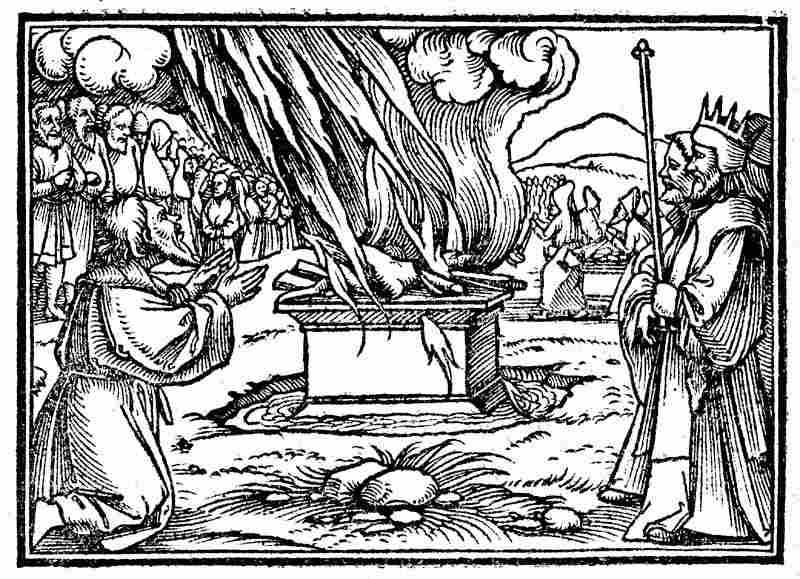
Elijah and Ahab at Mount Carmel, Zurich Bible, 1531

The Israelites agree that whichever god sends down fire will be their god. So Jezebel’s 450 prophets spend all morning and most of the afternoon calling on Ba-al, dancing, and gashing themselves, but nothing happens. Then Elijah mends the ruined altar of Y-H-V-H, stacks the firewood and the slaughtered bull, and has water poured over the whole thing. He calls to God once, and fire falls down from the sky. The fire devours the cut-up bull, the wood, the stones, the dirt, and the water.

All the people prostrate themselves, and shout:

“Y-H-V-H is God! Y-H-V-H is God!” (1 Kings 18:39)

Victory? Not enough for Elijah. He tells the Israelites:

“You must seize the prophets of the Ba-al! Not one must escape you!” (1 Kings 18:40)

They do. Elijah takes all 450 of them down to the nearest gully and slaughters them like sacrificial animals. Then he announces to King Ahab that it is about to rain at last.

The flight

This week’s haftarah opens with Elijah’s triumphal run through the rain in front of the king’s chariot, all the way from Mount Carmel to the king’s house in the Yizreil Valley, about 18 miles (29 km). There King Ahab tells Queen Jezebel what happened at Mount Carmel. She sends Elijah a message saying that she will have him killed the next day.

And he saw, and he rose, and he went for [the sake of] his nefesh. And he came to Beersheba that belongs to Judah, and he left his young man there. (1 Kings 19:3)

nefesh (נֶפֶשׁ) = soul that animates the body, life force; throat, appetite, desire.

In another time and place, a man in Elijah’s position might start a revolution against the king and queen instead of fleeing. But popular revolutions were rare in the Ancient Near East. The only one recorded in the Hebrew Bible is led by Jereboam against King Reheboam, Solomon’s son and heir. When the northern Israelites secede from Reheboam’s kingdom, they proclaim Jereboam king of their new nation.4

But biblical prophets only try to motivate people, from kings to commoners, to stop worshiping other gods, to follow God’s rules (especially the ethical ones), to refrain from certain wars, and (after the Babylonian Exile) to return to Jerusalem.

Elijah succeeds in inducing the Israelites to choose God over Ba-al. But King Ahab does whatever his wife says, and Jezebel is furious at the death of the prophets she supported. Neither converts to worshiping Y-H-V-H. So Elijah concludes that he has failed.

He travels about 200 miles (320 km) south, to the southern edge of the kingdom of Judah. He does not stop at Jerusalem to ask for asylum from King Jehosephat, who worships Y-H-V-H. Maybe he is afraid of extradition, or of a paid assassin sneaking into Jehosephat’s palace.

Or maybe he imagines spending the rest of his life as a useless courtier, instead of as a powerful prophet fighting for Y-H-V-H, and he decides a life like that is not worthwhile.

He stops at the last town before the Negev Desert, where he thoughtfully leaves his only servant. He does not want the young man to die in the desert.

Elijah, however, is ready to die. At least he will die on his own terms, not Jezebel’s.

And he walked into the wilderness, a day’s journey, and he came and sat down under a lone broom bush, and he asked for his nefesh to die. And he said: “Too much! Now, Y-H-V-H, take my nefesh, since I am no better than my forefathers!” [1 Kings 19:4]

What does he mean by the reference to his forefathers? One interpretation is that “up until this point, he has harbored an ambition that with his unique methodology, he could surpass his ancestors … Where his ancestors failed, Eliyahu HaNavi [“the prophet”] thought his innovative and more aggressive approach would succeed.” (Jachter)5

He asks for death when he concludes that he, too, has failed to turn the Israelites away from worshiping other gods.

Answer to a prayer

Two other prophets in the Hebrew Bible, Moses and Jonah, beg God for death.

Moses is fed up when he has brought the Israelites within a day’s march of the border of Canaan, and they sit and wail that they miss the food in Egypt. He never wanted the job of leading them in the first place. He tells God:

“Where am I to get meat to give to all this people, when they cry on me saying: ‘Give us meat, so we may eat it!’ I am not able to carry all this people alone by myself, because they are too heavy for me! If this is what you do to me, definitely kill me, please!” (Numbers 11:13-15)

To me this seems like a cry of desperation, not an actual desire for death. And God does not kill Moses, but rather sends so many quail that many Israelites die when “the meat was still between their teeth” (Numbers 11:33).

Jonah, like Moses, does not want the job God assigns him. He is supposed to go to Nineveh, the capital of Israel’s enemy, and proclaim that in 40 days the city will be overthrown. But he is afraid that the Ninevites might actually repent, and then God will have mercy on them. Jonah tries to run away from God, to no avail. After he finally does his job, all the Ninevites do repent, even the king. And Jonah feels frustrated, because he wants the Ninevites to die.

And to Jonah this was very bad, and he burned with anger. And he prayed to Y-H-V-H, and said: “… And now, Y-H-V-H. please take my nefesh from me, because it would be better if I die than if I live!” (Jonah 4:1–3)

To me this seems more like an ill-considered expression of anger than an actual death-wish. And God does not kill Jonah, but instead gives him an object lesson on compassion.

Is Elijah cracking under stress, like Moses? Or angry, like Jonah? Perhaps, but I think he is also seriously depressed and really does want to die. He does not merely ask God to kill him, but walks into the desert all day, then sits down in a place with shade, but no water. He has made sure that if God does not take his life immediately, he will die of dehydration.

And God does not kill Elijah, either.

And he lay down and slept under a lone broom bush. And hey, this malakh was poking him! And it said to him: “Get up! Eat!”  

malakh (מַלְאָךְ) = messenger, human or divine. A messenger from God might appear human, but is not; in that case it is often translated as “angel”.

And he looked, and by his head was a cake baked on hot stones, and a jug of water. And he ate and he drank, and he went back and he lay down. (1 Kings 19:6)

Elijah merely obeys the angel, without pausing to think about what the divine rescue might mean. He does not want to do anything, ever again.

And the malakh of Y-H-V-H returned a second time and poked him, and it said: “Get up! Eat! Or the journey will be too much for you.” (1 Kings 19:7)

Since God will not leave him alone to die, Elijah eats and drinks again, then continues walking south, all the way to Mount Sinai. There God tells him he will go on living, but he must anoint Elisha, who will replace him as the kingdom of Israel’s chief prophet.6


I can empathize with Moses when he bursts out “If this is what you do to me, definitely kill me, please!” because I, too, feel frustrated when something I didn’t really want to do in the first place is not going well due to the behavior of the other people involved. But what I really want is to get out of that particular responsibility and enjoy life.

I also feel mildly depressed now and then, but I am grateful that I have never felt so depressed I wanted to die. Poor Elijah could not imagine life without his mission: to convert the whole kingdom of Israel to the worship of Y-H-V-H. My own mission is smaller: I just want to write about Torah.


  1. See my post Pesach: Who Is Elijah?
  2. 1 Kings 17:1.
  3. Mount Carmel is one of the hills just east of present-day Haifa.
  4. 1 Kings 12:1-20.
  5. Chaim Jachter, From David to Destruction, 2019, reprinted in www.sefaria.org.
  6. See my posts Haftarat Pinchas—1 Kings: The Sound of God and Haftarat Pinchas—1 Kings: Passing On the Mantle.

Beha-alotkha: Cold Feet, Dry Throat

The Israelites followed Moses out of Egypt in an adrenaline rush. After years of being treated as sub-human disposable labor by the pharaoh and most Egyptians, they were free! Their Egyptian neighbors gave them gold, silver, jewels, clothes, swords—anything to make them leave so the plagues would end.1 Moses told his followers that God would give them the whole land of Canaan as their own country.2 They did not wonder what would happen to Canaan’s current inhabitants. All they had to do was follow God and God’s prophet, Moses, to happiness and glory.

An adrenaline rush does not last. Anxiety plagued the people along the way, because everything depended on God’s help. They panicked when God delayed in rescuing them from the Egyptian chariots at the Reed Sea,3 and they panicked whenever they were uncertain about food or water.4 When Moses disappeared into the fire on top of Mount Sinai for 40 days, they panicked so much that they made a golden calf for God to inhabit.5 Then God gave them an alternative, and they spent a contented year making a portable tent-sanctuary for God to dwell in.

But once the new Tent of Meeting was completed and its new priests were ordained, it was time to leave Mount Sinai and head north toward Canaan.

Military service

When the book of Numbers opens, God tells Moses to take a census of men aged 20 and over—

“—everyone in Israel going out to war; you will muster them for their troops, you and Aaron.” (Numbers 1:2)

Illustration of Numbers 2, by Jan Luyken, 1673

There is a separate census of the Levites, whose war duty is to guard the Tent of Meeting while the Israelites are encamped. Each Levite clan is assigned a campsite next to one side of the Tent, and the other twelve tribes must camp in a larger square around them. (There are twelve tribes not counting the tribe of Levi, because at this point the descendants of Joseph count as two tribes, Efrayim and Menashe.)

And God spoke to Moses and to Aaron, saying: “Each in its contingent, under the banner of their fathers’ house, the Israelites will camp, at a distance surrounding the Tent of Meeting they will camp. Those camping eastward, toward sunrise: the contingent of the camp of Judah, by their troops … (Numbers 2:1-3)

When they pull up stakes, they will travel in military formation, from Judah at the front to Naftali at the rear. (The Torah does not tell us where the women and children are in this army; we are left to assume they are walking with the men of their tribes.) And God will give the marching orders. This week’s Torah portion, Beha-alotkha, reminds us:

At God’s order the cloud would rise up from above the tent, and after that the Israelites would break camp; and in the place where the cloud would settle down, there the Israelites would camp. (Numbers 9:17)

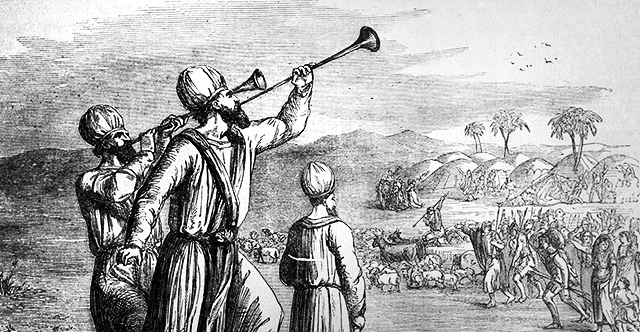
Silver trumpets in Numbers 10, 19th-century illustration

But then we learn that the signal of the divine cloud is not enough; God also calls for two silver trumpets. When a priest blows a single short blast, the leaders of the Israelites must assemble at the Tent of Meeting for instructions. A longer, trilling blast means that that the people must march.

And when you enter into battle in your land with an attacker who attacks you, then the trumpets should cry out, and you will be remembered before God, your God, and you will be delivered from your enemies. (Numbers 10:9)

Thus when the Israelites finally leave Mount Sinai, they leave as an army expecting to fight for the land of Canaan.

Rebellion

They march north for three days, then camp in the Wilderness of Paran.

And the people became like bad complainers in the ears of God. God heard, and [God’s] nose heated up [with anger]. And a fire of God burned against them, and it ate up the outer edge of the camp.  Then they wailed to Moses for help, and Moses prayed to God, and the fire sank down. (Numbers 11:1-3)

The book of Numbers does not tell us what the people are complaining about this time. According to Rashi, they felt sorry for themselves because they had walked for three days without stopping to camp, and they were weary.6 But according to Da-at Zekinim,

“The people were already mourning the potential casualties they would incur when going into battle against the Canaanites in order to conquer their land. They were lacking in faith and dreading warfare.”7

After the fire, people start complaining again.

Still Life with a Plate of Onions, by Van Gogh, 1889

Then the asafsuf who were among them felt a lusting lust. And moreover, the Israelites turned away and wept, and they said: “Who will feed us meat? We remember the fish that we ate in Egypt at no charge, the cucumbers and the melons and the leeks and the onions and the garlic! And now our nefesh is dry. There is nothing except for the manna before our eyes!” (Numbers 11:4-6)

asafsuf (אֲסְפְּסֻף) = rabble, riffraff; the non-Israelites who joined the exodus from Egypt. (They are called the eirev rav (עֵרֶב רַב)—the“mixed multitude”—in Exodus 12:38.)

nefesh (נֶפֶשׁ) =throat, appetite, life (in the sense of the animating force that makes one’s body alive).

First the asafsuf feel a lusting lust. Some commentators have written that they crave forbidden sexual relations; others that they lust for meat, and the Israelites pick up on their complaint. The manna that God provides every morning magically meets everyone’s nutritional needs, but not their emotional needs.

Their fond memories of some of the foods they ate in Egypt reveal that sometimes they wish they were still Pharaoh’s servants, instead of God’s. “… we are confronted by yearnings and nostalgia for a humdrum, small-time existence, a life of serfdom subject to their habits, passions and desires.” (Leibowitz)8

Life as God’s people seems too hard. In Egypt, they did not need to exercise any self-discipline, or follow so many rules. As long as they did whatever their foremen told them to, for as many hours as they were forced to work, they were fed “at no charge” and they could indulge in whatever pleasures they liked during their miniscule amounts of free time.

“The terrible price they had to pay for this give-away diet—slavery, suffering, persecution, murder of their children—is conveniently forgotten.” (Abravanel)9

Yet they lived at Mount Sinai for a year without complaining, the year when they were engaged in making the Tent of Meeting for God—a cooperative project calling for skilled craftsmanship. What has changed now, a three-day journey north of the mountain?

I would argue that now they are facing war, against unknown enemies. None of the Israelites were soldiers in Egypt. They engaged in only a single battle on their journey to Mount Sinai, when Amalek attacked them.10 The only other time anyone used the swords they took from Egypt was right after the golden calf worship, when Moses ordered the Levite men to go through the camp and kill the worst offenders.11

Yes, God rescued them many times on the way to Mount Sinai. But how could God make it easy to fight a long war against the Canaanites and seize all their land? They are not soldiers. How can they face all those battles? If God will no longer let them live quietly in the wilderness, they would rather be slaves in Egypt. Just thinking about the war ahead fills them with fear and dread. And they are close to the southern border of Canaan now. Desperate for a distraction and a respite from anxiety, the people long for comfort food.


We all live with anxiety about what will happen next. We might be afraid of an attack, or we might worry about our health, our work, our family, our country, our world. And most of us know about “good” strategies for managing anxiety and carrying on. I used to take long walks while singing prayers. These days, I find respite by studying and writing about Torah, and I fortify myself with naps, physical therapy, and nutritious food such as fish and leeks.

But when too many appointments and obligations use up my self-discipline, and I feel overwhelmed, I sit down with a pint of gelato. I crave sensual distraction. So I slowly savor every spoonful of gelato. Sometimes it takes a whole pint before I calm down.

I feel sorry for the people in this week’s Torah portion, who only have manna and memories.


  1. Exodus 11:1-3, 12:33-36 and 13:18.
  2. Exodus 6:2-8, 12:25, 13:5, 13:11
  3. Exodus 14:1-31.
  4. Exodus 15:22-25, 16:2-3, 17:1-7.
  5. Exodus 24:17-18, 32:1-6. See my post: Vayakheil & Ki Tisa: Second Chance.
  6. Rashi is the acronym of 11th-century rabbi Shlomoh ben Yitzchak.
  7. Da-at Zekinim, a 12th-13th century collection of commentary by tosafists, translation in www.sefaria.org.
  8. Nehama Leibowitz, Studies in Bamidbar (Numbers), translated by Aryeh Newman, The World Zionist Organization, Jerusalem, 1980, pp. 95.
  9. Yitzchak Abravanel, 15th century, quoted and translated in Leibowitz, p. 99.
  10. Exodus 17:8-13.
  11. Exodus 32:26-28.

Beha-alotkha & Ki Tisa: Calf Replacement

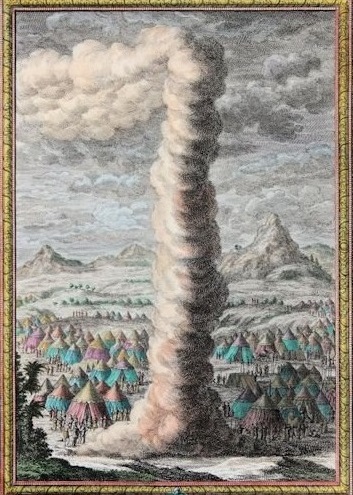
When the Israelites arrive at Mount Sinai in the book of Exodus, they are led by God’s pillar of cloud by day and fire by night, as well as by God’s prophet Moses. When they leave in the book of Numbers, they are led by God’s cloud and fire, and Moses, and the ark.

It sounds like a net gain. But it was nearly a total loss.

Descent in Exodus

The Israelites, who spent their whole lives under Egyptian rule, are deeply insecure when they head into the wilderness. They cannot believe God will rescue them—from the Egyptian chariot army, from thirst, from hunger. After they reach Mount Sinai, God puts on an impressive revelation including fire, smoke, lightning, thunder, and shofar-blasts. The people tremble as violently as the mountain,1 and they unanimously pledge to do everything God commands.2

But all they really learn is that God is powerful, not that they can trust God to get them to Canaan and help them conquer it, as promised.

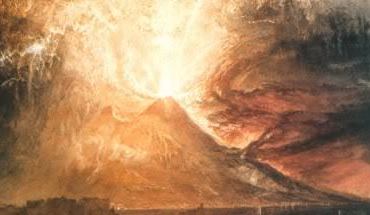
Vesuvius in Eruption, by J.M.W. Turner, 1817

When Moses climbs Mount Sinai for his first forty-day stint, the presence of God at the summit looks like a cloud to him. But it looks like a “consuming fire” to the Israelites.3 How could anyone, even a prophet of Moses’ stature, come back out of that fire alive?

The Israelites below fall into despair in the Torah portion Ki Tisa (Exodus 30:11-34:36), just as God finishes giving instructions to Moses and inscribes some words on a pair of stone tablets.

Then the people saw that Moses was delayed in coming down from the mountain, and the people assembled against Aaron and said to him: “Get up! Make us a god that will go in front of us, because this man Moses who brought us up from the land of Egypt, we do not know what has become of him!” (Exodus 32:1)

The Israelites are afraid to go any farther in the wilderness without Moses. Furthermore, God’s pillar of cloud and fire, which led the way to Mount Sinai,4 seems to have disappeared when they arrived.5 (Perhaps the divine pillar changed shape and relocated to the top of the mountain?) So, grasping at straws, they ask Aaron, Moses’ brother, to make them an idol “to go in front of us”. They would not expect a statue to walk, but they must hope that God would inhabit the idol, as the Egyptian gods inhabited statues in Egypt. Then if the idol were carried on a cart in front of them, God would, in a sense, be leading them. (See my posts Ki Tisa: Golden Calf, Stone Commandments and Ki Tisa: Making an Idol Out of Fear.)

Since the people “assembled against Aaron”, I suspect Aaron was telling them to wait a little longer for Moses to return. But now he caves in, and asks them to bring him gold earrings.

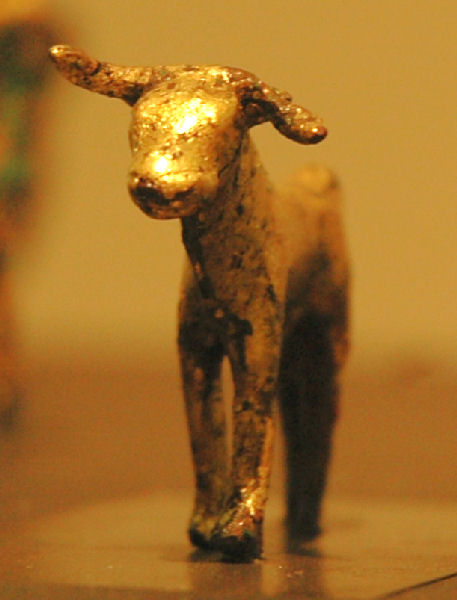
Golden calf figurine from temple of Baalat, Byblos

And he took [the gold] from their hands and he shaped it in a mold, and he made it into a statue of a calf. And they said: “This is your God, Israel, who brought you up from the land of Egypt!” And Aaron saw, and he built an altar in front of it. And Aaron called out and said: “A festival for Y-H-V-H tomorrow!”  (Exodus 32:4-5)

The Israelites worship the golden calf as if the God of Israel, whose personal name is Y-H-V-H, were inhabiting it. Nobody mentions that God has already prohibited making or worshiping any statue.

On the mountaintop above, God tells Moses what is happening, and threatens to wipe out all the Israelites and make a nation out of Moses’ descendants instead. Moses talks God out of it. Then he carries the stone tablets down to the camp below—and smashes them. The Levites kill 3,000 calf-worshipers at Moses’ command. And God kills additional people with a plague.

After that, God tells Moses that the Israelites should still go north and conquer Canaan.

“And I will send a malakh in front of you, and I will drive out the Canaanites …. But I will not go up in your midst, lest I destroy you on the way, because you are a stiff-necked people.” (Exodus 33:1,3)

malakh (מַלְאָךְ) = messenger. (In most English translations, a malakh from God is called an angel. A divine malakh can look like a man, or look like fire, or be a disembodied voice.)

And [when] the people heard this bad news, they mourned, and not one man put on his ornaments. (Exodus 33:4)

Their human leader is with them again, but the people want their divine leader as well. How will they know that God is with them, and they are going the right way, unless God’s pillar of cloud and fire is in front of them?

Moses knows a malakh would not be enough to reassure the Israelites, so he tells God:

“If your presence is not going, don’t you make us go up from this [mountain]!” (Exodus 33:15)

And God agrees to go with the Israelites for Moses’ sake. Only then does Moses pass on to the people the instructions God gave him for building a tent-sanctuary so God can dwell among them. The people eagerly donate materials and labor. They spend a year making everything, from the courtyard enclosure to the gold-plated ark inside the Holy of Holies. Then Moses assembles the sanctuary.

And Moses finished the work. And the cloud covered the Tent of Meeting, and the glory of Y-H-V-H filled the mishkan. (Exodus 40:33-34)

mishkan (מִשְׁכָּן) = Literally: dwelling-place (from the root verb shakhan, שָׁכַן = settle, stay, inhabit, dwell). In practice throughout the five books of the Torah: God’s dwelling-place, God’s sanctuary.

So God is willing to inhabit the tent-sanctuary, but not a gold statue. The book of Exodus ends:

For a cloud was over the mishkan by day, and fire was in it by night, in the sight of all the House of Israel on all their journeys. (Exodus 40:38)

Ascent in Numbers

The Israelites finally resume their journey to Canaan in this week’s Torah portion, Beha-alotkha (Numbers 8:1-12:16). Just before this Torah portion begins, the Torah indicates that unlike the golden calf, the two gold statues of keruvim (hybrid winged creatures) rising from the gold cover of the ark are not idols.

And when Moses came into the Tent of Meeting to speak with [God], then he heard the voice speaking to him from above the cover that was on the Ark of the Testimony, from between the two keruvim. (Numbers 7:89)

In other words, God speaks to Moses from the empty space between the two gold statues.

When the Israelites are finally ready to set out for Canaan, the Torah refers back to the end of Exodus.

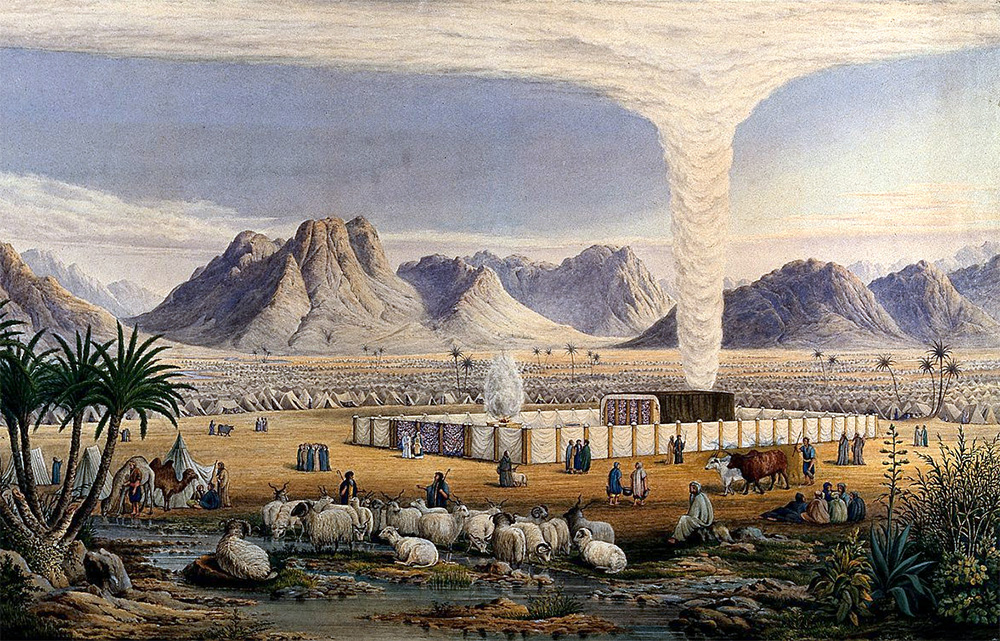
The Tabernacle in the Camp, Collectie Nederland

And on the day the mishkan was erected, the cloud covered the mishkan for the Tent of the Testimony; and in the evening it was over the mishkan as an appearance of fire, until morning. Thus it was always: the cloud covered it, and appeared as fire at night. And according to when the cloud was lifted up from over the tent, after that the Israelites set out; and at the place where the cloud settled, there the Israelites camped. (Numbers 9:15-17)

The cloud by day and fire by night is not described as a pillar here; its shape is not mentioned at all. But it serves at least one of the purposes of the pillar of cloud and fire that led the Israelites from Egypt to Mount Sinai.

Whether for days or a month or a long time, when the cloud lingered over the mishkan, staying over it, the Israelites were camped, and they did not set out. But when it was lifted, they set out. (Numbers 9:22)

The other purpose of the pillar of cloud and fire was to indicate the direction of travel. This purpose is implied later in this week’s Torah portion:

And they set out from the mountain of God on a journey of three days, and the ark of the Covenant of God  traveled in front of them a journey of three days to seek out a resting place for them. (Numbers 10:33)

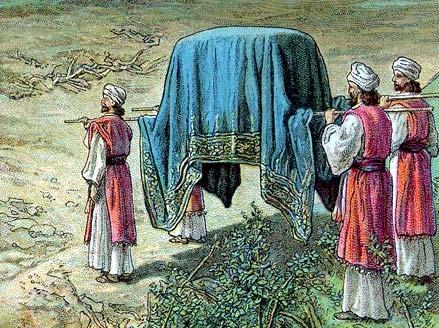
The ark, as we learned earlier in the book of Numbers, is covered by a curtain, a sheet of leather, a blue cloth, a crimson cloth, and another sheet of leather when the people travel6—both to honor it and to make sure nobody sees it. Levites from the clan of Geirshon carry it by the wood poles extending from the bottom of the ark.

The portion Beha-alokha contains two different descriptions of the location of the ark when the Israelites are traveling. First it describes the tribes of Judah, Yissachar, and Zevulun setting out, followed by Levites carrying the ark and other pieces of the mishkan.7  Then it says “the ark of the Covenant of God  traveled in front of them”. Either way, the ark goes wherever the Levites gripping the poles take it, so how can it “seek out a resting place”?

And the cloud of God was above them by day, when they set out from the camp. (Numbers 10:34)

If the divine cloud hovers over the marching Israelites all day, then it could indicate the direction of travel by veering off. The Israelites would respond with a course correction—just as they did when the pillar of cloud by day and fire by night led them from Egypt to Mount Sinai.

And the cloud can still take the shape of a pillar. When God orders Moses, Miriam, and Aaron rto report to the entrance of the mishkan,

Then God came down in a pillar of cloud and stood at the entrance of the tent, and called: “Aaron and Miriam!” And the two of them went forward. (Numbers 12:5)

Thus God addresses the anxious insecurity of the Israelites by traveling with them in person, so to speak, in the form of the cloud above them. They also have Moses, the man who arranged their liberation from Egypt and who communicates regularly with God. And they have the ark as a symbol of God’s presence among them even when the mishkan is disassembled and God is not currently speaking to Moses from above the ark.


I have friends who want to believe God is leading them. None of them see pillars of cloud by day and fire by night, as far as I know. But they often notice signs and omens (what I would call coincidences) that reassure them God is in charge and they are being led in the right direction.

I don’t blame them, any more than I blame the Israelites marching toward the unknown dangers of the land of Canaan. The wilderness of this world is frightening.


  1. Exodus 19:16-18, 20:15-16.
  2. Exodus 24:3, 24:7.
  3. Exodus 24:15-18.
  4. Exodus 13:21-22.
  5. So many commentators conclude, since throughout their stay at Mount Sinai no pillar is mentioned until they have finished building the sanctuary. Then God’s cloud by day and fire by night settles on the sanctuary tent, and lifts to signal that it is time for them to travel on (Exodus 40:33-34-38).
  6. Numbers 4:5-8. See my post: Bemidbar: Covering the Sacred.
  7. Numbers 10:13-17.

Beha-alotkha: Waving Levites

Moses, Aaron, and Miriam, the leaders of the Exodus from Egypt, were born into the tribe of Levi.1 When the Israelites are wildly worshiping the Golden Calf, Moses calls out:

“Whoever is for God, to me!” And all the sons of Levi gathered to him. (Exodus 32:26)

Numbering of the Israelites, by Henri P.E. Philippoteaux, 19th century

The male descendants of Levi obey Moses’ order to go through the camp killing the calf-worshippers. But the Levites are not specifically mentioned again until the book of Numbers, which begins with a census of all the men of Israel who are twenty years old and above and are able to bear arms. The three priests (Aaron and his two surviving sons, Elazar and Itamar) and the tribe of Levi are excluded.

And God spoke to Moses, saying: “Indeed, you must not muster the tribe of Levi; you must not lift their heads [i.e. count them in a census] among the sons of Israel. You must assign the Levites over the Sanctuary of the Testimony, and over all its gear, and over all that belongs to it. They will carry the sanctuary and all its gear, and they themselves will guard it, and they will camp all around the sanctuary.” (Numbers/Bemidbar 1:48-50)

The “Sanctuary of the Testimony” is the portable tent-sanctuary the Israelites made for God in Exodus, with the “Ark of the Testimony” in its rear chamber, the Holy of Holies. This sanctuary is also called the Tent of Meeting, since Moses and God converse there.

Later in the first Torah portion of Numbers, Bemidbar, God adds:

“Bring forward the tribe of Levi and station them in front of Aaron hakohein, and they will wait on him. And they … serve the service of the sanctuary.” (Numbers 3:6)

hakohein (הַכֹּהֵן) = the priest (usually the high priest). Kohein (כֺּהֵן) = priest, and kohanim (כֺּהֲנִים) = priests.

The book of Numbers establishes three categories of people: priests (Kohanim), Levites (Leviyim), and Israelites (Yisrael). Even today, when Jews give their Hebrew names at services, those descended from the Kohanim add “hakohein” and those descended from the Leviyim add “halevi”.2 All other Jews are in the Yisrael category.

The priests (kohanim) and the Levites (Leviyim) get their ordination in two different books of the Torah. This week’s Torah portion, Beha-alotkha (Numbers 8:1-12:16) ordains the Levites in a ceremony that treats them like an animal offering.

But the first priests are ordained in the book of Leviticus, when the altar is inaugurated.3 Their ordination ceremony treats them like the altar.

Ordination of priests

This ordination of priests begins when Moses washes Aaron and his sons with water, dresses them in their new vestments, and anoints both the men and the altar and sanctuary-tent with oil. Then Moses, acting as a priest for the last time, slaughters a bull and two rams. The second ram is the ordination offering. After Aaron and his sons have laid their hands on its head, Moses slaughters it, then applies its blood, mixed with oil, to the corners of altar as well as to the right ears, right thumbs, and right big toes of Aaron and his sons. (See my post Tzav: Oil and Blood.) In other words, the priests are consecrated the same way as the altar, with anointing oil and blood.

After the blood-dabbing, the new priests hold out their hands, and Moses gives them the fat parts of the ram, its right thigh, a loaf of bread, and two cakes.

And he placed everything on the palms of Aaron and his sons, vayanef them as a tenufah before God.” (Leviticus/Vayikra 8:27)

vayanef (וַיָּנֶף) = and he waved, moved back and forth. (A form of the verb nuf, נוּף = move back and forth, wave, lift.)

tenufah (תְּנוּפָה) = wave-offering. (A noun derived from the root verb nuf, but often translated as  “elevation offering” because the offering is usually lifted in the priest’s hands before being waved.)

This is the first tenufah in the Torah, but a tenufah is prescribed for many types of offerings in the book of Leviticus. The object lifted and waved before being given to God is often, but not always, the portion of an offering reserved for the priests to eat. In this instance, Moses appears to be guiding the hands of the new priests in the correct waving movements.

Ordination of Levites

Serving as  priest is a full-time job in the Torah. Someone else has to cover the remaining work to keep the religion going: the Levites.

In the first two Torah portions of the book of Numbers, the Levites are given responsibility for  disassembling the Tent of Meeting, transporting the pieces (as well as the sacred objects, which the priests have wrapped), and re-erecting the tent and courtyard—every time the people travel to a new campsite. They must also guard the tent from intruders, and assist the priests as requested.4

The [Levite] Choristers, by James J.J. Tissot, circa 1900

When the second temple in Jerusalem is erected in the books of Ezra and Nehemiah, the Levites are divided into singers and musicians, gatekeepers, and temple servants.5 Levites are also assigned the duty of collecting tithes (under the supervision of priests).6

The Levites are ordained in this week’s Torah portion in Numbers, Beha-alotkha. While the priests’ ordination treats them like the altar, the Levites’ ordination treats them like pieces of an offering at the altar.

Both ceremonies begin with washing for ritual purification, but the Levites do it a different way from the priests.

And God spoke to Moses, saying: “Take the Levites from among the Israelites and purify them. And this is what you will do to purify them: Sprinkle water of exoneration over them, and make them pass a razor over all their flesh; and they should wash their clothes and purify themselves.” (Numbers 8:5-7)

Animal offerings are already pure, since the animals must be not only kosher, but also without any physical blemishes.7

“And you must bring forward the Levites in front of the Tent of Meeting, and assemble the whole community of Israelites. And you will offer the Levites in front of God, and the Israelites will lay their hands on the Levites.” (Numbers 8:9-10)

Anyone who offers an animal at the altar first lays a hand on its head. But here, all the Israelites lay hands on the Levites—making the men of Levi their offering to God.

“Then the Levites will lay their hands on the heads of the bulls, and make one of them an exoneration-offering and the other a rising-offering for God, to make atonement for the Levites. Then you shall station the Levites in front of Aaron and in front of his sons, veheinafta them tenufah for God.” (Numbers 8:12-13)

veheinafta (וְהֵנַפתָּ) = and you will wave; and you have waved. (Another form of the verb nuf.)

At their own ordination ceremony, the priests wave choice parts of their animal and grain offering. But at their subordinates’ ordination ceremony, the priests wave the Levites themselves—after the Israelites have laid hands on them. The living men in the tribe of Levi are a tenufah from the Israelites to God.

We can only speculate about how these men were waved back and forth by the three priests. According to Kohelet Rabbah, “Rabbi Abba bar Kahana said: Aaron [picked up and] waved twenty-two thousand Levites on one day.”8

“And you will segregate the Levites from among the Israelites, and the Levites will be mine. And after this, the Levites will come to serve the Tent of Meeting, when have purified them veheinafta them as a tenufah. Because they were definitively given to me from among the Israelites to replace the openers of all wombs, the firstborn if all the Israelites, for me to take them.” (Numbers 8:14-16)

This quote from God reaffirms that the firstborn sons of various clans in every tribe will no longer run the family’s religious practice. From the portion Beha-alotkha on, religious positions in Israelite society are the sole prerogatives of hereditary priests and Levites.


Rabbis, rather than priests, have been the Jewish religious authorities since 70 C.E., when the second temple in Jerusalem was destroyed. Today any Jew can study and be certified as a rabbi, regardless of ancestry. The ordination ceremony includes smichah, in which established rabbis lay hands on the heads of the new rabbis.

There are also a number of supporting roles to keep Jewish communities going, from cantors and other service leaders to kosher butchers; these, too, depend on training rather than ancestry. When there is a ceremony to recognize people taking on these roles, it might also include smichah, but I have never heard of anyone waving the initiates back and forth.

Religious practices in the Torah are full of blood and slaughter. I thank God that Jews no longer have a temple with an altar, that we have moved on to addressing God through words rather than through burning dismembered animals. But I would like to see Levites being waved.


  1. Exodus 6:16-20.
  2. Genetic research has shown that most men called kohanim today do share a genetic marker. The leviyim do not, but the designation is still handed down through the generations by tradition.
  3. The ritual is prescribed in Exodus 29:4-29 and performed in Leviticus 8:1-9:24.
  4. Numbers 1:50-51. See my post Bemidbar & Naso: Dangerous Duty.
  5. Ezra 2:40-55, 3:10-11, 7:7, 7:24 and Nehemiah 7:1-46. (1 Chronicles 6:16-18 claims that King David appointed Levites to sing in front of the tent-sanctuary in Jerusalem before Solomon built the first temple, but Chronicles was written after the books of Ezra and Nehemiah, at least five centuries after the time of David. Rabbis in the Talmud claimed that some Levites were singers even in the book of Numbers, but there is no actual textual evidence. 1 Chron. 9:21-27 makes a similar specious claim regarding gatekeepers.)
  6. Nehemiah 10:38-40.
  7. See my post Emor: Flawed Worship.
  8. Kohelet Rabbah 12:7:1, written 700-950 C.E./, translated in www.sefaria.org.

Beha-alotkha & Metzora: Fresh Start

A new station in life calls for a ceremony—a wedding, a commencement, an inauguration, an ordination. At Mount Sinai the Israelites receive a new formal religion, and consecrate two groups of men to administer it: priests (kohanim) and Levites (levi-im).

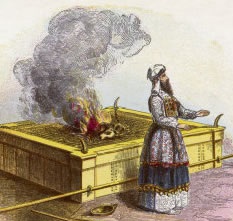
Altar and priest, Treasures of the Bible, Northrop, 1894

The first priests to serve at the new tent-sanctuary for God undergo an eight-day ordination in the book of Leviticus/Vayikra. Before then, any head of a household could build a stone altar and burn an animal offering for God. Noah, Abraham, Isaac, Jacob, and Moses all did it. But after Moses has ordained Aaron and his sons, only they can make the daily offerings at the altar, light the menorah, place bread and frankincense on the table, and burn incense on the incense altar.1

Aaron’s two older sons bring unauthorized incense into an unauthorized place on their first day of service, and God kills them.2 In the new religion, priesthood is a dangerous vocation. Aaron and his two younger sons are meticulous about following God’s rules.

The Levites replace the firstborn sons as acolytes when God reorganizes the religion at Mount Sinai. In this week’s Torah portion, Beha-alotkha, God reminds Moses:

“For every firstborn from the Israelites is mine, from human and from beast; on the day I struck down every firstborn in the land of Egypt, I consecrated them as mine. Now I take the Levites instead all the firstborn of the Israelites.” (Numbers 8:17-18)

Serving as a Levite could also be a hazardous job, as I wrote in last week’s post: Bemidbar & Naso: Dangerous Duty. Any close contact with the God of Israel carries grave risks.

The ordination of the Levites includes animal offerings similar to those in the ordination of the priests, but other elements of the ritual are dissimilar. One difference is that while priests are forbidden to shave any part of their bodies, the Levites must shave their entire bodies for their ordination.

“Take the Levites from among the Israelites and ritually purify them. And thus you shall do to them to make them ritually pure: sprinkle over them water of expiation3 and make a razor pass over all their flesh. And they shall clean their clothes, and they shall ritually purify themselves.”  (Numbers 8:6-7)

Shaving as disfigurement

Shaving is not an everyday activity in the Hebrew Bible. Shaving the scalp or beard is considered disfiguring, like gashing the skin; both are mourning practices indicating one’s abandonment to grief, along with tearing good clothing, wearing sackcloth, and throwing dust or ashes on one’s head.4

Priests and nazarites are expected to put their dedication to God first, so they are forbidden to engage in shaving or gashing when someone close to them dies.5 Male and female nazarites must not cut their hair at all during the term of their vow, but on the day their term ends, they shave their heads and burn their hair as an offering to God.6

Furthermore, the Torah forbids all Israelites to shave specific spots on their heads (possibly places that worshipers of other gods shaved).7

However, two groups of people must shave not just the whole head, but the whole body: those who have recovered from the skin disease tzara-at, and the Levites being ordained in this week’s Torah portion.

Shaving the metzora

A person who has tzara-at must live outside the camp, excluded from the community’s social and religious life. If the skin returns to normal, the person must undergo an elaborate ritual purification in order to return to society. The Torah portion Metzora in the book of Leviticus opens:

And God spoke to Moses, saying: “This will be the instruction for the metzora at the time of his ritual purification, when [the news] is brought to the priest.”

metzora (מְצֺרָה) = one afflicted with the skin disease tzara-at (צָרַעַת), characterized by one or more patches of scaly white skin that is depressed (tzirah, צִרְעָה) compared to the surrounding skin.

Metzora ritual, detail, by Simon Fokke, 18th cent.

If the priest pronounces the metzora healed from the disease, the ensuing ritual includes cleaning their clothes and shaving—elements that are also included in the consecration of the Levites.8

And it will be on the seventh day he shall shave all of his hair and his beard and his eyebrows; all his [body] hair he will shave. And he shall clean his clothes and wash his flesh in water, and he will be ritually pure. (Leviticus 14:9)

Only a healed metzora and the Levites inducted into sanctuary service are commanded to do full-body shaving.9 Does this imply a deeper similarity between them?

Shaving for separation

In the 20th century, Rabbi W. Gunther Plaut suggested that both kinds of people are separated from the rest of the community; the metzora is separated physically until the skin condition disappears, while the Levite is separated spiritually after consecration.10 After ordering the ordination ritual for the Levites, God adds:

“And you shall separate the Levites from among the Israelites, and the Levites will be mine.” (Numbers 8:14)

Shaving for abnegation

According to the Talmud, God afflicts individuals with tzara-at to punish malicious speech and arrogance.11 One example appears in the portion Beha-alotkha after Miriam criticizes her younger brother Moses’ marriage, and adds that God speaks not only through Moses, but through her and her older brother Aaron as well.

And God’s nose burned against them, and [God] left. And the [divine] cloud withdrew from over the Tent, and hey! Miriam was a metzora [with scales] like the snow!” (Numbers 12:9-10)

In the 19th century, Rabbi Samson Raphael Hirsch wrote that both the metzora and the Levites must renounce their selfish concerns: “This is true of the Levi’im: Until now, they led merely private lives, as was their right; but from now onward they must assume the service the community… And this is also true here of the metzora: Until now, he lived only for himself—selfishly and antagonistic toward society; and this was his main sin. From now onward he must undertake the self-sacrifice of his duties toward the community. In both cases … man must cease living only for himself. Hair is intended to protect the body … Stripping a body of all hair exposes it to the effects of the outside world.”12

Shaving for transition

In the 11th-century, Rashi summarized this argument by another French rabbi, Moshe ha-Darshan: The Levites were substitutes for the firstborn, the firstborn had worshiped the golden calf, and Psalm 106:28 calls idol-worship “offerings to the dead”. Therefore the Levites had to shave their bodies like a metzora, who is also called dead—when God afflicts Miriam with tzara-at in this week’s Torah portion.

And Aaron said to Moses: “Oh, my lord, please don’t put guilt on us for our foolishness that we were guilty of! Please don’t let her be like a corpse that emerges from the womb of its mother and half its flesh [looks] eaten away!” (Numbers 12:11-12)

It does not make sense to equate the appearance of Miriam’s skin disease with the offerings of the people the Levites are replacing. Yet death and rebirth are implicit in both ceremonial shavings.

If shaving one’s head is a mourning practice, then shaving one’s whole body might be a reminder of the death of one’s old identity.

I agree with Hirsch that both the Levites and a metzora are purified and sanctified in order to rise above their self-centered concerns and step into a new role in the community. The Levite must become a servant of God, the priests, and the new religion; the ex-metzora must become an ethical and thoughtful member of society.

Shaving the entire body makes someone even more hairless than a newborn infant. The Levite and the ex-metzora must abandon their previous adult identities along with their hair, and be born into their new lives.

  1. Leviticus 8:1-9:24.
  2. See my post Shemini: Fire Meets Fire.
  3. chata-at (חַטָּאת) = guilt, wrongdoing, ritual error; expiation of wrongdoing, ritual error, or ritual impurity. Anyone who has been in contact with a human corpse is impure until sprinkled with water of chata-at (Numbers 19:1-22).
  4. Jeremiah 41:5, Micah 1:16. These mourning practices were widespread in the Ancient Near East; cf. Deuteronomy 21:12, Isaiah 15:2, Jeremiah 48:37, Ezekiel 27:31.
  5. Leviticus 21:1-6, Ezekiel 44:20, Numbers 6:5.
  6. Numbers 6:5, 6:13-18. See my post Naso: Distanced by Hair.
  7. Leviticus 19:27 bans rounding off the hair at the temples, the sideburns, or the edges of the beard. Deuteronomy 14:1 bans shaving “between the eyes”. (See my post Re-eih: Eyebrows for the Dead.)
  8. See my post Metzora: Time to Learn, Part 2.
  9. The only other reference to full-body shaving in the Hebrew Bible is in Isaiah 7:20, part of a prophecy about a sign from God rather than a command for people to obey.
  10. Gunther Plaut suggests this answer in his commentary on Numbers 8:7 in The Torah: A Modern Commentary, ed. by Plaut, Union of American Hebrew Congregations, New York, 1981, p. 1075.
  11. Talmud Bavli, Arakhin 15b-16a. Several of the Talmudic rabbis cite Psalm 101:5 as their proof text.
  12. Rabbi Samson Raphael Hirsch, The Hirsch Chumash: Sefer Vayikra, Part 1, trans. by Daniel Haberman, Feldheim Pub., Jerusalem, 2002, pp. 438-439.

Beha-alotkha: Miriam Looks Back

(I am writing a Torah monologue from the viewpoint of Reuben for my book on Genesis.  As Jacob’s firstborn son, he keeps trying to do the right thing and manage his eleven brothers, but he keeps getting it wrong.

So for this week’s Torah portion in the book of Numbers, Beha-alotkha, I am sharing a Torah monologue I wrote back in 2008 from the viewpoint Miriam as she tries to figure out what she did wrong.)

Miriam Looks Back (Beha-alotekha)

My God, my God, why did you do this to me?  One moment I’m Miriam the Prophetess—old, healthy, strong, respected, looked up to.  The next moment—I’m an abomination, afflicted with tzara’at, shedding scales like drifts of sand.  Unclean, unclean! —shamed and shunned, seven days outside the camp.  And I’ve only been here for one day.  I’ve got six more days to get through.

Why did you do this to me, God?  The itching is unbearable!  No, I take that back.  The itching is a temporary inconvenience, but it’s all part of God’s plan, and I accept it humbly.

Rrrr!  Look at me now!  Scaly as a snake, white as—salt.  Reminds me of Lot’s wife, when she looked back at Sodom burning, and she turned into a pillar of salt.

Because she looked back—

But I never look back.  I always look forward, because I have faith in you, God.  Whenever the men whine about the cucumbers, melons,  leeks, onions, and garlic they used to eat in Egypt, what do I do?  I invent another recipe for manna.

Women Dancing, by J.J.J. Tissot

And when we left Egypt, grabbing whatever we could, I packed my timbrel.  Because I knew we’d have a reason to celebrate.  Even when the Pharaoh’s chariots came after us, I knew sooner or later we’d be singing and dancing and praising you, God.

I bet you didn’t expect an old lady to dance like that, did you?

Hey, I was forward-looking even when I was young, before Moshe was born.  Remember when Pharaoh ordered the Egyptians to drown every Hebrew baby boy?  How my father, Amram, told the other Hebrew men to separate from their wives?  He said, it’s better not to make a baby at all, than to see him drowned in the Nile.

But I said, what about the girl babies?  I said, I had a vision about a boy who escaped.  I said, someday God’s gonna hear our groaning and rescue us.  I said, in the meantime, let’s grab as much life as we can, even under the shadow of death.  I said, I’m going ahead with my wedding, and you should tell all the married men to go back to their wives’ beds, and bring some light into the night!

And my father did just what I said.  Turned out well, didn’t it?

But now, when I try to give my little brother Moshe some advice, hhhh!  God strikes me with tzara’at, and I’m shedding scales all over the place, and everyone turns away from me because I’m unclean, and here I am stuck outside the camp, waiting out my sentence, seven days of shunning, and why did you do this to me, God?

But I’m not complaining.  I have a good attitude.  I know this is all for the best.  Somehow.

*

One, two, three …  Day four.  I’m halfway through my seven days outside the camp.  Halfway through this long, long week.  But I’m not complaining!

Though I still don’t know why I’m being punished for giving my brother some advice.  Listen, I know Moshe is way above my level.  I mean, the man has to wear a veil over his face!  Because he’s been exposed to so much of Your divine light, that his own face glows.  Me, I’ve just got a regular old woman’s face.  Or I used to, before You crusted it over with these white scales.

But just because You turned my little brother into the prophet of all prophets, am I supposed to treat him like a king?  Like a god?  Is that why You punished me for criticizing him on account of the Cushite woman he married?

All I did was point out that just because he talks with God all the time, it doesn’t mean he can’t go to bed with his wife once in a while.  The poor thing is shriveling up from lack of affection.  My God, you give us life, you give us desire, you give us joy like fire when two people come together.  Is it right to reject Your gifts?  Is it right for Moshe to turn away from his wife?  Isn’t that turning away from life?

So I told Moshe he should go back to her bed, just like my father and the other men of Israel went back to their wives in Egypt.  But I couldn’t tell if I was getting through to him; it’s hard to read his expression, through that veil.  And Aharon the Eloquent just stood there like a dummy.  So I kept talking.  I told Moshe, look at me and Aharon, we’re prophets, too.  But Aharon still gives Elisheva a kiss whenever he steps into their tent.  And me, I was good to my own man, right up to the day he died.

Was it so awful to say that we’re prophets, too?  We are.  You do speak to us.  You spoke to us right then, telling us to report to the Tent of Meeting.  And when we got there, we heard your voice again, from the pillar of cloud, and you said plenty.  All three of us heard you.  And then hhhh!  I’m covered with tzara’at.  Skin like scales.  Like salt.  Like death.  Me, not Aharon.  Why me?  Because I was doing the talking?

You know, God, you always did let Aharon off the hook.  Like when he made the golden calf.  You hold me to a higher standard.  Maybe it’s a compliment.  Maybe this scaly skin is actually a sign of your favor.  I just need to look at it the right way.

But I have to confess, my good attitude has been slipping, these past four days outside the camp.  I guess it’s easier to keep smiling when I have people to smile at.  Now that I’m alone, I—I’m starting to lose faith that you make everything work out for the best.

But I know it’s just a passing weakness.  I never really break down.  I can get through all seven days of tzara’at with my chin up.

*

I still can’t get used to this itching!  But this is the seventh day.  I just have to stick it out until sunset, and then it will be over.

I’ve got to remember to thank Moshe for begging God to heal me.  If it weren’t for him, I’d be stuck like this for the rest of my life.  Not just itching, but shamed and shunned.  Thanks to Moshe, I can come back into the camp tonight, and be myself again.

But it won’t be the same, will it?  Everyone will remember what you did to me, God.  When I walked out of the camp seven days ago, nobody would meet my eyes.  When I come back—I bet they won’t look at me the way they used to.

Could be worse.  At least I won’t have to wear a veil, like Moshe.  Only time I ever wore a veil was for my wedding.  I remember the moment when my husband lifted the veil and kissed me.

Now Moshe, he only takes off his veil to talk to God, or to tell the people what God said.  Nobody’s going to argue with a man when his face is glowing like the sun.

It’s hard to look at.  Most people take one glance at his face, then look off to the side until he’s done talking.  You can see everyone relax when he puts the veil back on.  It’s a kindness he does, covering his face so he won’t frighten anyone.

I suppose if he wanted to kiss his wife, he’d have to kiss her through the veil.  Not so easy.  And their eyes can’t meet, not really.  But if he took off his veil, she couldn’t bear to look at him at all.

I never thought of that before.  Since Moshe speaks face to face with you, God, that means he can’t speak face to face with anyone else.  Not even his wife.  Nobody ever looks him in the face.

I wonder if he feels like he’s being shunned.

I got seven days of shunning.  Moshe gets a lifetime sentence.  Poor man.  Maybe that’s why he’s so humble.

Maybe I was wrong to criticize him for being a bad husband.  His life is a lot harder than I realized.  I wonder if he ever looks back on the old days in Midian, where he was just a shepherd and a family man.  I wouldn’t blame him.

Actually, I can’t blame Lot’s wife for looking back at Sodom.  What good was it to escape, when her older daughters were dying in the fire?  Hey, maybe I shouldn’t even blame the children of Israel for looking back on our life in Egypt as if it were a good thing.  At least in Egypt there was always garlic.

To think I’ve been proud of not looking back!  How did I get to be such an old woman without ever turning my head around?

You know, even after my husband died, I didn’t let myself look back and long for him.  I thought I was so important, Miriam the Prophetess, I had to set an example.  I had to keep my chin up and my face toward the Promised Land every day, every moment.  I thought I was so righteous, I could tell everyone else how to behave, too.

Hah!  What a stiff-necked Jew I’ve been.

Blessed are you, my God, who blessed me with seven days to look back.

(by Melissa Carpenter)

Beha-altokha: Cloud over Paran

Tabernacle in the Wilderness, by J.J. Derghi, 1866

The Israelites wait for the signal from God before they leave Mount Sinai and head north toward Canaan.  At last God’s cloud, which has been hovering over the portable tent-sanctuary, ascends and glides off in the direction where God wants the Israelites to travel next.1

The Israelites spend the whole book of Leviticus/Vayikra at Mount Sinai, initiating the priests and the sanctuary and performing various religious rituals for the first time.  During the first two Torah portions of the book of Numbers/Bemidbar, they learn how to disassemble the Tent of Meeting and its courtyard, carry the pieces safely, and march in formation by tribe.  But they do not set off until this week’s Torah portion, Beha-alotkha (“When you bring up”):

On the twentieth of the second month of the second year, the cloud rose up from over the Mishkan of the Testimony.  The Israelites journeyed on their journey-stages from the Wilderness of Sinai.  Vayishkon, the cloud, in the Wilderness of Paran.  (Numbers 10:11-12)

mishkan (מִשְׁכָּן) = dwelling-place.  (From the root verb shakhan, שָׁכַן = dwell, inhabit, settle in, stay.)  The portable tent-sanctuary or “tabernacle” is made as a place for God to dwell, at least part-time, among the Israelites.2

vayishkon (וַיִּשְׁכֺּן) = and it settled, and it came to rest and dwelled.  (Also from the root verb shakhan.)

The first stage of the journey north toward Canaan lasts three days; then the cloud descends, and they camp for a month at an uninhabited spot in Paran.3  The Torah gives it two place-names: first Taveirah, then Kivrot Hata-avah.

The complaints begin after the cloud has come to a stop and the camp is set up.  The Torah does not say what the Israelites complained about; the important thing is that once they have left Mount Sinai they start whining again.

And the people were becoming complainers, and it was evil in the ears of God.  God listened, and [God’s] anger heated up and burned against them, and a fire of God ate up the edge of the camp.  Then they wailed to Moses for help, and Moses prayed to God, and the fire sank down.  And the name of that place was called Taveirah, because the fire of Hashem barah.  (Numbers 11:1-3)

Taveirah (תַּבְעֵררָה) = it burns.  (From the verb barah, בָּרעֲרָה = burned.)

But the people do not stop complaining.  They find a pretext: they do not like the food.

Then the riffraff who were among them felt a craving and they wept again, and the Israelites also wept, and said: “Who will feed us meat?”  (Numbers 11:4)

There is no lack of meat at the camp in Paran; the people brought all their livestock with them from Egypt, herds of cows and flocks of sheep and goats.4  At Mount Sinai they learned how to make wholeness-offerings, in which portions of the slaughtered animals were eaten along with  some of the bread by the priests and by the donors and their guests.5

If some of the “riffraff” among the people6 got left off the invitation lists, it might explain their complaint.  But then why do all the Israelites join in asking “Who will feed us meat?”

Perhaps their problem is not that a shortage of meat, but that they want to be fed, like children—or slaves.  Yet even though the people eat their own meat and bread, God is still providing them with the miracle of manna every morning.

We remember the fish that we ate in Egypt at no charge, the cucumbers and the melons and the leeks and the onions and the garlic.  And now our throats are dry.  There is nothing but the manna before our eyes!  (Numbers 11:5-6)

In other words, they miss Egypt.  They miss the food they ate in Egypt, and despise the food God gives them in the wilderness.  Egypt was where the Israelites were slaves to a government that wanted their eventual extermination.  Yet it was also their home.  The Wilderness of Paran does not feel like home, even though God is feeding them and taking care of them, even though everyone can see the cloud by day and fire by night over the mishkan, so they know their God is in residence.

The rules Moses has transmitted to them are clear; they know how to serve God instead of Pharaoh, they know what to do in terms of both cult ritual and communal life.  The divine cloud leads them on every journey, and tells them when to pitch camp and when to pull up stakes.  Life should be easy.

Common quail

But the Israelites whine so much that God gets angry and teaches them a lesson by sending flocks of quail that stack up two cubits deep on the ground.  The people gather more dead quail than they can eat.

The meat was still between their teeth, not yet chewed, when God’s anger heated up against the people and God struck a great blow against them.  And the name of that place was called Kivrot Hatavah, because there the people kavru those who were mitavim.  (Numbers 11:33-34)

Kivrot (קִבְרוֹת) = burial grounds of.  (From the same root verb as kavru, קָבְרוּ = they buried.)

Hata-avah (הַתַּאֲוָה) = the desire, appetite, craving.  (From the same root verb as mitavim, מִתְאַוִּים = feeling a craving, a longing.)

Thus the first camp in the Wilderness of Paran is named both Taveirah, after both God’s burning anger when the people began complaining again, and Kivrot Hatavah, after the burial of people who were too attached to their cravings for the former home in Egypt, the place of slavery, extermination, and comfort food.

*

Why did God’s cloud stop and settle for a while in the Wilderness of Paran, before the Israelites reached the border of Canaan?  Was it a test to find out if the people would revert to their old complaining ways, even after they had built the mishkan for God to dwell in?

In every human heart there is both a longing for a new life and a longing to return to the familiar and well-known.  There is courage to journey to a new land, and there is also entrenched discouragement.  Although the proportion of resilience to despair is different inside each individual, every person does get opportunities to lean one way or the other.

Are you leaning toward God or Pharaoh today?

  1. And when the cloud rose up from above the mishkan, the Israelites would pull out on each of their journeys. But if the cloud did not rise up, they would not pull out until the day it did rise. Because the cloud of God was over the mishkan by day, and fire was in it by night, in the sight of all the Israelites on all their journeys. (Exodus/Shemot 40:36-38)
  2. See my posts Terumah & Psalm 74: Second Home, and Bemidbar: Two Kinds of Troops.
  3. Numbers 10:33-34.
  4. Exodus 12:38.
  5. See my post Vayikra & Tzav: Fire Offerings Without Slaughter, Part 2.
  6. The Hebrew word sometimes translated as “riffraff” is asafsuf (אֲסַפְסֻף), based on the verb asaf (אָסַף) = gather in, gather against, take in, take away.

Beha-alotkha: Facing It

One face is dark brown.  One face is white with disease.  One face radiates bright light.

Dark

circa 400 BCE, Greek

The dark face belongs to Moses’ wife in this week’s Torah portion, Beha-alotkha (“when you are drawing up”).

Miriam spoke, and Aaron, be-Moses on account of the Kushite wife that he had taken; for he had taken a Kushite wife.  (Numbers/Bemidbar 12:1)

be- (בְּ) = a prepositional prefix.  Like most prepositions, be- has many meanings.  In this context, be- = with, against.  (In the word beha-alotkha, be- = when.)

The ambiguity of the preposition be- has led to two interpretations of Miriam and Aaron’s complaint:

1) Miriam and Aaron speak privately with Moses on behalf of his wife, because he is not treating her properly.  What is he doing wrong?  Withholding sex from her, according to the Midrash Rabbah and later commentary.1  This interpretation provides one explanation of the next verse:

And they said: “Is it indeed only be-Moses God spoke?  Isn’t it also banu He spoke?”  (Numbers 12:2)

be- (בְּ) = In this context, the preposition be- = with, through.

banu (בָּנוּ) = with us, through us. Banu = be-(בְּ) + -anu (נוּT) = a suffix indicating a first personal plural pronoun as an object.

According to the commentary, Miriam and Aaron are saying that God speaks with them (or through them, when they serve as prophets), but they still have sex with their spouses.  Even if God speaks more often with and through Moses, that is no excuse for him to deprive his wife.

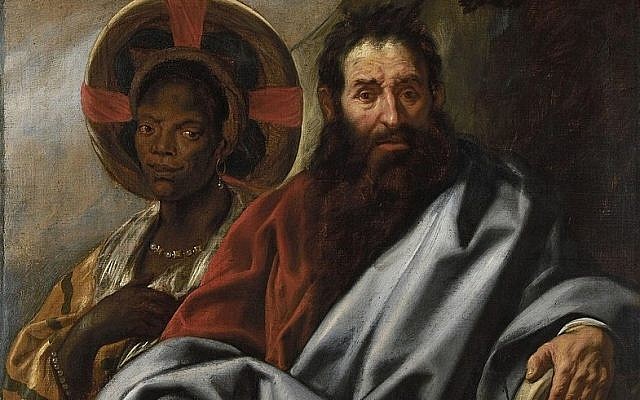
Moses and His Ethiopian Wife, by Jacob Jordaen, 1650

2) Miriam and Aaron speak publicly against Moses, complaining about his mixed marriage.

In Exodus/Shemot Moses’ wife was Tziporah, the daughter of a Midianite priest.  But this week, in the book of Numbers/Bemidbar, she is only called “the Kushite”.  Kush is the land south of Egypt, noted in the bible for people with very dark skin.2

Some commentators have argued that Tziporah is “the Kushite wife”, so-called either because she had darker skin than usual for a woman in the ancient Near East, or because “kush” also means beautiful, or because there was also a land of Kushites in Arabia.3

But others wrote that Moses had two wives, Tziporah and an Ethiopian.  Josephus told one version of an extrabiblical adventure for Moses in Ethiopia, where he supposedly served as an Egyptian general in his youth, won a war, and married the defeated king’s daughter.4

Whether the wife in this week’s Torah portion is a Midianite or a Kushite, the complaint about Moses’ marriage implies racism.  Yet the first five books of the bible are only concerned about marrying outside one’s religion.5  The Torah repeatedly tells us not to cheat or oppress foreign immigrants (see my post Mishpatim: The Immigrant).  Even the book of Ezra, which requires Israelite men to separate from non-Israelite wives, describes these foreign women in terms of their religious practices.6  And the book of Ruth is an example of a virtuous mixed marriage between an Israelite and a Moabite.

Moses’ wife, Midianite or Kushite, presumably converted, like Ruth.  So Miriam and Aaron may well find her acceptable, regardless of the color of her face.

*

When I see people who look markedly different from me and my family, I try to catch their eye, and then smile at them.  If they smile back, we might exchange a greeting.  Then as I walk on I feel brighter—and safer.  The stranger is not a threat after all, but someone like me.

Why do so many of my fellow citizens hate the stranger, the man with “black” skin, the immigrant who speaks a different language, the woman who dresses like a Muslim?  I know the answer: because they are afraid, and it feels better to turn fear into anger.

At least it does for many people.  One advantage of being scared of everyone as a child, even of girls who looked like me, is that now timidity is an old friend.  When I grew up I made a habit of smiling at people who do look like me, as well as those who don’t, and exchanging a greetings with them, too.  Then as I walk on I feel brighter—and safer.

White

by Ernest Christophe, 1876

The white face belongs to Moses’ sister, Miriam.

After Miriam and Aaron speak with or against Moses, God orders the three siblings to report to the Tent of Meeting.  According to God, the problem is that Miriam and Aaron are claiming to be prophets equal to Moses.  God declares that nobody is equal to Moses, and adds:

“Why were you not afraid to speak against my servant, against Moses?”  (Numbers 12:8)

Miriam is the instigator of the complaint against Moses. and God is angry.

And the cloud moved away from over the tent, and hey!  Miriam had a skin disease like snow!  Aaron vayifein Miriam, and hey!  Skin disease!  (Numbers 12:10)

vayifein (וַיִּפֵן) = turned to face.  (From the same root as paneh, פָּנֶה = face.)

Leucoderma

Miriam’s skin disease is tzara-at, which make skin look dead-white and depressed compared to the surrounding skin.  (See my post Tzaria & 2 Kings: A Sign of Arrogance.)  The book of Exodus decrees that anyone with that skin disease must live outside the camp until it has healed.

Aaron begs Moses to intercede with God, saying:

“Please don’t let her be like one who is dead going out from the womb of his mother, and half his flesh looks eaten!”  (Numbers 12:12)

Moses prays, and God promises that Miriam’s skin disease will last for only seven days, but she must live outside the camp in shame for those seven days.

Moses is separated from his wife indefinitely, because his whole being is engaged in being God’s prophet.  Miriam is separated from the community for seven days, because she was too self-absorbed to see that Moses is a different kind of prophet.

*

Like Miriam, I can become so absorbed in my own desires and my own calling that I forget other people have different desires and different callings.  I write about the Torah, but I do not embrace every aspect of Jewish tradition.  Some Jews are meticulous about halakhah, the rules for behavior in every aspect of life.  Some are absorbed in the mysticism of kabbalah.  (I have encountered the same two types among Christians.)

I do not understand these people, any more than Miriam understood her brother Moses.  Nevertheless I have been guilty of speaking against them, declaring that both approaches are irrational.  They are irrational to me.  But my mind works differently from the mind of a strictly observant Jew or the mind of a mystic, even if our faces are similar.

When I express my own truth too loudly, I am like Miriam declaring that she is a prophet, too, so she knows Moses is wrong to be celibate.

Miriam blanches when God reveals her error.  She knows she must isolate herself until she has healed.  When I realize I have forgotten that individuals are different behind their faces, I feel ashamed and I retreat for a while.

Bright

The burning face belongs to Moses himself.  He acquires radiant skin in the book of Exodus, after seeing God’s “back” on Mount Sinai.

Moses, by James Tissot

When Moses went in before God to speak with [God], he would remove the veil until after he went out; and he went out and spoke to the children of Israel what had been commanded.  And the Israelites saw the penei Moses, that the penei Moses radiated light.  Then Moses put the veil back over panav until he came to speak with [God again].  (Exodus/Shemot 34:34-35)

penei (פְּנֵי) = face of.  (From paneh, פָּנֶה = face.)

panav (פָּנָו) = his face.  (Also from paneh, פָּנֶה = face.)

When Moses passes on God’s commands, he leaves his face exposed.  His glowing skin demonstrates that he is not an ordinary prophet like Miriam or Aaron.

But when he is not speaking with God or passing on God’s instructions, Moses veils his face.  The radiance of his skin is too overwhelming for the Israelites to see as they go about their daily tasks.

I imagine that if the skin all over his body also glows, marital relations would be difficult.  Even if Moses’ wife kept her eyes shut, could they touch one another the way they used to?  This physical explanation for Moses’ celibacy does not occur to Miriam or Aaron.

Nor does it occur to them that Moses never gets time off from listening for God.  God has conversations with Moses all the time, but Miriam and Aaron are summoned when God wants to speak with them.  In this week’s Torah portion,

Suddenly God said to Moses and to Aaron and to Miriam: “Go, the three of you, to the Tent of Meeting.”  So the three of them went.  And God came down in a pillar of cloud, and stood at the entrance of the tent, and called out: “Aaron and Miriam!”  (Numbers 12:4-5)

Then God reminds them that they are ordinary prophets, not comparable with Moses.

*

Several friendly Muslim women in our apartment complex wear a hijab whenever they leave their apartments.  Their hair and necks are covered, but their faces are exposed, so when I meet them in the laundry room we can easily exchange smiles and greetings.

But once I passed a woman in the grocery story wearing a burka, so her face was completely covered.  She could see through the mesh panel in front of her eyes, but I could not see her eyes, and therefore I could not meet them.  I smiled in her direction, but I could discern no response.  I felt as if I were smiling at a rock draped in cloth.

The woman in the burka was more isolated than Miriam during the seven days she lived outside the camp because of her skin disease.  And her isolation was deliberate.

Is Moses that isolated when he wears his veil around the camp?  What would it be like to give up all ordinary human contact?  What would you get in exchange for losing your face?

  1. Midrash Tanchuma (a 6th to 9th-century collection of allegories and homilies) assumes in Tzav 13 that Moses stopped having sexual relations with his wife. So do Exodus Rabbah 46:13 and Deuteronomy Rabbah 11:10 (10th to 12th century collections of imaginative commentary, part of the Midrash Rabbah), and Rashi (11th-century rabbi Shlomo Yitzchaki).
  2. Being a Kushite indicates a genetic skin color in Jeremiah 36:14: “Can a Kushite change his skin?  Or a leopard his spots?”  It is a derogatory term in Amos 9:7, where God says challengingly: “Aren’t you like the Kushites to me, children of Israel?”
  3. E.g. Sifrei Badmidbar (a 3rd-century CE commentary on Numbers), 12:99; Midrash Tanchuma, Tzav 13; and Rashi.  Tziporah might be unusually dark-skinned because she spends her days out in the sun, like the female narrator in Song of Songs 1:5-6.
  4. Jewish historian Flavius Josephus, in Antiquities 2:252-253 (circa 93 CE), told one version of the Ethiopian marriage story invented by an unknown Judean sometimes between the 6th and 3rd centuries BCE.
  5. However, Deuteronomy 23:4-7 prohibits a Moabite or Edomite from converting.
  6. Ezra 9:1-2.


Beha-alotkha & Ezra: Retirement Age

This is what regards the Levites:  From the age of 25 years and above, each will enter the battalion of service for the Tent of Meeting.  And from the age of 50 years, yashuv from the battalion of service, and he shall not serve any more.  He shall attend to his brother in the Tent of Meeting, keeping his watch, but he shall not do service.  Thus you shall do for the Levites regarding their duties.  (Numbers/Bemidbar 8:24-26)

yashuv (יָשׁוּב) = he shall return, turn back, turn away, withdraw.

It sounds like a mandatory retirement age.  And retirement at 50 would be a golden dream to all the people today who must continue to toil at jobs that sap their energy instead of nourishing them.  Do the Levites really get this blessing?

*

This week’s Torah portion, Beha-alotkha, includes the consecration of the Levites as servants of God’s sanctuary, the Tent of Meeting.1  (The first priests, Aaron and his sons, are consecrated in the book of Leviticus/Vayikra.2 ) Leviticus also provides lengthy job descriptions for priests, who perform all the rituals of offerings at the altar, tend the most sacred holy objects, and judge various issues about ritual purity.

While the priests perform the highest-ranking work in the religious life of the ancient Israelites, many other duties are necessary to maintain either a traveling sanctuary (in Exodus through Joshua) or a permanent temple (from 1 Kings on).  The first two Torah portions in Numbers begin assigning these duties to the three clans of Levites.  (See last week’s post, Bemidbar & Naso: Four Directions of Service.)

For each leg of the Israelites’ journey from Mount Sinai to the Jordan River, the Tent of Meeting must be disassembled, carried to the next campsite, and reassembled.  Only the priests can prepare the holiest items for travel; they wrap the ark, the lampstand, the bread table, the incense altar, and the altar for offerings in multiple coverings before turning them over to the Levites of the Kehat clan for porterage.

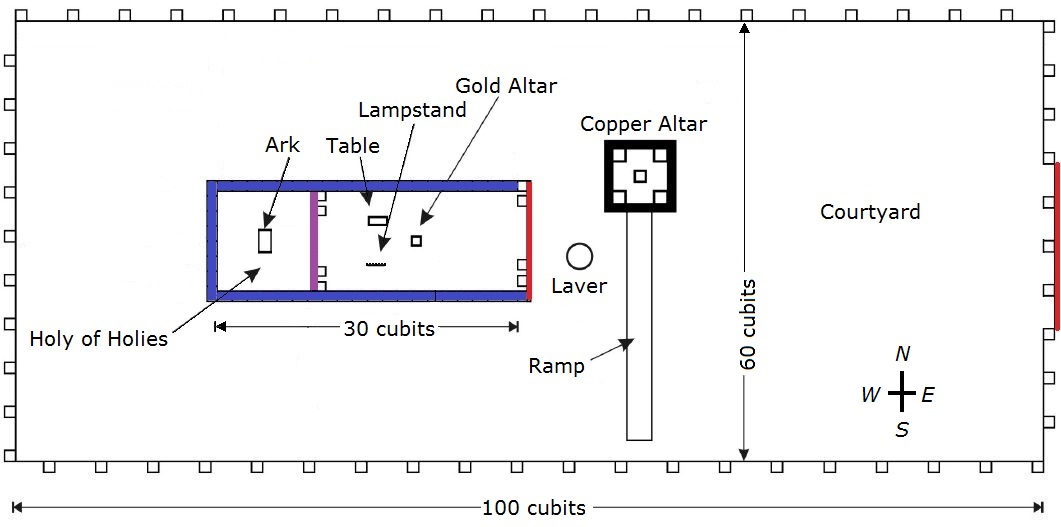
Tent of Meeting and its courtyard

The other two clans of Levites, Geirshon and Merari, disassemble, carry, and reassemble the tent roof, the cloth walls of both tent and courtyard, and the frameworks they are stretched over.  All of these jobs are critical, and an error may result in death.  (See my post Shemini & 2 Samuel: Separating Holiness.)  They are also jobs that require physical strength and skill.

I believe the tasks of dismantling, carrying, and erecting the pieces of the santucary are restricted to Levites old enough to be mindful, but young enough to do the labor without faltering.  Levites must retire from these duties before old age compromises their physical abilities.  So the men who do this work must be between the ages of 25 and 50—at least in the portion Beha-alotkha.

The first two portions of the book of Numbers give a different starting age for the Levites.  God requests a census of each of the three clans of Levites,

From the age of 30 years and above, up to the age of 50 years, all those who come into the battalion to do labor in the Tent of Meeting.  (Numbers 4:3, 4:23, 4:30)

According to Rashi, the strength to carry heavy objects is not fully developed until age 30.  After age 50, a man’s strength begins to diminish again.  The Talmud3 explains the different starting ages by claiming the Levites began learning these duties at age 25, and began actually performing them at 30.  I suspect the discrepancy is due to different opinions about the age at which young men can be trusted to carry out a long process with unflagging mindfulness of the sanctity of every movement.

*

The Levites age 50 and above still perform some duties, those that all Levites do while the Israelites are encamped and the sanctuary is in place.  What are these jobs?

The only ones mentioned in the first five books of the Torah are guarding the sanctuary to prevent any unauthorized persons from entering;4 and helping to collect tithes from the rest of the community, tithes used to support the priests, the Levites, and the poor.5

Other Levitical duties are not mentioned until books of Ezra and Nehemiah, which describe the building of the second temple in Jerusalem.

Supervising the building of a temple can apparently be done well by a wider range of Levites.  The book of Ezra says that when the exiled Israelites returned to Jerusalem from Babylon, their leaders appointed the Levites from age 20 years and above to supervise the labor of [building] the House of God.  (Ezra 3:8)

Both books list the job titles, ancestry, and numbers of men who serve at the new temple.  Priests are listed first, then Levites, then singers, then gatekeepers, then temple servants.6  Although the singers and gatekeepers are listed separately from “Levites”, the traditional interpretation is that these two groups were subdivisions of Levites.

One piece of evidence is the celebration over the completion the foundation of the second temple in the book of Ezra.

(woodcut, 1860)

…and the priests were stationed in their vestments with their trumpets, and the Levites, descendants of Asaf, with cymbals to praise God … And they [the Levites] answered with haleil and with thanks to God: “because [God]is good, because [God’s] kindness is everlasting(Ezra 3:10-11).

haleil (הַלֵּל) = songs of praise.

The same words “because [God] is good, because [God’s] kindness is everlasting” appear in Psalms 106, 118 and 136.  As far as we know, all the Psalms were sung at temple rituals, accompanied by instruments—and the musicians were Levites.

For us, as for the Levites, retirement is not ceasing to work; it is withdrawing from a job that has become difficult, and turning to work that benefits body and soul.  Yes, many retirees spend more and more time taking care of their aging and cranky bodies.  But we can also take some time to help others from a place of wisdom, and to do the work that nourishes our souls.

No doubt some of the Levites serving in the second temple got bored with locking and unlocking gates, or dreaded singing under a certain conductor, and wished they could retire at 50 like the Levites in the book of Numbers.  Lighter work is not always soul-nourishing work.

Levite singers, by James Tissot

Nevertheless, the duties of the Levites can inform our own retirements, when we finally shuv—withdraw, turn away, return from—the jobs we had to do to make a living.  In the workforce (equivalent to the “battalion” in this week’s Torah portion), we have to keep disassembling and reassembling our knowledge base, our skills, our resumes, as we meet the demands imposed by our employers or the larger society with live in.

Retired, we can exercise more of our own judgement about what to let in through our personal gates, and what to keep out.  And we can lift our own spirits toward the spirit of the divine by singing to God.

  1. Numbers 8:8-22.
  2. Leviticus 8:1-9:24.
  3. Talmud Bavli, Chullin.
  4. Numbers 18:2-6.
  5. Numbers 18:20-24; Nehemiah 12:44.
  6. Ezra 2:40-41 and 2:70; Nehemiah 7:43-45, 10:29, and 11:15-22.

Pesach: Miriam the Prophetess

Pesach (פֶּסַח, “skipping”) means Passover.  Seder (סֵדֶר, “order”) means the dinner table ritual following the order in the Haggadah.  Haggadah (הַגָּדָה, “the telling”—a term that came into use in the 19th century) means the book of rituals, prayers, questions, four cups of wine, and stories.  The longest story, told while the second cup of wine sits on the table, is about the exodus from Egypt, up to the point when the pursuing Egyptian army drowns in the Reed Sea, and the newly-freed slaves celebrate on the far shore.

In the book of Exodus, Moses led the people in celebrating by singing a lengthy psalm.1

Miriam’s Song, 1909

Then Miriam the neviyah, the sister of Aaron, took the drum in her hand, and all the women went out after her, with drums and with circle-dances.  And Miriam chanted for them:

Sing to God, for He is high above the high;

horse and its rider He hurled into the sea.  (Exodus/Shemot 15:20-21)

neviyah (נְבִיאָה) = prophetess (the feminine form of navi (נָבִיא) = prophet).

Miriam is the first woman in the Torah to be called a neviyah.  She leads the women in singing as well as in tapping hand drums and dancing.2

Miriam is a character in three dramatic scenes in the Torah.  She is the resourceful young woman who, when the pharaoh’s daughter adopts her infant brother Moses, arranges for their own mother to be his paid wet-nurse.3  She is the leader of thousands of women in the scene above.  And later in the trek across the wilderness, she leads her brother Aaron in a joint complaint regarding Moses’ wife.  (See my post Beha-alotkha: Unnatural Skin.)  The two siblings point out that they are prophets, too:

“Has God spoken only with Moses?  Hasn’t He also spoken with us?”  And God heard.  (Numbers/Bemidbar 12:2)

by Johann Christoph Weigel, 1695

God calls Miriam, Aaron, and Moses to the entrance of the Tent of Meeting, and speaks to all three from the pillar of cloud—in order to tell them that Moses gets the most direct divine communication.

And [God] said: “Please listen to my words!  When there is a navi of God among you, I make myself known to him in a vision; I speak with him in a dream.  Not so my servant Moses … I speak with him mouth to mouth, and in seeing, not in riddles, and he looks at the likeness of God.  (Numbers 12:6-8)

God afflicts Miriam with a temporary skin disease to underscore the point.  Nevertheless, in that scene Miriam is indeed a neviyah who hears God’s voice directly!

Miriam is mentioned in passing five times after this, including God’s speech in the book of Micah reminding the Israelites that God sent them three leaders for the exodus from Egypt: Moses, Aaron, and Miriam. 4

*

What is a navi or neviyah?  The Torah offers several paradigms.

  • Intercessor

The word navi first appears in the book of Genesis, when God tells King Avimelekh in a dream: “And now, return the wife of [Abraham], since he is a navi, and he can pray for you and you will live.” (Genesis 20.7)

Moses, Samuel, Elijah, Elisha, and an unnamed prophet in the first book of Kings are also prophets who have God’s ear and intercede with God to save other people.5

  • Spokesperson

The Torah introduces a second paradigm of a navi after the enslaved Israelites give up on Moses’ idea that God will liberate them.  When God tells Moses to speak to Pharaoh next, he tries to get out it, arguing that he has “uncircumcised lips”, i.e. he cannot speak well.6  But God has an answer for everything.

Then God said to Moses: “See, I place you as a god to Pharaoh, and Aaron your brother will be your navi.”  (Exodus 7:1)

Moses and Aaron with Pharaoh, March Chagall, 1931

In other words, Aaron will act like a navi for Moses, hearing Moses speak and then passing on Moses’ words to the Egyptian court.  Obviously Moses is God’s navi, hearing God speak and passing on God’s words, though the Torah does not bother to say so until the end of Deuteronomy:  And never again in Israel rose a navi like Moses, who knew God face to face.  (Deuteronomy 34:10)

Moses and God have the longest, most frequent, and most direct conversations in the entire Hebrew Bible.  After Moses gets over his initial reluctance to speak, he fluently delivers God’s instructions, warnings, and hundreds of rules.7

Other prophets transmit God’s predictions, or warnings, about the future of kings or kingdoms if they do not change their ways.  These include all the major prophets (Isaiah through Malachi).

  • Ecstatic

The third kind of navi in the Hebrew Bible is one who goes into an altered state of consciousness characterized by an awareness of the divine and obliviousness to the world, and who does not return with any coherent message from God.  The first occurrence of this state in the Torah is when God shares some of Moses’ spirit or ruach with 70 elders.

And the spirit was upon them, vayitnabe-u, but they did not continue.  (Numbers 11:25)

Saul Before Samuel and the Prophets, by Benjamin West, 1812

vayitnabe-u (וַיּתְנַבְּאוּ) = and they acted like prophets, and they prophesied to themselves, and they spoke in ecstasy.  (From the same נבא root as navi.)

In both books of Samuel and both books of Kings, bands of prophets wander around making music, dancing, and babbling.  The bible explains the proverb “Is Saul, too, among the prophets?” first with a scene in which King Saul falls in with a band of prophets on the road and speaks in ecstasy like them, then with a scene in which not only babbles, but also strips naked.8

*

Miraim is the first of only five women called prophets in the Hebrew Bible. After her, two major prophetesses are spokespersons for God (type 2 above): Deborah, who summons a general and tells him to go to war;9 and Huldah, who authenticates a scroll as the word of God and utters two prophetic predictions.10  Two other prophetesses are mentioned only glancingly.11

Miriam is the only neviyah whom the bible reports as engaging in what might be ecstatic behavior: playing a drum, dancing, and singing on the shore of the Reed Sea.  But Miriam leads circle dances in complicated patterns that require concentration and planning.  She leads a coherent chant.  Rather than directing ecstatic worship, she is probably organizing a celebration of God as the victor in a war against the Egyptian charioteers.  Women customarily greeted soldiers returned from a victory with drumming, dancing, and singing.12

Although Miriam hears God’s voice, the Torah does not report her serving as either an intercessor or a spokesperson for God.

by Simeon Solomon, 1860

The Talmud attempts to fill the void by claiming that Miriam did pronounce a prophecy: that her mother would have a son who would save the Israelites from Egypt.  When Moses was born, according to this story, the whole house filled with light, and Miriam’s father exclaimed that his daughter’s prophecy had been fulfilled.13  This is a pleasant tale with no basis in the Torah.

A modern folk explanation is that Miriam must have had foreknowledge of the victory at the Reed Sea, and told the women to bring their drums.  Otherwise they would not have bothered to pack them, since they left their homes in Egypt in such a hurry that the dough had no time to rise in their kneading-troughs.14

This argument for Miriam’s power as a neviyah fails in the context of the larger story in Exodus.  The Israelite women were already packing all the gold, silver, jewelry, and clothing they “borrowed” from the Egyptians; they could easily add their hand drums and any their other sentimental and ritual objects.

*

Miriam may be called a neviyah because of other deeds not recorded in the bible.  Or she may simply be an exceptional person who has a close relationship with God.

A traditional Passover seder includes pouring a cup of wine for Elijah the navi.  Many a modern seder adds a ritual cup of water for Miriam the neviah.  (The water alludes to a Talmudic story that says a well of water followed the Israelites through the wilderness for 40 years thanks to the merit of Miriam.15)

I lift a cup for Miriam at Passover knowing that she may not be a neviyah in the sense of being an intercessor with God, a spokesperson for God, or a religious ecstatic.  I celebrate her lifelong wise leadership, and her ability to listen to God.  May we all learn to be a little more like Miriam the neviyah.

  1. Exodus 15:1-18. See my post Beshalach & Psalm 136: Miracle at Sea.
  2. Since the two lines of Miriam’s song are the same as the first two lines of the psalm ascribed to Moses, the women might sing them as a periodic refrain during the longer psalm. Most modern scholars consider either the entire psalm, or at least Miriam’s song, to be one of the oldest poems in the Torah (based on Frank M. Cross and David N. Freedman, Studies in Ancient Yahwistic Poetry, Eerdmans, Grand Rapids, MI, 1973).
  3. Exodus 2:4-8.
  4. When she dies in Numbers 20:1; in two genealogies listing her with her brothers Aaron and Moses, Numbers 26:59 and 1 Chronicles 5:29; in a warning about skin disease in Deuteronomy 24:9, and in Micah 6:3-4.
  5. Moses for the Israelite people in Exodus 32:9-14, Exodus 33:12-17, Numbers 11:1-2, and Numbers 21:6-9, and for Miriam in Numbers 12:10-15; Samuel for the Israelites in 7:5-10; Elijah to bring a dead boy back to life in 1 Kings 17:20-24; Elisha for the same reason in 2 Kings 4:8-37; an unnamed prophet for King Jereboam in 1 Kings 13:1-6.
  6. Exodus 6:12, 6:30. See my post Va-eria & Shemot: Uncircumcised, Part 2.
  7. The Talmud (Makkot 23b and Yevamot 47b) claims there are 613 commandments in the Torah.  It is hard to decide which rules should count, but 10th-century C.E. rabbi Saadiah ben Yosef Gaon found a way to list 613 in his Sefer Hamitzvot, and Maimonides (12th-century C.E. rabbi Moshe ben Maimon, nicknamed Rambam) came up with 613 for his book by the same name.
  8. 1 Samuel 10:10-12 and 19:18-24.
  9. Judges 4:4-16.
  10. 2 Kings 22:14-20.
  11. The unnamed wife of the first Isaiah (Isaiah 8:3) and Noadeyah, a false neviyah listed in Nehemiah 6:14.
  12. Judges 11:34, 1 Samuel 18:6-7.
  13. Talmud Bavli Megillah 14a.
  14. Exodus 12:34.
  15. Talmud Bavli Taanit 9a.