Vayikra: Happening or Calling

by Melissa Carpenter, maggidah

Vayikra to Moses, and God spoke to him from the Tent of Meeting. (Leviticus/Vayikra 1:1)

vayikra (וַיִּקְרא) = and he/It called, proclaimed, summoned; and he/It met.

The book of Leviticus and its first Torah portion are called Vayikra, the opening word.  In Hebrew, the word looks different here than in any other place in the Bible, because of the size of the last letter:

Vaiykra with nikkud

Early copies of the Torah had no diminutive letters.  But when the Masoretes wrote their definitive 9th-10th century versions of the Torah, they spelled 28 words with small letters, including Vayikra with a small alef, and the word has appeared that way ever since.

Torah scrolls omit the vowels that the Masoretes added to the text, but keep the Masoretic diminutive letters. So in a Torah scroll, the first word of Leviticus looks like this:

Vayikra alef

Most of the Masoretic additions to the text of the Hebrew Bible make it easier for someone to read (or chant) the Bible out loud. The nikkudim (marks above, below, and inside letters to indicate vowels and doubled consonants) clarify pronunciation. The trope (cantillation marks above and below letters) indicate which syllables to accent, and which melodic phrases to use for chanting. With both kinds of markings, the first word of Leviticus looks like this:

Vayikra with trope

There are also places where the Masoretic text gives two versions of a word, one (ketiv) in its original spelling (an actual word, but probably a scribal error), and one (kere) in a spelling that makes sense in context.

But the 28 words with diminutive letters would be spoken or chanted the same way regardless of the size of their letters.  Why did the Masoretes use small letters?

Some versions of 10th century Masoretic texts include marginal notes, and at least six of these notes on small letters say (in a rough translation of the Aramaic) “small [name of letter] to state the accepted version”. The footnotes for at least four more just say “small” (ze-ira), probably an abbreviation of the note that the letter is small to indicate the accepted version.

In other words, in the versions of the text that the Masoretes found unacceptable, the words were spelled with the controversial letters omitted.  For example, the first word of Leviticus was spelled ויקר.

In the accepted version of the text, the words were spelled with the controversial letters included.  Vayikra was spelled ויקרא. The Masoretes spelled these words according to the “accepted” version—but they made the controversial letters undersized to document that they were missing in some Torah scrolls.

Out of the 28 words with diminutive letters, seven are proper names, and ten are not even Hebrew words without the small letter. So only eleven of the words might mean something different if the diminutive letter were omitted.  And one of these is vayikra, the first word of this week’s Torah portion.

Without the alef (א) at the end, vayikra (וַיִּקְרא = and he/it called, summoned, met, encountered) would be vayiker (וַיִּקֶר = and he/it happened to, befell). The opening sentence would read: And It happened to Moses, and God spoke to him from the Tent of Meeting.

God “happens to” (וַיִּקֶר) the Mesopotamian prophet Bilam in Numbers/Bemidbar 23:3. God tells Bilam what to do, and then when it is time for him to utter a curse or blessing, God puts the words into Bilam’s mouth. It is a one-way relationship.

But the prophet Moses has a two-way relationship with God.  They have long conversations, and sometimes argue with one another.  So God wants to get Moses’ attention, God “meets” him or “calls” to him.

In an earlier post, Vayikra: A Voice is Calling, I mentioned that God “called” Moses three times, the first two times from Mount Sinai, and the third time (with the diminutive alef) from the Tent of Meeting. I cited commentary in Rashi and the Zohar that the miniature alef  indicates a restriction or muting of the call, and suggested that God switched to an “indoor voice” when the people switched to connecting with God through the vehicle of the sanctuary tent.

This year, I’d like to add that whether you encounter God in a sanctuary, or anywhere else in your life, there are two kinds of encounters. Sometimes a mystical experience just happens to you. If you are like Bilam, your mind is wired in such a way that it happens relatively often.

Moses at the Burning Bush by Rembrandt van Rijn
Moses at the Burning Bush
by Rembrandt van Rijn

The other kind of encounter begins when you merely notice the possibility of the numinous—as Moses noticed the bush that burned but was not consumed. You stop and pay attention, and try to figure out what is going on. If you are quiet enough, you may discover that the divine is calling you—as God called to Moses in the first portion of Exodus:

God saw that he had turned aside to look, vayikra to him from amidst the bush, and It said: Moses! Moses! (Exodus/Shemot 3:4)

18th-century rabbi Menahem Nahum Twersky of Chernobyl wrote in Me’or ‘Eynayim , “God the cosmic aleph is present in miniature form within each Israelite, calling us to return. These are our pangs of conscience, but we do not perceive them as God’s own call to us.” (Translated by Rabbi Arthur Green in Speaking Torah, Vol. 1, p. 250.)

Thus a conversation with the divine voice could be a much quieter affair than when God “happens” to someone.

At the beginning of this week’s Torah portion, at the beginning of the book of Leviticus, God calls Moses with a small alef.  Then Moses realizes that completing the Tent of Meeting according to God’s specifications is not the end of his work. Even though God’s radiance has filled the sanctuary, Moses hears the divine inner voice urging him to go back into the Tent of Meeting for further instructions.

May all of us learn how to be still, pay attention, and listen for the call inside ourselves.
Vayikra & Tzav: Fire Offerings Without Slaughter, Part 1

My teeth clench every year when I start to read the book of Leviticus/Vayikra.

The first two Torah portions, Vayikra (“And [God] Called”), and Tzav (“Command”) consist of rules for various kinds of offerings, or sacrifices, at the altar.  The Torah refers to these offerings or sacrifices as a korbanim (קָרְבָּנִים) = things brought near.1  Since God now inhabits the tent-sanctuary behind the altar, at least part time,2 bringing something to the altar means bringing it close to God—i.e., presenting it to God as a gift.

Five of the six offeerings God requests in the Torah portions Vayikra and Tzav include animals slaughtered on the spot.

The book of Leviticus opens when God calls to Moses from the new Tent of Meeting and begins giving instructions for korbanim:

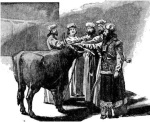
Leaning hands on a bull in an ordination offering

“… you shall offer your offerings (korbanim) from the animals from the herd or the flock.  If someone offers an olah from the [cattle] herd, he shall offer an unblemished male at the entrance of the Tent of Meeting.  He shall offer it out of his own desire in front of God.  And he shall lean his hand on the head of the olah, and it will be accepted for him, to atone for him.  And he shall slaughter the young bull in front of God.  Then the descendants of Aaron, the priests, shall offer the blood and splash the blood against the altar all around … (Leviticus/Vayikra 1:2-5)

olah (עֹלָה) = rising-offering.  (From the root verb alah (עלה) = go up.)  In an olah the entire slaughtered animal is burned up, so olah is often translated as “burnt offering” or even “holocaust offering”.

The same procedure applies to every animal offered at the altar: the donor leans his hand on the animal’s head, then slices its throat.  A priest splashes its blood on the altar, then butchers it.  For an olah, the entire animal is burned up on the altar; for other types of animal offerings, the priest waves around various pieces of the animal, then burns the fatty parts on the altar to make smoke rise up to God.  The breast and right thigh are for the priest and his family to eat.  The remaining meat is eaten by the donor and his guests.

This is difficult reading for someone who stopped eating mammals and birds 24 years ago because they are too much like human beings.3

The Torah’s instructions emphasize the affinity between livestock animals and humans be requiring the donor to lean or lay a hand on the animal’s head just before slaughtering it.  This act transfers the donor’s identity to the animal, so that killing and offering it is the equivalent of sacrificing one’s own life to God.4

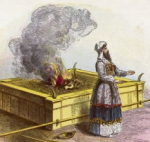
Smoke from the altar, “Treasures of the Bible”, Northrup 1894

Live, healthy cows, sheep, and goats were valuable items among the ancient Israelites, suitable as bribes, gifts, or payments to chieftains and prophets.  Dead animals were only good for hospitality, as part of a festive  meal.

What use would God have for a dead animal?

In the book of Leviticus, the fatty parts of the animal offerings are burned up into smoke, which ascends to the heavens, and the scent of that smoke pleases God.  The Torah does not specify whether an anthropomorphic God loves the smell of burning fat, or loves the smell that means humans are sacrificing valuable assets as gifts.

I can understand the desire to present God with a gift—out of sheer gratitude for our lives in the world, or out of a desire to return to harmony with the divine after we have strayed.  But I am grateful that Jews have moved beyond killing animals at an altar.

So what we can give to God instead?  The usual answer is that prayer has replaced animal offerings, and the passion of sincere prayer replaces the fire on the altar.

The first two Torah portions of Leviticus describe six types of fire-offerings.  In Part 2 of this post I will suggest alternatives for each type.  But first, let us look at fire-offerings in general.

Fire-offering

One thing that all six types of offerings have in common is that part of the offering is placed on the altar fire, and it goes up in smoke.  Even the minchah offering, which consists only of grain products, requires oil and frankincense on each item put on the altar.

When this week’s Torah portion, Vayikra, describes the first type of offering, the olah or rising-offering, it establishes that fire-offerings make God relax.

…and the priest shall bring all of it and make it go up in smoke on the altar; it is an olah, an isheh of restful fragrance for God. (Leviticus/Vayikra 1:13)

isheh (אִשֵּׁה) = fire-offering; offering burned on the altar. (From the word eish (אֵשׁ) = fire.)

Yet fire often evokes the emotion of anger the Torah; Biblical Hebrew, like English, uses words meaning “burning” and “inflamed” to indicate rage, especially God’s rage.  When the anthropomorphic God-character in the Torah gets a “hot nose”, a plague or another disaster kills thousands of Israelites, the innocent with the guilty.5

It is not the fire that that God finds restful, but the fragrance of the smoke.6

Today, some people claim that it is good to feel outrage at politicians, at authority figures who oppress the poor, and even at people who vote the “wrong” way, because outrage motivates people to take action.  Yet political action is more effective, as well as more ethical, when it comes from compassion tempered by reason.  Anger is an overwhelming emotion that carries us away, leading us to do things that our better selves regret later.

Anger is also a selfish emotion.  When we say or think “How dare they!” the underlying assumption is that “they” are threatening our power.  Both the child abuser and the rioter use what power they have to express an anger that does not respect other human beings.

Can we turn the fire of our natural selfish anger into smoke that rises up to the level of the divine?

Pillar of Fire, by Paul Hardy, 1896

To soothe an angry impulse we might make an isheh, a fire-offering, by praying, chanting, or meditating on our anger.  (I find that walking while I do this helps to release the physical energy of anger.)  If we are easily inflamed by controversies, or by the behaviors of other people, we might imagine offering our passionate anger on the altar to burn itself down.  We might visualize the smoke rising into a clear, calm sky.  After a while we might reach a state in which our original outrage is tempered both by rational considerations and by empathy for people who at first appeared to be enemies.

If we are anxious or afraid of the anger expressed by another person or group, we might sing prayers while imagining the majesty of God’s pillar of fire leading the way through the wilderness.  Eventually we, too, can move forward into the unknown with courage and calm strength.

*

Next week I will look at the six types of fire-offerings described in the Torah portions Vayikra and Tzav, and how we might address the impulse behind each one today—without slaughtering animals.

(I published an earlier version of this essay in March 2014.)

  1. From the hifil form of the verb karav (קָרַב) = come near.
  2. Exodus 29:42-45.  See my post Terumah & Psalm 74: Second Home.
  3. When I posted my first version of this essay in 2014, it was 18 years.
  4. Samakh (סָמַךְ) = he leaned (or lay) a hand (or hands) on.  When Moses lays his hands on Joshua, he transfers some of his authority and spirit to his successor as the leader of the Israelites (Numbers 27:18-23, Deuteronomy 34:9).  When the Levites are ordained, the Israelites lay hands on them to make them the people’s substitutes for service in the sanctuary (Numbers 8:10).  The word samakh is also used for the ritual before an animal sacrifice.  The word smikha (סְמִיכָה), from the root samakh, refers to the ordination of rabbis and other Jewish religious functionaries to this day.  See my post Tzav: Oil and Blood.
  5. For example, Exodus 32:10, Numbers 11:1-35, and Numbers 17:7-10.
  6. See my post Pinchas: Aromatherapy.

Vayikra: Sour, Sweet, and Salt

Humans tend to bring gifts to their gods. They have done it all over the world, from the beginning of history. In the Torah, the first human to offer a gift to God is Cain, the oldest son of Adam and Eve … and God rejects his offering. Religions help people to avoid the fear of being rejected by their gods by spelling out what gifts are and are not acceptable.

The first part of the book of Leviticus/Vayikra (And It Called) is devoted to instructions about offerings for the altar. What kinds of animal and grain offerings will be acceptable to God? The first Torah portion begins by considering animals for burned offerings.

If one brings an olah from the herd, he shall bring an unblemished male; he shall bring it to the opening of the Tent of  Meeting, liretzono before God. And he shall lean his hand upon the head of the olah, and it will be nirtzah for him, to atone for him. (Leviticus/Vayikra 1:3-4)

olah = an offering that is completely burned, so its smoke will rise to the heavens

liretzono = to be accepted for him

nirtzah = favorably received, acceptable, counted as good (from the same root as liretzonoרצה)

After an initial review of animal offerings, the Torah gives particulars about the minchah offering: a gift of homage to God, made from grain. (See my blog post “Vayikra: Gifts to the Giver”.) Embedded in the minchah instructions is a ban on any leavening or sweetener in a burned offering:

Every homage that you bring to God you shall make without chameitz; for you shall not bring any sourdough or any devash into an offering by fire to God. (Leviticus 2:11)

chameitz = leavened bread, fermented food

devash = syrup, bee honey, fruit nectar

Leavened loaves of bread can only be brought to the sanctuary for the priests and their families to eat; they must not be burned on the altar. Fruit syrup or jam can only be brought at the annual festival of first fruits, Shavuot, and the fruit preserves were also eaten by the priests.

Why are leavened bread and syrup are banned from burned offerings?  Philo of Alexandria, who lived 2,000 years ago, began a long line of Jewish commentatary comparing bread rising to a human puffing up with self-importance—the opposite of the humility needed to pay homage to God. Another view stresses the instruction in the book of Exodus/Shemot to eat unleavened matzah on Passover/Pesach in order to remember that the Israelites did not have time to let their dough leaven before escaping Egypt. Since matzah is “the bread of our affliction”, the Israelites presumably did not have time to watch bread rise during their years of slavery, either. According to 19th-century rabbi Samson Raphel Hirsch, leavened bread therefore represents political independence, which the Israelites achieved not by their own efforts, but only by following God’s Torah. Fruit syrup represents ownership of land where dates and other fruit trees grow naturally—another gift from God. Hirsch argued that an acceptable offering to God could only be something that the Israelites had acquired by their own efforts. (Presumably the Israelites put a lot of their own labor into making flour and tending their animals.)

I am not persuaded by either Philo or Hirsch. I suspect that the key lies in the way the ancient Israelites viewed leavening. For modern Americans, leavened bread is sweet and yeasty, and sourdough bread is an interesting variation. But the ancient Israelites had only sourdough leavening, and their word for leavened bread, chameitz, comes from the same root as the word for vinegar, chometz. In Biblical Hebrew, when something leavens or ferments itself, yitchameitz, it turns sour and sharp, whether it is flour becoming sourdough bread or grape juice becoming vinegar.

An offering that is going to straight up to God in smoke should not be sour. If we give ourselves to God in a sour mood, our offering will not be accepted.

Nor should an offering sent straight to God be sweetened, as if the donor wanted to make it more palatable to God. If we try to sweet-talk our way into God’s favor, or to adopt a sweetness that we do not feel inside, our offering will not be accepted.

After banning leaven and syrup in burned offerings, the Torah says that all offerings to God must be salted:

Every offering of your homage you shall salt with salt; you may not omit the melach of the brit of your God from your homage. You shall put melach on every offering of yours. (Leviticus/Vayikra 2:13)

melach = salt

brit = covenant, pact, alliance

Why is salt required for acceptance? Salt was not a rare commodity in Canaan; the Israelites used to quarry rock salt near the Dead Sea, which the Hebrew Bible calls the Sea of Salt. The salt quarries between that sea and the city of Sodom may be the “Valley of Salt”, the site of at least two battles in the Hebrew Bible. When God annahilates Sodom and Gomorrah in the book of Genesis/Bereishit, Lot’s wife looks back at Sodom and becomes a pillar of salt (one of many strange salt formations left by the evaporation of the Dead Sea). In Deuteronomy/Devarim Moses warns that when the Israelites worship idols in the future, God will destroy their land, and visitors will compare its barrenness to burning with sulfur and salt.

Yet the proper care of a newborn infant included bathing it in water and rubbing it with salt, according to the book of Ezekiel/Yechezkeil; and the prophet Elisha “heals” a contaminated spring with a dish of salt in 2 Kings/Melakhim. Salt is both a preservative and a condiment for food. Thus the Hebrew Bible associates salt with both death and life.

This week’s Torah portion refers to salt as a form of covenant. A covenant of salt also shows up in the book of Numbers/Bemidbar. After disposing of Korach’s threat to the rights of priests, God tells the high priest Aaron:

All holy upraised offerings that the children of Israel raise up to God, I give to you and to your sons and to your daughters with you, as a decree forever; it will be a brit melach forever; it is before God for you and your offspring with you. (Numbers/Bemidbar 18:19)

And in the second book of Chronicles, Aviyah, king of Judah, says:

Listen to me, Yaravam and all Israel! Don’t you know that God, the god of Israel, gave kingship to David over Israel forever, to him and to his sons, a brit melach? (2 Chronicles/2 Divrei Hayamim 13:4-5)

Salt apparently makes a covenant especially unbreakable and long-lasting. Many commentators attribute this to the fact that salt was the main preservative used by the Israelites. But salt was also their universal seasoning, set on the table for every meal. Eating a man’s salt was an idiom for being either his friend or his dependent. So a covenant of salt might imply not only durability, but also dependence or even friendship.

Now that we reach out to God by praying instead of by burning animals and matzah, we can apply the ideas in Leviticus about leaven, syrup, and salt in a more subtle way. All too often, when we stand before other people, we have to paste on a sweet smile. But when we stand before God, we need to abandon any false sweetness, as well as the pride and the sourness implied by leavening. And we need to be serious about life and death, offering our whole selves, and acknowledging that we all eat our salt at God’s table.

Vayikra: Fat Belongs to God

(This blog was first posted on March 14, 2010.)

And the priest will make them go up in smoke, a food offering by fire, for a soothing fragrance.  All fat belongs to God.  A law for all time for your generations: You will not eat any fat, nor any blood, in any of your settlements.  (Leviticus 3:16-17–Vayikra)

chalev = fat, especially abdominal fat

dam = blood

The blood and the abdominal fat of livestock are reserved for God in chapter 3 of the book of Leviticus/Vayikra, which provides instructions for making zevach shelamim, the animal sacrifices that are offered by an individual for the sake of shaleim,  “wholeness”.  This type of offering is made to express gratitude to God, or to confirm peace with the people invited to share the feast afterward.

In brief, a man brings an unblemished cow, sheep, or goat to the altar, leans his hand against the animal’s head, and then slaughters it.  The priests splash the animal’s blood against all four sides of the altar.  The priests burn the fat covering the entrails, liver, and kidneys.  The fragrance of the smoke from the burning fat is the donor’s gift to God.  Then the donor and his guests eat the meat in celebration (and according to Leviticus 7:31-35, the priests are given the breast and the right thigh to eat).

Splashing blood is certainly a dramatic ritual, and fat burns well.  But fat and blood are not merely reserved for the ritual at the altar.  The Torah prohibits the people from eating any abdominal fat, or any blood, anywhere.  Even far away from the altar, even in a time when there is no temple, abdominal fat and blood are reserved for God.  Why?

A reason for not consuming blood is given in Leviticus 17:14: “You may not consume the blood of any flesh, because the nefesh (soul, animating force) of all flesh is its blood.” Genesis 9:5-6 also links blood with the nefesh of a human or animal, and forbids humans to eat flesh with the blood still in it.  Ramban (13th-century rabbi  Moshe ben Nachman) wrote that someone who eats an animal’s blood dilutes his own nefesh and becomes less spiritual, more animal.

So blood is equated with the nefesh, the animating force that makes a creature alive.  What does abdominal fat stand for?

Rabbi R.S. Hirsch wrote in the 19th century that the blood of an animal is its essence, while the fat is what it produces for its own needs.  The essence of an animal must never become a human being’s essence, and the needs of an animal must never become a human being’s needs.  Human nature must not be equated with animal nature.

I would add that abdominal fat is stored up as a reserve calorie supply against a hungrier time.  It’s like a pot of silver buried against hard times; in modern terms, it’s like a stock portfolio.  Stockpiling resources can be a good strategy.  But we must not become so attached to our stock portfolios that we despair when the market plunges.  We cannot really control our savings, so in a way they do not really belong to us.  The fat belongs to God.

Similarly, it’s good to tend to our health, to enjoy each day of life, to “choose life” for ourselves and others.  But my life, my nefesh, ultimately belongs to God.