Tzav & Pesach:  Being Unleavened, Part 1

by Melissa Carpenter, maggidah

If you mix flour and water, spread it flat, and slap it in the oven at once, what comes out is a matzah (plural: matzot):  “unleavened bread” that is really a large, bland cracker.

one kind of leavened bread

If you mix flour and water and let the mixture sit indoors for six to nine days, adding more flour and water each day, you get frothy sourdough starter, thanks to the activity of wild yeast—invisible microorganisms that cover everything, even flour. Add more flour to the starter, spend a day kneading it, shaping it, and letting it rise twice, and put the balls of dough in the oven.  What comes out is chameitz: loaves of leavened bread.  To get from flour and water to loaves of sourdough bread takes at least seven days.

The difference between matzot and chameitz is critical in this week’s Torah portion, Tzav (“Command”), and even more critical in the Torah readings for the following two weeks, during the holiday of Passover/Pesach.

The Torah first mentions matzot in the book of Genesis/Bereishit, when Abraham’s nephew Lot meets two strangers in the town square of Sodom and invites them home.

He urged them very much, so they turned aside to him and came into his house.  And he prepared food and drink, and he baked matzot, and they ate. (Genesis/Berieshit19:3)

matzah
matzah

matzot (מַצּוֹת) =  (plural) unleavened “bread”.

Lot’s wife is not involved in this act of hospitality.  Lot himself, who may not even know whether she has dough rising somewhere, simply mixes flour and water and spreads it on the hot inner surface of the oven, so that at least his guests will have crackers to eat with their meal.

The first mention of chameitz in the Torah is in the book of Exodus/Shemot, when God tells Moses what the Israelites should eat during the night of the final plague in Egypt, in preparation for the exodus the next morning. They must eat their meat roasted (the fastest way to cook it) and their bread as matzot (the fastest way to bake it).  And every year after that, they must remember the event with matzot:

Seven days you shall eat matzot; but on the first day you shall eliminate se-or from your houses, because anyone who eats chameitz, that soul shall be cut off from Israel—from the first day to the seventh day.  (Exodus/Shemot 12:15)

se-or (שְׂאֹר) = leavening agent, sourdough starter.

chameitz (חָמֵץ) = leavened bread, leavened food.

The Torah forbids the people of Israel to eat or own leavened bread during Passover. It also says that leavened bread must never be burned on the altar for God. But this week’s Torah portion, Tzav, gives directions for two kinds of offerings that include matzot burned on the altar: the grain offering and the thanksgiving offering.

And this is the teaching of the minchah: Sons of Aaron, bring it close before God, to the front of the altar. Then (one) shall elevate his handful: some of the fine flour of the minchah and some of its oil and all of its frankincense. Then he shall make it go up in smoke on the altar for a soothing aroma, a memorial portion for God. (Leviticus/Vayikra 6:8)

minchah (מִנְחָה) = grain offering; tribute or gift to express respect and allegiance.

The loose flour sprinkled with oil and frankincense can be burned on the altar because it is dry, and therefore unleavened.

A similar rule applies to the thanksgiving offering, which is made by someone who has emerged safely from a dangerous or oppressive situation. This type of offering includes both meat and grain products, and is divided into three portions: one to burn up on the altar for God, one for the officiating priest to eat, and one for the donor and his guests to eat.

And this is the teaching of the slaughtered-animal of the wholeness-offering that is brought close to God: If as a todah he brings it close, then he shall bring close along with the slaughtered-animal of todah [the following]: round bread of matzot mixed with oil, and thin matzot sprinkled with oil, and fine flour loaves soaked through with oil, along with loaves of chameitz bread.  He shall bring close his offering: along with the slaughtered-animal, his whole todah. (Leviticus 7:11-13)

todah (תּוֹדָה) = thanks; thanksgiving offering (one category of shelamim = wholeness-offering).

In other words, the donor brings animals for slaughter, three kinds of matzot, and loaves of leavened bread.  Portions of the animals and the matzot are burned on the altar.  The officiating priest gets one of each kind of item (including a loaf of chameitz). The rest of the food, including the chameitz, is eaten by the donor and his guests.

Once again, matzot are considered more “holy” than chameitz.

matzah001

In the first century C.E., Philo of Alexandria wrote that leaven is forbidden on the altar because it makes dough rise, and nobody should be inflated and puffed up by arrogance or insolence in front of God.

In the 19th century C.E., Rabbi Samson Raphael Hirsch suggested that chameitz stands for independence, and matzot for dependence. In a thanksgiving offering, Hirsch wrote, the chameitz represents the donor’s well-being and independence in the world.  The matzot acknowledges that he regained his worldly independence only through God, upon whom he is always dependent.

As a modern Jew, I am happy to offer prayers and blessings as my tribute (minchah) and my thanks (todah) to the divine. But when I am addressing God, I do not want to waste my time begging a parent-figure to give me what my inflated ego wants.  Instead, I want to acknowledge that I am not in charge—with an expression of humility, like tribute to a king, like matzot in a minchah offering.

I also want to give thanks for the amazing and wonderful universe I live in, knowing that I and the rest of the universe exist only because of forces I cannot imagine or control.  I want to acknowledge that I am not in charge—with an expression of dependence and appreciation, like giving thanks, like the matzot in a todah offering.

And while I’m at it, I want to express my gratitude for life by sharing my food with others, like the donor of a todah.  One of the things I want to share is some chameitz, some lovely leavened bread that stands for my joy over the small sphere of independence and power I have been given.

matzah001

(Next week, check my blog for Tzav & Pesach: Unleavened, Part 2, which will discuss how ideas about leavened versus unleavened bread apply to the holiday of Passover.)
Vayikra & Tzav: Fire Offerings Without Slaughter, Part 1

My teeth clench every year when I start to read the book of Leviticus/Vayikra.

The first two Torah portions, Vayikra (“And [God] Called”), and Tzav (“Command”) consist of rules for various kinds of offerings, or sacrifices, at the altar.  The Torah refers to these offerings or sacrifices as a korbanim (קָרְבָּנִים) = things brought near.1  Since God now inhabits the tent-sanctuary behind the altar, at least part time,2 bringing something to the altar means bringing it close to God—i.e., presenting it to God as a gift.

Five of the six offeerings God requests in the Torah portions Vayikra and Tzav include animals slaughtered on the spot.

The book of Leviticus opens when God calls to Moses from the new Tent of Meeting and begins giving instructions for korbanim:

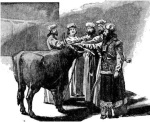
Leaning hands on a bull in an ordination offering

“… you shall offer your offerings (korbanim) from the animals from the herd or the flock.  If someone offers an olah from the [cattle] herd, he shall offer an unblemished male at the entrance of the Tent of Meeting.  He shall offer it out of his own desire in front of God.  And he shall lean his hand on the head of the olah, and it will be accepted for him, to atone for him.  And he shall slaughter the young bull in front of God.  Then the descendants of Aaron, the priests, shall offer the blood and splash the blood against the altar all around … (Leviticus/Vayikra 1:2-5)

olah (עֹלָה) = rising-offering.  (From the root verb alah (עלה) = go up.)  In an olah the entire slaughtered animal is burned up, so olah is often translated as “burnt offering” or even “holocaust offering”.

The same procedure applies to every animal offered at the altar: the donor leans his hand on the animal’s head, then slices its throat.  A priest splashes its blood on the altar, then butchers it.  For an olah, the entire animal is burned up on the altar; for other types of animal offerings, the priest waves around various pieces of the animal, then burns the fatty parts on the altar to make smoke rise up to God.  The breast and right thigh are for the priest and his family to eat.  The remaining meat is eaten by the donor and his guests.

This is difficult reading for someone who stopped eating mammals and birds 24 years ago because they are too much like human beings.3

The Torah’s instructions emphasize the affinity between livestock animals and humans be requiring the donor to lean or lay a hand on the animal’s head just before slaughtering it.  This act transfers the donor’s identity to the animal, so that killing and offering it is the equivalent of sacrificing one’s own life to God.4

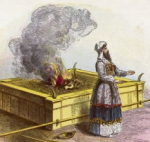
Smoke from the altar, “Treasures of the Bible”, Northrup 1894

Live, healthy cows, sheep, and goats were valuable items among the ancient Israelites, suitable as bribes, gifts, or payments to chieftains and prophets.  Dead animals were only good for hospitality, as part of a festive  meal.

What use would God have for a dead animal?

In the book of Leviticus, the fatty parts of the animal offerings are burned up into smoke, which ascends to the heavens, and the scent of that smoke pleases God.  The Torah does not specify whether an anthropomorphic God loves the smell of burning fat, or loves the smell that means humans are sacrificing valuable assets as gifts.

I can understand the desire to present God with a gift—out of sheer gratitude for our lives in the world, or out of a desire to return to harmony with the divine after we have strayed.  But I am grateful that Jews have moved beyond killing animals at an altar.

So what we can give to God instead?  The usual answer is that prayer has replaced animal offerings, and the passion of sincere prayer replaces the fire on the altar.

The first two Torah portions of Leviticus describe six types of fire-offerings.  In Part 2 of this post I will suggest alternatives for each type.  But first, let us look at fire-offerings in general.

Fire-offering

One thing that all six types of offerings have in common is that part of the offering is placed on the altar fire, and it goes up in smoke.  Even the minchah offering, which consists only of grain products, requires oil and frankincense on each item put on the altar.

When this week’s Torah portion, Vayikra, describes the first type of offering, the olah or rising-offering, it establishes that fire-offerings make God relax.

…and the priest shall bring all of it and make it go up in smoke on the altar; it is an olah, an isheh of restful fragrance for God. (Leviticus/Vayikra 1:13)

isheh (אִשֵּׁה) = fire-offering; offering burned on the altar. (From the word eish (אֵשׁ) = fire.)

Yet fire often evokes the emotion of anger the Torah; Biblical Hebrew, like English, uses words meaning “burning” and “inflamed” to indicate rage, especially God’s rage.  When the anthropomorphic God-character in the Torah gets a “hot nose”, a plague or another disaster kills thousands of Israelites, the innocent with the guilty.5

It is not the fire that that God finds restful, but the fragrance of the smoke.6

Today, some people claim that it is good to feel outrage at politicians, at authority figures who oppress the poor, and even at people who vote the “wrong” way, because outrage motivates people to take action.  Yet political action is more effective, as well as more ethical, when it comes from compassion tempered by reason.  Anger is an overwhelming emotion that carries us away, leading us to do things that our better selves regret later.

Anger is also a selfish emotion.  When we say or think “How dare they!” the underlying assumption is that “they” are threatening our power.  Both the child abuser and the rioter use what power they have to express an anger that does not respect other human beings.

Can we turn the fire of our natural selfish anger into smoke that rises up to the level of the divine?

Pillar of Fire, by Paul Hardy, 1896

To soothe an angry impulse we might make an isheh, a fire-offering, by praying, chanting, or meditating on our anger.  (I find that walking while I do this helps to release the physical energy of anger.)  If we are easily inflamed by controversies, or by the behaviors of other people, we might imagine offering our passionate anger on the altar to burn itself down.  We might visualize the smoke rising into a clear, calm sky.  After a while we might reach a state in which our original outrage is tempered both by rational considerations and by empathy for people who at first appeared to be enemies.

If we are anxious or afraid of the anger expressed by another person or group, we might sing prayers while imagining the majesty of God’s pillar of fire leading the way through the wilderness.  Eventually we, too, can move forward into the unknown with courage and calm strength.

*

Next week I will look at the six types of fire-offerings described in the Torah portions Vayikra and Tzav, and how we might address the impulse behind each one today—without slaughtering animals.

(I published an earlier version of this essay in March 2014.)

  1. From the hifil form of the verb karav (קָרַב) = come near.
  2. Exodus 29:42-45.  See my post Terumah & Psalm 74: Second Home.
  3. When I posted my first version of this essay in 2014, it was 18 years.
  4. Samakh (סָמַךְ) = he leaned (or lay) a hand (or hands) on.  When Moses lays his hands on Joshua, he transfers some of his authority and spirit to his successor as the leader of the Israelites (Numbers 27:18-23, Deuteronomy 34:9).  When the Levites are ordained, the Israelites lay hands on them to make them the people’s substitutes for service in the sanctuary (Numbers 8:10).  The word samakh is also used for the ritual before an animal sacrifice.  The word smikha (סְמִיכָה), from the root samakh, refers to the ordination of rabbis and other Jewish religious functionaries to this day.  See my post Tzav: Oil and Blood.
  5. For example, Exodus 32:10, Numbers 11:1-35, and Numbers 17:7-10.
  6. See my post Pinchas: Aromatherapy.

Tzav: Keep the Altar Fire Burning

The last Jewish temple was razed in the year 70 C.E., almost two thousand years ago, when the Romans destroyed Jerusalem. So what use do we have, today, for an instruction manual for priests officiating at the altar?

This week’s Torah portion, Tzav (“Command”) tells priests what to do with the grain offering and four types of animal offerings (or sacrifices) brought to the altar at the front of the sanctuary.  These instructions ares certainly of historic interest. But do they matter to our own psycho-spiritual lives?

For the past two thousand years, Torah commentary has answered yes—by finding deeper meanings embedded in the practical instructions for the priests. One example is the Torah’s insistence that the fire on the altar must burn through the night and never go out.

Command Aaron and his sons, saying: This is the Teaching of the olah: It is the olah that [stays] on the hearth, on the altar all night until the morning, and the fire in the altar must be kept burning. (Leviticus/Vayikra 6:2)

olah = ascending, going up; that which ascends; an animal offering completely burned on the altar and thus turned entirely into smoke that ascends to God

And  you shall keep the fire on the altar burning, you shall not let it go out; and the priest shall kindle wood on it each morning, and he shall arrange the olah on it and cause the fat of the shelamim to ascend on it.  A continual fire must be kept burning on the altar; you may not let it go out. (Leviticus 6:5-6)

shelamim = offerings of peace and wholeness; animals offered to express thanks or to fulfill a vow, and divided into portions to be burned into smoke for God, portions for priests to eat, and portions for the donors and their guests to eat

The olah was offered twice a day, morning and evening. Other offerings were burned on the altar during the day, but at night the sanctuary was closed to everyone but the priests, and no new offerings were added to the fire. For the other kinds of animal offerings, including shelamim, the priests cut up the animal and reserved some pieces for eating, but burned the choice fatty parts on the altar. The fatty pieces burned up quickly, but the olah was the whole skinned animal, so it burned slowly.

One interpretation of the commandment to keep the altar fire going all night is simply that the burning of the olah must be completed, no matter how long it takes. And who would want to deprive God of even a whiff of the smoke?  (See my blog post Pinchas: Aromatherapy.)

But the ancient Israelites must have appreciated the symbolic value of a fire that must never go out as much as we do today. In next week’s Torah portion, Shemini, Aaron and his sons inaugurate the sanctuary’s altar with various offerings, lighting the wood themselves. But then a fire comes straight out from God and consumes every animal and animal part smoldering on the altar in one glorious rush. From then on, the fire that burns on the altar has a direct line of transmission—or ignition—from that divine fire. As Rabbi Elie Munk pointed out in the early 20th century, “Fire is an allusion to the Divine Word, the Torah.”  The word of the Torah must never be extinguished.

The fire on the altar is both divine and man-made, rekindled daily by the priests. Thus it also represents our passionate desire for God, which we must never extinguish.

Rabbis in the Talmud tractate Yoma deduce that all the fire used for holy purposes in the sanctuary is taken from the continual fire on the altar, including the fire used to kindle the incense altar, to burn coals in the censer on Yom Kippur, and to light the seven lamps of the golden menorah. Naturally a fire started by God would be the most holy fire to use. But Rabbi Munk compares the fire on the outer altar, used for animal offerings (i.e. sacrifices) to “the altar of duty” on which we should sacrifice our egotism. Only if we tend the fire of that altar will we be able to kindle the fire of passion for God that brings us exaltation.

Other commentary points out that although the fire on the altar must never go out altogether, it burns low during the night, and in the morning a priest kindles fresh wood from it. The late 19th-century Hassidic rabbi Yehudah Leib Alter of Ger wrote that the rekindling in the morning means that every day a new light comes to those who serve God.  Our spirits burn low at night, that is, when our soul are distracted by darkness and evil. But when we remove the ashes from the previous day’s sacrifices, we are removing the waste in our lives, and that uplifts us so that we receive new light from God.

About 100 years later, in 1998, Rabbi David Wolfe-Blank zt”l wrote the following double translation of Leviticus 6:6. (The first sentence is a literal translation; the second interprets it at a psycho-spiritual level.)

This is the law of the elevation offering, the elevation offering on the flames on the altar all night until the morning, and the fire of the altar shall be kept aflame on it.

This is the teaching which enables you to transcend. Transcend the ‘small’ by moving toward whatever enflames the passion in your heart even during times of illusion and conventional life-issues, leading towards the time of enlightenment. Let the parts of the Torah which seem brightly lit to your heart blaze and shine and fire up those parts of your soul that are ignitable.

Both Rabbi Yehudah Leib Alter of Ger and Rabbi David Wolfe-Blank of Seattle compared the nights in this Torah verse to the times when we are distracted and deluded. I believe these times of darkness  are frequent for everyone; it is so easy to get caught up in the obsessions of our society, so hard to keep out minds on a higher purpose in life. But if we stick to a practice of offering ourselves to the divine at regular intervals—perhaps every morning and evening, like the olah—then we keep the fire from going out altogether. Another way to keep the fire from going out during the dark times, according to Wolfe-Blank, is to keep paying attention to the parts of the Torah that light up our hearts.

Then after every dark night comes a morning, and by the grace of God we see beauty and light again. We recall our own souls, and the fire is rekindled—the fire of desire and enlightenment and glory, the fire that is both a gift from God, and our gift to God.

Tzav: Who Gets the Skin?

When I read all the gory details of the animal sacrifices in the book of Leviticus/Vayikra, I have to work hard to imagine how all that slaughtering, butchering, and throwing blood around could bring anyone closer to God. I believe that when we kill our fellow mammals we should mourn, not celebrate; and I view the slaughter as something we need to atone for, not as a means of atonement.  Thank God we switched to worship through prayer about 2,000 years ago!

It would be easy for me to dismiss the earlier technology as an artifact of an ancient culture.  I could simply address the issues of the present day, and campaign for treating all mammals more humanely, killing them only out of practical necessity, and reforming our diets. But I have dedicated myself to Torah study, and that means I must search for deeper meaning in the text, even the descriptions of animal offerings.

When I reread this week’s Torah portion, Tzav (Command), I noticed that the three basic motivations for offering an animal at the altar correspond to three instructions for what to do with the animal’s skin.

Although the book of Leviticus/Vayikra classifies offerings with five different names, covering at least a dozen different situations, they boil down to three reasons for bringing an animal to the altar:  to express individual gratitude or devotion to God; to atone for individual guilt; and to atone for the whole community and/or its religious leaders.

When a man brought an animal offering to express gratitude or devotion (in the Torah only men bring animals to the altar), after the butchery, burning, and feasting, he got to keep the animal’s skin, which had value because it could be tanned to make leather.

We learn in the Torah portion Tzav that when an individual brought an animal offering to be relieved of guilt over a lapse, a wicked thought, a sin of omission, or an unintentional wrong against God, the priest who performed the atonement got to keep the hide.

As for the priest who brings near a man’s rising-offering, the skin of the rising-offering that the man brought to the priest will become his.  (Leviticus/Vayikra 7:8)

or = skin (either human or animal)

When a priest brought an animal offering to make atonement for himself or for the entire community, the skin was burned on the ash-heap outside the camp where the ashes from the altar were taken.  Moses does this in this week’s Torah portion during the ordination of Aaron and his four sons as the first priests of the Israelites, so they can begin their new offices with a clean slate.

And the bull and its skin and its flesh and its intestinal contents he burned in the ash-heap outside the camp, as God had commanded Moses.  (Leviticus 8:17)

The three ways of disposing of the slaughtered animal’s skin make sense on a practical level.  Someone who wanted to draw closer to God out of a devotional impulse, or gratitude for good fortune, should be allowed to keep any part of the animal not used in the ritual.  Why should he suffer any extra economic loss?

However, someone who was guilty of missing the mark in his relationship with God needed to experience a loss, to give up something in exchange for being freed of his guilt.  The priest got the skin because his service enabled the guilty man’s atonement.  (Priests were not paid salaries, or given land to farm, so they received compensation in the form of meat, skins, and bread from various offerings.)

If a priest erred in his holy service, or if the whole community missed the mark (because the priests did not guide them properly), then it makes practical sense that the priest should get no economic benefit from the sacrificial animal’s skin.  Burning the hide adds dramatic impact to this most serious kind of ritual offering.

I can also see symbolic meaning in the three ways of handling the skins.  In the book of Genesis/Bereishit, God clothes Adam and Eve in skins before sending them out into the world. Skin is like a garment.  It separates and protects an individual from the rest of the world.  And skin, like a garment, also signals the individual’s public identity and role in the world.

Perhaps the skin of an animal offering represents the skin of the man who brings it.  The Torah mandates that the man who brings an animal  to the altar must lean his hands on its head before it is slaughtered.  This gesture apparently connects the human with the animal, so the offering counts as his.

When someone brought an offering of gratitude or devotion, he was already in a good standing with God; the offering expressed his feelings and brought him even closer to the divine.  His public identity did not need to change.  Therefore he could keep the animal skin.

When someone brought an offering out of guilt, he had stumbled in his service to God.  In order to atone and return to good standing, he needed to recognize, in his heart, that his position in the community and his connection with God must not be taken for granted.  I think he gave the animal skin to the officiating priest as an act of humility.

Why was the skin burned when a priest brought an offering to atone for his own guilt, or for the guilt of the whole community?  The Torah requires burning the skin outside the camp when a priest is ordained, when a priest discovers that he or the whole community has committed a lapse in service to God, and once a year on Yom Kippur, the day of atonement for everyone.

The priests of the Israelites, like all religious leaders today, and everyone else who guides people on the level of their souls, have to be meticulous in their service.  If they violate someone’s trust; if they treat other humans without respect; if they preach one thing and do another; if they become so enamored of their role, so dazzled by their own garments, that they fail to examine their inner selves; then their guilt is so great they must burn their animal skins.  That means they must leave their sanctuary and leave the community where they did wrong, going “outside the camp”, and give up their public roles, their animal skins.

What if the animal offering atones for the whole community, like the goat offered to God on Yom Kippur?  Modern Jews do not cast lots on goats on Yom Kippur, but we do spend the day praying.  Our prayers for atonement are in the plural: we have become guilty, we have betrayed, we have robbed, we have slandered, and so on.  No one is isolated; we are all responsible for one another.  We share the good and the bad.  We are our brothers’ keepers.  And our membership in the human community is intrinsic to our connection with the divine.

Therefore, when we want to come closer to God, we must all abandon the garments of our public roles.  Burn those animal skins, and let the smoke rise up to the heavens!

Tzav: Horns, Ears, Thumbs, and Toes

(This blog was first posted on March 22, 2010.)

And Aharon and his sons leaned their hands on the head of the bull of the purification offering.  And Moshe slaughtered it. and took the blood and put it on the horns of the altar all around with his finger, and he purified the altar.  And he poured out the blood on the foundation of the altar, and he made it holy for atonement.  (Leviticus/Vayikra 8:14-15)

And Aharon and his sons leaned their hands on the head of the ram.  And Moshe slaughtered it, and took some of its blood and put it on the rim of Aharon’s right ear, the thumb of his right hand, and the thumb of his right foot (i.e. his right big toe).  Then he brought near the sons of Aharon, and Moshe put some of the blood on the rims of their right ears, the thumbs of their right hands, and the thumbs of their right feet.  Then he dashed (the rest of) the blood on the altar, all around.  (Leviticus 8:22-24)

In Exodus, God tells Moses how to ordain the first priests, his brother Aaron and Aaron’s four sons.  In Leviticus, in this week’s Torah portion, Tzav (Command), Moses performs the ordination ritual.  The ritual involves elaborate costumes, consecration with oil, three sacrificial animals, purification with blood, and finally seven days spent at the entrance to the Holy of Holies.

During this ritual, whenever Moses anoints the future priests with oil, or purifies them with blood, he also sprinkles the oil or blood on the altar where future animal sacrifices will be burned.  Thus the priests are identified with the altar.

The main function of both the priests and the altar is to facilitate animal sacrifices.  Animal sacrifices are the primary means of worshiping God in the five books of Moses.  (Prayer, according to Jewish tradition, is introduced by Hannah in the first book of Samuel.)  Once the priests are ordained in this week’s Torah portion, the Israelite people bring their animals to the altar in front of the sanctuary, and there the priests officiate over the slaughter and over the burning of certain parts to create a fragrance pleasing to God.  Thus both the priests and the altar are intermediaries between the people and God.

Moses consecrates all five future priests by sprinkling them with anointing oil (as well as pouring some on Aaron’s head).  He sprinkles the same oil on the altar and the tools that will be used there.  But the distribution of the blood of purification is more elaborate.  The altar gets bull’s blood on the “horns” at its four corners, then at its foundation.  The blood of a ram is dashed all around the altar.  The men get ram’s blood on their right ears, right thumbs, and right big toes.

Is there any connection between where Moses puts blood on the altar, and where he puts it on Aaron and his sons?

Many commentators say that daubing blood on the future priests’ extremities, from top to toe, symbolically purifies their entire bodies.  On this theory, applying blood to the altar’s top extremities and bottom foundation symbolically purifies the entire altar.

But why those particular extremities?  Rabbi R.S. Hirsch wrote that the ear stands for hearing and understanding, the hand for creative work, and the foot for striving to advance — all of which are expected of a community’s spiritual leaders.

Why does Moses apply the blood to the right ear, hand, and foot, rather than to the left?  The Torah associates the right hand with power.  Probably this association extends to the whole right side.  (Later, kabbalists associated the right side with active energy, and the left with restraint and judgment.)

The altar for animal sacrifices has neither ears nor hands, but Moses applies blood to its four horns and its foundation.  The Torah sometimes uses the word for “horn”, keren, as a metaphor for a ray of light, or as a symbol of strength and power.  The “horns” protruding from the top corners of the altar are probably a reminder of the horns of the cattle, sheep, and goats sacrificed there.  But they also might stand for the altar’s connection with the divine, evoking the idea of powerful rays of light pointing up toward the heavens.

Moses also poured the blood of purification on the ground at the foundation, or footing, of the altar.  Both the priests and the altar must be pure where they reach toward heaven, and also where they have their feet on the ground.  Only then can they be holy intermediaries between God and the people.

Kabbalists take note: Leviticus 8:15 uses the word yesod for the base of the altar.  Yesod means “foundation”, but it is also one of the ten sefirot in kabbalah, the ten aspects of divine action in our world.  The sefirah of yesod is associated with the ego, and also with creative, generative power.  On the human body, it corresponds metaphorically with the sexual organs.

The Hebrew word for  “foot”, regel, is sometimes used in the Torah as a polite synonym for a man’s sexual organ.  In this Torah portion, Moses daubs blood on the future priests’ big toes on their right feet.

Do our own symbolic altars, where we sacrifice some of our animal aspects, need to be purified at the level of sex and ego?  Does our own service to the divine, our own inner priesthood, also need to be purified at the level of yesod?