Shemini: Follow the Rules

The first animal offerings on the new altar are devoured by God’s fire—and so are two of the new high priest’s sons.
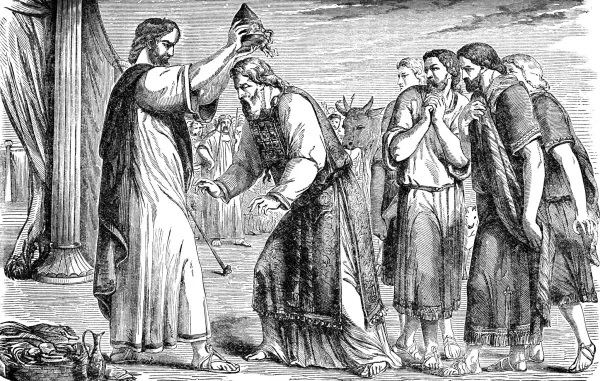
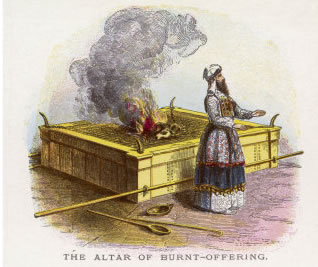
The Consecration of Aaron and his Sons, Holman Bible, 1890

The new portable tent-sanctuary, also called the Tent of Meeting, is complete. The first five priests of the revised religion are dressed in their new vestments. Moses has sacrificed a “ram of ordination”; daubed its blood on Aaron, the new high priest, and his four sons; and splashed the rest of the blood on the new altar in front of the tent. After that, Aaron and his sons have spent seven days sitting in the entrance of the tent-sanctuary.

This week’s Torah portion, Shemini (Leviticus 9:1-11:47), opens on the eighth (“shemini”) day, when the high priest slaughters the animal offerings for the first time. Aaron applies the blood to the horns, base, and sides of the altar, and lays out the prescribed animal parts over the wood fuel inside.

Then Aaron lifted his hands toward the people and he blessed them. And he came down from doing the guilt-offering, the rising-offering, and the wholeness-offering. Then Moses and Aaron entered the Tent of Meeting. And they went out, and they blessed the people. (Leviticus 9:22-23)

The text does not say why Moses and Aaron pop into the Tent of Meeting and back out. One common answer in the commentary, as explained in the 17th-century commentary Siftei HaChamim, is:

“Since the incense is a service performed inside [the Tent of Meeting], Moshe could not teach Aharon during the seven days of installation, and he needed to teach him on the eighth day of the installation.”1

But it seems odd to interrupt the dramatic inauguration of the priests and the altar for a lesson on how to burn incense on the incense altar inside the tent—a job the high priest would not perform until sunset anyway.2

Another line of commentary theorizes that Moses and Aaron are waiting for God to make the next move. When nothing happens, they go inside God’s tent to pray. Perhaps they even say a prayer the back chamber, the Holy of Holies, where God promised to dwell in the empty space above the ark. According to Sifra, circa 300 C.E.:

“When Aaron saw that all the offerings had been sacrificed and all the services had been performed and the shekhinah had not descended upon Israel, he stood and grieved: “I know that the Lord is wroth with me [because of the Golden Calf].” … Whereupon Moses entered [the tent] with him, they implored mercy, and the shekhinah descended upon Israel.”3

The term shekhinah (שְׁכִינָה), meaning God’s presence dwelling in the world, was not invented until after the fall of the second temple in 70 C.E. The book of Leviticus says that after Moses and Aaron come out and bless the people, everyone sees God’s kavod emerge from the tent.

And the kavod of God appeared to all the people. And fire went out from in front of God, and it consumed the burnt offering and the fat parts on the altar. And all the people saw, and they shouted in joy and they threw themselves on their faces. (Leviticus 9:23-24)

kavod (כָּבוֹד) = glory, weight, magnificence, authority; (later) shekhinah.

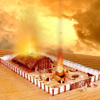
If the divine fire starts “in front of God”, it apparently goes through the curtain screening off the Holy of Holies, through the main chamber of the tent, and out through the entrance curtain, without burning anything. Then God’s fire lands on the altar in front of the tent-sanctuary, and instantly creates a blaze that consumes the animal parts laid out there.

The people’s year of labor fabricating the Tent of Meeting has been crowned with success! No wonder they shout joyfully and prostrate themselves.

Meanwhile, Aaron’s two younger sons, Elazar and Itamar, are apparently just standing outside, waiting for instructions. But his two older sons, Nadav and Avihu, do something on their own initiative.

And Aaron’s sons Nadav and Avihu took, each one, his fire-pan. And he put embers in it, and he placed incense on it, and he brought it close before God—zarah fire, which [God] had not commanded them. (Leviticus 10:1)

zarah (זָרָה) = strange, foreign, unauthorized.

Aaron the High Priest (at the incense altar), by Ephraim Moshe Lilien, 1914, detail

The commentary assumes that since Nadav and Avihu “brought it close before God”, they went inside the Tent of Meeting—as Moses and Aaron had done shortly before. Yet God’s instructions in Exodus are that incense for God is to be burned only on the gold incense altar in the main chamber of the sanctuary tent, and only by the high priest. Aaron must burn incense on the incense altar at sunset and sunrise, when he tends the lamps of the menorah. And he must burn the incense on embers brought in from the big altar outside. God adds:

“You may not bring up any zarah incense on it!”  (Exodus 30: 9)

Nadav and Avihu, being only assistant priests, are not authorized to burn incense on the gold altar at all.

Moses and Aaron are allowed to go in and out of the Tent of Meeting, and to pray to God there, so they did not break any rules when they popped inside between blessings. But Nadav and Avihu violated God’s rules about incense: they used their own embers and their own fire-pans, and they usurped one of the high priest’s jobs. None of this was authorized, so their incense was zarah in three ways. Furthermore, they did not consult with their father or their uncle Moses first, to see if they had forgotten any rules that Moses had passed down from God.
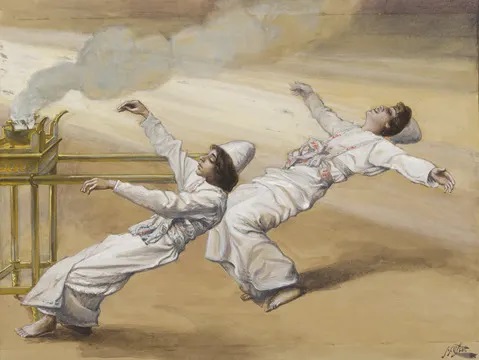
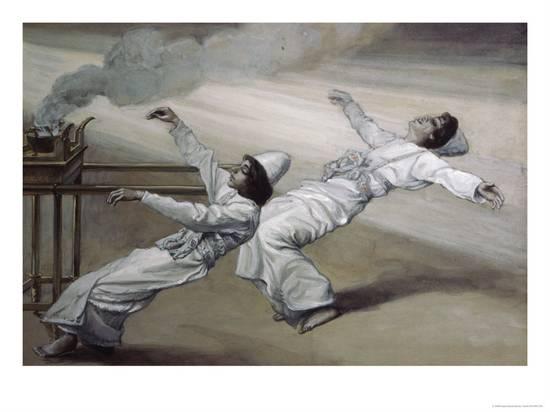
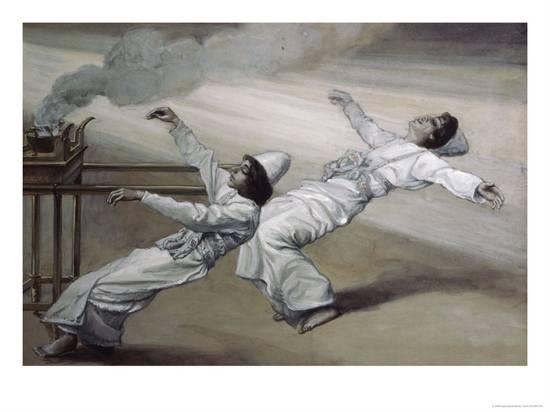
The Two Priests are Destroyed, by James Tissot, circa 1900

And fire went out from in front of God, and it consumed them; and they died in front of God. (Leviticus 10:2)

Why did they do it?

My favorite theory about why Nadav and Avihu risk death to bring unauthorized incense to God is that they are impulsive mystics. They are reckless because they are eager for the ecstasy of another close encounter with God, like their encounter partway up Mount Sinai when they and the 70 elders saw God’s feet on a sapphire pavement. (See my post: Shemini: Fire Meets Fire.)

But Jewish commentary offers other theories. This year, I am struck by the theory that God’s fire rushes out from the Holy of Holies only once, killing Nadav and Avihu on the way to igniting the animal parts on the altar.

One piece of evidence is that the two descriptions of God’s fire start with identical language in Hebrew. Here are direct English translations:

And fire went out from in front of God, and it consumed the burnt offering and the fat parts on the altar. (Leviticus 9:24)

And fire went out from in front of God, and it consumed them; and they died in front of God. (Leviticus 10:2)

Rashbam, a 12th-century commentator, explained the timing: “Fire came forth from before God—from the Holy of Holies … The fire found Aaron’s two sons there, near the golden [incense] altar, and it burned them to death. Then the fire went out of the Tabernacle to the copper altar where it consumed the burnt offering and the fats on the altar.”4

In this reading, Moses and Aaron have emerged from the Tent of Meeting and are outside blessing the people while Nadav and Avihu slip behind them and bring their own incense into the tent. God’s fire does not rush out of the tent until after the two assistant priests are inside.

Zornberg explained in her recent book, The Hidden Order of Intimacy: “Nadav and Avihu are on fire to bring God’s presence into their midst. Only in this way will the shadow of the Golden Calf be removed. This passion is pragmatic in its thrust: to resolve the suspense of waiting for the sacrifices to be consumed. It is, starkly, a passion to consummate the sacrificial rituals. The Netziv5 imagines the situation—the crowds of Israelites waiting for the revelation of the consuming fire: an element of social pressure plays its part.”6

Although God never promises to inaugurate the altar with divine fire, the crowd of Israelites is no doubt expecting to see something spectacular. It would be a disappointing anticlimax if the new priests had to light the first fire on the altar—the fire that is supposed to be so holy that it can never be allowed to go out.7 Naturally all the people are delighted when God’s miraculous fire rushes right through the entrance curtain of the tent-sanctuary and pounces on the altar.

All the people except Nadav and Avihu, who are dead because they disobeyed God’s rules at a critical time.


The book of Leviticus is primarily a priests’ handbook, listing rule after rule about how to correctly run a religion that no longer exists. The Israelite way of worship based on animal sacrifices died out quickly after the Romans destroyed the second temple in Jerusalem in 70 C.E. Since then, Jews have worshipped God through prayer, study, and good deeds. Few of the laws in Leviticus apply any more; the major exceptions are the rules for keeping kosher in Leviticus 11:1-23, and the ethical injunctions in the “Holiness Code”, Leviticus 19:1-35, which includes “Love your fellow as yourself” and “You must not place a stumbling-block in front of the blind”.8

Yet even when specific rules for worship no longer have any application, the concept of following the rules remains crucial. On a political level, the rule of law is necessary for civil society, and if the leader of a nation overrides it, everyone’s liberty is imperiled. On a religious level, each group has its own norms of behavior, and anyone who violates them too extravagantly will disrupt and perhaps even destroy a congregation. And on a personal level, we can function well in families and other social groups only when everyone observes basic rules of courtesy.

I believe it is good to question rules that may be outdated, and to suggest new rules to meet new needs. But human beings need rules. Without them, the best of us do unintended harm to others, and the worst of us get away with murder.


  1. Siftei HaChamim, 17th century, translation in www.sefaria.org.
  2. Exodus 30:7-8.
  3. Sifra, circa 300 C.E., translation in www.sefaria.org.
  4. Rashbam (12th-century Rabbi Shmuel ben Meir), translation in www.sefaria.org.
  5. The Netziv is the nickname of Naphtali Tzvi Yehudah Berlin, a 19th-century rabbi who wrote Ha-Amek Davar.
  6. Avivah Gottlieb Zornberg, The Hidden Order of Intimacy: Reflections on the Book of Leviticus, Schocken Books, New York, 2022, p. 98.
  7. Leviticus 6:12-13.
  8. See my posts: Kedoshim: Ethical Holiness, Kedoshim: Love Them Anyway, and Kedoshim: Vilification and Hindrance.

Haftarat Shemini—2 Samuel: Legacy

The obvious connection between this week’s Torah portion and haftarah reading is the message that God might strike dead even people who are doing God’s work, if they don’t get proper authorization for every action.

In the Torah portion, Shemini (Leviticus 9:1-11:47), two of Aaron’s sons who have just been consecrated as priests bring unauthorized incense into the sanctuary; God consumes their souls with fire.1 (See my post Shemini: Fire Meets Fire.) In the accompanying haftarah reading from the prophets, 2 Samuel 6:1-7:17, King David is transporting the ark on an ox cart to Jerusalem. Uzza, one of the two ad-hoc priests walking beside it, puts his hand on the ark to steady it when the oxen stumble; God strikes him dead “over the irreverence”.2 (See my post Shemini & 2 Samuel: Segregating the Holy.)

Eifod with sash,
side view

But Uzza’s death during King David’s first attempt to bring the ark to Jerusalem is not long enough for a haftarah portion. So the reading for this week continues with David’s second, successful transportation of the ark to his new capital. In this story, he dances in front of the ark wearing only a tabard called an eifod, and whenever he whirls his genitals are exposed. His wife Mikhal scolds him, but God apparently does not find David’s half-naked dancing irreverent; God punishes Mikhal with childlessness, but does nothing to David. (See my post Haftarat Shemini—2 Samuel: A Dangerous Spirit.)

The third story

A third story, which completes the haftarah, begins:

And it happened that the king was settled in his bayit, and God gave him rest from all the enemies around him. And the king said to Natan the Prophet: “See, please! I myself am dwelling in a bayit of cedar, and the ark of God is dwelling within the curtains [of a tent]!” (2 Samuel 7:1-2)

bayit (בַּיִת) = 1) house; any building where humans or a god reside at least part-time. 2) household; everyone who lives in the householder’s compound, including slaves as well as family members. 3) dynasty, lineage (like today’s House of Windsor).

Earlier in the haftarah, David brought the ark—considered God’s throne—into a tent he had pitched near his new cedar palace in Jerusalem.3 Now, when he says the ark is “dwelling within the curtains”, we learn that part of that tent is screened off from the main area with curtains, like the curtain that screened off the Holy of Holies in the portable tent sanctuary the Israelites built at Mount Sinai in the book of Exodus.

According to 11th-century commentator Rashi,4 King David thinks it is time to fulfill one of Moses’ commands in Deuteronomy about building a temple:

And you will cross the Jordan and settle in the land that God, your God, is allotting as your possession, and you have rest for yourselves from all your enemies from all around, and you dwell in safety, then it will become the place where God, your God, chooses [God’s] name to inhabit. There you must bring all that I command you, your rising-offerings and your slaughter-offerings … (Deuteronomy 12:10-11)

But 21st-century commentator Everett Fox wrote: “In the ancient Near East, such a desire would have been prompted not merely by piety; temples were political statements as well, symbolizing a god’s approval and protection of the regime.”5

King David’s motivations for building a temple could include a desire to welcome God at a higher level, a need to show everyone that Israel has its own powerful god, and a wish to leave a legacy in a world where he might lose the kingship like his predecessor, King Saul.

But David is foiled when the prophet Natan hears from God that night.

Nathan Tells David, by Jacob Backer, ca. 1633

And that night, the word of God happened to Natan, saying: “Go and say to my servant David: Thus said God: Are you my builder of a bayit for me to stay in?” (2 Samuel 7:4-5)

Midrash Tehillim6 adds to the biblical story by adding to what God said, claiming that God refused to let David build the temple because he had “shed much blood”. This is probably not a reference to all the Philistines David killed when he was an Israelite general, but rather to David’s killing and looting when he was the leader of an outlaw band and worked for a Philistine king.7

Midrash Tehillim also points out that Psalm 30 begins: “A psalm song of the dedication of the bayit for David”. Therefore, the midrash says, even though David did not build the temple, it was named after him—“to teach you that whoever intends to perform a commandment but is prevented from doing so, the Holy One, blessed be He, credits him as if he had performed it.”8

But God gives Natan a different explanation in this week’s haftarah:

“For I have not stayed in a bayit from the day I brought up the Israelites from Egypt until this day; but I have been moving about in a tent and in a sanctuary. Wherever I have been moving about among the Israelites, have I ever spoken a word with one of the leaders of Israel whom I commanded to shepherd my people Israel, saying: Why didn’t you build me a bayit of cedar?” (2 Samuel 7:6-7)

Once again God has asked a rhetorical question whose answer is “No”.

“Now you must say thus to my servant David: Thus said the God of Armies: I myself took you from the pasture, from following the flock, to become ruler over the people, over Israel.” (2 Samuel 7:8)

When Natan repeats this to David, it will serve as a reminder both of how far he has come, and of how God is in charge. Next God affirms that the people will remain safe from enemies in the land David has finished conquering. Then comes a promise to David:

“And God declares to you that God will make a bayit for you.” (2 Samuel 7:11)

King David has already built his own cedar palace. Now God is promising a different kind of bayit for him: a dynasty.

“When your days [of life] are filled, and you lie with your forefathers, then I will raise up your seed after you, one who issued from your innards, and firmly establish his kingship. He will build a bayit for my name, and I will establish the throne of his kingship forever.” (2 Samuel 7:12-13)

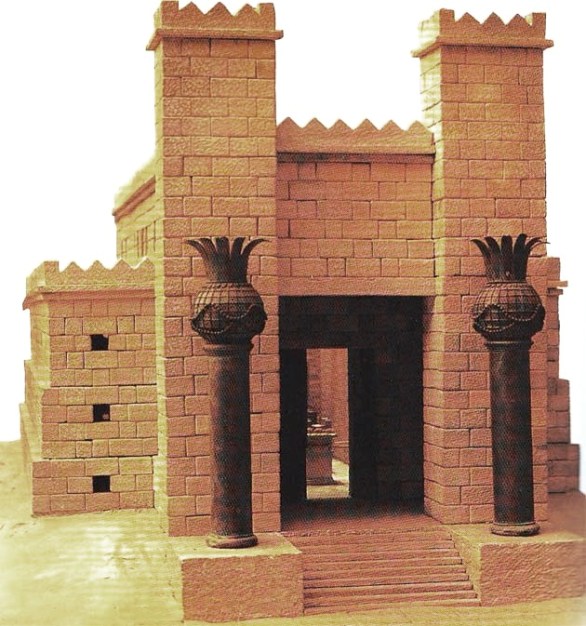
Reconstruction of Solomon’s temple,
Bible Museum, Amsterdam

David has not yet seen Batsheva at this time. But eventually David’s second child by Batsheva, Solomon, becomes the next king of Israel. Solomon does build a temple (bayit) dedicated God in Jerusalem.9 He is not as effective at building a dynasty (bayit) dedicated to God, and the northern half of his kingdom breaks away shortly after he dies. But kings from his line do rule Judah, the southern half of David and Solomon’s kingdom, until the Babylonian conquest over 200 years later.

Natan’s vision from God concludes with a reassurance that God will not replace David’s son with a new king, the way God replaced King Saul with David.

“I will be a father to him, and he will be a son to me. When he acts perversely, I will rebuke him with the rod of men and the affliction of humans. But my loyal kindness will not be removed from him as I removed it from Saul, whom I removed [to make room] for you. And your bayit and your kingship are confirmed forever before me; your throne will be established forever.” According to all these words and all this vision, thus Natan spoke to David. (2 Samuel 7:14-17)

In effect, God adopts David’s future son Solomon.

A qualification

What God does not say is that God’s promise to King David is contingent on the next king’s good behavior. In the first book of Kings, King Solomon completes the temple in Jerusalem and God fills it with a cloud of glory.10 Then Solomon makes a long speech to the assembled crowd, in which he says:

“And now, God of Israel, please let your word be confirmed that you promised to your servant David, my father.” (1 Kings 8:26)

Eight days later, after the people go home, God appears to King Solomon and says:

“And you, if you walk before me like your father David walked, with a whole heart and with uprightness, doing everything that I commanded you, keeping my decrees and my laws, then I will erect the throne of your kingship over Israel forever, as I spoke regarding your father David, saying: No one will cut you off from the throne of Israel. [But] if you actually turn away from me, you or your descendants, and do not keep my commands [and] decrees that I have set before you, and you go and serve other gods and bow down to them, then I will cut off Israel from the face of the soil that I gave them. And the bayit that I made holy to my name I will send away from my presence, and Israel will become a proverb and a taunt among all peoples.” (1 Kings 9:4-7)

Is the bayit that God made holy the temple? God hallowed it by filling it with the divine cloud of glory. But although God stay away from the temple, the physical building cannot be sent anwhere. A couple of centuries later, when the Babylonians loot and burn the temple,11 2 Kings and Jeremiah consider it a punishment for bad behavior.

What if the bayit that God made holy is the dynasty of King Solomon? Then the appearance of the cloud of glory shows that God has consecrated Solomon. And Solomon’s dynasty is “sent away from God’s presence” when the Babylonian army deports the last two kings of Judah, Jehoiachin and Zedekiah, to Babylon.


The yearning to leave a legacy, something that will last long after your death, is part of human nature. Parents hope their children’s children’s children will pass down their genes and their family history. Writers hope people will read their work after they are gone. Founders of businesses hope their companies will go on for decades without them.

The book of Ecclesiastes (Kohelet) notes:

The living know they will die. But the dead know nothing; they have no more reward, since even the memory of them is forgotten. Also their loves and their hates and their jealousies have already perished; and they have no share ever again in anything that is made under the sun. (Ecclesiastes 9:5-6)

King David does not get to build a bayit of cedar and stone to be God’s temple, but God consoles him with the promise that he will build a dynasty, a bayit of a royal line. But even that does not last forever.


  1. Leviticus 10:1-5.
  2. 2 Samuel 6:3-7.
  3. 2 Samuel 6:17.
  4. Rashi is the acronym of 11th-century Rabbi Shlomoh Yitzchaki.
  5. Everett Fox, The Early Prophets, Schocken Books, New York, 2014, p. 454.
  6. Midrash Tehillim on Psalm 62, 11th century.
  7. See 1 Samuel 27:8-12.
  8. Midrash Tehillim on Psalm 62. Translation from www.sefaria.org.
  9. 1 Kings 6:1-8:46.
  10. 1 Kings 8:10-11.
  11. 2 Kings 25:8-18.

Haftarat Shemini—2 Samuel: Consolidation of Power

The Consecration of Aaron, Holman Bible, 1890

Religious and secular authority are combined in a new power structure both in this week’s Torah portion (Shemini, Leviticus 9:1-11:41) as well as in the haftarah reading (2 Samuel 6:1-7:17). In the Torah portion, Moses (the prophet and de facto ruler of the Israelites) consecrates his own brother Aaron as the first high priest. In the haftarah, King David installs the Ark of the Covenant in his new capital and serves as a priest.

Both stories include a reminder that the religion of the Israelites is perilous. After Aaron’s four sons are consecrated as priests, two of them bring incense into the tent-sanctuary without permission, and God kills them. (See my post: Shemini: Fire Meets Fire.) When King David is bringing the ark to Jerusalem and one of the ark’s priestly attendants steadies it with his hand, God kills the man instantly. (See my post: Shemini & 2 Samuel: Segregating the Holy.) Yet the consolidation of religious and secular authority is apparently worth the danger to both Moses and David.

In Leviticus, Moses is following God’s instructions for creating the priesthood and inaugurating the tent-sanctuary. But in 2 Samuel, David figures out what to do on his own.

The king before David

David became the second king of Israel after a career as a musician, a warrior—and a rival of the first king, Saul.

Saul was a tall, handsome young man searching ineffectually for his father’s lost donkeys when the prophet Samuel secretly anointed him king. Samuel then told Saul to walk to a meeting of tribal leaders.

Saul Prophesies with the Prophets, sketch by James Tissot, circa 1900

“And … you should come to the Hill of the Gods, where there is a Philistine outpost. And it will happen as you enter the town there, you will encounter a band of neviyim coming down from the hill-shrine, preceded by lute and drum and flute and lyre. And they will be mitnaviym. And the spirit of Y-H-V-H will come over you powerfully, vehitnaviyta along with them, and you will be transformed into another man.” (1 Samuel 10:5-6)

neviyim (נְוִיאִם) = professional ecstatics; prophets. (Singular נָבִיא.)

mitnaviym (מִתְנאבְּאִים) = speaking in ecstasy, raving, acting like an ecstatic; speaking prophecy.

vehitnaviyta (וְהִתְנַבִּים) = and you will act like an ecstatic.

It happened just as Samuel predicted.

And [Saul] finished meihitnavot, and he entered the hill-shrine. (1 Samuel 10:13)

meihitnavot (מֵהִתְנַבּוֹת) = from raving, from speaking in ecstasy.

The neviyim who came down from the hill-shrine were not prophets like Samuel, but professional ecstatics who were moved by the spirit of a god connected with the hill-shrine.1 Saul was moved by the spirit of Y-H-V-H, the God of Israel. Religion in the hill-country of Canaan at that time seems to have been a mixture of practices prescribed in the Torah and the customs of indigenous polytheists.

After Saul arrived at the meeting, he was chosen king by lot, and then everyone went home. But the next time a belligerent chieftain attacked an Israelite clan, Saul rallied the disorganized Israelite tribes, led a united army to battle, and won. Apparently his experience of raving and/or dancing in public had indeed transformed him.

Saul began a long campaign against the Philistines, who had been migrating in from the Mediterranean coast and capturing the hill country where the Israelites lived. But he did not follow Samuel’s orders closely enough for the prophet’s satisfaction, and Samuel secretly anointed a new king, a boy named David. Saul began having episodes of mental illness, and he hired David to soothe him at those times by playing the lyre. Then David volunteered for single combat with the Philistine giant Goliath. He became a successful and popular warrior and military leader, and Saul became insanely jealous. Saul ordered David’s murder, and David fled.

After King Saul died in a battle against the Philistines, David became the king—first of Judah, then of all the territory of Israel. He captured the southern part of Jerusalem from the Jebusites and made it his new capital, the City of David.

David as king, ecstatic, and priest

Meanwhile, the prophet Samuel has died, and there is no one in the land with his religious authority. King David, always inventive, figures out in this week’s haftarah how to acquire some religious authority himself.

His first idea is to move the Ark of the Covenant into the City of David. Back when the prophet Samuel was a child, the Philistines had captured the ark in battle. But when they brought it home, it destroyed one of their own idols and caused two plagues, so they returned it to Israelite territory. During all of King Saul’s reign, the ark remained near the border in a private Israelite household at Kiryat Yearim. (See my blog post Pedudei & 1 Kings: Is the Ark an Idol?)

Then David and all the troops that were with him got up and went … to bring up from there the ark of God … And they mounted the ark of God on a new cart. (2 Samuel 6:2-3)

And David and the whole house of Israel were dancing before God with all their might, with lyres and with lutes and with drums and with castanets and with cymbals. (2 Samuel 6:5)

In other words, they were acting like the band of ecstatics that Saul had joined on his way to become king.

19th-century engraving featuring a sedate David with robes instead of eifod

The cart tips, and the attendant walking beside it lays a hand on the ark to steady it. He dies instantly.

And David was afraid of God that day, and he said: “How can the ark of God come to me?” (2 Samuel 6:9)

King David leaves the ark at a nearby house. But three months later he is told that the household has prospered because of the ark. David returns and escorts the ark the rest of the way to the City of David. Once again he behaves like an ecstatic overcome by the spirit of God, “whirling with all his might” (2 Samuel 6:14). This time he wears a priest’s linen tabard (eifod).2 King David is deliberately combining a priest’s garment with ecstatic dancing.

And they brought the ark of God, and they set it in its place inside the tent that David had pitched for it. And David brought up rising-offerings and wholeness-offerings in front of God. And David finished bringing up the rising-offering and the wholeness-offering, and he blessed the people in the name of God of Armies. Then he distributed to all the people, to all the multitude of Israel, to every man and woman, one round loaf of break, and one pan cake, and one raisin cake. And all the people left, each to his house. (2 Samuel 6:17-19)

Burning the animals offered to God is a priest’s job. So is blessing the people in the name of God; the high priest Aaron blesses the people in the inauguration in this week’s Torah portion.3

When David first fled from Saul, the priest Ahimelekh gave him and his men some of the priests’ bread.4 But King David has more resources than a priest, and distributes largesse like a king.

Thus the crowd at the ceremony in the City of David sees David as an ecstatic and a priest as well as a king. Secular power and the religious power of priest and prophet are consolidated in one person.


It is understandable that David wanted to cement his position as king by becoming a religious authority as well. But in today’s heterogeneous world, that kind of consolidation is dangerous.

The idea of “a wall of separation between church and state”5 has been promoted since the 17th century in northern Europe and America as a means to ensure religious freedom. All citizens must obey the laws of the government, but the rules of a particular religion must not become the law of any government.

This hands-off approach would have been unthinkable in the Ancient Near East, where every city and country had its reigning deity. And according to the Hebrew Bible, religion was inseparable from government in Israelite kingdoms. Many of God’s laws concerned relations between individuals. Citizens were defined by their inherited religion, and even resident aliens were required to refrain from work on Shabbat.6 But they were not required to make offerings on Israelite holy days.7

Later in the Hebrew Bible, kings sometimes keep tame prophets to say that God supports the government’s position. But God makes other prophets speak out against the policies of kings.

I am an American and a Jew, and I worry about recent calls for making some of the rules of conservative Christian religions (such as those on abortion) the law of the land. When a government and a particular religion are consolidated in the modern world (as in Iran and Saudi Arabia), the result is usually the oppression of minorities and dissenters.

May we all avoid taking King David’s path.


  1. Later in the bible God wants every hill-shrine (bamah, בָּמָה) destroyed (cf. 1 Kings 13:2, 2 Kings 17:9-11, 2 Kings 23:8-20, and Ezekiel 6:1-6). But these shrines pass without comment in the two books of Samuel.
  2. But he apparently omits the linen breeches priests must wear; one of his wives complains later about how he exposed himself (2 Samuel 6:20-22). See my blog post Haftarat Shemini—2 Samuel: a Dangerous Spirit.
  3. Leviticus 9:22.
  4. 1 Samuel 21:4-7.
  5. Thomas Jefferson, 1902, on the First Amendment to the United States constitution.
  6. Exodus 20:10, 23:12; Deuteronomy 5:14.
  7. Numbers 9:14.

Shemini: Realities

Every day I explain to my 92-year-old mother why I moved her into assisted living near me. Every day she says she managed just fine living alone, and every day I remind her of serious problems that she ignored and then forgot about.

Sometimes I explain reality to her in person, sometimes over the phone. And she believes me—until she forgets what I said. I am touched that she trusts me now, and relieved that she has moved beyond her old habit of inventing her personal version of reality and defending it.

This week I am still solving problems and helping my mother unpack, so I do not have the quiet time I need to write a new blog post. But I have been thinking about this week’s Torah portion, Shemini, in which God creates a fire that sweeps out of the new tent-sanctuary and ignites the animal offerings on the altar. Immediately after this divine consecration of the altar, the high priest Aaron’s two older sons, Nadav and Avihu, bring their own incense into the tent-sanctuary. They, too, are immolated by divine fire.

Do they want to sacrifice themselves to God? Or do they ignore the plain evidence of God’s ferocious power, and stroll into the sanctuary without even asking Moses or Aaron if they are doing the right thing? Are they so swept away by their desire for divine union that they forget how dangerous God is? Or are they in denial about reality?

For more on the possible motivations of Nadav and Avihu, see my 2018 post: Shemini: Fire Meets Fire.

Shemini & 2 Samuel: Segregating the Holy

The Two Priests Are Destroyed, by James Tissot, ca.1900

Aaron and his four sons have just finished their eight days of ordination in this week’s Torah portion, Shemini (“Eighth”).  Then the two older sons, Nadav and Avihu, bring unauthorized incense into the Tent of Meeting, and the fire of God consumes them.  (See my post Shemini: Fire Meets Fire.)  After their bodies are dragged out,

Then God spoke to Aaron, saying: “Do not drink wine or strong drink, neither you nor your sons with you, when coming into the Tent of Meeting, and you shall not die.  [This is] a decree forever for your generations: to havdil between the holy and the ordinary, and between the ritually-impure and the ritually-pure; and to instruct the children of Israel on all the decrees that God spoke to them through Moses.” (Leviticus/Vayikra 10:10-11)

havdil (הַבְדֹּיל) = make a distinction, separate, segregate, distinguish.

The new priests already know they must officiate at the altar; tend the menorah, bread table, and incense altar inside the Tent of Meeting; and guard the ark in the curtained-off Holy of Holies in back.  Now God says they must distinguish between the holy and the ordinary and keep them separate; and teach God’s decrees to the Israelites.  (Since a priest would need a clear head to perform both duties, many commentators connect these duties with God’s injunction against drinking on the job.) 

Although Nadav and Avihu did not disobey a specific decree, they made a serious error when they brought unauthorized incense into the holy Tent of Meeting, perhaps into the Holy of Holies.  A priest must not violate a holy space.

What does it mean to distinguish and segregate the holy from the ordinary?


In the Hebrew Bible, holiness is not a feeling.  The holy (hakodesh, הַקֹּדֶשׁ) means whatever is dedicated to God.  Objects, places, and days are all holy if they are reserved for serving God.

Levites carry the ark properly, Bible card by Providence Lithograph Co., 1907

The holiest object is the ark, which holds two stone tablets that God gave Moses on top of Mount Sinai.  When the ark is inside the innermost chamber of the sanctuary, the Holy of Holies, God’s presence manifests in the empty space right above its lid.  No one but Moses and the high priest may see the ark inside the Holy of Holies.  When the tent-sanctuary is dismantled and Levites transport the ark to the Israelites’ next camp, priests drape three layers of coverings over it to protect people from seeing it.  No one may touch it except for the Levites carrying its poles.1

The haftarah reading accompanying this week’s Torah portion is a selection from the second book of Samuel which describes how King David transports the ark from a private house near the border of Philistia to his new capital in Jerusalem.2  In this story, as in Shemini, someone serving as a priest fails to differentiate between the holy and the ordinary.

The ark resides in a private house near the border because 20 years earlier, in the first book of Samuel, two priests who had a reputation for being derelict in their duties took the ark out of the sanctuary in Shiloh and into battle, where the Philistines captured it.3  After the enemy brought it home, their idol of Dagon fell over and broke, and the Philistines were plagued by mice and hemorrhoids.  They sent the ark back across the border into Israelite territory, where the people of Beit-Shemesh rejoiced and make animals offerings on the spot.  But then 70 men looked into the ark and died.4   Frightened, the remaining men of Beit-Shemesh sent the ark to the house of Avinadav in Kiryat-Yarim, where it remained for 20 years.5

In the haftarah reading from the second book of Samuel, King David decides to transport the ark to Jerusalem.

They mounted the ark of God on a new cart, and they carried it away from the house of Avinadav, which was on the hill.  Uzza and Achio, descendants of Avinadav, were guiding the new cart.  (2 Samuel 6:3)

Elazar, Avinidav’s “consecrated son”, had served as the first priest to guard the ark.6  But after 20 years there is a new generation of guardians.  Achio walks in front of the ox-cart, and Uzza has the honor of walking beside the ark.  The procession includes King David and thousands of Israelites dancing to the sound of musical instruments.  Then the oxen pulling the cart stumble.

The Chastisement of Uzza, by James Tissot, ca. 1900

They came as far as the threshing-place of Nakhon; then Uzza reached out to the ark of God and grabbed at it, because the cattle had let [the cart] go off by itself.  And God’s anger flared up against Uzza, and [God] struck him down there, over the heedless error.  And he died there beside the ark of God.  (2 Samuel 6:6-7)

While Uzza is accompanying the ark, he is serving as a priest, who must havdil the holy and the ordinary”.  His impulsive action, however well-meant, fails to distinguish between the perilously holy ark and an ordinary ox-cart load.

King David sends the ark to a nearby house, and tries again three months later.  This time the ark reaches the tent the king has prepared.  As the procession crosses the City of David in Jerusalem,

David was whirling around with all his might before God; and David had belted on a linen efod. (2 Samuel 6:14)

efod (אֵפוֹד) = a tunic or cuirass with the front and back tied together, worn by the high priest as part of his ritual costume.

David is dancing in front of the ark, but the ark is so holy that the Torah says he is dancing before God.  His whirling around with all his might” reminds me of the prophets who speak in ecstasy in Exodus and the two books of Samuel.  Although David is wearing a priest’s efod, he acts more like a prophet filled with the spirit of God—until the ark has been placed inside the tent in Jerusalem.

Then King David soberly plays the role of high priest, performing all the rituals without a hitch.

They brought the ark of God and set it up in its place inside the tent that David had pitched for it, and David brought up rising-offerings before God, and the wholeness-offerings.  And when David finished bringing up the rising-offerings and the wholeness offerings, then he blessed the people in the name of the God of Armies.  (2 Samuel 6:17-18)

David treats the ark as holy in two ways: first as a prophet filled with the spirit of God, second as a high priest conducting ritual.  Both responses to holiness are acceptable in the bible, at the appropriate time and place.


The ark was lost with the fall of the first temple in Jerusalem in 586 B.C.E.  The innermost chamber of the second temple was empty, but it was still called the Holy of Holies, and treated with awe and reverence.  The high priest still entered it only once a year, on Yom Kippur.

Since the fall of the second temple in 70 C.E., Jews have made do with objects and places of lesser holiness.  Instead of an ark, we have Torah scrolls, which are unrolled for everyone to see.  Instead of a sanctuary with a Holy of Holies, we have the foundation wall of the place where the temple once stood in Jerusalem.

But Jews still have the holy days set out in the Torah: our annual feast and fast days, and Shabbat every week.  On Friday night we light candles and say blessings to distinguish the new seventh day, and on Saturday night we make a havdallah, a separation, between the holy day of Shabbat that has ended and the ordinary days of the week to come.  The havdallah blessing concludes with words from God’s instructions to Aaron:

Blessed are you, God, [who] hamavdil between the holy and the ordinary.

I find treating a day as holy is harder than treating an object or a place as holy.  The sun sets and rises on Shabbat the way it does on any other day; the only difference is in what we do that day.  And even if we try to dedicate every moment to serving God on a Shabbat or on an annual holy day, and avoid any activity that counts as labor, we still have to spend some of our time getting dressed, eating, and so forth, just as on an ordinary day.

And Jews who fail to observe Shabbat properly are not struck dead.

Segregating the holy from the ordinary is critically important in the bible, where God is present as the threat of magical annihilation.  Today, treating Torah scrolls and other religious objects with reverence, and setting aside certain days for special prayers and actions, serve the purpose of helping humans to approach the whole idea of God with awe and love.

Is that enough?  Perhaps today we can serve God more by bringing the holy into the ordinary, by bringing awe and love into more places and more times.


  1. Numbers 4:4-5, 4:15, 4:20.
  2. The haftarah begins with 2 Samuel 6:1. It ends somewhere between 2 Samuel 6:19 and 7:17, depending on whether the community follows the Ashkenazi, Sefardi, Misrachi, or Italian tradition.
  3. 1 Samuel 2:12-17, 4:3-11.
  4. And [God’s] hand was on the people of Beit Shemesh, because they looked into the ark of God, and [God’s] hand [struck down] 70 men of Beit Shemesh, 50,000 men. And the people mourned because God had struck a great blow against the people. (1 Samuel 6:19).  Rashi (11th-century Rabbi Shlomoh Yitzchaki) wrote that this passage means each of the 70 men that God smote was the equal of 50,000.
  5. 1 Samuel 7:1-2.
  6. 1 Samuel 7:1.

Shemini, Jeremiah, Ezekiel, & Psalm 131: Silenced

Something shocking happens after the first priests, Aaron and his four sons, consecrate the new altar in this week’s Torah portion, Shemini (“Eighth”).1

The Two Priests Are Destroyed, by James Tissot, ca. 1900

Nadav and Avihu, sons of Aaron, each took his fire-pan and he put embers on it and he placed incense on it.  And they brought alien fire in front of God, which [God] had not commanded them [to do].  And fire went out from before God, and it devoured them, and they died in front of God.  Then Moses said to Aaron: “It is what God spoke, saying:  Through those close to me, I will be proven holy; and in the presence of all the people I will be glorified.” And Aaron, vayidom. (Leviticus/Vayikra 10:1-3)

vayidom (וַיִּדֺּם) = he was silent, he became quiet; he was motionless.  (A form of the verb damam, דָּמַם = was silent, quiet, still, motionless.2)

Why do Aaron’s two older sons bring unauthorized incense into the new tent-sanctuary?  Why did Moses tell Aaron, who has just watched his sons die, that God said, “Through those close to me, I will be proven holy”?  Why is Aaron is silent and still?

I have offered some speculations in previous blog posts.  (See Shemini: Fire Meets Fire and Shemini: Mourning in Silence.)  This year I wondered why Aaron’s silence continues beyond the initial shock of the catastrophe.  Does guilt tie his tongue?  Is he too exhausted or frightened to make a move, except to obey an order?  Or is it possible that he has a moment of enlightenment?

  • After the first shock, Aaron might be unable to move or make a noise because he is overwhelmed by guilt.  Maybe he set a bad example when he made an alien idol, the golden calf.  Maybe he should have stopped Nadav and Avihu the instant when they filled their fire-pans.  Maybe God is punishing him for doing the wrong thing.
  • After the first shock, he might remain silent at some signal from his brother Moses.  As soon as Moses has arranged for Aaron’s cousins to remove the bodies, he orders Aaron and his two surviving sons to refrain from mourning.3  Aaron obediently remains silent until a question comes up about an animal offering; then he has recovered enough to take initiative again.4
  • After the first shock, Aaron might realize that no one is safe, not even Moses’ family.  He did not survive the episode of the golden calf because he was Moses’ brother, but merely because God had another plan.  God chose all four of his sons to serve as priests, then killed two of them on their first day of service.  This is life, and anything can happen.  In a moment of non-attachment, Aaron waits quietly for whatever happens next.

All three of these attitudes can be expressed with silence, as we see in Jeremiah, Ezekiel, and Psalm 131.

Jeremiah and Guilt

In the book of Jeremiah, God declares through the prophet that all the people of Jerusalem will die because they are guilty of persistent wrongdoing.  At one point, Jeremiah interrupts:

Fortress on a Hill, by Augustin Hirschvogel, 1546

Why are we sitting here?

Let us gather and enter fortified towns, venidmah there.

For God, our God, hadimanu,

And has made us drink venom,

Because we offended God. (Jeremiah 8:14)

venidmah (וְנִדְּמָה) = and we will be still and wait.  (Another form of the verb damam.)

hadimanu (הֲדִמָּנוּ) = has silenced us.  (Also a form of damam.)

Jeremiah repeatedly declares that the Babylonian conquest of Jerusalem will succeed because God is punishing the people for their sins.  They are guilty, so they must be silent.

Ezekiel and Obedience

Moses tells Aaron and his surviving sons that priests may not bare their heads or tear their clothing even if a close family member dies.  All the other Israelites can wail and mourn, but not the holy priests.

Mourning is also silenced in the book of Ezekiel, a prophet from a family of priests (who would be priest himself if the Babylonians had not deported him from Jerusalem).  Ezekiel reports that God told him:

Ezekiel (with head-dress), by Michelangelo

Human, I am here taking away from you by pestilence what is precious in your eyes.  And you may not beat the breast, nor wail, nor shed a tear.  Groan in dom.  You may not do mourning rites for the dead.  You shall tie on your head-dress and put your sandals on your feet, and you may not cover your lips, and you may not eat the bread of other men.  (Ezekiel 24:16-17)

dom (דֺּם) = silence.  (From the verb damam.)

Ezekiel’s wife dies that night, and he obeys God’s orders.  When the Jews in his community in Babylon ask him why he is not mourning, Ezekiel replies that this is how they should act when the temple in Jerusalem falls and the sons and daughters they left behind die by the sword.  Like priests, they must not exhibit mourning even when God lets their beloved city and their children perish.

However, they must also remember their guilt.

… you shall not beat the breast and you shall not wail.  But you shall rot in your crimes, and you shall moan, each man to his brother.  (Ezekiel 24:23)5

Psalm 131 and Acceptance

After Nadav and Avihu die, Aaron is silent and motionless, a powerless man with nothing to do but wait.

Quiet acceptance is the theme of Psalm 131, a short poem translated here in full:

A song of ascents for David.

            God, my heart is not haughty

            And my eyes are not arrogant.

            I have not gone after greatness

            Or wonders too difficult for me.

            I have found equilibrium vedomamti my soul.

            Like a weaned child on its mother,

            Like a weaned child is my soul.

            Wait, Israel, for God

            From now until forever.  (Psalm 131:1-3)

vedomamti (וְדוֹמַמְתִּי) = and I have made quiet.  (Also a form of the verb damam.)

The speaker is humble, not striving to achieve.  He or she is weaned from attachment and dependence, and has found equilibrium6 and an inner state of peace and quiet.  Such a person can wait patiently for God to manifest.

Does Aaron become a quiet and humble man after God devours his two older sons?  Does he reach a state of peaceful non-attachment?  Perhaps; when God says Aaron must die without entering the “promised land”, Aaron, unlike Moses, does not make a fuss.7

What would it take for your soul to become quiet and peaceful after a disaster?


  1. See my post Shemini: Prayer and Glory.
  2. Some translators distinguish between damam I, which refers to silence and stillness, damam II, which refers to quiet sobbing or murmuring, and damam III, which refers to being destroyed or perishing. I believe this distinction is unnecessary.  A word indicating silence and stillness can also indicate a noise that is barely audible, like the “still, small voice” (demamah, דְּמָנָה) of God in 1 Kings 19:12.  And every time a word with the root damam has been translated as being devastated or perishing, it appears in a poetic passage that easily accommodates a translation in terms of silencing or stopping all motion. (See Psalm 31:18 and Jeremiah 25:37, 48:2, 49:26 and 50:30, and 51:6.)
  3. Leviticus 10:5-6.
  4. Leviticus 10:16-20.
  5. The translation of וּנְמַקֺּתֶם בַּעֲוֹנֺתֵיכֶם as “and you shall rot in your crimes” comes from Robert Alter, The Hebrew Bible, Vol. 2: Prophets, W. Norton & Co., New York, 2019.
  6. Shiviti (שִׁוִּתִי) = I have leveled, I have made even, I have equated. Therefore my translation here is “I found equilibrium”.
  7. Both men are doomed to die outside the “promised land” of Canaan in Numbers 20:12, although Moses is the one who shouts the words God finds offensive. Aaron quietly dies on Mt. Hor in Numbers 20:23-28.  Moses complains about God’s decree in Deuteronomy 3:23-6.

Acharey Mot & Shemini: So He Will Not Die

How can anyone enter the Holy of Holies and come out alive?

God spoke to Moses after the death of two of the sons of Aaron, when they drew close in front of God and they died.  And God said to Moses: “Speak to Aaron, your brother, so he shall not come at [just] any time into the holy place inside the curtain, to the front of the atonement-cover that is on the ark—so he will not die, because I appear in an anan over the atonement-cover.  (Leviticus/Vayikra 16:2)

anan (עָנָן) cloud (of water vapor, smoke, or anything that hangs in the air and limits vision.  Anan comes from the same root as onein, עוֹנֵן = made appear, conjured up.)

by James Tissot

Aaron’s two older sons, Nadav and Avihu, bring unauthorized incense “close in front of God” earlier in the book of Leviticus/Vayikra.  (See my post Shemini: Fire Meets Fire.)  Their souls are consumed by a divine fire.1  Only in this week’s Torah portion, Acharey Mot (“After the death”), does the Torah indicate how “close in front of God” is too close.

A curtain separates the Tent of Meeting, a portable sanctuary for God, into two rooms.  All the priests walk in and out of the larger front chamber, as they tend the incense altar, the bread table, and the menorah.  The smaller back chamber is the Holy of Holies where the ark stands.  The solid gold lid of the ark is called the atonement-cover or kaporet (כַּפֺּרֶת).  According to the Torah, God speaks to Moses from the empty space above the lid.2

Tent of Meeting. (Red lines are curtains.)

Do Nadav and Avihu go too far by bringing their unauthorized incense into the front chamber of the tent?  Or did they go farther and transgress by entering the Holy of Holies?  The commentary is divided, but the beginning of Acharey Mot implies that they walk all the way into the Holy of Holies.3

Then God says that even Aaron, the high priest, will die if he enters the back chamber at the wrong time.  When is the right time?  The ensuing instructions designate one day a year when the high priest will enter the Holy of Holies as part of a long ritual to make atonement with God.4  Identified here as “the tenth day of the seventh month”, this day came to be known as Yom Kippur.

On that day the high priest steps inside the Holy of Holies twice, and both times he sprinkles blood on the atonement-cover of the ark.  The first time the blood comes from a bull he has slaughtered to make atonement for himself and his own household.5

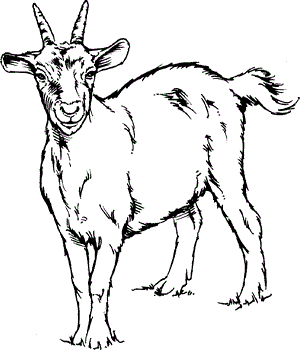
The second time the blood comes from a goat he has slaughtered as an atonement offering for the people.6  (It is one of two goats chosen by lot; the other goat is sent out into the wilderness to Azazel.  See my post Metzora & Acharey Mot: Doubles.)

But before the high priest sprinkles blood the first time, he must make a cloud of incense inside the Holy of Holies.

He shall take a pan-full of glowing charcoal embers from the side of the altar facing God, and two handfuls of finely-ground, fragrant incense, and he shall bring them through the curtain.  And he shall place the incense on the fire, in front of God.  And the anan of the incense shall conceal the atonement-cover that is over the Reminder [inside the ark], so he will not die.  Then he shall take some blood of the bull and sprinkle it with his finger over the surface of the atonement-cover… (Leviticus 16:12-14)

Apparently when Aaron first enters the Holy of Holies, no cloud covers the lid of the ark.  He has to generate a cloud from incense, on the spot.7  According to the Talmud, in the Holy of Holies inside the temple in Jerusalem the smoke from the high priest’s incense “rose straight up like a palm tree”.  Then it spread out over the ceiling and down the walls until it filled the whole room.8

The chamber remains thick with smoke when the high priest returns with the goat’s blood.  The Talmud says the smell of the incense on Yom Kippur spread out so far from the temple in Jerusalem that it made the goats in Jericho sneeze.9  (I imagine the goat led out into the wilderness for Azazel was also sneezing as it went.)

The phrase “so he will not die” is linked with an anan both at the beginning of the Torah portion and in the instructions for filling the Holy of Holies with smoke.

… so that he shall not come at [just] any time into the holy place inside the curtain, to the front of the atonement-cover … so he will not die, because I appear in an anan over the atonement-cover.

Leviticus 16:2

 And he shall place the incense on the fire, in front of God.  And the anan of the incense shall conceal the atonement-cover … so he will not die.

 Leviticus 16:13

In verse 16:2, God appears in an anan over the ark.  In verse 16:13, Aaron must generate an anan to conceal the ark.  In verse 16:2, this sight of God in an anan seems to be fatal.  In verse 16:13, a prolonged view of the ark cover seems to be fatal.

One cloud or two?

Are there two clouds, one conjured up by God and the other made by the high priest?  Classic commentary is divided on the question.10  If there is only one cloud, the anan of incense, then what would Aaron see when he first walks into the Holy of Holies?  This week’s Torah portion implies that he would see the lid of the ark and empty air above it.  Since he would remain alive long enough to fill the room with incense, the sight of the atonement-cover would be fatal only when he sprinkles blood on it.

We can assume God is in residence, to witness the atonement ritual.  The book of Exodus/Shemot tells us that no human being can see God’s “face” and live.11  Even Moses would not see God’s face when God spoke to him from above the lid of the ark.  So God’s presence above the ark must be either invisible, or clouded by God’s own anan.

From Egypt to Mount Sinai, and again from Mount Sinai to the Jordan River, God provides a pillar of cloud (by day) and fire (by night) to guide the Israelites and their fellow-travelers.12  At Mount Sinai, only Moses can enter the cloud of smoke at fire on the mountaintop, where he goes to converse with God before the tent-sanctuary is built.

But when Moses finishes assembling the sanctuary,

…the anan covered the Tent of Meeting, and the glory of God filled the dwelling-place.  Moses was not able to enter the Tent of Meeting because the anan settled on it and the kavod of God filled the dwelling-place.  (Exodus/Shemot 40:34-35)

kavod (כָּווֹד) = splendor, magnificence, weightiness.  (When kavod refers to God, it is usually translated as “glory” or “presence”.)

from
Collectie Nederland

Everyone can see the cloud on top of the tent roof, just as everyone can see the pillar of cloud and fire during the Israelites’ journeys.  But even Moses cannot enter the Tent of Meeting when it is filled with the kavod of God—looked, to human eyes, like either cloud or fire.

The cloud above the tent remains until God gives the signal to strike camp and journey on by lifting the cloud and restoring the guiding pillar of cloud and fire.  The kavod inside the tent shrinks or disappears at some point while the tent is still pitched at Mount Sinai, before Moses takes Aaron inside in the portion Shemini.

And Moses and Aaron came into the Tent of Meeting and they went out and they blessed the people.  Then the kavod of God appeared to all the people.  And fire went out from in front of God …  (Leviticus 9:23-24)

The fire consumes the offerings on the altar.  Then Aaron’s sons Nadav and Avihu go into the tent with their unauthorized incense, and the fire appears again and consumes them.  Yet after that, Aaron’s cousins safely enter the Tent of Meeting and carry out the two bodies.  And from then on, the priests move freely in and out of the front chamber of the tent.  Only the back chamber, the Holy of Holies, remains dangerous—probably because God might appear at any time in an anan of kavod over the ark.

If only the sight of God’s appearance in an anan is fatal, it follows that Aaron can enter the Holy of Holies safely on Yom Kippur because that is the day God will refrain from appearing in an ananat least until the room is so full of incense smoke that the high priest could not see God’s anan.

Therefore when Aaron first steps into the Holy of Holies there is no anan inside.  God is either invisible or not yet in residence.  Aaron makes a cloud of incense in order to hide the atonement-cover of the ark, so he can sprinkle blood on it without dying.  When the incense has filled the room, either God remains an invisible presence (as when God speaks to Moses in that spot), or God appears in a small anan of kavod over the ark, which Aaron cannot see through the smoke.

Inevitable Fog

I can understand why God’s kavod appears as cloud and fire.  We are finite creatures; when we try to understand the infinite, our minds cannot penetrate the mystery, and we find ourselves in a mental fog, glimpsing only transient flickers of enlightenment.  When we try to turn our experiences of God into concrete words or images, we lose their essence.

Perhaps if human beings look straight at the anan of God’s kavod for more than a moment, our minds snap.13  Our bodies remain whole, like those of Nadav and Avihu, but we lose our personal selves or souls, and what remains cannot function in the world.  This is the kind of death Aaron must avoid by entering the Holy of Holies under only two conditions:

  • when God has signaled that it is time to strike camp and move on; then Aaron and his two surviving sons take down the curtain and cover the ark with it.14
  • on Yom Kippur, the one day a year God has designated for the ritual of atonement.

The rest of the time, Aaron must stay out, so he will not accidentally see God appear in an anan.

While the incense altar in the front chamber of the Tent of Meeting is used for other purposes, the high priest creates an anan of incense inside the Holy of Holies only on Yom Kippur, the day of atonement.  This is the day when we ask God for forgiveness for everything we have done wrong over the past year.  When we ask for that level of divine, inner forgiveness, it is not enough to know that God appears in a cloud.  We need to know that we cannot see ourselves clearly, either: neither our motivations nor how our actions look to others.  Like God, our own souls are manifest only in a cloud.

Yet as we grope through the fog of life, we can still try to become better people and try to serve God, whatever “God” might mean to each of us.

Even if we generate so much smoke our goats sneeze.


  1. The fire consumes them in Leviticus 10:1-2. Aaron’s cousins carry the bodies of Nadav and Avihu out of the camp, holding them by their tunics, in Leviticus 10:4-5.  Therefore the divine fire took their lives without incinerating their bodies or even burning their clothes.
  2. Exodus 25:22, Numbers 7:89.
  3. Since the divine fire passes through their tunics without charring them, it could also pass through both the inner curtain and the curtained doorway to the courtyard without damaging either curtain.
  4. Leviticus 16:29-34.
  5. Leviticus 16:6, 16:14.
  6. Leviticus 16:15.
  7. It seems clear to me that Aaron walks into the chamber carrying a pan of embers, two handfuls of ground incense (probably in a bag), and a bowl of bull’s blood (Leviticus 16:11-12). Once inside, he shall place the incense on the fire, in front of God, and the smoke conceals the atonement-cover (Leviticus 16:14).  This was also the opinion of the Pharisees during the time of the second temple in Jerusalem.  The Sadducees insisted the incense had to be smoking before the high priest entered the Holy of Holies.  They also tied a rope around the high priest’s ankle so someone could pull him out if he did die inside the Holy of Holies.
  8. Talmud Bavli, Yoma 53a.
  9. Talmud Bavli, Yoma 39b.
  10. Rashi and Maimonides wrote that Leviticus 16:2 refers to God’s cloud of kavod, so there were two clouds. Nachmanides and the Talmud Yerushalmi tractate Yoma  say that Leviticus 16:2 refers to the high priest’s cloud of incense.
  11. Exodus 33:18-23. Face (panim, פָּנִים) and kavod are used as synonyms in this passage.
  12. Exodus 13:21-22, Leviticus 40:36-37.
  13. The Talmud Bavli, Chagigah 14b, tells the story of four rabbis who entered pardes, paradise. Ben Azai looked at the divine kavod and died, Ben Zoma looked and went mad, and Elisha ben Abuyah (a.k.a. Acher) became an apostate.  Only Akiva, the greatest rabbi of that era, returned whole.
  14. When the Israelites break camp, Aaron and his two surviving sons take down the curtain in front of the Holy of Holies and cover the ark with it. Touching the uncovered ark would be fatal to the Levites who will carry it to the next campsite, but the priests are safe while they cover it. (Numbers 4:5-6, 4:15.)

Shemini: Fire Meets Fire

Northrup’s Treasures
of the Bible, 1894

Aaron and his four sons spend seven days at the entrance of the tent-sanctuary after Moses consecrates them as the first priests of the Israelites.  (See my post Tzav: Filling Up a Priest.)  On the eighth day, in this week’s Torah portion, Shemini (“Eighth”), Moses summons the new priests to make their first offerings on the altar.  He lists the necessary animal and grain offerings, then adds:

“This is the thing that God commanded you shall do; and then the glory of God will appear to you.”  (Leviticus/Vayikra 9:6)

Aaron, assisted by his sons, does the required slaughtering, blood splashing, and separation of the fatty parts (which make the best smoke for God’s pleasure).  The five priests lay out everything to be burned on the altar.  Aaron blesses the people.  Moses takes Aaron into the Tent of Meeting, and when they emerge again, they bless the people together.  (See my post Shemini: Prayer and Glory.)

Divine cloud of glory over sanctuary,
artist unknown

… and the glory of God appeared to all the people.  And fire went out from before God, and it devoured the rising-offering and the fat parts on the altar.  And all the people saw, and they shouted with joy, and they fell on their faces.  (Leviticus 9:23-24)

The “glory of God” appears as a fire rushing out of the tent-sanctuary and devouring the offerings on the altar.  Since God’s presence is supposed to touch down in the Holy of Holies, the chamber at the back of the tent,1 the fire must miraculously travel through the curtains in two doorways without burning them.

In the midst of the rejoicing, Aaron’s two older sons, Nadav and Avihu, pick up their incense pans.  Nobody has instructed them to do so; each one is moved by his own impulse.  They put fire, in this case glowing embers, in their pans.

And Nadav and Avihu, sons of Aharon, each took his incense pan, and they placed fire in them, and they put incense upon it.  And they brought near before God strange fire, that [God] had not commanded them.  (Leviticus 10:1)

Nadav (נָדָב) = generous one, spontaneous giver.  (From the same root as nedavah, נְדָבָה = a voluntary and spontaneous gift, usually to God.2)

Avihu (אֲבִיהוּא) = my father (אֲבִי) is he (הוּא).

The Two Priests Are Destroyed, by James Tissot,
ca. 1900

And fire went out from before God, and it devoured them, and they died in front of God.  (Leviticus 10: 2) 

The Torah uses exactly the same Hebrew for “And fire went out from before God, and it devoured” on both occasions of divine fire.

What happened?  Commentators have developed too many theories over the last two thousand years to list them all in this blog post.  Here is my theory.

Nadav and Avihu are unlike their younger brothers, Elazar and Itamar, in two ways:

1. They saw the feet

Only Aaron’s two older sons walked halfway up Mount Sinai with Moses, Aaron, and the 70 elders. There they saw God’s feet on a pavement of sapphire (Exodus 24:10).  The elders could probably accept this as a once-in-a-lifetime vision, since they could never be prophets or priests.  But Nadav and Avihu are left hungry for more contact with God, more than the usual pillar of cloud and fire everyone sees.  As priests, they feel they are entitled.

They wait for the next opportunity to behold God.  In this week’s Torah portion, the miraculous fire of God comes forth and lands on the altar after Moses takes Aaron into the Tent of Meeting and back out again.  Perhaps the way to experience another close encounter with God is to enter the Holy of Holies—now, while God is in the mood to manifest.

Aaron’s younger sons, Elazar and Itamar, did not climb Mount Sinai and see God’s feet.  They are still waiting patiently for whatever comes their way in their new life as priests.

2.  They are impulsive

The two older brothers are more impulsive than the two younger brothers—and the Torah signals this with their names. Nadav, whose name means “spontaneous giver”, decides to give himself as a nedavah to God.  He is willing, even eager, to let his own ego go up in smoke in order to be united with God.  So he picks up his incense pan and puts embers in it, even though Moses gave no such instructions.

Avihu, whose name means “he is my father”, takes after his father, Aaron.  When the people asked for an idol, Aaron had a flash of inspiration and immediately made the golden calf, forgetting that Moses had said God detests idols.1  Avihu is also forgetful in an important moment.  He watches Moses take his father Aaron into the tent, probably into the Holy of Holies.  And Avihu wants to do it, too.  When he sees Nadav heading into the sanctuary with an incense pan, he has a flash of inspiration, and immediately seizes his own pan, forgetting that Moses had not authorized an incense offering.

Elazar (אֶלְעָזָר = God helps) and Itamar (אִיתָמָר = date-tree coast) are not so impulsive.  Elazar wants to follow God’s rules in order to receive God’s help, and Itamar focuses on the physical things of this world.  They both want to preserve their lives, and they know God’s presence is dangerous, so they avoid taking any unauthorized actions.

3. They are consumed with desire

Nadav and Avihu, unlike their younger brothers, crave religious experiences and are willing to risk their lives.  Symbolically, the “strange fire” they bring into the sanctuary is their burning desire to come closer to God—Nadav because of his impulsive generosity, and Avihu because he copies his father.  Their consuming desires are met with a consuming fire from God, and they die—presumably in ecstasy.

Elazar and Itamar stick to following instructions and doing the job God has given them.  They are rewarded with long lives and many descendants who also serve as priests.


Is it better to die in ecstasy, hurtling your soul into the unknown? Or is it better to keep your head and pay attention to the demands of this world? Both paths have their attractions. Perhaps there is a middle way, a life with one’s own feet on the ground as well as a vision of God’s feet in the sky.

But I prefer to be like Elazar and Itamar, and hope for a long life of service in this world, doing my work as well and as carefully I can.  (And I am glad I was not given the bloody work of an ancient Israelite priest!)

(An earlier version of this essay was published in April 2010.)


  1. Leviticus 16:2, Numbers 7:89.
  2. A nedavah is an offering on the altar, from a human to God, throughout the bible except in Psalms 68:10 and 110:3.

Kedoshim: Reciprocal Holiness

The Torah portion named Kedoshim (“holy” in the plural) begins:

And God spoke to Moses, saying:  “Speak to the whole community of the Children of Israel, and you shall say to them:  Kedoshim you shall be, because kadosh am I, God, your God.”  (Leviticus/Vayikra 19:1-2)

kedoshim (קְדֺשִׁים) = plural of kadosh.

kadosh (קָדוֹשׁ) = (As an adjective:) holy, sacred; set apart for religious use; dedicated to God. (As a noun:) something that is holy. (Kodesh, קֺדֶשׁ, has a similar meaning, and is also used in the Torah both as an adjective and as a noun.)

Vestments of the high priest

An object (such as a priest’s vestments, a tool for the altar, an animal offering) is kadosh in the Hebrew Bible when it is for religious use only. A place is (such as Mount Sinai, the temple, Jerusalem) is kadosh when God is present there, either manifesting as a fire or a voice, or simply known to dwell there. (See my posts Chayyei Sarah: A Holy Place and Terumah & Psalm 74: Second Home.) The day of Shabbat is kadosh because it is dedicated to abstaining from ordinary activities in order to spend time in contemplation or worship of God.

God’s reputation is also called kadosh. Later in the Torah portion Kedoshim, God warns that anyone who gives a child to the Molekh, an alien idol, profanes the reputation of God’s kodesh.1

A priest is kadosh because he is formally dedicated to God and leads a different life from non-priests.  He must serve God at the temple and instruct the people on ritual matters; and he depends on the whole community for support, owning no farmland of his own.

But what does it mean for God to be kadosh? And what does it mean for human beings who are not priests to be kedoshim?

Here are the three passages in the Hebrew Bible in which God orders people to be kedoshim because God is kadosh:

1. Holiness as ritual purity

The first two times God declares that the Israelites shall be kedoshim because God is kadosh happen in the Torah portion Shemini, earlier in the book of Leviticus. Right after a list of which animals are and are not kosher for eating, the Torah says:

Because I, God, am your god, vehitkadishtem, and you will be kedoshim, because kadosh am I; and you shall you shall not make yourselves impure through any of the tiny teeming animals swarming over the earth.  Because I am God, the one who brought you up from the land of Egypt to be your god; and you shall be kedoshim because kadosh am I. This is the teaching of the land-animals and the flying-animals, and for all living beings teeming in the water and for all swarming animals on the earth: to distinguish between the impure and the pure, and between the edible living things and the living things that you may not eat. (Leviticus 11:44-47)

vehitkadishtem (וְהִתְקַדִּשְׁתֶּם) = you shall make yourselves kedoshim, you shall consecrate yourselves.

Animals that the Israelites are forbidden to eat cause temporary ritual impurity in any person or thing that touches their dead carcasses.  The mammals and birds that are acceptable sacrificial offerings to God (cattle, sheep, goats, and two kinds of birds) are all from the kosher list.

The Torah includes many other laws about ritual observance. Transgressing one of these laws means being less obedient to God, and therefore no longer kadosh—until one has made atonement with the appropriate sacrifice.

The Torah portion Kedoshim reinforces this idea two-thirds of the way through its list of rules:

Vehitkadishtem, and you will be kedoshim, because I, God, am your god. And you shall observe My decrees and do them.  I, God, am mekadishkhem. (Leviticus 20:7-8)

mekadishkhem (מְקַדִּשְׁכֶם) = the one who makes you kedoshim, the one who consecrates you, the one who transfers holiness to you.

For a human, in other words, being kadosh is a condition like ritual purity.  People who follow all the rules of the Israelite religion are kedoshim—because God puts them in a kadosh state.  Maybe for God, being kadosh means being mekadishkhem.

2. Holiness as moral virtue

Honor Your Parents,
by Hans der Maler, 1529

The Torah portion Kedoshim begins with Kedoshim you shall be, because kadosh am I” (Leviticus 19:2). Right before this divine direction, in the previous portion, Acharey Mot, is a list of forbidden sexual partners.2  Right after it is a list of 20 commandments, starting with “Everyone shall revere his mother and his father” and concluding with “You shall love your neighbor as yourself”. While two or three of these commandments are about religious ritual3, the rest lay out ethical standards for human interactions.

For the last millennium, many commentators have concluded that God is asking us to become kedoshim by behaving ethically toward other people. In the 11th century C.E. three great rabbis, Rashi in France4, Maimonides in Egypt5, and Bachya ibn Pakudah in Spain6, all responded to Kedoshim by writing that human beings become kedoshim by exercising self-restraint over their passions and appetites, especially their sexual appetites. Besides avoiding the immoral deeds specifically mentioned in Acharey Mot and Kedoshim, humans must fully dedicate themselves to holiness by acting moderately and responsibly even when they are doing what is permitted.

More recently, Rabbi Adin Even Israel Steinsaltz has pointed out: “Bringing a korban [an offering to the altar] every once in a while is simple. But to fulfill all the various major and minor requirements listed in Parashat Kedoshim every day is quite another story. Not for naught does the Torah say, ‘Everyone shall revere his mother and his father’ (Lev. 19:3). Anyone who has any experience in this knows how difficult it is. It is something that we are faced with every day, and it can be especially challenging when one’s father and mother are themselves not exceptionally holy people.

            “This struggle is the fundamental struggle for holiness. Parashat Kedoshim presents a long list of minor requirements, none of which is extraordinary on its own, but each one recurs day after day. The very requirement to maintain this routine without succumbing to jadedness and despair—that itself creates the highest levels of holiness.”7

For a human, in other words, being kadosh means continuously striving to act ethically in the world.  Most commentators who argue for this meaning of kadosh assume that God is kadosh because God is morally perfect, and we become kedoshim to the extent that we imitate God.

Yet the anthropomorphic God portrayed in much of the Torah often seems to act immorally. The “God” in the first five books of the Torah or Bible frequently bursts into anger and kills thousands of people without discriminating between the truly evil ringleaders (if any) and those who are merely weak or imperfect, or happen to be part of a wrong-doer’s family.

However, in the book of Exodus God claims to be compassionate, gracious, slow to anger, kind, truthful, and forgiving.8 Some people claim that what looks to us like God’s bad behavior, both in the Torah and when bad things happen to good people today, is really part of God’s larger plan for ultimate justice and mercy for everyone.  We humans can’t see the big picture, but this is the best of all possible worlds, and God is kodesh after all.

3. Holiness as exclusive possession

Sometimes the Torah calls the Israelites kadosh because they are set apart by God, and God is kadosh through the distinction of being the only god the Israelites worship.9 This concept of holiness as segregation appears near the end of this week’s Torah portion.

And you shall be kedoshim for Me, because kadosh am I, God, and I have separated you from the [other] peoples to be Mine.  (Leviticus 20:26)

Asa Destroys Idols,
Petrus Comestor Bible Historiale, France, 1372

The exclusivity of this arrangement between God and the Israelites leads to rules that discriminate against non-Israelites.  For example, in the book of Deuteronomy/Devarim, Moses warns the people that when they conquer their “promised land’ in Canaan and defeat the seven tribes already living there, they must not make any treaties with these tribes; they must not intermarry with them; and they must destroy all their religious items.

For you are a kadosh people to God, your god; God, your god, chose you to belong to It as a treasured possession, out of all the peoples on the face of the earth.  (Deuteronomy/Devarim 7:6)

Sifra, a collection of commentary on Leviticus that was probably compiled in the third century C.E., rephrases God’s direction at the beginning of the Torah portion Kedoshim this way: “As I, God, am set apart, so you must be set apart.” The same condition of being “set apart”—from other peoples or from other gods—defines how both the Israelite people and God are kadosh.


All of the passages in the Torah that include some version of Kedoshim you shall be, because kadosh am I” concern activities in the physical world: obeying or decreeing ritual rules; behaving ethically; and excluding other people and other gods. None of these passages mention spiritual transcendence.

Later in the Hebrew Bible, the prophets sometimes use the word kadosh to indicate that God is an awesome and overpowering mystery.10  In the 16th century C.E., the Maharal of Prague wrote that a person or act is kadosh when it is transcendent in its essence—like God.11 And in the 18th century, Hassidic rabbis defined holiness as an intense and continuous attachment and devotion to God. This deep mental connection let God’s holiness flow into a person.12

But in the book of Leviticus, kadosh describes something in the physical world: an object, a place, a day, a priest—or an ordinary Israelite’s actions in the world, or God’s actions in the world.

What it means to say God’s actions are kadosh depends on how you define “God”—and that determines what human beings do to become kadosh.

1. The God of ritual purity

Some people think of “God” as the anthropomorphic biblical character who makes all the rules. They strive to follow whatever rules their current human leaders have selected from the Bible in a literal way, eschewing symbolism. (It would be impossible to follow all the rules in the Bible; some contradict each other, and some cannot be performed in the modern world.)

To the extent that literal-minded religious people achieve this, they consider themselves holy. But all too often this definition of God leads people to denounce those who they believe are not following their chosen biblical rules.

2. The God of moral virtue

Some people think of “God” not as an anthropomorphic being, but as a theological abstraction of perfection: omnipotent, omniscient, and omnibenevolent. Others think of “God” as the force of goodness in the world. Either way, “God” is perfectly virtuous by definition, and the bible should not always be taken literally.

When people think of “God” as an ethical ideal (from the original 13 attributes to modern variations on “God is love”), and they try to become holy, they strive to act with more forethought or kindness or compassion toward others—thus imitating their God.

3. The God of exclusive possession

Some Jews consider themselves the “chosen people”, descendants of the Israelites with whom “God” has a special and exclusive relationship in the Hebrew Bible.  Some Christians consider themselves the “chosen people”, with whom “God” made a new covenant in the Christian Bible.

Defining God in terms of the in-group usually results in disparaging the out-group. People imitate the “God” who singles out one “chosen people” by discriminating against all other groups of people, who they assume are inferior and/or threatening.

If you want to become kadosh, be careful how you think about God!


1  Leviticus 20:3.  The Torah portion does not say whether sacrificing a child to the alien god Molekh profanes God’s reputation for separating the Israelites from people with other religions, or God’s reputation for the ethical act of banning child sacrifice.

2  Leviticus 18:1-30.

3  Seventeen of the twenty commandments in 19:3-18 are definitely about behavior toward other people, i.e. ethics.  The other three are:

* Observe Shabbat. (Leviticus 19:5)

* Do not worship idols. (19:4)

* Eat a wholeness-offering (שְׁלָמִים) in the first two days. (19:5-8)  This appears to be an instruction about ritual, but some commentators point out that the wholeness-offering is the only offering in which some of the roasted meat and grain is shared with guests. In order to make sure this large offering is eaten in two days, the person making the offering must invite multiple guests, so this commandment may also address the ethical virtue of generosity.

4  Rashi (Rabbi Shlomoh Yitzchaki), commentary on Leviticus 19:2.

5  Maimonides (Rabbi Moses ben Maimon), Guide for the Perplexed.

6  Rabbi Bachya ben Yosef ibn Pakudah, Kad HaKemach.

7  Rabbi Adin Even-Israel Steinsaltz, Talks on the Parasha, Koren Publishers, Jerusalem, 2015, p 250.

8  This is a summary of the “13 attributes” God proclaims to Moses in Exodus 34:6-7. However, 34:7 ends by saying that God punishes not only wrongdoers, but their children and children’s children, to the fourth generation.

9  God is called kedosh Israel, “the holy one of Israel”, twelve times in the first book of Isaiah and fourteen times in the second book of Isaiah, as well as in 2 Kings 19:22; Jeremiah 50:29 and 51:5; Ezekiel 39:7; and Psalms 71:22, 78:41, and 89:19.

10  One example is a vision of the first Isaiah: In the year of the death of the king Uzziyahu, I beheld my lord sitting on a high and elevated throne, and [God’s] skirts were filling the palace.  Serafim were standing over [God], six wings, six wings to each … And they would call, one to another, and say:  “Kadosh! Kadosh! Kadosh!  God of hosts!  [God’s] glory fills the earth!” (Isaiah 6:1-3)

11  Rabbi Yehudah Loew ben Betzaleil, a.k.a. the Maharal of Prague, Tiferet Yisrael 37.

12  Arthur Green, Speaking Torah, Vol. 1, Jewish Lights Publishing, Woodstock, Vermont, 2013, pp. 292, 295.

Shemini: Prayer and Glory

For seven days after Moses consecrates Aaron and his sons as priests, they sit at the entrance of the Tent of Meeting. The Torah portion Shemini (“Eighth”) opens on the eighth day, when the new priests are ready to make their first offerings on the altar: two different offerings for the high priest Aaron, and four different offerings for the people.1 Moses explains:

Because today God will appear to you.  (Leviticus/Vayikra 9:4)

After the animals and the grain have been assembled, and the rest of the Israelites are standing in front of the altar, Moses gives further instructions, saying:

This is the thing that God commanded you must do; then the kavod of God will appear to you.  (Leviticus/Vayikra 9:6)

kavod (כָּבוֹד) = weight, importance, impressiveness, magnificence; a glorious manifestation (often translated as “glory”).

Vesuvius in Eruption, by J.M.W. Turner, 1817

The Israelites have already witnessed a long string of miracles in Egypt, culminating in the splitting of the Reed Sea.  They have followed the kavod of God, in the form of a pillar of cloud and fire, from Egypt to Mount Sinai. On the day of the revelation they experienced God’s kavod as lightning and smoke on the mountain itself, along with thunder and blasts of a shofar.2

Yet once miracles stop, it is hard to keep faith.  When Moses stayed on top of Mount Sinai for 40 days, and no pillar of cloud and fire reappeared near the camp, the Israelites felt abandoned.  Who would lead them to a new home?

In desperation, the men asked Aaron for an idol, then worshiped the golden calf he made.3  Moses returned to them, but God’s cloud and fire did not.  The Israelites were so anxious to see the kavod of God again that when Moses called for donations to make a dwelling-place for God, they donated more than enough treasure and labor.4  The dwelling-place, the new Tent of Meeting, is completed at the end of the book of Exodus/Shemot.

Then the cloud covered the Tent of Meeting, and the kavod of God filled the dwelling-place.  (Exodus/Shemot 40:34)

For the cloud of God was over the dwelling-place by day, and fire was in it at night, in the sight of all the house of Israel, on all their journeys.  (Exodus 40:38)

Presumably the cloud is resting over the Tent of Meeting on the day the new priests make their first offerings at the altar.  So why do the Israelites need another view of God’s kavod?

Perhaps God, or Moses, knows that the Israelites are still insecure. The survivors of the Golden Calf incident have committed their work and treasure to God, and they are ready to follow the new version of God-worship Moses has laid out, in which priests are intermediaries.  But they need divine confirmation that Aaron and his sons really are God’s chosen priests. After all, it was Aaron who made the Golden Calf—choosing to pacify the people rather than sticking to God’s commandment against idols. Could they trust him to serve only God from now on—and keep the Israelites in God’s favor?

While all the people watch, Aaron and his sons carry out the required procedures for the six offerings at the altar.

Then Aaron raised his hands toward the people and he blessed them …  (Leviticus  9:22)

The Torah doesn’t say what Aaron’s blessing is, but the Talmud assumes that it must be the blessing prescribed for priests in the book of Numbers/Bemidbar 5 (and still used in Jewish liturgy today):

May God bless you and guard you;

May God illuminate Its face for you and be gracious to you;

May God lift Its face to you and place peace over you.”  (Numbers/Bemidbar 6:22-27)

After this blessing, one might expect the kavod of God to appear as promised. It does not.

19th-century rabbi Samson Raphael Hirsch, claimed that God delays the divine manifestation on purpose so as to prevent any belief that animal offerings make God’s glory appear by magic.6  The kavod appears when God wants it to appear.

Then Moses came, and Aaron, into the Tent of Meeting. Then they went out and they blessed the people … (Leviticus 9:23)

What is this second blessing?  According to the Sifra, a 4th-century collection of commentary on the book of Leviticus, Moses says: “May it be God’s will to cause His Presence to rest upon the work of your hands!  May God, the God of your fathers, increase your numbers a thousand-fold and bless you, as He promised you!”

And the people respond with a verse that appears in Psalm 90:

May the comfort of God, our God, be upon us, and may the work of our hands be an enduring foundation for us.  (Psalm 90:17)7

Moses’ blessing is a prayer that God will indeed dwell in the new Tent of Meeting that the Israelite people made.  The people’s response, in this context, is a prayer that the work they did with their own hands will result in both divine comfort and an enduring commitment to serving God.

The children of Israel are moved to commit themselves further to God when Moses and Aaron, their human leaders, come out of God’s dwelling-place and bless them. After this commitment,

… and the kavod of God appeared to all the people. Fire went out from the presence of God, and it devoured the rising-offering and the fatty animal-parts on the altar. And all the people saw, and they shouted with joy and they fell on their faces.  (Leviticus 9:23-24)

At that sign of God’s acceptance, the people shout with joy—and relief.

*

A blessing from another person can seem like a useless exercise.  After all, a human being has no power to make the blessing come true.  We can only express the hope that God will make it happen.

And today, the sudden appearance of fire means an emergency, not divine acceptance.

Yet I remember when I received blessings from Rabbi Aryeh Hirschfield, of blessed memory, and I felt a transfer of good will and even a sense of kavod.  This feeling made a psychological difference to me, changing my attitude toward life and toward the divine.

I find I can be committed to an abstract principle, but not comforted by it. Comfort and joy come more naturally when the abstraction is connected with a human being, someone whose warm feelings are palpable.  Maybe a blessing in itself can be a manifestation of God.

Bless someone today.  It might make a difference.

(An earlier version of this essay was posted on March 20, 2010.)

1  First the new high priest, Aaron, makes a reparation-offering (חַטָּאת) and a rising-offering (עֺלָה) for himself. Then he makes a reparation-offering, a rising-offering, a grain offering (מִנְחָה), and a wholeness-offering (שְׁלָמִים) for the people.  For an explanation of these four types of offerings, see my posts Fire Offerings Without Slaughter, Part 1 and Part 2.

2  Shofar (שׁוֹפָר) = a ram’s horn modified for blowing as a wind instrument.

3  Exodus/Shemot  32:1-6.  See my post Ki Tissa: Heard and Not Seen.

4  Exodus/Shemot  35:4-29 and 36:2-7.

5  The Babylonian Talmud, Sotah 38a, assuming that Aaron’s first blessing of the people in Leviticus 9:22 is the same as the blessing God commands all priests to give in Numbers 6:22-23, argues that therefore the “priestly blessing” in Numbers 6:24-26 must be pronounced with the hands raised. Rashi (11th-century rabbi Shlomoh Yitzchaki) and the majority of medieval commentators agreed that Aaron spoke the “priestly blessing”.

6  Samson Raphael Hirsch, The Hirsch Chumash, Sefer Vayikra Part 1, translated by Daniel Haberman, Feldheim Publishers, Jerusalem, 2002,  p. 289-290.

7  Sifra, quoted by W. Gunther Plaut, The Torah: A Modern Commentary, Union of American Hebrew Congregations, New York, 1981, p. 804.