
Haftarat Emor: Tzadok the Priest

by Melissa Carpenter, maggidah

Say to the kohanim, the sons of Aaron, say to them: For the death of someone among his people he shall not become ritually impure; only for the blood-relations closest to him… (Leviticus/Vayikra 21:1-2)

kohanim (כֹּהֲנִים) = priests.  (Singular:  kohein, כֹּהֵן)

Thus this week’s Torah portion, Emor (“Say”), opens with instructions from God to the priests on avoiding ritual impurity as much as possible in their personal lives, including who they mourn for and who they marry.  The haftarah (the weekly reading from the prophets) comes from the book of Ezekiel, and also warns that a priest must not marry a divorced women, enter a house where there is a corpse, or engage in mourning practices for anyone except his immediate blood relatives.
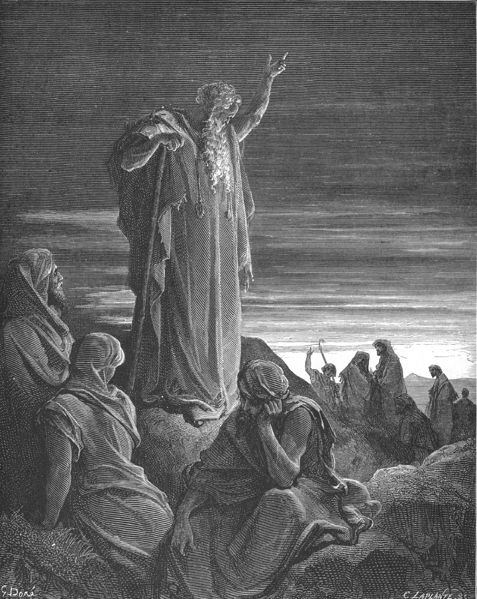
The Prophet Ezekiel by Gustave Dore
The Prophet Ezekiel
by Gustave Dore

The details of the two warnings differ, but the general themes are the same, and support the idea that a priest must devote himself completely, body and soul, to the ritual service for God. (All priests were male.) According to both the book of Leviticus/Vayikra and the book of Ezekiel (Yechezkeil), that includes avoiding certain negative conditions as much as possible—physical conditions such as contact with a corpse, and psychological conditions such as the states of mind that arise in mourning, or in dealing with a wife who was divorced by her previous husband.

In the entire Hebrew Bible, priesthood is hereditary.  And even today, men whose last name is “Cohen” share a genetic marker.  The right genealogy was enough to qualify a man for service as a priest in both the portable sanctuary of Leviticus and the temple of Ezekiel.  But both books insist that the priests must also observe certain rules of behavior in order to be “holy” and serve God properly.

The book of Ezekiel was written either by, or about, a man named Ezekiel who was exiled to Babylon, along with other Judahite officials, priests, and craftsmen, after the Babylonians captured Jerusalem and destroyed the first temple in 586 B.C.E.  Ezekiel lived in a community of exiles on the Kedar Canal outside the city of Babylon, where he had a series of visions and became a prophet.  The haftarah begins in the middle of one of Ezekiel’s visions, shortly after a divine guide has given Ezekiel the measurements for rebuilding the temple in Jerusalem.

And the priests of the Levites [who are] the children of Tzadok, who kept custody of My sanctuary while the children of Israel were straying away from Me, only they shall come close to Me to minister to Me, and they shall stand before Me to offer Me fat and blood—declares my lord, God.  Only they shall come into My sanctuary, and only they shall come close to My table to minister to Me, and they shall keep My custody. (Ezekiel 44:15-16)

Tzadok (צָדוֹק) = Righteous one.  From the same root as tzedek (צֶדֶק) = what is morally right or just.

In the book of Leviticus, all the descendants of Aaron (a man from the tribe of Levi who was the brother of Moses and the first high priest) qualify as priests who can perform the rituals involving incense and animal and grain offerings. Men in the tribe of Levi who are not descended from Aaron are classified as Levites, who assist the priests by transporting the (carefully wrapped) holy objects, and by guarding the portable sanctuary while it is erected. (Singing Levites are not mentioned until the first book of Chronicles.)

Ezekiel says that only the descendants of Tzadok will be priests when the temple in Jerusalem is rebuilt. Tzadok is a tenth or eleventh-generation descendant of Aaron through Aaron’s son Eleazar. He first appears in the second book of Samuel, where King David appoints him as one of two priests in Jerusalem, along with Evyatar.  In the first book of Kings, after many adventures, King Solomon fires Evyatar and makes Tzadok the only high priest.

And the king placed Benayahu son of Yehoyada over the army instead of him [Yoav], and Tzadok ha-kohein the king placed instead of Evyatar. (I Kings 2:35)

ha-kohein (הַכֹּהֵן) = the priest; the high priest.

Aaron has numerous descendants; two of his four sons die childless in Leviticus, but the survivors, Eleazar and Itamar, father large dynasties. Why should the priesthood be limited to Tzadok’s branch of the family tree?

A later chapter in the book of Ezekiel explains:

…the holy contribution [of land] for the kohanim: on the north 25,000 [cubits] and on the west 10,000 and on the east 10,000 and on the south 25,000, and the holy place of God will be in its center.  The holy place will be for the kohanim [descended] from Tzadok, who kept My custody, who did not stray continually [like] the Children of Israel or like the Levites. (Ezekiel 48:10-11)

Ezekiel implies that during the last years of the first temple in Jerusalem, there were two factions of priests. The Tzadokites stuck to the rules for serving God, but the other priests, as well as the Levites and the non-clergy, kept straying.  A vision in chapter 8 of Ezekiel shows some priests as well as some Israelites worshipping other gods right on the temple grounds.

Scholars speculate that Ezekiel himself was a descendant of Tzadok, because his visions and prophecies focus on rebuilding the temple in Jerusalem and reinstating the traditional priestly rituals. Nothing else is important to him; the presence of God must once again have a home in Jerusalem.

In order to make God’s contact point on earth secure, the Tzadokites must be the only legitimate priests—not because of their lineage, but because they remained true to God and continued the ritual service of the God of Israel.  And part of that service, in both the haftarah in Ezekiel and the Torah portion Emor, is maintaining a state of mind compatible with ritual purity.

Despite Ezekiel’s prophecy, non-Tzadokite priests were allowed to serve in the second temple once it was built in 538 B.C.E.  But Tzadokites were the high priests of the second temple from the founding priest Ezra until 153 B.C.E., when the Romans appointed Jonathan Maccabaeus as both king and high priest of Judah.

During the past two millennia, since the fall of the second temple in 70 C.E., almost all Jews have abandoned the idea of reinstating temple worship.  Unlike Ezekiel, we do not believe that God needs one particular spot to bring the divine presence to earth.

Priestly blessing: birkat kohanim
Priestly blessing:
birkat kohanim

We have also abandoned the idea of hereditary priesthood, except for a few minor customs. (Cohens get to do special blessings at services, and are supposed to stay out of cemeteries.)  Instead of ritually pure technical experts who make temple offerings, we now want spiritual leaders such as rabbis to help us improve our inner selves and our prayers.  Many Jews retain some practices having to do with ritual purity, such as keeping kosher.  But holiness is now about divine inspiration and ethical behavior.

We can still aspire to be “a kingdom of priests” and priestesses, as Moses predicts in Exodus/Shemot 19:6. We can even aspire to be Tzadok the priest. But today, that means being tzaddikim, people who are righteous and ethical, like Tzadok—“Righteous One”.

Emor: Challah with a Hole

When you invite a god to be with you, you want to be a good host. Being a good host for human guests always includes offering them food and drink. So the ancient peoples of the Middle East offered their gods bread and cake.

In his book Leviticus, 20th-century scholar Jacob Milgrom noted: “In Egypt the offerings are placed on the outer altar, but only the fresh bread and cakes are brought into the sanctuary and laid on mats (together with incense) before the god’s table … Ritual bread laying was an early custom in Mesopotamia, appearing in a Sumerian inscription of Urukagina of Lagash (c. 2340 BCE). Babylonians laid sweet unleavened bread before various deities, in twelves or multiples of twelve.”

The book of Exodus/Shemot describes the three holy containers in the inner sanctum of the Israelites’ sanctuary: the gold lampstand (menorah) for making light, the gold incense altar for making fragrant smoke, and the small gold-plated table for displaying bread. The display itself is only described in the book of Leviticus/Vayikra, in this week’s Torah portion, Emor (“say”). It begins:

You shall take fine flour, and you shall bake it into twelve challot; a challah shall be two tenths [of an eyfah in size]. And you shall put them in two rows, six in each row, upon the ritually-pure table in front of God. (Leviticus/Vayikra 24:5-6)

challah (חַלָּה), plural challot = loaf or cake made of finely-ground wheat flour, leavened or unleavened, probably  pierced with one or more holes (from the root verb chalal (חָלַל) = pierced through).

Half of the 14 references to challah in the Hebrew Bible specify that the challah shall be unleavened (matzah); in these cases, part of the challah is destined to be burned up on the altar, where leavening is banned. However, when the challah is destined to be eaten by people, it can be sourdough. (A thanksgiving offering, according to Leviticus 7:13, requires both unleavened challah to burn on the altar and leavened challah for people to eat.)

Other cultures in the ancient Middle East laid out bread in front of statues of their gods, and replaced the bread every day. The Israelites are forbidden to make a statue of their god, but the bread table stands in front of the innermost room of the tent, where God’s presence manifests over the ark. The bread is replaced only once a week. The twelve loaves are strictly symbolic; nobody pretends that God eats them. In fact, the Torah orders the priests to eat the week-old challot after the fresh loaves are laid out.

And you shall place as an addition to each row clear frankincense, and it shall become a memorial-portion for the bread, a fire-offering to God. Sabbath day after sabbath day it shall be arranged in rows in front of God, perpetually, as a covenant from the children of Israel forever. And it shall be for Aaron and for his sons; and he shall eat it in a holy place, because it is most holy for him, out of the fire-offerings of God; [this is] a decree forever. (Leviticus 24:7-9)

Unlike the unleavened challot people bring as offerings, the challot on the display table are never burned on the altar. Every seven days the priests set out fresh-baked challot and two new bowls of frankincense. They burn the previous week’s frankincense, so God can enjoy the fragrance (see my post Pinchas: Aromatherapy). Then the priests eat the stale bread.

This week’s Torah portion is the only place in the Hebrew Bible that calls the bread on the sanctuary table challah. Elsewhere it is simply “bread in rows” or “the bread of panim”, the bread that faces God. (See my post Terumah: Bread of Faces.) The twelve challot represent the twelve tribes of Israel, all lined up in front of God.

One might imagine each challah as a fluffy braided loaf, since that is what the challah that Jews eat on Shabbat today looks like. But the root of the word challah is challal, which means “pierced through”. The Torah uses the verb challal most often for fatal wounds, but the word also applies to window-openings in walls and to certain loaves or cakes.  Thus the challot in the Israelite sanctuary and temples might have looked like large bagels.

(Talmudic rabbis, considering the small size of the table—2 cubits by 1 cubit, about 4 square feet—speculated that each challah must have been shaped like a lidless rectangular box, so that one row would stack neatly on top of the other with no gaps. But since we do not know how much flour is in two-tenths of an eyfah, nor how dense the bread was, the table might just as well have held two rows of six bagel-shaped challot, one in front of the other.)

Does the shape matter? I think so. Bread begins as grain that grows as a gift from God or nature. But then humans add a lot of labor to transform that grain into bread. When we display our own creative work to God, are we showing off or expressing gratitude? A continuous loaf with no holes is full of itself; it leaves no empty spaces for God to fill. But a loaf with a hole in the middle says: “The center of my life is for You to fill with Your inspiration. I am building my life around that holy hole.”

That is what I want to say to the divine presence inside me.


Omer: Counting 49

I have been counting the omer every evening for two weeks now, and we have five more weeks to go. The omer count begins on the second day of Passover and goes on for 49 days. On the 50th day, we celebrate the holy day of Shavuot (“Weeks”).

Barley sheaf

In the Torah, the priest waves a sheaf of barley each day for 49 days. But after the fall of the second temple in Jerusalem in 70 C.E., the omer-counting became a prayer service, and acquired new  meanings. This is the first of several posts I am writing about the fascinating prayers from Kabbalah that come  before and after the daily count in orthodox Jewish prayers.

But first, what does “counting the omer” mean?

The Hebrew word omer first appears in the book of Exodus/Shemot (in the Torah portion  Beshallach), as a measure for manna; one omer of manna feeds one person for one day.

The word omer does not show up again until Leviticus/Vayikra, in the Torah portion Emor. The Torah sets the time for the Festival of Matzah, i.e. Passover, then gives instructions for the next day:

…then you shall bring an omer of the first of your harvest to the priest. And he will wave the omer before God so you will be acceptable; [starting] from the day after the rest-day the priest will wave them. (Leviticus/Vayikra 23:10-11)

And you shall count for yourselves, from the day after the rest-day, from the day you bring an omer of the waving, seven tamim weeks. Until the day after the rest-day of the seventh [week] you shall count [to] the 50th day; then you shall bring close a new grain-offering to God. (Leviticus 23:15-16)

omer (עֺמֶר) = a measure for barley.  

tamim (תָּמִים) = whole, entire, intact, unblemished, blameless, sincere.

When the word tamim refers to a sacrificial animal, it means blemish-free. When it describes a human being, it can mean either that the person’s body is unblemished, or that the person is innocent, blameless, honest. So I think the text in the Torah itself invites us not merely to count the days for seven weeks, but to make the days count—by checking for blemishes in our souls.

The culmination of the 49 days of counting is Shavuot, the 50th day. Until the fall of the second temple, Shavuot was a harvest festival. People brought their “new grain-offering” of two loaves of wheat bread to the temple, along with the first fruits from seven kinds of plants (wheat, barley, grapes, figs, pomegranates, olives, and dates).

After the fall of the temple, the rabbis soon found a new meaning for Shavuot, deciding that it marked the anniversary of receiving the Torah at Mount Sinai. So for the last 2,000 years, the 49-day count has been linked with preparing, day by day, to be worthy of receiving the divine revelation of Sinai.

Naturally, rabbis over the millennia have enriched counting the omer with other prayers that have a count of  7 or 49. The orthodox omer-counting procedure as it stands today follows this order:

#1.  Opening prayer: a) a sentence declaring the intention of the omer prayer service, b) Leviticus 23:15-16 (translated above), and c) a blessing from Psalm 90.

#2.  Blessing for counting the omer.

#3.  Statement of which day it is in the count.

#4.  A one-sentence prayer about restoring the service of hamikdash = the holy place (usually translated as “the Temple”).

#5.  Psalm 67, which has 49 words.

#6.  Ana Bekhoach, a 7-line poem of supplication written by Rabbi Nechunya ben HaKanah, a Kabbalist who lived in the first century C.E.

#7.  Closing prayer framing the count in terms of Kabbalah, including the 7 lower sefirot. (Sefirot is the plural of sefirah, a word from the same root as sofeir = counting. Sefirot area categories of creative power, or forces ruling the universe and the human soul.) In the middle of this closing prayer, you fill in the blank with the  the sefirah of the day and the sefirah of the week. Over the course of seven weeks, you get 49 different pairings.

Most non-orthodox Jews who count the omer today simply read or recite two sentences, labeled as #2 and #3 above. That way they get it done quickly—and miss all the juicy parts. Some people, especially in Jewish Renewal, go on to consider the essence of #7, and try to find a personal meaning in the pair of sefirot for the day. There are many books and blogs about what each of the 49 sefirot pairs might mean.

My posts will look instead at the often overlooked prayers in the omer-counting procedure: numbers 1, 4, 5, 6, and 7 in the list above.  This week, let’s zoom in on just the first prayer in number 1:

For the sake of the unification of the Holy One, blessed is He, and His shekhinah, in fear and love to unify the name Yud Heh with Vav Heh, in complete unity, in the name of all Israel.

shekhinah (שְׁכִננָה) = the indwelling presence of God in our universe (literally, the feminine form of “dweller”)

This opening prayer sets the intention of the rest of the omer-counting prayer service. We are not just counting the days; we are doing spiritual work that helps to change the nature of reality.

This introduction was written (in Aramaic) by the disciples of Rabbi Isaac Luria. Luria taught from 1569 to 1572 in Sfat, a town full of Kabbalists about 80 miles north of Jerusalem. In those three years before his death, he founded a major branch of Kabbalah. One of the core Lurianic ideas is that in order to create our universe, God first withdrew a measure of divine “light” to make space, then created ten sefirot, ten forces of creative power, which Luria saw as vessels for the divine light. The first three vessels, the three upper sefirot, could contain the light  poured into them. But the next six vessels shattered. The tenth and the lowest sefirah, Malkhut, cracked.

After the “shattering of the vessels”, the rest of the creation of the universe proceeded differently from God’s original plan, and included evil as well as good. Yet everything in our universe contains a spark of divine light. And human beings have the ability, through good deeds and prayers, to “raise the sparks” and repair the universe. Therefore the Lurianic Kabbalists preceded many prayers with the sentence above, to remind the person praying that the purpose of the prayer service is to unify God Itself with the shekhinah, the divine presence in our world. According to Kabbalah, the shekhinah is in the sefirah of Malkhut, the lowest one, the one closest to our daily physical life on earth. So uniting the Holy One with the shekhinah is also uniting the upper three sefirot with the lower seven  sefirot, and it also uniting the first two letters of God’s most holy Name, yud and heh, with the last two letters of the Name, vav and heh.

Every evening, during the 49 days of counting the omer, when I recite that intention to unify God with my prayers, I feel hollow with awe inside. What nerve! How could anything I do affect God, reality, the nature of being? And anyway, I’m not much of a mystic compared with most of my Jewish Renewal friends. I find the images of Kabbalah powerful, and they feel significant; but my rational mind does not believe any of this stuff.

And yet … if I pray for the sake of the unification of the Creating and the creation…if I pray for the sake of making whole the holiness I glimpse in the world…then maybe this little ritual of counting the omer  has a deeper meaning than I think. Maybe everything I do, everything each of us does, has a deeper meaning than we think.