Vayishlach: Blessing Yourself

by Melissa Carpenter, maggidah

Jacob finally gets a blessing he can believe this week, in the Torah portion Vayishlach (“And he sent”).

In the book of Genesis/Bereishit, a blessing usually means a transmission from God that improves the recipient’s lot in life. When a human being blesses someone, it is a request that God will transmit that blessing. God’s blessings grant people eventual success in practical affairs, including numerous descendants, wealth, land, authority over others, a good reputation, and becoming a by-word for other people’s blessings.

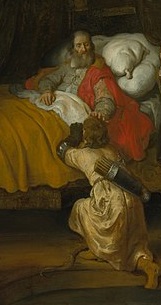
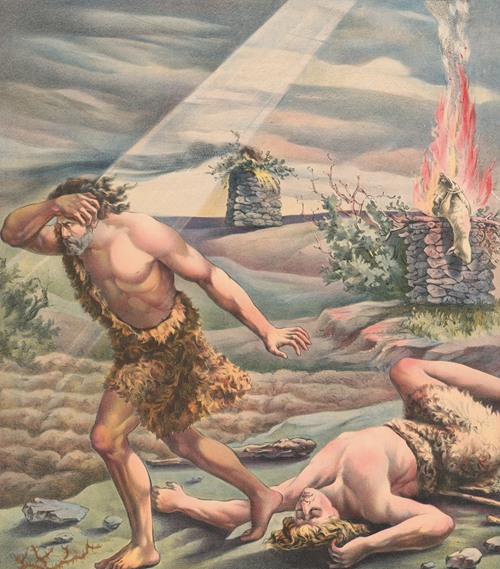
Hands raised in blessing
Hands raised in  blessing of Temple priests

Before this week’s Torah portion, Jacob receives three blessings: two from his father Isaac (one while Jacob is impersonating his brother Esau, and one as himself), and one blessing from God. But he still does not feel blessed—partly because of his guilt over cheating his brother, and partly because of his habit of calculating how to take advantage of others. (See my posts Toledot: To Bless Someone and Vayeitzei: Guilty Conscience.)

During his 20 years working for his uncle Lavan in Charan, Jacob acquires two of the material advantages promised in the blessings by Isaac and God: many children (eleven sons and a daughter), and material wealth (abundant flocks, herds, and servants). He does not yet own land, but God reminds him he must return to Canaan.

Even though he appears to be blessed by God, Jacob is afraid to go. First he fears that his uncle Lavan will prevent him from leaving. After the two men make a peace treaty, he is afraid that his brother will kill him and his family. In this week’s Torah portion, Vayishlach, Jacob sends messengers to Seir, where Esau is living, as he travels west toward Canaan. When he reaches the Yabbok River, the messengers return with the news that Esau is coming to meet him—with 400 armed men. Jacob frantically makes arrangements to prevent his whole family from being annihilated:

1) He divides his family and servants into two camps, hoping that if Esau’s men attack one camp, the other camp will escape.

2) He prays to God:

I am too small for all the kindnesses and all the fidelity that you have done for your servant; for with my walking-stick I crossed this Jordan, and now I have become two camps. Deliver me, please, from the hand of my brother, from the hand of Esau, for I, I am afraid of him, lest he come and strike me down, mother and children. And You, You said: I will certainly be good to you, and I will set up your offspring like the sand of the sea, which cannot be counted in its abundance. (Genesis 32:11-13)

Here Jacob expresses his own unworthiness for blessing, admits that God has aided him, and reminds God of the blessing from 20 years before. He views the blessings he has received so far as temporary and easily wiped out.

3) He sends gifts of livestock ahead to Esau, hoping to appease him.

4) He takes his family and servants across the river, then returns to the other side of the ford to spend the rest of the night alone—because he senses that there is one more thing he must do. Jacob may not know consciously that the fourth and final thing he needs to prepare for Esau’s arrival is a new blessing, a fourth blessing that comes from neither his father nor his god. But he waits alone in the dark.

And Jacob was left alone, vayei-aveik, a man, with him until the dawn rose. And he [the “man”] saw that he had not prevailed against him, so he touched the hollow of his hip; he struck the hollow of Jacob’s hip during hei-avko with him. (Genesis 32:25-26) 
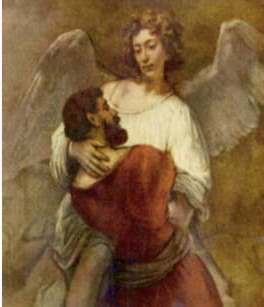
Rembrandt, "Jacob Wrestling with the Angel"
Rembrandt, “Jacob Wrestling with the Angel”

vayei-aveik (וַיֵּאָבֵק) = and he wrestled (?); and he kicked up dust (?)

hei-avko (הֵאָבְקוֹ) = his wrestling (?); his kicking up dust (?)

(The verb אבק occurs only here in the entire Hebrew Bible. It has been translated as wrestling for at least  two thousand years, based on the description in this passage. But the root of the verb is shared with the noun avak (אָבַק) = cloud of fine dust.)

Elsewhere in the Torah a “man” appears out of nowhere, and later turns out to be a malakh Elohim, a messenger of God (sometimes translated as an “angel”). For example, earlier in Genesis, three “men” appear when Abraham is sitting at the entrance of his tent, and they turn out to be divine messengers who announce that Sarah will give birth to Isaac. When a “man” appears to Jacob out of nowhere, we expect a divine emissary with a message for him.

The other “men” who appear in the Bible speak, walk, and appear to eat. But a “man” that wrestles is unique to this passage. Jacob and the “man” struggle all night without a victory.

Then he [the “man”] said: Let me go, for the dawn rises. But he [Jacob] said: I will not let you go unless you bless me. Then he said to him: What is your name?  And he said: Jacob. (Genesis 32:27-28)

For the first time, Jacob is asking for a blessing as himself, Jacob. Perhaps wrestling his opponent to a standstill has given him both courage and the feeling that he deserves recognition. In this case, both the message from God and the blessing he requests are a new name.

And he said: Your name will no longer be said “Jacob”, but instead Yisrael, because sarita with God and with men, and you prevailed. Then Jacob asked and said: Please tell your name.  And he said: Why do you ask for my name? And he blessed him there. (Genesis 32:29-30)

Yisrael  (יִשׂרָאֵל) = Israel; probably yasar  = he contends for dominion, he rules + el = god; “He contends with God”, “God rules”. (Another possible etymology is yashar = upright, level, straight + el = god; “He is upright with God”, “God is straight”.)

sarita (שָׂרִתָ) = you contended for dominion; you ruled.

So Jacob called the name of the place Peniel, “Because I saw God face to face, and my soul was spared”. And the sun rose for him as he passed Penuel, and he was limping on his hip. (Genesis 32:31-32)

Through the rest of the book of Genesis, Jacob sometimes acts decisively and correctly, living up to his new name. At other times he is fearful, hesitant, and calculating, like the old Jacob. He does not always prevail. However, he does proceed as if he expects God to be on his side. He also gives more blessings to others than any other person in the Torah.

Many of us are like Jacob before he wrestled. We can see our wealth and success in the material world, yet we do not believe we have received a divine blessing. We do not feel the peace of being blessed.

When we are alone at night, does a “man” come to wrestle with us? Shmuel Klitsner wrote that “And Jacob was left alone, and a man wrestled with him until the dawn rose” (Genesis 32:24) could be read as happening at the same time. In that case, the man Jacob is wrestling with is himself. Furthermore, Klitsner suggested, when Jacob’s wrestling partner says “you contended with God and with men, and you prevailed” the “man” is identifying himself as both divine and human.1

May each one of us be blessed to wrestle with our own inner divine force, and to emerge with a blessing we can believe in, a blessing of the peace and personal authority that comes from being Yisrael, upright with God—even when we walk into the sunrise with a limp.


  1. Shmuel Klitsner, Wrestling Jacob, Urim Publications, Jerusalem, 2006.
Toledot & Vayeitzei & Vayishlach: Goat Versus Snake

Esau and Jacob are twin brothers, but because of their personality differences they can never build a real partnership—any more than a goat can partner with a snake.

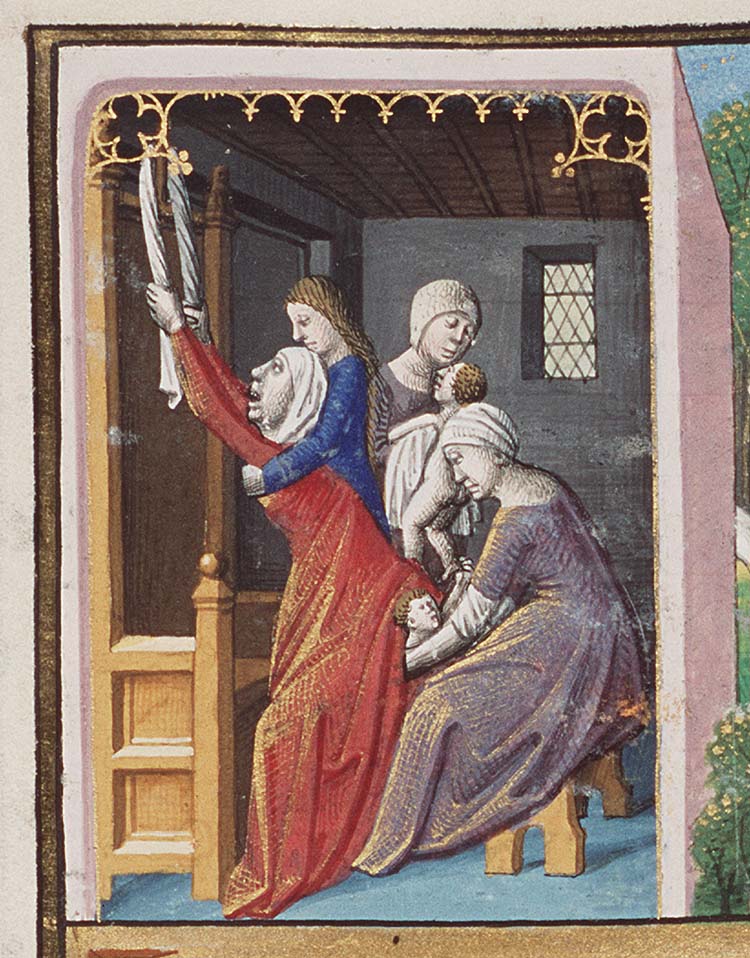
Birth of Esau and Jacob, by Francois Maitre, ca. 1480

The Torah identifies the twins with these two animals when they are born in this week’s Torah portion, Toledot (“Lineages”):

The first emerged red [and] completely like a robe of sei-ar, so they called his name Eisav.  And after that his brother emerged, and his hand was holding fast to the heel of Eisav, so he called his name Ya-akov …  (Genesis/Bereishit 25:25-26)

sei-ar (שֵׂעָר) = goat hair, bristling hair.  (From the same root as sa-ir, שָׂעִיר = he-goat.)

Eisav (עֵשָׂו) = (Esau in English)  Doer, Made.  (From the root verb asahעָשָׂה = do, make.)

Ya-akov (יַעֲקֹב) = (Jacob in English)  Heel-grabber, Sneak.  (From the same root as akeiv, עָקֵב = heel, which derives from the verb akav,  עָקַב= came from behind.)

The Torah explains why Jacob and Rebekah, the parents of the twins, named the second one Ya-akov: he emerged hanging onto his brother’s heel.  But why did they name the first one Eisav?  Rashi (11th-century rabbi Shlomoh Yiztchaki) wrote that because he was covered with hair, he looked like an adult, completely “made”.

Toledot

At birth, Esau is hairy like a goat.  Goats are also known for being “horny” beasts, which fits Esau’s personality when he grows up.  He brings home not one, but two Hittite wives against his parents’ objections.1

Jacob’s grip on his twin’s heel is a reminder of the snake in the garden of Eden, whom God cursed to crawl on his belly and bite humans on the heel.2  The Torah describes the heel-biting snake as arum (עָרוּם) = naked; clever, cunning.3  Jacob is hairless, and therefore naked compared to Esau; and when he grows up he is the clever one.  We first see this when Esau comes home famished and Jacob talks him into trading his birthright for a bowl of stew.4

In the next scene about Esau and Jacob, their blind father, Isaac, wants to give his firstborn son a blessing.  But first he tells Esau to go hunt game and make it into the delicacy he loves.   Rebecca, the twins’ mother, overhears.  She is certain that Jacob should get the blessing instead.  So she orders Jacob:

“Please go to the flock and take for me two good goat kids, and I will make them a delicacy for your father like [those] he loves.”  (Genesis 27:9)

Rebecca’s favorite son can bring back goats from the flock faster than Esau can hunt, and she knows how to make them taste like the game Esau often cooks for his father.  On another level, Rebecca may be implying that Jacob should overpower his hairy he-goat of a brother.

And why does she need two goats for one old man’s meal?  Is she subconsciously sacrificing both of her sons to make sure the right one gets Isaac’s blessing?

Isaac Blessing Jacob, by Gerbrand van den Eeckhout, 1642, detail

Jacob protests:

Hey, my brother Esau is a sa-ir man, and I am a smooth man!  (Genesis 27:11)

sa-ir (שָׂעִר) = hairy.  (Also from the same root as sa-ir, שָׂעִיר = he-goat.)

Physically, Jacob is still as smooth as a snake.  So Rebecca fixes it.  After dressing Jacob in Esau’s clothes, she covers his hands and neck “with skins of goat kids” (Genesis 27:16).  When he brings in the dish of meat, his blind father is not sure which son he is.  He speaks like Jacob, so Isaac asks him to come closer, and touches his son’s hands.

And he did not recognize him because his hands were like the hands of his brother, se-irot.  And he blessed him.  (Genesis 27:23)

se-irot (שְׂעִרֹת) = hairy.  (The plural of sa-ir above.)

Isaac gives Jacob the blessing he intended for Esau.  Enraged by the “theft” of his blessing, Esau rashly swears he will murder his brother, and Jacob quickly slips away and heads for his uncle Lavan’s house in Aram.

Vayeitzei

In the next Torah portion, Vayeitzei (“And he went”), Jacob marries his uncle Lavan’s daughters, Leah and Rachel, and serves Lavan for fourteen years in lieu of bride-prices for them.  When his time is up, his employer/uncle/father-in-law does not want to let him go.

And Lavan said to him: “If, please, I have found favor in your eyes!  Nichashti, and God has blessed me on account of you.”  And he [Lavan] said: “Designate your wage to me, and I will give it.”  (Genesis 30:27-28)

nichashti (נִחַשְׁתִּי) = I received an omen.  (From the same root as nachash, נָחָשׁ = snake.  Snakes were associated with omens and magic in the ancient Near East.)

Lavan comes close to saying, “I sought a snake, and God has blessed me on account of you.”

The serpentine Jacob makes a clever bargain with Lavan and works for another six years in exchange for far more livestock than his employer expected.  Then twenty years after Jacob fled to avoid being murdered by his brother, he finally heads back toward Canaan with his family, servants, and flocks.

Vayishlach

The next Torah portion begins:

And Jacob sent messengers ahead of himself to his brother Esau, to the land of Sei-ir, the country of Edom.  (Genesis 32:4)

sei-ir (שֵׂעִר) = hairy goat.

Esau has become the chieftain of “The Land of the Hairy Goat”, also called Edom.  Jacob’s messengers return with the news that Esau is already marching to meet him—with 400 men.

Reconciliation of Jacob and Esau, by Peter Paul Rubens, 1624

This time, instead of bargaining with his twin brother, Jacob sends him extravagant gifts of livestock.  (See my post Vayishlach: Two Camps.)  In the morning, after Jacob has wrestled with a “man” who turns out to be a messenger of God, the estranged brothers meet.  They embrace one another and weep out loud.  Esau offers to return Jacob’s gifts, and Jacob insists that he keep everything.

“Because I have seen your face, which is like seeing the face of God, and you have accepted me.”  (Genesis 33:10)

Then Esau offers to travel with Jacob as far as Sei-ir.  But Jacob politely says his group has to go more slowly, so Esau and his men should go ahead, and he will catch up later.  As soon Esau and his warriors are out of sight, Jacob heads in another direction.  The two brothers do not see one another again until their father’s funeral.5


Esau and Jacob do better than Cain and Abel; they manage a peaceful reunion, and nobody dies.  Yet a goat and a snake cannot become close friends and go home together.  They have separate destinies.

May each of us be blessed, like Jacob, to see God’s face in people who are fundamentally different from us.  And may we learn to greet them in peace, and part from them in peace.


  1. Genesis 26:34, 27:46.
  2. Genesis 3:15.
  3. Genesis 3:1.
  4. Genesis 29:25-34.
  5. Genesis 35:29.

Bereishit & Toledot: Seeing Red

The book of Genesis/Bereishit explores a series of conflicts between brothers, and one between sisters.  Two of these conflicts feature an especially hot-blooded, emotional brother, and both of these use various permutations of the word for the color “red”: adom, אָדֺם.

Blood red

After Cain kills Abel in the first Torah portion of Genesis, Bereishit, God tells Cain:

The Killing of Abel, Providence Lithograph Co., 1905

“What have you done? The voice of the damim of your brother is crying out to me from the adamah!”  (Genesis/Bereishit 4:10)
damim (דֱָמִים) = shed blood. (plural of damדָּם = blood.)
adamah (אֲדָמָה) = ground, dirt, earth.

Both Hebrew words come from the same root as adam (“human”, also the name of the father of Cain and Abel, whom God makes out of dirt in Chapter 2).  To be human is, among other things, to be red.  Dam, “blood”, is obviously red.  And traditional commentary explains that uncultivated earth (at least in the world described by the Torah) is red clay.

Red man, red stew

This week’s Torah portion, Toledot (“Histories”), tells the story of the twins Esau and Jacob, from their conception until they are in their forties and  Jacob flees because Esau is threatening to kill him.

Then her days of pregnancy were completed, and hey! –twins were in her womb.  And the first one went out, admoni all over like a fur robe of hair, and they called his name Eisav.  And after that his brother went out, and … they called his name Jacob.. (Genesis 25:24-26)

admoni (אַדְמוֹנִי) = reddish.

Eisav (עֵשָׂו) = Do it, get it done. (From the verb asahעָשָׂה = do.) “Esau” in English.

The text is not clear about whether he has ruddy skin and is covered with hair, or whether his fur-like hair is reddish.  Either way, he is born red, like blood, and hairy, like a beast.

Since Esau is born a moment before Jacob, he counts as the firstborn son.  In the world of the Torah, when the patriarch of an extended family dies, his firstborn son inherits a double portion of his father’s possessions, and also becomes the family’s priest.  Yet in this story, when Esau grows up and becomes a hunter, he does not care about the role of the firstborn.  Jacob, who stays in the tents, cares very much.

Jacob stewed a stew, and Esau came in from the field, and he was famished.  And Esau said to Jacob: “Please let me gulp down some of the adom— this adom— because I am famished.”  Therefore his name was called Edom.  (Genesis 25:29-30)

Edom (אֳדוֹם) = a people who later lived in the hill country east of the Jordan river valley, supposedly descended from Esau.  (From the same root as adom = red.)

Esau Selling His Birthright to Jacob, by Rembrandt, 17th c.

Jacob takes advantage of his incoherent brother’s request by charging an exorbitant price for the stew.

And Jacob said:  “Hand over, as of today, your right as firstborn to me”.  And Esau said:  “Hey, I am going toward death, so what is this to me, a firstborn right?”  Then Jacob said:  “Swear to me, as of today!”  And he swore to him, and he handed over his firstborn right to Jacob.  And as for Jacob, he gave to Esau bread and a stew of lentils.  And he ate and he drank and he got up and he went.  Thus he belittled the right of the firstborn.  (Genesis 25:31-34)

On a literal level, this story amuses me, because I often make stew from red lentils, and it always comes out a golden color.  Other kinds of cooked lentils are dark brown or green-brown—but never red.  Did someone who never cooked write down this story, and get the detail about lentils wrong?  I prefer to assume that Jacob is so clever, he adds an ingredient to his stew that will make even lentils look red enough to attract Esau’s attention.

Esau sees food and the color red.  He does not notice the lentils.  He cannot even find the word for stew.  The 19th-century commentator Samson Raphael Hirsch wrote that the color red delights Esau because it reminds him of the blood on an animal when his arrow hits it.1

The 20th-century psychologist Helen Luke wrote that red is the color of instinct, impulse, and emotion.  She added that Esau, who is controlled by the color red, is in danger of losing all civilizing tendencies and becoming evil.  Jacob, his opposite, is in danger of repressing or denying all instinct and emotion, and becoming evil.2

Neither Cain, the man of blood-red violence, nor Jacob, the bloodless schemer, is a good candidate for the spiritual role of the firstborn, the one who speaks with and makes offerings to God.

I think Jacob sees the world as black and white, divided between losers and winners.  Since he sees the firstborn as the winner in the family, he applies his intelligence to acquiring that role.  He suppresses any emotional impulses in order to carry out first his own scheme for taking his brother’s birthright, then his mother’s scheme for stealing his brother’s blessing.  Jacob may not savor his food as much as Esau, but he knows how to plan ahead.

Esau sees only red.  Carried away by one emotion after another during the Torah portion of Toledot, he carries out his impulses and lives for the moment.  In the passage translated above, he gives away his birthright to appease one day’s feelings of hunger and despair.  Later in the Torah portion, he weeps like a child when he finds out Jacob has stolen the blessing their father intended for Esau.  Then he becomes so angry he threatens to kill Jacob as soon as their father dies.

Jacob flees from him, and (in the Torah portion Vayeitzei) he meets his match in his cold, calculating uncle Lavan—whose name means “white” in Hebrew.  Yet some color finally comes into Jacob’s black-and-white life, as he falls in love with Lavan’s daughter Rachel.  Gradually he succeeds in becoming the leader of his own clan, through a combination of sensitivity to others’ emotions and rational long-term planning.

Meanwhile, Esau leaves home and learns how to be a leader.  When he hears that his twin and nemesis is coming his way (in the Torah portion Vayishlach), he plans ahead by bringing 400 men to meet Jacob on the road.  But he retains his emotional instincts, and when he sees Jacob bow to him, he runs over and embraces his brother.  The two older and wiser men pull off a peaceful reunion.


We all have some of Jacob’s black-and-white rationalism and some of Esau’s red emotionalism.  We can only be whole human beings when those two sides embrace.

Furthermore, in order turn our whole personality toward peace rather than toward evil, we must learn from the evolution of both brothers.  Jacob learns to use his black-and-white intellect to lay plans for the good of everyone, instead of for just his own advantage.  And Esau learns to move beyond seeing red as the blood shed in killing, and see red as the blood of life, shared with other humans.

If we can widen our vision enough, through both our intellects and our emotions, we will recognize that all human beings share the same blood; we are descendants of Adam, אָדָם = the human, humankind. (From the same root as adom = red.) Then we will all truly deserve the right of the firstborn to speak with and offer gifts to God.


  1. Rabbi Samson Raphael Hirsch, The Hirsch Chumash: Sefer Bereshis, Feldheim Publishers, Jerusalem, 2002, pp. 561-562.
  2. Helen Luke, Kaleidoscope, Parabola Books, New York, 1992, p. 225.