Vayeitzei: Two Stones

And Yaakov walked away from Beirsheva and went toward Charan. (Genesis/Bereishit 28:10)

So begins this week’s Torah portion, Vayeitzei (“And he went out”, Genesis 28:10-32:3). Yaakov (“Jacob” in English) has to leave home because his twin brother Eisav (“Esau” in English) has been threatening to kill him as soon as their ailing father dies.1

The family is dysfunctional. Eisav resents Yaakov for cheating him twice.2 Their parents, Yitzchak (“Isaac” in English) and Rivkah (“Rebecca” in English), play favorites, as last week’s Torah portion, Toledot, reports:

When the boys grew up, Eisav became a man who knew how to hunt, a man of the outdoors; and Yaakov was a quiet man staying indoors. And Yitzchak loved Eisav, because of [the taste of] game in his mouth; but Rivkah loved Yaakov. (Genesis 25:27-28)

Furthermore, Rivkah and Yitzchak are not frank with one another. Yitzchak does not tell his wife what he plans to do in terms of deathbed blessings for his sons. Rivkah manipulates Yaakov into deceiving his blind father and steal the blessing he plans to give Eisav. (See my post Toledot: Rebecca Gets It Wrong.) Everyone in the family assumes that Yitzchak has the power to pass on the blessing he received from God.

After Eisav threatens to kill Yaakov, Rivkah urges her favorite son to flee to Charan, where her brother lives, until Eisav’s anger has faded. Then she announces to her husband that she could not bear it if Yaakov, like Eisav, took a Canaanite wife. She does not need to say more; Yitzchak himself has never left Canaan, but he knows of one place outside the land: Charan, where his father Avraham and his wife Rivkah came from. So he orders Yitzchak to go there. 

“… and take yourself a wife from there, from the daughters of Lavan, your mother’s brother” (Genesis 28:2).

Yaakov departs at once. He is over 40 years old, and this is the first time in his life he leaves his immediate family, and the land of Canaan.

Erecting a stone

On the way to Charan he encounters God in a transformative dream. (See my post Vayeitzei: The Place.)

And Yaakov woke up from his sleep, and he said: “Truly there is God in this place, and I, I did not know!” And he was awestruck, and he said: “How awesome is this place! This is none other than a house of God, and this is the gate of the heavens!” And Yaakov got up early in the morning, and he took the stone that he had set by his head, and he set it up as a matzeivah, and he poured oil on top of it. (Genesis 28:16-18)

matzeivah(מַצֵּבָה) = a tall upright stone used for a religious purpose, as a grave marker, or as a memorial to an important event.

Erecting a tall stone and anointing it with olive oil was an accepted way of acknowledging a god in the Ancient Near East. Although Yaakov is smaller than his huge twin Eisav, he is strong enough to manhandle a long slab of stone.

Then Yaakov vows that if God takes care of him until he returns,

“… then Y-H-V-H will be my god. And this stone, which I have set up as a matzeivah, will become a house of God, and from everything that you give to me, I will tithe a tenth for you.” (Genesis 28:21-22).

The matzeivah remains at the spot as a witness to Yaakov’s experience and a marker for fulfilling his vow when he returns.

Rolling a stone

And Yaakov picked up his feet and went to the land of the Easterners. And he looked around, and hey! A well was in the field. And hey! There were three flocks of sheep lying down near it, because from that well they watered the flocks. And there was a large stone on the mouth of the well. For when all the flocks were gathered there, then they rolled the stone off from the mouth of the well, and watered the sheep, and brought the stone back to its place over the mouth of the well. (Genesis 28:1-3)

The shepherds could have chosen a lighter covering for their well, something made with wood that anyone could lift. But instead they use a stone that is so heavy, they have to cooperate to roll it off the well. This would prevent strangers or natives from drawing water unless a large group of men is there to enforce fair distribution of a limited resource.3 (Perhaps it takes all day for groundwater to seep in and refill the well.)    

Yaakov greets the shepherds of the three flocks that have arrived so far, finds out they are from Charan, and asks about Lavan, whom they report is doing well. They add:

“And hey! His daughter Racheil is coming with the flock!” (Genesis 29:6) 

As Racheil (“Rachel” in English) leads her flock over, Yaakov tells the men:

“Hey, the day is still long, it’s not time to gather in the livestock [for the night]. Water the sheep and go pasture them!” (Genesis 29:7)

Yaakov was in charge of the sheep in his father’s household, so he knows what should be done. But to me it seems bossy to tell men whom one has just met that they are wasting time. Perhaps Yaakov wants them to water their sheep and leave, so that he will have a moment alone with Racheil while she is watering her flock.

The shepherds tell Yaakov that they always wait until everyone is there to roll the stone off the mouth of the well.

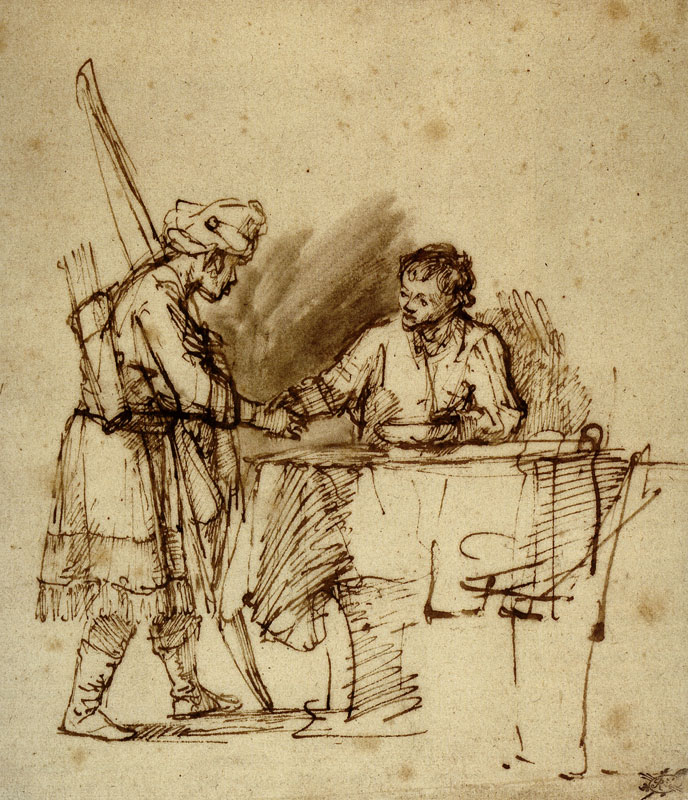
He was still speaking with them when Racheil came with the sheep that were her father’s, for she was a shepherdess. And when Yaakov saw Racheil, a daughter of his mother’s brother Lavan, and the flock of his mother’s brother Lavan, then Yaakob stepped forward and rolled the stone off from the mouth of the well, and he watered the flock of his mother’s brother Lavan. (Genesis 29:10)

How does he have the strength to roll a stone so heavy that normally it can only be budged by many men working together? Tur HaArokh answered: “The new hope he had been given through his dream about the ladder had left its mark also on his body.”4

Another answer appears in Or HaChayim: “This teaches us that unless Jacob had had divine assistance he could not have moved that stone.”5

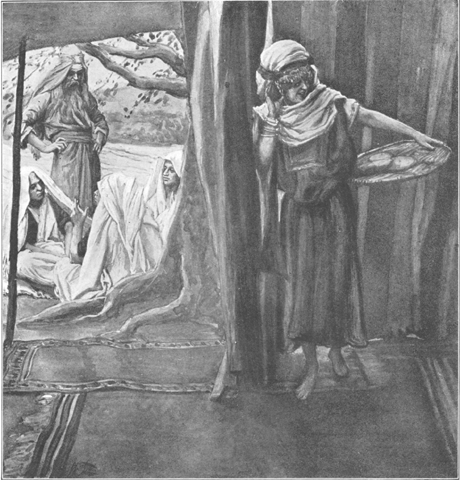
He might also have inherited strength and stamina from his mother. About 60 years earlier, when Rivkah was a teenager in Charan, she was at the well when a stranger arrived with a train of camels. She offered him a drink of water. Then she ran back and forth pouring heavy pitchers of water into the watering-trough until all ten of the stranger’s camels had drunk their fill. The stranger ( whom Avraham had sent to find a bride for his son Yitzchak) was awed by her athletic feat. (See my post Chayei Sarah: Seizing the Moment, Part 1.)

by Ephraim Moshe Lilien (1874-1925)

Rivkah’s son Yaakov also performs an athletic feat at the well, then waters Racheil’s sheep.

Then Yaakov kissed Racheil, and he lifted up his voice and wept. And he told Racheil that he was her father’s kinsman, and that he was Rivkah’s son. And she ran and told her father. And when Lavan heard tidings of Yaakov, his sister’s son, then he ran to meet him, and he embraced him and kissed him, and brought him into his house. (Genesis 29:11-13)

So far, so good. Yaakov, who never considered marriage while he was in Canaan, is smitten with Racheil. Now marrying into Lavan’s family is no longer just his parents’ idea. But although Lavan probably expects as large a bride-price as Avraham’s steward brought for Rivkah, Yaakov has unaccountably neglected to put any gold, silver, or jewelry in his pack. (See my post Vayeitzei: Guilty Conscience for one explanation.) So Yaakov offers to work for his uncle for seven years as the bride-price for marrying Racheil.

And Yaakov served seven years for Racheil, but they were like a few days in his eyes, because of his love for her. (Genesis 29:20)

Blocked by a stone

Traditional Jewish commentary often takes symbolism to extremes. Many classic commentaries identify the well near Charan with the temple in Jerusalem, and the three flocks of sheep with the three pilgrimage festivals there—even though Jerusalem and its festivals have nothing to do with Yaakov’s story. Others propose that the well represents knowledge of the Torah, and the stone is the evil inclination that blocks people from drinking it in. Compared to these far-fetched analogies, Robert Alter’s comment is refreshing:

“If, as seems entirely likely, the well in the foreign land is associated with fertility and the otherness of the female body to the bridegroom, it is especially fitting that this well should be blocked by a stone, as Rachel’s womb will be ‘shut up’ over long years of marriage.”6

But I am intrigued by a Chassidic commentary that identifies the well and the stone in terms that could be applied to Yaakov’s feelings by the end of the month during which he leaves home, encounters God, and falls in love—all for the first time.

Kedushat Levi compares the well to the human heart, which longs to connect with God, but is blocked as if by a stone. “The large stone is the evil urge … preventing the flow of God’s blessing. … He rolled the stone off the mouth of the well means that he removed the stumbling-block from the heart that flows with prophecy.”7

Arthur Green added: “… our evil urge, that which causes the human ego to assert its own will, blocks us from that vision. Our strongest force in defeating it is that of joy.  When we open our hearts and rejoice … we overcome that need for self-assertion. Then divine blessing can flow upon us, even opening our hearts to the prophetic witness that is our true natural state of being.”8

While Yaakov is in Canaan, his “evil urge” is his jealousy of Eisav. Eisav is slated to get the larger inheritance of the firstborn son because he was born one minute before his twin brother. Furthermore, Eisav’s knack for hunting and cooking game wins their father’s love. So Yaakov cheats Eisav twice. He cannot let go of his jealousy until he is forced to leave Canaan, the inheritance, and Yitzchak. As soon as he is on the road, the heavy stone of Yaakov’s jealousy rolls away, and his heart opens. He has a vision and hears God in a dream, and the stone that lay by his head becomes his matzeivah for God. He falls in love with Racheil, and he rolls the stone off the well. Instead of continuing to dedicate his life to jealousy, Yaakov chooses a life of joy.


I always questioned the popular saying “Wherever you go, there you are”—with all the same problems you had before. It is true that we cannot erase the old experiences that shaped our personalities. Yet a big change in our lives can lead to psychological growth. Some of our old complexes can become healed scars instead of bleeding wounds, and we can move on.

In the portion Vayeitzei, Yaakov begins this process with the liberation of leaving home—leaving behind his manipulative mother, his detached father, and the unfair law of inheritance. Immediately he has stunning new experiences: encountering God, and falling in love. He changes. During the rest of his story in Genesis, he remains weighed down by mistrust and selfishness. But at least his jealousy and rivalry have rolled away, making a good life possible.

I, too, had a manipulative mother and a detached father, and I suffered from other types of unfairness when I was growing up. My liberation began when I escaped to college, and over many years the heavy stone rolled off my well. I still carry scars, but now love and a good life are not only possible for me, but a reality.


  1. Genesis 27:41.
  2. Genesis 27:34-36, referring to Genesis 25:29-34 and Genesis 27:5-27.
  3. According to 19th-century Rabbi Samson Raphael Hirsch, the heavy covering means that the people who live there do not trust one another.
  4. Rabbi Jacob ben Asher (c. 1269 – c. 1343), Tur HaArokh, translated in www.sefaria.org.
  5. Rabbi Chayim ben Moshe ibn Attar, Or HaChayim, 18th century, translated in www.sefaria.org.
  6. Robert Alter, The Hebrew Bible, Vol. 1, W.W. Norton & Co., New York, 2019, p. 103.
  7. Levi Yitshak of Berdyczow (1740-1809), Kedushat Levi, translated by Arthur Green,in Speaking Torah, Vol. 1, edited by Arthur Green, Jewish Lights Publishing, Woodstock, VT, 2013, pp. 126-127.
  8. Arthur Green, Speaking Torah, Vol. 1, p. 127.

Vayeitzei: Father Figures

And Jacob went out from Beersheba and went toward Charan. (Genesis 28:10)

The first verse in this week’s Torah portion, Vayeitzei (“And he went”, Genesis 28:10-32:3), sounds simple—until you consider the family Jacob is leaving behind in Beersheba.

In last week’s Torah portion, Toledot, Jacob cheated his twin brother, Esau (older by a minute), into trading his firstborn rights for a bowl of lentil stew.1 Years later their father, Isaac, announced he would give his deathbed blessing to Esau, his favorite. The twins’ mother, Rebecca, talked Jacob, her own favorite, into impersonating his brother and stealing the blessing.2

When Esau found out, he vowed to kill his brother as soon as their father died. Rebecca urged Jacob to flee for his life, then maneuvered her husband into ordering Jacob to go to her old hometown in northern Mesopotamia and get a wife.3 At least Isaac gave Jacob a blessing of his own to send him off.4

Jacob turns his back on Isaac

What is Jacob thinking as he hikes north toward Charan? In my post Vayeitzei: Guilty Conscience, I argue that he might feel guilty about his deceptions—guilty enough to leave at once, without waiting for his wealthy father to give him a bride-price, pack animals, and a servant or two for the journey. Jacob does not even ask his father for a bag of silver; he arrives in Charan with nothing but his walking stick.

Besides guilt, Jacob may feel relief and a sense of freedom. For the first time in his life he is on his own, away from his remote father, his controlling mother, and his big, hairy, primitive brother.

Jacob’s Dream, German, 14th century

On the first night of his journey Jacob lies down with his head on a stone, and dreams about a ramp or stairway from the ground to the heavens, with divine messengers ascending and descending on it.

And hey! God stood above him and said: “I am Y-H-V-H, god of Abraham your av, and god of Isaac. The land that you are lying on, I will give to you and to your descendants.” (Genesis 28:13)

av (אָב) = father; someone in the role of a father (usually God or the head of a household or clan).

Why does God put it that way? Abraham is Isaac’s father, and Isaac is Jacob’s father. Jacob and his grandfather Abraham never interact in the book of Genesis, probably because Isaac and Abraham were estranged.5 So Abraham was neither a nurturer, nor an authority figure, nor a role model for Jacob.

According to 18th-century Rabbi Chayim ibn Attar, God means that Jacob is Abraham’s sole heir:

“The reason … was intended to emphasize that Esau had no share in the heritage of Abraham. The Torah here made Jacob the sole heir of Abraham. This heritage did not come to Jacob via his father Isaac but directly from his grandfather Abraham. … the fact that all the blessings of Abraham were transferred to Jacob excludes Esau as an heir.”6

According to 19th-century Rabbi S.R. Hirsch, God means that Jacob is Abraham’s spiritual successor:

“Nowhere else in Scripture do we find such a thing that the grandfather is called ‘father,’ with the father himself mentioned right afterward as though he were a stranger. …Jacob truly was the successor of Abraham, with Isaac being only the intermediate link.  Spiritually, Abraham was Jacob’s father.”7

But according to 21st-century Rabbi Shmuel Klitsner, it means Jacob wants Abraham’s God:

“… the Talmud records the observation … that in dreams, ‘a person is shown nothing if not the inner thoughts of his own heart’ (BT, Tractate Berakhot 55b). … It seems clear that in Jacob’s ‘inner thoughts of heart’ the Lord who will comfort him will be the Lord of Abraham his father. As for the God of Isaac (his genetic father), there is a missing relational adjective, as the very situation that begs comfort, Jacob’s precarious homeless state, is a result of his having betrayed the father-son relationship.”8

Does the phrase “god of Abraham your father” signal that only Jacob and his descendants will inherit what God promised to his grandfather Abraham (ibn Attar)? Or that Jacob will have the same relationship with God as Abraham (Hirsch)? Or that Jacob wants Abraham’s God rather than Isaac’s? (Klitsner)?

Does Jacob inherit Abraham’s blessings?

Chayim ibn Attar’s proposal is supported by the next words God says in Jacob’s dream:

“And your descendants will be like the dust of the land, and you will spread out to the west and to the east, to the north and to the south. And all the clans of the earth will be blessed through you and your descendants.” (Genesis 28:14)

This statement echoes two of the blessings God gave to Abraham:

“All the land that you see, I give it to you and to your descendants forever. And I will make your descendants like the dust of the earth, in that if a man were able to count the dust of the earth, your descendants could also be counted.” (Genesis 13:15-16)

“I will bless those who bless you, and those who despise you I will curse, and all the clans of the earth will be blessed through you.” (Genesis 12:3) Thus God promises both Abraham and Jacob that their descendants will be as uncountable as the dust, that their descendants will own the land, and that they will become a blessing to everyone on earth. Jacob does indeed inherit Abraham’s blessings.

Is Jacob Abraham’s spiritual successor?

However, Hirsch’s proposal that Abraham, not Isaac, is Jacob’s spiritual father gets only weak support from the book of Genesis. Abraham hears God speak on twelve occasions in the book of Genesis. Isaac hears God speak once.9 And Jacob hears God speak three times: once during Jacob’s ladder dream at the beginning of this week’s Torah portion, and twice when he returns to the same spot 20 or more years later.10 (Jacob also tells Leah and Rachel that God also spoke to him in a dream telling him to leave Charan and return to his native land,11 but since he had already decided to go, he might have invented this dream in order to secure his wives’ consent.)

Jacob never experiences the intimacy Abraham has with God. Abraham and God have six conversations.12 In one of these conversations, Abraham talks God into refraining from obliterating Sodom if the city has at least ten innocent men.13 Jacob hears God speak, but never answers. Once Jacob prays to God to rescue him, but God is silent.14

In addition to the conversations between Abraham and God, God speaks to Abraham another six times to deliver an order or a promise, or both.15 Abraham obeys all of God’s orders, even when God tests him by telling him to sacrifice his son Isaac.16 Jacob obeys God’s only order to him, to build an altar at Beit Eil.17

Abraham persuades Sarah, by James Tissot, ca. 1900, detail

Furthermore, God cooperates with Abraham’s scams. Twice when Abraham arranges for his wife, Sarah, to be carried off to a king’s harem, God afflicts the king so he cannot have sex with her.18

In short, God spends a lot more time with Abraham than with Jacob, and the two of them have a real relationship. With Jacob, God is almost as distant as with Isaac.

Is Jacob the heir to Abraham’s God?

What about Klitsner’s proposal that Jacob wants Abraham’s god rather than Isaac’s?

Near the end of this week’s Torah portion, Jacob has left Charan and is heading to Canaan with his family, servants, and herds, when Lavan (his employer, uncle, cousin, and father-in-law) catches up with him in a mountain pass. Lavan accuses Jacob of stealing his daughters—Jacob’s wives. Jacob accuses Lavan of cheating him multiple times as his employer. Jacob concludes:

“Had not for the god of my father—the God of Abraham and the Pachad of Isaac—been for me, certainly now you would have sent me off empty-handed!” (Genesis 31:42)

pachad (פַּחַד) = terror.

Twenty years after he left home and dreamed of the ladder, Jacob now calls both Abraham and Isaac his father.

The two men set up stones to serve as a boundary, and they both swear not to cross it for any harmful purpose. Lavan says:

The Heap of Witness, Holman Bible, 1890

“May the God of Abraham and the God of Nachor judge between us—the God of their father.” (Genesis 31:53a)

Lavan is referring to a single god, Y-H-V-H, worshiped by the both Abraham and Nachor, their respective paternal grandfathers. We know that Abraham and his brother Nachor had the same god because earlier in Genesis Lavan and his father said Rebecca’s marriage to Isaac “went forth from Y-H-V-H” (Genesis 24:50).19

But Jacob swore by the Pachad of Isaac. (Genesis 31:53b)

Twice Jacob calls God the Pachad of Isaac. There is no indication in the book of Genesis that Isaac threatened Jacob, with a punishment from God or any other way. So Jacob must be thinking about the defining event in Isaac’s life, when God ordered Abraham to sacrifice him, and did not call it off until Abraham had bound his son on an altar and put a knife to his throat.20

Jacob invokes Isaac’s God as a source of terror in order to make an implied threat against Lavan. But when he left home twenty years before, he did not want the Pachad of Isaac. He wanted a protective God who would help him out of tight spots the way God helped Abraham get his wife back from two kings.

And that is what Jacob got at the end of his dream about the ladder. After saying that Jacob’s descendants will own the land and be a blessing to the world, God added:

“And hey! I myself am with you. And I will guard you wherever you go, and I will bring you back to this ground, because I will not leave you until I have done what I have spoken to you.” (Genesis 28:15)

Then Jacob wakes up. The God of Abraham has promised to protect him.

He has a new father figure.


  1. Genesis 25:29-34. (See my post: Bereishit & Toledot: Seeing Red.)
  2. Genesis 27:1-30. (See my post: Toledot: To Bless Someone.)
  3. Genesis 27:31-28:5.
  4. Genesis 28:3-4.
  5. Ever since Abraham bound Isaac as a sacrifice and almost cut his throat (Genesis 22:1-19). See my post: Vayeira: Stopped by an Angel.)
  6. Chayim ibn Attar, Or Hachayim, translation in www.sefaria.org.
  7. Samson Raphael Hirsch, The Hirsch Chumash: Sefer Bereshis, translated by Daniel Haberman, Feldheim Publishers, Jerusalem, 2002, p. 602.
  8. Shmuel Klitsner, Wrestling Jacob, Urim Publications, Jerusalem, 2006, pp. 82-83.
  9. Isaac hears God speak to him, and builds an altar for God, in Genesis 26:24-25.
  10. Genesis 35:1, 35:9-13.
  11. Genesis 31:9-13.
  12. Genesis 15:1-11, 17:1-22, 18:9-10, 18:17-33, 22:1-2, 22:11-12.
  13. Genesis 18:17-33. (See my post: Vayeira: Who Is the Teacher?)
  14. Genesis 32:10-13.
  15. Genesis 12:1-4, 12:7, 13:14-18, 15:12-21, 21:12-13, 22:15-18.
  16. Genesis 22:1-10.
  17. Genesis 35:1-7.
  18. Genesis 12:11-20, 20:1-18.
  19. See my post Vayeitzei: Awe versus Terror for the complete inbred family tree.
  20. Genesis 22:9-12.

Vayeitzei: Awe versus Terror

Jacob introduces a new name for God in this week’s Torah portion, Vayeitzei (Genesis 28:10-32:3):

“If it were not that the elohim of my father—the Elohim of Abraham and the Pachad of Isaac—is with me, you would have sent me off empty-handed!” (Genesis 31:42)

elohim (אֱלֹהִים) = gods, god, God.

pachad (פַּחַד) = trembling; terror, dread. (From the verb pachad, פָּחַד = tremble uncontrollably, shudder, be terrified; dread.)

Everyone in the book of Genesis uses the common noun elohim to refer to gods in general. Descendants of Terach, both Abraham’s line in Canaan and Nachor’s line in Aram, also use the proper name Y-H-V-H for the god who becomes known later as the God of Israel.1 Y-H-V-H has other names and titles, but only Jacob calls God the Pachad of his father.

Jacob’s awe

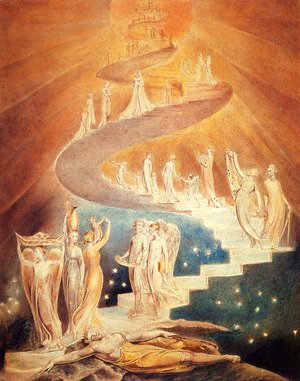
Jacob’s Dream, by William Blake, 1800

In last week’s Torah portion, Toledot, Jacob cheats his older brother Esau twice, and Esau vows to kill him. He flees to his uncle Lavan’s house in Aram, a northern Mesopotamian territory far from Canaan. On the way, Jacob has his first direct experience of God: a dream featuring a stairway between the earth and the heavens, and God standing over him.

Then Jacob woke up from his sleep, and he said: “Surely there is Y-H-V-H in this place, and I, I did not know!” Vayiyra, and he said: “How awesome is this place!” (Genesis 28:16)

vayiyra (וַיִּירָא) = and he was afraid, and he was awed. (A form of the verb yarei, יָרֵא = fear, be afraid, be awed, revere.

Jacob feels awed and frightened by his numinous experience. Maybe he has goosebumps. But he is not overcome by the uncontrollable trembling associated with pachad, terror. When he gets up, he erects a stone, pours oil on it, and vows that if God protects him until he returns to his father’s house, he will worship God and give God a tenth of his possessions.

Isaac’s terror

Jacob’s practical bargaining is a far cry from his father Isaac’s relationship to God. As a young adult, Isaac voluntarily let his father tie him up on an altar as a burnt offering to God. Abraham almost cut his throat before God intervened.2 According to some classic Jewish commentators, Isaac experienced pachad then, and carried the trauma for the rest of his life.3 When Isaac is old and blind, Jacob impersonates his brother Esau in order to steal Isaac’s blessing in the name of God. When Esau arrives and confirms what Jacob did, Isaac is seized by another kind of fearful trembling, charad.4

Perhaps Jacob thinks of Isaac’s overwhelming relationship to God in terms of trembling.

Jacob’s wages

Jacob arrives safely at his uncle’s house in this week’s Torah portion, and promptly falls in love with Lavan’s younger daughter, Rachel. Having arrived without any gifts to use as a bride-price,5 Jacob works as a shepherd for Lavan for seven years. But on the wedding day, Lavan substitutes his older daughter, Leah. Jacob still wants Rachel, and Lavan tells Jacob he has to work another seven years for her.6

After Jacob completes fourteen years of service for his two wives, he continues to work for his uncle and father-in-law, this time in exchange for the black sheep and the spotted and brindled goats in Lavan’s flocks. Lavan promptly sends them all to a distant pasture before they can be counted.7 But over the next six years Jacob uses breeding techniques to build up his own flocks of black sheep and brindled goats.

… so the feeble ones were Lavan’s and the [sturdy] striped ones were Jacob’s. And the man spread out very much, and he owned large flocks, female slaves and male slaves, and camels and donkeys. (Genesis 30:42-43)

After Jacob has accumulated this wealth, he notices that Lavan and Lavan’s sons act as if they have a grudge against him.

Then Y-H-V-H said to Jacob: “Return to the land of your fathers and your clan, and I will be with you.” (Genesis 31:3)

Jacob talks it over with his wives, who agree it is time to leave their father in order to ensure their own children’s inheritance. While Lavan and his sons are away at a sheep-shearing, Jacob leaves town with his whole household (his two wives, two concubines, twelve children, and many slaves) and all his flocks and other possessions. He does not know that his wife Rachel secretly brings along the small idols from her father’s house.8 They cross the Euphrates River and continue west, heading for Canaan.

Final confrontation

Lavan and his sons are not amused. They pursue Jacob’s party for seven days, and catch up with them in the hill country.

And Lavan said to Jacob: “What have you done when you deceived me and you carried off my daughters like captives of the sword? … There is power in my hand to do harm to you all! But last night the elohim of your father spoke to me, saying: Guard yourself, lest you speak with Jacob for good or bad. And now, you are surely going because you surely longed for your father’s house. [But] why did you steal my elohim?” (Genesis 31:29-30)

Elohim is an elastic word in the Hebrew Bible. When Lavan remembers his dream, he refers to the elohim of Jacob’s father (and also of Lavan’s father), whose name is Y-H-V-H. But also when he remembers that his household idols are missing, he accuses Jacob of stealing his elohim. Lavan does not limit himself to a single god.

Jacob chooses not to respond to Lavan’s allegation that he carried off Leah and Rachel like captives. Instead he makes his own accusation.

And Jacob answered, and said to Lavan: “Because yareiti, because I thought: Lest you take your daughters from me by force!” (Genesis 31:31)

yareiti (יָרֵאתִי) = I was afraid. (Another form of the verb yarei.)

Jacob’s use of the verb yarei does not imply that he was pusillanimous, only that he recognized a danger. He was afraid, not terrified.

Then Jacob challenges Lavan to look through the camp and see if he can find his household idols. Lavan searches the tents belonging to Jacob, his two wives, and his two concubines without finding them. (Rachel has hidden them in a camel cushion and is sitting on them. She tells her father she cannot get up because it is her menstrual period.)8

After that, Jacob feels entitled to castigate Lavan. He points out that he did hard, honest work for for twenty years, while Lavan tricked him more than once regarding his wages. He claims that he had to leave while Lavan was away, because:

“If it were not that the elohim of my father—the Elohim of Abraham and the Pachad of Isaac—was with me, you would have sent me off empty-handed! But Elohim saw my plight and the labor of my hands, and gave judgement last night.” (Genesis 31:42)

The judgement, according to Jacob, is God’s warning to Lavan the previous night that he must not say (or do) anything bad to his nephew and son-in-law. If God had not intervened in Lavan’s dream, Lavan would have taken everything Jacob had earned.

The two men agree that the Elohim in Lavan’s dream is the god they both acknowledge, Y-H-V-H. But Jacob includes another name for God: the Pachad of Isaac.

Jacob is not the kind of person who says the first thing that pops into his mind. I suggest that Jacob thought of “the pachad of Isaac”, then decided to say the words out loud in order to warn Lavan that his father’s God is a god of terror. The aspect of Y-H-V-H that causes terror and dread is on Jacob’s side.

Lavan cannot resist one last protest:

“The daughters are my daughters, and the children are my children, and the flocks are my flocks, and everything that you see, it is mine!” (Genesis 31:43)

But then he gives up and proposes that he and Jacob make a formal peace treaty. Jacob raises a memorial stone and builds a cairn (a heap of stones) to mark the boundary between them. Lavan says:

The Heap of Witness, Holman Bible, 1890

“A witness is this cairn, and a witness is the standing-stone, that I will not cross over past this cairn to you, and that you will not cross over past this cairn or this standing-stone to me, [to do anything] bad. The elohim of Abraham and the elohim of Nachor, may he judge between us—the elohim of their father.” (Genesis 31:52-53)

When Lavan swears by the elohim of Abraham (Jacob’s grandfather) and Nachor (his own grandfather) and their mutual great-grandfather, Terach, he knows he is swearing by Y-H-V-H, the god that Jacob also recognizes. Lavan phrases his oath to emphasize his kinship with Jacob. It is a reassurance: We have the same god.

And Jacob swore by the pachad of his father, Isaac. (Genesis 31:53)

Perhaps, as Robert Alter wrote, “he himself does not presume to go back as far as Abraham, but in the God of his father Isaac he senses something numinous, awesome, frightening.”9

Or perhaps Jacob is fed up with his uncle and father-in-law, and wants a clean break—as long as he gets to keep all of his own family and property. He does not care about his kinship with Lavan. Swearing by the pachad of Isaac emphasizes the dreadful power of the god who helped him and judged in his favor. It is a warning: My god is more dangerous!

Divine terror

The next time the word pachad appears is in the book of Exodus, in an ancient poem about how Egyptians were defeated at sea by the power of Y-H-V-H. The poem declares that all the nations in the region are aghast and tremble with fear of the God of Israel.

Horror and pachad fall upon them! (Exodus 15:16)

Pachad next appears in the book of Deuteronomy, when God promises the Israelites:

“This day I begin putting pachad of you and yirah of you over the faces of all the peoples under the heavens, so that they will pay attention to a rumor of you, and they will shake and they will weaken before you.” (Deuteronomy 2:25)

Later in Deuteronomy, Moses warns the Israelites that if they fail to obey God’s rules, God will inflict horrors upon them.

“And your life will hang in the balance, and you will be pachad night and day, and you will not [be able to] rely upon living. In the morning you will say ‘Who will make it evening?’ and in the evening you will say ‘Who will make it morning?’ because of the pachad of your heart that you will be pachad, and the vision of your eyes that you will see.” (Deuteronomy 28:66-67)

So God is the pachad of Isaac, who obeyed and nearly died; the pachad that Jacob uses to threaten Lavan; the pachad of the enemies and rivals of the Israelites; and the pachad of anyone who dares to disobey God.


I have felt a touch of yirah of the divine, though not quite at the goosebump level. I have never experienced pachad, the shuddering terror. I hope I never do. When I pray, I try to cultivate awe, but not dread.

Yet I know what is going to happen to Jacob in next week’s Torah portion. He will wrestle with a mysterious being, and walk away limping on his hip. He ran away from Esau and he ran away from Lavan, but he cannot run away from God.

I pray that everyone who is overwhelmed by terror is able to walk away—perhaps traumatized, like Isaac, or limping, like Jacob—but able to go on living.


  1. In Genesius 24:50-51, Nachor’s son Betuel and grandson Lavan spontaneously use the name Y-H-V-H.
  2. Genesis 22:1-14.
  3. Cf. Ibn Ezra, Ramban, Rabbeinu Bachya.
  4. Genesis 27:33. Charad (חָרַד) = tremble with fear.
  5. Even though Isaac is rich, Jacob runs off without any silver, animals, or trade goods to use as a bride-price. See my post Vayeitzei: Guilty Conscience.
  6. Genesis 29:9-20.
  7. Genesis 30:33-36.
  8. See my posts Vayeitzei: Idol Thief and Vayeitzei: Stealing Away.
  9. Robert Alter, The Five Books of Moses, W.W. Norton & Co., NY, 2004, p. 175.

Toledot & Vayishlach: Wrestlers

(This week’s Torah portion is Vayeishev (Genesis 37:1-40:23), the beginning of Joseph’s story. But before I write about Jacob’s favorite son, I have more to say about Jacob, a.k.a. Israel, and whom he wrestles with—both face to face and alone—in last week’s portion, Vayishlach (Genesis 32:4-36:43).)


Jacob spends the first sixty years of his life wrestling—with his brother, with his uncle, with God, and with himself—always maneuvering to steal the privileges that he is, or feels, unentitled to.

Wrestling over a birthright

Twins wrestle in Rebecca’s womb at the beginning of the Torah portion Toledot (Genesis 25:19-28:10). Esau is born first, so in the world of the ancient Israelites he is entitled to inherit twice as much of their father Isaac’s wealth as his brother. He is also slated to become the head of the extended family and to serve as its priest.

And after that his brother came out and his hand was hanging on to Esau’s akeiv, so they called his name Ya-akov. And Isaac was sixty years old when they were born. (Genesis 25:26)

akeiv (עָקֵב) = heel.

Ya-akov (ֺיַעֲקֺב‎) = “Jacob” in English. (From ya-ekov, יַעְקֺב  = he grasps by the heel, he cheats; from the same root as akeiv.)

The Birth of Esau and Jacob, by Master of Jean de Mandeville,
Bible Historiale, 1360’s

Even at birth, Jacob did not want to be left behind. Judging by his later attempts to cheat Esau out of his firstborn rights, this detail about his birth might even mean that Jacob was trying to pull Esau back so he could come out first.

Jacob gets his foolish brother to agree to swap his rights for a bowl of lentil stew.1 But there are no witnesses to that transaction, so he is still insecure. When their blind father, Isaac, summons Esau to receive a deathbed blessing, Jacob follows instructions from their mother, Rebecca, to impersonate Esau and appropriate the blessing.2 Then he flees to his uncle’s house in Charan so Esau will not murder him.

Wrestling with an uncle and a guilty conscience

Jacob spends twenty years in Charan in the Torah portion Vayeitzei (Genesis 28:10-32:3), wrestling verbally with his uncle Lavan, who also becomes his employer and father-in-law. Jacob’s first goal is to marry Lavan’s younger daughter, Rachel, but he arrives without any goods he can offer as a bride-price, and instead of bargaining with Lavan he generously offers to work for him as a shepherd for seven years. I believe Jacob handicaps himself because he feels guilty about impersonating Esau and lying to his father. (See my post Vayishlach: Message Failure.)

Lavan turns out to be no more honorable than Jacob was when he stole Esau’s blessing. In a surprise move, he switches brides on Jacob’s first wedding day, then gets him to agree to serve another seven years of unpaid labor so he can marry the daughter he wanted in the first place.3 Jacob’s guilt still prevents him from trying to make a better bargain.

But after fourteen years of service, Jacob wins the next round of bargaining by claiming the black sheep and spotted goats as his wages henceforth. Lavan agrees, then tries to cheat him by removing all the animals of that description from the flock ahead of time. But Jacob breeds more of them, and in six years he is richer than his uncle.4 Lavan and his kinsmen simmer with resentment.

Once again Jacob has to flee, this time heading back to Canaan with his large household and his flocks. His route skirts the land of Edom, where Esau has become the chieftain. In the Torah portion Vayishlach, he sends a propitiating message to his twin brother, and his messengers return with the news that Esau is coming to meet him with 400 men. Hastily Jacob assigns some of flocks to his servants to bring to Esau as gifts. Then he transports his whole family and the rest of his servants and flocks across the Yabok River, and returns to the other side alone.5

Wrestling the wrestler

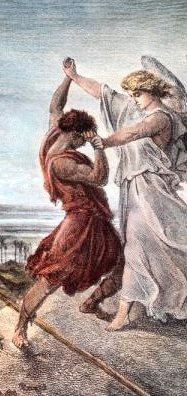
Jacob Wrestling with an Angel, by James J.J. Tissot, ca. 1900

And Jacob was left alone, and a man wrestled with him until the dawn rose. (Genesis 32:25)

At night this “man” apparently looks and feels like a human being, and even injures Jacob’s hip.6 But at dawn it becomes apparent that the wrestler is not human.

Then he [the “man”]said: “Let me go, because the dawn is rising.” And he [Jacob] said: “I will not let you go unless you bless me.” (Genesis 32:27)

Desperate to protect himself and his family from Esau, Jacob has already sent his brother lavish gifts, and reminded God of their deal twenty years before.7 Now he tries to extract a blessing from the mysterious wrestler. What he gets is a second name.

And he [the “man”] said: “It will no longer be said [that] Ya-akov is your name, but instead Yisrael, because sarita with gods and with men and you have hung on.” (Genesis 32:29)

Yisrael (יִשְׂרָאֵל) = “Israel” in English. (Possibly yisar, יִשַׂר = he strives with, contends with (a form of the verb sarah, שׂרָה = strive; contend) + Eil, אֵל = God, a god; therefore: he strives with God. On the other hand, a subject usually follows a verb in Biblical Hebrew, so Yisrael could mean “God strives” or “God contends”.)

sarita (שָׂרִיתָ) = you have striven with, contended with. (Another form of the verb sarah.)

The wrestler knows that Jacob has already striven with humans; he was born hanging onto his brother’s heel, and he maneuvered against Esau in Canaan, and Lavan in Charan. Now he has striven with a being that might be God, or at least one of God’s messengers.

And Jacob inquired and said: “Please tell me your name.” But he [the “man”] said: “Why do you ask for my name?!” And he blessed him there. (Genesis 32:30)

Perhaps the mysterious wrestler says “Why do you ask for my name?” because God’s angelic messengers have no names.8

Blessings are usually spelled out verbally in the book of Genesis,9 like prophecies and promises. But the statement that someone blessed someone else may follow or precede the actual blessing; the text does not bother about the exact chronological order. In this case, the unnamed messenger’s blessing is: “It will no longer be said [that] Ya-akov is your name, but instead Yisrael”.

So Jacob called the name of the place Peniyeil, “Because I have seen God panim to panim yet my life was saved.” (Genesis 32:31)

Peniyeil (פְּנִיאֵל) = Face of God (penei,פְּמֵי= face of + Eil).

panim (פָּנִים) = face, faces.

Jacob is now convinced that he wrestled until dawn with a manifestation of God.

But it also makes sense to say that Jacob wrestled with himself, as one aspect (or face, or camp10) of his psyche strove against another. Among the many commentators who have reached this conclusion are Shmuel Klitsner, who wrote that Jacob’s conscious mind wrestles with his unconscious;11 Jonathan Sacks, who wrote that the person he wants to be wrestles with the person he really is;12 and David Kasher, who wrote that his instinct to use guile in order to achieve control wrestles with his underdeveloped faith in God.13

Perhaps the question “Why do you ask for my name?” arises because one side of Jacob already knows he is wrestling with himself.

Ya-akov and Yisrael meet face to face at dawn. Neither side wins the wrestling match. The stalemate at dawn could be a triumphant integration. But it does not last. After Jacob/Israel settles at Shekhem in the land of Canaan, his sons begin taking control over the family away from him.

For the rest of his life, he alternates between complaining about being cheated by his sons, and calmly doing what he must while leaving outcome to God.


It is hard to walk your own path in life instead of trying to get what someone else has. And it is hard to find peace and clarity when you have a pair of camps facing one another inside you.

I spent the first sixty years of my own life wrestling with myself. On one side, I want to do all the right things for other people; on the other side, I want to succeed at my calling. Age has refined my ethics and softened my desire for public success. I am still a pair of camps confronting one another. But now when I face my other self, I smile in recognition.


  1. Genesis 25:29-34. See my 2011 post Bereishit & Toledot: Seeing Red.
  2. Genesis 27:1-30. See my 2012 post Toledot: Rebecca Gets It Wrong.
  3. Genesis 29:15-30. See my post Toledot: Unrequited Love.
  4. Genesis 30:25-43.
  5. Genesis 32:4-24. See last week’s post, Vayeitzei & Vayishlach: Pair of Camps, and my 2021 post, Vayishlach: Message Failure.
  6. Genesis 32:26 implies that the wrestler dislocates Jacob’s hip, but Genesis 32:33 implies an attack of sciatica.
  7. Genesis 32:10-13, in reference to Genesis 28:10-22.
  8. According to Judges 13:16-18 and Genesis Rabbah 78:4.
  9. See Genesis 9:1-7, 12:2-3, 14:19-20, 16:10-12, 22:15-18, 24:60, 26:2-4, 27:28-29, 27:39-40, 28:1-4, 35:9-12, 48:10-16, 48:20, and 49:1-28. Exceptions are Genesis 32:1 and 47:7.
  10. See last week’s post, Vayeitzei & Vayishlach: Pair of Camps.
  11. Shmuel Klitsner, Wrestling Jacob: Deception, Identity, and Freudian Slips in Genesis, Urim Publications, Jerusalem, 2006, pp. 126-127.
  12. Jonathan Sacks, Covenant & Conversation, “Be Thyself: Vayishlach 5781”.
  13. David Kasher, ParshaNut, “The Man in the Midrash”, Parshat Vayishlach.

Vayeitzei & Vayishlach: Pair of Camps

A man’s firstborn son gets extra rights, according to the Torah. After his father dies, the firstborn inherits twice as much wealth as any of his brothers, becomes the head of his extended family, and (until the Israelites receive other instructions in the book of Numbers/Bemidbar) serves as the family’s priest1.

Jacob covets the rights of the firstborn so much that he tries to steal them from Esau twice: first by trading a bowl of lentil pottage for the rights,2 later by impersonating Esau to get their blind father’s blessing.3

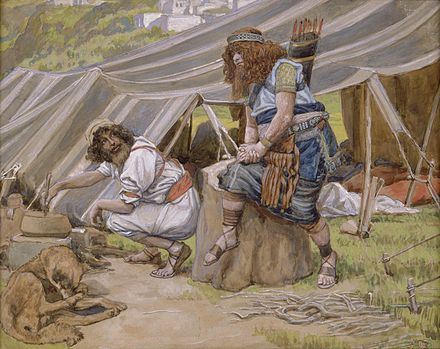
The Mess of Pottage, by James Tissot, ca. 1900 (Esau is suitably hirsute, but why does Jacob have a full beard?)

The first time, Esau is so famished he hardly notices he has lost anything. But the second time, Esau is beside himself with rage, and Jacob flees to his uncle Lavan’s house in Charan, bringing nothing but what he can carry on foot.

Divine Camp

One night along the way, at the beginning of the Torah portion Vayeitzei (Genesis 28:10-32:3), he falls asleep outdoors with a stone for a pillow, and he sees God’s messengers—i.e. angels.

And he dreamed, and hey! A ramp was set on the ground, and its top was reaching to the heavens. And hey! God’s messengers went up and down on it. (Genesis/Bereishit 28:12)

Then God speaks to him in his dream and promises to guard him and return him to the land of Canaan, which his myriad descendants (not Esau’s) will eventually possess.

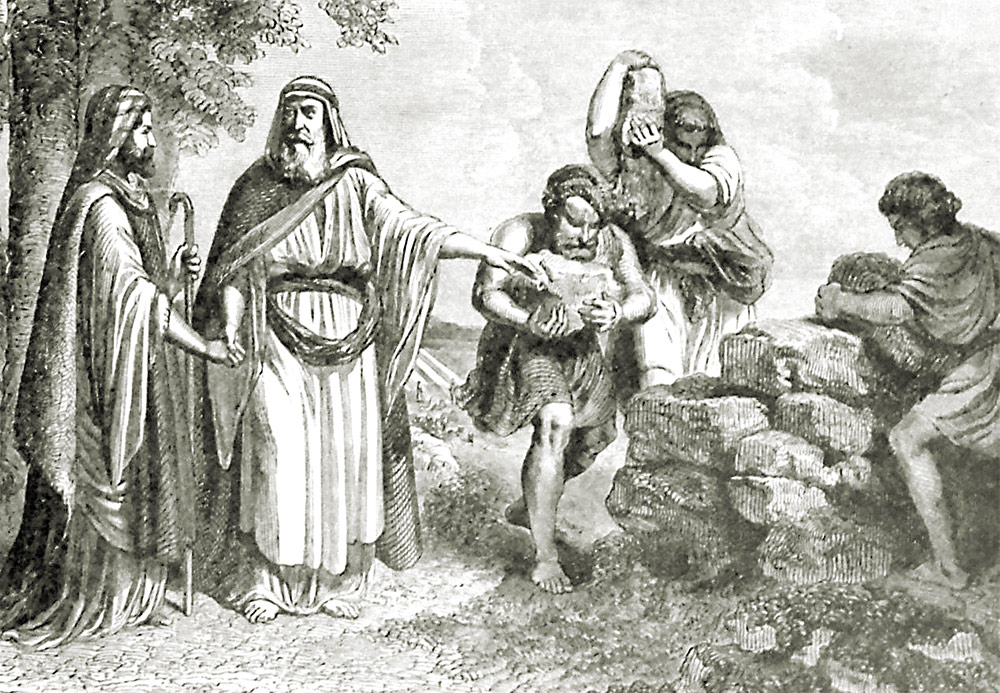
Jacob Pouring Oil on the Stone,
Cassell’s Illustrated Family Bible, ca. 1880

Is Jacob relieved and grateful when he wakes up? No. He does not trust God to keep a promise. So he sets his stone pillow upright and pours oil on it, then vows that if God really does protect him and return him safely, he will give God a tenth of whatever wealth he acquires.

Jacob acquires no wealth at all during first fourteen years in Charan, only wives and children. He works for his uncle Lavan for seven years in order to marry Lavan’s younger daughter Rachel. When Lavan switches daughters at the wedding, Jacob meekly agrees to work another seven years so he can have both Rachel and Leah. Only after he has served Lavan for fourteen years does he ask for a shepherd’s regular wages: a share of animals from the flock. During his final six years in Charan, Jacob gets rich through clever livestock breeding. When he finally leaves and sets off for Canaan, he is the owner of a great wealth of livestock, and the head and priest of a household.4 Through his own hard work and intelligence, he has attained everything a firstborn son would inherit.

One night along the way back to Canaan, at the end of the Torah portion Vayeitzei, Jacob sees God’s messengers again.

Jacob went on his way, and God’s messengers confronted him.  And Jacob said as he saw them: “This is a machaneh of God!” And he called the name of that place Machanayim. (Genesis 32:2-3)

machaneh (מַחֲנֶה) = camp, group of temporary shelters erected in a defensive circle.

machanayim (מַחֲנָיִם) = pair of camps, double camp. (Machaneh + dual suffix -ayim, ־ָיתם.)

This is the first time the word machaneh appears in the Torah. Repeating the word in the dual form is unusual; the Torah often refers to a pair of eyes, for example, but camps do not usually come in pairs. What Jacob observes is that the same place holds two camps: his earthly camp of people and animals, and God’s heavenly “camp” of angelic messengers.

Or does the heavenly camp also belong to Jacob?  He is the one who sees angels, whether they stay in the background going up and down between heaven and earth, or they confront him at a campsite. Perhaps the word machanayim also refers to a pair of camps, or roles, within the same person: Jacob as a clan leader focused on wealth and progeny, and Jacob as a priest who sees angels and carries his grandfather Abraham’s blessing and connection with God. Jacob’s two roles are not in conflict yet.  His return to Canaan liberates him from the man who took advantage of him for twenty years. At last he is an independent head of household! But his return is also a step toward fulfilling his promise to God.

Two human camps

With both sides of his life going well, Jacob feels confident enough to send his own, human messengers to his estranged brother Esau at the beginning of this week’s Torah portion, Vayishlach (Genesis 32:4-36:43).

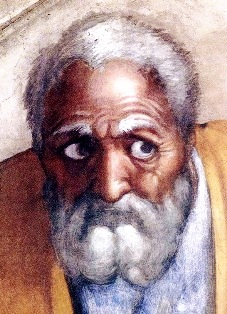
Jacob, by Michelangelo, Sistine Chapel, ca. 1510

The messengers return with the news that Esau is coming to meet him, accompanied by 400 men—the right size for a fighting unit. Jacob’s new confidence collapses.

Jacob was very afraid, and shaped by distress; so he divided the people who were with him, and the flock and the herd and the camels, into two machanot.  And he said: “If Esau comes to the first machaneh and strikes it down, the remaining machaneh might survive.” (Genesis 32:8-9)

machanot (מַחֲנוֹת) = camps.  (The plural of machaneh, rather than the dual form.)

Why does he call his two camps simply “camps” (machanot), rather than “a pair of camps” (machanayim)? The two camps at the place he named Machanayim had two different owners: himself and God (or perhaps his materialistic side and his spiritual side). They faced one another like nonidentical twins, like impulsive Esau versus scheming Jacob.

But the two camps at the Yabok River are both Jacob’s property. One group consists of the animals he designates as gifts to Esau, along with the servants in charge of each drove. He sends them ahead to meet Esau and his 400 men on the road.5

The other group consists of the animals, servants, and other belongings he plans to keep for himself, along his own family: his two wives, two concubines, eleven sons, and one daughter. He leads this “camp” across the Yabok River, then returns to the other side to spend the rest of the night alone.6

But before sending his two camps in different directions, Jacob prays, begging God to rescue him and his family from Esau. He introduces his prayer by saying:

“I am too insignificant for all the loyal-kindnesses and all the fidelity that you have done for your servant; for I crossed this Jordan with [only] my staff, and now I have become two machanot.” (Genesis 32:11)

He uses the word machanot again because he is thinking about his two camps of people and animals. But at the beginning of the sentence, he uses the word for “insignificant”7 for two different purposes. On one level, Jacob is thanking God for his fertility and prosperity, enough for two camps of actual people and animals. Saying that he himself is insignificant gives more credit to God for his material success. On another level, Jacob still feels insignificant, not only because he was born second, but also because he knows he is guilty of tricking Esau twice, and his brother’s enmity is justified. Thus Jacob’s language is two-sided, coming from two internal camps.

And Jacob was left alone, and a man wrestled with him until the dawn rose. (Genesis 32:25)

If Jacob is alone, are Jacob and the “man” two psychological camps inside one person? If so, does the wrestling match make Jacob whole? See next week’s post: Toledot & Vayishlach: Face to Face.


We are all like Jacob in some way. I was the older child in my family, and one of my parents’ favorite stories was about when they brought home two treats and let my younger sister choose hers first. She said, “I want Melissa’s!”

Many years later, after my sister published a novel, I wanted the same success. Neither of us would have changed places with the other; we only wanted the same advantages—like Jacob, who wanted all the advantages of the firstborn without being rash and slow on the uptake like Esau.

It is hard to walk your own path in life instead of trying to get what someone else has. And if you try, you might find yourself face to face with a person you did not know was there.


  1. The Levites replace the firstborn sons of all other tribes in Numbers 3:5-13 and 3:44, when religious worship is professionalized.
  2. Genesis 25:29-34.
  3. Genesis 27:1-38.
  4. Jacob’s wealth and household are described in Genesis 31:17-18, 32:6, and 32:23. He acts as a priest by setting up an altar at Shekhem in Genesis 33:20 and at Beit-Eil in Genesis 35:7.
  5. Genesis 32:14-22.
  6. Genesis 32:23-25.
  7. The Hebrew word is katonti, קָטֺנתִּי = I am small, young, trifling, insignificant.

Vayeitzei: Unrequited Love

Falling in love can lead to years of unhappiness.

Sometimes an infatuation is gradually replaced by a mature love, one with sincere affection and respect. But sometimes infatuated lovers remain desperate to own the objects of their affection.

When Jacob arrives at his uncle’s house in this week’s Torah portion, Vayeitzei (“and he went”), he falls in love at first sight with his cousin Rachel. Rachel’s sister, Leah, falls in love with him. And both Jacob and Leah suffer for years.

Jacob

Jacob travels from his home in Beir-sheva to his uncle’s house in Charan on the orders of both of his parents. His mother, Rebecca, tells him to flee and stay in Charan until his brother, Esau, no longer wants to kill him. His father, Isaac, tells him to go and marry one of his cousins.1

He leaves without anything to give his uncle Lavan for a bride-price. Isaac would not have sent him off to find a wife without providing him with gold, silver, and pack animals. But Jacob, motivated by fear and guilt, rushes off on foot with nothing but his staff.2 (See my post Vayeitzei: Father Figures.)

Outside the city of Charan, Jacob meets some shepherds beside a well with a giant stone covering its mouth. When he asks why they do not water their flocks and move on, they reply that they are not able to move the stone by themselves, so they always wait until the other shepherds arrive. While they are talking, a girl approaches with a flock, and the men tell Jacob she is Rachel, one of Lavan’s daughters.

And it happened when Jacob saw Rachel, his uncle Lavan’s daughter, and his uncle Lavan’s flock: Jacob stepped forward and rolled the stone off the top of the mouth of the well, and he watered his uncle Lavan’s flock. (Genesis/Bereishit 29:10)

Jacob is so electrified by a close look at Rachel that he rolls off the stone by himself in a surge of superhuman energy.

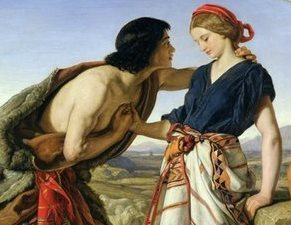
The Meeting of Jacob and Rebecca, by William Dyce, 1853, detail

Then Jacob kissed Rachel, and he lifted his voice and wept. And Jacob told Rachel that was her father’s kinsman and Rebecca’s son. And she ran and told her father. (Genesis 29:11-12)

Lavan welcomes his nephew as a member of the family, and Jacob works for him like a son rather than a prospective son-in-law; after all, he has brought no bride-price. At the end of a month, Lavan asks Jacob:

“Is it because you are my kinsman that you serve me for nothing? Tell me what your wages shall be.” (Genesis 29:15)

Lavan sounds generous, but later he cheats his nephew twice in order to make him stay longer.3 I believe Lavan offers to pay Jacob wages only in order to make sure he does not find a job elsewhere. Jacob is unusually skilled at animal husbandry, and Lavan wants his flocks to continue increasing.4

And Lavan had two daughters; the name of the elder was Leah, and the name of the younger was Rachel. And Leah’s eyes were soft, but Rachel—she had a beautiful shape and a beautiful appearance. Vaye-ehav, Jacob: Rachel. So he said: “I will serve you seven years for Rachel, your younger daughter.” (Genesis 29:16-18)

vaye-ehav (וַיֶּאֳהַב) = and he loved, liked, was fond of, was charmed by. (A form of the verb ahav, אָהַב = loved.)

And Jacob served for Rachel seven years, and they were like a few days in his eyes, be-ahavato for her. (Genesis 29:20)

be-ahavato (בְּאַהֲבָתוֹ) = because of his love. (Another form of the verb ahav.)

Seven years is a long engagement, especially when the two people are living in the same house but are not allowed to share a bed. According to one line of commentary, Jacob had to wait seven years for Rachel to reach puberty.5 However, if Rachel were about eight years old, she would probably not be in charge of a whole flock. Furthermore, there are no indications in the book of Genesis that Jacob is a pedophile attracted to small children.

In see my post Vayeitzei: Father Figures I speculated that Jacob volunteers for such a long period of service because he feels guilty and unworthy. His choice of seven years of labor might also indicate that he sets an exaggerated value on the object of his infatuation.6

Then Jacob said to Lavan: “Bring my wife, because the time is completed, and I will come in to her.” And Lavan gathered all the people of the place, and he made a drinking-feast. And when it was evening, then he took his daughter Leah and brought her to him, and he came in to her. (Genesis 29:21-23)

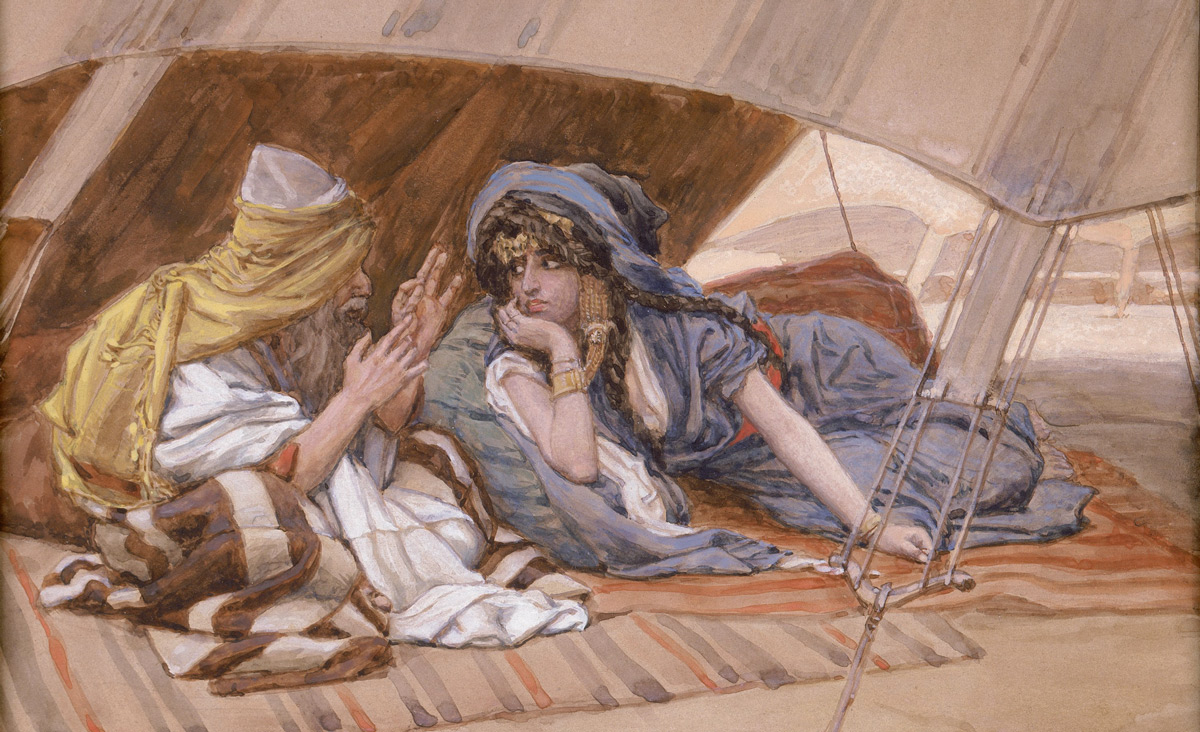
Jacob was drunk; it was dark; Leah was wearing a veil.7

In the morning, Jacob protests that Lavan deceived him and gave him the wrong daughter. His uncle, and now his father-in-law, proposes:

“Complete this week [with Leah], and I will give you that one also for the service—if you serve with me another seven years.” (Genesis 29:27)

Jacob agrees, partly because he is guilty about deceiving his own father by pretending to be his brother Esau, and partly because he is still in love with Rachel.

And he came in to Rachel also, vaye-ehav Rachel even more than Leah. (Genesis 29:30)

He likes Leah, but he cannot be satisfied unless he also gets the woman he fell in love with. Therefore he spends fourteen years working for someone else without acquiring any wealth of his own.

Leah

Lavan masterminds Leah’s masquerade as Rachel on what was supposed to be the wedding night of Rachel and Jacob. But Leah does it, and Rachel either cooperates or is restrained from appearing at the critical moment.  It is possible that neither of them dares to disobey their father.  But Leah has another motive for her imposture: she is in love with Jacob.

We know this because when she names her first three sons, she explains each name in terms of her longing for Jacob to love her in return.

And Leah conceived and she bore a son, and she called his name Reuvein because “I said that God ra-ah my suffering, since now my husband will love me.” (Genesis 29:32)

ra-ah (רָאָה) = he saw.

Reuvein (רְאוּבֵן) = “Reuben” in English. Ra-u, רָאוּ = they saw (a form of the verb ra-ah) + bein, בֵּן = son.

Leah names her second son Shime-on,שִׁמְעוֹן (“Simeon” in English), claiming that God “heard” (shama,שָׁמַע) that she was hated. She names her third son Leivi, לֵוִי (“Levi” or “Levite” in English). Although the name Leivi is probably a loan-word for a religious functionary from the Minaeans in the southern Arabian peninsula, Leah assigns it a folk etymology as she hopes her husband “will become attached” (yilaveh, יִלָּוֶה) to her.

When her fourth son is born, Leah says “This time I will thank God,” and names him Yehudah, יְהוּדָה (“Judah” in English), referring to the verb yodeh, יוֹדֶה = “willthank, will praise”. Then she has to wait for another pregnancy, because Rachel decides to make Jacob stay away from Leah’s bed. We can deduce this from a scene in which Reuben brings his mother some mandrakes8 he found, and Rachel asks for them.

“But she [Leah] said to her: “Was it a trifle you took away my husband? And now to take also my son’s mandrakes!” And Rachel said: “All right, he can lie with you tonight in return for your son’s mandrakes.” When Jacob came in from the field in the evening, then Leah went out to meet him, and she said to him: “To me you will come, because I paid your hire with my son’s mandrakes.” And he lay with her that night. (Genesis 30:15-16)

Leah wants her husband to fall in love with her, but she settles for sex. She has three more children, and retains her position as one of Jacob’s wives.

Rachel

The book of Genesis never says that Rachel loves Jacob, only that she blames him for her childlessness,9 and is so jealous of her sister’s fertility that she orders him to stay away from Leah’s bed. The besotted man obeys her. At her command, he also lies with her female slave, Bilhah, so that Rachel can adopt Bilhah’s children. Leah then uses her own female slave, Zilpah, for the same purpose. The competition between the two sisters continues until Rachel bears a child of her own, her son Joseph.


The three of them make peace only after Jacob has worked for Lavan for another six years—this time in order to build up his own flocks. Then, after twenty years of unhappy marriage, he takes both his wives out into a field and tells them that God wants him to leave Lavan and return to Canaan.

And Rachel and Leah answered, and they said to him: “Do we still have a portion of inheritance from our father’s house? … Now do everything that God said to you!” (Genesis 31:14, 16)

The two sisters stop competing. They choose to spend the rest of their lives with each other and their now-rich husband, rather than with their friends and relatives in Charan. The book of Genesis reports no further conflict among Jacob, Leah, and Rachel. At last, twenty years after the three of them met, they achieve a peaceful partnership.

May everyone who falls in love find contentment sooner than Jacob and his wives.


  1. Genesis 27:41-28:2. In the previous Torah portion, Toledot, Jacob cheated Esau out of his inheritance as the firstborn and then out of their father’s blessing.
  2. Genesis 32:11.
  3. Lavan cheats Jacob by replacing his bride in Genesis 29:23-27, and by removing his spotted goats and dark sheep from the flock in Genesis 30:30:27-36.
  4. Lavan recognizes Jacob’s skill in Genesis 30:27.
  5. E.g. Rabbi Jacob ben Asher, Tur HaArokh, circa 1300 C.E., translated by Rabbi Eliyahu Munk in www.sefaria.org.
  6. “Perhaps he wanted to demonstrate that he considered Rachel worth more than the maximum servitude that a Hebrew servant serves with his master (Exodus 21,2).” (18th-century Rabbi Chaim ibn Attar, Or Hachayim, translation in www.sefaria.org.)
  7. In Genesis 24:65, Rebecca puts on a veil before her wedding night with Isaac.
  8. The Hebrew word translated as “mandrakes” is dudaim (דוּדָאִים). Mandrake roots are hallucinogenic and narcotic, and are often forked like human legs. The first Greek translation of the Hebrew Bible, the Septuagint, translated dudaim as mandragoras.
  9. Genesis 30:1.

Vayishlach: Message Failure

If you have wronged someone, and many years later you want to make amends, how can you arrange a meeting in a way that will reduce your former victim’s hostility? How can you word your message so they will show up calm enough to listen to you?

This question of moral psychology comes up in this week’s Torah portion, Vayishlach (“And he sent”), when Jacob sends a message to his estranged brother Esau. I wrote about it in the first draft of my book on moral psychology in Genesis. Now I am laboring mightily over a complete rewrite of the book, but I still like this essay.

Cheating

Esau Sells his Birthright, by Rembrandt

When Jacob leaves Beir-sheva in Canaan and heads for Charan, he is already guilty of cheating Esau twice. First he trades a bowl of lentil stew to his famished brother in exchange for Esau’s rights as the firstborn.1 Then he impersonates Esau in order to steal a prophetic blessing from their blind father, Isaac.2

Jacob cheats because he feels cheated. Why should his twin brother get twice as much inheritance, just because he emerged from the womb a few seconds earlier? Why should their father give Esau the blessing and leave him unblessed? It is not fair.

Yet the story of Jacob indicates that he also has a guilty conscience; he knows his own actions were not fair, either. So he obeys his parents without a murmur when his mother tells him to flee from Esau’s anger, and his father tells him to go get a bride from his uncle Lavan’s family in Charan. And he slinks away on foot without taking any valuables to offer as a bride-price. Jacob’s family is rich, but he chooses to leave home as a pauper.3

In the Torah portion Vayeitzei, Jacob works for Lavan for twenty years, then leaves the town of Charan with two wives (Lavan’s daughters), two concubines (his wives’ personal servants that they gave to him), twelve children, and a wealth of moveable property. Lavan chases after him and complains that Jacob stole everything from him.

This time Jacob denies any wrongdoing, pointing out that he served Lavan fourteen years for his two daughters, Leah and Rachel, and six years for his share of the flocks. This is a reminder to Lavan that he had only offered to work seven years for Rachel, but Lavan “changed his wages” by tricking him into marrying Leah, and then working an extra seven years to get Rachel, too.4 Compared to that, deceiving Lavan with a secret breeding program in order to get larger flocks from his last six years of labor hardly balances the scales.5

Jacob walks away from Lavan free of guilt. But he still has not cleared his guilt over cheating Esau.

Confronting the past

Jacob’s unethical behavior did no long-term harm to Esau, who now has everything Jacob thought he was stealing. The firstborn rights have not come into play, since their father is still alive, but it no longer matters who gets the most inheritance. The first part of the blessing Jacob thought he had stolen from Esau is now true for both of them:

“And may God grant you

From the dew of the heavens and from the fat of the earth

And an abundance of grain and wine.

May peoples serve you

And may tribes bow down to you.” (Genesis/Bereishit 27:28-29)

Both men now have abundant possessions and plenty of food, and each brother is the head of his own tribe (though Esau’s is larger).

Jacob is heading for Canaan, where their parents live, not Se-ir, where Esau rules. For once he does not want what his brother has. His route to Canaan goes west along the Yabok River, then crosses the Jordan north of the Dead Sea. The hills of Se-ir are south of the Dead Sea, more than 150 miles (240 km) away from Jacob’s camp on the Yabok. If he merely continued his journey, he would be settled in Canaan long before any news of his whereabouts reached Esau.

Instead Jacob deliberately lets Esau know where he is camping.

Then Jacob sent messengers ahead to Esau, his brother, to the land of Sei-ir, the field of Edom. (Genesis 32:4)

However nervous Jacob might be about a confrontation, he wants to meet with his brother as soon as possible, and get it over with. I suggest that all he wants is to make reparations for his past misdeeds, whether Esau needs them or not. Then he can forgive himself, and maybe Esau will forgive him.

He does not know whether Esau still wants to kill him. When the twins were younger, Esau was impulsive and changeable. But twenty years have passed, and Esau must have learned how to plan ahead, or he would not have become the chieftain of a tribe. He might also have been planning his revenge during those twenty years.

So Jacob takes a chance when he sends messengers all the way to his brother in Se-ir. His action is both ethical and brave.

Message to a brother

Jacob words his message carefully.

And he commanded them, saying: “Thus you shall say to my lord, to Esau: Thus said your servant Jacob: Garti with Lavan, and I delayed until now. And I came to own ox and donkey, flock and male-slave and female-slave. And I send to tell my lord, to find favor in your eyes.” (Genesis 32:5-6)

garti (גַּרְתִּי) = I sojourned, I stayed as a foreigner. (A kal form of the verb g-r, גּור = stayed as a geir, גֵּר= a foreigner.)

Jacob instructs his messengers to say the message is from “your servant, Jacob”, and to quote him as saying “to tell my lord, to find favor in your eyes”. He wants Esau to know that he considers Esau his senior and superior, as if the sale of the firstborn rights had never happened.

Why does Jacob say he was a geir in Charan, even though he is Lavan’s nephew and son-in-law? Rashi wrote that Jacob’s subtext is: “I have become neither a prince nor other person of importance but merely a sojourner. It is not worth your while to hate me on account of the blessing of your father who blessed me (27:29) ‘Be master over thy brethren’, for it has not been fulfilled in me.”6

Jacob probably mentions his livestock and servants because he wants Esau to know that he is already wealthy, so he no longer needs the inheritance of the firstborn. He also says that he delayed (by twenty years!) his return to Canaan. This implies that he earned his wealth through years of labor, not because of Isaac’s blessing.

Having sent a message intended to show Esau that he is not benefiting from either the firstborn rights or the stolen blessing, Jacob waits for news of Esau’s reaction.

Jacob Sees Esau Coming to Meet Him (with an army),
by James Tissot, ca. 1900

And the messengers returned to Jacob saying: “We came to your brother, to Esau, and moreover he is on his way to meet you, and 400 men are with him.” And Jacob became very frightened … (Genesis 32:7-8)

Four hundred men count as an independent army in the Torah.7 If Esau is still angry at Jacob, then he can use his army kill his brother and take over his people. If Esau, too, is frightened and anxious, then his army would be good to have on hand in case their meeting goes badly.

Hearing the message

Esau might view Jacob’s message as a challenge dressed up in polite language. Here is one way Esau might misinterpret his brother’s words:

Thus said your servant Jacob— “Ah, he’s using the standard polite formula, instead of treating me like a brother.”

Garti with Lavan— “He’s been staying all this time with our mother’s brother? I don’t call that living as a foreigner! I suppose Lavan adores him, just like Mother always did. And Lavan probably taught him some new tricks.”

And I delayed until now— “Of course he delayed. Why would he want to see me again? Or our poor father? He already got everything he could out of us.”

And I have ox and donkey, flock and male-slave and female-slave— “Oh, so he’s rich now, and bragging about it. But he’s still coming back to collect his inheritance when Father dies. I wonder how many men he has, and if they are armed for battle?

And I am sending to tell my lord, to find favor in your eyes— “More polite language, pretending I’m his lord! We both know he got the upper hand over me long ago. Does he wants my favor now so he can safely ignore me? Or is he trying to pacify me before he springs on me? Well, I have four hundred men at my command now. If we start marching north today, we can surprise Jacob. And then maybe, just maybe, I’ll have a chance to hold my own against him.”

This is only my midrash; Esau’s reactions to Jacob’s careful message are not recorded in the Torah. But Esau does march north immediately with 400 men.


If Jacob had anticipated Esau’s response, he would have sent a different kind of message. What if Jacob called Esau not “my lord”, but “my older brother”? What if he said he wanted to see his brother again so he could apologize? Esau might not have mustered his 400 armed men.

But Jacob is so cautious, he does not say enough. Although he is trying to make amends for his past misdeeds, he is unable to approach the problem head-on. By trying to avoid a confrontation with Esau, Jacob makes confrontation more likely.


  1. Genesis 25:29-34.
  2. Genesis 27:1-36.
  3. See my 2011 post Vayeitzei: Guilty Conscience.
  4. Genesis 31:38-43. Lavan tricked Jacob into marrying Leah and paying an additional bride-price in labor (Genesis 29:23-27).
  5. Jacob tricked Lavan by asking for the spotted kids and dark lambs as his wages, so he could conduct his secret breeding program (Genesis 30:31-43).
  6. Rashi, translation in sefaria.org.
  7. David has 400 men in 1 Samuel 22:2 and 25:13.

Book of Genesis: Inbreeding

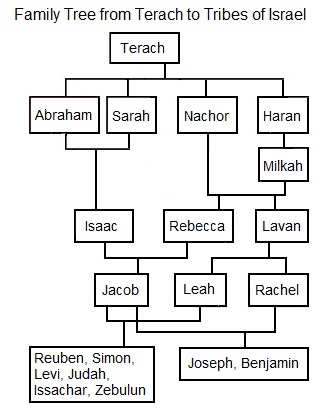
Why is there so much inbreeding in the book of Genesis/Bereishit? After the first two Torah portions, most of the major characters are descended from Abraham’s father, Terach, through multiple lines. The branches of their family tree keep growing together again.

Noach

The Torah does not say how many wives Terach has, but it does name four of his children at the end of the Torah portion Noach. He has three sons: Avram (whom God renames Abraham), Nachor, and Haran.1 He also has a daughter named Sarai (whom God renames Sarah).2 While they are all living in the southern Mesopotamian city of Ur, Avram and Nachor marry their own relatives.

Avram and Nachor took wives for themselves. The name of Avram’s wife was Sarai, and the name of Nachor’s wife was Milkah, the daughter of Haran … (Genesis 11:29)

In other words, Avram marries his half-sister, Terach’s daughter, and Nachor marries his niece, Terach’s granddaughter.

Terach leaves Ur and heads toward Canaan with some of his family members. Halfway there they stop and settle in the town of Charan, where Terach dies.3

Thanks to archeology, we know that Charan was an actual city where the main road north from Ur met the main road that went southwest to Canaan. Both Charan and Ur were dedicated to the moon-god Nannar. The residents of those two cities worshiped many other gods as well, in temples stocked with idols. They also kept terafim, figurines of lesser gods, to protect their households.

Terach would probably acknowledge Nannar, but his primary god might be a different deity. In last week’s Torah portion, Chayei Sarah, both Betueil (son of Nachor and Milkah) and Betueil’s son Lavan use the same four-letter name of God that Avram uses (commonly represented in Roman letters as Y-H-W-H).4 Later in Genesis, Lavan says “Y-H-W-H” has blessed him, and he makes a vow in the name of “the god of Nachor”.5 But he is not a monotheist; he also owns terafim.6

Lekh-Lekha and Vayeira

Does Terach hear the voice of God, Y-H-W-H? The Torah is silent.7 But it is conceivable that he starts traveling toward Canaan because he hears the same voice in Ur that his son Avram hears  in Charan:

“Go for yourself, away from your land and from your relatives and from your father’s house, to the land that I will show you.” (Genesis 12:1)

For Avram, that land turns out to be Canaan.

Avram hears God’s voice many more times in the portions Lekh-Lekha and Vayeira. On five occasions God promises him that his descendants will inherit the land of Canaan.8 God informs him that first those descendants will be enslaved in another land for 400 years.9 God demands circumcision for every male in his household and all of his future descendants, alters the names of Avram and Sarai, and promises that Sarai (now Sarah) will have a son at age 90.10 Avram (now Abraham) talks God into agreeing not to wipe out Sodom and Gomorrah if there are even ten innocent people living there.11 When Sarah demands that Abraham cast out his first son, Ishmael, along with Ishmael’s mother, God tells him to do what Sarah says.12

Sarah Hears and Laughs, by James J.J. Tissot

Terach’s daughter Sarah also hears God’s voice. When three men who turn out to be angels visit in the Torah portion Vayeira, she overhears one of them say that she will have a child the following year. Sarah, who is 89, laughs silently. Then she hears God asking Abraham: “Why did Sarah laugh?”

And Sarah lied, saying: “I did not laugh,” because she was afraid. But [God] said: “No, for you did laugh.” (Genesis 18:15)

Abraham and Sarah do have a son. Isaac is probably 26 when his father hears God order him to sacrifice that son on an altar.  God calls him off at the last minute, and Abraham goes home alone.13 Then he gets news from Charan: Nachor and Milkah (Abraham’s brother and niece) had a son named Betueil, and Betueil now has a daughter named Rebecca.14

Chayei Sarah

Abraham arranges a marriage for Isaac fourteen years later, in the Torah portion Chayei Sarah. He insists that Isaac must marry one of his relatives back in the Aramaean town of Charan. He adds the condition that the bride must be willing to move to Canaan, because he wants Isaac to stay in Canaan.

Why does he reject the idea of simply getting Isaac a Canaanite wife?

In last week’s post I proposed that Abraham worries Isaac might stray in his religion, after the trauma of being bound as a sacrifice to his father’s god. (See Chayei Sarah: Arranged Marriage.) Since his extended family in Charan worships Y-H-W-H (among others)15, a wife from that branch of the family would not tempt Isaac away from serving the God of Abraham.

But there is another possible reason for marrying Isaac to one of his relatives. Perhaps Abraham believes his covenant with God can be best continued through the generations if as many of his descendants as possible can hear God’s voice. For that, more inbreeding might help.

Rebecca may be exactly the young woman Abraham has in mind as a bride for Isaac. After all, she is descended from Terach through both Nachor and Milkah. She agrees to go to Canaan, and marries Isaac.

Toledot

In Toledot, this week’s Torah portion, Rebecca is alarmed by her pregnancy; it feels as though a wrestling match is taking place in her womb.

And she went to inquire of God. And God said to her: “Two nations are in your womb, and two peoples will branch off from your belly. One people will be mightier than the other, and the older will serve the younger.” (Genesis 25:22-23)

The text does not say where Rebecca goes to inquire of God; some commentary suggests that she consults an oracle.  But the text does say that God speaks directly to her, and it uses the name Y-H-V-H. The voice of God is correct; Rebecca has twins, Esau and Jacob, who eventually found two peoples in the Torah: the Edomites and the Israelites.

Rebecca’s husband Isaac, who is descended from Terach through both Abraham and Sarah, also hears God’s voice.

And God appeared to him that night and said: “I am the god of Abraham, your father. Don’t be afraid, because I am with you, and I will bless you and increase your descendants for the sake of my servant Abraham.” (Genesis 26:24)

Jacob proves more intelligent and more patient than his twin brother Esau.17 The Torah does not say whether his parents realize that Jacob is the better candidate to carry on the covenant with God. Isaac fumbles his delivery of the blessing of Abraham, Esau is enraged at the result, and Rebecca tells Jacob to flee to her brother Lavan’s house in Charan. Then she tells Isaac that she is disgusted with the Hittite women Esau married, and she could not bear it if Jacob also married one of the local women.

Isaac calls in Jacob. Rebecca has not told him where to send Jacob for a bride, but Isaac decides to continue Abraham’s family breeding program.

And he said to him: “Do not take a wife from the daughters of Canaan! Rise, go to Padan Aram, to the house of Betueil, your mother’s father, and take yourself a wife from there, from the daughters of Lavan, your mother’s brother.” (Genesis 28:1-2)

Thus he orders Jacob to marry one of his first cousins, who also carries more than the usual share of Terach’s blood (or genes).

Vayeitzei

Jacob’s ladder, German 14th century

As soon as Jacob leaves home he, too, hears the voice of God. In next week’s Torah portion, Vayeitzei, he dreams of God’s angelic messengers ascending and descending between heaven and earth, and then sees God standing over him. God confirms that the blessing of descendants who will inherit Canaan has gone from Abraham to Isaac to Jacob.

And [God] said: “I am God [Y-H-V-H], the God of your father Abraham and the God of Isaac. The land which you are lying on I will give to you and to your descendants.” (Genesis 28:13).

Jacob marries both of Lavan’s daughters, and their eight sons (plus Jacob’s four sons with Lavan’s daughters’ servants) become the ancestors of the twelve tribes of Israel.

Being able to hear God is not a unique trait of Terach’s descendants. Before the Flood, God converses with Adam and Eve, Cain, and Noah. After the flood, God speaks twice to Hagar the Egyptian and once to Avimelekh of Gerar.18 But most of God’s words in the Genesis are addressed to Abraham, Sarah, Isaac, Rebecca, and Jacob, all inbred descendants of Terach.19

There is no record in the Torah of God speaking to any of Jacob’s children. Perhaps a few of them would be able to hear God’s voice, but God chooses to be “with” them without words. It may be enough for God that all the inbreeding among Terach’s descendants results in the genesis of the Israelite people. The next time God speaks in the Torah is in the book of Exodus when God needs a prophet to bring the Israelites from Egypt to Canaan, and chooses Moses.20


In the Torah, God is one of the characters, and converses with some of the human characters. Is this only a literary device to make the stories juicier? Or does it also reflect some deeper truth?

When individuals today claim to have heard God’s voice, how can we tell whether they have heard an external power of the universe, or a hidden part of their own minds?

Is there a difference?


  1. Genesis 11:26-27.
  2. Genesis 20:12 (unless Abraham is lying).
  3. Genesis 11:31.
  4. Genesis 24:50-51.
  5. Genesis 30:27 and 31:51-53.
  6. Genesis 31:19.
  7. In a 5th century C.E. story attributed to Rabbi Chiya, Terach made idols for a living, and Abraham mocks them (Bereishit Rabbah, 38:13). This fable enhanced Abraham’s reputation with a Jewish audience, but the Hebrew Bible itself never mentions idols in connection with Terach.
  8. Genesis 12:7, 13:14-17, 15:1-7, 15:17-21, 17:1-8.
  9. Genesis 15:13-16.
  10. Genesis 17:9-22.
  11. Genesis 18:20-33.
  12. Genesis 21:9-13.
  13. Genesis 22:1-2, 22:11-19.
  14. Genesis 22:20-23.
  15. Joshua 24:2.
  16. Genesis 25:27-28.
  17. See Genesis 25:29-34, in which Esau can only think about eating, but Jacob cooks stew ahead of time and is prepared to bargain for Esau’s birthright.
  18. Hagar hears God in Genesis 16:7-13 and 21:17-18. Avimelekh hears God in a dream in Genesis 20:3-7.
  19. Lavan, Rebecca’s brother, also hears God in a dream (Genesis 31:24).
  20. Exodus 3:1-4:23.


Vayeitzei: Idol Thief

I am still writing my book, Tasting the Fruit: Moral Psychology in Genesis. Today I wrote about how Rachel steals her father’s household idols as she leaves home, sneaking off toward Canaan with her husband (Jacob), her son (Joseph), and her three fellow wives and their children (Genesis 31:1-21 in the portion Vayeitzei).

Why would Rachel steal the idols?  Because they can be used for divination, and she does not want her father to know where she and her family are.

Idols (physical images of gods) are forbidden in the book of Exodus.  One of the Ten Commandments declares: “You may not make for yourself a statue or any likeness of what is in the heavens above or what is on the earth below or what is in the waters from under the earth.  You may not bow down to them or serve them.”  (Exodus 20:4-5)

15th-13th century BCE storm god from Megiddo, Israel Museum

The books of Isaiah and Psalms make fun of idols, asking why anyone would treat a piece of inert wood, stone, or metal as if it could hear and speak.  But the book of Genesis is a different story.  The patriarchs Abraham, Isaac, and Jacob do not use idols, but Jacob’s father-in-law Lavan does, and his daughter Rachel believes they can speak to him.

The idols Rachel steals are small enough to fit into a camel pack.  They may look like the figurines of gods I saw last year in the Israel Museum in Jerusalem, all smaller than my hand.

Idols were standard religious equipment in Egypt during the 19th dynasty (1292–1190 B.C.E.), where Moses was born in this week’s Torah portion, Shemot.  He would have learned about all the gods of Egypt and their representations in painting and sculpture after he was adopted by Pharaoh’s daughter.  When he left Egypt as a young man, he went to live with a priest of Midian, and learned about the gods of the Midianites–probably including the god on Mount Sinai that later became the God of Israel.

Moses first encounters that god, God with a capital “G”, when he sees the  bush on Mount Sinai that burns but is not consumed.  God speaks out of the fire, not from an idol.  Click here to read about it in my post Shemot: Holy Ground.

Today most of us do not hear strange voices in our heads, only the familiar subvocalizations of our own psyches.  Yet many people engage in magical thinking.  I can imagine staring a long time at a bronze figurine, and hearing it speak inside your head.  And if the figurine said something that you did not consciously know, but that turned out to be true, you would stare at it again when you needed insight.

Unless it was gone when you got home, because someone had stolen it.

Repost: Toledot & Vayeitzei

When I looked through my previous posts on this week’s Torah portion, Toledot, the one that grabbed my attention was Toledot & Vayeitzei & Vayishlach: Goat Versus Snake.  (Click on the title to read an updated version of my 2012 essay.)

In the story of Esau and Jacob, the contrast between the twins is described in language related to the goat and the snake.  Esau is hairy as a goat, and goatish about sex.  He becomes the chieftain of “the land of the goat”.

Does the description of Esau also allude to the most famous goat scene in the Torah, the instructions in Leviticus 16:5-30 for the Yom Kippur ritual with two goats?  One goat, chosen by lot, is sacrificed to God.  The high priest confesses the sins of the whole community on the head of the other goat, and it is sent out into the wilderness to Azazel, a  mysterious goat-demon.  The Ramban and the Zohar claimed that Azazel represented the heathenism of Esau.1

Jacob, Esau’s twin brother, is smooth and hairless like a snake.  He is also clever and a heel-grabber, like the snake in the Garden of Eden.

We have been seeing a lot of symbolic animals in paintings and sculptures during our travels in Europe.  The most common is the lion, the ubiquitous symbol of royal or religious power. There are also beasts that stand for powerful families or cities.  For example, in Florence we saw dolphins carved in relief on many buildings because dolphins stood for the Pazzi family.  Other heraldic animals I have noticed include ravens, eagles, stags, wolves, bulls, boars, bees, dragons, and griffins.

The most widespread subject matter for art in the middle ages and the Renaissance was Catholic.  So we have seen a lot of sheep, as well as the beasts associated with certain saints, such as Jerome’s lion, George’s dragon, and John’s snake-in-a-chalice.

“Original Sin” by Paolo Uccello, 1430’s.  (Photo by M.C.)

The two most popular subjects from the “Old Testament” have been the near-sacrifice of Isaac (considered a prefiguration of Jesus’ self-sacrifice) and the story of the Garden of Eden (which Catholics interpreted in terms of “original sin”, a concept important to their idea of redemption through Jesus).

The snake in the Garden of Eden appears with a human head in this weathered fresco on the wall of the Santa Maria Novella refectory in Florence, Italy:


Satyr in “Bacchus” by Michelangelo, 1496-97

As far as I know, goats did not appear in symbolic Christian art.  But Italian Renaissance artists did borrow themes from the ancient Romans and Greeks.  One of their favorites was the story of Leda seduced by Jupiter in the form of a swan.  They also revived the image of the satyr, a hybrid goat-man representing impulsive sex and drunken orgies.  Michelangelo included a satyr in one of his lesser sculptures, now in the Bargello in Florence.  The Greek satyr is a separate tradition from the story of Esau, but both feature sex, impulsive decisions, and an allusion to goats.

*

This repost covers two Torah portions—Toledot this week and Vayeitzei next week.  I am staying up late tonight in Barcelona so I can post it.  Tomorrow we get up early for a day trip to Girona, and then we are off to Granada, with its famous Moorish palace, the Alhambra.  Will we see any goats or snakes there?  I will let you know.

  1. “Ramban” is the acronym of 13th-century Rabbi Moses ben Nachman, a mystical Torah commentator from Girona, Spain. The Zohar is a kabbalistic work written by Moses de Leon in 13th-century Spain.  (See http://www.jewishencyclopedia.com/articles/2203-azazel.)