Vayeira & Toledot: Laughter, Part 2

Democritus, by Johannes Moreelse, 1630, detail

Laughter is not always happy.  In English we distinguish between the friendly act of laughing with someone and the cruel act of laughing at someone.  A “fool” might be either a professional jester, or an innocent ignoramus who makes people laugh because of the contrast between his serious doings and what his words or actions mean to “normal” people.  All of these meanings of “laugh” and “fool” are captured by Biblical Hebrew verbs based on the root tzachak, צָחֲק = laughed.

Abraham and Sarah laugh

The first person to laugh in the Torah is Abraham, when God tells him that he and his wife Sarah will finally have a baby the following year.  His laughter is incredulous.

And Abraham fell on his face vayitzchak, and he said in his heart:  Will he be born to a 100-year-old man, and will 90-year-old Sarah give birth? (Genesis 17:17)

vayitzchak (וַיִּצְחָק) = and he laughed.

The first six times a word derived from the root verb tzachak appears in the Torah, it is in the kal stem of the verb and refers simply to laughing.  (See last week’s post, Vayeira: Laughter, Part 1.)  Even the name of Abraham and Sarah’s son comes from the kal stem of tzachak.
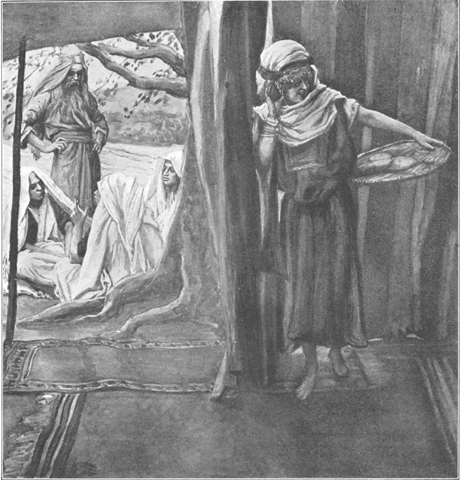
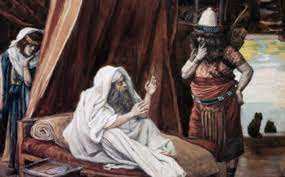
Sarah Hears and Laughs,
by James Tissot

“Truly Sarah, your wife, will be pregnant with your son, and you shall call his name Yitzchak, and I will establish my covenant with him …” (Genesis 17:19)

Yitzchak (יִצְחָק) = Isaac in English; “He laughs” in Hebrew.

When God reveals the same information to Sarah in last week’s Torah portion, Vayeira, she too laughs incredulously.

Lot the joker

Later in the portion Vayeira, Abraham’s nephew Lot tries to convince his sons-in-law that God is about to destroy the town of Sodom.

Lot went out and he spoke to his sons-in-law who had married his daughters, and he said: “Get up and go out from this place, because God is destroying the town!” But he was like a metzacheik in the eyes of his sons-in-law. (Genesis 19:14)

metzacheik (מְצַחֵק) = joking, amusing oneself, fooling around, making someone laugh; a jester, a fool.

Although metzacheik is derived from the same root verb as vayitzchak and yitzchak, it comes from the piel stem.  While the kal stem of the root means laughing, the piel stem means making or causing laughter—and can also indicate someone who makes people laugh.

Lot’s sons-in-law see Lot as a fool who seriously believes something will happen that “normal” people know is impossible.  How could the god of Lot and Abraham wipe out the whole town of Sodom?  The men cannot believe in the miracle that kills them the next morning.

Abraham, standing on the heights above, sees Sodom and Gomorrah being obliterated, and moves his household south, settling near Gerar.

Embarrassing laughter

Then Sarah became pregnant, and she bore for Abraham a son for his old age, at the appointed time that God had spoken of …  And Abraham was 100 years old when his son Yitzchak was born to him.  And Sarah said: God has made tzechok for me; everyone who hears, yitzachak about me. (Genesis 21:2, 6)

tzechok (צְחֹק) = laughter (noun, from the root tzachak).

yitzachak (יִצֲחַק) = he will joke, he will amuse himself or others (from the root tzachak in the piel stem).

Old Woman, with Child, by Jakub Schikaneder, 1855–1924, detail

For Sarah, having a baby is a good miracle.  After all, in the Torah portion Lekh-Lekha she wants a son and heir so much that she gives Abraham her slave Hagar and plans to adopt their baby, Ishmael.  That plan does not go well, but now Sarah has her own son.

However, instead of laughing with joy, Sarah is self-conscious about the laughter she expects from other people.  How ridiculous it looks for a 90-year-old woman to nurse an infant! Sarah expects to be the butt of jokes.

Yishmael the joker

When Yitzchak is weaned, Abraham holds a feast in celebration.  There Sarah observes Ishmael, now an adolescent, doing something that alarms her.

Sarah saw the son of Hagar the Egyptian, whom she had born to Abraham, metzacheik.  And she said to Abraham: Drive out this slave-woman with her son, because the son of this slave-woman must not inherit along with my son, with Yitzchak! (Genesis 21:9-10)

Sarah observes Ishmael metzacheik: “joking, playing, amusing himself”.  But what, exactly, is the boy doing?

Rashi1 suggested three possibilities taken from the Midrash Rabbah on Genesis2: Sarah might have seen Ishmael in the act of sexual immorality, idolatry, or killing people in a contest.  His bad moral character would give Sarah an excuse to exile him, so that her own Yitzchak would become Abraham’s only heir.

Ramban and later Sforno3 wrote that Ishmael is joking that Yitzchak is actually the son of Avimelekh, the king of Gerar, who only pretended he had not touched Sarah when he held her captive in chapter 20. This is a potentially profitable joke for Ishmael to make; if Yitzchak really were the son of Sarah and Avimelekh, then Ishmael would be the only son of Abraham, and therefore his only heir.

Robert Alter has pointed out that since Yitzchak and metzacheik come from the same root, “we may also be invited to construe it as ‘Isaacing it’—that is, Sarah sees Ishmael presuming to play the role of Isaac, child of laughter, presuming to be the legitimate heir.”5

If Ishmael were merely laughing with Yitzchak, his behavior might be innocent.  But since the text says she sees Ishmael metzacheik, making someone laugh, he probably is joking around at Yitzchak’s expense.

Yitzchak plays

What about Yitzchak himself?  Is he named “He laughs” merely because Abraham laughs at the news of his conception?

The Torah never says that Yitzchak himself laughs.  But in next week’s Torah portion, Toledot, Yitzchak creates laugher (in the piel stem).

Yitzchak and his beloved wife Rebecca move to Gerar to escape a drought, and Yitzchak, like his father Abraham, worries that the king of Gerar or one of his men will seize Rebecca for his own harem.  If the men of Gerar know she is married to Yitzchak, he thinks, they will kill him so they can take her as a widow without fear of reprisal.  Thus Yitzchak, like Abraham, calls his wife his sister. (See my post Lekh-Lekha, Vayeira, & Toledot: The Wife/Sister Trick.)
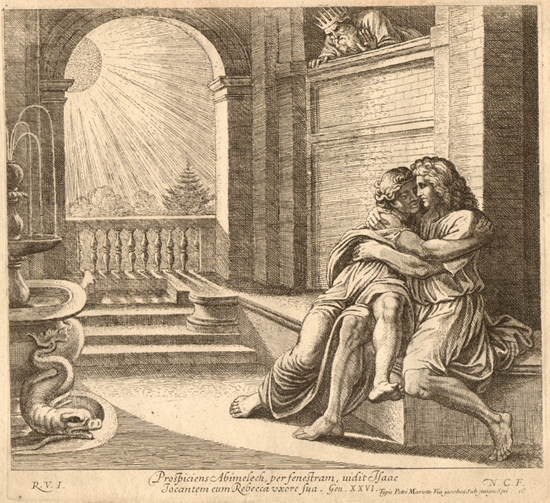
Abimelech, Isaac, and Rebecca,
by Daniele Squaglia, 1649

But unlike his father, Yitzchak cannot keep his hands off his wife.

And the days became long for him there.  And Avimelekh, the king of the Philistines, looked down through the window, and he saw—hey!—Yitzchak metzacheik with Rebecca, his wife!  (Genesis 26:8)

Here metzacheik means fondling: playing or fooling around sexually.  There is no implication of mockery or meanness in Yitzchak’s behavior.  He is merely in love with his own wife, and touches her when he thinks they are unobserved.

Like the king of Gerar who took in Sarah, this king of Gerar is horrified to discover that an apparently single woman is actually someone’s wife.  The king issues an order:  Anyone who touches this man or his wife shall certainly die.  (Genesis 26:11)  And Yitzchak prospers in Gerar.


Yitzchak, “He laughs”, is surrounded by people who laugh and joke.  Both his parents laugh at the incredible mismatch between their extreme old age and having a baby.  Both accept God’s miracle and adjust their lives to it, Abraham by winning God’s reassurance that his older son Ishmael will survive, and Sarah by finding a reason to exile Ishmael and give her own son the inheritance.

Yitzchak’s uncle Lot informs his sons-in-law of a different divine miracle, the impending destruction of Sodom.  His earnest belief in something they think is impossible makes them laugh, and they see him as a fool, a metzacheik.  So they stay put in Sodom, and are annihilated.

May we become more like Abraham and Sarah than like Lot’s sons-in-law: flexible and able to accept the unexpected in our lives.

When Ishmael is metzacheik at Yitzchak’s weaning feast, he is probably making other people laugh at Yitzchak’s expense.  But when Yitzchak is metzacheik with his wife in Gerar, he is probably making her laugh with his playful fondling as he expresses his love for her.

May we become more like Yitzchak than like Ishmael; may we guard ourselves against cruelty, even toward our opponents, when we joke around, and restrict ourselves to generating only loving laughter.


  1. Rashi is the acronym for the 11th-century C.E. French rabbi Shlomoh Yitzchaki, who wrote commentary on the entire Hebrew Bible and all of the Babylonian Talmud.
  2. Genesis/Bereishit Midrash Rabbah is a compilation of commentary by rabbis of the first through third century C.E. The three alternatives on page 53:11 are based on the use of similar words in three other passages.  In Genesis 39:17, the verb letzachek (לְצַחֶק, in the piel) is used to accuse someone of attempting sexual seduction.  In Exodus 32:6, letzacheik (לְצַחֵק, in the piel) is what the Israelites do after sacrificing to the Golden Calf.  In 2 Samuel 2:14, the lietwort viysachaku (וִישַׂחַקוּ) is used to mean a tournament or contest in which pairs of soldiers fight to the death.
  3. Ramban is the acronym for the 13th-century C.E. rabbi Moshe ben Nachman Girondi, a.k.a. Nachmanides. 16h-century C.E. rabbi Ovadiah Sforno gave the same opinion.
  4. Rachel Adelman, “The Expulsion of Ishmael: Who Is Being Tried?”, thetorah.com.
  5. Robert Alter, The Five Books of Moses, W.W. Norton & Co., New York, 2004, p. 103.
 

Haftarat Toledot—Malachi: Respectfully Yours

Every week of the year has its own Torah portion (a reading from the first five books of the Bible) and its own haftarah (an accompanying reading from the books of the prophets). This week’s Torah portion is Toledot (Genesis 25:19-28:9), and the haftarah is Malachi 1:1-2:7.
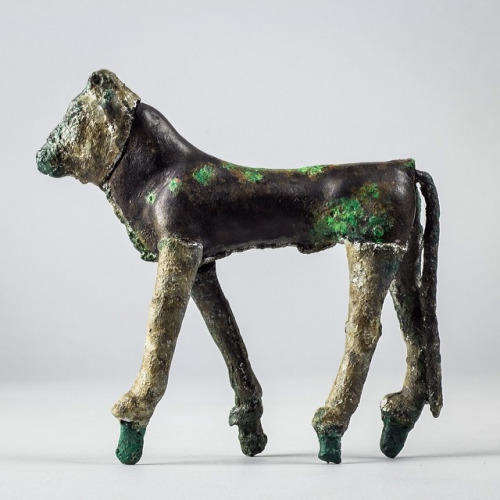
calf-ashkleon-silver

Do religious rituals and observances matter? How important is it to get the details right?

The three faults that draw the most condemnation from the prophets in the Hebrew Bible are:

1) worshiping other gods,

2) behaving unethically toward other people, and

3) failing to follow the rules of rituals

—in that order, if one judges by the number of words devoted to each.

When the prophets criticize the Israelites for their sacrifices at the temple, they usually condemn them for going through the ritual motions while continuing to act unjustly toward the poor, orphans, and widows.

But when the prophets criticize the temple priests, they denounce them for not teaching the Israelites about God (Jeremiah 2:8), for not separating the holy from the unholy and the pure from the impure (Ezekiel 22:26 and Zephaniah 3:4), for charging fees to make religious rulings (Micah 3:11), for promoting sexual sins (Hosea 6:9), and, in this week’s haftarah, for accepting defective animals as offerings for the altar.

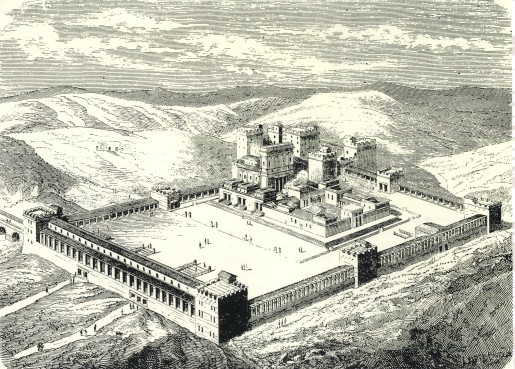
Second Temple, Jerusalem
Second Temple, Jerusalem

The last prophet in the Hebrew Bible is Malachi, whom most scholars date to the 5th century B.C.E., when the homeland of the Israelites has become a province in the Persian Empire, and Ezra and Nehemiah have rebuilt Jerusalem and its temple.

A pronouncement: the word of God to Israel, by the hand of Malakhi. (Malachi 1:1)

Malakhi (מַלְאָכִי) = Malachi (usual English spelling); My malakh.

malakh (מַלְאָךְ) = messenger, either human or divine.

God’s messenger delivers God’s complaint against the priests of the second temple.

“A son should honor a father, and a slave his master; but if I am a father, where is My honor? And if I am a master, where is My reverence?” says the God of [Heavenly] Armies to you, the priests who are bozeh of My sheim. And you say: “How are we bozeh of Your sheim?” (Malachi 1:6)

bozeh (בּוֹזֶה) = being in contempt, slighting, disrespecting, demeaning, finding insignificant.

sheim (שֵׁם) = name, reputation.

God answers:

“Presenting on My altar degraded food, then you ask: How are we degrading you? When you say: The table of God is nibezeh. Then if you present a blind [animal] for a slaughter-sacrifice, there is nothing wrong, and if it is lame or sick, there is nothing wrong!” (Malachi 1:7-8)

nibezeh (נִבְזֶה) = insignificant, contemptible, not worthy of respect. (From the same root verb as bozeh.)

Temple altar
Temple altar

The animals are given by the people, but the priests must decide whether each animal is acceptable to burn on the altar that serves as God’s “table”. Malachi astutely diagnoses the problem with flawed offerings: although the end-product of smoke is the same, priests who accept defective animals as gifts for God are showing contempt for God’s reputation. By doing so, they teach the people that they can give God any old leftovers; they need not honor God the way they would honor a parent or a master by serving a beautifully presented dinner.

The haftarah contrasts this negligent attitude with the respect and reverence that Israelite priests used to show for their God.

A torah of emet was in his mouth

And no wickedness was found on his lips;

In peace and on level ground he walked with Me

And he turned many away from wrongdoing. (Malachi 2:6)

torah (תּוֹרַה) = instruction, direction; the sum of God’s law; a book containing God’s laws. (From the same root as yoreh (יוֹרֶה) = he will teach; and moreh (מוֹרֶה) = teacher.)

emet (אֱמֶת) =  reliability, trustworthiness, truth; reliable, trustworthy, true.

A good priest teaches the people what to do, both ritually and ethically. The priest’s actions are consistent with his teachings; he is honest, what we call being “on the level” even in English. Therefore his instructions are emet.

kohen-ordinary-garments

Because the lips of a priest preserve knowledge

And they seek torah from his mouth;

Because he is a malakh of the God of [Heavenly] Armies.

But you turned away from the path;

You made many stumble through the torah;

You wiped out the covenant of the Levites, said the God of Armies. (Malachi 2:7-8)

Just as the author of the book Malachi is a malakh, a messenger from God, every priest must be a responsible malakh.

The Talmud extends this requirement to everyone who teaches about God. Rabbi Yochanan says: “If the rabbi is like a messenger of the God of Armies, they should seek the law at his mouth; but if he is not, they should not seek the law at his mouth.” (Babylonian Talmud, Mo-ed Katan 17a)

Back to our original question: Do rituals matter? And how important is it to get the details right?

For the priests at the second temple in the 5th century B.C.E., it was essential. They had to carry out the letter of the law concerning animal sacrifices, particularly the requirements for unblemished animals, in order for the people to see that they took God seriously.

After the fall of the second temple in 70 C.E., Judaism’s new teachers, the rabbis cited in the Talmud, focused on interpreting and extrapolating the laws in the Bible that did not require offerings at a temple. The examples they set in their personal lives were also scrutinized. If you wanted your rulings to be respected about the shape of lamps permissible on Shabbat or which slaves a master is obligated to feed, you had to follow all the rules yourself.

Today many rabbis and other teachers of the Torah, as well as many teachers of other religions, are primarily concerned with ethical behavior toward fellow human beings. The Hebrew Bible addresses ethics, but provides proof texts for contradictory opinions. For example, in one passage Moses commands genocide (see my post Mattot: Killing the Innocent).  In another, God tells Moses to tell the people: You shall not wrong a stranger, and you shall not oppress him, for you were strangers in the land of Egypt. (ExodusShemot 22:20)

In the face of conflicting passages, a modern Torah interpreter is responsible for finding the deepest truth and teaching it. Rabbi David Frankel wrote: “Thus, what makes Torah “true” is the sincerity and integrity with which one pursues the process of searching and interpreting.”

I am continually away of the shortcomings in my own behavior when I teach the Torah in a class, in a service, or in this blog. Not only is my idea of keeping kosher too idiosyncratic for most observant Jews, but I catch myself falling short of my own standards for kindness and justice. Are my words emet? Probably not. I can only pray that my sincere attempts to wrestle with the text and reach through to the divine spirit behind it will somehow lead to an occasional flicker of inspiration.  I may not walk with God on level ground, but I am grateful for this journey.

Toledot: Generations of Impersonations

The story of Abraham’s family in the book of Genesis/Bereishit is a story of impostors. Four family members (Sarah, Rebecca, Jacob, and Leah) deceive others by assuming false identities.  And four family members (Abraham, Isaac, Rebecca, and Lavan) ask one family member to impersonate another in order to deceive someone.

(See my posts on The Wife-Sister Trick, Part 1, Part 2, and Part 3 regarding the first two impersonations, and my post Vayeitzei: A Den of Thieves on the last one.)

In this collection of tricksters, only Rebecca both acts as an imposter herself and tells someone else to become an imposter. Both episodes occur in this week’s Torah portion, Toledot (“Lineages”).

The second episode is the most famous. When Isaac has grown old and blind, he summons his favorite son, Esau, and asks him hunt game and cook it for him.

Then I will eat, so that my nefesh will bless you before I die. (Genesis 27:4)

nefesh (נֶפֶשׁ) = appetite, animating soul.

Isaac does not mention God; he may want only to give Esau his personal blessing.  But his wife, Rebecca, is listening on the other side of the wall, and she hears something different.

And Rebecca spoke to Jacob, her son, saying: Hey! Shamati to your father speaking to Esau your brother, saying: Bring me hunted-game and make tasty dishes for me, and I will eat and I will bless you in front of God before I die. (Genesis 27:6-7)

Shamati (שָׁמַעְתִּי) = I listened to, I heard, I heeded.  (Here the word means “listened in on”.)

Rebecca assumes Isaac is going to pass on the grand blessing that God gave to Abraham, and repeated in abbreviated form to Isaac. And she is determined that this blessing go to her favorite son, Jacob, instead of to his twin brother Esau.

If she trusted her husband, Rebecca might wait until Esau goes hunting, and then try to persuade Isaac that he give God’s blessing to Jacob, and give Esau an ordinary garden-variety blessing instead.  But she does not.  She does not believe Isaac would listen to her.

On the other hand, she believes Jacob will listen to and obey her.

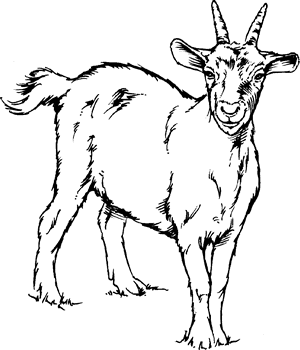
Goat kid
Goat kid

And now, my son, shema my voice, to what I am commanding you. Go, please, to the flock, and take for me from there two good goat kids, and I will make them into tasty dishes for your father, like those he loves. Then you will bring [them] to your father and he will eat, so that he will bless you before he dies. (Genesis 27:8-10)

shema (שְׁמַע) =  Listen to! Hear! Heed!  (The imperative form of the same verb as shamati.)

Although Rebecca does not explicitly command Jacob to impersonate his brother, Jacob takes it that way.  He has no moral qualms about deceiving his father, but he is afraid the impersonation will not work, because he has smooth skin, and Esau is exceptionally hairy.

Rebecca responds by helping Jacob do a more effective impersonation.

Then Rebecca took Esau’s best garment, which was with her in her house, and she put it on Jacob, her younger son.  And the skins of the goat kids she put on his hands and over the smooth part of his neck. (Genesis 27:15-16)

When her blind husband touches Jacob, he feels skin that is as hairy as a goat—like Esau’s skin. He even says: The voice is the voice of Jacob, but the hands are the hands of Esau. (Genesis 27:22)

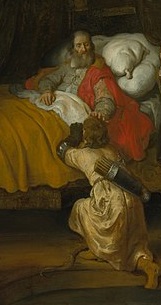
Isaac y Jacob, by Jose de Ribera
Isaac y Jacob, by Jose de Ribera, 1637

The blessing Isaac gives the impostor includes most of the blessing of Abraham.

Of course, as soon as Esau returns with his own meat to cook, the impersonation is discovered. Esau vows to kill his brother, and Jacob has to flee. But at least he got the blessing Rebecca wanted for him, a blessing that is irrevocable.

Why does Rebecca have Jacob impersonate his brother, instead of simply speaking to Isaac? Why doesn’t she trust her husband to listen to her?

I think the answer lies in an earlier episode where Rebecca is the impostor. When Isaac and Rebecca moved to Gerar in the land of the Philistines, Isaac told everyone Rebecca was his unmarried sister.

And it happened that when their days there grew long, Avimelekh, king of the Philistines, looked down from the window and he saw—hey! Isaac was fooling around with Rebecca—his wife! Avimelekh summoned Isaac and said: Hey, surely she is your wife!  Why did you say she was your sister?

And Isaac said to him: Because I thought “In case I would be killed over her…” (Genesis/Bereishit 26:8-9)

Isaac’s father, Abraham, had given the same reason when he asked his Sarah to pretend to be his unmarried sister:

Hey, please—I know that you are a beautiful-looking woman.  And it will happen, when the Egyptians see you, then they will say: This is his wife. And they will kill me, but you they will keep alive. Say, please, that you are my sister, so that it will go well with me for your sake, and I will stay alive on account of you. (Genesis 12:11-13)

As long as Sarah appeared to be single and available, Abraham’s reasoning went, any man hoping to make her his concubine would court the favor of her “brother”.

Isaac must have heard this family story, because assumed that any foreign king would kill the husband of a beautiful woman.  And Isaac pulled the same trick as his father when he brought his own beautiful wife to Gerar.

The Torah does not report Isaac asking Rebecca to pretend to be single. But Rebecca obviously went along with her husband’s lie anyway, since her true marital status was discovered only after they had lived in Gerar for a while.

Rebecca is not by nature submissive.  As an adolescent, in the Torah portion Chayyei Sarah, she independently invited a stranger to stay at her parents’ house, and boldly decided to leave home and marry the stranger’s master, Isaac.

But at this point in the story, Rebecca still trusts Isaac to keep her best interests in mind. After all, Isaac fell in love with her when they first met, and prayed for her when she failed to get pregnant.

I think Rebecca stopped trusting Isaac when she heard him explain that he passed her off as his sister because he was afraid of being killed.  At that point, Rebecca would realize that her husband was slavishly imitating his father’s example, even in a town with a friendly and ethical king. She could no longer count on him either to make rational decisions, or to consult with her first.

Years later, when she thinks Isaac is about to give the wrong son the blessing of Abraham, Rebecca does not even try to talk him out of it.  Instead, she falls back on a different family tradition:  when you need a favor from a man you do not trust, try deceiving him with an imposture.

Resorting to impersonation is an especially flamboyant family tradition. But all of us, in times of doubt, tend to fall back on strategies we learned from our families.  For example, I often used to follow my father’s strategy of making myself absent when interpersonal frictions arose.

What family strategies did you learn? How do they get repeated?

Toldedot: To Bless Someone

For most of my life, the closest I came to giving or receiving a blessing was “Good luck!” When I converted to Judaism, I learned how to bless God as a way to express my appreciation for food and other good things in life. But the idea blessing another person never occurred to me.

Yes, I had read about Isaac blessing his sons in this week’s Torah portion, Toledot (“Lineages”). I gathered that giving a blessing means both stating the good outcomes you want for another person, and calling on (or praying to) God to make your words come true. But I did not believe that the actual words mattered, or that a formal blessing would be any more effective than “Good luck!” I felt sorry for Isaac and his family for taking the blessing business so seriously. I was 48 before I discovered Jewish Renewal and the potential power of blessing.

What makes a blessing a living force instead of a formality?

The blessings in the book of Genesis/Bereishit use formal poetic language. Even when they are personal blessings, they focus material prosperity, fertility, and/or victory over enemies, and use customary phrases. For example, Rebecca’s mother and brother bless her as she leaves home to get married, saying: Our sister, may you become a thousand multitudes, and may your descendants take possession of their enemies’ gate.” (Genesis/Bereishit 25:60)

Another kind of blessing in Genesis is “the blessing of Abraham”, a phrase the Torah uses to refer both to God’s promise that Abraham’s descendants will possess the land of Canaan, and to the first blessing God gives Abraham:

I will make you a great nation, and I will bless you and I will make your name great, and you will become a blessing. And I will bless those who bless you, and those who curse you I will curse. And all the clans of the earth will find blessing through you. (Genesis 12:2-3)

In this week’s Torah portion, Isaac decides to give a blessing to Esau, the firstborn of his twin sons. The Torah does not say whether Isaac is planning to give Esau his personal blessing, or the blessing of Abraham, but it does say what part of himself Isaac hopes will deliver the blessing.

Isaac Sends Esau to Hunt, by James Tissot, ca. 1900

He said: I have grown old, and I do not know the day of my death. So now, please pick up your gear, your quiver and your bow, and go out to the field and hunt game for me. Then make me tasty tidbits, the kind that I love, and bring them to me, and I will eat, so that my nefesh may bless you before I die.” (Genesis/Bereishit 27:2-4)

nefesh (נֶפֶשׁ) = animating soul; seat of appetite, desire, yearning, instinct; person

Isaac wants the blessing to come from his nefesh, his instinctual self, without any interference from his conscious mind. Isaac loves Esau and could invent a formula of blessing. But he wants his blessing to express the will of God as it moves through him, not his own conscious will.

When Isaac’s wife, Rebecca, overhears him, she assumes he intends to give Esau the blessing of Abraham. She panics, not only because she loves Jacob more, but also because she knows that Jacob is the one who will carry on the worship of the God of Abraham.

Apparently Rebecca and Isaac are having communication problems, because she does not march into Isaac’s tent and straighten him out. Instead, she says to Jacob:

Hey, I heard your father speaking to your brother Esau, saying: Bring game to me and make me tasty tidbits, and I will eat them, and I will bless you lifnei God, before my death.” (Genesis 27:6-7)

lifnei (לִפְנֵי) = in the presence of, before

Rebecca interprets Isaac’s reference to blessing with his nefesh as blessing “in the presence of God”, and she associates this with God’s blessing of Abraham.

She quickly cooks some tasty tidbits from goat meat, and orders Jacob to bring them to his father. Jacob protests that he is not a hairy man, like his brother, so his blind father will know he is not Esau as soon as he touches him. So Rebecca disguises Jacob by dressing him in Esau’s spare clothes and fastening the skins of goat kids around his hands and neck.

Of course as soon as Jacob comes in and says, My father, Isaac recognizes Jacob’s voice, and asks:

Who are you, my son?” Then Jacob said to his father: “I am Esau, your firstborn. I have done as you spoke to me. Get up, please, sit, and eat some of my game, so that your nefesh may bless me.” (Genesis 27:18)

Jacob thinks like his father. He hears Rebecca’s “in the presence of God”, and interprets it in terms of Isaac’s nefesh!

Isaac tests his son several times, unable to believe that this man with Jacob’s voice is really Esau, no matter how hairy his hands feel. Then he decides to bless the son in front of him anyway. Now it is even more important that the blessing come from God, so he repeats:

I will eat some of the game of my son, so that my nefesh may bless you.” (Genesis 27:25)

After Isaac has eaten and received a kiss from his son, he delivers the blessing:

May God give to you from the dew of the heavens, and from the fat of the land, and abundant grain and wine. May peoples serve you, and may nations bow down to you. Be a leader to your kinsmen, and may the descendants of your mother bow down to you. Cursed be those who curse you, and may those who bless you be blessed.” (Genesis 27:28-29)

The blessing begins with the standard themes of material abundance and victory over other nations. Then Isaac adds part of God’s blessing of Abraham:  Cursed be those who curse you, and blessed be those who bless you. He does not say the other part of the blessing of Abraham—that he will have many descendants, and they will possess the whole land of Canaan—until later in the Torah portion, when he gives a blessing to Jacob as Jacob.

I think that Isaac gives Jacob-in-disguise part of the blessing of Abraham because he is indeed speaking from his instinctual self, channeling divine inspiration without thinking it through. His words naturally mirror the words of the blessing of Abraham.

When his other son shows up a moment later with his own tasty tidbits, Isaac recognizes Esau’s voice, and comes out of his trance and back to earth. He trembles, partly because he knows he cannot repeat the same blessing to Esau, and partly because he realizes that the blessing he just gave Jacob is indeed an expression of God’s will.

Then Isaac trembled, full of fear, and said: “Who is it, then, who hunted game and brought it to me and I ate everything before you came and I blessed him? He must be truly blessed!” (Genesis 27:33)


Is it possible to channel a blessing from God, as Isaac apparently channels his first blessing? I do not know. But when I was 48 and I wandered into a Jewish Renewal service, I saw the rabbi of P’nai Or of Portland, Aryeh Hirschfield zt”l, blessing people. I could tell he was connecting with some inner source of energy, and the people he blessed were taking in that energy.

Is that kind of blessing from the instinctual self, the nefesh, confirmed by God and therefore bound to come true? Again, I do not know. What I do know is that a blessing given with what seems to be divine energy makes a big impression on both giver and receiver. No doubt the words of the blessing are absorbed deep into the subconscious mind of the one blessed, where they affect one’s outlook and behavior for years to come. That alone might make a blessing come true.

May everyone who needs a blessing be truly blessed. And may everyone who sees the need for a blessing be inspired to give a true blessing.

Toledot & Vayeitzei & Vayishlach: Goat Versus Snake

Esau and Jacob are twin brothers, but because of their personality differences they can never build a real partnership—any more than a goat can partner with a snake.

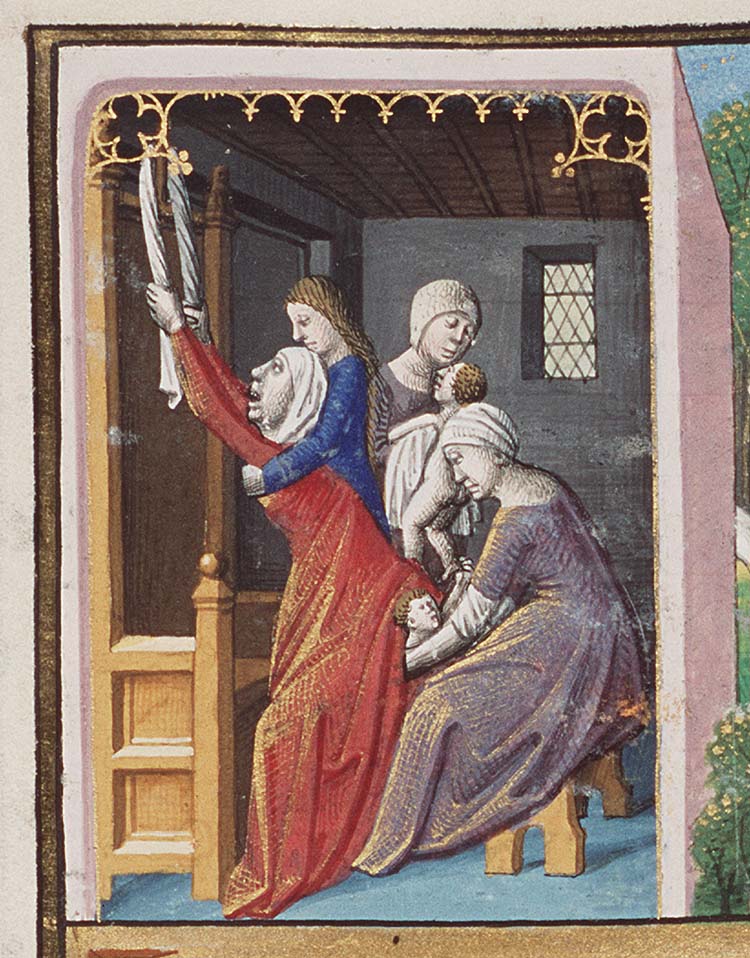
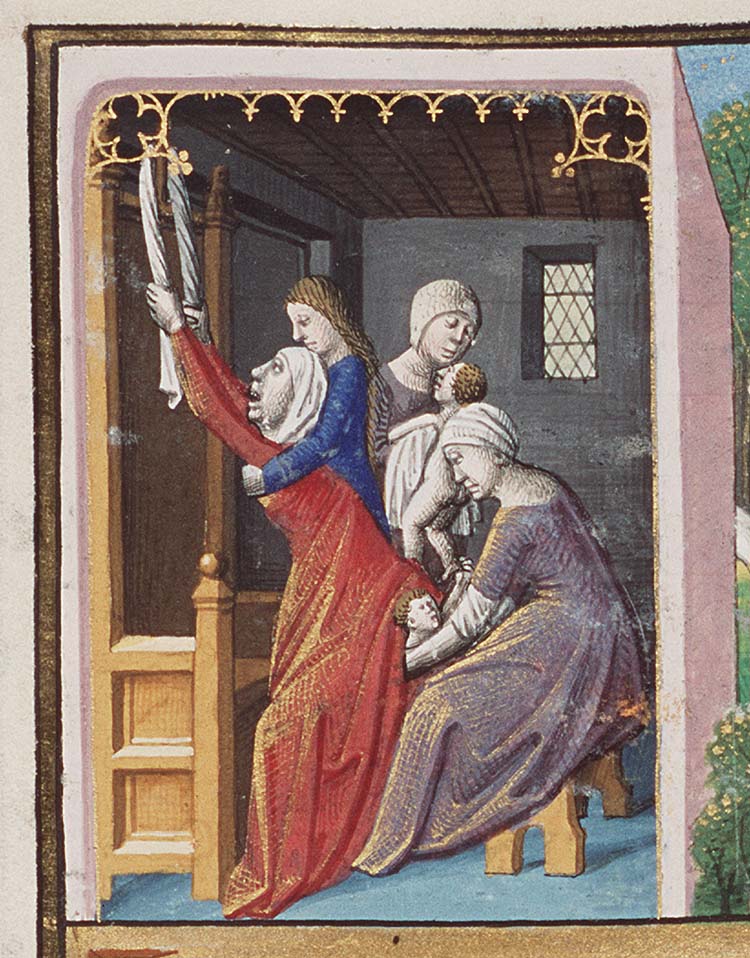
Birth of Esau and Jacob, by Francois Maitre, ca. 1480

The Torah identifies the twins with these two animals when they are born in this week’s Torah portion, Toledot (“Lineages”):

The first emerged red [and] completely like a robe of sei-ar, so they called his name Eisav.  And after that his brother emerged, and his hand was holding fast to the heel of Eisav, so he called his name Ya-akov …  (Genesis/Bereishit 25:25-26)

sei-ar (שֵׂעָר) = goat hair, bristling hair.  (From the same root as sa-ir, שָׂעִיר = he-goat.)

Eisav (עֵשָׂו) = (Esau in English)  Doer, Made.  (From the root verb asahעָשָׂה = do, make.)

Ya-akov (יַעֲקֹב) = (Jacob in English)  Heel-grabber, Sneak.  (From the same root as akeiv, עָקֵב = heel, which derives from the verb akav,  עָקַב= came from behind.)

The Torah explains why Jacob and Rebekah, the parents of the twins, named the second one Ya-akov: he emerged hanging onto his brother’s heel.  But why did they name the first one Eisav?  Rashi (11th-century rabbi Shlomoh Yiztchaki) wrote that because he was covered with hair, he looked like an adult, completely “made”.

Toledot

At birth, Esau is hairy like a goat.  Goats are also known for being “horny” beasts, which fits Esau’s personality when he grows up.  He brings home not one, but two Hittite wives against his parents’ objections.1

Jacob’s grip on his twin’s heel is a reminder of the snake in the garden of Eden, whom God cursed to crawl on his belly and bite humans on the heel.2  The Torah describes the heel-biting snake as arum (עָרוּם) = naked; clever, cunning.3  Jacob is hairless, and therefore naked compared to Esau; and when he grows up he is the clever one.  We first see this when Esau comes home famished and Jacob talks him into trading his birthright for a bowl of stew.4

In the next scene about Esau and Jacob, their blind father, Isaac, wants to give his firstborn son a blessing.  But first he tells Esau to go hunt game and make it into the delicacy he loves.   Rebecca, the twins’ mother, overhears.  She is certain that Jacob should get the blessing instead.  So she orders Jacob:

“Please go to the flock and take for me two good goat kids, and I will make them a delicacy for your father like [those] he loves.”  (Genesis 27:9)

Rebecca’s favorite son can bring back goats from the flock faster than Esau can hunt, and she knows how to make them taste like the game Esau often cooks for his father.  On another level, Rebecca may be implying that Jacob should overpower his hairy he-goat of a brother.

And why does she need two goats for one old man’s meal?  Is she subconsciously sacrificing both of her sons to make sure the right one gets Isaac’s blessing?

Isaac Blessing Jacob, by Gerbrand van den Eeckhout, 1642, detail

Jacob protests:

Hey, my brother Esau is a sa-ir man, and I am a smooth man!  (Genesis 27:11)

sa-ir (שָׂעִר) = hairy.  (Also from the same root as sa-ir, שָׂעִיר = he-goat.)

Physically, Jacob is still as smooth as a snake.  So Rebecca fixes it.  After dressing Jacob in Esau’s clothes, she covers his hands and neck “with skins of goat kids” (Genesis 27:16).  When he brings in the dish of meat, his blind father is not sure which son he is.  He speaks like Jacob, so Isaac asks him to come closer, and touches his son’s hands.

And he did not recognize him because his hands were like the hands of his brother, se-irot.  And he blessed him.  (Genesis 27:23)

se-irot (שְׂעִרֹת) = hairy.  (The plural of sa-ir above.)

Isaac gives Jacob the blessing he intended for Esau.  Enraged by the “theft” of his blessing, Esau rashly swears he will murder his brother, and Jacob quickly slips away and heads for his uncle Lavan’s house in Aram.

Vayeitzei

In the next Torah portion, Vayeitzei (“And he went”), Jacob marries his uncle Lavan’s daughters, Leah and Rachel, and serves Lavan for fourteen years in lieu of bride-prices for them.  When his time is up, his employer/uncle/father-in-law does not want to let him go.

And Lavan said to him: “If, please, I have found favor in your eyes!  Nichashti, and God has blessed me on account of you.”  And he [Lavan] said: “Designate your wage to me, and I will give it.”  (Genesis 30:27-28)

nichashti (נִחַשְׁתִּי) = I received an omen.  (From the same root as nachash, נָחָשׁ = snake.  Snakes were associated with omens and magic in the ancient Near East.)

Lavan comes close to saying, “I sought a snake, and God has blessed me on account of you.”

The serpentine Jacob makes a clever bargain with Lavan and works for another six years in exchange for far more livestock than his employer expected.  Then twenty years after Jacob fled to avoid being murdered by his brother, he finally heads back toward Canaan with his family, servants, and flocks.

Vayishlach

The next Torah portion begins:

And Jacob sent messengers ahead of himself to his brother Esau, to the land of Sei-ir, the country of Edom.  (Genesis 32:4)

sei-ir (שֵׂעִר) = hairy goat.

Esau has become the chieftain of “The Land of the Hairy Goat”, also called Edom.  Jacob’s messengers return with the news that Esau is already marching to meet him—with 400 men.

Reconciliation of Jacob and Esau, by Peter Paul Rubens, 1624

This time, instead of bargaining with his twin brother, Jacob sends him extravagant gifts of livestock.  (See my post Vayishlach: Two Camps.)  In the morning, after Jacob has wrestled with a “man” who turns out to be a messenger of God, the estranged brothers meet.  They embrace one another and weep out loud.  Esau offers to return Jacob’s gifts, and Jacob insists that he keep everything.

“Because I have seen your face, which is like seeing the face of God, and you have accepted me.”  (Genesis 33:10)

Then Esau offers to travel with Jacob as far as Sei-ir.  But Jacob politely says his group has to go more slowly, so Esau and his men should go ahead, and he will catch up later.  As soon Esau and his warriors are out of sight, Jacob heads in another direction.  The two brothers do not see one another again until their father’s funeral.5


Esau and Jacob do better than Cain and Abel; they manage a peaceful reunion, and nobody dies.  Yet a goat and a snake cannot become close friends and go home together.  They have separate destinies.

May each of us be blessed, like Jacob, to see God’s face in people who are fundamentally different from us.  And may we learn to greet them in peace, and part from them in peace.


  1. Genesis 26:34, 27:46.
  2. Genesis 3:15.
  3. Genesis 3:1.
  4. Genesis 29:25-34.
  5. Genesis 35:29.

Toledot: Rebecca Gets It Wrong

Rebecca tries so hard to set up her son Jacob for a good life—and everything she does turns out to be a mistake.

Birth of Esau and Jacob, by Francois Maitre, ca. 1480

In this week’s Torah portion, Toledot (“Histories”), Rebecca and Isaac have twins who are opposites. Esau, the firstborn, is big and hairy, emotional and impulsive, fixated on food and sex.1 Jacob, born holding onto Esau’s heel, is smooth-skinned and smooth-tongued, clever and scheming, fixated on becoming a patriarch someday. He makes his first move when Esau comes home hungry after a long day of hunting, and Jacob trades a bowl of  stew for his his brother’s birthright as the firstborn.2

Esau expresses his love for his 100-year-old blind father, Isaac, by feeding him meat from his hunts. Esau’s needs are as simple as his intellect, and he takes care of himself. Rebecca does not worry about her firstborn son.

Isaac loved Esau because of the hunted-meat in his mouth, but Rebecca was loving Jacob. (Genesis/Bereishit 25:28)

Rebecca does worry about her son Jacob. Although he has the intelligence and desire to carry on the legacy of his grandfather Abraham, he sticks close to the family’s tents, and at age 40 he remains unmarried. He will never be able to serve Abraham’s god unless he gets out into the world, and he will never continue the line of Abraham’s descent unless he marries a suitable woman.

What Rebecca wants for Jacob is a good wife and Abraham’s blessing from God. But only her husband Isaac can make these things happen. They live in Canaan, where marriages are arranged by men. And although God did answer Rebecca’s question once, when she was pregnant, Isaac has a stronger connection with the divine. After all, when he prayed to God to let her bear children, God responded.

Also God gave Isaac the blessing of Abraham. Rebecca knows that he has the power to pass it on to  Jacob before he dies. And Isaac’s health is failing. When the twins were born, Isaac was 60. Now he is over 100. He is blind and finds it hard to stand up. One day, Rebecca overhears Isaac tell Esau:

“… go out in the field and hunt meat for me. Then make for me some tasty food that I love, and bring it to me, and I will eat it, so that my nefesh will bless you before I die.” (Genesis 27:3-4)

nefesh (נֶפֶשׁ) = soul, self, animating spirit, appetite.

Rebecca jumps to the conclusion that Isaac is about to give Esau the blessing of Abraham. But God’s blessing would be wasted on Esau; it has to go to Jacob!

Isaac Blessing Jacob,
by Gerbrand van den Eeckhout,
1642 (detail)

Rebecca orders Jacob to bring Isaac the tasty food and secure the blessing before Esau gets back from the field. When Esau and Isaac find out what happened, she will take care of the consequences somehow. The charade spins out from there. Rebecca fastens goat-skins around Jacob’s hands and neck to imitate Esau’s hairiness. Isaac, after some uncertainty, gives Jacob the blessing he intended for Esau: a prayer for a life of material abundance and power, with no reference to God or Abraham.

I can imagine Rebecca listening in and discovering her mistake. Isaac merely wanted to bond with Esau the only way he could, through food, and  then leave him with a father’s blessing–the blessing of his personal self, or even the blessing of his appetite. Isaac was saving the blessing of Abraham for Jacob after all. Now what can she do?

Of course the subterfuge is discovered as soon as Esau returns from his hunt. Esau weeps and begs his father for another blessing, and Isaac does the best he can. But Rebecca finds out that Esau is so enraged, he wants to kill Jacob as soon as their father dies.

Rebecca does not try to talk him down. Instead, she sees another opportunity to promote Yaakov’s welfare. She tells Yaakov he must flee to her brother in Charan in order to escape Esau’s murderous rage. Then she reminds Isaac of how much they dislike Esau’s Hittite wives, and hints that he must send Yaakov away to get a wife.

Rebecca said to Isaac: “I am disgusted with my life because of the Hittite women. If Jacob takes a wife from the Hittite women like these, why should I go on living?” (Genesis 27.46)

So Isaac summoned Jacob and he blessed him and  commanded him, and he said to him: “You must not take a wife from the daughters of Canaan. Get up, go to Padan of Aram, to the house of Betu-el, your mother’s father, and take yourself a wife from there, from the daughters of Lavan, your mother’s brother.” (Genesis 28:1-2)

Then Isaac, who never loses his temper, gives Jacob the blessing of Abraham.

“May God give you the blessing of Abraham for yourself, and for your offspring as well, so as to possess the land from your sojournings, which God gave to Abraham.” (Genesis 28:4)

Most commentary says that Rebecca’s motivation is to save Yaakov’s life, and her marriage scheme is an excuse. I think it is the other way around. As modern commentator Tikva Frymer-Kensky writes, Jacob would be just as safe if Isaac sent him to his ally, King Avimlelkh, or to his half-brother Ishmael, both of whom live nearby. Rivkah is smart enough to think of a pretext for sending Jacob to either man. Instead, she deliberately brings up the subject of Jacob’s marriage, knowing that Isaac’s first thought will be to get Jacob a wife from the relatives in Aram, just as Abraham did for him.

Why does Rebecca want Jacob to marry one of her brother Lavan’s daughters? The Torah does not say, but her desire is similar to Abraham’s; both want to keep the intermarriage among the descendants of Terach going.  At least Lavan worships the same god as Abraham, even if he is not exclusive about it.

Rebecca also knows that her brother thinks in terms of material wealth. In last week’s Torah portion, we read that Lavan was willing to marry off his sister once he saw the jewelry Abraham’s steward had given her, and the ten camels carrying packs. Lavan would not accept a husband for any of the women in his household without receiving a hefty bride-price.

Yet in next week’s Torah portion, Vayeitzei (And he went), Jacob leaves home on foot, carrying nothing but a staff (and a few personal supplies, such as the oil he pours on the stone where he has his famous dream of the ladder of angels). Surely neither Isaac nor Rebecca would send their son off to Lavan to take a wife without giving him a mount, some servants, and a generous bride-price!

In my blog post Vayeitzei: Guilty Conscience, I speculated that Jacob’s guilt  drives him to leave home before his parents have time to give him anything, and then to sentence himself to seven years of servitude to Lavan as the price for a wife. Now I think Jacob’s hasty departure might be due to fear as well as guilt. And Rebecca is to blame for this fear, since she tells Jacob Esau is determined to kill him, and urges him to flee.

Poor Rebecca. What she wants for Jacob is God’s blessing and the right wife. But everything she does to help Jacob has the opposite effect. Isaac planned all along to give God’s blessing to Jacob. By making Jacob masquerade as Esau, Rebecca only makes Jacob guilty and Esau enraged. Then Rebecca tries to get Jacob the right wife by telling him to flee to his uncle Lavan before Esau tries to murder him. The combination of fear and guilt make Jacob leave too soon, without a bride-price, and stay with Lavan for 20 years.

Jacob does, eventually, get what his mother wants for him: God’s blessing, both from Isaac’s lips and from God in a vision; and both of Lavan’s daughters as his wives. Yet Rebecca dies without ever seeing her favorite son again, or his children.

Could she do better? What if, as soon as she overheard her husband promising to give Esau the blessing of his nefesh, she went straight to Isaac and asked him what he intended? Or what if she spoke to Jacob directly about why he should marry one of Lavan’s daughters? Could Rebecca achieve her goals by being honest?

I know from my own experience that being honest and direct works well with someone who can listen to me, and ask for clarification when necessary. It does not work well with someone who becomes emotionally overwhelmed because a childhood complex is triggered, or with someone who simply cannot focus on what I am saying.

Isaac is passive and traumatized because his father nearly sacrificed him as a burnt offering, lifting the knife off his throat only at the last moment. Everything relating to fathers and sons might be emotionally overwhelming for him. And he is 100 years old, infirm, and blind. When the Torah says his eyes have dimmed, it may mean his mind has also dimmed, and he cannot focus long enough to hear Rebecca out.

And Jacob?  He would be shocked by the consequences of obeying his mother and stealing Esau’s blessing, and expect a rejection from his father or an attack by his brother at any moment. In the middle of this crisis, how could he listen to someone talk about marriage?

Perhaps there are times when we are all like Rebecca, longing for the best outcome, but knowing there is no use in going for it directly and honestly. Yet if we try to manipulate the situation, we may discover that we have misread another person’s heart, and done everything wrong. We are only human. Yet sometimes, even if it comes too late for us, the best outcome arrives after all.


  1. Esau is hairy from birth (Genesis 24:25), becomes a hunter (Genesis 25:27), is more interested in eating than in preserving his future (Genesis 25:29-34), and violates custom by bringing home two local Hittite women as wives without his parents’ permission (Genesis 26:34-35).
  2. Genesis 25:29-34.

Vayeitzei: Guilty Conscience

At the end of last week’s Torah portion, Toledot (Histories), Jacob runs away to his uncle Lavan’s house in Charan.  The official reason for his trip east is to get a wife.  But his more urgent reason is to avoid being murdered by his twin brother Esau.

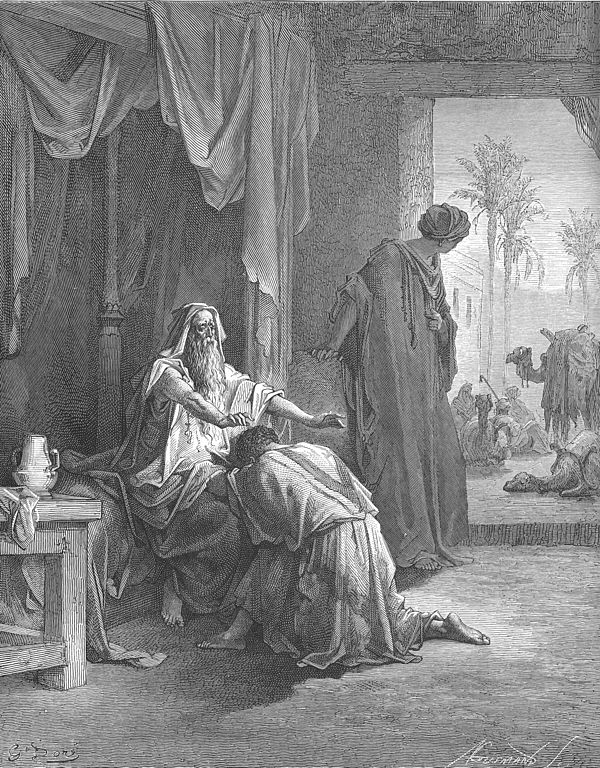
Isaac Blesses Jacob, by Gustave Dore, 1866

Jacob has just tricked their blind father in order to “steal” the blessing that Isaac intended for Esau.  The twins’ mother, Rebecca (who instigated the scheme to divert the blessing), finds out that Esau is so enraged he is vowing to kill his brother.  So she privately tells Jacob:

Flee for yourself to my brother Lavan, to Charan!  And stay with him a few days, until your brother’s rage turns away… from you, and he forgets what you did to him; then I will send and take you away from there. (Genesis 27:43-45)

Rebecca does not mean a few days literally; it would take at least a week just to travel to Charan and back.  But she does indicate that Jacob’s stay in Charan will be brief.  This is reasonable, since we know Esau is a man whose emotions, though  overwhelming, are short-lived. (See my post Toledot: Seeing Red.)

Officially, Jacob is not running away at all, but following Isaac’s instruction to go to Charan and take a wife from among the daughters of Rebecca’s brother, Lavan.  But Jacob does not wait for his wealthy father to give him a bride-price, riding animals, and servants for the journey.  Instead, he dashes away with only his walking stick.

I think Jacob is determined to leave his past behind, and never again try to take anything from his father: neither an inheritance, nor a blessing, nor even a bag of silver.

In this week’s Torah portion, Vayeitzei (“And he went”), Jacob arrives in Charan, and Lavan takes him in.

And he stayed with him a month of days.  Then Lavan said to Jacob:  Is it so, that you are my kinsman, and you serve me without compensation?  Tell me what is your maskoret!  (Genesis/Bereishit 29:14-15)

maskoret (מַשְׂכֺּרֶת) = wage, pay for hired labor.

And Jacob loved Rachel, so he said:  “I will serve you for seven years for Rachel, your younger daughter.”  (Genesis 29:18)

Seven years?  Jacob has already been tending Lavan’s flocks for a month.  Why does he offer to serve for seven years?

Many commentators have written that seven years of labor is the bride-price Jacob pays for Rachel. Yet Jacob’s family is wealthy.  When his father sends him off to get a bride, he would normally send him with riding animals, servants, and gifts for the bride’s family—just as Abraham did when he sent his steward to Charan to get a wife for Isaac.1  And even though Isaac learned how Jacob had tricked him, he still gave Jacob a generous parting blessing, showing no desire to deprive him of anything.  So Jacob should be well equipped to pay a large bride-price to Lavan on the spot.

Yet he is not.  The text does not say any servants are traveling with him; when he stops for the night he is alone and sleeps on the ground with a stone for his pillow.2  And he travels on foot:

Then Jacob lifted his feet and he walked toward the land of the easterners.  (Genesis 29:1)

Lavan puts him to work as soon as he arrives, treating him as a poor relative rather than as a guest, so we can infer that Jacob did not carry any valuable gifts in his pack.  And in next week’s Torah portion, Vayishlakh (And he sent), when Jacob heads back west, he says:

“With my walking-stick I crossed this Jordan, and now I have become two camps.”  (Genesis 32:11)

Why does Jacob leave without the servants, riding animals, and gifts that his father must have provided for his journey?

I believe Jacob is punishing himself, perhaps subconsciously, for tricking his father and cheating his brother.  Instead of coming to Lavan as a guest and a wealthy prospective bridegroom, he arrives as a poor relative who volunteers to serve Lavan as his master.

The 20th-century commentator Shmuel Klitsner3 has pointed out that although a hired laborer is paid a daily wage and is free to leave his employer at any time, a Hebrew slave serves his master without fair wages for up to seven years.

If you buy a Hebrew slave, he will serve six years, and in the seventh he will go out as free, without compensation. (Exodus/Shemot 21:1)

Jacob gives himself the maximum number of years of slavery as a punishment for stealing Esau’s blessing.  Since his father has not sentenced him to any punishment, he has to punish himself.  It is the only way he can cope with his guilty conscience.

Later in the Torah, Moses sets up a system of animal sacrifices as guilt-offerings; the animal’s owner not only suffers the loss of the valuable property, but also lays hands on the animal before the priest slaughters it, symbolically transferring his guilt to the animal about to be killed for God.  In the book of Genesis, Noah, Abraham, Isaac, and later Jacob himself, do offer animal sacrifices to God.  But they are never guilt-offerings, and never for the purpose of expiating sin or wrongdoing.

If Jacob cannot atone for his bad deed through a guilt-offering, and his clan leader and father will not punish him, what else can he do to resolve his guilty conscience?  Today, we might ask him to apologize to both Isaac and Esau, and find a way to make restitution.  That is precisely what Jews are expected to do every year before Yom Kippur, the Day of Atonement.

But although the people in the book of Genesis sometimes confess their wrongdoing to God, they never think of apologizing to one another.  Jacob’s grandfather Abraham never apologizes  either to Sarah, or to the two kings he hoodwinks, for passing off his wife as his sexually available sister.  Neither Sarah nor Hagar apologizes after they abuse one another.  Rebecca does not apologize to anyone for masterminding the trick on Isaac, which also hurts Esau and makes Jacob flee for his life.  And Jacob does not apologize to Esau, either for talking him into trading his birthright for stew, or for cheating him out of his blessing.  In his family, in his whole experience, people do not apologize to each other.

I am tempted to conclude that we are better off today, when rabbis, teachers, and parents train us to confess and apologize whenever we do something wrong.  Yet I know it’s not that easy.  Sure, I can apologize for an inconsiderate remark to someone who understands and forgives me, and then I feel relieved.  But I also know from personal experience that few things are harder than apologizing to someone whom you believe will neither understand nor forgive you.  It takes not only courage, but also an ability to accept that your effort may fail, and the only reward you will get for doing the right thing is the knowledge that you did the right thing.

This knowledge may not seem like much of a blessing at the time.  But it does save you from having to run away from the person you wronged, and punish yourself by becoming a slave for seven years.  


  1. Genesis 24:21, 24:53.
  2. Genesis 28:10-11.
  3. Shmuel Klitsner, Wrestling Jacob: Deception, Identity, and Freudian Slips in Genesis, Urim Publications, Jerusalem, 2006.

Bereishit & Toledot: Seeing Red

The book of Genesis/Bereishit explores a series of conflicts between brothers, and one between sisters.  Two of these conflicts feature an especially hot-blooded, emotional brother, and both of these use various permutations of the word for the color “red”: adom, אָדֺם.

Blood red

After Cain kills Abel in the first Torah portion of Genesis, Bereishit, God tells Cain:

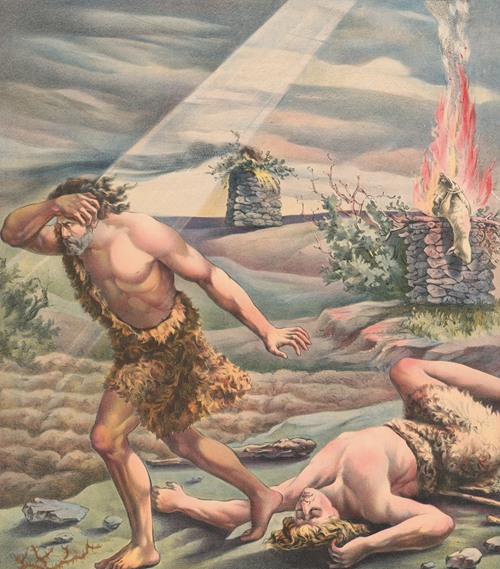
The Killing of Abel, Providence Lithograph Co., 1905

“What have you done? The voice of the damim of your brother is crying out to me from the adamah!”  (Genesis/Bereishit 4:10)
damim (דֱָמִים) = shed blood. (plural of damדָּם = blood.)
adamah (אֲדָמָה) = ground, dirt, earth.

Both Hebrew words come from the same root as adam (“human”, also the name of the father of Cain and Abel, whom God makes out of dirt in Chapter 2).  To be human is, among other things, to be red.  Dam, “blood”, is obviously red.  And traditional commentary explains that uncultivated earth (at least in the world described by the Torah) is red clay.

Red man, red stew

This week’s Torah portion, Toledot (“Histories”), tells the story of the twins Esau and Jacob, from their conception until they are in their forties and  Jacob flees because Esau is threatening to kill him.

Then her days of pregnancy were completed, and hey! –twins were in her womb.  And the first one went out, admoni all over like a fur robe of hair, and they called his name Eisav.  And after that his brother went out, and … they called his name Jacob.. (Genesis 25:24-26)

admoni (אַדְמוֹנִי) = reddish.

Eisav (עֵשָׂו) = Do it, get it done. (From the verb asahעָשָׂה = do.) “Esau” in English.

The text is not clear about whether he has ruddy skin and is covered with hair, or whether his fur-like hair is reddish.  Either way, he is born red, like blood, and hairy, like a beast.

Since Esau is born a moment before Jacob, he counts as the firstborn son.  In the world of the Torah, when the patriarch of an extended family dies, his firstborn son inherits a double portion of his father’s possessions, and also becomes the family’s priest.  Yet in this story, when Esau grows up and becomes a hunter, he does not care about the role of the firstborn.  Jacob, who stays in the tents, cares very much.

Jacob stewed a stew, and Esau came in from the field, and he was famished.  And Esau said to Jacob: “Please let me gulp down some of the adom— this adom— because I am famished.”  Therefore his name was called Edom.  (Genesis 25:29-30)

Edom (אֳדוֹם) = a people who later lived in the hill country east of the Jordan river valley, supposedly descended from Esau.  (From the same root as adom = red.)

Esau Selling His Birthright to Jacob, by Rembrandt, 17th c.

Jacob takes advantage of his incoherent brother’s request by charging an exorbitant price for the stew.

And Jacob said:  “Hand over, as of today, your right as firstborn to me”.  And Esau said:  “Hey, I am going toward death, so what is this to me, a firstborn right?”  Then Jacob said:  “Swear to me, as of today!”  And he swore to him, and he handed over his firstborn right to Jacob.  And as for Jacob, he gave to Esau bread and a stew of lentils.  And he ate and he drank and he got up and he went.  Thus he belittled the right of the firstborn.  (Genesis 25:31-34)

On a literal level, this story amuses me, because I often make stew from red lentils, and it always comes out a golden color.  Other kinds of cooked lentils are dark brown or green-brown—but never red.  Did someone who never cooked write down this story, and get the detail about lentils wrong?  I prefer to assume that Jacob is so clever, he adds an ingredient to his stew that will make even lentils look red enough to attract Esau’s attention.

Esau sees food and the color red.  He does not notice the lentils.  He cannot even find the word for stew.  The 19th-century commentator Samson Raphael Hirsch wrote that the color red delights Esau because it reminds him of the blood on an animal when his arrow hits it.1

The 20th-century psychologist Helen Luke wrote that red is the color of instinct, impulse, and emotion.  She added that Esau, who is controlled by the color red, is in danger of losing all civilizing tendencies and becoming evil.  Jacob, his opposite, is in danger of repressing or denying all instinct and emotion, and becoming evil.2

Neither Cain, the man of blood-red violence, nor Jacob, the bloodless schemer, is a good candidate for the spiritual role of the firstborn, the one who speaks with and makes offerings to God.

I think Jacob sees the world as black and white, divided between losers and winners.  Since he sees the firstborn as the winner in the family, he applies his intelligence to acquiring that role.  He suppresses any emotional impulses in order to carry out first his own scheme for taking his brother’s birthright, then his mother’s scheme for stealing his brother’s blessing.  Jacob may not savor his food as much as Esau, but he knows how to plan ahead.

Esau sees only red.  Carried away by one emotion after another during the Torah portion of Toledot, he carries out his impulses and lives for the moment.  In the passage translated above, he gives away his birthright to appease one day’s feelings of hunger and despair.  Later in the Torah portion, he weeps like a child when he finds out Jacob has stolen the blessing their father intended for Esau.  Then he becomes so angry he threatens to kill Jacob as soon as their father dies.

Jacob flees from him, and (in the Torah portion Vayeitzei) he meets his match in his cold, calculating uncle Lavan—whose name means “white” in Hebrew.  Yet some color finally comes into Jacob’s black-and-white life, as he falls in love with Lavan’s daughter Rachel.  Gradually he succeeds in becoming the leader of his own clan, through a combination of sensitivity to others’ emotions and rational long-term planning.

Meanwhile, Esau leaves home and learns how to be a leader.  When he hears that his twin and nemesis is coming his way (in the Torah portion Vayishlach), he plans ahead by bringing 400 men to meet Jacob on the road.  But he retains his emotional instincts, and when he sees Jacob bow to him, he runs over and embraces his brother.  The two older and wiser men pull off a peaceful reunion.


We all have some of Jacob’s black-and-white rationalism and some of Esau’s red emotionalism.  We can only be whole human beings when those two sides embrace.

Furthermore, in order turn our whole personality toward peace rather than toward evil, we must learn from the evolution of both brothers.  Jacob learns to use his black-and-white intellect to lay plans for the good of everyone, instead of for just his own advantage.  And Esau learns to move beyond seeing red as the blood shed in killing, and see red as the blood of life, shared with other humans.

If we can widen our vision enough, through both our intellects and our emotions, we will recognize that all human beings share the same blood; we are descendants of Adam, אָדָם = the human, humankind. (From the same root as adom = red.) Then we will all truly deserve the right of the firstborn to speak with and offer gifts to God.


  1. Rabbi Samson Raphael Hirsch, The Hirsch Chumash: Sefer Bereshis, Feldheim Publishers, Jerusalem, 2002, pp. 561-562.
  2. Helen Luke, Kaleidoscope, Parabola Books, New York, 1992, p. 225.

Toledot: Opposing Twins

(This was my first “Torah Sparks” blog post, published on November 17, 2009.  I made a few small additions before reposting it in 2020.)

Birth of Esau and Jacob, by Francois Maitre, ca. 1480

And [Rebecca’s] days for giving birth filled, and hey!  Twins were in her womb!  And the first one emerged red all over, like a robe of fur; and they called his name Eisav.  After that, his brother emerged, and his hand was holding onto the akeiv of Eisav, so he called his name Ya-akov.  (Genesis/Bereishit 25:24-26)

Eisav (עֵשָׂו) =  (“Esau” in English.)  Doer?  (Probably from the verb asahעָשַׂה = did, made.  Aso, עֲשׂוֹ = to do.)

akeiv (עָקֵב) = heel.  (From the verb akav, עָקַב = grasp by the heel, cheat.)

Ya-akov (יַעֲקֺב) = (“Jacob” in English.)  He grasps by the heel.

Isaac and Rebecca name the first one Eisav, and he grows up to be a hunter and a man of action.  They name the second one Ya-akov because he was born holding onto his twin brother’s heel .  Clearly this heel-holding is important.  But what does it mean?

The traditional Jewish interpretation is that Jacob is trying to pull Esau back, because even in the womb Jacob knows that he, not Esau, should receive the inheritance and the blessing that belong to the firstborn.  Since he fails to switch places with Esau at birth, the adult Jacob resorts to trickery to get the rights of the firstborn.

But what if Jacob is hanging onto Esau because he cannot bear to be separated from his twin?  Esau has always been with him, since they were conceived.  Rebecca noticed the agitation in her belly as the brothers struggled, or wrestled, or perhaps danced inside her.  Then suddenly Esau was gone.  How could Jacob stand the sudden loss?

The birth process separates the twins, and also separates them into two halves of one person, dividing the traits of a human being between them.  Esau is a physical man, hairy like an animal, focused on eating, taking wives, and killing.  Jacob is an intellectual, a smooth-skinned smooth-talker, focused on cooking up the future and getting words of blessing.

That’s why neither Jacob nor Esau can be whole until he takes on some of his brother’s characteristics.  In next week’s Torah portion, Vayeitzei, Jacob  becomes interested in taking a wife and acquires physical strength when he sees Rachel and rolls the big stone off the well (Genesis 29:10).  And in the following portion, Vayishlach, Esau learns to think well enough to become a leader of a tribe (Genesis 32:7).  But neither twin can be at peace until they finally meet again in old age, and kiss and weep together (Genesis 33:4).


Toledot: Why?

(This blog was first posted on November 1, 2010.)

Isaac prayed to God, in front of his wife, because she was barren; and God was moved by the prayer to him; and his wife, Rebecca, conceived.  But the sons pushed and crushed one another inside her.  And she said: “If thus why this I?”  And she went to question God.  (Genesis/Bereishit 25:21-22)

im kein lamah zeh anochi = literally:  “If thus why this I?”

“If it’s like this, why me?”

“Why am I this way?”

“If so, why do I exist?”

In last week’s Torah portion, Rebecca is portrayed as remarkably strong-willed and hospitable to strangers (hauling water for the camels of Abraham’s steward until they’ve drunk their fill); decisive and courageous (deciding she will leave at once to marry a stranger in a strange land); and impressed by a man who prays (falling off her camel when she sees him, and then, upon discovering the man is her fiancé Isaac, instantly donning her wedding veil).

This week’s Torah portion, Toledot (Histories) opens when Isaac and Rebecca have been married almost twenty years, and are still childless.  Isaac prays, and Rebecca gets pregnant, but the violent movements in her belly alarm her.  She says something cryptic, then becomes the first person in the Torah to seek out and question God.

Even Abraham waits for God to speak to him before venturing to ask God any questions.  But although Rebecca lets her husband do the praying for conception, she does not ask Isaac to find out about the battle in her belly.  She goes straight to God.

At least that’s what the text says.  Some medieval commentary says she went to the school of Noah’s sons Shem and Ever, who were somehow still alive and running the world’s first yeshiva (Jewish seminary).  Some modern commentary speculates that she actually went to a professional oracle.  But the remaining commentary credits her with going directly to God.  I suspect Rebecca goes to the nearest holy spot—perhaps the well where Hagar heard God—and stands there alone, asking her question from her heart until she gets an answer.

What is her motivation for this unprecedented act?  It depends on the interpretation of her cry, Im kein lamah zeh anochi.  If she means “If it’s like this, why me?”, Rebecca questions God because she wishes some other woman were carrying the painful burden and risking miscarriage or her own death.  Why can’t Isaac have his sons by a concubine instead?  (c.f. Abraham Ibn Ezra, 12th century; Obadiah Sforno, 16th century).  Is God punishing her because there’s something wrong with her?  (c.f. Talmud, tractate Sotah 12a).

If Rebecca means, “Why am I this way?”, she just wants to understand why her pregnancy is so unusual (c.f. Radak–Rabbi David Kimhe, circa 1200; 19th-century rabbi S.R. Hirsch).  What can she expect when it’s time for the birth?  What will happen after that?

But if Rebecca means, “If so, why do I exist?”, she seems to be close to despair, wondering if her painful pregnancy is worth living through (c.f. 13th-century rabbi Moses ben Nachman).  Going to God is a last-ditch effort to find a reason to carry on.

I don’t think the “Why me?” attitude fits Rebecca’s character.  Would someone that hospitable to a stranger want to inflict pain or death on a concubine?  Would someone that self-confident wonder if she had some horrible hidden flaw?

“Why am I this way?” makes more sense.  Rebecca might well have a practical motivation for questioning God.  She is fundamentally a woman of action, and now that something strange and alarming is happening, she can no longer stay in her tent and leave things up to her adored husband.  She has to find out what will happen next, so she can be prepared to respond to any emergency.  Later in the Torah portion, when she overhears that Isaac is about to give the blessing to the wrong twin, she reacts with a decisive emergency response, as if certain that her desire matches God’s will.

Yet is also possible that even a strong woman like Rebecca might come close to despair after 20 years of watching her husband pray for a child right in front of her, followed by a pregnancy that tortures her and seems likely to end in death.  She would be desperate to find some meaning in life, some reason for it all—desperate enough to seek out God.

Many of us reach a moment when we wonder: “Why am I this?”  Is there some reason for everything I’ve gone through?  What is my purpose in life?  What is the meaning of it?

I believe the worst thing to do, when that moment comes, is to accept the answer of an authority figure:  someone in a pulpit, on a book jacket, on television, on a calendar page or refrigerator magnet.  Someone else’s idea of the meaning of life might bring me temporary comfort, but how can it answer a cry from the depths of my soul?  No, I have to seek God on my own, like Rebecca.  I have to keep questioning God, even though I don’t know what God is, until my answer comes.

I think I am beginning to feel my purpose in life, but it’s too amorphous to put into words.  And I believe, without any rational reason, that there is meaning in life, but I don’t know what the meaning is.  Since I’m a modern woman, I get my incomplete and mysterious answers in the form of vague intuitions, instead of in the form of riddling prophecies like the one Rebecca received.

Maybe a complete answer will never come to me.  That’s okay.  I’ll keep on seeking God, I’ll keep on questioning.  For me, the search is what’s important.