Lekh-lekha: Unconditional Covenant

The first three covenants God makes with human beings in the Torah are unconditional; God promises to do something regardless of what the other party does. First God says to Noah:

Everything on earth will perish, but I will raise up my berit with you, and you shall come into the ark… (Genesis/Bereishit 6:18)

berit (בְּרִית) = covenant, pact, treaty of alliance. (This is the source of the Yiddish word bris = covenant of circumcision.)

After the flood, God tells Noah and his descendants not to eat the blood in animal meat, and not to shed the blood of humans.  But then God declares a unilateral covenant with all future humans and animals on earth—without making it contingent on humans following the rules about blood.

And I, here I am, raising up my berit with you and with your descendants after you, and with every living creature that is with you—with birds, with beasts, and with everything living on the earth with you …I raise up my berit with you, and I will not cut off all flesh again by the waters of the flood, and never again will there be a flood to destroy the earth. (Genesis 9:9-11)

God makes a third, and last, unconditional covenant in this week’s Torah portion, Lekh-lekha (“Get yourself going!”).

Abraham hears God’s call at age 75, leaves his home in Aram, and travels to Canaan, where he is landless and childless (though he has a wife, a nephew, and a large number of men working for him). God promises Abraham three times that he will have a whole nation of descendants, from his own loins, and they will possess the land of Canaan.
Abraham-looks-at-stars

The third time, Abraham points out that he is still childless. God shows him the stars, and says his descendants will be just as numerous. The sight of the stars moves Abraham, and he trusts God on this. Then God repeats that Abraham will possess the land of Canaan, and Abraham questions God again:

God, my master, how will I know that I will take possession of it?” (Genesis 15:8)

God responds by changing the promise into a covenant. And since words alone do not seem to be enough for Abraham any more, God does not just “raise up” or establish a covenant through words, but “cuts” a covenant in a ritual used for centuries among ancient people in the Middle East, including Akkadians, Amorites, Hittites, Assyrians, and Arameans as well as Israelites.

In this ritual, two parties ratified a pact or treaty by slaughtering one or more animals and cutting each one in half. Surviving written documents include threats that if one of the parties does not uphold the agreement, he will be cut in half like the animal.

At some point, Israelites added a step to the ritual: after an animal was cut in two, someone walked between the pieces.

…the berit that they cut before Me: the calf that they cut in two and they passed between its pieces: the officers of Judah, and the officers of Jerusalem, the court officials, and the priests, and all the people of the land, the ones who passed between the pieces of the calf … (Jeremiah 34:18-19)

In this week’s Torah portion, God requests five animals, from the five species that are used later in the Torah for burnt offerings.

“Take for me a three-year-old heifer and a three-year-old she-goat and a three-year-old ram and a turtledove and a young pigeon.” And he took for [God] all these, and he cut them through the middle, and set each part opposite its fellow. But the birds he did not cut. (Genesis 15:9-10)

The 20th-century rabbi Meir Zlotowitz claimed that Abraham placed the two uncut birds opposite one another, completing the path between the pieces. And God grants him a vision.

And the sun had set, and darkness happened, and hey!—a smoking tanur and a torch of fire, which passed between these cut pieces. On that day, God cut with Abraham a berit, saying: To your descendants I have given this land, from the river of Egypt up to the great river, the river Euphrates. (Genesis 15:17-18)

tanur (תַנּוּר) = fire-pot, oven; brazier, furnace.

In the books of Exodus and Deuteronomy, God’s presence is often described in terms of smoke and fire. But imagine a disembodied smudge-pot and a torch passing between the pieces!

This is God’s last unilateral covenant in the Hebrew Bible. The next covenant between God and Abraham, at the end of this week’s Torah portion, is conditional; God will multiply Abraham’s descendants if and only if every male in Abraham’s household is circumcised.

After that, covenants between God and humans are like Biblical covenants between two humans: the party with more power promises to protect the party with less power, on the condition that the weaker party remains loyal to his superior and follows the stipulated rules. In God’s case, people must obey various laws, observe holy days, and/or refrain from worshiping other gods as a condition for God’s favor and protection.

Why does God switch to conditional covenants? I think God is frustrated by what happens right after God cuts a covenant with Abraham.  His post-menopausal wife, Sarah, gives him her slave Hagar to produce a son for him; and instead of continuing to wait for a miraculous birth, Abraham cooperates. But God seems disappointed, and makes a new covenant with Abraham. Besides requiring circumcision as a condition, God specifies that Sarah must be the mother of the son who inherits the covenant, and says: I will bless her, and also give you a son from her. (Genesis 17:16)

From then on, God apparently does not trust humans to make their own arrangements without at least a few divine rules to guide them.

Today people make many conditional contracts with each other: for rent, for employment, for services. Some people also try to bargain with God, promising to do something they think God wants in exchange for a divine favor—as if God could be bribed.

There is also a widespread unconditional covenant between human beings today: marriage. Our wedding rituals can be elaborate (though they do not feature cutting up animals and walking between the pieces). But at the heart of the ceremony, each person promises to be with and support the other (like God promising to favor and protect someone), regardless of what happens.

Today, Jewish circumcision is more like an unconditional covenant with God.  Infant boys are dedicated to the God of Israel through circumcision with no expectation that God will grant them fertility or any special favors in return.

But can you imagine God initiating a covenant with a human being today?  Can you imagine God raising up or cutting a covenant with you? What would it be like? 

Has it already happened, in some subtle way?

Noach: The Soother

by Melissa Carpenter, maggidah

By the end of the first Torah portion in the book of Genesis/Bereishit, God regrets creating human beings, and decides to wipe them out. I offered theories about why God thought the human race was spoiled in two of my earlier blog posts: Noach: Spoiled, and  Bereishit: Inner Voices. This year, when I reread the Torah portion named after Noah—Noach in Hebrew—I wondered why such a discouraged God made one exception, and saved Noach and his immediate family from the flood.

Last week’s Torah portion ends:

But Noach found favor in the eyes of God. (Genesis/Bereishit 6:8)

This week’s Torah portion, named after Noach, begins:

These are the histories of Noach. Noach was a righteous man; in his generations, Noach walked with God. (Genesis 6:9)

Noach (נֹחַ) = Noah; an alternate spelling of noach נוֹחַ)), a form of the verb nuch (נוּח) = come down to rest, settle down.

Noah Leaving the Ark, by Sisto Badalocchio

The first appearance of the verb nuch in the Torah is when Noach’s ark comes to rest on Mount Ararat at the end of the flood in Genesis 8:4. This is also Noach’s turning point, when he finally begins (at the age of 600) to take some initiative: sending out the birds to test the water level, making an animal offering to God, and planting a vineyard.

Before the flood, God tells His favorite person, Noach, that people are evil and the whole world has been spoiled.  He gives Noach instructions for making a wooden ark, and says He will flood the earth and destroy all flesh—except for the few humans and animals on the ark.

(I used the pronoun “He” in case because the God character the Torah presents here is quite anthropomorphic, making sweeping generalizations and acting emotionally.)

Later in the Torah, when Abraham is God’s favorite person of the era, and God tells him that He is about to commit genocide, Abraham talks God out of it.  He persuades God to refrain from burning up Sodom if there are even ten innocent people in the city. In the book of Exodus, Moses persuades God to give the Israelites a second chance after they worship the Golden Calf.

But Noach is silent. After God has spoken to him, all the Torah says is: And Noach did everything that God commanded him; thus he did. (Genesis 6:22)

God tells Noach to load seven pairs of each of the ritually-pure animals on board, as well as one pair of each of the impure animals. Then He rephrases His plan, saying that He is going make a flood and

wipe out everything standing on the face of the earth (Genesis 7:4).

Again, Noach is silent. The Torah repeats:

And Noach did everything that God commanded him.

Both times, Noach makes no protest, but only does what God commands. So God floods the earth.

After the flood is over and Noach empties the ark, his first order of business is acting on the hint implied in God’s order to carry seven times as many of the animals that are ritually pure (according to the rules for purity laid out later, in the book of Leviticus/Vayikra).

Then Noach built an altar for God, and he took from all of the ritually-pure animals and from all of the ritually-pure birds; and rising-offerings went up [in smoke] on the altar. And God smelled the nichoach aroma, and God said to His heart:  I will not again draw back to curse the earth on account of the human, for the impulse of the human heart is bad in its youth … (Genesis/Bereishit, 8:20-21)

nichoach (נִיחֹחַ) = soothing or pleasing to a god. (The use of this word may be a play on Noach’s name, and may also imply that the god in question will be inclined to come down and rest its presence over the sacrifice.)

Noach’s action puts God in a better mood. God has another change of heart, and views the human condition more optimistically and rationally. According to classic commentary, God decides that it is only natural for children to act on their bad impulses, but adults can learn to control these impulses and be good. So God tells Himself not to overreact to human misdeeds again.

Why does the aroma of Noach’s offering soothe God?

Maybe the God character in the Torah, like other Canaanite gods, loves the smell of burning animals. This would explain why God favored Abel’s animal offering and rejected Cain’s plant offering. It would also explain why slaughtering and burning livestock was the primary method of worshiping God from the time of Genesis down to the fall of the second temple 70 BCE. God really liked that barbecue smell, so that’s what the Israelites gave Him.

On the other hand, maybe God provided Noach with excess ritually-pure animals because He remembered Cain and Abel’s spontaneous offerings, and wanted to make sure Noach had something to offer if he happened to feel spontaneous gratitude for being saved from the flood. The thick clouds of smoke from the combustion of more than 33 kinds of birds and beasts reassures God that Noach does, indeed, feel grateful. So God concludes that adults, at least, can feel and act on good impulses.

So have many commentators, from Philo of Alexandria in the first century C.E. to Rabbi Samson Raphael Hirsch in the 19th century. But I think both those commentators and the God character in the Torah still had more to learn about human psychology.

Why Noach Burned the Animals

I can imagine Noach acting purely out of fear of this God of wholesale destruction, who cares nothing about innocent children or animals. Noach might well be moved to burn as many animals as possible in the hope of forestalling the Destroyer’s next whimsy.

Another possibility is that Noach acts out of despair. When the flood begins, he had to hustle his own family and the animals he has collected into the ark, then keep everyone else out of it.  God closes the door into the ark, but perhaps Noach could still hear the cries of his own neighbors and the sobbing of frightened children.

When the flood waters sink, Noach would see not only mud and broken trees, but floating corpses. He goes ahead and sacrifices the excess ritually-pure animals because he has figured out God wants him to. There is no point in disobeying God now. He wishes he had spoken up earlier, before the earth was destroyed.  Did God leave another hint that he missed? Could he have done anything to save more people? Now it is too late, and Noach has to live with himself.

He listens to God’s speech giving instructions for living in the new world, and promising that a flood will never destroy the earth again. But I think Noach is too depressed to care.  As soon as God is done talking, Noach plants a vineyard. In the next sentence, he gets drunk.

Some commentators criticize Noach for his silent obedience. But when I reflect on my own life, I know that the number of times I spoke up in favor of justice or mercy were few in comparison with all the times I felt powerless and kept my mouth shut. When the person in authority has absolute power and does not show compassion, it is hard to risk a loss of acceptance, loss of a job, or even loss of one’s life. I can only feel sorry for Noach.

The most frightening thing about the Torah portion Noach is that the person in authority is a god, a god who gets carried away by egotistical emotions and has only a primitive sense of justice. Even today, natural disasters such as earthquakes, hurricanes, and volcanic eruptions can be taken as evidence of a morally deficient god.

That’s why, when I write about these parts of the Torah, I often refer to “the God character”. The anthropomorphic character that the Torah stories refer to by various names of God is simply not the same as the creator of the universe; or the theologians’ omnipotent, omniscient, omnibenevolent being; or the essence and totality of existence; or even the mysterious unknown we sometimes sense with our non-rational minds.

Yet we can still learn from Torah stories in which the God character not only creates and tests and destroys human beings, but also learns from them. There is a God character inside each of our psyches, as well as a Noach, and an Abraham, and maybe even a Moses.

Vayeira & Noach: Drunk and Disorderly

As I read the book of Genesis/Bereishit again this year, I feel sorry for the characters who try to rise to the challenge of walking with God, but are just too limited to keep up. Two of those who fall by the wayside are Noah and Lot, who both attempt to do the right thing, then collapse into drink and incest after they see their worlds destroyed.

Noah begins by following all of God’s directions; he sees God destroy all life on land with the over-the-mountaintop flood. Abraham’s nephew Lot begins by offering hospitality to strangers in this week’s Torah portion, Vayeira (“And he saw”). He sees the strangers, who are actually messengers from God, destroy the city of Sodom and the land around it.

After their respective catastrophes are over, and it is time to build a new life, both men think only about getting drunk.

Noah

Drunkenness of Noah, mosaic, Basilica di San Marco, Venice, 1215

And Noah began to be a man of the soil, and he planted a vineyard. And he drank some of the wine, and he became drunk, and vayitgal in the middle of his tent. And Cham, the father of Canaan, saw the erat of his father and he told his two brothers outside. (Genesis/Bereishit 9:20-22)

vayitgal = he uncovered himself, exposed himself

erat = nakedness

Noah plans his drunkenness with the foresight of an alcoholic who hides stashes of liquor in strategic places. He has to wait a long time, through planting and harvesting and fermentation, before he gets his first drink after the flood. Although the Torah does not report Noah’s feelings, I imagine he is haunted by the deaths of everyone he knew outside his own immediate family of eight. Perhaps he dreams of children drowning. Perhaps he wishes he had said something to change God’s mind, or found some way to rescue more people.

I suspect that Noah cannot find a way to live with this knowledge and move forward. So he opts to escape into an altered state of consciousness, or unconsciousness.

After becoming drunk, Noah uncovers his nakedness in the middle of his tent. A modern reader might wonder what is so bad about lying down naked in the privacy of your tent—even if one of your sons barges in and accidentally sees you.

But in the Torah, to “uncover the nakedness” of someone is a euphemism for a sexual act. The book of Leviticus/Vayikra devotes thirteen verses to listing close relatives whose nakedness you must not uncover, using the same words for “uncovering” and “nakedness” as the passage above.

The implication is that Noah and his son Cham (whose name means “heat”) are guilty of some illicit sexual act. Furthermore, Noah begins it, by “uncovering himself”. Yet Noah shifts all the blame to his son.

And Noah woke up from his wine, and he knew what his youngest son had done to him. (Genesis 9:24)

Noah expresses his anger at Cham by cursing Cham’s son Canaan. Alas, it is a common human reaction to reject your own guilt by lashing out at someone else.

Lot

In this week’s Torah portion, Lot and his daughters act out a different version of the drunken incest theme.

Lot, like Noah, means well. His story begins with a good deed; when two messengers from God, disguised as ordinary men, come to the city of Sodom, Lot goes out of his way to give them hospitality and treat them with respect and kindness—just as his uncle Abraham did in the previous scene in this week’s Torah portion. After Lot has brought the strangers home and fed them, the men of Sodom converge on Lot’s house and demand that he bring out his guests, so that they can “know” them.

Just as it never occurs to Noah to question God’s plan to wipe out the earth, it never occurs to Lot that there might be an alternative to sacrificing two people to the mob. Since his two guests are out of the question, Lot steps outside and offers the would-be rapists his two virgin daughters instead.

Maybe Lot is so terrified of his neighbors that he cannot think straight. But we can still question his impulse to sacrifice his daughters—and perhaps after the crisis is over, Lot is tormented by remembering his own behavior.

The mob outside ignores Lot’s proposed substitution of rape objects, and crowd forward to break down the door. The messengers from God save the day (or night) by pulling Lot inside and blinding the men outside. Then they tell Lot that God has sent them to destroy the whole city, and they order Lot to flee with his family.

Lot panics, and at dawn he is still dithering in his house. The messengers grab him, his wife, and their two daughters by the hand and lead them outside the city. They tell Lot to save himself by escaping to the mountain, without stopping or looking back.

When God rains sulfur and fire down from the heavens, Lot’s wife looks back and turns into a pillar of salt, but Lot hurries on. He settles into a cave on the mountain with his two daughters.

And the elder said to the younger: Our father is old, and there is no man on the earth to marry us as the way of all the earth. Come, we will give our father a drink of wine, and we will lie down with him, and we will keep alive seed from our father. So they gave their father wine to drink that night, and the elder came, and she lay down with her father, and he did not know when she was lying down or when she was getting up. (Genesis 19:31-33)

They repeat the procedure the next night, with the younger daughter as the seed collector. And once again the Torah claims Lot did not know when she was lying down or when she was getting up. Both women become pregnant, as they planned.

Many commentators have pointed out that preserving a man’s lineage is a high value in the Torah, and concluded that Lot’s daughters were doing the right thing. But if incest were truly the right behavior in their situation, they would simply ask their father to cooperate, without resorting to wine. Lot may not have read the Torah’s prohibition against “uncovering the nakedness of your father”, but he obviously knows that incest, like mistreating a stranger, is wrong.

The Torah appears to view Lot as innocent of incest by reason of unconsciousness. Yet it is Lot’s decision to keep drinking the wine until he passes out; even two strong young women could not force it down his throat.

And where did the wine come from? The Midrash Rabbah, a collection of commentary from Talmudic times, speculates that either the Sodomites stored wine in distant mountain caves, or the wine appeared miraculously. However, I agree with modern commentator Jonathan Kirsch that Lot probably grabs some wine when they pass through the village of Zoar on the way to the mountain. Like Noah, Lot would anticipate a need for escape from sanity after the catastrophe. And as in Noah’s story, the Torah blames Lot’s subsequent sexual misdeed on his children.

It is easy for me to judge both Noah and Lot harshly. But if God gave me orders, would I have the imagination or the courage to talk back? If I were faced with a mob of evil men, would I have the imagination or the courage to divert them safely? I have lots of imagination—except when it comes to my own problems. I’m learning courage, but I still prefer avoidance.

If all my friends, most of my family, and every familiar thing in my life were suddenly wiped out, would I have the imagination and courage to build a new life from nothing? I think I would, but how do I know?

When life becomes unbearable, do I stick with reality and avoid any drugs of escape? Cookies don’t count, do they?

When something bad happens between two people, do I duck responsibility by blaming it on the other guy? Never—except for when I am fixated on escaping the situation.

As I read the book of Genesis again this year, I feel sorry for the characters who try to rise to the challenge of walking with God, but are just too limited to keep up. I might be one of them.

Lekh-Lekha and Bereishit: Giving Directions

For me, every story in the book of Genesis/Bereishit is another fruit from the Tree of Knowledge of Good and Evil. And the God who speaks to individual people, from Adam to Jacob, is like a human teacher trying to prod people into making conscious choices and moral judgments.

Like other animals, we humans make most of our decisions automatically, out of instinct and habit. Sometimes we stop to solve a practical problem or an intellectual puzzle. But only rarely do we stop to solve a moral problem. When we do become aware of a moral issue, and of our ability to choose between good and evil actions, I think we are tasting another fruit from the Tree of Knowledge.

The anthropomorphic God in Genesis often talks to Himself, debating what to do next. He also talks to human characters, asking them questions, telling them His plans, blessing and cursing them, making covenants with them, and giving them directions.

“God” tries out several methods for giving directions. In the second creation story, “God” makes a single human out of dirt and breathes life into it. After placing the human (ha-adam) in the garden of Eden, the God character gives it an instruction.

figGod tzivah the human, saying: From every tree of the garden, certainly tokheil. But from the tree of the knowledge of good and bad, not tokhal; for on the day you eat from it, you will certainly die. (Genesis 2:16-17)

tzivah = commanded, ordered, directed.

tokheil, tokhal = you will eat, you shall eat, you should eat, you could eat, you may eat, you can eat, you are going to eat, you must eat.

It is impossible to translate this passage literally, because biblical Hebrew has only one verb form for action that has not yet happened. Is “God” telling the human “you must not eat” from the tree of knowledge, and if you do, you will be punished with death? Or is “God” saying “you could not eat” from it without becoming mortal?  Either translation is correct.

The God character’s motivation in giving this order is also open to interpretation. Classical commentary assumes “God” wants the human to stay in the garden, in a state of moral ignorance, and therefore after the female and male humans eat the fruit, they are punished for disobeying orders. I think “God” points out the Tree of Knowledge in order to show the adam, the solo and sexless human, that it can act of its own free will, and gain knowledge. But the adam passively follows orders, and nothing changes. I can imagine the God character wondering what it will take to get the humans to make a choice and acquire a sense of good and evil, so He can remove them from Eden and place them in the real world! “God” solves the problem by splitting the human it into male and female persons, and inventing the snake to make the female human think.

The next person in the Torah to get moral training is Cain, who gets upset when God shows a preference for Abel’s offering over his. Perhaps because reverse psychology did not work well with Adam, “God” avoids anything that sounds like an order when He first addresses Cain.

Cain, by Henri Vidal, detail


And God said to Cain: Why are you making yourself angry, and why has your face fallen? Is it not so: if you do good, [there is] uplifting; but if you do not do good, wrongdoing waits at the door, and its desire is for you. Yet you can rule over it. (Genesis 4:6-7)

Cain does not get the hint, and in a fit of rage kills his brother Abel.

In the story of Noah, the God character tries a different approach.

God said to Noah: The end of all flesh is coming before Me, because the earth is filled with violence on account of them, and here I am, the one Who destroys the earth.  Make for yourself a floating-container of gofer wood; you shall make the floating-container compartmented, and you shall cover it inside and outside with caulking. (Genesis 6:13-14)

If what “God” wants is for Noah to obey orders, His new style works. Noah simply follows orders, and makes no independent decisions until after the flood. But commentators have wondered for millennia whether Noah’s mechanical obedience is actually what “God” wants. (See my post last week, Noach: Righteous Choices.) What if “God” is hoping that Noah will propose an alternative, the way Abraham does later when “God” announces He will destroy Sodom and Gommorah?

abraham-looks-at-starsThis week’s Torah portion, Lekh-lekha, begins with the God character’s first direction to Abraham.

God said to Abraham: Lekh-lekha, away from your land, and away from your home, and away from the house of your father, to the land that I will show you. And I will make you into a great people, and I will bless you, and I will make your name great, so it will become a blessing. (Genesis 12:1-2)

Lekh = Go!

-lekha = yourself, for yourself, to yourself.

Here the God character’s order specifies what Abraham should leave behind, but gives no details about the future he is walking into. What “God” does communicate is that this move is important for Abraham, not just for God. Rashi (11th-century Rabbi Shlomo Yitzchaki) interpreted Lekh-lekha as “Go for yourself”, i.e. for your own sake. The Zohar (a 13th-century kabbalistic text) interpreted it as “Go to yourself”, i.e. recreate yourself as a new individual, separate from your past.

All the promises of blessing, while non-specific, also serve to let Abraham know that going to the new land will be for his own benefit. This is the first time in the Torah that “God” promises a reward for obeying His directions.

Abraham responds to the divine direction by leaving home for good, as instructed. But he takes some initiative and prepares for his own future by bringing along his wife, nephew, servants, and livestock.

Since the voice of God does not even tell him which way to head when he leaves his father’s house in Charan, Abraham chooses to travel west into Canaan. Only after he has reached Shechem, well inside Canaan, does “God” appear to him and say: To your offspring I will give this land. (Genesis 12:7)

The God character’s method of giving partial directions, promising an eventual reward, and leaving the rest up to the human being seems to be the most successful approach so far. Abraham responds by leaving his old familiar habits behind, and making new choices.

Today, few people hear God giving them direct instructions in Biblical Hebrew. But I can imagine the God character in these stories as an inner voice from the human subconscious, struggling to be heard properly.

There are many ways for a human being to get stuck and wait passively for change, instead of looking for a good action and bravely doing it. At times in my life I have been like the adam, obeying orders without raising questions, avoiding any potential conflict. I had to reach a certain level of misery before an inner voice from God’s snake reminded me that it would not kill me to pick the fruit and liberate myself, to choose my own course and act.

At times in my life I have been like Cain, feeling as though I am at the mercy of a bad desire. Yet eventually I hear the divine hint that I can master the desire, and choose to do good.

Other times, I feel overwhelmed, drowned, by the demands of other people and by the way the world works. I want to make my own little floating container and hide in it. But my conscience nags at me, reminding me that I cannot hide in an ark without bringing my family and hordes of hungry animals with me. God wants engagement with the world.

And yes, periodically I have heard an inner call to leave my familiar but not-so-good life, and set out for an unknown destination and destiny, like Abraham. So far, responding to that voice has led to blessings.

May we all be blessed to listen to our inner “God” voice, and never lose the taste of the fruit from the Tree of Knowledge of Good and Evil.

Noach: Righteous Choices

This is the story of Noah: Noah was a man of tzadik; he was blameless in his generations; Noah walked with God. (Genesis/Bereishit 6:9)

tzadik (צַדִּיק) = right conduct, lawfulness, innocence; a righteous person.

In the Talmud, a man is called a tzadik if he devotes his life to Torah study and prayer. For the Chassidim in Eastern Europe, a tzadik was a holy man so esteemed by God that he could work miracles. Some commentary reads these meanings of the word tzadik back into Noah’s story, but the Torah never shows Noah studying, praying, or acting like a holy miracle-worker. So I think Noah is merely innocent and lawful, avoiding violence even though everyone around him is doing it.

At the end of last week’s Torah portion, God regrets creating humankind, because of

the abundant badness of the human on earth, that the shape of every idea of his heart was only bad all the time. (Genesis 6:5)

(See my post last week, Bereishit: Inner Voices.) Since Noah is the best human being available, God speaks to him at the beginning of this week’s Torah portion, Noach (Noah” or “resting”).

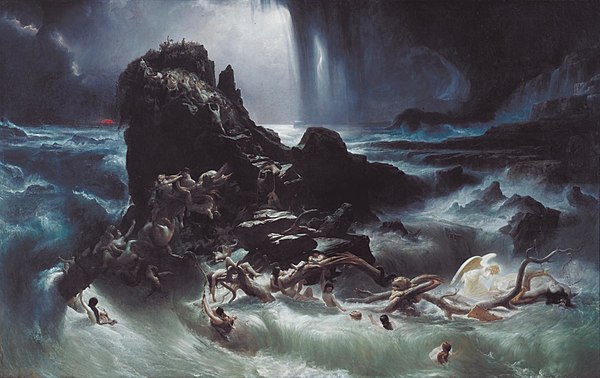
The Deluge, by Francis Danby, 1840

And God said to Noah: “The end of all flesh is coming before me, because violence has filled the earth on account of them, and here I am, their destroyer of the earth. Make for yourself an ark …” (Genesis 6:13-14)

God gives Noah explicit instructions on how to build the ark, and explains that the problem of human violence will be solved when God wipes out everything else on earth with a vast flood. Then God tells Noah to collect what will go inside the ark: a pair of every kind of animal; Noah and his wife, sons, and daughters-in-law; and food for everybody.

And Noah did so; everything that God commanded him, thus he did. Then God said to Noah: Enter, you and all your household, into the tevah, because in you I have seen tzadik before Me in this generation. (Genesis 6:22-7:1)

It sounds as if God approves of Noah’s passive obedience. Yet commentators through the ages have wondered why Noah does not try to talk God out of the Flood, the way Abraham tries to talk God out of destroying Sodom and Gomorrah by saying perhaps there are some innocent people among the wicked.

Most of the commentary I have read falls into two camps. One camp considers Noah either a failed prophet (because he did not warn anyone to repent) or a failed tzadik in the Chassidic sense (because he did not ask God to decree a different fate for the world). The other camp argues that God must have asked Noah to prophesy in an unrecorded conversation, and Noah must have done his best, while building the ark, to warn people about the flood and urge them to repent before it was too late.

But the commentary that alarms me the most comes from the 19th-century Rabbi Samson Raphael Hirsch. Hirsch wrote that performing God’s will is what matters; acting on the basis of your own judgment is of secondary and uncertain importance. So although Noah could have done other things, he was correct in doing exactly what God commanded, and no more.

I would say that if God only wants humans to do as they are told, God had no reason to plant the Tree of Knowledge in the Garden of Eden in the first place. Yet God not only places the Tree, but points it out to Adam by warning him not to eat from it. Then when Adam obediently avoids it, God creates Eve and the talking snake, so the humans finally eat. The taste of knowledge of good and bad gives humans have the ability to form opinions, and choose between them. Though we usually act out of habit and instinct, we have the ability to make new and creative choices.

Some rabbis have argued that the most desirable outcome is when a human deliberately chooses to do exactly what God wants. But sometimes there is a difference in the Torah between what God says and what God wants. On several occasions God “tests” (nasah) people to see what they will choose to do. For example, God tests Abraham by telling him to sacrifice his son Isaac as a burnt offering—but when Abraham binds his son on an altar and raises his knife, God intervenes to save Isaac’s life. It was only a test, and in a real test you do not tell the subject everything you want.

So when God tells Noah to build and supply the ark before the flood wipes out the earth, is that really all God wants Noah to do? Or is God testing him, to see whether Noah will warn people to repent, or even propose a different solution to God?

Suppose Hirsch is right, and God only wants us to choose to follow explicit directions. That not only makes the relationship between humans and God uninteresting, it also leaves us stranded when we have to make independent decisions that are not explicitly covered by the 613 rules in the Torah. The tradition of Jewish oral law tries to fill the gap, but it still cannot cover everything. Human beings often find themselves in situations where they need to figure out the best course of action for themselves.

Thank God!  I believe we humans shine when we discover, or invent, good ideas that nobody considered before. Choosing to follow God’s orders is a virtue of sorts. But we are blessed with the ability to rise above Noah’s level of virtue, and improve the world in ways the Torah never envisioned. Depending on how you define “God”, this might be what God really wants.

In my own lifetime, I have seen great progress in granting status, rights, and respect to people in groups that were subjugated for millennia, including women, people outside the traditional heterosexual model, and outsiders from different ethnic groups and countries. We still have farther to go, and some parts of the world lag far behind, but we have created a good path. The Torah merely assumes these groups will always be inferior, and offers a few paltry laws to protect the members of some groups within their inferior status. Thanks to our God-given abilities, humans are now working on a better vision.

The Torah also promotes war, while alluding to a distant future when war will disappear because everyone will worship the same god. But we can do better than that, thanks to our taste for knowing good from bad, our ability to transcend our habits and instincts and make choices, our creative minds, and our power to rise above ourselves to speak as prophets or tzaddikim. Someday humans may achieve an era of peace better than the one imagined in the Bible!

May it be God’s will … but most of all, may it become our will.

Noach: Spoiled

Noah’s ark is a favorite theme for children’s illustrators. Who can resist the animals climbing into, or out of, the ark in pairs? But the larger story is unnerving for adults: God decides to wipe out all life on earth because humans have “spoiled” it, and the most righteous man around makes no protest. His name, and the name of this week’s Torah portion, is Noach in Hebrew.

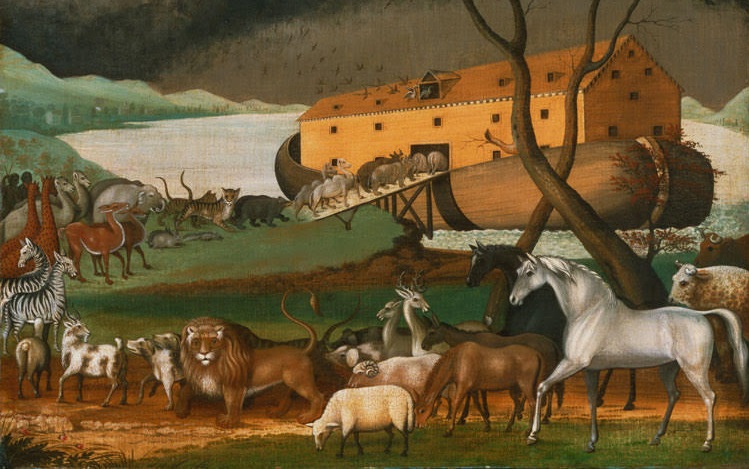
Noah’s Ark, by Edward Hicks, 1846 (detail)

God looked at the earth, and hey! nishechatah, because all flesh hishechit its way upon the land. And God said to Noah: “The end of all flesh is coming before Me, because the earth is filled with violence on account of them, so hey! —mashechitam along with the land. Make for yourself an ark … (Genesis/Bereishit 6:12-6:14)

nishechatah (נִשְׁחָתָה) = it had become spoiled, ruined. (A form of the verb shachat, שׁחת = spoil, ruin, corrupt.)

hishechit (הִשְׁחִית) = has spoiled, ruined; has wiped out. (Also a form of the verb shachat.)

mashechitam (מַשְׁחִיתָם) = spoiling themselves, ruining themselves. (Another form shachat.)

The God-character here sounds like a small child wailing, “They spoiled my toys!  Now everything is ruined! I’m going to kill them all, and wipe out the whole world! But me and my friends, we’ll build a boat and escape …”

Is God actually being childish in this passage? Is the Flood an overreaction? Or is humanity in this story irredeemable?

And is there any reason for wiping out all the other living things on the land?

One clue about the people of Noah’s generation is that the Torah calls them neither “humanity” (adam) nor “men” (anashim), but “all flesh” (kol basar). Perhaps the relationship between flesh and spirit in those early humans is spoiled; people’s spirits are unable to master their physical cravings. (See my post Bereishit & Noach: All Flesh.)

In the previous Torah portion, God creates the human out of two materials: dirt and the divine breath. Body and soul. Flesh and spirit. By Noah’s time, according to traditional commentary, the desires of human “flesh” have taken over. People think only of gratifying their physical appetites, and the desires of their spirits disappear.

According to some commentary, the people of Noah’s generation avoid having children, so they can devote more time to their own animal pleasures. Modern commentator Avivah Gottleib Zornberg argues that the real problem is the narcissism of these pleasure-seekers. If someone has no curiosity, no interest in other people, then love and kindness are impossible.1 I would add that if you do not care about other people, then you will speak and act with violence  whenever you feel like it (and believe you can get away with it).

According to the Torah, before the Flood all humans are wallowing in selfish sensuality, their souls beyond recovery, except for Noah (and possibly the other seven people God allowed on the ark: Noah’s wife, sons, and daughters-in-law). Noah is not a paragon; the Torah portion opens with this description:

These are the histories of Noah: Noah was a righteous man–he was unblemished in his generations–Noah walked with God. (Genesis 6:9)

In other words, compared to everyone else at the time, Noah is good. Presumably he retains the proper balance between his spirit and flesh, paying enough attention to his divine side to “walk with God”. But he never questions God’s plan to wipe out all life on earth. He is deficient in compassion, yet there is hope for him or his descendants.

So God decides not to give up on the human experiment altogether, but instead to destroy the failures, and start over again with Noah and his family. Then why does God choose to flood the earth, and wipe out millions of land animals and birds along with the irredeemable humans?

Traditional commentary claims that God made all the other animals, and everything else on earth, only for the sake of the human. Non-human life on earth has no value in itself. When humans use other living things for corrupt purposes, they have to be destroyed, too.

To me, this opinion demonstrates a lack of interest in, or curiosity about, the rest of the world. When a  commentator views other animals as merely tools for humans to use in carrying out God’s laws, he is committing the same error as the antediluvian man who views other animals as merely tools to use in the pursuit of selfish pleasure.

This is the kind of selfish attitude that leads people today to “spoil” nature: to pollute the air and water, to cut down forests, to disregard extinctions of species, and to do nothing about global climate change. They focus only on their own immediate desires, and take no interest in the earth and its life.

Clearly, human beings are still spoiled, and still spoiling the earth. In the Torah, after the Flood is over and Noah makes an animal sacrifice, God says to God’s heart:

Never again will I draw back to curse the earth (adamah) for the sake of the human (adam), because the shapings of the human heart are evil from its adolescence; and never again will I strike down every living being, as I have done. (Genesis 8:21)

God reseeds the earth with human beings who are still mixtures of dirt and divine breath, body and soul. God continues to grant humans free will, and accepts that sometimes adolescents and adults, people who are old enough to know better, will nevertheless choose evil. God’s experiment with humanity continues.

Today, we do not need an anthropomorphic God to create a flood. We humans have the ability to strike down every living being, all on our own. We are the ones melting the glaciers and ice caps, threatening to flood the earth. I just hope we have not completely spoiled it.


  1. Avivah Gottlieb Zornberg, The Beginning of Desire: Reflections on Genesis, Doubleday, New York, 1995, p. 46, 53, 54, 63.

Bereishit & Noach: All Flesh

Light and dark, good and evil, heaven and earth, spirit and matter—the narratives as well as the religious laws in the Torah often speak in terms of opposites.  In this universe of contrasting pairs, humans are a unique combination of the heavenly and the earthly.  This concept of humankind begins in the second chapter of Genesis:

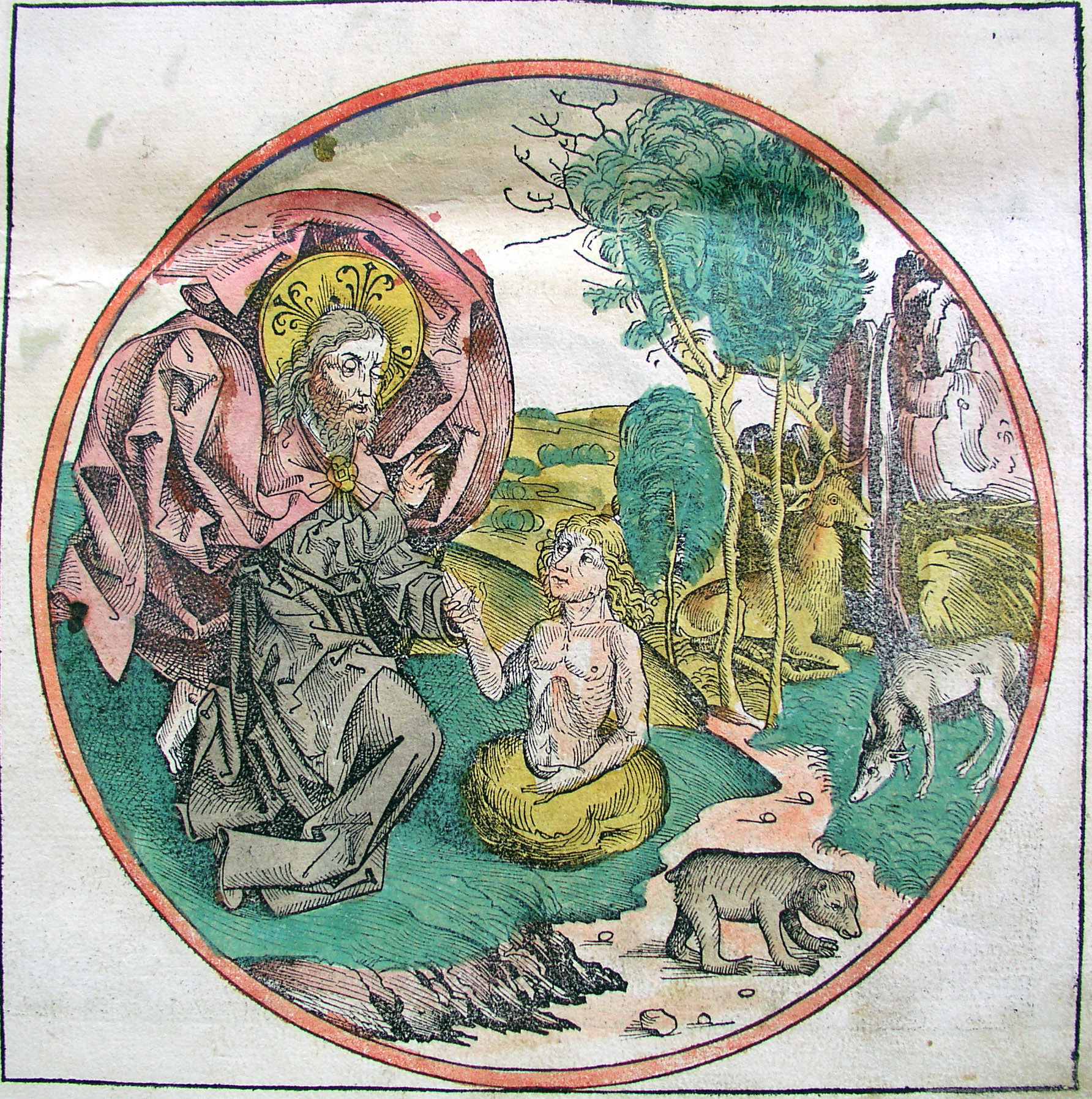
Creation of Adam, Nuremberg Chronicle, 1493

And God formed the human out of dirt from the ground, and blew into its nostrils the soul of life, and the human became a living being. (Genesis/Bereishit 2:7)

Humans are a combination of dirt and God’s breath—a vivid way of saying we are a combination of body and soul (in the English idiom), or basar (flesh) and ruach (spirit) in the biblical Hebrew idiom.

basar (בָּשָׂר) = flesh; muscle; all the soft tissue of a human or other animal, the part that can decay, be eaten, or be burned up; all mortal creatures

ruach (רוּחַ) = wind; spirit; temperament; divine movement or impulse

The word ruach appears right at the beginning of the Torah, at the beginning of the first creation story:

… and darkness was over the face of the deep, and the ruach of God was hovering over the face of the waters.  (Genesis 1:2)

The word basar first appears when God divides the primordial human into two sides, and refashions them into two independent creatures:

Then God cast the human into a supernal sleep, and took one of its side, and closed the basar.  And God built the side that It took from the human into a woman, and It brought her to the human.  And the human said:  This time, it is bone from my bone, and basar from my basar; this one will be called woman, because this one was taken from man. (Genesis 2:21-23)

Eleven generations and about a thousand years later, God observes that the human combination of flesh and spirit has led to a lot of bad thoughts and actions.

And God saw that the evil of the human on the earth was abundant, and all the shapings of its inventions were only evil, every day.  (Genesis 6:5)

How were they evil?  The next Torah portion, Noach (a resting place, serenity; as a proper name, “Noah”) gives us only a hint.

God looked at the earth, and hey! it had become spoiled, because all basar had spoiled its ways upon the earth.  So God said to Noach:  “An end of all basar is coming, because they have filled the earth with outrage; so here I am, about to spoil the earth.”  (Genesis 6:12-6:13)

When God warns Noah about the flood, God predicts the end of  all basar.  But when God proceeds to flood the earth, the Torah describes the end of the ruach  of humans and the other land animals.

Everything that had the soul of the ruach of life from God’s nostrils, out of all that was on dry land, died.  …and God wiped them away from the earth, and kept safe only Noach and those with him in the ark.  (Genesis 7:22-23)

Apparently the evil does not lie exclusively in either the basar (flesh, which is the “dirt” or inanimate matter that God brought to life) or the ruach (which means either wind or spirit: God’s movement inside us).  The evil may be in a spoiled relationship between flesh and spirit.

Medieval Jewish commentators said the problem was sexual immorality (one of their favorite topics).  The 19th-century rabbi Samson Raphael Hirsch explained that a righteous person refrains from sexual immorality by subordinating the physical, sensual drives of the flesh to the divine will of God’s spirit.  If, on the other hand, the spirit is subordinate to the flesh, then a person’s thoughts and actions will tend toward immorality, and be “spoiled”.

Jews have little or no monastic tradition, and even medieval rabbis carefully distinguished between morally desirable sex and immoral sex.  Today some of us might draw the line in a different place, but we still draw a line, and expect a decent human being to have enough self-control to refrain from immoral sexual acts.

And sex is not the only area in life where humans experience a conflict between the flesh and the spirit.  For example, sometimes we crave food or drugs that we know will have bad results for ourselves and other humans who depend upon us; if our flesh is not subordinate to our spirit, we act on our cravings.  Sometimes we have trouble giving up a material comfort our “flesh” is attached to, for the sake of a higher good.

It’s easy to condemn other people for not trying hard enough, when their spirit loses the struggle with an undesirable desire of the flesh.  But when I look deeper, I see people who find dieting manageable condemning those who try to diet without success; people who already have sexual self-control condemning those who succumb to temptation; people who can afford to buy hybrid electric cars condemning those who drive old gas-guzzlers.

In the Torah, God condemns and wipes out the whole human race except for Noah and his immediate family, and throws in millions of animals for good measure.  After the flood subsides, Noah sacrifices the excess animals that God included in the ark at the last minute, in Chapter 7.  By building an altar and completely burning up their flesh, Noah demonstrates that he values God more than animals, spirit more than flesh.

And God smelled the soothing fragrance, and God said to [God’s] heart:  I will not again denigrate the ground on account of the human , for the tendencies of the human heart are bad from its youth; so I will not again strike down everything that lives, as I have done.  (Genesis, 8:21)

Thus God decides to continue the experiment, continue with these strange combinations of physical flesh and divine spirit that we call adam, humankind.  God pulls back from condemnation because of the mere scent of a better relationship between flesh and spirit.

If God can do it in the Torah, maybe we can do it here on earth.  We humans all have bad tendencies, because we are all hybrid creatures of flesh and spirit.  My most troublesome bad tendency may be different from yours.  But I pray that I will notice what is good in you, and in myself ; that I will refrain from the impulse to condemn; and that I will become a humane human.

Noach: Babble and Meaning

(This blog was first posted on October 5, 2010.)

And all the earth was of one language and one set of words …   And they said: Come let us build a city for ourselves, and a tower with its head in the heavens, and let us make a name for ourselves, lest we be scattered all over the face of the earth.   And God went down to see the city and the tower …

And God said: Hey!  One people and one language for all, and this is what they begin to do? …  Come let Us go down there and scramble their language, so that they will not understand each other’s language.  Then God scattered them from there over the surface of all the earth, and they stopped building the city.  Therefore He called its name Babel, because there God scrambled the language of all the earth, and from there God scattered them over all the surface of the earth. (Genesis/Deuteronomy 11:1-9)

Babel = Babylon, from the Sumerian Babilim, “Gate of the God” (both city and region)

balal = scramble, confuse; thoroughly mix oil into grain for a meal offering

Obviously the people of Babel are doing something wrong—something that isn’t horrible enough for God to destroy them with a flood, but is  serious enough for God to investigate and correct their mistake.

What is their mistake?  Three theories are: that they don’t follow God’s order to scatter; that they enforce conformity and suppress individuality; and that they try for permanence in a world God created for change.

1) They refuse to scatter.

After the Flood, God tells Noah’s descendants to be fruitful and multiply and fill the land.  But the traumatized people are afraid of being scattered.  There is comfort in numbers—and in being able to see that nobody is engaged the kind of outrageous sins that led to the Flood.  I can imagine the anthropomorphic God in this story heaving a celestial sigh, wondering what it will take for humans to get with the program.  Then God scrambles their minds so they have different languages and different sets of words—i.e., different concepts.  This time, when God scatters the humans, they have so much trouble communicating that they stay scattered.

2) They suppress the individual.

The people of Babel speak only in the plural, and appear to be in perfect agreement.  No individuals are named in the story.  Whether this counts as cooperation, or conformity, it’s not what God has in mind.  Sforno (Rabbi Obadiah Sforno, 16th century) wrote that if everyone held the same beliefs, including the same beliefs about God, then no one would seek the true God.  Only when people find out about religious differences do they develop a desire for deeper understanding.   Martin Buber (1878-1965) wrote that only a person with a well-developed sense of self is able to connect with God.

In the allegory of Babel, after God scatters the people and gives them different languages and concepts and cultures, individuality and variety return to humankind.  Then we are again able to learn and change.

3) They crave permanence.

Permanence is a continuing issue in Genesis/Bereishit.  Although subsequent chapters focus on the desire for a sense of permanence through one’s descendants, the book has already addressed the issue of death.  The result of eating from the Tree of Knowledge in Eden is personal mortality; God removes Adam and Eve from the garden of Eden and places them in our own world, where they will eventually die.  Noah and his family witness the death of their entire world, and must start all over again when the Flood waters recede.

What is the meaning of life when, sooner or later, you will die?  One possible response is to create something that will outlast you, that will be a monument down through the ages.  This is difficult to do alone.  So the people act collectively to make a name for themselves, by building a city and a tower so high that its head is in the heavens.  (In this part of the Torah, the heavens are eternal, while the earth is always changing.)

Of course their plan fails.  God, or the nature of the universe God created, will not let anything on earth endure forever.

The answer is to give up on permanence, and find a different meaning of life.

Each human must find his or her own individual meaning.  But the book of Genesis offers some suggestions.  We can “walk with God”, which I interpret as behaving morally for its own sake.  We can raise and teach children.  We can love another person, as Isaac loves Rebecca and Jacob loves Rachel.  We can wrestle with ourselves and develop our own hidden potential, like Jacob wrestling and finding new courage at the ford of Yabbok.

What other ways can we find meaning in a life without permanence?  I welcome your comments.