Bereishit & Toledot: Seeing Red

The book of Genesis/Bereishit explores a series of conflicts between brothers, and one between sisters.  Two of these conflicts feature an especially hot-blooded, emotional brother, and both of these use various permutations of the word for the color “red”: adom, אָדֺם.

Blood red

After Cain kills Abel in the first Torah portion of Genesis, Bereishit, God tells Cain:
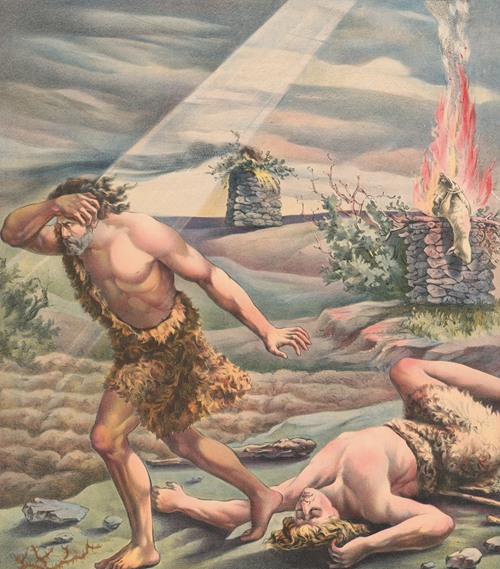
The Killing of Abel, Providence Lithograph Co., 1905

“What have you done? The voice of the damim of your brother is crying out to me from the adamah!”  (Genesis/Bereishit 4:10)
damim (דֱָמִים) = shed blood. (plural of damדָּם = blood.)
adamah (אֲדָמָה) = ground, dirt, earth.

Both Hebrew words come from the same root as adam (“human”, also the name of the father of Cain and Abel, whom God makes out of dirt in Chapter 2).  To be human is, among other things, to be red.  Dam, “blood”, is obviously red.  And traditional commentary explains that uncultivated earth (at least in the world described by the Torah) is red clay.

Red man, red stew

This week’s Torah portion, Toledot (“Histories”), tells the story of the twins Esau and Jacob, from their conception until they are in their forties and  Jacob flees because Esau is threatening to kill him.

Then her days of pregnancy were completed, and hey! –twins were in her womb.  And the first one went out, admoni all over like a fur robe of hair, and they called his name Eisav.  And after that his brother went out, and … they called his name Jacob.. (Genesis 25:24-26)

admoni (אַדְמוֹנִי) = reddish.

Eisav (עֵשָׂו) = Do it, get it done. (From the verb asahעָשָׂה = do.) “Esau” in English.

The text is not clear about whether he has ruddy skin and is covered with hair, or whether his fur-like hair is reddish.  Either way, he is born red, like blood, and hairy, like a beast.

Since Esau is born a moment before Jacob, he counts as the firstborn son.  In the world of the Torah, when the patriarch of an extended family dies, his firstborn son inherits a double portion of his father’s possessions, and also becomes the family’s priest.  Yet in this story, when Esau grows up and becomes a hunter, he does not care about the role of the firstborn.  Jacob, who stays in the tents, cares very much.

Jacob stewed a stew, and Esau came in from the field, and he was famished.  And Esau said to Jacob: “Please let me gulp down some of the adom— this adom— because I am famished.”  Therefore his name was called Edom.  (Genesis 25:29-30)

Edom (אֳדוֹם) = a people who later lived in the hill country east of the Jordan river valley, supposedly descended from Esau.  (From the same root as adom = red.)

Esau Selling His Birthright to Jacob, by Rembrandt, 17th c.

Jacob takes advantage of his incoherent brother’s request by charging an exorbitant price for the stew.

And Jacob said:  “Hand over, as of today, your right as firstborn to me”.  And Esau said:  “Hey, I am going toward death, so what is this to me, a firstborn right?”  Then Jacob said:  “Swear to me, as of today!”  And he swore to him, and he handed over his firstborn right to Jacob.  And as for Jacob, he gave to Esau bread and a stew of lentils.  And he ate and he drank and he got up and he went.  Thus he belittled the right of the firstborn.  (Genesis 25:31-34)

On a literal level, this story amuses me, because I often make stew from red lentils, and it always comes out a golden color.  Other kinds of cooked lentils are dark brown or green-brown—but never red.  Did someone who never cooked write down this story, and get the detail about lentils wrong?  I prefer to assume that Jacob is so clever, he adds an ingredient to his stew that will make even lentils look red enough to attract Esau’s attention.

Esau sees food and the color red.  He does not notice the lentils.  He cannot even find the word for stew.  The 19th-century commentator Samson Raphael Hirsch wrote that the color red delights Esau because it reminds him of the blood on an animal when his arrow hits it.1

The 20th-century psychologist Helen Luke wrote that red is the color of instinct, impulse, and emotion.  She added that Esau, who is controlled by the color red, is in danger of losing all civilizing tendencies and becoming evil.  Jacob, his opposite, is in danger of repressing or denying all instinct and emotion, and becoming evil.2

Neither Cain, the man of blood-red violence, nor Jacob, the bloodless schemer, is a good candidate for the spiritual role of the firstborn, the one who speaks with and makes offerings to God.

I think Jacob sees the world as black and white, divided between losers and winners.  Since he sees the firstborn as the winner in the family, he applies his intelligence to acquiring that role.  He suppresses any emotional impulses in order to carry out first his own scheme for taking his brother’s birthright, then his mother’s scheme for stealing his brother’s blessing.  Jacob may not savor his food as much as Esau, but he knows how to plan ahead.

Esau sees only red.  Carried away by one emotion after another during the Torah portion of Toledot, he carries out his impulses and lives for the moment.  In the passage translated above, he gives away his birthright to appease one day’s feelings of hunger and despair.  Later in the Torah portion, he weeps like a child when he finds out Jacob has stolen the blessing their father intended for Esau.  Then he becomes so angry he threatens to kill Jacob as soon as their father dies.

Jacob flees from him, and (in the Torah portion Vayeitzei) he meets his match in his cold, calculating uncle Lavan—whose name means “white” in Hebrew.  Yet some color finally comes into Jacob’s black-and-white life, as he falls in love with Lavan’s daughter Rachel.  Gradually he succeeds in becoming the leader of his own clan, through a combination of sensitivity to others’ emotions and rational long-term planning.

Meanwhile, Esau leaves home and learns how to be a leader.  When he hears that his twin and nemesis is coming his way (in the Torah portion Vayishlach), he plans ahead by bringing 400 men to meet Jacob on the road.  But he retains his emotional instincts, and when he sees Jacob bow to him, he runs over and embraces his brother.  The two older and wiser men pull off a peaceful reunion.


We all have some of Jacob’s black-and-white rationalism and some of Esau’s red emotionalism.  We can only be whole human beings when those two sides embrace.

Furthermore, in order turn our whole personality toward peace rather than toward evil, we must learn from the evolution of both brothers.  Jacob learns to use his black-and-white intellect to lay plans for the good of everyone, instead of for just his own advantage.  And Esau learns to move beyond seeing red as the blood shed in killing, and see red as the blood of life, shared with other humans.

If we can widen our vision enough, through both our intellects and our emotions, we will recognize that all human beings share the same blood; we are descendants of Adam, אָדָם = the human, humankind. (From the same root as adom = red.) Then we will all truly deserve the right of the firstborn to speak with and offer gifts to God.


  1. Rabbi Samson Raphael Hirsch, The Hirsch Chumash: Sefer Bereshis, Feldheim Publishers, Jerusalem, 2002, pp. 561-562.
  2. Helen Luke, Kaleidoscope, Parabola Books, New York, 1992, p. 225.
Bereishit & Noach: All Flesh

Light and dark, good and evil, heaven and earth, spirit and matter—the narratives as well as the religious laws in the Torah often speak in terms of opposites.  In this universe of contrasting pairs, humans are a unique combination of the heavenly and the earthly.  This concept of humankind begins in the second chapter of Genesis:

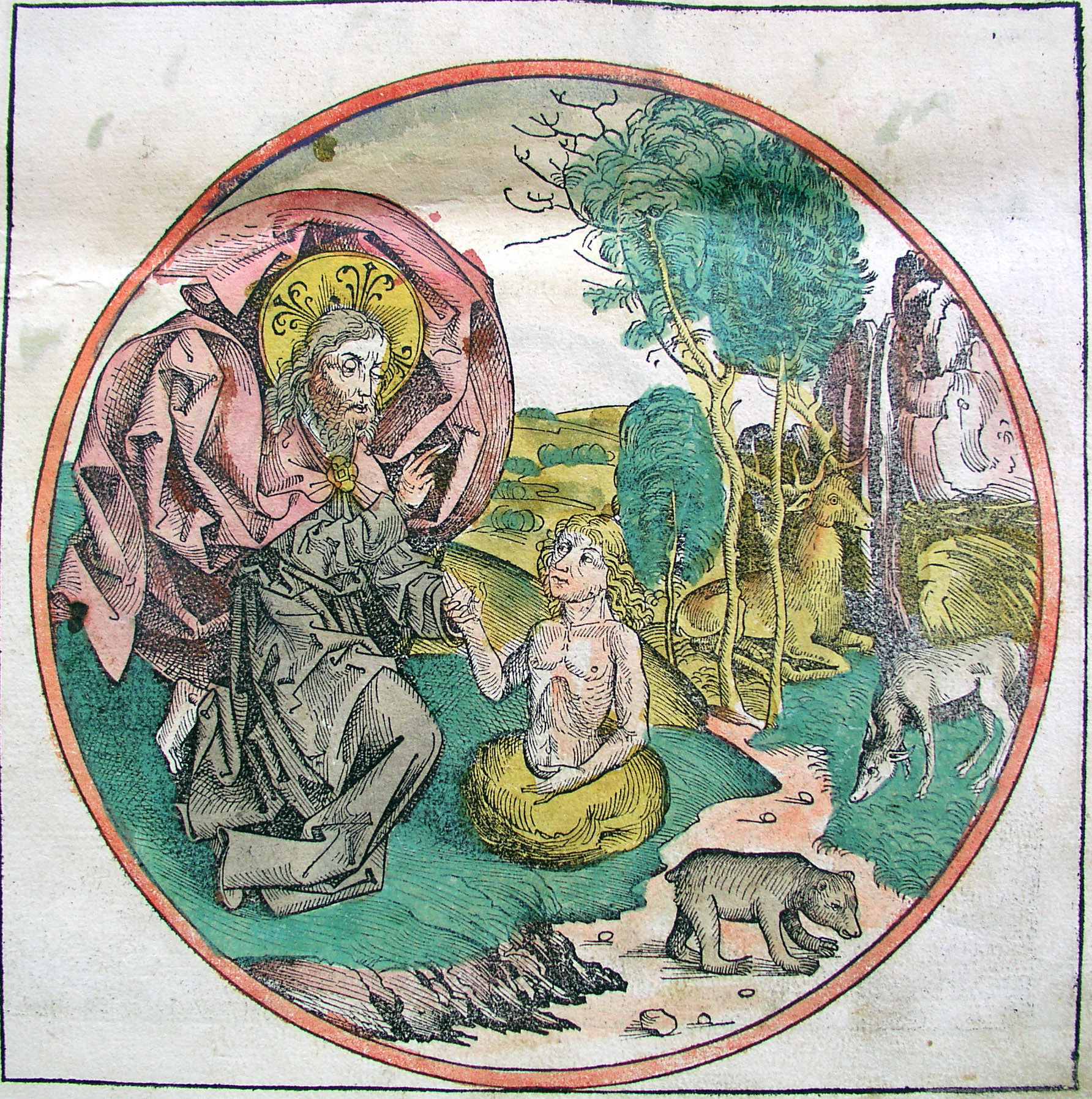
Creation of Adam, Nuremberg Chronicle, 1493

And God formed the human out of dirt from the ground, and blew into its nostrils the soul of life, and the human became a living being. (Genesis/Bereishit 2:7)

Humans are a combination of dirt and God’s breath—a vivid way of saying we are a combination of body and soul (in the English idiom), or basar (flesh) and ruach (spirit) in the biblical Hebrew idiom.

basar (בָּשָׂר) = flesh; muscle; all the soft tissue of a human or other animal, the part that can decay, be eaten, or be burned up; all mortal creatures

ruach (רוּחַ) = wind; spirit; temperament; divine movement or impulse

The word ruach appears right at the beginning of the Torah, at the beginning of the first creation story:

… and darkness was over the face of the deep, and the ruach of God was hovering over the face of the waters.  (Genesis 1:2)

The word basar first appears when God divides the primordial human into two sides, and refashions them into two independent creatures:

Then God cast the human into a supernal sleep, and took one of its side, and closed the basar.  And God built the side that It took from the human into a woman, and It brought her to the human.  And the human said:  This time, it is bone from my bone, and basar from my basar; this one will be called woman, because this one was taken from man. (Genesis 2:21-23)

Eleven generations and about a thousand years later, God observes that the human combination of flesh and spirit has led to a lot of bad thoughts and actions.

And God saw that the evil of the human on the earth was abundant, and all the shapings of its inventions were only evil, every day.  (Genesis 6:5)

How were they evil?  The next Torah portion, Noach (a resting place, serenity; as a proper name, “Noah”) gives us only a hint.

God looked at the earth, and hey! it had become spoiled, because all basar had spoiled its ways upon the earth.  So God said to Noach:  “An end of all basar is coming, because they have filled the earth with outrage; so here I am, about to spoil the earth.”  (Genesis 6:12-6:13)

When God warns Noah about the flood, God predicts the end of  all basar.  But when God proceeds to flood the earth, the Torah describes the end of the ruach  of humans and the other land animals.

Everything that had the soul of the ruach of life from God’s nostrils, out of all that was on dry land, died.  …and God wiped them away from the earth, and kept safe only Noach and those with him in the ark.  (Genesis 7:22-23)

Apparently the evil does not lie exclusively in either the basar (flesh, which is the “dirt” or inanimate matter that God brought to life) or the ruach (which means either wind or spirit: God’s movement inside us).  The evil may be in a spoiled relationship between flesh and spirit.

Medieval Jewish commentators said the problem was sexual immorality (one of their favorite topics).  The 19th-century rabbi Samson Raphael Hirsch explained that a righteous person refrains from sexual immorality by subordinating the physical, sensual drives of the flesh to the divine will of God’s spirit.  If, on the other hand, the spirit is subordinate to the flesh, then a person’s thoughts and actions will tend toward immorality, and be “spoiled”.

Jews have little or no monastic tradition, and even medieval rabbis carefully distinguished between morally desirable sex and immoral sex.  Today some of us might draw the line in a different place, but we still draw a line, and expect a decent human being to have enough self-control to refrain from immoral sexual acts.

And sex is not the only area in life where humans experience a conflict between the flesh and the spirit.  For example, sometimes we crave food or drugs that we know will have bad results for ourselves and other humans who depend upon us; if our flesh is not subordinate to our spirit, we act on our cravings.  Sometimes we have trouble giving up a material comfort our “flesh” is attached to, for the sake of a higher good.

It’s easy to condemn other people for not trying hard enough, when their spirit loses the struggle with an undesirable desire of the flesh.  But when I look deeper, I see people who find dieting manageable condemning those who try to diet without success; people who already have sexual self-control condemning those who succumb to temptation; people who can afford to buy hybrid electric cars condemning those who drive old gas-guzzlers.

In the Torah, God condemns and wipes out the whole human race except for Noah and his immediate family, and throws in millions of animals for good measure.  After the flood subsides, Noah sacrifices the excess animals that God included in the ark at the last minute, in Chapter 7.  By building an altar and completely burning up their flesh, Noah demonstrates that he values God more than animals, spirit more than flesh.

And God smelled the soothing fragrance, and God said to [God’s] heart:  I will not again denigrate the ground on account of the human , for the tendencies of the human heart are bad from its youth; so I will not again strike down everything that lives, as I have done.  (Genesis, 8:21)

Thus God decides to continue the experiment, continue with these strange combinations of physical flesh and divine spirit that we call adam, humankind.  God pulls back from condemnation because of the mere scent of a better relationship between flesh and spirit.

If God can do it in the Torah, maybe we can do it here on earth.  We humans all have bad tendencies, because we are all hybrid creatures of flesh and spirit.  My most troublesome bad tendency may be different from yours.  But I pray that I will notice what is good in you, and in myself ; that I will refrain from the impulse to condemn; and that I will become a humane human.

Bereishit: Fairness & Free Will

(This blog was first posted on September 26, 2010.)

And God said to Cain:  Why did you heat up, and why did your face fall?  Isn’t it true that if you do good, there is uplifting?  And if you do not do good, sin is lying like a beast at the door, and its hunger is for you.  But you, you can rule over it.  (Genesis/Bereishit 4:6-7)

chatat = sin, moral violation, missing the mark, going off track, fault, guilt

Yes, God gives Cain a warning, and he kills his brother anyway.

The first time I read the story of Cain and Abel in Hebrew, I saw it in a new light.  Cain’s name in Hebrew is kayin, which means “spear”, and may or may not be related to the word kanah, “acquire”.  But Abel’s name in Hebrew is hevel—the same word that is translated as “vanity” in the King James version of Ecclesiastes/Kohelet.  A hevel is a puff of air, a vapor, something transitory and insignificant; it can also be translated as “emptiness” or “futility”.

Somebody named Abel might well be a virtuous shepherd who brings a superior sacrifice to God.  But somebody named Futility?  Or Puff?  I don’t think so.

Puff’s insubstantiality is underscored by the description of the births of Adam and Eve’s first two sons.  First the Torah says: She conceived and she gave birth to Cain, and she said: I have created a man with God.  Then it says:  And she added to the birthing his brother, Puff.  Clearly Cain is the important character.  Puff is merely a foil for Cain’s drama.

Cain is the one who gets the idea of bringing an offering to God, and since he works the soil like his father Adam, he brings a sacrifice from the fruit of the ground.  Puff then imitates Cain, and brings a sacrifice from the firstborns of his flock and from their fat.

God pays attention to Puff’s offering, and ignores Cain’s.  (The Torah does not say how God demonstrated this attention, but somehow Cain could tell.  Medieval commentary said that fire from heaven devoured Puff’s animals, but left Cain’s fruits and vegetables untouched.)

Then Cain gets upset; in the metaphor of the Torah, he becomes hot, and his face falls.  I remember how upset my own son used to get when he was small and something unfair happened.

Is God’s action unfair?  Traditional commentary argues that Puff’s sacrifice is superior to Cain’s, so he deserves God’s favor.  But I don’t buy it.  It’s true that later in the Torah, firstborn animals and fat are especially appropriate for sacrifices, so Puff gave God the best he had.  But the text says nothing about the quality of Cain’s gifts; he might have offered the best he had, too.  And given that at this point God still expects humans to be vegetarians, it seems odd that God would prefer the sacrifice of animals.

I think God’s action is deliberately unfair, and its purpose is to give Cain a test or  challenge.  God then gives Cain a strong hint with the warning translated above.  Never mind whether life is fair, God implies.  The important thing is to do good yourself, regardless.  If you do, you’ll be uplifted.  But if you succumb to the animal impulse to do evil, you’ll be eaten up by it.  Believe me, you have the ability to overrule that impulse.  So here’s your chance to prove yourself.

Alas, Cain fails the test and kills his brother.

Traditional commentary claims this is the second time a human fails one of God’s tests, the first time being in the garden of Eden.  But I think that when God creates the adam (which means “human” or “humankind”) out of dirt and the divine breath, this new creature is incomplete, not entirely human yet.  God transfers the proto-human into an otherworldly place in which all the animals subsist on fruit.  Judging by God’s “curses” on man, woman, and serpent, the garden of Eden has no weeds, thorns, pain, birth, or death; it’s not part of the real world we know.

The whole point of Eden seems to be to expose the adam to the Tree of Knowledge.  God points out the tree to the creature by saying: From all the trees of the garden you may certainly eat; but from the Tree of Knowledge of Good and Bad, you may not eat, because once you eat from it you will certainly die.

When the adam doesn’t do anything about this prohibition, God divides it into two beings, male and female counterparts.  This does the trick; the female human accepts the challenge, and both of them eat from the Tree of Knowledge.  Now they are truly human: they exercise free will, they have a moral sense that other animals lack, and they are mortal.  Now God can take them out of Eden and return them to the real world to get the history of humanity going.

But apparently humanity needs another nudge from God.  The knowledge of good and bad that Adam and Eve acquired in Eden is still nascent and primitive.  A real test is needed to show humanity what free will and good and evil really mean.  So God sets it up, with Puff as the foil for Cain.  Cain has a good impulse, wanting to show his gratitude for the produce of the earth, and gives some to God.  God responds with unfairness, injustice.  Cain has a primitive intuition of good and evil, and gets upset when life isn’t fair.  And God tells Cain to get over it, and use his free will, his ability to override his impulses and make deliberate choices, his ability to act according to a higher morality.  This is the first real test of a human being.

Cain flunks the test.  And to this day, human beings keep on flunking the test.  We lash out at unfairness, we take revenge, and we murder our brothers, our fellow human beings.

But some of us grow up.  Some of us hear an echo of God’s message to Cain, and override our angry impulses, and choose to behave with more virtue.  It’s not easy at first, but gradually we can develop a habit of choosing good over evil, of keeping the hungry beast at the door at bay.  We can make the beast lie outside, instead of letting it come in and take over.

Is humanity making any progress on this hard path?  Examples of atrocities are still all too easy to find.  But I believe that more and more people are recognizing them as atrocious.  The world is still full of Cains.  But maybe, in some future century, if humanity lasts long enough, we will all finally be able to hear God’s warning to Cain, and rule over our emotional reactions to unfairness, and dedicate ourselves to choosing good, no matter what.

May it happen soon.