Yitro & Mishpatim: Four Attempts at a Lasting Covenant

(This is my ninth post in a series about the conversations between Moses and God, and how their relationship evolves in the book of Exodus/Shemot. If you would like to read one of my posts about this week’s Torah portion, Vayakheil, you might try: Vayakheil & Psalm 13: Waiting in Contentment.)


Between God and Moses’ conversation at the burning bush on Mount Sinai and God’s revelation to all the Israelites at the same mountain a couple of years later, the God-character in Exodus maintains the same approach to Moses: calm, reassuring, patient with all of his prophet’s panic and dithering, but always nudging him to take the next step toward becoming the human leader of the Israelites.

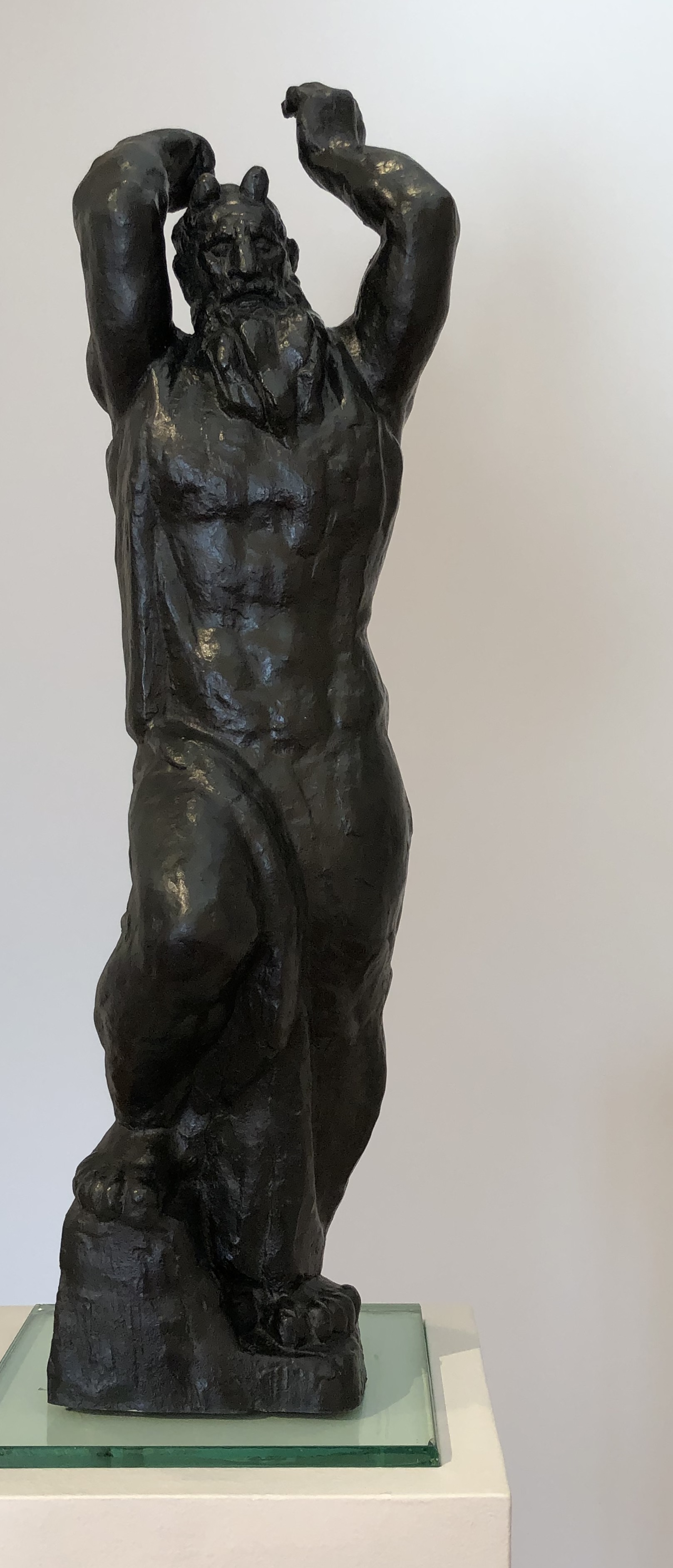
Study of Moses, by Ivan Mestrovic, 1934

By the time Moses returns to Mount Sinai, he has become that leader. His experiences have changed him from a frightened introvert with an inferiority complex who is certain he cannot speak convincingly or lead anyone (see my posts Shemot: Not a Man of Words and Shemot: Moses Gives Up) into someone who asks God for advice, but is prepared to speak and to make decisions for his people when necessary (see my post Beshalach: Moses Graduates). While God remains the ultimate authority, Moses is the human leader whom the Israelites both follow and complain to.

Now that the Israelites have camped at the foot of God’s mountain, they must make a binding covenant with God. Moses, knowing he must arrange it, orchestrates four covenants in a row.

First covenant

One the Israelites have pitched camp, Moses climbs up the mountain to speak with God—even though he had no trouble speaking with God at any place in Egypt or on the journey across the wilderness. Perhaps at Mount Sinai, he keeps hiking up and down so that all the Israelites can see him when goes to speak with God. (See my post Yitro: Moses as Middle Manager.) The first time he walks back down,

Moses came and summoned the elders of the people, and he set before them all these words that God had commanded him. And all the people answered as one, and they said: “Everything that God has spoken, we will do!” Then Moses brought the words of the people back to God.  (Exodus 19:7-8)

This is the first covenant, an oral agreement. “All these words that God had commanded him” are only that the people must “really listen to my voice and observe my covenant” and become “a kingdom of priests, a holy nation”. In return, God promises that the Israelites will be God’s personal treasure out of all the nations on earth.1

This initial agreement may be inspiring, but it lacks specifics.

Second covenant

The Law on Mount Sinai, by Jan Luyken, 1708

Three days later, God stages what Jews call “The Revelation”, which includes dense cloud, thunder, lightning, the sound of a ram’s horn blowing, smoke, and earthquake.2 Moses leads the people out of the camp to the foot of the mountain.

And God came down upon Mount Sinai, to the top of the mountain. And God summoned Moses to the top of the mountain, and Moses went up. (Exodus 19:20)

Moses obeys even though Mount Sinai seems to be an erupting volcano. Clearly he has learned to trust God to preserve his life.

Before the revelation begins, God tells Moses:

“Hey, I myself am coming to you in a dark cloud, so that the people will listen when I speak with you, and also they will trust you forever.” (Exodus 19:9)

We do not know whether the dark cloud is the smoke emerging from the mountain, or a manifestation of God coming down from the heavens.

At this point, the redactor of the story inserts what have become known as the Ten Commandments (called “The Ten Words” when they are repeated in Deuteronomy).3 Then God’s revelation continues with:

And all the people were seeing4 the sounds of thunder and the flashing lights and the sound of the ram’s horn and the smoking mountain. And the people saw, and they trembled, and they stood at a distance. And they said to Moses: “You speak with us, and we will listen! But may God not speak with us, lest we die!”5 (Exodus 20:15-16)

God’s plan is working; the people are terrified of God—and they now trust Moses and promise to listen to whatever he says God said.

Moses steps closer to the dark cloud where God is, and God tells him the dozens of laws in verses 20:21 through 23:22, which are more specific than the “Ten Commandments”. Most of the laws are ethical rules for an agrarian society, including two laws about not oppressing an imigrant.6

Then comes God’s side of the covenant:

“And you must serve God, your God! And [God] will bless your food and your water, and I will remove sickness from among you. There will be no miscarriage or barrenness in your land, and the number of your days I will make full. My terror I will send before you, and I will panic all the people among whom you come, and I will give all your enemies to you by the neck.” (Exodus 23:25-27)

The ancient Israelites prized fertility as well as good health and long life. And people facing a protracted war for land ownership would be relieved to learn that God will be on their side—as long as they follow the rules.

The final word from God during this session with Moses is about the Canaanite tribes that have been living for centuries in the land God will give to the Israelites:

“You must not cut a covenant with them or their gods. They must not dwell in your land, lest they cause you to do wrong against me.” (Exodus 23:32-33)

Immigrants should be treated fairly, but existing residents of Canaan must be rejected.

Then God tells Moses:

“Come up to God, you and Aaron, Nadav and Avihu, and seventy elders of Israel, and bow down from a distance. Then Moses alone will come close to God, but they must not come close, and the people must not go up with him.” (Exodus 24:1-2)

But first, without any order from God, Moses confirms a second oral covenant between God and the people.

Then Moses came and recounted to the people all the words of God and all the laws. And all the people answered with one voice, and said: “All the words that God has spoken, we will do!” (Exodus 24:3)

Third covenant

Next on God’s agenda is a special revelation and covenant partway up Mount Sinai, between God and seventy elders plus Aaron and his two older sons. But Moses has a different idea. He imagines a written covenant, which he will notarize with ritual elements that the Israelites are accustomed to: an animal sacrifice and the splashing of its blood. And God does not interfere with Moses’ plan.

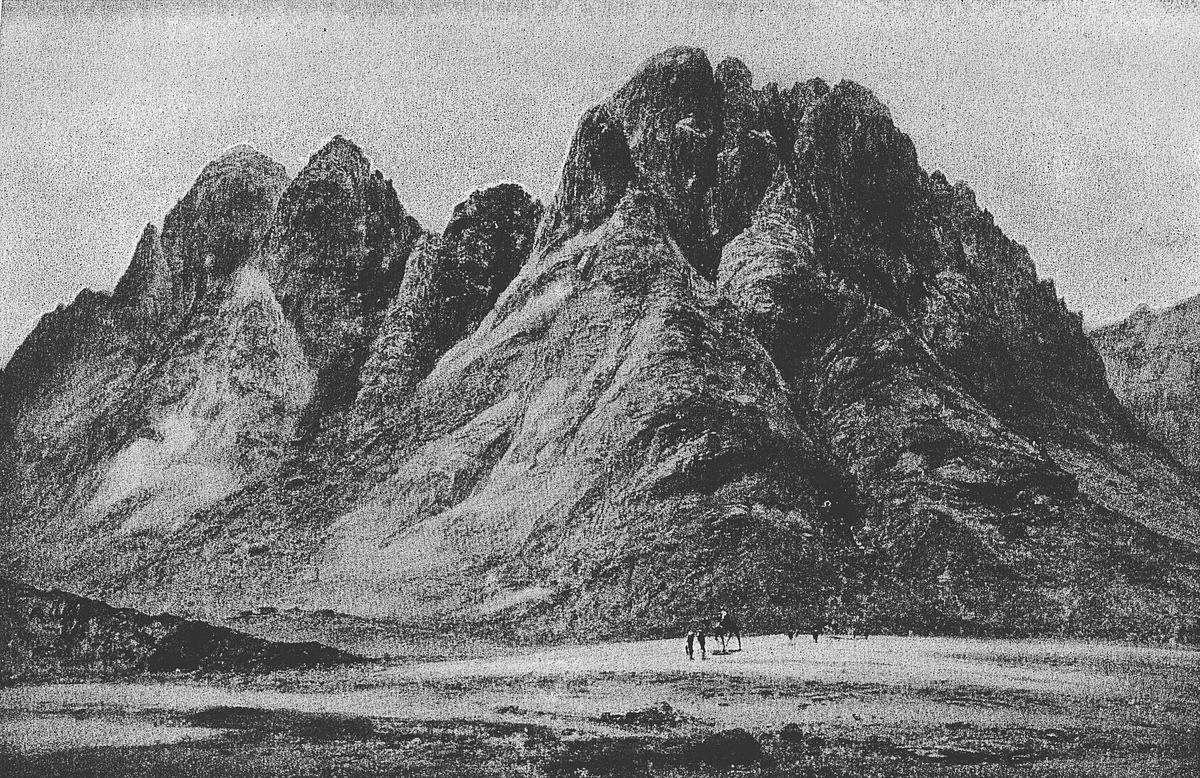
Standing stones on the Sinai Peninsula, photo by Emmanuel Anati

Then Moses wrote down all the words of God. And he started early in the morning and he built an altar below the mountain, and twelve standing-stones for the twelve tribes of Israel. And he sent the young men of the Israelites, and they made rising offerings and slaughtered wholeness offerings for God: bulls. And Moses took half the blood and put it in bowls, and half the blood he threw over the altar. (Exodus 24:2-6)

The altar represents God in this covenant ceremony, so Moses scatters half of the blood over it. He reserved the other half for the Israelites after they have agreed to the covenant.

Then he took the scroll of the covenant, and read it in the hearing of the people. And they said: “Everything that God has spoken, we will do and nishma!”  (Exodus 24:4-7)

nishma (נִשְׁמָע) = we will listen, hear, pay attention, heed, obey.

This time the people add another vow after “we will do”. Why do they add nishma? According to one early commentary, their vow should be translated as “We will do, and then we will understand.”7 The people were wise enough to realize that sometimes you cannot understand what an action means until after you have done it.

Another explanation is that the Israelites meant: “We will carry out what God has said already, and we are also prepared to listen (obey) to what He will command from here on in.”8

Either way, the people make a stronger commitment (although they break it when they worship the golden calf). And Moses figured out how to inspire them to make that commitment.

Then Moses took the blood and threw it on the people, and he said: “Here! The blood of the covenant that God cut with you according to all these words!”9 (Exodus 24:8)

Only after the Israelites as a whole have finished ratifying the written covenant with God does Moses carry out God’s order regarding the seventy elders.

Fourth covenant

Then went up, Moshe and Aharon, Nadav and Avihu, and seventy of the elders of Israel. And they saw the God of Israel, and under [God’s] feet something like a brick pavement of sapphire, and like the substance of the heavens for purity. And God did not send out [God’s] hand to the eminent Israelites. Vayechezu God, and they ate and they drank. (Exodus 24:10-11)

vayechezu (וַיֶּחֱזוּ) = and they beheld, saw in a vision, perceived.

This may not sound like a covenant between God and the elders. Furthermore, many medieval Jewish commentators criticized the Nadav, Avihu, and the elders for eating and drinking at a time like that.10 Others wrote that looking at God “provided them with the kind of satisfaction ordinary people get through the intake of food and drink”.11

But one 13th-century commentary pointed out: “…we know from Avraham, Yitzchok and Yaakov, that when they made a pact with human beings, they invariably sealed it by having a festive meal with their partner.”12

Rabbi Steinsaltz wrote in his 2019 commentary: “And they beheld God, to the extent that this is possible, and ate the peace offerings and drank, as though sharing a meal with God.”13


Moses walks to the top of a smoking, thundering volcano because he trusts God to keep him safe. And God goes along with Moses’ additional covenant ritual because he trusts Moses to know what the Israelites need. The two leaders have reached a point of harmony.

Until God decides to test Moses, and Moses decides to test God.

To be continued …


  1. See my post: Yitro: Moses as Middle Manager.
  2. Exodus 19:16-20; Deuteronomy 4:13.
  3. Exodus 20:1-14.
  4. Exodus 20:15 says “the people ro-im (רֺאִים)” sounds as well as sights. Usually ro-im means “were seeing”. Some translations say “the people were perceiving”. Others suggest that the people were experiencing synesthesia.
  5. The story assumes that Moses could hear the people below when he was on top of the mountain. Perhaps the authors imagined a shorter mountain than any of the current top candidates for Mount Sinai: Jabal Sin Bisher, Jabal Musa, and Chashem el Tarif.
  6. Exodus 22:20, 23:9. The word geir (גֵר) is often translated as “stranger”, but it means a resident alien or immigrant.
  7. Avot DeRabbi Natan 22:1, c.700–900 CE, translation in www.sefaria.org.
  8. Rashbam (12th century Rabbi Shmuel ben Meier), translation in www.sefaria.org.
  9. The story assumes that enough of the thousands of Israelites were splashed with blood to make the ritual effective.
  10. From Rashi (11th century) to Rabbeinu Bachya (14th century).
  11. Chayim in Attar, Or HaChayim, 18th century, translation in www.sefaria.org. This concept also appears in Talmud Bavli, Berakhot 17a.
  12. Chizkuni, 13th ccentury, translation in www.sefaria.org.
  13. Rabbi Adin Even-Israel Steinsaltz, The Steinsaltz Tanakh, Koren Publishers, Jerusalem, 2019, quoted in www.sefaria.org.

Yitro: Moses as Middle Manager

(This is my eighth post in a series about the conversations between Moses and God, and how their relationship evolves in the book of Exodus/Shemot. If you would like to read one of my posts about this week’s Torah portion, Ki Tisa, you might try: Ki Tisa: Making an Idol Out of Fear.)


The Israelites reach Mount Sinai three months after they leave Egypt, and perhaps a couple of years after God recruited Moses on that same mountain to serve as their prophet and leader.

The ultimate goal of the Israelites’ journey is Canaan, which God has promised to give them as their own land (after dispossessing the people who already live there). But Moses knows that Mount Sinai, also called Mount Choreiv or simply “the mountain of God”, is a necessary stop on the way. Back when God first spoke to Moses, out of the fire in the bush that burned but was not consumed, God said:

“When you [singular] have brought the people out of Egypt, you [plural] will serve God at this mountain.” (Exodus 3:12)

Moses does not know that this is the spot where God will stage an impressive revelation, and make a covenant with the Israelites. But after all his leadership training in Egypt and on the road, he is ready for whatever God has in mind. (See my posts Shemot to Bo: Moses Finds His Voice and Beshallach: Moses Graduates.)

Up and down the mountain

… and Israel camped there, opposite the mountain. And Moses went up to God, and God called to him from the mountain, saying: … (Exodus 19:2-3)

Moses takes the initiative and starts climbing up the mountain before God calls to him. According to the 18th-century commentary Or HaChayim,

“Moses felt that if he waited until he would be asked to ascend, this would demonstrate both lethargy on his part and perhaps even unwillingness. … As soon as God noticed that Moses was ascending, God called out to him. You have to remember that it is in the nature of sanctity, not to make the first move towards a person until that person has made active preparations to welcome such sanctity.”1

God Appears to Moses, anonymous English woodcut, 1539

Yet in Egypt, when Moses first initiated a conversation with God, he did not go to any special place first.2 Moses and God have had conversations in Egypt, at the Reed Sea, and at several spots on the road to Mount Sinai, all without special preparations.

I think Moses follows a different procedure when the Israelites reach Mount Sinai because he knows that something significant will happen there, even though he does not know what. Now that they have arrived, Moses does not wait for God to make the first move. He has learned how to think like a leader. So he decides to show the Israelites that this mountain is God’s place, where something important will happen. So he decides to show the Israelites that this mountain is God’s place by climbing up while everyone watches. Does Moses walk to the spot where he first heard God’s voice? Or does he climb to the summit, closer to the “heavens”? The book of Exodus does not say.

Then God calls to him and says:

“Thus you shall say to the house of Jacob, and you will tell to the children of Israel:3 ‘You yourselves have seen what I did to Egypt, and how I carried you on wings of eagles and I brought you to me. And now, if you really listen to my voice and observe my covenant, you will become to me a segulah out of all the peoples—for all the earth is mine.” (Exodus 19:3-5)

segulah (סְגֻלָּה) = personal treasure, cherished possession.

This is the first time the Torah says God has a segulah. Three later references in the Hebrew Bible say both that the Israelites are God’s segulah and that God “chose” them.4 A standard idea in the Ancient Near East was that each god had his or her own chosen people. The God character in Exodus claims power over all the peoples on earth, but makes the offer of becoming God’s segulah only to the Israelites.

Here God may be using the word segulah to introduce the idea of a covenant or treaty. Being God’s personal treasured possession is conditional upon the people’s behavior: they must earn that status by paying attention to God’s instructions and keeping God’s yet-to-be-revealed covenant with them.

The God character in the Torah definitely plays favorites. Just as God did favors for Abraham, Isaac, Jacob, and Joseph in the book of Genesis, God does favors for Moses in the book of Exodus. So far in this book, God has been patient not only with Moses, but also with the Israelites—even though they keep wanting to go back to Egypt.5

God finishes by saying:

“‘And you, tiheyu to me a kingdom of priests, and a holy nation!’ These are the words that you must speak to the Children of Israel.” (Exodus 19:6)

tiheyu (תִּהְיוּ) = you (plural) will be, will become, would become, should become, must become.

In Exodus 28:1-2, during Moses’ first 40-day stint on top of Mount Sinai, God tells him that Aaron and his sons will be the priests of the new Israelite religion. It is unlikely that God first plans a religion in which everyone (or at least every man) is a priest, and then switches to the hereditary priesthood plan in less than two months. During that period, all the Israelites agree to the covenant with God three times, and do not disobey any of God’s laws.

On the last day of Moses’ 40-day stint, the Israelites commit a major violation by demanding an idol to follow. But Aaron is the one who makes them a golden calf. So God would have no reason to install Aaron and his sons as the priests instead of letting every Israelite be a priest.

Perhaps ‘And you, tiheyu to me a kingdom of priests, and a holy nation!’ is a goal for the distant future, rather than an immediate divine plan. The sentence could be translated: “And you, you should become to me a kingdom of priests, and a holy nation.”

Rabbi Lord Jonathan Sacks wrote that God’s pronouncement means:

“The Israelites were called on to be a nation of servant-leaders. They were the people called on, by virtue of the covenant, to accept responsibility not only for themselves and their families, but for the moral-spiritual state of the nation as a whole.”6

One of the duties of the priests, we learn in Leviticus 10:10-11, is to teach the people about God’s rules. In a kingdom of priests, presumably, everyone would remind everyone else about the right thing to do.

Up and down again

And Moses came and summoned the elders of the people, and he set before them all these words that God had commanded him. And all the people answered as one, and they said: “Everything that God has spoken, we will do!” Then Moses brought the words of the people back to God.  (Exodus 19:7-8)

The implication is that Moses climbed back to the top of the mountain to give God the people’s reply. Rashi repeated a common objection in the classic commentary when he wrote:

“But was it really necessary for Moses to deliver the reply to God? God is Omniscient! — But the explanation is that Scripture intends to teach you good manners from the example of Moses …”7

Although later theologians decided that God is omniscient, the God character in the Torah does not know ahead of time what human beings will do.8 This God also loses track of what the Israelites are doing; they suffer because of forced corvée labor for many years before God hears their moaning and recruits Moses to lead them out of Egypt.9 Moses knows how long it took for God to notice the cries of the Israelites. Perhaps now he reports the Israelites’ reply in case God missed it in a moment of distraction.

Moses might also think that climbing Mount Sinai again is more likely to get God’s attention than standing at the bottom and silently praying.

When Moses reaches the top of the mountain again, God speaks first.

The Cloud of Smoke over Mount Sinai, by James Tissot, circa 1900

And God said to Moses: “Hey, I myself am coming to you in a dark cloud, so that the people will listen when I speak with you, and also they will trust you forever.” Then Moses told the words of the people to God. (Exodus 19:9)

Rabbi Rami Shapiro explained:

“God isn’t saying that He will speak directly to the people that they may know He is God, He is saying that He wants the people to see that He is speaking to Moses so that they will believe that when Moses says such and such is the word of God, they will trust him. There is no reason to think that the people will even overhear what God is saying to Moses; all they will hear is that something is being spoken. Which is exactly what happens …”10

After Moses has reported how the people promised to do everything God said, God gives Moses orders to prepare the Israelites for a revelation (including a dark cloud) in three days. God tells him to make the people holy (without describing the method), to have everyone wash their clothes, to set a boundary around the mountain, and to warn the people that anyone who crosses that line, or even touches it, will be put to death.

Then Moses went down from the mountain to the people, and he made the people holy, and they washed their clothes. And he said to the people: “Be ready for the third day. Don’t go near a woman!” (Exodus 19:14-15)

Once again, Moses is taking initiative. Why does he add this injunction?

According to Leviticus 15:16-18, an emission of semen makes a man ritually impure, and anything it touches also becomes impure. If a man and a woman have sex, they must both bathe and wait until evening before they are ritually pure and able to participate in religious rites. Someone can be ritually pure without being holy, i.e. set aside for God, but a person cannot be holy without being ritually pure.

In a patriarchal society, Moses is addressing only the (heterosexual) men. He orders them to go without sex for two days before the day of God’s revelation. The classic commentators assumed that Moses somehow already knew the laws about ritual purity that God gave later, in Leviticus, and they explained that Moses thought a man’s semen might stay alive inside his wife for three days.11

This seems far-fetched. I prefer Rabbi Steinsaltz’s explanation that Moses was telling the men: “Refrain from sexual relations during these three days in order to focus your minds and prepare for the encounter.”12


At Mount Sinai, God is the boss, and Moses is the middle manager who relays God’s words to the people and the people’s words to God. But God is not a micro-manager, and welcomes it when Moses takes the initiative—as he does when he climbs the mountain to speak with God, and when he adds the order to refrain from sexual intercourse for three days.

And it happened on the third day, when it became morning. And there were thunder-sounds and lightning-flashes, and a heavy cloud on the mountain, and a very loud sound of a shofar [ram’s horn], and all the people who were in the camp trembled. (Exodus 19:16)

The revelation of God has begun.

To be continued …


  1. Or HaChayim, by Chayim ibn Attar, translation in www.sefaria.org.
  2. In Exodus 5:22-23, after his first audience with the new pharaoh, when the Israelites were given more labor instead of the holiday that Moses and Aaron had requested. See my post: Shemot to Bo: Moses Finds His Voice.
  3. The ethnic group known to the Egyptians in the book of Exodus as Hebrews is usually called the “children of Israel” (i.e. Israelites) in the Hebrew Bible, but occasionally called the “house of Jacob”.  Exodus 1:1-6 explains that these people are the descendants of Jacob in the book of Genesis, to whom God gave a second name, Israel.
  4. Deuteronomy 7:6 and 14:2, and Psalm 135:4, announce both that the Israelites are God’s segulah and that God chose them, using the verb bahar (בָהַר) = “chose” or “chosen”.
  5. So far, they complain about leaving Egypt and/or say they want to return there in Exodus 14:11-12, 16:3, and 17:3. Their backsliding will continue.
  6. Rabbi Lord Jonathan Sacks, Covenant & Conversation, “A Nation of Leaders: Yitro 5781”, 2022.
  7. Rashi (11th century Rabbi Shlomo ben Yitzchak), translation in www.sefaria.org.
  8. But God does predict what the pharaoh in Exodus will do, and hardens the pharaoh’s heart at key points to make sure it happens.
  9. Exodus 2:23-25.
  10. Rabbi Rami Shapiro, teaching@topica.email-publisher.com,  May 25, 2004, Shavuot.
  11. E.g. Avot deRabbi Natan, Talmud Bavli Niddah 42a and Shabbat 86a, Rashi.
  12. Rabbi Adin Even-Israel Steinsaltz, The Steinsaltz Tanakh, Koren Publishers, Jerusalem, 2019, quoted in www.sefaria.org.

Yitro & Va-etchanan: Whose Words?—Part 2

How did the Ten Commandments get into the two accounts of the revelation at Mount Sinai?

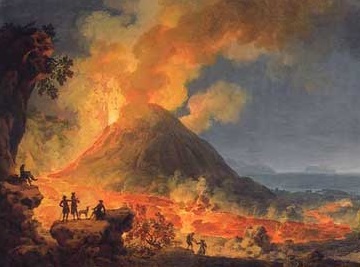
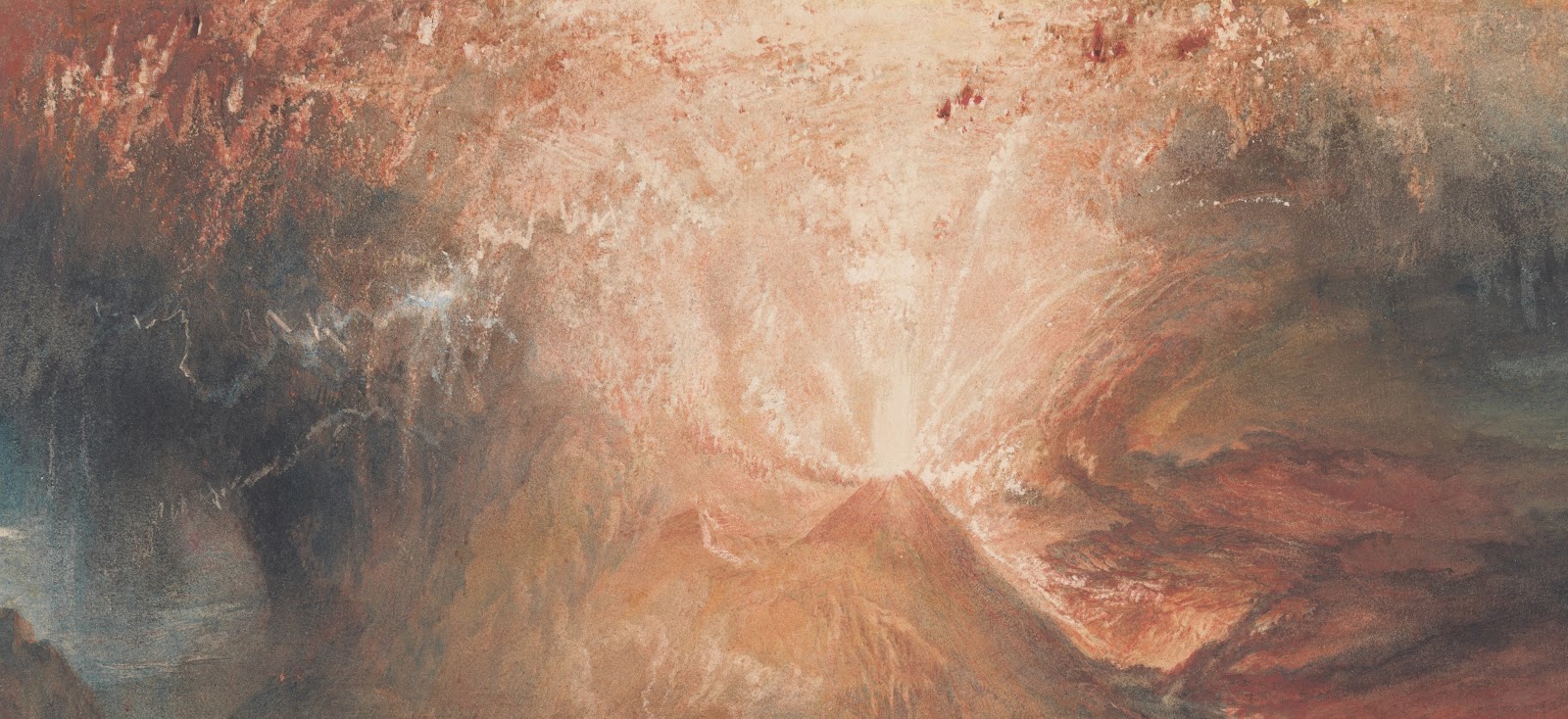
Eruption of Vesuvius,
by Pierre-Jacques Volaire, 1774,
detail

In last week’s Torah portion, Yitro (Exodus 18:1-20:23), God manifests on the mountain as fire, smoke, thunderclaps, and horn blasts. The Israelites are terrified.

The story of this epiphany is interrupted by what we call the “Ten Commandments” or Decalogue. When the narrative resumes, God’s manifestation is intensifying, and the people experience synesthesia, SEEING the sounds of thunder and horns.

And they said to Moses: “You speak to us, and we will listen. But may God not speak to us, or else we will die!” (Exodus/Shemot 20:16)

In other words, the people have not heard God delivering the words of the Decalogue. They are afraid of any communication from God, especially in words. So they beg Moses to speak for God. (See my post Yitro & Va-etchanan: Whose Words?—Part 1.)

And the people stood at a distance, and Moses approached the dark cloud where God was. And God said to Moses: “Thus you will say to the Israelites …” (Exodus 20:18-19)

Then God tells Moses a long series of civil and religious laws on a variety of specific topics, a law code that runs from Exodus 20:19 through 23:33.

So why is the story interrupted by the Decalogue?

A later insertion

According to modern source criticism, the Decalogue was written in a different style and vocabulary than the text before and after it, and therefore that section was inserted later by a redactor.

The story does read smoothly if the Decalogue section, Exodus 20:1-14, is simply deleted. Then we have:

And God said to [Moses]: “Go down! Then you may come up, you and Aaron with you; but the priests and the people may not break through to come up to God, lest [God] burst out against them.” Then Moses went down to the people, and he spoke to them. (Exodus 19:24-25)

Then all the people were SEEING the kolot and the flames and the kol of the horn and the mountain smoking. When the people saw, they were shaken and they stood at a distance. And they said to Moses: “You speak to us, and we will listen. But may God not speak to us, or else we will die!”  (Exodus 20:15-16)

kolot ( קֺלֺת or קוֹלוֹת) = thunderclaps.

kol (קֺל or קוֹל) = a noise, sound, voice.

Moses goes back up the mountain, where God gives him the law code in Exodus 20:20-23:33.

If a redactor inserted the Decalogue into Exodus, where did that text come from?

Ambiguity in Deuteronomy

The only other place in the Torah where the Decalogue appear is in Deuteronomy, the book in which Moses tells the next generation of Israelites what he remembers of the exodus from Egypt. Moses introduces the Decalogue in the Torah portion Va-ethchanan (Deuteronomy 3:23-7:11) by saying:

Face to face God spoke with you on the mountain, from the midst of the fire—I myself stood between God and you at that time to tell you the words of God, since you were afraid in the face of the fire, and you did not go up the mountain—saying: (Deuteronomy/Devarim 5:4-5)

The Decalogue follows. In this account, God speaks and Moses either repeats God’s words, or translates God’s communication into words.

The Decalogue in Deuteronomy is similar, though not identical, to the version in the book of Exodus; the biggest difference is the rationale for the commandment about Shabbat.1 After reciting the commandments, Moses says:

Moses and the Tablets,
by Ephraim Moshe Lilien, 1908

These words God spoke to the whole assembly on the mountain, from the midst of the fire, the cloud, and the dark cloud, a great kol, and did not add more. And [God] wrote them on two stone tablets, and gave them to me. (Deuteronomy 5:19-20)

This sounds as if Moses remembers God speaking all the words of the Decalogue to the Israelites, and identifies them as the text on the stone tablets. (Exodus describes Moses coming down from Mount Sinai with two stone tablets that God had inscribed, but that book never says what God wrote.2 After Moses smashes the two tablets at the sight of people celebrating the Golden Calf, God tells Moses to prepare a second pair of tablets. The commandments Moses writes down on these stones include two of the “Ten Commandments” (on idols and Chabbat), but also command observing three annual holidays, redeeming or sacrificing firstborn livestock, and not boiling a kid in its mother’s milk.3)

No matter what was written later on the stone tablets, did the Israelites really hear God speaking the whole Decalogue? After reporting that God inscribed those words on the tablets, Moses says:

And it happened that you heard the kol from the midst of the darkness, and the mountain was blazing with fire, and you came up to me, all the heads of your tribes and your elders. And you said: “Hey! God, our God, has shown us his impressiveness and greatness, and his kol we heard from the midst of the fire! This day we have seen that God spoke and humans lived. And now, why should we die because this great fire consumes us? If we ourselves listen to his lips, the kol of God, our God, any more, then we will die! … You go closer and listen to everything that God, our God, says, and then you speak to us everything that God, our God, spoke to you, and we will listen and do it.”  (Deuteronomy 5:21-24)

Moses says that God agreed, and then moves on to his next topic. In Moses’ account in Deuteronomy, the Israelites heard God’s kol, i.e. the sound or voice of God. But, as in Exodus, they begged Moses to tell them what God said, so they could avoid hearing God speak in words.

The mysterious source of the Decalogue

In the portion Yitro in Exodus, the transition to the Decalogue is ambiguous, so we do not know whether Moses pronounced them to the Israelites at Mount Sinai. In the portion Va-etchanan in Deuteronomy, the Israelites do not hear God’s words, but Moses does pass on the Decalogue at the mountain.

However, twenty-first century commentator Cynthia Edenburg argued that a redactor spliced the Decalogue into Deuteronomy as well as Exodus.

“In neither … does YHWH indicate that part of the event will be the revelation of laws to the people of Israel. And, indeed, when the day arrives, the text focuses its description on the impressive visual and auditory elements of the theophany.”4

In the first two or three commandments (including the prohibitions against “having” other gods or idols) in both Exodus and Deuteronomy, God speaks in the first person. Then starting with the third commandment (on swearing falsely by God’s name), God is referred to in the third person. The Talmud explained the switch by saying that the Israelites heard only the first two commandments before they begged Moses to be the go-between.5

But Edenberg pointed out that neither text indicates an interruption in the transmission of the Decalogue. The style of the writing in the first few commandments matches much of the book of Deuteronomy, so the redactor of Exodus could have borrowed them from Deuteronomy. But then where did the rest of the commandments come from?

Edenberg, citing the work of Erhard Gerstenberger,6 proposed:

“The basic form of the Decalogue as we now know it came into being as scribes attempted to reinterpret the essence of the Sinai/Horeb revelations in Exodus and Deuteronomy. They accomplished this by adding the YHWH commands now found at the beginning of the Decalogue to a list of moral instructions of universal validity, transforming it into a theological statement of principles for one group—Israel. The rules were now presented as a foundational agreement between Israel and their national god, established in the wilderness period.”4


Jews who insist that God dictated every word of the books of Genesis through Deuteronomy—along with everyone who insists that the entire bible is the word of God—have to either overlook the bad transitions and contradictory passages, or resort to forced explanations. I cannot help but believe that the bible has many authors. When possible, I prefer to trust the redactor of a biblical book, and read it as a complete work. But sometimes the seams show too much.

We can notice where the Decalogue is stitched into Exodus and Deuteronomy. We can agree that the first commandments, about our relationship to God, come from a different source than the remaining commandments, about our relationship with other humans.

But none of this reduces the importance of the commandments. Other lists of laws in the Torah are more specific, narrower in scope. Many were suited to ancient Israelite society, but not to our lives today. The Decalogue, on the other hand, presents basic, general rules that still deserve our attention.


  1. Exodus says “Because in six days God made the heavens and the earth and the sea and all that is in them, and [God] rested on the seventh day; therefore God blessed the day of Shabbat and made it holy” while Deuteronomy says “so that your male slave and your female slave may rest as you do; and remember that you were a slave in the land of Egypt and God, your God, brought you out from there with a strong hand and an outstretched arm; therefore God, your God, has commanded you to do the day of the Shabbat”. (Additionally, the commandment in Exodus begins “Remember the day of the Shabbat” while in Deuteronomy it begins “Observe the day of the Shabbat”.)
  2. They are called “two tablets of the eidut (pact, written witness)” in Exodus 31:18 and 32:15. Exodus 34:28 reports that “he” (either God or Moses) wrote on the second pair of tablets “the words of the covenant, the ten words”. The Torah does not say what the “ten words” are. Later commentators declared they were the commandments in the portion Yitro, and since then people have labored to turn the information in the Decalogue into exactly ten commandments.
  3. Exodus 34:17-28.
  4. Dr. Cynthia Edenberg, “The Origins of the Decalogue”, https://www.thetorah.com/article/the-origins-of-the-decalogue.
  5. Talmud Bavli, Makkot 23b-24a.
  6. Erhard S. Gerstenberger, “Covenant and Commandment,” Journal of Biblical Literature 84 (1965): 38–51.

Yitro & Va-etchanan: Whose Words?—Part 1

Moses often hears God talking to him. It begins when God speaks to him out of the burning bush on Mount Sinai:

“Moses! Moses! … Do not come closer! Remove your sandals from upon your feet, because the place where you are standing, it is holy ground.” (Exodus/Shemot 3:4-5)

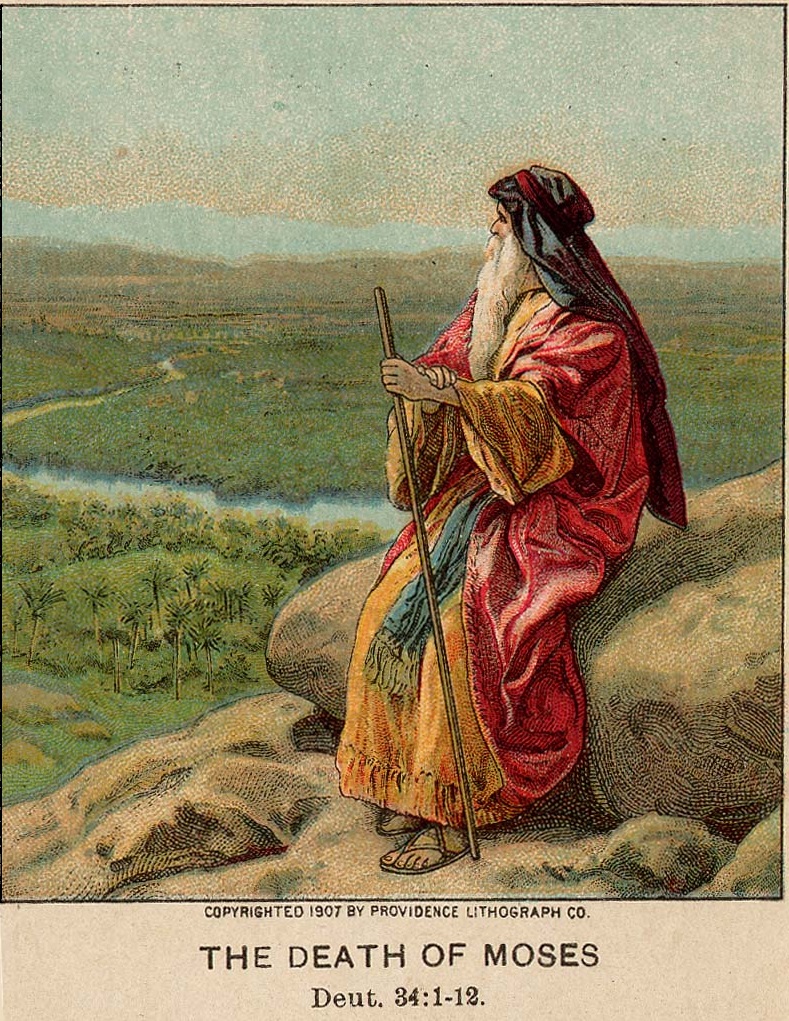
The Death of Moses, Providence
Lithograph Co. 1907
(Still listening to God)

And it ends with God’s final words before Moses dies on Mount Nevo overlooking Canaan:

“This is the land that I vowed to Abraham, to Isaac, and to Jacob, saying: ‘To your descendants I will give it.’ I have let you see it with your eyes, but you will not cross over there.” (Deuteronomy 34:4)

For roughly 41 years in between,1 the private conversations between God and Moses continue, and God also uses Moses as a middleman. Over and over again, God speaks to Moses and gives him new information or instructions, and then Moses passes God’s words on to the Israelites.

Moses’ brother, Aaron, only hears God speak 18 times.2 God speaks only once to their sister, Miriam, and once to Aaron’s son Elazar.3

The other Israelites hear God once, in this week’s Torah portion, Yitro (Exodus 18:1-20:23). Following God’s instructions (and God’s pillar of cloud and fire),4 Moses leads the refugees from Egypt to Mount Sinai before heading north toward Canaan. After they reach the mountain,  God tells Moses:

“Here I am, coming to you in a thick canopy of cloud, so that the people will hear my words along with you, and also [so that] they will trust in you forever.” (Exodus 19:9)

Nevertheless, the Israelites may not hear God speaking in words, the way God speaks to Moses and his brother, sister, and nephew.

The voice of God: thunderclaps and horn blasts

And it was morning on the third day, and there were kolot and lightning flashes, and a heavy cloud over the mountain, and a very strong kol of a shofar; and all the people who were in the camp trembled. (Exodus 19:16)

kolot ( קֺלֺתor קוֹלוֹת) = thunderclaps. (Singular kol (קֺל or קוֹל) = a noise, sound, voice.)

shofar (שֺׁפָר) = a loud wind instrument made from the horn of a ram or goat.

Moses leads the people out of the camp and stations them at the foot of the small mountain, which resembles an erupting volcano.

Vesuvius in Eruption,
by Jacob More, 1780 (detail)

And Mount Sinai was smoking, all of it, from the presence of God that had come down upon it in fire. Its smoke rose like the smoke of a furnace, and the whole mountain trembled very much. And the kol of the shofar went on and was very strong. Moses would speak, and God would answer him with a kol. And God came down on Mount Sinai, to the top of the mountain, and God called Moses to the top of the mountain, and Moses went up. (Exodus 19:18-20)

So far, the people at the foot of the mountain have heard no words, only sounds like thunder and horns. When Moses climbs to the top of the mountain, he and God have a brief conversation about whether the people below are standing far enough away for safety.

An ambiguous transition

And God said to [Moses]: “Go down! Then you may come up, you and Aaron with you; but the priests and the people may not break through to come up to God, lest [God] burst out against them.” Then Moses went down to the people, vayomer to them …  (Exodus 19:24-25)

vayomer (וַיֺּמֶר) = and he said. (Less frequently, when there is no object of the verb, vayomer = and he spoke.)

Should vayomer be translated here as “and he spoke”, implying that Moses passed on God’s instructions in the previous verse about who was allowed to climb the mountain? Or should it be translated as “and he said”, implying that the next verse is what Moses said? The answer determines whether the punctuation after “to them” should be a period or a colon.

The next verse is:

Vaydabeir, God, all these words, saying: (Exodus 20:1)

vaydabeir (וַיְדַבֵּר) = and he spoke.

“All these words” turn out to be the basic rules known as the “Ten Commandments” or Decalogue.

So what is the correct punctuation at the end of “Then Moses went down to the people, vayomer to them”—a period or a colon?

The only punctuation in Biblical Hebrew is a sof passuk (which looks like a colon) at the end of a verse. These punctuation marks were added by the Masoretes about a thousand years ago—thus defining the verses, though not assigning any numbers to them. A sof passuk can be translated as a period, a colon, an exclamation point, a question mark, or even a dash.

In the 16th century, Christian bibles began dividing the text into chapters and numbering the verses in each chapter. Jewish bibles adopted their convenient system.

Exodus 19:25 could end with a colon. But since the next verse was assigned the number 20:1, starting a new chapter, most translations end Exodus 19:25 with a period. And because of the period, vayomer is translated as “and he spoke” instead of “and he said”.

The effect of translating vayomer as “and he spoke”, followed by a period and a chapter break, is to make it sound as if first Moses speaks, reminding the people not to climb the mountain, and then God speaks, telling the people the basic commandments.

But what if there were no chapter break after “Then Moses went down to the people, vayomer to them”? And what if the sof pasuk, the punctuation after this clause, were translated as a colon? Then we would have:

Then Moses went down to the people, and he said to them: “God spoke all these words, saying: I am God, your God who brought you out from the land of Egypt, the house of slavery. You will have no other gods before me.” (Exodus 19:25-20:2)

In this version, Moses tells the people the Decalogue, quoting what he heard God say at some unspecified earlier time.

I was attached to this alternative translation, until I started wondering if the Israelites at Mount Sinai heard the words of the Decalogue at all.

Back to the story

Immediately after the tenth commandment, the one about coveting, the Torah returns to the narrative:

Then all the people were seeing the kolot and the flames and the kol of the shofar and the mountain smoking. When the people saw, they were shaken and they stood at a distance. (Exodus 20:15)

In this description the Israelites are not hearing God speak words. They are experiencing synesthesia, seeing the sounds of thunderclaps and horn blasts along with the  flames and smoke.

And they said to Moses: “You speak to us, and we will listen. But may God not speak to us, or else we will die!”  (Exodus 20:16)

Here the people only know they are afraid of any communication from God, and they beg Moses to speak for God. Therefore they have not yet heard the Decalogue from either God or Moses.

And the people stood at a distance, and Moses approached the dark cloud where God was. And God said to Moses: “Thus you shall say to the Israelites: You yourselves saw that I spoke with you from the heavens. You must not make me silver gods or gold gods; you must not make them for yourselves. You must make me an altar of earth, and slaughter on it your rising-offerings …” (Exodus 20:18-19)

After a few more instructions about sacrifices at the altar, God goes on (in the next Torah portion, Mishpatim) to lay out a long series of civil and religious laws on a variety of specific topics. These are the rules God tells Moses to pass on to the Israelites.

So how did the Decalogue get into the Exodus account of the revelation at Mount Sinai?

See my next post, Yitro & Va-etchanan: Whose Words?—Part 2.


  1. The book of Exodus does not say how much time passes between Moses’ return to Egypt and the departure of all the Israelites for their 40-year journey to Canaan. If all of God’s ten plagues occur during the year preceding their departure, the story is more dramatic and the pressure on Pharaoh is more intense.
  2. To Aaron alone in Exodus 4:27, Leviticus 10:8-11, and Numbers 18:1-24; to Aaron and Miriam in Numbers 12:5-8; and to Aaron and Moses in Exodus 7:8, 9:8, 12:1-20, and 12:43-49, in  Leviticus 11:1-47, 13:1-59, 14:33-57, and 15:1-32, and in Numbers 2:1-2, 4:1-20, 14:26-38, 16:20-22, 19:1-22, and 20:12.
  3. To Miriam in Numbers 12:5-8, and to Elazar in Numbers 26:1-2.
  4. See my post Beshalach: Pillar of Cloud and Fire.

Yitro & Bereishit: Don’t Even Touch It

Finally, after walking through the wilderness of the Sinai Peninsula for two and a half months, the Israelites and their fellow-travelers arrive at Mount Sinai, where Moses first encountered God.1

They camp at the foot of the mountain, and Moses climbs up and down four times in this week’s Torah portion, Yitro (Exodus 18:1-20:23). On each trip, he gets instructions from God at the top, and reports them to the people below.

Mount Sinai, by Elijah Walton, 19th century

The second time Moses climbs up, God tells him:

“Here I am, coming to you in a thick canopy of cloud, so that the people will hear my words along with you, and also [so that] they will trust you forever!” (Exodus/Shemot 19:9)

No one will be able to see God, but all the people will hear God’s words—an extraordinary phenomena.

And God said to Moses: “Go to the people and consecrate them today and tomorrow. And they must wash their clothes. And they must be ready for the third day, because on the third day, God will come down on Mount Sinai before the eyes of the people. And you must set boundaries for the people all around [the mountain], saying: Guard yourselves against going up on the mountain, or negoa its outskirts.  Anyone hanogeia the mountain must definitely die.” (Exodus19:10-12)

negoa (נְגוֹעַ) = touching. (A form of the verb naga. נָגַע = touched, reached.)

hanogeia ( הַנֺּגֵעַ) = who is touching. (Another form of naga.)

One might think that if God touched the top of Mount Sinai, any human who touched the bottom of it would automatically die, as if the whole mountain were electrified. But then God clarifies that anyone (except Moses) who dares to touch the mountain while God’s presence rests on it must be executed. And the people must perform the execution without touching the offender.

“A hand lo tiga him! Because he must definitely be stoned or shot; if a beast or if a man, he must not live. When [there is] a protracted sound of a ran’s horn, they may go up on the mountain.”  (Exodus19:13)

lo tiga (לֺא תִגַּע) = it may not touch. (Another form of naga.)

All the people have to be clean and consecrated before they can safely hear God’s voice coming from the cloud that lands on Mount Sinai. But even in this condition, they cannot see God. And touching the mountain while God is on top is taboo. Like some other taboos in the bible, this one is communicable by touch.2

Don’t go up Mount Sinai, God commands. Don’t even touch it! Don’t even touch someone who touches it!

Touching the Tree of Knowledge

The order not to touch the mountain reminds me of the conversation between the snake and Eve in the garden of Eden. Both God in Exodus, and Eve in Genesis, say that death is the penalty for touching something holy.

The snake speaks first in the first Torah portion of Genesis, Bereishit (Genesis 1:1-6:8).

He said to the woman: “Did God really say you should not eat from any tree of the garden?” And the woman said to the snake: “We may eat fruit from the trees of the garden. But as for fruit from the tree that is in the middle of the garden, God said: ‘You must not eat from it, and lo tigeu, lest you die.’” (Genesis/Bereishit 3:1-3)

lo tigeu (לֺא תִגְּעוּ) = you must not touch it. (Another form of naga.)

Eve, by Lucan Cranach the Elder, 1528

In Genesis, God orders the primordial human not to eat from the Tree of the Knowledge of Good and Evil in the middle of the garden.3 But God says nothing about touching or not touching the tree. Although God delivered the original order to the one primordial human being, before it was divided into male and female, there is no reason why the female human would not remember it. Maybe she simply added “and you must not touch it” on the spur of the moment.

Why? The classic commentary suggested that she was “making a fence around the Torah”: protecting herself from accidentally violating God’s actual prohibition by avoiding doing something that could lead to the violation.4 (One of the more famous examples of a fence around the Torah is the rule in many orthodox Jewish communities that bans turning on a stove or an electric light on Shabbat. If you feel free to make heat and light, you might forget the biblical prohibition against lighting a fire on Shabbat.5)

At first glance, a rule to avoid touching the Tree of Knowledge seems like a reasonable fence. If Eve does not get close enough to that tree to touch it, she will not be able to eat its fruit. Yet after further conversation with the snake, she transgresses both her own fence and God’s order.

Bereishit Rabbah, a fifth-century collection of commentary, adds some action and dialogue to the biblical story: “Rabbi Chiyya taught: That means that you must not make the fence more than the principal thing … When the serpent saw her exaggerating in this manner, he grabbed her and pushed her against the tree. ‘So, have you died?’ he asked her. ‘Just as you were not stricken when you touched it, so will you not die when you eat from it.’”6 According to Bereishit Rabbah, if the fence seems too important (in this case because Eve claims touching the tree carries a death penalty), then once you break the fence, it feels insignificant to break the original command as well.

Touching Mount Sinai

In Exodus, on the other hand, God tells Moses that the people may not climb Mount Sinai on the day that God will descend, and God also says the people may not touch the mountain until the signal of the sound of a ram’s horn. Both prohibitions, against climbing and against touching, come from God. God makes the fence.

What is the reason for it? 16th-century rabbi Ovadiah Sforno wrote that some people might have been so eager to catch a glimpse of God, they would trample the boundary markers and run up the mountain. The death penalty was a deterrent.

19th-century rabbi Samson R. Hirsch wrote that one reason for the two prohibitions was to make the people realize they were nowhere near Moses’ spiritual level. This seems plausible to me, since God tells Moses that after the people hear God speak from the cloud on the mountaintop, they will trust Moses forever (Exodus 19:9, above). Recognizing Moses’ high spiritual level—or closeness to God—would help to foster this trust.

Another reason, Hirsch wrote, was: “The distinction between the people about to receive the Torah, and the Source from which they are to receive it, is underscored also in terms of physical separation.”7

The realm of ordinary people at the foot of the mountain is mundane. The realm of Mount Sinai is the realm of God and God’s teachings.8 Only God’s prophet, Moses, goes back and forth between the two realms.9

There is also a practical reason for prohibiting both climbing and touching Mount Sinai on the day of revelation: the mountain becomes a dangerous place.

And it was the third day, in the morning, and there was thunder and impressive lightning on the mountain, and a very loud sound of a ram’s horn … And Mount Sinai was all in smoke from the presence of God that came down on it in fire, and its smoke rose like smoke from a furnace, and the whole mountain shuddered violently. (Exodus 19:16-18)

Vesuvius in Eruption, by J.M.W. Turner, 1817-1820, detail

Thus the prohibition against getting close enough to touch the bottom of Mt. Sinai is a reasonable fence around the prohibition against climbing the mountain—which, in turn, is a fence around the prohibition against attempting to look and see God.

Nobody breaks the fence. Moses leads the people to the foot of the mountain, but they cannot bear to get any closer. They are already seeing too much, experiencing synesthesia.

Then all the people were seeing the thunderclaps and the flames and the sound of the ram’s horn and the mountain smoking. When the people saw, they were shaken and they stood at a distance. And they said to Moses: “You speak to us, and we will listen. But may God not speak to us, or else we will die!”  (Exodus 20:15-16).

The people back  away from the supernatural volcano. No fences, with or without death sentences, are needed to keep them at a distance.


I have heard people say they wish they could experience a miracle like seeing God’s voice at Mount Sinai.  Personally, I think a miracle like that would terrify me as much as it terrified the Israelites and their fellow-travelers.  I am grateful that, by the grace of God, my own numinous experiences have been only gentle intimations.

Sometimes there is no question that we will follow a rule, because we want to follow it with all our heard and soul.  But sometimes we recognize that a rule is a good idea, yet we have no emotional investment in it. That is when we need a fence around the rule to keep us on track.


  1. At the burning bush in Exodus 3:1-4:17. The “mountain of God” is called Mount Choreiv in some passages and Mount Sinai in others, since the book of Exodus was redacted from more than one original source.
  2. For example, when someone who have been in contact with a corpse is ritually purified by being sprinkled with water containing the ashes of a pure red heifer, the person who does the sprinkling has to wash his clothes and wait until nightfall to return to a state of ritual purity. While the sprinkler waits, “Anything that he touches is impure, and the person who touches him will be impure until nightfall.” (Leviticus 19:19:22)
  3. Genesis 2:17.
  4. The phrase “Make a fence around the Torah” originated in Pirkei Avot 1:1, a compendium of rabbinic advice composed around 200 C.E.
  5. Exodus 35:3.
  6. Bereishit Rabbah 19:3, translated by www.sefaria.org.
  7. Samson Raphael Hirsch, The Hirsch Chumash: Sefer Shemos, translated by Daniel Haberman, Feldheim Publishers, Jerusalem, copyright 2005, p. 322.
  8. Torah (תּוֹרָה) = instruction, teachings; divine law; the first five books of the bible; all instructions in the Hebrew Bible.
  9. In Exodus 19:24, God tells Moses to go down and bring his brother Aaron up to the top of Mount Sinai, but this request is not followed up in the text; the Ten Commandments are delivered instead. On another day, Aaron climbs partway up Mount Sinai, along with two of his sons and 70 elders (Exodus 24:9-14), but only Moses and his attendant Joshua complete the trip to the top.

Bemidbar & Naso: Dangerous Duty

Two dangers face the Israelites as they leave Mount Sinai in the book of Numbers/Bemidbar: the risk of attack by an enemy in the wilderness, and the risk of annihilation by God.

They have already experienced both dangers. On their way from Egypt to Sinai the Amalekites attacked them, and the Israelites beat them off with the help of God.1 When they stood at the foot of Mount Sinai to hear God speak, the earth quaked—and so did the Israelites.

Mount Vesuvius in Eruption, by Jacob More, 18th cent., detail

And all the people were seeing the thunder and the flashes and the sound of the ram’s horn, and the mountain was smoking; and the people saw and they quaked and drew back and stood at a distance. And they said to Moses: “You speak to us and we will listen; but don’t let God speak to us, or else we will die!” (Exodus 20:15-16)

The Jewish day of Shavuot commemorates the revelation at Sinai, when the Israelites were terrified and God uttered the “ten commandments”. This holiday always falls the same week as the Torah reading Bemidbar, the first portion in the book of Bemidbar.

This Torah portion begins with God telling Moses to take a census of the men in all the tribes except Levi.2 The purpose of this census is to learn how many troops can be mustered in the event of a battle after the Israelites leave Mount Sinai and resume their journey to Canaan.

Israelite service

Numbering of the Israelites, by Henri F.E. Philippoteaux, 19th cent.

And all the [male] Israelites were mustered from the houses of their forefathers, from the age of twenty years and up, all who were going out in the tzava in Israel. (Numbers 1:45)

tzava (צָבָא) = army, unit of warriors, army service.

The qualifying phrase “all who were going out in the tzava” implies that the census counted only men aged 20 and over who were able to march and wield weapons.

Then God spoke to Moses saying: “However, the tribe of Levi you shall not muster, and you must not make a head count of them among the Israelites.” (Numbers 1:48-49)

In the second Torah portion of Numbers, Naso, there is a census of the three Levite clans.

And Moses and Aaron and the chieftains of the community enrolled the sons of the Kehatites by their families and by the house of their father, from the age of thirty years and over, up to the age of fifty years, all who were entering the tzava for the service of the Tent of Meeting. (Numbers 4:34-35)

The censuses of the Geirshonite and Merarite clans also count men aged 30 to 50, and also add “all who were entering the tzava for the service of the Tent of Meeting”.3

Why does the Torah call the Levites an army?

Levite service

Before telling Moses to take a separate census for the tribe of Levi, God says:

“Assign the Levites over the Sanctuary of the Testimony and over all its equipment and over everything that belongs to it. They themselves shall carry the sanctuary and all its equipment, and they shall attend it, and they shall camp around the sanctuary. And when [it is time for] the sanctuary to pull out, the Levites shall take it down; and when [it is time for] the sanctuary to be pitched, the Levites shall erect it. And any unauthorized person who comes close must be put to death.” (Numbers 1:50-51)

Thus one of the duties of the Levites is to guard the tent-sanctuary and kill any unauthorized person who persists in coming too close to the tent, or even entering it.4 That is the military aspect of their service, but it is not the most dangerous.

“And the Israelites shall encamp, each man in his camp and each man at the banner for his troop. But the Levites shall encamp around the Sanctuary of the Testimony, and then there will be no fury against the community of Israelites; and the Levites shall guard the guardianship of the Sanctuary of the Testimony.” (Numbers 1:52-53)

Whose fury? When the Torah portions Bemidbar and Naso describe the duties of the Levites whenever the people break camp, it becomes clear that the fury would come from God.

First the priests (Aaron and his two surviving sons) must go inside the tent and wrap up the most holy items before anyone else can see them, and place them on carrying frames with poles. The holiest items are the ark, lampstand (menorah), the bread table, and the gold incense altar. The priests also wrap up the gold tools used for the rituals inside the tent.5

And Aaron and his sons shall finish covering the holy items and all the holy equipment when breaking camp, and after that the Kehatites shall come in to pick them up, so they do not touch the holy objects and die. These things in the Tent of Meeting are the burdens the Kehatites. (Numbers 4:15)

Each of the three clans in the tribe of Levi is responsible for carrying some part of the tent-sanctuary. The Kehatites must carry the most holy items, while the Geirshonites and Merarites carry the outside altar and the disassembled parts of the tent and the wall around it—cloth hangings, posts, planks, bars, pegs, sockets, and cords.

No touching

Certainly Betzaleil touched the holiest items when he hammered them out of gold in the book of Exodus.6 But later in the book of Numbers, God tells Aaron that the priests must not touch them, or they will be killed.7 Somehow the priests must light the menorah, lay bread on the table, and place coals and incense into the incense altar without touching their gold surfaces. And they must wrap these items in cloths without directly touching them.

Model of ark, Jerusalem

In the first book of Samuel the ark sits for twenty years in the house of Avinadav at Kiryat Ye-arim. His son Elazar is consecrated as an ad-hoc priest to look after it.8 Then King David decides to move it to his new capital in Jerusalem. The ark is lifted up onto a new cart, and two other sons of Avinadav, Uzah and Achyo (presumably younger replacements for Elazar) walk beside it. Partway to Jerusalem,  the oxen pulling cart stumble, and Uzah puts his hand on the ark to steady it.

And God’s anger flared up against Uzah, and God struck him down there … and he died there beside the ark of God. (2 Samuel 6:7)

Uzah’s impulse is good, but nevertheless a divine power zaps him the instant he touches the ark.

No looking

No one in the bible is harmed from carrying the ark by its two poles, but touching the ark itself is deadly. The ark takes a circuitous route to Kiryat Ye-arim in the first book of Samuel. After the Philistines capture the ark in battle they bring it to their town of Ashdod, but everyone there is stricken with a plague. They send it on to Gath, then to Ekron, each time with the same result. So they load the ark onto a cart pulled by two cows and send it back into Israelite territory. The cows stop in a field near the town of Beit Shemesh, where seventy curious Israelites look inside. God strikes down every one of them.9

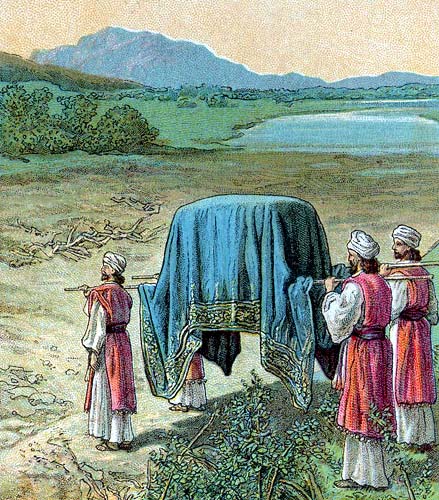
Kehataties carrying ark on a bible card by Providence Lithograph Co., 1907

In the portion Bemidbar: Don’t Look, the priests cover all the holiest items not only to prevent the Kehatites from touching them, but also to prevent these Levites from seeing them, even from the outside.

And God spoke to Moses and to Aaron, saying: “Do not cause the staff of the families of the Kehatites to be cut down from among the Levites!  Do this for them, so they will live and not die: when they approach the Holy of Holies, Aaron and his sons shall come in and assign each individual man his service and his burden.  And they must not come inside [the tent] to look as the holy things are swallowed [by the wrappings], or they will die.”  (Numbers 4:17-20) 

I speculated that the Levites are not allowed a glimpse of the holiest items either because it might make them feel as powerful as the priests, or because it might make them treat the holy items (and therefore God) with insufficient reverence.

Transporting the wrapped-up holy things might be nerve-wracking for the Kehatites. They carry them by hand, not on carts. What if they stumble and drop something? What if one of the coverings slips off?

For the “armies” traveling north from Mount Sinai, guard duty is more dangerous than combat duty.


  1. Exodus 17:8-13.
  2. In the book of Genesis Jacob has twelve sons; Levi is his third son, and Joseph is his eleventh. In other books of the Torah eleven tribes are named after Jacob’s sons, but there is no tribe of Joseph; instead two tribes are named after Joseph’s two sons, Efrayim and Menashe. That makes thirteen tribes—but even in the Torah, the tradition is that there were twelve tribes of Israel. The solution in the first three portions of Numbers is that there are twelve tribes of Israel plus one tribe of Levi.
  3. Numbers 4:39, 4:43.
  4. See Numbers 25:6-8.
  5. Numbers 4:5-14. See my post Bemidbar: Covering the Sacred.
  6. Exodus 37:1-29.
  7. Numbers 18:3.
  8. 1 Samuel 6:21-7:2.
  9. 1 Samuel 6:10-20.

Vayikra & Kedoshim: Guilty Speech

I thought that when the Jewish cycle of readings reached the book of Leviticus, I would be too busy moving my 92-year-old mother to write a post. I also thought there was nothing about the Ten Commandments in the book’s first Torah portion, Vayikra.

I was wrong on both counts. But next week the packing and moving begin!

The Third Commandment

The “Ten Commandments” appear both in Exodus (in the Torah portion Yitro) and Deuteronomy (in the portion Va-etchanan). The first commandment prohibits other gods, and the second prohibits idols. The third commandment reads:

You must not raise the name of Y-H-V-H, your God, for a worthless reason,1 since Y-H-V-H will not acquit anyone who raises [God’s] name for a worthless reason. (Exodus 20:7; Deuteronomy 5:11)

“Raising” the name of God means using God’s name in an oath, vow, or promise, according to the Talmud tractate Shevuot (“Oaths”). This tractate distinguishes two kinds of worthless oaths:

  • empty oaths that use God’s name to declare something true when it is either false or impossible;2 and
  • false oaths that use God’s name to make a promise that the speaker does not carry out.3

One Talmudic example of an empty oath is attaching God’s name to the declaration: “If I did not see a camel flying through the air!”4

Kedoshim: Any Name

Does the third commandment prohibit swearing by any of God’s names for a worthless reason, or only swearing by God’s four-letter personal name? The text is ambiguous. A command from God in the “holiness code” which appears later in the book of Leviticus in the portion Kedoshim elaborates:

Velo tishavu in my name for a falsehood; then you would profane the name of your God. (Leviticus 19:12)

velo tishavu (וְלֺא־תִשָּׁבְעוּ) = and you must not swear, vow, or pledge. (From the root verb shava.)

The author of Sifra, a commentary on Leviticus from early in the Talmudic period, wrote that the third commandment could be interpreted as forbidding a worthless use only of God’s personal name Y-H-V-H. Therefore the command in Kedoshim says “in my name” — any name that I have.5

According to this reasoning, the Torah tells us not to profane any name of God by misusing it. Yet people who are in the habit of swearing might argue that they are not demeaning God when they say something harmless.

A deceitful vow is unethical whether the speaker swears by God or not. But is it really so bad to use one of God’s names in an empty way?

Yes, according to both this week’s Torah portion, Vayikra, and the later portion Kedoshim.

Vayikra and Kedoshim: An Empty Oath

This week’s Torah portion lists the correct offerings to bring to the altar for various purposes, including two types of atonement for inadvertently disobeying God’s rules: a reparation-offering (chattat, חַטָּאת), and a guilt-offering (asham, אָשָׁם).6 The section on reparation-offerings specifically addresses a harmless or empty violation of the third commandment:

… Or a person tishava with the lips, to do evil or to do good—whatever a human [says] bishevuah—and it was hidden from him; and then he realizes that he is carrying guilt because of one of these [oaths]; then it shall be that he shall accept guilt for one of these, and he shall confess what he did wrong concerning it. (Leviticus 5:4-5)

tishava (תִשָׁבַע) = swears, vows, or pledges in God’s name. (A form of the verb shava, שׁבע = swore an oath, vowed, or pledged using God’s name.)

bishevuah (בִּשְׁבֻעָה) = in a oath or vow using God’s name. (Also from the root verb shava.)

In this case the person is guilty merely of misusing God’s name, even if the outcome is good. The text goes on to prescribe that after the person realizes what they said and confesses to using God’s name for a worthless reason, they must bring a female sheep or goat to the altar as a reparation-offering.

What needs to be repaired? Swearing a pointless or empty oath is like swearing a false oath in the portion Kedoshim; it “would profane the name of your God.” 12th-century commentator Ibn Ezra wrote:

“Now the one who is constantly swearing, although there is no need for him to do so publicly, desecrates the name of God without deriving any benefit from his act.7

This forbidden act is different from the ninth commandment, which prohibits a witness in court from affirming a falsehood. Violating the ninth commandment can harm another person. Violating the third commandment cannot harm God, but it does demean God.

Vayikra: A Compounding Oath

The section on guilt-offerings in this week’s Torah portion considers a case in which one person inadvertently takes or keeps the property of another, and then the perpetrator swears they did nothing wrong.

And it shall be when he does a misdeed and realizes his guilt, then he will restore the robbed item that he robbed, or the deposit that was deposited with him, or the lost item that he found, or anything that yishava about falsely. And he will make amends for it by its principal and a fifth of it in addition; he will give it at that time to the one whose it is, as compensation for guilt. (Leviticus 5:23-24)

yishava (יִשָּׁבַע) = he swears in God’s name. (Another form of the verb shava.)

This time the perpetrator must compensate the victim, and also bring a ram as a guilt-offering to God.

Vayikra: Forgiveness

And the priest will make atonement for him in front of God, and he will be pardoned for everything that he did to incur guilt. (Leviticus 5:26)

The third commandment says God will not acquit anyone who swears an empty or false vow in God’s name. Yet God’s instructions in Vayikra say that after making recompense and offering the appropriate animal to God, the perpetrator will be pardoned. In other words, although the person who swears falsely will not be declared innocent, that person may still be forgiven.

This week’s Torah portion sets out the requirements for forgiveness: perpetrators must realize what they did wrong, confess it, compensate their victims, and make a public offering to God.

This model for forgiveness from God can also work to get forgiveness from a human. Although some crimes seem unforgivable to us, we are generally willing to forgive people for committing lesser crimes or doing personal harm if they recognize what they did, apologize, provide whatever recompense is possible, and—if they violated a civil law—serve their sentence.

*

Although confession, apology, and forgiveness can be done all year round, Jews set aside the month of Elul (in the late summer or early fall) for searching our consciences, apologizing to our fellow humans, and accepting the apologies of others. After Elul ends, we confess our sins against God and beseech God for forgiveness on Yom Kippur.

I find that in real life, only some of the people who have harmed me apologize. I figure the others do not realize that they said anything wrong—but although I can pardon them for their ignorance, I do not fully forgive them in my heart.

This week’s Torah portion does not say what to do if someone transgresses inadvertently and does not realize it. But the portion Kedoshim, later in Leviticus, says:

You must not hate your brother in your heart; you must definitely reprove your comrade, and then  you will not carry guilt because of him. (Leviticus 19:17)

One standard interpretation of this directive is that you must alert your fellow human beings to the consequences of their bad behaviors, so they become motivated to change their ways. But perhaps it is also good to let people know what they did that hurt you, so they receive an opportunity to realize it and apologize to you.

I wonder if I will ever be both brave and thoughtful enough to provide this kind of information, gently, to someone I wish I could forgive?

  1. lashaveh (לַשָּׁוְא) = for a worthless reason; in emptiness or in falsehood. (The traditional English translation is “in vain”.)
  2. Talmud Bavli, Shevuot
  3. Talmud Bavli, Shevuot
  4. Talmud Bavli, Shevuot 29a, Mishna.
  5. Sifra is a commentary on Leviticus written in 250-350 C.E. that influenced the Talmud. This quote is from Sifra, Kedoshim, Section 2:6, translated in sefaria.org.
  6. See my post Vayikra & Tzav: Fire Offerings Without Slaughter, Part 2.
  7. Abraham ben Meir Ibn Ezra, translated in sefaria.org.

Pekudei, Yitro, & Ki Tisa: Not Like Other Gods

The Ten Commandments are delivered in thunder at Mount Sinai partway through the book of Exodus. As I wait to move my mother into assisted living (an example of obeying  the fifth commandment), I have been writing about how these famous directives play out in the rest of the book.

This week’s reading is the last Torah portion in Exodus, Pekudei, which confirms that the Israelites are finally on the right track about the first two commandments.  

*

The first two of the Ten Commandments in the Torah portion Yitro both warn the Israelites not to treat their God like other gods. By the end of the book of Exodus, they have succeeded—at least temporarily.

First Commandment

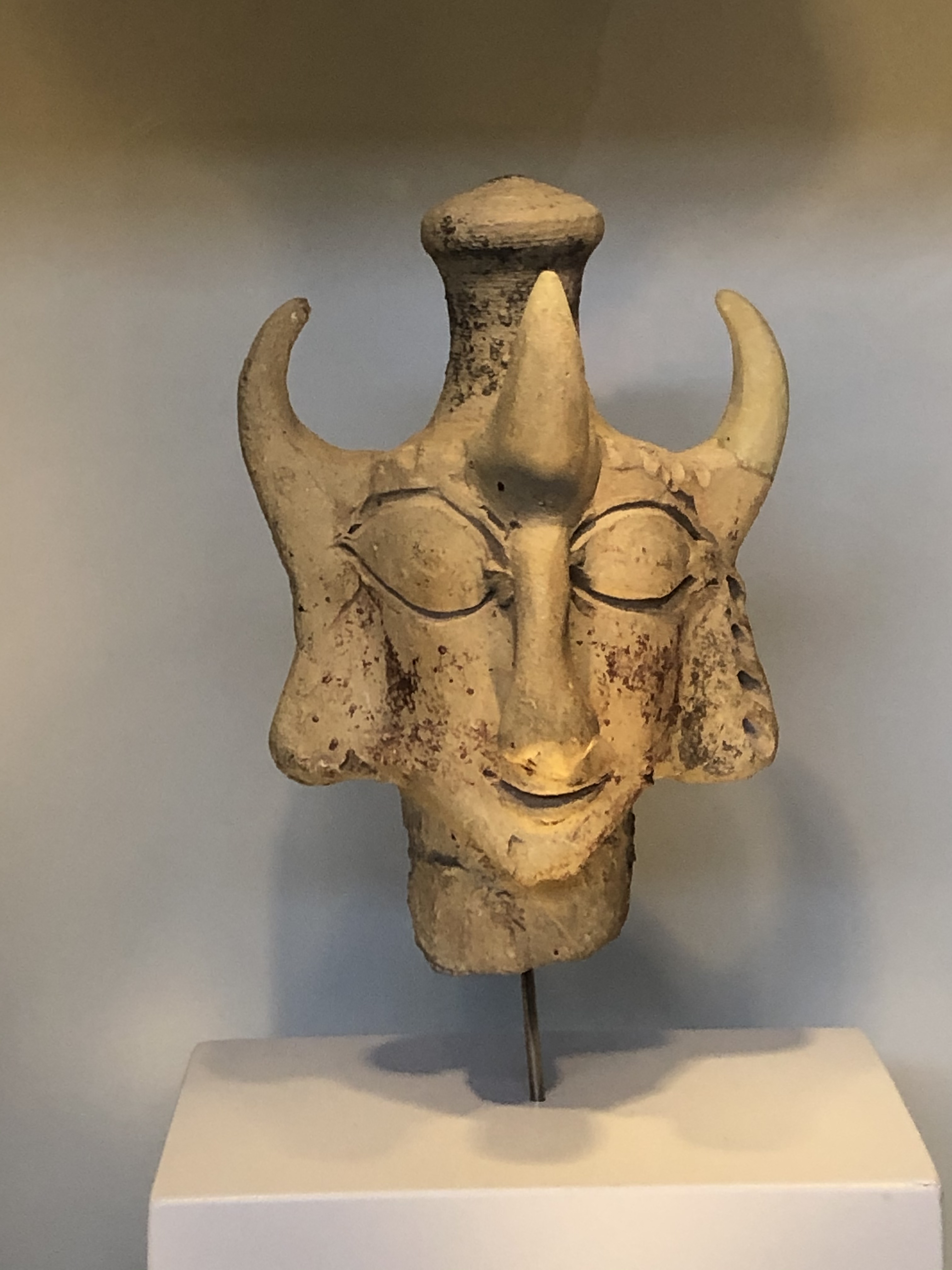
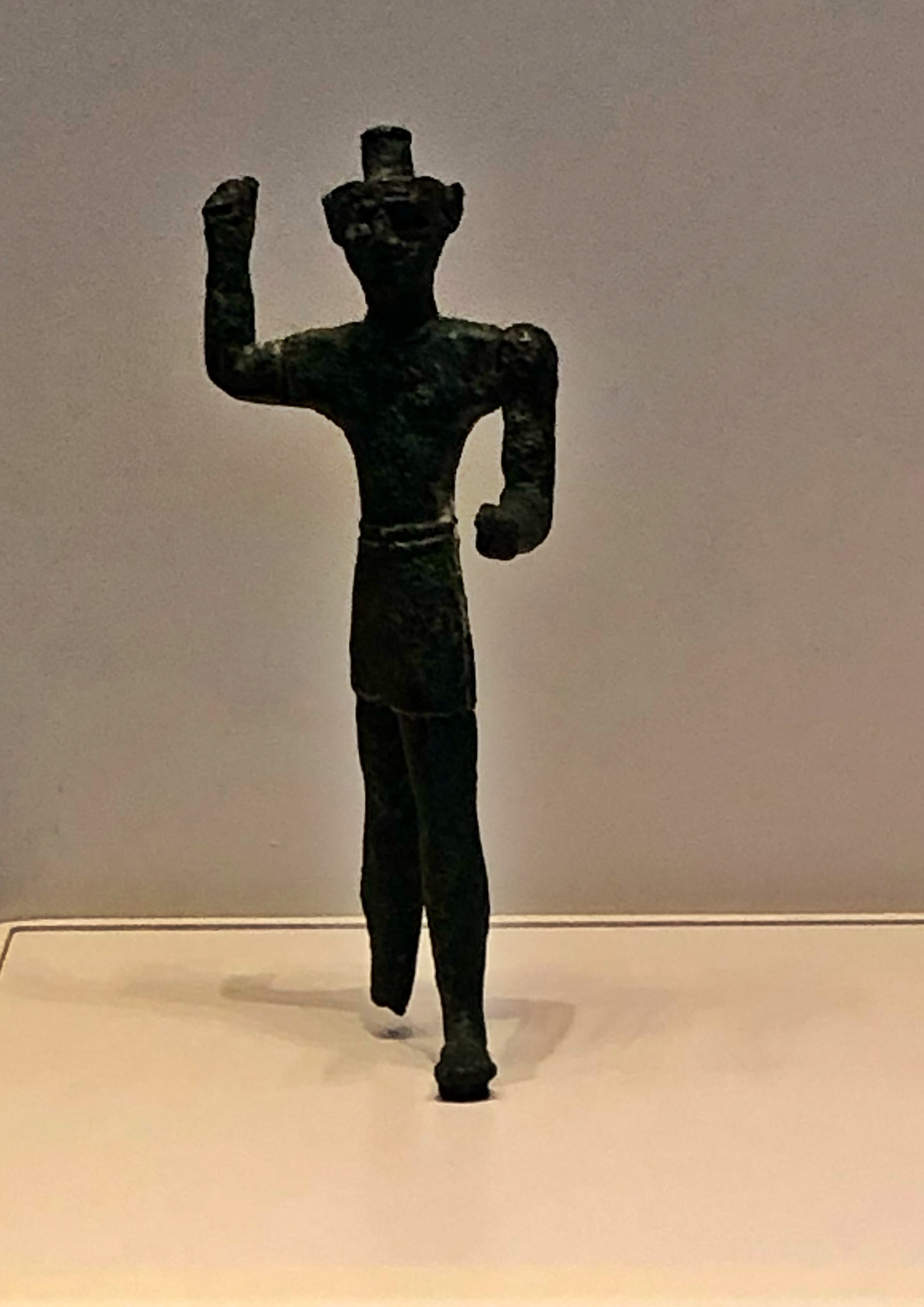
Edomite goddess, 7th-6th century BCE, Israel Museum (photo by M.C.)

I am Y-H-V-H, your God who brought you out of the land of Egypt, out of the house of slavery. You must have no other gods al panai. (Exodus 20:2-3)

al panai (עַל פָּּנָי) = over my face, above me, in front of me, in addition to me. (Panai is the first person singular possessive of panim, פָּּנִים = face, surface, self, presence.)

First God identifies “himself” in two ways:

  • as the god of the four-letter name that riffs on the verb for being and becoming,1 and
  • as the god who brought the Israelites out of slavery in Egypt with ten miraculous disasters.

Then God utters one of the following commands, depending on translation:

  • You must have no other gods above me.
  • You must have no other gods in addition to me.

It is not clear whether God wants to be considered the supreme god, or the only god.2 But the existence or non-existence of other gods is not the issue; the important point is that the God called Y-H-V-H is incomparable to any other god.3

Second Commandment

Idol of Hazor storm-god, 15th-13th century BCE, Israel Museum (photo by M.C.)

One way that the God of the Israelites is not like any other god is Y-H-V-H’s objection to being worshiped through an idol.

You must not make yourself a carved idol or any likeness of what is in the heavens above or what is on the earth below or what is in the waters below the earth. You must not bow down to them, and you must not serve them. Because I, Y-H-V-H, your God, am a jealous god … (Exodus 20:4-5)

Is God jealous of other gods? I think a better reading is that God is jealous of the privilege of manifesting only in sounds, earthquakes, and amorphous sights such as cloud and fire. Only other gods are willing to inhabit man-made idols.

A divine pillar of cloud by day and fire by night leads the Israelites from Egypt to Mount Sinai. Then in the Torah portion Ki Tisa the people panic about forty days after Moses has disappeared into the cloud or fire on top of the mountain. They tell Moses’ brother, Aaron:

“Get up! Make us a god that will go before us! Because this Moses, the man who brought us up from the land of Egypt, we do not know what has happened to him!” (Exodus 32:1)

So Aaron makes them an idol out of gold.4 The Israelites call the golden calf the god who brought them out of Egypt, and Aaron identifies it by God’s four-letter personal name, Y-H-V-H. They are not disobeying the first commandment and worshiping another god. Yet their God is furious.5

If the God of the Israelites were like other gods, Aaron’s only mistake would be making a golden calf instead of a golden bull. After all, a bull is more powerful than its juvenile offspring.

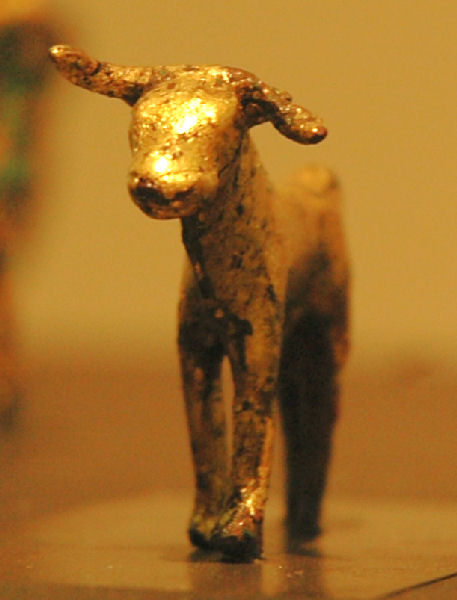
Gold calf from temple of Baalat in Byblos

Bulls represented Egyptian, Mesopotamian, and Canaanite gods. And 1 Kings 12:28-29 reports that golden “calves” were placed in the sanctuaries of Beit-El and Dan in the northern Kingdom of Israel. (They were probably bulls, which the southern kingdom of Judah belittled by calling them calves.)6

Most idols in the Ancient Near East were shaped like humans, animals, or fanciful hybrids. Archaeologists have found many small enough to hold in one hand. Neither Egyptians nor Mesopotamians nor Canaanites appear to have believed that the statues or figurines were gods. What they did believe was that gods could be enticed into temporarily inhabiting their idols. A god inhabiting a statue was easier to address with promises and bribes so it would act for your benefit.

The God of the Israelites, however, refuses to inhabit an idol. God cannot be represented by the shape of any physical object in the world because God has an entirely different, transcendent, kind of being.

In the first four portions of Exodus, God manifests as a voice coming from a burning bush, and as a moving pillar of cloud by day and fire by night.7 During the revelation at Mount Sinai, God manifests as thunder and shofar blasts, earthquake tremors, and lightning, fire, cloud, and smoke.8 The visible—but intangible and unbounded—manifestation of God as cloud and fire reappears in the portion Pekudei at the end of Exodus.

*

This gives the book of Exodus a happy ending. In the portion Ki Tisa, thousands of are punished with death for worshiping the golden calf. Then Moses tells the Israelites that God wants them to make a portable tent-sanctuary so God can dwell among them.9 The people eagerly donate materials and labor.

In this week’s portion, Pekudei, Moses assembles the tent and places the ark inside. Rising from the lid of the ark are two gold winged creatures called keruvim,10 but they are not considered idols, since God will speak from the empty space between the wings of the keruvim.

And Moses completed the work. Then the cloud covered the Tent of Meeting, and the kavod of God filled the dwelling-place. And Moses was not able to come into the Tent of Meeting because the cloud dwelled in it, and the kavod of God filled the dwelling-place. (Exodus 40:33-35)

kavod (כָּבוֹד, כָּבֺד) = weight, impressiveness, magnificence, glory, honor.

The cloud covering the tent looks like the pillar of cloud by day and fire by night that led the Israelites from Egypt to Mount Sinai.10  The kavod of God inside is not described.11 Nevertheless, the people can see that God is with them again.

The book of Exodus concludes with a summary the movements of the divine manifestation for the next 38 years:

Pillar of cloud over the sanctuary, Collectie Nederland

And when the cloud lifted from the dwelling-place, the Israelites pulled out on all their journeys. And if the cloud did not lift, then they did not pull out until the day it did lift. Because the cloud of God was above the dwelling-place by day, and it became fire by night, in the eyes of the whole house of Israel on all their journeys. (Exodus 40:36-38)

In other words, God’s pillar of cloud and fire returns to lead the Israelites from Mount Sinai to the land of Canaan. The people get what they need, a God who provides a visible sign to follow—without violating the second commandment.

May we all find ways to invite the divine spirit to be with us, without trying to contain and idolize that spirit through magical thinking.

  1. Also called the “tetragrammaton”. See my post Beshallach & Shemot: Knowing the Name.
  2. Jerome Segal, in his analysis of God’s psychology as presented in the Torah, wrote: “… it may be that God is happy to have the Israelites believe in multiple gods, as that makes it all the more significant that they worship only Yahweh.” (Jerome M. Segal, Joseph’s Bones, Riverhead Books/Penguin Group, New York, 2007, p. 223)
  3. 16th-century commentator Ovadiah Sforno imagined God explaining: “I cannot tolerate that someone who worships me worships also someone beside me. The reason is that there is absolutely no comparison between Me and any other phenomenon in the universe. I am therefore entitled to stand on My dignity by refusing to be compared.” (translation by http://www.sefaria.org)
  4. See my post Ki Tisa: Golden Calf, Stone Commandments.
  5. Exodus 32:4-5, 32:7-10.
  6. See Rami Arav, “The Golden Calf: Bull-El Worship”, https://www.thetorah.com/article/the-golden-calf-bull-el-worship.
  7. Exodus 32:4-5.
  8. Exodus 3:1-17, Exodus 13:20-22.
  9. Exodus 19:16-20. A shofar is a trumpet-like instrument made from the horn of a ram or goat.
  10. Exodus 35:4-38:20 (most of the Torah portion Vayakheil).
  11. See my post Terumah: Cherubs Are Not for Valentine’s Day.
  12. See my post Pekudei: Cloud of Glory.

Vayakheil+4: Not on Shabbat

“Hurry up and wait” describes a lot of life. Two weeks ago I was frantically getting ready to move my mother into assisted living. Now my effort to fulfill the Fifth Commandment and honor my mother is on hold until I get a moving date from the center—and wouldn’t you know it, she had another fall while she was alone in her house …

Talmud Readers, by Adolf Behrman, 1876-1943. What could be more absorbing?

I wish this period of waiting instead of doing labor were like the day of shabbat, the sabbath day of rest, but these days my soul is too heavy to rise to either refreshment or holiness. So this week I took my mind off my troubles by researching the commandment about shabbat. Here is a new post for this week’s Torah portion, Vayakheil—and four other portions in the book of Exodus, Beshallach, Yitro, Mishpatim, and Ki Tisa, that include variations on the command to desist from labor on the seventh day.

*

The first three of the Ten Commandments order us not to underestimate God.1 The last six are ethical precepts for human relations with other humans.2 In between, the fourth commandment combines holiness and ethics. It opens:

Remember the day of the shabbat, to treat it as holy. (Exodus 20:8) 3

shabbat (שַׁבַּת) = sabbath, day of rest. (From the same root as shavat, שָׁבַת = cease, stop, desist; stop working.)

This command is followed by explanatory notes in the Torah portion Yitro. More details are added every time the observance of shabbat is commanded in the book of Exodus—from the first time, in the portion Beshallach, when the Israelites are collecting manna, to the sixth time, in this week’s portion, Vayakheil, after God has given Moses a second set of tablets with the Ten Commandments carved in stone.

1) Don’t move

Manna Raining from Heaven, Maciejowski Bible, c. 1250 C.E.

Moses first mentions shabbat in the Torah portion Beshallach, when God provides manna for the hungry Israelites to gather up from the ground six, and only six, days a week. Moses says:

“See that God has given you the shabbat. Therefore on the sixth day [God] is giving you food for two days. Everyone in his place! No one go out from his spot on the seventh day!” (Exodus 16:29—Beshallach)

This introduces shabbat as a day of rest, at least in terms of going out and gathering food.

2) Holy break

The next order regarding shabbat is the one in the Ten Commandments in Yitro. The full fourth commandment states:

The Creation, by Lucas Cranach, 1534, Luther Bible

Remember the day of the shabbat, to make it holy. Six days you may work and you may do all your labor. But the seventh day is a shabbat for God, your God; you must not do any labor, you or your son or your daughter, your male slave or your female slave or your livestock or your immigrant within your gates. Because in six days God made the heavens and the earth and the sea and everything that is in them, and [God] took a break on the seventh day. Therefore God blessed the day of the shabbat and made it holy. (Exodus 20:8-11)

The emphasis in this commandment is on the holiness of shabbat. Since the day itself is holy, it must be set aside from mundane labor by all humans and animals in an Israelite’s household, and even by God.

3) Ethical refreshment

The third injunction about shabbat is in the portion Mishpatim:

Six days you may do your doings, but on the seventh day tishbot so that your ox and your donkey can take a break, veyinafeish, your slave and the immigrant. (Exodus 23:12)

tishbot (תּשְׁבֺּת) = you must cease, stop, stop working. (A form of the verb shavat.)

veyinafeish (וְיִנָּפֵשׁ) = and he can refresh himself, reanimate himself, catch his breath. (From the same root as nefesh, נֶפֶשׁ = throat, breath, appetite, mood, animating soul.)

This time Moses, speaking for God, gives a reason why even slaves, immigrants, and beasts must be given a day off from work on shabbat: so that draft animals can rest their muscles, and human laborers can rest their souls, becoming refreshed and revitalized.

Providing a day of rest is an ethical mandate; the moral principle of kindness calls for helping others to have a better life, and the moral principle of fairness supports giving everyone a day off when the landowner has a day off. Shabbat is the opposite of Pharaoh’s unethical subjection of the Israelite slaves to unremitting labor.4

4) Be holy or die

The fourth command about shabbat appears in the Torah portion Ki Tisa, after God finishes telling Moses what the Israelites must make to set up the sanctuary and the priests of their new religion. God warns that all of this construction must pause on the day of shabbat.

Nevertheless, you must observe shabtotai, because it is a sign between me and you for your generations, for knowledge that I, God, have made you holy. And you must observe the shabbat because it is holy for you. Whoever profanes it must definitely be put to death, because whoever does labor on it, his life will be cut off from among his people. (Exodus 31:12-14)

shabtotai (שַׁבְּתֺתַי) = my shabbats.

This order not only reiterates that shabbat is holy, but adds that observing it is a reminder that the Israelite people themselves are holy, i.e. set aside for God.

In addition, profaning shabbat by doing labor on that day is such a serious transgression that God assigns it the death penalty.

This rule about observing shabbat is the source text for the Talmud’s list of 39 categories of labor forbidden on the seventh day. The rabbis assume that since God warns that the work of building the sanctuary and fabricating the priests’ clothing must cease on shabbat, the labors involved in doing those tasks are the labors forbidden on shabbat from then on.5

This injunction in Ki Tisa continues:

The Israelites must observe the shabbat, doing the shabbat throughout their generations as a covenant forever. Between me and the Israelites it will be a sign forever, because for six days God make the heavens and the earth, and on the seventh day [God] shavat vayinafash. (Exodus 31:16-17)

vayinafash (וַיִּנָּפַשׁ) = and he refreshed himself, reanimated himself, caught his breath.   (A variant of veyinafeish.)

Since the divine life of the universe pauses every seven “days” for refreshment and redirection, so must our own souls. (See my earlier post,  Mishpatim, Ki Tisa, & 2 Samuel: Soul Recovery.)

5) No farming

Shabbat comes up again later in the portion Ki Tisa when God gives Moses additional instructions for the Israelites.

Six days you may work, but on the seventh day tishbot; at plowing and at grain-cutting tishbot. (Exodus 34:21)

The book of Exodus gives no reason why agricultural labor in particular is prohibited on shabbat. One possibility is that this sentence refers to the ethical law about shabbat in Mishpatim, since landowners used draft animals (oxen and donkeys) to plow, and teams of underlings including slaves and immigrants to scythe down ripe grain.

Sheaves of grain

On the other hand, the list in the Talmud of activities prohibited on shabbat includes farming chores that eventually lead to the bread that must be displayed on the gold-plated table in the sanctuary.6 The first eleven of the 39 prohibited labors in the Talmud are sowing grain, plowing, reaping, gathering sheaves, threshing, winnowing, selecting the edible kernels, grinding them into flour, sifting the flour, kneading dough, and baking bread. By this interpretation, the ban on plowing and reaping on shabbat might mean the holiness of the day surpasses the holiness of the sanctuary.

6) Light no fires

The sixth and final shabbat instruction in the book of Exodus occurs in this week’s Torah portion, Vayakheil. Again the seventh day is called holy, and doing labor on that day is punishable by death.

Six days you may do labor, but the seventh day must be holy for you, a shabbat shabbaton for God. Anyone who does labor on it must be put to death. You must not kindle a fire in any of your settlements on the day of shabbat. (Exodus 35:2-3)

shabbaton (שַׁבָּתוֹן) = most solemn shabbat, feast day of shabbat, day of absolute stopping.

Here Moses repeats God’s commands that the day of shabbat must be treated as holy and that anyone who does not desist from labor on that day must be executed.

The new information in Vayakheil is that lighting a fire is prohibited on shabbat. Before this, the only specific examples of labor forbidden on shabbat are agricultural: gathering manna, using draft animals, sowing and reaping . Now, in Vayakheil, Moses gives another example of labor: lighting a fire.

The purpose of this prohibition cannot be ethical, since lighting a fire is not in itself a heavy labor, and it benefits other humans by giving them heat, light, and a way to cook food.

Since the previous verse reminds us that the seventh day must be holy, refraining from kindling a fire must be another religious rule associated with holiness.

Kindling a fire is number 37 in the Talmud’s list of 39 labors banned on shabbat, right after extinguishing a fire. It may allude to the fire on the altar. Although burnt offerings continue during shabbat according to the Torah, the fire is not rekindled. In fact, it must never go out.7 The altar fire is holy because it is dedicated to God, and because God kindled it.8

*

Thus the book of Exodus presents the law against working on shabbat as a religious rule (guarding what is holy) three to five times.9 It presents the law as an ethical rule (promoting kindness and fairness) only twice.10

Yet when we observe the day of shabbat we can remember that it is not solely a religious requirement reminding us of holiness. We will not be put to death for doing forbidden work on shabbat, since that part of the order in this week’s Torah portion is no longer followed. But when we try to set aside mundane concerns in order to elevate our souls on the seventh day, we can also remember the ethical values in the last six commandments, which address kindness, fairness, and respect for other human beings.

And I can pray that soon I will be able to obey the fifth commandment, and treat my mother with kindness and respect by moving her into a safe place.

  1. See my upcoming post, Pekudei, Yitro, & Ki Tisa: Not Like Other Gods.
  2. See my posts Yitro, Mishpatin, & Va-etchanan: Relative or Relevant? Part 1, Part 2, and Part 3 on the last six commandments.
  3. This is the opening in Exodus. When Moses repeats the Ten Commandments in Deuteronomy, the fourth commandment opens: Observe the day of the shabbat and treat it as holy. (Deuteronomy 5:12)
  4. Exodus 5:1-9, 6:9.
  5. Talmud Bavli, Shabbat 73a, Mishna.
  6. Exodus 25:23-30.
  7. Leviticus 6:5-6.
  8. Leviticus 9:24 for the portable sanctuary in the wilderness.
  9. Exodus 16:29, 20:8 and 11, 31:12-13 at a minimum. According to the Talmud Exodus 34:21 and 35:2-3 are also rules for religious purposes.
  10. Exodus 20:9-10, 23:12.

Yitro, Mishpatim, and Va-etchanan: Relative or Relevant? Part 3

Ten Commandments by Jekuthiel Sofer, 1768

Universal ethical principles are relevant in all places and times. While the first four of the Ten Commandments1 are religious injunctions rather than universal ethical rules, the last six are sometimes considered universal.

In my last two blog posts I discussed commandments five through eight,2 and suggested that the following versions would be more comprehensively relevant:

  1. Parents must respect their children, and children must respect their parents. (To replace “Honor your father and your mother.”)
  2. You must not kill except to prevent someone from being killed. (To replace “You must not kill-without-a-legal-sanction.”)
  3. You must not break a vow to another person without formally dissolving it first. (To replace “You must not commit adultery-between-a-man-and a married-woman.”)
  4. You must not covertly take what rightfully belongs to another. (To replace “You must not steal.”)

What about commandments nine and ten, on false testimony and coveting? Are they morally relative, guides to good behavior only within Ancient Israelite culture? Are they moral absolutes? Or do they, too, need some revision to become universal ethical precepts?

*

The Ninth Commandment

Witness stand, by Ida Libby Dengrove

Lo ta-aneh against your fellow [as] a witness to a falsehood. (Exodus/Shemot 20:13)

lo ta-aneh (ֺלֺא תַעֲנֶה) = you must not answer, testify; stoop.

Like the previous four commandments, the ninth is followed by more specific statutes in Mishpatim, last week’s Torah portion.

You must not take up an empty rumor. You shall not put in your hand with the wicked to become a malicious witness. (Exodus 23:1)

In other words, ethical witnesses in a court of law must testify only to what they have perceived with their own senses, discounting anything they have heard that might be a rumor, and ignoring what other witnesses say. (In Torah law, a person cannot be convicted without the testimony of at least two witnesses.3)

You must not follow rabim for evil, and lo ta-aneh on a legal dispute to turn aside [and] follow the majority4 to mislead. (Exodus 23:2)

Using that definition, this law specifies that a witness must not support popular sentiment against the defendant by making misleading statements.

Ibn Ezra pointed out that even a large number of witnesses can be wrong: “Thou shalt not follow a multitude to do evil. If you see many people testifying concerning something that you know nothing of, do not say to yourself all of these people cannot be lying.”5

The book of Exodus continues by warning witnesses not to give misleading testimony in order to help out the poor.6

And you must not favor the powerless in his legal dispute. (Exodus 23:3)

Kindness to the poor is an important moral value in the Torah,7 but when someone is being tried for a crime, honesty is more important.

Is honesty always the best policy? Many cultures consider a “white lie” harmless and even ethical when it is used to avoid hurting someone’s feelings and has no negative consequences. A “white lie” might include rejecting an invitation by falsely saying you are busy that night, or complimenting someone on a new haircut that you actually think is ugly.

The ninth commandment only addresses giving honest testimony as a witness. But is honesty always the best, most ethical policy when you are testifying to legal authorities? What if you live in a society that punishes the crime of shoplifting with death or the loss of a hand, and you hold the conviction that this punishment is unethical? Should you tell a falsehood?

Your society would consider it ethical to report everything you saw the shoplifter do. But if your own belief is morally better, complete honesty as a witness cannot be a universal ethical precept.

However, the ninth commandment only says: You must not testify against your fellow as a witness to a falsehood. It does not require full disclosure in a morally difficult situation, but only prohibits lying when a falsehood could result in conviction and punishment of an innocent person.

This strict interpretation of the ninth commandment is relevant in all cultures. It could even be rephrased to cover situations outside of court, and remain a universal principle:

You must not speak falsehood that might cause harm to another.

The Tenth Commandment

The other nine commandments all forbid or require certain actions. (Commandment five, “Honor your father and your mother”, requires certain actions rather than an internal feeling of honor or respect. See my post Yitro, Mishpatim, and Va-etchanan: Relative or Relevant? Part 1.) At first glance, the final commandment seems to be forbidding a feeling rather than an action.

Thou Shalt Not Covet Thy Neighbor’s House, postcard by The Rose Co., 1908

Lo tachmod your fellow’s house; lo tachmod your fellow’s wife, or his male slave, or his female slave, or his bull, or his donkey, or anything that belongs to your fellow. (Exodus 20:14)

lo tachmod (לֺא תַחְמֺד) = you must not covet, crave, desire to possess. (From the root verb chamad, חָמַד = desired and tried to acquire, coveted, craved.)

Although many of the other commandments are elaborated by statutes given in the Torah portion Mishpatim, no laws in Mishpatim refer to coveting or craving.8

Another way to determine the meaning of the tenth commandment is to look at how the verb chamad is used elsewhere in the Hebrew Bible.9 In ten of the twenty occurrences of the verb chamad, it is connected with taking possession of the thing coveted. Therefore some commentary has interpreted the tenth commandment as prohibiting robbery, under the assumption that coveting inevitably leads to an attempt to steal by force.10

The repetition of the tenth commandment in the book of Deuteronomy is worded slightly differently, putting another man’s wife first, and using a synonym to prohibit an unhealthy desire for any other possessions:

And lo tachmod your fellow’s wife, and lo titaveh your fellow’s house, his field, or his male slave, or his female slave or his bull, or his donkey, or anything that belongs to your fellow. (Deuteronomy/Devarim 5:18)

lo titaveh (לֺא תִתְאַוֶּה) = you must not crave. (A form of the verb aveh, אוּה = craved, longed for.)

Why does Deuteronomy use the verb chamad only for coveting someone else’s wife, and the verb aveh for everything else? The Mekhilta d’Rabbi Yishmael claims that craving leads to coveting, and coveting leads to robbing.11 Certainly the verb aveh indicates a visceral desire; out of the 27 times it appears in the Hebrew Bible, thirteen are about craving a particular food or drink.12

But why does the tenth commandment prohibit coveting rather than the action that follows it, the attempt to take by force? I suspect that the Torah is distinguishing between taking a fellow Israelite’s possessions when one is obsessed with desire, from taking foreigners’ possessions when one is authorized to do so in war. The Torah is full of commands to the Israelites to strip the Canaanites of all their possessions as they conquer the land. Other rules in the Torah discuss the correct ways of taking booty in battles with other countries. This is not the kind of robbing the Torah would include in the Ten Commandments.

Those who covet what belongs to others also harm themselves; envious obsession does not make for a happy life.  But is it possible to legislate feelings?

Yes, according to 11th-century commentator Abraham ben Meir Ibn Ezra. He wrote that just as a man does not desire to sleep with his mother, although she be beautiful, because he has been trained from his childhood to know that she is prohibited to him,” sensible people may notice that certain people or things owned by others are desirable, but they dismiss any covetous thoughts about possessions that are obviously off-limits.13

The remaining question is why the tenth commandment prohibits a feeling, when the other nine commandments prohibit or require an action.

While classic commentary claims that the tenth commandment really prohibits the act of robbery, I would argue that this final commandment caps the Decalogue by implying that obsessive thoughts about illegal deeds can lead to everything the Torah considers evil, from worshiping other gods (Commandment 1) to murder (6), adultery (7), and theft (8). Failing to honor one’s parents (5) could be the result of nursing resentment against them for their own bad deeds, and giving false testimony (9) could be the result of a consuming desire for popularity in the crowd that is accusing the defendant.

Therefore an appropriate update of the tenth commandment could be simply:

You must not covet anything that belongs to another person.

An alternative that encompasses a wider range of negative obsessions is:

You must not dwell on desires that would cause harm to others.

  1. The “Ten Commandments” is the popular English designation for the ten precepts God utters at Mount Sinai, listed in both Exodus 20:2-14 (in the Torah portion Yitro) and Deuteronomy 5:6-18 (in Va-etchanan).
  2. See Yitro, Mishpatim, and Va-etchanan: Relative or Relevant? Part 1 and Part 2.
  3. At least two witnesses are required for conviction in a legal case according to Deuteronomy 17:6, 19:15.
  4. Many English verstions of Exodus 23:2 including the standard JPS (Jewish Publication Society) translation, interpret the word rabim (רַבִּים) as the wealthy, even though its usual meaning is “the many”. But the Talmud, Rashi, and at least two careful modern translations interpret rabim as the many or the majority.4 Talmud Bavli, Bava Metzia 59b, Chullin 11a, Sanhedrin 2a. Rashi on 23:2. Robert Alter, The Five Books of Moses, W.W. Norton & Co., New York, 2004, p. 448. Everett Fox, The Five Books of Moses, Schocken Books, New York, 1983, p. 383.
  5. 17th-century commentator Abraham ben Meir Ibn Ezra, translated in sefaria.org.
  6. Exodus 23:6-8 instructs judges not to bend the truth to help or harm the poor, as well as to reject bribes—presumably from the wealthy. Also see Leviticus 19:15.
  7. g. Exodus 22:20-26 in the Torah portion Mishpatim, which also reiterates the commandment against favoring the poor in a legal case (Exodus 23:3).
  8. The laws in Mishpatim on theft (Exodus 21:37-22:3 and 22:6-8) are more closely related to the eighth commandment, “You must not steal”, and are covered in my post Yitro, Mishpatim, and Va-etchanan: Relative or Relevant? Part 2.
  9. See Leonard Greenspoon, “Do Not Covet: Is It a Feeling or an Action?”, https://www.thetorah.com/article/do-not-covet-is-it-a-feeling-or-an-action.
  10. The proof text given in Mekhilta d’Rabbi Yishmael 20:14:1-3 (2nd-3rd century C.E.) and other early commentaries is Micah 2:1-2. This line of reasoning considers the eighth commandment, “You must not steal”, a prohibition against kidnapping a man who is not the property of anyone else. (E.g. Sanhedrin 86a).
  11. Mekhilta d’Rabbi Yishmael 20:14:1-3, from sefaria.org.
  12. Numbers 11:4, 11:34, and 34:10; Deuteronomy 12:20 and 14:26; 1 Samuel 2:16; 2 Samuel 23:15 and 1 Chronicles 11:17; Micah 7:1; Psalm 106:13-14; Proverbs 23:3 and 23:6.
  13. Translation of Ibn Ezra in sefaria.org.